pull up a chair

where wisdom gathers, poetry unfolds and divine light is sparked…

Category: blessings

fragility

one of those phone calls came the other afternoon, the sort that snap you into realizing with every synapse that this fragile interwebbing we call our lives is so precariously held together, barely a breath keeps the filaments from snapping right in two. it was one of those calls when one minute you think the biggest worry on your list is the ache in your hand that won’t be quelled, and then the phone rings. you hear the voice you know so well. you hear the depths of its deepest canyons, and the words can’t spill quite fast enough. you listen, and you hear words that send you tumbling, catapulting down an unimaginable chute for which there feels no bottom.

you hear words that someone you love dearly has just gotten word from a doctor, and there’s a death sentence attached.

and you spend the next 18 hours barely breathing. swiping tears from your cheeks, your chin, your nose, the hard back of your hand.

blessedly, miraculously, that call was followed by a clarifying one the morning after, and it turns out the message first conveyed was not nearly as drastic as originally told. the one i love has every reason to believe he’ll be around years and years from now.

but in the intervening space, in the hours of scanning the whole of my life and the deepest places in my heart, i stared once again at the fragile filaments that hold us, that position us, that sometimes fool us into thinking they’re indestructible. we forget the fragility. we forget how each day when we first stir under our covers, plant a wobbly foot on the floorboards, peek out the window at the rising sun’s pink wash across the sky, it’s a miracle. it’s a flat-out gift that no one dare take for granted.

because in a sweep, in a single phone call, in a tumbling out of words–in a heartbeat–it could all be gone. poof! no longer….

i didn’t mean to scare you here, the way i wrote this, the way i waited a whole paragraph to let you know the coast is clear. but i did mean to remind us all that this is fragile, oh so, so fragile.

most of us have gotten those phone calls, those knocks at the door. i got one when i was 18, and another when i was 24. i admit to living too much on the edge of fear.

but it’s hard to scrub away the clear memory of the operator breaking in the phone call, telling me there was an emergency, and someone needed to interrupt the call. hard to wipe away the long drive through the blizzard, the walking the hospital halls, kneeling with my youngest brother in the stripped-bare hospital chapel as cold as everything else that night. hard to undo the doctor’s somber words, when he walked down the hall, ashen, and simply said, “i’m sorry.”

it’s hard to forget six years earlier the unfamiliar sight of my father walking into the drug store where i worked, telling me in the middle of a weekday afternoon that i had to come home, i was being taken to a hospital. hard to forget all the nightmare that unfolded after that.

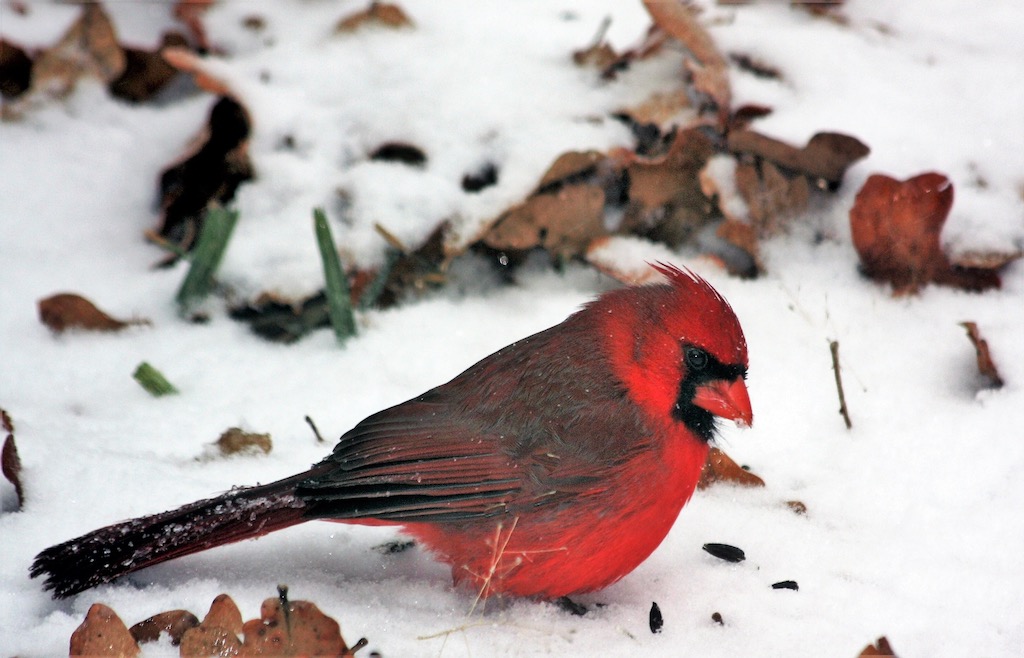
with those indelible etchings on my heart, i count myself among the blessed ones, the ones less likely to forget most days just how precious this all is. just what a miracle it is that i became a mother to two boys who are as precious to me as all the magnificence in this wide world. that i met a man i dearly fiercely love, a man whose depths have steadied me, have buoyed me, have fueled my updraft in ways i never ever dreamed. that i’ve lived well past the 52 years my blessed father was allotted. and that i never take for granted a moon’s rise, or the sun’s setting. i live to hear the cardinal singing, to stir something bubbling on the stove. life’s littlest miracles are the sum and substance of my days. and then you add the big ones — the loves that animate my heart and soul, the laughter that punctuates the hours, the wisdoms that take my breath away — and i am living, breathing, holy gratitude.

and i aim to live my life at fullest attention.

what moments in your life have made you see the fragility that underpins it all?

to name them is a prayer…

the thought struck me, as thoughts often do, as i got to the last line of a poem that read (to me anyway) as a prayer.

the last lines were these:

I take refuge in You
from the inextricable mischief
of every thing You made,
eggs, milk, cinnamon, kisses, sleep.

it was in the quiet of the quotidian, the kisses tucked in between the cinnamon and sleep. the noticing the eggs and milk. that’s what took my breath away. nine hundred times out of 10, eggs and milk might be mere scribbles on a grocery list, but really, when you pause long enough, when you think about it, when you find them there on the shelf of the icebox, and don’t find yourself dashing to the store to grab the eggs to make the french toast your kid home from college is hungry for, their being there at all is a blessing, a grace, a reason to whisper hallelujah, which is just a jubilant form of thank you.

it’s in the fine grain, again and again, that some of the most sumptuous gratitudes—graces—are found. the hundred and one barely perceptible goodnesses that cross our paths each day. but if we don’t name them, do we notice them?

to name them is a prayer.

more often, too often, when we sit down to count our blessings, we sweep across the broad terrain of our lives, grab the big stuff, swoop right over the infinitesimal, and, well, we lose ’em, lose their power to inject a jolt of realizing just how darn blessed we really truly are.

talk to someone who’s never heard a cardinal sing the world to sleep. or the pit-a-pat of rain on the roof. talk to someone who can’t push up from a chair. or saunter down to the mailbox. or taste the tart-sweet pop of a pomegranate seed. ask them how hard they might have prayed for that sound, that step, that sweetness.

what we don’t notice, all the things that we forget to count, just might be the out-of-reach to someone else. just might be the thing for which they pray so mightily. day after holy, holy day…

seems right to up our game, our paying-attention game. it’s a praying pose, after all.

and so, in this season of counting up and gathering a motherlode of blessings, i decided to give it a whirl, to put my eye to the fine-grain ones, the ones that come without bullhorn or billboard, the ones that simply quietly punctuate the day. i kept watch across the week. and knowing that to name them is a prayer, i named them, each and every one. here’s an abbreviated census:

  • my answer man of a brother, the one i know i can call midway through turkey prep to get an educated opinion on whether to leave the naked bird to air dry in fridge, or leave him (the bird, not the brother) shrink-wrapped for another cold dark night.
  • the husband who sees the joy in a vintage turntable on which to play rescued vinyl from his youth, and thinks nothing of driving 38 miles on thanksgiving eve to fetch it from the one store that happens to have a single one in stock.
  • the rare, rare gift of standing shoulder-to-shoulder at the cookstove with my firstborn, (well, really, my shoulder hits him at about mid-rib) instead of being connected by the long, long-distance phone line. 
  • knowing two boys are in beds up above my head as i sit here tap-tapping on the keys, and the sheer joy of knowing they’re stirring when i hear the floorboards creak.
  • the heating and cooling guy who two years ago promised he’d get us a new vent for over the stove, and at 4 o’clock on the eve of thanksgiving called to say he was on his way over. and then promised no schmutz would flutter down into the pots already simmering away on the stove….
  • the lull on thanksgiving eve, when the potatoes have been mashed, the naked bird is air-drying, and the choreographed list awaits the dawn….
  • and on the day of feasting itself, nothing beats the sheer hallelujah of finally, finally having every last morsel out of the oven, off the stove, and on the table. and as you plop your bum in the chair, pour your knob of prosecco, you look across the maple planks, set with hand-me-down plates and rescued candlesticks, and drink in the faces of those you so deeply, dearly love.
  • the pink wash of dawn that veiled the garden this morning as i hauled out the bulging bags of recyclables from a long day’s imbibing and inhaling…
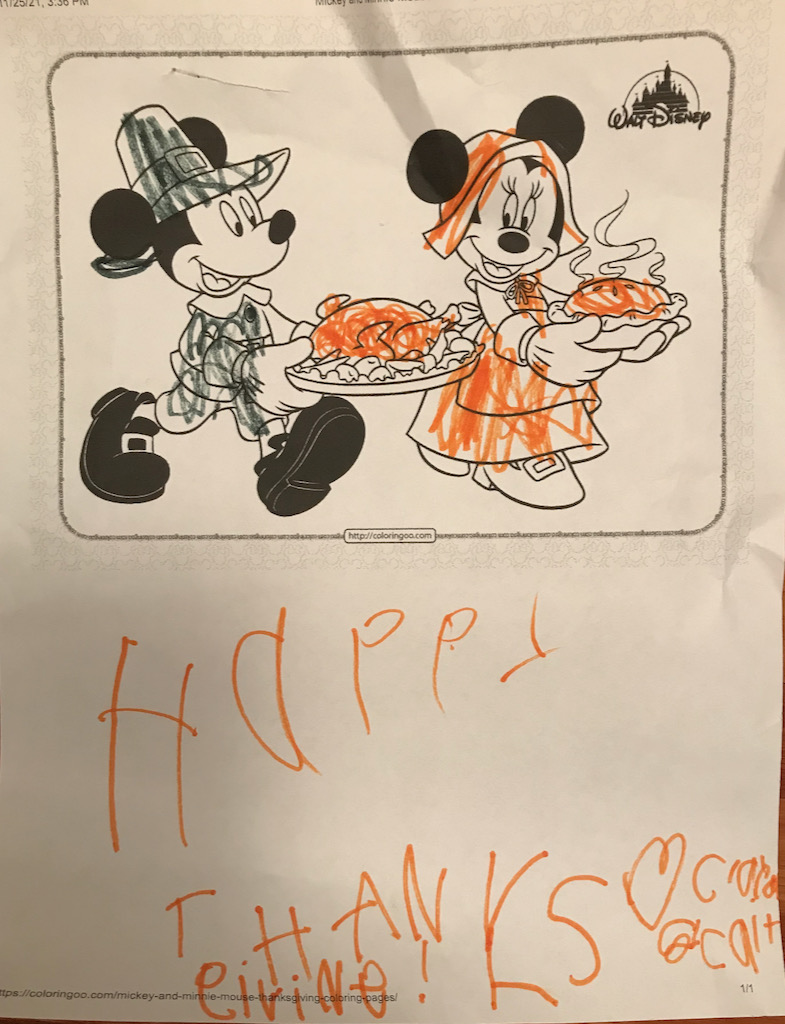
  • and one last one, just found tucked in the mailbox, from the darling darling little angels who live across the street, and who make my heart do cartwheels every time our days entwine:
  • and no proper list would end without this: the incredible warmth and the wisdom that never ever fails to burst through the glass screen of any laptop or phone, from all the wonderful “chairs” who ring this globe. you–yes, YOU!–are among the dearest in my life, and you never ever cease to melt my heart. thank you for always being kind, always bringing wisdom, and making this the sacred place we all believe in….

what fine grains are on your list?

praise song for november

ever since the jersey sojourner landed safely back home here along the shores of our great lake, this old house has been awash in crumpled-up wads of packing paper, and boxes, and bubblewrap. i’ve been up to my hipbones wading through it all, trying to find tucked-away places for treasures now in our keep, relics salvaged from a faraway house now awaiting its death blows. 

and that’s when, while sipping a time-out tea, i scrolled through the mail and stumbled upon a praise poem, a praise poem so lovely it made time expand, a few short minutes turned into what felt like a goodly chunk of time, and i carried the praise poem with me while i worked. 

here’s the poem worthy of praising:

Praise Song

Praise the light of late November,
the thin sunlight that goes deep in the bones.
Praise the crows chattering in the oak trees;
though they are clothed in night, they do not
despair. Praise what little there’s left:
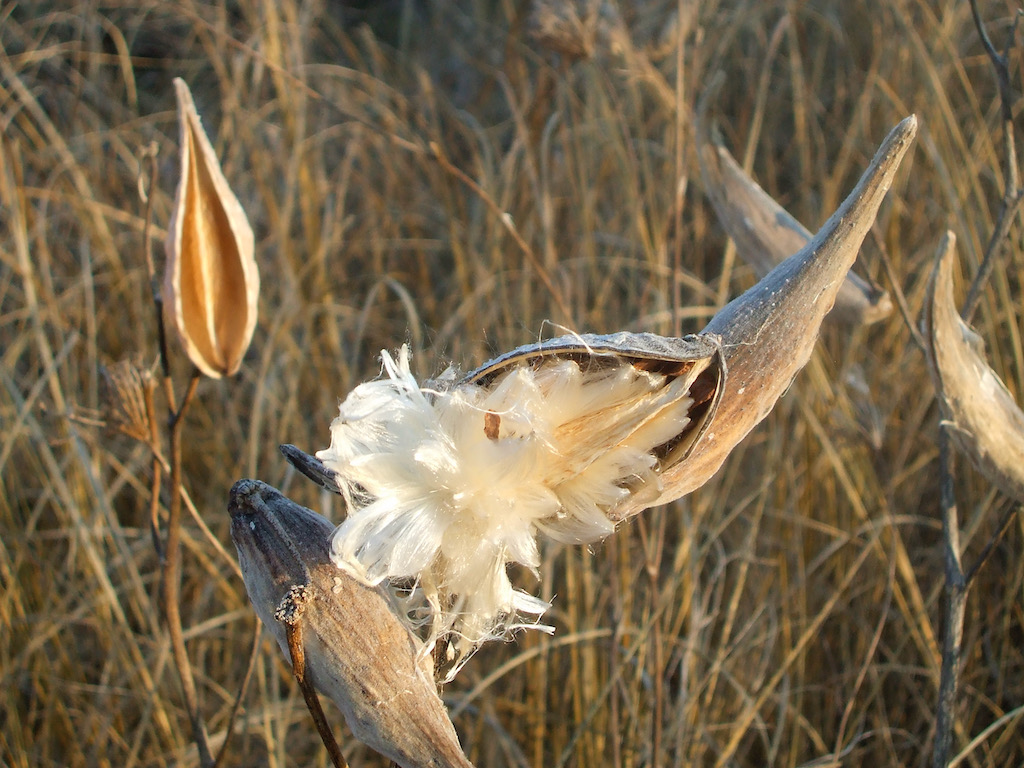
the small boats of milkweed pods, husks, hulls,
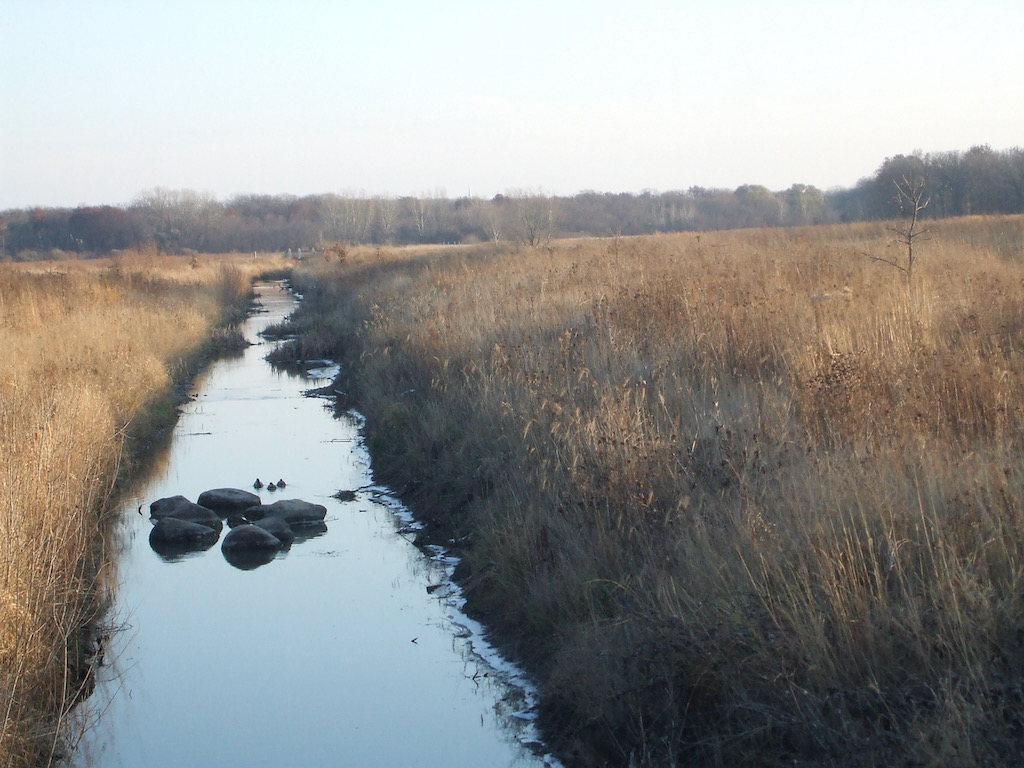
shells, the architecture of trees. Praise the meadow
of dried weeds: yarrow, goldenrod, chicory,
the remains of summer. Praise the blue sky
that hasn’t cracked yet. Praise the sun slipping down
behind the beechnuts, praise the quilt of leaves
that covers the grass: Scarlet Oak, Sweet Gum,
Sugar Maple. Though darkness gathers, praise our crazy
fallen world; it’s all we have, and it’s never enough.

~ Barbara Crooker ~
 (Abalone Moon, Summer 2004)

next time i took a break from all the stripping away of papers and the swiping away of cobwebs in the places i’d found for storing, i decided to dig into a bit of knowledge about this literary genre that pulses with pure and unfiltered heart, one praise practically tripping over another. 

here are but a few bare bones, mostly dug up from my friends at britannica (the encyclopedia, that is): praise poetry first stirred in medieval literature, especially during the renaissance, when it poured forth worship of or admiration for heroes, kings, or deities.

it seems the praise poem––also called mlenmlen, oriki, or praise name––is one of the most widely used poetic forms in africa, a series of laudatory epithets––descriptive word-pictures or word-paintings––applied to gods, men, animals, plants, towns, you name it. the point is to capture the essence of whoever or whatever is being praised, and to lavish praise.

think not that just anyone is inclined to get up and start praising, at least not in the african homeland. professional bards––akin to a court poet––are the ones ordained to chant praise songs, with the reciter taking position in an open space, visible to all assembled. the reciting begins in high voice, rhythmic backbeat sometimes provided by spear stomped against ground, a punctuational note that would get my attention. metaphor is a key device, so too poetic license for coining new words. (i’m in with anyone who’s making up words.)

it’s an oral form that, not surprisingly, found its way to worship in the american black tradition, and, now rooted there, fills the sanctuary of many a black church. you might remember elizabeth alexander’s glorious “praise song for the day” written for and recited at president obama’s first inauguration, on that cold yet hopeful january day in 2009. (so far in the distance now, it almost seems like another america.)

inspired by this notion of rolling praise, especially in this season of gathering gratitudes, i decided to try my own, mindful that praise is another name for anointing through blessing. the beannacht is the celtic version thereof, the bracha is how jews unfurl their blessings. all the earth and its inhabitants, certainly the ones humble enough to know we’re not here of our own making, seem hardwired to nod, bend knee, and bow. i beg permission to attempt the tradition, and hereby begin:

Praise the homecomings of late November, the footsteps you know by heart, the ones that tell you someone you love is just one floor above, and any minute now his bear-like hungers will awake, will startle, and he’ll come foraging into the woods of your well-fruited refrigerator. 

Praise the mottled gray November skies, the herringbone of heaven and cloud, infinite afghan we draw round our shoulders, as November signals its call to begin the turning in, the deepening quiet of winter coming. 

Praise the molasses light of waning November, pooling across floorboards, magnifying the smudge and the splatters of each and every unwashed windowpane. 

Praise the gathering table you’ll set for the first time in a too-long time. Praise the remembering that comes as you haul out the once-a-year dishes, as your riffle through the recipe tin, bring to the feast heirlooms––and long-gone stirrers of pots––of kitchens past. 

Praise the voices soon to rise from the room where the forks and the knives will scrape against plates, where stories will unspool, and laughter—praise be—will punctuate the convening, weave the disparate souls of the room into one. 

Praise the stripped-bare essence of autumn’s end, the disrobing almost over now. Limb and bough and trunk, exposed against the palette of sky. Praise the way we see more now, as less is there to get in the way. Let that be our guiding vision.

Praise the wisdom that comes with November’s close, these days ripe for inner harvest. When the orchard’s gone sleeping, the fields have gone fallow, sift through the loam that’s rich in your soul. Root around, take in wisdom, turn the page, listen to the forest, or the grasses that rustle to the song of winter’s-coming. Let it sink in, sink deep, all through the slumbering months.

here’s a variation on praise, a heavenly one, albeit written in deepening shades of darkness, from one of my very favorite poets, w.s. merwin. it’s titled simply, “thanks.”

Thanks

W. S. Merwin – 1927-2019

Listen
with the night falling we are saying thank you
we are stopping on the bridges to bow from the railings
we are running out of the glass rooms
with our mouths full of food to look at the sky
and say thank you
we are standing by the water thanking it
standing by the windows looking out
in our directions

back from a series of hospitals back from a mugging
after funerals we are saying thank you
after the news of the dead
whether or not we knew them we are saying thank you

over telephones we are saying thank you
in doorways and in the backs of cars and in elevators
remembering wars and the police at the door
and the beatings on stairs we are saying thank you
in the banks we are saying thank you
in the faces of the officials and the rich
and of all who will never change
we go on saying thank you thank you

with the animals dying around us
our lost feelings we are saying thank you
with the forests falling faster than the minutes
of our lives we are saying thank you
with the words going out like cells of a brain
with the cities growing over us
we are saying thank you faster and faster
with nobody listening we are saying thank you
we are saying thank you and waving
dark though it is

From Migration: New & Selected Poems (Copper Canyon Press, 2005). Copyright © 1988 by W. S. Merwin.

both the crooker praise poem and possibly the merwin (should you care to make a point, to stir a somber note into your table’s conversation) might be welcome at your gratitude table. or you might be inclined to pen your own. either way, from my old maple table to your table in whatever its form, blessings, blessings, and praise be to the chairs. 

do you have a praise poem you love? what praise would you pen should you be so inspired? 

the rare company of an especially fine book

long, long ago, the one certain place where i escaped in the house where i grew up, where i all but opened the window and soared out through the oaks, was beneath the covers of a patchwork quilt in my upstairs room where i’d hide for hours on end in the pages of an opened book.

the very architecture of a book is built for drawing you in: there’re the pages opening like spread-wide angels’ wings, there’s the tucked-in gulley where those pages are hinged to the spine, the gulley that demands ocular acrobatics, as your eyeballs make the leap from one page’s bottom to another one’s top. it’s an enclosing space, the sprawl of a book, a paper-and-glue construction akin to being wrapped in the long arms of a hug.

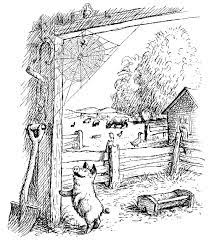
garth williams’ pig barn and charlotte’s web

back in the days when the books i read were washed in watercolor from the brushes of tasha tudor, or in the black ink of garth williams, i could get lost in a book from sun-up till starlight.

tasha tudor’s thumbelina

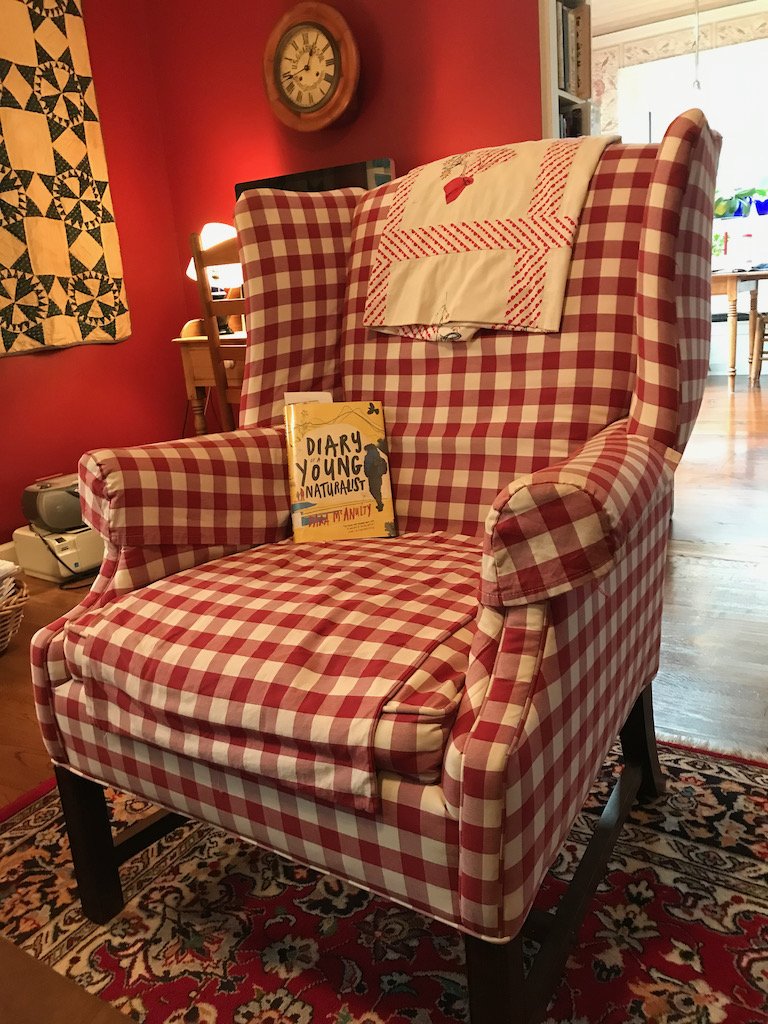
i’d wager a bet that those were the pages that imprinted on me the storybook poetries that have shaped every room of my grown-up house — the ticking and chiming of old schoolhouse clocks, windowpanes that peer into trees, birdhouses on poles, amply padded armchairs upholstered in checks, teapots that whistle, and logs that crackle in hearths.

that itch to escape — really, more of a pang or an unstoppable pull — still lures me, especially as the affairs of the world seem to crumble, as the ends of my nerves feel rubbed raw with brillo and steel wool. it might be why the walls of this old house are stacked, floor to ceiling in plenty of rooms, in tight-soldier rows of spine after spine. books are the balm, the antidote to so much of the madness beyond our front doors.

especially so is a book i tumbled into only this week. it’s a book for the soul, if ever there was. it’s a book for the tenderhearted, to which i most assuredly and emphatically admit. it’s diary of a young naturalist, by dara McAnulty, who not only is a teenager (a northern irish one) but one with extraordinary voice and vision. he’s autistic, he lets you know before you’ve come to the end of the prologue. but before he tells you that, he describes himself thusly: “i have the heart of a naturalist, the head of a would-be scientist, and the bones of someone who is already wearied by the apathy and destruction wielded against the natural world.”

count me as a kindred spirit.

even more so, he lets on again and again how trampled his heart often feels, how porous it is, and how solace for him comes in the tendernesses of the unfiltered natural world.

the book has bedazzled the literary world. young dara, all of fourteen when he penned these glorious pages, won the wainwright prize, britain’s blue ribbon for nature writing, for this, his debut work. that his words found their way into a book, let alone a prize-winning book, is a feat in and of itself; “quite amazing,” he writes, “as a teacher once told my parents ‘your son will never be able to complete a comprehension (a mandatory exam in the british educational system), never mind string a paragraph together.'”

well, string paragraphs he has done. has done, indeed. has done to the tune of 222 pages.

he’s been compared to the incomparable greta thunberg, perhaps the planet’s fiercest defender and an unfiltered critic of our devastations thereof. the guardian of london sang the diary’s praises, calling it “miraculous,” writing that it’s “a combination of nature book and memoir, a warm portrait of a close-knit family and a coming-of-age story,” in which McAnulty’s “simple, gorgeous sentences unfurl, one after another.” the poet aimee nezhukumatathil called it “at once a lush and moving meditation and electric clarion call to action.” reviewers, in the UK and here in the states, have heaped it with praise. “it really is a strange and magical experience,” wrote a reviewer in the daily mail, before comparing McAnulty’s writing to that of the poet ted hughes. another reviewer, one in the guardian, said McAnulty’s writing reminded him again and again of the great WH Hudson, a brilliant and eccentric nature writer “who lived with the same deep and authentic sense of emotional engagement with nature as McAnulty.”

weaving across the arc of a year, paying exquisite attention to season upon season, McAnulty drops us all to our knees, as we behold, along with him, the wonders of barn owls, cowslips, corncakes, and the summer’s first blackberries.

of the poetry of a blackbird’s morning sonata: “When the blackbird came, I could breathe a sigh of relief. It meant the day had started like every other. There was a symmetry. Clockwork.”

of dandelions: “Dandelions remind me of the way I close myself off from so much of the world,” he writes, “either because it’s too painful to see or feel, or because when I am open to people, the ridicule comes.”

a hidden pond: “…reflecting the sky and squiggling with shadows galore, darting in and out of the light. A convulsing mass of tadpoles, and with them the epic cycle of life, anticipation and fascination.”

springtime: “The ebb and flow of time punctuated by the familiar brings a cycle of wonder and discovery every year, just as if it’s the first time. That rippling excitement never fades. The newness is always tender.”

for a girl whose jangled nerves and galloping heart are soothed and slowed by the poetries of startling never-before-so-captured language, McAnulty is bliss by the spoonful. he describes his family as “close as otters,” and in describing a soaring white seabird he writes of “the art deco lines” of the gannet. caterpillars move “like slow-motion accordions,” and a goshawk chick looks “like an autumn forest rolled in the first snows of winter.”

as if that’s not more than more than plenty, here are but two excerpts:

Prologue
This diary chronicles the turning of my world, from spring to winter, at home, in the wild, in my head. It travels from the west of Northern Ireland in County Fermanagh to the east in County Down. It records the uprooting of a home, a change in county and landscape, and at times the de-rooting of my senses and my mind. I’m Dara, a boy, an acorn. Mum used to call me lon dubh (which is Irish for blackbird) when I was a baby, and sometimes she still does. I have the heart of a naturalist, the head of a would-be scientist, and the bones of someone who is already wearied by the apathy and destruction wielded against the natural world. The outpourings on these pages express my connection to wildlife, try to explain the way I see the world, and describe how we weather the storms as a family……

I started to write in a very plain bungalow surrounded by families who kept their children behind closed doors, and empty-nesters who manicured their gardens and lawns with scissors – yes, I actually witnessed this. This is where sentences first began to form, where wonder grappled with frustration on the page, and where our garden (unlike any other in the cul-de-sac) became a meadow during the spring and summer months, with wildflowers and insects and a sign that read ‘Bee and Bee’ staked in the long grasses, and where our family spent hours and hours observing the abundance that other gardens lacked, all of us gloriously indifferent to the raised eyebrows of neighbours that appeared from behind curtains from time to time.

Wednesday, August 1
We watch in wonder as countless silver Y moths feast on the purple blooms. Some rest, drunk with nectar, before refilling, whirling and dancing in constant motion. The feather-like scales, brown flecked with silver, are shimmering with starry dust, protecting them from being eaten by our other nocturnal neighbours. I find it fascinating that silver Y fur can confuse the sonar readings of bats, and even when they are predated they can escape, leaving the bat with a mouthful of scales. And here we all are, the McAnultys congregated in worship of these tiny migrants. Soon they will make the journey to their birthplace, silver stars crossing land and sea to North Africa.

The night crackles as the storm of flitting moves off. We jump up and down and hug each other, tension leaking out. We chat and look at the sky, sparkling with Orion, Seven Sisters and the Plough. This is us, standing here. All the best part of us, and another moment etched in our memories, to be invited back and relived in conversations for years to come. Remember that night, when fluttering stars calmed a storm in all of us.

Dara McAnulty, Diary of a Young Naturalist

part of the miracle of McAnulty’s writing is that he writes as evocatively about his neurocognitive otherness as he does about the dandelions, the otters, and the caterpillars. he is something of a spelunker into the unexplored wilds of the world seen through an asperger’s lens.

again, from the prologue, where he writes matter-of-factly:

“Not only is our family bound together by blood, we are all autistic, all except Dad [a conservationist] — he’s the odd one out, and he’s also the one we rely on to deconstruct the mysteries of not just the natural world but the human one too. Together, we make for an eccentric and chaotic bunch. We’re pretty formidable, really. We’re as close as otters, and huddled together, we make our way out in the world.”

he writes, bracingly, about being bullied. about how, under the fluorescent lights of a classroom, he feels “boxed in, a wild thing caged.” he writes of the foul-mouthed insults hurled his way. simply because he’s not like the others.

i’d say he’s beyond them.

reading his stripped-bare sentences, my eyes stung with tears. and in his aloneness, i felt the walls of my own heart reaching toward his. i found not merely comfort, but the rarest of company.

how blessed is the world that from his distant landscape of otherness, he makes art from life’s murkiest shadows to its patches of purest white light.

McAnulty’s latest book, wild child: a journey through nature, a multi-sensory jaunt through the wilds especially for children, was published last summer, and described as a “dreamy dive” into the natural world. he’s planning another book about his wanderings around ireland, connecting nature with myth. i’ve taken a number and am already standing in line for that one.

for i’ve found, in the pages gloriously inscribed by a boy who writes in tender tones, who sees the world in ways that make me truly see, a kindred spirit, a diarist who makes me feel safe and warmed in the clutches of this holy, holy earth.

what are the titles that bring you comfort in these trying times? and how precisely do they do so?

wilbur the terrific

holy comforter

maybe you haul your wounded self to the water’s edge, to where rocks punctuate the water’s otherwise-unstartled flow, and set things percolating, gurgling. perhaps it’s the roar of the water falling, tumbling down ledges. or the susurrations of a creek rushing through grasses. 

maybe you park your bum in the golden glowing woods, squat on a fallen trunk of maple or oak, a log now home to mosses and mushrooms. or you press your soles to the slope of a mountain, hard against granite or igneous rock, where, as the woodsman John Muir (who advised climbing barefoot) once noted, we’re wise to absorb the sacred essence “with our heels as well as our heads.” 

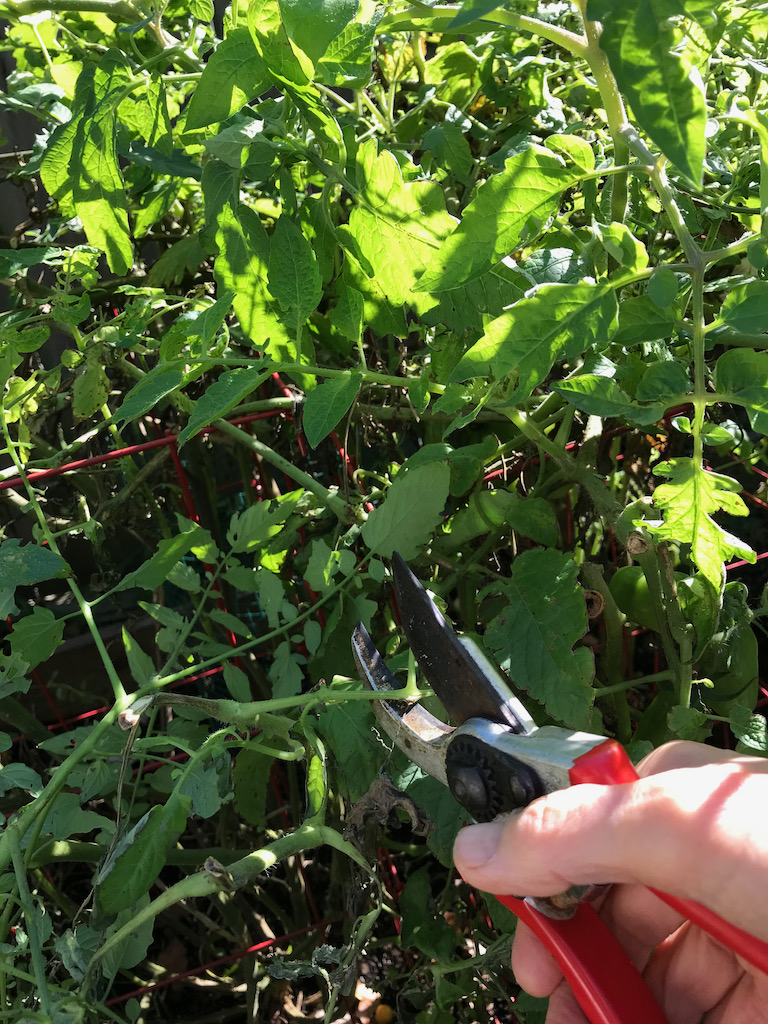
the other morning, knocked about by a phone call i’d been both chasing and dreading, i sought triage and solace out where the autumn light slanted in on my garden’s last gasps. holy comfort i found there with my clippers in hand, untangling my thoughts along with the last of the tomato’s serpentine withering vines, soaking in the morning’s few waning sunbeams. 

i all but wrapped myself in the strands of this earth’s balms. holy comforter, indeed. the warmth of the harvest sun. the unparalleled green. each late-season leaf expiring its last bits of life-giving balm, or what the twelfth-century mystic and herbalist hildegard of bingen termed viriditas, the divine healing power of green. she once wrote, “there is a power that has been since all eternity, and that force and potentiality is green!” in other words, the surging “thereness” of God, life source of all. and, oh, i basked in it the other morning. 

there is something particularly soothing — nay, healing — about the comforts of the late-season garden, about the comforts of each and every season, really. 

it’s as if the earth presses itself hard against my hollowed chest, against the faint beating of my worn-thin heart. it soothes without words, the whole of the creation does. doesn’t try to fill in the silence, offer quick fix. the earth, holy comforter, simply is present. stands in certain unwobbling encounter. makes real the declaration: “i am here.”

benevolent, earth offers healing by multiple choice: should you not feel the radiant heat on the bare skin of your arms, inhale the pungent spice-notes of marigold or spearmint as you break off a stem. or catch the fluttering shadow of october’s south-bound monarch playing with the breeze. or the chatter of sparrows, incessantly sparring. 

each and every sensory channel stands at the ready, inviting the way in. 

there’s a presence, grander, more tender, than i’ve otherwise known. it’s the enveloping bosom of this holy healing earth. or the soft shoulder against which i lay my weary head. 

it’s where i turn when the hurt is too big, or not yet sorted out, not pegged into words. and i’m as certain as anything that it’s the one i call God who enwraps me when i step into the wilds, when i carry my banged-up sorry old self into the balm that is this holy comforter earth. 

***

Glance at the sun. See the moon and stars. / Gaze at the beauty of earth’s greenings. / Now, think. / What delight God gives to humankind / with all these things….

—Hildegard of Bingen

how has any aspect of the whole of creation comforted you of late, or in particular?

anointed places

it’s as if someone’s set a buzzer that must go off at asynchronous times–could be twilight, could be the middle of the afternoon, could be on the verge of thunderclap, or the first dappled stitches of starlight–and deep inside me there is some cord that must be yanked. suddenly, i am turning toward the east, propelled to the water’s edge by wagon, bike, or soles. it’s the vast, vast ever-shifting canvas, where lake and sky, earth and heaven, never cease their stagings.

in these weeks and months when what’s bottled up inside–the worldly angst, the brokenness in all its iterations–when all of that feels so compressed, so hungry for release, relief, it’s the expanse, the i-can’t-reach-the-end-of-it of heaven’s vault that offers ablution. that rinses out the muck. and fills me once again with hope, with depth, with the unshakable sense that i am held in the very palm of God. and all that worries me, weighs me down, is drained away.

there’s the play of color, a color wheel of endless turning, from indigo to amethyst, cerulean to aubergine, and at the dawn and dusk, who’s ever behind the curtain hauls out the rosy tray, where the sky ignites in shades of flame. there’s light and shadow, too. the sky roils in charcoaled turbulence, storm churning in the distance. the sun illuminates the lacy edges of a cloud. sun and clouds and sky in eternal choreography, not one scene ever plays on rerun.

it is, by definition, an anointed place, a most holy place. a place where the nearness of God, the encircling of that infinite tenderness, pours out from some unseen vessel. holy unction, indeed.

when i was all of eight, in Mrs. Bishop’s third-grade religion class, learning all the things that make a catholic catholic, i always tripped over the one of the seven sacraments they called extreme unction. it sounded downright scary. i knew that oil was involved. i couldn’t tell you if it was safflower or olive, but it was oil, and it was poured on you in the hour of your direst need. at the cusp of dying, among other times. getting blessed with water was an everyday matter (to this day i lurch toward any holy water basin, splash fitfully and let it rain sloppily down on me), but getting blessed with oil was like calling in the light brigade. it was reserved for Serious Stuff. in my third-grade vernacular that probably meant whatever was worse than falling off your bike, or getting pushed down on the playground, when Mrs. Dolder the school nurse, pulled out that stinging bottle of mercurochrome, its iron bitterness running down your leg.

thetis anointing achilles

turns out, oil’s claim to holiness is an ancient one. it’s there in the early pages of the bible, not long after genesis. thought to be the medium through which God’s blessings are conveyed. it’s what makes a king a king, apparently. (well, that and a crown.) jews and egyptians reached for olive oil (poured from a ram’s horn). butter is the anointment of choice in hindu blessings. a newly built house is smeared with it, so too are those thought to be possessed by demonic forces. indigenous australians believed that if they smeared themselves with the intestinal fat of a dead person they would absorb that person’s virtues. (i’ll pass, thank you.) arabs of east africa rubbed themselves with lion’s fat to muster courage. and in greek mythology, the sea nymph thetis anointed her mortal child achilles with ambrosia to make him immortal. (another telling of the myth has thetis dipping achilles in the waters of the river styx, but she failed to dip the heel by which she held him. and we all know what happened to achilles’ heel).

lest i get too far sidetracked by the oily substance of anointments, let us leap back to a consideration of a place that’s anointed, even if not a slick. a place the celts would call a thin place. where the opening to heaven is so thin as to be not there. in other words, it’s where you go when you need to fall into the arms of God, or whomever you think is out there trying to hold us together.

walking along the water’s edge, dodging the tickle of the still-warm undulations, dodging the squawky gulls, it’s all but impossible not to be swept into the game of it, the deep-down child’s joy of it. nearly every time, i hear the sound of someone out-loud laughing; i look around and figure out the sound is me, it’s coming from my bellows. be it a brisk constitutional or a lazy jaunt, those sands, those waves, that sky, soak up what ails me every time.

i’ve not always been a shore girl. more often i’ve found myself tucked inside grassy coves, leaning against the rough bark of oak or cottonwood, or plopped on a log deep in the woods. i’m one for making myself all but hidden, a tiny dot, in the all-engulfing canvas of the never-ending curve of globe. but there is a singular prescriptive that comes where water plays, and where the sky can’t keep from turning. it’s a wide-out-in-the-open sort of place.

it’s cast a holy spell on me. and i’ve no intention of rubbing it away.

what’s your anointed place?

and should the woods be on your anointed list, i share this meditative walk in the woods from my wonderful friends at orion magazine. (it’s a 20-minute enchantment, sung by the Crossing Choir of philadelphia, sure to lift you to some ethereal plane.) it’s described thusly:

IN THE DEPTHS of the pandemic, when choral groups could not safely gather to sing indoors, The Crossing Choir of Philadelphia took their singing outdoors, into parks and open-air venues. Last October, they premiered a work entitled “The Forest” in Bowman’s Hill, a stand of mature trees, many over 200 years old, in the Philadelphia neighborhood of Mt. Airy.

During the performance, the singers, unmasked, stood far apart among the trees, their voices amplified by specially-designed speakers, while audience members walked at safely-distanced intervals along a thousand-foot path through the forest.

it’s the little joys that sometimes carry us…

in which, after a seven-week summer’s sabbatical, our little scribe shuffles back to the table, ferrying a tall stack of books, and the hope of something to say….

well, good morning. i promised it wouldn’t be long, and it wasn’t. really. oh, i’ll admit to all but sitting on my typing hands the first few fridays, an itch to write that nearly needed ointment to make it go away. but i held on, and soon enough, savored the quiet. found plenty to fill the days. in the weeks i’ve been away, tucked behind the virtual monastery walls, i’ve been witness to the scattering of ashes of a woman we loved, i’ve flown across the country, had both my boys under this old roof for one 36-hour slice of heavenliness, cheered on the now dubbed TriathlonMan (aka former architecture critic) not once but twice as he gleefully crossed the finish line (well, he was gleeful the first time, and in last sunday’s 97-degree heat “gleeful” would be the last adjective i’d reach for), and said too many tearful goodbyes at airports and college dorms.

so here we are. not unlike the back-to-school rhythms of clean underwear and sharpened pencils, ready to dive back in. what a blessing that the holiest of holy days are upon us, just as the light takes on its amber molasses glow. and the blood in my veins percolates with its usual seasonal vivacity (i am autumn’s child, to be sure).

one of the truths of the summer — and of this moment — is that i often feel crushed by the news of the world around me. these last few weeks and days offer no reprieve. many a night i’ve lay awake imagining how it is to be sardined in a hangar in qatar with no water, no food, and sunlight beating down, all of it underscored with unchartable fear. and the cries of hungry babies all around. and now we’ve got a lone star state filled with deputized vigilantes racing around to turn in their already broken neighbors. let he who is without sin cast the first stone.

and so i was particularly struck when i stumbled on an essay this week from maria popova, she of brain pickings wonderment, an essay in which she writes of hermann hesse’s belief in little joys. i seem to gather proponents of littleness — dorothy day and her little courages, and now hesse and his little joys. anyway, i ran to the library — the candy counter equivalent for those who binge on poetries and paragraphs — and checked me out some hesse (german-swiss poet, painter, novelist; author of siddhartha*), specifically his collection, translated into english in 1974, titled my belief: essays on life and art.

hesse writes, in his 1905 essay “on little joys”:

Great masses of people these days live out their lives in a dull and loveless stupor. Sensitive persons find our inartistic manner of existence oppressive and painful, and they withdraw from sight… I believe what we lack is joy. The ardor that a heightened awareness imparts to life, the conception of life as a happy thing, as a festival… But the high value put upon every minute of time, the idea of hurry-hurry as the most important objective of living, is unquestionably the most dangerous enemy of joy…

Our ways of enjoying ourselves are hardly less irritating and nerve-racking than the pressure of our work. “As much as possible, as fast as possible” is the motto. And so there is more and more entertainment and less and less joy… This morbid pursuit of enjoyment [is] spurred on by constant dissatisfaction and yet perpetually satiated.

I would simply like to reclaim an old and, alas, quite unfashionable private formula: … Do not overlook the little joys!

These little joys … are so inconspicuous and scattered so liberally throughout our daily lives that the dull minds of countless workers hardly notice them. They are not outstanding, they are not advertised, they cost no money!

Hermann Hesse, “On Little Joys” from My Belief: Essays on Life and Art

he echoes annie dillard, another of my pantheon of “little” saints, she who preaches like no other on the sacred art of paying attention, she who indelibly wrote:

The world is fairly studded and strewn with pennies cast broadside from a generous hand. But — and this is the point — who gets excited by a mere penny?

[…]

It is dire poverty indeed when a man is so malnourished and fatigued that he won’t stoop to pick up a penny. But if you cultivate a healthy poverty and simplicity, so that finding a penny will literally make your day, then, since the world is in fact planted in pennies, you have with your poverty bought a lifetime of days. It is that simple.

Annie Dillard, Pilgrim at Tinker Creek

keep your eyes — nay, your whole soul — open is her point. and hesse follows suit. leaving little to chance, hesse points to the particulars, and prescribes thusly:

Just try it once — a tree, or at least a considerable section of sky, is to be seen anywhere. It does not even have to be blue sky; in some way or another the light of the sun always makes itself felt. Accustom yourself every morning to look for a moment at the sky and suddenly you will be aware of the air around you, the scent of morning freshness that is bestowed on you between sleep and labor. You will find every day that the gable of every house has its own particular look, its own special lighting. Pay it some heed if you will have for the rest of the day a remnant of satisfaction and a touch of coexistence with nature. Gradually and without effort the eye trains itself to transmit many small delights, to contemplate nature and the city streets, to appreciate the inexhaustible fun of daily life. From there on to the fully trained artistic eye is the smaller half of the journey; the principal thing is the beginning, the opening of the eyes.

yet another wise person i read this week, yuriko saito, a professor of philosophy at the rhode island school of design, calls the little joys “everyday aesthetics,” and defines them as “tiny, perfect things.” it’s the art of the ordinary, and the ordinary is where we live, those of us whose days are mapped by carpools and grocery trips and scrubbing out the bathroom sinks.

the world — even in its brokenness — is filled with tiny, perfect things. the imperative is that we keep close watch. God gave us input pipes — eyes, ears, nose, skin, tastebud. we are meant to notice. invited to, anyway. we dwell in holy kaleidoscope. it twists and turns and sways and dapples minute by minute, season upon season.

and so my days take on a hopscotch paradigm: i skip and hop from little joy to little joy, and hold on tight to those wisps of poesy that fall across my path. i mosey the alley, where wild things bloom and sway, and wander through my garden, clippers in hand, snipping stems for tiny bouquets i tuck all around the house, especially on the windowsills, a perch made for paying outward glance. i tiptoe down the brick walk to my summer porch, and keep watch from behind the screens where the birds take no notice, and carry on their birdlike ways as if i’ve morphed into just another leaf or willow frond and become unseen, no longer alien, no longer brake to their flutterings and chatter. i curl in my reading nook, keeping watch on the world passing by, on the pages i turn.

i keep a silence. a holy silence. the sort from which my prayers take flight endlessly, eternally. i pray for this world which too many days seems to be crumbling. i pray for lives i will never know. but i imagine. and my empathies carry me to faraway deserts, to tarmacs and hotlines where the desperation rises by the hour.

i’m surely not saying that the little joys will mend the brokenness. that takes a whole nother level of dedication and muscle moving. all i’m saying is that if we can fix our gaze on even the occasional tiny, perfect thing, we might stave off the paralysis that comes with the avalanche of awful news. we might gather up shards of beautiful, shards of little joy, and find the oomph to not stay stuck, the oomph to make the blessed most of these fine breaths left in us as we march through the bracketed hours of our days.

for this i pray.

what might be the little joys, the tiny perfect things that carry you through the day, even when the darkness comes?

*starting a new cumulative reading list, and first up, siddhartha, hesse’s 1920 novel which delves deep into hinduism, a religion about which i know not enough….it’s described as the “absolutely amazing and engrossing tale of one man’s journey to find that all-elusive idea of enlightenment.” enlightenment, here i come.….

the stories we tell

in a hospice room 719 miles away, a cluster of people i love sit circled round a bedside: a son, a daughter, their mother. words are few now, hours vary by breaths per minute, by doses of morphine. i am there/not there by the miles on a map between us, but my every breath is with them. vigils are kept without proximities. vigils are kept by heart. and my heart is there…

this vigil, as with most any vigil, is one syncopated by its own time and twists, all of which are beyond — far beyond — our inclinations toward clock and calendar, those false measures by which we mark things. minutes turn to hours turn to days. in the timelessness of now, i’m reminded how we set our hearts sometimes by timekeeping tools of our own making. we allow for acceleration, we slow, we pace. but really all of it is no more than device within which we pour ourselves for the comfort of the walls around us. as a species we seem to prefer to plunk ourselves in vessels rather than fling ourselves unbounded onto undulating limitless seas.

i steady myself inside this landscape of not knowing by extracting and considering the stories that emerge, that tell us who we are, who we mourn and who we aim to emulate. as is always the way, the stories we extract from lives well lived are the very fibers that will weave us back together again, in the wake of our emptiness. they’re the totems and road signs that point the way for every day thereafter. the etchings of the heart that prove inextinguishable instruction, the wisdoms and glories that keep the radiance from dimming.

here’s one of the ones i will tell from the life of a woman who from the start was always in my corner. that alone is everything (especially in a mother-in-law), but more than anything i have loved her for her goodness. her endless, endless, bottomless goodness.

in a parade of tales to tell, this one i’m forever seizing: it’s the tale of a gas-station attendant and my mother-in-law, who just two months ago was as blonde, beautiful, and fully engaged as ever. the gas-station attendant, it turns out, is an immigrant woman from a sometimes-unwelcome country, who some years back with her now-late husband bought a CITGO station in new jersey, worked the register seven days a week, long hours every day, and came to know the blonde-haired lady with the old volvo as a friend, one who never failed to deliver kindness every time she filled her tank, and carefully-wrapped gifts at christmas and easter. when the gas-station lady hadn’t seen my mother-in-law and her spiffy new Honda Fit for weeks, she tracked down the home phone and left a message, saying she missed her, and hoped all was well. my husband—who has meticulously been attending to all matters of the heart, and much else besides during these long weeks—called her back, and the woman explained that my mother-in-law had always been so kind, and over the last few weeks she’d grown more and more worried by her absence. the gas-station woman said that when her own husband had died — leaving her to run not only the register but the whole gas station on her own — my mother-in-law was right there with sympathies and kindness, and had become something of a rare american friend here in this strange new land.

to befriend the folks who pump your gas, to befriend them to the extent they notice your absence, and track you down, leave word and hope you’re well, that’s a measure of goodness worth remembering.

here’s another story that’s emerged, that tells us who she is and was in the silence and the solitude when no one was looking: in poring through the piles of papers that shrouded the desk in his old boyhood bedroom, my mother-in-law’s first-born and only son found a yellow legal pad with pages and pages of carefully enumerated names and gifts. my mother-in-law, an inveterate bargain hunter and irrepressible gift giver, spelled out her christmas lists every january, once the post-holiday sales were cleared, and her bedrooms filled with carefully chosen dollar-sale finds. when the Gap marked down winter scarves from $20 to $1 apiece, my mother-in-law bought the whole lot, and squirreled away each one for her endless christmas list. (she also never missed a new baby gift, a wedding, a graduation, or a sympathy gift, but hands down, my jewish mother-in-law’s favorite holidays were those wholly christian christmas and easter. maybe it’s no wonder she never minded the idea of a catholic daughter-in-law.) christmas 2021 was months ago enumerated, executed, and laid out in shopping bags all across the bedroom floors. all that’s left was the wrapping, a months-long ritual she usually began each october. indeed, my mother-in-law had her giving down to something of a science. a science of goodness, of calibrated, counted-out (and bargain-hunted) perpetual goodness.

it’s a goodness without measure, and she lived and breathed it every blessed day.

what stories do you tell of the ones you’ve loved most dearly? or even ones you barely knew but whose stories became the measures of your own every day?

for all these 15 years here on the chair, my mother-in-law was among its most loyal dedicated readers. she was the first to call if she liked it, and if she didn’t….well, the silence….

i tell her tales here with love. with so much love….

a little bit Miss Rumphius, a little bit madwoman with spade…

someone i love is dying, and someone else i love is stationed at her bedside, has been so for weeks now, navigating the shoals and sharp rocks of slowly, surely dying. 

someone wise once said that dying is hard, hard work. so too is being the one who keeps the bedside vigil, who is there when the breathing comes hard, who is there in the rare in-between moments when the stories from long, long ago come tiptoeing into the light, seeping out of tucked-away places in the black-box mystery that is the human mind. 

because we live in a world with ethernet connection, and because rhythm and routine etches something of a lifeline in even the most uncharted landscapes, i know each day how the hospice day is more or less unfolding, 720 miles away on the fabled jersey shore. i am living some shadow of those faraway days right here in this old house. holding my breath, holding down the fort on this end, so the ones i love can do what needs to be done in these anointed hours, with no mind to what’s unfolding here. 

somehow, in a summer that’s breathing hot and hard, i’ve drifted toward the tool rack in my cobwebby garage. i’ve taken on tasks long overdue — and back-achy. weeded like a madwoman. envisioned something beautiful where before there’d been bald and desiccated earth. set out to make it so.

as endless chore has morphed into life-breathing vision, as prairie weeds came out, and carpet roses, false indigo, and myrtle were laid into newly-dug holes, i found myself fueled by Miss Rumphius, she of Barbara Cooney’s eponymous classic picture book, she who set out to scatter lupine seeds wherever she traipsed and turned. for Miss Rumphius held faithful to her creed: “you must do something to make the world more beautiful,” her grandfather had once told her, as she perched upon his knee. “all right,” she promised, not knowing just what that promise might be.

when she grew up, the little girl with the promise, Miss Alice Rumphius worked in a library, where she read books about faraway places, which made her want to travel the world just like her seafaring grandfather. and so she did, trekking from tropical island to tall mountains where the snow never melted, through jungles and across deserts. when at last she came home to a place by the sea, she remembered her instruction and her promise to her grandfather: to make the world more beautiful.

in the arithmetic of my little brain, i too took on that creed; subtraction counterpointed by addition. as the someone i love lay gasping, lay whispering her goodbyes, i set out to sow pre-emptive beauty into this thirsty, blessed earth. it seemed a necessary exertion. it seemed to breathe a little oxygen into this airless stretch of days.

of course i know i’m not really balancing anything. no forever blooming white rose could supplant the weekly phone calls, or the undying knowledge that once upon a time the one who’s dying was the one who emphatically and open-heartedly endorsed the marriage between the lifelong observant jew and the lifelong devoted catholic. and besides, long before that, she was the one who taught the one i love how to engage deeply in conversation, never letting pass a cursory question or response. long before i met him, deep conversation had become my lifeline. and, in the long list of things the reading teacher taught, she’s the one who made me love the color red. because a world in red just might stop you in your tracks, or charm you trying. and it’s a color now that will forever make me see her standing in her red kitchen with her red plaid apron, the one i once sewed for her, the one she wore for decades ever after, and she’ll be waving a big red spoon as if conducting some orchestra, though really she’d be making some essential point because that’s the most certain thing she ever did with a spoon. cooking, you see, was not her thing. and she was more than proud to say so.

there is no tally, in the end or all along, for the countless ways someone weaves her way — indelibly — into the fibers of your heart. all i know is that she melted me — and half the jersey shore — endlessly, unforgettably. 

every once in a while in these mad garden-reshaping days, salty tears have fallen on the clods of dirt i’m heaving with my shovel. but at day’s end, when i rinse my muddy toes under the faucet, when i finally pause to eat, i look out at the white roses, and the false indigo shifting in the summer breeze, and i think hard about the hard work of living and dying and making the world more beautiful. 

in whatever holy blessed form the beautiful comes. 

and it’s a promise i will never break. 

fully admitting that a good bit of my binge gardening was merely putting my worries to work, and keeping me from idly staring at the clock, awaiting word from the jersey shore, praying fiercely all along the hours, here’s the question: where do you find balm for the deepest aches in your heart? and how do you follow Miss Rumphius’ instruction to make this world more beautiful? (latter question is one for your own heart, no need to divulge your secrets here….)

and while we’re at it, may this first-ever national holiday of a juneteenth be a blessed one….

the pure power of kindness

i remember learning the lesson. i was squeezed in the back seat of a buick riviera, circa 1965, pulled to the pump at a gas station just outside cincinnati’s coney island, an amusement park to end all amusement parks, where i’d finally grown tall enough to be strapped in a bumper car all on my own. it was a hot cincinnati afternoon. and the six or so cousins squeezed in my grandpa’s regal coach might have had their eyes trained on my grandpa, or maybe they were poking each other in the sides and the shoulders and under the knees. i know i was watching my grandpa, and i watched him greet the man with his fist on the nozzle as if the man was his old lost best friend. it was, needless to say, an indelible moment, the way my grandpa’s eyes sparkled in conversation with this man he’d actually never met before. but they carried on anyway, a good while after the tank was filled. and then my grandpa slid back into the driver’s seat, turned his head to look us in the eye, and announced to whomever was listening (and, believe me, we all were): “always treat everyone with the same kindness you’d wish for yourself.”

if that was the only time i’d sat through that class — kindness 101 — i still think it’d have stuck, but i was taught it over and over and over again. by teachers all along the way — a best friend, an aunt, a gazillion glory-be-to-God they-belong-with-angels friends, strangers whose names i never learned — tender-hearted souls i count as if beads on a rosary. each one inching me closer and closer to that radiance that is momentary heaven here on earth. especially on the days when it feels a little bit like flame-licking hell.

so it comes as welcome blessing but little surprise that the awful hard road of the last couple weeks was paved with gold bricks of kindness that really, truly gave us the little bit of spark we needed to not slump to our knees, to not break down in tears and never stop crying. 

we teach kindness, those of us who still believe in the grace of getting along. we teach kindness sometimes because it’s the thing we think we’re supposed to preach. but sometimes i think we forget just how mighty a force the tiniest kindness can be. how one kindness can drain the sting from any day. how one kindness can be the burst of oxygen that keeps us from keeling to the ground. especially when we’re running on fumes, when we’re hollowed out with despair, when we can’t stand watching the tears run down the cheeks of someone we love. 

kindness literally moves mountains. the mountains deep down inside us that feel immovable. the mountains of worry. the mountains of sadness, of not knowing what’s just around the bend, and having little reason not to fear the worst. 

but then the doorbell rings. or the email pings. or you wake up to find a bushel of pansies waving in the morning’s breeze. or a box arrives, stuffed to the brim with all the things you count as simple treasures, and you scratch your head wondering how in God’s name you could be so blessed to know — to count as a most beloved friend — someone who pays such exquisite attention, who took the time and trouble to gather up a heart-melting litany, beans and bread and birdseed, even the hard-to-find monastery candle that kindles your most sacred hours, and it’s all flown halfway across the country. just in time to make a big ol’ pot of sustenance for the rainy days ahead.

and you remember all over again that you’re powered not simply by your own sweat and heartache and tears, but that the collective might of hearts — hearts that happen to be supercharged at the very moment yours is drained — gives you just enough oomph to take on another day. to shake yourself off, to grab the keys to the car, to drive where you’re needed, to do whatever needs doing: to clean out the wound, to scrub out the sink, to sling on a mask and march into the drug store, to look the doctor in the eye — or the tow yard boss, or the police officer, or the priest — and say what needs to be said. 

because you’re propelled not all on your own, but by the compound goodness and kindness of a thousand little kindnesses. even the slightest bit of kindness — the “how you doing?,” the “hey, i made extra,” the “i’m headed to the store, do you need anything?” — all of it is just enough to tip the scales, to keep you on your feet and in business for another day. amid the arid days of breathlessness and worry, there is no kindness too too small to put the necessary ping in the human heart that pumps on despite it all. 

as i sit and ponder kindness, i almost wish i was some sort of molecular scientist, someone who could pry open the envelope in which kindness arrives, and slide its essence under the microscope to discern just what it is — electrical valence? neurochemical charge? — that literally alters our physiologies, disrupts the sorrow-drenched, worry-stoked synapse, switches tracks from despair to hope. it’s not an illusory thing. it’s as real as real could be. the tiniest seemingly insignificant gesture — the saying without words, i am listening to your heartbeat and it sounds as if the rhythm’s off, a sorrowful syncopation has taken hold and i’m here to try to budge it back on beat — it matters. it’s a seed of life and love that’s planted deep and certainly, and it blooms just as it’s needed. 

and this world needs it in abundance, in bumper crops and without end. it’s not nothing, the barest brush with kindness. 

it’s everything. 

in other words, bless you and thank you each and every someone who offered up a prayer, a thought, a holy card, a kindness seen or unseen. 

love, the barbaras — the Wiser and her offshoot

xoxox

what are the moments of kindness you will never ever forget?