pull up a chair

where wisdom gathers, poetry unfolds and divine light is sparked…

Category: blessings

pay attention to this one most blessed day. . .
i am sitting here in a shaft of golden light spilling across the worn planks of this old maple table. i am looking out at a world ablaze in iterations of gold. as if the world out my window is a benjamin-moore paint strip, all in the key of saffron. 

i sighed a deep sigh when i tiptoed down the stairs this morning, and filled my lungs with the glorious knowing that this day held no appointments. no doctors. no dentists. no needs to stand or sit in front of a crowd and talk about the words i’d poured onto a page. 

this day is a big blank slate. a slate to fill with the simple wonders of being alive. and i intend not to waste it, not a drop of it. and urgently so.

it’s the unintended gift of holding on for dear life to the life that you love with every cell of your being. 

it’s a day i might otherwise not have noticed quite so keenly. but i see more vividly now. the blessing of holding on dearly to life is that you see each new dawn for the miracle that it is. 

it might have been just another weekday. but suddenly, perceptibly, it is the answer to my deepest prayer, a day to simply be alive and breathing it in. every pore of it. the earthy rummesence of autumn leaves crisping and crinkling and falling in heaps to the ground. the last gasp of the garden, exploding in singular vibrancies that beg to be remembered all through the winter. the air, a mix of chill with undertones of heat as if the earth’s autumnal respirations draw forth the last breaths from summer’s stockpiled embers. 

to knowingly not waste a day is to live at fullest attention. while we can. while we’re upright and ambulant. 

sometimes we realize we shan’t take it for granted. 

sometimes we need a reminder. 

i am reminded. 

i am living inside a body that reminds me to savor it, to inhale it. to all but rub it over my skin, to  let it soak in through each wide-open pore. 

we all have days when our hours are clogged with the usual distractions. we forget the marvel of a friday reliably following a thursday. we look to the calendar as if it’s the sovereign of how we spend our time. we are chained and unchained. we’re obliged to to-do’s, and we forget that all the in-betweens might just be the hours we’re most deeply alive. we might, at any moment, put down the chores, surrender the assignments. we might seize the day in whatever outline or equation rises from the blur. 

we might call a friend whose voice we’ve not heard in too long. we might find a log in the woods, plop ourselves down, and keep watch––close watch. we might fill a bowl with the indulgences of autumn, the leaves and the seeds and the roots, all meant for seasonal sustenance. 

we might light a candle. sit in a shaft of sunlight, watching the dust motes ride the air. we might roll up our sleeves, or get down on our knees, and plant a few bulbs for the joy of it––for the allure and the promise and perpetual hope of the springtime to come.

more and more, one of the first prophets i turn to for wisdom is the incomparable maria popova, she of marginalian wonders. in a cataloging of eighteen wisdoms she’s extracted from her eighteen years of gathering wisdoms (she must have started her brain pickings––now re-named the marginalian––a mere two months before the first chair was pulled up, for we too are about to mark 18 years of chairing), she included this bit of wonder and wisdom that says it as beautifully as it might be said:

Choose joy. Choose it like a child chooses the shoe to put on the right foot, the crayon to paint a sky. Choose it at first consciously, effortfully, pressing against the weight of a world heavy with reasons for sorrow, restless with need for action. Feel the sorrow, take the action, but keep pressing the weight of joy against it all, until it becomes mindless, automated, like gravity pulling the stream down its course; until it becomes an inner law of nature. If Viktor Frankl can exclaim “yes to life, in spite of everything!” — and what an everything he lived through — then so can any one of us amid the rubble of our plans, so trifling by comparison. Joy is not a function of a life free of friction and frustration, but a function of focus — an inner elevation by the fulcrum of choice. So often, it is a matter of attending to what Hermann Hesse called, as the world was about to come unworlded by its first global war, “the little joys”; so often, those are the slender threads of which we weave the lifeline that saves us.

and she includes these lines from poet and former zen monk jane hirshfield’s “the weighing”:

So few grains of happiness
measured against all the dark
and still the scales balance.

and if all that isn’t enough joy stoking for the day, here’s one other wonder and wonder-soul i learned of this week at a book talk where to my delight and pure joy i was pointed toward good souls i fully intend to get to know more deeply and intimately. (i never cease to be amazed at the goodness lurking in utterly unexpected nooks and crannies of this world.)

here is a woman—one with a PhD in human anatomy and cell biology, no less—who happens to live in a house with a four-acre flower garden who coaxes beauty from the earth for the sole purpose of giving it all away, filling the flower fridges at hospices and homeless shelters, and the larders at food pantries near and far. she calls it the backyard flower lab. and it sounds like a holy slice of sustenance to me. i intend to point my old wagon in the direction of her flower farm before the sun sets on this day, and i will see where the adventure takes me. her name is april potterfield (which sounds to be a perfect plucked-from-the-storybook name for someone who grows beauty for joy), and you can find her on instagram at @thebackyardflowerlab.
what prompts you to find joy and seize the slender threads of which we weave our lifelines? and what are some of your favorite ways of doing so?

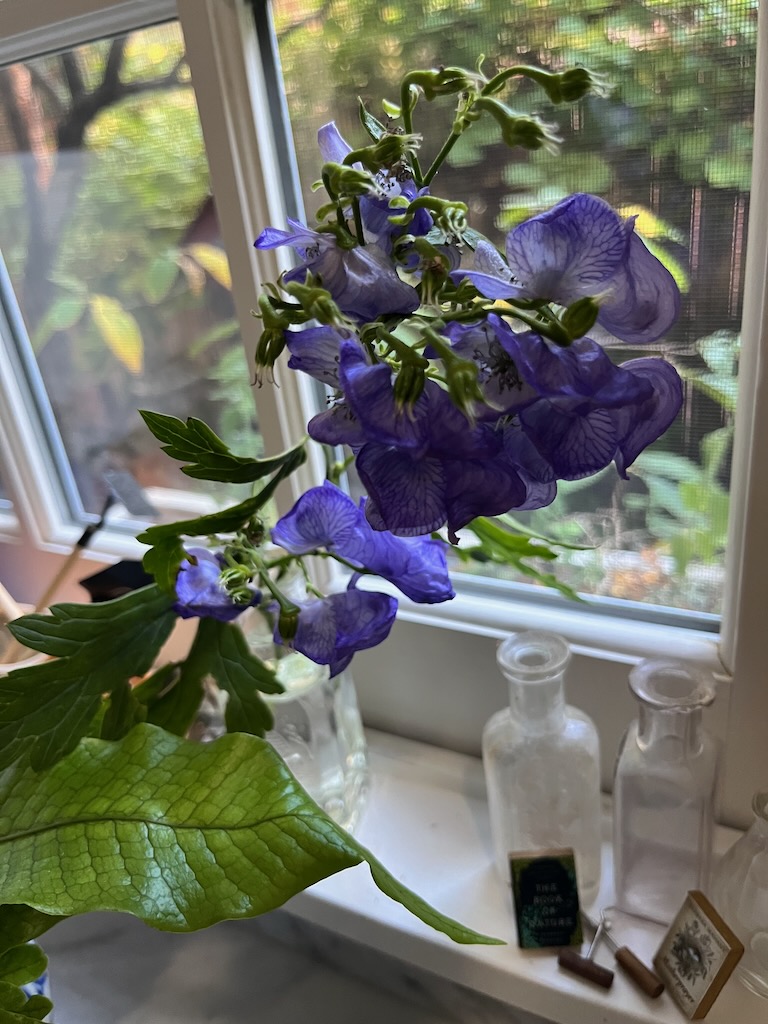
 the cobalt beauty perched on the windowsill above is an autumn vibrancy from my garden, the closing note of a summer’s-long love song. i call it monkshood, but it has other names: aconite, wolfsbane, leopard’s bane, devil’s helmet, or blue rocket. the name aconitum comes from the greek word ἀκόνιτον, which may derive from the greek akon for dart or javelin, the tips of which were poisoned with the substance, or from akonae, because of the rocky ground on which the plant was thought to grow.

deep thanks to maria popova who week after week for years now has filled me with wonder, with curiosities, and most of all with the breathtaking beauty of her intellect and imagination…

the names we are called, and the names that call us

my little irish grandma mae, as my grandpa, “choo-choo papa,” received his 50-year gold watch from the L&N Railroad, for which he was a locomotive engineer on the cincinnati-to-corbin (ky.) line

the email from synagogue came back in the spring. the rabbis and cantor had been thinking for awhile about some of us. an odd lot of us. we were the ones who’d found our way, through one inlet or another, into the river of jewish life — at synagogue and at home — yet “don’t identify as jewish.” (that wording, so very of the cultural times, cracks me up. in the old days wouldn’t we simply have been “not jewish”?) 

they, this lovely trio of clergy, all young, brilliant, and devoted to their callings, recognized that we were in many ways bringing our lives to the poetries and prayers of judaism, and that judaism’s poetry and prayers had found its way fairly deep into our lives. they wanted to honor that. 

they weren’t asking that we convert, weren’t asking us to sign on any dotted line. 

but they had a radical idea, deeply radical when set against the context of a tradition that long saw intermarriage as the great scourge, one of the most grievous threats to the ancient and blessed religion. the radical idea of our rabbis and cantor was to give us each a hebrew name. but not without deeply engaging in weeks of contemplation and discussion, coming to synagogue on wednesday nights as summer turned to autumn, as the air grew cooler, and the trees more golden and crimson. 

we talked the first night about the journey into judaism, they asked us to talk about moments of pain, times we felt excluded, rejected, pushed to the margins. or when we’d felt welcomed. we talked about being an outsider versus insider. did we feel we had a voice in the conversation, in the congregation, at our own kitchen tables, and even more broadly in the jewish world?

they asked us to tell the stories of each of the names we’d been given at birth, and the names we’d chosen to carry through life. they asked us to unspool the narrative of nicknames that ebbed and flowed through our stories. 

and they asked us to think deeply about what a name means. and to pull from our lives and from Torah particular names of particular souls who somehow stirred us. with whom we felt some deep, almost palpable pull.

i knew fairly quickly whose pull i was feeling. but before settling on my little irish grandma, the only grandparent i never knew, one with whom i’ve long felt an uncanny cord, i briefly considered sarah, she who — like me — thought she was “barren,” and found out at the ripe old age of 90 (i was nearly 45) that she was “with child.” and who greeted the news by laughing out loud. sarah, like me, is the archetypal old mother.

we had homework: a sheet of essay questions pondering names, all of which were meant to evoke for the rabbis a few hebrew names that might be fitting for each of us. after poring over our essays, they sent us our custom-curated list of possibilities. i didn’t choose from high up on the list; i found my name deep down in the unlikelier choices. but, turned out, it was a tight fit. a name with the same roots, the same meaning, whether celtic or hebrew. (you’ll see below.)

once we had our names, and had written the stories of how we came to those names, and why, we were invited to synagogue for a special friday night Shabbat service, where we’d be called to stand in a half circle on the bimah (the raised platform from which the Torah is read). one by one, we’d speak our names, and tell our short stories. 

before we told our stories, the rabbi, who i love, and whose name is ally or allison, (i don’t know her hebrew name, i just realized), set the stage with the eloquence and grace i’ve come to think of as her trademark, her inimitable magnificent, heart-melting way.

“Jewish tradition believes that names have great power,” she began. and then she read this poem from the israeli poet zelda, who is known widely by only her first name: 

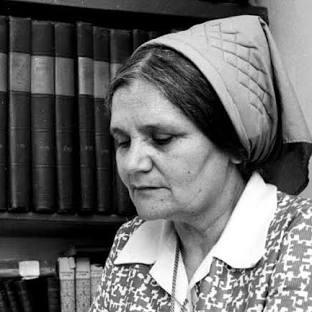
israeli poet, zelda

“Each of us has a name given by God and given by our parents.
“Each of us has a name given by our stature and our smile and given by what we wear.
“Each of us has a name given by the mountains and given by our walls.
“Each of us has a name given by the stars and given by our neighbors.
“Each of us has a name given by our enemies and given by our love.” 

in a sentence that took my breath away before she called us from our pews to stand in our half-circle, to step to the podium, she said that we’d “earned these names through sacrifice and grit, through tenderness and care. they earned these names through their openness, their tolerance, their expansive and soft hearts.”

that sentence made me riffle through the rolodex of my life, through the hard conversations at the kitchen table, the tears on long telephone calls when a Jew and a Catholic were hashing it out in the three years before we married, trying to decide whether we could work it out, whether we could braid two faiths, two traditions, two deep ancestral ties into something that might even be greater than the sum of its parts. made me think of the blessing ceremonies in our tiny little garden on Wellington Avenue, when a rabbi and a priest poured their words, their wisdoms, and their blessings on two baby boys we were both blessing and naming (with eight years between each). made me think of the pair of Shabbat candlesticks, layered with wax from candles dripping and dripping over the years. made me think of the lamb stew we’ve stirred at the cookstove, my beloved and i side-by-side. 

i thought how, indeed, both of our hearts have softened, have opened, have grown.

and then it was my turn to step to the podium, clear the tears from my eyes, and read these words to those gathered:

I’ve spent much of my life peeking beyond the borders of what was before me. Yearnings have always stirred me––reaching for what I don’t yet know, reaching for the holiness I deeply believe in, reaching for loves long after they’re gone. 

And there is a particular grandmother, the only grandparent I never met, who has always, always animated my imagination. I yearned to know this daughter of Irish immigrants, a Kentucky schoolteacher, who, according to family lore, was the first woman to graduate from college in the commonwealth, who snagged the highest score on her county’s teachers’ exams, and just as importantly, could wring a chicken’s neck!––a praiseworthy prelude to many a Sunday supper in the Bluegrass State. 

Her name was Mae, Mae Shannon, and her only child, her beloved child, was my beloved long-gone papa, Eugene Shannon Mahany. 

Until now, my connection to Mae has been purely by heart, and through a few fading photographs that show we share an uncanny resemblance. 

Her name, Mae, is a Celtic derivitive of Mary or Margaret, and one of its meanings is “pearl.” So, too, the Hebrew name Margalit—yet another “pearl.” 

Considered the gemstone of inner wisdom, the pearl is one of creation’s wonders, formed through the mysterious interplay of oceanic depths and the celestial pull of the tides. 

The pearl is formed when the mollusk, or bivalve, senses an irritant—a grain of sand, perhaps—which it enwraps by secreting layer upon layer of minerals, all extracted from seawater. Sand to seawater to pearl.

Ergo, pearl equals protection, luminous protection. Its very creation, an equation of awe. And the pearl, a moonlike orb, is thus said to be a vessel for water’s energy, to carry the lucid movement of the tide’s ebb and flow. It’s believed to hold deeply healing powers. 

Its beauty, formed in unseen depths. 

Radiance, evolved over time. 

The pearl, Margalit––the Hebrew name of my choosing––my tie at long last to the little Irish grandma I so long to sit down beside. And whose inner luminous wisdom I so yearn to absorb. 

And mightn’t she be wonderstruck to discover she’s inspired her only granddaughter’s new Hebrew name.

love you, dear chairs. by your names that i know, and your names that i don’t.

what’s the story of your names?

p.s. our rabbis are pretty sure that ours is the first congregation in the U.S. to undertake such a process, the giving of hebrew names to those who don’t identify as jewish.

and tonight we begin the highest and most solemn of high holy days, yom kippur, the day of deep atonement.

the equinox of scan time: equal parts shadow and light

you start to wonder. which is another name for worry. for most of the last five months, i’ve worked at pushing it off to the edge of the frame. to keep it out of my focus. but october is coming. and with it, the next scan. the next clear-eyed peek into my insides, into my lungs, to see if anything’s lurking that oughtn’t be. 

i’ve mused about the saintly side of scan time. how it’s akin to memento mori, the ancient and holy practice of remembering our death so that we maximally live our one swift shot at this astonishing life. 

but the other side of scan time is the deeply human side. the wake-me-up-in-the-night, the try-not-to-worry-that-the-pain-in-my-ribs-is-anything-scary side. 

i feel it rumbling around the edges. the what-ifs i bat down as if a pesky mosquito that won’t leave me alone. i try not to tumble down the shadowy mole hole of imagining a call to my boys, letting them know i need another round of surgery. i try to quash the dialogue that runs through my head, my doctor’s voice telling me there’s something in the scan that looks worrisome, that needs more poking around. i try not to let cancer be the ice to my spine. 

i try not to cry.

but sometimes i get scared.

i am, always, bumpily, raggedly, very much human.

i’m still new to the tidal ebb and flow of scan time. and the scan now rising on the horizon’s edge is only my third since surgery, since they took out a chunk of my lung, since they found an uncommon cancer that sometimes decides to shuffle around in the lungs, settle in where it wasn’t before. what i’m finding here in the precinct of scan time is that when i near the one-month-to-go mark, the palpable fear comes. 

maybe each round i’ll get a little bit less wobbly (though, having lived with myself and my keen imagination for all of these years now, i tend to doubt that). maybe i won’t be tempted to imagine the worst. 

but the flip side, the smarter side, even now, even at the less-than-three-weeks-to-go mark, is that the hovering worry makes me sink deeper and deeper into the now. “today is a day when i don’t know anything’s wrong yet,” i sometimes hear myself saying. i suppose there are healthier ways to frame the day (for instance, omitting the “yet”), but once the doctor stamps the C word onto your chart, once it follows you pretty much wherever you go, it gets decidedly hard to unshackle yourself from being afraid.

remember, i’m bumpily, raggedly, very much human.

which is why a necessary ingredient on this bumpy, pock-riddled road is to enlist a battalion of comrades. some are fellow travelers i know up close and personal. a few are glorious souls i only know through their words, words they beam to me as if telepathic lifelines to put oomph where i’m lacking. 

whether they’re friends whose numbers i could find in my phone, or soulmates by circumstance, they’re all someones who know by heart how it is to live in the penumbra of cancer. what i find utterly indispensible about each and every one of them is that they put words to the rumblings i’d otherwise keep under lock and key. 

and when you hear the worst of your worries, the very words you’ve not yet dared to utter aloud, come out of a mouth that’s not yours, there comes an incomparable sigh, a sheer and certain relief to find you are hardly alone. and deep in communion, even if it’s a union to which you wish you didn’t belong.

one of my incomparable comrades is suleika jaouad, the best-selling author of between two kingdoms: a memoir of a life interrupted, the new york times writer of the “life interrupted” column, and every week in my inbox, the author of “the isolation journals,” her unfolding and intimate chronicle of her rare leukemia and relapse and bone marrow transplant. she’s one of the ones whose wisdom and courage i lean on. she infuses me. and, often, she steadies me. 

just the other day, after a weeks-long silence that signaled something amiss, suleika, who indeed has suffered yet another relapse and is back to chemotherapy, mused about radical acceptance.

she wrote:

That’s not to say I don’t feel fear—of course, I do. But strangely, the anticipation of pain can be far scarier than just being in it, actually confronting it. After my first transplant, in the years when I was cancer-free, I felt hijacked by the prospect of a recurrence and afraid that I wouldn’t be able to handle it. When it actually happened, I faced it. Knowing that, I have been trying to practice a kind of radical acceptance of whatever comes up, responding with whatever the situation calls for.

Take last weekend, for example. On Saturday, I had to go in for my last infusion of my second round of chemo. The side effects compound day-to-day, and afterward I felt awful, and I knew I’d be spending the day in bed. It had been a rainy morning, but on my way home, the sky began to clear, and I beheld a spectacular rainbow. For a moment, I glimpsed a sense of wonder. When I got to my room, I said to myself, “If I have to be in bed all day, so be it. What can I do to make this a little less miserable?” I took some anti-nausea meds and got a big glass of water. I put on my favorite face oil, wrapped myself a heating pad, gathered my pups around me, and queued up some favorite old movies to watch. Did I still feel awful? Yes. But instead of fighting it, or lamenting all of the things I wouldn’t be able to accomplish that day, I accepted it. And it turned out that staying in bed all day felt almost luxurious.

she speaks such truth. and then she somehow wraps it in what feels like a velvet blanket, somehow makes even a day in the sickbed sound a bit like a day at the spa. no wonder suleika is someone whose hand i would reach for on the darkest and scariest of days.

even though she wouldn’t know me if i bumped into her in the revolving door of sloan-kettering (a hospital entrance both of us have spun through) i wrote her right away to thank her for planting seeds of courage that some day might be my ballast. and i seized on her phrase, “radical acceptance,” to try to put it to practice. to not let my fears escape from the barnyard. to not be hijacked by fear, but to stare it square on, and to remind myself that time and again in my fair little life, i’ve steadied my knees and my spine in the fulcrum of whatever would have been my worst fear. i’ve always been braver than i’d ever imagined. i think we all are.

another one of my unparalleled big-hearted compatriot warriors who speaks to my deepest-down soul is the spoken-word poet and queer activist andrea gibson, diagnosed with ovarian cancer in 2021 and a recurrence last spring. i can’t count the times she’s sprung me to tears. tears of recognition. of stripped-naked truths. of beauty so rare and so fine i sometimes imagine she dwells with celestial beings. 

here’s a line from one of her poems that stiffened my spine and reminded me to steady my ways:

My worst fear come true. But stay with me y’all-
because my story is one about happiness
being easier to find once we finally realize
we do not have forever to find it. 

we do not have forever to find it…

i play their words over and over, as if a broken record, hoping and hoping that with each spin of needle to groove, i might finally inscribe their wisdom, their wonder, their truth, onto my heart. or at least find a strong steady hand to hold while i aim there….

what steadies you when you’re afraid?

the imperative prompts: realizing life while we live it

“Do any human beings ever realize life while they live it?––every, every minute?”

“No.”

Pause.

“The saints and poets, maybe––they do some.”

it’s these three lines plus the pause from thornton wilder’s “our town” that stopped me cold this week. released to the world in 1938, the three-act classic set in grover’s corners, a celebration of “ordinary people who make the human race seem worth preserving,” was once described by edward albee as “the greatest american play ever written.” i’m sure that claim is dusted over now, but its timelessness is proven. and these lines between emily and the stage manager, rising off the page after the commonplace litany of ticking clocks, and sunflowers, food and coffee, new-ironed dresses and hot baths, are the ones that called out to me across the arc of time.

it is the question that preoccupies me. it is the spiritual quest at my core: can i stay awake to the marvel around me? can i sift through the detritus and chaff that inevitably litter the days, and seize the glittering wonders? can i palpably know that these are the days i’ve been given to give what i have, to tap into the holiness within and leave at least some in my wake?

and thornton wilder was putting those questions on the stage nearly a century ago. and before wilder, and since wilder, countless sages have put forth the very same prod. are we awake yet? are we taking this all for granted? are we forgiving those who’ve trespassed against us, and asking forgiveness for the sins of our very own making?

we are meant to pay attention. we are meant to be kind. we are meant to love and love gently yet fiercely. we are meant to notice the ticking of clocks, the falling of rain, the sunglorious glow of one fat red tomato.

it’s the saints and the poets who sometimes remember. who point us, perhaps, in the certain direction. it was that reminder, the ranking of poets right up there with saints, that captured me too. that underscored and amplified a truth i know to be true: the imperative prompts so often come in the unlikeliest, quietest voices among us. in the script of a play nearly a century old.

where did you find your wisdoms this week?

gathering a congregation of sages…

if you asked me today what church i belong to, i might stumble into an answer that wasn’t much of an answer. it might go round about. explain that sometimes i feel like an orphan. yes, there is a place where i go on the sundays when i’m on duty. i’m an altar girl at a church that welcomes my presence, where the sermons are great, but where i’m not much of a signer-upper which makes me feel a bit like a slacker. i have a synagogue, where sometimes i wander in to talk with the rabbi. where i can find myself in the deepest of prayer.

but the truth i’ve been wrestling with all summer long is that, mostly, i feel lost, adrift.

i didn’t grow up with a deep congregational sense. i talked to God most of the time from behind the closed door of my childhood bedroom. i found God in the notes i wrote, night after night during high school, to a motley band of the broken-hearted, the lost, and the otherwise looking for warmth. for a friend.

good thing i grew up with a mama who quoted emily dickinson more than anyone else. who taught me the lines of this poem that’s been ground into my soul in the finest of fine-grain elixirs:

Some keep the Sabbath going to Church – (236)

Some keep the Sabbath going to Church –
I keep it, staying at Home –
With a Bobolink for a Chorister –
And an Orchard, for a Dome –

Some keep the Sabbath in Surplice –
I, just wear my Wings –
And instead of tolling the Bell, for Church,
Our little Sexton – sings.

God preaches, a noted Clergyman –
And the sermon is never long,
So instead of getting to Heaven, at last –
I’m going, all along.

the other thing my mama taught me––the one line she etched onto my soul was this: don’t let the Church get in the way of God.

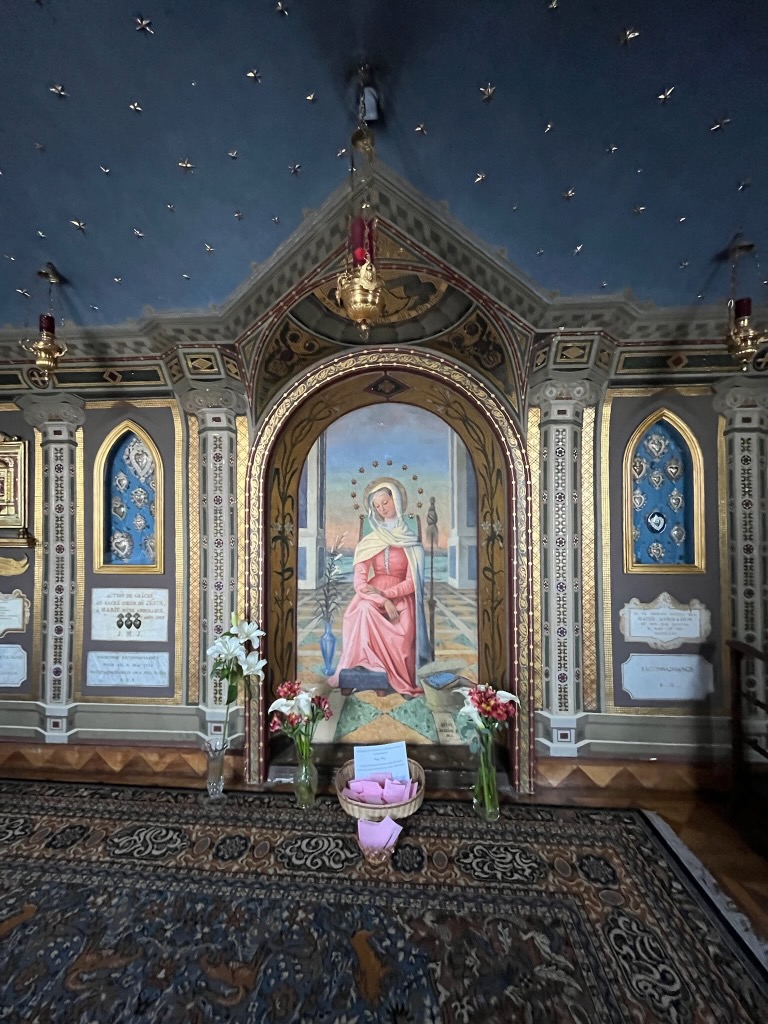
my mama, a girl who grew up in a convent where the nuns taught her to curtsy each time she dashed past the statue of the Pink Madonna (a story is told that one of the nuns–these are Sacred Heart nuns–once tried to paint a portrait of the Blessed Virgin Mary, and what she painted was so godawful, they tossed a rug over the thing, to hide it, and some time later when the rug was pulled off, lo and behold, there was a breathtakingly beautiful Mother of God decked out not in the usual blue but in pink. thus, the Pink Madonna that Sacred Heart girls (and their dutiful daughters) seek out whenever and wherever in the world they sense themselves in breathing distance of one of the few extant copies), my mama, as devout as the day is long, is far more radical than you might imagine for a girl who grew up in a convent in the most parochial burg of cincinnati, ohio. and that might be one of the things i treasure most about my mama.

and maybe that has something to do with my unwavering quest to find my way in this world along a path populated by sages, and not always of the churchly persuasion. i find holiness in unorthodox moments and places and, often, smack dab in the thick of a sentence.

i might not belong to a particular church these days. but i gather a goodly––and godly––congregation of pathfinders along my way. my church, quite often, rises up from the page.

i read, hour by hour, and day after day, with an eye out for wisdoms and truths, and guideposts to stir me. something akin to wandering an orchard, plucking from trees the lushest of fruits. i find my convictions deepened. my heart, often on fire. my intent: to make this blip that is my life as blessed as i can make it. i live by a gospel of love, one with an emphasis on that which is tender, and gentle not harsh. i believe, more and more, in humility. in understanding how little i know. and how much there is still for me to learn. to understand.

we live in a world that some days feels like it’s spewing all that i detest: there is cruelty, and hubris, and parading around as if no one else matters.

but then i open a book. or click on a text from a most blessed friend. and i read words that resonate. that underscore what seems to be Truth with a capital T. and i feel less alone, and less lost.

these are the lines that spoke to me this week in this holy space of my own making; one is from hafiz, the 14th-century sufi poet, another from thich nhat hanh, the blessed buddhist monk who died just two years ago, and the third is from greg boyle, the jesuit priest who founded Homeboy Industries, the world’s largest gang intervention and rehab program, based in east LA, and whose book, barking to the choir, is now on my most-wanted list.

first up, a prayer poem sent by a beloved friend, one from hafiz, the sufi poet, from a translation by daniel ladinsky, and which my blessed friend found in the pages of greg boyle’s barking to the choir:

Every child has known God,
Not the God of names,
Not the God of don’ts,
Not the God who ever does anything weird,
But the God who knows only four words.
And keeps repeating them, saying:
“Come Dance with Me, come dance.”

i love a God who whirls with me, who invites me into the dance.


next up, thich nhat hanh:

Understanding someone’s suffering is the best gift you can give another person. Understanding is love’s other name. If you don’t understand, you can’t love.

oh, that we should enter deep into the wounds of another. and therein find the walls of our own hearts widening and deepening, and our compulsion to hold a trembling hand the surest thing we can do.


and, finally, once down the greg boyle rabbit hole, i just got deeper and deeper, and then i found this:

“For unless love becomes tenderness—the connective tissue of love—it never becomes transformational. The tender doesn’t happen tomorrow . . . only now.” 

― Gregory Boyle, Barking to the Choir: The Power of Radical Kinship

tenderness, the connective tissue of love . . .

to which i whisper, amen

who do you gather in your congregation of sages?

photo above, of Mater Admirabilis, the Pink Madonna, is from our trip to rome back in may, during which, dutiful daughter that i am, i trekked to the top of the Spanish Steps, rang a bell at the convent of the sacred heart (my mother’s breed of nuns), turned over my passport for entry to the upper chapel where Our Lady resides, and beheld her.

all these years later

forty-four cakes. three-thousand-two-hundred-seventy-eight candles. that’s how many cakes and candles we’ve missed since my papa died in the winter of 1981. i counted it up because today would have been his 96th birthday. he didn’t make it past 52. 

all these years later the second of august is still a day i remember.

i remember the sunny sunday mornings when honeydew melon and handmade cards were strewn at his place at the dining room table, birthday brunch a step-up from the requisite eggs, bacon, and toast after ten-o’clock mass. i remember, in the preambles to birthday dinner, the glistening of his pewter mug, summer’s sultry humidity meeting the cold of his ice cubes and tonic and gin. the quarter of lime floating canoe-like near the rim. eight-minute burgers on the grill, corn on the cob littering all of our chins. 

i remember his laugh. 

much, though, fades.

i can’t remember the sound of his voice. or the way he called me barbie. i remember a few lines, but not the ones my brothers often remember. i remember the time he told me he’d prayed and prayed and could not understand why he was driving me to the hospital. i remember the time, driving home from my college graduation, when he told me he’d felt his mother right beside him when they called out the names of those who, like him long before, were graduating with highest latin honors, and he watched me rise from my seat in the crowded arena. 

i remember how one late summer’s afternoon he called me from the office and asked me to meet him for burgers on the outdoor cafe of a place called jerome’s in lincoln park, a place he deemed “kicky.” my papa liked things that were “kicky” or “cool.” my papa, born of a locomotive engineer and a country school teacher in little bitty paris, kentucky, never shed the marvel of being a big-city ad man in the heady era of Mad Men and martini lunches and sixty-second commercials whose jingles and cutlines stoked the soundtrack of america’s bell-bottomed woodstock-and-watergate age. my papa liked to travel the globe. to give speeches in sydney and meetings in munich. he liked his corporate apartment in mid-town manhattan. he loved new york city. a place he never wanted to move us; he’d moved his moptop crew too many times, he and my mama agreed. one more uprooting might do us in. so he more or less made a weekly commute to the big juicy apple.

and home base for all those years was the two-story colonial with all the big trees at the bend in the dead-end lane. he brought the “neat, keen, cool, fab, it’s a blast” to our dutch backdoor, and on in to the big oval table where, at 6:30 sharp each night of the week except for on sunday when we pushed it to 5:30, we sat down for dinner, all seven of us. if there was something new out there in the world, my papa wanted us to know. didn’t matter if it was a word or a box soon to be labeled “hamburger helper.” he was our conduit, our passport, to all that was grander and jazzier than our sleepy little burg one in from the lake. 

those are the things, all these decades later, i still remember––like yesterday. i remember, too, the year after he died when i thought i might never stop crying. how there were nights when i wailed a wild-animal sort of a wail, and bit into my pillow to muffle the sound. i never thought i would know joy again. 

i never thought the ache would stop aching.

but here we are: two kids, a long marriage, and a whole career later. my papa had no idea i––a nurse when he died––would take his and my shared love of words and make a life of it. but the first day i sat down in the chicago tribune newsroom and they told me i needed a password, i knew just what i’d type each time i needed to rev up my desktop computer: my papa’s initials and mine; he was a part of every start to every story. and i never dropped his last name, cuz i wanted my papa to stay in the news. and in print. day after day. byline by byline. 

here’s where i fell short: no matter how many stories i’ve told my boys and the man i love the most, i have not come close to bringing my papa to life. and, believe me, i’ve tried. no story, no matter how animated, no matter the gleam in my eye, can ever, ever come close. the man was a human high-wattage bulb. he was known for his wit. but i remember the tenderest parts. i’ve tried to bring all of it forth over the years. 

but all these years later, it fades. and the truth is, my papa fades too. there’s too much i cannot remember. 

grief and time make for an odd, sometimes cruel calculus. yes, the aching abates most of the time. though the piercing can come and come strong. in a grocery aisle. when a certain song comes on. when you’re trying to tell––or to catch every word of––a particular story. (writing these words here this morning, the tears have come too. if i’ve wallowed in moments, in memories, here, it’s only to make it all last. to live in those moments again.) 

as much as the gasping for air is no longer a part of the grief, so too the frames of a life reel on, and the erasing begins. after so, so many years, you sometimes forget the one who’s no longer there. not always, and not in those crucible moments, when time itself feels condensed and magnified all at once. i too have felt my papa beside me when my firstborn walked a graduation stage; when my firstborn became a professor of law (a profession my papa once yearned for). i’ve watched how tender my so-called “little one” is, especially to my papa’s widow (“grammy” to both of my boys), and i know my papa would melt. but, truth is, ordinary time mostly hurls by, and i don’t remember. and then i might catch myself with a twinge. or i might not catch myself at all. there’s an anesthesia in grief that i never saw coming. maybe it saves us. maybe it’s cruel.

maybe that’s why there are birthdays, even when the someone is gone. especially when someone is gone. they become remembering days. they are days without cakes and no candles. but, in the silent chambers of the heart and the mind and the soul where time knows no rules, those someones return. 

my papa rumbles in me this morning. in the only way i know how, i just brought him back. and i didn’t need to close my eyes, or make a wish, or blow out candles to make it happen.

he’s here. right beside me. in each of these stories. i know it.

happy birthday, dear papa. i love you forever.

at our house, we have an august birthday parade, a 2-4-6-8 of celebrations. so most blessed of birthdays i wish for my brother david (4), my blair(6), my teddy(8). i love you each and all to the moon and mars and beyond.…

tell a story of any someone you miss. any story. any someone. we’ll make this a party.

my papa and me

summer is for cooking. no, really.

when the day presents itself as sooty afghan, gray and soft and without shadow. when the air is cool, so cool that cranking the oven is not an act of self-destruction. when the bins at farmers’ market are nearly tumbling to the parking lot below, so weighted by their zaftig field-plucked wares. well, on summer days like that the itch to cook begins.

and so it was the other morning i woke up with eggplant visions. eggplant layered lushly with cheesy-herby oozy pillows in between. all bathed in marinara. baked. dubbed summer’s abbondonza eggplant lasagna.

i promised easy reading here in summer time. and thus, below, i keep my promise, with nothing more strenuous to read than a grocery list of things to gather, and step-by-step notes so you can play along.

abbondonza eggplant lasagna, with more than a few idiosyncratic twists

(as always, i read a few recipes, extract a few cues and follow my whims from there. this began from something that zipped by me on instagram, and led me to a website called mediterranean something or other, and wound up so delicious i gobbled two oozy squares the size of my dinner plate. my annotations below in italics, which is basically me talking back to the recipe. . .)

Ingredients

2 to 3 eggplants (about 1 ½ pounds), sliced lengthwise into ½-inch thick slices (about 10 to 12 slices)
1 zucchini, sliced into coins (or honestly any shape you choose)
1 pint cherry tomatoes
Extra virgin olive oil
Kosher salt
1 large egg
1 15-oz tub part-skim ricotta cheese
1 ½ cup part-skim mozzarella cheese, divided
½ cup grated Parmesan cheese, divided
3 garlic cloves minced (i squeezed mine through garlic press)
1 teaspoon dried oregano
10 oz frozen spinach, thawed and fully dried (wring out all the water)
1 cup packed chopped fresh parsley
½ cup packed chopped fresh basil, ⅔ ounce
Black pepper to your liking
2 generous cups marinara sauce of choice (i used trader giotto’s organic tomato basil marinara)

Instructions

  • Season the eggplant slices on both sides with kosher salt and set aside for 20 to 30 minutes (if you don’t have the time, this step can be optional). i skipped this part, because i didn’t have time and because i recently read that these days eggplant has been cured of its bitterness.
  • Meanwhile, preheat the oven to 400 degrees F and position a rack in the middle.
  • Wipe the eggplant slices very well with a paper towel (you want to dry it well and remove any excess salt), then arrange on parchment-lined baking sheet (or two if needed). Brush both sides of the eggplant with extra virgin olive oil. Roast in the heated oven until the eggplant softens and becomes pliable (about 15 to 20 minutes or so on the first side, at least another 10 minutes for the B side, which might be because i have a cranky old oven). to this step i added sliced zucchini, and a tub of cherry tomatoes, similarly brushed with oil, and roasted on their own sheet pan.
  • While the eggplant, zucchini, and tomatoes are roasting, prepare the ricotta filling. In a mixing bowl, beat the egg. Add the ricotta, 1 cup mozzarella, ¼ Parmesan, garlic, oregano, spinach and chopped herbs. Add a small pinch of kosher salt and black pepper to your liking. Mix well to combine. i wandered out to my so-called farm (a raised bed alongside the back alley) and snipped a cup’s worth of basil and another of flat-leaf parsley; the freshness filled the air surrounding my cutting board.
  • Remove the eggplant, zucchini, and cherry tomatoes from the oven. Lower the heat to 375 degrees F.
  • Prepare a 9 x 13-inch baking dish. Pour a bit of the pasta sauce (i used 1 cup of trader joe’s marinara) and spread it out into one layer. Lay a few eggplant slices (anywhere from 4 to 6 and it’s fine if they overlap a bit). Next, add half the zucchini slices and half the roasted cherry tomatoes. Spread 1/2 of the ricotta filling, then spread a thin layer of the sauce. Repeat the process in the same pattern. Spread the final layer of sauce and follow with the remaining ½ cup mozzarella cheese and ¼ cup of Parmesan.
  • Cover the dish tightly with foil. Bake in the heated oven for 15 to 20 minutes, then carefully uncover and return to the oven. Bake for another 10 to 20 minutes or until the cheese has melted and the edges of the lasagna turn a nice golden brown.
  • Let the lasagna rest for 10 minutes before cutting and serving.
  • Slice and savor. And then daydream about it till you get around to making it again.

not all who wander to the chair believe in the stove as kitchen essential, and thus for those good souls and anyone else who never minds a blessing, here’s a treasure sent to me weeks back by dear beloved chair friend nan. it’s a blessing from kate bowler, who is herself something of a wonder. a four-times NYT best-selling author, a professor of american religious history at duke divinity school, the scholar who wrote the book on the prosperity gospel, a wife and mother and 35-year-old when she was diagnosed with stage IV colon cancer, deemed incurable, and now (nine years later) is cancer-free, she’s taken as her mission “giving you permission to be human.” fully human: warts, dents, soft spots, wonders, glories, whole truths and nothing but the truths.

i’ve been in a room where kate was speaking and she is hilarious. and self-deprecating. and doesn’t present herself as the eighth wonder of the world (which isn’t always the case at writing festivals that showcase those who’ve gained fame by building sentences that grow into paragraphs that fly off the shelves and rack up fine profits). so, with no further ado, and deep thanks to our beloved nan, here is a blessing from kate that, to my mind, gets to the heart of so much that matters:

the blessing above is from kate’s book of blessings, co-written with the lovely jessica richie, and titled “The Lives We Actually Have: 100 Blessings for Imperfect Days.”

may all of us work to be the ones who notice the light in their eyes, or when that light dims, and to always not be afraid of scooting up close, close as need be, to their suffering.

and that’s the news from the summer kitchen this week. xox

where did you find blessing this week, at the cookstove or otherwise?

the loads beyond measure

sometimes a batch of words comes tumbling into our world, fluttering onto the path we cross as if the petals from an apple blossom whose bloom has expired. the words come unannounced, and lay there waiting for us to notice. once we read them we can’t think of anything else. all day long, all our thoughts come round to them again and again. 

so it was when a friend whose grief is without measure sent along these words the other morning:

I have been telling myself that I don’t know how to do this, that nothing has prepared me.

i’ve been thinking long and hard about those loads we’re tasked to carry. how every one of us, at some time or another, is bound to have one. a load so beyond measure, a load we never saw coming, it simply stumbles us, knocks us flat and gasping. and in the depth of our hollows — if we’re telling truth — we mouth those very words: “i don’t know how to do this. . . . nothing has prepared me.”

all we see is steep climbing ahead. a load we don’t know how to hold. and all we’ve got to bear it are our stubby shuffling feet, and a ribcage that holds the parts of us that breathe and pump the oxygen. our shoulders and our spine we fear will crumple under the weight of it. 

and then there’s the beehive of a brain, where all the wiring and the worrying, where all the remembering and the grieving and the what-iffing and the if-onlying whirs in and out at every turn in every hour of the day. 

the poet and collagist jan richardson put it like this in her “blessing for the dailiness of grief”:

It will take your breath away,
how the grieving waits for you
in the most ordinary moments.

It will wake
with your waking.

It will
sit itself down
with you at the table,
inhabiting the precise shape
of the emptiness
across from you.

It will walk down the street
with you
in the form of
no hand reaching out
to take yours. . . .

but here, maybe, is what we need to remember, to bear the load we’re sure will finally be the one we cannot budge or bear: our whole life long, we’ve been preparing. every hurt and insult hurled our way. the time in third grade when we cried because the kid one desk over made fun of our clunky shoes. but, next morning, we tied their laces into bows and we walked back in the classroom, and sat there all day long, learning how it is to become more than the stubby shoes that were not penny loafers. the time in high school, when someone in the hall pointed at us and said our face looked like someone smashed us flat against a wall. and it stung for weeks after, every time we stood before a mirror and turned this way and that to measure just how flat our irish face really was. 

and then the big ones come: the time the doctor walked up to the knot of us coagulated in the hospital corridor, and simply said, “i’m sorry.” and we were left without air in our lungs, and with the sudden senseless knowing that the brightest light in our existence had just gone dark. forever.

or the night the clots kept coming. and at last the tiny, tiny arms and legs, the intricately blessed face i’ll never forget, as the baby i thought i was having was cupped in the palms of my bloody hands, the miscarriage that hurt the most. 

the litany is plenty long. and we sometimes never notice just how much each ache is strengthening the fibers of the muscle group without a name, the one that holds us up — yes, wobbling at first; yes, stained with umpteen tears; yes, with sleepless sleepless night — but the one that, in the end, does not fail us. 

we are stronger than we know. and, all along, we’ve been piling on the sinew, deepening the courage, deep breathing the determination, to look that unbearable load square in the eyes, to say, “climb on. i’ll carry you.”

just watch. 

and then, at last, there comes this (jan richardson again, this time “blessing of breathing”):

That the first breath
will come without fear.


That the second breath
will come without pain.

The third breath:
that it will come without despair.

until at last . . .

When the tenth breath comes,
may it be for us
to breathe together,
and the next,
and the next,

until our breathing
is as one,
until our breathing
is no more.

my dear and blessed friend, and all who bear loads they deem unbearable, you do know how to do this. deep in your marrow, you know. your whole life long you’ve been growing strong and stronger. you’ve got this, and you’ve got this. and if and when you stumble, we are here with our simple grace and our love that will not falter. 

where did you find the strength you did not know was yours?

PS (note the all caps!): it’s the birthday sunday of one of the wise women of the chair, our very own lamcal, and i can’t gather up enough love in my bouquet to sufficiently surround her. she is beyond measure! happy blessed day, beautiful one. xoxox and happy mothering day who all who love in that way that knows no end….

sunshine girl

i tend toward the grays. and i don’t mean the pewter locks atop my head. i refer here to my meteorological preferences.

i’m of celtic persuasion, which means a pigeon-colored sky, preferably with mists rolling in, a landscape without shadow, for clouds are in the way, that’s the sort of day that wraps me like an afghan dropped from heaven’s hutch, makes me feel cozied by the hearth, deeply much at home. 

give me a gray day and i all but purr. 

this week, though, has been anomaly. the sunbeams of this latest swatch of springtime have been pouring in full proof, and voluptuously so. sunbeams so pure, so concentrated, i’ve bridled the urge to stick out my tongue and lick them––as if a gelato on a cone. or gulp, as if a nectar in the most delicate cut-glass flute that ever was.

it wasn’t lost on me how novel it was for me to be fixated––and bedazzled––by the motes of sunlight shafting in. it shook me from some rafters i’d not even realized had boxed me in. i was paying attention to my paying attention. an attunement to the nth power. and the simple substance that transfixed me was but one of that elemental trilogy: sunlight, water, air. 

to live in a state of fine-grained attentiveness is the instructive of every sage or prophet who’s walked this sunlit earth. for us to notice celestial shifts, as winter turns to spring, as the great star is jimmied higher into sky, must be God’s rapturous delight.

and i must have been more sun-starved than i realized after a long and washed-out winter, for i couldn’t keep myself inside the house this whole week long. i was all but stripping bare my crepe-papery arms and legs, so my famished flesh could guzzle sun. and, every chance i got (and even those i didn’t have), i found myself down on my knees, at the garden’s edge, wherever tender growing things gave me excuse to coax and coddle and slapdash in the dirt. 

from nearly sun-up to sundown, i was out and about, clocking miles on my soles, slip-sliding along a river trail, dodging red-winged blackbirds who tried to perforate my noggin. and, when my legs and knees were tuckered out, i sat splotched in sprees of golden light as i perched, robin-like, atop a rock or stoop, keeping watch on flutterings in trees. 

i’m not typically a sunshine girl. despite a nomenclature suggesting otherwise.

my papa and me (aka his “sunshine girl”)

long long ago, there was a fine irishman––my witty papa––who pinned a moniker on me back in the days when i’d take him by the hand and maybe reach just beyond his knees. he called me his sunshine girl, his one and only, and it’s a name that makes my knees go limp even to this day. 

i’ve not heard his voice in 43 years, but i can see the glint in his eyes, the way the pilot light burned bright and brighter, as he warmed up to pronounce the words, deeming me his sunlit girl. 

i rather fail my reputation.

in the long years of his absence, i’ve grown more inclined to sunshine’s shadowless counterpart, the days some define as “the color of bad weather.” i protest, tend to be of a mind with leo da vinci, the polymath and painter, who insisted “a gray day provides the best light.”

though not this golden-glowing week. and not without exception.  

like the poets emily D and annie dillard, i like my light in slants, or as dillard put it once: “i’m a collector” of such angled penetrations. the oblique is how i see things best.

most days, pure drenched feels too exposed. the white light of summer’s height makes me wither. 

springtime, though, is tender season. and the sunlight comes in slant, in perfect concentration. and every once in a rare while, in days as delicious as the sun-drenched string that was this week, i’ll gulp my yearly dose of solar plenty. and i’ll gulp it without pause. 


speaking of sunshine and the irish, here’s a line that made me laugh aloud this week:

“the sad truth is that, like fish, the looks of the irish are not improved by sunshine . . .”

—Niall Williams, This is Happiness, page 193


and as is my wont, i’ll bring mary oliver into the conversation, as she came to mind more than once when i was down on my garden knees this week: in “the summer’s day,” she writes:

“I don’t know exactly what a prayer is. /  I do know how to pay attention, how to fall down / into the grass, how to kneel down in the grass, / how to be idle and blessed.”

and, lastly, i zoomed into a poetry conversation with the poet (and yale institute of sacred music professor) christian wiman the other day, and he was asked to read a poem that shocks right through him, and here’s the one he read: 

Prayer
by Carol Ann Duffy

Some days, although we cannot pray, a prayer
utters itself. So, a woman will lift
her head from the sieve of her hands and stare
at the minims sung by a tree, a sudden gift.

Some nights, although we are faithless, the truth
enters our hearts, that small familiar pain;
then a man will stand stock-still, hearing his youth
in the distant Latin chanting of a train.

Pray for us now. Grade 1 piano scales
console the lodger looking out across
a Midlands town. Then dusk, and someone calls
a child's name as though they named their loss.

Darkness outside. Inside, the radio's prayer —
Rockall. Malin. Dogger. Finisterre.

(the four names in the last line are towns called out on BBC radio’s nightly “shipping forecast” for the various seas around the british isles, waters divided into 31 sea areas, including rockall, malin, dogger, and finisterre. the broadcast litanies, especially the late-at-night ones, are for many britons––including carol ann duffy––a familiar touchstone: the announcer’s voice reciting the sea areas all around the islands, one by one, forecasting the weather. and, higher up, minims are the half-notes in a page of musical notation)

of all the meteorological options, which one most floats your boat? and how and why?

amid the dizzyings of springtime…

i imagine it’s been well-established that i am of the homebody persuasion. the sort of girl who thrums inside the cozy confines of space and time i know by heart. to plop behind the wheel and point myself in a direction i’ve not been is, well, to stretch me. to accelerate the tempo of my little heart, to bring on the rumblies in my tummy. and so it was as i set out for The Driftless (a topography that deserves every drop of its capital consonants) a week ago today.

for starters, i got lost. yes, yes, after dutifully trying to follow my index-card directions through country roads and farmer fields, i decided maybe it was safer to let the little voice tell me where to go rather than glancing down and trying to find the numbers i had scribbled. well, news flash: there are TWO mineral points in ol’ wisconsin, and the one i was steered toward was the one in otherwise unmarked farrow field. that little voice announced, “you’ve arrived. your destination is on the right,” whilst i looked up and saw literally nothing but an undulating plot of shaved-off stalks. hmm. this must not be, i intuitively surmised.

i was miles from nowhere, and 67 miles from where i needed to be. where the world’s loveliest host had a turkey meatloaf in the oven, and asparagus steaming in a skillet. ah, but in due time, rollercoastering along country roads, past baby calves (yes, i know it’s redundant, but i like to say it that way) all gathered under little calf-ling igloos, which must be the latest in dairy husbandry for each baby calf had its own domed shelter, and a place to escape the drifting snows, past rock formations that felt prehistoric or laid there by ancient peoples, through towns that time forgot and that i prayed still stuck to old ways, and not the toxic juice that’s infected so very much of old america, i pulled in the gravel lane that was my destination.

and, from the first footfall inside the charming farmhouse, i was home. daffodils and aldo leopold awaited on the bedside table, and the bed itself was a cloud of comforters. each morning that sunrise above greeted me from the kitchen windows. and each morning, it took my breath away, and filled me with holy airs.

the folks i met were as fine and fluent in the poetries of earth as any souls i’ve met along my way. i met a farmer who plows his field with draft horses, and writes letters back and forth with wendell berry (be still my heart!). and another farmer who used to cook at chez panisse. (yes, that chez panisse, the one in berkeley CA, where alice waters revolutionized the kitchen.) i scrubbed pots and pans beside a woman whose heart must pump in gold. and i heard tales of keeping watch on eagles’ nests.

and then, come sunday morning, after hiking through the woods, and talking books in a charming indie book store (where croissants were rising in the ovens behind me), i took to the pulpit in a little country church to deliver what you might call the sermon, but which the priest referred to as a “reflection” since i’ve not passed the sermon-licensing exams. and as i wove threads from the doubting thomas gospel and the book of nature’s sometimes tangible God, i looked out on a congregation of fine souls who were listening in a way i’ve never known: heads cocked, a posture of deep attentiveness, eyes on the pulpit, you could hear a pin drop in that blessed church. and i saw how good souls are hungry for a word of wisdom with their sunday-morning coffee. if this is church, and i do believe it is, may we become a people who know to carve out time to put down phones, dial down the pings, and find our way to wherever it is the holy wisdoms come.

not an hour later, the whole adventure in soul-stretching reached its crescendo when every last soul at the basement coffee hour stood and raised an arm toward me, or laid a hand on my shoulders, and at the behest of the priest, father christian was his name, blessed me with a prayer that had me all but gulping back a walloping sob. when i felt the tiny hand of father christian’s little boy, a kid with special needs, squeezing my left arm, i really truly nearly lost it, as they say. instead, i held his hand and together we squeezed and prayed all the way to the last amen.

and then i motored home, not quite the way i got there. and forever deepened and shifted by the glorious goodness of my new friends who dwell in the driftless.


i came home, of course, to sunlight-blocking moon, and a garden erupting in springtime’s accelerandos. and i spent a good bit of week deep-breathing all of that, and getting mighty muddy too. but i also came home to friends who are grieving inconceivable losses. and when i found this prayer-poem from jan richardson, i knew i needed to pass it along. so, here, too, for all of you is a poem to keep for when grief comes to you or someone you love, or even someone you might not know too well at all. jan is a poet, artist, ordained minister in the united methodist church. i was introduced to her years ago now, by my very own night chaplain (slj to all of you, a regular visitor here at the chair). and as jan’s life was torn open by the sudden death of her husband, she has only deepened. and her work all the more mesmerizing. this is from not long after the death of her husband, when she was coming up on her first valentine’s day without him. her words are among the truest i’ve ever read. she is pure blessing.

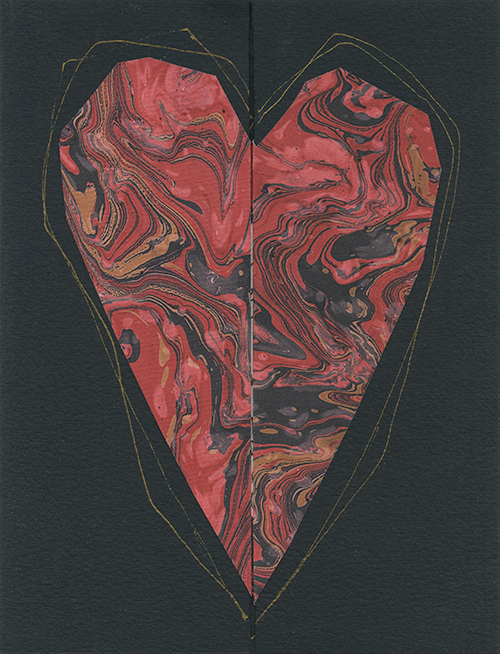
Image: Valentine © Jan Richardson

Blessing for the Brokenhearted

There is no remedy for love but to love more.
—Henry David Thoreau

Let us agree
for now
that we will not say
the breaking
makes us stronger
or that it is better
to have this pain
than to have done
without this love.

Let us promise
we will not
tell ourselves
time will heal
the wound,
when every day
our waking
opens it anew.

Perhaps for now
it can be enough
to simply marvel
at the mystery
of how a heart
so broken
can go on beating,
as if it were made
for precisely this—

as if it knows
the only cure for love
is more of it,

as if it sees
the heart’s sole remedy
for breaking
is to love still,

as if it trusts
that its own
persistent pulse
is the rhythm
of a blessing
we cannot
begin to fathom
but will save us
nonetheless.

—Jan Richardson

This blessing appears in Jan’s book, The Cure for Sorrow.

gremlins seem to be lurking here this morning, so let us see if we can fling this to the cyberwires that carry this from my kitchen table to yours. question for the day, besides “will this work?” is where did you find holiness this week? 

and here is a special wink and nod for the great good souls i didn’t get to mention above: the glass sculptor who sailed the world before planting herself on high street, in downtown mineral point. the ones who’d taught for years and years in alaska before sinking deep roots in driftless loam. the bibliophile who opened an indie bookstore, and thought to attach a cooking school besides. and most of all to jane, my storytelling hostess whose graces left me nothing short of gobsmacked.