how not to get sucked into the cesspool, or the tarpit of utter despair.
there are flocks of us, bumbling around, looking down at our weathered, timeworn selves, our selves that are wrinkled or missing some parts, wondering what in tarnation little old me can do about this. all of this chaos, all of this cruelty, all of this jaw-dropping gilding and seizing of power, all of this thuggery, what in the heck can i do?
it’s pretty much the question that runs on auto-pilot through the spheres of my brain.
what oh what oh what?
i turn to the poets, i turn to the pacifists. this week i found myself in the pages of history. more and more i am drawn to the plain old truths of our not-yet-extinguished civilization.
as a species we’ve been cruel from the start, that’s a streak that runs in us. we’ve had so much darkness it makes me want to run for the hills. no wonder the desert elders of the third and fourth centuries did just that, ducked out in far-flung caves and barely ever came out. they just prayed and prayed, imagined God as their next-door neighbor and turned their humble selves into living, breathing prayer altars.
but, just as emphatically, there’ve always been those who turned the other cheek, who refused to partake in whatever the scourge of the age. who did not give up on the vision of radiance, of equal justice for all. there have always been those who heeded the words of the jew from bethlehem: blessed are the poor in spirit, the meek, the merciful, those who hunger for righteousness, blessed are the peacemakers. jesus didn’t even make it to ten. he cut off the list at eight. later on, he threw in “love as you would be loved,” which is actually a teaching he would have learned in the temple, leviticus 19:18, “love your neighbor as yourself.” (i hate to break it to christians, but we’ve no corner on that commandment, it’s as old as time, and core of nearly all world religions.)
it’s the revolutionaries, the radicals, the refuseniks who would not succumb, they’re the ones who might hold the clues: how to be a force against daily injustice when all you’ve got is your will and your hope and your deadset compass pointed at kindness, at mercy, at justice for all.
their point, the refuseniks, ever has been thus: we cannot decide that we’re not equipped. we cannot throw in the towel. the heroes of history usually don’t come with superman capes. it’s people like us, with a limp or a lisp, figuratively or literally, who might look in the mirror and decide, “i’m all i’ve got, so i’d best get to work.”
which brings us back to the cruelty and chaos du jour.
this week, beating back the latest bout of teeming futility and powerlessness, against the backdrop of scenes i’d not imagined emerging from the american landscape—federalized gangs knocking heads against pavement, crushing ribcages under the weight of full-body clutch holds, beaning clergy in the head with pepper balls, and most recently dragging a preschool teacher from her classroom in front of her gaggle of toddlers—i found myself once again on the prowl for what in the world little old me might do to push back against any of this, to counter the cloak of rampant despair.
and i found it—curiously, plainspokenly—in the introduction to a book of letters from prison, specifically the gdansk prison during poland’s communist takeover by the totalitarian regime that clamped down cruelly on every facet of daily life in the last decades of the 20th century.
adam michnik
adam michnik, an irrepressible political activist, is the writer of the letters, a lifelong dissident first arrested at 18 for partaking in the writing and dissemination of “an open letter to the party,” critical of the communist regime. he would become one of the leaders of the solidarity movement that in 1989 ended communist rule in poland, and went on to become editor-in-chief of Gazeta Wyborcza, credited with elevating the newspaper to become “a sort of conscience of the New Poland.” he rightfully lays claim to a life spent provoking debate on democracy and human rights.
during that lifetime, punctuated by intervals of activism followed by imprisonment, again and again, michnik often found himself in jail cells where he forged his activism with pen and paper, his letters and essays smuggled out of prison, and widely distributed on the far side of the prison walls.
what i find especially notable about his essays, as i rail against blatant mis- and dis-information in our clickbait age, is that his essays were then and still now are considered models of balance and fairness. what drove him was a singular concern for “deepening his own and others’ understanding, and therefore he [could] not afford the luxury of distortion for partisan reasons.” (emphasis mine). oh, that we should emulate his restraint, seize his clear-eyed purpose.
while ours certainly isn’t a national moment that rises to the level of “organized evil” of poland’s totalitarian regime, it seems fair to say we’re witnessing “authoritarian adjacent” dictates and dramas, particularly in the demonization of the helpless, and the thuggery thrust viciously upon them.
and so, turning to even darker moments in history, we find our cues.
in the introduction of michnik’s letters from prison and other essays, the new yorker’s longtime foreign policy analyst, jonathan schell, captured michnik’s revolutionary counter-revolutionary approach.
he leads into it by first laying out the norm in mapping revolution, and illustrating how the poles turned it on its head, ultimately triumphantly: “the classic formula for revolution is first to seize power and then to use that power to do the good things you believe in. in the polish revolution, the order was reversed. it began to do the good things immediately, and only then turned its attention to the state. in a sort of political and moral version of the hedonist’s credo, ‘carpe diem,’ the opposition proceeded directly, and without postponement toward its goals. its simple but radical guiding principle . . .”
what comes next seems to me the wisest, most doable action we might take:
“Start doing the things you think should be done, and . . . start being what you think society should become. Do you believe in freedom of speech? Then speak freely. Do you love the truth? Then tell it. Do you believe in an open society? Then act in the open. Do you believe in a decent and humane society? Then behave decently and humanely.”
do not succumb to the ways of the demonizers, the clickbaiters, the shills for distortion, deceit, and demagoguery.
put simply: love as you would be loved.
or, in the words of james baldwin: “the place in which i’ll fit will not exist until i make it.”
so, go make it.
how would you describe the world in which you pray to live?
i emerge here from a day of prayer, a day of poring over the sins of my soul, and the sins of us all collectively. it is a day that’s not easy to leave behind. certainly not this year.
Yom Kippur, the day of atonement, opened with the rabbi once again sharing shattering news. a horror in manchester, england, he told us, without details, had left more than one dead.
morning light streamed in.
i felt us all move in closer, a natural deeply human instinct to harbor each other. it’s those natural instincts that tend to get drowned out on ordinary days, days when it’s noisy, days when we’re so distracted we don’t pay attention to the sound of our breath, the warmth of our skin, the deeply human instinct to run toward, not away, from someone who’s hurting.
we live in a world so distant now from the original vision. from an edenic world where boughs were bent from the heaviness of their fruits, where the silence allowed for the chorus of chirring and chirping to rise from the underbrush, from the branches. in the beginning, in the genesis, after the cascade of wonders—light, darkness, seas and sky, dry land and waters, seed-bearing plants and fruits with seeds buried inside, two great lights in heaven’s vault, the demarcation of day and night, teeming waters and birds filling the air, wild beasts and slithering, down-on-the-ground ones—the one who’d imagined it all, the one we name God, God looked down and saw still a void. how would the garden be tilled? how would it be kept?
and so God made beings in God’s own image, so genesis tells us. and for a short flash of time, man and woman lived in peaceful accord. but temptation arose. and it all shattered and changed. eden was no longer. the man and the woman were banned.
and all these millennia later, we are a people plagued by temptation. temptation of power, of greed, of malice and evil, of hurtful whisper, and weapons of war.
we have fallen so far from the garden of peace and tranquility.
and so, on Yom Kippur, we atone. all world religions, as far as i know, hold confession at the core, are built on the knowing that we will go wrong, exercise evil, traffic in hate.
and so, through the day, over and over and over again, we confess. we confess in short form and long form. we confess and confess, each go at it grating closer and closer to the core.
against the backdrop of the world in which we are living, these are a few of the confessions we prayed:
“The ways we have wronged you by hardening our hearts; and the harm we have caused in Your world through careless speech.”
“The ways we have wronged You by giving in to our hostile impulses; and the harm we have caused in Your world through inflexibility and stubbornness.”
or this, one of the pleas to the Almighty and Merciful, Avinu Malkeinu:
“Avinu Malkeinu, halt the reign of those who cause pain and terror.”
so ardently we confess and we pray.
to enter the sanctuary, be it the one of a synagogue or the one under the heavens in my own backyard, is to submit to a paradigm other than the distortions of a world ruled by greed, and power, and envy, and lust.
in these past godawful years, when i can almost hear the walls of decency and democracy crumbling, i retreat more and more into the sanctuary. the voice to whom i answer is that of the Merciful, Benevolent God, a God who is gentle, and tender, a God who seeps into the deepest parts of me, the parts where i surrender, where i know my place is so, so small, and yet, whatever light i can bring to this world, whatever infinitesimal flickering flame, it matters. because we are not the only flame. we inch closer together when word comes, once again, of horror and chaos and evil upon evil. we are many, many flames. or we can be. if we so choose.
it is a mighty thing to stand and sit through a day when over and over we confess our sins, our evils, our hurt-making acts. we are a nation that could do with a day of atoning.
and i am blessed that i, a lifelong believer in God’s tender mercy, was asked to atone for the sins of my own and the sins of us all.
i enter quietly back into this shattered, and shattering world.
i will not extinguish my faint little flame.
what will be your flame this holy day?
i leave you with words of john lewis, the late great hero of civil rights and warrior for justice:
Every human personality is something sacred, something special. We don’t have a right, as another person or as a nation, to destroy that spark of divinity, that spark of humanity, that is made and created in the image of God. —John Lewis
and should you care to be moved by one of the gentlest, fiercest spirits ever to walk among us, this beautiful interview, recorded just last week, of jane goodall, the great primatologist and anthropologist who died at 91 on wednesday. bless her, she was deep in her last book tour when her blessed heart beat its last.
i remember how, when there was a jane goodall special on national geographic, my mother would huddle us around the TV, for she was someone worthy, and i always found her a brilliant source of hope, kindness, an uncanny attunement with nature and nature’s creatures. i have prayed all my life to live to be a wise grace-filled woman like her…..wrinkles worn with dignity, hair whitened by the sun, wrapped in her shawl, at once wise and funny, of the moment and yet timeless. . . .
it started because months, or maybe years, ago, i stumbled onto a poem that took my breath away. it was written by a poet i’d not known of, didn’t think i’d ever read. but the poem, titled “Nativity,” stayed with me, a poem that paints the first Christmas scene in strokes and shades that settled deep into my marrow, and forever more are the Christmas i imagine.
it’s a poem that lays the baby Jesus in a rough-sawn barn, the air pungent with animal. “the wind tugging at the shutters.” there is nothing gilded about it. and it was written, i knew right away, by someone at ease with being small, tucked off in a corner keeping watch. it was written, i could tell, by someone whose very veins course with humility, and understood a God who preached the same, a God who asks us to get about the business, the holy business, of loving as we would be loved without noise or bombast or folderol.
it turns out he lives on an isle on the scottish west coast, a place where the wind might tug at shutters. and it turns out he is something of a polymath: a poet, a painter, a children’s book writer, a translator of great works. and, above all, something of a pilgrim, a pilgrim seeking the quiet beauties that punctuate the everyday. he calls them “atoms of delight.”
and he writes of pilgrimage: “the word is often used to describe the journey to a shrine or sanctuary in search of spiritual transformation, which is a meaning i acknowledge. but now pilgrimage has become a much bigger thing for me; it has gone far beyond that rather heavy and medieval sense of going on a journey to visit a holy site. why shouldn’t it be about a walk to a hill loch to listen to the impossibly beautiful singing of red-throated divers? why shouldn’t it be about a child running into the forest in the early morning to find the treasure they dreamed of? these are journeys of the heart, seeking the profoundly precious places where little miracles happen. and why shouldn’t it be about panentheism—the finding of God in all things?”
it’s not hard sometimes to recognize a kindred soul.
what is hard is to imagine finding yourself in conversation with such a kindred someone. but that’s what’s happened. kindness is the thing that opened the door, his kindness. in a world ruled by transaction, where fees are paid and contracts signed for any exchange of goods—be it words or bricks or lumber—kenneth steven lives otherwise.
i found that out not long ago, when, during the editing phase of my next book, i dove into the task called “permissions,” in which for any chunk of text—poetry or prose or lyrics to a song—beyond a certain measure, you must secure permissions from its author. this can be a costly exercise. and it is always one that makes me quiver, wondering what walls i’ll encounter, and what cold-shouldered hubris i might have to tiptoe through.
it’s that poem, “Nativity,” that’s stayed with me all these years. and i’d included the whole of it, eight lines, at the start of an essay that i hope to include in the book.
wondering if i was whistling into the wind, i sent off a proper letter, the digital kind, and shipped it cross the sea. i’d no idea if mr. kenneth steven would ever reply. but, lo and behold, come monday morning, there he was, tucked kindly in my mailbox. and more than generously writing: “of course you are more than welcome to use the poem. i’m sure you’ll mention where you found it.”
and thus, with the stroke of his generous heart, a friendship has unfolded. and a treasure trove of poetries have now brushed through me. and i am richer for this scottish friend who, as a boy, awoke one night at midnight, and hearing a great and ferocious wind, hurriedly dressed and left the house, where he climbed a hill in howling winds, before crossing through a field to reach his favorite tree, where he knew the horse chestnuts would be falling, and he was out to save them, to gather them up. “i felt given a whole world,” he writes in an essay about the midnight escapade. “it was about the autumn and the big winds, and the thrill of running up that long hill and entering the field at last at what felt like the middle of the night.” and the indescribable delight of knowing “that all this treasure was mine.” the treasure: a cloth bag of chestnuts shaken from the limbs, their deep and woody smell, orbs that looked as though they were made of shoe leather.
befriending him, he who writes me every day now, sometimes more than once a day, is magical. is akin to befriending any of the authors from my childhood who’ve long entranced me, drew me into storybook tableaus: tasha tudor; e.b. white; frances hodgson burnett, who wrote the 1911 children’s classic, the secret garden, a book that featured my holy trinity—an orphaned girl, a padlocked garden, and a robin redbreast that finds the key—and once prompted me to fake a fever so i could skip church one sunday to stay at home and turn its pages.
long ago, when i’d be asked if i’d ever want to write a book, i demurred, brushed away the thought. didn’t think i could hold a thought long enough to pen more than a few pages. i didn’t know, though, that the magic of a book comes in all the threads unspooled along the way. threads that carry me to places far and wide, and to souls i’d never otherwise know. but words, like little birds, or prairie seeds, catch on the wind and settle into fertile loam. and we are richer for them.
in much the way, my beloved chairs, through all the words and all the years, have become my dearest treasures.
bless you.
love, bam
have you a penpal in this digital, globe-crossing, email world? someone you’ve not met but who seems a certain friend?
i promised kenneth i would share word of his beautiful meditative podcast, Imagining Things, on the patreon platform. recorded in a studio that seems to be just behind his island home, you can sometimes hear the scottish winds blowing off the atlantic, and a bird or two not far away. (or maybe i’m imagining.) and of course he speaks in a scottish-soaked timbre, and in between reflections he shares poems that will make you hit rewind so you can listen once again, so breathtaking are the lines.
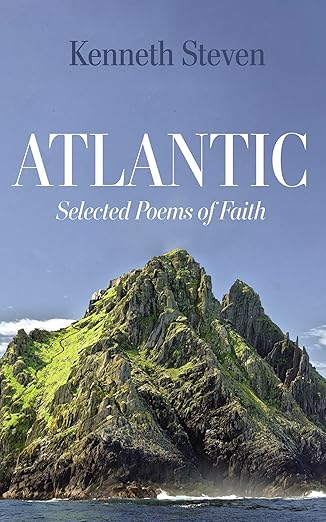
his latest book, one that should be landing on my front stoop within days, is Atlantic: Selected Poems of Faith. but i’m already deep into Atoms of Delight: Ten Pilgrimages in Nature, and Iona: New and Selected Poems.
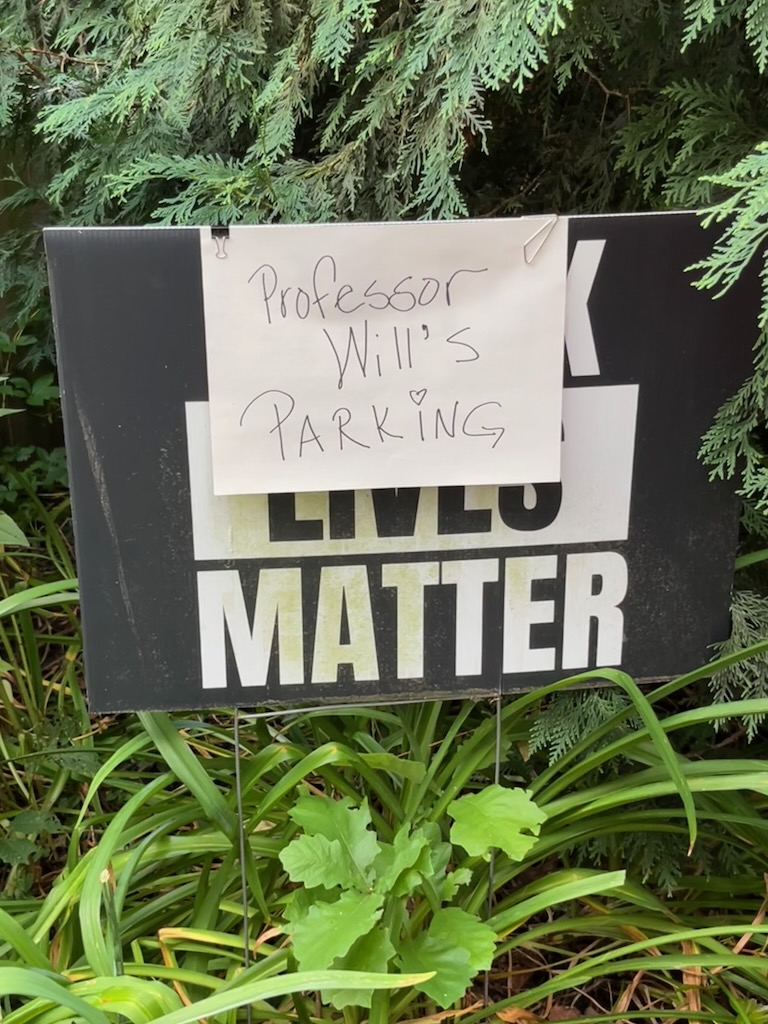
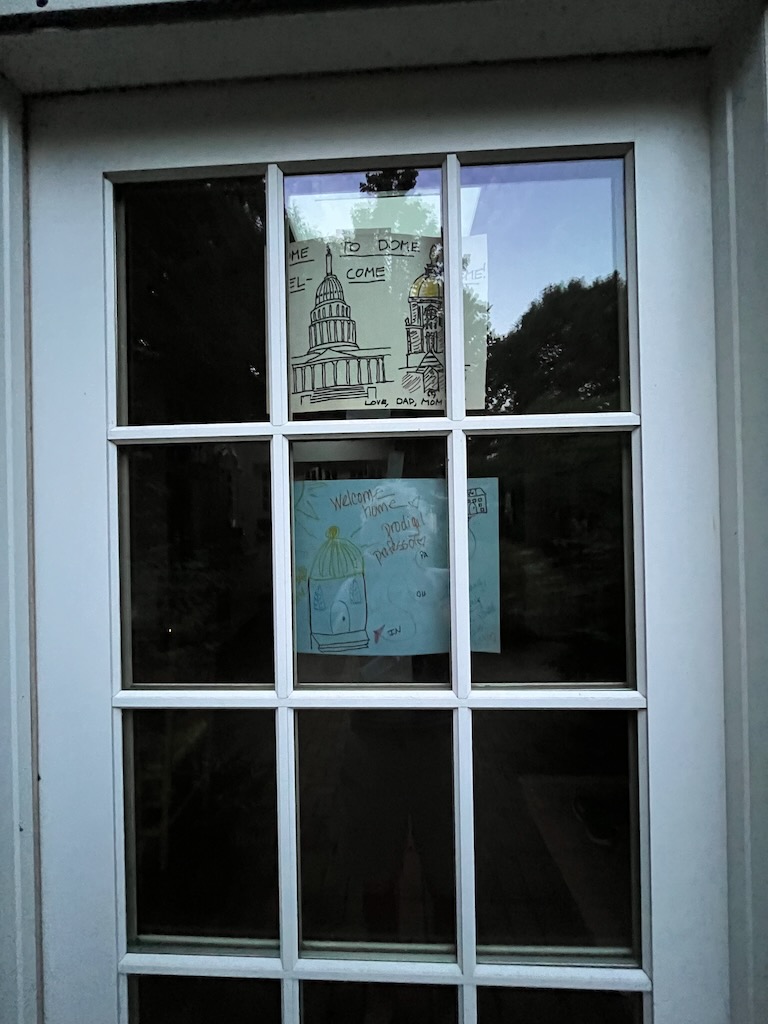
professorial parkingwe make welcome signs at our house‘from dome to dome, welcome home,” reads the top one.
i poured myself out of bed minutes before three last night, as i seem to do like an old swiss clock. and in the murk of the dark, as i stumbled toward the bathroom, a thought crept forth reminding me this wasn’t any old middle-of-the-night trip to the bathroom, this was a night in which the professor was in the house. sleeping under this old roof. back in the room where he grew up.
it’s been 13 years, and a whole lot of law school, and bar exams, and zigzagging across the country. there’ve been trips to the ER that scared the behoozies out of me, and weeks that were hard, and hours that were glorious, but the kid with the dream, the kid who with all his heart was hoping to get back to this middle-of-america, one-of-a-kind american city, that happens to be “home,” is back. for at least a year, an equation my mind is still trying to absorb. any time he’s been here in all these years, it’s only been for a day or two, a week at the most. there was always an end date, a date he’d be leaving, and we’d be back to texting and calling. and missing.
he drove 12 hours to get here. he and a car stuffed to the gills with law tomes and professorial garb. and he’s here now, a truth i witnessed just now with my very own eyes as i tiptoed in the dawn’s thin light past the old room where he’s slumbering. i saw the lump in the bed: proof!
truth is, what prompted him most to want to come home, is that he, like the rest of us, had the behoozies shaken out of him by whatever it is that lurked/lurks in my lungs. we all know the grains of time are gliding from one end of the dial to the other. it’s a subtraction, no matter how you cut it. and so we are hellbent on making addition of it. in the best ways possible. in filling the vessel of time with pure unfiltered joy. pushing our hearts to our sleeves. living a life of heart-thumping gratitude. that’s a word so over-spun it’s lost what it means, but when you get to the heart of it, it’s living a life where the thin veil is lifted, the veil between heaven and earth, and the presence of God, of love, is palpable, is visible in the form of the wonders in which we’re immersed: the soft morning sounds, the laughter of knowing each other by heart, the hand reached across a table and squeezed.
so happens the kid got an invite to teach for a year at a law school not too far away. south bend, indiana, a destination i could reach by lunchtime if i decided at 10 in the morning to head there. he’s moving into an old farmhouse tomorrow, a house out in the country, where apples and peaches hang from the limbs in the orchard out back, and raspberries grow fat on the brambles. it’s a genius invention called a sabbatical home, where one professor hopscotches away, leaving behind a fully-furnished, fully-equipped home (straight down to the pioneer-grade hearth in the hoosier kitchen), and another professor on the visitor’s wheel moves in. keeps the place running, the lights on, till the semester ends.
it’s not lost on me how hard he worked to get here, nor the one or two strokes of pure chance that propelled this along. in these months when i’ve whittled my life to those rare few things that truly matter, being the four of us—mom, dad, and two kids, together, rolled in a ball—is at the tippy top of the list. i’ve imagined the hour when i take my last breath, and what i know is that the last faces i want to see in this life are the three of them, circling round me. i’ll promise to haunt them. and, so help me, i’ll do it. the friendliest ghost there ever was.
for now, though, i’m here and i’m kicking. we all are. and we’re holding on. and i am ever so grateful to the university of notre dame for bringing my beautiful beautiful boy, the professor, back home where we all belong.
radon update, for anyone who wondered: we’re not out of the darn woods yet. in fact, the trail is only more twisted. the little disc i bought on the internet, the one reputed to be so accurate, it’s still flashing bright red, a color that signals far more than caution. it’s readings are high, scary high. but the actual professional radon tester is now on the third round of testing, and each time we’ve passed with enough room to breathe. she’s now as curious as i am as to why the disparity in readings, and we’re about to be stuck in the balance of deciding what to do. it’s no small feat to remediate for radon, though i don’t think it entails knocking out the basement out from under us. my date with the pulmonologist has been moved up from november to next month, and maybe they’ll know from looking into my lungs if there’s any sign of radon’s wreaked havoc. once again: uncertainty, the state of existence i dwell in.
that’s the news from here at the house that might be glowing.
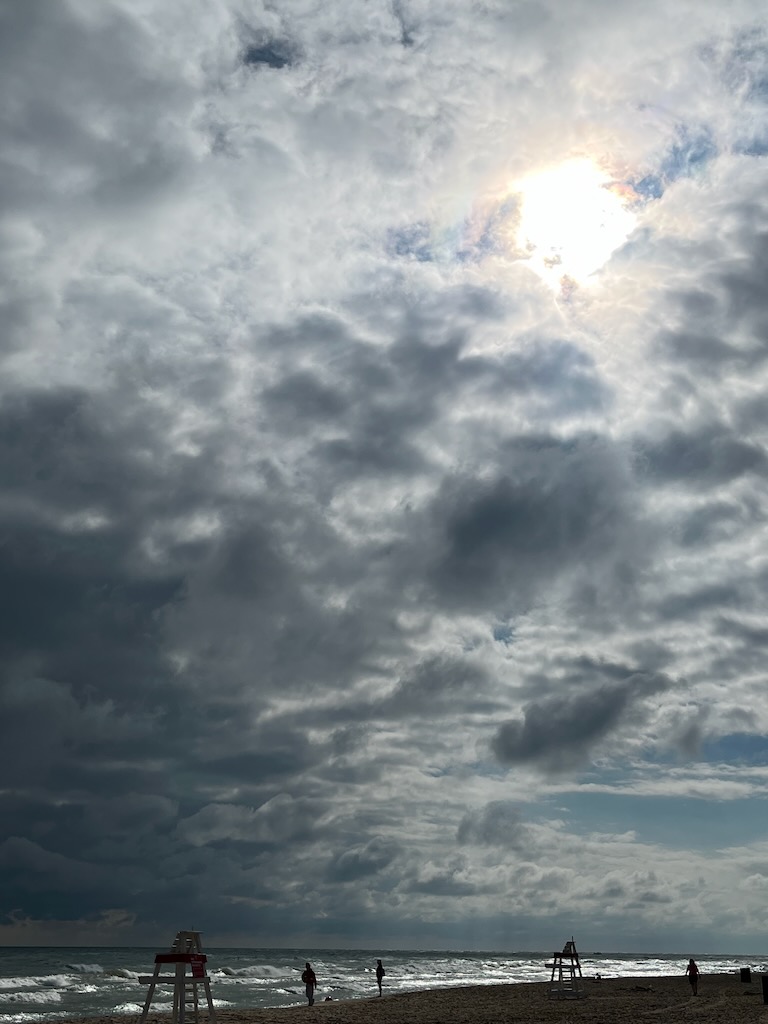
all you need do is glance toward the sky, eyes skimming over the players on high. sunlight and cumulus. sunlight and cirrus. sunlight and nimbostratus. sunlight and cloud ever in play, in duet, in doh-si-doh of shadow and light.
there’s a truth being told there, a universal and organizing principle of all creation. on the first day, in the second verse, there was darkness, darkness hovering over the deep. in the third verse, light. God commanded it. and God saw that it was good.
in our lives, the leitmotif is a given. light will come. shadow will follow. light will come again.
so it was in my reading this week, when first i tumbled deeply into a luminous shaft, a boreen* of writings from a norwegian bishop and monk, erik varden, whose power as a writer was pointed out to me by a poetry friend whose taste i know to be exquisite and deep. i swiftly realized the bishop’s thinking and writing are everything they were billed to be: rare. exquisite. deep. radiant.
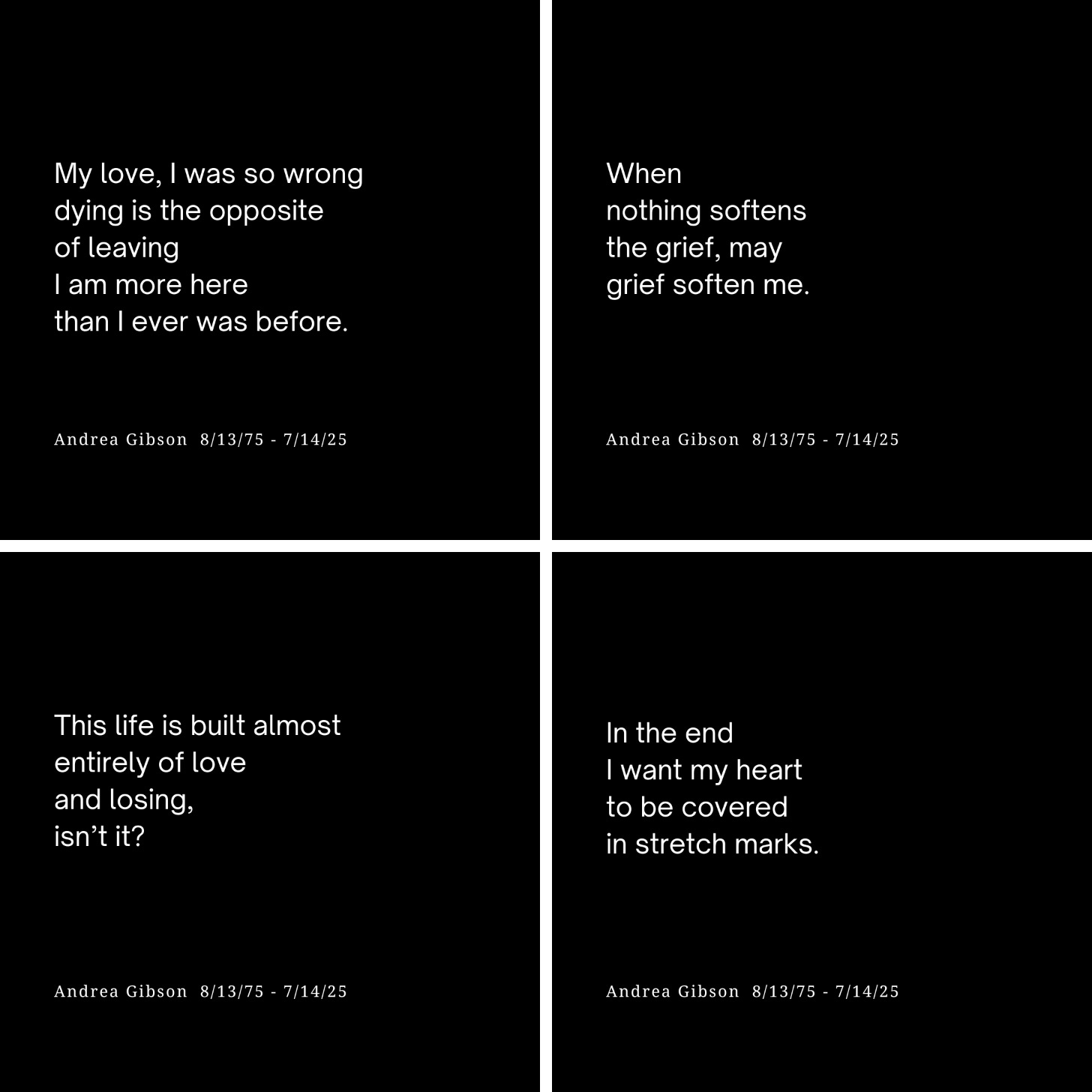
but then, hours later, shadow: i began reading a string of sentences posted from the account of one of my lifeline poets, someone you might call a patron saint of heartbreak and healing, of being more alive than you’ve ever imagined. i started to read, as if it were just another brilliant post: “Whenever I leave this world, whether it’s sixty years from now, I wouldn’t want anyone to say I lost some battle. I’ll be a winner that day.” and then i got to these words: “Andrea Gibson was a winner today. On July 14th, at 4:16AM, Andrea Gibson died…” and my legs stopped moving, and my breath was caught in midstream, and i read and read again. and then my fingers started to tremble, and my knees too.
andrea gibson
andrea gibson, 49, colorado poet laureate in 2023, queer activist (they/them/their pronouns), who had been diagnosed with stage 4 ovarian cancer in 2021, not long after they’d started a newsletter titled “Things That Don’t Suck,” had many, many times pried open my heart, pulled out the unspoken words and the fears and set them soaring. when i too found out what it is to live with cancer as one of the nouns in my story, i drew andrea into my innermost circle. the ones who know, without you uttering a word, just what you’re thinking, you’re feeling, you’re praying. the ones who some days save you. because even though the cyberworld is distant and intangible, it works in mysterious ways, and someone with whom you’ve never breathed the same air can become someone whose voice you can hear as you flutter to sleep, and whose courage you conjure as they glide you into the sarcophagus that is your biannual CT scan.
light. shadow. light from shadow. shadow deepening light. it’s the dance of the duet, interminably entwined. one is always more beautiful because of the other’s presence, because the duet is perpetual.
first, this week’s light:
that monk on a bicycle, spotted cycling through the garth just beyond the cloister, is all it took for me to want to whisper my vows, and cycle along.
as i’m quick to do, i signed up for bishop varden’s website, coram fratribus, a name derived from his episcopal (meaning “of the bishop”) motto, coram fratribus intellexi, latin for “understanding with my brothers.” because the bishop is shepherd of a flock spread across 22,000 square miles in the north of norway, extending beyond the polar circle, he sees his site as a way to speak to the diaspora, to think aloud of those things he finds beautiful or challenging, to gather his flock into a communion of thought. specifically, i felt my heart quicken as i burrowed into the bishop’s collections of writings under the tabs “life illumined,” and the shorter jottings under “notebook,” which he describes thusly:
“To scribble in the margins of texts is an ancient practice. There are people, these days, who make an academic career out of studying ancient marginalia. Any exercise of reading is fundamentally conversational. The notes collected here are brief responses to impressions received not just through books, but also through encounters, art, music, and films.”
now you see why i, a marginalian of long practice, swoon?
before i get to the paragraph in “life illumined” that drew me deep into thought, let us pause to note why we see that little outline of an owl, in the upper right corner, and hovering over every page of the site. the good bishop describes that choice thusly (emphasis mine from here on in):
“The emblem of the site is an owl. The owl does not just wing you back to the front page. It has for centuries been a symbol of the monk. Why? Because it watches in the night, when most people sleep; because it is able to see in the dark, discerning movements and patterns, foundations of meaning, where the human eye perceives only vaguely. I am fond of this Italian doggerel:
“Sopra una vecchia quercia c’era un vecchio gufo: più sapeva e più taceva, più taceva e più sapeva.
“In an old oak tree there sat an old owl: the more it knew, the silenter it was; the silenter it was, the more it knew.”
what fluttered into my mailbox the other morning was a page of the monk’s notebook on the nightingale, complete with an ancient poem (from the early middle ages, written by alcuin of york, an adviser to charlemagne) mourning the absence of the wild creature and its delicate throat. a recitation in english and latin, and including a recording of the nightingale’s song. that alone was more than beautiful enough. and then my poking and peeking accelerated, and that’s how, under the “life illumined” tab, i found a break-me-open paragraph on learning to pray.
in an essay focused on the simplicity of jesus’s prayer, and the universal cry of all believers, “lord, teach us to pray,” varden paints the scene of 72 disciples who learned not simply by listening to the words of jesus in prayer, but in witness to his consuming attention to the ways and will of God. varden expounds:
“Jesus’s teaching on prayer amounted to more than the provision of a text for recitation, that is clear. It was the sight of Jesus praying that made the disciples wish to learn prayer. The words of prayer, which touch our reason and orient our will, point towards the breaking-open of our heart, the transformation of our being as we dare to aspire, even in this life, to ‘become participants of the divine nature’.”
it is the breaking open of the heart, indeed, where the truest serum of our souls pours out. only in the last couple years have i understood that as profoundly as i do now. and, yes, that breaking so often comes with pain, or in pain, or through pain. but i’ve learned now how it truly is the propellent, the force that pushes us deeper into sacred truths than we might otherwise venture. without the breaking open, we might cling to the safer and shallower waters.
the bishop goes on. takes us beyond merely the breaking, and makes the point of its purpose. be it through prayer or through living, the breaking open is the vehicle for those who dare to aspire, in the here and now, to become participants of the divine nature. to inch as close as we can in this lifetime to something akin to sacred. i found a redemptive resonance in that line because at heart, even for the quiet ones among us, we are a people of communion, and there is a heartening, an emboldening, that comes in finding that your purpose, your aim, is not yours alone, but shared in common understanding with at least some of your sisters and brothers.
let us be broken open, then, if it points us toward our holiest purpose. through the break in the clouds, the light comes.
and onto the shadow, the eclipsing shadow…
less than one month shy of her fiftieth birthday, andrea gibson, the poet who boldly faced the coming of her death, who has been amplifying wonder, making us see the unseen, relish the oft-overlooked, took her last breath in the wee hours of monday morning.
i have been relishing her, here and in my everyday, for years now. curiously, her presence in my life spans almost precisely the arc of time in which i’ve been in the company of my own cancer.
the month before my lung surgery, when the world felt overwhelmingly like the depths of a cave, i wrote of andrea and lines i’d inscribed on my heart:
thanks to a friend i love with my whole heart, i stumbled on another wise soul with buckets of beauty to grace the world. a poet-activist-performer named andrea gibson, now a cancer survivor whose words might take your breath away. andrea identifies as queer, and uses the pronoun “they;” and they are known for their trademark honesty and bare-naked vulnerability, traits i find irresistible and blessed beyond words. here are just a few lines i couldn’t keep from scribbling down:
when it comes to hearts i want always to be size queen…
i love you because we both showed up to kindness tryouts with notes from the school nurse that said we were too hurt to participate….
when your heart is broken, you plant seeds in the cracks and pray for rain.
before i die, i want to be somebody’s favorite hiding place, the place they can put everything they know they need to survive, every secret, every solitude, every nervous prayer, and be absolutely certain i will keep it safe. i will keep it safe.
yesterday, thursday, this slipped into my mailbox from andrea’s wife, meg:
A couple years ago, Andrea said, “Whenever I leave this world, whether it’s sixty years from now, I wouldn’t want anyone to say I lost some battle. I’ll be a winner that day.”
Whatever beast of emotion bucks or whimpers through you right now, I hope you can hold that line beside it: Andrea didn’t lose anything. If you had been here in our home during the three days of their dying—if you’d seen dozens of friends drift in to help, to say goodbye, to say thank you, to kiss their perfect face, if you’d felt the love that floored every hospice nurse—you would have agreed. Andrea won.
I won’t sugarcoat the fact that they desperately wanted more time on this planet that they loved so much. This planet of squirrels and romance and basketball and moonlight.
But the time they had was significant, prismatic, and wild. It was full of trampolines and mountain ranges, stage lights and pants-peeing laughter. In their words, they “juiced the sun for every holy drop.” One of the last things they said before dying was, “I fucking loved my life.” Their conviction stunned the room.
If Andrea’s life was a poem (and it was), could there be a better last line?
a little backstory, again from meg:
In 2021, before the diagnosis, Andrea announced they were writing a newsletter, titled Things That Don’t Suck. A few weeks later, we learned they had ovarian cancer.
At first, Andrea said, “What a terrible time to be committed to writing about what doesn’t suck.” Then, almost immediately, they shifted their perspective and said, “What a perfect time.”
And so, this space was born. Part journal, part poetry, part pep talk, part treasure hunt. It became an archive of Andrea’s ability to find beauty in unlikely places, to wring gratitude from even the hardest hours. A museum of how they danced through their diagnosis, always turning their compass toward joy. It fostered a community they deeply loved.
And Andrea wanted all of it to continue.
meg tells us it will. there are reams and reams of unpublished writings, lines scribbled under the silvery light of the moon on those nights when sleep wouldn’t come. pages poured into volumes tucked away. a memoir, unfinished. half-written poems. a documentary coming this fall.
and meg promises this:
And there are stories of our life, and of the last months, that I, as their partner, and as a writer, feel both lucky to carry and uniquely able to tell.
As gut-wrenching, impossible, and tear-soaked as this moment is, I’m grateful beyond measure that they were so prolific. Through their books, their reels, their interviews, their albums, Andrea’s incredible mind will reverberate for a century—I’m sure of that.
and so, in the presence of the bishop monk, and the absence of the poet prophet, we shall go on. awake in the light and the shadow. and the shadow that deepens the light.
in case you’re curious, a bit more about dear bishop varden:
it was only after absorbing so much of his writing that i circled back to learn a bit of his origin story.
varden was born into a non-practicing lutheran family in a small village in the south of norway, and would go on to earn a doctorate in theology and religious studies at the university of cambridge, and further study in rome. a convert to catholicism at 19, he was drawn to the monastic life, and joined the mount saint bernard abbey, a cistertian monastery, in charnwood forest, in leicestershire, england. he was called to rome to be a professor of syriac language, monastic history, and Christian anthropology. and two years later, returned to the abbey when he was named its eleventh abbot. and, in 2019, pope francis named him bishop of trondheim, a nearly 22,000-square-mile prelature north of the polar circle in norway.
mount saint bernard abbey, varden’s home monastery, is where the only Trappist beer is brewed in all of England, under the name Tynt Meadow English Trappist Ale. beer to the trappists is no earthly distraction. the belgian trappists have a saying: “Beer should be liquid bread, not coloured water.”
and here’s a morsel, this one on the theology of beer, as spoken at the blessing of the monk’s brewery on st. george’s day, 2018. from Dom Erik’s address:
“One of the fascinating things about beer, is that this (potentially) sophisticated beverage is made of the simplest ingredients. By being refined to manifest their choicest qualities; by being brought together in a favourable environment; by mingling their properties and so revealing fresh potential; by being carefully stored and matured, the humble malt, hops, yeast, and water are spirit-filled and bring forth something new, something nurturing and good, that brings joy to those who share it. Considered in this perspective, the brewery provides us with a parable for our monastic life, with the Lord as virtuoso brewmaster. The Scriptures favour wine as an image of the Gospel – but that is culturally conditioned; beer, it seems to me, is a much neglected theological symbol.”
*boreen, you might recall from a few weeks ago, is the old irish word for what we might call a pothole, a rabbit’s hole, but in ireland, an island etched with cowpaths, it’s a word derived from a meandering side path when the cow decides to venture off on her own….if language is a cumulative patchwork, boreen is a word now in my lexicon….
you’ll find a veritable font of andrea’s spoken word poems, and writings at their website, andrea gibson.org. spend some good time there.
Mostly, this is a love letter. One I might have tucked in the pine coffin now buried beneath a foot-and-a-half of Chicago’s clumpiest earth, earth we shoveled onto it, one full spade at a time. The one to whom I write this, though, my fairy gardenmother, is not one ever confined by boxes or borders or hard lines scrawled in the dirt. She, my Marguerite, was as free a spirit as they come. So I cast this to the wind, and know she will catch it.
Marguerite made beauty for a living. She sowed joy in abundance. Not a single root or shoot was tucked in the earth or tied to a trellis without the ringing sound of her laughter.
Marguerite’s acanthus
She bequeathed me beauty, her beauty and that of this holy earth. And grace, and a tidepool of peace, the sort that settles deep within, calming what had long been a turbulence. It all came in a litany of botanic derivative, a litany I water and witness: tree peonies, fuchsia and ruffled and broad as a dinner plate; oakleaf hydrangea, its bottle-brush blooms now bursting in time for the Fourth of July. Pieris japonica (sometimes known as lily-of-the-valley shrub, or flame of the forest) whose delicate white star-blooms are the petit point of late springtime, stitched along the bluestone path that bends toward my front door. A dwarf lilac that defies its definition and perfumes profusely my brick walk out back. My garden blooms with acanthus, the ancient Greek thistle of endurance and immortality, and white bleeding hearts that, as instructed, seem to be on the verge of spilling succulence drop by drop by drop. Everywhere, the vanilla scent of Jack-in-the-pulpit rises. There are ferns in abundance, and climbing hydrangea who wouldn’t be daunted by Everest. And about a dozen other beauties whose names I often forget, and when I do I’d text her, and she’d remind me, always with annotation of what she loved most about it. And another something I might want to try.
If I tried to describe her, I’d begin with her face. Her face was alive, was radiant, was always revved up in joy. Or deep concentration. Her laugh came easy, so easy. Her limbs flowed. She was a ballerina in the everyday. Clogs buried in garden, wielding a shovel or pruners, she swayed with the wind, with the whims, with purpose.
She planted my secret garden, the one that meanders along the side of my house, from my writing room window, past the kitchen door, and into the garden out back. It’s the place I’d point to if pressed to answer the question: Where did you finally find your long-sought peace? It was there in the garden that Marguerite grew.
I first met Marguerite a garden ago, back in 1991, months after we married, my beloved and I. The very day we wandered into the old Victorian that became our house for a decade, the house to which both our boys first came home, the house that held so many joys and so many sorrows, Marguerite was there. She was packing up boxes with Jim the sculptor who was dying of AIDS, and who would soon leave us his beautifully sculpted three-story house (and a set of Old Willow dishes besides). They wept and wailed and laughed together. We heard the echo of their affections before we saw them, and when we climbed the stairs there she was: radiant, a mop of blond curls, eyes hazel and sparkling.
She knelt beside me summer after summer, teaching me much of what I know about what grows in a garden. We wandered nurseries and tree lots. We planted according to her unorthodox teachings. When anything ailed, she knew the fix. Or we yanked it and started again.
My jewel box of a tiny urban garden, one where the alley rats dared not roam for the fierce farm cat who patrolled it, grew to be a wonder. One whose measure in my mind far exceeded a yardstick.
When at last we decided we’d finished our work, at least for the time being, Marguerite and Ted, her rabbi of a husband who presided over a congregation of his psychotherapy clients, came by one late summer’s evening to bless the little plot. In a story I love so much I included it on pages 37 and 38 of The Book of Nature**, Ted offered up fertility prayers for my garden, that it would blossom and bloom, and multiply. Four months later, on the brink of my 44th birthday, after eight years of broken hearts and infertility, I discovered that I was the one blossoming and multiplying. I was “with child,” as the Bible would put it. I always giggled that Ted had mixed up his fertility prayers, and pulled out the ones for the barren woman instead of the ones for the garden.
ted and marguerite
And so, of course, and ever since, Marguerite is the one to whom I turned with every garden question, and every delight as it bloomed. When Ted died not quite two years ago, I knew Marguerite’s heart was shattered. And there was no glue in the world to put it back together. But I didn’t know it would kill her.
I now know that it did. For she died on Monday, and was buried on Tuesday. And ever since I’ve been strolling through my garden, stopping to marvel here, stooping to deadhead there. I’ve been shlepping my hose, and giving big drinks to each and every bloom bequeathed to me by my Marguerite.
Marguerite will always bloom in my garden. Her longtime sidekick, David the cop, is coming soon to help me dream once again. There is a plot under the ornamental lilac and the row of burning bush, and I have named it Marguerite’s Garden, and I will be planting it before the month of her death turns to August.
And it will be abundant in beauty. Because that’s what Marguerite taught me to grow. And that will never die.
the jewel box of a flower shop: Marguerite Gardens (from Victoria Magazine)
Marguerite’s genius in the garden spread far beyond our little block of Wellington Avenue, 60657. When she couldn’t be contained, she launched a for-hire garden crew (a motley crew counting two cops, a U of C theology grad fluent in Mandarin Chinese, a commodities trader, a banker, and a pet photographer) with a seasons-long waiting list. She planted tulips by the thousands up and down Boul Mich, Chicago’s grand Magnificent Mile. She planted the city’s lushest rooftops and balcony gardens. She was a connoisseur of miniatures, and knew how to cram the most in the least. She opened a dream of a flower shop in Andersonville, aptly named Marguerite Gardens, and twice daily received imports from her beloved Netherlands. The shop, with the bell that tinkled as you walked in, held a European-style flower market, and was stuffed to the rafters with eighteenth-century antiques, from bird cages to terraria. Aptly, she was named for the daisy whose name means “pearl” in French, and is the bloom from which petals are plucked in the prognostication game, “he loves me, he loves me not.” Married for 43 years to the inimitable, unorthodox, Yale-educated rabbi and psychotherapist, Theodore Gluck, Marguerite died 656 days after Ted, three days short of what would have been his 95th birthday. Marguerite was 75.
**excerpt from pages 37 and 38, Marguerite’s star turn in The Book of Nature, in which i describe that first garden we planted and blessed together…
. . .That garden—where a priest, a rabbi, and a tight circle of people we love gathered for blessings shortly after the births of each of our boys; where baby bunnies and nestlings and goldfish were buried after premature deaths; where our stubbornly resistant house cat mastered the art of escape—that plat of earth became as sacred to me as any cloister garth.
Not only was it where I knelt to teach my firstborn the magic of tucking a spit-out watermelon seed into the loam and, each morning after, tracking its implausible surge. During seven long years of miscarriage after miscarriage, ectopic pregnancy and emergency surgery, and doctors finally telling us to give up hope, I dug and I dug in that garden, all but willing the tiniest bulbs and tenderest sprouts to beat impossible odds, refusing to let anything else die on my watch. And then, at the end of one summer, as the crab apples were starting to turn, a rabbi who lived down the block came by with his wife, whom I’d long called my fairy gardenmother for her magical ways and her unbroken guidance. Standing under the stars, the rabbi, his wife, and I, we blessed the garden itself, casting prayers and sprinklings of water. By that Christmas, I was pregnant, with nary a drop of medical intervention. Just shy of forty-five when that blessing of a baby arrived the next August, I’ve always wondered if maybe the rabbi mixed up the garden fertility prayers.
It’s all a holy whirl—that intricate and inseparable interweaving that is the cosmos.
one poem this week, from a bouquet of many i plucked:
Desiderata
Go placidly amid the noise and the haste, and remember what peace there may be in silence. As far as possible, without surrender, be on good terms with all persons.
Speak your truth quietly and clearly; and listen to others, even to the dull and the ignorant; they too have their story.
Avoid loud and aggressive persons; they are vexatious to the spirit. If you compare yourself with others, you may become vain or bitter, for always there will be greater and lesser persons than yourself…
Exercise caution in your business affairs, for the world is full of trickery. But let this not blind you to what virtue there is; many persons strive for high ideals, and everywhere life is full of heroism…
Take kindly the counsel of the years, gracefully surrendering the things of youth…
Beyond a wholesome discipline, be gentle with yourself. You are a child of the universe no less than the trees and the stars; you have a right to be here.
And whether or not it is clear to you, no doubt the universe is unfolding as it should. Therefore be at peace with God, whatever you conceive Him to be. And whatever your labors and aspirations, in the noisy confusion of life, keep peace in your soul. With all its sham, drudgery and broken dreams, it is still a beautiful world. Be cheerful. Strive to be happy.
I shan’t often begin with an image de moi but this is not usual time. This is unusual. As in extraordinary. As in pinch-me, this-could-be-heaven time.
Bliss would be a word for it. Bliss defined as when all variables in an equation perfectly align: three boys + one mama + Dublin, capital of the Land of 40 Shades of Green = Bliss. Then square it. And square it again. Getting close.
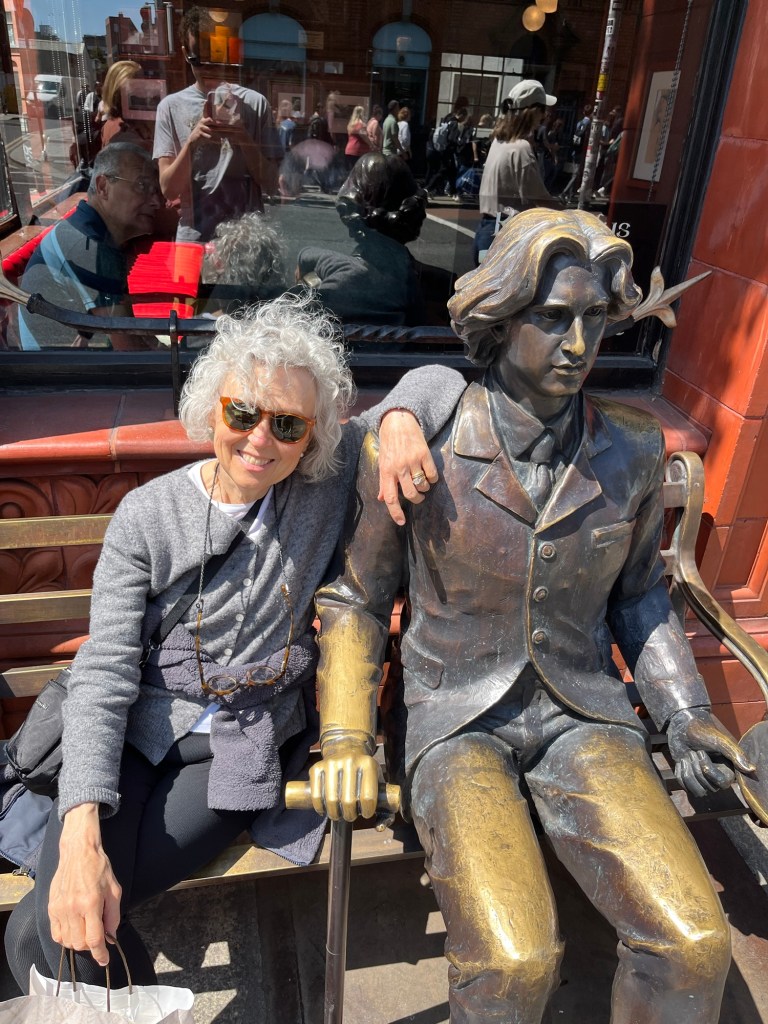
It’s only been a wee few days but oh what we’ve all squeezed in. Joyce (of course; we’re here for Bloomsday it turns out, and the city is teeming with folks dressed as if they’ve just stepped out of Ulysses, June 16, 1904) and O. Wilde, whom I bumped into on a city bench.
Oscar & me
Add to that pair, a stunning afternoon absorbing epigraphs at the Museum of Literature Ireland, miles and miles of strolls through greenswards like this:
And hilarities that come every other syllable in a land that flows with wit and gab.
It’s the gift of living in the crucible of time. You’re compelled by holy ordinance and keen attentiveness to squeeze each succulence from every blessed morsel.
And so I gulp and gulp. I whisper undying thanks and memorize the moment, pressing all this wonder, all this love, into the cockles of my heart.
Before I dive into another Dublin day, a short picture reel:
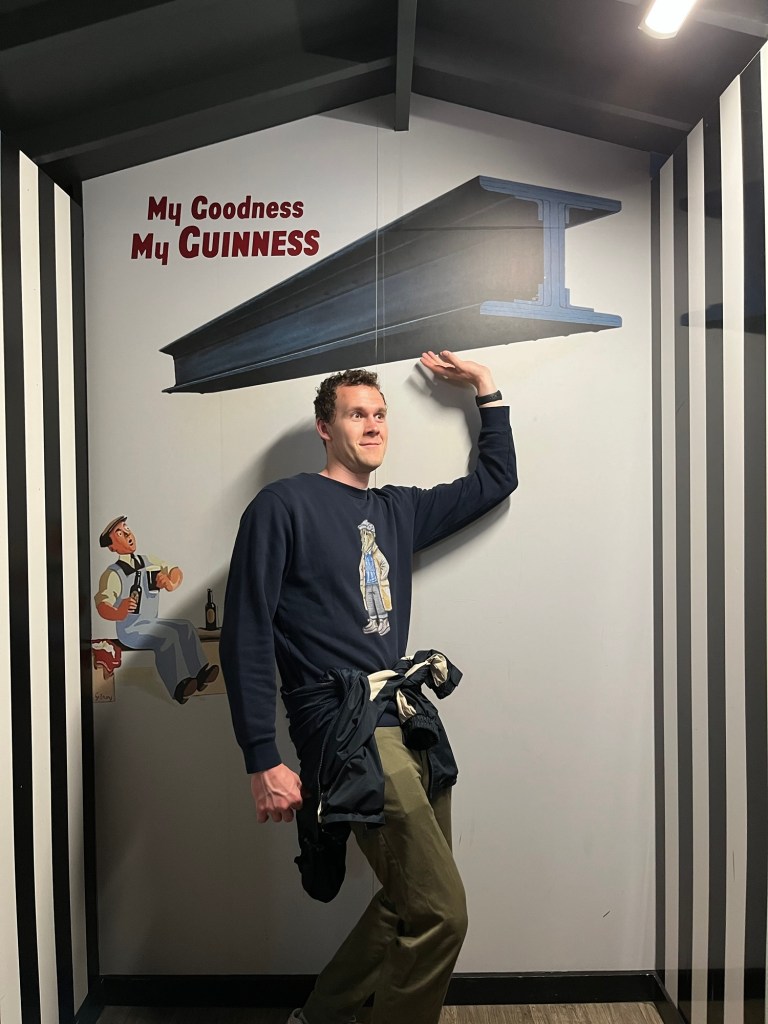
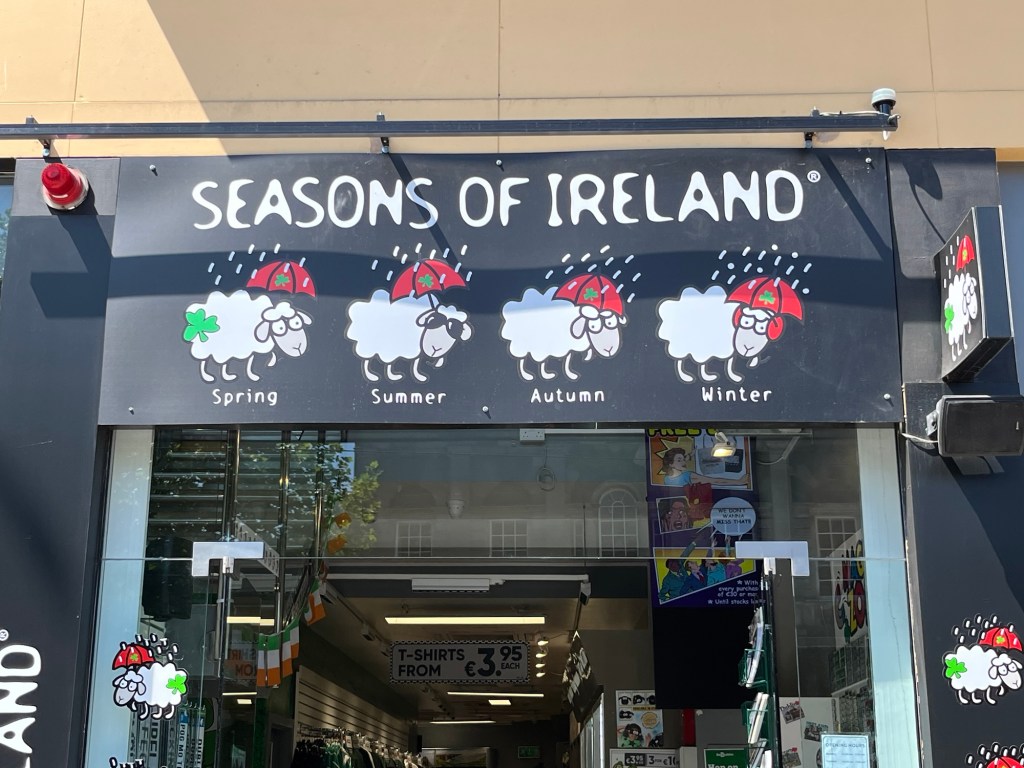
The Winding Stair Fish PlateMy Goodness, indeed.A word heard in abundance. I’m importing this new derivation.A peoples not averse to poking fun wherever possibility lies.
And I don’t even mention Evensong in St. Patrick Cathedral, nor the intoxicating tour of the Guinness Storehouse, nor fish and chips in Dublin’s most ancient pub (1198), nor the coterie of cabdrivers we now count among our friends.
But when I gulp the most—voraciously and with all my soul—is nothing more astounding than sitting round a table, or strolling hand in hand along a winding path with the boys who grew my heart as big as big could be.
May your day too be blessed in big big gulps or the sweetest sips to ever wet your lips.
of all the ways of love, tenderness is one i hold closest to my heart. it’s the lesson learned and practiced as a little girl, when my mother taught me to run for a shoebox, or little glass jar. to punch its lid with air holes. and to line it with grass and leaves, to bring the outdoors in for this space that would become an infirmary, whether the patient be a baby bird fallen from the nest, or one with a broken wing, or simply a ladybug or firefly who happened to straggle behind.
i don’t remember signing up for the advanced class, but i do very much recall the village i (a kindergartener at the time) made for my singular ladybug, each edifice constructed of paper and cardboard, care and attention devoted to every adornment (a flower box under the paned window, a wiggly “flagstone” path to the house’s front door). the steeple for the ladybug church i recall being a particular construction challenge. (and i remember depositing said spotted-back bug into the church come sunday morning at 9, per clockwork familial custom.)
tenderness is love on its gentlest setting. tenderness is the heart pierced through with empathies, with quiet, with the barest wisp of touch. a touch so silken it breaks you out in chills down your spine, might make you audibly sigh. to be tendered is, well, to be buttered in love. it is a butterfly kiss of kindness. a heart petaled open, and dusted with golden-grained succors.
tenderness, maria popova tells us, “is the best adaptation we have to our existential inheritance as ‘the fragile species.’”
lewis thomas, the poet and physicist (the lives of a cell: notes of a biology watcher) who first named us “the fragile species,” gives context for why in a 1996 essay from his last such collection, published under the same title, in which he positions us in the context of the universe’s timeline:
“This is a very big place,” lewis begins, “and I do not know how it works, or how I fit in. I am a member of a fragile species, still new to the earth, the youngest creatures of any scale, here only a few moments as evolutionary time is measured, a juvenile species, a child of a species. We are only tentatively set in place, error-prone, at risk of fumbling, in real danger at the moment of leaving behind only a thin layer of our fossils, radioactive at that.”
olga tokarczuk
when olga tokarczuk, the polish psychologist turned poet and novelist, won the 2018 nobel prize in literature, she mused on the art of tenderness in her nobel banquet lecture, a lecture titled “the tender narrator,” and one widely regarded as nothing short of “magnificent.”
tokarczuk began by telling the story of a black-and-white photo of her mother that’s always haunted her, in a blessed way. it was a photo taken before olga was born, and i’ll let her words take it from here (emphasis mine throughout):
“There’s nothing really happening in the picture—it’s a photograph of a state, not a process. The woman is sad, seemingly lost in thought—seemingly lost.
“When I later asked her about that sadness—which I did on numerous occasions, always prompting the same response—my mother would say that she was sad because I hadn’t been born yet, yet she already missed me.
“‘How can you miss me when I’m not there yet?’ I would ask.
“I knew that you miss someone you’ve lost, that longing is an effect of loss.
“‘But it can also work the other way around,’ she answered. ‘Missing a person means they’re there.’”
stopped by the tenderness of a mother telling her small daughter that she missed her even before she was born, popova comments, is “an astonishing gesture of love so total that it bends the arrow of time.”
ponder that string of words, and the meaning behind it, before reading on. “an astonishing gesture of love so total that it bends the arrow of time.” may we all know such love…
tokarczuk picks up her telling from there:
“This brief exchange, someplace in the countryside in western Poland in the late sixties, an exchange between my mother and me, her small child, has always remained in my memory and given me a store of strength that has lasted me my whole life. For it elevated my existence beyond the ordinary materiality of the world, beyond chance, beyond cause and effect and the laws of probability. She placed my existence out of time, in the sweet vicinity of eternity. In my child’s mind, I understood then that there was more to me than I had ever imagined before. And that even if I were to say, ‘I’m lost,’ then I’d still be starting out with the words ‘I am’—the most important and the strangest set of words in the world.
“And so a young woman who was never religious—my mother—gave me something once known as a soul, thereby furnishing me with the world’s greatest tender narrator.”
a good bit later in the speech, tokarczuk raises this next question, more than worth considering:
“….Have you ever wondered who the marvelous storyteller is in the Bible who calls out in a loud voice: ‘In the beginning was the word’? Who is the narrator who describes the creation of the world, its first day, when chaos was separated from order, who follows the serial about the origin of the universe, who knows the thoughts of God, is aware of his doubts, and with a steady hand sets down on paper the incredible sentence: ‘And God saw that it was good’? Who is this, who knows what God thought?
“Leaving aside all theological doubts, we can regard this figure of a mysterious, tender narrator as miraculous and significant. This is a point of view, a perspective from where everything can be seen. Seeing everything means recognizing the ultimate fact that all things that exist are mutually connected into a single whole, even if the connections between them are not yet known to us. Seeing everything also means a completely different kind of responsibility for the world, because it becomes obvious that every gesture ‘here’ is connected to a gesture ‘there,’ that a decision taken in one part of the world will have an effect in another part of it, and that differentiating between ‘mine’ and ‘yours’ starts to be debatable.”
and then toward the very end of her speech, tokarczuk turns to a literature of tenderness:
“Tenderness is the art of personifying, of sharing feelings, and thus endlessly discovering similarities. Creating stories means constantly bringing things to life, giving an existence to all the tiny pieces of the world that are represented by human experiences, the situations people have endured and their memories. Tenderness personalizes everything to which it relates, making it possible to give it a voice, to give it the space and the time to come into existence, and to be expressed.
“Tenderness is the most modest form of love. It is the kind of love that does not appear in the scriptures or the gospels, no one swears by it, no one cites it. It has no special emblems or symbols, nor does it lead to crime, or prompt envy.
“It appears wherever we take a close and careful look at another being, at something that is not our ‘self.’
“Tenderness is spontaneous and disinterested; it goes far beyond empathetic fellow feeling. Instead it is the conscious, though perhaps slightly melancholy, common sharing of fate. Tenderness is deep emotional concern about another being, its fragility, its unique nature, and its lack of immunity to suffering and the effects of time. Tenderness perceives the bonds that connect us, the similarities and sameness between us. It is a way of looking that shows the world as being alive, living, interconnected, cooperating with, and codependent on itself.
“Literature is built on tenderness toward any being other than ourselves.”
and a short bit later, she closes her remarks with this:
“That is why I believe I must tell stories as if the world were a living, single entity, constantly forming before our eyes, and as if we were a small and at the same time powerful part of it.”
in a world emblazoned with harshness and cruelties for the sake of cruelty, i will joyfully devote my days to making a living case for tenderness as a way of being. those who have touched me most indelibly in my life are those who wove their way in through that very rare and breathtaking capacity, the one that comes on with a whisper not a bang, the one that quietly says i’ve been keeping close watch on your finest-grained threads, and i see where those threads are tattered or thinned, and i am here to tenderly, yet certainly, place my palm against the small of your back, to let you know you are not alone, you are not unloved, you are seen and beheld.
and an excerpt from one of the works that won her the 2018 Nobel Prize in Literature, and for which the judges cited: “for a narrative imagination that with encyclopedic passion represents the crossing of boundaries as a form of life”
this one from Flights, her 2007 novel that twines fiction and non-fiction, and which james wood, the new yorker critic and harvard english professor, in 2018 described as tokarczuk’s “omnium-gatherum, a big book full of many peculiar parts: there are mini-essays on airports, hotel lobbies, the psychology of travel, guidebooks, the atavistic pleasures of a single Polish word, the aphorisms of E. M. Cioran. Some of these riffs, which themselves tend toward the aphoristic, are as short as a couple of sentences.”
HERE I AM
I’m а few years old. I’m sitting on the window sill, surrounded by strewn toys and toppled-over block towers and dolls with bulging eyes. It’s dark in the house, and the air in the rooms slowly cools, dims. There’s no one else here; they’ve left, they’re gone, though you can still hear their voices dying down, that shuffling, the echoes of their footsteps, some distant laughter. Out the window the courtyard is empty. Darkness spreads softly from the sky, settling on everything like black dew.
The worst part is the stillness, visible, dense – а chilly dusk and the sodium-vapour lamps’ frail light already mired in darkness just а few feet from its source.
Nothing happens – the march of darkness halts at the door to the house, and all the clamour of fading falls silent, makes а thick skin like on hot milk cooling. The contours of the buildings against the backdrop of the sky stretch out into infinity, slowly lose their sharp angles, corners, edges. The dimming light takes the air with it – there’s nothing left to breathe. Now the dark soaks into my skin. Sounds have curled up inside themselves, withdrawn their snail’s eyes; the orchestra of the world has departed, vanishing into the park.
That evening is the limit of the world, and I’ve just happened upon it, by accident, while playing, not in search of anything. I’ve discovered it because I was left unsupervised for а bit. I’ve clearly found myself in а trap now, and I can’t get out. I’m а few years old, I’m sitting on the windowsill, and I’m looking out onto the chilled courtyard. The lights in the school’s kitchen are extinguished; everyone has left. All the doors are closed, hatches down, blinds lowered. I’d like to leave, but there’s nowhere to go. My own presence is the only thing with а distinct outline now, an outline that quivers and undulates, and in so doing, hurts. And all of а sudden I know there’s nothing anyone can do now, here I am. —Olga Tokarczuk
maybe you’ll want to add olga to your summer reading list. if you’ve a favorite passage that holds tenderness to the light for you, we’d love to read along here at the table….
who taught you tenderness or, rather, how did you learn of its ways?
blessed birthday today to becca who i love, and who is as wise and strong as woman as i am blessed to know….
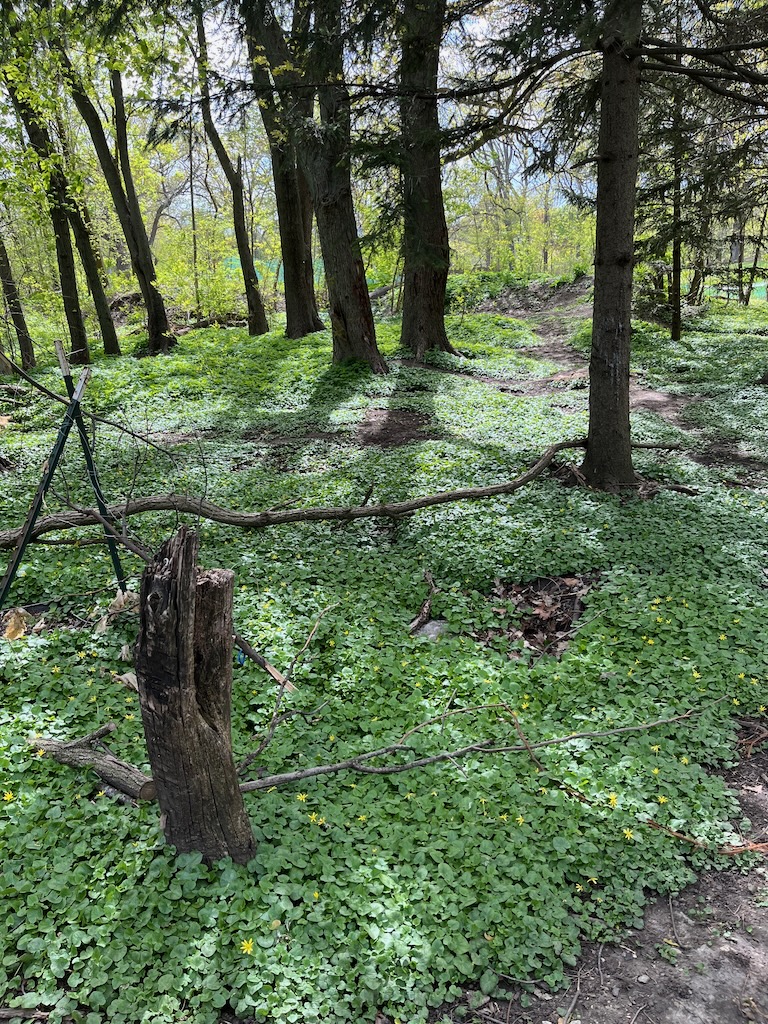
etched on a map, you might not notice; its tucked-away nature is but the flint of its charm: a treasure in almost plain sight. i might have zipped by a thousand times. it only took once for curiosity’s lure to draw me into its fold. and now it won’t let me go.
i’m coming to think of it as my footpath to the wellspring where the sacred stirs me, a nowhere-else-like-it sanctuary under the arbors, carved into the banks of a slow-flowing channel, a serpentine zig and a zag, through patches of woodland and birdsong.
as far back as i can remember, the woods behold wonder to me. my biography would be laced with a trail through woodlands and ponds and gurgling creeks. the never-ending acres of lily of the valley where my papa once drove me as a wee girl of three. the woods across from the house where i grew up, a copse that came to life in my imagination, one day a pioneer’s outpost, the next day a place to pretend i’m laura ingalls wilder in the big woods.
trailheads beckon. the barely-noticed aperture into the brush, where suddenly suburbia is leagues and leagues away. maybe it’s my imaginative overdrive, or my storybook tendencies. but give me a path, and a parting of trees leaning this way and that, and my feet cannot but go forward.
so it was on mother’s day morn when at last i found myself at the trailhead i’d vaguely noticed in the making. trees had been felled, and buckthorn burned by the wheelbarrow full. logs were yanked from where they’d fallen, and laid in a line, woodchips carpeted the paths in between. a woodland trail that meanders along and through a woods both ancient and newly imagined.
enchanted at first footfall, the only way to describe it. the ups and the downs, the dappling of light, and the peek-a-boo shadow. i walked with my eyes and my mouth wide open. over and over i marveled.
it’s a woods best described as delicate, at least in the moment—a petit point of vernal ephemerals stitched into the hillsides. springtime at its tenderest, springtime in may when it’s no longer tenuous.
it’s a place that suddenly holds inexplicable pull on me. enough to lurch me out of my wintry posture, curled over a book or an alphabet keyboard, snug in the nook by the wall-to-wall windows. it’s a place that lured the prayer right out of me. a place to dwell in my quietest stillness.
it’s my axis mundi, you see.
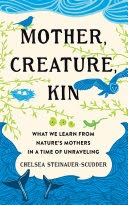
my friend chelsea steinauer-scudder, a breathtaking writer and author of the new book, mother, creature, kin: what we learn from nature’s mothers in a time of unraveling(broadleaf), explains: “i’ve heard countless stories of what i’ve come to think of as axis mundi experiences: encounters that have pulled someone into a deep experience of felt belonging upon the tiny bit of Earth that they find themselves upon.
“…within the study of religion, an axis mundi is a sacred pole, literal or figurative, which is fixed in a particular place, connecting Earth to the realms of heaven, underworld, and divine. “
these holy places might be a mountain (the Mauna Kea on Hawaii’s Big Island, known by the Indigenous peoples to be the umbilical cord, “the place from which the world emerged”), a cosmic tree (Norse mythology), the Ka’aba in Mecca (which pilgrims encircle seven times, as within it is the stone believed to have been handed to Adam as he was banished from Eden, so his sins would thus be forgiven).
or, in my case, an undulating woodland path along what in fact is a sanitation canal, though i pretend for the life of me that it’s an idyllic stream or a creek. one that just happens to shimmer an odd shade of aqua, a phosphoresence that might signal toxins astir.
my friend chelsea goes on to write that “we are a species in need of centers,” and within us there is encoded “an inherent capacity for place-based awe.”
those are the places with gravitational pull. a pull from the deepest well. the sacred well.
or, as chelsea distinguishes between the capital-A Axes Mundi (the most sacred of places so recognized by cultures or religions), and the small-a axes mundi (the ones you and i might call our own), the ones i know best are the quotidian, intimate ones, defined as “small, daily irruptions of majesty, those any-place encounters with the sacred.”
no surprise then that i can’t stay away. it’s an itch that can’t be scratched till i double-knot my sneakers, and try to remember sunscreen (i never do).
and it’s walking through a poem, quite literally. the soundscape a montage of birdsong and trill, punctuated with quarter notes and a screech that scares off the feeble.
these are the verses i walked among on just one of my mornings traipsing along the trail: common yellowthroat; red-bellied woodpecker; swainson’s thrush; red-winged blackbird; northern cardinal; blue jay; goldfinch; baltimore oriole; rose-breasted grosbeak; gray catbird; and a hairy woodpecker to boot. it’s as if the crayola crayon box was suddenly feathered in flight.
and in the flora department, a whole other poem: bloodroot, bluebells, celandine poppy, and columbine. lily of the valley, trout lily, spring beauty, wood anemone, and blue cohosh. jack-in-the-pulpit, shooting star, mayapples, and dutchman’s breeches.
all these names, which whirl in me thanks to the Original Mother Nature who schooled me, got me to wondering who in the world gave the names to the winged flocks and the leafy ones too. the stories behind names are their own wonders. the ones from folklore and legend are the ones that charm me most: jack-in-the-pulpit is said, of course, to resemble a preacher spreading the Good Word; the trout lilies’ mottled leaves resemble the markings of the freshwater fish; and dutchman’s breeches clearly resemble the pantaloons of one who’d also wear wooden shoes.
those, though, are merely the preamble curiosities, the ones that loosen my soul, open me up to the prayer that burbles up whilst sauntering deeper and deeper, per God’s gravitational pull, unwilling to pause till i get there. to the place where i go to feel as saturated with the sacred as i do of the sun when at last i plop onto the stump of a log, and consecrate the most blessed moment of being.
where is your axis mundi?
wislawa szymborska
and before we part, a poem worth pondering, from the late, great polish poet and nobel prize-winner, wislawa szymborska
Life While-You-Wait
Life While-You-Wait. Performance without rehearsal. Body without alterations. Head without premeditation.
I know nothing of the role I play. I only know it’s mine. I can’t exchange it.
I have to guess on the spot just what this play’s all about. |Ill-prepared for the privilege of living, I can barely keep up with the pace that the action demands. I improvise, although I loathe improvisation. I trip at every step over my own ignorance. I can’t conceal my hayseed manners. My instincts are for happy histrionics. Stage fright makes excuses for me, which humiliate me more. Extenuating circumstances strike me as cruel.
Words and impulses you can’t take back, stars you’ll never get counted, your character like a raincoat you button on the run? the pitiful results of all this unexpectedness.
If only I could just rehearse one Wednesday in advance, or repeat a single Thursday that has passed! But here comes Friday with a script I haven’t seen. Is it fair, I ask (my voice a little hoarse, since I couldn’t even clear my throat offstage).
You’d be wrong to think that it’s just a slapdash quiz taken in makeshift accommodations. Oh no. I’m standing on the set and I see how strong it is. The props are surprisingly precise. The machine rotating the stage has been around even longer. The farthest galaxies have been turned on. Oh no, there’s no question, this must be the premiere. And whatever I do will become forever what I’ve done. ~ Wislawa Szymborska ~
(Poems New and Collected 1957-1997, trans. S. Baranczak and C. Cavanagh)
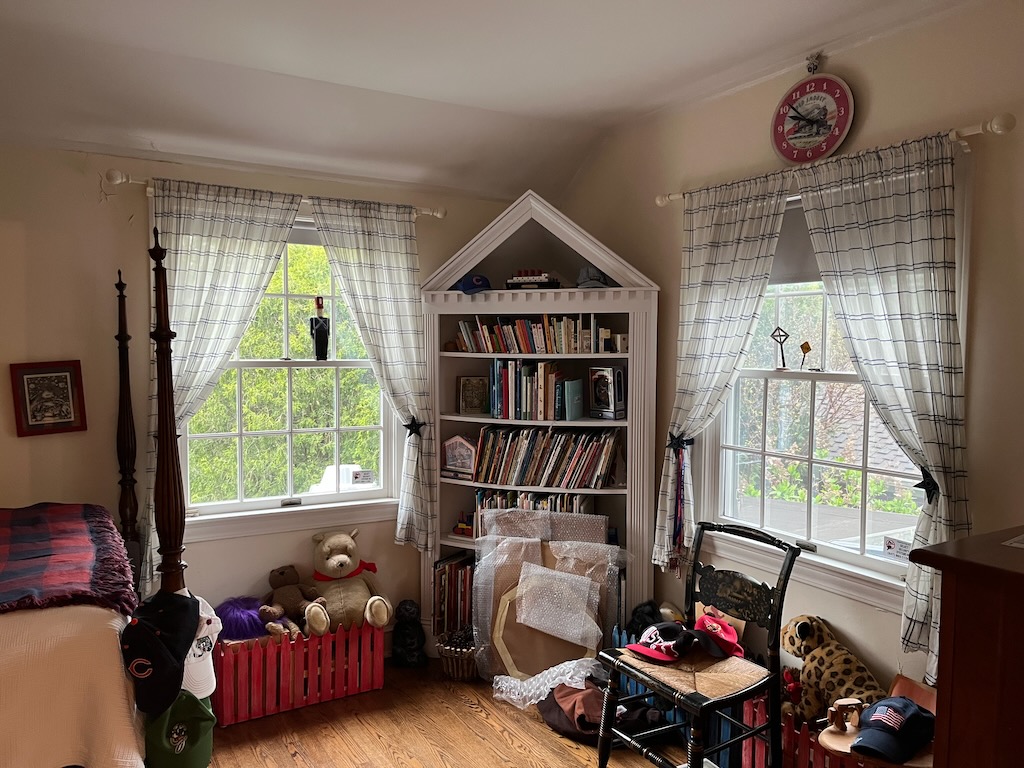
i found myself standing in a bedroom doorway the other day, staring. you might have thought i’d momentarily lapsed into freeze frame, but my mind was whirring wildly. it must be a sign of the times — my times, my where-did-the-years-go, i-remember-all-that-unfolded-in-this-storybook-room flash in time.
i call it a kodak-carousel moment, a name in itself that dates me. as obsolete a term as there might be here in the age of slide shows on phones. no need to plunk in the slides, the film framed by cardboard, a portrait in miniature, and click-click-click to advance.
the kodak carousel in my mind was playing and replaying the little boy room, the room where my miracle baby grew up. the room where we once stacked his baseball jersey and glove, his ballcap of his very first team, on the eve of his very first game. the room where a fallen-out wiggly tooth was laid to rest (in hope for the fairy) under the pillow. the room where night after night we prayed he would please fall asleep so we could tiptoe our escape without raising a plaintive cry.
i suppose i’ve made something of a museum of that room. added a few paper-wrapped hand-me-downs tucked in a corner (a safe spot for storage) but otherwise it’s all as it was. the alphabet rug, where i taught two boys their ABCs. the four-poster bed where my grandma once slept, a bed where i too slept for years, and then both of our boys. and now whoever comes to visit. the bins of blocks and bears and hand puppets, too. a whole childhood frozen in time.
and i won’t touch it.
the drawers of the dresser are filled these days with extra sheets, and art project makings. no longer stuffed with little boy PJs, and shorts and T shirts, size small. but if you open the top drawer on the right you can still find a vial filled with the teeny-tiniest babies of teeth. i couldn’t bear ever to toss those.
in time, an old house starts to show its cracks. and chips in the paint. and squeaks in the floorboards, and layers of impenetrable grease in the vent of the diner-grade six-burner cookstove.
i fear i might be blind to the blemishes as the house crumbles around me.
all i see is the room where i tucked into bed one reluctant sleeper, night after night, for sooo many years. where he learned how to read, and chased away night-prowling monsters. and another (the room at the bend in the stairs) where we brought home the boy with the broken neck. where he wrote his essays to get into college, and years and years later studied for LSATs. (and just a few weeks ago, home for easter, sat at the old desk and recorded a lecture for all of his first-year law students.)
i look at the pillows on the old four-poster bed, and remember the nights and the mornings we propped up against them, turning the pages of books that left us—both reader and readee—with tears soaking our cheeks. charlotte’s last web. or giggling at the antics of a big raspberry-hued rascal named Ted. or that little monkey named George.
it seems a holy thing. to pause, to turn back in time. to anoint each moment, each memory, with the deepest form of thanksgiving. to soak in to the deepest fiber of your soul those hours you thought might never end.
i hope, in that ephemeral fluidity of time, we can rewind the clock, even if only in our soul, to finger each hour, each grace, as if the bead of a rosary. to press it against the whole of who we are now. day by day each of us more graced. as we fill ourselves with accumulation of blessing we’ve lived. the boy who defied every odd of a very old singular ovary, the pregnancy that lasted all nine months, the chromosomes that aligned just as prescribed. the life that was given to me. the years upon years of joy, of undiluted wonder, that grew up in that room where i now stood. soaking it in. soaking and soaking.
saying my prayers once again.
yesterday was a glorious day in the life of the soul, and in the life of the church i was born into. it was a stunner of a moment as we listened, in italian, to the first then the middle name of the new Il Papa. in all the italian we didn’t yet know that for all of his life, he was just Bob. Bob the priest. Bob the cardinal. now Leo the Pope.
as i wrote to my boys in the flurry of texts that then punctuated the day, “i feel close as i’ve felt in a long time that God had an actual hand in worldly affairs. this world needs a voice unafraid to speak to worldly power, and proclaim the rule of God. it’s a paradigm the polar opposite of so much idolization in this world. peace and love are not vagaries. huge swaths of the world desperately need both.”
there is much to learn and to listen to from this unlikely pope from chicago’s very own south side. a pope who roots for the sorry sorry white sox, a pope who loves an aurelio’s slice. a pope, we learn, with creole roots. a pope whose grandparents identified as black in a turn-of-the-century census from new orleans’ seventh ward. a pope who left for peru as a very young priest, to work with the poor. a pope with the courage to set straight those who misread Catholic theology—no matter their office, nor the power they wield. i have been praying with all my heart for a voice of true courage in this world. and this morning, i am thinking that in time the moral arc of the universe does sometimes bend toward justice.
what doorways to time have you found yourself staring into of late?and what stirred through your heart at the news of the new Il Papa?
happy blessed almost birthday to a most beloved chair who, around here, goes by the name lamcal. a wise woman of the highest order.
and happy mothering day to all. because, in my book, mother is a verb, and if you gather here you do it magnificently. xoxox love, bam






















 pull up a chair