pull up a chair

where wisdom gathers, poetry unfolds and divine light is sparked…

Category: antidotes to madness

they call it grounding for a reason . . .
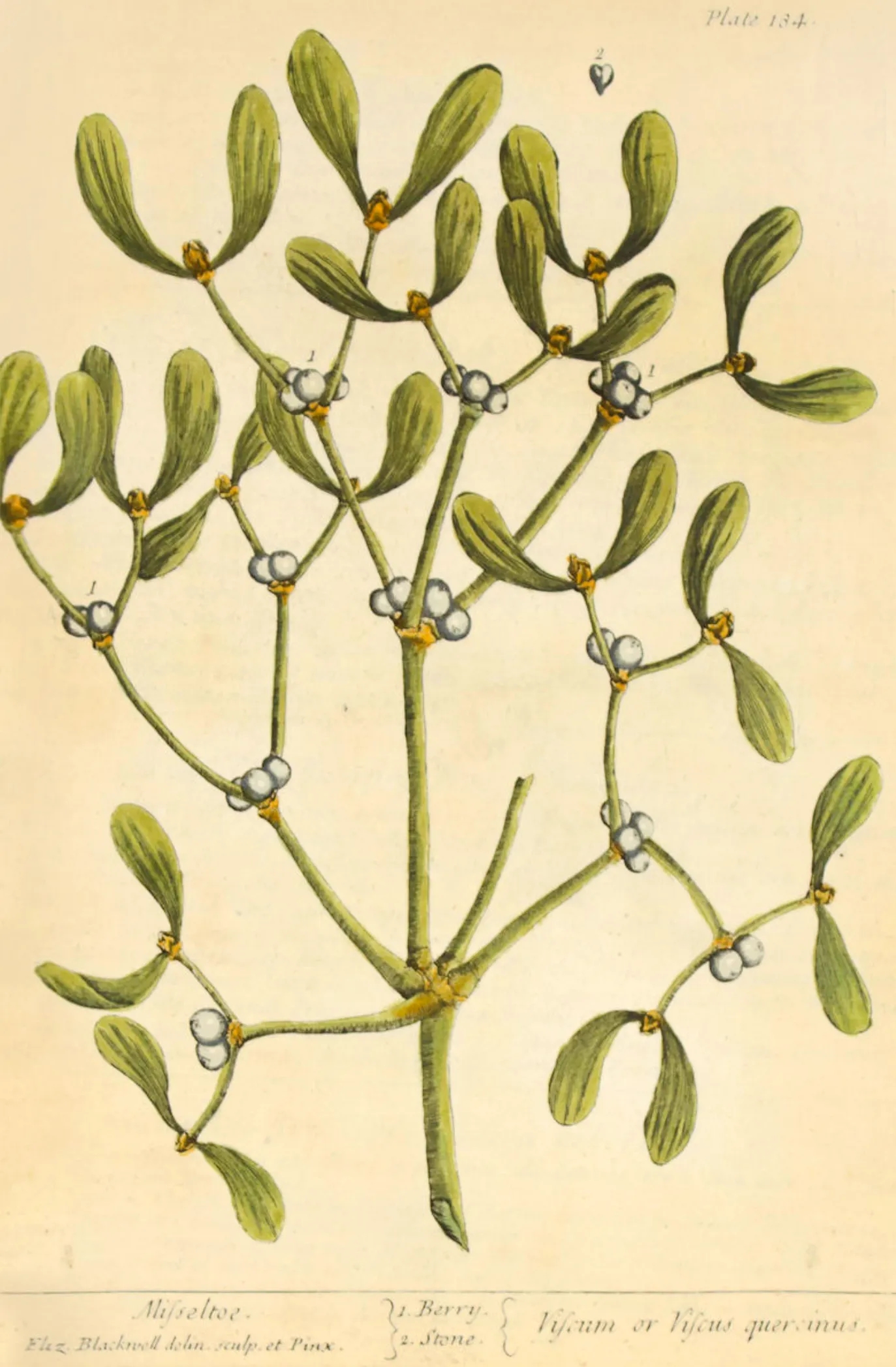
mistletoe (now studied for its tumor-shrinking capacities) fights “convulsion fits, the apoplexy, palsy, and vertigo.” (elizabeth blackwell, 1737)

there’ve been days of late when i feel dizzy, dizzy with a lightheadedness that comes from being afraid, from not knowing, from wondering if i’m standing on a very thin edge, and worrying about what might swallow me. 

dizzy from trying to figure things out on my own, because doctors don’t always tell you all you need to know. so you piece it together the smartest ways you know. 

on those dizzying days, the days that come because it seems my cancer is more complicated than i was first told, i all but plant myself –– ground myself –– in this holy earth. i listen for the cardinal’s aubade at the hour of first light, as the inky molecules of night dissolve into the tissue-paper pink of dawn. i pluck flowers with whimsy and abandon, and tuck them willy-nilly into wee tiny bottles that line my sink and my windowsill, and make me dizzy with short breaths of joy. i stare into the depths of the starry night. i all but beg all the heavens and earth to enfold me. 

if creation is holy, and i believe it is, if holy God is the spark that animates the whisperings of the cottonwood’s quaking and the duet of the butterfly couplet, and i believe that God is, then this holy earth is here for more than just astonishment and wonder. 

this holy earth is here for healing. 

for healing what’s broken inside. deep inside. and broken in ways where you barely recognize the pieces, and can’t quite find the way to piece them together. 

holy earth has offered its healing since the beginning. the very beginning. 

foxglove

sometimes, it’s straight-up medicinal. the foxglove, a magnificent stalk dangling with deep-throated bells, is the font for digitalis, the cure for a galloping heart. coneflower is where we pluck echinacea, the compound that chases away a cold. even morphine, the pain killer to which i’m allergic, comes to us from the fields of poppies that sway in the mountains of turkey and burma. and it was madagascar periwinkle, described as a “carefree annual,” that gave its leaves to heal the kids with leukemia i cared for so long ago. (how gobsmacking miraculous is each of these earth-given cures?)

sometimes, it heals in ways that infuse without compound or molecule. sometimes, pharmacology is not in the equation. but the healing is as certain, as deep, as true, as that from any pill or tonic i’ve ever swallowed or slurped from a spoon. 

i was drawn back to the groundedness that comes from this earth, to the veritable apothecary of cures upon which we dwell –– both the medicinal and the ethereal (the ones that most often infuse me) –– when i stumbled upon a poem-slash-essay in orion magazine the other day. it was titled “11 interventions in the 10 days of your dying,” and, one by one, it ticks through the litany of earth’s holy graces that saved its writer as she watched her husband die. it ends in this coda: 

XI.
Katydids

I have kissed you goodbye, made the calls, packed our things. I step out into a hot summer midnight to the paeans of katydids ringing the trees. The only conceivable response is to set down our bags and bow.

trebbe johnson

i read that its author, a blessed woman named trebbe johnson, is a writer, wilderness leader, and founder of a global community that goes by the name “radical joy for hard times,” a community that describes itself as “devoted to finding and making beauty in wounded places.” sign me up, say i! 

because poking around is my default mode, i poked around long enough to peek into trebbe’s newest book, fierce consciousness: surviving the sorrows of earth and self, a book i’m ordering up from my friends at the library. here’s one paragraph that just might pull me out of the cold, dark well where i’ve been splashing about: 

so joy is what i’m seizing. joy with its amazing, even if only momentary, loft. startling joy. joy that comes up and grabs you at the heart, and taps on your chest long enough for you to notice. joy is the thing that carries us forward when our feet might feel stuck in the muck. 

joy comes in so many colors, and sounds, and serendipities. joy comes when someone breaks into a particular smile, and zings straight to your heart. joy comes when i sit here typing (another source of deep grounding i’ve noticed) and a word or three pop out in a particular order, one i’d not realized would happen, nor even imagined. 

joy, to me, is when an old friend i love as dearly as life calls me out of the blue, and out of the decades. just after i’ve walked in the door from a harrowing too many hours in the ultrasound chamber. joy is the sound of his voice when he tells me something he was reading felt like “a theological poem from the heart of God.” joy is remembering how deeply i loved him, my dear friend the priest who’s as joy-filled and funny and holy as just about anyone i’ve ever known.

and joy, nearly every day, is what pours from the throat of the cardinal, and the wing of the butterfly whirling. and the way the sunlight darts and illuminates. 

and joy, strung like beads on a string, just might save us. no matter the darkness. 

what radical joy is saving you these summery days?

seneca, ancient roman philosopher

p.s. i should probably listen to the old roman, seneca, who has this to say about groundless fears:

“There are more things … likely to frighten us than there are to crush us; we suffer more often in imagination than in reality.”

and i should probably pay heed to his follow-up advice: 

“What I advise you to do is, not to be unhappy before the crisis comes; since it may be that the dangers before which you paled as if they were threatening you, will never come upon you; they certainly have not yet come.

“Accordingly, some things torment us more than they ought; some torment us before they ought; and some torment us when they ought not to torment us at all. We are in the habit of exaggerating, or imagining, or anticipating, sorrow.”

and here’s his kicker, quoting epicurus, an old greek philosopher: 

“The fool, with all his other faults, has this also, he is always getting ready to live.”

we should heed the ancients, is the moral here…

p.s.s. dearest chairs, i want to be sure you know that there is no need to worry about me. i am finding my way, and have chosen to be truly honest with you in the wake of my medical mystery tour (though sparing any medical details, as this is not the place for that). i don’t intend to write too often on the subject, but when it interlaces with whatever leaps out from my emotional landscape for a chosen pondering, i won’t skirt around it, and i will always write true. so when i write of being afraid, it’s because that is how this is, this thing that has boggled me and thrown me into territory i never would choose to enter. there are days that leave me gasping for breath and hope. and there are days where i can be utterly swept into joy upon joy. mostly, it’s just that this is all new, and uncharted. and i didn’t see it coming. i have always taken life and its emotional obstacles head-on. my knees might buckle, but my spine stays strong. and the only way i know is the truth way. we are all humans who find ourselves afraid. and i’m not afraid to say so. because in our vulnerabilities, we discover our strengths. especially when there are glorious hands to hold all along the way….


new year cleanse

despite being a fundamentally punctual soul, i tend to be late for plenty of things. in life, that is. 

got married at 34. first baby at 36. last one at just shy of 45. so i shouldn’t be too surprised that we’re two weeks into the new year and i’ve finally gotten around to realizing it’s high time for a cleanse.

i’m not talking refrain from fuzzy bubbly, nor gulping goopy green drinks in an effort to roto-root my insides. i’m talking one of those good old-fashioned retreats from the noise and the headaches that too often encumber the festooned days of fa-la-la december.

fact is, after a string of weeks that brought to this old house canceled christmas eve flights, hacked bank accounts, more late nights than i’m used to, a general level of cacophony, and too many comings and goings, i am full-on frazzled. 

i dream of hot bubbly baths. and towering monastery walls (of which i’m on the inside, safely ensconced, and far from the harsh, harried world). i imagine quietude. not a decibel louder than that of a page turning, a firelog crackling, or a kettle of soup lazily simmering. 

i long for unfettered days, with nowhere to go, and no one to answer to.

it takes some of us a good bit of time to snap our synapses into order again, to de-frazzle our wee little nerves, to fill our heads and our souls with pure fresh breathable oxygen. 

i basically long for a DIY friary, with compulsory silence. and menial chores. 

yes, chores. and, yes, the more menial the better.

since this is a prime time of year to be confessional, and confession is a fine first stop on the monastic road, i’ll go first, and––ahem––admit to one or two quirks when it comes to the ways i unjangle my nerves: over the years, i’ve found uncanny pacification in hoisting bucket and mop. yes, i’m a serial cleaner. i often reach for fleece-lined yellow rubber gloves when i’m in need of mollifying. vacuuming dehydrated bits of the vacated christmas-y tree (wee little thing that it was) tends to quell my wobbliest self. scrubbing spots off the floor puts me together again. de-greasing the stove = the short route to nirvana.

you can bet your brill-o pad that soon as the college kid slips out the door and onto the tarmac this weekend, i’ll be peeking behind the bedroom door he’s all but barricaded these past many weeks (the better to bar me from tsk-tsking the mess). i’ll be switching out sheets, spritzing sweet herbal poofs in the air, rinsing the crud out from the drains. call me loony (if you didn’t already) but i tap into rarefied bliss when armed with squeegee and lysol. 

only then, when every last wrinkle is smoothed, and the faucet and sink twinkling like venus, will i settle into my preferred mid-january posture: squished in a nook with a book. decidedly monk-like. and i might not look up for days. should the phone ring, i’ll not hear it. should the phone ping, i’ll play possum. 

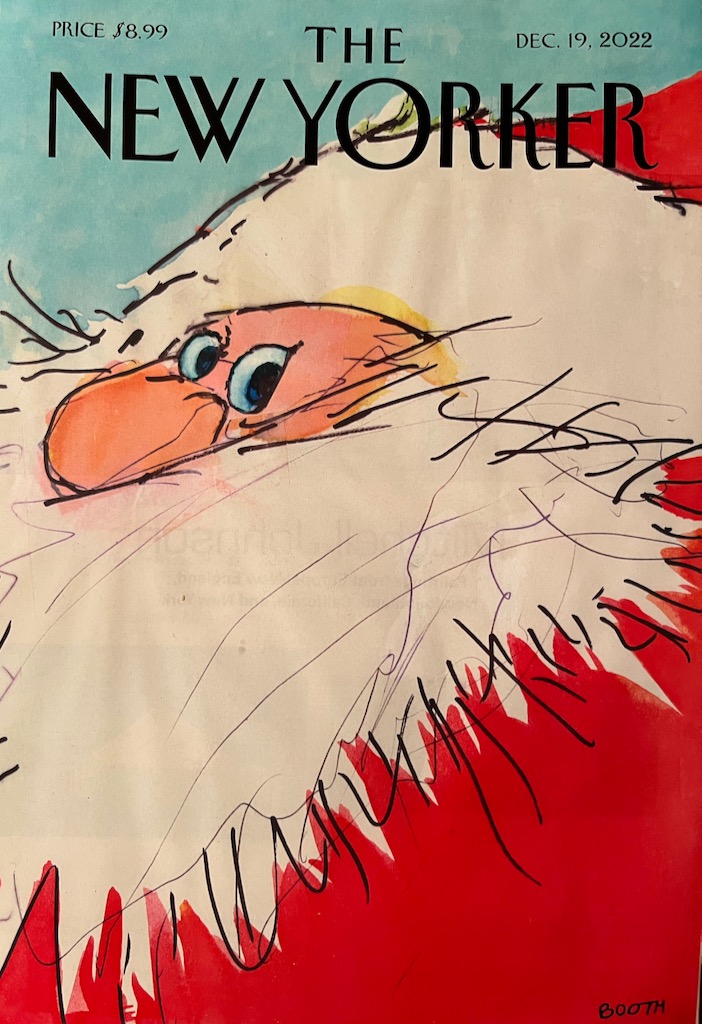
of course, this isn’t the only way to take on the starter month, the one roz chast (yet another of my new yorker supernovas) vividly declared the “cruellest.” (see new yorker cover above)

i realize i’m hardly alone in pondering new-year restoratives. just the other day, blithely turning the pages of the new york times, i found––in the food section, no less!––even the recipe mavens were proffering thoughts on how to muddle through the 31 days. here’s longtime writer melissa clark on the matter: 

“maybe there’s another way to look at it,” she begins. “what if january could be quiet and centered, a period of calm reflection when it’s too cold to go out and no one wants or expects anything social from you anyway? to me this is the ideal moment to hide in your house, cozy up near the stove and simmer a nice pot of stew. go low and slow—after all, you’ve got plenty of time this month.”

sign me up, missy!

while i set my sights on the distant shores of far-off february (when things might really turn dreary), i’ve decided to up my january game, and thus will subscribe to a slight monastic upgrade: 

as a firm believer that one shouldn’t starve while immersed in abstemious mode (a fancy way to say spartan), i plan on stocking my make-believe monastery with sumptuous soups, breads so grainy they give your incisors a run for their money, and, true to time-tested friarly ways, a good vintage to wash it all down (mine will be an $8.99 prosecco from ol’ trader joe).

here’s what i’m stirring this morning: 

Carrot-Leek Soup With Miso
By David Tanis* (annotations by babs) 

4 servings

INGREDIENTS
2 tablespoons olive oil
4 cups peeled, cubed carrots (from about 6 medium carrots)
2 medium leeks, white part only, chopped
Salt and black pepper
8 cups water or vegetable broth
2 tablespoons yellow or white miso
1 small lime
Thinly sliced chives, for garnish (optional) 

PREPARATION
Step 1
Heat olive in a heavy pot over medium heat. When the oil glistens or ripples (both signs that it’s hot enough), add carrots and leeks. Season generously with salt and pepper, and stir to coat well. Sauté for a minute or 2, then add broth (Tanis insists lightly salted water simmered with leeks and carrots is plenty tasty enough; count me among the not-yet-convinced). Bring to a boil over high heat, then reduce to a simmer. As soup simmers, taste and add salt as needed. Cook until carrots are soft, about 15 minutes. 

Step 2
Once the soup is cooled, reserve 2 cups liquid, then purée the remaining contents of the pot in a blender. (Alternatively, use an immersion blender in the pot.) Use reserved liquid to adjust the purée’s thickness, adding just enough so the consistency is that of a thin milkshake. 

Step 3
To serve, heat soup and whisk in miso. Divide among 4 bowls. Grate a little lime zest over each bowl. Quarter the lime and add a good squeeze of lime juice into each bowl. Scatter with chives, if using. 


well, that was a long-winded way to bring you a root-vegetable recipe. but this space for me is what a gym might be to a gymnast. it’s where i practice my twists and turns, and aim to stick my landings. as a long-ago failed athlete, i ply no bodily tricks, and confine myself to maneuvers of nouns, verbs, and a host of dangling modifiers. 

because levity is a proven balm for most ails, i’m adding a bonus here this morning, and showing you a snap of what this ol’ monk shall be wearing during her retreat from the world. if it seems i’m on some sort of new yorker binge, it’s unintentional, and pure coincidence. but the one thing i got for christmas this year was this fine pair of cat’s pajamas (new yorker cartoon cats splattered up and down legs, sleeves, and even the pockets), which arrived in the post just the other day and which i just might never take off (the ad on the new yorker shop site shows new yorkers wearing these things out and about. even in art galleries, and on the stoops of their brownstones). i solemnly vow only to wear mine inside the friary.

what’s your preferred prescription for those chunks of the year when you’re in need of deep hibernation?

p.s. thank you roz chast for your eternal and forever brilliance. new yorker cover above, by dear roz!

low tide

at the dawn of this new year, i am drawn into a particular quiet, the quiet of entering in slowly, and deliberately. i am turning pages, pulling taut the threads of a thick new wrap, stirring onions and garlics and soups on the stove. i am looking out windows, with little inclination to step into the misty fog of the morning. i am content. content to be quiet. content to be still.

i am, you might say, at low tide.

and i’ve no desire to barge in on your own quietudes and stillness. and so i am simply leaving a few traces here, gatherings this week has brought me. i find myself more inclined these days to bring you the wisdom of others. i am holding this space for the days when i will have something worth saying, but for now, my offerings come from the wonders of others. it’s my hope and my prayer that you find here a little nourishment for the week. i’m inclined to think that my most generous offerings these days come not from my own well, but from reading and looking and living through the days with an eye toward deep curiosity and a never-ending sense of the wonder that always seems to find its way in to our most closely-held nooks and our crannies…


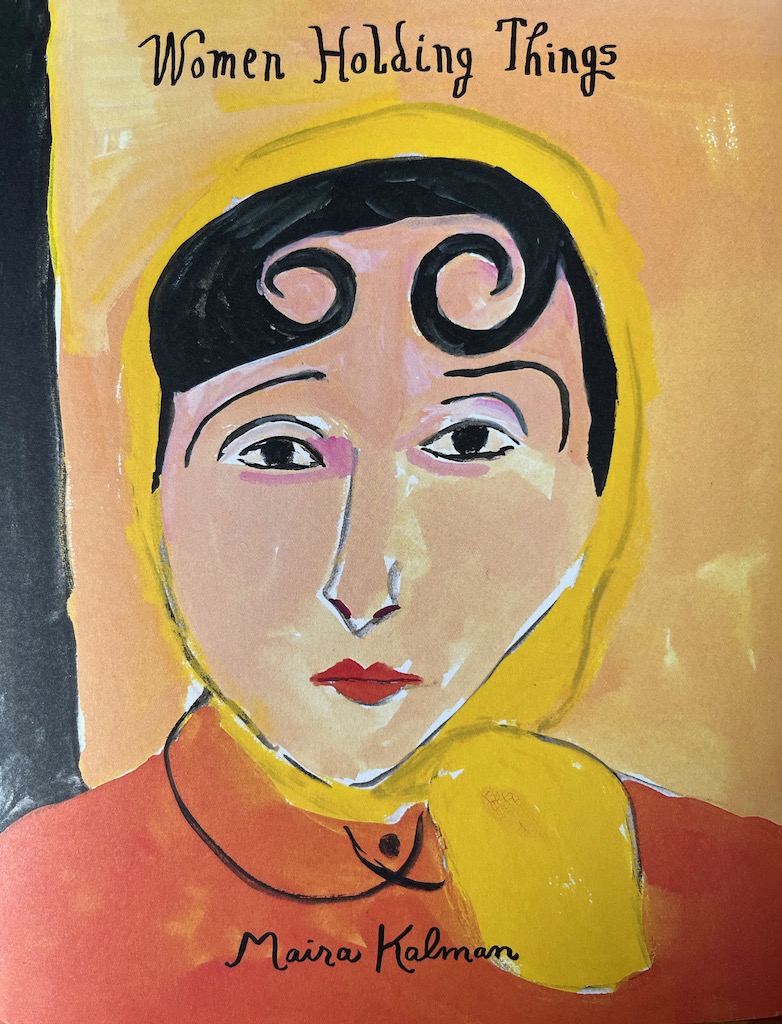
i begin with a book, a book mailed to me by my oldest best friend in the world, the one who long ago all but scooped me off the floor and propped me up, and spooned goodness into me, and shone sunlight on me till i ripened and pinkened, and has never ever let go. she’s the one i call when my heart hurts, and when i can barely breathe. over the years we’ve woven a lifeline that stretches from here on the shores of lake michigan to her house along the pacific coast. she and i share a love for quirky artists and writers and painters of marvelous colors. and she sent me this week maira kalman’s latest: women holding things, described as “a love song to women and the many things they hold, literally and metaphorically.” maira kalman is the madcap artist and illustrator who lights up pages of the new yorker, and lately has been making books so bright and beautiful and hilarious and heart-melting you might want to devote a whole shelf just to maira. you almost might wish to invite her to tea. but it would have to be tea in a room with armchairs covered in eye-popping colors. and you’d need to wear leggings in vivacious stripes and a skirt made of patchworks of peacock-hued threads. and you might serve pomegranates sprinkled on white peaches in winter. because maira seems like a someone who would like the most exotic fruit you could find. and if you served petit fours they would come swirled with coils of sugary buttercream in rose-petal colors. because maira seems like someone who has never colored inside the lines, and never turns down a dollop of whimsy.

and what i love so very much about maira is that you are merrily turning pages, pages so bright and colorful you almost need sunglasses, and then you come to a page that just about stops your heart for a second. a page like this:

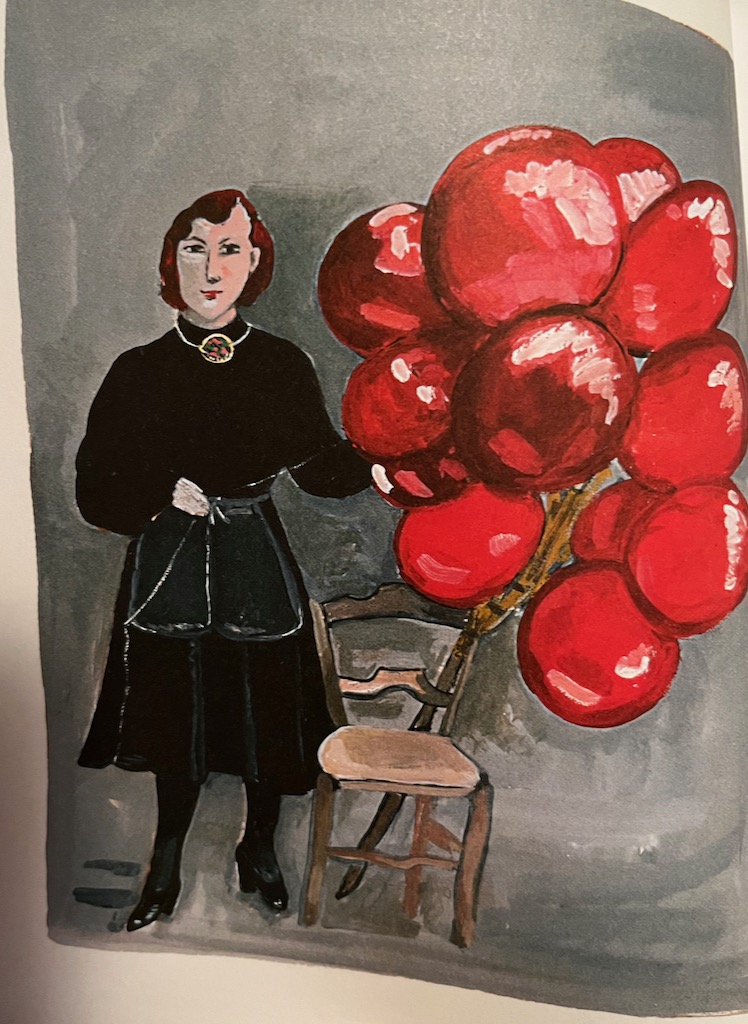
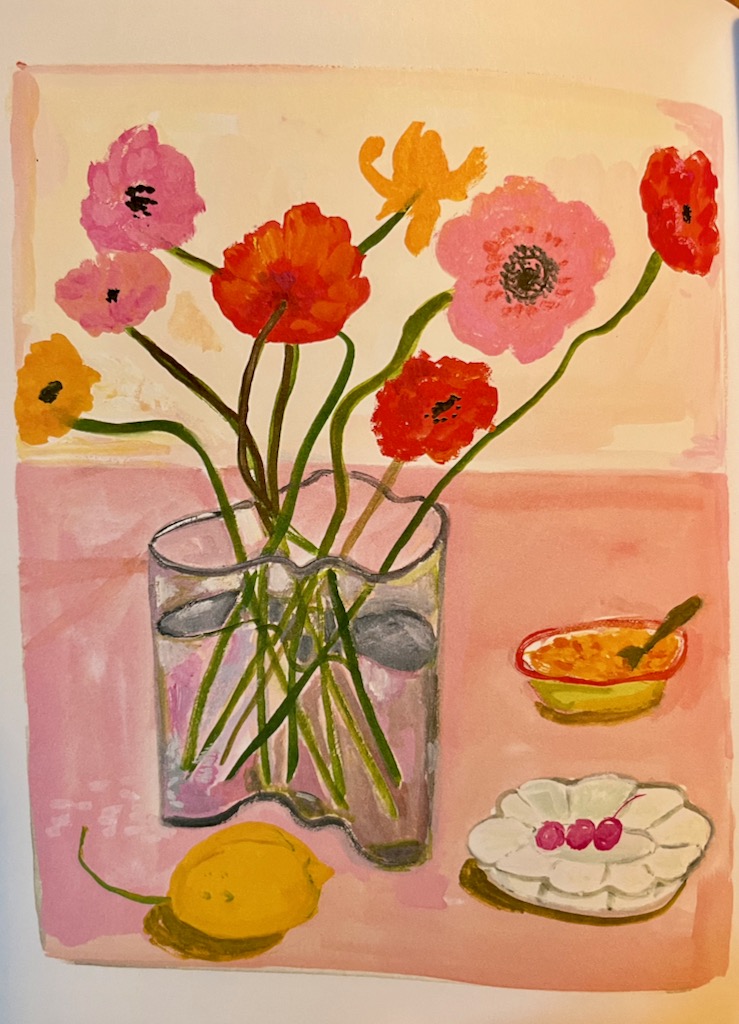
but maira is always maira, so page after page is simply marvelous to look at, and absorb in all its whimsy. pages like these (woman holding a pink ukulele under a giant cherry tree, woman holding shears, woman holding red balloons, fruits and jam):


Don’t think the garden loses its ecstasy in winter.

It’s quiet, but the roots are down there riotous.

Rumi

and then, in a maria popova posting about how to beat back a sense of helplessness in a world of so much suffering, i ran across this from the musician nick cave:

The everyday human gesture is always a heartbeat away from the miraculous — [remember] that ultimately we make things happen through our actions, way beyond our understanding or intention; that our seemingly small ordinary human acts have untold consequences; that what we do in this world means something; that we are not nothing; and that our most quotidian human actions by their nature burst the seams of our intent and spill meaningfully and radically through time and space, changing everything… Our deeds, no matter how insignificant they may feel, are replete with meaning, and of vast consequence, and… they constantly impact upon the unfolding story of the world, whether we know it or not.

i found it a profound burst of a reminder that every little move we make matters. every little one. only nick cave says it beautifully: “the everyday human gesture is always a heartbeat away from the miraculous.” it’s a very good thing to tuck in your front pocket at the start of the year, to remember that every single day we hold the possibility of being makers of the miraculous. all it takes is a whole lot of love, and a wheelbarrow full of humility, enough to be willing to turn the other cheek, and love as you would be loved…


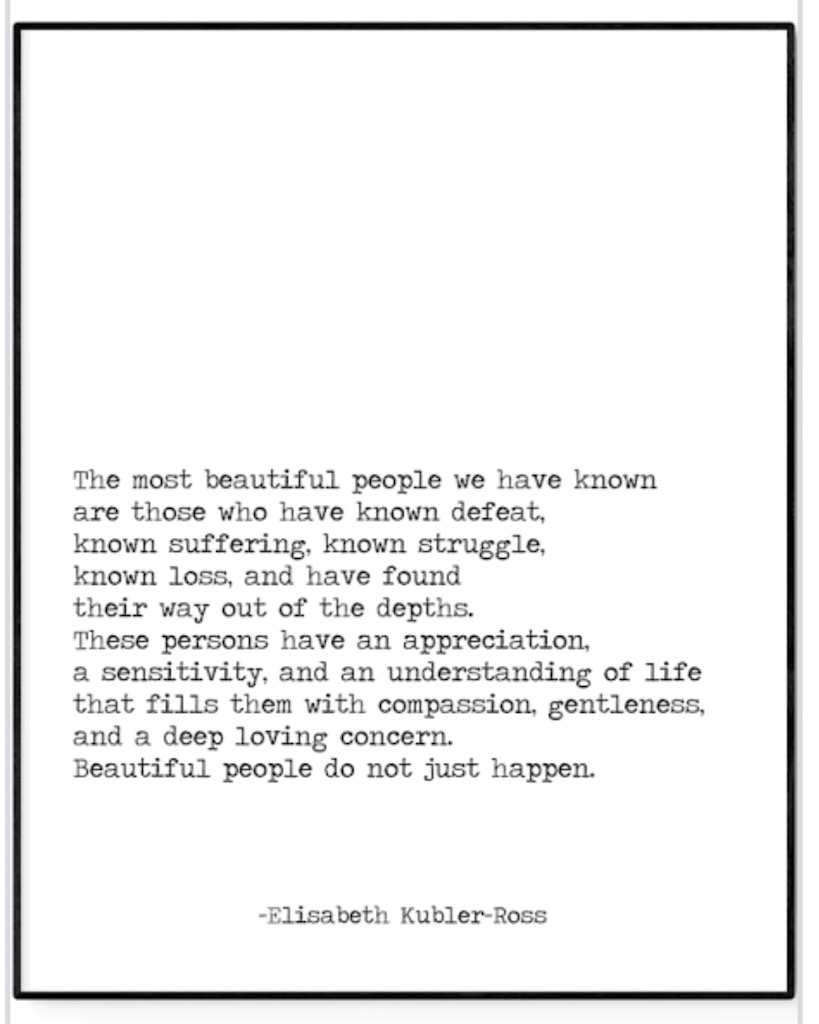
and, finally, a friend i love sent me this, and it took my breath away, and i am leaving it here, in case you needed to read this very thing. and maybe it will take your breath away, too.

i studied lots and lots of elisabeth kubler-ross in nursing school, but i don’t think i ever came across this. and it’s so true, and so beautiful. “beautiful people do not just happen.” bless the beautiful people who populate our every day with their everyday gestures that hold the possibility of becoming the miraculous.

who’s inspiring you in your new year?

p.s. there are a bevy of birthdays upon us here at the end of the year’s first week: dear friends of the chair mary jo and mary beth, may your days be bursting with the miraculous, large and small….

and i’m reminded that today, january 6, is epiphany, which in ireland is sometimes celebrated as Women’s Christmas, a tradition we’d be wise to take up. it’s described by the brilliant artist Jan Richardson thusly: “some folks celebrate Epiphany (January 6) as Women’s Christmas. Originating in Ireland, where it is known as Nollaig na mBan, Women’s Christmas began as a day when the women set aside time to enjoy a break and celebrate together at the end of the holidays.” you can find your own copy of her wonderful at-home retreat PDF by clicking to her “sanctuary of women” webpage here. it’s free but her artistry and her soulfulness might stir you to drop a figurative dime in her coffer.

merry blessed women’s christmas, and holy new year….

the littlest tree and the beating heart of Christmas . . .

shuffling in from the tree lot––the Christmas tree lot––with the littlest tree that nearly ever there grew, and once i’d kerplunked the pitiful seedling in its far-too-big tree stand (the yuletide equivalent of a saggy pair of dungarees slipping down to the knees of an undersized tot), i sat right down to pen my apologia to my faraway boys.

my mea culpa unfolded thusly: 

sweet boys, we have adopted this year, from the neediest Christmas tree farm, the wee littlest tree you ever did see. he very much wanted a home, and we shall be taking name nominations starting now. he’s an inflationary victim, the poor little sprout (there’s a name, Sprout!), as trees are in short short supply (and they’re short!). we’ve gussied him up with a santa cap, cranberry ropes (don’t tell him they’re wooden), and the lovely quilted skirt that will soon be an heirloom. a standard-sized tree topped 200 bucks this year, and for two weeks of Christmas that is not allowed. (just think, your tree funds will be shifted to the beef tenderloin fund, which is much more delicious anyway.) the little fellow smells just like the woods, and i am certain a bird might land in him soon. i beg your mercies in embracing this little guy. he tried with ALLLLL his might to grow like the big guys, but he just didn’t have it in him, and here in this house we love the ones on the margins, even the trees. xoxoxox deepest apologies if you are duly disappointed…

xox 

didn’t take but a minute for the one i might forever call our “little one” to ping right back: 

I like underdogs

and then:

This tree seems like a underdog

and so my upside-down day was snapped into crystal-clear focus: the message of Christmas delivered, and echoed. 

it’s all about heart, and dimensions don’t matter. nor superlatives. nor getting it right. nor any of the vexations that sometimes tangle me in my own unlit strands.

never mind the panting toward some imaginary finish line, as once again our festival of lights and our feast of nativity wedge their way into the same single overbooked week. never mind the slab of brisket i need to fetch from the butcher, or the welcome-home mac-n-cheese i need to slide in the oven, while dashing to an incoming plane at an airport many miles south (after picking up grammy plenty miles north, making for a 78-mile loop on a holiday weekend afternoon). and never mind the onerous chore that just yesterday had us signing last wills and testaments, which i can assure puts something of a damper on the jolly spirit of christmas. (one of those “responsible-grownup” tasks right up there with root canals!)

all of it vanished, the panting, the worries, the how-will-get-it-all-dones, in the flick of a text (the modernday spin on a wink of the eye, and a twist of the head, as clement c. moore immortally put it). 

the kid needed no convincing. no need to shovel lament. he was ready to love the littlest tree.

in years past i’d taken some ribbing––and serious protest––for my proclivities toward picking the spindliest trees. so i figured a misshapen midget of a fraser fir might have me taking my Christmas out in the doghouse (and since we’ve no dog, the fair equivalent might have been sheltering under the seed trough). 

thus, i’d decided to nip protests in the bud, devised my long-winded defense. 

and the lightning-quick reply––I like underdogs––made me see what should have been clear all along: the kid with the very big heart needs no convincing, no urging to consider the plight of the nearly forgotten. 

This tree seems like a underdog

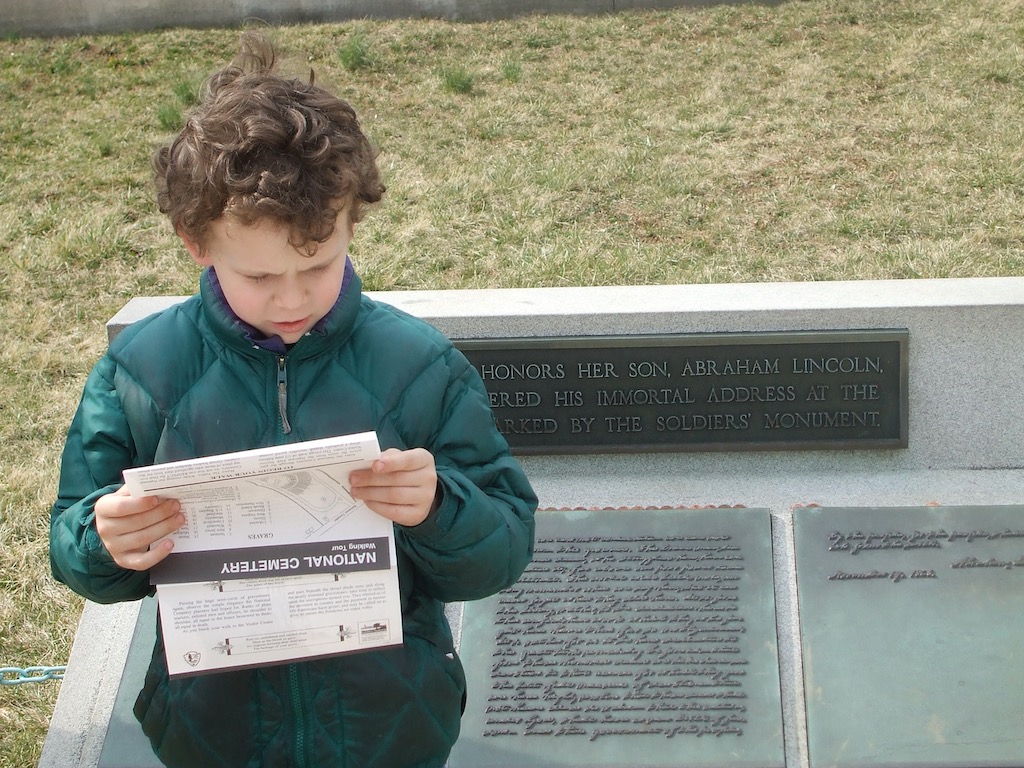
he’s the kid who long, long ago taught me to watch out for worms, who led me on moon walks, and insisted he stand on the very same spot where abraham lincoln once stood so he could recite the line from the gettysburg address that made him break into tears every time: “we can not dedicate, we can not consecrate, we can not hallow this ground.” and, on that gray pennsylvania day in 2009, when we asked why the tears, he choked out what to him seemed blatantly obvious, “it’s the soldiers.” a sadness too big for his second-grade heart.

he’s 21 now. old enough to drink, drive, and drop a vote in the ballot box. and that heart, it only grows bigger. 

hearts have a way of finding each other, the truest hearts anyway.

so, once again, he’s pointed the way to the bright heart of the season. and the littlest tree, the tree with no name yet, will stand tall and stand proud on its upturned crate. because in this old house, underdogs are always, always the heroes. 

and ours is now dressed in mighty regalia: santa cap, blinking lights (they’ll be switched out, soon as i get to the Christmas light store), and string upon string of bright wooden berries. and up on the milk crate, he’s gotten some inches. our sorry old tree isn’t so sorry, hauled in from the cold, given due glory.


here’s a beauty of a poem, just because it stirred me. . . a poem about rising up, about beauty from ashes. . .

such beauty from ashes
by carolyn marie rodgers**

and we are singing our hearts out, and
our souls are in our eyes,
and they are beautiful souls.
they are souls of truth.
they are souls of love.
they are souls of faith.
they are souls of hope.
and we have conquered a little corner in the
world of fear.

and we have stepped up and forward,
    and we have torn down walls.
we have smashed sound barriers between us.
we have dared again and again and yet again to dream,
and our dreams have finally taken material form.
we have changed our hearts.
we have altered and changed our minds,
and because of this, we now have some
    valor and strength,
and we are threatening to change the world.
that it     might be a better place.
For us and for all god’s children.
for all that we are.
for all that we might be
we have done it.
And we rise now as one voice, with many harmonies,
Through the mystery and beauty of harmony.
One voice

    Though many, for one, for all.
For all the earth to grow and know,
From the mounds of ashes of our dead, our martyred,
Our lambs, our sacrificed, those who died and have been dead
So long, so long they are no more than, nor any less than,
Sacred memories. Mountains of ashes, of our sweet, beloved,
Beautiful dead.
Today, what beauty we now have, to gain strength from to continue on,
Beauty,
From ashes.

***

**Born in Chicago on December 14, 1940, Carolyn Marie Rodgers was born to Clarence Rodgers, a welder, and his wife, Bazella. The last born of four children, her family had moved from Little Rock, Arkansas to Chicago’s South Side, where Rodgers grew up. Early in her career, Rodgers was associated with the Black Arts Movement, attending writing workshops led by Gwendolyn Brooks and through the Organization of Black American Culture. Rodgers’s poetry collections include Paper Soul (1968); Songs of a Black Bird (1969), which won the Poet Laureate Award of the Society of Midland Authors; her best-known book, how i got ovah: New and Selected Poems (1975), a finalist for the National Book Award in 1976; The Heart as Ever Green: Poems (1978); and Morning Glory: Poems (1989).

Rodgers’s poetry addresses feminist issues, including the role of Black women in society, though her work evolved over time from a militant stance to one more focused on the individual and Christianity. Other themes she explored in her poetry include mother-daughter relationships, relationships between Black men and Black women, street life, and love. In addition to poetry, Rodgers wrote plays, short stories, and essays. She worked as a book critic for the Chicago Daily News and as a columnist for the Milwaukee Courier.

Rodgers founded Third World Press in 1967 with Haki Madhubuti, Johari Amini, and Roschell Rich and began Eden Press with a grant from the Illinois Arts Council. She was as a social worker through the YMCA and taught at various colleges. She was inducted into the International Literary Hall of Fame for Writers of African Descent in 2009 on the campus of Chicago State University. She died in 2010 in Chicago, at the age of 69.

—abridged bio taken from the Poetry Foundation


and here is the heavenly late cartoonist George Booth’s last New Yorker Christmas cover. . .  

i seem to be reverting to smorgasbord here at the chair, leaving more than one thing, as i meander through the week collecting my morsels. likely comes from thinking a little isn’t enough. making sure there’s at least enough. today, a tale, a poem, and a drawing. oh, and a question, always a question:

has a little bit of Christmas leapt out from the cracks or the corners of your life, surprised you, taken your breath away just a bit because suddenly, amid the blur, you saw crystal clear the beating heart of the season?

merry almost everything. . .

slow birding

A force in us drives us to the untamed. We dream of the wild, not the domestic, for it is wildness that is unknown….It can be a daily need, a desire to connect with the wind, to live facing the unexpected.

What will bring us wildness in the places we live, domesticated with warmth and culture? For some, icy branches scratching together will suffice. A glimpse of a gibbous moon or a pomegranate-stained evening sky might help. But more than these, more than perhaps anything else, are the birds. These winged dinosaurs that have given up stored fat, hollowed their bones, and made many other compromises for flight––these organisms connect us with here and there, with then and now, as they chatter outside our windows or soar past our lives. 

Slow Birding: The Art and Science of Enjoying the Birds in Your Own Backyard by Joan E. Strassmann

i surrender my soul to anyone who looks out the window and sees so vastly, so deeply. someone who understands that the pulsebeat of all creation––timeless creation––is as near as the fluttering in the branch that scrapes against the panes of our window. 

joan strassmann, an animal behaviorist and beloved professor, is the someone who penned those words. she penned them in her new book, Slow Birding, a title that immediately caught my eye (and when i mentioned it to my birdwatching mother, she swiftly informed me she’s been slow birding forever; so much for novel ideas). strassmann writes that she, like my mother, has been a slow birder all her life, not one of those birders frantically motoring hither and yon for a quick glimpse through the binocular lens, a scribbled addition to the “lifelist,” and then onto the next spotting. strassmann is not about “spotting.” she’s about slow-paced study. about taking the time to delight in the humors, startle at the spats (as even regal papa cardinal squawks away the lowly sparrowly choristers), marvel at the parabolas of flight, as feather takes on the wind. she’s all about absorbing the wonder. 

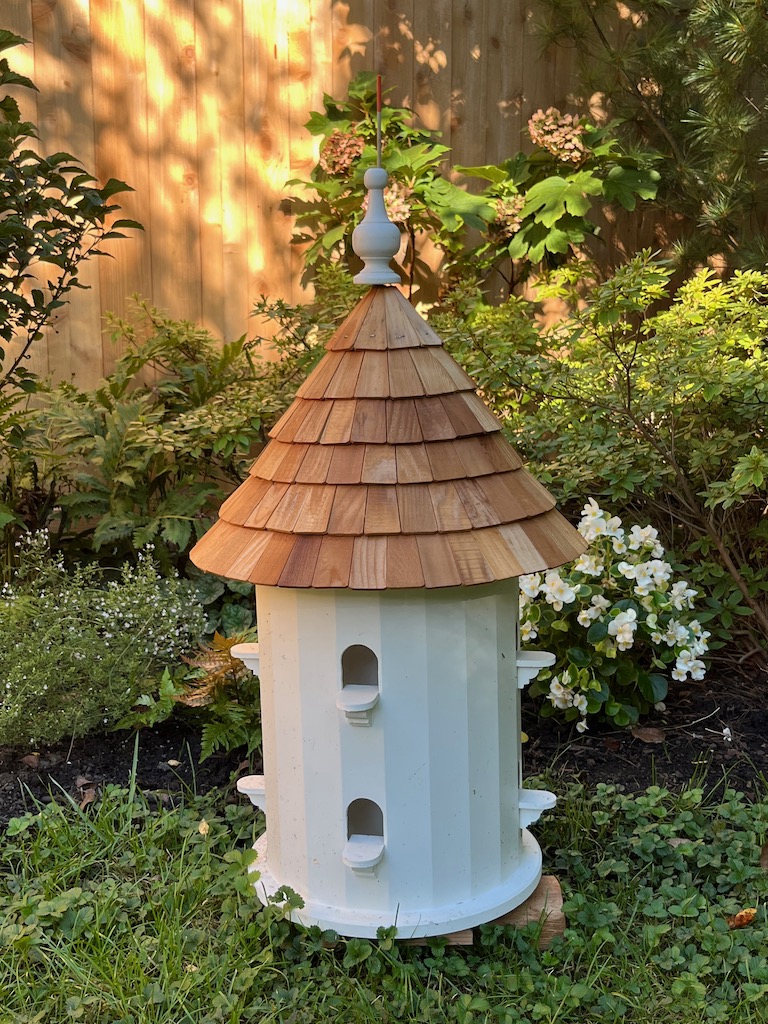
here at my cloister-in-the-making, where the walled garden soon will be serpentined with climbing hydrangea, where an elegant and capacious shingle-roofed bird B+B has been ceremoniously mounted on an elegant hand-carved post (the resident architecture critic thought it would be nifty if the scrolled brackets of the house were matched by post brackets that echoed the scrolling; and our beloved jim the builder obliged), it’s the feathered flocks that spring the whole place to life, to effervescent animation: the crimson troupe of cardinals, the squawking trio of jays, the countless sparrows, the occasional and pesky grackles, the ominous hawk.

with a mind toward soothing and stoking the soul, we’ve pared our dwelling here in this old house to an unfettered few balms: armchairs are ample and poised for conversation, a fireplace crackles with logs from the forest, books line the walls, hours are filled with the quiet of pages turning and spices simmering on the near-ancient cookstove. 

it’s the birds who bring the wild to our windowsills and put flight to our wondering. my housemate here, the aforementioned architecture critic, a man who makes an art of the rhythm of routine, has made it his solemn and devoted morning chore to scoop up a tin of seed and ferry it out to the flocks. whenever i can manage to beat him to the punch, i punctuate my seed dumping with a cheery call to the flocks, to let them know that breakfast is served. i refer to my birds in the diminutive. “here, sweeties,” i call, much to the dismay, i fear, of the neighbors. (but, oh well, they put up the fence so i can do as i wacky-well please in my now-secret walled garden.)

and even though our birding has always been slow, i find strassmann’s intentionality, her keen and fine-grained observations of the ways of each and every genre of bird, has me upping my game. putting down distraction, training my eye out the window for longer and longer spells of the day. taking note of peculiar particulars i might otherwise miss. (it’s excellent training for the whole of one’s closely examined and attentively-lived sole chance at life.)

strassmann passes along the wisdom of famed ornithologist margaret morse nice whose instruction is at once spare yet richly complex: sit still and watch. draw what you see, perhaps, the singular birds who flutter and flit. befriend them. scribble notes in a journal you keep by the window. 

but why a whole book, a 334-page book, if the instruction itself is so brief? well, strassmann explains that she delves into the intricacies of sixteen birds––and five bird-watching places––because to know the ways of the birds, to know each particular one’s biological story, is to illuminate all the more what we might otherwise be utterly missing out yonder. and thus we might look and look more closely.

the stories, obtained over the lifetimes of various ornithologists who trained their lenses on a single question or puzzle or species, might leave you oohhing and ahhing and racing to windows.

for instance: blue jays––noisy, bossy––are “the most american of birds, occurring in every state” (though not a single state claims the jay as its state bird); the american robin is the “earthworm whisperer,” and when a robin cocks its head toward the earth, it’s listening for the rustle of the underground worm; the ubiquitous sparrow is a bird with roots in bethlehem (yes, that bethlehem), and once was considered a pot-pie delicacy (thankfully those days are behind us––and the sparrow); and finally, the cardinal has reason for chasing after the reddest of berries: the carotenoids in the fruits make for a deeper red of its feathers (and not only that, but the redder the cardinal, the more desirable it’s regarded in the feathered fiefdom of red-bird mating).

it’s all endlessly wondrous to me, the alchemy of poetry and science and feather on air, the proximity of the wild, the animations of beings both social and singular. 

there is something about the delicate ways of the avian world, something about the simple existence of seed and nest, flight and song, that stirs in me an exercise of the prayerful. it’s as close as i come to the wild day in and day out, and it draws me every time into a marveling that makes me sense i’ve been brushed by the holy divine. 

what will you do slowly today?

the other night i was blessed to sit and listen in proximity to pádraig ó tuama, who among many wonders spoke about how he loves birds and irish names for birds, and i was enchanted. because he’s as kind and generous as he is brilliant, yesterday afternoon he sent me the poem he’d read—“now i watch through an open door”––with the irish names for various birds woven into the poetry, and so i am including here the last stanza, with the names highlighted and i’m adding a little glossary below, so you too might be enchanted by the names the irish put to their birds…..

Oh forest flame, oh young light on the old oak,
oh small brown druid I hear
but never see. Oh red king of the morning, oh dainty feet
among the dungheaps, and fierce goose
with fierce goslings, oh muscled hare, russeted
by the long evening. Oh my
low deer, powerful and insignificant,
oh glen, oh magnificent.

irish names for birds:

*goldfinch: “bright flame of the forest” 

*wren: “brown druid”

*chaffinch: “red king”

barn owl: “graveyard screecher”

red wing: “little red one of the snow”

meadow pipit: “little streaked one of the bog/moor”

kestrel: “wind frolicker”

bullfinch: “little scarlet one of the woods”

greenfinch: “little green one of the oak tree”

oh, sigh, oh magnificent irish….

one last thing: i’ve been invited by a dear friend, the poet mark burrows, to partake of a celebration of the great austrian-bohemian poet rainer maria rilke, on dec. 4, rilke’s birthday. i quake to tell you that we’ll be in conversation with none other than pádraig ó tuama, and the details are spelled out in the flyer below. and you can find out more and register for the free zoom program here. (you’ll need to scroll down a wee bit; it’s the third in the roster of events…) (my favorite part of the flyer is where it notes the time of the event in ireland! be still my ol’ irish heart….)

and that, dear friends, is it for the week. be well, and be slow….

george booth has died and other news of the week…

George Booth, the New Yorker cartoonist who created a world of oddballs sharing life’s chaos with a pointy-eared bull terrier that once barked a flower to death, and sometimes with a herd of cats that shredded couches and window shades between sweet naps, died on Tuesday at his home in Brooklyn. He was 96.

so begins the new york times obituary of a man who infused my childhood. no, he didn’t frequent the five-and-dime in our leafy little town. he didn’t populate the pews of our native church. he came in the mail. every week. and in the weeks when he graced the cover, or was tucked inside the confines of william shawn’s new yorker (known as “the holy grail for cartoonists”), you could count on tracking down my mother if you traced the vapors of her out-loud laughing to where you’d find her giddily all but hiding behind the glossy pages of the slick. she would laugh, back then and even now, in a way that made you think there was something almost-naughty about those pages, which of course made us, her troupe of five, scamper to its pages soon as she abandoned it on the stack of mail, where hours later our ad man of a dad (who never met a joke or pun he didn’t relish) would saunter on the scene and chuckle at whatever was the funny. 

george booth proved to us that our mother — the very one who trained us to eat our peas and lima beans without complaint, and never tell a lie, to ne’er ignore the dinner bell, and always look both ways –– had a secret compartment full of almost-naughty humor. and if we kept close watch, we too might figure out the shortcut to some eternally redemptive funny bone. 

thus, coming upon the news that mr. booth has died this week, and that his wife of 64 years had died a mere six days earlier (such tales of love and lives that end in stunning unison nearly always make me weak at the knees), i felt a thud to the heart that only certain deaths elicit. 

there is a minor cast of characters in every childhood — the names that brought applause, the ones whose books most frequently recurred, the ones whose movies brought us the rare chance to blow a bedtime  –– who indelibly marked our evolution, and maybe formed the foggy outlines of who we aimed to be when we grew up. or at least what attributes we might try on for size. 

if i close my eyes and tick through the litany of those my mother ushered in, the ones held up in near heroic halo, it’s george booth & co., the new yorker cartoony cast; peg bracken, she of the i hate to cook cookbook; it’s doris day and julia child, all of whom made my mother giggle. it must have been the giggle that so allured. it was a merriment i must have longed for, and long for still. laughter belongs to a human register all its own, audible proof of joyful stirring deep inside. w. h. auden once observed: “among those whom i like or admire, i can find no common denominator, but among those whom i love, i can: all of them make me laugh.”

thank you, mr. booth, for bringing laughter, so much muffled laughter, to the house where i grew up.

in other news, i find myself absorbing the miracle of 70-degree november days. took me a long time — too long — to learn to freeze-frame pure joy and deep-down contentment. but now the hours of my days are as if beads threaded on a string, not unlike the rosaries i long ago learned to pray: mysteries joyful, sorrowful, glorious, and luminous. not a bad paradigm for living. learn to live bead by bead, moment to holy saturated moment. allow each orb to shine in all its constitution, be it radiant or shadowed or somewhere in between. and the beauty of these days, when the leaves are blazing paint-pot hues –– aubergine and persimmon, pure gold and harvard crimson –– they tap me on the soft shell of my soul, and whisper: this is holy time. behold it well. 

george booth would make me laugh at that. but he’s no longer here. so it’s on us to find the humor hidden in the chaos of the every day. 

who comprised the minor cast of characters in your growing up years? who made your mama laugh or cry, who or what did you aspire to be when you grew up and moved away from home?

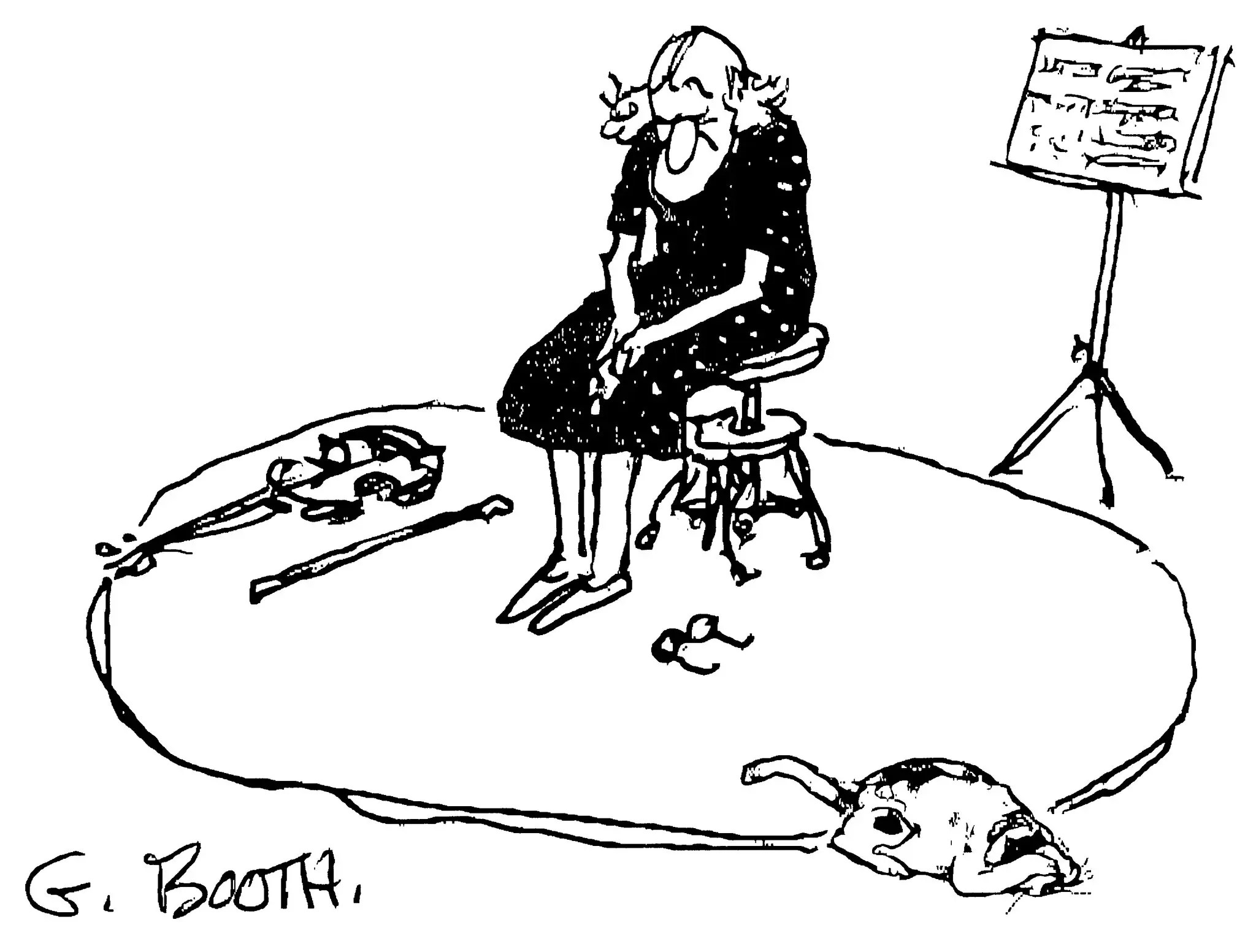
this is booth’s cartoon in the immediate wake of 9/11, when the new yorker had decided no cartoons for that issue, but george submitted this anyway; the cat covering its face with its paws, the usually animated fiddle-playing miss rittenhouse (a recurring character modeled after booth’s mother), head down, hands clasped in prayer, sadly silenced by it all.

contemplating hope . . .

In Any Event

If we are fractured
we are fractured
like stars
bred to shine
in every direction,
through any dimension,
billions of years
since and hence.

I shall not lament
the human, not yet.
There is something
more to come, our hearts
a gold mine
not yet plumbed,
an uncharted sea.

Nothing is gone forever.
If we came from dust
and will return to dust
then we can find our way
into anything.

What we are capable of
is not yet known,
and I praise us now,
in advance.

Dorianne Laux

i am contemplating hope, as it seems to me — and maybe to you, too — that we are living in a darkening world. a world whose headlines are chasing me away, whose headlines often sicken me. i find myself feeling the urge to draw within, to curl into a tight mollusk, a chambered nautilus of the soul. i look at flickers of the news and hear the echoes of history, a boomerang of hideousness i never dreamt would come this way again. 

i am giving thought to how to live in a world where darkness gathers, how to keep an ember glowing. in my soul and in my world. can random acts of kindness be enough to keep the incandescence from extinguishing? is unending prayer enough to shift the course of history, to undermine the ugliness that seems without end or purpose? has it ever been?

i’d been thinking more humility was the desperately-needed imperative, the very thing this self-obsessed world — intoxicated by celebrity, by overblown parading in the public square — most emphatically calls for. i still think so. humility in a world of supersized ego is as countercultural as can be. and it just might expand our gaze, allow us to see past our own blinding appetites, make us more willing to quietly, determinedly turn the other cheek. to be the necessary instruments of peace, to sow pardon where there’s injury, love where there’s hatred. it’s a centuries-old prayer, the prayer of st. francis, and it is true for me each and every morning. now more than ever.

but read a little further in the prayer, and it calls for hope where there’s despair. 

despair is spreading like a cancer. it undergirds the cynicism everywhere. it’s the magnetic pull toward apathy. it’s surrender punctuated with slamming of the door. it snuffs out every shard of light.

so now i’m thinking hard about hope, the counterforce of gloom, despondency, profound sorrow (each and every one, another name for despair). where does hope begin? how might we stir it? feel its updraft catch beneath our wings? 

i don’t have answers. 

in time, though, i may stumble on inklings.

but there are poets, now and ever. poets like dorianne laux, whose words came to me this week and made me feel that fetal kick that might be where hope begins. when someone wiser and deeper draws the faint outlines of the life ropes we just might need. 

dorianne laux

dorianne laux, who worked as a waitress, a sanitorium cook, a gas-station manager, and a maid before getting a BA in english at 36 from mills college in oakland (and has gone on to be a pulitzer finalist, and a guggenheim fellow), and who is absolutely one of my most beloved poets, begins with “fractured” in the poem above. 

fractured is how i sometimes feel. fractured has sharper edges than just plain broken. fractured is what bones do when they split and crack. sometimes hairline, sometimes compound. fractured makes a snapping sound. fractured is low-down broken. sometimes shattered.

but dorianne doesn’t leave us at fractured. she turns our gaze swiftly toward the stars, which are fractured too, but into pretty little points. and it’s the points of stars where the shining, twinkling comes. it’s where the light pings or oozes i don’t know which; i’m not a physicist of the heavens. i’m only someone who watches and wonders. maybe it’s where the light –– twinkling, shining –– bounces off the brokenness. it’s the brokenness that makes for the dizzying luminescence. stars in their brokenness are bred to shine in every direction. maybe that’s something to think about.

and then dorianne goes on to tell us that it’s not time yet to lament. “there is something more to come,” she promises. 

our hearts still are goldmines to be plumbed. our little bitty self-contained vessels of all that’s good, all that’s holy; no one’s got a right to reach in and steal those hearts, to tap those hearts of all that’s bottled up inside. all the sweet succulence of all the kindness we’ve known in our whole lives. all the times we’ve been forgiven. all the times someone gentle looked our way and whispered words that might have made us feel beautiful, and seen. don’t abandon those sacred hearts, turn over the keys to whatever evil awfulness might flatten you. guard those good and plenty hearts as if your life depended on it, as if the good world depended on it. because it does, it does. 

and so, dorianne was just the lifeline i needed as i began to consider hope, as i set out to figure out how to live wisely and luminously in a world where dark skies are growing denser in the distance. 

my considerations of hope are only just beginning.

What we are capable of
is not yet known,
and I praise us now,
in advance.

where do you find hope? does it come in faint traces, or in bold strokes that sometimes bowl you over? do you sometimes feel the hairline fractures in your heart or your soul? 

i let it rip this week. once upon a time, this would be the very sort of meander my mother-in-law would have met with deafening silence. too dark, she’d diagnose it. and leave me to second-guess the whole day long. should i have held back? but to ignore the chasms that rend us apart, push us away from one another, to ignore the fallout that inevitably shrouds the tender among us is to let the rot seep in till it’s too, too late. i am determined in my searching for hope. and thank you, dorianne, for pointing me in hopeful direction….

something screwy happened when i was typing and all of the sudden everything shrank. i tried and tried to fix it, but it might still be screwy. i’ll keep trying to fix it. till then, put on your magnifying lenses……

grounding

birdhouse awaiting its post, in my new walled garden
pants for which my mother might disown me.

I wasn’t long off the plane, the suitcase barely unpacked, the clothes not halfway down the chute, and I was leaping into my oldest, most tattered, hand-me-down shorts (I seem to have a whole wardrobe of tattered ill-fitting hand-me-down shorts, these are the ones with the hem that dangles in front and disappears somewhere behind) and the t-shirt so ancient it’s bearing the name of a slick Andy Warhol launched in the very late ’60s. I call these my gardening clothes. The muddier they get, the more merrily I and they hum.

I had grounding to do. Grounding for me is quite literal. It’s a psychological balm and it comes with a trowel. I literally slice into the earth to draw out what amounts to a steadying potion, the closest I know to nerve-soothing elixir. 

September had gotten away from me. I’d intended a few weeks of quiet. So go such intentions. The holy communion of saints must be guffawing up in the clouds. 

So out I trotted into my back twenty; what once seemed endless expanse is now (thanks to the neighbors’ newly-erected 6.5-foot solid-cedar wall) most generously described as a wee jewel box of growing potential. My plot has shrunk, so it seems, but the newly defined outlines merely raise the ante. It’s a petit point of a garden I’m after. A tapestry of tiniest botanical stitches. 

I was soon on my knees. Fitting in ferns with their feathery fronds. Tucking in anemones with upstanding names, names that made them feel like royalty (Honorine Jobert — I imagine an empress) and names that sound like poetry in motion (Whirlwind — imagine them asway in September’s gentle breezes). 

Balms come in a thousand disguises. There are balms to swallow, and balms to chew. Balms that cover you in sweat, and balms that make you smell of chlorine. Took me a long, long time to find a balm that didn’t hurt me (plain old eating vexed me for decades). At last, though, I found healing balm in the sacred ground that surrounds this old shingled house. I found it watching the shadows play catch-me-if-you-can. And I found it watching the red bird alight on my window sill. I found it pretending I live in a cloister, and this is my garth. My prayer bench draped in clouds; my kneeler in clumps of compost. 

Maybe it was the long time coming that makes it more sacred. Maybe it’s remembering how emptiness once felt. And how distant that hollow is now. Maybe it’s facing the truth that there will still be days when the emptiness rises, when I feel my nerves starting to jangle, and tears are on the verge. Those are the days when I need to remember that something akin to a heavenly flow is just beyond the kitchen door. And I can tap into it with merely a trowel.

It’s quietly waiting there in the garden, my potpourri of barely detectable perfumes (lavender and heirloom hyacinth) and ones that knock your socks off (Korean spice viburnum); and leaves in shapes that might have been scissored in some far-off French lace factory. And then there are all the wild things who know they need no invitation. They’re the animators, the ones that chirp and chatter and squawk and belt out their twilight arias. Wide-bellied bees gather gold dust right before my eyes; butterflies flit and flutter and all but land on my shoulder. Even hummingbirds roll through town, on their way to tropical jungles where they’ll blend in with all the other primal screams of ruby and gold and shimmering emerald. It’s a menagerie out there, and I play the role of devoted observer, the one who quietly putters, poking plants here, there, and anywhere I can squeeze one more in. 

It’s all merely excuse for getting as close to the thrum of the earth as I can. It’s there where the worms wriggle, and the trees find their succulence, where the anemone roots and the chipmunks play chase, that I hear the undeniable, deeply permeable notes of heaven’s indelible undying song. 

I am grounding myself for the winter ahead. Grounding myself from the September and the summer behind….

welcome to autumn, the season of turning within….

for reasons that escape me, i seem to have decided that i will employ the shift key on my keyboard from time to time, and occasionally tap out a sentence complete with capital letters. sometimes makes for easier reading, i’d imagine. so i am — on occasion — giving it a Whirl. 

where or how do you find grounding? was it hard for you to find?

make room for joy. always make room.

from what i know, from what i hear, and from what i gather, there’s a miasma of gloom hovering over the landscape, not unlike an early morning fog that forgets to scuttle away once the sun burns down. 

it’s a despair in general and in particular. it’s a despair that has long been casting its shadow, as we seem to be dwelling in an epoch of upheavals. from a rage that’s spilled even into the lanes of the little village where i live (did i really deserve a middle finger for driving exactly the speed limit on a curvy hill?) to venom poured onto airwaves and social media feeds (excuse me for backing away from all but a quick scroll for news), it’s gotten harsh out there. and institutions we counted on seem to be pulling out the rug.  

but i read something this week that reinforced what’s become my saving grace, though reading it helped me to see more clearly that i needn’t feel guilty for reaching toward my apothecarial shelf of simplest balms. i’ve been making a practice of stitching the tiniest joys into my day, and pausing long enough and deeply enough to let them sink deep down into the crevices, the nooks and crannies and channels of the soul where the life spark burns. 

i might pause in my dashing down the walk to listen to the gurgle of my bubbling fountain. i might plop in a wicker chair to watch the slanting sunlight turn golden a flapping hydrangea leaf. i might catch mama wren ferrying a worm to her chirpy little ones. they’re the littlest wisps of joy, the things that percolate my heart and soul and each and every summer’s day.

what i read this week were wisdoms from mary pipher, an american clinical psychologist, long rooted in lincoln, nebraska (which in my book certifies her down-to-earth wisdoms as deep as the roots of the prairie dropseed that rolls across the miles). pipher, whose wisdoms are too boundless to be bottled, is best known for reviving ophelia: saving the selves of adolescent girls, her 1994 rescue guide for an america she calls a “girl-destroying place,” and more recently she’s written women rowing north, a book on aging gracefully. (note to self: please read.)

this week, though, she wrote an op-ed for the new york times, in which, after outlining the simple joys with which she unfurls her day––a morning cup of coffee, watching the sun rise over a lake, listening to the sounds of sparrows, the commonest of common birds––she writes that she is “leading a double life.”

Underneath my ordinary good life, I am in despair for the world. Some days, the news is such that I need all my inner strength to avoid exhaustion, anxiety and depression. I rarely discuss this despair. My friends don’t either. We all feel the same. We don’t know what to say that is positive. So, we keep our conversations to our gardens, our families, books and movies and our work on local projects. We don’t want to make one another feel hopeless and helpless.

Many of us feel we are walking through sludge. This strange inertia comes from the continuing pandemic, a world at war and the mass shootings of shoppers, worshipers and schoolchildren. In addition, our country and our planet are rapidly changing in ways that are profoundly disturbing. We live in a time of groundlessness when we can reasonably predict no further than dinnertime. The pandemic was a crash course in that lesson.

As we are pummeled with daily traumatic information, more and more of us shut down emotionally. I can hear the flatness in the newscasters’ voices, see the stress in my friends’ faces and sense it in the tension of the workers at my sister’s nursing home. We are not apathetic; we are overwhelmed. Our symptoms resemble those of combat fatigue.

Mary Pipher

she goes on to write that in an age where ukraine and afghanistan and yemen are everyday news, and the horrors therein threaten to numb us, where the american political landscape some days resembles an extreme-wrestling match, nothing short of world-class coping skills are called for. and thus she lists three of her wellsprings: her grandmother who raised five children on a ranch during the dust bowl and the great depression; thich nhat hahn, the buddhist monk and zen master; and her years-long study of psychology. 

her wisdoms are these: her grandmother urged her to “be the person you want to live with every day of your life,” and on the last day of her life she told mary that her life goal had been “to leave the world a better place;” from thich nhat hahn, who’d witnessed great suffering in vietnam, she not only absorbed his practices of mindfulness, anchoring herself in the present moment, but also his deepest teaching about our interconnectedness with all of life, a worldview that finds healing through reaching out to the frightened, the hungry, the ravaged in all its forms; and, from psychology, pipher learned that the best way to cope with suffering is to face it, feel it in our bones, explore it, extract its meaning, and then muster the resources to move forward. here she prescribes: “find ways to balance our despair with joy.”

maybe take a minute to let each one of those soak in. . . 

“be the person you want to live with. . .”

“present moment. beautiful moment. . .”

“action is an antidote to despair. . .”

Most of us cannot be great heroes. However, we all have the capacity to be ordinary heroes.

to be an ordinary hero is to find someone close to home who’s hurting, and be the healing balm. resist the urge to flip back someone else’s insolence. even on a day when you might prefer pure silence, invite in someone whose days are defined by loneliness. make your front stoop or your back porch a place where the welcome sign is often posted. 

go about the business of gathering up simple joys; know that they’re the fuel to carry you across the long and lonely miles. revel in the red bird who alights just beyond your window sill, and serenades the coming darkness. follow a butterfly across your garden. watch the night stars turn on. keep an eye out for the fireflies’ first flickering. 

make room for joy. joy is a necessary oxygen for both soul and psyche. without it, we shrivel, furl inward, gasp for breath amid the not-unlimited allotment of days we have here. 

those joys needn’t be grand, needn’t strike up any band. we’re on the hunt here for simple joys, barely detectable threads of joy; weave them through your day.

they just might embolden you for the long haul, the long and seemingly unbearable haul. 

where will you find joy today? how will you make room?

i just yesterday got page proofs for my next book, The Book of Nature: The Astonishing Beauty of God’s First Sacred Text (pub date: march 21, 2023), and that means i will be underwater for the next two weeks making sure there are no runaway commas, or words wrongly landed amid a sentence. it’s nerve-wracking and eye-straining, but it moves me closer to the finish line. i might not get a chance to circle back to reply to comments for awhile, but sooner or later, i promise i will. and soon as i can i’ll show you how pretty someone made the pages of my little book. till then, take care, and take joy, as tasha tudor always insisted…

photo above by will kamin.

p.s. here’s a little joy that slipped under the transom yesterday, when my beloved brother brian found my little book available for pre-order in — get this!!! — park slope and switzerland. excuse me while i gulp. (the actual cover, which i’ve not yet been told i can share, is peeking out from under the pre-order banner on the community bookstore, now a shop added to my must-visit list. xoxoxo thank you little bookstores, online and real-world.)

retreat to mothering earth…

my not-so-secret skinny rail of a garden

mothering, a verb that has always spoken to me for its broad application, its attachment to acts and not to a particular gender, doubles its duty as a descriptive of those acts as life-giving, as loving. now attach it to earth, allow it to describe the essence of so much of creation––and our place in it––and the whole shebang snaps into sharp focus: mothering earth embraces us, wraps us in her proverbial arms, allows us to rest our weary head against her bosom, her heartbeat. she holds us till the shaking ceases. she brushes the nettles from our hair, sets us back on our steadying way.

it’s a notion i found in pablo neruda’s “i ask for silence,” a poem that speaks to the stillness––the oasis from sound, from stirring––my soul is seeking. 

. . . But because I ask for silence,
don’t think I’m going to die.
The opposite is true;
it happens I am going to live.

To be, and to go on being.

I will not be, however, if inside me,
the crop does not keep sprouting,
the shoots first, breaking through the earth
to reach the light;
but the mothering earth is dark,
and, deep inside me, I am dark.
I am a well in the water of which
the night leaves behind stars
and goes on alone across fields.

It’s a question of having lived so much
that I want to live a bit more.

Pablo Neruda, an excerpt of “I Ask for Silence” from I Explain a Few Things: Selected Poems

and, as neruda knows, so my unspokenness knows.

i find myself pulled into the garden, and soon down to my knees. muddy knees, grass-stained knees, be damned. i go down to the lilliputian place. where a dragonfly the color of limes is hovering; his shadow eclipsing the fat bud of a peony who might think the hoverer an alien from outer cosmos. where worms wriggle, endlessly defying geometries; i sense their delights, the deliciousness they find in the loam i’ve kneaded and kneaded over the years. 

it is the apothecary without pills, mothering earth and her patches of garden. its potions are in the perfumes of the peony, the fading scent of the lilac now past bloom, past seduction. mothering earth’s elixirs are the stillness so still you can tell when the breeze barely moves. it’s the air, unfiltered. chilled or warmed by rivers of winds surging around the marble that’s ours, the blue marble. its dramas––ones that delight, ones that stir sorrow––are the openings and closings, the risings and fallings, of all that makes its home there, a cast not limited to botanicals. a cast of birds and butterflies, those wiggly worms and the many-appendaged crawlers (some call them creepy, i do not).

i retreat to mothering earth when the world all around and within gets too vicious, too ragged, too worn. my preferred posture is bent, and down low. i want to put my ear to the thrum of the grass growing and the roots deepening. i want to catch the morning light as it first drapes across the fronds of my ferns now at full mast. 

i’ve been wobbling for weeks now with a dizzying, one that comes with heart pounding and queasiness in waves that feel pacific-sized. i’m convinced it’s the aftermath of christmastime’s covid, the red-ringed virus that finally caught up with me, never-minding my double masks and double boosters. it’s slowing me down, some days more than others. and being out where the breeze blows, and the sun shines in unbroken beams, it steadies me. long as i don’t do backbends or bows from the waist. 

once a child of make-believe times and places, i retreat to that familiar fiefdom even now. even now with my own children long past making believe, long past six-feet, if anyone’s measuring. all week i’ve been building a gurgling fountain, a simple one, made from a moss-covered planter, filled with river rocks i’ve gathered from magical places over the years. in my imagination i’m building not simply a gurgler but a cavalcade of sound that will soothe me, cast its magical spell upon all who catch the music of water plashing on rocks. i am building a way station for birds and chipmunks, a place for even the hosta to dip her thirsty leaves. and i can get determined, refuse to give up, refuse to order a ready-made one from a catalog. determined is sometimes a polite way, a watered-down way, of saying i’m a wee bit obsessed. i can hear the gurgle in my mind’s ear, and despite a shorted-out extension cord, and a pump that gave up the ghost, i’ve not yet abandoned my plot. i’ll get to gurgling before the sun sets to signal shabbat this evening.

it’s all the perfect balm after weeks of editing, weeks of being torn by the news. i pay no attention to news when i’m flesh to flesh with mothering earth. my news of the day is which bloom is on the brink, and which is waning. the choreography of this mothering plot, it’s ceaseless. 

sometimes we all need to be mothered. mothering earth mothers me. 

and i bask in her stillness. 

where have you found your stillness, your healing balms, of late?

well, here’s a first for the ol’ chair: a talkie, in the old vernacular. in other words, not just a picture but a gurgling picture……