pull up a chair

where wisdom gathers, poetry unfolds and divine light is sparked…

Category: angels among us

canticle of gratitudes in shadowed times

I’ve always noticed the light shines through more perceptibly, more piercingly, when the skies are grizzled gray, and there’s a fissure, a peep hole, in the clouds. 

And so, in this shadowed episode in which I find myself –– awaiting word on my first lung scan since before surgery, trying to navigate my mama through the roiling seas of rehab and the stark knowing she won’t go home –– I wend my way through the days on watch for grace notes which tumble onto me like snowy flakes before the melt: each one unlike any before or aft, each one magnificent in its own faceted incandescence. 

And, in the spirit of blessed Francis of Assisi, I am stringing them into a canticle, a praise song typically referencing Gospel text. I’m not so literate in those Scriptural ways, so I am stringing mine in the vernacular of the everyday: 

Praise be the blessed, blessed nurse named Vishruti whose charcoal eyes are ever sparkling, and whose attendance to my mama’s every woe is pure blessing before my most grateful eyes.

Praise be the harvest moon pinned high in the night sky one especially hollow night, and the acolyte Jupiter who clung to Moon’s southwestern rim, as if to catch any drippings once the melt began again.

Praise be my blessed “baby” brother who seems the answer to my every prayer before I’ve even prayed it: the one who keeps every necessary form on file (to ensure nary a hiccup in our mama’s journey), attends to every detail with fastidious care, and who is so blessedly tender with our mama’s every ache and pain and worry that in watching him tears spring to my eyes nearly every time. Praise be that brother who has always fit me like my other half. I’m 1/3/57 and he just happens to be 2/4/68. Mathematically sequenced, and aptly paired, we are.  

Um, addendum to brotherly praise (did Francis addend his canticles? hmmm): As I was typing that very verse above, said saintly brother was ambling through a lumber yard, intent on rebuilding our mama’s four-poster bed to make it six inches closer to the ground, thus subtracting risk by six not-insignificant inches. And he’s not even the carpenter brother! Be still my brothered heart….

Praise be the ones who fill my stoop with dahlias, and chicken ala yummy, and farmer’s market bounty. And whose prayers and hand squeezes hold me up, even when I wobble.

Praise be my sweet Fred who holds my hand in the dark of night, even when I don’t let on that I am thinking hard about the day ahead, or the one just left behind…

Praise be Pope Francis who, in his latest encyclical, Laudate Deum, squarely implored us to face these crucial questions:

“What is the meaning of my life? What is the meaning of my time on this earth? And what is the ultimate meaning of all my work and effort?”

Praise be Alice Walker who gave us these lines in The Color Purple:

Listen, God love everything you love — and a mess of stuff you don’t. But more than anything else, God love admiration.

You saying God vain? I ast.

Naw, she say. Not vain, just wanting to share a good thing. I think it pisses God off if you walk by the color purple in a field somewhere and don’t notice it.

What it do when it pissed off? I ast.

Oh, it make something else. People think pleasing God is all God care about. But any fool living in the world can see it always trying to please us back.

Yeah? I say.

Yeah, she say. It always making little surprises and springing them on us when us least expect.

You mean it want to be loved, just like the bible say.

Yes, Celie, she say. Everything want to be loved. Us sing and dance, make faces and give flower bouquets, trying to be loved. You ever notice that trees do everything to git attention we do, except walk?

Alice Walker, “The Color Purple”

Praise be that God who aims to please us, even with the color purple. Praise be the God who’s “always making little surprises.”

And praise be the simple, simple miracle of a smile spread across any human face. I don’t know why God thought to give us the capacity to upturn our lips in tenderness or joy, but oh, there is little so life-saving as that simple twitch of those few muscles. 

In gratitude, in joy, in infinite blessing, and with deepest smile, for all the little surprises that steady us through and through…

what blessings steadied you this week?

in which we pause to remember one who would bristle at being called the patron saint of anything. . .

She stretches from Sharon Olds’ Stag’s Leap to Christine Valters Paintner’s Dreaming of Stones on my bookshelf. Sixteen volumes in all. And that’s just the poetry. Doesn’t count her essays, housed on a whole other shelf. I am talking, of course, of the poet I call my “patron saint of paying attention.” Mary Oliver. 

You might also say she’s the poet master of astonishment. She breaks me out in goosebumps and wonder. Line after line after line.

Oh, I’ve heard her poetries dismissed for their “surface simplicity and populist reach.” But when it comes to stirring my soul, I’ve no need for the critics. I side with those who, as was written in her New York Times obituary, find that “her poems, which are built of unadorned language and accessible imagery, have a pedagogical, almost homiletic quality.”

I call them holy. 

Give me a writer who can write of the “uncombed morning,” or confess that “sometimes I am that quiet person down on my knees.” Or cobble together words into a stanza that reads: “All things are inventions of holiness / Some more rascally than others.” Give me that writer and I’ll hitch my starship any last day.

These days, this long hard season, I seek saving grace wherever it falls. I find it in an evening’s sky punctuated by dragonflies drifting and darting in parabola. I find it in any sentence that ends “unlikely distant metastasis.” And I most certainly find it in the poet who reminds me: “So quickly, without a moment’s warning, does the miraculous swerve and point to us, demanding that we be its willing servant.” 

Count me willing.

Emily D. taught me to look for and love the slant, the wisdom that slides in on a steep-edged, improbable angle. Mary O does that every time. I am reading of a bluefish being washed at the water’s edge, and suddenly I am remembering to be on the lookout. To find God, the Holy, in all of creation. Or, as Emerson put it: “To attend all the oratorios, the operas, in nature,” in life, in the day upon day. 

Mary O is the one who puts her ink to the sacred as it spills across creation’s page. How else to describe the one who, when writing of a lone seal pup found on a desolate beach, muses: “. . . maybe / our breathing together was some kind of heavenly conversation / in God’s delicate and magnifying language, the one / we don’t dare speak out loud, / not yet.”

Pay attention to how she places that very last line. The barbed last hook. The one that sticks in your craw just a little bit longer. Whispers a gossamer faith. Mary O was a theologian of the barest brushstroke. You’d barely know you were shaken, but then you quake through to your deepest marrow. 

Mary Oliver’s birthday is September 10. She would have been 88.

And here, in her poem “Messenger,” she describes her life’s work:

My work is loving the world.
Here the sunflowers, there the hummingbird—
equal seekers of sweetness.
Here the quickening yeast; there the blue plums.
Here the clam deep in the speckled sand.

Are my boots old? Is my coat torn?
Am I no longer young, and still half-perfect? Let me
keep my mind on what matters,
which is my work,

which is mostly standing still and learning to be
astonished.
The phoebe, the delphinium.
The sheep in the pasture, and the pasture.
Which is mostly rejoicing, since all the ingredients are here,

which is gratitude, to be given a mind and a heart
and these body-clothes,
a mouth with which to give shouts of joy
to the moth and the wren, to the sleepy dug-up clam,
telling them all, over and over, how it is
that we live forever.

—by Mary Oliver


Seeing Not Looking

Celtic scholar Esther de Waal considers Thomas Merton’s practice of contemplative photography:   

Thomas Merton was of course a writer and a teacher, and a poet, but he was also a photographer, and it is from his photographs that we learn much about how he saw the world, and how he prayed—and the two are of course intimately connected…. He handled a camera as an artist would, and used it as an instrument of delight and perception. It was in the later 1950s that the journalist John Howard Griffin [1920–1980] visited Merton in his hermitage. He had his camera with him and … let [Merton] keep it on extended loan. At first when Merton sent him the negatives, John Howard Griffin was puzzled, for [Merton’s] view was so different from that of most people. Merton photographed whatever crossed his path—a battered fence, a rundown wooden shack, weeds growing between cracks, working gloves thrown down on a stool, a dead root, a broken stone wall. He approached each thing with attention, he never imposed, he allowed each thing to communicate itself to him in its own terms, and he gave it its own voice.  

Later on when he was out in the woods with a young friend, Ron Seitz, both with their cameras, Merton reprimanded him severely for the speed with which he approached things. He told him to stop looking and to begin seeing:  

Because looking means that you already have something in mind for your eye to find; you’ve set out in search of your desired object and have closed off everything else presenting itself along the way. But seeing is being open and receptive to what comes to the eye…. [1] 

He used his camera primarily as a contemplative instrument. He captured the play of light and dark, the ambience, the inner life. But above all he struggled towards an expression of silence through the visual image, so that his photographs show us that ultimately his concern was to communicate the essence of silence. 


it’s the month of Elul in the Jewish calendar, a month for accounting of the soul before the high holidays, Rosh Hashanah, the new year, and Yom Kippur, the day of atonement. i’ve been deep in soulful accounting, and bring along this prayer from the blessed Rabbi Nachman, who taught that life should be lived with joy. and centered in prayer.

A Prayer of Rabbi Nachman of Bratslav (1772-1810)

Grant me the ability to be alone;
may it be my custom to go outdoors each day
among the trees and grass – among all growing things
and there may I be alone, and enter into prayer,
to talk with the One to whom I belong.
May I express there everything in my heart,
and may all the foliage of the field –
all grasses, trees, and plants –
awake at my coming,
to send the powers of their life into the words of my prayer
so that my prayer and speech are made whole
through the life and spirit of all growing things,
which are made as one by their transcendent Source.
May I then pour out the words of my heart
before your Presence like water, O God,
and lift up my hands to You in worship,
on my behalf, and that of my children!


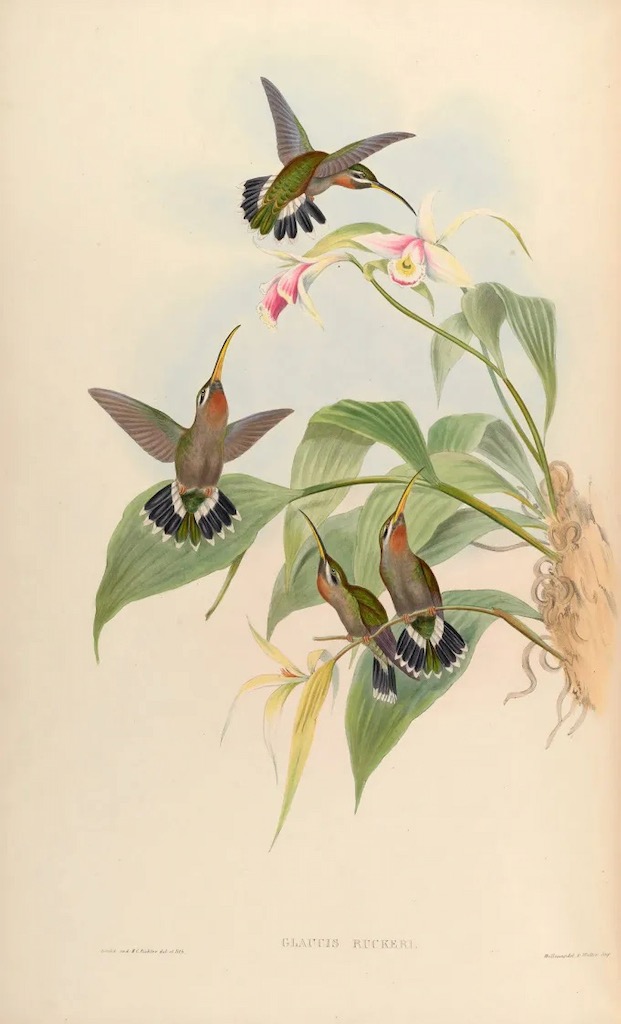
hummingbird photo (above) by shelia zimmerman, sister of my beloved late friend mary ellen sullivan, may her memory be a blessing, (and it is. every day.)

happy blessed sunday birthday to a personal patron saint of mine, mark burrows.

looks like i was in the mood for capitals this morning, maybe just to prove i know how to find the shift key. hope you don’t mind the tall letters every once in a while. i do understand how it makes a sentence filled with proper nouns a bit easier to read…..

let’s play a bit of book group: what are some of your favorite Mary O lines, or words, or phrases?

p.s.s. i almost forgot: i’m taking The Book of Nature on the road this weekend. sunday afternoon, in fact, when i’ll be at Winnetka’s Book Stall at 2 p.m. for a book talk canceled last spring and now back on the calendar. problem is my little voice has gone missing again, and my vocal cord injections are on the books for tuesday, so it’ll be a bit squawky but the show must go on. it’s also Printers Row LitFest this weekend, so lots of getting pulled in several directions. wherever you are, have a lovely blessed almost-autumn weekend.

nursing tender things along. . .

barely perceptible nub of palest green, on the first outpost of the left branch of what might once again be my peewee hydrangea…see it?

i found myself crouching down as low as i could go the other day—likely lower than a girl with slits in her side should wisely have gone. but i was intent on inspection. i was searching clumps of stick for little nubs of green. of life. of any sign that the last shrub i planted in the fall — the day before the frost came — had survived the long winter. 

it was a long winter for plenty of us — certainly for my garden, newly planted in the weeks not long after the dreaded fence went up next door, and indeed for me. 

and yet now the season of birth and rebirth is upon us. from every bough and limb, from every red bird’s throat, the song of springtime’s hallelujah bursts forth and keeps on forthing. 

i find myself particularly intent on the tendernesses of this holy spring. i am crouching down low day after day, keeping watch for signs of life, coaxing beauties to unfurl.

poor mama robin laid her egg on a porch railing. oops. fear not, all now is well.

seems a wise posture, that of nursemaid to the birthing earth. it’s one i am learning to mimic as i consider my own deeply tender places, as i picture the convulsions of my poor little lung that likely has no clue what hit it, and why all the folderol and commotion a week or so ago. but it is now doing its darnedest to sew itself back to whole, pressing tight the seams that now are held in place with metal threads. the miracle of the human body is not unlike the miracle of holy earth, and as i slowly walk my garden’s edge, stooping here or there to lend a hand — lifting clematis vine to its fallen trellis, rescuing a robin’s egg mislaid on a railing’s edge — i am breathing in the tender caretaking ways of the God who so tenderly holds us in God’s sacred trusted hand. or so i imagine. none of us has a clue really just what form this God of ours inhabits, so from time to time i apply my storybook imaginings to make it all more apprehensible. i understand the naiveté of picturing a God who scoops me in God’s hand, but somewhere deep in that vision there is a grain of holy comfort. there is an image put to the ineffable. and right in here, i need that image.

i’m not the first to put pictures to my God, and i know i’m not the last. it’s a hard task here on earth to imagine the Divine goodness that inhabits all the cosmos, and surely all the heavens, and then the questions come: is heaven the holy light deep in our hearts? is heaven that palpable knowing that we are held by a goodness beyond our wildest imagination? once upon a time the nuns taught that heaven had a pearly gate, and was carpeted in clouds. oh, lord, they shouldn’t teach such things to wide-eyed little children; it can take a long long time to revise the picture reel inside your head, and why waste time in lala land when God is so much more and vaster and infinitely deeper.

i am spending many chunks of time pondering the presence of God in this messy chapter of my life. what i know is this: when i was deep in the dark tunnel of an MRI that scanned the vessels of my brain, and told not to flinch a single muscle for 45 excruciating minutes, i surrendered to the softest arms i’ve ever known. i imagined them as the arms of God, cradling me. and in that space of utter peace, i rested. and did not flinch, did not cough, did not exercise the itch or cramp in my shoulder; i found the holy wherewithal to do precisely as the doctor ordered. 

and that is how i pass the hardest hours. i go deep down under. into the place where God and angels dwell. i’ve no knowledge of this landscape. it’s all uncharted and unknown. but when i go there i am safe. and i am cradled in what feels like love. and that to me is how it feels when i walk my garden’s edge, crouch down low, and lift a hand to bud or vine or mislaid egg. we are all nurturing each other along. God and all of us. and i’ve no idea just how it works, or what it is. but i know i sense a holiness that i am choosing to call my God.

amen.

(i fully grasp that i’m going out on limbs here, groping along in wholly naked ways, but if i don’t use these hours of my life to plumb the deepest questions, to fumble for the truest answers i know, then what worth will these struggles hold? we have a chance to be our best selves in our darkest hardest hours. and these are mine. so far. so why not open the book and see what stirs? i’m impelled to wonder and to muse aloud….)

mama robin, safely atop her mislaid egg. photo by kerry, who saved the egg and whose porch is mama’s birthing room….

and now a few morsels, as has been my way in this year of gathering up bouquets of wisdoms…

Julian of Norwich, an English anchoress who experienced a vision in 1373 and wrote about it in a work titled Showings or Revelations of Divine Love — the earliest surviving book by a woman in the English language. my friends at the SALT Project (emmy-award-winning visual storytellers with a spiritual bent; check them out) laid this excerpt out as a poem. i found it lovely….

And in this he showed me a little thing
the quantity of a hazelnut,
lying in the palm of my hand, as it seemed.
And it was as round as any ball. 

I looked upon it with the eye of my understanding,
and thought, ‘What may this be?’
And it was answered generally thus,
”It is all that is made.”

I marveled how it might last,
for I thought it might
suddenly have fallen to nothing
for littleness. 

And I was answered in my understanding:
It lasts and ever shall, for God loves it.
And so have all things their beginning
by the love of God. 

In this little thing I saw three properties.
The first is that God made it.
The second that God loves it.
And the third, that God keeps it.


+ Julian of Norwich


 as has been my habit in recent months, i mark the turning of each month by turning to the pages of Henry David Thoreau’s The Journal: 1837–1861. here’s a dreamy entry from the ninth of may when thoreau was 34 and aswirl in the warmth of mid-Spring. (may our warmth please come….) 

May 9. It is impossible to remember a week ago. A river of lethe flows with many windings the year through, separating one season from another. The heavens for a few days have been lost. It has been a sort of paradise instead.

Saw a green snake, twenty or more inches long, on a bush, hang­ing over a twig with its head held forward six inches into the air, without support and motionless. What there for? Leaves generally are most beautiful when young and tender, before insects or weather has defaced them.

These are the warm­-west-­wind, dream­-frog, leafing­-out, wil­lowy, haze days. Is not this summer, whenever it occurs, the vireo and yellowbird and golden robin being here? The young birch leaves reflect the light in the sun.

Mankind seen in a dream. The gardener asks what kind of beans he shall plant. Nobody is looking up into the sky.

a little dictionary for those of us who don’t know our greek: lethe: “forgetfulness,” from the river in Hades that causes drinkers to forget their past.


one more thing a brilliant woman sent me this week when i was inquiring whether a certain “tiny retreat” (that’s how it was billed) had a virtual component, for those of us whose lives are pretty zoom-y these days…..

“Be who God meant you to be and you will set the world on fire.”

Catherine of Siena

finally, a profound note of thanks, to the brilliant and bold mountain-mover of a friend i have in poet and scholar (and my former cambridge landlord) mark burrows, who sent a note to all who were at the zoom book launch a few weeks ago (a lifetime ago!), and who implored you to add a little amazon review to my “languishing” Book of Nature. well, the book isn’t languishing but its state of review sure was. i have no understanding of the algorithms of amazon, but apparently, without reviews, you’re sunk. glub. glub. glub. so mark, unbeknownst to me, rallied the forces and got the reviews boosted from 3 to 11, currently. in a million years i couldn’t have done what he did. in these otherwise upturned days, the human species has shown me in brilliant colors just how magnificently we all can be, and love is pouring forth with the might to rocket me to the holy moon, which was magnificent last night if you happened to notice.

so, thank you, blessed blessed mark. and thank every one of you who in your own magnificent ways has stepped to my side in this curious curious walk through springtime 2023…..

love, bam

some words are hard to say. . .

i don’t think i will ever forget the first time i heard the word cancer spoken in a sentence in which i was the unspoken subject. i was groggy from anesthesia, but there was my surgeon, leaning against the curtain in the recovery room. he was dressed in street clothes, his backpack slung over his shoulder, headed home to dinner, i imagined, with his little brood up here in the leafy suburbs, where we happen to both share the same zip code. i heard him say “it was cancer,” and i heard him say he was so surprised. i don’t think i heard much after that. and for all the days since i’ve been trying on that word. 

it’s a word that’s hard to say. it’s a word that’s hard to slip your lips around. especially when it belongs to you. and when the cancer in question is the one that was settled quite inconspicuously in your very own lung. i’ve thought a lot about the eight years since they first saw it there. no one thought it was cancer. they thought maybe it was a scar, from a pneumonia i’d once had. or an old broken rib. nothing to worry about. all those years. all those christmases and birthday candles blown. all those graduations and droppings off at college, and at law school. all those late late nights when a million worries kept me up, but never that one. never ever a worry that i had cancer in my lungs.

until december, when someone once again saw it by accident and decided we should not ignore it anymore. i owe that someone every year of the rest of my life. and while the next weeks of january into march were a wild, wild ride, it took till april 18 to finally figure out what it was, to finally figure out that the suspicious “neoplastic process” was in fact just that: neoplastic is another word for cancer. 

and it’s gone now. they cut it out. all of it, we hope. my surgeon called the other day and in the cheeriest voice i might ever have heard, he said “congratulations;” said “it’s as good a report as we could hope for, knowing it was cancer.”

i am writing the word here, because words are how i make sense of life. i have always found my way with words. words on paper most of all. words on paper even more than words in air. words on paper are the tracings across the topography of my life. i find my way stringing one word to another, groping along from one to another till the sentence ends. and right now i am in a thicket that makes very little sense. for a few days there, i could not for the life of me tell which way was north, and which was south. i was all turned around, and upside down. i wept and wept some more. 

but slowly, slowly, i am feeling my way. and i am feeling very brave. braver than i ever would have guessed. i would have guessed i’d crumble. but maybe all my crumbling is only in my imaginings. maybe, over the years, when i’ve played out my potpourri of disaster scenarios, i’ve been getting the crumbling out of the way, so that when the real thing came along i was practiced, i was ready to step boldly, bravely, even valiantly up to the plate. 

part of being brave is learning to say those two words, strung together: lung + cancer. lung cancer. i am now part of an unwelcome sisterhood; i’m among the ones to whom those words now belong, and whose lives are shaped and re-shaped thereafter and ever after. and i am linking arms emphatically with the ones who know these hauntings and these hollows. i am, so help me God, intending with every ounce of will and fierce determination to be among the ones who say aloud that we’ve had lung cancer and we are here to prove you can live beyond it. you can live with it shrinking––day by day, month by month––into the distant distance. 

i am still going to dance at my firstborn’s wedding, and my secondborn’s too (or whatever is the life event for which cakes will be ordered and flowers strung). i am going to sashay through my garden, the wise old woman who communes with birds and bumblebees and baby ferns. i will some day tell stories that include the chapter of the time they made the words lung and cancer a part of my vernacular. how never in a million years did i think those words would find their way into my narrative. but here they are. and who knows where they’ll take me, though i’ve a hunch it will be a heady, heady heart-swelling somewhere. i’m not one to leave life’s sheddings by the wayside, unstudied, unplumbed for all their wisdoms and epiphanies.

these might be the two hardest words i’ve ever said. but i am going to say them till they shrink in size, in wallop. i am going to say them till they’re stripped of high-voltage burn capacity.

we all have words that are hard to say, words we don’t think will ever be ours. words we don’t want to be ours: widow, widower, survivor, victim, divorcee, depressed, anxious, anorexic (the word that used to be my hardest one to say), amputee, diabetic, dyslexic, broken-hearted. maybe the point is to take on those words, slip our arms through their sleeves, make them a part of who we are, but not the whole of who we are. to be not afraid, nor defined solely by their simple syllables. but to allow them to deepen who we are, to add contour and dimension, to layer on the empathies. to shape our particular view of how we see the world. and where we find our place within it. 

i don’t intend to turn this into a place where we contemplate cancer. not at all. but right now, it’s the woodsy thicket in which i am trying to find my way. if i—someone who never smoked a single cigarette, someone who never lived with anyone who smoked—can bring the words out into the open then maybe, just maybe, it won’t be such a surprise to the next someone who finds herself stymied by a spot on her lung that cannot be explained. i will be the first one to wave my hand in the air, and say, please don’t wait. don’t hesitate. bite the bullet and let them have at it. find out if it’s cancer or not. don’t dawdle. cuz dawdling does not buy time. 

only courage buys time. stare it down, this cancer. let it know who’s in charge. let it know that you’ve no intention of letting it steal a day of your most precious life. 

i have always known that life is fragile precious. i’ve known that since long before the day my papa died, and i somehow kept on breathing after he was gone. i’ve known it over and over and over again. i’ve known it on the day i got married, when walking down the aisle was something i never really knew i’d know. i’ve known it when i birthed each of my two boys, one whose birth almost felt as if it was about to slip away, but i was determined, and i was not going to lose the answer to the million prayers i’d prayed. i knew it, too, the night i miscarried my baby baby girl, a night as real to me as the ones that ended with babies cradled in my arms. 

i’ve lived so many days i’d never thought i’d see. 

and i am going to live even more. and i am going to say aloud that i once had cancer in my lung, but they cut it out, and now it’s gone. and i am going to tell the story of what it’s like to live emphatically after the doctor in the recovery room tells you he was so surprised. so so surprised to find out that it was, in fact, cancer idling in my lung. 

cancer i hope and pray is gone. completely, totally, forever gone. 


the two little bits i found this week seem fitting for a day of telling hard truths. first, musician Nick Cave’s advice to a 13-year-old:

“Read. Read as much as possible. Read the big stuff, the challenging stuff, the confronting stuff, and read the fun stuff too. Visit galleries and look at paintings, watch movies, listen to music, go to concerts — be a little vampire running around the place sucking up all the art and ideas you can. Fill yourself with the beautiful stuff of the world. Have fun. Get amazed. Get astonished. Get awed on a regular basis, so that getting awed is habitual and becomes a state of being. Fully understand your enormous value in the scheme of things because the planet needs people like you, smart young creatives full of awe, who can minister to the world with positive, mischievous energy, young people who seek spiritual enrichment and who see hatred and disconnection as the corrosive forces they are. These are manifest indicators of a human being with immense potential.

“Absorb into yourself the world’s full richness and goodness and fun and genius, so that when someone tells you it’s not worth fighting for, you will stick up for it, protect it, run to its defence, because it is your world they’re talking about, then watch that world continue to pour itself into you in gratitude. A little smart vampire full of raging love, amazed by the world.”


 and next up, annie dillard on why we read and write at all….

“Why are we reading, if not in hope of beauty laid bare, life heightened and its deepest mystery probed? Can the writer isolate and vivify all in experience that most deeply engages our intellects and our hearts? Can the writer renew our hope for literary forms? Why are we reading if not in hope that the writer will magnify and dramatize our days, will illuminate and inspire us with wisdom, courage, and the possibility of meaningfulness, and will press upon our minds the deepest mysteries, so that we may feel again their majesty and power? What do we ever know that is higher than that power which, from time to time, seizes our lives, and reveals us startlingly to ourselves as creatures set down here bewildered?”

– Annie Dillard


and, this, maybe more than anything. . .

a friend who will be a lifeline sent me this late last night, and i breathed it in through my tears. we can do hard things. humans have done hard things since the beginning of time.

a little note: i am not going to share any medical details here, only the rumblings of my heart. please know that i have a team of angels on my side, medically.

what hard things have you done? and what lightened the load?

waiting. . .

i decided to give you a pretty picture of this season erupting, but doing it in slo-mo. this is korean spice viburnum waiting to open wide its little throats and let out its intoxicating perfumes. this is waiting, the spring edition.

waiting is the word of the week. word of the year, in fact––so far, anyway. i’m on the other side of surgery––and have the tic-tac-toe board crisscrossing my side to prove it. they got out what they needed to get out (i hope), though it was more than we’d been betting on. so now i’m waiting.

waiting is a quilt of many textures. sometimes it washes over me, with a calm that takes the sting away. sometimes i feel my heart kick into higher, faster gear. i try hard to turn off the nozzle that lets the worries out. but even my secondborn tells me i do too much of that. and he’s only been keeping watch for twenty-one of my years (and he is 300 miles away right now, so he’s out of range for any current worries; job one for me is to project calm to the one with the very, very giant heart). it’ll take two weeks for the blessed souls in the pathology lab to do what all they do to lay out the specifics of this little dervish that somehow found its way to the bottom of my lung. and that gives me time to sink slowly into the bath of this new reality.

waiting gives the human species time to settle in, to realize you’ve taken more steps into the unknown than you’d ever imagined you would. and you’re calmer––and maybe braver––than you’d ever ever imagined you could be (most of the time anyway). of all the worries i’ve worried over the years, i never added lungs to the list.

just the other week, i read a lovely line from a 96-year-old, a woman who knew she was on the last pages of her life, and so she scribbled out her truths for her children, her grandchildren, and her many greats. when asked what might be the most important thing she’d realized as she rounded the final bend, she simply said: “i wish i hadn’t spent so many hours worrying, cuz most of those worries never came to be.”

mostly, what waiting does is make me savor every minute. stepping out into the balmy springtime air. tucking my nose into the soon-to-be blossoms. listening to the owls hoot at 5:15 a.m. marveling at the miracles of modern medicine that can do so very very much, and for the most part do it so very lovingly. (i fell in love with my nurses, emily who stayed all night with me, and clare who worked by day. the care with which they changed dressings, filled syringes, listened to my questions, they made me so so proud that i was once one of them. and they made me realize how very much even their most basic medical tasks translate into a language that feels like love. i was a stranger to them when i was rolled into my cubicle of a room, but by shift’s end i was sad to see them leave. if you’re a nurse, believe me when i tell you you’re a living saint. to make the scared and fragile and confused feel safe and tended to is a sacred act, is sacramental, in that it lifts even the most perfunctory of duties into the closest thing i know to benediction.)

a few of things i marveled at this week, while idling in my wait station: my friend the nurse practitioner who, when she found out how much it hurt to try to lie down in bed, ordered up a giant wedge pillow that made last night a whole lot less bumpy. having two of my three boys right by my bedside all week long. one of ’em had me laughing (sidesplittingly is not such an apt description here, though it might have stretched some stitches) within hours of getting to my little room. (i was on the heart transplant floor, and, believe you me, i did not miss for a minute how blessed i was to be there only for a chunk taken out of my little lung.)

yet another surround-sound marvel in this week one of the two-week wait: the promise of springtime, that life bursts forth year after year after year. we live in an eternal spiral, and i am on for the holy blessed sumptuous ride. stepping into the still soft air, watching the goldfinch nibble at the thistle seed, rejoicing as the daffodils tossed off their snowy caps to rise and shine again, golden periscopes of spring. it felt to me like the arms of God were wrapping round me in the form of this gentle greening world.

in book world, one fine thing happened: there is a lovely lovely journal, the EcoTheo Review––a quarterly put out by a collective of poets (mostly), writers, and artists who plumb the depths of wonder and beauty in this world, and who claim as their mission, to “celebrate wonder, enliven conversations, and inspire commitments to ecology, spirituality, and art.” and they published a conversation we’d had a few weeks back about The Book of Nature, which you can read here. the editor who spent hours in our exchange of thoughts, Esteban Rodriguez is his name, is himself a poet, and one of the kindest, gentlest souls i’ve been blessed to come to know. it more than more than made up for the half dozen book events that got wiped off the calendar.

while i wait in these days ahead (and try so hard not to worry!), i’m going to be on watch, to soak up and see every blessed wonder and beauty in this holy world. i don’t want to miss a drop. i am following the instruction of richard rohr, the modern-day mystic, who asked:

Where is this God being revealed? Not in the safe world, but at the edge, at the bottom, among those where we don’t want to find God, where we don’t look for God, where we don’t expect God.

i’m going to look for God in every nook and cranny along this waiting way. because i’m fairly certain God comes in a thousand thousand forms: in the gentle touch of the nurse who poked my arm, in the bouquet dropped on my front stoop, in the tub of soup that now takes up a shelf in the fridge, in the box that’s on its way from zingerman’s deli in ann arbor, and in every last note and gentle text that simply says, “you got this, and i am here beside you.”

God comes most certainly in the hours when our waiting gives God more than plenty time to tap us on the heart, the soul, the noggin. i’m on watch while i wait…

where did you find God this week, or whatever is the name you give to the all-embracing goodness that i call the holy Author of it all?

she blossomed, my olfactory factory….

of thin places and the deep soul of my ancient peoples

i remember perfectly the first time i heard mention of a “thin place.” i was on holy ground, a farm smack dab in the middle of abe lincoln’s homeland. beau’s farm was the name of the farm, an organic farm, an organic farm that rose from an almost impenetrable shadow of grief. deep grief. beau was a marine, a strapping handsome fellow, who died down the road from the farm, home on leave from iraq, when he drowned. his mother, a woman i’ve come to love dearly, once told me that losing beau was “just like being hung, that moment when they pull that thing out from under you,” when the sheriff comes to the door, rings the bell at just past dawn to break the news.

beau’s mama was lost to grief for two long years. but then, she told me, she started to notice little beauties. she’d toss an old dried plant to the ground; and it’d grow.

“it dawned on me, after all those months, i was noticing beauty,” she once told me as we walked the gravel drive to where the peacocks pecked and strutted in their pen. and as i once wrote in the pages of the chicago tribune, “that’s when she realized. realized maybe the one place where she could plant her sorrow, turn it into something beautiful, something lasting, was the almost seven acres that surrounded her old white resurrected farmhouse. . .”

terry starks is beau’s mama’s name; she lives up in maine now, where she still turns earth and life into something beautiful, something lasting.

terry starks was the first to tell me of thin places. she told me the hay loft in her barn was where she went to cry when the tears seemed to have no end. she told me she was drawn there because the loft was surely a thin place, a place where the veil between heaven and earth is lifted. where you can all but feel the arms of God reaching out toward you.

it’s the celts who see the world that way, who know that ours is a topography of the sacred. who live attuned to soulful rhythms most others miss.

i remember sitting on the porch swing at beau’s farm, as beau’s mama poured her hard-won wisdoms as if a pitcher without bottom. i absorbed more gospel that day on beau’s and beau’s mama’s farm than i’ve absorbed most days of my holy blessed life.

ever since, i’ve been drawn deeper and deeper into the wisdoms of the celts, a holy people who traipse the hills and vales and rocky shorelines of my ancient roots.

because today happens to be a day when plenty of folk haul out green beer and soda bread, i decided to haul out just one of many passages from The Book of Nature, my little book due to be birthed just the other side of the weekend, on the vernal equinox, day of equal light and shadow, when all of us might look upon each other’s faces for the very first time, reason to rejoice if you ask me. it’s a passage from a chapter on the dawn. and i picked the photo way up above because i took it on the day i drove to beau’s farm, and it fits blessedly with how the celts see the sun. and because i was thinking of thin places, i decided to tell terry’s tale as the long way in to how the celts have taught me so very many things. thin places, among the litany.

here tis. . . a passage from The Book of Nature…

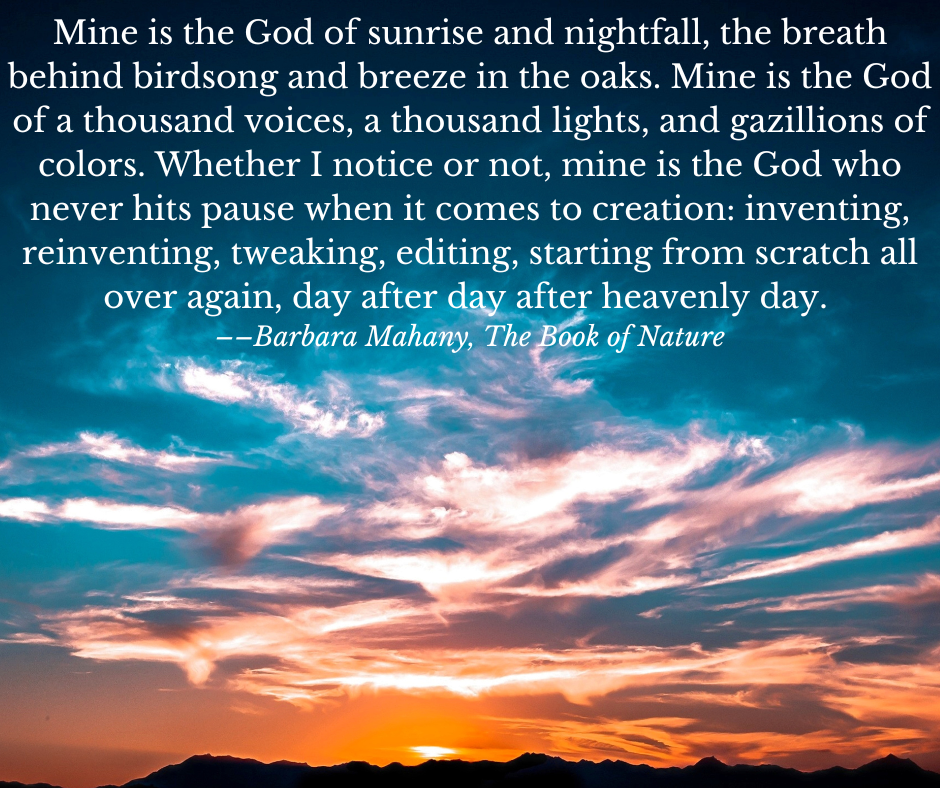
God was considered “the Sun behind all suns,” as the author George MacLeod once wrote. The whole of creation was dappled with the light of the sun as it journeyed across the sky. Wherever its light fell, there was God filtering through, an earthly translation of the divine infusion. And the perpetual Celtic praise song rose up with the dawn. Celtic gentlemen—farmers and herders and fishermen, set off to work in the predawn darkness—doffed their hat at the first light of the sun, and bowed in blessing. The Carmina Gadelica, a collection of Gaelic prayers and chants, is filled with start-of-day blessings, as the Celts were wont to offer up benediction for every chore and implement and God-given element of every day, from milking to weaving to shearing the sheep, from fire to wind to sprinkling of water. And certainly for the miraculous return of the morning’s first light. Mystic and teacher Alexander Scott, who grew up in the west of Scotland and kept Celtic ways alive in his nineteenth-century books, wrote that his were a people “listening for God in all things, ‘in the growth of the tree, in the rising of the morning sun, in the stars at night, and in the moon.’” 

–Barbara Mahany, The Book of Nature


of the many, many stories i wrote over the almost 30 years, the story of beau’s farm was one of the ones i hold closest to my heart. here’s a link, should you care to read it. with love, from terry’s scribe. (apologies if you need a subscription to open the link.)


thanks to a friend i love with my whole heart, i stumbled on another wise soul with buckets of beauty to grace the world. a poet-activist-performer named andrea gibson, now a cancer survivor whose words might take your breath away. andrea identifies as queer, and uses the pronoun “they;” and they are known for their trademark honesty and bare-naked vulnerability, traits i find irresistible and blessed beyond words. here are just a few lines i couldn’t keep from scribbling down:

when it comes to hearts i want always to be size queen…

i love you because we both showed up to kindness tryouts with notes from the school nurse that said we were too hurt to participate….

when your heart is broken, you plant seeds in the cracks and pray for rain.

before i die, i want to be somebody’s favorite hiding place, the place they can put everything they know they need to survive, every secret, every solitude, every nervous prayer, and be absolutely certain i will keep it safe. i will keep it safe.

andrea gibson

one more morsel for this blessed day, a poem from billy collins, once poet laureate of the united states, and a poet with plenty o’ irish roots . . .

Questions About Angels
by Billy Collins

Of all the questions you might want to ask
about angels, the only one you ever hear
is how many can dance on the head of a pin.

No curiosity about how they pass the eternal time
besides circling the Throne chanting in Latin
or delivering a crust of bread to a hermit on earth
or guiding a boy and girl across a rickety wooden bridge.

Do they fly through God’s body and come out singing?
Do they swing like children from the hinges
of the spirit world saying their names backwards and forwards?
Do they sit alone in little gardens changing colors?

What about their sleeping habits, the fabric of their robes,
their diet of unfiltered divine light?
What goes on inside their luminous heads? Is there a wall
these tall presences can look over and see hell?

If an angel fell off a cloud, would he leave a hole
in a river and would the hole float along endlessly
filled with the silent letters of every angelic word?

If an angel delivered the mail, would he arrive
in a blinding rush of wings or would he just assume
the appearance of the regular mailman and
whistle up the driveway reading the postcards?

No, the medieval theologians control the court.
The only question you ever hear is about
the little dance floor on the head of a pin
where halos are meant to converge and drift invisibly.

It is designed to make us think in millions,
billions, to make us run out of numbers and collapse
into infinity, but perhaps the answer is simply one:
one female angel dancing alone in her stocking feet,
a small jazz combo working in the background.

She sways like a branch in the wind, her beautiful
eyes closed, and the tall thin bassist leans over
to glance at his watch because she has been dancing
forever, and now it is very late, even for musicians.


nothing would delight me more than to see some of you, or all of you, come tuesday night, when i am shoving aside my worries about stepping up to speak in front of a crowd any bigger than the one or two who might share this old maple table on any given morning. we’ll gather to mostly rejoice in what’s become a holy sacred bond, one woven over time, through shared wisdoms, devoted kindness, good grace and humor. and i promise to read one or two passages from The Book of Nature, and even talk a little bit about how it came to be. it’s the first of my five books that wasn’t first birthed here, but its pages are filled with wisdoms learned here, steeped here, refined here. so you all have a thread in the whole cloth it became. and i can imagine no finer benediction than to begin the book with you. so see you tuesday, march 21, the vernal equinox at 7 p.m. chicago time.

now, what celtic wisdoms fuel your every day? and where are the thin places in your life where the veil between heaven and earth is at its thinnest, and you too feel it lifted for a blessed glance of the sacred beyond?

when it comes to hearts, i always want to be known as size queen…

foreverest friends and the incomparable lessons of the heart

my grandma lucille, me, and the Divine Ms M, easter circa 1977, in the house where i grew up

because this week paused to celebrate the glories of the ever-pulsing heart, and because i happened to board a jet plane and criss-cross the country, to land in the state of movie stars and swaying palms, where i am romping with my foreverest friend, i decided a love letter was the order of the day. . . and, besides, who ever grows old of lettres d’amour?

this is going to be a love letter to my very, very best forever-and-ever friend, yet it’s also a love letter to friends of the deepest-down sort. i call my forever-and-ever friend the Divine Ms M. and sometimes i call her Auntie M, because she is auntie to my bookends of boys. she lives 2,041 miles away, in sunny LA, which is far too far for afternoon mugs of tea, or long mornings side-by-side on a park bench, or those other indulgences of forever friendships. i’ve said that she saved my life. but what she really did was teach me how it feels to be loved in the deepest nooks and crannies of the heart, and she taught it in a way that felt so very very heavenly, so otherworldly, i’ve spent the rest of my life trying to love like she loves. 

it was second semester of my sophomore year of college, and suddenly there was a willowy blond-haired beauty with big big eyes and an even bigger heart who had moved onto our wing of the second floor of a mostly-sophomore dorm, a dorm with clunky elevators and skanky carpet ribboned along long dark hallways, a dorm that looked out over nothing so scenic as endless parking lot. this new someone, a brand-new freshman among us second years, carried herself with an elegance i spied miles away. in the thick of downtown milwaukee, a california girl is a rarity. 

right away i noticed her tender heart. maybe she noticed mine. 

we’d both suffered a few tough knocks, knocks still raw for both of us. not the sorts of things you say much about till you’ve sniffed around, made sure the coast is clear and you’re in a safe heart zone.  

it wasn’t long till we must have realized there was a certain pull that held us; it had been a long long time since i had a friend to whom i could safely hand my whole heart. but i knew she was just that friend. what i remember most emphatically is that, for a reason that long ago escaped me, she one day knocked on my dorm room door, and sat down beside me with a basket. every delicately-selected something in that basket was speaking to a different turn of the prism’s light. i seem to remember an apple. and a tea bag. but i don’t remember a single other thing. i do remember that little squares of folded-up paper explained each and every something. and i remember my breath was sucked away, because each and every something burrowed deeper and deeper into the heart of me. she had covered the whole expanse of a many-chambered heart with a few fine things tucked in a handled, wicker basket. 

we’ve shared hard years, and a few sweet rejoicings, over all these years. the sorts of years lifelong friends inevitably share: deaths, disease, weddings, births, worries, worries, more worries. 

and after almost 15 years of only phone calls, and emails, and brown paper packages mailed back and forth, and more recently the miracle of texting in real time (whether it be from an emergency room, or a surgical waiting room, or the children’s library where she enchants the kindergarteners), we have tumbled into each other’s real life arms. i hopped a plane and tagged along my bespectacled mate as he motors off to the california desert, and the oasis that is palm springs, to give a sunday talk. we decided to make it a hop, skip, and a jump trip. one that plopped us first in sunny LA, and then will find us out palm springs way.

for a million and one reasons, this visit is just what the doctor ordered. and it will upholster me (another word for plump me up, or cushion me) for the weeks to come. 

i hope and pray we all have a Divine Ms M in our lives, that rare someone whose hearing is so high-grade she or he can hear the words we utter without sound. whose sight is keen to the faintest of subtle twitches, the ones we try to hide deep inside the smiles we sometimes wear. i am blessed with a glorious handful of such friends. some make me laugh so hard i nearly choke on whatever’s in my mug. some set me straight with unabashed, unfiltered truth talk. some hold my hand so tight it forgets to tremble.some bowl me over with a brilliance and a sheaf of wisdoms that leave me gobsmacked.but there’s no one who goes so far back to what might be my new beginning, not long out from a hellhole of a dark, dark chapter in my early days. my LA girl brought me sunshine, and all these 46 years later, she still holds the secret wand to chase away whatever big gray cloud dares to scuttle in. 


in honor of friendship, and its miraculous healing powers that make us strongest in our broken places, here’s a beauty of a poem from jane hirschfield, a wunder poet and ordained practitioner of soto zen buddhism. 

For What Binds Us

There are names for what binds us:
strong forces, weak forces.
Look around, you can see them:
the skin that forms in a half-empty cup,
nails rusting into the places they join,
joints dovetailed on their own weight.
The way things stay so solidly
wherever they’ve been set down —
and gravity, scientists say, is weak.

And see how the flesh grows back
across a wound, with a great vehemence,
more strong
than the simple, untested surface before.
There’s a name for it on horses,
 when it comes back darker and raised: proud flesh,

as all flesh
is proud of its wounds, wears them
as honors given out after battle,
small triumphs pinned to the chest —

And when two people have loved each other
 see how it is like a
scar between their bodies,
stronger, darker, and proud;
how the black cord makes of them a single fabric
that nothing can tear or mend.

~ Jane Hirschfield ~
 (Of Gravity & Angels)

what are some of the ways you learned to love from someone you happened to tumble into in the hollows of your holy blessed life?

auntie m + me + our babies, her sweet girl and my beloved firstborn in sunny LA a long time ago…i think 1999, cuz we went to the not-yet-opened Legoland and i just checked when it opened, and voila march ’99.

remembering and other acts of blessing

yahrzeit is a yiddish word translated as “time of year,” and for jews, a people who sanctify time in so many ways, yahrzeit is both solemn and a blessing. yahrzeit is when jews remember the dead, and, as in so many cultures, when we wrap ourselves in an almost-palpable sense of remembering. for jews, it dates back to the 16th century, when an otherwise obscure rabbi wrote of yahrzeit in his book of customs. every year on the anniversary, “the time of year,” of the death of someone beloved, jews are called to the synagogue, and rise for the reciting of the mourner’s kaddish, a praise prayer to God, spoken in the depths of mourning, of grieving, and of remembering. it is one of the beautiful mysteries of judaism that the kaddish does not mention death. it’s an ancient aramaic prose-poem, thought to be an echo of Job, “spoken from the sub-vaults of the soul,” that, as some have written (beautifully), is offered up as consolation to God, who suffers the loss of any one of us as piercingly as we do.

at home, the marking of “the time of year” is when a yahrzeit candle is lit, and burns for 24 hours. to glance at the dance of the flickering flame is to remember, to offer up a word, a prayer, from the heart.

my papa’s yahrzeit is today. 42 years ago, this became the darkest day, the snow-swept night the doctor walked into the cold, linoleum-tiled hospital corridor and simply said, “i’m sorry,” leaving us to fill in the unimaginable, unspeakable blank. my beloved papa had breathed his last. and it would be a long time till i could fill my own lungs again. and it is a miracle and testament to godly healing that all these years later i do know laughter again, and i have filled my life with treasures––my boys, first among them––my papa would have so reveled in. oh, he would have beamed. in my darkest and my brightest hours, he is with me still and always.

i am not alone in marking this day as a day of remembering. all our calendars are filled with dates all but written in invisible inks that we alone decode. the date i miscarried my baby girl. the date my firstborn broke his neck. the date you found out something terrible. the date you or someone you love got sober. the date you figured it out, whatever “it” might be.

it is in remembering, i think, that we sometimes grow our hearts. it is in holding close whatever was the whammy life dealt. those whammies come in a thousand thousand colors and flavors and sounds. and those moments, those chapters, are the ones that propel us into our truer and truer depths. it’s life in its complexities that draws out the marrow of who we are.

i am not one who usually turns to nietzche but i stumbled across this line this week, and suddenly it fits with thoughts of yahrzeit and remembering and loving:

“no one can build you the bridge on which you, and only you, must cross the river of life,” the young nietzsche wrote.

but we walk the bridge with those who’ve walked before us, with those we’ve loved and lost.

and in my darkest hours, and in my brightest ones, i somehow always find my papa shimmering there at the edge of the frame. in my deepest dark hours, i pray: “be with me papa.” and he is.


it’s the last line of this poem where i feel my soul swoop up and skyward…

Lines For Winter

Tell yourself
as it gets cold and gray falls from the air
that you will go on
walking, hearing
the same tune no matter where
you find yourself —
inside the dome of dark
or under the cracking white
of the moon’s gaze in a valley of snow.
Tonight as it gets cold
tell yourself
what you know which is nothing
but the tune your bones play
as you keep going. And you will be able
for once to lie down under the small fire
of winter stars.
And if it happens that you cannot
go on or turn back and you find yourself
where you will be at the end,
tell yourself
in that final flowing of cold through your limbs
that you love what you are.

~ Mark Strand  ~


the earthquake in turkey and syria: as we all watched helplessly the devastations in syria and turkey, it was hard to watch, and hard not to want to reach across the screen and clear away the rubble. i have been moved time and time again why the white helmets, an all-volunteer corps who leap into chaos and devastation with unbridled courage and determination to pull any breathing bodies from beneath the dusty hell on earth. should you be inclined to do what we can from over here, and want to be sure your money’s getting where it will make the most lasting impact, check out this navigator from NPR to find out just that. the baby girl to the right is the sole survivor of her family, pulled from the rubble with her umbilical cord still attached to her dead mother. the world is rooting wildly for her. and blanketing her in so, so much love. and remembering her mother. . .


and before i go, in case you didn’t happen to see my highly unusual monday morning posting here on the chair, i bring this invitation to the friday table! it’s a real-live virtual (such is the definition of real-live these days) chair gathering. we’re calling it a launch for my next little book, but really for me it’s the joy of finally finally gathering us all together. and finally putting faces to names like “jack,” and “hh,” and “nan”. . .

we’ll gather on the evening of Tuesday, March 21––the actual pub date of The Book of Nature: The Astonishing Beauty of God’s First Sacred Text––when we shall send it soaring into the everland. it’s free and it’s just for friends of the chair––wherever you are––and it’ll be at 7 p.m. chicago time, when we’ll gather by zoom. and all you need to do is click this link to register. the zoom link will be magically sent to you. and, since i’ve never ever done this before, beyond that we will all find out together what happens next.


that’s my papa above, feeding the kangaroo, when he was once down under, giving yet another one of his gloriously animated speeches to a crowd of grocery mavens. my papa was an ad man, an ad man who loved a microphone. i, as his deeply devoted daughter, decidedly did not get the microphone gene, though i can find myself animated once i get over the trembles.

how do you remember the ones you’ve loved and lost?

the littlest tree and the beating heart of Christmas . . .

shuffling in from the tree lot––the Christmas tree lot––with the littlest tree that nearly ever there grew, and once i’d kerplunked the pitiful seedling in its far-too-big tree stand (the yuletide equivalent of a saggy pair of dungarees slipping down to the knees of an undersized tot), i sat right down to pen my apologia to my faraway boys.

my mea culpa unfolded thusly: 

sweet boys, we have adopted this year, from the neediest Christmas tree farm, the wee littlest tree you ever did see. he very much wanted a home, and we shall be taking name nominations starting now. he’s an inflationary victim, the poor little sprout (there’s a name, Sprout!), as trees are in short short supply (and they’re short!). we’ve gussied him up with a santa cap, cranberry ropes (don’t tell him they’re wooden), and the lovely quilted skirt that will soon be an heirloom. a standard-sized tree topped 200 bucks this year, and for two weeks of Christmas that is not allowed. (just think, your tree funds will be shifted to the beef tenderloin fund, which is much more delicious anyway.) the little fellow smells just like the woods, and i am certain a bird might land in him soon. i beg your mercies in embracing this little guy. he tried with ALLLLL his might to grow like the big guys, but he just didn’t have it in him, and here in this house we love the ones on the margins, even the trees. xoxoxox deepest apologies if you are duly disappointed…

xox 

didn’t take but a minute for the one i might forever call our “little one” to ping right back: 

I like underdogs

and then:

This tree seems like a underdog

and so my upside-down day was snapped into crystal-clear focus: the message of Christmas delivered, and echoed. 

it’s all about heart, and dimensions don’t matter. nor superlatives. nor getting it right. nor any of the vexations that sometimes tangle me in my own unlit strands.

never mind the panting toward some imaginary finish line, as once again our festival of lights and our feast of nativity wedge their way into the same single overbooked week. never mind the slab of brisket i need to fetch from the butcher, or the welcome-home mac-n-cheese i need to slide in the oven, while dashing to an incoming plane at an airport many miles south (after picking up grammy plenty miles north, making for a 78-mile loop on a holiday weekend afternoon). and never mind the onerous chore that just yesterday had us signing last wills and testaments, which i can assure puts something of a damper on the jolly spirit of christmas. (one of those “responsible-grownup” tasks right up there with root canals!)

all of it vanished, the panting, the worries, the how-will-get-it-all-dones, in the flick of a text (the modernday spin on a wink of the eye, and a twist of the head, as clement c. moore immortally put it). 

the kid needed no convincing. no need to shovel lament. he was ready to love the littlest tree.

in years past i’d taken some ribbing––and serious protest––for my proclivities toward picking the spindliest trees. so i figured a misshapen midget of a fraser fir might have me taking my Christmas out in the doghouse (and since we’ve no dog, the fair equivalent might have been sheltering under the seed trough). 

thus, i’d decided to nip protests in the bud, devised my long-winded defense. 

and the lightning-quick reply––I like underdogs––made me see what should have been clear all along: the kid with the very big heart needs no convincing, no urging to consider the plight of the nearly forgotten. 

This tree seems like a underdog

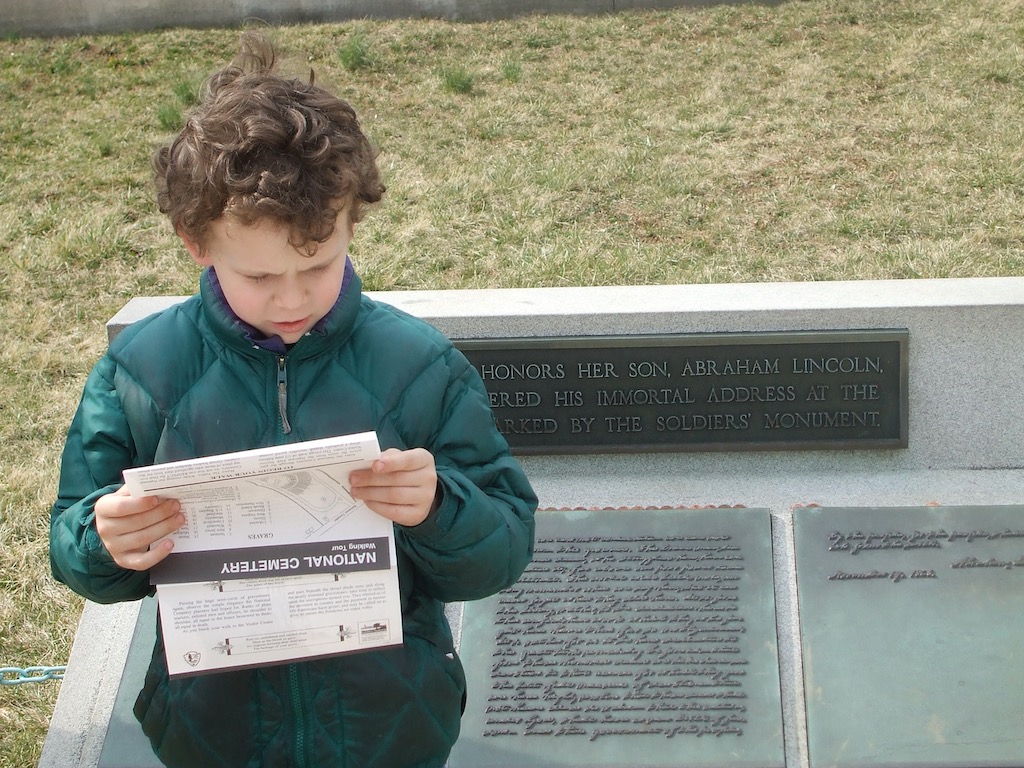
he’s the kid who long, long ago taught me to watch out for worms, who led me on moon walks, and insisted he stand on the very same spot where abraham lincoln once stood so he could recite the line from the gettysburg address that made him break into tears every time: “we can not dedicate, we can not consecrate, we can not hallow this ground.” and, on that gray pennsylvania day in 2009, when we asked why the tears, he choked out what to him seemed blatantly obvious, “it’s the soldiers.” a sadness too big for his second-grade heart.

he’s 21 now. old enough to drink, drive, and drop a vote in the ballot box. and that heart, it only grows bigger. 

hearts have a way of finding each other, the truest hearts anyway.

so, once again, he’s pointed the way to the bright heart of the season. and the littlest tree, the tree with no name yet, will stand tall and stand proud on its upturned crate. because in this old house, underdogs are always, always the heroes. 

and ours is now dressed in mighty regalia: santa cap, blinking lights (they’ll be switched out, soon as i get to the Christmas light store), and string upon string of bright wooden berries. and up on the milk crate, he’s gotten some inches. our sorry old tree isn’t so sorry, hauled in from the cold, given due glory.


here’s a beauty of a poem, just because it stirred me. . . a poem about rising up, about beauty from ashes. . .

such beauty from ashes
by carolyn marie rodgers**

and we are singing our hearts out, and
our souls are in our eyes,
and they are beautiful souls.
they are souls of truth.
they are souls of love.
they are souls of faith.
they are souls of hope.
and we have conquered a little corner in the
world of fear.

and we have stepped up and forward,
    and we have torn down walls.
we have smashed sound barriers between us.
we have dared again and again and yet again to dream,
and our dreams have finally taken material form.
we have changed our hearts.
we have altered and changed our minds,
and because of this, we now have some
    valor and strength,
and we are threatening to change the world.
that it     might be a better place.
For us and for all god’s children.
for all that we are.
for all that we might be
we have done it.
And we rise now as one voice, with many harmonies,
Through the mystery and beauty of harmony.
One voice

    Though many, for one, for all.
For all the earth to grow and know,
From the mounds of ashes of our dead, our martyred,
Our lambs, our sacrificed, those who died and have been dead
So long, so long they are no more than, nor any less than,
Sacred memories. Mountains of ashes, of our sweet, beloved,
Beautiful dead.
Today, what beauty we now have, to gain strength from to continue on,
Beauty,
From ashes.

***

**Born in Chicago on December 14, 1940, Carolyn Marie Rodgers was born to Clarence Rodgers, a welder, and his wife, Bazella. The last born of four children, her family had moved from Little Rock, Arkansas to Chicago’s South Side, where Rodgers grew up. Early in her career, Rodgers was associated with the Black Arts Movement, attending writing workshops led by Gwendolyn Brooks and through the Organization of Black American Culture. Rodgers’s poetry collections include Paper Soul (1968); Songs of a Black Bird (1969), which won the Poet Laureate Award of the Society of Midland Authors; her best-known book, how i got ovah: New and Selected Poems (1975), a finalist for the National Book Award in 1976; The Heart as Ever Green: Poems (1978); and Morning Glory: Poems (1989).

Rodgers’s poetry addresses feminist issues, including the role of Black women in society, though her work evolved over time from a militant stance to one more focused on the individual and Christianity. Other themes she explored in her poetry include mother-daughter relationships, relationships between Black men and Black women, street life, and love. In addition to poetry, Rodgers wrote plays, short stories, and essays. She worked as a book critic for the Chicago Daily News and as a columnist for the Milwaukee Courier.

Rodgers founded Third World Press in 1967 with Haki Madhubuti, Johari Amini, and Roschell Rich and began Eden Press with a grant from the Illinois Arts Council. She was as a social worker through the YMCA and taught at various colleges. She was inducted into the International Literary Hall of Fame for Writers of African Descent in 2009 on the campus of Chicago State University. She died in 2010 in Chicago, at the age of 69.

—abridged bio taken from the Poetry Foundation


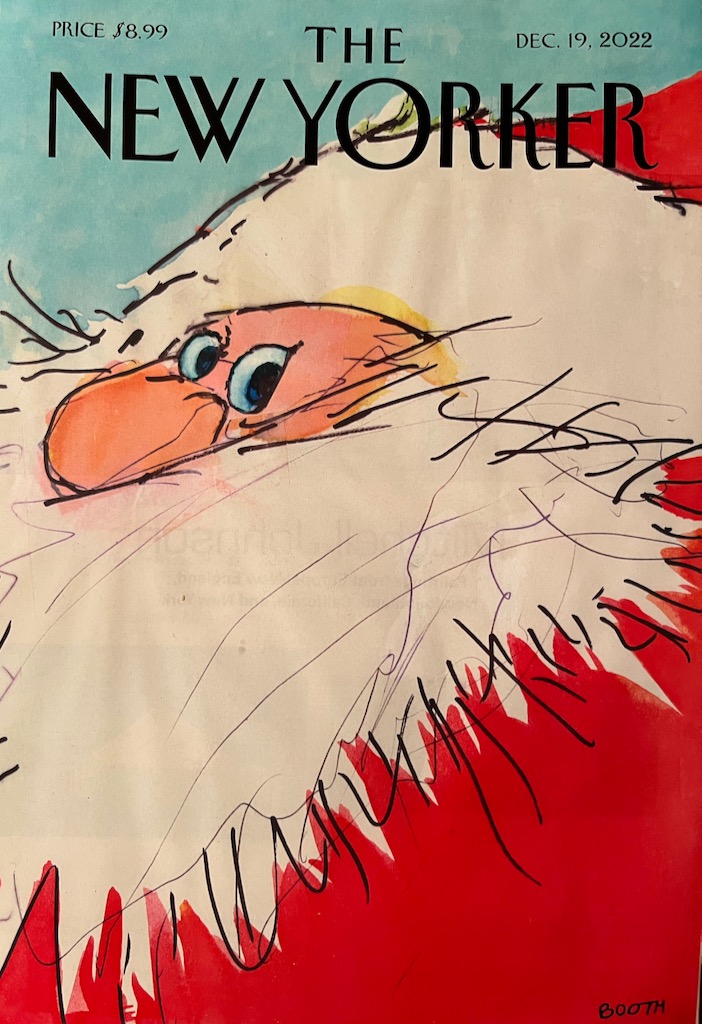
and here is the heavenly late cartoonist George Booth’s last New Yorker Christmas cover. . .  

i seem to be reverting to smorgasbord here at the chair, leaving more than one thing, as i meander through the week collecting my morsels. likely comes from thinking a little isn’t enough. making sure there’s at least enough. today, a tale, a poem, and a drawing. oh, and a question, always a question:

has a little bit of Christmas leapt out from the cracks or the corners of your life, surprised you, taken your breath away just a bit because suddenly, amid the blur, you saw crystal clear the beating heart of the season?

merry almost everything. . .

musings on sainthood . . .

soon-to-be-beheaded st. babs

i’m actually in amherst, massachusetts, this morning, about to traipse over to the homestead, the butter-yelllow brick house where emily dickinson was born and penned her nearly 1,800 poems, and i’m even hoping for a peek into the upstairs room where it all flowed from her inkwell, a room not normally on the itinerary of those who tiptoe in hushed tones through the hallways of emily’s house on the hill. but with an eye toward next week’s all saints day (a day that’s always captured my imagination), i spent a bit of this week musing on sainthood, just another name for what this world needs abundantly, urgently, in the form of plain old honest-to-goodness holiness, empathy, unheralded kindness, and megadoses of humility.


saint (n.)

early 12c. as an adjective, seinte, “holy, divinely inspired, worthy of worship,” used before proper names (Sainte Marian Magdalene, etc.), from Old French saint, seinte “holy, pious, devout,” from Latin sanctus “holy, consecrated,” past participle of sancire “consecrate.” It displaced or altered Old English sanct, which is directly from Latin sanctus.


i’ve had my eye on the saints since i was a wee thing. in the catholic imagination of my first and second grade, i thought hard about the haloed ones held up in the pages of my religion books. we were schooled to be demure, kind (endlessly kind), and enamored with Jesus (always dashingly handsome with his ambered skintones and long flowing locks in the full-color catechism primers, which wisely omitted most of the stories of tortures to which the anointed had had to submit). 

every night, i prayed to be saintly and attempted what i thought might be a postural shortcut: i began by smoothing my patchwork covers, then i’d lie as still as the mummies that scared me in the darkened chambers of chicago’s labyrinthine field museum of natural history, and then––the clincher––i clasped my hands in my best saintly imitation and hoped to move not even a squiggle during the night, to awake still clasped in prayerful pose. it seemed the first in a series of requisite feats on the dusty pilgrimage to sainthood.

by day, i practiced my fledgling aspirations on a lady bug, my fumbled attempt at assisian communing with all of creation. i built her a village––complete with steepled church––and ordained her high priestess of the cardboard hamlet. i checked on her last thing at night, and first thing in the morning, making sure her wings still opened and closed, and that she hadn’t succumbed to inside air. then i let her go. opened the window and unfurled the chant: “go little lady, go free!” and off into the orchard behind our house she flew, the happiest well-loved ladybug that ever there was. 

since i’ve long been an ecumenicist at heart, and don’t subscribe to any of the ecclesial hoops and tangles that dictate who’s in and who’s out in the saintly department, i go about my saint-watching by intuition and impulse. i know a saint when i see one or sense one. a saint to me is just another name for someone whose deep-down goodness is pure as pure can be. while catholics insist on a step-ladder to sainthood, other world religions seem just as intent on holiness but without the boxes to check. according to page 8033 of the thomson gale encyclopedia of religion (2nd edition):

“Historians of religion have liberated the category of sainthood from its narrower Christian associations and have employed the term in a more general way to refer to the state of special holiness that many religions attribute to certain people. The Jewish hasid or tsaddiq, the Muslim waliy, the Zoroastrian fravashi, the Hindu rsi or guru, the Buddhist arahant or bodhisattva, the Daoist shengren, the Shinto kami and others have all been referred to as saints.”

the best of the saints (hasids, waliys, fravashis, gurus, bodhisattvas, shengrens, kamis), in my book, are the quotidian ones. the ones whose everyday garb keeps them from being noticed. except for their kindness, the certain radiance they leave in their wake, the sense that something holy has just brushed by, you might not notice the saintly among us. 

but they leave behind a mark, a certain mark, a change of heart, a new expanse of seeing. we become better, bigger of heart and soul, kinder, gentler, maybe quieter, certainly softer, because of them. that’s saintly to me. 

among the saints i’ve known in my life, there was the old wrinkled man who perched on a fire hydrant befriending the pigeons. “i’m really advertising to the public how easy it is to be good without an attitude; it’s just as easy to show decency as it is to hate today,” joe zeman, the pigeon man of lincoln square once told me. 

and there was the foster mother who’d taken in nearly 100 newborns, and who was sitting by a hospital crib when she looked up and told me: “i’m no mother teresa,” she insisted, wrapping her fingers around a metal rung of the crib, as her littlest toddler was being infused with drip after drip of cancer-fighting chemo. “i always think of something i saw in the New World (a catholic newspaper) in which a columnist was saying, `i’d hate to be in line at heaven’s gate behind mother teresa when God looks down and says, `you could have done more.’”

even now, when it’s no longer my job to scour the landscape in search of those sorts of souls whose goodness leaps off the newspaper page, i find saints in the unlikeliest places: behind the cash register at the grocery store; in the catering office of my college kid’s dining hall; at a check-in gate at america’s busiest airport; in the lady down the alley who never dresses in anything fancier than her mud-stained sweats but who routinely writes checks for thousands of dollars for families in trouble, be it escape from afghanistan or domestic abuse. (a secret i discovered only by listening closely, and connecting a dot or two.)

so what makes a saint a saint, or a hasid a hasid, or a bodhisattva a bodhisattva

is it answering to an otherworldly call, the whisper of the holy divine? is it believing that the glimmering lights of the public square are simply distractions; turning instead to a quieter code, one infused with boundless empathy more than anything: love as you would be loved? is it the courage to call out injustice, to muster the chutzpah to say, “this isn’t right. you’re treating her poorly. your words are scarring her, leaving welts where they’ve hit her.” is it emanating a peacefulness, a serenity, that comes from knowing yours is a timeless eternal, a blessing for ever and all time?

what makes a saint a saint, what makes holiness holy? 

it’s a question worth asking, but mostly it’s a question to put to work. what are the scant few things you might include in, say, a manual for the would-be saint, the very title of a poem i left here on the old maple table a few years ago, after coming upon them in a book i was reviewing for the tribune. i’ll leave the first lines here again, as a place to begin your own musings on sainthood. 

Manual for the Would-Be Saint
by Susan L. Miller

The first principle: Do no harm.
The second: The air calls us home.
Third, we must fill the bowls of others
before we drain our own wells dry.
The fourth is the dark night; the fifth
a subtle scent of smoke and pine.
The sixth is awareness of our duties,
the burnt offering of our own pride.
Seventh, we learn to pray without ceasing.
Eighth, we learn to sense while praying.
The ninth takes time: it is to discover
what inside the seed makes the seed increase.

(the poem goes on for 14 more lines…but you might be inclined to pen your own…)

because i’m so worried about the world, and the evils and horrors that seem to be steamrolling goodness, i’m thinking we might put forth a collective effort here, outline a framework for how we might bring a bolus of holiness into this world. have at it. i’ll chime in too…

what do you see or sense when you encounter someone you’re sure is steeped in a certain holiness, another name for the sainted?

emily d., the belle of amherst