
adopt-a-poet: lynette roberts—silenced, forgotten, deserving of her due
by bam
most of us might do well, or we think so anyway, to live our lives in reverse.
or maybe it’s as it should be that the richest chapters come now, at the far end of our sprint, when we know just a shade more about where our hungers lie, and what sates us.
maybe there’s some common thread between the long-ago me drawn to be a nurse, and the me now drawn to—can’t keep myself away from—the world of poets and poetics, where words are the fine implements that probe the soul, elicit what stirs there, often from the realm of the unspoken.
in my best stints as a nurse, caring for kids who often were dying of terrible cancers, i prayed for the not-often-enough chances to plunk down at their bedsides, in between the passing of meds, and the chasing down of doctors’ orders, to unspool whatever was tight-wound in their souls. to listen for the words that painted the stories inside: what it felt like to be 15 and so sick from the chemo you locked yourself in the bathroom, stuffed towels under the door, and lit up the joint your mother bought for you off some street corner somewhere—because it was the only thing that quelled the endless heaving. or what it felt like to be 12 and unable to wiggle your toes cuz the tumor that tentacled your spine had cut off the nerves from your waist on down.
it’s the soul—and its uncharted interior—that’s always drawn my attention. once as a nurse where unfathomable questions loomed in rooms where children lay dying, lay suffering, and, nowadays, it’s poetry that brings me to that sharp edge.
it’s struck me of late that this old table might be a fine place for the occasional poet to drop in, to squeeze in among the circle of chairs, to be heralded as the subject of the day. where i might tell a bit of their story, unfurl a snippet of poem and praise.
thus begins the occasional episode of adopt-a-poet here at the chair.
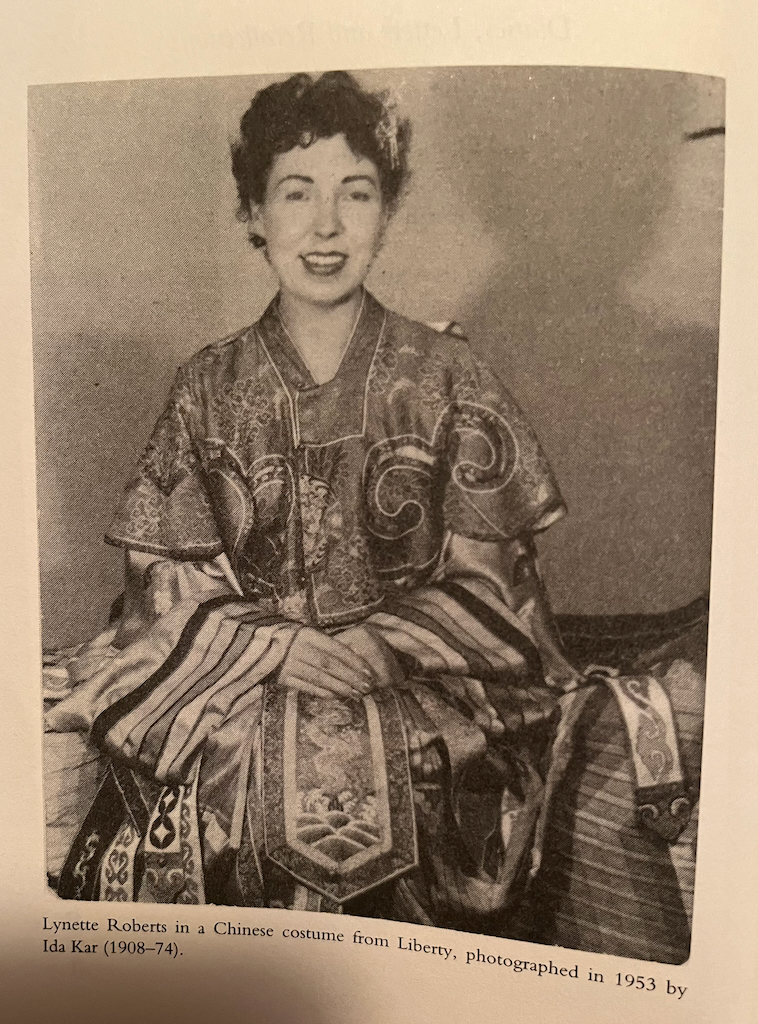
this morning, i bring you one lynette roberts (1909-1995), a hauntingly original welsh poet, argentine-born, whose two books of poetry—collected poems (1944) and Gods with stainless ears: a heroic poem (1951)—have been described as “as dramatic, varied, dense, elliptical and inset with verbal novelty as any experimental poetry in the twentieth century.”
t.s eliot was her friend and editor, and offered the highest of eliotic compliments, writing that her poetry “communicated before it made sense.” (ah, both the magic and miracle of poetry; and a line worth pondering.)
dylan thomas was best man at her wedding. robert graves—he of i, claudius—was her pen pal. (graves wrote that in her fruitful years, the 1940s, during world war II, when she was living in a small welsh village, she was “one of the few true poets,” and added that “her best is the best” among a milieu that included the likes of eliot, thomas, and, yes, graves himself.)
most endearing of all to a ragtag magpie like me, roberts and her poetry were long considered eccentric. even at her height, she was an outsider, dwelling at the outskirts of london’s bohemian literary scene. then and now, literary critics describe her as “a poet’s poet,” and one of those critics defines that epithet as one “by which we designate writers we know are important but who don’t have the readership or reputation to prove it.” (long live the poet’s poets.)
that was all it took for me to decide to do my feeble best to haul her out of the shadows. to nudge her back toward the literary glow i believe is her due (or at least offer her a chair to this old table). and to read her, everywhere i could find her.
when i read that she was committed to a mental institution after a particularly rough breakdown, diagnosed with schizophrenia, and in and out of such quarters at least four times in her remaining years, her pen going silent until her death, i grew all the more determined.
her poetry, until its resurrection in 2005 in the tome simply titled collected poems, had been out of print for half a century. her prose, including a war diary, an autobiography, and unpublished articles and memoirs, long had been forgotten. i’d never heard of her till a week ago when i heard the american scholar‘s amanda holmes read one of her poems.
roberts’ best work, though, is considered to stand alongside that of her near-contemporaries, the anglo-welsh poets david jones, r.s. thomas (an anglican priest and poet i count among my favorites), and dylan thomas. but even in wales, her ancestral homeland and the country to which she returned and finally settled, she found herself on the margins.
in the poets’ academy, roberts is considered a war poet, a modernist, especially focused on a woman’s life in wartime. her poetry during the second world war plumbed bereavement, brokenness, and fracturing both for those sent to the front lines and for those left at home. she’s also been called “a love poet,” and “a poet of the hearth,” though not one to idealize the domestic. she captured it in all its extremes, the heartbreaking, and the cruel.
it’s bits of her biography beyond the poetic that might charm me as emphatically as her poems stir me.
before ever dipping her pen in the inkwell, roberts who’d come to london to study art in the 1930s, decided she and her roommate, the writer and painter celia buckmaster, needed a holiday. perusing an atlas, she decided—on the basis of it being the only place where the Bristle Footed Worm remained—to venture off to madeira, a portuguese archipelago, and traveled there in cargo. it was in madeira, in a house high on a hill, that she settled on her life’s work as a poet. “have found my voice at last,” she announced in a telegram sent back to london.
for reasons i’d love to know, once back in london, roberts trained to be a florist, and opened a flower arranging business before marrying, birthing two children, and later divorcing the welsh writer and editor keidrych rhys about whom she had once written that he “was charming and spoke like a prince.”
her daughter, angharad (welsh for “beloved”), describes roberts as nomadic (crisscrossing the seas and continents from buenos aires to london to madeira to wales to london and back to wales), someone who longed for nothing so fancy as a simple home, a place defined by the sparest necessities: a fire, a table, a place to look after friends in need.
for a good bit of her life, as a single mother with a daughter and son, roberts took to living in a caravan, with an address as plain as could be: The Caravan, The Graveyard, Laugharne, on the coast of south west wales (and literally parked in the village graveyard). angharad remembers: “we spent a whole summer catching butterflies and dragonflies, draping muslin round the caravan to keep them captive so we could draw them.” roberts drew as charmingly as she penned poetry, the pages of her diary filled with both.
and she grew roses, but not just any roses. she deciding which to grow by smelling. and she had two criteria for planting in her garden: scent + history. a proper story need be attached. oh, to plant a garden led by nose and narrative.
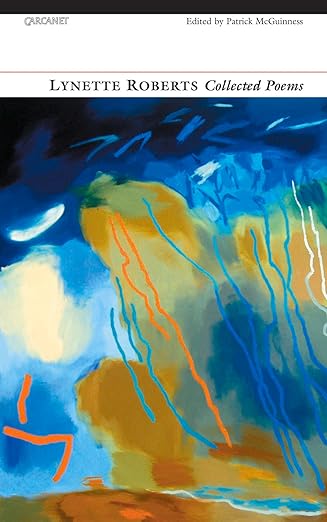
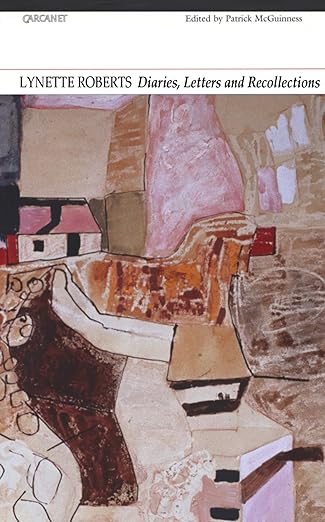
and so, my library this week has grown by two: i’ve added collected poems, and diaries, letters. and recollections to my shelf. and i intend to read, underline, asterisk, and dog-ear many a page, clear to the end, as i absorb the quirky wonders of one lynette roberts, and carry her forth (at least in my own little mind) into this time, the ever-so-rocky twenty-first century.
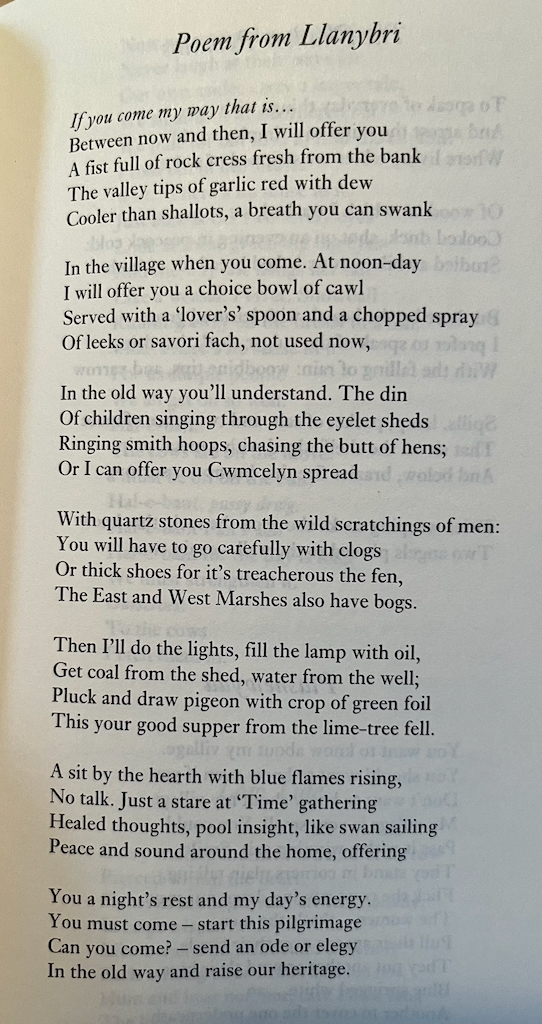
here is the first of roberts’ poems found in collected poems, “poem from llanybri,” a welcome-poem to a soldier and fellow poet. the oxford literary critic patrick mcguiness writes of it as “a portal to the book,” one that “imagines the poetic encounter as a hospitality extended and hospitality repaid. this is poetry as dialogue, poetry as rooted tradition: a celebration of community, both in the village, here described for its uniqueness, and within the circle of poets. it takes pleasure in the welsh words and phrases—‘cawl’, ‘savori fach’, and place names such as ‘cwmcelyn’—but also in the welsh speech-patterns that make their way into english: if you come my way that is…”
what i love is nothing so much as the way she brings a wee welsh village, and its innate kindness in war time, to life. i can see the pair sitting by the fire, absorbed in the silence best shared by those who know each other so fully. “No talk. Just a stare at ‘Time’ gathering” . . .
at the end of his introduction to her collected poems, mcguinness, editor of both her republished volumes (poems in 2005; diaries, 2008) concludes that hers is a poetry “bristling with contexts, alive to its time and place even as it dazzlingly dramatizes and reimagines them—a poetry open to influence and example while perfecting its own distinct voice and vision.”
whether it be her poems, her quirky tellings of village life, or her inspiration to plant a garden led by my nose, i intend to keep ms. roberts close and alive, in that way that poets and poetries live on long after their one last breath.
what is the medium that holds deepest allure for you? that leads you into depths so deep you lose sense of the world around, and burrow into the place beyond answers to questions?
 pull up a chair
“a breath you can swank…” ❤️
ha! i love it too.
apparently it means something along the line of “show off, display, parade.”
>
Thank you for this discovery!! I’ve just picked up Oliver’s posthumous, Litt
Little Alleluias! I didn’t know till you left a breadcrumb above and I followed its trail to news that I’d missed its 2025 arrival!
Merci, madame!
I struggled to get through paragraph 4. I was crushed.
I was amazed at paragraphs 9, 10, 11. Literary history rewritten, the best parts having been left out from college seminars.
Once I was told, by a licensed social worker, that the definition of sanity is “the ability to function in society,” which a poet like Ms. Roberts – the wandering bard, who settled in a graveyard – lays bare for its thin thread of respectability. If the outcast is Society’s fool, then remember that sages have long known one must be a Fool to be on the path to wisdom.
Her “Poem from Llanybri” is as delightful as its alternating rhyme structure is classic. There is more than meets the eye.
>
i delight in the fact that she spoke to you. i first took her books out from the library and they came from beyond the regular network, reaching deep into the nationwide library loan. not surprisingly, both arrived from university libraries. what would we do without them? but once i dove in, i knew i needed hard copies of my own, so i could “read” the way i do: with pen in hand, queen of the asterisk and the underline. my favorite books are as messy in the margins as they are whompingly powerful in the text.
as i make my way through the poems and the diary, i am certain i will fill my commonplace book.
will pass along the best, one way or another.
and thank you for pulling up a chair. xox
>
The “Magister” teaches your Nephew to read the same way, marking the books (that he owns) with marginalia. In other words, to fully own the books in your possession. Also, he has introduced your Nephew to the “Commonplace” book. May the tradition continue.
>
And for good measure, I just re-read your “About” page at PUAC. “Kid, you can write…” never truer words told. BUT, you paid heed to the words. The spoken word is naught, until we act. Which you did.
>
Ooohhh I haven’t read th