
end notes
by bam
for weeks now, i’ve been toiling on the latest iteration of the manuscript for a book in gestation*. and this week, i came to the writerly part known as the “end notes,” as in dotting every i, and crossing every t, to be certain all is as clean as clean could possibly be.
and, most of all, should anyone someday reading said book become curious about the source of this or that line, the author (that would be me in this case) must leave a perfectly followable trail of breadcrumbs through the woods, so that the curious someone can find exactly the spot where i, the author, once found those very words.
in other words, fastidiousness is not negotiable. it is a must. (and i might as well sleep with the chicago manual of style, 18th edition, under my pillow, for i consult it every other breath, at a minimum.)
per than manual’s strict instruction, and to be sure that every last page i cite is the exact page in the exact edition of each and every book in my notes, i have been skittering hither and yon to those temples of bookshelves known as public libraries.
i gather up books by the armload, and haul them off to a library table, where i dutifully record (in image and scribble) all pertinent info.
of all the books i’ve scooped up and returned to the shelves, there was one—and only one—that i chose to haul home once again. it called me to do what i’m not so adept at doing these days: to dilly and dally inside its pages. to read for the holy essence of it, not merely to cross off the last of the end notes (currently numbering 103).
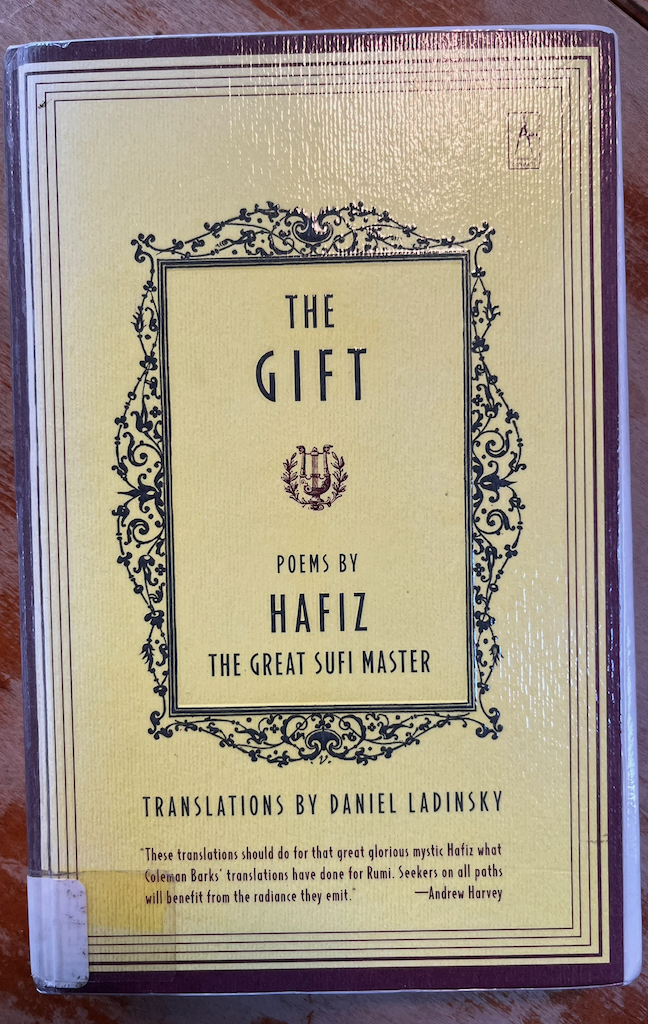
the book i brought home was the gift: poems by hafiz the great sufi master, translated by daniel ladinsky. and it is exactly what it purports to be: a gift.
its poems, quite often, are short, not too taxing on the eyes or the brain. and yet, and yet, they do pack a wallop. concentratedly so.
in this era of emotional saturation, when every day seems to bring reams and volumes of terrible news, a droplet of wallop is just about all i can swallow.
but even before i got to the poems, it was the backstory of the sufi master that held me. (sufiism, in the west, is regarded as a form of islamic mysticism; its name is derived from the farsi word meaning “wisdom,” “purity,” or, curiously, “wool,” so drawn from the coarse woolen garments of wandering dervishes.)
hafiz, a persian poet of the 14th century, has been called “a poet for poets” by emerson, who wrote “he fears nothing. he sees too far; he sees throughout. . .” goethe enthused that hafiz “has inscribed undeniable truth indelibly,” and called him “mystically pure.”
such superlatives can get you in trouble, it seems. it’s estimated that 90 percent of his work was destroyed over the centuries by clerics and rulers who disapproved of what he wrote in his poems.
“hafiz was viewed as a great threat, a spiritual rebel, whose insights emancipate his readers from the clutches of those in power—those who exploit the innocent with insane religious propaganda. for hafiz reveals a God with a billion I.Q.—a God that would never cripple us with guilt or control us with fear.” so writes ladinsky in his preface.
it’s said that hafiz’s poetry can be read “as a record of a human being’s journey to perfect joy, perfect learning, and perfect love.”
that’s a journey for which i’ll buy a ticket.
here are a few stops (poems) you might find along the way:
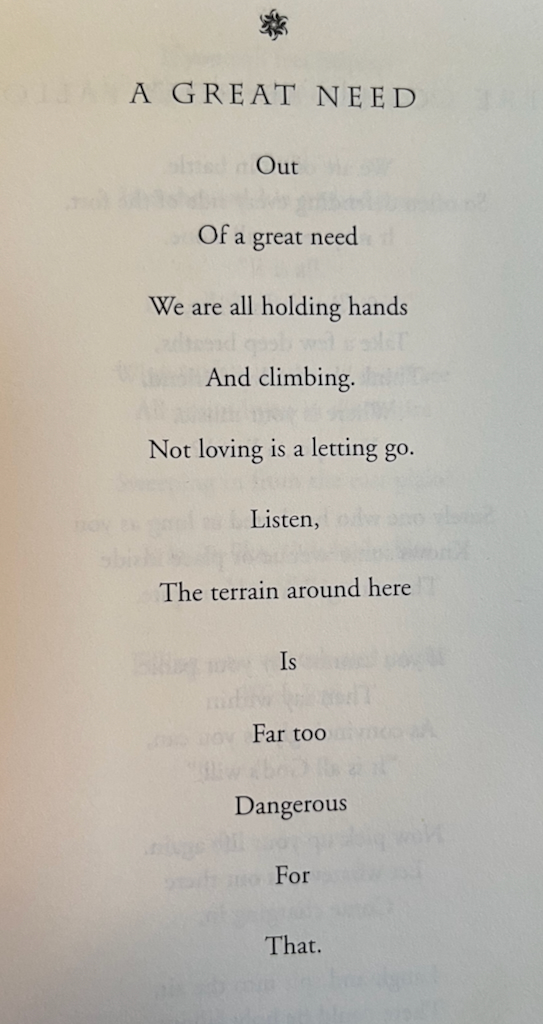
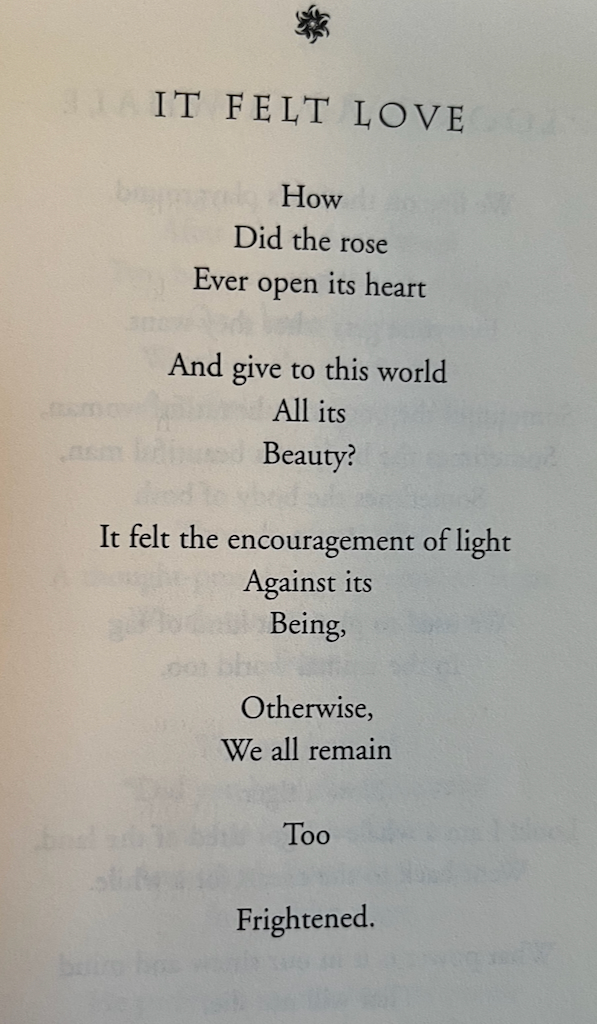

the lessons from 14th-century persia: hold tight to each other, for that is love; allow the light to unfurl your beauty; every cell in all of us, in all creation, yearns for God—or however you name the Holy Being, the Author of Us All.
sustenance in small sips: more than plenty for this day.
what inspired you to hold on this week?
*the book in gestation, you might have read here earlier, though i’ve yet to officially unveil it, is for now titled When Evening Comes: An Urgent Call to Love (Brazos Books, Spring 2027), and it’s a book about being broken open (by whatever the cause) and discovering that in between the brokenness, amid the puzzle of shards, a light finds its way in. i’m currently on the third round of edits with the main editor, and soon will be moving to copy editing, and then production, when the boxes of books will land plop on my stoop. call me crazy (a redundant suggestion perhaps) but i tend to find the imperative fastidiousness of end notes an exercise as delightful, engrossing, and challenging as a 100-piece jigsaw puzzle. in this case, 103 pieces.
 pull up a chair
in my effort to try to chase away the comment gremlins which trip up so many of us (yes, me too!) i was playing around with possible ways to fix it, and now see that i inadvertently did the opposite of what i was trying to do (par for my course). when this first posted there was a thing that said “no comments” but that is utterly fiction. i ditched that little devil, and comments are as always open for business. should anyone be so stirred….
CAN’T WAIT for the new book! And, love Hafiz. And you. ❤️
❤️❤️❤️
Barbara, Can’t wait to read and absorb the lines. Here’s to your diligent efforts!
thank you!!!
hafiz. love these beauteous words. bam. love your words, that light is not gone, it is finding its way in.💕
ohhhhhhh gracious. what a beautiful beautiful line. poetry from across the way. xoxoxox
>
I cannot wait to hold your beautiful book in my hands and absorb its message of light and love. xx
thank you, my beautiful……
>
Must be so wonderful as you navigate completing a book. Good luck with the last pieces. Looking forward to finished product.
thank you, beautiful mar……
i keep saying that writing this book, at every stage, has felt like being wrapped in a prayer.
>