pull up a chair

where wisdom gathers, poetry unfolds and divine light is sparked…

Month: July, 2025

summer’s height: the magpie edition

alas, the tuxedo-clad bird, decked out in what seems at swift glance a crisp white bib, along with obsidian jacket and tails, is reputed to be a plunderer of shiny baubles, be it crumples of tinfoil or pop tops of aluminum cans. as such, its reputation is nastier than it deserves. it’s thought to be a mischievous thief, a rapscallion of the ornithological world. one who surveys the landscape for the juiciest morsel to scavenge.

in that case, i am showing my magpilian virtues this week. i am, in summer’s height, plucking and gathering, assembling but a brief collection of baubles for your consideration.

lest we let the poor magpie’s reputation flounder down at the bottom of the seed barrel, science leaps to its rescue with news from the university of exeter that, in fact, the ‘pie is not a thief. it’s been exonerated by exeter’s ornithologists, it seems. according to a study published in the journal Animal Cognition, the bird is merely curious, and actually suffers from a malady known as neophobia, fear of new things.

here’s how the ornithologists explain it:

“The Exeter University study found that magpies were actually more cautious and less likely to approach shiny or novel objects, even when food was nearby. In 64 tests, magpies only made contact with shiny objects twice, picking up a ring and immediately discarding it. This behavior suggested they were trying to determine if the rings were food, rather than expressing an attraction to their shine.”

if only shakespeare had known. over and over, the bard plucks at the so-called plunderer.

“And chatt’ring pies in dismal discords sung;”

this, from Henry VI, Part 3 (Act V, Scene 6, Line 45), but one example.

again and again, shakespeare draws on the corvids—the raven, crow, rook, jackdaw, jay, and magpie—luring them into his scripts. and except for the blue jay, they often appear, according to those of the literary cognoscenti, the ones who read the bard closely, “together in ominous flocks to plunder the dead.” the magpie, specifically, was thought to be “possessed by the devil and channeled his evil words while chattering,” an idea traced back especially to king henry who in Henry VI pulls out “chattering pie” as the cutting-est put-down he knows for his archnemesis, the dastardly duke of york.

audubon’s plate 357, american magpie

nearly a quarter century later, j.j. audubon himself attempted to rehabilitate the bird’s roguish reputation, writing in his journal, the birds of america, of the american magpie in plate 357:

“It is extremely shy and vigilant in the vicinity of towns, where it is much molested, but less so in country places, although even there it is readily alarmed. When one pursues it openly, it flits along the walls and hedges, shifts from tree to tree, and at length flies off to a distance. Yet it requires all its vigilance to preserve its life; for, as it destroys the eggs and young of game birds, it is keenly pursued by keepers and sportsmen, so that one might marvel to find it maintaining its ground as a species, and yet it is not apparently diminishing in most parts of the country.” 

all this to say that at this sauna-like point in the summer, when the air outside is thick enough to cut with a butter knife, and the sweltering has us curling up in arboreal shadows, i come bearing plundered fruits. i am the magpie of ill repute, the one before the reputational rescue. (a warning: not all fruits are sweet. some, too bitter for words, though words are one sure means of conveying even a hint of the harshness.)


joanna macy

for the third week in a row, i come bearing tribute to a great woman whose death leaves us once again with a great voice silenced, and a soul we pray lives on. joanna macy, the buddhist ecophilosopher and translator of rilke, died over the weekend at 96. four years earlier, in conversation with krista tippett, on the occasion of her and anita barrows’ then-new translation of rilke’s Letters to a Young Poet, macy had this to say about living in the moment, and opening ourselves to the beautiful, during this moment in history she refers to as the Great Unraveling:

Well, it seems clear that we who are alive now are here for something and witnessing something for our planet that has not happened at any time before. And so we who are alive now and who are called to — who feel called, those of us who feel called to love our world — to love our world has been at the core of every faith tradition, to be grateful for it, to teach ourselves how to see beauty, how to treasure it, how to celebrate, how — if it must disappear, if there’s dying — how to be grateful. Every funeral, every memorial service is one where you give thanks for the beauty of that life or the quality of what — and so there’s a need, some of us feel — I know I do — to what looks like it must disappear, to say, “Thanks, you were beautiful. Thank you, mountains. Thank you, rivers.”

And we’re learning, how do you say goodbye to what is sacred and holy? And that goodbye has got to be — has got to be in deep thanksgiving for having been here, for being part of it. I kind of sound like I’m crying, and I do cry, but I cry from gladness, you know. I’m so glad to recognize each other. You can look in each other’s face, see how beautiful we are. It’s not too late to see that. We don’t want to die not knowing how beautiful this is.


the thing about being a magpie in human form, is that shiny objects—the true kind, the sort that carry weight and depth all on their own, shininess aside—come all but hiding under rocks. i never know where i’ll spy one. might be bound between the covers of a great book, or might simply be scrolling along when i’m stunned in my own tracks. and so it was when i came upon this sumptuous reply to a post from suleika jaouad in her isolation journals recounting her recent breathtaking birthday trip to tunisia, where she spent much time during her childhood summers. someone named kim wrote this, and set me off on my own voyage into the uninvited beauties that populate and punctuate my world:

In my own world, beauty doesn’t knock. She slips in uninvited—smelling faintly of burnt sugar & sandalwood. She hides in the scorch on toast, the chipped bowl I can’t let go of, the silver cutlery I keep polished for no one but me. I light incense for no reason. I turn the spoon the right way in the drawer. I whisper thank you to the kettle like it’s an old friend who stayed.

you never know where poets are poking about…

but, oh, the reverie in my mind as i, too, considered the beauties too many to count…


i’m going to wade into troubled waters here, and there is nothing but tragedy and horror in the words i feel compelled to leave as the lingering ones of the week.

we cannot let ourselves be living in a world that has children too malnourished to let out a whimper, children whose every rib you could count as if an x-ray with the barest of flesh. in a world of abundance, a world where each night alley dumpsters are spilling with portions too overzealous for even a glutton, in a world where essential nutrition can be picked into space-food sticks, or gel packets meant for mass distribution, there is NO godly or ungodly reason for children or infants or mothers or fathers or the ones who’ve borne them to wither away, for flesh and sinew to waste (the medical term for the breaking down of tissue as the body desperately seeks energy), for breathing to be labored because even the muscles of the chest wall have wasted, and the barest of life-sustaining functions are on their last gasp.

read this statement below, issued yesterday by Philippe Lazzarini, the Commissioner-General of the United Nations Relief and Works Agency, and decide what you might do to respond to the cry of this so-broken world:

“People in Gaza are neither dead nor alive, they are walking corpses…. One in every five children is malnourished in Gaza City as cases increase every day. When child malnutrition surges, coping mechanisms fail, access to food & care disappears, famine silently begins to unfold. Most children our teams are seeing are emaciated, weak & at high risk of dying if they don’t get the treatment they urgently need…. Parents are too hungry to care for their children. Those who reach UNRWA clinics don’t have the energy, food, or means to follow medical advice. Families are no longer coping, they are breaking down, unable to survive. Their existence is threatened.”

we cannot look away. what will we do?

light and shadow, in perpetual dance

all you need do is glance toward the sky, eyes skimming over the players on high. sunlight and cumulus. sunlight and cirrus. sunlight and nimbostratus. sunlight and cloud ever in play, in duet, in doh-si-doh of shadow and light. 

there’s a truth being told there, a universal and organizing principle of all creation. on the first day, in the second verse, there was darkness, darkness hovering over the deep. in the third verse, light. God commanded it. and God saw that it was good. 

in our lives, the leitmotif is a given. light will come. shadow will follow. light will come again. 

so it was in my reading this week, when first i tumbled deeply into a luminous shaft, a boreen* of writings from a norwegian bishop and monk, erik varden, whose power as a writer was pointed out to me by a poetry friend whose taste i know to be exquisite and deep. i swiftly realized the bishop’s thinking and writing are everything they were billed to be: rare. exquisite. deep. radiant.

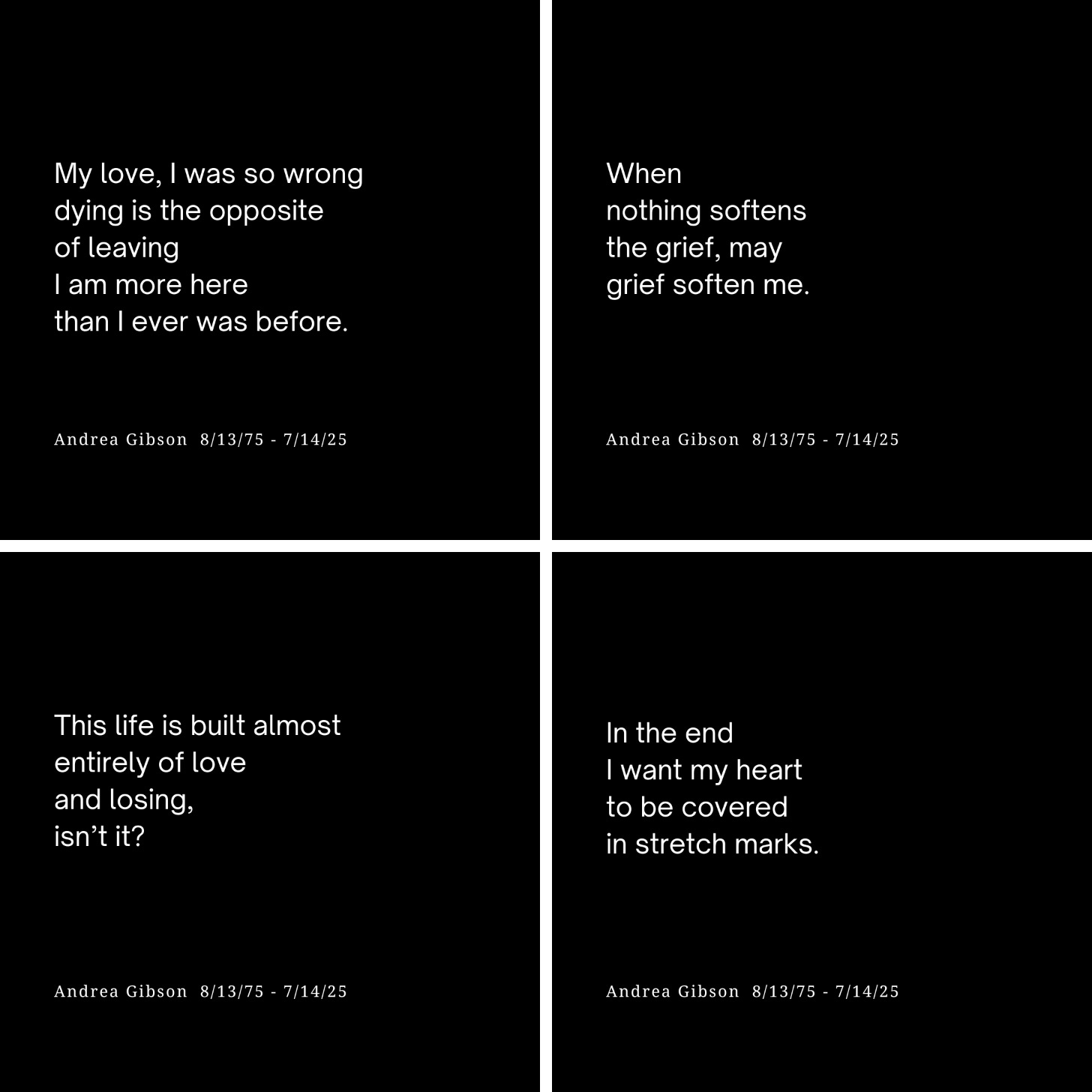
but then, hours later, shadow: i began reading a string of sentences posted from the account of one of my lifeline poets, someone you might call a patron saint of heartbreak and healing, of being more alive than you’ve ever imagined. i started to read, as if it were just another brilliant post: “Whenever I leave this world, whether it’s sixty years from now, I wouldn’t want anyone to say I lost some battle. I’ll be a winner that day.” and then i got to these words: “Andrea Gibson was a winner today. On July 14th, at 4:16AM, Andrea Gibson died…” and my legs stopped moving, and my breath was caught in midstream, and i read and read again. and then my fingers started to tremble, and my knees too. 

andrea gibson

andrea gibson, 49, colorado poet laureate in 2023, queer activist (they/them/their pronouns), who had been diagnosed with stage 4 ovarian cancer in 2021, not long after they’d started a newsletter titled “Things That Don’t Suck,” had many, many times pried open my heart, pulled out the unspoken words and the fears and set them soaring. when i too found out what it is to live with cancer as one of the nouns in my story, i drew andrea into my innermost circle. the ones who know, without you uttering a word, just what you’re thinking, you’re feeling, you’re praying. the ones who some days save you. because even though the cyberworld is distant and intangible, it works in mysterious ways, and someone with whom you’ve never breathed the same air can become someone whose voice you can hear as you flutter to sleep, and whose courage you conjure as they glide you into the sarcophagus that is your biannual CT scan.

light. shadow. light from shadow. shadow deepening light. it’s the dance of the duet, interminably entwined. one is always more beautiful because of the other’s presence, because the duet is perpetual. 

first, this week’s light:

that monk on a bicycle, spotted cycling through the garth just beyond the cloister, is all it took for me to want to whisper my vows, and cycle along. 

as i’m quick to do, i signed up for bishop varden’s website, coram fratribus, a name derived from his episcopal (meaning “of the bishop”) motto, coram fratribus intellexi, latin for “understanding with my brothers.” because the bishop is shepherd of a flock spread across 22,000 square miles in the north of norway, extending beyond the polar circle, he sees his site as a way to speak to the diaspora, to think aloud of those things he finds beautiful or challenging, to gather his flock into a communion of thought. specifically, i felt my heart quicken as i burrowed into the bishop’s collections of writings under the tabs “life illumined,” and the shorter jottings under “notebook,” which he describes thusly: 

“To scribble in the margins of texts is an ancient practice. There are people, these days, who make an academic career out of studying ancient marginalia. Any exercise of reading is fundamentally conversational. The notes collected here are brief responses to impressions received not just through books, but also through encounters, art, music, and films.”

now you see why i, a marginalian of long practice, swoon?

before i get to the paragraph in “life illumined” that drew me deep into thought, let us pause to note why we see that little outline of an owl, in the upper right corner, and hovering over every page of the site. the good bishop describes that choice thusly (emphasis mine from here on in): 

“The emblem of the site is an owl. The owl does not just wing you back to the front page. It has for centuries been a symbol of the monk. Why? Because it watches in the night, when most people sleep; because it is able to see in the dark, discerning movements and patterns, foundations of meaning, where the human eye perceives only vaguely. I am fond of this Italian doggerel:

“Sopra una vecchia quercia
c’era un vecchio gufo:
più sapeva e più taceva,
più taceva e più sapeva.

“In an old oak tree
there sat an old owl:
the more it knew, the silenter it was;
the silenter it was, the more it knew.”

what fluttered into my mailbox the other morning was a page of the monk’s notebook on the nightingale, complete with an ancient poem (from the early middle ages, written by alcuin of york, an adviser to charlemagne) mourning the absence of the wild creature and its delicate throat. a recitation in english and latin, and including a recording of the nightingale’s song. that alone was more than beautiful enough. and then my poking and peeking accelerated, and that’s how, under the “life illumined” tab, i found a break-me-open paragraph on learning to pray.

in an essay focused on the simplicity of jesus’s prayer, and the universal cry of all believers, “lord, teach us to pray,” varden paints the scene of 72 disciples who learned not simply by listening to the words of jesus in prayer, but in witness to his consuming attention to the ways and will of God. varden expounds: 

“Jesus’s teaching on prayer amounted to more than the provision of a text for recitation, that is clear. It was the sight of Jesus praying that made the disciples wish to learn prayer. The words of prayer, which touch our reason and orient our will, point towards the breaking-open of our heart, the transformation of our being as we dare to aspire, even in this life, to ‘become participants of the divine nature’.”

it is the breaking open of the heart, indeed, where the truest serum of our souls pours out. only in the last couple years have i understood that as profoundly as i do now. and, yes, that breaking so often comes with pain, or in pain, or through pain. but i’ve learned now how it truly is the propellent, the force that pushes us deeper into sacred truths than we might otherwise venture. without the breaking open, we might cling to the safer and shallower waters.

the bishop goes on. takes us beyond merely the breaking, and makes the point of its purpose. be it through prayer or through living, the breaking open is the vehicle for those who dare to aspire, in the here and now, to become participants of the divine nature. to inch as close as we can in this lifetime to something akin to sacred. i found a redemptive resonance in that line because at heart, even for the quiet ones among us, we are a people of communion, and there is a heartening, an emboldening, that comes in finding that your purpose, your aim, is not yours alone, but shared in common understanding with at least some of your sisters and brothers.

let us be broken open, then, if it points us toward our holiest purpose. through the break in the clouds, the light comes.

and onto the shadow, the eclipsing shadow…

less than one month shy of her fiftieth birthday, andrea gibson, the poet who boldly faced the coming of her death, who has been amplifying wonder, making us see the unseen, relish the oft-overlooked, took her last breath in the wee hours of monday morning.

i have been relishing her, here and in my everyday, for years now. curiously, her presence in my life spans almost precisely the arc of time in which i’ve been in the company of my own cancer. 

the month before my lung surgery, when the world felt overwhelmingly like the depths of a cave, i wrote of andrea and lines i’d inscribed on my heart: 

thanks to a friend i love with my whole heart, i stumbled on another wise soul with buckets of beauty to grace the world. a poet-activist-performer named andrea gibson, now a cancer survivor whose words might take your breath away. andrea identifies as queer, and uses the pronoun “they;” and they are known for their trademark honesty and bare-naked vulnerability, traits i find irresistible and blessed beyond words. here are just a few lines i couldn’t keep from scribbling down:

when it comes to hearts i want always to be size queen…

i love you because we both showed up to kindness tryouts with notes from the school nurse that said we were too hurt to participate….

when your heart is broken, you plant seeds in the cracks and pray for rain.

before i die, i want to be somebody’s favorite hiding place, the place they can put everything they know they need to survive, every secret, every solitude, every nervous prayer, and be absolutely certain i will keep it safe. i will keep it safe.

andrea gibson

and nearly a year ago, in a musing about scan time’s equal measures of shadow and light, i shared lines that kept me from drowning.

and just a little more than a month ago, i wrote about them and a poem i called more than enough:

yesterday, thursday, this slipped into my mailbox from andrea’s wife, meg:

A couple years ago, Andrea said, “Whenever I leave this world, whether it’s sixty years from now, I wouldn’t want anyone to say I lost some battle. I’ll be a winner that day.”

Whatever beast of emotion bucks or whimpers through you right now, I hope you can hold that line beside it: Andrea didn’t lose anything. If you had been here in our home during the three days of their dying—if you’d seen dozens of friends drift in to help, to say goodbye, to say thank you, to kiss their perfect face, if you’d felt the love that floored every hospice nurse—you would have agreed. Andrea won.

I won’t sugarcoat the fact that they desperately wanted more time on this planet that they loved so much. This planet of squirrels and romance and basketball and moonlight.

But the time they had was significant, prismatic, and wild. It was full of trampolines and mountain ranges, stage lights and pants-peeing laughter. In their words, they “juiced the sun for every holy drop.” One of the last things they said before dying was, “I fucking loved my life.” Their conviction stunned the room.

If Andrea’s life was a poem (and it was), could there be a better last line?

a little backstory, again from meg: 

In 2021, before the diagnosis, Andrea announced they were writing a newsletter, titled Things That Don’t Suck. A few weeks later, we learned they had ovarian cancer.

At first, Andrea said, “What a terrible time to be committed to writing about what doesn’t suck.” Then, almost immediately, they shifted their perspective and said, “What a perfect time.”

And so, this space was born. Part journal, part poetry, part pep talk, part treasure hunt. It became an archive of Andrea’s ability to find beauty in unlikely places, to wring gratitude from even the hardest hours. A museum of how they danced through their diagnosis, always turning their compass toward joy. It fostered a community they deeply loved.

And Andrea wanted all of it to continue.

meg tells us it will. there are reams and reams of unpublished writings, lines scribbled under the silvery light of the moon on those nights when sleep wouldn’t come. pages poured into volumes tucked away. a memoir, unfinished. half-written poems. a documentary coming this fall. 

and meg promises this: 

And there are stories of our life, and of the last months, that I, as their partner, and as a writer, feel both lucky to carry and uniquely able to tell.

As gut-wrenching, impossible, and tear-soaked as this moment is, I’m grateful beyond measure that they were so prolific. Through their books, their reels, their interviews, their albums, Andrea’s incredible mind will reverberate for a century—I’m sure of that.

and so, in the presence of the bishop monk, and the absence of the poet prophet, we shall go on. awake in the light and the shadow. and the shadow that deepens the light. 


in case you’re curious, a bit more about dear bishop varden:

it was only after absorbing so much of his writing that i circled back to learn a bit of his origin story. 

varden was born into a non-practicing lutheran family in a small village in the south of norway, and would go on to earn a doctorate in theology and religious studies at the university of cambridge, and further study in rome. a convert to catholicism at 19, he was drawn to the monastic life, and joined the mount saint bernard abbey, a cistertian monastery, in charnwood forest, in leicestershire, england. he was called to rome to be a professor of syriac language, monastic history, and Christian anthropology. and two years later, returned to the abbey when he was named its eleventh abbot. and, in 2019, pope francis named him bishop of trondheim, a nearly 22,000-square-mile prelature north of the polar circle in norway.

mount saint bernard abbey, varden’s home monastery, is where the only Trappist beer is brewed in all of England, under the name Tynt Meadow English Trappist Ale. beer to the trappists is no earthly distraction. the belgian trappists have a saying: “Beer should be liquid bread, not coloured water.”

and here’s a morsel, this one on the theology of beer, as spoken at the blessing of the monk’s brewery on st. george’s day, 2018. from Dom Erik’s address:

“One of the fascinating things about beer, is that this (potentially) sophisticated beverage is made of the simplest ingredients. By being refined to manifest their choicest qualities; by being brought together in a favourable environment; by mingling their properties and so revealing fresh potential; by being carefully stored and matured, the humble malt, hops, yeast, and water are spirit-filled and bring forth something new, something nurturing and good, that brings joy to those who share it. Considered in this perspective, the brewery provides us with a parable for our monastic life, with the Lord as virtuoso brewmaster. The Scriptures favour wine as an image of the Gospel – but that is culturally conditioned; beer, it seems to me, is a much neglected theological symbol.” 

*boreen, you might recall from a few weeks ago, is the old irish word for what we might call a pothole, a rabbit’s hole, but in ireland, an island etched with cowpaths, it’s a word derived from a meandering side path when the cow decides to venture off on her own….if language is a cumulative patchwork, boreen is a word now in my lexicon….

you’ll find a veritable font of andrea’s spoken word poems, and writings at their website, andrea gibson.org. spend some good time there.

where did you find light and shadow this week?

among those unafraid to ask the unanswerable

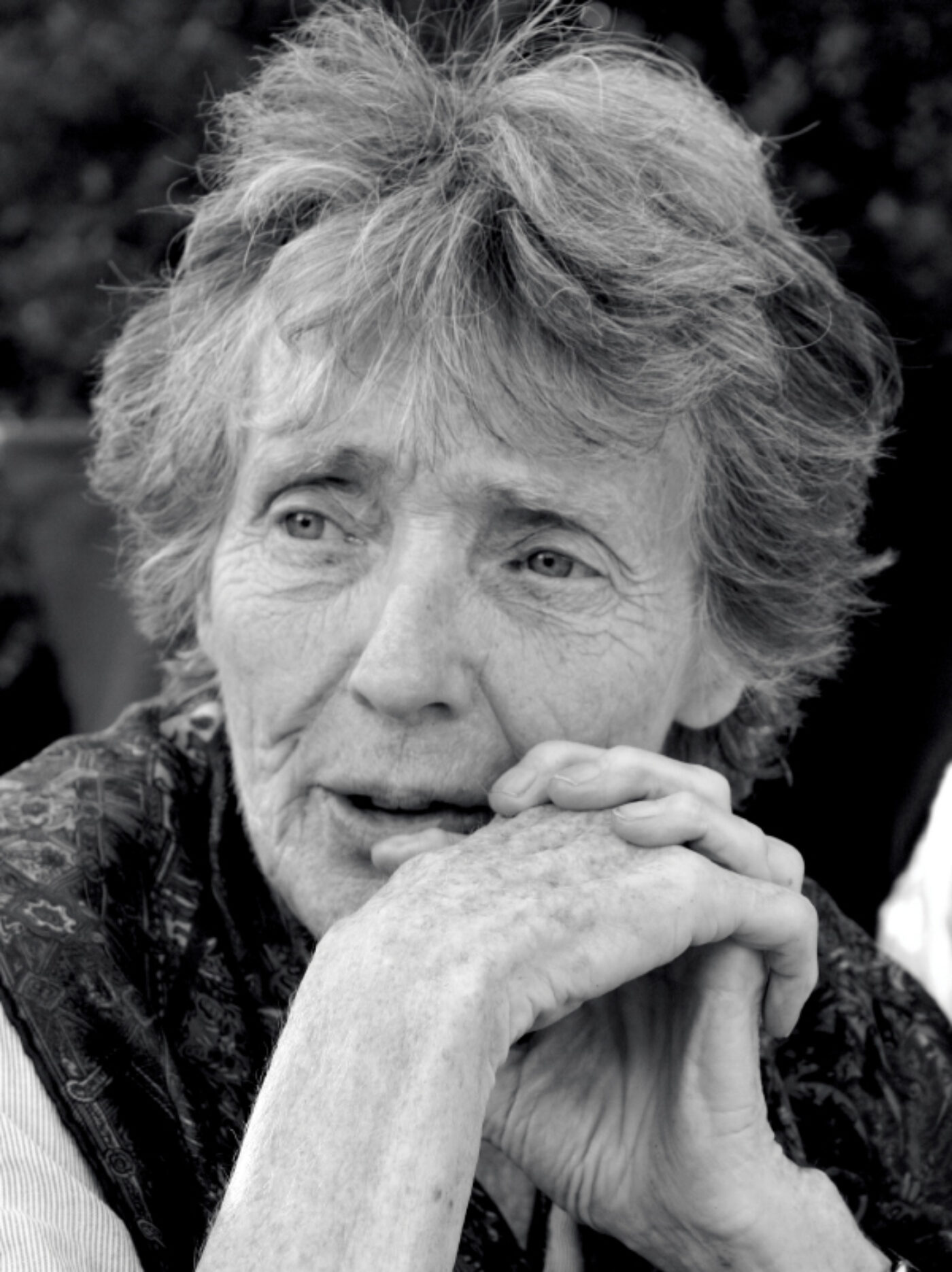
fanny howe (photo by lynn christoffers)

If the intensity of my curiosities in this world were put to trial, and I was pressed to answer what question stirs me most, it would be the realm of the God I reach for as my North Star. I ruminate on the presence of God, the proximity of what I know as tender ballast, and though the edge of my knowing falls into a liminal mist, I aim anyway to live by what seems to be the timeless code of a just and loving, most merciful God. 

Poetry, a gossamer web of knowing and unknowing, seems to be the closest frame through which to ask those questions, to rummage in the dim light and the darkness. It’s the poetry that rubs up against what seems true, and then falls swiftly away, that for me lasts and lingers. More so than sacred Scripture, I find myself venturing closest to the heavens when I follow poets unafraid to ask the unanswerable. The poets, so often, are my priests, my conduits from this much-battered planet to the uncharted heavens. Palpably alive and paying attention to the tiniest shards among us—the broken clock, the fallen sparrow, the furrow of a brow—the poet then leaps beyond or into, catapulting us into the vast, where the questions linger and the answers merely hover. Epiphany sometimes strikes. And we go forth, fortified.

I am particularly taken by those poets unafraid of doubt. As, truth be told, we live in mystery. It is those willing to expose their wrestling, their quest to question, that I find most resonant. Most true.

And when one of those poets dies, a volume closes; the possibility of question falls silent. We no longer knot our life raft to her fearless oceangoing vessel.

The world of poetry, from Ocean Vuong to those on the masthead at The Paris Review, mourned the loss this week of Fanny Howe (1940–2025), who died on Wednesday at 84. Over recent months, Howe, the daughter of an Irish playwright and a Harvard legal historian whose family traced its roots to the Boston Brahmin Quincy family, had been in conversation with the poet and translator Chloe Garcia Roberts, as part of the review’s Art of Poetry series. In a prelude I found as delicious as some of the conversation itself, Roberts sets the stage thusly in a piece published just last month: 

“Howe has a sparrowlike figure and a blue peregrine stare. We met for this interview every few weeks over the course of several months from fall to spring, as she was moving out of her garden-level apartment in Cambridge into an assisted living facility just down the road. I would arrive midmorning, bearing scones and coffee with extra sugar cubes wrapped in napkins, and we’d talk each time for an hour or so. Our conversations circled family, motherhood, failure, race, and faith. After we were done recording, we’d gossip about the poetry scene and the succession of Pope Francis.”

And from there begins the interview, from which I pluck just a few snippets, and some of the Review’s own words (emphasis mine):

“I’d always been looking for a revelation that would open the whole universe for me and make it all have sense,” began Howe, who described herself as a “pagan Catholic,” and who converted to the faith at forty-one, counting among her guides Simone Weil, Giorgio Agamben, and the monks of Glenstal Abbey** in County Limerick, Ireland, with whom she stayed every summer for twenty years and whom she later watched on TV every Sunday, her personal Mass. 

Howe was the author of an astonishing body of work—including twenty-five books of poetry, twelve novels, two story collections, and also essays, pulp romances, and young adult fiction. Her poems often enact the shock of belief, taking their power not from their devotional qualities—in fact, Howe avoided words like devotion and prayer—but their combination of faith and doubt. “I would think of poetry as a place where you connect your doubts to the things you don’t doubt,” she said. “Free-floating doubt wouldn’t trigger the lightning that contradiction does.”

In one of the hours of interviews, Howe let on that she considered it her “job” to be antidote to cynicism. When Roberts asked her to say more, she elaborated:

fanny in 1972 with her son, maceo

If I could say I was assigned something at birth, it would be to keep the soul fresh and clean, and to not let anything bring it down. And that’s the spirit of childhood, usually. Once you know that that’s what you’re doing, even when you’re walking through a war field, you’re carrying something to keep it safe. It’s invisible but you know it’s there, and it’s a kind of vision and a weight. 

(You can listen to Howe, warbly voice and all, speak those very words here.)

Is it not all of our jobs—or certainly the job of some of us—to labor to keep the soul fresh and clean, to strain to not let anything bring it down? It is our singular entity, the one form over which we and we alone can steer the vessel, make the choices, choose love not hate, choose silence not bitter words, it is ours to keep, to draw in all the light we can muster. Our bodies, I’ve learned, are not under our control. Pathogens come, and cancers too. We crumble under the weight of time and toil. Our skin wrinkles, breaks out in bumps. But not our soul. Our soul is eternal, is timeless. Our soul is what we make of it. 

The work of my soul is abetted, most often, by those whose words I read, by those whose way of being I watch. It is, so often, in the smallest, quietest of kindnesses. The triumphs of spirit over the temptations to turn away, to forgo the sharp edge, the blunt force. 

Ours is an ongoing work in progress. 

In her role as perhaps a patron saint of doubt within the amalgam of faith, Howe staked her claim in her introduction to George Bernanos’s 1937 novel of the 14-year-old French peasant girl, Mouchette: “Like a healthy human heartbeat, which has an intrinsic irregular system, the body of an artwork gets its vitality from a rhythm based in uncertainty. (Sick hearts have a dull regular thump.)” 

Among the many lauds that poured forth in the wake of her death, Kazim Ali, the poet and co-founder of the small indie press, Nightboat Books, wrote this of Howe, the first author Nightboat published:

It would be wrong to say she was a polar star or a beacon in the darkness, because Fanny believed in mystery, in unknowing, in bewilderment. She didn’t mean to shine a light, but rather to see in the darkness.

Fanny once told me, in our life-long conversation about God, literature, and the world, that she thought Gnosticism was evil. What she found so evil was the belief that the material world was inferior to, or somehow separate from, the spiritual one. This world was the world to Fanny. “Human was God’s secret name,” she said in one poem. “If this life isn’t enough, then an afterlife won’t be enough,” she said in another. 

To live in this rich, infinite world was the most important thing to her. “One cathedral is equal to the sky,” she wrote. And to God, she begged, “no answers, please, to any of my questions.”

Her life and work were conjoined in a long, lucid series of questions. How lucky we all are to have heard her askings.

may her askings live on, and her memory be a blessing. rest in knowing, dear fanny.

other than life itself and living, how have you encountered wrestling with doubt? is it a plain that animates you, or is it a space from which you run? (as always these questions are meant to be considered in the solitude and sanctity of your own quiet womb.)

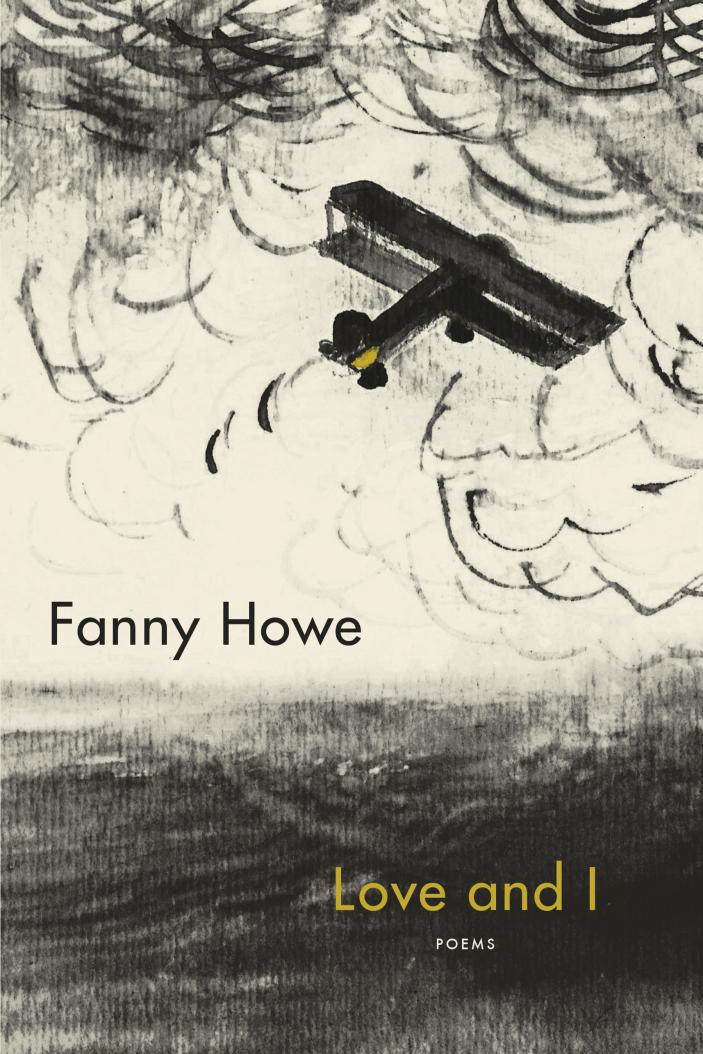
i nearly forgot! should you choose to dig in to a bit of fanny howe and her wrestling with faith, the two books you might seek (mine is coming from interlibrary loan) are Love and I: Poems (2019) and Gone (2003). in both she writes about her conversion to Catholicism, and her relationship to faith.


**because i’ve not found many a rabbit hole into which i’ve chosen not to burrow, my reading of howe led me to Glenstal Abbey, a place i now dream of tucking into for a fulsome contemplative spell. it’s a benedictine monastery in county limerick, ireland, housed in a 19th-century normanesque castle, surrounded by 500 acres of farmland, forests, lakes, and stream. you might just want to join me there…(and you can tune in any time for matins, lauds, vespers, compline, or daily Mass, in both recordings and livecam.) 


and one more thing before i go. it seems bishop marian budde, she who gained fame (and infamy in some quarters) presiding over the prayer service at washington’s national cathedral following the inauguration, has now launched a substack, where she will gather her writings, and broaden the scope of her reach. she introduces herself with these words. . .

“On January 21, 2025, the day after President Trump’s inauguration as our 47th president, I chose to conclude my sermon at a Prayer Service for the Nation, held at the Washington National Cathedral, with a call for mercy:

“Let me make one final plea, Mr. President. Millions have put their trust in you and, as you told the nation yesterday, you have felt the providential hand of a loving God. In the name of our God, I ask you to have mercy upon the people in our country who are scared now.”

she stirred up good trouble with those words. and in her new space on substack, she lays out her mission—”to live as best we can according to the highest aspirations of humankind revealed to us in Jesus” (also in Gandhi, in Buddha, in Brahma, in Allah, in Yahweh)—with this litany:

  • to recognize the inherent, God-given dignity of every human being
  • to love our neighbors as ourselves, and even to love our enemies
  • to share what we have and to strive for an equitable and just society
  • to refrain from evil and refuse to hate
  • to be mindful of the power of our words, and to speak without malice or contempt
  • to forgive, as we have been forgiven
  • to live in hope
  • to be willing to sacrifice, even our very lives, for the sake of love.

she concludes with these words:

“In this space, I hope to encourage a kind of human discourse in which we don’t have to see the world the same way, but we can all agree that we all belong in this world.

“In a culture of contempt, may we speak with dignity.

“In a world of mean-spiritedness, may we act with kindness and love.”

how might you stir good trouble today?

ode to my fairy gardenmother: one last love note. . .

Mostly, this is a love letter. One I might have tucked in the pine coffin now buried beneath a foot-and-a-half of Chicago’s clumpiest earth, earth we shoveled onto it, one full spade at a time. The one to whom I write this, though, my fairy gardenmother, is not one ever confined by boxes or borders or hard lines scrawled in the dirt. She, my Marguerite, was as free a spirit as they come. So I cast this to the wind, and know she will catch it. 

Marguerite made beauty for a living. She sowed joy in abundance. Not a single root or shoot was tucked in the earth or tied to a trellis without the ringing sound of her laughter. 

Marguerite’s acanthus

She bequeathed me beauty, her beauty and that of this holy earth. And grace, and a tidepool of peace, the sort that settles deep within, calming what had long been a turbulence. It all came in a litany of botanic derivative, a litany I water and witness: tree peonies, fuchsia and ruffled and broad as a dinner plate; oakleaf hydrangea, its bottle-brush blooms now bursting in time for the Fourth of July. Pieris japonica (sometimes known as lily-of-the-valley shrub, or flame of the forest) whose delicate white star-blooms are the petit point of late springtime, stitched along the bluestone path that bends toward my front door. A dwarf lilac that defies its definition and perfumes profusely my brick walk out back. My garden blooms with acanthus, the ancient Greek thistle of endurance and immortality, and white bleeding hearts that, as instructed, seem to be on the verge of spilling succulence drop by drop by drop. Everywhere, the vanilla scent of Jack-in-the-pulpit rises. There are ferns in abundance, and climbing hydrangea who wouldn’t be daunted by Everest. And about a dozen other beauties whose names I often forget, and when I do I’d text her, and she’d remind me, always with annotation of what she loved most about it. And another something I might want to try. 

If I tried to describe her, I’d begin with her face. Her face was alive, was radiant, was always revved up in joy. Or deep concentration. Her laugh came easy, so easy. Her limbs flowed. She was a ballerina in the everyday. Clogs buried in garden, wielding a shovel or pruners, she swayed with the wind, with the whims, with purpose. 

She planted my secret garden, the one that meanders along the side of my house, from my writing room window, past the kitchen door, and into the garden out back. It’s the place I’d point to if pressed to answer the question: Where did you finally find your long-sought peace? It was there in the garden that Marguerite grew. 

I first met Marguerite a garden ago, back in 1991, months after we married, my beloved and I. The very day we wandered into the old Victorian that became our house for a decade, the house to which both our boys first came home, the house that held so many joys and so many sorrows, Marguerite was there. She was packing up boxes with Jim the sculptor who was dying of AIDS, and who would soon leave us his beautifully sculpted three-story house (and a set of Old Willow dishes besides). They wept and wailed and laughed together. We heard the echo of their affections before we saw them, and when we climbed the stairs there she was: radiant, a mop of blond curls, eyes hazel and sparkling. 

She knelt beside me summer after summer, teaching me much of what I know about what grows in a garden. We wandered nurseries and tree lots. We planted according to her unorthodox teachings. When anything ailed, she knew the fix. Or we yanked it and started again. 

My jewel box of a tiny urban garden, one where the alley rats dared not roam for the fierce farm cat who patrolled it, grew to be a wonder. One whose measure in my mind far exceeded a yardstick. 

When at last we decided we’d finished our work, at least for the time being, Marguerite and Ted, her rabbi of a husband who presided over a congregation of his psychotherapy clients, came by one late summer’s evening to bless the little plot. In a story I love so much I included it on pages 37 and 38 of The Book of Nature**, Ted offered up fertility prayers for my garden, that it would blossom and bloom, and multiply. Four months later, on the brink of my 44th birthday, after eight years of broken hearts and infertility, I discovered that I was the one blossoming and multiplying. I was “with child,” as the Bible would put it. I always giggled that Ted had mixed up his fertility prayers, and pulled out the ones for the barren woman instead of the ones for the garden. 

ted and marguerite

And so, of course, and ever since, Marguerite is the one to whom I turned with every garden question, and every delight as it bloomed. When Ted died not quite two years ago, I knew Marguerite’s heart was shattered. And there was no glue in the world to put it back together. But I didn’t know it would kill her. 

I now know that it did. For she died on Monday, and was buried on Tuesday. And ever since I’ve been strolling through my garden, stopping to marvel here, stooping to deadhead there. I’ve been shlepping my hose, and giving big drinks to each and every bloom bequeathed to me by my Marguerite. 

Marguerite will always bloom in my garden. Her longtime sidekick, David the cop, is coming soon to help me dream once again. There is a plot under the ornamental lilac and the row of burning bush, and I have named it Marguerite’s Garden, and I will be planting it before the month of her death turns to August. 

And it will be abundant in beauty. Because that’s what Marguerite taught me to grow. And that will never die.

the jewel box of a flower shop: Marguerite Gardens (from Victoria Magazine)

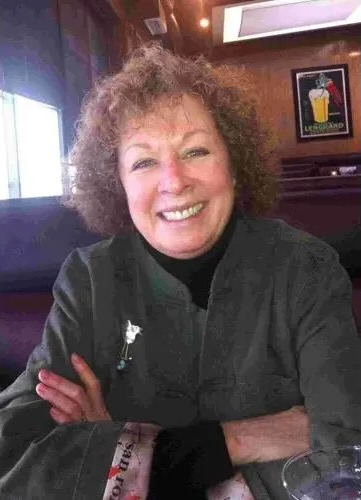
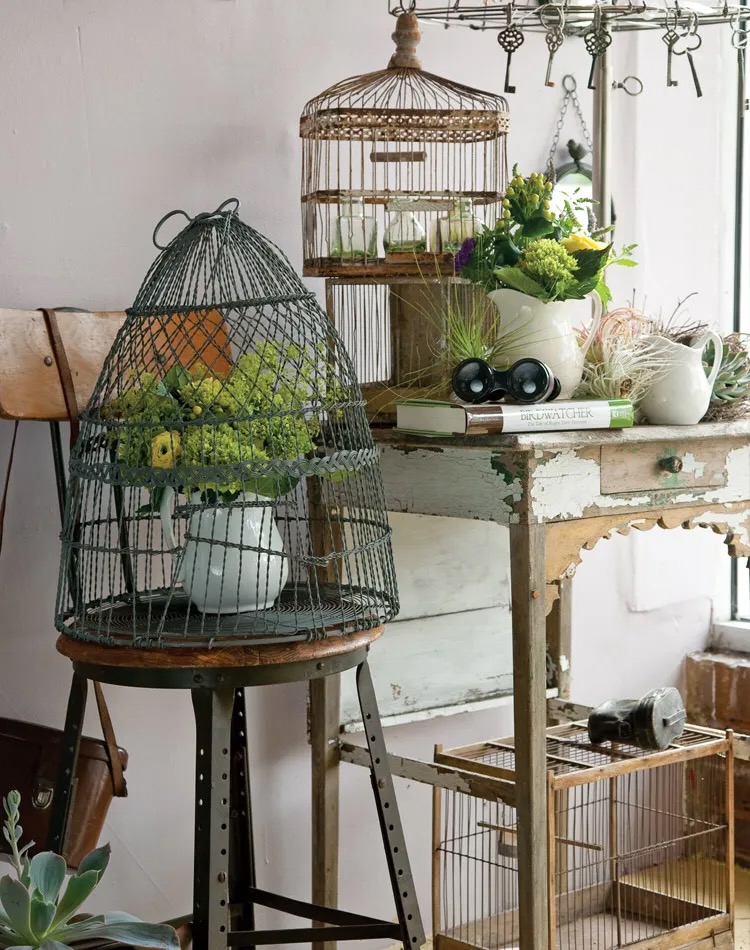
Marguerite’s genius in the garden spread far beyond our little block of Wellington Avenue, 60657. When she couldn’t be contained, she launched a for-hire garden crew (a motley crew counting two cops, a U of C theology grad fluent in Mandarin Chinese, a commodities trader, a banker, and a pet photographer) with a seasons-long waiting list. She planted tulips by the thousands up and down Boul Mich, Chicago’s grand Magnificent Mile. She planted the city’s lushest rooftops and balcony gardens. She was a connoisseur of miniatures, and knew how to cram the most in the least. She opened a dream of a flower shop in Andersonville, aptly named Marguerite Gardens, and twice daily received imports from her beloved Netherlands. The shop, with the bell that tinkled as you walked in, held a European-style flower market, and was stuffed to the rafters with eighteenth-century antiques, from bird cages to terraria. Aptly, she was named for the daisy whose name means “pearl” in French, and is the bloom from which petals are plucked in the prognostication game, “he loves me, he loves me not.” Married for 43 years to the inimitable, unorthodox, Yale-educated rabbi and psychotherapist, Theodore Gluck, Marguerite died 656 days after Ted, three days short of what would have been his 95th birthday. Marguerite was 75.

**excerpt from pages 37 and 38, Marguerite’s star turn in The Book of Nature, in which i describe that first garden we planted and blessed together…

. . .That garden—where a priest, a rabbi, and a tight circle of people we love gathered for blessings shortly after the births of each of our boys; where baby bunnies and nestlings and goldfish were buried after premature deaths; where our stubbornly resistant house cat mastered the art of escape—that plat of earth became as sacred to me as any cloister garth.

Not only was it where I knelt to teach my firstborn the magic of tucking a spit-out watermelon seed into the loam and, each morning after, tracking its implausible surge. During seven long years of miscarriage after miscarriage, ectopic pregnancy and emergency surgery, and doctors finally telling us to give up hope, I dug and I dug in that garden, all but willing the tiniest bulbs and tenderest sprouts to beat impossible odds, refusing to let anything else die on my watch. And then, at the end of one summer, as the crab apples were starting to turn, a rabbi who lived down the block came by with his wife, whom I’d long called my fairy gardenmother for her magical ways and her unbroken guidance. Standing under the stars, the rabbi, his wife, and I, we blessed the garden itself, casting prayers and sprinklings of water. By that Christmas, I was pregnant, with nary a drop of medical intervention. Just shy of forty-five when that blessing of a baby arrived the next August, I’ve always wondered if maybe the rabbi mixed up the garden fertility prayers.

It’s all a holy whirl—that intricate and inseparable interweaving that is the cosmos.


one poem this week, from a bouquet of many i plucked:

Desiderata

Go placidly amid the noise and the haste, and remember what peace there may be in silence. As far as possible, without surrender, be on good terms with all persons.

Speak your truth quietly and clearly; and listen to others, even to the dull and the ignorant; they too have their story.

Avoid loud and aggressive persons; they are vexatious to the spirit. If you compare yourself with others, you may become vain or bitter, for always there will be greater and lesser persons than yourself…

Exercise caution in your business affairs, for the world is full of trickery. But let this not blind you to what virtue there is; many persons strive for high ideals, and everywhere life is full of heroism…

Take kindly the counsel of the years, gracefully surrendering the things of youth…

Beyond a wholesome discipline, be gentle with yourself. You are a child of the universe no less than the trees and the stars; you have a right to be here.

And whether or not it is clear to you, no doubt the universe is unfolding as it should. Therefore be at peace with God, whatever you conceive Him to be. And whatever your labors and aspirations, in the noisy confusion of life, keep peace in your soul. With all its sham, drudgery and broken dreams, it is still a beautiful world. Be cheerful. Strive to be happy.

by Max Ehrmann


and in extra case you’re extra curious, here’s a story i wrote for the chicago tribune back in may of 2000 about my friend marguerite and her garden crew: https://www.chicagotribune.com/2000/05/07/planting-away-again-in-marguerite-aville/

who taught you much of what you know about beauty and joy and free-flowing grace? might you tell us a bit of that story….

one last time: love story of a lifetime. ted + marguerite = forever and ever. amen.