
of pickled onions and a particular fondness for kentucky’s homegrown farmer bard
by bam
in which the somnolence of summer has settled into its seasonal adagio so much so that pickling a red onion or two, and slow-reading the poetries and musings of one wendell berry is as fever-pitched as it gets around here. welcome to my slo-mo world of the week.
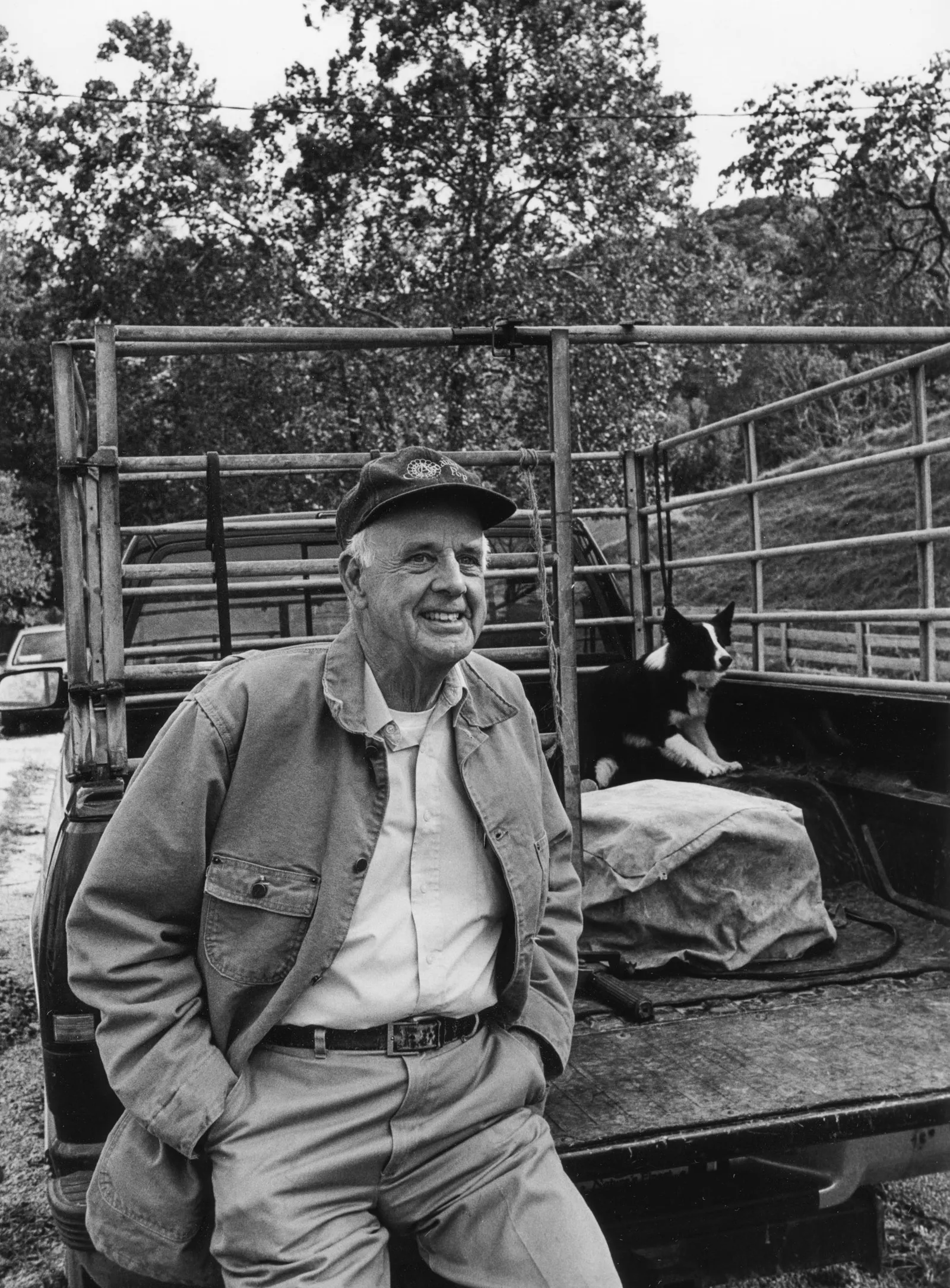
it started when i stumbled on the poem below, a poem that captures the quietude of a couplet of humans who’ve breathed in unison for so long they can fill the silence richly. so it is here in this old house of late, where only two of us now reside. where we know the choreography of most days by heart. and come and go as in a wordless waltz. there’s an ease now, one i never imagined, as i balked mightily long ago about the idea of two lives squeezed under one roof and in a labyrinth of too-tight rooms. but over time, across all these years (near 33), the respirations of our souls have aligned, at least enough to feel our echo in the lines below. those lines, by wendell berry, the poet, novelist, and conservation farmer whom i count as one of my heroes, were just enough to take me down the rabbit hole that is the life and work of kentucky’s homegrown literary treasure. and, besides, mr. berry’s birthday was this week, the fifth of august, wedged, it so happens, between the birthdays of two of the three humans whom i count as pillars holding up my world and whose arrivals to the planet are marked across the week in that steady beat of 4-6-8.
here’s the poem that got me started:
They Sit Together on the Porch
By Wendell Berry
They sit together on the porch, the dark
Almost fallen, the house behind them dark.
Their supper done with, they have washed and dried
The dishes–only two plates now, two glasses,
Two knives, two forks, two spoons–small work for two.
She sits with her hands folded in her lap,
At rest. He smokes his pipe. They do not speak,
And when they speak at last it is to say
What each one knows the other knows. They have
One mind between them, now, that finally
For all its knowing will not exactly know
Which one goes first through the dark doorway, bidding
Goodnight, and which sits on a while alone.
i shared the verse with the one with whom i share these walls, and he wrote back that he found it “haunting,” which made me see the lines anew. and was just enough to prompt a bit more poking around, again reminded how much i love the poetries that come with accumulated lifelong wisdoms. and that’s where i then re-bumped into this 2019 dispatch from the new yorker, a days-long interview between bard and scribe, one distilled and put to paper. it’s worth a read in whole (link below will take you straight to it), but i’ll pluck a few parts should your summer’s day demand a snappier pace than mine (or should a paywall keep you out):
the dispatch, titled Going Home with Wendell Berry, is by amanda petrusich, a new yorker staff writer and writer-in-residence at the gallatin school of individualized study at NYU. a 2016 guggenheim fellow, she writes often about music, and blessedly for us she takes the occasional road trip down kentucky way. in this case, she wound her way to where berry’s farmed for more than four decades, a little town that goes by the name port royal. sixty-three miles from the dot in the blue-grass map my papa called home (paris, KY), and one mile from the meandering kentucky river, it’s a town you might think ol’ garrison keillor pulled from his imagination. (in 2010, its population, according to the U.S. Census, was all of 64 humans.) it’s a town one writer (sandra mcCracken, a singer-songwriter) described thusly (and not too surprisingly given the threadworn quilt that is rural america these days): “Port Royal is a patchwork strip of storefronts, a blink-and-you’ll-miss-it sort of spot made up of a local bank, a post office, a general store with a built-in diner (with little printed signs about their town’s famous author, Wendell Berry), and an old Baptist church. I am sad to report that, like most small towns in our country, Port Royal looks as though it is dying.”
here’s how the new yorker‘s chronicling of that luscious conversation between journalist (petrusich) and poet (berry) begins:
Two and a half years ago, feeling existentially adrift about the future of the planet, I sent a letter to Wendell Berry, hoping he might have answers. Berry has published more than eighty books of poetry, fiction, essays, and criticism, but he’s perhaps best known for “The Unsettling of America,” a book-length polemic, from 1977, which argues that responsible, small-scale agriculture is essential to the preservation of the land and the culture. The book felt radical in its day; to a contemporary reader, it is almost absurdly prescient. Berry, who is now eighty-four, does not own a computer or a cell phone, and his landline is not connected to an answering machine. We corresponded by mail for a year, and in November, 2018, he invited me to visit him at his farmhouse, in Port Royal, a small community in Henry County, Kentucky, with a population of less than a hundred.
Berry and his wife, Tanya, received me with exceptional kindness, and fed me well. Berry takes conversation seriously, and our talks in his book-lined parlor were extensive and occasionally vulnerable. One afternoon, he offered to drive me around Port Royal in his pickup truck to show me a few sights: the encroachment of cash crops like soybeans and corn on nearby farms, the small cemetery where his parents are buried, his writing studio, on the Kentucky River. Berry’s connection to his home is profound—several of his novels and short stories are set in “Port William,” a semi-fictionalized version of Port Royal—and his children now run the Berry Center, a nonprofit dedicated to educating local communities about sustainable agriculture. Our correspondence would continue, but, before I left, Berry gave me a broadside letterpress of his poem “A Vision.” I think often of some of its final lines, which clarify, for me, what it means to truly know a place:
Memory,
native to this valley, will spread over it
like a grove, and memory will grow
into legend, legend into song, song
into sacrament.
here’s but one of the questions captured from their conversation (with a few lines in bold for emphasis):
Q: Have you always farmed here?
A: Right away, we had a large garden, and we kept two milk cows. We fattened two hogs to slaughter, for our own meat. We had a flock of chickens. And we had some fruit that we produced ourselves, and some that was wild. We were sitting down during that time to a lot of meals that came entirely from under our own feet by our own effort. And our children came up in that way of living. The integration of the various animals and crops into a relatively small acreage becomes a formal problem that is just as interesting and just as demanding as the arrangement of the parts of a novel. You’ve got to decide what comes first, and then you work your way to the revelation of what comes last. But the parts also have to be ordered. And if they’re ordered properly on a farm, something even more miraculous than most art happens: you have sustainability. Each thing supports the whole thing.
and here’s another exchange:
Q: It’s funny, clarity is often undervalued in art. One of the things I admire about your writing, especially the essays, which feel like polemics, is that you’re very clear in your arguments. They’re beautifully supported. In the new book, you talk about how you often read seeking instruction. I’m curious how you balance that idea with reading for beauty, savoring the visceral pleasure of words.
A: You’re being fed in an essential way by the beauty of things you read and hear and look at. A well-made sentence, I think, is a thing of beauty. But then, a well-farmed farm also can feed a need for beauty. In my short story “The Art of Loading Brush,” when Andy Catlett and his brother go to a neighbor’s farm, there’s a wagonload of junk, and it’s beautifully loaded. Andy’s brother says, “He couldn’t make an ugly job of work to save his life.” In the epigraph I use from Aldo Leopold he questions if there’s any real distinction between esthetics and economics.
and here, in case you’re even a little bit hooked, is a poem worth reading in whole. it’s from a 1965 volume of Poetry magazine, and it’s excerpts from an early Berry wonder, titled, “The Handing Down,” a poem about a grandfather and grandson sitting on a porch and the quiet conversation that unspools between them. read those excerpts here.

oh, and about those onions. . . my kid, the one who turned 23 yesterday, finds himself a line cook these days at a chicago eatery of some notoriety; girl and the goat, it’s called, and stephanie izard, who dreamed up the joint seems to have a particular fondness for things pickled. she pickles everything from kumquats to mushrooms to beets. i decided pickled red onions might be a summery thing to do, and besides i like a little crunch amid the strata of my sandwich. and, as with many a task in my kitchen, i pickle the easy way. no cauldrons steaming for me. no sterilizing jars and lids. i dumped a little of this, stirred in some of that, and by next morning, i had a jar of garnet rings shimmering in my fridge. i’m not fond of sugar these days (i never was, and then a dear friend told me cancer is fond of sugar, making it something of a foe of mine, thus i’ve perma-sealed my lips to sugar’s sweetness), so i searched for pickling roadmap that steered clear of the sugar bin. here’s what i found: (and ps i have no real clue what whole30 compliant means, so feel free to disregard.)

what captured your fancy this week, quick-clipped or slow?
 pull up a chair
Thanks so much for the Berry poem. It’s one of my favorites, especially at this time in my life. Now I plan to go back to find his whole book of poems somewhere hiding among all the books in the house.
your old house sounds just like mine….
and serendipity rules because not an hour after casting my little dispatch to the world, I stumble upon yet another Wendell wisdom:
“And the world cannot be discovered by a journey of miles, no matter how long, but only by a spiritual journey, a journey of one inch, very arduous and humbling and joyful, by which we arrive at the ground at our own feet, and learn to be at home.”
– Wendell Berry,
poet / critic
”You’re being fed in an essential way by the beauty of things you read and hear and look at.” ❤️ this thought. Thank you for inviting Mr. Wendell (isn’t that how Southerners address respected elders?) to the table this fine morning! ☀️
I revere Wendell Berry. He’s my hero, too. The quote you added in the comments is a longtime favorite of mine, inscribed not only in my commonplace book, but in my heart. Thank you for today’s lovely post. xoxo
dear darling, you are welcome. these are my lazy summer days, and i am reaching not too far for the things that delight me. and mr. wendell does! as do my latest discovery: those purply pickled onions. yum!
pickled onions and Wendell Berry.
Both something beyond magical for the soul.
thank you for slo-mo ponderings. I saved and reread with front porch rocking, sun retiring savoring mind.
And this treasure too, you posted below, wowza amen.
“And the world cannot be discovered by a journey of miles, no matter how long, but only by a spiritual journey, a journey of one inch, very arduous and humbling and joyful, by which we arrive at the ground at our own feet, and learn to be at home.”
– Wendell Berry,
poet / critic