
unearthing the wisdoms entwined in the past. . .

in which these uncharted times have me leaning on the wisdoms of great minds and expansive souls who’ve navigated their own immensely dark and tough times…
more and more i find history is my balm. i think back to the eras of darkness across the arc of time and the indomitable human spirit that has never yet been extinguished, no matter the force of the counterwinds.

curiously, albert camus––whom i’d never thought of as any sort of balm––has served well in that role. though considering the era in which he was writing, it’s no wonder it was darkness he saw through, shone a fierce beam of light on the way through the horrors of europe during the holocaust.
so often it’s the artists and writers, the makers of films and penners of poems, the ones endowed with an eye to see beyond the occlusions, the ones who imagine what others can’t conceive, who cast the lifeline beyond the capacities of strategists and political operators, power brokers and thieves.

in his 1940 essay titled “the almond trees” (a species that brilliantly blooms in winter), found in his Lyrical and Critical Essays, camus weighs in on happiness, despair, and how to amplify our love of life.
only twenty-seven when he wrote this, here is the french-algerian philosopher who gave us the plague, the fall, the stranger,and the myth of sisyphus:
We have not overcome our condition, and yet we know it better. We know that we live in contradiction, but we also know that we must refuse this contradiction and do what is needed to reduce it. Our task as [humans] is to find the few principles that will calm the infinite anguish of free souls. We must mend what has been torn apart, make justice imaginable again in a world so obviously unjust, give happiness a meaning once more to peoples poisoned by the misery of the century. Naturally, it is a superhuman task. But superhuman is the term for tasks [we] take a long time to accomplish, that’s all.
Let us know our aims then, holding fast to the mind, even if force puts on a thoughtful or a comfortable face in order to seduce us. The first thing is not to despair. Let us not listen too much to those who proclaim that the world is at an end. Civilizations do not die so easily, and even if our world were to collapse, it would not have been the first. It is indeed true that we live in tragic times. But too many people confuse tragedy with despair. “Tragedy,” [D.H.] Lawrence said, “ought to be a great kick at misery.” This is a healthy and immediately applicable thought. There are many things today deserving such a kick.
echoing the sentiments of an earlier manifesto written in the immediate wake of the first world war, the 1919 “declaration of the independence of the mind,” again by a french philosopher, this time romain rolland––and signed by such luminaries as bertrand russell, albert einstein, bengali poet and nobel laureate rabindranath tagore (a favorite of mary oliver), social worker and activist jane addams (chicago’s own), upton sinclair, and hermann hesse––camus argues that this “kick” is to be “delivered by the deliberate cultivation of the mind’s highest virtues”:
If we are to save the mind we must ignore its gloomy virtues and celebrate its strength and wonder. Our world is poisoned by its misery, and seems to wallow in it. It has utterly surrendered to that evil which Nietzsche called the spirit of heaviness. Let us not add to this. It is futile to weep over the mind, it is enough to labor for it.
But where are the conquering virtues of the mind? The same Nietzsche listed them as mortal enemies to heaviness of the spirit. For him, they are strength of character, taste, the “world,” classical happiness, severe pride, the cold frugality of the wise. More than ever, these virtues are necessary today, and each of us can choose the one that suits him best. Before the vastness of the undertaking, let no one forget strength of character. I don’t mean the theatrical kind on political platforms, complete with frowns and threatening gestures. But the kind that through the virtue of its purity and its sap, stands up to all the winds that blow in from the sea. Such is the strength of character that in the winter of the world will prepare the fruit.
elsewhere in lyrical and critical essays, we find the line that practically serves as camus’s epigraph: “in the depths of winter, i finally learned that within me there lay an invincible summer.”

no less than toni morrison takes the baton, elaborating that the task of the artist is as a grounding and elevating force in turbulent times, in her essay titled “no place for self-pity, no room for fear,” included in the 150th anniversary issue of the nation, the monthly founded by abolitionists in 1865, not long after the adoption of the thirteenth amendment abolishing slavery.
morrison writes:

This is precisely the time when artists go to work. There is no time for despair, no place for self-pity, no need for silence, no room for fear. We speak, we write, we do language. That is how civilizations heal.
I know the world is bruised and bleeding, and though it is important not to ignore its pain, it is also critical to refuse to succumb to its malevolence. Like failure, chaos contains information that can lead to knowledge — even wisdom. Like art.
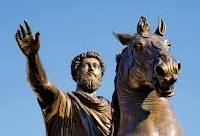
and finally let us turn way back the clock to ancient wisdoms, in this case those of good ol’ marcus aurelius, the roman emperor whose meditations were suggested to me the other day by one of my more astute and heavenly comrades. the meditations, written in the late second century of the Common Era during the emperor’s military campaigns against germanic tribes along the danube, are thought to be a window into his inner life, uncannily recognizable to our own deep-down whisperings. i borrowed the stoics from the library, but have already decided i need a paper copy all my own, the better for underscoring and stars in the margins. here’s but one of marcus’s wonders, from book II of his meditations, thought to be written in about the year 170 C.E. (uncanny how true wisdom is timeless, as this fits the november of 2024 as fulsomely as it fit nearly two millennia ago):

Begin the morning by saying to thyself, I shall meet with the busybody, the ungrateful, arrogant, deceitful, envious, unsocial. All these things happen to them by reason of their ignorance of what is good and evil. But I who have seen the nature of the good that it is beautiful, and of the bad that it is ugly, and the nature of him who does wrong, that it is akin to me, not [only] of the same blood or seed, but that it participates in [the same] intelligence and [the same] portion of the divinity, I can neither be injured by any of them, for no one can fix on me what is ugly, nor can I be angry with my kinsman, nor hate him. For we are made for co-operation, like feet, like hands, like eyelids, like the rows of the upper and lower teeth. To act against one another then is contrary to nature; and it is acting against one another to be vexed and to turn away.
what timeless wisdoms do you find anchoring, or elevating? and where might lie your invincible summer; how might you summon it?
here’s a challenge: imagine what’s possible. work toward it. begin with a baby step.
 pull up a chair