
if you look closely enough……
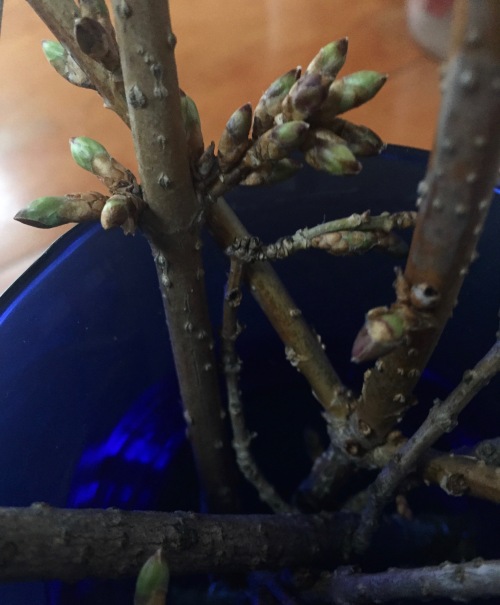
you might have to get down on your knees. or bend like an origami human. you definitely might need your magnifying glass, but if you look closely enough — say, at the tips of the twigs you’ve hauled into your house, the ones that “force” the vernal tide — you might, just maybe, see the first droplets of spring.
the earth is turning. really it is. even on the days we don’t notice.
hildegard of bingen, one of the wise women whose words i’ve been deep in all week (simone weil is the other), calls it “viriditas,” the green energy of the divine pulsing through the entire universe, the animating force, the goodness that charges the world with life, beauty, and renewal — literally with “greenness.” you might call it “hope,” pure and certain.
the surest time to catch a glimpse, i’d wager, is now, in the dregs of early march, when the world is grey-on-grey-on-grey tableau. and any shock of pigment — a dab of green, the cardinal’s red, shock-of-shocks forsythia yellow — is enough to set off alarm bells inside. the ones that let you know you’re almost at the goal post. the goal being nothing short of survival — winter survival. (for those who need booster shots of assurance, here in the middle west, and most of the u.s., this weekend brings time change — aka “daylight savings time” — in which we spring forward our clocks, and gain an hour of sunlight at twilight.)
as i type this, flakes are tumbling from the sky. i might need snow boots to go find me some viriditas. but, to my thirsty little heart, i find it astonishing in the highest order that just when we’re flagging, just when we start scrounging around for the oxygen tanks, the ones that will keep us from gasping, the arbors and twigs leap into action. sap starts running. birds chime their love songs. holy mackerel. it’s as if all the universe is conspiring, whispering in our deepest inner ear: “have hope, have hope, resurgence will come.”
the eternal cycles. the rhythms as ancient as time. viriditas. ebb and flow. the turning wheel of the seasons. winter thawing to spring. grey exploding in green. to some it’s little more than sunlight + chlorophyll. to the rest of us, it’s something akin to surround-sound proof that we’re deep in the clutch of heaven on earth. and so blessed to be here.
what wisps of hope have you stumbled upon in these grey days of march?
 my roundup of books for the soul for the tribune is now my one soulful book you might want to read. budget cuts keep chipping away at newspapers, and the latest cuts cut away two of my three soulful reads in my monthly (or so) roundup. here’s the first of the one-book-at-a-time reviews, a fascinating read from mary gordon who takes on a literary critique of the writer-monk of gethsemani, thomas merton.
Mary Gordon illuminates the literary works of Thomas Merton
| Barbara Mahany |
Mary Gordon — novelist, memoirist, professor of English at Barnard College — has long proved herself to be a Catholic voice engaged in deep and nuanced dialogue with the Church. She is fluent in its rhythms, its mysteries, its illuminations — and its darkness. She is a truth-teller, one not afraid to name her church’s sins, nor unwilling to see through its complexities to its radiant core.
Gordon’s capacity to dwell in duality, to circle her subject from all perspectives, to call it as she sees it, positions her squarely as a critic — both literary and cultural — robustly qualified to take on Thomas Merton, the celebrated mid-20th-century monk and writer with a worldwide ecumenical following. In her new slim but soulful volume, “On Thomas Merton,” Gordon plants herself on her firmest footing: “I am a writer. I wanted to write about him, writer to writer.”
She opens her exploration by pinpointing the tension at the heart of Merton: “(I)n becoming a Trappist,” she writes, “he entered an order devoted to silence, and yet his vocation was based on words.”
Merton, author most famously of “The Seven Storey Mountain,” belonged, Gordon writes, to the post-World War I period “when Catholicism was intellectually and aesthetically chic.” He was one of a heady crop of distinguished literary converts, along with G.K. Chesterton, Evelyn Waugh and Graham Greene.
Before he entered the monastery as a Trappist monk at Gethsemani, the abbey outside Louisville, Kentucky, Merton had been engaged in urgent conversation with the modern world. It’s a conversation that never ceased, not until the hour of his death in a Thai cottage, some 20 miles outside Bangkok, in 1968. He’d been granted special permission to leave his hermitage to address a world interfaith conference, in a talk titled “Marxism and Monastic Perspectives.”
While Gordon begins her examination of Merton’s works on a sympathetic note, fully understanding “the conflict between being an artist in solitude and being a human in the world,” further adding that his is “a spiritual test that combines the ascetic and the aesthetic,” she cuts the writer-monk little critical slack. In her scope is a litany that includes Merton’s autobiography, “The Seven Storey Mountain,” his 1941 novel, “My Argument with the Gestapo,” and finally his seven-volume, 2,500-plus-page Journals — “longer than the whole of Proust,” Gordon notes.
It’s her bracing honesty along the way that makes her final coda so penetrating. Wrapping up her assessment of “My Argument with the Gestapo,” she writes, “more than likely he would have been marginalized or disappeared,” had he not gone on to publish “The Seven Storey Mountain.” No wonder the reader startles to attention when, one page later, Gordon declares the journals “Merton’s best writing.” She explains: “I detect a much greater sense of spiritual vitality in his journal passages than I do in his books that are self-consciously ‘spiritual.’…(F)rom the very first pages of the journals, everything he describes using sensory language shimmers and resonates.”
Studded with excerpts, Gordon’s meticulous probing of literary Merton points the curious reader toward the richest veins — in effect mapping the Merton catalogue, pointing out the places to begin, or, for a reader already well-versed, sharpening the prism through which he’s understood.
Because she’s regarded Merton with the necessary distance of critic, Gordon’s closing passages — in which she throws down her guard — rivets our attention. “I close the volumes of the journal, and I weep.”
She places him alongside those other martyrs of 1968, Martin Luther King Jr. and Robert Kennedy. The greatness of Merton, she writes, lies in his “life lived in all its imperfectability, reaching toward it in exaltation, pulling back in fear, in anguish, but insisting on the primacy of his praise as a man of God.”
It’s an intimate literary portrait, stitched through with Merton’s own threads. Ultimately, it’s a prayerful one. And the prayer echoes far beyond its final page.
Barbara Mahany’s latest book,“The Blessings of Motherprayer: Sacred Whispers of Mothering,” was published last spring.
Twitter @BarbaraMahany

 pull up a chair