pull up a chair

where wisdom gathers, poetry unfolds and divine light is sparked…

Tag: teaching writing

writing school

we call it “the kitchen table writing school,” and every once in a while someone i love, someone who’s eager to put words to a page with more oomph or less ouch, wanders over and we plunk our bums down on the chairs, pull out pads of paper and pens, and have at it. might be muscular verbs, the lesson of the day. might be fluid lines of poetry. might be all about one-of-a-kind telling details, not a profligate slop of as many descriptives as can fit in a breath, but that one singular––and immediate––detail that telescopes layers of meaning and knowing into a single keen––and immediate––observation. (while i was poking around for a good example, i came across this, and can’t say it one iota better, so here’s this from the gotham writers’ workshop):

A telling detail does what it says: it tells the essence of what it’s describing. Telling details are the scotch tape holding up Susie’s hemline in the back, the tiny piece of ice that never seemed to melt in the bottom of Mom’s martini, the street sign on the corner that still says, to this day, SCHOOL CROSSING, though the school is long gone. A telling detail can speak volumes in a very short amount of time. They help you achieve a golden mean–enough description to paint the picture, but not so much as to weigh it down.

Chris Lombardi

so whilst i’m puttering about in my so-called quiet summery time, i gathered up a few fine thoughts on the subject of writing, a thread that draws together many of us here at the old maple table. so pull out your pens––or your pencils––and follow along…

first up, this delicious bit from rainer maria rilke, from his Notebooks of Malte Laurids Brigge:

“For the sake of a few lines one must see many cities, men and things. One must know the animals, one must feel how the birds fly and know the gesture with which the small flowers open in the morning. One must be able to think back to roads in unknown regions, to unexpected meetings and to partings which one has long seen coming; to days of childhood that are still unexplained, to parents that one had to hurt when they brought one some joy and one did not grasp it (it was a joy for someone else); to childhood illness that so strangely began with a number of profound and grave transformations, to days in rooms withdrawn and quiet and to mornings by the sea, to the sea itself, to seas, to nights of travel that rushed along on high and flew with all the stars — and it is not yet enough if one may think of all of this. One must have memories of many nights of love, none of which was like the others, of the screams of women in labor, and of light, white, sleeping women in childbed, closing again. But one must also have been beside the dying, one must have sat beside the dead in the room with the open window and the fitful noises.”

so luscious is this instruction, i might scribble it onto a square of paper, fold it, and tuck it into my pocket, to pull out and read at regular intervals.


and, in keeping with pens and pencils, naomi shihab nye, one of my favorite poets, plays right along…

ALWAYS BRING A PENCIL
by Naomi Shihab Nye

There will not be a test.
It does not have to be
a Number 2 pencil.

But there will be certain things —
the quiet flush of waves,
ripe scent of fish,
smooth ripple of the wind’s second name —
that prefer to be written about
in pencil.

It gives them more room
to move around.


no less than the great david bowie has this to say about writing:

“Never play to the gallery… Always remember that the reason that you initially started working is that there was something inside yourself that you felt that if you could manifest in some way, you would understand more about yourself and how you coexist with the rest of society. I think it’s terribly dangerous for an artist to fulfill other people’s expectations — they generally produce their worst work when they do that.

“…If you feel safe in the area that you’re working in, you’re not working in the right area. Always go a little further into the water than you feel you’re capable of being in. Go a little bit out of your depth, and when you don’t feel that your feet are quite touching the bottom, you’re just about in the right place to do something exciting.”

go a little bit out of your depth…maybe in writing, and in this thing called living…


and finally there’s nick cave who is something of a mystic, a mystic who happens to be in the business of making music, and lifting words from the soul and onto the page…

“There is more going on than we can see or understand, and we need to find a way to lean into the mystery of things…. and recognise the evident value in doing that, and summon the courage it requires to not always shrink back into the known mind.

“…The luminous and shocking beauty of the everyday is something I try to remain alert to, if only as an antidote to the chronic cynicism and disenchantment that seems to surround everything, these days. It tells me that, despite how debased or corrupt we are told humanity is and how degraded the world has become, it just keeps on being beautiful.”

on the lookout for the luminous as i step into this day, one that began with the rumbling of distant thunder and broke into a light show of celestial proportion, luring me leapingly from under my bedsheets…


and which of these thoughts spark deeper rumblings in you? might it be bowie’s “go a little bit out of your depth? or nick cave’s remaining alert to “the luminous and shocking beauty of the everyday”? or is there a telling detail you stumbled upon this week that won’t let you go? do tell…

(a few gremlins seem to have put my font through the wash, and shrunk it, and while i try to bring it back to size, apologies for the wee wee words here…)

telling our truest true stories

writing school

for years now, it’s been an annual rite of november — and i don’t mean the rite that stars the plucked and very plump bird. i mean the one where i pile up my books on writing, pore over the pages i find richest and wisest, scribble then type pages of notes, and shlep off to the high school, to try to impart a thing or three about the fine art of writing from the heart, searching for epiphany, making your story reach across the abyss that exists between us, between strangers, and sometimes even bedfellows, to cinch the space, the hollow, to fill it in with the communion of sparked connection. the one that comes when we dare to tell our truest true stories. when our truest true stories are heard, in that way that mysteriously, miraculously, defiantly opens — and channels — two hearts.

it’s litFest at the high school where my sweet boy is now counting down the days toward Triumphant Escape. he’s a senior. and litFest is only for seniors, so later this morning when i plug in my laptop, and fire up my modern-day slide show, i will more than likely be looking out at a sea of faces i’ve known since long before any one of them could read, let alone hold a pencil or squeeze out anything resembling a paragraph. (i’m told that a whole flock of my sweet boy’s best chums — the ones who know me only as the silver-haired marm who long drove the carpool, flipped the french toast, cheered from the side of the soccer field — they are coming to witness the fact that i have a life beyond the care and feeding of two growing boys. and they’re hoping i’ll tell a tale or two about their chum who’s long been my very best muse.)

i’ll be asking each one of them to write one true sentence about themselves. then i’ll ask them to write four more true sentences. and to circle the sentence that would be hardest to write about. to draw a rectangle around the one that most begs to be written about. and to scribble some form of a star next to the one that’s most uniquely their own story to tell, but also most likely to intersect with a story others know as their own. i’ll ask them to think a bit about what keeps them from plucking the sentence that’s circled or rectangled or starred, and plumbing its depths. then i’ll leave them alone with their thoughts while i talk to them about epiphany, and how the one fine thing that lifts a personal essay out of the belly of navel-gazing and into the realm of revelation, of the connectedness that comes between reader and writer, is the courage to tell the truth, to be willing to be vulnerable as you sift through the tangles for some glimmering shard of understanding, a deeper knowledge of what it means to be human — in all our foible and wobble and sorrow, and, yes, our occasional triumph and glory.

or, as the writer vivian gornick puts it: the narrator in personal narrative is “the instrument of illumination,” the “truth speaker.” the writer, she tells us, “is on a voyage of discovery,” comprised of almost equal parts narration, commentary, and analysis.

what makes personal narrative serve the reader, gornick says, is that “[w]e are in the presence…of a mind puzzling its way out of its own shadows — moving from unearned certainty to thoughtful reconsideration to clarified self-knowledge.”

put simply: the writer is leaning into question, searching for the why that propels the story, the self; not knowing quite what truth might be unearthed, but unearthing anyway. or as e. l. doctorow once explained: “it’s like driving a car at night; you can only see as far ahead as your headlights, but you can make the entire journey that way.”

i will remind these young writers that we’re using the tens of thousands of words in the dictionary just as the symphony uses its strings and its timpani, and as the painter dips her brush into infinite blendings of color. we are, as john cheever once wrote, trying to reach toward this narrative bar: “a page of good prose is where one hears the rain and the noise of battle. it has the power to give grief or universality that lends it a youthful beauty.”

or, as eudora welty once said: “no blur of inexactness, no cloud of vagueness, is allowable in good writing; from the first seeing to the last putting down, there must be steady lucidity and uncompromise of purpose.”

and then i will look out to the sea of seniors in high school, this classroom filled with kids who are spending the day immersed in spoken or written word, and i will ask them to put their fingers to keyboard, or pen to paper. i will ask them to pick one of their five sentences — including the one that might be the hardest to write about — and i will ask them to write without stopping — not for pause or punctuation, just push the truth out to the screen or the page — for the next 10 minutes. and then, without revealing a word out loud, i will ask them to look at their words and see if they’ve stumbled on one bit of self-understanding they’d not before known.

if one single one of them ever again remembers to reach for epiphany, or considers the power of telling true stories when the truth is your own, well then i’ll have taught the lesson i set out to learn.

what’s the one true story you’ve found the courage to tell? or for which you might some day muster said courage?

thurman books

** and while we’re at it, here’s the latest chicago tribune roundup of books for the soul, published nov. 1:

Powerful collection from MLK’s pastor — fitting for our current political moment — leads roundup review of spiritual books

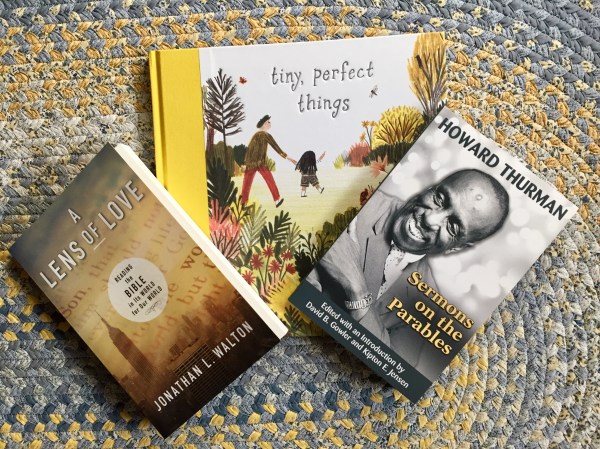
“Sermons on the Parables” by Howard Thurman, edited with an introduction by David B. Gowler and Kipton E. Jensen, Orbis, 208 pages, $25

Howard Thurman, pastor to Martin Luther King Jr. and long considered one of the great spiritual thinkers and most powerful preachers of recent times, died in 1981, so his voice no longer shakes the sanctuary walls. But a new collection, “Sermons on the Parables,” is the surest dose of what’s needed in these fraught times: a clear, compelling voice that rises up from the page, illuminating a sacred way toward all that’s good and just.

It’s the closest we might come to counting ourselves among the blessed in his pews. All that’s missing is the rustling of fellow worshippers, shifting in their seats, and the booming decibels of the gifted preacher who aimed in his sermons for nothing less than “the moment when God appeared in the head, heart, and soul of the worshiper.”

The treasure here is not only the 15 previously unpublished sermons on the parables of Jesus (brilliantly retold and examined by Thurman), but the rich commentary that rightly refocuses the spiritual world’s attention on this extraordinary 20th-century luminary. It’s a book born out of conversation between editors David B. Gowler, who holds a chair in religion at Emory University, and Kipton E. Jensen, associate professor of phi­losophy at Morehouse College.

Oh, to have rocked beneath the rafters with Thurman at the pulpit.

“A Lens of Love” by Jonathan L. Walton, Westminster John Knox, 216 pages, $16

How fitting that Jonathan Walton, the Pusey Minister in the Memorial Church of Harvard University, opens this serious and heartfelt biblical study in the intimacy of his Cambridge dining room, logs crackling in the fireplace nearby, as an eclectic mix of dinner guests steer conversation awkwardly toward the intimidating 66 books that comprise the Hebrew Bible and New Testament.

Walton, who is beloved in the classroom and at the pulpit, writes that a “silence born of biblical insecurity” among his dinner guests is what stirred him to begin the monthly scriptural study that underpins “A Lens of Love.” And it’s that posture — a certain humility — and approach — a serious sociohistorical analysis (“no text without context”) — that makes Walton’s work so unshakeable.

He brings a critical voice — that of the progressive evangelical, counterpoint to the conservative strain of American Christian evangelicalism — to the table. And he is driven, first, to illuminate the ancient world in which the Bible was produced, to lay bare its timeless teachings, and ultimately to apply those moral imperatives to our own wrestling with “the big questions of contemporary life.” His inquiry is guided at every turn by both a critical mind and sensitive heart.

In these pages, under Walton’s tutelage, we find a God who “sides with those on the underside of power.” Walton never shies from the unbearable questions of how God allows suffering. And he takes head-on his disillusionment with so many public professions of Christian piety in the Age of Trump. In Walton’s hands, the Bible becomes — for all of us, skeptics to die-hards — a tome of fathomless instruction.

“Tiny, Perfect Things” by M.H. Clark, illustrated by Madeline Kloepper, Compendium, 40 pages, $16.95

For this experiment in soul stretching, you might yearn for a young human to plop on your lap, but that’s hardly necessary.

What we have here is a picture book with text penned by a poet fluent in the fine art of paying fine-grained attention. Poets often are the prophets, the seers, among us. The book’s bold, colored-pencil pages — drawn by Madeline Kloepper, a Canadian artist who employs equal parts sweetness and curiosity — will reach out and not let you go.

“Tiny, Perfect Things” wants to slow you — and your optional young reader — to a somnolent amble. Learn to look closely, seems the instruction. Practice here — in the luscious pages of the picture book extolling the wonders of the world all around — and you might learn to apply the technique to the rest of your life. The litany here, as a young girl and her grandfather head out for a walk as day turns to night, is simple enough: a spider’s web that’s caught the light, a snail that’s climbed a fence post, an invincible flower rising from a sidewalk crack, even the magic of shadowplay.

It’s the beholding of the oft-unnoticed that is the blessing. And this is a book that invites you to practice through the slow, simple turning of page after tiny, perfect page.

Barbara Mahany’s latest book,“The Blessings of Motherprayer: Sacred Whispers of Mothering,” was published last spring.

Twitter @BarbaraMahany

writing school

writing stack

friday mornings are sacred. friday mornings are when i burrow deep into my soul, poke around, see what’s percolating. i learned a few years ago to pencil in friday mornings, ink them in is more like it. as certainly and solidly as if it’s a trip to the dentist, or a date with the pope, i scribble “write” on my friday morning calendar. that means i’ve devoted the hours to whatever unfolds here. that means it matters — to me, anyway.

but this friday morning i’ve surrendered my sacred time, turned it over to a gaggle of kids — high school kids — who want to learn how to write. how to write from the heart, specifically. so i’m writing this on thursday afternoon. i’m pausing from the making of outlines, the stacking of papers, the pulling tomes from my shelf, so i can lay out the words that will find their way to you come friday morning.

come friday morning, i’ll be at the head of a class — a workshop filled with 78 kids in the first round, and a second session with 32 seats now claimed — and i’ll be trying to impart a few things about the magnificent art of writing. i’ll ask, first, why it matters, why finding and telling the truth is essential to not just the whole lot of us as a republic, a civilization, but why it matters to each of us as living, breathing, heart-pounding human beings. human beings who know what it is to grieve or to doubt; to thrust our arms in the air, expression of joy; to question, to ponder, to stumble toward illumination. at its best, its holiest, writing allows us to slip inside someone else’s story. to understand their loneliness, their heartache, their triumph or tragedy.

we write to lean into communion, to abridge the abyss.

which brings us to craft. to the “how” of the sacred equation. we’ll peek inside the bag of writerly tools, pull out a few, try them on for utility and maybe even capacity for magic.

all week i’ve been pounding away at the keyboard, typing up thoughts; poring through pages and pages, culling the very best musings i could find on the subject of writing, writing straight from the heart. i’ve spent a lot of time thinking about the blessing of teaching. of finally reaching the point in a long life of doing one thing with unswerving focus — devotion, defined — day after day, year after year, and finally realizing you do know a thing or two worth turning around and passing along to the folks coming up behind you. i’ve considered the moral imperative. and the miracle of being in a room, strolling up and down the rows of desks, watching the gleam in the eyes begin to turn on, to brighten.

i’ve felt my heart skip a beat at the thought of connecting. of being in a room where the number of years on the planet does not matter. where we connect, writer to writer, because we were born, some of us, with a heart that beats to the rhythm and power of poetry, with a deep-down knowing that story is, after all, the great connective tissue, the one best hope for, well, nothing short of peace on earth, and the particular soul-soothing balm that comes from knowing you’re not all alone in the end.

so while i shuffle off to room 301 at new trier east high school, that storied hall of secondary learning nestled along chicago’s north shore, i’m leaving you perhaps my very favorite of seven handouts, a glorious swatch of thought from the writer Colum McCann, author of Thirteen Ways of Looking (Random House). McCann’s “Letter to A Young Writer,” instruction worth etching onto a wall of your house or your heart, is the 24th in a series of posts on 2015 books entered for The Story Prize, an annual prize for a short-story collection published in english and in the u.s. during a calendar year.

here’s McCann, advice to a writer — young or old or anywhere in between:

“Do the things that do not compute. Be earnest. Be devoted. Be subversive of ease. Read aloud. Risk yourself. Do not be afraid of sentiment even when others call it sentimentality. Be ready to get ripped to pieces: It happens. Permit yourself anger. Fail. Take pause. Accept the rejections. Be vivified by collapse. Try resuscitation. Have wonder. Bear your portion of the world. Find a reader you trust. Trust them back. Be a student, not a teacher, even when you teach. Don’t bullshit yourself. If you believe the good reviews, you must believe the bad. Still, don’t hammer yourself. Do not allow your heart to harden. Face it, the cynics have better one-liners than we do. Take heart: they can never finish their stories. Have trust in the staying power of what is good. Enjoy difficulty. Embrace mystery. Find the universal in the local. Put your faith in language—character will follow and plot, too, will eventually emerge. Push yourself further. Do not tread water. It is possible to survive that way, but impossible to write. Transcend the personal. Prove that you are alive. We get our voice from the voices of others. Read promiscuously. Imitate. Become your own voice. Sing. Write about that which you want to know. Better still, write towards that which you don’t know. The best work comes from outside yourself. Only then will it reach within. Restore what has been devalued by others. Write beyond despair. Make justice from reality. Make vision from the dark. The considered grief is so much better than the unconsidered. Be suspicious of that which gives you too much consolation. Hope and belief and faith will fail you often. So what? Share your rage. Resist. Denounce. Have stamina. Have courage. Have perseverance. The quiet lines matter as much as those which make noise. Trust your blue pen, but don’t forget the red one. Allow your fear. Don’t be didactic. Make an argument for the imagined. Begin with doubt. Be an explorer, not a tourist. Go somewhere nobody else has gone, preferably towards beauty, hard beauty. Fight for repair. Believe in detail. Unique your language. A story begins long before its first word. It ends long after its last. Don’t panic. Trust your reader. Reveal a truth that isn’t yet there. At the same time, entertain. Satisfy the appetite for seriousness and joy. Dilate your nostrils. Fill your lungs with language. A lot can be taken from you—even your life—but not your stories about your life. So this, then, is a word, not without love, to a young writer: Write.”

what words of wisdom would you impart to a starting-out writer, or starting-out thinker, intent on employing a very big heart?

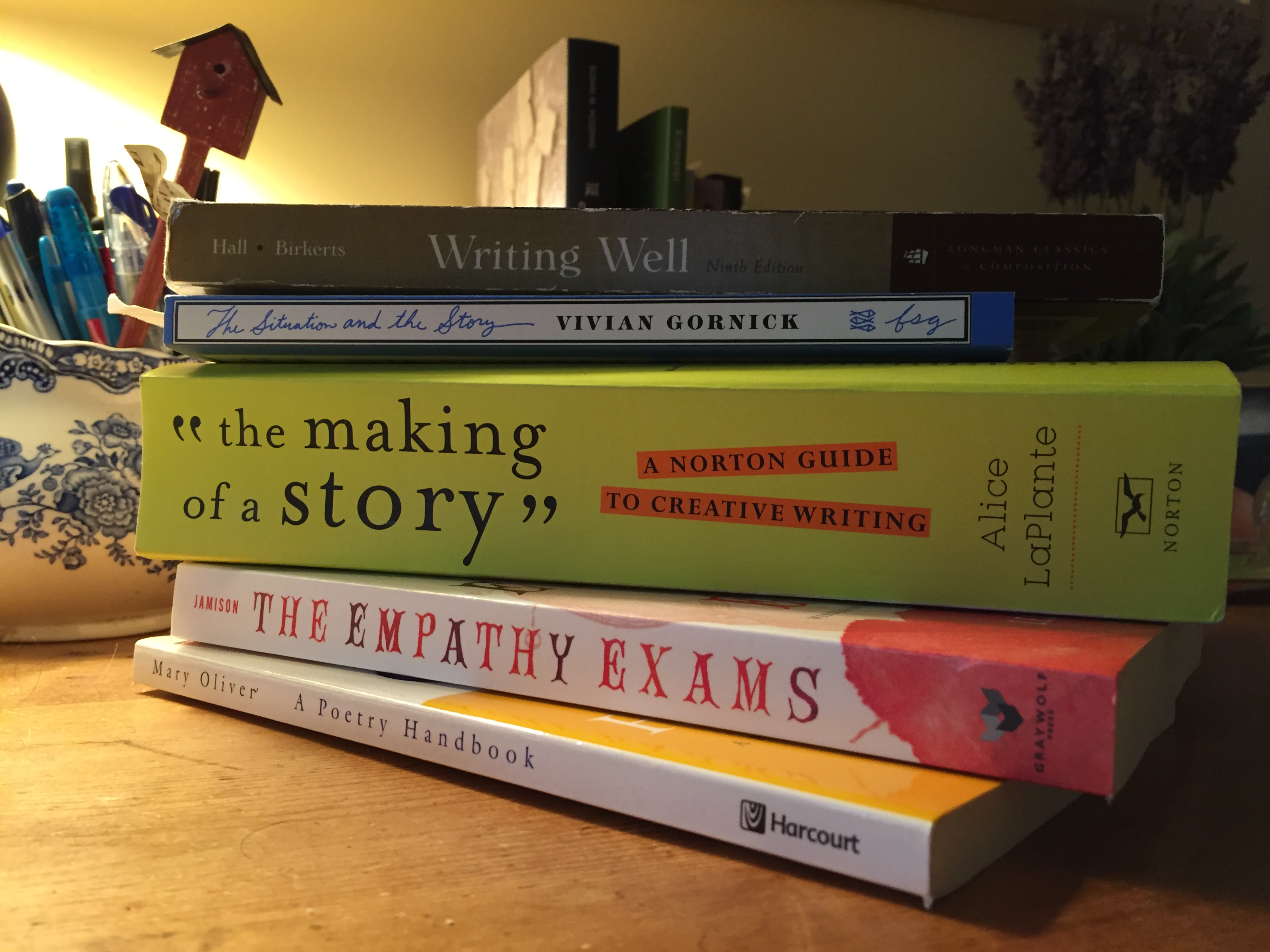
up above, a few of the books i’m hauling along to writerly school. vivian gornick, donald hall, mary oliver, leslie jamison, and alice laplante, among the bound volumes.