pull up a chair

where wisdom gathers, poetry unfolds and divine light is sparked…

Tag: seeking wisdom

the chair is old enough to vote. . .

i’ve raised a blog, it seems, from birth to the verge of being grown-up. eighteen years: 12.12.06 it all began. 1,200 posts before today, so this––wondrously (to me, anyway)––is 1,201. at first i tended it, this conversation, this wondering aloud, this occasional epiphany, every weekday for a year, then chiseled it down to thrice a week. and then, yet again, i distilled it: once weekly––religiously every friday morn. here and there i’ve taken rare short breaks. a bit of summer breather once or twice.

and yet, kept on. and on and on. (sometimes wondering if maybe i should just be quiet.)

cycled through waves who’ve pulled up chairs in ebb and flow as of the tides. friends who’ve come to stay awhile, then shuffled off for one reason or another. at least a few i’ve deeply loved have died; angels still among us. some who’ve pulled up a chair have never ever strayed. here from the beginning, faithful as the day is long. bless them. bless and bless and bless them. 

i too have ebbed and flowed. waded into deep and deeper waters. shed old fears, grew courage. been puzzled. pondered. hatched new fears. wobbled. stumbled. inhaled courage again, again, and again. i’ve wondered and worried aloud. weathered aching heart, and phone calls and headlines that left me breathless. i’ve loved and loved some more. i intend to never stop. 

my school at first was all that unfolded under this old roof, where creaky twisting stairs and a nearly antique Garland stove––six burners, flattop, quasi-oven, a behemoth you’d find at any all-night diner––came to animate so many stories. it was my boys from whom i mostly learned and learned the most. and learned and learned again. and of course the holy earth and heavens high above: the gardens, the birds, the trees, the stars and moon, the dawn and dusk and nighttime’s inky darkness that never fail to draw me in. the book of nature, i’ve come to read, where lessons rise and fall season after season after season. i found a holy peace in this old house and the ramshackle plots where i kneel with trowel and soul wide open. i’d been chasing that peace for years. 

i seem to have stumbled into a new teacher these days, one i’d never thought could bring such knowing: it comes with darkness, yes, though i’m reminded that darkness is the embryonic space where stirrings first begin. and it’s nighttime’s darkest hour when stars most brightly shine. stripped of distraction, of the nettlesome sorts of things that blur our everyday, it denudes us to our barest essence. it’s cancer (even when i do not name it here it’s ever present in my rumblings, and has catapulted me to highest most-reverent attention). mine is an especially wily iteration, one that doesn’t follow rules. and brings me squarely into the land of uncertainty. where i, a girl who likes to know things, am finding out how not knowing whittles the knowing to one or two immutables: love is the force that triumphs over all; its alpha and omega, the God who dwells within. within me, and you. and even all the ones who make us want to scream and run for cover. 

here’s what i know 18 years in: there is nothing that love––true, deep love in all its iterations––cannot infuse. and in the infusing, molecules are stirred, shifted, and forms reshaped, dissolved, emboldened, made new. i’ve felt mountains move. i’ve felt fear melt away, like butter on hot biscuits. i’ve felt surrender––holy, holy “thy will be done.”

and a life well lived is one in which we love as unstintingly, as capaciously, as we might never have known possible. to live a life of loving is to scatter the few seeds that might blossom in our wake, that might rise in the seasons beyond us. it is the deepest mark i hope and pray to leave: to know my heart, my soul, has found a way in, forever in, to those whose lives i might have touched. 

it all becomes so spare, so simple, in the end. when you realize your days––for as long as they stretch––are your one rare turn to hone the art of loving, as it is meant to be. as it is meant to make the holy difference. to trace the path from here to heaven. 

that’s some of what i’m thinking eighteen sweet years in.

and now, because the older i get the more i glean from the wisdom of those who’ve left their trace, here’s my birthday bouquet to ponder for the day, the week, the hour…an indelible quote, a poem to make you laugh, and one to maybe melt you….

first, a quote from the french philosopher and playwright gabriel marcel, from the mystery of being:

“You know you have loved someone when you have glimpsed in them that which is too beautiful to die.”


a poem that might make you laugh, and certainly leave you with a smile:

Emily Dickinson at the Poetry Slam
BY DAN VERA

I will tell you why she rarely ventured from her house. 
It happened like this:

One day she took the train to Boston,
made her way to the darkened room,
put her name down in cursive script
and waited her turn. 

When they read her name aloud
she made her way to the stage
straightened the papers in her hands —
pages and envelopes, the backs of grocery bills,
she closed her eyes for a minute,
took a breath, 
and began. 

From her mouth perfect words exploded,
intact formulas of light and darkness.
She dared to rhyme with words like cochineal
and described the skies like diadem. 
Obscurely worded incantations filled the room
with an alchemy that made the very molecules quake.

The solitary words she handled
in her upstairs room with keen precision
came rumbling out to make the electric lights flicker.

40 members of the audience 
were treated for hypertension.
20 year old dark haired beauties found their heads
had turned a Moses White.

Her second poem erased the memory of every cellphone
in the nightclub,
and by the fourth line of the sixth verse
the grandmother in the upstairs apartment 
had been cured of her rheumatism. 

The papers reported the power outages. 
The area hospitals taxed their emergency generators
and sirens were heard to wail through the night.

Quietly she made her way to the exit,
walked to the terminal and rode back to Amherst. 

She never left her room again
and never read such syllables aloud. 


and finally, a christmas poem that just might melt you, as it melted me. . . 

Kenosis
by Luci Shaw

In sleep his infant mouth works in and out.
He is so new, his silk skin has not yet
been roughed by plane and wooden beam
nor, so far, has he had to deal with human doubt.
He is in a dream of nipple found,
of blue-white milk, of curving skin
and, pulsing in his ear, the inner throb
of a warm heart’s repeated sound.
His only memories float from fluid space.
So new he has not pounded nails, hung a door
broken bread, felt rebuff, bent to the lash,
wept for the sad heart of the human race.

thank you, with all my heart, for pulling up a chair, be it only for awhile, or for some or all these years. i am holding especially close against my heart this morning ginny, my once closest reader (my beloved mother in law who was quick to call if she liked what she’d read, and deafeningly silent if she did not!), mary ellen, and ceci, who waft over my shoulder, angels to my every day….and especially to my boys, who animate each and every pulse of my heart and every breath i breathe….(and certainly to will, who got this whole thing started, when he insisted i could do it, and built the website to make it happen….)  xoxo love, bam

how did you find the chair?

when you find the sages on your shelf echoing one essential truth. . .

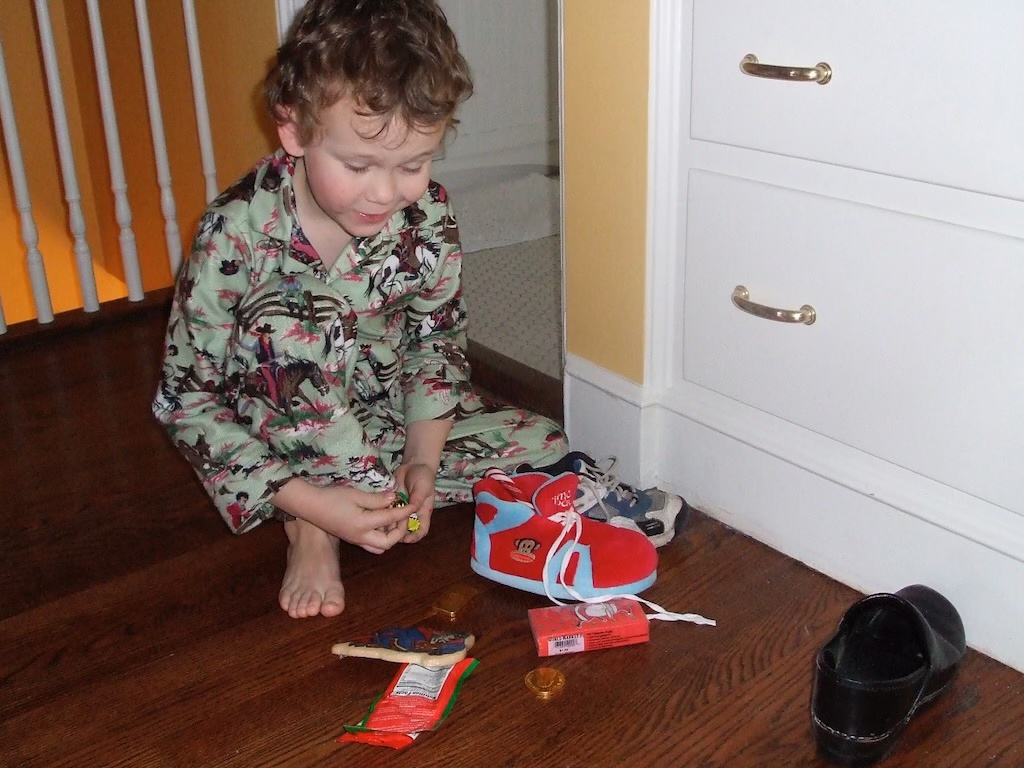
not so very long ago, within the reach of my old brain folders, this was the morn i had my boys set out shoes (sometimes admittedly smelly sneakers), which i filled with clementines and tinfoil-wrapped chocolates. the feast of st. nick, the jolly soul who in long-ago times filled the shoes of girls and boys with trinkets from his pouch. the original arbiter of good v. not-so-good; a lump of coal you did not want to find tucked in the toe of your wooden clog.

december, it seems, is a month punctuated with tradition. we embroider advent’s waiting, the dim day-by-day darkening with the kindled flickering of myth and lore and wonder gathered round the globe. every land, it seems, is looking for a bit of light amid the darkness.

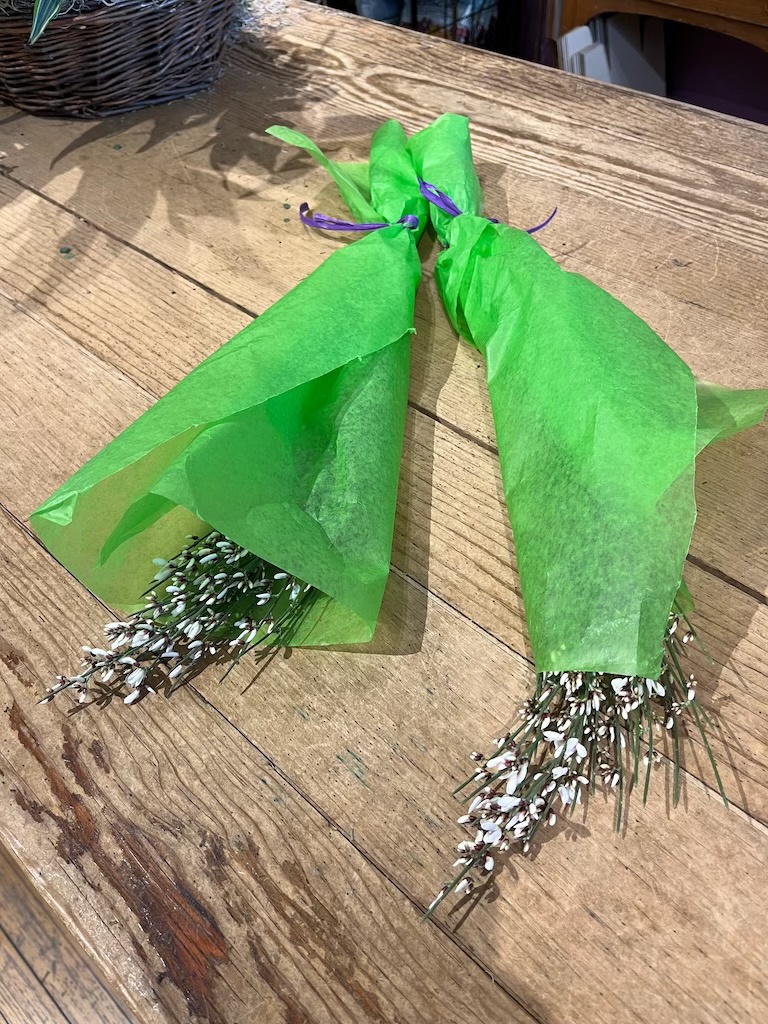
i learned only this week of december fourth’s “barbara branch,” when the german tradition is to give the branch of a flowering tree to a barbara and await its blossoming by christmas. the story goes that barbara, who would become a saint and then later (at my tender and impressionable age of 9 or 10) be stripped of her sainthood (for reasons i never quite grasped but the good ol’ Church did it anyway), dear barbara back in medieval times was such a beauty that her wretched father locked her in a tower whenever he went away. and when she refused to marry some princely fellow, because she preferred to marry Jesus Christ (plenty of saints chose that path) he sent her off to prison, awaiting beheading. on the way to prison, so the story goes, a cherry branch snagged against her skirt, so wise and wily barbara clutched the branch and carried it along to her cell, whereupon every few days she watered it with drops from her scantly-filled drinking glass. and don’t you know that on the day she was burned at the stake and then beheaded, the branch blossomed. and so we barbaras carry on the blossoming, with branches awaiting bloom. my mother is a barbara, and she now has a dear friend where she lives who also happens to be a barbara. so this barbara brought those barbaras branches awaiting bloom. 

and so december goes. 

but really what i find myself thinking here this morning is how the sages i have come to know and love find themselves in conversation across space and time. how their wisdoms interlace and amplify, and to my mind underscore the eternal in their simple truths. 

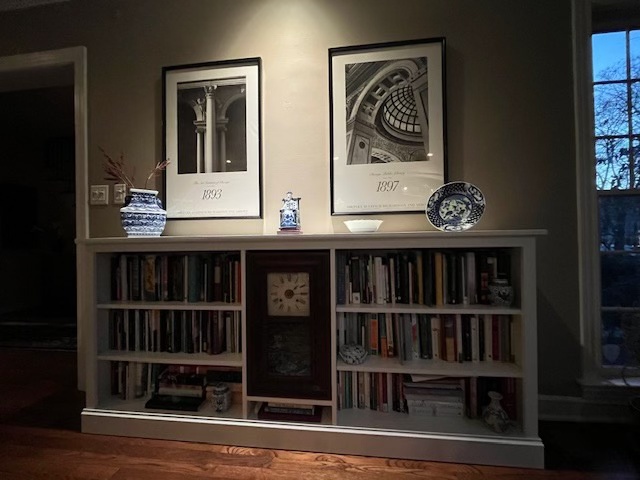
the sages shelf: poets, left; mystics and sages to the right

the two i’ve drawn from my shelf this week are brian doyle, the beyond-brilliant late great essayist and longtime editor of portland magazine, who died of a brain tumor not too many years ago. his wisdoms cannily or not line up with those of dorothy day, the radical pacifist and co-founder of the Catholic Worker movement, devoted to the poor, the hungry, the broken, and now on the road to sainthood, though she famously protested that labelling when she once snapped: “don’t call me a saint. i don’t want to be dismissed so easily.” (a sassy saint she’ll be, patron saint of sassiness among her zillion virtues.)

i found myself pulling dear brian off my sages shelf this week, and zeroed in on this passage in particular from his magnificent one long river of song: notes on wonder (a book whose praises i once sang in the pages of the chicago tribune, back when i wrote a column called “books for the soul”): 

This is what I know: that the small is huge, that the tiny is vast, that pain is part and parcel of the gift of joy, and that this is love, and then there is everything else. You either walk toward love or away from it with every breath you draw. Humility is the road to love. Humility, maybe, is love.

he echoes the essence of dorothy’s wisdom, an epiphany of hers long etched on my heart. this simple, simple code: “by little and by little.” 

her biographer, robert ellsberg in dorothy day: selected writings, elucidates: “simply, it consisted of performing, in the presence and love of God, all the little things that make up our everyday life and contact with others. from therese [of lisieux, yet another saint, the one who inspired dorothy], dorothy learned that any act of love might contribute to the balance of love in the world, any suffering endured in love might ease the burden of others. . . we could only make use of the little things we possessed—the little faith, the little strength, the little courage. these were the loaves and fishes. we could only offer what we had, and pray that God would make the increase. it was all a matter of faith.”

what i’ve come to know, through the alchemies of age and maybe cancer, is that my one holy task here is to live by love, little by little, day by day, for as many days as i have. if i can be a little flame, if i can choose love, choose joy, choose kindness at each and every turn and each and every choice, then my swift life here will have left some mark and measure. if each one of us might tip the balance, bend the arc toward justice, then our existence holds holy purpose. the choice becomes so clear, so finely-grained focused: i aim to walk closer and closer to the holiness i was––we were all––meant to be. and to find unending bliss within.

so help me God. 

one more brian doyle: in a brilliant, brilliant essay (found in One Long River, p. 12) about two strangers holding hands as they leapt from the south tower on sept. 11, doyle wrote: “their hands reaching and joining are the most powerful prayer i can imagine, the most eloquent, the most graceful. it is everything we are capable of against horror and loss and death. it is what makes me believe we are not craven fools and charlatans to believe in God, to believe that human beings have greatness and holiness within them like seeds that open only under great fires, to believe that some unimaginable essence of who we are persists past the dissolution of what we were, to believe against such evil hourly evidence that love is why we are here.”

i don’t know why i even try to say what has been so magnificently, unforgettably uttered already. brian doyle’s truth i feel unfolding in me every blessed day. i feel those seeds breaking open in the roaring furnace that is a cancer in your lungs.


because, why not, two Advent poems from emily d. or at least two poems worth contemplating in this season of anticipation, of heightened awaiting, of soul on the lookout for wonder coming….(Advent reflection on the poems, from my friends at the Salt Project, down below, but first, emily, the belle of amherst:)

“The Infinite a sudden Guest” (1309)

The Infinite a sudden Guest
Has been assumed to be —
But how can that stupendous come
Which never went away?

“Tell all the truth but tell it slant — “ (1263)

Tell all the truth but tell it slant —
Success in Circuit lies
Too bright for our infirm Delight
The Truth’s superb surprise
As Lightning to the Children eased
With explanation kind
The Truth must dazzle gradually
Or every man be blind —

+ Emily Dickinson

and here’s what my friends at Salt Project say about both…

These two Dickinson poems are perfect meditations for Advent:

The first as a provocative play on one of the season’s mysteries (How can we “wait” for someone who is also present to us, and in us, even as we wait?); and the second as a window into the many ways the Advent and Christmas stories testify to a God who comes in ways that are somewhat softened, accessible, “slant,” camouflaged, even hidden.

An ordinary baby in an ordinary backwater town, signaled by a star so faint that only Magi can spot it (Herod’s assassins can’t!), and announced not to the powerful in Jerusalem but to nameless shepherds on a forgotten hillside, watching their flocks by night.

It’s as the old carol has it: “Veiled in flesh the Godhead see, Hail th’ incarnate Deity!” (that’s from “Hark the Herald Angels Sing”). Veiled, hidden, not so God disappears but precisely so God may appear — or rather, so we may see. The Truth must dazzle gradually…

what simple sages’ truths have you found echoing of late?

blessings to teresa p for teaching me all about BBs, barbara branches!

unearthing the wisdoms entwined in the past. . .

in which these uncharted times have me leaning on the wisdoms of great minds and expansive souls who’ve navigated their own immensely dark and tough times…

more and more i find history is my balm. i think back to the eras of darkness across the arc of time and the indomitable human spirit that has never yet been extinguished, no matter the force of the counterwinds. 

albert camus

curiously, albert camus––whom i’d never thought of as any sort of balm––has served well in that role. though considering the era in which he was writing, it’s no wonder it was darkness he saw through, shone a fierce beam of light on the way through the horrors of europe during the holocaust. 

so often it’s the artists and writers, the makers of films and penners of poems, the ones endowed with an eye to see beyond the occlusions, the ones who imagine what others can’t conceive, who cast the lifeline beyond the capacities of strategists and political operators, power brokers and thieves. 

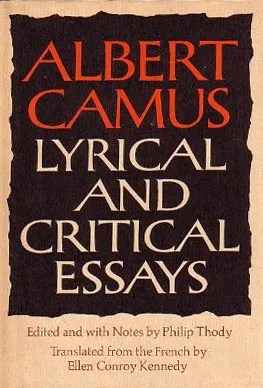
in his 1940 essay titled “the almond trees” (a species that brilliantly blooms in winter), found in his Lyrical and Critical Essays, camus weighs in on happiness, despair, and how to amplify our love of life.

only twenty-seven when he wrote this, here is the french-algerian philosopher who gave us the plague, the fall, the stranger,and the myth of sisyphus:

We have not overcome our condition, and yet we know it better. We know that we live in contradiction, but we also know that we must refuse this contradiction and do what is needed to reduce it. Our task as [humans] is to find the few principles that will calm the infinite anguish of free souls. We must mend what has been torn apart, make justice imaginable again in a world so obviously unjust, give happiness a meaning once more to peoples poisoned by the misery of the century. Naturally, it is a superhuman task. But superhuman is the term for tasks [we] take a long time to accomplish, that’s all.

Let us know our aims then, holding fast to the mind, even if force puts on a thoughtful or a comfortable face in order to seduce us. The first thing is not to despair. Let us not listen too much to those who proclaim that the world is at an end. Civilizations do not die so easily, and even if our world were to collapse, it would not have been the first. It is indeed true that we live in tragic times. But too many people confuse tragedy with despair. “Tragedy,” [D.H.] Lawrence said, “ought to be a great kick at misery.” This is a healthy and immediately applicable thought. There are many things today deserving such a kick.

echoing the sentiments of an earlier manifesto written in the immediate wake of the first world war, the 1919 “declaration of the independence of the mind,” again by a french philosopher, this time romain rolland––and signed by such luminaries as bertrand russell, albert einstein, bengali poet and nobel laureate rabindranath tagore (a favorite of mary oliver), social worker and activist jane addams (chicago’s own), upton sinclair, and hermann hesse––camus argues that this “kick” is to be “delivered by the deliberate cultivation of the mind’s highest virtues”:

If we are to save the mind we must ignore its gloomy virtues and celebrate its strength and wonder. Our world is poisoned by its misery, and seems to wallow in it. It has utterly surrendered to that evil which Nietzsche called the spirit of heaviness. Let us not add to this. It is futile to weep over the mind, it is enough to labor for it.

But where are the conquering virtues of the mind? The same Nietzsche listed them as mortal enemies to heaviness of the spirit. For him, they are strength of character, taste, the “world,” classical happiness, severe pride, the cold frugality of the wise. More than ever, these virtues are necessary today, and each of us can choose the one that suits him best. Before the vastness of the undertaking, let no one forget strength of character. I don’t mean the theatrical kind on political platforms, complete with frowns and threatening gestures. But the kind that through the virtue of its purity and its sap, stands up to all the winds that blow in from the sea. Such is the strength of character that in the winter of the world will prepare the fruit.

elsewhere in lyrical and critical essays, we find the line that practically serves as camus’s epigraph: “in the depths of winter, i finally learned that within me there lay an invincible summer.” 

toni morrison

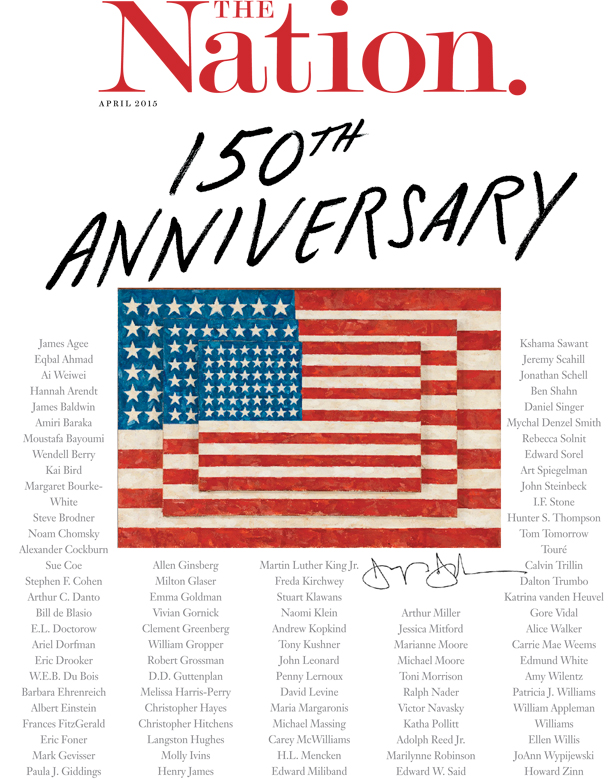
no less than toni morrison takes the baton, elaborating that the task of the artist is as a grounding and elevating force in turbulent times, in her essay titled “no place for self-pity, no room for fear,” included in the 150th anniversary issue of the nation, the monthly founded by abolitionists in 1865, not long after the adoption of the thirteenth amendment abolishing slavery.

morrison writes:

This is precisely the time when artists go to work. There is no time for despair, no place for self-pity, no need for silence, no room for fear. We speak, we write, we do language. That is how civilizations heal.

I know the world is bruised and bleeding, and though it is important not to ignore its pain, it is also critical to refuse to succumb to its malevolence. Like failure, chaos contains information that can lead to knowledge — even wisdom. Like art.

marcus aurelius

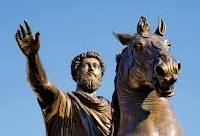
and finally let us turn way back the clock to ancient wisdoms, in this case those of good ol’ marcus aurelius, the roman emperor whose meditations were suggested to me the other day by one of my more astute and heavenly comrades. the meditations, written in the late second century of the Common Era during the emperor’s military campaigns against germanic tribes along the danube, are thought to be a window into his inner life, uncannily recognizable to our own deep-down whisperings. i borrowed the stoics from the library, but have already decided i need a paper copy all my own, the better for underscoring and stars in the margins. here’s but one of marcus’s wonders, from book II of his meditations, thought to be written in about the year 170 C.E. (uncanny how true wisdom is timeless, as this fits the november of 2024 as fulsomely as it fit nearly two millennia ago):

Begin the morning by saying to thyself, I shall meet with the busybody, the ungrateful, arrogant, deceitful, envious, unsocial. All these things happen to them by reason of their ignorance of what is good and evil. But I who have seen the nature of the good that it is beautiful, and of the bad that it is ugly, and the nature of him who does wrong, that it is akin to me, not [only] of the same blood or seed, but that it participates in [the same] intelligence and [the same] portion of the divinity, I can neither be injured by any of them, for no one can fix on me what is ugly, nor can I be angry with my kinsman, nor hate him. For we are made for co-operation, like feet, like hands, like eyelids, like the rows of the upper and lower teeth. To act against one another then is contrary to nature; and it is acting against one another to be vexed and to turn away. 

what timeless wisdoms do you find anchoring, or elevating? and where might lie your invincible summer; how might you summon it?

here’s a challenge: imagine what’s possible. work toward it. begin with a baby step.

a literary form for the slipperiest of minds

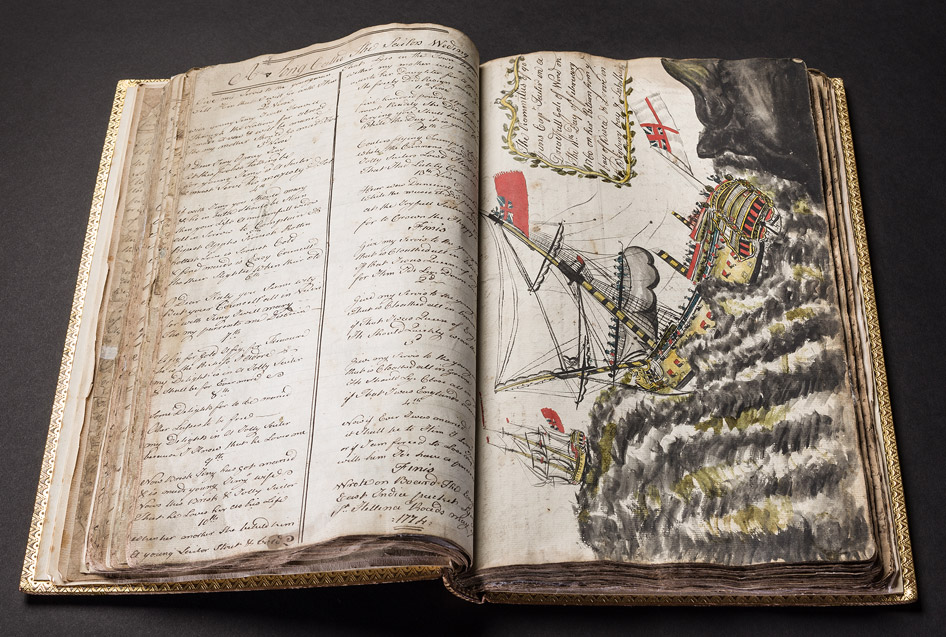
a page from british sailor henry tiffin’s commonplace book, 1760

more and more, the literary form into which i ease is one that traces roots to the ancients. to pliny, the great naturalist, whose mind must have been a beehive of sorts back in first-century rome. it’s an enthusiasm for accumulation that courses its path on through the renaissance when humanists, especially, were anxious to lock down their thoughts, keenly aware of the tragic loss of ancient learning, as libraries were so often, too often, the sites of military revenge. it’s a form that wends its way on and on through the centuries, straight through the twentieth, when mark twain, thomas hardy, ralph waldo emerson, and henry david thoreau, to name but a few, all partook of the habit. and here we are now, with plenty of us keen practitioners of the urge to gather up bits of literary esoterica and assorted ephemera before they skitter away. i think of myself, more often than you might imagine, as a rag picker of ideas in any which size, from the itty-bitty and poetic to the mindbogglingly big.

humans, it seems, like to scribble things down.

may our scribbling never cease.

the fancy name for this scribbling is commonplacing, the literary form the italians once named zibaldone, “a salad of many herbs,” in culinary terms, or a “hodgepodge” more broadly. we’re contemplating here the hodgepodge.

it’s the mosquito netting of the mind, of wonders and thoughts before they escape. or, as the 13th-century dominican monk, vincent of beauvais, once explained, it was “the multitude of books, the shortness of time, and the slipperiness of memory” that compels one to scribble.

count me in on the slippery mind.

vincent’s not-so-slippery solution: a ginormous tome, totaling 4.5 million words (someone counted!), an exhaustive compendium of all medieval knowledge, which he titled speculum maius (literally “great mirror”), speculum a word he chose because it contained “whatever is worthy of contemplation (speculatio), that is, admiration or imitation.” and thus he set out, over the course of his monastic lifetime to gather all the “flowers” (his word), or best bits of all the books he was able to read, in a selfless quest to save others the strains (time, money, trips to the library) of doing so themselves.

over the last many months, as the population of this old house has dwindled to two, and the stories to tell are fewer and fewer, my efforts here seem to have morphed into a looser, yet more concentrated consideration of the bountiful ideas and thunderbolts i bump into across the arc of a week.

there is something so natural about the human instinct to share what we’re thinking. of course there are those who might protest, who might consider me rude for shoving a book or a page or a picture in your face. but, when you think of it, isn’t that the instinct that drives so much of social media? (i often think we’ve gone overboard there, but that might be because too often it’s the magnification of any or every passing brain burp and not necessarily ones that might leave us enlightened. and too often amount to plain old overgazing at navels, or hair-raising nastiness and gut-wrenching vulgarity. but i digress…)

i’ve been keeping what amounts to my salad of many herbs for years and years now, and that urge seems to have spilled over to here, where week after week sometimes i seem to be assaulting you with the few morsels i’ve found most delicious in recent days. it’s a way, i suppose, of collectively swelling our brains. and our souls, most certainly.

in the spirit in which i bring my rag picking here, i like to think of us sitting side-by-side, cozy against the pillowy confines of an armchair broad enough for two. and in the gentlest, yet conspiratorial whisper, i offer you a page or a passage, my eyes widened and sparkling with glee, as if to say, wait’ll you see this one. what wonderments or deep thoughts spring to your mind?

any one of these next morsels is worthy of long and deep consideration. here are the ones that struck me this week:

these first two come from maria popova, whom i’ve referred to in the past as the high priestess of cultural commentary, and one of the most voracious gatherers of ideas i’ve encountered in recent years. her online literary journal, now known as The Marginalian, has been described as a compendium of hundreds of thousands of entries “that search for meaning, cross-linking ideas and connecting metaphysical dots.” here’s where she thunderbolted me this week:

“joy is a stubborn courage we must not surrender.”

“. . . love — whether we call it friendship or family or romance — is the work of mirroring and magnifying each other’s light. Gentle work. Steadfast work. Life-saving work in those moments when life and shame and sorrow occlude our own light from our view, but there is still a clear-eyed loving person to beam it back. In our best moments, we are that person for another.”


another place i often turn for soulful sustenance is Emergence magazine, a wellspring that explores the timeless connections between ecology, culture and spirituality. in a recent talk, titled “memory, praise, and spirit,” the filmmaker, composer, sufi teacher, and driving force behind Emergence, emmanuel vaughan-lee, opened with these words:

“The mystics say that we are like a seed; that we hold the blueprint for our highest potential within us, and that much of spiritual practice, regardless of what tradition, is unlocking that potential.”


and i close with this one from the great james baldwin, a passage from his 1964 collection of intimate but somewhat little-known essays, titled nothing personal. this passage is from the fourth of the four essays collected there:

“One discovers the light in darkness, that is what darkness is for; but everything in our lives depends on how we bear the light. It is necessary, while in darkness, to know that there is a light somewhere, to know that in oneself, waiting to be found, there is a light.”

i could write an essay on any one of the above, but instead i invite you to chew on each or any one. each one, a morsel worthy of your time, your mind, your soul.

which one spurs you and stirs you the most, and what deep thoughts spring to your mind?

i’ve written before of commonplacing. here at the chair, and in my latest book, The Book of Nature, on pages 87 and 88. it’s a habit i can’t get enough of, an urge i can’t quench.

pages from the commonplace book of charles dodgson, aka lewis carroll

the imperative prompts: realizing life while we live it

“Do any human beings ever realize life while they live it?––every, every minute?”

“No.”

Pause.

“The saints and poets, maybe––they do some.”

it’s these three lines plus the pause from thornton wilder’s “our town” that stopped me cold this week. released to the world in 1938, the three-act classic set in grover’s corners, a celebration of “ordinary people who make the human race seem worth preserving,” was once described by edward albee as “the greatest american play ever written.” i’m sure that claim is dusted over now, but its timelessness is proven. and these lines between emily and the stage manager, rising off the page after the commonplace litany of ticking clocks, and sunflowers, food and coffee, new-ironed dresses and hot baths, are the ones that called out to me across the arc of time.

it is the question that preoccupies me. it is the spiritual quest at my core: can i stay awake to the marvel around me? can i sift through the detritus and chaff that inevitably litter the days, and seize the glittering wonders? can i palpably know that these are the days i’ve been given to give what i have, to tap into the holiness within and leave at least some in my wake?

and thornton wilder was putting those questions on the stage nearly a century ago. and before wilder, and since wilder, countless sages have put forth the very same prod. are we awake yet? are we taking this all for granted? are we forgiving those who’ve trespassed against us, and asking forgiveness for the sins of our very own making?

we are meant to pay attention. we are meant to be kind. we are meant to love and love gently yet fiercely. we are meant to notice the ticking of clocks, the falling of rain, the sunglorious glow of one fat red tomato.

it’s the saints and the poets who sometimes remember. who point us, perhaps, in the certain direction. it was that reminder, the ranking of poets right up there with saints, that captured me too. that underscored and amplified a truth i know to be true: the imperative prompts so often come in the unlikeliest, quietest voices among us. in the script of a play nearly a century old.

where did you find your wisdoms this week?

gathering a congregation of sages…

if you asked me today what church i belong to, i might stumble into an answer that wasn’t much of an answer. it might go round about. explain that sometimes i feel like an orphan. yes, there is a place where i go on the sundays when i’m on duty. i’m an altar girl at a church that welcomes my presence, where the sermons are great, but where i’m not much of a signer-upper which makes me feel a bit like a slacker. i have a synagogue, where sometimes i wander in to talk with the rabbi. where i can find myself in the deepest of prayer.

but the truth i’ve been wrestling with all summer long is that, mostly, i feel lost, adrift.

i didn’t grow up with a deep congregational sense. i talked to God most of the time from behind the closed door of my childhood bedroom. i found God in the notes i wrote, night after night during high school, to a motley band of the broken-hearted, the lost, and the otherwise looking for warmth. for a friend.

good thing i grew up with a mama who quoted emily dickinson more than anyone else. who taught me the lines of this poem that’s been ground into my soul in the finest of fine-grain elixirs:

Some keep the Sabbath going to Church – (236)

Some keep the Sabbath going to Church –
I keep it, staying at Home –
With a Bobolink for a Chorister –
And an Orchard, for a Dome –

Some keep the Sabbath in Surplice –
I, just wear my Wings –
And instead of tolling the Bell, for Church,
Our little Sexton – sings.

God preaches, a noted Clergyman –
And the sermon is never long,
So instead of getting to Heaven, at last –
I’m going, all along.

the other thing my mama taught me––the one line she etched onto my soul was this: don’t let the Church get in the way of God.

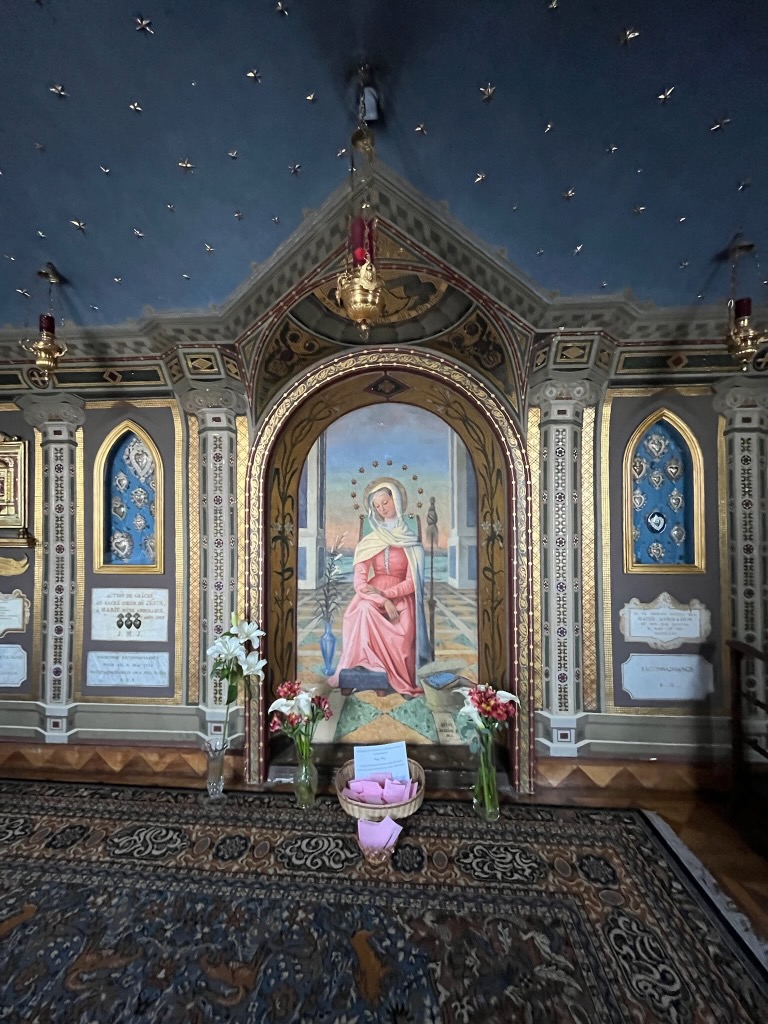
my mama, a girl who grew up in a convent where the nuns taught her to curtsy each time she dashed past the statue of the Pink Madonna (a story is told that one of the nuns–these are Sacred Heart nuns–once tried to paint a portrait of the Blessed Virgin Mary, and what she painted was so godawful, they tossed a rug over the thing, to hide it, and some time later when the rug was pulled off, lo and behold, there was a breathtakingly beautiful Mother of God decked out not in the usual blue but in pink. thus, the Pink Madonna that Sacred Heart girls (and their dutiful daughters) seek out whenever and wherever in the world they sense themselves in breathing distance of one of the few extant copies), my mama, as devout as the day is long, is far more radical than you might imagine for a girl who grew up in a convent in the most parochial burg of cincinnati, ohio. and that might be one of the things i treasure most about my mama.

and maybe that has something to do with my unwavering quest to find my way in this world along a path populated by sages, and not always of the churchly persuasion. i find holiness in unorthodox moments and places and, often, smack dab in the thick of a sentence.

i might not belong to a particular church these days. but i gather a goodly––and godly––congregation of pathfinders along my way. my church, quite often, rises up from the page.

i read, hour by hour, and day after day, with an eye out for wisdoms and truths, and guideposts to stir me. something akin to wandering an orchard, plucking from trees the lushest of fruits. i find my convictions deepened. my heart, often on fire. my intent: to make this blip that is my life as blessed as i can make it. i live by a gospel of love, one with an emphasis on that which is tender, and gentle not harsh. i believe, more and more, in humility. in understanding how little i know. and how much there is still for me to learn. to understand.

we live in a world that some days feels like it’s spewing all that i detest: there is cruelty, and hubris, and parading around as if no one else matters.

but then i open a book. or click on a text from a most blessed friend. and i read words that resonate. that underscore what seems to be Truth with a capital T. and i feel less alone, and less lost.

these are the lines that spoke to me this week in this holy space of my own making; one is from hafiz, the 14th-century sufi poet, another from thich nhat hanh, the blessed buddhist monk who died just two years ago, and the third is from greg boyle, the jesuit priest who founded Homeboy Industries, the world’s largest gang intervention and rehab program, based in east LA, and whose book, barking to the choir, is now on my most-wanted list.

first up, a prayer poem sent by a beloved friend, one from hafiz, the sufi poet, from a translation by daniel ladinsky, and which my blessed friend found in the pages of greg boyle’s barking to the choir:

Every child has known God,
Not the God of names,
Not the God of don’ts,
Not the God who ever does anything weird,
But the God who knows only four words.
And keeps repeating them, saying:
“Come Dance with Me, come dance.”

i love a God who whirls with me, who invites me into the dance.


next up, thich nhat hanh:

Understanding someone’s suffering is the best gift you can give another person. Understanding is love’s other name. If you don’t understand, you can’t love.

oh, that we should enter deep into the wounds of another. and therein find the walls of our own hearts widening and deepening, and our compulsion to hold a trembling hand the surest thing we can do.


and, finally, once down the greg boyle rabbit hole, i just got deeper and deeper, and then i found this:

“For unless love becomes tenderness—the connective tissue of love—it never becomes transformational. The tender doesn’t happen tomorrow . . . only now.” 

― Gregory Boyle, Barking to the Choir: The Power of Radical Kinship

tenderness, the connective tissue of love . . .

to which i whisper, amen

who do you gather in your congregation of sages?

photo above, of Mater Admirabilis, the Pink Madonna, is from our trip to rome back in may, during which, dutiful daughter that i am, i trekked to the top of the Spanish Steps, rang a bell at the convent of the sacred heart (my mother’s breed of nuns), turned over my passport for entry to the upper chapel where Our Lady resides, and beheld her.

of joy and hope in hard times

evidence of joy lurking somewhere in the house

joy comes in curious form. in simplest form sometimes. it arrived deep in the night last night in the form of tiptoes up the stairs. and then a creak of bedroom door. had i not been lost in the murky land of dreams i might have been startled, might have worried that burglars were afoot. instead, i somehow thought it was the mate asleep beside me, that he’d roused and went out lurking. but then i felt the lump beneath the sheets. and as the murk faded i realized the night visitor must be the very one who’d called that room his own for so many years.

a night visitor, sometimes, brings joy.

and so it is that the simple knowing that, come the waking hour (his waking hour clocks in hours beyond mine), i’ll be at the stove tossing berries in a pond of batter, is enough to wash me in a morning’s joy.

it’s as simple as that sometimes. as narrow-focused.

these days, i contemplate strategies for making joy. and survival.

we live in dark times. not so dark as other moments in history, perhaps, but dark enough to make it hard to dodge the shadow. or the pit in my belly that will not subside.

i found myself turning, this week, in three different instances to albert camus. not the first on my list when it comes to literary prozac, but thrice he and his wisdoms came through for me. his words, drawn from a collection of posthumously published essays, speak across the decades, and if a writer born into one world war, who lived through another, could find it in his soul searching to seek and find a trail of hope, well then he’s one to whom i’ll listen.

in the year i was born, camus (1913-1960) became the second-youngest laureate of the nobel prize for literature, awarded for writing that “with clear-sighted earnestness illuminates the problems of the human conscience.” the problems he mined were these: art as resistance, happiness as our moral obligation, and the measure of strength through difficult times.

one of my modern-day muses, as you might have gathered if you read here very often, is the cultural critic maria popova who rarely fails to pluck gems worth tucking in forever chests. in a trail that led me to her this week, i found that some years ago she too took a turn into the deep well of camus. she wrote:

“During WWII, Camus stood passionately on the side of justice; during the Cold War, he sliced through the Iron Curtain with all the humanistic force of simple kindness. But as he watched the world burn its own future in the fiery pit of politics, he understood that time, which has no right side and no wrong side, is only ever won or lost on the smallest and most personal scale: absolute presence with one’s own life, rooted in the belief that ‘real generosity toward the future lies in giving all to the present.’”

she goes on to point out that in camus’ writing she hears the echo of the young dostoyevsky’s exultant reckoning with the meaning of life shortly after his death sentence was repealed (“to be a human being among people and to remain one forever, no matter in what circumstances, not to grow despondent and not to lose heart,” dostoyevsky wrote to his brother, “that’s what life is all about, that’s its task”). these giants of literature belong on our nearest shelves for, in so many ways, they’ve left us instructions––or is it imperatives?––for living.

and here we hear camus:

“What counts is to be human and simple. No, what counts is to be true, and then everything fits in, humanity and simplicity. When am I truer than when I am the world?… What I wish for now is no longer happiness but simply awareness… I hold onto the world with every gesture, to men with all my gratitude and pity. I do not want to choose between the right and wrong sides of the world, and I do not like a choice… The great courage is still to gaze as squarely at the light as at death. Besides, how can I define the link that leads from this all-consuming love of life to this secret despair?… In spite of much searching, this is all I know.”

albert camus

not realizing i was tracing camus through the week, the first time he caught my eye this week was in the single short first sentence below, which hit me as a fist to the belly as i count my days under the penumbra of those first three words:

“Life is short, and it is sinful to waste one’s time. They say I’m active. But being active is still wasting one’s time, if in doing one loses oneself. Today is a resting time, and my heart goes off in search of itself. If an anguish still clutches me, it’s when I feel this impalpable moment slip through my fingers like quicksilver… At the moment, my whole kingdom is of this world. This sun and these shadows, this warmth and this cold rising from the depths of the air: why wonder if something is dying or if men suffer, since everything is written on this window where the sun sheds its plenty as a greeting to my pity?”

and finally, at 27, camus wrote this, speaking for this moment as well as the dark, dark times of 1940 when he wrote them:

“Our task as [humans] is to find the few principles that will calm the infinite anguish of free souls. We must mend what has been torn apart, make justice imaginable again in a world so obviously unjust, give happiness a meaning once more to peoples poisoned by the misery of the century. Naturally, it is a superhuman task. But superhuman is the term for tasks [we] take a long time to accomplish, that’s all.”

as if all that was not enough to carry me across the tide of this july’s miasma, it was with joyful inkling of recognition that my reading unearthed this most unforgettable line of camus:  “In the depths of winter, I finally learned that within me there lay an invincible summer.”

do yourself a favor and check out camus’ lyrical and critical essays. and consider leaving the front door unlocked lest any night visitor might wander in with reservation for blueberry pancake breakfast.

and may we all find that invincible summer.

what carried you across the abyss this week?

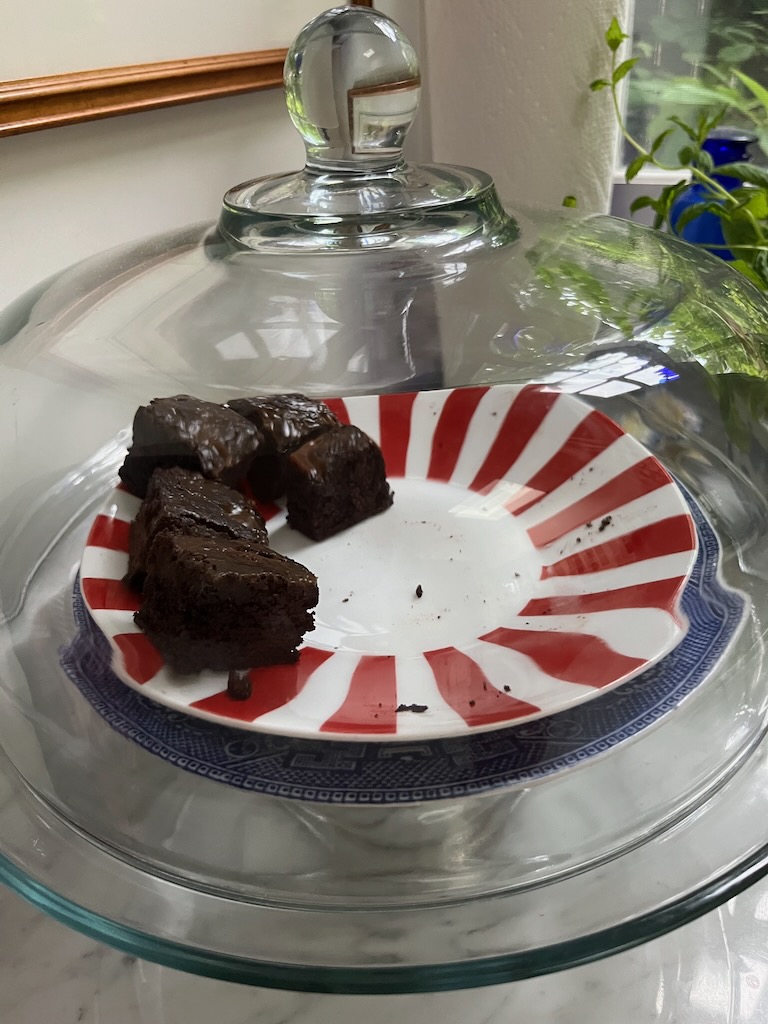
my night visitor, of course, is the boy we rarely see these days as he is ever toiling in the kitchen of stephanie izard’s famed girl and the goat eatery. but the holiday upon us drew him out of the city to an old friend’s house, where the hour was late enough that trains must have ceased their chugging along the track, and thus we scored him for the night. good thing the sheets are always clean, and the griddle ever at the ready.

the cookie dome above, scattered with bits of brownie crumb, is one of the few clues left behind by the night visitor. i always delight in remnant evidence when i awake in the morning and find the kitchen not exactly as i’d left it. those crumbs bring volumes of joy to me…

the quarryings of time

my hair is gray. my left shoulder is frozen. my right middle finger locks most mornings. and half of one of my lungs is no longer. 

there’s more (darn that paralyzed vocal cord), but the dirge needn’t drone on. the point is i’ve been quarried by time. which is close to the way annie dillard, my polestar and patron saint of seeing, put it in a passage i read –– and couldn’t forget –– this week. 

on page 238 of pilgrim at tinker creek, my bible of the woods, annie D. turns her otherworldly attentions to living creatures in various states of disarray: spiders with only six or seven of eight species-imperative legs; grasshoppers missing antennae; butterflies whose wings are torn; a swallowtailed sparrow minus its tail. and, yet, and yet, they creep and leap and flutter and glide on anyway. nature is not daunted by its disassembling. 

nor should we be. 

when it comes to us humans –– the species with the power to wonder, to question, to connect the occasional dots –– each quarrying carries its own volume, its own mysteries and humilities and sometimes epiphanies. each nick or chink in the armament of flesh and sinew and bone both takes us down a notch, and, if we’re paying soulful attention, points us closer to our soul, to that essence that bellows our being.

dillard writes thusly:

I am a frayed and nibbled survivor in a fallen world, and I am getting along. I am aging and eaten and have done my share of eating too. I am not washed and beautiful, in control of a shining world in which everything fits, but instead am wandering awed about on a splintered wreck I’ve come to care for, whose gnawed trees breathe a delicate air, whose bloodied and scarred creatures are my dearest companions, and whose beauty beats and shines not in its imperfections but overwhelmingly in spite of them, under the wind-rent clouds, upstream and down.

she got me to thinking about the beauty in brokenness. in disrepair. in all the parts of me that no longer follow instructions. 

and then four pages in, annie lands on the phrase that’s entranced me all week. she wonders aloud if, rather than somehow thinking it our birthright to come into existence “with the spangling marks of a grace like beauty rained down from eternity,” we might be wiser to realize we’re most whole “with the botched assaults and quarryings of time?”

“we are all of us clocks,” she goes on, quoting british astrophysicist arthur stanley eddington, who described us as clocks “whose faces tell the passing years.”

there, in those time-etched crowsfeet and the lines that furrow our brow, lie some of our deepest wisdoms. and most hard-earned beauties. that is, if you, like me, consider it a dazzling thing to have tucked into your brain files those rare few ideas whose staying power drives your every step thereafter. 

i’ve been in hospitals more times than i can count, have sat with eyes squeezed shut as someone drew needle and thread through my torn flesh, have felt the warm ooze of plaster cast being swaddled round my broken wrist. and each and every time, the wounds have left me more awake to life’s unscripted, oft-unspoken ponderings. (except maybe not the time when i made like peter pan, and flew off a garage roof when a rope swing escaped my grasp.) each and every time, we emerge keener to the pains –– and wonders –– of the world.

the most lasting empathies are forged in ERs and aftermaths.

and think about this: might you tally the innumerable times you’ve broken into smile, or squinched your eyes in irrepressible delight, to earn yourselves those hieroglyphs that now stand testament to your life’s-long accumulation of joy, or the hours you bent in deep concentration. or worried for the someones you love.

such are the quarryings of time. they inch us toward our holiest core.

it’s an excavation i’d not surrender.

now in my seventh decade (egad, that sounds sooooo old), i’ve been reminded time and again that none of this is a given. and we are breakable vessels nearly every time. and yet, without the botched assaults and the quarryings, from whence would come our vast acquired wisdoms? 

how would i know how precious each birthday candle is if i’d not wondered “will there ever be another?” how would i know the utterly-taken-for-granted gift of seamlessly sliding an arm down a sleeve if i’d not done so yelping the whole while?

doesn’t our brokenness bring us the pricelessness of knowing how deeply perishable we are? and how we’d best get on with what we know to be those few defining pursuits: whatever is the thumbprint we aim to leave behind on the life and lives we’ve loved? 

aren’t our depths — even the impossible-to-ask-aloud parts –– the prize that comes via our frayed and nibbled selves? 

none of us asked for nor expected the choreography of our lives. but with each and every quarrying there’s come an unintended plus. even if it took awhile to make itself apparent. 

all of which brings me roundabout to this prayer for beauty in the mundane. beauty in the brokenness is another prayer for which i pray. but first, this from writer and poet Cole Arthur Riley*’s breathtaking book Black Liturgies, in which she prays for our capacity to hold together the extraordinary and the ordinary:

God of every beautiful thing,

Make us people of wonder. Show us how to hold on to nuance and vision when our souls become addicted to pain, to the unlovely. It is far easier to see the gloom and decay; so often it sings a louder song. Attune our hearts to the good still stirring in our midst, not that we would give ourselves to toxic positivity or neglect the pain of the world, but that we would be people capable of existing in the tension. Grant us habits of sacred pause. Let us marvel not just at the grand or majestic, but beauty’s name etched into every ordinary moment. Let the mundane swell with a mystery that makes us breathe deeper still. And by this, may we be sustained and kept from despair. Amen.

cole arthur riley

*i am reading cole, stockpiling her wisdoms, as i begin to stock my larder for the lean months to come, when i sense the discord of the world beyond my quarter acre might otherwise knock me asunder. i intend to find a path toward the light. and i will, of course, bring it here.

how has time quarried you? what treasures did you find down deep beneath the dug-out parts?

any time i can bring a nurse to these pages it’s a good day. here, a fine acolyte of healing in action….can you imagine the shenanigans that landed this crew in her sublimely fine care? and, yes, i once wore a cap as pert as hers. and shoes not too dissimilar….

ordinary time

noddling bells of spring

deep in the recesses of my DNA, these knowings lurk. those little bits of knowledge slipped in once upon a time, those bits that order time, that frame the paradigm, the window frame, through which i watch the passing picture show called life.

somehow this week there was a whisper barely heard that told me ordinary time had come. technically, liturgically, it had come because the church i grew up in, the catholic church, ordains the monday after pentecost sunday as the opening of the long chapter of the year called “ordinary time.” and so, this week, as i slipped into this time, i couldn’t keep myself from considering the folds and undulations of just what ordinary means.

all around me, as lily of the valley sent up its flagpoles of perfume, as apple blossoms drifted down like vernal snowfall, as songbirds in feathers shocking pink and golden yellow darted in and from my feeders, i hardly thought things “ordinary.” the world’s in exultation.

and in my daily everyday, there was no relenting from the news that never stops and never slows to a trickle, nor was there quelling from the firehose of bumps and bangs that comes with loving widely, deeply. one night had me up till 2 a.m., making sure a young typist came to the end of his bibliography and junior theme (aka massive term paper) before we clicked out the lights. that same night had me dispensing nursing cures to a long-distance patient whose neck was in some spasm. all while keeping track of a train chugging to st. louis, where my sweet mate and familial co-conspirator drew more distant by the minute and the mile. by day, i somehow managed to turn in — on deadline — my own newspaper assignment, the first such one (a cookbook tale, complete with half a dozen lively interviews) in quite a while. none of this seemed “ordinary,” if by ordinary we mean “having no distinctive features,” as the oxford american dictionary tries to persuade us.

oh, around here, it’s distinctive all right.

i even plopped my bum on the old cedar slab i call my prayer bench, amid the ferns and bleeding hearts of my secret garden, intent on keeping watch on this so-called ordinary time.IMG_0172

lured by curiosity to the pages of old books, i dug around to learn a thing or three about this ordinariness. here’s a bit of what i learned: the church, in all her wisdom, divides the year into chunks of time (perhaps to fine-grain our focus, knowing full well we’d succumb to blur if not for demarcation). the church knows, according to one wise writer, “that human psychology desires the marking of moments.”

there are, apparently, two liturgical mountain peaks in the year, easter and christmas, each with preamble (lent and advent, respectively) and in between (here comes “ordinary time”) “the pasture between the mountains,” otherwise referred to as “vast verdant meadows,” of ordinary time, of tempus per annum (my church loves its latin, and, according to my resident latin translator, this literally means “time throughout the year”).

it must be the quiet season, the chunks of year when — inside the church and beyond — there is not the cacophony that comes with birth (christmas) or death and dying and its glorious resurrection (easter).

in one lovely meditation, i read that God, in infinite wisdom, invented the notion of seasons (not unlike the kaleidoscope that turns a notch and explodes in all new shapes and colored bits) as “invitation to reflection,” to jostle us awake as the all-around ever shifts. yet another meditation opined that God uses seasons to “translate wisdoms into a language of purpose for our lives.”

what that means, i think, is that it’s no accident that some of us walk around fully willing to be klonked on the head by the 2-by-4s of revelation that have us extracting lessons from earth and sky and trickling waters in between. it’s why a vine that blooms long after deadline (the week before thanksgiving, one year) might speak to me of undying courage, and the quiet of the dawn reminds me to settle my soul and breathe deep before the launch of day. it’s why the springtime stirs me full of hope, and all but insists i power up my rocket blasters.

ordinary, i read, comes from “ordinal,” or numbered, the weeks of the year simply counted off, one by one. amid the canvas of quiet, without profound distraction, our task in this stretch of time is to think hard and deep about the mysteries in the weft and warp of being alive. as this is the longest time of year, a full 33 to 34 weeks of ordinary time, depending when the feast days fall, i suppose the point is to settle in, sink deep, into the extraordinary work of living, with our attention meters cranked as high as we can muster.

all of that is literal, is what the books i sought spelled out. i tend to veer off the page. and that’s when i began to really contemplate the power of unencumbered ordinary. as if we’re given unfettered canvas on which to quietly and without bother absorb the sacred simple. the gift of being alive without all the inner chatter. the charge to scan the hours of the day for those moments that break us out in goosebumps. the blessing of deep, slow breathing. the chance, scant chance, to catch God in the act….
IMG_0173

of late, i’ve become intrigued by what i call the theology of the sacred ordinary. not the loud bangs and pyrotechnics, not the stuff that comes at the end of miles-long, desert-crossing pilgrimage, but rather the stark and quiet notion that we are living the Holy right now.

it’s the hush of a whisper, the percussion of the rain, those are the sounds that call us in, call us to behold the simple pure sacred. it’s the humility of the moment that belies its grandeur, its magnificent majesty……

and perhaps that’s the invitation of ordinary time, to dwell amid the plain-jane, stripped-down quotidian of the everyday. to awaken our deeper senses, our fuller attentions, to behold the Beautiful, the Wise, the Profound amid our daily stumbles and bumbles. to live as if the Book of Wonder has been placed upon our open palms, its pages spread akimbo. to extract, inhale, deep breathe its mighty and eternal lessons. the ones that whisper, the ones we hear only when we truly, truly listen.

what does ordinary time mean to you?

this morning’s writing came in fits and starts, as it sometimes does, as somehow this morning this old house clattered like it was grand central station, locomotives and the people who aim to board them rushing in and out the station, barely and noisily keeping to the clockwork schedule.