pull up a chair

where wisdom gathers, poetry unfolds and divine light is sparked…

Tag: seeking peace

sodden, sodden week

i come this week with sodden heart, afraid for the world we are (no longer becoming but present in the now), fearful of what’s to come. 

once again, a week of news bulletins, and the voices of mass-shooter psychologists filling the airwaves, unfurling the narrative in their cable-news staccato. i didn’t write of the children of annunciation church two weeks past, because i had no words vast enough to reach the depths of it. and i didn’t want to add empty noise.

but a woman i’ve come to love for the purity of her heart, and her inextinguishable humor (mother of five, breast cancer survivor, sister of a brother who died too young, neighbor of annunciation, and one as likely to freely shed tears as to find the hilarity in the everyday) found out that at the moment the first bullets shattered the stained glass of annunciation church, the children in the pews were just beginning to recite psalm 139. 

one of the most ancient prayers, it begins: 

Lord, you have probed me, you know me:

    you know when I sit and stand;
    you understand my thoughts from afar.

You sift through my travels and my rest;
    with all my ways you are familiar.

Even before a word is on my tongue,
    Lord, you know it all.

Behind and before you encircle me
    and rest your hand upon me.

Such knowledge is too wonderful for me,
    far too lofty for me to reach.

and it includes a line i consider one of the most beautiful of all sacred text: 

II
You formed my inmost being;
    you knit me in my mother’s womb.

I praise you, because I am wonderfully made;
    wonderful are your works!
    My very self you know.

My bones are not hidden from you,
When I was being made in secret,
    fashioned in the depths of the earth.[e]

Your eyes saw me unformed;
    in your book all are written down;
    my days were shaped, before one came to be.

III
How precious to me are your designs, O God;
    how vast the sum of them!

Were I to count them, they would outnumber the sands;
    when I complete them, still you are with me.

When you would destroy the wicked, O God,
    the bloodthirsty depart from me!

Your foes who conspire a plot against you
    are exalted in vain.

i can barely get past the line about being knit in my mother’s womb. and it turns out neither could my friend laura. 

she recites it here, a reading worth hearing, as you absorb the words….

then came this wednesday, and with it an assassination and yet another school shooting. and then, thursday, the twenty-fourth anniversary of 9/11. another tragedy, another thread that over the years has brought its tragedy into full view as a woman i have come to love lost her father in that tower that day. and because i know of the layers and layers of tragedy it brought, it is so much more to me now than a terrible day in our national story. as with any violent death, the shrapnel is of the never-ending sort, carnage upon carnage, year after year. flesh shredded, souls shattered, psyches never ever re-settled. 

and so, this poem, with its title so apt: “Try to Praise the Mutilated World.” mutilated we are, all right. 

this poem, it seems, made its way to light in the immediate wake of 9/11 quite by accident, when the poetry editor at the new yorker, who happened to be reviewing an advance copy of the poet’s newest book (at the time) was asked by david remnick, the new yorker’s editor, to find a poem fitting for a special edition of the magazine to be printed and published within days of the tragedy. it was printed on the last page of that issue, as we all scanned the mutilations that hadn’t yet fully revealed themselves. isn’t that always the case with tragedy? the revelations, not unlike a land mine, explode and explode, unseen until the moment of detonation, whenever that comes. 

adam zagajewski, a polish poet who died in 2021, had written the poem with no particular occasion in mind. over the last two dozen years, it’s become his most famous poem, and a poem often pulled from the files to mark this sad, sad day. his choice of the word mutilation is most apt, a word not too too often pulled into text. twinning it with the verb “to praise,” is wholly disturbing. what is there to praise? maybe the work is in the “try.” maybe that’s the instructive, meant to be just beyond our reach. try to praise….

there is work to be done here. there is always work. and maybe if we can remember june’s long days, and the wild strawberries, and the gentle caring of one stranger for another, we can remember why we must weep at the sound of gunshot, and why we must not surrender. this world, mutilated in so many ways, is still a world rife with wonders. 

might we add but a single drop of sweetness to the bitter, bitter taste in our mouths….

Try to Praise the Mutilated World

By Adam Zagajewski

Try to praise the mutilated world.
Remember June’s long days,
and wild strawberries, drops of wine, the dew.
The nettles that methodically overgrow
the abandoned homesteads of exiles.
You must praise the mutilated world.
You watched the stylish yachts and ships;
one of them had a long trip ahead of it,
while salty oblivion awaited others.
You’ve seen the refugees heading nowhere,
you’ve heard the executioners sing joyfully.
You should praise the mutilated world.
Remember the moments when we were together
in a white room and the curtain fluttered.
Return in thought to the concert where music flared.
You gathered acorns in the park in autumn
and leaves eddied over the earth’s scars.
Praise the mutilated world
and the gray feather a thrush lost,
and the gentle light that strays and vanishes
and returns.
(Translated, from the Polish, by Clare Cavanagh.)


a closing thought from jeremiah johnson, co-founder of the Center for New Liberalism, who writes on his substack Infinite Scroll, where he ponders the politics of posting and the dynamics of the social internet: 

As much as you can, resist the hysteria. Refuse to participate in it, refuse to make the polarization worse. The purpose of liberalism is to allow us to disagree with someone without discriminating against them, without harassing them, without killing them. It’s a precious thing, perhaps the most precious thing our civilization has achieved. Every time you break bread in peace with an outsider, every time a Catholic and Protestant shake hands, it’s a miracle. Don’t take it for granted.

what might you find to praise in this mutilated time and this week of mutilation?
artisanal peace

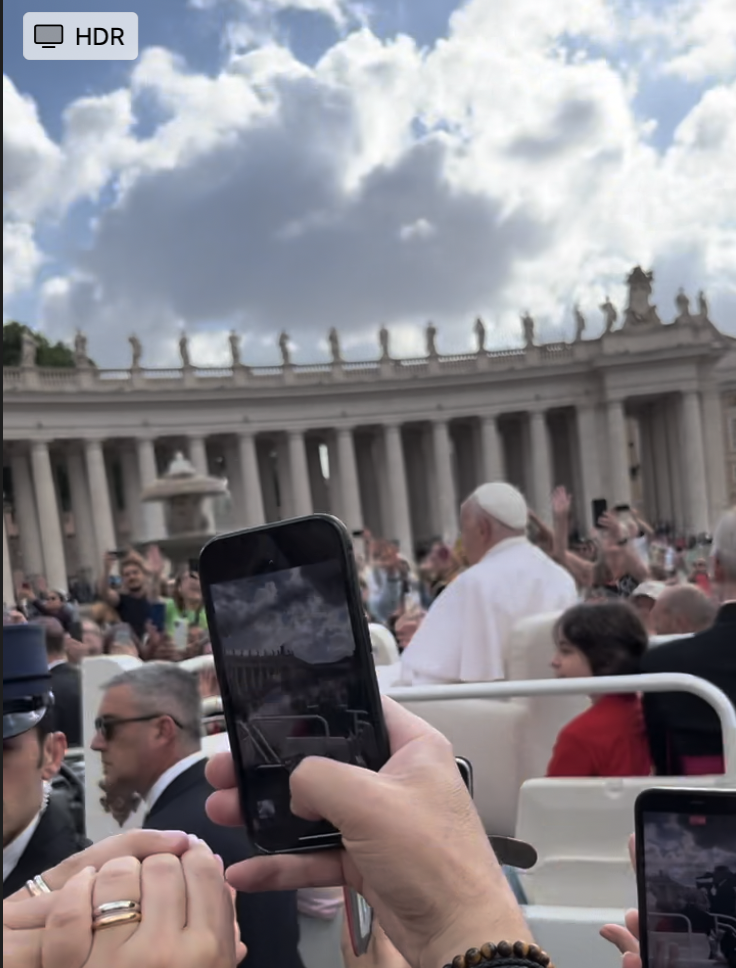
closest i got to Il Papa, when i found myself accidentally at the barricades that clear the way for the Pope-mobile

sages are in short supply, it seems. certainly now, and certainly on the global scale. i scan where i can, ever on the lookout. and wasn’t my eye caught when i read the words “artisanal path” to “handmade peace.”

tell me more, my little heart shouted. 

though it sounded a bit like a recipe for earthy bread or hand-thrown plates, the sort that rise from the potter’s wheel, i sensed the subject here was far more urgent, and in dire need of replenishing. not what you’d find on any pantry shelf. 

hand-crafted peace, peace constructed with care and attention. peace that we at home can build, without scissors or glue or a potter’s spinning wheel.

i clicked on a duly-provided link, and wasn’t one iota surprised to find that Il Papa, our most beloved Francis, was the one who not only dared to raise his voice above the blather, but considered it a requisite of his job’s description.

he is, after all, shepherd to a farflung flock. but more than that, he’s a prophet, which, according to the definition i found in richard rohr’s brand-new the tears of things: prophetic wisdom for an age of outrage, means a radical change agent, teacher of a moral alternative, and deconstructor of every prevailing order. rohr reminds us of the prophets of ancient times, the ones described by isaiah and ezekiel, whose job it was to hold the powers that be “maddeningly honest.”

bring on the prophets, please.

in these times, francis, our dear pope who from his hospital bed in rome reached out to the suffering of gaza, is the rare voice to which all the world will sometimes listen. thank holy God, he speaks the language of love without condition, clause, or pause. there are those among us, in this age of outrage, who might do well to listen. especially when they claim to take instruction from the very same God who whispers to Il Papa

the new york times calls him “an increasingly lonely moral voice on the world stage.”

all the more reason to listen. and listen hard.

“peace is crafted; it is the work of our hands,” francis began at a prayer vigil in the central african republic back in 2015, “it is built up by the way we live our lives.” he was speaking to an audience of children, teens, and young adults in bangui, the capital of the central african republic, when that country was in the midst of a sectarian war between Christians and Muslims, and thousands had been killed, and more than a million displaced from homes, their properties looted or destroyed.

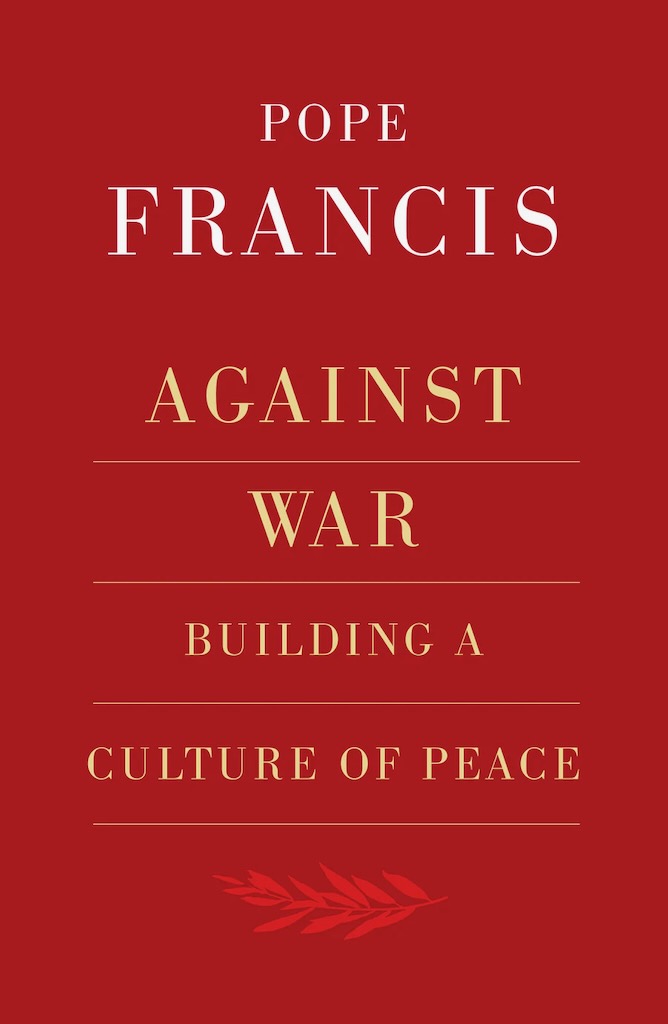
this artisanal path, “built up by the way we live our lives,” is spelled out, it turns out, in francis’s Against War: Building a Culture of Peace, a book i’ve ordered from my local bookstore, as it’s one with permanent claim to a slot on my bookshelf. 

it’s not that i think i can build a culture of worldwide peace, though once upon a time i dreamed of such things. the point here, from the wee bit i’ve read, is that peace is a sphere we build bit by bit, as we travel through space and time, and it’s built by even the most unassuming of gestures, attitudes, and actions.

what the pope is saying, and what the world ought listen to, is that the tiniest empathies and kindnesses matter: giving cuts in the grocery line, waving someone into your expressway lane; taking time to take the call, dropping the tupperware of soup on your neighbor’s stoop. biting your tongue when you’re tempted to snap, and, yes oh yes, turning the other cheek, a trait i’m told no longer belongs in a world of dog eat dog. 

what a game changer: here’s the head of a church that counts 1.39 billion baptized among its ranks, and he too concurs that we needn’t be rocket scientists in the art of magnanimous charitable persuasion to make a dent in the realm of ever-spreading goodness. 

for one thing, it’s fairly contagious. if you’re out-of-the-blue kind to me, if you take my breath away with some wonder act of yours, chances are i’m inclined to be a copy cat and try the same. if for no other reason than the pure joy of watching someone be surprised you’ve not just slammed the door in their sorry, sorry face. 

here’s where Il Papa begins his artisanal path to handmade peace, with this fulsome criticism of the futility of war: 

“war is not the solution, war is madness, war is a monster, war is a cancer that feeds off itself, engulfing everything!”

that’s all i needed to keep on reading. and what i found, and what you’ll find should you decide to play along, is a compendium of his most outstanding commentaries on war and peace during the first nine years of his pontificate. 

here are a few of the nuggets you just might choose to tuck in your peace-gathering pockets. 

because one can’t best the pope when it comes to eloquence and voice, i am quoting from the book, here on in, and plucking five that leap out the most….

1.) seeing the world as one human family living in one common home.

The stars in the sky shine down on every single person — from the beginning of time to today — and learning “to look at the stars” will be “the most effective vaccine for a future of peace,” he said in Ur, Iraq, in 2021.

“Anyone with the courage to look at the stars, anyone who believes in God, has no enemies to fight. He or she has only one enemy to face, an enemy that stands at the door of the heart and knocks to enter. That enemy is hatred,” the pope said.

“There will be no peace as long as we see others as them and not us,” he said. Humanity lives under one heaven, under the gaze of one God who desires his children to be “hospitable and welcoming” to each other on earth.

2.) reconciling with one’s enemies and embracing unity in diversity.

The pope told young people in the Central African Republic that the first step toward being a peacemaker was “never hate anyone. If someone wrongs you, seek to forgive.”

“We only win if we take the road of love,” he said, and, with love, “you will win the hardest battle in life” and find peace.

But “we need to pray in order to be resilient, to love and not to hate, to be peacemakers,” and “you must be courageous,” he added. “Courageous in love, in forgiveness, in building peace.”

3.) the difficult art of dialogue and listening, which can sometimes be as hard as building a bridge over an abyss.

Pride and arrogance must be eradicated from one’s own heart, he told young people at a congress of the educational project, “Scholas Occurrentes,” in 2016. “Our world needs to lower the level of aggression. It needs tenderness. It needs gentleness, it needs to listen, it needs to walk together.”

Dialogue is “the capacity to listen, not to argue immediately, to ask,” he said. “Everyone wins in dialogue; no one loses” because “it is about agreeing to proposals so as to move forward together.”

Dialogue is to put oneself in the other’s place, “to form a bridge” and “persuade with gentleness.”

4.) peace is a constant journey of “getting one’s hands dirty,” concretely working for the common good.

“Our path leads us to immersing ourselves in situations and giving first place to those who suffer,” he said in Assisi for the World Day of Prayer for Peace in 2016.

Feeling responsible for helping others and refusing to be indifferent cleanses the heart and requires the “purification” and conversion that can only come from God, he said in Irbil, Iraq, in 2021.

This new order must meet humanity’s desire for justice, equality and participation, he said in his World Day of Peace message in 2020. A democratic society recognizes everyone’s rights and one’s duties toward others, which can temper a harmful, unbridled understanding of freedom.

5.) living the beatitudes is to bring heaven––and peace––to earth.

In his homily in Baghdad in 2021, the pope said, “We do not need to become occasional heroes, but to become witnesses, day after day,” embodying the wisdom and love of Jesus.

Jesus changed history “with the humble power of love, with his patient witness. This is what we are called to do,” he said, and “that is how the world is changed: not by power and might, but by the beatitudes.”

People who live the beatitudes “are helping God to fulfill his promises of peace,” he said. “This is the way; there is no other.”


in these tumultuous times, i am turning hungrily to prophets and sages in the news and on my dusty bookshelves. i’m inclined to not fill this space with my own blather, but rather to bring any lights that might dapple our paths. it’s always a tug-of-war to quiet the chair or keep it going with whatever bits i find. this doesn’t seem like the time to turn to silence. so my aim is upped to break through blather and bring voices that will wedge open our hearts, and like a doorstop, keep it wedged till we get through to the other side….

what voices broke through to you this week?

earlier and earlier

IMG_9787

crescent moon winking over the dawn. from my kitchen window.

i wake earlier and earlier, as if those fractions of hours just might wrap me more certainly in the velvet folds of the day. as if i’m grasping for a blanket someone’s pulling away.

i wake early for peacefulness, for quietude. i wake for the hum of the cricket, even before the trill of the dawn begins. just now a bird with quivering throat joined in. it’s off in the distance, faint. faint is the way i like my sounds in the morning. muffled. just beginning to fracture the silence.

i wake before a single floorboard creaks. i wake before anyone else turns a faucet. i wake to be alone with my thoughts and my prayers, and the gentle God who joins me.

this was a week for awaking earlier and earlier. it gets harder and harder to know what to do, to rise up against hate and horrors. i blanketed myself this week by typing away. i’m typing as fast as i can, bearing down on a deadline, typing gentle words, shimmering words, onto the page, in hopes that they’ll carve out rivulets of blessedness, course straight into hearts. whoever opens the pages, in months or years down the road, i pray they find something gentle, words that simply tap at the door, trickle in, make for peaceable eddies, right there in the well of someone’s heart.

the light now is beginning to soak into sky. i can make out the filigree of morning, the edge of the dill, the willow fronds barely rustling. the wind hasn’t yet stirred up its muscle. the morning is still.

the moon, winking, hasn’t yet faded–dawn’s cradle, off to the east, far beyond my kitchen window, it shines in sliver of crescent. where will you be when the moon blocks the sun, that once in a century heavenly upstage?

there wasn’t much to steady us in this past whirl of days, but there were glimmering moments, one or two, that broke through the melee, that caught our attention, took our breath away in the course of rending our hearts.

the mother of heather heyer, the woman crushed by a hellfire car in charlottesville, she was the voice of pure holiness this week. her lone voice rose up from the din. her words echo and echo in the chambers of my heart. hers is the poetry of the week, worth remembering.

here’s a bit of what she said, called out into the wilderness of a nation reeling, a nation whose moral compass is spinning dizzily, scrambling to find its true north.

sharon bro:

“They tried to kill my child to shut her up. Well, guess what? You just magnified her.”

“You need to find in your heart that small spark of accountability. What is there that I can do to make the world a better place? What injustice do I see—and want to turn away: ‘I don’t really want to get involved in that. I don’t want to speak up. They’ll be annoyed with me. My boss might think less of me.’ I don’t care. You poke that finger at yourself, like Heather would have done, and you make it happen. You take that extra step. You find a way to make a difference in the world.”

she concluded with this:

“So, remember in your heart: If you’re not outraged, you’re not paying attention. And I want you to pay attention, find what’s wrong. Don’t ignore it. Don’t look the other way. You make it a point to look at it, and say to yourself, ‘What can I do to make a difference?’ And that’s how you’re going to make my child’s death worthwhile. I’d rather have my child, but, by golly, if I got to give her up, we’re going to make it count.”

beautiful chairs, make it count.

where’s your true north, and how will you get there?