
pull up a chair

where wisdom gathers, poetry unfolds and divine light is sparked…

Tag: richard rohr

artisanal peace

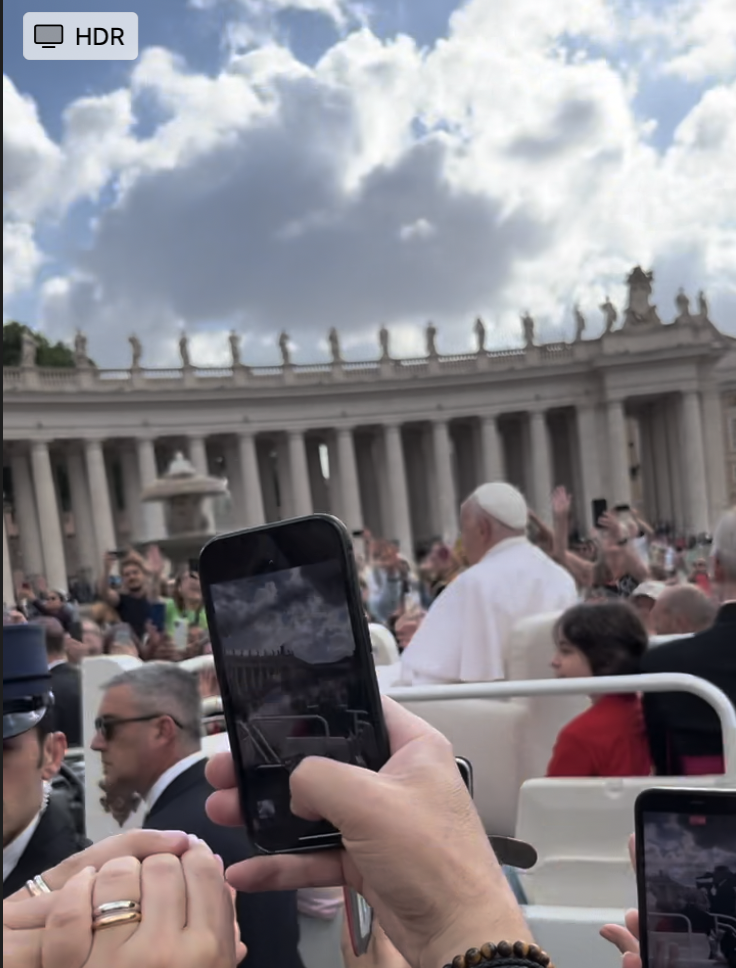
closest i got to Il Papa, when i found myself accidentally at the barricades that clear the way for the Pope-mobile

sages are in short supply, it seems. certainly now, and certainly on the global scale. i scan where i can, ever on the lookout. and wasn’t my eye caught when i read the words “artisanal path” to “handmade peace.”

tell me more, my little heart shouted. 

though it sounded a bit like a recipe for earthy bread or hand-thrown plates, the sort that rise from the potter’s wheel, i sensed the subject here was far more urgent, and in dire need of replenishing. not what you’d find on any pantry shelf. 

hand-crafted peace, peace constructed with care and attention. peace that we at home can build, without scissors or glue or a potter’s spinning wheel.

i clicked on a duly-provided link, and wasn’t one iota surprised to find that Il Papa, our most beloved Francis, was the one who not only dared to raise his voice above the blather, but considered it a requisite of his job’s description.

he is, after all, shepherd to a farflung flock. but more than that, he’s a prophet, which, according to the definition i found in richard rohr’s brand-new the tears of things: prophetic wisdom for an age of outrage, means a radical change agent, teacher of a moral alternative, and deconstructor of every prevailing order. rohr reminds us of the prophets of ancient times, the ones described by isaiah and ezekiel, whose job it was to hold the powers that be “maddeningly honest.”

bring on the prophets, please.

in these times, francis, our dear pope who from his hospital bed in rome reached out to the suffering of gaza, is the rare voice to which all the world will sometimes listen. thank holy God, he speaks the language of love without condition, clause, or pause. there are those among us, in this age of outrage, who might do well to listen. especially when they claim to take instruction from the very same God who whispers to Il Papa

the new york times calls him “an increasingly lonely moral voice on the world stage.”

all the more reason to listen. and listen hard.

“peace is crafted; it is the work of our hands,” francis began at a prayer vigil in the central african republic back in 2015, “it is built up by the way we live our lives.” he was speaking to an audience of children, teens, and young adults in bangui, the capital of the central african republic, when that country was in the midst of a sectarian war between Christians and Muslims, and thousands had been killed, and more than a million displaced from homes, their properties looted or destroyed.
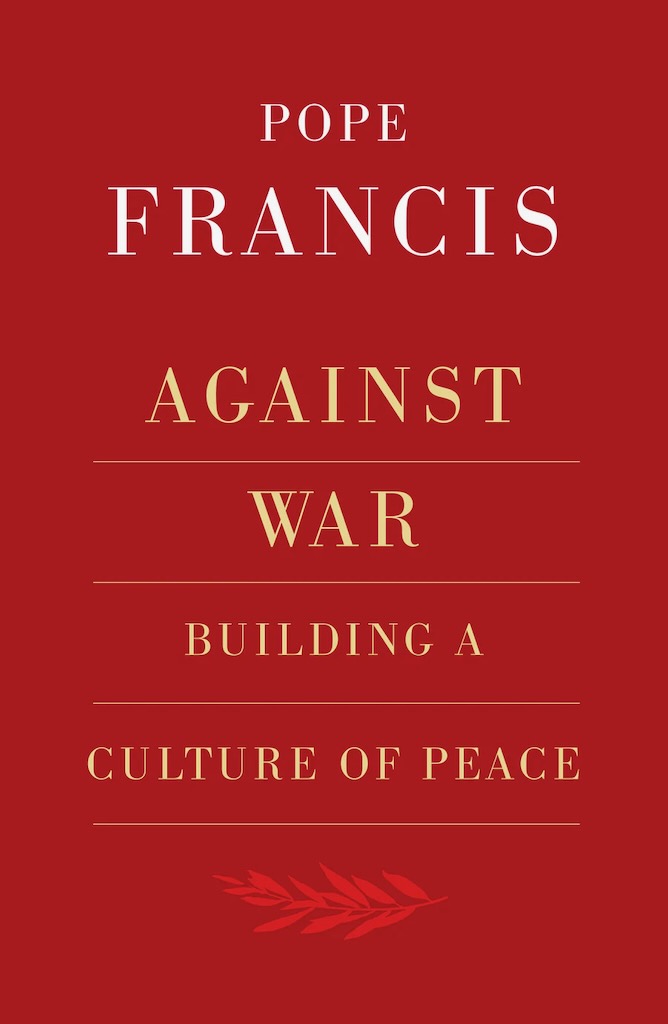
this artisanal path, “built up by the way we live our lives,” is spelled out, it turns out, in francis’s Against War: Building a Culture of Peace, a book i’ve ordered from my local bookstore, as it’s one with permanent claim to a slot on my bookshelf. 

it’s not that i think i can build a culture of worldwide peace, though once upon a time i dreamed of such things. the point here, from the wee bit i’ve read, is that peace is a sphere we build bit by bit, as we travel through space and time, and it’s built by even the most unassuming of gestures, attitudes, and actions.

what the pope is saying, and what the world ought listen to, is that the tiniest empathies and kindnesses matter: giving cuts in the grocery line, waving someone into your expressway lane; taking time to take the call, dropping the tupperware of soup on your neighbor’s stoop. biting your tongue when you’re tempted to snap, and, yes oh yes, turning the other cheek, a trait i’m told no longer belongs in a world of dog eat dog. 

what a game changer: here’s the head of a church that counts 1.39 billion baptized among its ranks, and he too concurs that we needn’t be rocket scientists in the art of magnanimous charitable persuasion to make a dent in the realm of ever-spreading goodness. 

for one thing, it’s fairly contagious. if you’re out-of-the-blue kind to me, if you take my breath away with some wonder act of yours, chances are i’m inclined to be a copy cat and try the same. if for no other reason than the pure joy of watching someone be surprised you’ve not just slammed the door in their sorry, sorry face. 

here’s where Il Papa begins his artisanal path to handmade peace, with this fulsome criticism of the futility of war: 

“war is not the solution, war is madness, war is a monster, war is a cancer that feeds off itself, engulfing everything!”

that’s all i needed to keep on reading. and what i found, and what you’ll find should you decide to play along, is a compendium of his most outstanding commentaries on war and peace during the first nine years of his pontificate. 

here are a few of the nuggets you just might choose to tuck in your peace-gathering pockets. 

because one can’t best the pope when it comes to eloquence and voice, i am quoting from the book, here on in, and plucking five that leap out the most….

1.) seeing the world as one human family living in one common home.

The stars in the sky shine down on every single person — from the beginning of time to today — and learning “to look at the stars” will be “the most effective vaccine for a future of peace,” he said in Ur, Iraq, in 2021.

“Anyone with the courage to look at the stars, anyone who believes in God, has no enemies to fight. He or she has only one enemy to face, an enemy that stands at the door of the heart and knocks to enter. That enemy is hatred,” the pope said.

“There will be no peace as long as we see others as them and not us,” he said. Humanity lives under one heaven, under the gaze of one God who desires his children to be “hospitable and welcoming” to each other on earth.

2.) reconciling with one’s enemies and embracing unity in diversity.

The pope told young people in the Central African Republic that the first step toward being a peacemaker was “never hate anyone. If someone wrongs you, seek to forgive.”

“We only win if we take the road of love,” he said, and, with love, “you will win the hardest battle in life” and find peace.

But “we need to pray in order to be resilient, to love and not to hate, to be peacemakers,” and “you must be courageous,” he added. “Courageous in love, in forgiveness, in building peace.”

3.) the difficult art of dialogue and listening, which can sometimes be as hard as building a bridge over an abyss.

Pride and arrogance must be eradicated from one’s own heart, he told young people at a congress of the educational project, “Scholas Occurrentes,” in 2016. “Our world needs to lower the level of aggression. It needs tenderness. It needs gentleness, it needs to listen, it needs to walk together.”

Dialogue is “the capacity to listen, not to argue immediately, to ask,” he said. “Everyone wins in dialogue; no one loses” because “it is about agreeing to proposals so as to move forward together.”

Dialogue is to put oneself in the other’s place, “to form a bridge” and “persuade with gentleness.”

4.) peace is a constant journey of “getting one’s hands dirty,” concretely working for the common good.

“Our path leads us to immersing ourselves in situations and giving first place to those who suffer,” he said in Assisi for the World Day of Prayer for Peace in 2016.

Feeling responsible for helping others and refusing to be indifferent cleanses the heart and requires the “purification” and conversion that can only come from God, he said in Irbil, Iraq, in 2021.

This new order must meet humanity’s desire for justice, equality and participation, he said in his World Day of Peace message in 2020. A democratic society recognizes everyone’s rights and one’s duties toward others, which can temper a harmful, unbridled understanding of freedom.

5.) living the beatitudes is to bring heaven––and peace––to earth.

In his homily in Baghdad in 2021, the pope said, “We do not need to become occasional heroes, but to become witnesses, day after day,” embodying the wisdom and love of Jesus.

Jesus changed history “with the humble power of love, with his patient witness. This is what we are called to do,” he said, and “that is how the world is changed: not by power and might, but by the beatitudes.”

People who live the beatitudes “are helping God to fulfill his promises of peace,” he said. “This is the way; there is no other.”


in these tumultuous times, i am turning hungrily to prophets and sages in the news and on my dusty bookshelves. i’m inclined to not fill this space with my own blather, but rather to bring any lights that might dapple our paths. it’s always a tug-of-war to quiet the chair or keep it going with whatever bits i find. this doesn’t seem like the time to turn to silence. so my aim is upped to break through blather and bring voices that will wedge open our hearts, and like a doorstop, keep it wedged till we get through to the other side….

what voices broke through to you this week?

bibliotherapy: of fictional nature

i tend to ground myself in the world in all its nitty-gritty. that mattered (critically) when i was a nurse (don’t you dare inverse a systolic for a diastolic, when it comes to blood pressure reading), and in all my decades of chasing after news, the truth—and every grimy detail—was what we sought. thus, when i peruse the bookshelves of my local free library (the world’s most generous invention, to be sure), i am nearly always in the down-low where no windows are, where the endless rows of fact not fiction reside. 

i’m decidedly non-fictionally inclined.

but this week i was lulled into the rooms upstairs, the rooms where sunshine streams through sky-high windows, and where make-believe is the order of the room. in other words, i crept up to where the fiction is. and in the writings of one irish novelist, a fellow i’d give anything to sit with in any irish pub, or better yet to stroll the rocky coastline of the continent from which half my peoples come, i found the surest cure for running from the blues. 

niall williams is his name, an irishman, who is but a year younger than me, and who has gathered wisdom as an old stone takes on a mossy coat. i can almost see the glint in his eye, as from some quiet post in the corner of a dimly-lit, crossbeamed room, he’s kept closest watch on the quirks and comedies of human nature. and on the heartbreak too. as the tenderness he kneads into his prose and paragraphs has left me gasping more than once (and i am only eight chapters in). 

the book is this is happiness, as prescriptive a title as a girl in search of antidote might want. 

the irishman had me at chapter 1: “It had stopped raining.” (that’s the chapter in its entirety.)

chapter 2 picked up where 1 left off: “Nobody in Faha” (the fictional irish town that just happens to be a spot on the map not far from where my non-fictional peoples hailed) “could remember when it started.” by the third sentence of that second chapter, i was ready to shove up my shirtsleeves and not move an inch till i’d turned the last page. it went like this: “[Rain] came straight down and sideways, frontwards, backwards, and any other wards God could think of. It came in sweeps, in waves, sometimes in veils. It came dressed as drizzle, as mizzle, as mist, as showers, frequent and widespread, as a wet fog, as a damp day, a dreeping, an out-and-out downpour.” 

and on it goes, plip-plopping along, this incantatory passage that soon enough tells us that the unrelenting rain came “like a blessing God had forgotten he had left on.”

this is nothing less than bliss in garamond font (a literary typographic detail nearly always spelled out at the back end of any book); and most certainly for a girl who penned a paragraph of her own, in her most recent book, that unfurled in uncannily kindred ways. c’est moi:

“Rain, like most of us, has its moods. In its more laconic hours, it comes on unsuspectingly, without folderol, timpani, or cymbal crashing, the barest slip of a presence and suddenly you’re bespattered. On the days when rain is tempestuous, furious, raging, it rattles the heavens, cleaves the night, pummels the trees, and sends all the world—even the puddle-­paddling robins—running for cover. Betwixt and between, it’s the master of a thousand voices, from the salubrious plopp—the drop with a splatter—to the militaristic rat-a-tat-tat, when the rain tries to pretend it’s a handful of pebbles thrashing your windows, and on to the audible gulp when a downpour is frothing your gulleys. The Brits, reliably saturated in the subject, offer a lengthy lexicon for precipitation’s multiple personalities: there’s a basking (drenching in heavy shower); a drisk (misty drizzle); a fox’s wedding (sudden drops out of clear blue sky); a hurly-burly (thunder and lightning); a stotting (rain so hard it bounces up off the ground); and, for closers, thunner-­pash (heavy shower with thunder). Because it’s so elemental, the life stuff of our very existence, the celestial surge that fills our rivers and waters our crops, rinses away the detritus, bathes all the woods, and the sidewalks as well, it’s been the subject of intense preoccupation and prognostication for a long, long time. time. Since ever ago.”
(p. 85, The Book of Nature)

is there not a hint here of shared joy in precipitatory romps? can you not feel the two of us––niall et moi––luxuriating in the many, many wondrous ways to say “the rain is unrelenting”?

i am hardly alone in my enamorment of mr. williams. my best best friend, a longtime children’s librarian in the los angeles public schools, couldn’t stop texting me pictures of its pages this week, and, soon after, when i mentioned to a beloved literary friend (a sister chair, who might reveal herself below) that i’d fallen into novel love, she reminded me that she’d told me so a few years back. as always, i am late to my own party. 

in any case, here’s what the new yorker had to say back at the dawn of 2020, in the year of our covid, when happiness whirled onto the world stage.

This Is Happiness, by Niall Williams (Bloomsbury). This elegiac novel is as unhurried as its setting: Faha, a village in western Ireland, “unchanged since creation” until, in the late fifties, electricity arrives. The narrator, now elderly, reminisces about that time; having come from Dublin as a teen-ager, to live with his grandparents after the death of his mother, he conceived a hopeless passion for three sisters. “We spend most of our lives guarding against washes of feeling, I’m guarding no more,” he promises. The novel’s description of a lost rural life style, and the gaps between a young man’s romantic expectations and the inescapable letdown of reality, is comic and poignant in equal measure.

all of which is to say that bibliotherapy is one of the world’s great cures for whate’er ails you. and even more so when it ferries you off to a wee irish village “where story was a kind of human binding,” where church pews were filled as if by unwritten order, where front doors were never closed in daytime nor backdoors locked at night, and where, we’re told, “religion lasted longer … because we were an imaginative people, and so could most vividly picture the fires of Hell.” 

and wherein the self-described antiquarian narrator notes in passing, “i know it seems unlikely that Faha then might have been the place to learn how to live, but in my experience the likely is not in God’s lexicon.”

the world these days is wearying. and worrying, too. my week began with a funeral, a breathtakingly beautiful one that wove buddhist and roman catholic threads but was tragic nonetheless, and was followed by a seder where the weight of gaza and jerusalem bore down on every heart. by week’s end, i’d heard tell that my kid was nearly carjacked, and a dear friend who lives alone (and has borne already more than too much suffering) is on the cusp of twelve rounds of godawful, pray-to-God-it-works chemo for the newly-diagnosed cancer in her lungs.

the blooms outside my kitchen door were doing all they could to boost the perfumed quota in the vernal air, and the robins busied themselves constructing scrappy nests in my window box along the alley. (do not ask me to tell you the tragic tale of the mama robin who was tangled in a dessicated grapevine, nor of the nest no longer in the works.) all the earth’s wonderment––glorious as it is as winter erupts into spring––is ephemeral, is here, then, poof, it’s gone. 

but what i find on the page is lasting. can be read and read again. can be indelibly inked into the files of our mind.

and so, this week, a newfound balm and friend was found. and i’ll be tucked away in faha, on the fictional irish coast, for as long as the pages will carry me. bibliotherapy rarely fails me. 

what carried you away this week?


here’s a jolt of joy that took my breath away this week: the great christian mystic richard rohr, a franciscan friar and ecumenical teacher, and his new mexico-based Center for Action and Contemplation saw fit to surprise me by clipping an excerpt from The Book of Nature in his daily meditations on wednedsay. that he chose a favorite passage, the story of brother lawrence, the barefoot monk who saw God in the pots and pans of his parisian monastery kitchen, and was struck by the innate holiness of a nuck-naked little tree, only charmed me all the more. here’s a peek at the preaching of the trees.


and from this week’s commonplacing. this morsel from DH Lawrence:

The vast marvel is to be alive… The supreme triumph is to be most vividly, most perfectly alive. Whatever the unborn and the dead may know, they cannot know the beauty, the marvel of being alive in the flesh. The dead may look after the afterwards. But the magnificent here and now of life in the flesh is ours, and ours alone, and ours only for a time. We ought to dance with rapture that we should be alive and in the flesh, and part of the living, incarnate cosmos. I am part of the sun as my eye is part of me. That I am part of the earth my feet know perfectly, and my blood is part of the sea. My soul knows that I am part of the human race, my soul is an organic part of the great human soul… There is nothing of me that is alone and absolute except my mind, and we shall find that the mind has no existence by itself, it is only the glitter of the sun on the surface of the waters.

this, from mary oliver

Morning Light

by MARY OLIVER

Every morning
 the good news
  pours
   through the field

touching
 every blossom
  every stem
   and each of them,

on the instant
 offers to be part of it—
  offers to lift and hold, willingly
   the vast burden of light

all day.
 In my life
  I have never seen it to fail—
   flower after flower

leaf after pearly leaf,
 to the acre,
  to the massy many,
   is silvered, is flooded;

and such voices
 spangle among it—
  larks and sparrows—
   all those small souls—

are everywhere
 tossing the quick wheels of pleasure
  from their red throats
   as they hang on—

as though on little masts
 of golden ships,
  to the tops of the weeds—
   and that’s when I come—

that’s when I come, crying out to the world:
 oh give me a corner of it
  to lift also, to sing about, to touch
   with my wild hands—and they do.

and this from annie dillard‘s the writing life, prose laid out as a poem by my friends at SALT Project:

One of the few things I know
about writing is this:
spend it all, shoot it, play it, lose it,
all, right away, every time. 

Do not hoard what seems good
for a later place in the book,
or for another book;
give it, give it all, give it now. 

The impulse to save
something good
for a better place later
is the signal to spend it now. 

Something more will arise
for later, something better.
These things fill from behind,
from beneath, like well water. 

Similarly, the impulse to keep
to yourself what you have learned
is not only shameful, it is destructive.

Anything you do not give
freely and abundantly
becomes lost to you. 

You open your safe
and find ashes.

and finally, this goodbye to “poetry’s colossus,” helen vendler, whom i was blessed to call my teacher in our year of sumptuous thinking

and blessings to you, and thanks for whirling by….

p.s. the other two books in my bibliotherapy stack (above) are william’s history of the rain, which had me at the title, and letters from max: a book of friendship, an epistolary collection between a poet and a playwright: sarah ruhl, the twice pulitzer-finalist playwright who was once teacher to poet max ritvo and quickly became dear friends, and as max’s cancer grew worse, their connection deepened. suleika jauoad ran an excerpt the other day in her isolation journals, and i ran to the library to grab a copy.

maybe acres of flowerpots would help. . .

in which i tell the truth and let on that this is a bumpy road right in here…

my summer companion, a fellow named tedd, leapt into the passenger seat, as he is wont to do these days. he loves nothing more than wending his way through the city, curiosity propelling the route. we stopped along the way, biscuits with cheddar and honey, fuel for the road. he took notes of places he’d want to come back to, the romanian sausage shop, the honeybear pancake house where the windows were bursting with clouds of silk flowers.

we were headed to a chicago institution, a garden shop that’s sprawled across city blocks. a garden shop that upholstered my very first garden, long long ago. we were looking, allegedly, for a fountain whose splash would punctuate the summer sounds, whose soothing whoosh might lull us into that fugue state that comes when you plop in a chair and listen to all that the world has to offer.

i love my companion more than life, and i love our urban adventures. but truth is, there was yet another uninvited passenger in the old red wagon, and its name was fear. i am inhabited of late by runaway fears, and worries, that this cancer has let loose and is running amok in odd parts of me. it’s too scary to say aloud to the people i love, so i mostly hold it inside. except for here, where words tapped out on keys have always been my one certain release valve.

it seems that two months after the day i first heard the words “it was cancer,” i’ve been caught in what’s likely an inevitable gulch. it’s a lot to absorb. it’s a lot to have half your lung up and cut out, sent off to pathology, where science-y folk slice it apart and mark it with names, stamp it with numbers that scare and confuse you. even the oncologist the other day said as much, though i think her words were something along the lines of “it rocks your world, especially when it’s right there in your chest.”

i was listening to a podcast the other day, a podcast for people with cancer (i still gulp when i write phrases like that, realizing i’m now among them, the people with cancer), and they talked knowingly about “the middle-of-the-night questions,” the ones that basically all circle back to “am i going to die?” there is solace, much solace, in knowing how universally some of this hits us. we are all human beings, a motley collection of bones and flesh, of freckles and smiles that wrinkle our faces in particular ways. we all hope big, though my big is different from yours. and we’ve all suffered hurts we’ll never forget, even if we’ve pushed them off to the side. and a lot of us get scared. the thing about cancer –– or any one of the other life-altering diagnoses –– is that it strips away so very much of the pretense. it’s brass tacks, and un-glittered questions. it’s a swift dunk in the truth-telling end of the pool, where you dispense with roundabout thoughts and spit out the unedited ones. the ones you might not bring up in the produce aisle, sifting through the bunches of carrots, or reaching for the ripest avocado.

once you have cancer, and find out the one or two others in your life who are on the same road, it’s like you’re ushered in to a particular locker room, where everyone walks around with the same flimsy towels, and no questions are barred. where you can say out loud those things that keep you awake in the night. and, somehow, putting breath to the words, seeing the knowing in the eyes of the one to whom you are talking, reminds you, over and over, how very much we all want to cling to this life we have built, this life filled with people we love, and dreams we still hold.

i’m thinking i’m struggling because all of this is so new, and it still feels like it came out of the blue. and it knocked the breath right out of me. i keep thinking that once i get one of those scans under my belt, the ones that will come every six months, i might settle in to the notion that maybe the cancer is gone. or at least settled back to its indolent state, my couch potato of a cancer, as the doctors proclaimed it (after all, it had been lolligagging down at the bottom of my lung for eight long years before anyone realized what trouble it was).

i realize i can’t call my doctor every time there’s an odd sensation — say, like the lump i feel in my armpit — or maybe i should just get a diagnostician on retainer, one who wouldn’t hold it against me for all of my worries.

somehow or other i am going to find my way to the other side of this rather dark cloud.

i intend to get on my knees. with trowel at my side. and a big jug of pellets, the ones that give plant roots a boost. while i’m down there i intend to dig deep into my very own soul, open up a portal to the God who animates the whole of me, and the whole of this earth.

deep in the night i spend plenty of time asking “those” questions. but i also spend just as much time lying in silence, holy silence, channeling the God in whose palm i am trying to rest, aching to rest.

i tend to find God when i’m out in the garden, or lying in the impossible dark. i tend to find God, too, when i tell the whole truth, and the balm comes — Holy Balm comes — to settle deep in the cracks.

how do you find your way to the other side, when the dark clouds come, or the wall of fear feels too high to scale?


i did find a couple poems i was going to leave here today, but i will save them for another day. and simply close with this blessed thought from rabbi abraham joshua heschel, one of my great, great sages…

To pray is to take notice of the wonder, to regain a sense of the mystery that animates all beings, the divine margin in all attainments. Prayer is our humble answer to the inconceivable surprise of living.

Abraham Joshua Heschel
photos (here and above) by teddy

p.s. a delightfully joyful thing did happen this week when, lo and behold, i discovered that none other than richard rohr, the great modern-day mystic, had quoted from The Book of Nature in his daily meditation for tuesday. and i’m getting back in the saddle this weekend, for a nature walk with an oak park synagogue, a two-hour radio show with a pittsburgh priest i’ve come to love, and a trek to milwaukee tuesday night for a conversation with the journal sentinel’s book critic, jim higgins, at the boswell book company, an east side literary institution.

p.s.s. happy blessed father’s day to the brilliant fathers who sometimes gather here…