pull up a chair

where wisdom gathers, poetry unfolds and divine light is sparked…

Tag: recipe

turn to sweetness

Gen One Honeycake

the new year calls for sweetness. the Jewish new year, i mean. it’s encoded, in fact, in the Talmud, the nearly-as-old-as-time, all-you-need-to-know guide to living Jewishly, a sacred compendia of rabbinic discourse, debate, and back-and-forth covering ancient teachings, law, and theology, and it gets down to the nitty gritty of what to eat when, and certainly on Rosh Hashanah, one of the highest of the high holy days. it’s spelled out, right there in tractate Keritot 6a (truth be told, i am not quite sure what a tractate is, but i’m surmising it’s something like a bullet point), where a certain sage named Abaye in the second century suggests that eating certain foods might bring on good things in the new year (this might explain the thinking behind the famous sheet cake scene with tina fey from saturday night live*). these sacred foods for the new year are called simanim, and while the Talmud explicitly names fenugreek, dates, leeks, and beets, it merely points broadly to sweetness. honey wended its way into the Rosh Hashanah traditions way back in the seventh century. which means the jews have kept the bees in business for a long, long time. and the dipping of apples in honey is a tradition that waited till the 16th century, which means we’ve been dipping now for 500 years.

and i realize i am steering well off course here, but i find myself in a rabbinic hole of infinite delight and must let you know that jews, known as lovers of wordplay, have prayers to accompany each of those prescribed foods (derived from the shared linguistics in the hebrew root), and the way it worked was that the particular prayer was prayed, followed by the eating of said foods, and this whole shebang was known as the simanim seder. here are a few of the foods and the prayers they inspired:
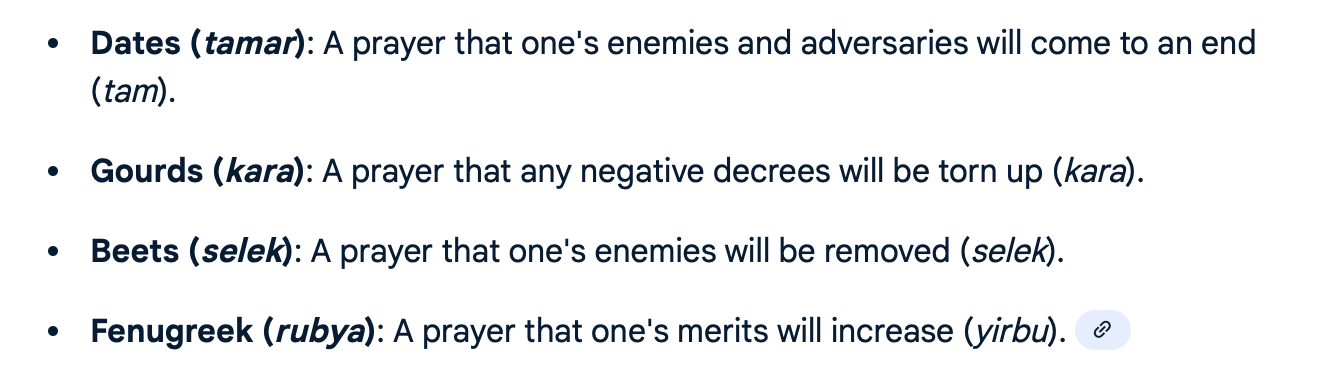
personally, i think we should all be loading up on dates and beets. but now i am really off in the ditch, and shall return myself to more linear thinking. . .

we were musing about honey, or at least i was. and since this is ultimately going to be a story about honey cake, i’m in the midst of explaining how we got there. how i wound up shoving a bundt pan of sumptuous honey-doused batter into my unreliable but deeply lovable ancient commercial-grade oven.

i tend to be someone who gloms onto traditions. and, given that these days, i spend a lot of time musing about time and the passing of years, i was suddenly struck—even though i am the farthest thing from a baker—with the question of whether there was some heirloom recipe for the holiday that i might have been missing. so i struck out to the best family baker, my brilliant and beloved sister-in-law brooke of the upper east side, and before the text with the query could possibly have registered in her wee little phone, she shot back the recipe she’s been baking for years. she noted that it was a super hit, and she noted that it was a family heirloom not in the traditional since, as her mother/my mother-in-law staked her claim to feminism by not knowing her way about the kitchen, and thus might not have baked in her life, dear brooke had made it a family tradition, one that secured its position the very first year she baked it when all that was left was a plate full of crumbs.

that’s all the convincing i needed, so i (practically as inept a baker as my late, great, mother-in-law) leapt aboard. i wheeled my grocery cart wildly through the store, plucking spices off shelves, fresh-squeezed OJ from the cooler, stocking up on fresh bags of flour, baking soda, baking powder (for the ones currently on my shelves had likely turned to clay, the subjects of years of idle waiting), and i set myself to baking. words being more my thing, i immediately gave it a name, this honey cake of famed repute. since dear brooke had clued me in its familial origins with this trademark hilarious note —”Considering that Mom’s recipe for the New Year was attending someone else’s party, this is our (1 generation = me) tradition.”—i immediately dubbed it Gen One Honeycake, and so it’ll stick. i also informed my boys they’d best follow along, for it was now incumbent upon them and their children’s children to crank the ovens every Rosh Hashanah, and pull out the whiskey and OJ.

excuse me, you say? where does the whiskey come in, and why are we talking cocktails so early in the morning? well, this famed honey cake, so dense it shall bulk your biceps as you ferry it to the table, is loaded: whiskey (or rye), OJ, a cup of coffee, a cup of honey, and a shuk‘s worth of spices. (a shuk is the israeli name for an open-air spice market)

aunt brooke continued, holding my hand (long-distance) the very whole way:

“It’s Marcy Goodman’s honey cake and it’s a fan favorite. Use the whiskey and use the sliced almonds in the recipe. And if you have whole wheat flour, sub in 1/2 c wheat flour for 1/2 c white flour. Make it in a tube pan. It’s a big dense cake.”

much to my amazement i found it pure delight to stand at the counter dumping in this and that, and stirring as directed. as the smell rose from the bowl, i began to understand the soothing powers of baking. and now wonder if it’s seductive enough—and sufficiently sedative—to carry me through the next 1212 days (inauguration 2029).

oops!

because my oven is, as i’ve mentioned, a recalcitrant behemoth, i’ve no idea whether it rose to the necessary 350-degrees Fahrenheit, and suspect it was probably my fault that the cake, despite its extra five minutes in the oven, decided to collapse round the middle (a flub fixed first by dumping extra almond slivers into the hole, and then duly disguised by brooke’s suggestion of stuffing the hole with rosemary sprigs, which i happened to have growing out back).

by the time i carried it to the table, where eager forks awaited, i felt my chest puffing out just a bit, swelled with pride at picking up the family slack. we now have ourselves a tradition. and my boys, by edict of their mother, shall carry it on, far into the next and the next and the next generation. may it always be so.

with no further ado, for i’ve tarried long enough here, i offer you the famed aunt brooke gen one honey cake, courtesy of one marcy goldman, reigning queen of the honey cake whoever she is. the version here was posted on deb perelman’s smitten kitchen site, and comes along with notes at the end, worth reading for their spicy humor.

Gen One Honeycake, from famed family baker BJKR, courtesy deb perelman’s Smitten Kitchen, courtesy marcy goldman (a cake with lineage!)

SERVINGS: 16
TIME: 20 MINUTES TO ASSEMBLE; 1 HOUR TO BAKE
SOURCE: MARCY GOLDMAN’S TREASURE OF JEWISH HOLIDAY BAKING
See Notes about recipe changes at the end of the recipe.

3 1/4 cups plus 2 tablespoons (445 grams) all-purpose flour (see Note)
1 3/4 teaspoons baking powder (see Note)
1 teaspoon baking soda
1 teaspoon kosher salt (see Note)
4 teaspoons ground cinnamon
1/2 teaspoon ground cloves
1/2 teaspoon ground allspice
1 cup (200 grams) vegetable or another neutral oil
1 cup (320 grams) honey
1 1/2 cups (300 grams) granulated sugar
1/2 cup (110 grams) light or dark brown sugar
3 large eggs
teaspoon vanilla extract
1 cup (235 grams) warm coffee or strong tea (I use decaf)
1/2 cup (120 grams) fresh orange juice, apple cider, or apple juice
1/4 cup (60 grams) rye or whiskey, or additional juice
1/2 cup (50 grams) slivered or sliced almonds (optional)

Pan size options: This cake fits in two (shown here) or three loaf pans; two 8-inch square or two 9-inch round cake pans; one 9- or10-inch tube or bundt cake pan; or one 9 by 13 inch sheet cake.
Prepare pans: Generously grease pan(s) with non-stick cooking spray. Additionally, I like to line the bottom and sides of loaf pans with parchment paper for easier removal. For tube or angel food pans, line the bottom with parchment paper, cut to fit.
Heat oven: To 350°F.
Make the batter: In a large bowl, whisk together the flour, baking powder, baking soda, salt, cinnamon, cloves and allspice. Make a well in the center, and add oil, honey, granulated sugar, brown sugars, eggs, vanilla, coffee, juice, and rye. [If you measure your oil before the honey, it will be easier to get all of the honey out.]
Using a strong wire whisk or in an electric mixer on slow speed, stir together well to make a well-blended batter, making sure that no pockets of ingredients are stuck to the bottom.
Spoon batter into prepared pan(s). Sprinkle top of cake(s) evenly with almonds, if using. Place cake pan(s) on two baking sheets, stacked together (which helps the cakes bake evenly and makes it easier to rotate them on the oven rack).
Bake the cake(s): Until a tester inserted into a few parts of the cake comes out batter-free, about 40 to 45 minutes for a round, square, or rectangle cake pan; about 45 to 55 minutes for 3 loaf pans; 55 to 65 minutes for 2 loaf pans (as shown), and 60 to 75 minutes for tube pans.
Cool cake: On a rack for 15 minutes before removing it from the pan. However, I usually leave the loaves in the pan until needed, as they’re unlikely to get stuck.
Do ahead: This cake is fantastic on day one but phenomenal on days two through four. I keep the cake at room temperature covered tightly with foil or plastic wrap. If I want to bake the cakes more than 4 days out, I’ll keep them in the fridge after the first 2 days. If you’d like to bake them more than a week in advance, I recommend that you freeze them, tightly wrapped, until needed. Defrost at room temperature for a few hours before serving.

Notes:
Size: These days, I bake this cake in two filled-out loaves, as shown, instead of 3 more squat ones. My loaf pans hold 6 liquid cups; they’re 8×4 inches on the bottom and 9×5 inches on the top; if yours are smaller, it might be best to bake some batter off as muffins, or simply use the 3-loaf option.
Flour: After mis-measuring the flour many years ago and baking the cake with 2 tablespoons less flour and finding it even more plush and moist, I’ve never gone back. The recipe now reflects the lower amount.
Baking powder: The original recipe calls for 1 tablespoon of baking powder, but I found that this large amount caused the cake to sink. From 2011 through 2023, I recommended using 1 teaspoon instead. But, after extensive testing this year, I’ve found that a higher amount — 1 3/4 teaspoons — keeps this cake perfectly domed every time, and even more reliably than the 1-teaspoon level.
Salt: The original recipe calls for 1/2 teaspoon but I prefer 1 teaspoon.
Liquids: This is address the question that comes up in at least 30% of the 1115 comments to date: “What can I use instead of whiskey?” and/or “What can I use instead of coffee?” The original trifecta of liquids in this cake [coffee, orange juice, and whiskey] is unusual and wonderful together, and I still think the perfect flavor for this cake. But if you want to omit the whiskey, simply use more orange juice or coffee. If you want to omit the coffee, simply use tea. If you don’t want to use tea, use more juice. If you don’t want to use orange juice, my second choice liquid here would be apple cider (the fresh, not the fermented, kind), followed by apple juice.
Apples and honey: It’s a whole thing!
Sweetness: The recipe looks like it would taste assaulting sweet but you must trust me when I say it doesn’t. But, if you reduce the sugar, any one of them, you will have a cake that’s more dry. You can still dial it back, but do understand what the adjustment can do to the recipe.
Flavor: Finally, this is every bit as much of a spice cake as it is a honey cake. Honey isn’t the most dominant flavor, but it’s one of many here that are harmonious and wonderful together. It smells of fall in a way that a simmer pot of $60 candle could never. I hope you get obsessed with it too.

that’s it, sweet friends. certain we could all use a little sweetness at this turn in the year, where did you find sweetness this week?

*as promised, the tina fey sheet cake scene. (nod to faithful chair reader sharon of twin cities!)

summer is for cooking. no, really.

when the day presents itself as sooty afghan, gray and soft and without shadow. when the air is cool, so cool that cranking the oven is not an act of self-destruction. when the bins at farmers’ market are nearly tumbling to the parking lot below, so weighted by their zaftig field-plucked wares. well, on summer days like that the itch to cook begins.

and so it was the other morning i woke up with eggplant visions. eggplant layered lushly with cheesy-herby oozy pillows in between. all bathed in marinara. baked. dubbed summer’s abbondonza eggplant lasagna.

i promised easy reading here in summer time. and thus, below, i keep my promise, with nothing more strenuous to read than a grocery list of things to gather, and step-by-step notes so you can play along.

abbondonza eggplant lasagna, with more than a few idiosyncratic twists

(as always, i read a few recipes, extract a few cues and follow my whims from there. this began from something that zipped by me on instagram, and led me to a website called mediterranean something or other, and wound up so delicious i gobbled two oozy squares the size of my dinner plate. my annotations below in italics, which is basically me talking back to the recipe. . .)

Ingredients

2 to 3 eggplants (about 1 ½ pounds), sliced lengthwise into ½-inch thick slices (about 10 to 12 slices)
1 zucchini, sliced into coins (or honestly any shape you choose)
1 pint cherry tomatoes
Extra virgin olive oil
Kosher salt
1 large egg
1 15-oz tub part-skim ricotta cheese
1 ½ cup part-skim mozzarella cheese, divided
½ cup grated Parmesan cheese, divided
3 garlic cloves minced (i squeezed mine through garlic press)
1 teaspoon dried oregano
10 oz frozen spinach, thawed and fully dried (wring out all the water)
1 cup packed chopped fresh parsley
½ cup packed chopped fresh basil, ⅔ ounce
Black pepper to your liking
2 generous cups marinara sauce of choice (i used trader giotto’s organic tomato basil marinara)

Instructions

  • Season the eggplant slices on both sides with kosher salt and set aside for 20 to 30 minutes (if you don’t have the time, this step can be optional). i skipped this part, because i didn’t have time and because i recently read that these days eggplant has been cured of its bitterness.
  • Meanwhile, preheat the oven to 400 degrees F and position a rack in the middle.
  • Wipe the eggplant slices very well with a paper towel (you want to dry it well and remove any excess salt), then arrange on parchment-lined baking sheet (or two if needed). Brush both sides of the eggplant with extra virgin olive oil. Roast in the heated oven until the eggplant softens and becomes pliable (about 15 to 20 minutes or so on the first side, at least another 10 minutes for the B side, which might be because i have a cranky old oven). to this step i added sliced zucchini, and a tub of cherry tomatoes, similarly brushed with oil, and roasted on their own sheet pan.
  • While the eggplant, zucchini, and tomatoes are roasting, prepare the ricotta filling. In a mixing bowl, beat the egg. Add the ricotta, 1 cup mozzarella, ¼ Parmesan, garlic, oregano, spinach and chopped herbs. Add a small pinch of kosher salt and black pepper to your liking. Mix well to combine. i wandered out to my so-called farm (a raised bed alongside the back alley) and snipped a cup’s worth of basil and another of flat-leaf parsley; the freshness filled the air surrounding my cutting board.
  • Remove the eggplant, zucchini, and cherry tomatoes from the oven. Lower the heat to 375 degrees F.
  • Prepare a 9 x 13-inch baking dish. Pour a bit of the pasta sauce (i used 1 cup of trader joe’s marinara) and spread it out into one layer. Lay a few eggplant slices (anywhere from 4 to 6 and it’s fine if they overlap a bit). Next, add half the zucchini slices and half the roasted cherry tomatoes. Spread 1/2 of the ricotta filling, then spread a thin layer of the sauce. Repeat the process in the same pattern. Spread the final layer of sauce and follow with the remaining ½ cup mozzarella cheese and ¼ cup of Parmesan.
  • Cover the dish tightly with foil. Bake in the heated oven for 15 to 20 minutes, then carefully uncover and return to the oven. Bake for another 10 to 20 minutes or until the cheese has melted and the edges of the lasagna turn a nice golden brown.
  • Let the lasagna rest for 10 minutes before cutting and serving.
  • Slice and savor. And then daydream about it till you get around to making it again.

not all who wander to the chair believe in the stove as kitchen essential, and thus for those good souls and anyone else who never minds a blessing, here’s a treasure sent to me weeks back by dear beloved chair friend nan. it’s a blessing from kate bowler, who is herself something of a wonder. a four-times NYT best-selling author, a professor of american religious history at duke divinity school, the scholar who wrote the book on the prosperity gospel, a wife and mother and 35-year-old when she was diagnosed with stage IV colon cancer, deemed incurable, and now (nine years later) is cancer-free, she’s taken as her mission “giving you permission to be human.” fully human: warts, dents, soft spots, wonders, glories, whole truths and nothing but the truths.

i’ve been in a room where kate was speaking and she is hilarious. and self-deprecating. and doesn’t present herself as the eighth wonder of the world (which isn’t always the case at writing festivals that showcase those who’ve gained fame by building sentences that grow into paragraphs that fly off the shelves and rack up fine profits). so, with no further ado, and deep thanks to our beloved nan, here is a blessing from kate that, to my mind, gets to the heart of so much that matters:

the blessing above is from kate’s book of blessings, co-written with the lovely jessica richie, and titled “The Lives We Actually Have: 100 Blessings for Imperfect Days.”

may all of us work to be the ones who notice the light in their eyes, or when that light dims, and to always not be afraid of scooting up close, close as need be, to their suffering.

and that’s the news from the summer kitchen this week. xox

where did you find blessing this week, at the cookstove or otherwise?

peachy

this crate of delectable, a fireworks of flavor that bursts on our tongues, plopped onto the front stoop not long ago (courtesy of a long-distance angel/saint/and holy mensch), and after parceling into brown paper sacks for a few of our favorite neighbors, the whole block has unanimously declared them the most delicious peaches that ever there were. in honor of their magical appearance out of the summer fog, a few morsels from the “peach” file.

first up, this perfection of a poem from a poet i only recently discovered, a chicago poet in fact, a longtime warehouse worker who penned beauties once he clocked off the job, and who before that made jewelry from soda bottle tops and wound up in the pages of vogue. his name is li-young lee, born in indonesia to chinese parents, and settled in chicago in 1964. he’s now described as a world-renowned poet, one who’s won the lannan literary award, a paterson poetry prize, and an american book award, among many. after reading “from blossoms,” i ran to the library and scarfed up all his books from the shelf. and then i read a few interviews. and now i sit and inhale his poetries as if to fill my lungs with the numinous.

his is an abiding belief that all the cosmos is imbued with a spark of the sacred, an idea i’ve spent a long time believing.

From Blossoms

BY LI-YOUNG LEE

From blossoms comes
this brown paper bag of peaches
we bought from the boy
at the bend in the road where we turned toward
signs painted Peaches.

From laden boughs, from hands,
from sweet fellowship in the bins,
comes nectar at the roadside, succulent
peaches we devour, dusty skin and all,
comes the familiar dust of summer, dust we eat.

O, to take what we love inside,
to carry within us an orchard, to eat
not only the skin, but the shade,
not only the sugar, but the days, to hold
the fruit in our hands, adore it, then bite into
the round jubilance of peach.

There are days we live
as if death were nowhere
in the background; from joy
to joy to joy, from wing to wing,
from blossom to blossom to
impossible blossom, to sweet impossible blossom.

Li-Young Lee, “From Blossoms” from Rose. Copyright © 1986 by Li-Young Lee.

in a conversation at a literary fest a few years ago, one i found in the los angeles review of books, lee says this, and you’ll see why i’m swooning:

If the person is a vessel then what would poetry be?

The mind of God. I think poetry is the mind of God. All the great poems that I love seem to me to all have that little ingredient. You feel like you’re in the presence of the mind of God. You can’t even account for the level of wisdom in certain poems. Take Rilke, I mean, you can’t just live and come to the conclusions he came to. I think his mission was to learn to get out of the way so that something bigger could speak through him.

Emily Dickinson, my God, she’s full of the mind of God. You can just feel God shining through those poems, darkly. So it was her, but it wasn’t. It’s unaccountable. In other words, if you wanted to be Emily Dickinson you couldn’t just have been born on the East coast, done the things she did. That wouldn’t guarantee that you could write anything. There’s something unaccountable that happened to her. And it’s that unaccountable thing that I love.

elsewhere lee has said that he considers every poem to be “a descendent of God.” and when asked about flawed poems by poets and writers, he explained: “There are great poems that have flaws. There are failures of perception, failures of understanding, but those flaws become a part of the poem’s integrity, so I still feel that those poems are descendants of God. But if a poem isn’t even good enough to be a poem, I don’t think it’s descended from God: [If] there is no “I” [as in Martin Buber’s I and Thou], there is no God. The ‘Me’ talking about ‘Me’—that’s not enough.”


and in a lineup of descendants of God, surely here’s a preacher: wendell berry, kentucky farmer, field plower, poet. it doesn’t take long for some to pack an almighty wallop; here’s wendell in a single stanza:

A Spiritual Journey

And the world cannot be discovered by a journey of miles,
no matter how long,
but only by a spiritual journey,
a journey of one inch,
very arduous and humbling and joyful,
by which we arrive at the ground at our feet,
and learn to be at home.

~ Wendell Berry ~
(Collected Poems)


and here’s one that especially melted me, because it came to me from the budding philosopher in this house. a recent college grad who has an eye for these things, and whose curiosities in this department are as delicious to me as the juiciest peach that ever there was….

Confucius, the renowned Chinese philosopher, once said, “A seed grows with no sound, but a tree falls with a tremendous noise. Destruction has noise, but creation is quiet. This is the power of silence. Grow silently.”


and finally, in honor of said budding philosopher and the juiciest peaches that ever there were, here is a long-ago-concocted rendition of peach-blueberry bread pudding, though truly the only way to eat these (or any plucked-straight-from-the-tree) peaches is bent over the sink, ready to swipe the dribble as it runs down your chin and wherever else it tries to escape.

teddy’s bread pudding, the peachy summer edition*

  • 3 cups milk (or cream)
  • 4 tablespoons (1/2 stick) butter, more for greasing pan
  • 1-1/2 teaspoons ground cinnamon
  • 1/2 cup sugar, plus 1 tablespoon
  • Pinch salt
  • ½ loaf sweet egg bread like challah or brioche, torn into 2-inch cubes (about 5 to 6 cups)
  • 3 eggs, beaten
  • 3 peaches, sliced
  • 3 to 4 tablespoons brown sugar
  • 1 cup blueberries
  1. Heat oven to 350 degrees. Over low heat in a small saucepan, warm milk, butter, 1/2-cup sugar, 1 teaspoon cinnamon, and salt. Continue cooking just until butter melts. Meanwhile, butter a 4-to-6-cup baking dish and tear the bread into bite-sized bits. Place the bread in baking dish.
  2. Slice peaches into separate medium-sized mixing bowl; stir in brown sugar. Set aside (wherein magic ensues, and syrup emerges). Rinse blueberries, and allow to drain.
  3. Once peaches are bathing in their brown-sugary juices (anywhere from five to 10 to even 15 minutes should do it), dump fruits atop bread chunks. Stir gently.
  4. Pour hot milk over bread, peaches, and blueberries. Let it sit for a few minutes, poking down the occasional chunk of bread that rises to the top. Beat the eggs briefly, and stir them into bread and fruit mixture. Mix together remaining cinnamon and sugar, and sprinkle over the top. Set the baking dish in a larger baking pan, and pour hot water into the pan, to within about an inch of the top of the baking dish, effectively making a bath for your bake.
  5. Bake for 45 minutes to 1 hour, or until custard is set but still a little wobbly and edges of bread have browned. Serve warm or at room temperature.

inhale the endless comfort vapors….

*thank you, mark bittman, for your endless guidance and your recipe on much-splattered page 662.

what was peachy ’bout your week?

our job is to savor. . .

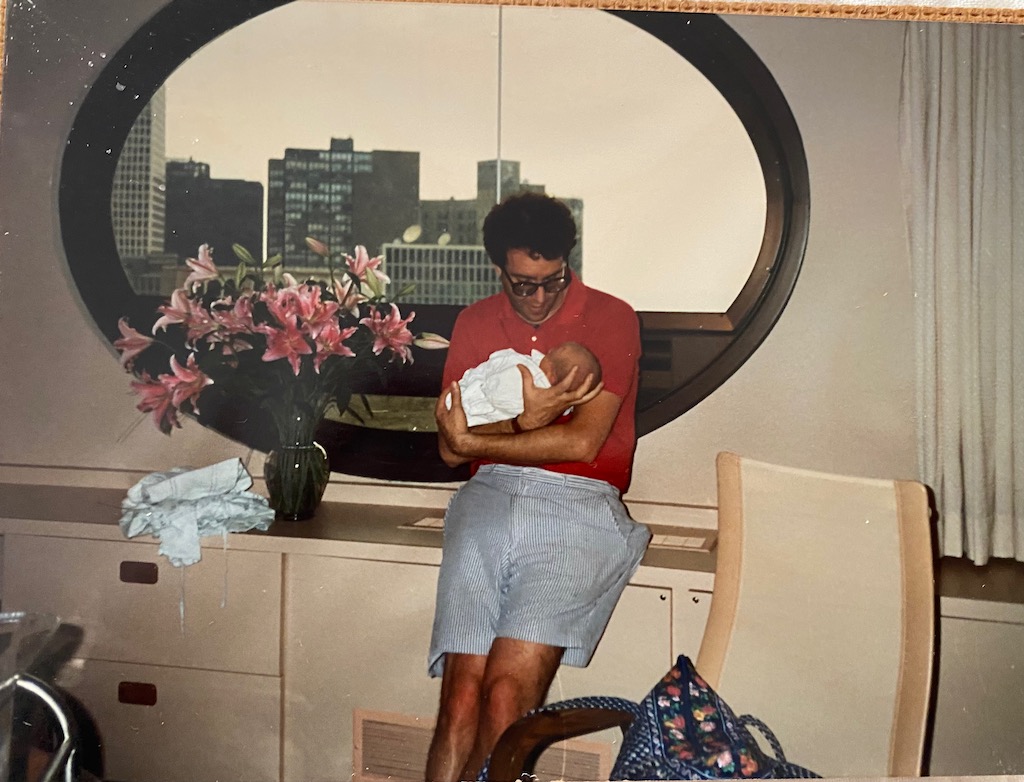
i’ve been especially partial to summer for precisely three decades — or 10,958 days — now, for my firstborn was born on the very first full day of the season precisely 30 years ago yesterday. i fell instantly in love. deliriously so. with my firstborn, yes, but also with the way the summery light slanted in on the long june morning i waited for him, and the new days thereafter, and every start of summer since, as it always brings me back to the solstice when the dial on my summer-savoring machine was cranked up infinite notches. 

truth is, i’ve savored summer’s start for as long as i can remember: it was the day my mama picked us up at the schoolhouse gate, end-of-year report cards in hand, and took us out for grilled cheese and fries. it was the day we trotted into the library and signed ourselves up for the summer reading brigade, an adventure i thought of as something of a secret society that promised me long afternoons with nose curled in a book, and the sheer delight of marching up to the children’s librarian with my summer-reading-club card, and my latest finished book, awaiting the inky stamp she’d press onto my card that felt like a passport, proof to me and the world that i was a serious reader. (or so i imagined.)

i was told just the other day that more than ever my job is to savor, that i’d make more room in my life, proportionally diminish the grief (that a diagnosis of cancer inevitably brings) if i made a point of savoring those joys that i love, each and every day. 

grief, this wise person explained, doesn’t ever go fully away. the things that bring it on, the things that break our hearts into pieces, can’t be erased. but they can settle into nooks and crannies of our souls where they might go quiet, or lose some of their sting. and, yes, it’s true too that those slumbering griefs will still make unannounced appearances all on their own schedule and of their own accord. grief, i’ve found over the many, many years, likes to catch you in the throat when you are, say, stumbling down a grocery store aisle, and suddenly you see the thing that makes you think of your long-gone papa, or the baby you lost, or your life before you worried about cancer cells running amok. 

but, the wise person explained, the more room we make in our life for those things that aren’t grief, the more alive and less strangled we might feel. 

so, savor it is. specifically, savor this summer, the unspooling of week upon week with barely an inkblot on the docket. no deadline, no due date. just one simple job: to savor.

it’s not such a tough assignment: conjure the things you love, the things that bring in the joy — or the peace or the grace or the wonder — as the tide to the shore, as the river that flows only forward and over the rocks and onto the sea. 

it’s a job, in fact, that belongs to all of us always. it’s just that cancer — or any one of those indelibly stamped diagnoses, or the sudden loss of someone or something you love — sharpens the urgency and the focus. if you don’t want to be strangled, if you’re searching for a light to come in through the cracks, a place to begin is racking up joys. an abacus of joy, one bead at a time. joy counting in plainest arithmetic. intricate, intricate calculus of the heart and the soul.

my joys are so, so simple. they rise from the garden, from the mud stained on my knees and under my fingernails. they are stirred at the cookstove. they flutter my heart when i curl into my old wicker chair and listen to mama wren warbling to her babies. 

when i lean my head against the chest of the boy i once birthed, when i drink in the tick and the tock of his heart, the surest steadiest lullaby i’ve ever known. when someone i love calls on the phone. or leaves a note tucked in the box by the door. when the sunset dizzies me.

the point, i’m told, is to root myself in all the things that make me feel most alive. the ones that slow the pounding in my heart. the ones that might make me giggle. the ones that make me know someone out there is listening. 

here’s to summer, the season when savoring is fresh in the air.


and here’s a roadmap to joy that converges multiple routes: herbs from the garden, simmering caramelized onions, squeezing a lemon, and summery salad. it’s nutritious and delicious and it comes from my friends at NYT Cooking, where they never ever lead me astray, nor off the path of the straight road to Joy. 

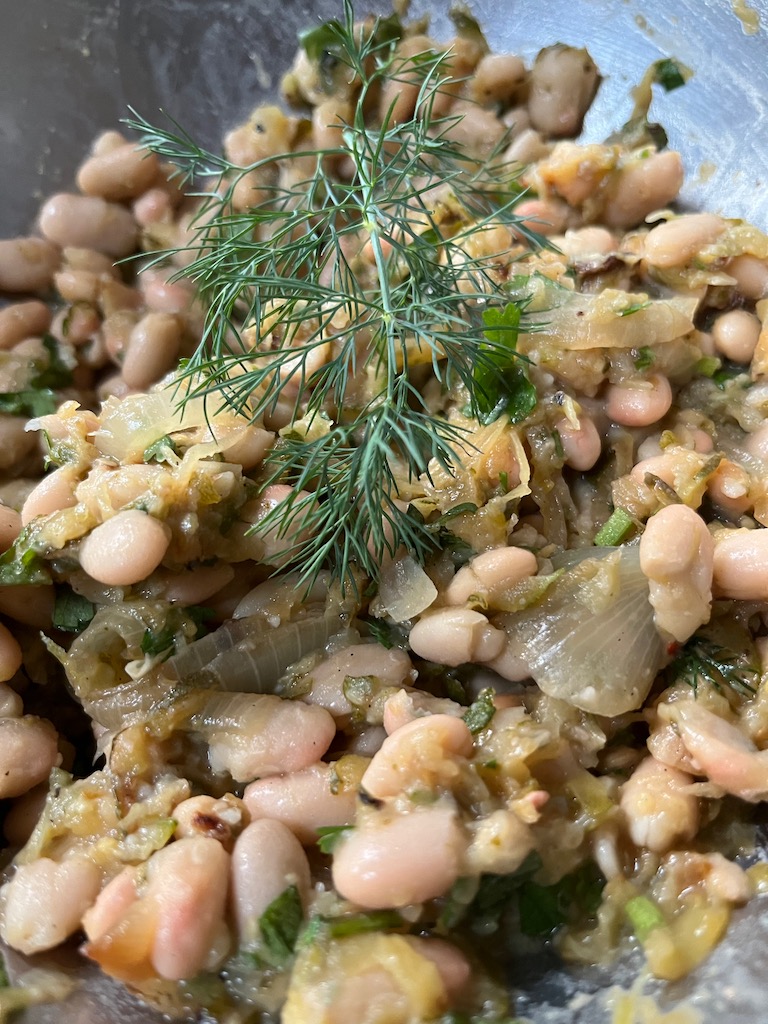
it’s not a pretty salad in a rainbow-y sense, but oh my it’s delicious. i promise. sometimes joy comes in plain clothes and drab colors (it can be sneaky like that….) here’s to joy, however it comes…`

Caramelized Zucchini and White Bean Salad
By Yossy Arefi for The New York Times
Time: 45 minutes, plus cooling and chilling
Yield: 6 servings

Start with a big pile of shredded zucchini and onions, and marvel at how much it cooks down as it browns and caramelizes. Toss that potent blend with creamy white beans and herbs –– it’s easy as that! The mint adds brightness, and pairs well with other soft herbs, like parsley, dill and basil. The caramelized zucchini mixture makes a great base for bean salad, but it can be used in many other ways: Make a big batch and toss it with pasta, serve it on top of ricotta-slathered toast, or top a flatbread with it; you really can’t go wrong, says the Times.

INGREDIENTS

2 large zucchini, shredded on the large holes of a box grater
1 large yellow onion, thinly sliced
4 tablespoons olive oil
1⁄2 teaspoon red-pepper flakes
Kosher salt and freshly ground pepper
2 (15-ounce) cans white beans, like cannellini, rinsed
1 lemon, plus more if needed
1⁄2 cup roughly chopped mint
1⁄2 cup roughly chopped parsley, dill or basil

PREPARATION 

Step 1
Wrap the shredded zucchini in a clean kitchen towel and gently squeeze it to remove excess moisture. 

Step 2
In a large nonstick skillet over medium-high heat, combine the zucchini and onion with 3 tablespoons olive oil, the red-pepper flakes, 1 teaspoon salt and a few grinds of pepper. Cook the mixture, stirring occasionally, until the water has evaporated and the zucchini and onion turn golden brown, 25 to 30 minutes. You will have to stir more often toward the end of cooking to prevent burning. 

Step 3
Add the cooked zucchini mixture to a large bowl along with the beans. Zest and juice the lemon over the top and add the remaining 1 tablespoon of olive oil; stir gently to combine. Let the mixture cool to room temperature, then add the herbs and stir gently. Season to taste with salt, pepper and additional lemon juice, if desired. Serve at room temperature or cold. 


someone wise sent this beauty…

A Prayer

Refuse to fall down
If you cannot refuse to fall down,
refuse to stay down.
If you cannot refuse to stay down,
lift your heart toward heaven,
and like a hungry beggar,
ask that it be filled.
You may be pushed down.
You may be kept from rising.
But no one can keep you from lifting your heart
toward heaven
only you.
It is in the middle of misery
that so much becomes clear.
The one who says nothing good
came of this,
is not yet listening.


and, as she so often does, mary oliver preaches:

The Summer Day

Who made the world?
Who made the swan, and the black bear?
Who made the grasshopper?
This grasshopper, I mean —
the one who has flung herself out of the grass,
the one who is eating sugar out of my hand,
who is moving her jaws back and forth instead of up and down —
who is gazing around with her enormous and complicated eyes.
Now she lifts her pale forearms and thoroughly washes her face.
Now she snaps her wings open, and floats away.
I don’t know exactly what a prayer is.
I do know how to pay attention, how to fall down
into the grass, how to kneel down in the grass,
how to be idle and blessed, how to stroll through the fields,
which is what I have been doing all day.
Tell me, what else should I have done?
Doesn’t everything die at last, and too soon?
Tell me, what is it you plan to do
with your one wild and precious life?

+ Mary Oliver


what will you savor as summer begins its unspooling?

chop. stir. turn. sigh. repeat.

my days these days are filled with simple verbs; staccato, monosyllabic verbs: chop. stir. turn. sigh.

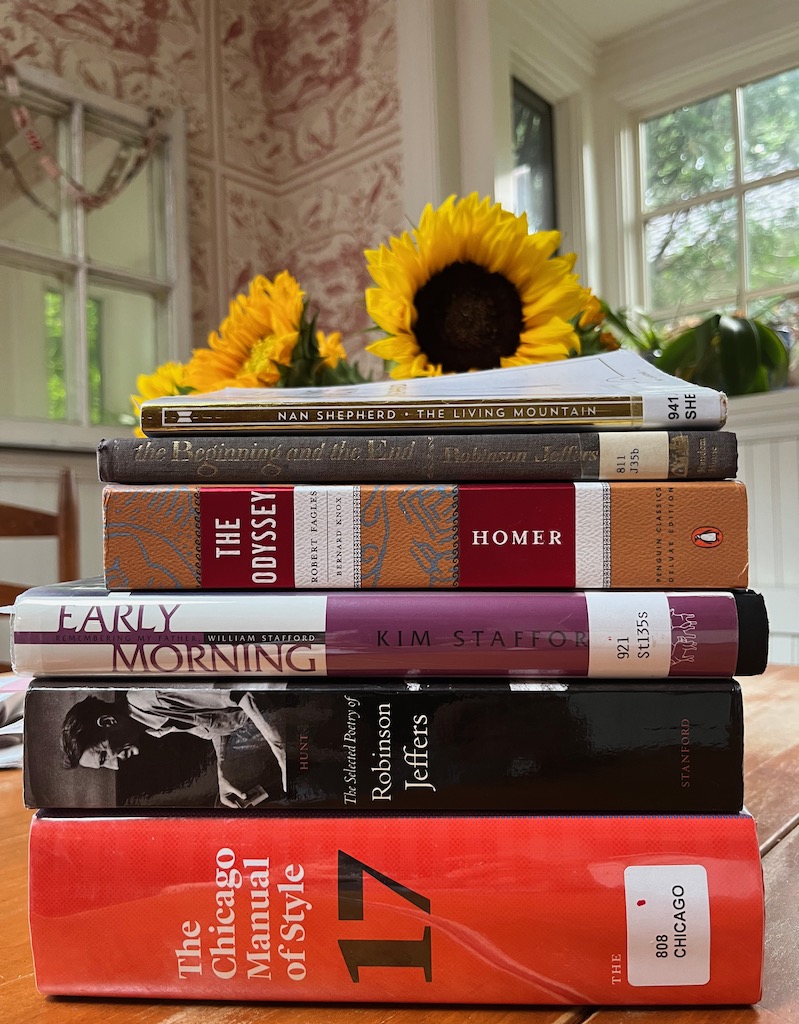
in other words, i fill my hours tucked between the pages of tall stacks of books i am guzzling down as if to carry me across the frozen tundra out my window. i guzzled my way through january, and except for a few days in the air in february, i aim to do it all over again in this the shortest month. 

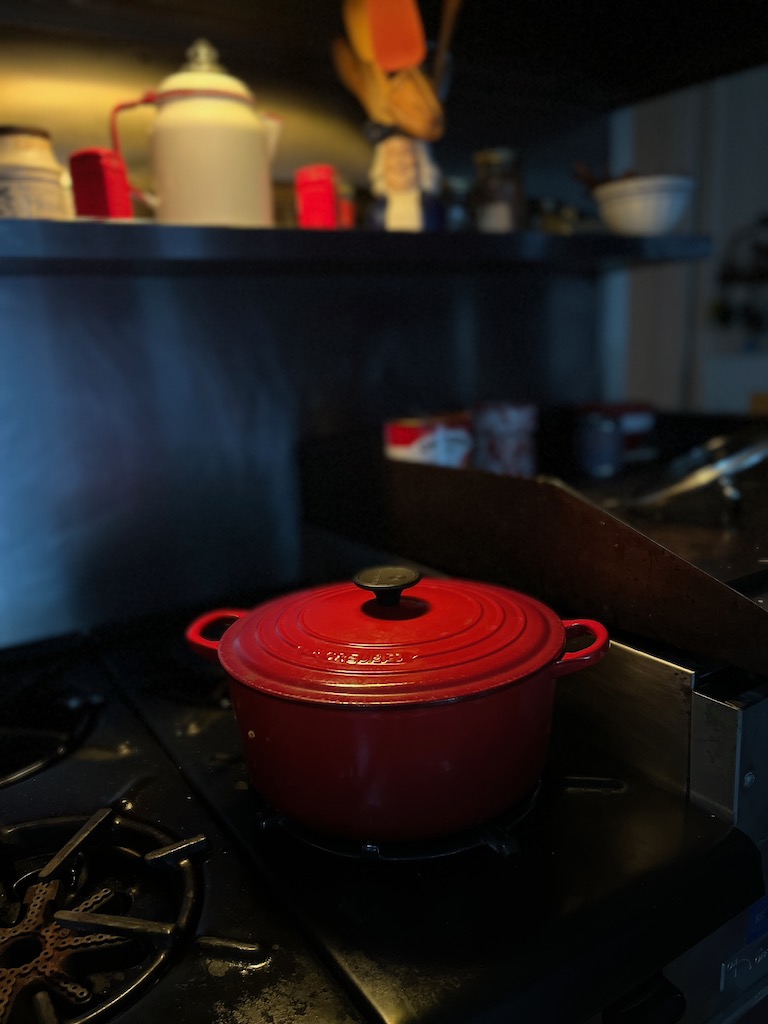
i do rise on occasion from my butter-yellow-checked chair, mid-morning sometimes, to take my station at the chopping block, where my knife work begins. usually in the alliums, chopping onions to bits, mincing garlic buds, filling the room and my fingertips with the essence of under-earth. i glug olive-y oils into the big red pot, the one weighty enough to shatter my toes should i ever let it slip from my grip. i slow-cooked my way through the year’s first month: stews and soups and braises. more stews and soups and braises.

it’s the simple rhythms that put the hum in my day. sustenance, really. the exotic and the excitement––the sighs and the gasps––come in the pages i turn. the ones where i might find a sentence so lovely i all but haul out my scissors to make of it a shrine to the genius of human mind and soul that so sees the world in these breathtaking ways, and dares to combine words in ways we’ve never before imagined. or felt.

really, it’s all filling my tank for the weeks ahead when my little book will take its pirouette for a few short moments, and i will step beyond my shadows long enough to put voice to its birthing. those of us who tremble when stepping before a crowd, we need to store up a winter’s worth of quietude, of sustenance, so we’ve a reserve to dip into. to share abundantly.

these wintry months i am doing winter’s work: letting the roots seek deeper ground whilst on the surface all looks still.

and so my offerings here are leaning more than usual on the genius of those i gather round me. and my hope is that what punctuates and titillates my day might bring the same to you…


we begin with mary oliver, a little poem she wrote as part of a septet.

“So Every Day”

So every day
I was surrounded by the beautiful crying forth
of the ideas of God,

One of which was you.

—Mary Oliver


a beloved, beloved friend of the chair sent me this the other day. and i thought you too might want to tuck it in your drawer of special words (i could not for the life of me find its origins, only that it was tagged “healers” and so i share it thusly:

some will turn away when you show them your bleeding.
some will stay.
will press stars into the wounds.
will hold your feet as you learn to walk again with the weight of a too-full heart pummeling your bones.

(healers)


i mentioned last week that i’d tumbled my way into a poetry conversation between dante micheaux and a poet priest named spencer reece, whose story so intrigued me i ran to the library and found his magnificent, magnificent memoir, the secret gospel of mark: a poet’s memoir, which is hands down the most gasp-inspiring book i’ve read in a good long while. i couldn’t stop reading; inhaled 400-plus pages in two days. tried hard as i could to stay awake into the night to keep reading. but my old body refused. i saved it till the morrow. i wound up giving it five stars in an amazon review, and i wrote this:

5.0 out of 5 stars In a Word: Brilliant Reviewed in the United States on February 2, 2023

In an age of binge-watching, this magnificent, tender, deeply vulnerable, and utterly breathtaking memoir from poet and Anglican priest Spencer Reece deserves to be binge-read. In one gulp, if you don’t need to sleep. I swallowed it whole in two sittings. And I couldn’t wait to get back to its pages when I had to put it down. Reece writes gloriously on multiple levels. He is at once raconteur and poet. A lifetime’s close read of poetry pours from the pages, as Reece takes us deep into his fluency in — and kinship with — Sylvia Plath, Elizabeth Bishop, Emily Dickinson, James Merrill, Mark Strand, George Herbert, and Gerard Manley Hopkins. Interwoven with his own sometimes wrenching, occasionally tragic, story — one that carries him through dark years as a closeted gay teen, and later an alcoholic who briefly finds himself on a psych ward, and ultimately stumbles into grace as a priest called to love with abundance — Reece writes that “poetry saved me more than the church.” The twinned lenses, funneling toward a holy and redemptive intersection of God and poetics, serve to make this a book I’ll long press close to my heart. As a longtime reviewer of Books for the Soul for the Chicago Tribune, this one counts among the rare few unforgettable treasures tucked on that bookshelf. It’s at turns bawdy, and funny, and crushing, and always, always crafted in sentences so beautiful, so crisp, and — yes — so poetic, they will leave you gasping in awe.

and from the pages of reece’s secret gospel come this week’s. . .

sentences of the week (in which i invite you into my commonplacing world and share some of the snippets that filled my notebook this week):

“The hint of night scratched at the edges of the day.” (372; Spencer Reece, Secret Gospel of Mark)

“foggy green lawn footnoted with hedgehogs” The Secret Gospel of Mark: A Poet’s Memoir, by Spencer Reece (“footnoted” as in splattered, punctuated with…(113)

“the land oozed God.” (and for the trifecta, it’s Spencer Reece once again…)


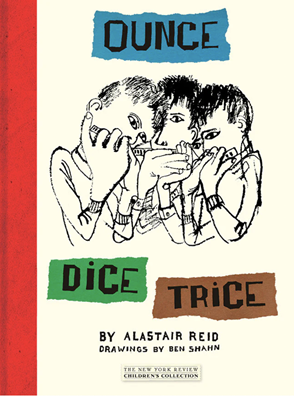
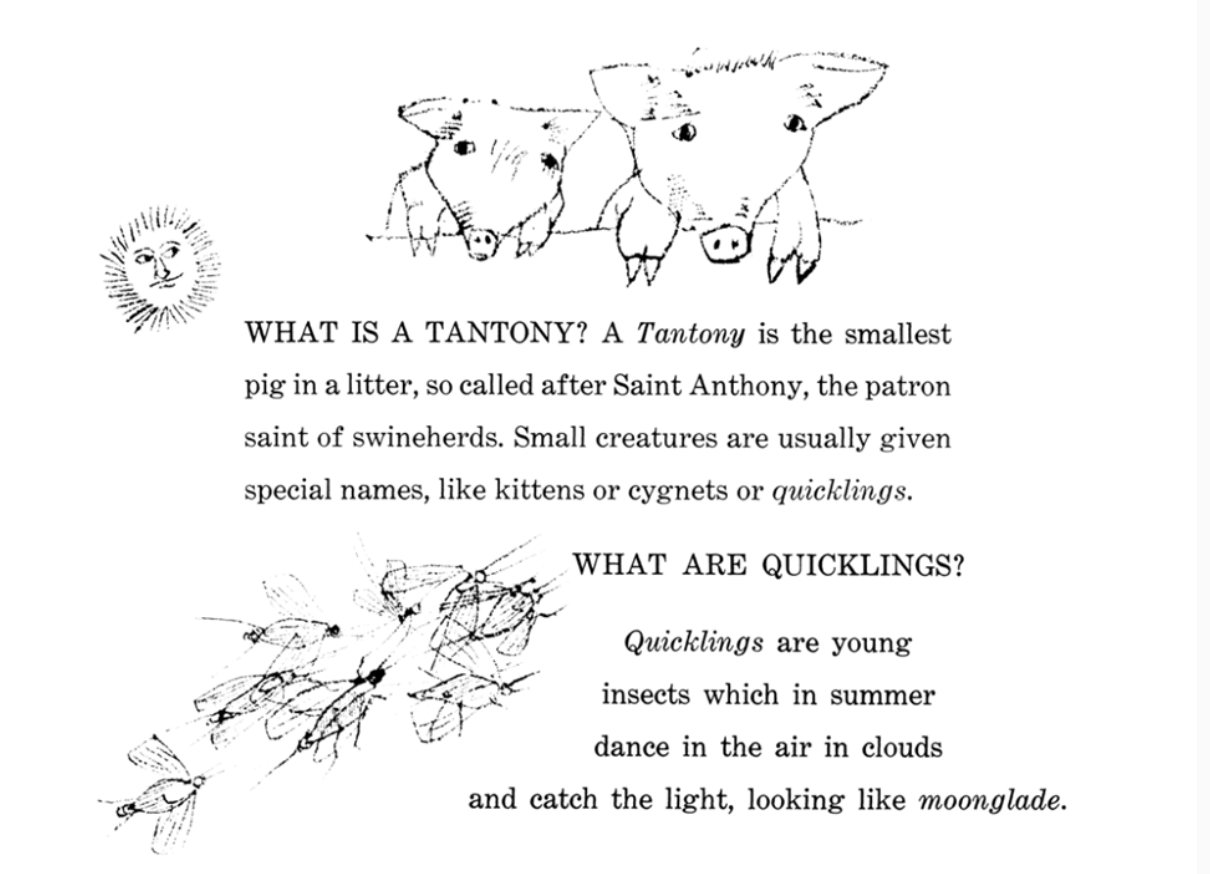
i often let my friends at the New York Review of Books point me toward what belongs on my shelves. and so it is, especially, in the children’s corner. i’ve long been mad for whimsical nearly obsolete words, words that need a puff of oxygen to keep their hearts still beating. and, so, i’m enchanted by this long-time favorite, which i’d not known before: Ounce Dice Trice, with words by Alastair Reid and illustrations by Ben Shahn. Ounce Dice Trice was the only children’s book ever illustrated by Shahn, and only one of two books Reid wrote for children. 

NYBR says this: “Ounce Dice Trice operates as a haphazard, whimsical dictionary of words and word play. Reid, a Scottish-born poet and long-time correspondent for The New Yorker, provides list upon silly list of fantastic words, most of them real, some completely made-up. Shahn, the Lithuanian-born American artist known for his socially- and politically-informed art, provides hilarious drawings to accompany the words.” [see below, for a wee quickling of a peek. and be charmed, like me, by the name for a little pig. i suppose dear wilbur (of charlotte’s barnyard) was a tantony.]


and that, dear friends, is my week’s worth of sustenance. except for one thing: the big red pot. so here is but one of the many things that filled that pot this past week and this past month:

Turkey Meatballs in Eggplant Tomato Sauce (from Melissa Clark at the New York Times, with a little twist by me*)

INGREDIENTS

Yield: 28 meatballs, 4 to 6 servings

  • ½ cup grated Parmesan cheese, more for serving, if desired
    ½ cup panko or other plain dried bread crumbs
    ¼ cup minced onion
    ¼ cup chopped chives or basil
    2 garlic cloves, grated on a microplane or minced
    1½ teaspoons kosher salt
    ½ teaspoon black pepper
    ½ teaspoon dried oregano
    Pinch red pepper flakes (optional)
    1½ pounds ground turkey, very cold
    1 large egg, beaten
    3 tablespoons extra-virgin olive oil, more as needed
    3 cups marinara sauce, more to taste*

PREPARATION
Step 1
In a large bowl, combine cheese, bread crumbs, onion, chives, garlic, salt, pepper, oregano and red pepper flakes, if using, and mix well. Add turkey and egg and blend with your hands until well mixed. If you’ve got time, cover mixture and chill for an hour or up to 24 hours. These are easiest to form into balls while very cold. Form into 28 meatballs, each about 1¼-inches in diameter.

Step 2
Heat 2 tablespoons of the oil in a large sauté pan. When hot, add enough of the meatballs to fit in one layer without crowding, and brown on all sides, 5 to 8 minutes. Transfer to a plate, add another tablespoon of oil to pan and brown another layer of meatballs, transferring them to the plate as they brown. Repeat until all meatballs are browned, adding more oil to the pan as needed.

Step 3
When meatballs are all browned, add marinara sauce to pan and bring to a simmer, scraping up the browned bits on the pan bottom. Return meatballs and their juices to pan, shake pan to cover the meatballs with sauce, and lower heat. Partly cover pan and simmer until the meatballs are cooked through, 15 to 20 minutes.

Step 4
Serve hot, drizzled with more olive oil and sprinkled with more cheese, if you like.

*note: this week i super jazzed up the sauce with a shiny night-black eggplant: while the meatballs chilled in the fridge, i took my marinara up a couple notches: sautéed onions, garlic, and then eggplant. added fennel, red pepper flaks (a pinch), marjoram and oregano, salt and pepper. cook till browned and then relaxed. add splash red wine. jar of tomato basil marinara; let simmer a good half hour. (here’s where i added extra bowls: i scooped my simmered sauce into a bowl, and browned my meatballs in the big red pot; once browned, i poured back the sauce, and let it all get cozy, simmering for another while. at dinner time, they all arrived deliciously on our plates. (and this is why you’d best take your cooking instruction for a more precise cook!)
what sustains you through your week?

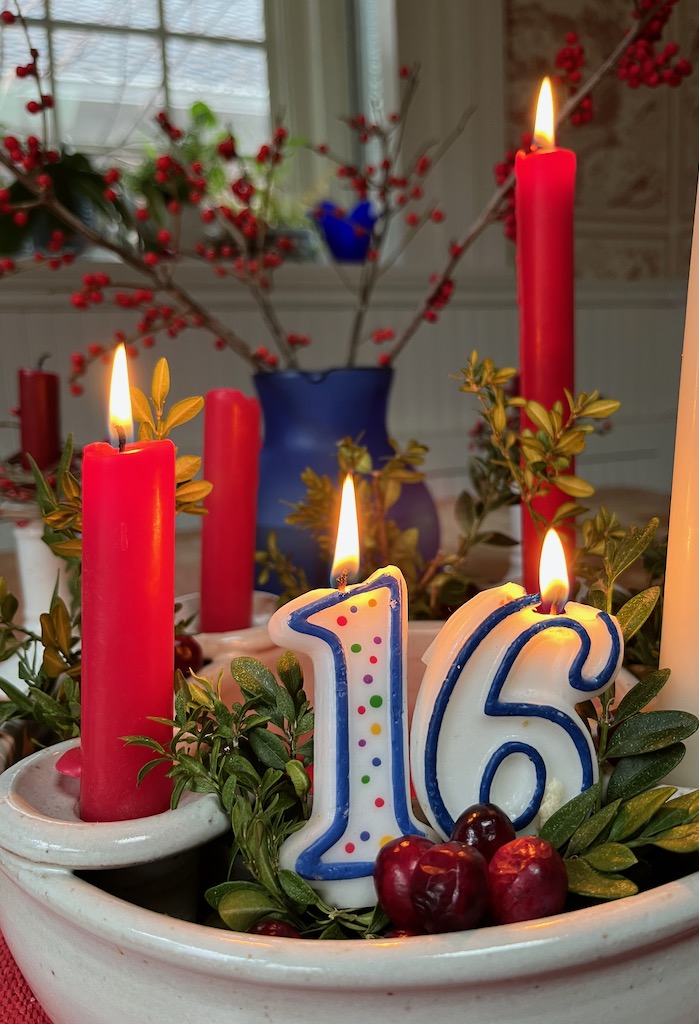
sixteen.

sixteen years old. old enough to drive a car, the chair now is. not quite old enough to vote, but we’ve stayed away from politics all these years; allowing only goodness, grace, to be our guide––even in those rare few times we’ve wandered in the public square, celebrated the election of a president, felt crushed by the words and ways of another.

we’ve stood watch here as the world crushed us (i can still see the image of that precious little two-year-old, the syrian toddler––alan kurdi was his name, the little boy in the bright-red T shirt, the little black sneakers, and scrunched-up navy pants––washed up on the sands of the aegean sea, trying to escape a war’s unimaginable horrors and terrors). we’ve felt the crushings, too, of close-to-home heartaches, the ones not felt much beyond our own intimate borders, but more piercing than all the rest sometimes. 

why do we invite in crushings here? because it’s how i’m wired, i suppose. i’ve always felt hurts so, so deeply (some say too deeply; to them i say not sorry). and i have always wished for a place where tender comforts, heart healings, might occur. where the one who’s hurt could find a featherdown place to curl into. to be tucked under fuzzy afghans. handed warm mugs of tea. and a bowl of clementines, for when the tears paused long enough to give way to nibbling. maybe it’s the nurse in me, the heart of me. i can’t bear to see, to hear, to feel, to imagine hurting. but i will witness every time. for every hurt needs witness. needs bearing. needs extra body parts––shoulders to lean on, hands to squeeze, eyes to gently smile––to bear and share the load.

sometimes, i’ve brought silly here. not because i’ve any proclivity for clowns or clownishness. but because life not seen through comic lens is sometimes too unbearable. to laugh is to lighten the load. to be lifted by the effervescence of a good giggle. or even a guffaw. there’s alchemy and medicine in the sound of joy rising from the lungs.

in sixteen years, we’ve held up to the candlelight life’s beginnings and endings and all in-betweens: goodbyes and homecomings, births and death, and the littlest flickerings of the everyday. 

i’ve uncorked a bit of my soul here, let you see my heart’s wanderings as i moved deeper and deeper, bolder and bolder into saying aloud what i was sometimes plenty timid to whisper. somehow, over the years, the sacred i call God––God, a name that resonates a tenderness to me, a name whose very uttering fills me with a knowing, a hope––has pulsed so palpably through my every day, i now put breath to it without too much trembling. and in words––i hope––that do not close doors. i’m more intent than ever to draw forth the wisdom, the wonder, the light from any path that winds toward God, Allah, Adonai, Divine and Holy Wisdom. i reach for the doorways, have no use for locks on doors.

i’ve brought tinkerings at the cookstove here, too. in part because i will always be trying to find my way back from a dark, dark place when i was just 18, and, for reasons that escaped me at the time, i’d somehow decided i’d see how little food i could swallow in a day. it’s a place that filled me with cringing shames for years, and years. and tangled me in terrible knots. not knowing how to eat, being daunted by and quaking in the face of simple food, is a scourge i’d wish on no one. the question i’d long asked, and which was long asked of me: how does the homecoming queen find herself riding an elevator to a full-blown psych ward? (1975 was back in the day before anyone really knew what anorexia was; and there were no such eating disorder programs as there are today. and the movie “one flew over the cuckoo’s nest” had just come out on the very big screen, so it set the stage for a most awful fright.) i can type those sentences now because the years have gentled my shame, and slowly, faithfully, i’ve found my way to a shore of my own. a shore where olive oil doesn’t scare me anymore. and where just last week i drizzled honey (on dorie greenspan’s sweet & smoky roasted carrots*). and it seems that when you’ve struggled so to feed yourself, you find a quiet certain joy in feeding those you love. (and maybe by osmosis you’re hoping to absorb some ease…)

i didn’t intend for this birthday note to grow so confessional. but over all these years, you’re the ones who’ve made this place into the sacred, gentle, quiet space i once dreamed of. and always believed in. you’ve shown me, though your unending kindness, that what i write here is safe here––and i will protect to the end your safety to say here what you will. and, hard as it might be to imagine (given the crude world in which we live), never once in all these years have i found a harsh or mean-spirited comment left here at the so-called “old maple table.” (it would crush me if i found one.) your gentle graces, your heartfelt, heartfelt notes and comments, as well as your incredibly heavenly occasional snail mails, have emboldened me to tell only truth here. life is short, too short, we know. and why waste a day fudging around the edges when what draws us whole––and into each other’s embrace––is saying who we are, and what hurts us, and what makes us giggle? and aren’t we all, in truth, wobbly creatures at the core, only slowly ascending from all the snags and quirks that make us so delightfully who we are? 

so here’s to truth. and sixteen, a number imbued with introspection, and spiritual purity, and a sign of good things to come, according to those who study numbers, find meaning therein. 

may this next whirl around the sun bring blessings to us each and all…

i have an especially lovely birthday present for all of you, one i will leave here on the table (down below). my friends at the SALT project dug it up from wendell berry’s bookshelf, and it’s a beauty like no other. it’s called “the birth (near port william)” and as you’ll see, it’s a nativity poem for all. happy blessed birthing day, for whatever it is you’ll birth today….(the poem is long, so i will leave it at the very bottom here….) (p.s. because the formatting itself is lovely and i can’t get it replicated here, and because you might love the SALT project, i’m leaving the link to their page here.)

one other gift, before i leave you the poem. little alan kurdi’s father, the only one of the family of four who survived the escape in a rubber boat back in the early autumn of 2015, a few years later started a foundation to help children whose lives have been torn apart by war. it’s yet another miracle of the human spirit’s capacity to rise from the deepest, darkest ashes. you can find out more about the kurdi foundation here.

and another treat: the other evening i time-traveled to amherst, mass., for a birthday celebration in the glorious home of emily dickinson, the great butter-yellow house on the hill, known as the homestead, and during that hour and a half of marvelousness, one of curators mentioned that emily’s beloved sister-in-law susan had written emily’s obituary, which was published in the springfield republican on may 18, 1886. immediately curious, i asked for the link, and here tis, with some of the most lovely writing, and most charmed intimacies of emily’s life, written in the immediate wake of emily’s death by the one who perhaps knew her most dearly…. https://www.emilydickinson.it/edobituary.html

here is but one passage i found delectable…

As she passed on in
life, her sensitive nature shrank from
much personal contact with the world,
and more and more turned to her
own large wealth of individual resources
for companionship, sitting thenceforth, as
some one said of her, “In the light of
‘her own fire.” Not disappointed with the
world, not an invalid until within the past two
years, not from any lack of sympathy, not be-
cause she was insufficient of any mental work
or social career – her endowments being so ex-
ceptional – but the “mesh of her soul,” as
Browning calls the body, was too rare, and the
sacred quiet of her own home proved the fit
atmosphere for her worth and work.

and the obit ends thusly:

To
her life was rich, and all aglow with God and
immortality. With no creed, no formulated
faith, hardly knowing the names of dogmas,
she walked this life with the gentleness and
reverence of old saints, with the firm step of
martyrs who sing while they suffer. How
better note the flight of this “soul of fire in a
shell of pearl” than by her own words? –

Morns like these, we parted;

Noons like these, she rose;

Fluttering first, then firmer,

To her fair repose.

*oh, and those carrots drizzled with honey? dorie greenspan’s sweet + smoky roasted carrots you’ll thank my sister-in-law, brooke, who sent them my way…

and that, dear friends, is the stack of gifts i have for you this blessed early morn…..(one question, and then wendell berry’s poem…)

so here’s the question: how did you find the chair?

“THE BIRTH (NEAR PORT WILLIAM),” BY WENDELL BERRY

They were into the lambing, up late.
Talking and smoking around their lantern,
they squatted in the barn door, left open
so the quiet of the winter night
diminished what they said. The chill
had begun to sink into their clothes.
Now and then they raised their hands
to breathe on them. The youngest one
yawned and shivered.

                         “Damn,” he said,
“I’d like to be asleep. I’d like to be
curled up in a warm nest like an old
groundhog, and sleep till spring.”

“When I was your age, Billy, it wasn’t
sleep I thought about,” Uncle Stanley said.
“Last few years here I’ve took to sleeping.”

And Raymond said: “To sleep till spring
you’d have to have a trust in things
the way animals do. Been a long time,
I reckon, since people felt safe enough
to sleep more than a night. You might
wake up someplace you didn’t go to sleep at.”

They hushed awhile, as if to let the dark
brood on what they had said. Behind them
a sheep stirred in the bedding and coughed.
It was getting close to midnight.
Later they would move back along the row
of penned ewes, making sure the newborn
lambs were well dried, and had sucked,
and then they would go home cold to bed.
The barn stood between the ridgetop
and the woods along the bluff. Below
was the valley floor and the river
they could not see. They could hear
the wind dragging its underside
through the bare branches of the woods.
And suddenly the wind began to carry
a low singing. They looked across
the lantern at each other’s eyes
and saw they all had heard. They stood,
their huge shadows rising up around them.
The night had changed. They were already
on their way — dry leaves underfoot
and mud under the leaves — to another barn
on down along the woods’ edge,
an old stripping room, where by the light
of the open stove door they saw the man,
and then the woman and the child
lying on a bed of straw on the dirt floor.

“Well, look a there,” the old man said.
“First time this ever happened here.”

And Billy, looking, and looking away,
said: “Howdy. Howdy. Bad night.”

And Raymond said: “There’s a first
time, they say, for everything.”

                                   And that,
he thought, was as reassuring as anything
was likely to be, and as he needed it to be.
They did what they could. Not much.
They brought a piece of rug and some sacks
to ease the hard bed a little, and one
wedged three dollar bills into a crack
in the wall in a noticeable place.
And they stayed on, looking, looking away,
until finally the man said they were well
enough off, and should be left alone.
They went back to their sheep. For a while
longer they squatted by their lantern
and talked, tired, wanting sleep, yet stirred
by wonder — old Stanley too, though he would not
say so.

          “Don’t make no difference,” he said
“They’ll have ’em anywhere. Looks like a man
would have a right to be born in bed, if not
die there, but he don’t.”

                         “But you heard
that singing in the wind,” Billy said.
“What about that?”

                         “Ghosts. They do that way.”

“Not that way.”

                         “Scared him, it did.”
The old man laughed. “We’ll have to hold
his damn hand for him, and lead him home.”

“It don’t even bother you,” Billy said.
“You go right on just the same. But you heard.”

“Now that I’m old I sleep in the dark.
That ain’t what I used to do in it. I heard
something.”

               “You heard a good deal more
than you’ll understand,” Raymond said,
“or him or me either.”

                        They looked at him.
He had, they knew, a talent for unreasonable
belief. He could believe in tomorrow
before it became today — a human enough
failing, and they were tolerant.

                                 He said:
“It’s the old ground trying it again.
Solstice, seeding and birth — it never
gets enough. It wants the birth of a man
to bring together sky and earth, like a stalk
of corn. It’s not death that makes the dead
rise out of the ground, but something alive
straining up, rooted in darkness, like a vine.
That’s what you heard. If you’re in the right mind
when it happens, it can come on you strong;
you might hear music passing on the wind,
or see a light where there wasn’t one before.”

“Well, how do you know if it amounts to anything?”

“You don’t. It usually don’t. It would take
a long long time to ever know.”

                                 But that night
and other nights afterwards, up late,
there was a feeling in them — familiar
to them, but always startling in its strength —
like the thought, on a winter night,
of the lambing ewes dry-bedded and fed,
and the thought of the wild creatures warm
asleep in their nests, deep underground.

Wendell Berry

**sixteen, in case you wondered, is how many years the chair has been this quiet little place where these days we gather every friday morn. or at least that’s when i pull up a chair. you’re welcome to stop by any time, stay as long as you’d like. or, for years and years….’twas launched, the chair was, on 12.12.06, with this little post…

turning the page with a tug and a pull

we are definitely turning the page here at this old shingled house. the bespectacled architecture critic no longer calls me from the office at 8 at night, saying he’ll be stuck writing for a few more hours. there are no carpools to coordinate, no getting up at 5 in the morning for soccer matches in kingdom come. i’ve gotten used to the new geographies in my head, the ones that have me simultaneously keeping track of news, weather, and covid in new york city and the middlelands of ohio, the current turfs of both of our birthlings. 

somehow, without notice, without even a sign posting the warning, we’ve moved into the loveliest calmest quietest chapter of our married life that ever there was. (do not think of even uttering a syllable of the R word, the one synonymous with hanging up one’s professional hat; one of us has no intention of putting away the keyboard and the other seems to have taken up full-time swimming, biking, and running across finish lines). underscoring the shift, this year we’ll be racking up plenty of lasts in the kid department: the last college drop off. last parents weekend. last winter and spring breaks. last graduation. last packing up the dorm room. last whopping tuition bill. 

we are, very much so, on the final verge of true empty nesting.

it’s a mix tinged with poignancy, and a good measure of disbelief. time passes so swiftly, you suddenly realize. after years and years of thinking the routines will never be broken. poof, and they’re gone! 

we’re late to this party, only because i found myself in a delivery room when others i knew were there awaiting their grandbabies, but i was there because of what felt and always will feel like i somehow squeaked through the maternity ward as the very last egg was being cleared from the deck. and, as with so much in my life, i’ve been soaking it in from every which angle, taking none of it lightly, extracting as much as i possibly could at every twist, turn, and trial along the way. 

ours, these days, is a quiet life by choice. my favorite hours are nestled in books and on my knees in the garden, over coffees with people i love, and the dinners at the end of the day when we weave together the threads we’ve both followed all through the day. i know full well that every drop of it is pure blessing, a benevolence no one deserves, for life is not doled out in rewards and punishments. we just get what we get, and it’s ours to savor or squander. i’ve had more than enough hours staring into the shadowed abyss, imagining sudden endings, to perk up my relishing gears. (the bright side of being a doomsayer is that any and every happy ending is reason for rousing hallelujah. don’t mind my scrambled up wiring. seven decades in, it works for me just as it is.) 

anyway, this weekend’s the last-ever parents weekend, that glorious mix of scintillating speakers and professorial panels, long strolls across a campus straight out of the picture books, and delivering a pile of groceries and pies and blankets and boots only a college kid’s idiosyncratic tastes would relish or request (who else would send a middle-of-the-night text asking for portwine spread cheese, rubber-soled boots, and someplace good to go out for dinner?). i plan to savor every sweet drop, knowing not long from now i’ll pine for the chance to make-believe i’m a kid savoring college. (as long as i don’t peek in the mirror, and wonder who in the world is the one with the locks now the color of silvery moon.)

i know, because life has taught me over and over, whole new adventures await, and none of this will ever get dull. but i’ve loved this part where you hover fairly closely over the shoulder of the kids you’ve brought into the world, and feel your heart grow by the week and the month and the year. i know, because life is already teaching me, each of their new adventures becomes vicariously mine, and therein lies a whole nother joy. but now, here i am at the precipice looking both ways. and mostly i’m grateful for this heart that finds it hard to let go….


because we’re motoring back and forth in three short days (the weekend cut short by a work trip to houston for the one more apt to be running or riding these days), i’m keeping this short, and will leave you instead with two little morsels: a peek inside the little book that landed on my stoop the other night, and a soup i plan to make on one of the autumnal days next week when the critic is chowing down on texas barbecue. slow cooking is in sync with my slow, savoring ways. 

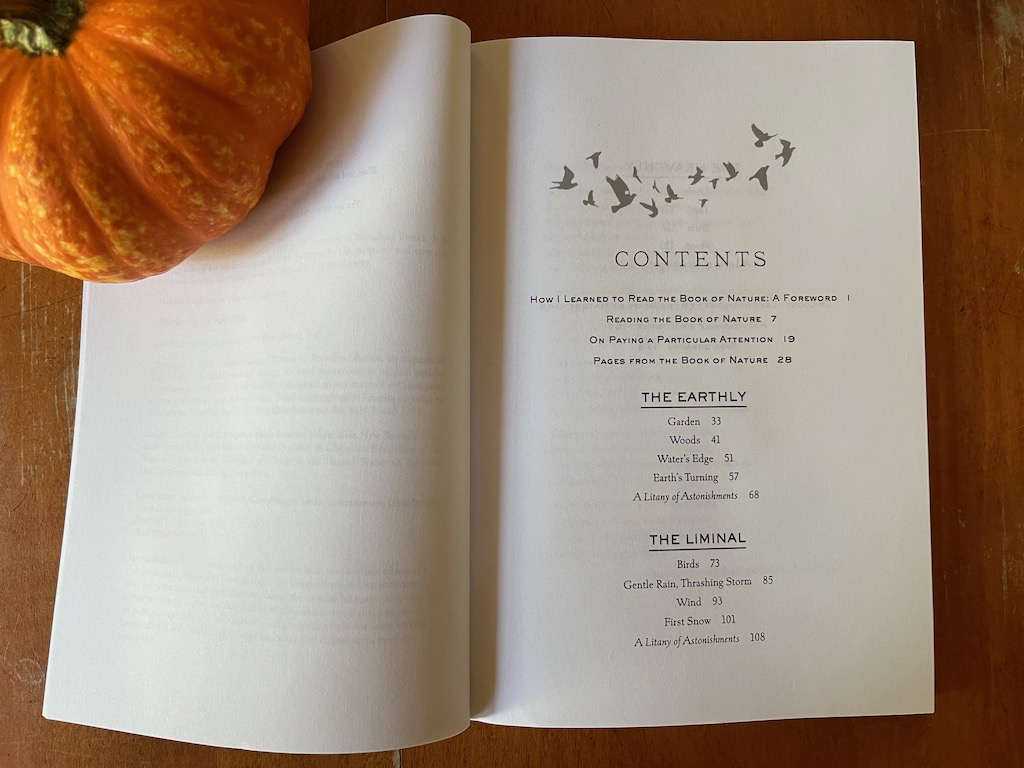
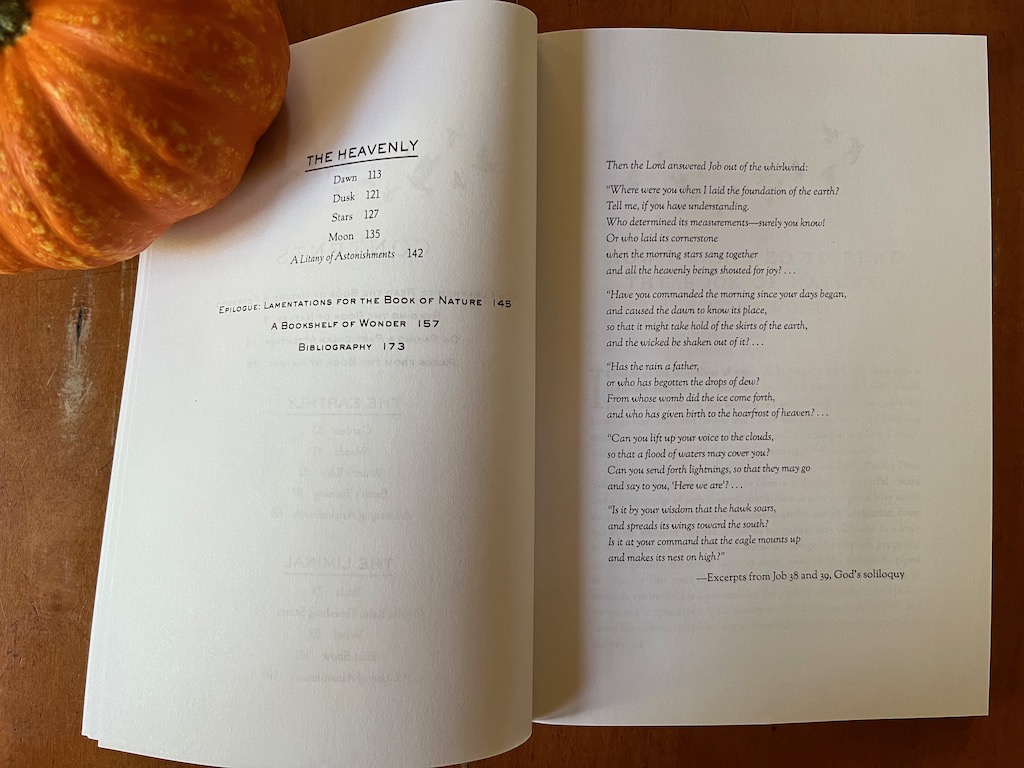
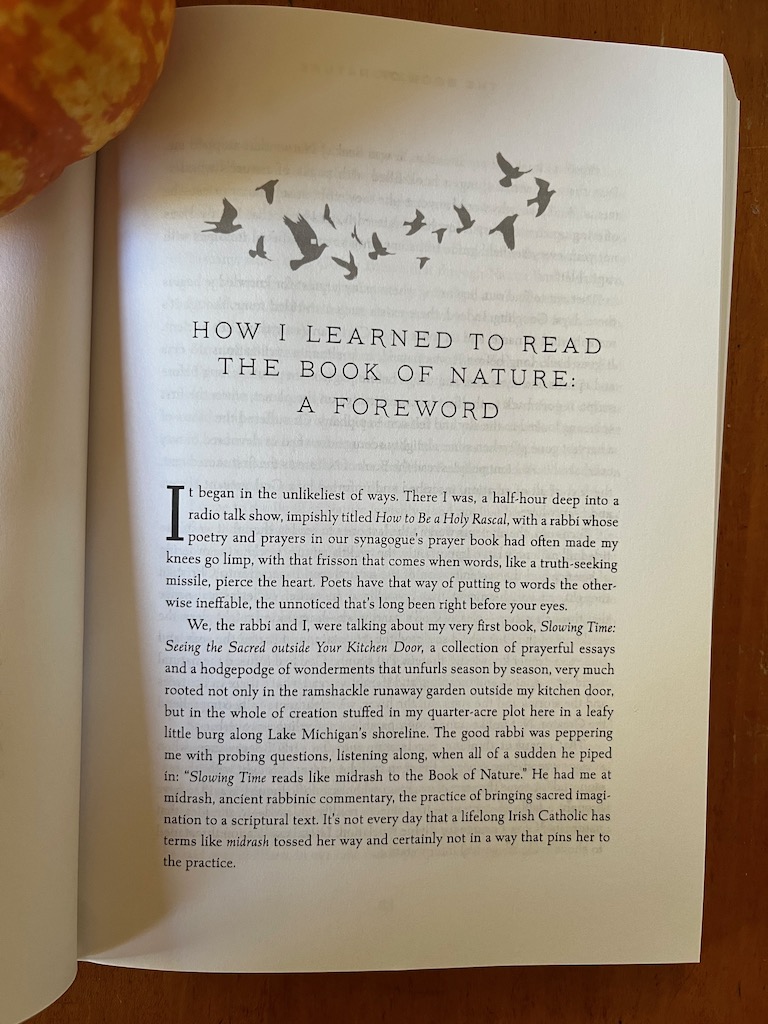
first, a peek at the Advanced Reading Copy of The Book of Nature, with a look at the cover, the table of contents, and the first page of the foreword.


photo by Bobbi Lin, NYT

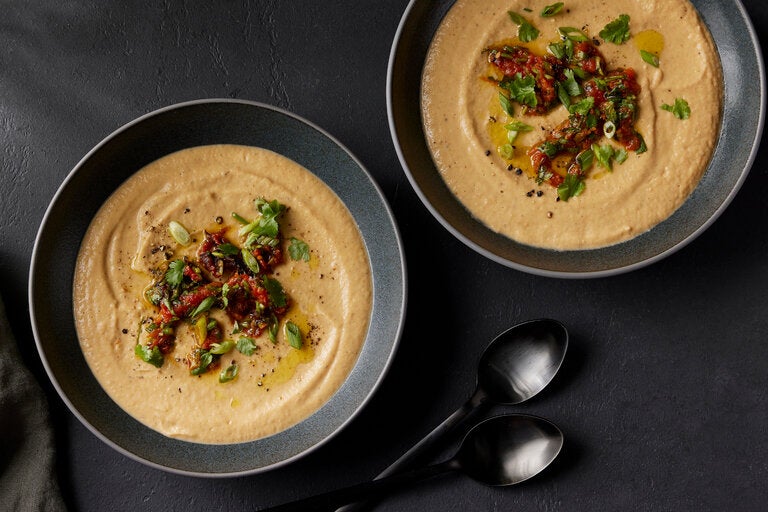
Creamy Cauliflower Soup With Harissa Tomatoes
By Melissa Clark, The New York Times
Yield: 6 servings

INGREDIENTS
1 large head cauliflower (about 3 pounds), trimmed and cut into 1-inch florets (about 12 cups)
Kosher salt (such as Diamond Crystal) and freshly ground black pepper
1-1⁄4 teaspoons ground coriander
7 tablespoons extra-virgin olive oil, plus more for serving
1 small bunch thyme (about 10 sprigs)
1 pound plum tomatoes, halved, seeds scooped out
2 to 4 tablespoons harissa paste
3 large bunches scallions, whites and greens thinly sliced (about 21⁄2 cups)
1 jalapeño, seeded (if desired) and coarsely chopped
4 large garlic cloves, finely chopped
1-1⁄2 teaspoons ground cumin
1 tablespoon tomato paste
6 cups vegetable stock
3⁄4 cup chopped cilantro leaves and tender stems, plus more for optional garnish
1 lemon

PREPARATION
Step 1
Heat oven to 425 degrees and line 2 sheet pans with parchment paper.
Step 2
In a large bowl, combine cauliflower, 1 teaspoon salt, a large pinch of black pepper, 3⁄4 teaspoon ground coriander, 3 tablespoons oil and half the thyme sprigs, tossing everything until well coated. Spread the cauliflower evenly across one of the prepared pans.
Step 3
Using the same bowl (no need to wash it first), combine halved tomatoes, 1 to 2 tablespoons of harissa (depending on how spicy your harissa is; taste it first), 2 tablespoons olive oil, a large pinch of salt and the remaining thyme sprigs, and toss gently until the tomatoes are well coated. Spread tomatoes on the other baking sheet, cut-side up.
Step 4
Place both sheet pans in the oven and roast for 20 minutes, then stir the cauliflower but not the tomatoes. Continue to roast until cauliflower is golden brown and tender, 15 to 20 minutes longer (35 to 40 minutes total roasting time). Transfer cauliflower pan to a rack, and discard thyme sprigs.
Step 5
Using tongs, gently flip tomatoes over so their cut sides are down. Using the tongs, pinch off the tomato skins – they should slip right off – and discard. Brush 1 to 2 more tablespoons of harissa onto tomatoes and continue to roast until shriveled and condensed, about 15 to 25 minutes (35 to 45 minutes total roasting time).
Step 6
While tomatoes are roasting, make the soup: In a large pot, heat the remaining 2 tablespoons oil over medium. Add scallions (saving 1⁄4 cup scallions for serving) and jalapeño, and cook, stirring occasionally, until soft and lightly colored, 5 to 7 minutes. Stir in garlic and cook for 1 minute. Add another 1 1⁄2 teaspoons salt, black pepper to taste, cumin and tomato paste, and cook until tomato paste darkens and caramelizes, 2 to 3 minutes.
Step 7
Stir in roasted cauliflower and stock, and bring to a simmer. Cook, partly covered, over medium-low heat until all vegetables are very tender, 15 to 20 minutes. Turn off the heat. Using an immersion blender, purée the soup until smooth. (Alternatively, you can purée it in batches in a food processor or blender.)
Step 8
Transfer the roasted tomatoes into a mixing bowl and add cilantro. Using a Microplane or other fine grater, grate zest from about half the lemon into the bowl, then stir in 1⁄2 teaspoon coriander and reserved scallions.
Step 9
Using a fork or spoon, break up some of the tomatoes as you combine everything. Cut the lemon in half and squeeze a little into the tomatoes, then taste and add more salt and lemon juice as needed. It should taste well seasoned and a little tangy.
Step 10
To serve, squeeze in the juice from half the lemon. Taste and add salt, pepper and lemon if needed. Ladle soup into individual bowls and dollop harissa tomatoes on top; top with olive oil and more cilantro, if you like.

how do you savor the most succulent parts of your life? and do you, like me, find turning the page a bit of a tug and a pull?

summer’s dalliances and a hodgepodge of other curiosities

some thoughts on summer attention: 

carrying a tray of napkins, forks, and knives out to the summer porch the other night, i noticed a silence. a new silence. the cicada, my favorite understory of sound signaling summer starting to close, had gone quiet. instead there were crickets, only crickets, relatively placid compared to the frenetic energies of the cicada, who are mortally pressed for time with only 24 hours to wake, procreate, and succumb. 

summer’s waning, i thought. and, darn, i missed the last chirr. 

(turns out the day it was quiet was a day less than 80 degrees, and the next day when it warmed up, they were back again. makes the pair of amateur entomologists who dwell in this old house think that maybe the ‘cadas had snuggled under their blankets, put their fiddles and strings in a case, awaiting a day with a little more burn in the air.)

straight off, it made me think of a glorious essay i’d read some months ago about paying exquisite attention, paying such exquisite and fine-grained attention that one is attuned to even the moment the cicadas cease their clattering, silence their love song. i’ve searched and searched all week for that misplaced essay, and can’t find it anywhere (maybe i too should call in the FBI for a search of my basement storage room). 

but even without the essay in hand, it still made me pause to think hard about those barely perceptible miracles that constitute the whole of each day. and made me construct my own litany of things worthy of my attentions: 

the moment in spring when the grass sheds its winter brown and slips on its verdant green.

the moment the nestling takes flight.

the moment the monarch emerges from his cocoon.

the moment the wedge of moon fades away in the dawn.

what if we were to notice? what if instead of numbly whirring through time we slowed to adagio and drank in even a half (or a teaspoon) of the everyday dose of miracles and wonders? what if even once a day we counted one thing we’d otherwise not see, not hear, not sense? what if we awoke to the mystery that’s animating every minute of every hour, day after day, year upon year? 

isn’t to see, isn’t attention, the first step to devotion? wouldn’t our life be infinite unfurling prayer if, as often as we breathe, we were awake to blessing?

have you noticed the day when the tomato turns just the right red for plucking?

have you heard the first or last note of the cardinal at the dawn or at nightfall? the moment when silence gives way to sound, or sound to silence?

have you noticed the firefly turn off its blink for the night? 

have you noticed the someone who’s hoping you’ll sit down and listen to one of his or her stories? 

the summer is fleeting, it’s begging we notice….


wee bouquet

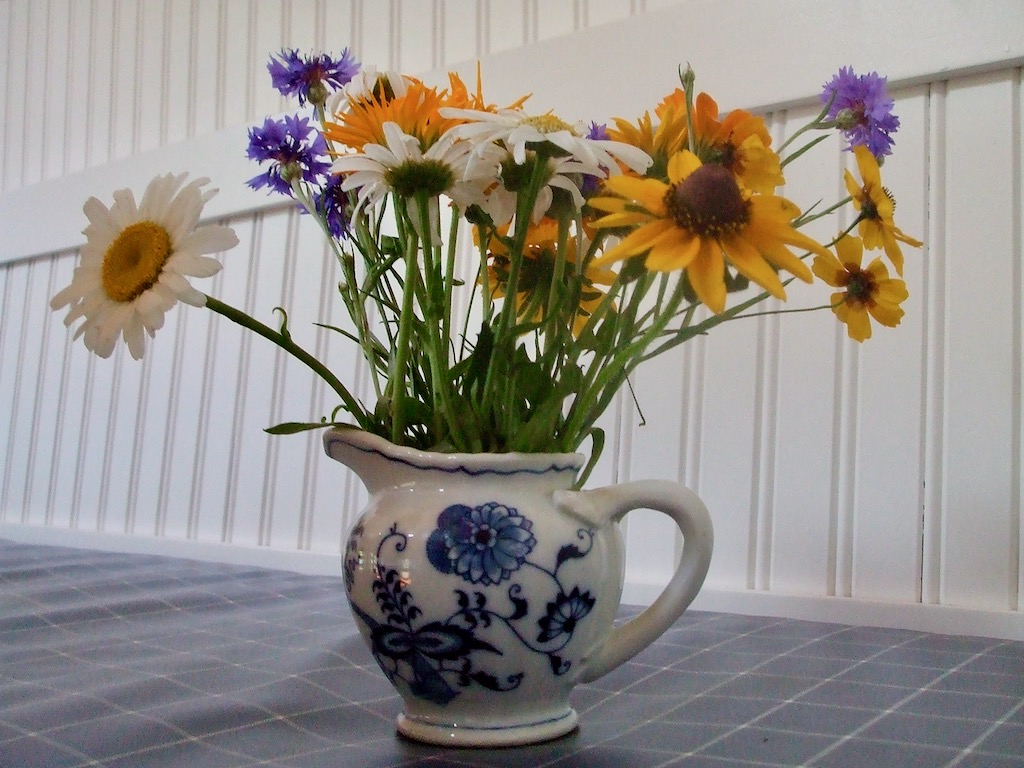
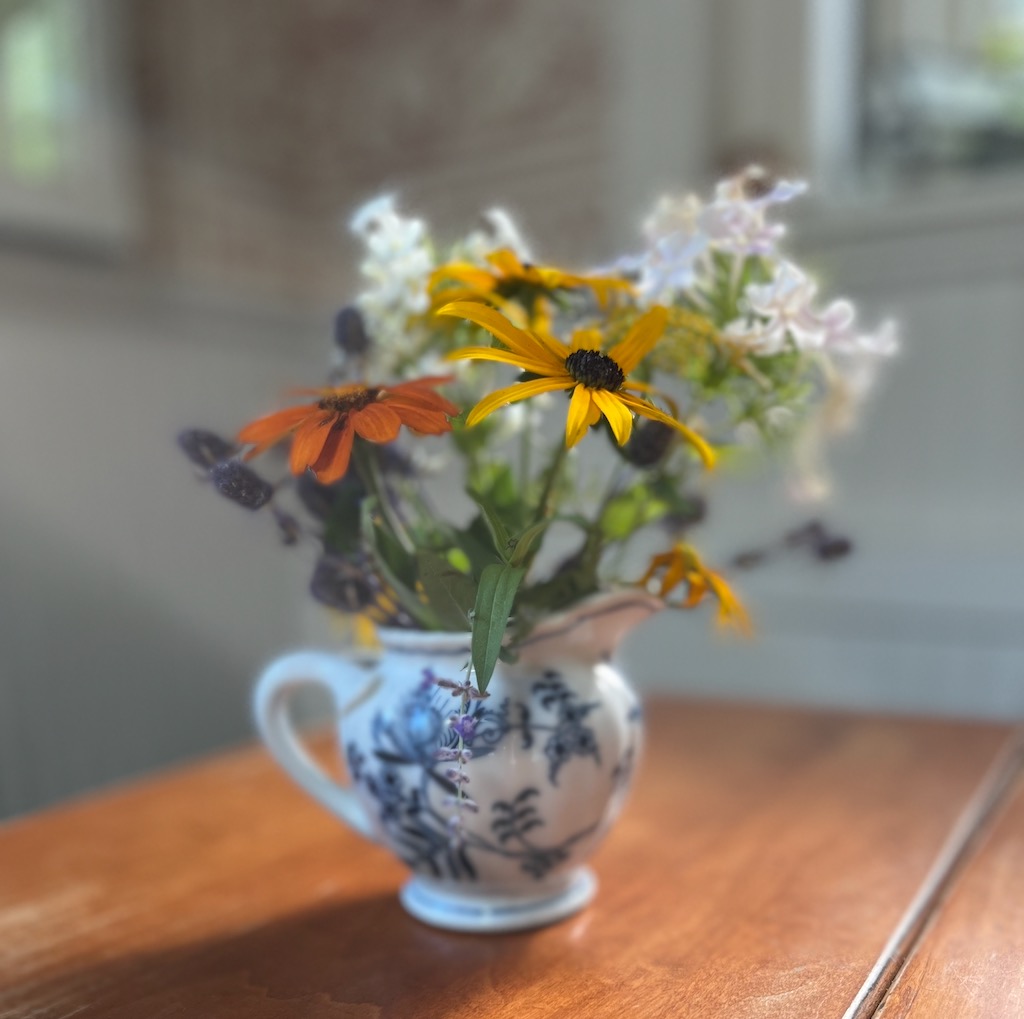
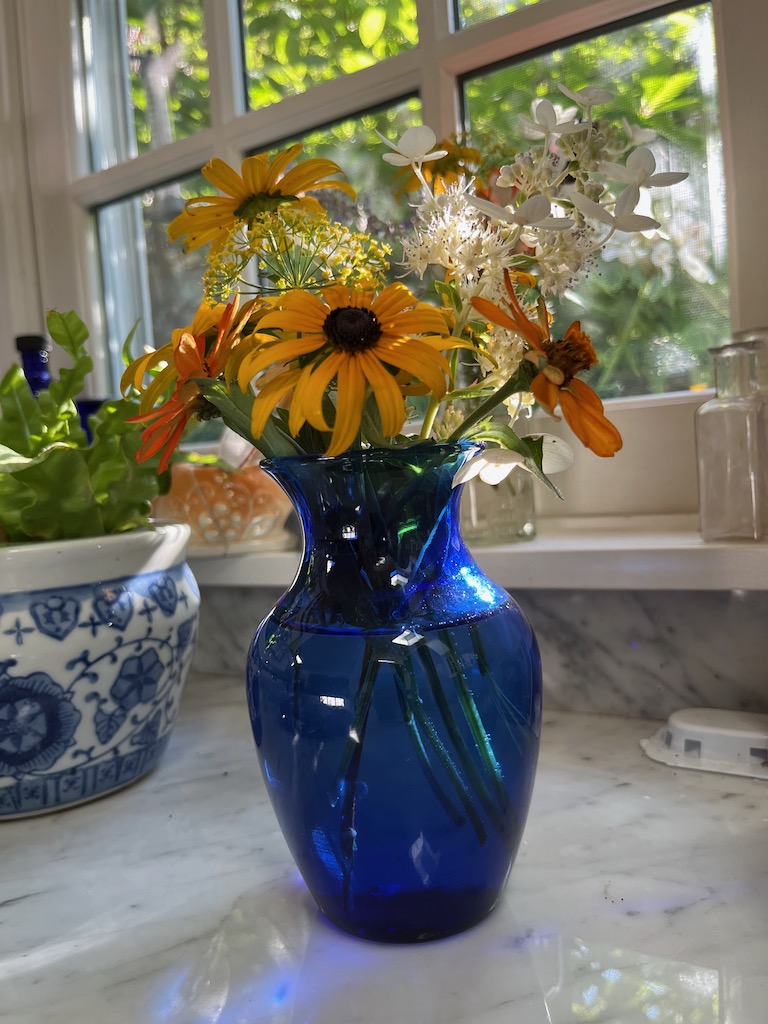
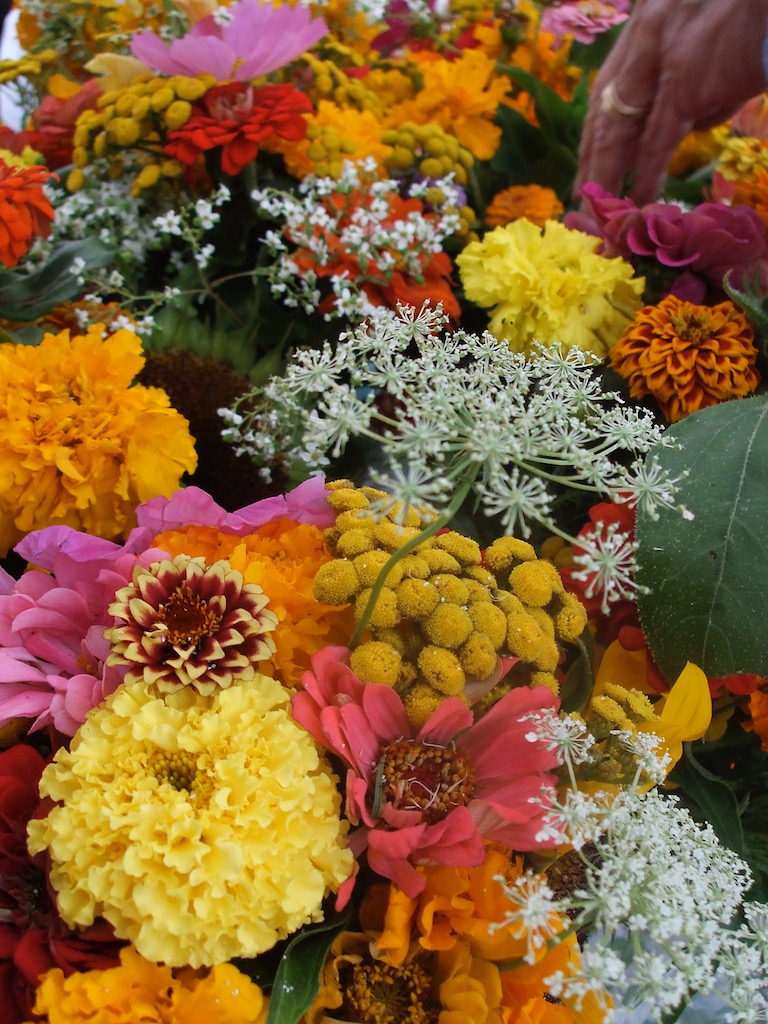
summer dalliance: i’ve a thing for little bouquets; always have (ever since my mama taught me to pick lily of the valley or daffodils for the teacher, wrap them in wet paper towel and then a sheaf of aluminum foil wrapped tight into a baton). i love to pluck blooms from wherever i traipse in the garden or alley, and tuck them loosely into jars or pitchers or wee tiny vases. i find the gatherings of color and form, petal and leaf, tickle my fancy. so i pluck and i tuck with abandon. and then i scatter my abandonments all over the house. 


book news: hardest task of the summer for me, far harder than scanning pages for blips and bloops, was sending off queries to authors whose work makes me tremble it’s so dang good. i was instructed to ask these legends to read my book, and send back a few words of kindness, a thing in the book world called “blurbs.” it was an instruction that trembled me. but the task, now completed and turned in to my editor, might have taught me a thing or two about being brave. and the kindness of pure strangers. i can’t pull back the covers on what they wrote (not yet anyway), but i can tell you to whom i will forever be grateful; most especially to: Pádraig Ó Tuama (the poet, peacemaker, and host of Poetry Unbound from OnBeing Studios), Scott Weidensaul (ornithologist and best-selling author of Living on the Wind and, more recently, A World on the Wing), Bill McKibben (environmental activist and legendary author), Rabbi Rami Shapiro (poet and podcast host who wrote skeins of prayer in our synagogue’s prayer book), and Mallory McDuff (another environmental activist and author of Love Your Mother: 50 States, 50 Stories, and 50 Women United for Climate Justice). equally kind, though they wrote back to say their plates were too jammed, include terry tempest williams (brilliant essayist and conservationist), susannah heschel (scholar and daughter of the late great rabbi Abraham Joshua Heschel) and margaret renkl (a New York Times columnist who often writes about things i’ve been thinking), belden lane (theology professor emeritus and esteemed author), and fred bahnson (brilliant essayist). a few, who shall remain unnamed, never wrote back. oh well. the kindness of those who did is what will glow into the evermore…..


reading nook:

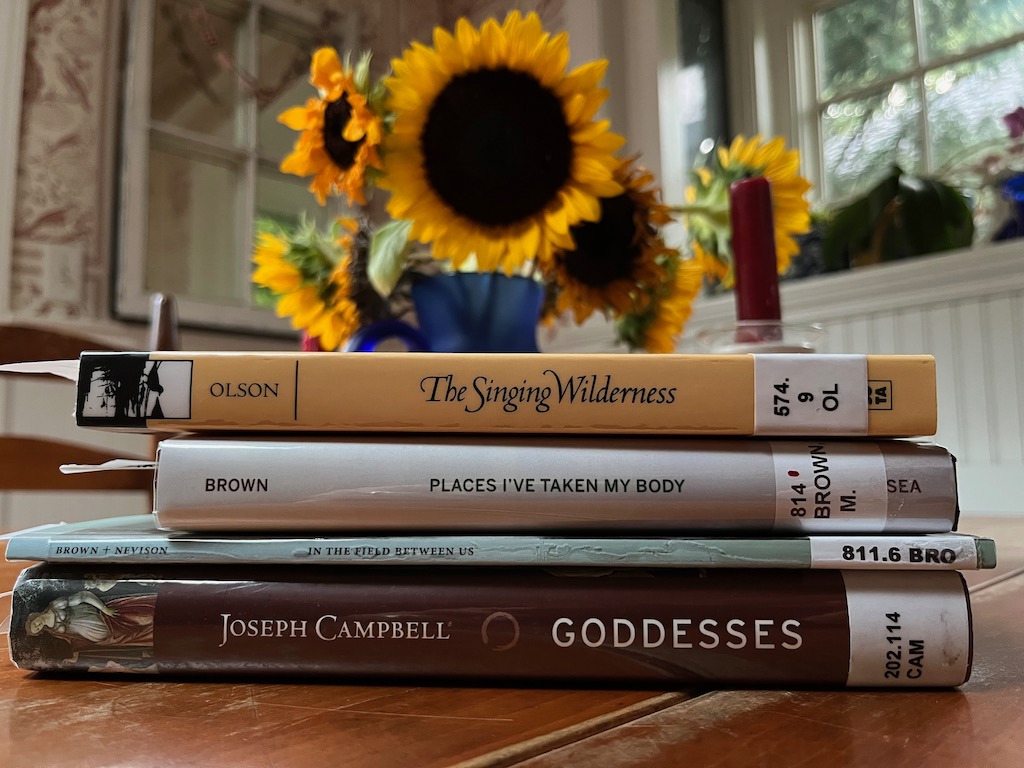
technically, i’m between rounds of page proofs which gives me time to indulge in my rabbit-hole school of reading, which this week has lured me into the writings and poetries of molly mcCully brown, a brilliant essayist and poet born with cerebral palsy who writes unforgettably about her intractable and ever-changing body, and who makes us think hard of the miracle of mobility, something we might take for granted unless we too were faced with a flight of stairs or an ancient cobblestone lane that kept us from the places we so longed to enter. somehow i’d never before known of sigurd olson, called “one of the great environmentalists of the twentieth century,” who wrote of the boundary waters, the northwoods, and the surrounds of lake superior. he won the john burroughs medal (the most esteemed prize in the world of nature writing) and made me think i just need to read my way through the lifetime list of winners. i’m beginning with The Singing Wilderness, described as the most poetic of his nine published books. on its back cover, it’s described as “an essential antidote to the trials of modern life.”


what’s cooking:

i find myself dizzy with summery sides from the vegetable patch this summer: corn, tomatoes, cukes, purple onions, frondy fennel (the crunch with a tassle), basil, basil, more basil. doused with vinegars, olivey oil, lemons, limes, oranges, and now a curious new douser: chili crisp, a sauce that’s sweeping the country, straight from the kitchen of Tao Hubi, owner of a popular Guizhou province noodle shop in China, who began selling her famed homemade chili sauce under the name Lao Gan Ma (found at whole foods, and, yes, on amazon). apparently the summer’s salady hit is nothing more complicated than tomatoes tossed with a splash of rice vinegar, a glug of olive oil, a pinch of flaky salt, and a generous spoonful of the magic sauce. it’s the gist of height-of-august deliciousness. and it’s called chili crisp tomato salad.

here’s an amazing twist on plain old green beans…

Side of Beans (Green):

from The Cordony Kitchen (Amanda Cordony is an Australian food stylist and recipe inventor, and she’s amazing!)Cook time: 4 mins | Prep time: 5 mins | Serves: 3 (as a side)

Ingredients
2/3 cup green beans – top and tailed
3 Tbsp + 1 tsp. olive oil
2 garlic cloves – minced
1 orange – zest and juice
1/4 cup of raw almonds – roughly chopped
 pinch of chili flakes

Garnish:
Mint leaves, olive oil

Method.
1.
Get a frying pan on medium to high heat with olive oil. Place your beans, garlic, orange zest, orange juice and sea salt. Stir for 2 minutes.
2. Take off the heat and sprinkle in the almonds and chili flakes.
3. Serve and add mint leaves, olive oil, salt, and pepper.


so those are the curiosities of the week, as i get back to proofing later this morning. thanks for indulging my gazetteian tendencies these past few friday mornings. i believe only one more week and then i send off the proofs to the printing presses, where they will whir off the presses and onto real pages….

what are the curiosities and wonders that strike you at august’s peak? and what will you notice that you’d otherwise miss?

p.s. happy height-of-august birthday to our very own hardshell aficionado and keeper of wisdoms, karen the wonder woman, whose birthday is any day now, though i don’t know which….

when summer starts to run away…

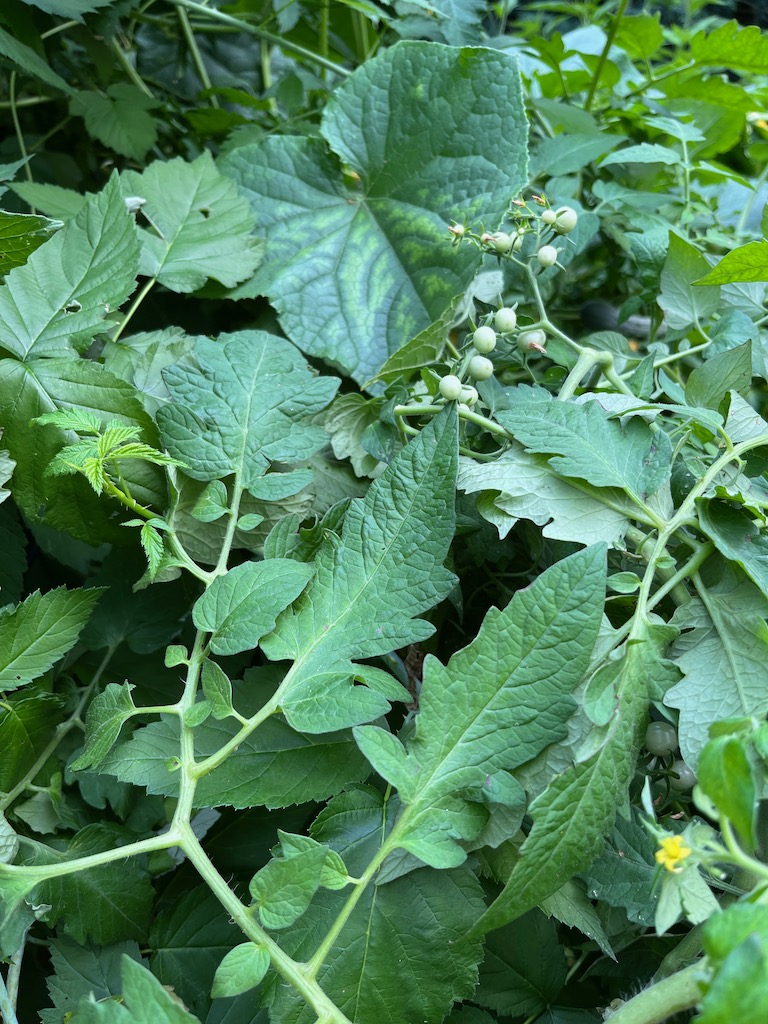
the tangle that is my plot of runaway vines

in which we continue in gazette-ian style, with bitlets and chunks from the week that’s just whirled by…..(as i roll toward end-of-summer editing deadline, the gazette affords the chance to gather up bits in between long hours of proofing pages and rethinking the occasional passage. the other big job of the summer is sending off queries to authors whose works are the high bars i reach for, including unproofed copies of the manuscript, humbly asking if they’d be willing to, ahem, read the whole darn thing and send along a few words, aka “blurb” the book. it’s a task that makes me tremble, but a dear friend reminded me to channel eleanor roosevelt, she who implored that we do something each day that scares us. and so i’ve been eleanoring. results: forthwith. but for now, a few bits from the week…)


trying to be tomatoes

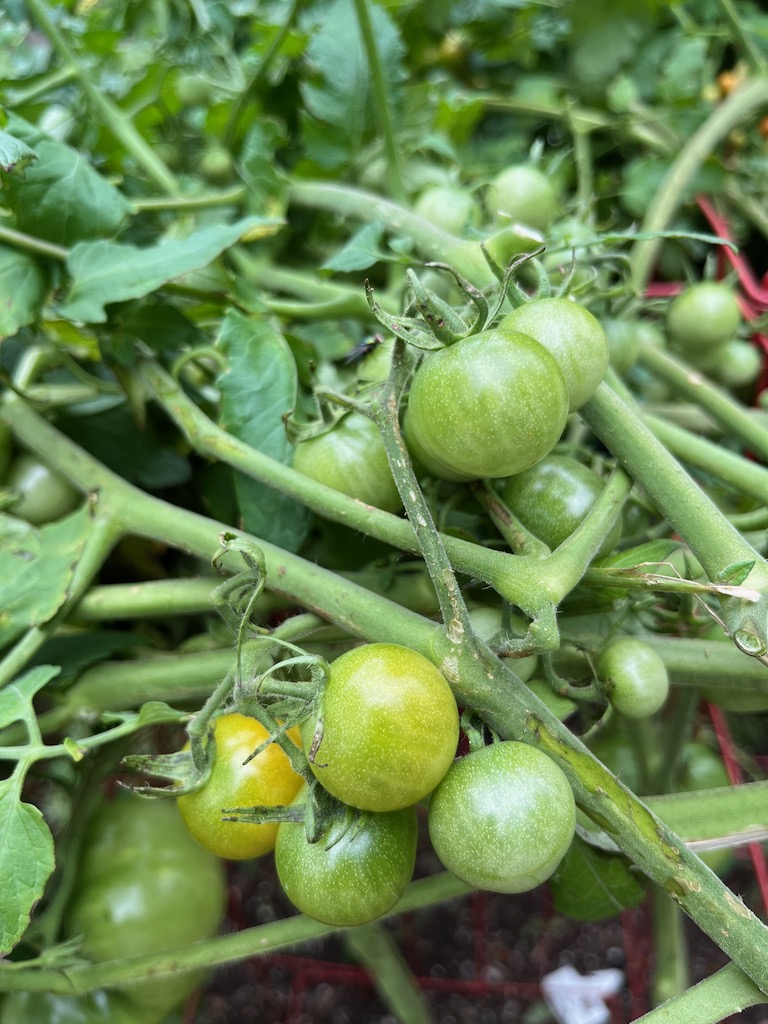
if one’s farmer plot is in any way a mirror of one’s soul, i’m in trouble. my tomatoes are tangled with my cukes, all of which have invaded the raspberries. the thyme has up and died. and the dill is dangling on what’s left of a skeletal spine. you know it’s bad when a friendly neighbor who regularly ambles down the alley inquires if she might apply her know-how to your tangled mess. that’s how it is here in suburbia: even your back plot is subject to scrutiny. you can’t hide your agrarian mishaps under a cloak of anonymity, and you sure can’t pretend the plot is not yours. all of which has prompted me to clean things up out there, save what i can, and assuage my ignominy. i suppose i could chalk it up to occupational hazard, one that comes from stuffing your nose in a book––especially a book of your very own making––rather than digging into nightly rounds with clipper and twine. 

it might just be that we’ve slammed smackdab into the dervish days of summer, when the heat is on high and the humidity’s higher. maybe the thrill of new growth has expired, and i let too much slide. or maybe the vines had a mind of their own, stayed up late in the night scheming how to outrun me. 

the worst problem is that for all their tangled overabundance they’ve overlooked their original job: they’re flunking the fattening drills, wherein those delicious tomatoey energies plump up the wee little orbs that, according to instructions, are supposed to turn from green to amber to red. and plumpen all the while. instead, i have clusters of nouvelle orbs, orbs the size of a miniature overpriced grape, when what’s intended is a candyland red (a proliferous cherry tomato) to pizazz your whole mouth. or a cherokee carbon (an heirloom slicing tomato) a good knife might sink into. 

i suppose the lesson my old plot is teaching this month is one that comes with double dose of humility. daren’t think that any old soul can muscle a trowel into earth, and make fruitful abundance appear. seems i should have gotten to work earlier on, nipping and pruning my runaway vines. perhaps it was a latent stinginess that kept me from cutting; not realizing the ancient truth that less almost always leads to more….

no matter the original sin; looks like i’ll mostly be bulking up on tomatoes the time-tested way: standing in line at the real-farmer’s market. where those who tend this blessed earth know bible and verse how to get vines to behave. 

in the meantime, my scant bits of herbs are being put to work morning, noon, and night in a panoply of summery sides. see below for the latest iteration of cooking with mint. 


when commonplacing is a way of being…

it’s a habit i can’t seem to curtail: an insatiable appetite for spotting and plucking fine little bits––poetries, wisdoms, epiphanies. as if a schoolgirl equipped with bottle of glue––might you remember those glorious clear glass bottles of amber-hued glue, with the pig snout of a pink-rubber slit-top through which the amber glue oozed?––i snip and i paste into my virtual scrap book, endlessly turning and filling the pages.

here are just a few of the snippets i’ve gathered this week: 

from Karen Armstrong’s, The Case for God:
Socrates: “The unexamined life is not worth living.” (as he explained to the court that condemned him to death) Plato’s Apology (i like knowing that no less than the old philosopher ordered us to pay close attention.)

“Socrates once said that, like his mother, he was a midwife whose task was to help the interlocutor engender a new self.” Plato, Theaetetus

Buddha to curious Brahmin priest (at end of Karen Armstrong’s The Case for God): “Remember me as the one who is awake.”
––
Thoreau’s journal, August 6, 1853
“Do not the flowers of August and September generally resemble suns and stars?—sunflowers and asters and the single flowers of the golden­ rod.”


this week’s reading:

finished karen armstrong’s The Case for God; started The History of God, but switched to Joseph Campbell when my brother told me he was reading Goddesses: Mysteries of the Feminine Divine (on order from my friendly librarians). whilst i wait, i’m diving into campbell’s Thou Art That: Transforming the Religious Metaphor. i find it an especially lovely thing to read in tandem with someone you love. and reading alongside my brother david is an act of pure love. he has one of the deepest classical bookshelves i’ve ever known, a harvest from his years working with a rare book collector. a beloved cousin sent a magnificent copy of james farrell’s Studs Lonigan, and it’s about time i commit a few of those lines to memory. recounting the tales of a south side irish punk, it’s a book whose every sentence i can hear oozing through the faint brogue of this beloved and quixotic cousin. and for dessert, i’m indulging in all the john burroughs i can get my hands on; Signs & Seasons, and The Gospel of Nature, is where this latest trail of burroughs begins….


Smoky Eggplant Salad With Yogurt and Mint
By David Tanis, NYT
YIELD 6 to 8 servings

sumptuous is the word that comes to mind for this. i was intrigued by the smokiness, and the joy of spinning an orb of eggplant atop the flame. i made it for Shabbat a few weeks ago, on a night when i was grilling salmon (we have fish for almost every Shabbat, a testament to our Jewish Catholicism, or would it be our Catholic Judaism?) and i swore i almost levitated off my chair. i happened to have a years old bottle of pomegranate molasses in the fridge, and thank heaven the label specifically assured “will keep almost indefinitely in the fridge.” i took my molasses at its word. could not be easier. nor more delicious. 

INGREDIENTS
2 pounds medium-size eggplants
1 teaspoon kosher salt
3 garlic cloves, minced
2 tablespoons lemon juice
3 tablespoons extra-virgin olive oil, plus more for garnish
1⁄2 cup plain yogurt (i used nonfat, cuz that’s how i am and that’s what i had)
1 teaspoon crumbled dried mint (i used fresh)
1 tablespoon pomegranate molasses, optional
1 tablespoon roughly chopped mint, for garnish
1 tablespoon roughly chopped parsley, for garnish
Red pepper flakes, for garnish 

PREPARATION
Step 1
Put the whole eggplants on a barbecue grate over hot coals. Turning frequently, cook until the skin is completely blackened and charred and eggplants begin to soften and collapse, about 10 minutes. Alternatively cook them directly on a stovetop burner or under the broiler. Set aside to cool. 

Step 2
Cut eggplants in quarters top to bottom and carefully separate the flesh from the skin with a spoon or paring knife. Discard the charred skin. Chop flesh roughly with a large knife or in a food processor and put it in a fine-meshed sieve to drain excess liquid. 

Step 3
Transfer eggplants to a mixing bowl. Add salt, garlic, lemon juice, olive oil, yogurt and dried mint. Mix well, then set aside to rest for a few minutes. Check seasoning and adjust. 

Step 4
Put mixture in a low serving bowl. Drizzle with pomegranate molasses, if using, and 1 tablespoon olive oil. Sprinkle with chopped mint and parsley and a pinch of red pepper flakes. 

and that, dear friends, is the jumble of the week. is summer running away from you? how are you trying to catch it??

at our house, summer’s runaway is punctuated by the rat-a-tat-tat of early-august birthdays all strung in a row: my long-gone dad; my beloved brother; sweet blair; and teddy who turns 21 on monday. how in heaven’s name did that happen, the joy of my heart, the answer to my wildest prayers, for all of these heavenly years??? happy birthday, all you beautiful souls. xoxoxox

summer’s fever pitch

i feel it, as if a whoosh about to come, when suddenly i’ll be sitting wrapped in a sweater looking out at the glistening autumnal goldenness, asking myself “where did the summer go?”

maybe we all feel it. maybe that’s why there’s a fever pitch in the air. squeezing in those few things you would not let pass by in these summery months: the sitting outdoors with a breeze in your hair, as you order your food and let someone else do the cooking; the staying up late, under the stars, talking the night away with the college kid who, once he’s gone, might go weeks without finding time for a phone call; throwing a towel on the sand, baring your arms and your legs, sensing the splash and the roar of the waves just inches away, and hours later, perhaps when sliding into your jammies, unplucking the last stubborn grains of sand from in between your toes. because summer is all of those things. 

summer is for savoring because summer, like any season when we’re keeping close watch, is fleeting. evanescent, a fancy name for flashing by. 

we all have our own definitions for the season of indolence, the season when sloth is not only allowed but welcomed. what makes it special in my book are the moments i dare to break rules, do what otherwise might count as overindulgence (oh, my catholic childhood––just post-baltimore catechism––does continue to hold me in its clutches). 

i remember as vividly as anything the summer’s night when my mom and i sat in the dark of the kitchen, our backs pressed against the fridge, with an aluminum pan of chilled fudge (the kind you made from a box) and two spoons and we giggled like schoolgirls trying out truancy. 

sometimes what makes summer summer is simply its sense of abandon, the que-sera season, i’ve called it.

i remember chasing through the yard with a glass jar and a lid poked by a nail, in quixotic pursuit of the flickering lights of the firefly. (speaking of fireflies, how’s this glorious expression thereof: “To behold the skywriters tracing poesy in summer’s vapors, to decipher their sticky sweet nothings, their blinking reminders that we are meant to shine in our short time.”) i remember running barefoot, something i’ve not done in a long, long swath of years.

nowadays––now that trays of fudge are no longer, and chasing through grass in the dark would count as orthopedic risk––summer is finally getting to sink into a book once the work of the week is turned in. summer is piling high whatever i find in the fridge, and calling it “salad for dinner.” summer is waking as soon as the birds start to sing, so i can sneak into the day ahead of the blistering heat. 

mostly nowadays, summer is holding on tight to the hours i’ve got before the boy i so love packs up and goes. back to college, one last time…

how do you define summer? and what are the summery moments you’ll never forget?


summer reading:

these are the books i’m diving into once i turn in my latest round of pages scoured and scrubbed of all typos and bloops. my stack inspires me….

The Living Mountain, by Nan Shepherd, introduced by Robert Macfarlane, afterword by Jeanette Winterson: a masterpiece of nature writing, first published in 1977, describing Shepherd’s journeys into the Cairngorm mountains of her native Scotland.

The Beginning and the End, and Other Poems, by Robinson Jeffers
The Selected Poetries of Robinson Jeffers, edited by Tim Hunt: The bard of the California coastline, a giant of modern letters who somehow has gotten a bit overshadowed, but whose capturings of words crash against me like the Pacific surf.

Early Mornings, by Kim Stafford: A biography of the great poet William Stafford,  a pacifist who called himself “one of the quiet of the land,” written by his son, a poetic force all his own.

The Odyssey, by Homer: Because it’s about time.

The Chicago Manual of Style, 17th Edition: Because it’s every page-proofer’s best friend. Or it should be.

i also just started karen armstrong’s The Case for God, and oh dear gracious, it’s blowing my mind. i’ve borrowed it from the digital library, but i already think i might need to grab a page-turning copy cuz just a few chapters in, this is already a book screaming for marginalia…

a snippet of summer poetry:

‘Can we learn wisdom watching insects now,
or just the art of quiet observation?’
from ‘Summer of the Ladybirds’ by Vivian Smith


summer cooking, er, non-cooking: 

i’m trying this for tonight, perfect in a week when there’s not much cooking time in between hours and hours of page proofing

Corn Salad With Tomatoes, Basil and Cilantro
By Genevieve Ko

INGREDIENTS
5 ears of corn
1 pint cherry or grape tomatoes, halved
1 lime
3 tablespoons extra-virgin olive oil Salt
1⁄4 teaspoon minced seeded fresh habanero or other very hot chile (optional)
(*i’m adding a pinch of ground ancho chile peppers; maybe more than a pinch)
1⁄2 cup fresh basil leaves
1⁄4 cup fresh cilantro leaves 

PREPARATION
Step 1
Microwave the corn in their husks on high for 3 minutes. Shuck the corn — the silks will come off easily. (If you want to boil or steam the corn on the stovetop, you can shuck the corn first then cook just until brighter in color, 2 to 3 minutes.) Cut the kernels off the cobs, transfer them to a large bowl and add the tomatoes. 

Step 2
Finely grate the zest of the lime directly over the corn mixture, then squeeze the juice from the lime all over. Add the oil, a generous pinch of salt and the chile, if using. Mix well, then tear the herbs over the salad and gently fold them in. Season to taste with salt and serve, or refrigerate in an airtight container for up to 1 day. 


until i wrap up this little old book in the works (final deadline, end of august), i’m continuing on in the spirit of the gazette, that old-fashioned compendium of things worth tucking under your belt for the day (not that any of my scribblings above so qualify).

and while we’re at it, and in case you’ve ever wondered where in the world the word comes from: gazette is “a loanword from the French language, which is, in turn, a 16th-century permutation of the Italian gazzetta, which is the name of a particular Venetian coin. Gazzetta became an epithet for newspaper during the early and middle 16th century, when the first Venetian newspapers cost one gazzetta.”

and, with that, may yours be a summery week. however you define it.