
pull up a chair

where wisdom gathers, poetry unfolds and divine light is sparked…

Tag: Rainer Maria Rilke

summer’s height: the magpie edition

alas, the tuxedo-clad bird, decked out in what seems at swift glance a crisp white bib, along with obsidian jacket and tails, is reputed to be a plunderer of shiny baubles, be it crumples of tinfoil or pop tops of aluminum cans. as such, its reputation is nastier than it deserves. it’s thought to be a mischievous thief, a rapscallion of the ornithological world. one who surveys the landscape for the juiciest morsel to scavenge.

in that case, i am showing my magpilian virtues this week. i am, in summer’s height, plucking and gathering, assembling but a brief collection of baubles for your consideration.

lest we let the poor magpie’s reputation flounder down at the bottom of the seed barrel, science leaps to its rescue with news from the university of exeter that, in fact, the ‘pie is not a thief. it’s been exonerated by exeter’s ornithologists, it seems. according to a study published in the journal Animal Cognition, the bird is merely curious, and actually suffers from a malady known as neophobia, fear of new things.

here’s how the ornithologists explain it:

“The Exeter University study found that magpies were actually more cautious and less likely to approach shiny or novel objects, even when food was nearby. In 64 tests, magpies only made contact with shiny objects twice, picking up a ring and immediately discarding it. This behavior suggested they were trying to determine if the rings were food, rather than expressing an attraction to their shine.”

if only shakespeare had known. over and over, the bard plucks at the so-called plunderer.

“And chatt’ring pies in dismal discords sung;”

this, from Henry VI, Part 3 (Act V, Scene 6, Line 45), but one example.

again and again, shakespeare draws on the corvids—the raven, crow, rook, jackdaw, jay, and magpie—luring them into his scripts. and except for the blue jay, they often appear, according to those of the literary cognoscenti, the ones who read the bard closely, “together in ominous flocks to plunder the dead.” the magpie, specifically, was thought to be “possessed by the devil and channeled his evil words while chattering,” an idea traced back especially to king henry who in Henry VI pulls out “chattering pie” as the cutting-est put-down he knows for his archnemesis, the dastardly duke of york.

audubon’s plate 357, american magpie

nearly a quarter century later, j.j. audubon himself attempted to rehabilitate the bird’s roguish reputation, writing in his journal, the birds of america, of the american magpie in plate 357:

“It is extremely shy and vigilant in the vicinity of towns, where it is much molested, but less so in country places, although even there it is readily alarmed. When one pursues it openly, it flits along the walls and hedges, shifts from tree to tree, and at length flies off to a distance. Yet it requires all its vigilance to preserve its life; for, as it destroys the eggs and young of game birds, it is keenly pursued by keepers and sportsmen, so that one might marvel to find it maintaining its ground as a species, and yet it is not apparently diminishing in most parts of the country.” 

all this to say that at this sauna-like point in the summer, when the air outside is thick enough to cut with a butter knife, and the sweltering has us curling up in arboreal shadows, i come bearing plundered fruits. i am the magpie of ill repute, the one before the reputational rescue. (a warning: not all fruits are sweet. some, too bitter for words, though words are one sure means of conveying even a hint of the harshness.)


joanna macy

for the third week in a row, i come bearing tribute to a great woman whose death leaves us once again with a great voice silenced, and a soul we pray lives on. joanna macy, the buddhist ecophilosopher and translator of rilke, died over the weekend at 96. four years earlier, in conversation with krista tippett, on the occasion of her and anita barrows’ then-new translation of rilke’s Letters to a Young Poet, macy had this to say about living in the moment, and opening ourselves to the beautiful, during this moment in history she refers to as the Great Unraveling:

Well, it seems clear that we who are alive now are here for something and witnessing something for our planet that has not happened at any time before. And so we who are alive now and who are called to — who feel called, those of us who feel called to love our world — to love our world has been at the core of every faith tradition, to be grateful for it, to teach ourselves how to see beauty, how to treasure it, how to celebrate, how — if it must disappear, if there’s dying — how to be grateful. Every funeral, every memorial service is one where you give thanks for the beauty of that life or the quality of what — and so there’s a need, some of us feel — I know I do — to what looks like it must disappear, to say, “Thanks, you were beautiful. Thank you, mountains. Thank you, rivers.”

And we’re learning, how do you say goodbye to what is sacred and holy? And that goodbye has got to be — has got to be in deep thanksgiving for having been here, for being part of it. I kind of sound like I’m crying, and I do cry, but I cry from gladness, you know. I’m so glad to recognize each other. You can look in each other’s face, see how beautiful we are. It’s not too late to see that. We don’t want to die not knowing how beautiful this is.


the thing about being a magpie in human form, is that shiny objects—the true kind, the sort that carry weight and depth all on their own, shininess aside—come all but hiding under rocks. i never know where i’ll spy one. might be bound between the covers of a great book, or might simply be scrolling along when i’m stunned in my own tracks. and so it was when i came upon this sumptuous reply to a post from suleika jaouad in her isolation journals recounting her recent breathtaking birthday trip to tunisia, where she spent much time during her childhood summers. someone named kim wrote this, and set me off on my own voyage into the uninvited beauties that populate and punctuate my world:

In my own world, beauty doesn’t knock. She slips in uninvited—smelling faintly of burnt sugar & sandalwood. She hides in the scorch on toast, the chipped bowl I can’t let go of, the silver cutlery I keep polished for no one but me. I light incense for no reason. I turn the spoon the right way in the drawer. I whisper thank you to the kettle like it’s an old friend who stayed.

you never know where poets are poking about…

but, oh, the reverie in my mind as i, too, considered the beauties too many to count…


i’m going to wade into troubled waters here, and there is nothing but tragedy and horror in the words i feel compelled to leave as the lingering ones of the week.

we cannot let ourselves be living in a world that has children too malnourished to let out a whimper, children whose every rib you could count as if an x-ray with the barest of flesh. in a world of abundance, a world where each night alley dumpsters are spilling with portions too overzealous for even a glutton, in a world where essential nutrition can be picked into space-food sticks, or gel packets meant for mass distribution, there is NO godly or ungodly reason for children or infants or mothers or fathers or the ones who’ve borne them to wither away, for flesh and sinew to waste (the medical term for the breaking down of tissue as the body desperately seeks energy), for breathing to be labored because even the muscles of the chest wall have wasted, and the barest of life-sustaining functions are on their last gasp.

read this statement below, issued yesterday by Philippe Lazzarini, the Commissioner-General of the United Nations Relief and Works Agency, and decide what you might do to respond to the cry of this so-broken world:

“People in Gaza are neither dead nor alive, they are walking corpses…. One in every five children is malnourished in Gaza City as cases increase every day. When child malnutrition surges, coping mechanisms fail, access to food & care disappears, famine silently begins to unfold. Most children our teams are seeing are emaciated, weak & at high risk of dying if they don’t get the treatment they urgently need…. Parents are too hungry to care for their children. Those who reach UNRWA clinics don’t have the energy, food, or means to follow medical advice. Families are no longer coping, they are breaking down, unable to survive. Their existence is threatened.”

we cannot look away. what will we do?
even in darkness, we gather light

i know the darkness is inching toward us, minute by minute. and i welcome it, being a winter baby, and being drawn to shadows and inkiest night. but i find myself thinking glistening sorts of thoughts these past few days, make-believing we’re pulling up chairs on this snow-swaddled morn for a festive wintry all-chair tea. 

my house is aglow and will be glowier once the candles are plunked in the menorah, and kindled one by one, eight nights in a row. this year, for the first time in two decades and only the second time since 1959, both Christmas and the first night of Hanukkah fall on the twenty-fifth of december. i’ll be pulling out all the festival stops with my anglophile mother’s favorite yorkshire pudding and roast of beef, and my beloved’s brisket and latkes. (crank the ovens! and, please, bring on the sous chefs!)

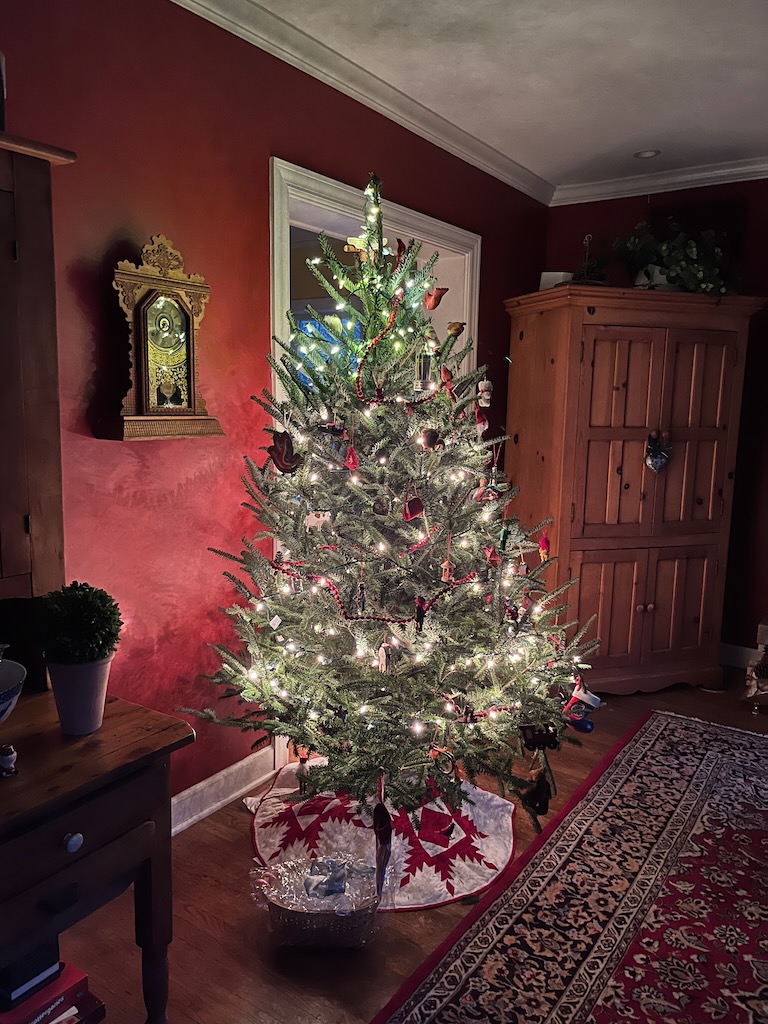
but here, at my make-believe solstice tea, i imagine the tintinnabulation of porcelain teacups being stirred with antique silver spoons, and the pungent perfume of star anise and clove and the peel of one fat orange simmering in my old red “christmasy smell” pot. without make-believing, i inhale the foresty perfume of the fraser fir that, for days now, has stood proud in the corner, obnoxiously blinking because someone pulled the wrong box off the hardware store shelf.

if we were all here, gathered round this old worn table, we’d be shy maybe at first. surely, one or two wouldn’t be because there’s always a livelier wire in every good bunch. but i’m of the shyer persuasion these days, so i’d be purring most loudly simply being a listener. i’m apt to station myself on the circle’s outer edge, and to be the one keeping close and quiet watch. 

i’d delight myself in crowding the table with sugar-dusted spice cookies, crisp and bronze round the edges. and i’d put out a mound of satsuma oranges, the ones plucked with leaves still attached, drawing me that much closer to pretending i’m sitting on the orchard floor, spine leaned against the trunk, peeling a just-plucked orb, watching the clouds waft by. 

and here at the old maple slab, there would be teas by the pots full. and a crackling hearth just across the room, where logs would hiss and pop and flames would leap up the chimney. and warm woolen blankets would be amply piled in a basket nearby. and a drummer boy or two surely would pa-rum-pum-pum-pum from the crackly radio. and maybe i’d set out earthenware bowls, one filled with clementines, another with sprigs of clove, and spools of ribbons, for the making of pomanders while we while away the morn telling stories.

i’d send you home with candy canes. and a fat satsuma too. and to tuck in your pocket, these beautiful, beautiful poems for safe-keeping. the first, from rainer maria rilke, and the next two from wendell berry, the farmer poet from the bluegrass state where i was born. his first is solstice-focused, and the other, a magical reframing of the very first Christmas.

all this my way of saying merry blessed Christmas, and Hanukkah, and Kwanzaa, too. may the glistenings and tinklings and all the spicy perfumes of the season set aglow your deep and tender and most blessed heart…

Advent
The wind in winter woods is like
a shepherd to his flock of flakes
and soon the firs anticipate
how blessed will be the light

and eavesdrop. The garden doves
ready themselves in branches white
and fend off the wind, growing towards
the glory of this night.
—Rainer Maria Rilke

To Know the Dark
To go in the dark with a light is to know the light.
To know the dark, go dark. Go without sight,
and find that the dark, too, blooms and sings,
and is traveled by dark feet and dark wings.
––Wendell Berry

Remembering that it happened once
Remembering that it happened once,
We cannot turn away the thought,
As we go out, cold, to our barns
Toward the long night’s end, that we
Ourselves are living in the world
It happened in when it first happened,
That we ourselves, opening a stall
(A latch thrown open countless times
Before), might find them breathing there,
Foreknown: the Child bedded in straw,
The mother kneeling over Him,
The husband standing in belief
He scarcely can believe, in light
That lights them from no source we see,
An April morning’s light, the air
Around them joyful as a choir.
We stand with one hand on the door,
Looking into another world
That is this world, the pale daylight
Coming just as before, our chores
To do, the cattle all awake,
Our own white frozen breath hanging
In front of us; and we are here
As we have never been before,
Sighted as not before, our place
Holy, although we knew it not.
––Wendell Berry

my hope this day of longest night, when darkness is the victor, is that no matter when or how the darknesses come we always find those and that which brings us light in all its intensities, from flickering to full-on blazing. bless you, bless you, ever bless you…

where do you find your essential light?

that fat little fir up above is the one that fills the room with its insistent eau de forêt

*branch of birds above from beautiful amy years ago….

independent study: the poetry of search

dispatch from 02139 (in which the bleary-eyed one demonstrates that she can rise to fumble with a college paper from 3 till 5 in the morning, return to faux slumber, then get back up and start all over again) …

so here we are, just an hour ago, back before i went to bed the second time, the sky out the front window that looks out over franklin street, and beyond to where the atlantic tickles the shore, it was pitch-black velvet stitched with one french-knot of a star and, dangling just above that, as if buttoned there, one silver crescent of moon.

now, it’s all poufy pink ruffles, backlit in gold, an underskirt of grey inching its way up the legs of the day. the sun rises over boston, over cambridge, over the whole eastern seaboard. the wind in the willows just two yards away, it’s already starting to rustle. the forecast is gloom for today. but when you’re up early, you get the first — sometimes the only — snippets of heaven on earth.

and that’s what i’m looking for here, that’s why i’ve pressed my nose against glass here of late.

oh, i suppose i always knew that behind the story of this trooping off to college, me and my old-fashioned pens and my notebooks (why, i might as well dip quill into inkwell, scritch-scratch my notes onto papyrus, so out-of-date, obsolete, i do seem to be in the land of laptops and iPads), i’d had a hunch that there just might be one other plot line. one other reason for being plucked up and re-planted, half a land mass from home.

i picked up on it early on. back before the start of summer, perhaps, when i first tiptoed through this apartment, spotted the books on the desk of the man who would become my landlord, yes, but more so my lighthouse keeper and guide. he had tall stacks, tomes of poetry, titles that spoke of the sacred. poetry and the divine, it was there in nearly every corner. and i kept poking along.

as i trace my fingers along his bookshelves, in the weeks and months since, i’ve often felt the pull to not leave the apartment, to slide a thin volume off the shelf — any shelf — (there’s wendell berry, thomas merton, a whole thicket of mary oliver, squeezed in between wislawa szymborska, the nobel laureate; there’s e.e. cummings, emily dickinson, and t.s eliot, to run through the c, d and e’s. wallace stevens abounds, as does octavio paz, and a good dash of old robert frost).

i imagine nothing so fine as a seminar for two, if you count bound pages as one half of that pair. i imagine curling up under one of the afghans i’ve pulled from high-above cabinets this week, as autumn’s chill has crept in through the windows. i’ve imagined beginning and launching my poetry school right here where i scramble up eggs, and scrub the sink of its leftover toothpaste.

the school didn’t wait, didn’t dawdle. didn’t put off what october demands (for we pull up stakes, turn back into pumpkins in a mere seven school months).

i knew, back in the summer, that my friend and soon-to-be landlord was writing a book, a book he told me might be the one thing in this world he was meant to make.

the book arrived with a thud on my doorstep this week. it’s titled, “prayers of a young poet: rainer maria rilke,” translated by mark s. burrows.

it’s a beautiful book, a book covered in gold, with a grainy turn-of-the-last-century sepia photo of the great german poet, best known, perhaps, for two works: “letters to a young poet,” published in 1929, and “the book of hours,” in 1905.

“prayers of a young poet” contains, for the first time, rilke’s raw drafts of a cycle of 67 prayers and one long letter written in verse, all penned over the course of three-and-a-half weeks, back in the fall of 1899, in berlin.

they belong, burrows writes, in the genre known as “the poetry of search.”

burrows goes on to tell his afghan-draped pupil that the allure of these prayers is that they give voice to what rilke calls “the stillness between two notes / that don’t easily harmonize.” and there, writes rilke, writes burrows, is where God dwells, within “the dark interval.”

rilke is a poet drawn to the woods, and to the monastery. in these newborn poems, he imagines a monk is the writer, the discoverer of the divine “behind trembling trees,” in the “mushrooms [that] stood up in the forest,” and in the “wet leaves of the blood-red, withering vine.”

but what is pulling me even deeper into the syllabus that spreads across 132 pages is that rilke’s “God,” according to burrows, “is one who is always becoming, ‘the dawning one from whom the morning rose.'”

rilke’s God is not known in intricate trace. rilke’s God is the God of primal darkness, “not sheer absence, but…rather a gesture toward a presence we can ‘sense’ but cannot know.” darkness, burrows writes, is the place of God’s becoming — for rilke, for apostles of rilke.

the poet writes: “I love the dark hours of my being / for they deepen my senses… / From them I’ve come to know that I have room / for a second life, timeless and wide.”

and so, for a student who has dwelled in the murky fog of not knowing for far too long, achingly long, these words come as a trumpet blast of hope.

here, on the pages of a book that landed thwop on my doorstep, i’ve discovered a matchstick to strike in my darkness.

i’m only just 61 pages in, but already i’ve felt its pull, a stirring deep where the pulse begins. i understand that i need to carve out quiet, embroider my days with stillness. it is the poetry of search.

i find it here in the nooks and crannies, the holy sacred rooms this city offers.

in the light-dappled pews of memorial church, on harvard yard, where i slid in yesterday morning, me and my red-strapped backpack, just as the reading began of an amy hempel story that served as scripture.

and, again, just past noon yesterday, when i shoved open the great wood-planked door of the monastery at the bend in the charles river.

i tiptoed in, and found the monks deep in noon song. i fell to my knees on a blue needlepoint cushion. i struck a match, and licked its flame against the wick inside a cobalt blue glass jar.

the blue glowed, a white light of halo within it, behind it. i bowed my head, and did not mind, for once, the not knowing. i am peeling back the poetry of search, and learning that in the darkness of my hours, i just might find what i’ve been waiting for, for so so long.

you can find mark’s rilke book here. who is the author of your most sacred prayer?

must dash (posting this as roughest of  draft); long day of classes, and grammy comes in on the train from portland, maine. big weekend here in 02139.