pull up a chair

where wisdom gathers, poetry unfolds and divine light is sparked…

Tag: pope francis

Dear God, thank you.
Dear God,

Um, I hate to be so bold but we could have used him a little bit longer. (You undoubtedly already know that.) Things are pretty rough around here. Whole swaths of this holy earth, and the people who populate it, seem to have lost their minds. And maybe their souls. 

As You most certainly know, and definitely must have heard, his was the rare voice that could drown out the ungodly noise. The cacophonies of greed and grievance, the ugliness of sin and the Self that thinks it’s higher and mightier. He didn’t let up when it came to the terrible, terrible traumas of war—newborns bombed in hospital nurseries; toddlers drowning in turbulent seas, washing to shore, as if cast-aside flotsam; whole families entombed in the rubble of raining-down concrete and rebar in murderous twists.

He called it where he saw it: called out the avarice of modern capitalism and consumerism, diagnosed it as the fundamental root of the exploitation and suffering of the poor and the vulnerable. Named it “the Devil’s dung.”

He minced not a word in a letter to American bishops this February, when in the wake of the current administration’s drastic deportation campaign, he wrote that while nations have the right to defend themselves, “the rightly formed conscience cannot fail to make a critical judgment and express its disagreement with any measure that tacitly or explicitly identifies the illegal status of some migrants with criminality.”

He didn’t stop there: “The act of deporting people who in many cases have left their own land for reasons of extreme poverty, insecurity, exploitation, persecution or serious deterioration of the environment, damages the dignity of many men and women, and of entire families, and places them in a state of particular vulnerability and defenselessness.”

Il Papa, il mio papa!

Oh, dear God, thank you immensely for making his lifetime line up, at least for a while, with mine. I was starting to fall off the edge there, till the first puff of fumata bianca arose from the Vatican chimney back on March 13, 2013, and the bells from St. Peter’s rang through the city.

Dear Francis filled my lungs again. He preached the version of You that I’d long pressed to my heart, the One taught to me by my post-Vatican II Sisters of Loretto, they who puffed cigarettes behind the convent, traded in their flowy black habits for street clothes and lipstick, all while strumming guitars and singing kumbaya, and all while watching films like “The Red Balloon,” where we little Catholics were meant to evoke the godly meaning from the metaphor.

He was, far as I could tell, a walking-talking, put-your-money-where-your-mouth-is, “love as you would be loved” kind of a guy. He colored wildly outside the lines, as if to shake us out of our stupors, our thinking the ways of the world were the only ways there were. As if to remind that love, honestly, could shatter the worst kind of walls, break through to the tender core at the heart of us all—the one You nestled inside all of us when You breathed us into being. 

His time as the 266th charge of the Church was something of a Kodak carousel of indelible encounters, the ones you cannot forget because they sear you so soundly. (p.s. He was mighty fine with the pen, as well; at least one modern poet called him “the most literary pope of the modern Vatican.”)

He took on no airs. Which made his message all the more of a wallop. He seemed to be saying that we too, in our fumbling, bumbling, banged-up bodies, we too could reach for the heavens. 

His message, quite simply, was to remind that we’re all equipped and ready to cut a swath of radical love through this world. 

And what I really loved about the beloved Argentian Jesuit were the moments when he reached out his arms, and cradled the sobbing child, especially the little boy whose atheist papa had died, and the boy was so very worried about what would happen to his papa. When the little guy was all but choking on his sobs and the words to his question, “Is my dad in heaven?” Francis called out to the little boy, “Come, come to me, Emanuele. Come and whisper it in my ear.” And everyone sobbed, while Francis quelled the boy’s fears and spoke to the crowd: “What a beautiful witness of a son who inherited the strength of his father, who had the courage to cry in front of all of us,” Francis said. “If that man was able to make his children like that, then it’s true, he was a good man.”

Or the little ones born with an extra chromosome who sometimes wandered curiously right onto the altar in the middle of Mass, or a homily, and instead of shooshing the child away, he stood there beatifically smiling, clutching their soft little hand. And went right on with his papal business.
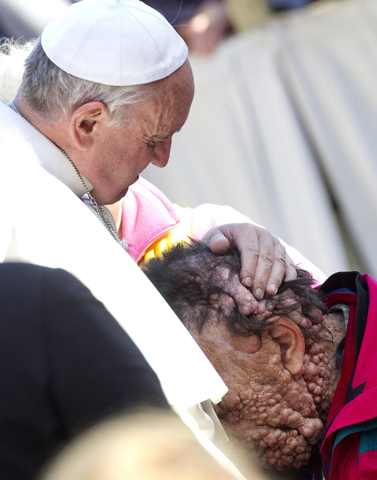
Pope Francis embraces Vinicio Riva, the man with neurofibromatosis.

Or that indelible image of Your Francis first kissing then cradling the man with the eruptions of leathery tumors curdled across his face, his scalp, and clear down his neck. 

And what struck me most, dear God, when I awoke Monday morning to the news that he’d died in the night, was the sudden stunning realization of how breathtakingly he had died—a lesson for us all, and surely for me. I believe he knew these were his last days on earth, when he insisted on leaving the hospital, and knew that until he breathed his last he would teach his last most lasting lessons. In the last week of his life, he visited with 70 prisoners in Rome’s Regina Coeli Prison, from a balcony overlooking St. Peter’s Square he blessed the crowds, and in his Easter Sunday sermon he begged for mercy for “the vulnerable, the marginalized, and the migrants.” He also sent an emissary to preach compassion to the nation’s second-highest ranking executive officeholder and fairly recent convert to Catholicism. 

And then, and only then, he breathed his last. 

I barely have words for the emptiness left in Francis’s wake. It’s rare these days to find a soul who’s proven her or himself worthy of speaking such penetrating truth that the whole world turns an ear to listen. 

We listened, and some of us shouted silent hallelujahs every time. 

We are a world with a spinning moral compass. Up seems down, and right and wrong are inside out and sideways. Hate is cloaked, too often, as a return to the old ways. Truth is chopped into bits and spit back out in bilious flows. 

Are we meant to be the collective voice to fill the new and jarring silence? Is that the point? He constructed the paradigm, handed us the blueprints, and now it’s us who must step to the line, to be brave now? 

Maybe it’s a blessing that much of the world is weeping. Maybe, if we follow our tears, we’ll dig down and rise up. Maybe, like Francis, we can look out at the battle field that is the world and make of ourselves the field hospital set to begin to stanch the bleeding, and work to heal some of the wounds. 

Anyway, God, we’re on it. And thank you, thank you, thank you.

Love, BAM

what memories or moments of Francis most lastingly speak to you?

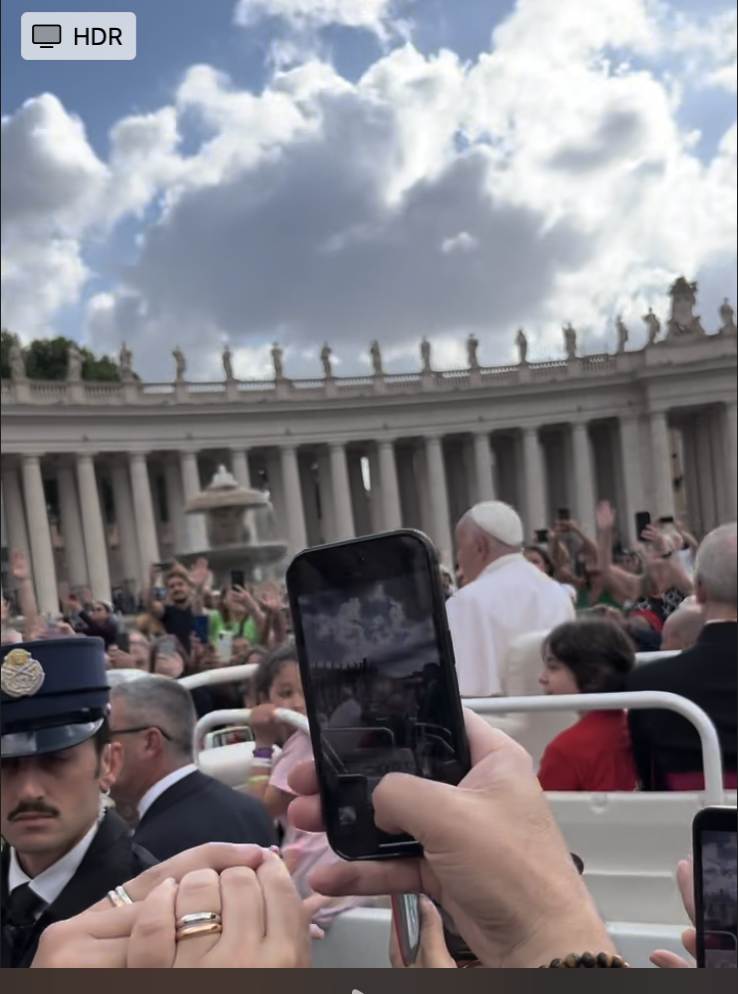
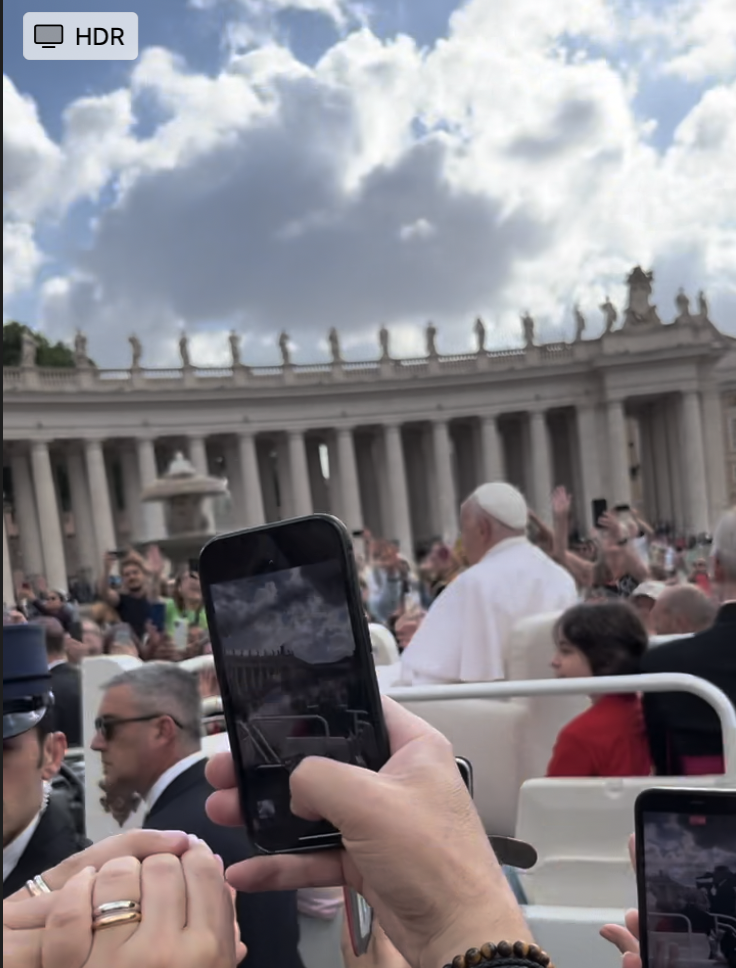
photo above is from the little video i managed to capture when i managed to all but stumble into the path of the oncoming PopeMobile this past summer in St. Peter’s Square….

and p.s.s. a letter to God, i figured, called for capitals. thus, i made rare use of the shift key this morning….
artisanal peace

closest i got to Il Papa, when i found myself accidentally at the barricades that clear the way for the Pope-mobile

sages are in short supply, it seems. certainly now, and certainly on the global scale. i scan where i can, ever on the lookout. and wasn’t my eye caught when i read the words “artisanal path” to “handmade peace.”

tell me more, my little heart shouted. 

though it sounded a bit like a recipe for earthy bread or hand-thrown plates, the sort that rise from the potter’s wheel, i sensed the subject here was far more urgent, and in dire need of replenishing. not what you’d find on any pantry shelf. 

hand-crafted peace, peace constructed with care and attention. peace that we at home can build, without scissors or glue or a potter’s spinning wheel.

i clicked on a duly-provided link, and wasn’t one iota surprised to find that Il Papa, our most beloved Francis, was the one who not only dared to raise his voice above the blather, but considered it a requisite of his job’s description.

he is, after all, shepherd to a farflung flock. but more than that, he’s a prophet, which, according to the definition i found in richard rohr’s brand-new the tears of things: prophetic wisdom for an age of outrage, means a radical change agent, teacher of a moral alternative, and deconstructor of every prevailing order. rohr reminds us of the prophets of ancient times, the ones described by isaiah and ezekiel, whose job it was to hold the powers that be “maddeningly honest.”

bring on the prophets, please.

in these times, francis, our dear pope who from his hospital bed in rome reached out to the suffering of gaza, is the rare voice to which all the world will sometimes listen. thank holy God, he speaks the language of love without condition, clause, or pause. there are those among us, in this age of outrage, who might do well to listen. especially when they claim to take instruction from the very same God who whispers to Il Papa

the new york times calls him “an increasingly lonely moral voice on the world stage.”

all the more reason to listen. and listen hard.

“peace is crafted; it is the work of our hands,” francis began at a prayer vigil in the central african republic back in 2015, “it is built up by the way we live our lives.” he was speaking to an audience of children, teens, and young adults in bangui, the capital of the central african republic, when that country was in the midst of a sectarian war between Christians and Muslims, and thousands had been killed, and more than a million displaced from homes, their properties looted or destroyed.

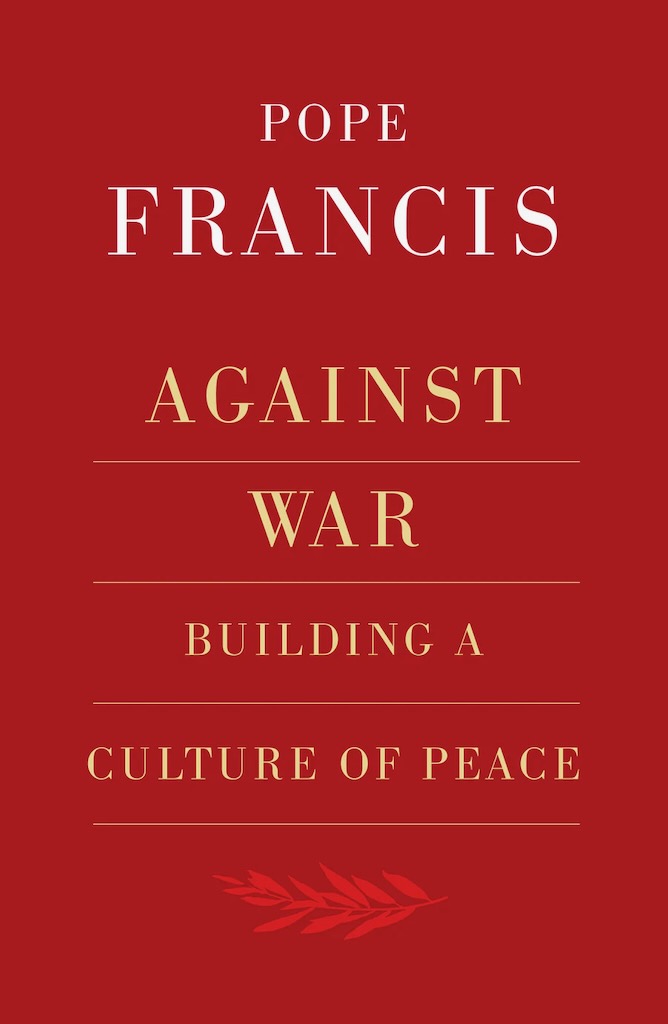
this artisanal path, “built up by the way we live our lives,” is spelled out, it turns out, in francis’s Against War: Building a Culture of Peace, a book i’ve ordered from my local bookstore, as it’s one with permanent claim to a slot on my bookshelf. 

it’s not that i think i can build a culture of worldwide peace, though once upon a time i dreamed of such things. the point here, from the wee bit i’ve read, is that peace is a sphere we build bit by bit, as we travel through space and time, and it’s built by even the most unassuming of gestures, attitudes, and actions.

what the pope is saying, and what the world ought listen to, is that the tiniest empathies and kindnesses matter: giving cuts in the grocery line, waving someone into your expressway lane; taking time to take the call, dropping the tupperware of soup on your neighbor’s stoop. biting your tongue when you’re tempted to snap, and, yes oh yes, turning the other cheek, a trait i’m told no longer belongs in a world of dog eat dog. 

what a game changer: here’s the head of a church that counts 1.39 billion baptized among its ranks, and he too concurs that we needn’t be rocket scientists in the art of magnanimous charitable persuasion to make a dent in the realm of ever-spreading goodness. 

for one thing, it’s fairly contagious. if you’re out-of-the-blue kind to me, if you take my breath away with some wonder act of yours, chances are i’m inclined to be a copy cat and try the same. if for no other reason than the pure joy of watching someone be surprised you’ve not just slammed the door in their sorry, sorry face. 

here’s where Il Papa begins his artisanal path to handmade peace, with this fulsome criticism of the futility of war: 

“war is not the solution, war is madness, war is a monster, war is a cancer that feeds off itself, engulfing everything!”

that’s all i needed to keep on reading. and what i found, and what you’ll find should you decide to play along, is a compendium of his most outstanding commentaries on war and peace during the first nine years of his pontificate. 

here are a few of the nuggets you just might choose to tuck in your peace-gathering pockets. 

because one can’t best the pope when it comes to eloquence and voice, i am quoting from the book, here on in, and plucking five that leap out the most….

1.) seeing the world as one human family living in one common home.

The stars in the sky shine down on every single person — from the beginning of time to today — and learning “to look at the stars” will be “the most effective vaccine for a future of peace,” he said in Ur, Iraq, in 2021.

“Anyone with the courage to look at the stars, anyone who believes in God, has no enemies to fight. He or she has only one enemy to face, an enemy that stands at the door of the heart and knocks to enter. That enemy is hatred,” the pope said.

“There will be no peace as long as we see others as them and not us,” he said. Humanity lives under one heaven, under the gaze of one God who desires his children to be “hospitable and welcoming” to each other on earth.

2.) reconciling with one’s enemies and embracing unity in diversity.

The pope told young people in the Central African Republic that the first step toward being a peacemaker was “never hate anyone. If someone wrongs you, seek to forgive.”

“We only win if we take the road of love,” he said, and, with love, “you will win the hardest battle in life” and find peace.

But “we need to pray in order to be resilient, to love and not to hate, to be peacemakers,” and “you must be courageous,” he added. “Courageous in love, in forgiveness, in building peace.”

3.) the difficult art of dialogue and listening, which can sometimes be as hard as building a bridge over an abyss.

Pride and arrogance must be eradicated from one’s own heart, he told young people at a congress of the educational project, “Scholas Occurrentes,” in 2016. “Our world needs to lower the level of aggression. It needs tenderness. It needs gentleness, it needs to listen, it needs to walk together.”

Dialogue is “the capacity to listen, not to argue immediately, to ask,” he said. “Everyone wins in dialogue; no one loses” because “it is about agreeing to proposals so as to move forward together.”

Dialogue is to put oneself in the other’s place, “to form a bridge” and “persuade with gentleness.”

4.) peace is a constant journey of “getting one’s hands dirty,” concretely working for the common good.

“Our path leads us to immersing ourselves in situations and giving first place to those who suffer,” he said in Assisi for the World Day of Prayer for Peace in 2016.

Feeling responsible for helping others and refusing to be indifferent cleanses the heart and requires the “purification” and conversion that can only come from God, he said in Irbil, Iraq, in 2021.

This new order must meet humanity’s desire for justice, equality and participation, he said in his World Day of Peace message in 2020. A democratic society recognizes everyone’s rights and one’s duties toward others, which can temper a harmful, unbridled understanding of freedom.

5.) living the beatitudes is to bring heaven––and peace––to earth.

In his homily in Baghdad in 2021, the pope said, “We do not need to become occasional heroes, but to become witnesses, day after day,” embodying the wisdom and love of Jesus.

Jesus changed history “with the humble power of love, with his patient witness. This is what we are called to do,” he said, and “that is how the world is changed: not by power and might, but by the beatitudes.”

People who live the beatitudes “are helping God to fulfill his promises of peace,” he said. “This is the way; there is no other.”


in these tumultuous times, i am turning hungrily to prophets and sages in the news and on my dusty bookshelves. i’m inclined to not fill this space with my own blather, but rather to bring any lights that might dapple our paths. it’s always a tug-of-war to quiet the chair or keep it going with whatever bits i find. this doesn’t seem like the time to turn to silence. so my aim is upped to break through blather and bring voices that will wedge open our hearts, and like a doorstop, keep it wedged till we get through to the other side….

what voices broke through to you this week?

holy lights

holy lights

you might think i was lighting vigil lights for my exhausted self, trying to keep the juices flowing just a few more sentences, a few more rounds of edits and revisions. but, in fact, i dipped into my files to find a snap from one of the holiest places i have ever knelt: deep inside the thick stone walls of the monastery by the bend in the charles river, far off now, in 02138.

i’m lodging it squarely on the page this morning because today, as i madly type, at least one more day, i am bringing to the table two bits of holy wonder: the first is a peek inside that monastery, a lovely video clip of a day in the life of brother geoffrey, brother superior of the society of st. john the evangelist. it’s the closest thing i’ve found to taking you by the hand, shoving open the oh-so-heavy oak-timbered doors, and tiptoeing across the hushed stone floors. for those among us who hunger for the occasional dose of monasticism, here’s your peek inside.

the next bit of wonder — and it truly is nothing short of modern-day miracle — is a mind-blowing interview with the new pope, francis, as he sits down with the self-proclaimed atheist founder of the italian newspaper, la repubblica.

there is a deep ecumenical thread to what’s brought to this table, and i certainly haven’t had much to bring from my old catholic church in recent years, but this pope francis is worth a watch. a close watch. and i am watching more and more closely all the time.

at rather a quick clip, he is racking up reasons to pay attention: he reaches into the throngs and embraces the disabled (he lifted into his arms a boy with cerebral palsy, a modern-day pieta, indeed — and on easter sunday, no less). he washes the feet of the sinners. he flicks away the papal apartment, opting instead for austere and simple digs. he drives a used car, for cryin’ out loud (and urges all priests and nuns to do the same). and, best of all, he wouldn’t know a prada if it hit him in the head.

well, check out this latest: he calls up common folk — that’s right, he dials them on his own, gets them on the line — and invites them over for a splash of coffee and conversation. and he sure doesn’t limit his phone calls to confirmed believers. he reaches out to anyone who’s reached out to him, or who might simply offer a stimulating hour’s conversation.

but even more than what he’s doing, it’s what he’s saying that makes me lean in close, listen hard, widen eyes, and fist-bump the heavens, holy hallelujah.

of gays, he said: “A gay person who is seeking God, who is of good will — well, who am I to judge him?”

on abortion and contraception: church hierarchy has been “obsessed,” the word he used, the word that stole headlines.

but i think it’s in the next few lines that the true wisdom is found:

“We have to find a new balance; otherwise even the moral edifice of the church is likely to fall like a house of cards, losing the freshness and fragrance of the Gospel. The proposal of the Gospel must be more simple, profound, radiant. It is from this proposition that the moral consequences then flow.”

here’s the link to the whole of that interview, in the jesuit magazine, america.

and my favorite line from that entire interview:

“I see clearly,” the pope continues, “that the thing the church needs most today is the ability to heal wounds and to warm the hearts of the faithful; it needs nearness, proximity. I see the church as a field hospital after battle. It is useless to ask a seriously injured person if he has high cholesterol and about the level of his blood sugars! You have to heal his wounds. Then we can talk about everything else. Heal the wounds, heal the wounds….”

…the church as a field hospital after battle….heal the wounds, heal the wounds…

ah, but it’s the latest interview, the one in the italian-language repubblica, that i set out to bring here (it’s dizzying, there is so much unfurling so swiftly from the vatican…).

even the big thinker andrew sullivan had his socks knocked off, by the latest. called the pope nothing short of “revolutionary,” and what he said, “miracle.”

i’m thinking that’s precisely the prescription for these times, a revolution laced with miracles.

one last bit of papal poetry, a line worth etching into your living room walls:

“God is the light that illuminates the darkness, even if it does not dissolve it, and a spark of divine light is within each of us.”

finally the link to andrew sullivan’s musings in his blog, “the dish,” and the repubblica interview itself.

as sullivan puts it: “I urge you to read it, whether you are an atheist, an agnostic, a believer or anything in between.”

and i do, too. get comfy. please, pull up a chair.

now, back to typing, stirred by revolution. your thoughts on the vatican’s radical resident, the first in a very long time?