pull up a chair

where wisdom gathers, poetry unfolds and divine light is sparked…

Tag: poetry

of pickled onions and a particular fondness for kentucky’s homegrown farmer bard
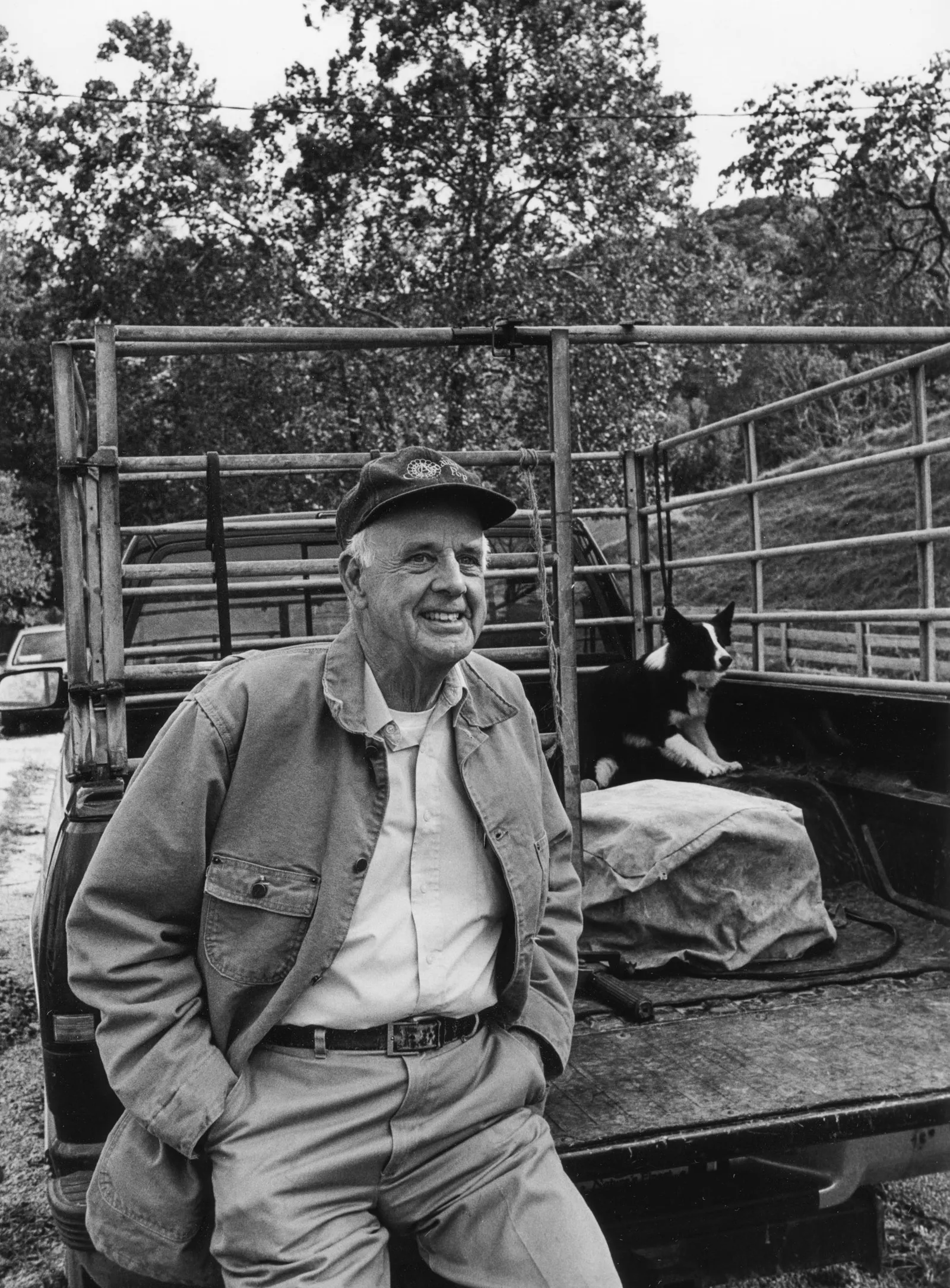
wendell berry

in which the somnolence of summer has settled into its seasonal adagio so much so that pickling a red onion or two, and slow-reading the poetries and musings of one wendell berry is as fever-pitched as it gets around here. welcome to my slo-mo world of the week.

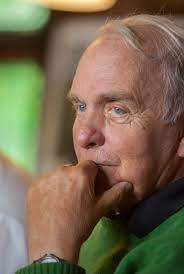
it started when i stumbled on the poem below, a poem that captures the quietude of a couplet of humans who’ve breathed in unison for so long they can fill the silence richly. so it is here in this old house of late, where only two of us now reside. where we know the choreography of most days by heart. and come and go as in a wordless waltz. there’s an ease now, one i never imagined, as i balked mightily long ago about the idea of two lives squeezed under one roof and in a labyrinth of too-tight rooms. but over time, across all these years (near 33), the respirations of our souls have aligned, at least enough to feel our echo in the lines below. those lines, by wendell berry, the poet, novelist, and conservation farmer whom i count as one of my heroes, were just enough to take me down the rabbit hole that is the life and work of kentucky’s homegrown literary treasure. and, besides, mr. berry’s birthday was this week, the fifth of august, wedged, it so happens, between the birthdays of two of the three humans whom i count as pillars holding up my world and whose arrivals to the planet are marked across the week in that steady beat of 4-6-8.

here’s the poem that got me started:

They Sit Together on the Porch
By Wendell Berry

They sit together on the porch, the dark
Almost fallen, the house behind them dark.
Their supper done with, they have washed and dried
The dishes–only two plates now, two glasses,
Two knives, two forks, two spoons–small work for two.
She sits with her hands folded in her lap,
At rest. He smokes his pipe. They do not speak,
And when they speak at last it is to say
What each one knows the other knows. They have
One mind between them, now, that finally
For all its knowing will not exactly know
Which one goes first through the dark doorway, bidding
Goodnight, and which sits on a while alone.

i shared the verse with the one with whom i share these walls, and he wrote back that he found it “haunting,” which made me see the lines anew. and was just enough to prompt a bit more poking around, again reminded how much i love the poetries that come with accumulated lifelong wisdoms. and that’s where i then re-bumped into this 2019 dispatch from the new yorker, a days-long interview between bard and scribe, one distilled and put to paper. it’s worth a read in whole (link below will take you straight to it), but i’ll pluck a few parts should your summer’s day demand a snappier pace than mine (or should a paywall keep you out):

the dispatch, titled Going Home with Wendell Berry, is by amanda petrusich, a new yorker staff writer and writer-in-residence at the gallatin school of individualized study at NYU. a 2016 guggenheim fellow, she writes often about music, and blessedly for us she takes the occasional road trip down kentucky way. in this case, she wound her way to where berry’s farmed for more than four decades, a little town that goes by the name port royal. sixty-three miles from the dot in the blue-grass map my papa called home (paris, KY), and one mile from the meandering kentucky river, it’s a town you might think ol’ garrison keillor pulled from his imagination. (in 2010, its population, according to the U.S. Census, was all of 64 humans.) it’s a town one writer (sandra mcCracken, a singer-songwriter) described thusly (and not too surprisingly given the threadworn quilt that is rural america these days): “Port Royal is a patchwork strip of storefronts, a blink-and-you’ll-miss-it sort of spot made up of a local bank, a post office, a general store with a built-in diner (with little printed signs about their town’s famous author, Wendell Berry), and an old Baptist church. I am sad to report that, like most small towns in our country, Port Royal looks as though it is dying.” 

here’s how the new yorker‘s chronicling of that luscious conversation between journalist (petrusich) and poet (berry) begins:

Two and a half years ago, feeling existentially adrift about the future of the planet, I sent a letter to Wendell Berry, hoping he might have answers. Berry has published more than eighty books of poetry, fiction, essays, and criticism, but he’s perhaps best known for “The Unsettling of America,” a book-length polemic, from 1977, which argues that responsible, small-scale agriculture is essential to the preservation of the land and the culture. The book felt radical in its day; to a contemporary reader, it is almost absurdly prescient. Berry, who is now eighty-four, does not own a computer or a cell phone, and his landline is not connected to an answering machine. We corresponded by mail for a year, and in November, 2018, he invited me to visit him at his farmhouse, in Port Royal, a small community in Henry County, Kentucky, with a population of less than a hundred.

Berry and his wife, Tanya, received me with exceptional kindness, and fed me well. Berry takes conversation seriously, and our talks in his book-lined parlor were extensive and occasionally vulnerable. One afternoon, he offered to drive me around Port Royal in his pickup truck to show me a few sights: the encroachment of cash crops like soybeans and corn on nearby farms, the small cemetery where his parents are buried, his writing studio, on the Kentucky River. Berry’s connection to his home is profound—several of his novels and short stories are set in “Port William,” a semi-fictionalized version of Port Royal—and his children now run the Berry Center, a nonprofit dedicated to educating local communities about sustainable agriculture. Our correspondence would continue, but, before I left, Berry gave me a broadside letterpress of his poem “A Vision.” I think often of some of its final lines, which clarify, for me, what it means to truly know a place:

Memory,
native to this valley, will spread over it
like a grove, and memory will grow
into legend, legend into song, song
into sacrament.

here’s but one of the questions captured from their conversation (with a few lines in bold for emphasis):

Q: Have you always farmed here?

A: Right away, we had a large garden, and we kept two milk cows. We fattened two hogs to slaughter, for our own meat. We had a flock of chickens. And we had some fruit that we produced ourselves, and some that was wild. We were sitting down during that time to a lot of meals that came entirely from under our own feet by our own effort. And our children came up in that way of living. The integration of the various animals and crops into a relatively small acreage becomes a formal problem that is just as interesting and just as demanding as the arrangement of the parts of a novel. You’ve got to decide what comes first, and then you work your way to the revelation of what comes last. But the parts also have to be ordered. And if they’re ordered properly on a farm, something even more miraculous than most art happens: you have sustainability. Each thing supports the whole thing.

and here’s another exchange:

Q: It’s funny, clarity is often undervalued in art. One of the things I admire about your writing, especially the essays, which feel like polemics, is that you’re very clear in your arguments. They’re beautifully supported. In the new book, you talk about how you often read seeking instruction. I’m curious how you balance that idea with reading for beauty, savoring the visceral pleasure of words.

A: You’re being fed in an essential way by the beauty of things you read and hear and look at. A well-made sentence, I think, is a thing of beauty. But then, a well-farmed farm also can feed a need for beauty. In my short story “The Art of Loading Brush,” when Andy Catlett and his brother go to a neighbor’s farm, there’s a wagonload of junk, and it’s beautifully loaded. Andy’s brother says, “He couldn’t make an ugly job of work to save his life.” In the epigraph I use from Aldo Leopold he questions if there’s any real distinction between esthetics and economics.


and here, in case you’re even a little bit hooked, is a poem worth reading in whole. it’s from a 1965 volume of Poetry magazine, and it’s excerpts from an early Berry wonder, titled, “The Handing Down,” a poem about a grandfather and grandson sitting on a porch and the quiet conversation that unspools between them. read those excerpts here.


oh, and about those onions. . . my kid, the one who turned 23 yesterday, finds himself a line cook these days at a chicago eatery of some notoriety; girl and the goat, it’s called, and stephanie izard, who dreamed up the joint seems to have a particular fondness for things pickled. she pickles everything from kumquats to mushrooms to beets. i decided pickled red onions might be a summery thing to do, and besides i like a little crunch amid the strata of my sandwich. and, as with many a task in my kitchen, i pickle the easy way. no cauldrons steaming for me. no sterilizing jars and lids. i dumped a little of this, stirred in some of that, and by next morning, i had a jar of garnet rings shimmering in my fridge. i’m not fond of sugar these days (i never was, and then a dear friend told me cancer is fond of sugar, making it something of a foe of mine, thus i’ve perma-sealed my lips to sugar’s sweetness), so i searched for pickling roadmap that steered clear of the sugar bin. here’s what i found: (and ps i have no real clue what whole30 compliant means, so feel free to disregard.)

what captured your fancy this week, quick-clipped or slow?

of darkness and sunlight in shifting proportion

night was on my mind this week, as the sunlight upon us stretched to its longest shift of the year, the apex of the solstice on thursday, and now the night grows longer minute by minute till winter’s solstice takes its turn, a doh-si-doh of celestial bodies. the interplay of light and shadow is eternal, has been, according to genesis, since the beginning, day one. and it was good. 

it might seem counterintuitive to contemplate night when the day is at its longest, but it’s often through the paradoxical that insights are gleaned. a wise and soulful priest pointed me toward considering the illuminations that come in darkness, at a saturday morning retreat in the great gothic-revival church that so often stirs me these days. 

and then through the week, i kept stumbling on poems that made me marvel, made me think deep and deeper of the hours of darkness. here are two: 

The night never wants to end, to give itself over
to light. So it traps itself in things: obsidian, crows.
Even on summer solstice, the day of light’s great
triumph, where fields of sunflowers guzzle in the sun—
we break open the watermelon and spit out
black seeds, bits of night glistening on the grass.

––Night in Day by Joseph Stroud

Night Ferry
by John Burnside

Had I been less prepared, I would have left
in springtime, when the plum tree in the yard
was still in bloom,
the windows open after months of snow,
one magpie in the road
and then another.

I could have slipped away, late afternoon,
while everyone was busy somewhere else,
the fish van at the corner, children
dawdling home from school
in twos and threes, a porch light
lit against the dusk on Tollbooth Wynd.

Give me these years again and I will
spend them wisely.
Done with the compass; done, now, with the chart.
The ferry at the dock, lit
stern to prow,
the next life like a footfall in my heart.

it’s the last stanza of burnside’s that spoke to me most profoundly. “give me these years again and I will / spend them wisely.”

and then, with celestial bodies on my mind, i stumbled onto john burroughs, the naturalist whose wisdoms and poetries never fail to stir me. 

“If I had my life to live over again, and had my choice of celestial bodies, I am sure I should take this planet, and iI should choose these men and women for my friends and companions. This great rolling sphere with its sky, its stars, its sunrises and sunsets, and with its outlook into infinity — what could be more desirable? What more satisfying? Garlanded by the seasons, embosomed in sidereal influences, thrilling with continents — one might ransack the heavens in vain for a better or more picturesque abode.” — John Burroughs 


but mostly this week i indulged in the sunlight of one of the oldest, dearest friends i have on this planet: my roommate in college, my roommate after college, my maid of honor, godmother to my firstborn, and my heartmate and soulmate through life’s most scouring hours. she’s a california girl, blond still (naturally so), and more beautiful than ever, and she married a man who might be the twin separated at birth from the one i married. not only do they both wear the exact same spectacles, they both dress in old-line khakis and oxford-cloth shirts, and think deeply about the subjects they love (film for the one from LA; bricks, mortar, and marble for the one i married) as well as the ideas that animate the life of the mind. we played, the four of us, at being playful: took long walks through woodsy ravines, gobbled ice cream from cones, motored downtown to see georgia o’keeffe at the art institute, and before we got there stumbled into one of the world’s great symphony orchestras rehearsing schumann’s piano concerto in frank gehry’s bandshell with someone billed as one of the world’s greatest pianist. all for free. and all in the sunlight.

and tomorrow, my firstborn marks another spin around the sun at the center of it all. there are not enough blessings under that sun for me to wish and hope and pray for my boy, but i wish every last one for him and his heart and his soul and his dreams. happy blessed life, you who made me a mama.

how did you mark the solstice, the day when the sunlight shines longest?

bibliotherapy: of fictional nature

i tend to ground myself in the world in all its nitty-gritty. that mattered (critically) when i was a nurse (don’t you dare inverse a systolic for a diastolic, when it comes to blood pressure reading), and in all my decades of chasing after news, the truth—and every grimy detail—was what we sought. thus, when i peruse the bookshelves of my local free library (the world’s most generous invention, to be sure), i am nearly always in the down-low where no windows are, where the endless rows of fact not fiction reside. 

i’m decidedly non-fictionally inclined.

but this week i was lulled into the rooms upstairs, the rooms where sunshine streams through sky-high windows, and where make-believe is the order of the room. in other words, i crept up to where the fiction is. and in the writings of one irish novelist, a fellow i’d give anything to sit with in any irish pub, or better yet to stroll the rocky coastline of the continent from which half my peoples come, i found the surest cure for running from the blues. 

niall williams is his name, an irishman, who is but a year younger than me, and who has gathered wisdom as an old stone takes on a mossy coat. i can almost see the glint in his eye, as from some quiet post in the corner of a dimly-lit, crossbeamed room, he’s kept closest watch on the quirks and comedies of human nature. and on the heartbreak too. as the tenderness he kneads into his prose and paragraphs has left me gasping more than once (and i am only eight chapters in). 

the book is this is happiness, as prescriptive a title as a girl in search of antidote might want. 

the irishman had me at chapter 1: “It had stopped raining.” (that’s the chapter in its entirety.)

chapter 2 picked up where 1 left off: “Nobody in Faha” (the fictional irish town that just happens to be a spot on the map not far from where my non-fictional peoples hailed) “could remember when it started.” by the third sentence of that second chapter, i was ready to shove up my shirtsleeves and not move an inch till i’d turned the last page. it went like this: “[Rain] came straight down and sideways, frontwards, backwards, and any other wards God could think of. It came in sweeps, in waves, sometimes in veils. It came dressed as drizzle, as mizzle, as mist, as showers, frequent and widespread, as a wet fog, as a damp day, a dreeping, an out-and-out downpour.” 

and on it goes, plip-plopping along, this incantatory passage that soon enough tells us that the unrelenting rain came “like a blessing God had forgotten he had left on.”

this is nothing less than bliss in garamond font (a literary typographic detail nearly always spelled out at the back end of any book); and most certainly for a girl who penned a paragraph of her own, in her most recent book, that unfurled in uncannily kindred ways. c’est moi:

“Rain, like most of us, has its moods. In its more laconic hours, it comes on unsuspectingly, without folderol, timpani, or cymbal crashing, the barest slip of a presence and suddenly you’re bespattered. On the days when rain is tempestuous, furious, raging, it rattles the heavens, cleaves the night, pummels the trees, and sends all the world—even the puddle-­paddling robins—running for cover. Betwixt and between, it’s the master of a thousand voices, from the salubrious plopp—the drop with a splatter—to the militaristic rat-a-tat-tat, when the rain tries to pretend it’s a handful of pebbles thrashing your windows, and on to the audible gulp when a downpour is frothing your gulleys. The Brits, reliably saturated in the subject, offer a lengthy lexicon for precipitation’s multiple personalities: there’s a basking (drenching in heavy shower); a drisk (misty drizzle); a fox’s wedding (sudden drops out of clear blue sky); a hurly-burly (thunder and lightning); a stotting (rain so hard it bounces up off the ground); and, for closers, thunner-­pash (heavy shower with thunder). Because it’s so elemental, the life stuff of our very existence, the celestial surge that fills our rivers and waters our crops, rinses away the detritus, bathes all the woods, and the sidewalks as well, it’s been the subject of intense preoccupation and prognostication for a long, long time. time. Since ever ago.”
(p. 85, The Book of Nature)

is there not a hint here of shared joy in precipitatory romps? can you not feel the two of us––niall et moi––luxuriating in the many, many wondrous ways to say “the rain is unrelenting”?

i am hardly alone in my enamorment of mr. williams. my best best friend, a longtime children’s librarian in the los angeles public schools, couldn’t stop texting me pictures of its pages this week, and, soon after, when i mentioned to a beloved literary friend (a sister chair, who might reveal herself below) that i’d fallen into novel love, she reminded me that she’d told me so a few years back. as always, i am late to my own party. 

in any case, here’s what the new yorker had to say back at the dawn of 2020, in the year of our covid, when happiness whirled onto the world stage.

This Is Happiness, by Niall Williams (Bloomsbury). This elegiac novel is as unhurried as its setting: Faha, a village in western Ireland, “unchanged since creation” until, in the late fifties, electricity arrives. The narrator, now elderly, reminisces about that time; having come from Dublin as a teen-ager, to live with his grandparents after the death of his mother, he conceived a hopeless passion for three sisters. “We spend most of our lives guarding against washes of feeling, I’m guarding no more,” he promises. The novel’s description of a lost rural life style, and the gaps between a young man’s romantic expectations and the inescapable letdown of reality, is comic and poignant in equal measure.

all of which is to say that bibliotherapy is one of the world’s great cures for whate’er ails you. and even more so when it ferries you off to a wee irish village “where story was a kind of human binding,” where church pews were filled as if by unwritten order, where front doors were never closed in daytime nor backdoors locked at night, and where, we’re told, “religion lasted longer … because we were an imaginative people, and so could most vividly picture the fires of Hell.” 

and wherein the self-described antiquarian narrator notes in passing, “i know it seems unlikely that Faha then might have been the place to learn how to live, but in my experience the likely is not in God’s lexicon.”

the world these days is wearying. and worrying, too. my week began with a funeral, a breathtakingly beautiful one that wove buddhist and roman catholic threads but was tragic nonetheless, and was followed by a seder where the weight of gaza and jerusalem bore down on every heart. by week’s end, i’d heard tell that my kid was nearly carjacked, and a dear friend who lives alone (and has borne already more than too much suffering) is on the cusp of twelve rounds of godawful, pray-to-God-it-works chemo for the newly-diagnosed cancer in her lungs.

the blooms outside my kitchen door were doing all they could to boost the perfumed quota in the vernal air, and the robins busied themselves constructing scrappy nests in my window box along the alley. (do not ask me to tell you the tragic tale of the mama robin who was tangled in a dessicated grapevine, nor of the nest no longer in the works.) all the earth’s wonderment––glorious as it is as winter erupts into spring––is ephemeral, is here, then, poof, it’s gone. 

but what i find on the page is lasting. can be read and read again. can be indelibly inked into the files of our mind.

and so, this week, a newfound balm and friend was found. and i’ll be tucked away in faha, on the fictional irish coast, for as long as the pages will carry me. bibliotherapy rarely fails me. 

what carried you away this week?


here’s a jolt of joy that took my breath away this week: the great christian mystic richard rohr, a franciscan friar and ecumenical teacher, and his new mexico-based Center for Action and Contemplation saw fit to surprise me by clipping an excerpt from The Book of Nature in his daily meditations on wednedsay. that he chose a favorite passage, the story of brother lawrence, the barefoot monk who saw God in the pots and pans of his parisian monastery kitchen, and was struck by the innate holiness of a nuck-naked little tree, only charmed me all the more. here’s a peek at the preaching of the trees.


and from this week’s commonplacing. this morsel from DH Lawrence:

The vast marvel is to be alive… The supreme triumph is to be most vividly, most perfectly alive. Whatever the unborn and the dead may know, they cannot know the beauty, the marvel of being alive in the flesh. The dead may look after the afterwards. But the magnificent here and now of life in the flesh is ours, and ours alone, and ours only for a time. We ought to dance with rapture that we should be alive and in the flesh, and part of the living, incarnate cosmos. I am part of the sun as my eye is part of me. That I am part of the earth my feet know perfectly, and my blood is part of the sea. My soul knows that I am part of the human race, my soul is an organic part of the great human soul… There is nothing of me that is alone and absolute except my mind, and we shall find that the mind has no existence by itself, it is only the glitter of the sun on the surface of the waters.

this, from mary oliver

Morning Light

by MARY OLIVER

Every morning
 the good news
  pours
   through the field

touching
 every blossom
  every stem
   and each of them,

on the instant
 offers to be part of it—
  offers to lift and hold, willingly
   the vast burden of light

all day.
 In my life
  I have never seen it to fail—
   flower after flower

leaf after pearly leaf,
 to the acre,
  to the massy many,
   is silvered, is flooded;

and such voices
 spangle among it—
  larks and sparrows—
   all those small souls—

are everywhere
 tossing the quick wheels of pleasure
  from their red throats
   as they hang on—

as though on little masts
 of golden ships,
  to the tops of the weeds—
   and that’s when I come—

that’s when I come, crying out to the world:
 oh give me a corner of it
  to lift also, to sing about, to touch
   with my wild hands—and they do.

and this from annie dillard‘s the writing life, prose laid out as a poem by my friends at SALT Project:

One of the few things I know
about writing is this:
spend it all, shoot it, play it, lose it,
all, right away, every time. 

Do not hoard what seems good
for a later place in the book,
or for another book;
give it, give it all, give it now. 

The impulse to save
something good
for a better place later
is the signal to spend it now. 

Something more will arise
for later, something better.
These things fill from behind,
from beneath, like well water. 

Similarly, the impulse to keep
to yourself what you have learned
is not only shameful, it is destructive.

Anything you do not give
freely and abundantly
becomes lost to you. 

You open your safe
and find ashes.

and finally, this goodbye to “poetry’s colossus,” helen vendler, whom i was blessed to call my teacher in our year of sumptuous thinking

and blessings to you, and thanks for whirling by….

p.s. the other two books in my bibliotherapy stack (above) are william’s history of the rain, which had me at the title, and letters from max: a book of friendship, an epistolary collection between a poet and a playwright: sarah ruhl, the twice pulitzer-finalist playwright who was once teacher to poet max ritvo and quickly became dear friends, and as max’s cancer grew worse, their connection deepened. suleika jauoad ran an excerpt the other day in her isolation journals, and i ran to the library to grab a copy.

looking into the darkness

maybe it’s the darkness we’re meant to look into. deep into. maybe halves of the world go darkest once a year, so we become practiced. so not only our eyes but our souls learn to widen the aperture, to let in whatever droplets of light there might be. or maybe it’s the inky darkness itself we’re meant to wrap ourselves in. to not be afraid.

maybe we’re left to our own devices when the darkness comes — and it will come — so we learn to find our way. steady our wobbling, put meat to the muscle that holds us upright. in a lifetime’s ebb and flow of darkness and light, it’s the shadowed chapters that have made me the deeper parts of who i am. maybe we should all look to the roots wriggling down below the frozen crust of earth to see how it’s done, how the growing comes unnoticed, in the tabernacle of earthly darkness.

maybe we’d be wise to consider the hidden work of wintertide, the profound intelligence unfolding where eyes cannot see, where sense cannot reach.

in this year’s darkest hour, i can’t say i was up keeping night vigil, awaiting the nadir of night. i was not out in my yard, kindling sticks and dried-up old leaves, setting a bonfire to keep the darkness at bay. fact is, i was felled by a bug that did have me up moseying about the house in the wee hours, but not to contemplate the darkness.

what i did do, as is my wont (and i did it by daylight), was gather up words, snippets of poetry, that made me think about light and darkness, and the shimmering shards we need to find to keep from tumbling headlong into the abyss.

the world this christmas is dark indeed. more than ever, we need to light our way. and pray that our penumbra illumines the path of those who travel nearby.

a solstice offering…

Let the ordinary be in your hand;
hold it open and imagine a bird landing,
offering all it possesses in trust
to come to you.

Learn to look for the little things
that weigh nothing at all,
but fill the heart with such light
they can never be measured.

-Kenneth Steven*, Seeing the Light 


To go in the dark with a light is to know the light.
To know the dark, go dark. Go without sight,
and find that the dark, too, blooms and sings,
and is traveled by dark feet and dark wings.
 
-Wendell Berry


Holding the Light
 by Stuart Kestenbaum

Gather up whatever is 
glittering in the gutter,
whatever has tumbled 
in the waves or fallen 
in flames out of the sky,

for it’s not only our
hearts that are broken, 
but the heart
of the world as well.
Stitch it back together. 

Make a place where
the day speaks to the night
and the earth speaks to the sky.
Whether we created God
or God created us

it all comes down to this:
In our imperfect world
we are meant to repair
and stitch together 
what beauty there is, stitch it 

with compassion and wire. 
See how everything 
we have made gathers 
the light inside itself
and overflows? A blessing.


i keep watch on a few monastics who dwell in the heart of france. brother laurence, a modern-day mystic, sent along this the other day, a wonder of imagery from the winter’s solstice at Newgrange, a stone-age relic and world heritage site that rises from the earth not too, too far from the irish sea along ireland’s eastern shore. he sent a short video along with this short meditation:

“New Grange is a monumental 5,000 year-old burial mound in Count Meath, Ireland. At sunrise on December 21st, the first ray of direct sunlight from the new-born sun precisely, silently, enters the narrow aperture over the entrance, penetrates into the mound of solid rock and fills the inner chamber with golden light for seventeen minutes. Light overcomes darkness. It is irresistible and yet gentle. As it grows stronger with occasional surges, its intensity increases and the power of its beauty. It communicates purely by itself – the meaning of truth.

“I hope you can take time to watch this short silent video of the phenomenon. It captures a sacred moment, the revelation of God in nature. And it may give you a sense of how the light of Christ, the light of truth, actually enters and changes our world.” (Laurence Freeman, OSB)


and finally, for those among us who find the poetic to be a vessel of the ineffable sacred, this from a Paris Review interview with the late great Louise Gluck. i particularly swooned over the line that a poem “is like a message in a shell held to an ear”…:

From the beginning, Glück cited the influence of Blake, Keats, Yeats, and Eliot—poets whose work “craves a listener.” For her, a poem is like a message in a shell held to an ear, confidentially communicating some universal experience: adolescent struggles, marital love, widowhood, separation, the stasis of middle age, aging, and death. There is a porous barrier between the states of life and death and between body and soul. Her signature style, which includes demotic language and a hypnotic pace of utterance, has captured the attention of generations of poets, as it did mine as a nascent poet of twenty-two. In her oeuvre, the poem of language never eclipses the poem of emotion. Like the great poets she admired, she is absorbed by “time which breeds loss, desire, the world’s beauty.” –Henri Cole


*as this is the second Kenneth Steven poem in as many weeks, you can bet i am following his thread and will be finding out more about this scottish poet and children’s book writer. and gathering up his new book of poems, Seeing the Light, from my favorite friendly librarians….

where are you gathering up shards of light these days?

in which we pause to remember one who would bristle at being called the patron saint of anything. . .

She stretches from Sharon Olds’ Stag’s Leap to Christine Valters Paintner’s Dreaming of Stones on my bookshelf. Sixteen volumes in all. And that’s just the poetry. Doesn’t count her essays, housed on a whole other shelf. I am talking, of course, of the poet I call my “patron saint of paying attention.” Mary Oliver. 

You might also say she’s the poet master of astonishment. She breaks me out in goosebumps and wonder. Line after line after line.

Oh, I’ve heard her poetries dismissed for their “surface simplicity and populist reach.” But when it comes to stirring my soul, I’ve no need for the critics. I side with those who, as was written in her New York Times obituary, find that “her poems, which are built of unadorned language and accessible imagery, have a pedagogical, almost homiletic quality.”

I call them holy. 

Give me a writer who can write of the “uncombed morning,” or confess that “sometimes I am that quiet person down on my knees.” Or cobble together words into a stanza that reads: “All things are inventions of holiness / Some more rascally than others.” Give me that writer and I’ll hitch my starship any last day.

These days, this long hard season, I seek saving grace wherever it falls. I find it in an evening’s sky punctuated by dragonflies drifting and darting in parabola. I find it in any sentence that ends “unlikely distant metastasis.” And I most certainly find it in the poet who reminds me: “So quickly, without a moment’s warning, does the miraculous swerve and point to us, demanding that we be its willing servant.” 

Count me willing.

Emily D. taught me to look for and love the slant, the wisdom that slides in on a steep-edged, improbable angle. Mary O does that every time. I am reading of a bluefish being washed at the water’s edge, and suddenly I am remembering to be on the lookout. To find God, the Holy, in all of creation. Or, as Emerson put it: “To attend all the oratorios, the operas, in nature,” in life, in the day upon day. 

Mary O is the one who puts her ink to the sacred as it spills across creation’s page. How else to describe the one who, when writing of a lone seal pup found on a desolate beach, muses: “. . . maybe / our breathing together was some kind of heavenly conversation / in God’s delicate and magnifying language, the one / we don’t dare speak out loud, / not yet.”

Pay attention to how she places that very last line. The barbed last hook. The one that sticks in your craw just a little bit longer. Whispers a gossamer faith. Mary O was a theologian of the barest brushstroke. You’d barely know you were shaken, but then you quake through to your deepest marrow. 

Mary Oliver’s birthday is September 10. She would have been 88.

And here, in her poem “Messenger,” she describes her life’s work:

My work is loving the world.
Here the sunflowers, there the hummingbird—
equal seekers of sweetness.
Here the quickening yeast; there the blue plums.
Here the clam deep in the speckled sand.

Are my boots old? Is my coat torn?
Am I no longer young, and still half-perfect? Let me
keep my mind on what matters,
which is my work,

which is mostly standing still and learning to be
astonished.
The phoebe, the delphinium.
The sheep in the pasture, and the pasture.
Which is mostly rejoicing, since all the ingredients are here,

which is gratitude, to be given a mind and a heart
and these body-clothes,
a mouth with which to give shouts of joy
to the moth and the wren, to the sleepy dug-up clam,
telling them all, over and over, how it is
that we live forever.

—by Mary Oliver


Seeing Not Looking

Celtic scholar Esther de Waal considers Thomas Merton’s practice of contemplative photography:   

Thomas Merton was of course a writer and a teacher, and a poet, but he was also a photographer, and it is from his photographs that we learn much about how he saw the world, and how he prayed—and the two are of course intimately connected…. He handled a camera as an artist would, and used it as an instrument of delight and perception. It was in the later 1950s that the journalist John Howard Griffin [1920–1980] visited Merton in his hermitage. He had his camera with him and … let [Merton] keep it on extended loan. At first when Merton sent him the negatives, John Howard Griffin was puzzled, for [Merton’s] view was so different from that of most people. Merton photographed whatever crossed his path—a battered fence, a rundown wooden shack, weeds growing between cracks, working gloves thrown down on a stool, a dead root, a broken stone wall. He approached each thing with attention, he never imposed, he allowed each thing to communicate itself to him in its own terms, and he gave it its own voice.  

Later on when he was out in the woods with a young friend, Ron Seitz, both with their cameras, Merton reprimanded him severely for the speed with which he approached things. He told him to stop looking and to begin seeing:  

Because looking means that you already have something in mind for your eye to find; you’ve set out in search of your desired object and have closed off everything else presenting itself along the way. But seeing is being open and receptive to what comes to the eye…. [1] 

He used his camera primarily as a contemplative instrument. He captured the play of light and dark, the ambience, the inner life. But above all he struggled towards an expression of silence through the visual image, so that his photographs show us that ultimately his concern was to communicate the essence of silence. 


it’s the month of Elul in the Jewish calendar, a month for accounting of the soul before the high holidays, Rosh Hashanah, the new year, and Yom Kippur, the day of atonement. i’ve been deep in soulful accounting, and bring along this prayer from the blessed Rabbi Nachman, who taught that life should be lived with joy. and centered in prayer.

A Prayer of Rabbi Nachman of Bratslav (1772-1810)

Grant me the ability to be alone;
may it be my custom to go outdoors each day
among the trees and grass – among all growing things
and there may I be alone, and enter into prayer,
to talk with the One to whom I belong.
May I express there everything in my heart,
and may all the foliage of the field –
all grasses, trees, and plants –
awake at my coming,
to send the powers of their life into the words of my prayer
so that my prayer and speech are made whole
through the life and spirit of all growing things,
which are made as one by their transcendent Source.
May I then pour out the words of my heart
before your Presence like water, O God,
and lift up my hands to You in worship,
on my behalf, and that of my children!


hummingbird photo (above) by shelia zimmerman, sister of my beloved late friend mary ellen sullivan, may her memory be a blessing, (and it is. every day.)

happy blessed sunday birthday to a personal patron saint of mine, mark burrows.

looks like i was in the mood for capitals this morning, maybe just to prove i know how to find the shift key. hope you don’t mind the tall letters every once in a while. i do understand how it makes a sentence filled with proper nouns a bit easier to read…..

let’s play a bit of book group: what are some of your favorite Mary O lines, or words, or phrases?

p.s.s. i almost forgot: i’m taking The Book of Nature on the road this weekend. sunday afternoon, in fact, when i’ll be at Winnetka’s Book Stall at 2 p.m. for a book talk canceled last spring and now back on the calendar. problem is my little voice has gone missing again, and my vocal cord injections are on the books for tuesday, so it’ll be a bit squawky but the show must go on. it’s also Printers Row LitFest this weekend, so lots of getting pulled in several directions. wherever you are, have a lovely blessed almost-autumn weekend.

early morning

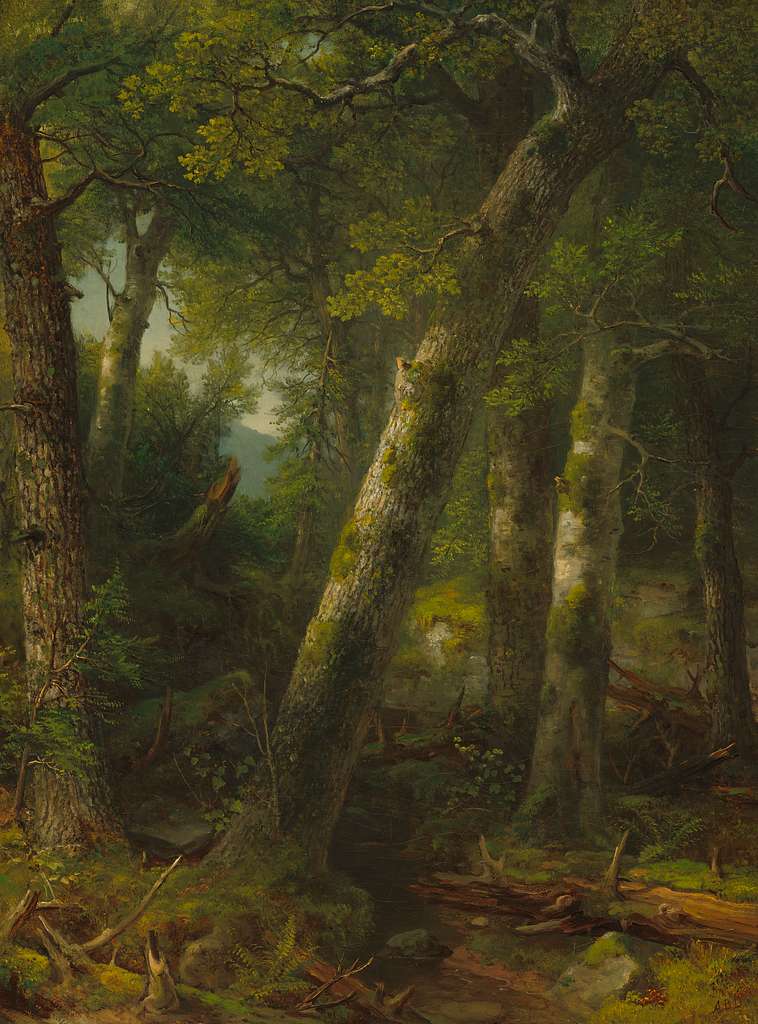
Forest in the Morning Light, 1855 (Oil on Canvas), by Asher Brown Durand

early morning is when the veil is thinnest, my soul most porous. i sometimes imagine the air i breathe then, the soft air, the air a recipe of oxygen and dew, is dispatched directly from the heavens. it’s why i slide out from under the bedsheet, to begin the percolating thoughts that rise while the coffee brews. i step outside, and there, as always, is my old friend ancient moon. all but winks at me, that moon, lets me know i’m not alone. there’s watchkeeping at work. from up where angels roam.

my thoughts feel less alone then. in bed they sometimes wrestle me, won’t let me sleep. but once i’m upright, once there’s mug in hand, and moon above, they settle down, fall in some semblance of a line. i find sense then. i feel infused then. infused in a Godly way. as if my gliding out of bed when the clock strikes five gives me just a wee little jump on what God might want me to consider. as if that might be the hour when the clarity comes.

this morning was one of those mornings, after a long, long week that took every ounce of courage my little self contained. i flew hundreds of miles away to talk to a doctor who knows a thing or two about the cancer in my lung. i walked into a shiny tower with expanse of glass, where as much light could shine in as the heavens had to spare. the place is infused with light, as if to tip the balance of all the darkness you can feel in every hallway, in every bent over human body, bodies leaning on canes, on walkers, in wheelchairs, on whomever walks beside them. where every body seemed to have an extra limb in the form of plastic tubes and tiny pumps, all attached, sometimes trailing, peeking out from under pant legs or flapping-open gowns, or tethered to misbehaving poles. all chasing out the demon cells that know not when to stop.

to sit in those waiting rooms is to witness human compassion at its most majestic. hands rubbing shoulders, rubbing backs. hands trying to knead the ache out of someone else’s flesh and bone. foreheads pressed against foreheads. words whispered. holy words. the most emphatic prayers i might ever have witnessed from across a room.

the prayers prayed there are the ones that gush up from untapped places in the soul. those places not known till life excavates to its deepest depths. till prognoses are spelled out, and sentences put forth — and i don’t mean the sentences with verb and nouns.

my visit was not so dire, but it was a visit that’s left me plenty to sift through, as i work hard — so hard — at absorbing all that’s been, and deciding how to seize my holy, holy days.

so i’m up early. where me and God are most likely to bump into each other. where sometimes when i plant my bum on the stoop just beyond the kitchen door, i almost feel another shoulder rubbing up against mine.


little gems just kept floating my way this week, in that way that sometimes blessings know to come. r.s. thomas, an anglican priest poet who kept watch on the rocky edge of wales, is one of my most favorite holy poets. i discovered him when i went to poetry school at yale divinity school a few blessed summers back. reading him always carries me back to the sunlit seminar room where i first met him.

THE BRIGHT FIELD

I have seen the sun break through
to illuminate a small field
for a while, and gone my way
and forgotten it. But that was the
pearl of great price, the one field that had
treasure in it. I realise now
that I must give all that I have
to possess it. Life is not hurrying

on to a receding future, nor hankering after
an imagined past. It is the turning
aside like Moses to the miracle
of the lit bush, to a brightness
that seemed as transitory as your youth
once, but is the eternity that awaits you.
— R. S. Thomas


this one came from a gentle tender soul who breathes poetry. i thought as i started to read it, that she had written it, but then i glanced down and saw “david whyte,” another in my pantheon of saintly poets, the ones who capture threads of my very own heart and weave them into stanzas…

AT HOME

At home amidst
the bees
wandering
the garden
in the summer
light
the sky
a broad roof
for the house
of contentment
where I wish
to
live forever
in the eternity
of my own
fleeting
and momentary
happiness.

I walk toward
the kitchen
door as if walking
toward the
door of a recognized
heaven

and see the
simplicity
of shelves and
the blue dishes
and the
vapouring 
steam rising
from the kettle
that called me in.

Not just this
aromatic cup
from which to drink
but the flavour
of a life made whole
and lovely
through the
imagination
seeking its way.

Not just this
house around me
but the arms
of a fierce
but healing world.

Not just this line
I write
but the
innocence
of an earned
forgiveness
flowing again
through hands
made new with
writing.

And a man
with no company
but his house,
his garden,
and his own
well peopled solitude,

entering
the silences
and chambers
of the heart
to start again.

   -from The House of Belonging
David Whyte


this one, from pablo neruda, needs no introduction. simply behold it.

Night,
night of mine,
night of the entire world,
you have something inside you, round
like a child
about to be born, like
a bursting
seed,
it is the miracle,
it is the day.
You are more beautiful
because with your darker blood
you feed the poppy being born,
because you work with eyes closed
so eyes can open,
so water can sing,
so our lives
might resuscitate. 

Ode to Night by Pablo Neruda (translated by Ilan Stavans)


and here, if you’ve read all the way down to here, is one last succulence. again, sent by a friend, a blessed friend, of this old chair.

Life is amazing. And then it’s awful. And then it’s amazing again. And in between the amazing and awful it’s ordinary and mundane and routine. Breathe in the amazing, hold on through the awful, and relax and exhale during the ordinary. That’s just living heartbreaking, soul-healing, amazing, awful, ordinary life. And it’s breathtakingly beautiful.

L.R. Knost

what time of day is thinnest for you? and did any gems flutter from the heavens for you this week?

i swear there must be more babies born in august than any other month (it’s not the case; i’ve checked) and some of my favorites are in the parade: my beloved brother david (today); my beloved blair (sunday, in which he will find himself among those competing in the triathlon world’s big national swim, bike, run along milwaukee’s lakefront); and my teddy (who is camping under the stars out in the rocky mountains for the next two weeks, and whose big day is tuesday). happy birthday to each of you whom i love with every chamber of my heart and then some! xoxoxox

writing school

we call it “the kitchen table writing school,” and every once in a while someone i love, someone who’s eager to put words to a page with more oomph or less ouch, wanders over and we plunk our bums down on the chairs, pull out pads of paper and pens, and have at it. might be muscular verbs, the lesson of the day. might be fluid lines of poetry. might be all about one-of-a-kind telling details, not a profligate slop of as many descriptives as can fit in a breath, but that one singular––and immediate––detail that telescopes layers of meaning and knowing into a single keen––and immediate––observation. (while i was poking around for a good example, i came across this, and can’t say it one iota better, so here’s this from the gotham writers’ workshop):

A telling detail does what it says: it tells the essence of what it’s describing. Telling details are the scotch tape holding up Susie’s hemline in the back, the tiny piece of ice that never seemed to melt in the bottom of Mom’s martini, the street sign on the corner that still says, to this day, SCHOOL CROSSING, though the school is long gone. A telling detail can speak volumes in a very short amount of time. They help you achieve a golden mean–enough description to paint the picture, but not so much as to weigh it down.

Chris Lombardi

so whilst i’m puttering about in my so-called quiet summery time, i gathered up a few fine thoughts on the subject of writing, a thread that draws together many of us here at the old maple table. so pull out your pens––or your pencils––and follow along…

first up, this delicious bit from rainer maria rilke, from his Notebooks of Malte Laurids Brigge:

“For the sake of a few lines one must see many cities, men and things. One must know the animals, one must feel how the birds fly and know the gesture with which the small flowers open in the morning. One must be able to think back to roads in unknown regions, to unexpected meetings and to partings which one has long seen coming; to days of childhood that are still unexplained, to parents that one had to hurt when they brought one some joy and one did not grasp it (it was a joy for someone else); to childhood illness that so strangely began with a number of profound and grave transformations, to days in rooms withdrawn and quiet and to mornings by the sea, to the sea itself, to seas, to nights of travel that rushed along on high and flew with all the stars — and it is not yet enough if one may think of all of this. One must have memories of many nights of love, none of which was like the others, of the screams of women in labor, and of light, white, sleeping women in childbed, closing again. But one must also have been beside the dying, one must have sat beside the dead in the room with the open window and the fitful noises.”

so luscious is this instruction, i might scribble it onto a square of paper, fold it, and tuck it into my pocket, to pull out and read at regular intervals.


and, in keeping with pens and pencils, naomi shihab nye, one of my favorite poets, plays right along…

ALWAYS BRING A PENCIL
by Naomi Shihab Nye

There will not be a test.
It does not have to be
a Number 2 pencil.

But there will be certain things —
the quiet flush of waves,
ripe scent of fish,
smooth ripple of the wind’s second name —
that prefer to be written about
in pencil.

It gives them more room
to move around.


no less than the great david bowie has this to say about writing:

“Never play to the gallery… Always remember that the reason that you initially started working is that there was something inside yourself that you felt that if you could manifest in some way, you would understand more about yourself and how you coexist with the rest of society. I think it’s terribly dangerous for an artist to fulfill other people’s expectations — they generally produce their worst work when they do that.

“…If you feel safe in the area that you’re working in, you’re not working in the right area. Always go a little further into the water than you feel you’re capable of being in. Go a little bit out of your depth, and when you don’t feel that your feet are quite touching the bottom, you’re just about in the right place to do something exciting.”

go a little bit out of your depth…maybe in writing, and in this thing called living…


and finally there’s nick cave who is something of a mystic, a mystic who happens to be in the business of making music, and lifting words from the soul and onto the page…

“There is more going on than we can see or understand, and we need to find a way to lean into the mystery of things…. and recognise the evident value in doing that, and summon the courage it requires to not always shrink back into the known mind.

“…The luminous and shocking beauty of the everyday is something I try to remain alert to, if only as an antidote to the chronic cynicism and disenchantment that seems to surround everything, these days. It tells me that, despite how debased or corrupt we are told humanity is and how degraded the world has become, it just keeps on being beautiful.”

on the lookout for the luminous as i step into this day, one that began with the rumbling of distant thunder and broke into a light show of celestial proportion, luring me leapingly from under my bedsheets…


and which of these thoughts spark deeper rumblings in you? might it be bowie’s “go a little bit out of your depth? or nick cave’s remaining alert to “the luminous and shocking beauty of the everyday”? or is there a telling detail you stumbled upon this week that won’t let you go? do tell…

(a few gremlins seem to have put my font through the wash, and shrunk it, and while i try to bring it back to size, apologies for the wee wee words here…)

contemplating hope . . .

In Any Event

If we are fractured
we are fractured
like stars
bred to shine
in every direction,
through any dimension,
billions of years
since and hence.

I shall not lament
the human, not yet.
There is something
more to come, our hearts
a gold mine
not yet plumbed,
an uncharted sea.

Nothing is gone forever.
If we came from dust
and will return to dust
then we can find our way
into anything.

What we are capable of
is not yet known,
and I praise us now,
in advance.

Dorianne Laux

i am contemplating hope, as it seems to me — and maybe to you, too — that we are living in a darkening world. a world whose headlines are chasing me away, whose headlines often sicken me. i find myself feeling the urge to draw within, to curl into a tight mollusk, a chambered nautilus of the soul. i look at flickers of the news and hear the echoes of history, a boomerang of hideousness i never dreamt would come this way again. 

i am giving thought to how to live in a world where darkness gathers, how to keep an ember glowing. in my soul and in my world. can random acts of kindness be enough to keep the incandescence from extinguishing? is unending prayer enough to shift the course of history, to undermine the ugliness that seems without end or purpose? has it ever been?

i’d been thinking more humility was the desperately-needed imperative, the very thing this self-obsessed world — intoxicated by celebrity, by overblown parading in the public square — most emphatically calls for. i still think so. humility in a world of supersized ego is as countercultural as can be. and it just might expand our gaze, allow us to see past our own blinding appetites, make us more willing to quietly, determinedly turn the other cheek. to be the necessary instruments of peace, to sow pardon where there’s injury, love where there’s hatred. it’s a centuries-old prayer, the prayer of st. francis, and it is true for me each and every morning. now more than ever.

but read a little further in the prayer, and it calls for hope where there’s despair. 

despair is spreading like a cancer. it undergirds the cynicism everywhere. it’s the magnetic pull toward apathy. it’s surrender punctuated with slamming of the door. it snuffs out every shard of light.

so now i’m thinking hard about hope, the counterforce of gloom, despondency, profound sorrow (each and every one, another name for despair). where does hope begin? how might we stir it? feel its updraft catch beneath our wings? 

i don’t have answers. 

in time, though, i may stumble on inklings.

but there are poets, now and ever. poets like dorianne laux, whose words came to me this week and made me feel that fetal kick that might be where hope begins. when someone wiser and deeper draws the faint outlines of the life ropes we just might need. 

dorianne laux

dorianne laux, who worked as a waitress, a sanitorium cook, a gas-station manager, and a maid before getting a BA in english at 36 from mills college in oakland (and has gone on to be a pulitzer finalist, and a guggenheim fellow), and who is absolutely one of my most beloved poets, begins with “fractured” in the poem above. 

fractured is how i sometimes feel. fractured has sharper edges than just plain broken. fractured is what bones do when they split and crack. sometimes hairline, sometimes compound. fractured makes a snapping sound. fractured is low-down broken. sometimes shattered.

but dorianne doesn’t leave us at fractured. she turns our gaze swiftly toward the stars, which are fractured too, but into pretty little points. and it’s the points of stars where the shining, twinkling comes. it’s where the light pings or oozes i don’t know which; i’m not a physicist of the heavens. i’m only someone who watches and wonders. maybe it’s where the light –– twinkling, shining –– bounces off the brokenness. it’s the brokenness that makes for the dizzying luminescence. stars in their brokenness are bred to shine in every direction. maybe that’s something to think about.

and then dorianne goes on to tell us that it’s not time yet to lament. “there is something more to come,” she promises. 

our hearts still are goldmines to be plumbed. our little bitty self-contained vessels of all that’s good, all that’s holy; no one’s got a right to reach in and steal those hearts, to tap those hearts of all that’s bottled up inside. all the sweet succulence of all the kindness we’ve known in our whole lives. all the times we’ve been forgiven. all the times someone gentle looked our way and whispered words that might have made us feel beautiful, and seen. don’t abandon those sacred hearts, turn over the keys to whatever evil awfulness might flatten you. guard those good and plenty hearts as if your life depended on it, as if the good world depended on it. because it does, it does. 

and so, dorianne was just the lifeline i needed as i began to consider hope, as i set out to figure out how to live wisely and luminously in a world where dark skies are growing denser in the distance. 

my considerations of hope are only just beginning.

What we are capable of
is not yet known,
and I praise us now,
in advance.

where do you find hope? does it come in faint traces, or in bold strokes that sometimes bowl you over? do you sometimes feel the hairline fractures in your heart or your soul? 

i let it rip this week. once upon a time, this would be the very sort of meander my mother-in-law would have met with deafening silence. too dark, she’d diagnose it. and leave me to second-guess the whole day long. should i have held back? but to ignore the chasms that rend us apart, push us away from one another, to ignore the fallout that inevitably shrouds the tender among us is to let the rot seep in till it’s too, too late. i am determined in my searching for hope. and thank you, dorianne, for pointing me in hopeful direction….

something screwy happened when i was typing and all of the sudden everything shrank. i tried and tried to fix it, but it might still be screwy. i’ll keep trying to fix it. till then, put on your magnifying lenses……

the sodden state of summer’s back-to-school days . . .

it’s been getting heavier and heavier all week. my heart, that is. the boy i love—or one of ‘em anyway—is heading off again. one last time. to school, that is. we’ll be playing follow-the-leader, interstate-style, this weekend, when he pushes off with a trunk filled to the gills, and i follow not far behind with a wagon equally jammed. i’m enlisted only for my skill at hospital corners (a nurse’s way of tucking in bedsheets), and my knack for stuffing things in the teeny spaces that qualify as dorm-room closets. 

all week, amid a blur of other complications, i’ve felt my heart grow heavy with tears not yet spilled. the country roads the whole way home––just me and some fine book on tape––will make for a bucolic sponge for salt-water spillage. 

that boy is the best of company, that boy of the very big heart and the disposition best described as super chill, and ever animated. the boy fills this old house, and every heart in it.

so, once he’s left behind, back here at the homestead it’ll feel hollow once again till we get used to the long pauses of silence, till we get used to a room where the door isn’t sealed shut to hide the disarray inside. 

a wise someone once told me that if i thought high school blurred by in a blink, i’d find college blurred in half a blink. and so it is. eight years after dropping off his big brother one last time, it’s time for the caboose to part as well. this is it: the end of tuition checks and dorm vernacular, the end of considering time in back-to-school and semester allotments.

there’s perhaps a better chance that this one will find his way back home, to call sweet chicago the place where he belongs. but till then, nine months will trickle by. 

it’s the leave-taking that always bumps me up. the saying goodbye is not my strong suit. my trouble in that department dates back to when i was five and my papa got a big new job in a city far away, and every sunday night for the rest of a school year, he slid behind the wheel of his turquoise ford falcon and headed down the drive while i sat slumped on the concrete stoop there in the garage. i remember crying till my cheeks hurt. and going to bed with tummy aches. till he came home on friday nights.

nowadays i cry while spritzing the bathroom mirror, and when luring dust bunnies out from under the college kid’s bed, once he’s emptied it, once he’s faded into the faraway. then i try to find my way again, to find the joy in silence, in the slower pace with which the fridge and pantry empty, in the fewer loads of laundry. in that bathroom mirror that never splatters.

it’s come and go, all life long. and we’re wise to make the most of those blessed hyphens in between.

in the weeks ahead, i’ll be busy plotting my new cloister garden as a six-foot wall is being erected (straight through a chunk of what had been my garden, and hard up against our once-breezy screened-in summer porch) even as i type. i’m thinking of it as my monastery wall––the cedar barricade shutting out all the troubles of the world. but the thing i’ll miss most is the slant of sunlight at the twilight hour, as the great orb sinks low and the shafts of light get long and longer. it’s a golden glow that makes my summer porch seem gilded with celestial stardust. 

and because the last round of page proofs got delayed till next week, i’ll fill my quiet hours with the intense concentration those pages demand. and then it’s off to the printer as i await the day the box of books lands plop on my doorstoop. 


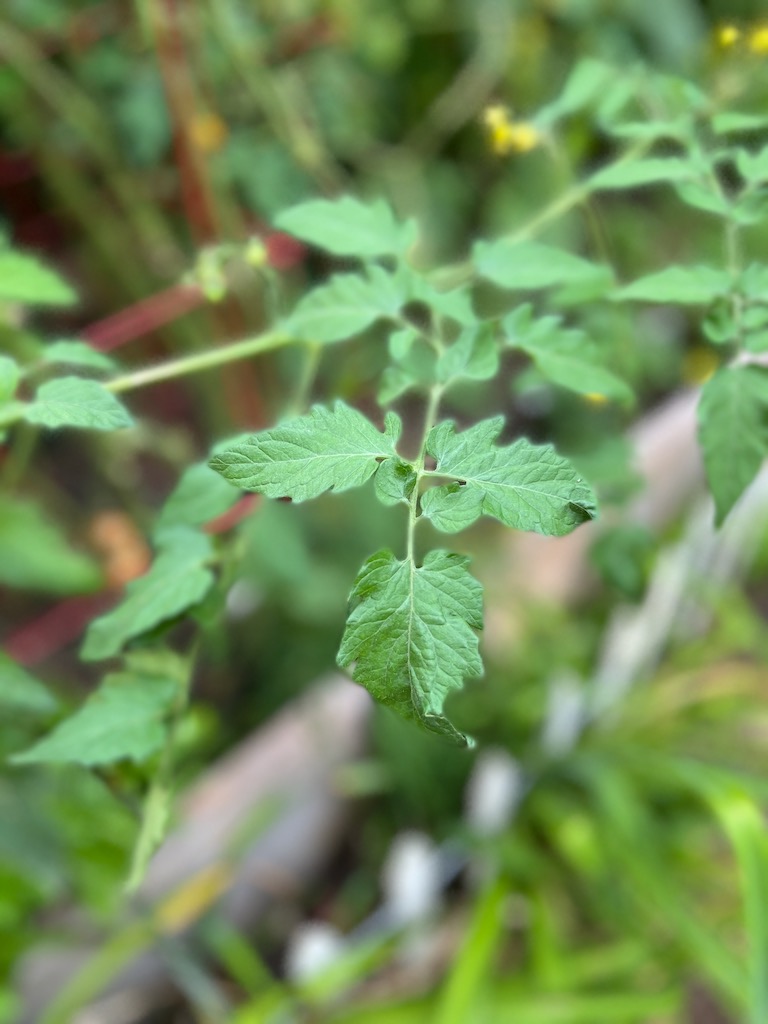
cook’s corner: here’s a truly nifty thing i bumped into this week (if meat lovers thrill to find a way to use every bit of the beast, from tongue to tail, then we who love the produce patch thrill just as mightily to find there’s more to the vine than just the fruits!). as one with a plethora of tangled vines, and one who sniffs deeply of my finger tips after plucking my daily tomato harvest, this enlightenment brings double the delight from those vines. and it’s all about the leaves…

How to Cook with Tomato Leaves

Tomato leaves contain 2-isobutlythiazole, a compound responsible for the plant’s distinctive aroma. Commercial tomato products, like ketchup, often include an isolated form of that compound to boost fresh tomato flavor.

If you have a garden full of tomatoes, though, you’ve got a great source of 2-isobutlythiazole right in your backyard. Here’s how to use tomato leaves to boost your sauce’s flavor.

1. When you harvest your tomatoes, pluck a handful of leaves from the plant.

2. Toss the leaves into the sauce and steep them for 10 minutes.

3. Remove and discard the leaves. 

Taste your sauce, and you’ll find that the tomato flavor has been both heightened and made more complex and earthy.


commonplacing:

from poet and pacifist William Stafford, found in his son Kim Stafford’s intimate portrait, Early Morning: Remembering My Father:
every day Stafford would write a page in his journal, his response to what he called “the emergency of being alive.” 

we are all of us deep in the emergency of our being alive…


a little bit of Buechner, in memory of the blessed man who died at 96 on monday. 

Frederick Buechner

a few years back, in 2016 to be precise, i counted a new collection of writings from theologian frederick buechner, with introduction by anne lamott, as one of the best books for the soul that year. his death this week made me pull that review from the shelf, and perhaps it’ll prompt you to pull a bit of buechner from your own bookshelf or that of your nearest library. 

Buechner 101: Essays and Sermons by Frederick Buechner

By Carl Frederick Buechner, Introduction by Anne Lamott, Frederick Buechner Center, 170 pages, $15.99

Maybe once a generation, once every few generations, someone is born with gifts literary and sacred, in equal brilliant measure. A translator, perhaps, of the highest calling. One who can at once lift our souls and our sights, by virtue of the rare alchemy of the poetic plus the profound. Therein lies the prophet. Therein lies Frederick Buechner, at 90, one of the greatest living American theologians and writers.

In these collected works, Buechner 101: Essays and Sermons by Frederick Buechner — a table of contents that includes excerpts from his Harvard Divinity School lectures, The Alphabet of Grace; a searing essay on his daughter’s anorexia; a seminary commencement address on the hard truths of pastoring a flock of believers, doubters and everyday sinners — we are introduced to, or immersed in, the depth and breadth of this rare thinker’s literary and soulful gifts. 

Anne Lamott, in her introduction, admits to being blown away by Buechner’s capacity “to be both plain and majestic” at once. She ranks him side-by-side C.S. Lewis, then declares, “No one has brought me closer to God than these two men.”

That alone might make you rush to pore over these pages. What I know is that this world sorely needs a prophet who reminds us to not give up our search for holiness amid the noise and hate and madness all around. Buechner, though, says it in words that work as poetry, shimmying through the cracks, burrowing deep within us, reverberating long after the page is turned. He writes: “We must learn to listen to the cock-crows and hammering and tick-tock of our lives for the holy and elusive word that is spoken to us out of their depths. It is the function of all great preaching, I think, and all great art, to sharpen our hearing precisely to that end.”

And it is that very sharpening that we find, paragraph upon paragraph, page after page, in Buechner 101


poet’s corner:

two poems worth pressing against your heart…

Field Guide

Once, in the cool blue middle of a lake,
up to my neck in that most precious element of all,

I found a pale-gray, curled-upwards pigeon feather
floating on the tension of the water

at the very instant when a dragonfly,
like a blue-green iridescent bobby pin,

hovered over it, then lit, and rested.
That’s all.

I mention this in the same way
that I fold the corner of a page

in certain library books,
so that the next reader will know

where to look for the good parts.

––Tony Hoagland

Moon

The moon is full tonight
an illustration for sheet music,
an image in Matthew Arnold
glimmering on the English Channel,
or a ghost over a smoldering battlefield
in one of the history plays.

 It’s as full as it was
in that poem by Coleridge
where he carries his year-old son
into the orchard behind the cottage
and turns the baby’s face to the sky
to see for the first time
the earth’s bright companion,
something amazing to make his crying seem small.

 And if you wanted to follow this example,
tonight would be the night
to carry some tiny creature outside
and introduce him to the moon.

And if your house has no child,
you can always gather into your arms
the sleeping infant of yourself,
as I have done tonight,
and carry him outdoors,
all limp in his tattered blanket,
making sure to steady his lolling head
with the palm of your hand.

And while the wind ruffles the pear trees
in the corner of the orchard
and dark roses wave against a stone wall,
you can turn him on your shoulder
and walk in circles on the lawn
drunk with the light.
You can lift him up into the sky,
your eyes nearly as wide as his,
as the moon climbs high into the night.

––Billy Collins


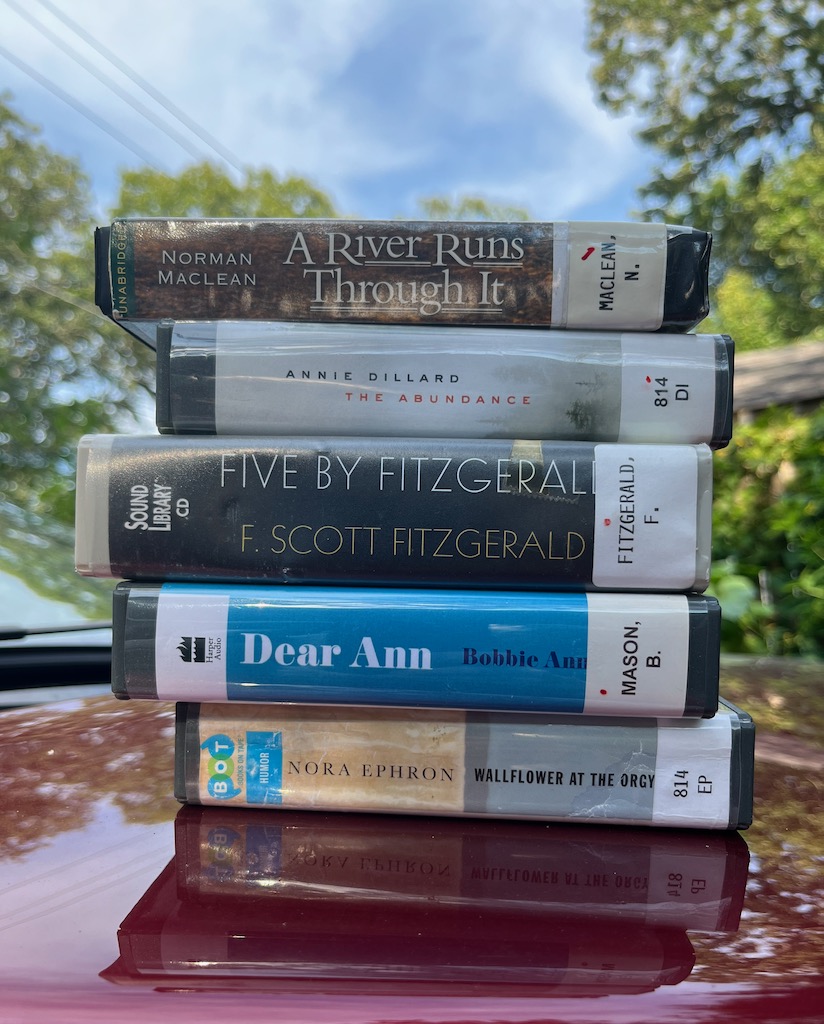
listening nook: because i’ll be coursing through the countryside in my red wagon this weekend, i’m bringing my reading nook on little discs. here’s the stack assembled from the library shelves:

A River Runs Through It, Norman Maclean: i once was graced to work alongside Norman’s son John, a fine fine bespectacled gent with a much quieter, more studious demeanor than many of the newsroom characters. his father’s masterwork  stands as one of the great “evocations of nature’s miracles…and a probing of human mysteries.”

The Abundance, Annie Dillard: a landmark collection from the writer i consider my north star.

Five by Fitzgerald, F. Scott Fitzgerald: i’m ever trying to expand and deepen my knowledge of the American canon and F. Scott deserves more of my attention. 

Dear Ann, Bobbie Ann Mason: mason, like me, is a kentucky native, so i feel it my native obligation to inhale her prose and her poetic ways of unspooling a story. i read my first bobbie ann mason so long ago, and it’s been ages since, so where better to reacquaint ourselves than the rolling countryside of the heartland we both call home?

Wallflower at the Orgy, Nora Ephron: ephron makes me laugh so hard i’d best keep an eye out for rest stops along the way. en route to one parents’ weekend, we listened to Heart Burn, her tale of woe from her years married to and divorcing from none other than journalistic legend Carl Bernstein. we loved listening so much we were sort of bummed we had to stop the car in ohio, where our kid was a freshman in college, and couldn’t roll along till, say, the atlantic seaboard, where we could have gotten a few more hours of ephron under our belts….


a bit more buechner, because there’s never enough:

“What we hunger for perhaps more than anything else 
is to be known in our full humanness, and yet that 
is often just what we also fear more than anything else. 
It is important to tell at least from time to time the secret of who we truly and fully are . . . because otherwise we run the risk of losing track of who we truly and fully are and little by little come to accept instead the highly edited version which we put forth in hope that the world will find it more acceptable than the real thing. It is important to tell our secrets too because it makes it easier . . . for other people to tell us a secret or two of their own . ”

Frederick Buechner

and with that, this week’s edition of the chair gazette is a wrap. question of the week: how will suck the succulence out of summer’s august sweetness?

college kid this week, on the brink of one last back-to-school.

summer’s fever pitch

i feel it, as if a whoosh about to come, when suddenly i’ll be sitting wrapped in a sweater looking out at the glistening autumnal goldenness, asking myself “where did the summer go?”

maybe we all feel it. maybe that’s why there’s a fever pitch in the air. squeezing in those few things you would not let pass by in these summery months: the sitting outdoors with a breeze in your hair, as you order your food and let someone else do the cooking; the staying up late, under the stars, talking the night away with the college kid who, once he’s gone, might go weeks without finding time for a phone call; throwing a towel on the sand, baring your arms and your legs, sensing the splash and the roar of the waves just inches away, and hours later, perhaps when sliding into your jammies, unplucking the last stubborn grains of sand from in between your toes. because summer is all of those things. 

summer is for savoring because summer, like any season when we’re keeping close watch, is fleeting. evanescent, a fancy name for flashing by. 

we all have our own definitions for the season of indolence, the season when sloth is not only allowed but welcomed. what makes it special in my book are the moments i dare to break rules, do what otherwise might count as overindulgence (oh, my catholic childhood––just post-baltimore catechism––does continue to hold me in its clutches). 

i remember as vividly as anything the summer’s night when my mom and i sat in the dark of the kitchen, our backs pressed against the fridge, with an aluminum pan of chilled fudge (the kind you made from a box) and two spoons and we giggled like schoolgirls trying out truancy. 

sometimes what makes summer summer is simply its sense of abandon, the que-sera season, i’ve called it.

i remember chasing through the yard with a glass jar and a lid poked by a nail, in quixotic pursuit of the flickering lights of the firefly. (speaking of fireflies, how’s this glorious expression thereof: “To behold the skywriters tracing poesy in summer’s vapors, to decipher their sticky sweet nothings, their blinking reminders that we are meant to shine in our short time.”) i remember running barefoot, something i’ve not done in a long, long swath of years.

nowadays––now that trays of fudge are no longer, and chasing through grass in the dark would count as orthopedic risk––summer is finally getting to sink into a book once the work of the week is turned in. summer is piling high whatever i find in the fridge, and calling it “salad for dinner.” summer is waking as soon as the birds start to sing, so i can sneak into the day ahead of the blistering heat. 

mostly nowadays, summer is holding on tight to the hours i’ve got before the boy i so love packs up and goes. back to college, one last time…

how do you define summer? and what are the summery moments you’ll never forget?


summer reading:

these are the books i’m diving into once i turn in my latest round of pages scoured and scrubbed of all typos and bloops. my stack inspires me….

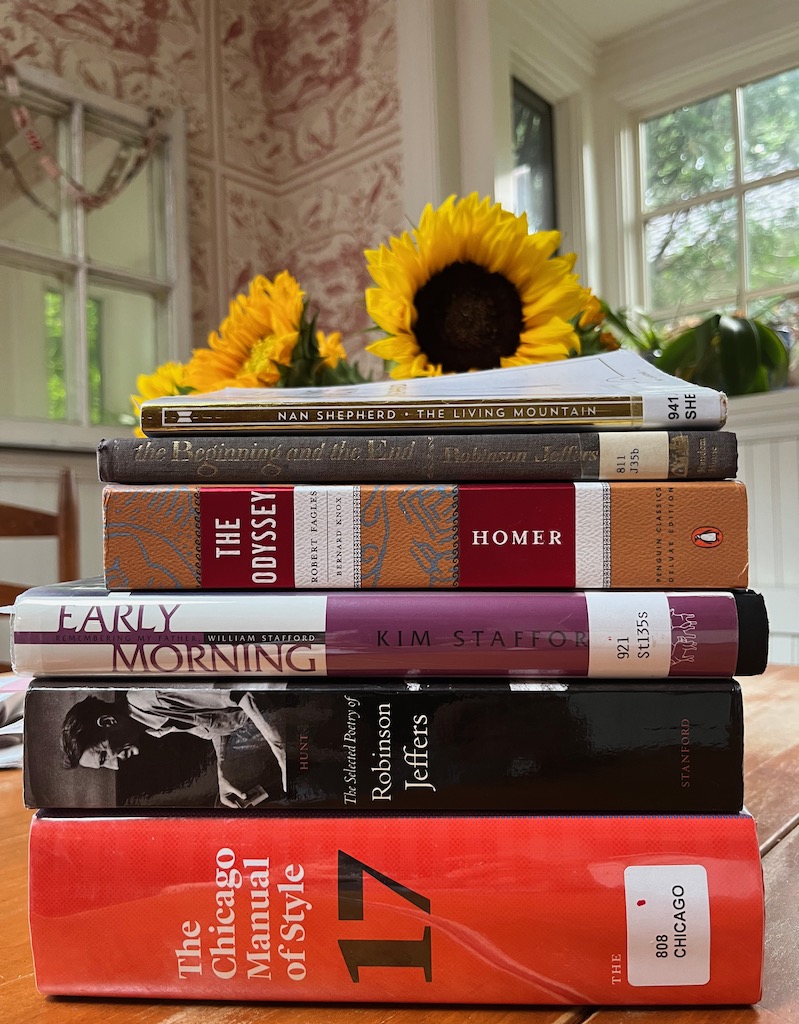
The Living Mountain, by Nan Shepherd, introduced by Robert Macfarlane, afterword by Jeanette Winterson: a masterpiece of nature writing, first published in 1977, describing Shepherd’s journeys into the Cairngorm mountains of her native Scotland.

The Beginning and the End, and Other Poems, by Robinson Jeffers
The Selected Poetries of Robinson Jeffers, edited by Tim Hunt: The bard of the California coastline, a giant of modern letters who somehow has gotten a bit overshadowed, but whose capturings of words crash against me like the Pacific surf.

Early Mornings, by Kim Stafford: A biography of the great poet William Stafford,  a pacifist who called himself “one of the quiet of the land,” written by his son, a poetic force all his own.

The Odyssey, by Homer: Because it’s about time.

The Chicago Manual of Style, 17th Edition: Because it’s every page-proofer’s best friend. Or it should be.

i also just started karen armstrong’s The Case for God, and oh dear gracious, it’s blowing my mind. i’ve borrowed it from the digital library, but i already think i might need to grab a page-turning copy cuz just a few chapters in, this is already a book screaming for marginalia…

a snippet of summer poetry:

‘Can we learn wisdom watching insects now,
or just the art of quiet observation?’
from ‘Summer of the Ladybirds’ by Vivian Smith


summer cooking, er, non-cooking: 

i’m trying this for tonight, perfect in a week when there’s not much cooking time in between hours and hours of page proofing

Corn Salad With Tomatoes, Basil and Cilantro
By Genevieve Ko

INGREDIENTS
5 ears of corn
1 pint cherry or grape tomatoes, halved
1 lime
3 tablespoons extra-virgin olive oil Salt
1⁄4 teaspoon minced seeded fresh habanero or other very hot chile (optional)
(*i’m adding a pinch of ground ancho chile peppers; maybe more than a pinch)
1⁄2 cup fresh basil leaves
1⁄4 cup fresh cilantro leaves 

PREPARATION
Step 1
Microwave the corn in their husks on high for 3 minutes. Shuck the corn — the silks will come off easily. (If you want to boil or steam the corn on the stovetop, you can shuck the corn first then cook just until brighter in color, 2 to 3 minutes.) Cut the kernels off the cobs, transfer them to a large bowl and add the tomatoes. 

Step 2
Finely grate the zest of the lime directly over the corn mixture, then squeeze the juice from the lime all over. Add the oil, a generous pinch of salt and the chile, if using. Mix well, then tear the herbs over the salad and gently fold them in. Season to taste with salt and serve, or refrigerate in an airtight container for up to 1 day. 


until i wrap up this little old book in the works (final deadline, end of august), i’m continuing on in the spirit of the gazette, that old-fashioned compendium of things worth tucking under your belt for the day (not that any of my scribblings above so qualify).

and while we’re at it, and in case you’ve ever wondered where in the world the word comes from: gazette is “a loanword from the French language, which is, in turn, a 16th-century permutation of the Italian gazzetta, which is the name of a particular Venetian coin. Gazzetta became an epithet for newspaper during the early and middle 16th century, when the first Venetian newspapers cost one gazzetta.”

and, with that, may yours be a summery week. however you define it.