pull up a chair

where wisdom gathers, poetry unfolds and divine light is sparked…

Tag: poem

oh, the places we’ve come . . .

winter, i’ve always sensed, is the curling-in time, the season of unseen stirring, and in an octave of dawns, dusks, and nightfalls, winter will be upon us. 

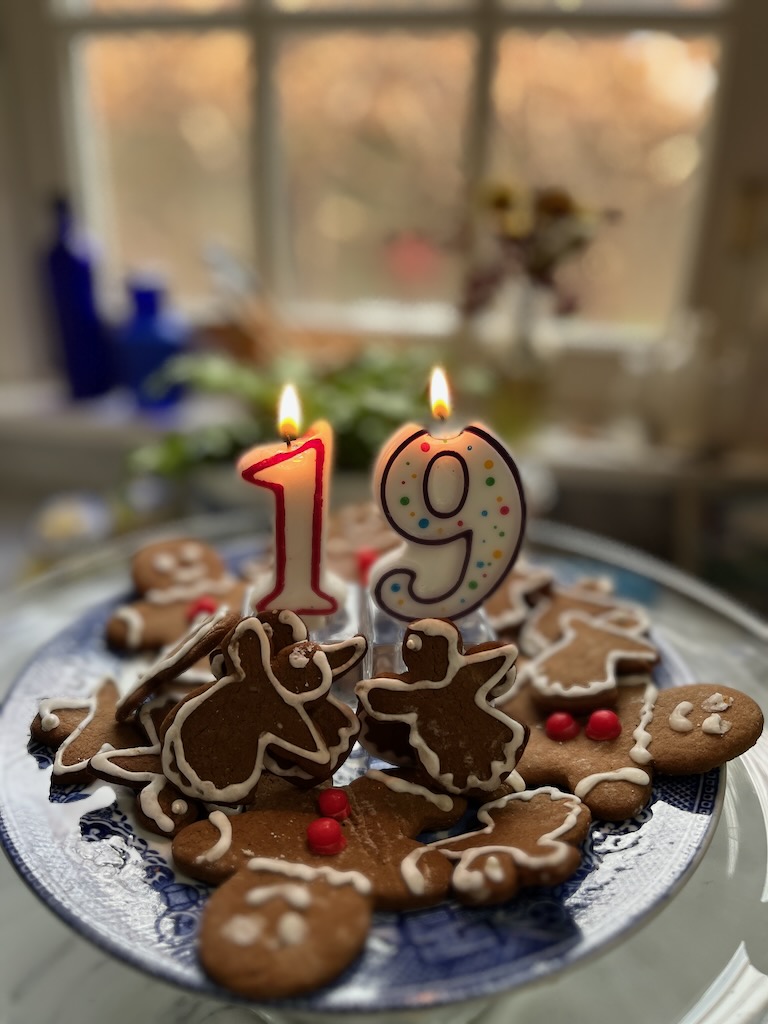
but even now, it’s a season for quieting, for simmering thoughts as well as saucepots of cinnamon stick, star anise, and clove. my simmering for the last nineteen years picks up the pace as the page turns on another year of pulling up chairs to this imaginary old maple table, one where the indentations of long-ago math homework are pressed into the grain, where so many coffees and juices have been poured and sipped and spilled and sopped up with sponges. over the course of these nearly two decades, it seems i’ve developed a knack for simmering while tapping away at the rows of alphabet keys—some 1,255 simmers and counting, all under the name “pull up a chair,” now tapped, posted, and filed away.

only a handful of the very first chairs—bless them, those stalwart humans—still pull up a chair, at least every once in a while. but along the way, so many chairs have been added, and multiplied. and our polestar has never shifted: to carve out a sacred space where questions are asked, and stories are told, where hearts are bared, and above all where gentle, gentle kindness is the metronome by which we set all our rhythms. once in a while, over all the bumps and bruises encountered along the way, we’ve been known to bow our heads and pour out our hearts in holy, holy please God, pray for us.

on the twelfth of december, 2006, our firstborn had just been bar mitzvahed, and our then so-called “little one” was but a kindergartener, not yet reading or writing but melting my heart by the minute and filling our notebooks with his stories and antics and an encyclopedia of unforgettable “teddyisms.” (some kept alive to this day; for the sheer pure joy of it). the firstborn, now law professor, insisted at the dawn of the self-published blogging age that i, his little old mother, could figure out how to “blog,” a verb that’s always sounded to me like a crude guttural effusion, a burp perhaps. and back in the day, he gave me his hand-me-down laptop to do it. to prove i could blog, that is. (as has so often been the case, he even then was wiser than me…)

back then, the question that had captured my attention was the simplest of notions: i believed, after a few years of keenly observing, tagging along with, and writing long newspaper stories of families in the thick of life transitions as a reporter for the chicago tribune, that life’s biggest questions aren’t reserved for colloquia and global summits, nor do they wait for podiums and percussive applause. they are the stuff of the everyday. and if we watch closely, pay keen attention, we can lift those universal, deeply-human questions and struggles from the quotidian stream, hold them to the light for closer consideration, and reap their wisdoms and epiphanies in real time. now, before the moments pass us by and we come to the saddest realization of all: that it’s too late, and our chance at most wakeful living has slipped into the distance. 

all these years later, life certainly has galloped along here at the table. this ol’ chair has seen the growings up of two boys, buried parents beloved, moved another from her home of sixty years. taken a tour of cambridge, mass., and a second helping of college. trekked across the pond, set our sights on war zones, and been rolled into surgical suites and recovery rooms. we’ve feared for our country, for humanity, for civility, and plain old decency. and we’ve refused to surrender to the crude and cruel ways wielded by those who seize power. we’ve kept our minds opened, and tried—oh, we’ve tried—to emphasize the imperative of objective, double-sourced truth, and the slaying of hearsay and heresy. we’ve laid out worries here, and plenty of joys; we’ve marveled and wondered and been gobsmacked aplenty. i’ve pondered cancer and the physics of time, and the holy shimmering presence i know as God. 

lately i seem to have taken to gathering up wisdoms far greater than mine will ever be. i am, as a beloved friend of the chair once put it, something of a magpie. a magpie mostly attuned to seeking the sacred amid the plainstuff of living. the idea of the commonplace book is one i heartily embrace: bring on the poets and sages and prophets, and let me invite you into their brilliant notebooks and minds and unfurl for you their passages and poetics that take away our collective breath and find a way of percolating for hours to come. 

this ol’ chair has given me a place to keep on tapping away at the keys. i realized long ago that i untangle the knots of my life by stringing out sentences. and trying on thoughts. thank you for indulging me, those of you who choose to read along. thank you for pondering the questions at the end of each post, in the quiet of your own soul, or by leaving a note at the table. 

you are, collectively and individually, humans who restore and buck up my faith in the inherent majesty and wonder of the shimmering undying spirit that populates this earth with more than a modicum of heaven’s best offerings.

bless you, bless you, a thousand times thousand, bless you.

this week i am bringing a little birthday bouquet of beauties that struck me across the week, all of them tied together by the beautiful idea that the birthing of holiness is a sacramental act of which we must partake. it’s one that entails unlocking our hearts, making room in the manger within, and allowing the Holy and Sacred to form within, and to birth it with our words and our love in the act. it’s quite the trinity here: a benedictine monk who practices and teaches meditation in the french countryside at a monastery known as bonnevaux; st. john of the cross, the great mystic, as translated by the poet daniel ladinsky; and the late, great luci shaw, a beloved british-american poet and essayist who died at 96 on december first. 


first up, the idea of birthing God within us from the benedictine monk, laurence freeman, whom i’ve been learning from for years…

In the 14th century, Meister Eckhart enjoyed waking people up in his sermons by expounding some uncomfortably new perspectives about their standardised faith. He must have stirred a few dozy parishioners when he asked: “What good is it to me if this eternal birth of the divine Son takes place unceasingly, but does not take place within myself? And, that it should take place within myself, is really what matters.” 

Actually, the great Augustine had asked the same question a thousand years before and added that if we are the children of God, we must become God’s mother as well. If, he said, this birth of the eternal word as Christ in the soul is to happen, our heart – the deepest centre of our being – must become the sacred manger. If we are filled with egocentric distraction there is ‘no room at the inn’ and so the heart must become that empty and open space where the birth takes place and through which he  is welcomed into our world.

In today’s gospel, John the Baptist is usually and badly translated as saying ‘repent, for the reign of God is close at hand’. Basileia, the Greek word we think of as ‘kingdom’, is feminine and so could equally well translate it as ‘queendom’. It doesn’t mean a juridical area but the space in which the presence and grace of God is acknowledged and welcomed. The gospel word, badly translated as ‘repent’, is ‘metanoia’: a change of mind and heart. It is not about feeling sorry for past mistakes. It means spinning round 180 degrees and entirely changing your perspective on and approach to reality.

Living in the desert, wearing a garment of camel hair and eating locusts and wild honey, John seems to us a bit extremist. People who reduce waste and get back to essentials are often called crazy. But because of his spiritual sanity he drew the crowds who asked him ‘what shall we do?’ because, like us, they lived in confused, divided and dangerous times. He told them simply to live honestly and justly but that this lifestyle would prepare them for the imminent – and immanent – coming of the great transformer of all things. 

Meditation is the great simplifier. It reduces the way we waste both time and life’s opportunities. In daily life it is the catalyst for ongoing metanoia. The medicine that loosens the grip of illusion. Usually, we start enthusiastically but before we get to the full 180 degrees we slow down and say, ‘this is quite good, let’s stop here’. Fortunately, if the birth process has already started, it will not allow us to arrest or deny it. We have to see it through until it breaks through into our world and we are happy and lucky if we do.

—Laurence Freeman


and from the sixteenth-century mystic St. John of the Cross there comes this interpretation/translation of what daniel ladinsky calls one of his “love poems”…

IF YOU WANT

If
you want
the Virgin will come walking down the road
pregnant with the holy,
and say,
“I need shelter for the night, please take me inside your heart,
my time is so close.”

Then, under the roof of your soul, you will witness the sublime
intimacy, the divine, the Christ
taking birth
forever,

as she grasps your hand for help, for each of us
is the midwife of God, each of us.

Yet there, under the dome of your being does creation
come into existence eternally, through your womb, dear pilgrim–
the sacred womb in your soul,

as God grasps our arms for help; for each of us is
His beloved servant
never far.

If you want, the Virgin will come walking
down the street pregnant
with Light and sing …

—St. John of the Cross, “If You Want” in Daniel Ladinsky, Love Poems from God: Twelve Sacred Voices from the East and West (New York: Penguin Group, 2002), 306-307.


and, in closing, here’s a classic from blessed, blessed luci, whose great contribution to the canon of Christian poetry would be her capacity for drawing big truths about God and human experience from viscerally pulsing fine-grained images and objects. she is the perfect voice to close out this nineteenth year of the chair….

Kenosis
By Luci Shaw

In sleep his infant mouth works in and out.
He is so new, his silk skin has not yet
been roughed by plane and wooden beam
nor, so far, has he had to deal with human doubt.
He is in a dream of nipple found,
of blue-white milk, of curving skin
and, pulsing in his ear, the inner throb
of a warm heart’s repeated sound.
His only memories float from fluid space.
So new he has not pounded nails, hung a door,
broken bread, felt rebuff, bent to the lash,
wept for the sad heart of the human race.

amen.

may this blessed week bring softening to the walls of your heart, and a widening within those chambers so that Holiness, however you name it, might be birthed there….love, b.

the not-so-simple tasks of being alive

life, sometimes, makes like it’s an arcade of carnival challenges, and to make it to the other side is, in fact, something of a triumph we barely take time to note.

we shouldn’t, though, take it for granted. we are mightier than we think. and there will come times when we truly need to believe how mighty we can be. we’re not here on this earth to dawdle around.

as this week draws to a close, i can testify that these things happened: a new used car was found, bought, driven home, and will soon be ferried to another state; a kid wrestled through the decision of which of three job offers he’d choose, and started the one; husband down for the count with a cough that sounds like it’s hollowing his lungs; cavity filled in the way back of my mouth; latest peek at my lungs behind me (now awaiting results, a fraught interval that always leads to some trembles); and the latest round of edits on Book No. 6 at last sent off to editor (i had to wait till her calendar cleared).

not included in the list, but very much there, are the facts that i spent the week dodging the heck out of whatever virus was mucking up the works, for fear my scan or my cavity filling would get bumped; also, never mind the “check tire pressure” light that went on halfway home from the car lot, and the hurdles to get that untangled. in addition, i arose each dawn, never crashed my own car, swam a few miles, cooked a few mediocre dinners and one or two fair ones, and grocery shopped what seems like ninety-five times.

such is the business of living. each week throws at us a spaghetti bowl of hurdles, some humdrum, some of dimension that leads us to gulping.

it’s the quotidian stuff that comprises our day to day. and to make it through and to the other side is a feat that draws on cords and gears we barely acknowledge. to miss the chance to take note, to not ponder just how resilient we are, just how swiftly we can untangle ourselves from houdini’s chains is to short shrift our capacities.

we live our lives amid stories of what seem insurmountable feats: folks rolling into surgeries that untangle their insides, or shave off a lump on their spine; house fires that leave lives in ashes and soggy remains; kids finding out their cancer is double-D badd. (and those are stories plucked only from the last 48 hours, each one devastating and true.)

the news of the bad guys around us might distract and infuriate and leave us in tears. but the hard work of being human is never far from home. it’s the pit in our belly we awake with, and the headache that drums us to sleep. it’s what we might face before breakfast, and what comes with an unsuspecting wallop midway through the day. it comes in the phone call we never expected, and the one that makes us fall to our knees.

i’m not trying out for a part as the voice of doom here. i’m simply saying what we too often forget: no matter the circumstances, nor the twists in the story, we are all made of strong stuff—stronger than we remember to note.

to get to the other side of the traumas and troubles that hurtle our way is worthy of note, if not ovation. it might do us well to take count of the muscle it takes, and the grit, and the intense imagination, to merely get to the other side.

and here we are, on the far side of all those things that a week ago seemed insoluble.

that alone might stand as proof that even the frailest among us are tough as tough can be. and we can take on just about anything. we are breathed into life with every capacity our lives will demand. and we are living proof of how much we can survive.

you needn’t share this with anyone other than yourself, but perhaps you might find strength in looking back across the arc of your life and seeing what a marvel you are, and all the impossible hills you have climbed. what marvels you the most?


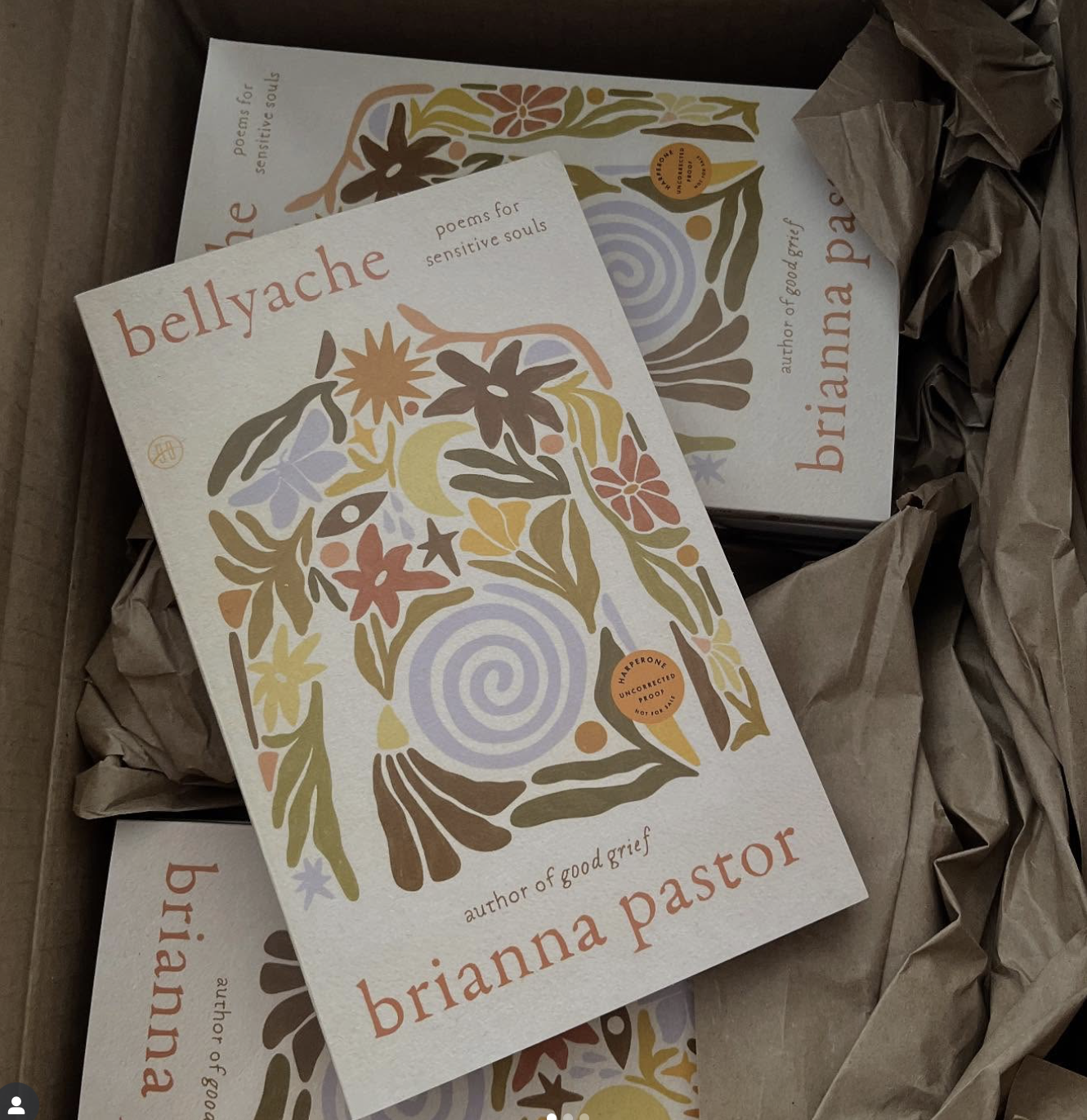
as antidote to all that, i bring you a bit of wonder in the form of the latest book that crossed my transom. it’s titled bellyache: poems for sensitive souls (harper one, 2026), and they had me at the subtitle. it’s by brianna pastor, a poet described in her bio as “a queer writer, empath, advocate, and author of the poetry collection good grief.” the book isn’t due out till february, but i got a review copy, and i’ll share a few marvels here. pastor’s poetry is rooted in childhood trauma and what it means to heal, with sensitivity and love as the non-negotiable parts of the deal. she writes, according to the author note, “about the raw, the uncomfortable, the overlooked, and makes clear that at the root of all things, is love.” it’s not every day that you open a book and find yourself in the midst of a poet whose heart feels so immensely attuned to the pain and the preciousness of tender, tender feeling.

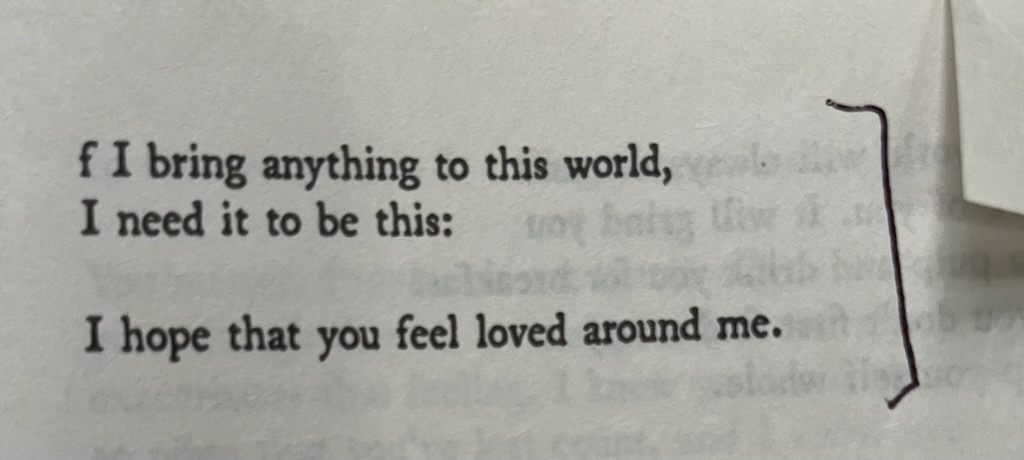
here’s one of my favorites….

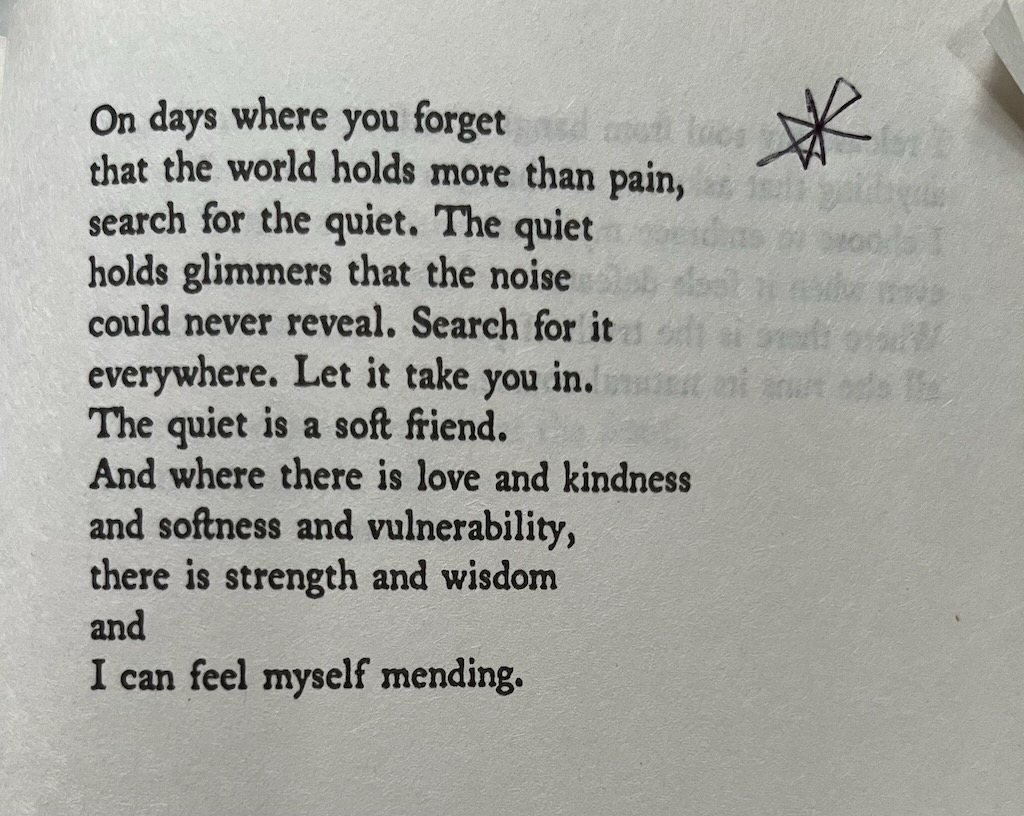
and here are two others (the spare simplicity is everything in these love-drenched poems):

and this:

Excerpted from pages10-12 Bellyache by Brianna Pastor, reprinted with permission from HarperOne, an imprint of HarperCollins Publishers. Copyright 2026.

on faraway sands, the poets of war spoke to me

i was alone for the day, a whole sumptuous day of solitude and silence. so i, like half the rest of the world it seemed, was pulled to the water’s edge. i carried but a book and a bottle of water. i knew the week ahead would be rough, though i hadn’t a clue yet quite how rough. (two beloved souls, my exact age, died suddenly, one falling to her death*, another simply dying in his sleep.)

the book i carried is one i’d yearned to crack into, and as i sat there allowing its truths to wash over me, as the waves of the lake just across the sand washed over the shoreline again and again, i felt every drop of its anguish and truth. it was a book of poems written by thirty poets in gaza, and four from the west bank.

once upon a time, for ten good years, i gathered up each month for the chicago tribune a collection of three books that had most stirred my soul. they might be children’s books, or poetries, or memoirs and stories of the holiest people. the gatherings were vast, and some of those publishers still send me books, knowing full well my readers now are not the millions from the tribune and beyond, but rather the cherished friends of the chair.

this book i bring today is one worth clutching in your hands, pressing hard against your heart. it might be even more poignant against the improbable news that a cease fire in gaza has begun and some twenty living israeli hostages will soon be released.

its title, you must live: new poetry from palestine (copper canyon press, 2025), only begins to tell the story, only hints at the horrors and tendernesses within. but you can hear the pleas, the cries rising up from the rubble. it’s a bilingual anthology of poetries from gaza and the west bank, translated from the arabic and edited by Tayseer Abu Odeh and Sherah Bloor, with guest editor Jorie Graham, and it’s written not by poets who’ve somehow escaped, left behind the ravages of war, but rather it’s written by those still there. in poring over its pages—slowly and with prayerful intent—you hear the murmurs perhaps unheard by anyone else, you hear the lone voice rising from dust, you hear the whimper of a child left alone in the world, in the shattered brokenness of a world that no longer stands.

“especially now,” the editors write, “it is crucial to attend to those whose voices are under threat of elimination.”

ocean vuong called it “a light beam of a collection in our dark hours.” ilya kaminsky, the great poet most famous for his deaf republic, has written that it’s a book “filled with poems of utter urgency, poems that give us wisdom, in the face of devastation, in spite of devastation.”

i was as moved by the story behind the poems, as by some of the poems themselves. for starters, editing in a war zone is no feat for the timid. the editors write that at first they didn’t realize that every time someone’s phone connected to a satellite (to reply to an editing question) they became a target. to get a clear signal, the editors write, meant a life-or-death decision: standing atop rubble is where the signal is sharpest, and yet of course that means the poet is risking her or his life to reply.

consider that.

the editors write too that every time a reply did come through, be it a response about punctuation or diction, the editors sighed with relief. “they were still with us.” imagine being willing to die over a comma rather than a semicolon. consider that the next time you make a simple correction in a sentence you’re typing.

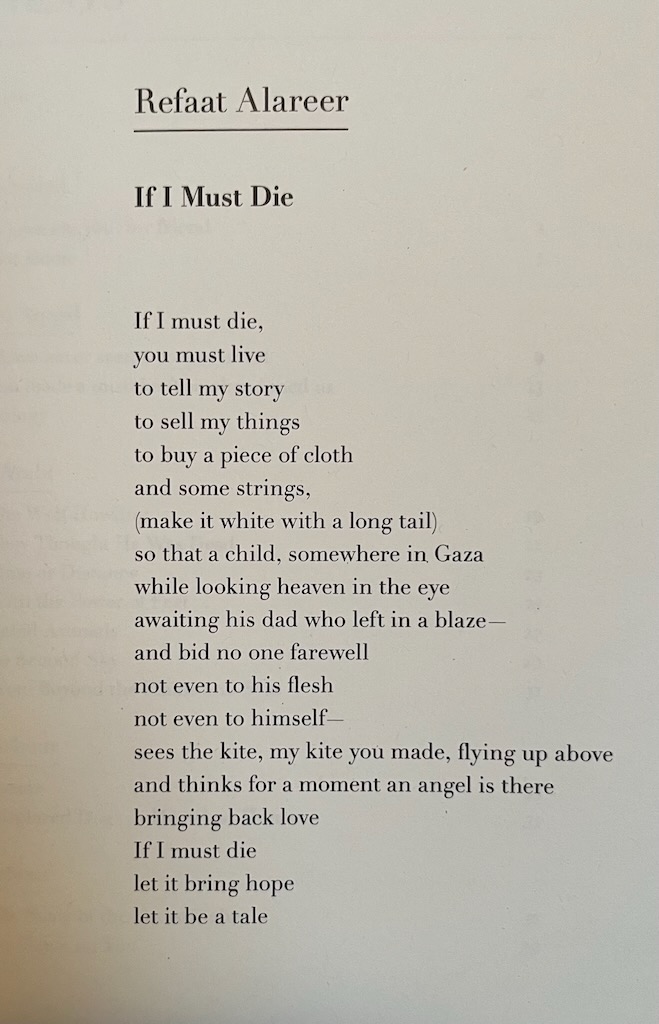
the collection begins with a poem that’s become fairly widely known, “if i must die,” by the late Refaat Alareer. the editors write: “this poem stands in for all those poets we failed to reach in time. their poems—chalked onto collapsed walls, or on the blackboards of schools-turned-shelters-turned-bombsites, traced in sand, or shared in private messages—will never reach us.”

the silence is stunning. the silence demands our reverence.

the editors call the poems a “poetry of witness,” speaking from a war zone deadly for journalists, a war zone where so many stories would otherwise go untold. the poets paint the portrait. and it is seizing with humanity. humanity crushed. humanity pummeled. human refusing to extinguish its tender, fragile beauties. we must know what we, humanity all, have wrought.

here are a few samples, barely enough to give you a sense of the pathos within, the pathos that rises from this old globe like a poisonous cloud desperate for one breath of air….

here is the poet Waleed al-Aqqad’s elegy for a young friend, set at the boy’s funeral, and tenderly describing the mutilations of his war-torn body:

We said goodbye
to you in your small death like the death
of sparrows.
We rearranged you.
We placed your severed hand across your chest,
covered your wounds with flowers,
cried as you wanted.

or this, from Ala’a al-Qatrawi’s poem to her children, two daughters and two sons, all under the age of six, all killed in an air strike on their home. she addresses her babies in heaven, offers her own body parts to her daughter, Orchida, as if she could piece her body back into her embrace:

And give my lungs to her.
Without them, maybe she suffocated.
Maybe she couldn’t call my name.
The rubble would have been too heavy for her.

it is wrenching to read. all of it. page after page, i read slowly, as if a dirge. i sat on a bench on the sand thousands and thousands of miles away. that seemed cruel, unfair, that i should be hearing the sounds of a day at a beach, when the sounds of war pressed on. and the words of new poets would again go unheard.

to those who understand the power of words, to those who dared to gather poems out from the rubble, bless you, and bless you, and may peace, everlasting peace, at last come to the holy land.

maria corina machado, recipient of the 2025 nobel peace prize

this hard week ends with a few sparks of hope: first, word of the cease fire and the imminent promised release of 20 living israeli hostages, and the bodies of 26 confirmed dead. and, in the immediate wake of that, the nobel peace prize was awarded this morning to venezuela’s “iron lady,” maria corina machado. the committees’ citation reads: “She is receiving the Nobel Peace Prize for her tireless work promoting democratic rights for the people of Venezuela and for her struggle to achieve a just and peaceful transition from dictatorship to democracy.”

where did you find hope in these hard times?

*joannie barth was a most beloved reader of the chair. she lived in evergreen, colorado. was the right-hand everything to the best-selling author philip yancey. she and i had gone to college together, but mostly got to know each other’s souls through this ol’ chair. she would send notes radiant with love, with a faith that couldn’t be shaken. she shared her own heart’s ache, an ache i now hold for her. i was with her less than a year ago, and as she always had, she lit up a room. her smile rose from a deep deep place. a week ago, she was rock climbing. and the belts gave out. she died instantly. not at all surprisingly, i feel her closer than ever. she was, and is, an angel.

joannie

acquiring acquaintances: another name for pen pals

it started because months, or maybe years, ago, i stumbled onto a poem that took my breath away. it was written by a poet i’d not known of, didn’t think i’d ever read. but the poem, titled “Nativity,” stayed with me, a poem that paints the first Christmas scene in strokes and shades that settled deep into my marrow, and forever more are the Christmas i imagine.

it’s a poem that lays the baby Jesus in a rough-sawn barn, the air pungent with animal. “the wind tugging at the shutters.” there is nothing gilded about it. and it was written, i knew right away, by someone at ease with being small, tucked off in a corner keeping watch. it was written, i could tell, by someone whose very veins course with humility, and understood a God who preached the same, a God who asks us to get about the business, the holy business, of loving as we would be loved without noise or bombast or folderol.

the poet’s name is kenneth steven.

it turns out he lives on an isle on the scottish west coast, a place where the wind might tug at shutters. and it turns out he is something of a polymath: a poet, a painter, a children’s book writer, a translator of great works. and, above all, something of a pilgrim, a pilgrim seeking the quiet beauties that punctuate the everyday. he calls them “atoms of delight.”

and he writes of pilgrimage: “the word is often used to describe the journey to a shrine or sanctuary in search of spiritual transformation, which is a meaning i acknowledge. but now pilgrimage has become a much bigger thing for me; it has gone far beyond that rather heavy and medieval sense of going on a journey to visit a holy site. why shouldn’t it be about a walk to a hill loch to listen to the impossibly beautiful singing of red-throated divers? why shouldn’t it be about a child running into the forest in the early morning to find the treasure they dreamed of? these are journeys of the heart, seeking the profoundly precious places where little miracles happen. and why shouldn’t it be about panentheism—the finding of God in all things?”

it’s not hard sometimes to recognize a kindred soul.

what is hard is to imagine finding yourself in conversation with such a kindred someone. but that’s what’s happened. kindness is the thing that opened the door, his kindness. in a world ruled by transaction, where fees are paid and contracts signed for any exchange of goods—be it words or bricks or lumber—kenneth steven lives otherwise.

i found that out not long ago, when, during the editing phase of my next book, i dove into the task called “permissions,” in which for any chunk of text—poetry or prose or lyrics to a song—beyond a certain measure, you must secure permissions from its author. this can be a costly exercise. and it is always one that makes me quiver, wondering what walls i’ll encounter, and what cold-shouldered hubris i might have to tiptoe through.

it’s that poem, “Nativity,” that’s stayed with me all these years. and i’d included the whole of it, eight lines, at the start of an essay that i hope to include in the book.

wondering if i was whistling into the wind, i sent off a proper letter, the digital kind, and shipped it cross the sea. i’d no idea if mr. kenneth steven would ever reply. but, lo and behold, come monday morning, there he was, tucked kindly in my mailbox. and more than generously writing: “of course you are more than welcome to use the poem. i’m sure you’ll mention where you found it.”

and thus, with the stroke of his generous heart, a friendship has unfolded. and a treasure trove of poetries have now brushed through me. and i am richer for this scottish friend who, as a boy, awoke one night at midnight, and hearing a great and ferocious wind, hurriedly dressed and left the house, where he climbed a hill in howling winds, before crossing through a field to reach his favorite tree, where he knew the horse chestnuts would be falling, and he was out to save them, to gather them up. “i felt given a whole world,” he writes in an essay about the midnight escapade. “it was about the autumn and the big winds, and the thrill of running up that long hill and entering the field at last at what felt like the middle of the night.” and the indescribable delight of knowing “that all this treasure was mine.” the treasure: a cloth bag of chestnuts shaken from the limbs, their deep and woody smell, orbs that looked as though they were made of shoe leather.

befriending him, he who writes me every day now, sometimes more than once a day, is magical. is akin to befriending any of the authors from my childhood who’ve long entranced me, drew me into storybook tableaus: tasha tudor; e.b. white; frances hodgson burnett, who wrote the 1911 children’s classic, the secret garden, a book that featured my holy trinity—an orphaned girl, a padlocked garden, and a robin redbreast that finds the key—and once prompted me to fake a fever so i could skip church one sunday to stay at home and turn its pages.
long ago, when i’d be asked if i’d ever want to write a book, i demurred, brushed away the thought. didn’t think i could hold a thought long enough to pen more than a few pages. i didn’t know, though, that the magic of a book comes in all the threads unspooled along the way. threads that carry me to places far and wide, and to souls i’d never otherwise know. but words, like little birds, or prairie seeds, catch on the wind and settle into fertile loam. and we are richer for them.

in much the way, my beloved chairs, through all the words and all the years, have become my dearest treasures.

bless you.

love, bam

have you a penpal in this digital, globe-crossing, email world? someone you’ve not met but who seems a certain friend?

i promised kenneth i would share word of his beautiful meditative podcast, Imagining Things, on the patreon platform. recorded in a studio that seems to be just behind his island home, you can sometimes hear the scottish winds blowing off the atlantic, and a bird or two not far away. (or maybe i’m imagining.) and of course he speaks in a scottish-soaked timbre, and in between reflections he shares poems that will make you hit rewind so you can listen once again, so breathtaking are the lines.

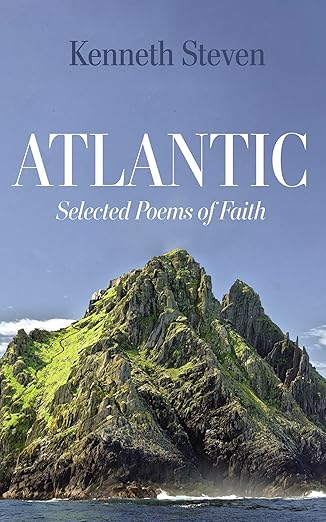
his latest book, one that should be landing on my front stoop within days, is Atlantic: Selected Poems of Faith. but i’m already deep into Atoms of Delight: Ten Pilgrimages in Nature, and Iona: New and Selected Poems.

public health announcement: check your darn radon

so, in the latest twist and turn over here in medical odyssey land, a very fine pair of doctors looked into my lungs the other day, and saw yet another odd thing. and the oddest thing is, they don’t think it’s cancer in the other lobe, but they do think it might be radon. RADON! the number one cause of lung cancer in never smokers.

because we were zooming, the doctors were able to see the room behind me, and a room you might note for its decidedly not modern detail. it’s a fairly old house, though not old by historic standards. it’s 1941, which means it’s older than 1970 when homes started to be built with attention to radon, a radioactive gas naturally occurring in the earth. i’ve been breathing here for twenty-two years.

the good doctors wanted to know if we’d ever checked for radon. yes, yes, i quickly answered, sounding just like the girl who sat near the front of the classroom, waving her hand whenever she knew the answer—especially when she knew it faster than everyone else. (i am poking fun at myself here, lest you not see that!) anyway, back to the radon and the trusty detector i got two years ago when i first learned i had mysterious lung cancer. soon as the doctors finished their question, i pointed straight to the detector so the good doctors could see where i’d tucked it. um, not so good, they replied in unison.

the very good doctor explained that radon can only be detected in the first few inches off the ground, and it has to be measured at the lowest point in the house, where the foundation rubs up against ol’ mother earth. that meant the basement. where i’d never measured, even though i’ve been down there an hour a day walking on the treadmill for as long as we’ve lived here, all twenty-two years.

don’t you know that the second we got off the phone i was lickety-split in the basement with that little detector that until then had always flashed green, giving me the falsest assurance that all was well at chez 522.

took but five minutes for that ol’ detector to turn yellow (not so good) then red (get outa here folks!). and as i felt my heart sinking, and my tummy beginning a series of flipflops, i scampered back up the stairs, to report the damage to my fellow breather in this old house.

any minute now the radon detector lady is going to be knocking at the door with her super-duper testing devices. she’ll track our radioactive gas over the weekend, and come back monday to fetch it and read it. she will write up her report and pass it over to the very kind guy who will come to our rescue, apparently boring a hole through to the earth below, sucking out the noxious gas, and blowing it out through the roof. the mechanics of this are unbeknownst to me, but whatever they want, they can do. PVC pipes running through the living room? no problem. please, just save what’s left of my lungs.

in the meantime, i’ve let my doctor know the results of my home-testing detector, one thought to be accurate. and she’s snared me an appointment with the top pulmonologist at U of C, though i can’t get in till november. i’m thinking this stuff they see in my right upper lobe (my left lower is the lobe now missing) might explain why i get so exhausted, and why i sometimes feel pale as a semi-ghost. and why when i try to breathe and talk and walk, one of the three has to go.

so why i am divulging all this before i know more, before i have answers? because my doctor, who i loved at first sight, told me that too few people are aware of the dangers of radon; i know that, for me, it was merely what sounded like an infomercial droning on in between dramas, or noise on the car radio.

but, people, it’s real. and i have the holes in my lung to prove it, it seems.

my doctor, already known as the world pioneer of a particular lung cancer mutation, suggested we team up together for an awareness campaign. i’m all in. and i wasn’t willing to wait for definitive answers. i’m starting with this, and with you, my beloved, breathable chairs.

what i know is this: my lung is missing a part, my breathing doesn’t come easy too often of the time, and my detector is flashing red rings. i don’t want any of that to happen to you.

my doctor says that chicago is especially bad, with higher naturally occurring radon than other places. but she says that too few of us know. too few of us think of it.

here’s what the EPA, that now shaved-to-the-bone federal department charged with saving our air among other things, has to say about radon: “Radon is a radioactive gas that forms naturally when uranium, thorium, or radium, which are radioactive metals break down in rocks, soil and groundwater.”

gets a wee bit more vivid when you turn to plain ol’ google, now powered by AI: “Radon is a naturally occurring radioactive gas, invisible and odorless, produced by the breakdown of uranium in soil, rock, and water. It can seep into buildings, particularly through cracks and openings in foundations, and accumulate indoors, posing a lung cancer risk if inhaled. Testing and mitigation are crucial for managing radon exposure.”

radioactive, invisible, risk, and crucial, are all words that grab my attention. mightily.

it’s never too early to be warned of a risk that might mess with your lungs, so while i wait for vicki the radon detector to knock on the door, i want you to know that if you happen to live in an old house (the kind i’ve always loved best), and it sits on the ground, or worse yet, was plopped in a hole in the ground (the standard for two-story-or-more construction), you might wanna look into your radon.

i’ve no desire to be the poster child for radioactive invisible gases that can eat away at your lungs, but if that’s who i am then so be it. i offer my troubled breathing for your protection. please, please consider it.


and because that’s rather a dark chunk of news to drop on your laps this morning, i bring you one magnificent poem to even things out.

barbara ras

appropriately, it’s titled, “you can’t have it all,” and it’s glorious…..the poet is barbara ras, an american poet, translator, and publisher, born in new bedford, mass., and traveled extensively in central america. she’s been honored with the walt whitman award, and both guggenheim and breadloaf fellowships. her most recent poetry collection is The Blues of Heaven (University of Pittsburgh Press, 2021), preceded by The Last Skin (Penguin Books, 2010), One Hidden Stuff (Penguin Books, 2006), and her first collection Bite Every Sorrow (Louisiana State University Press, 1998). soon as my radioactive gas is dashed from this ol’ house and my edits are all wrapped up, i am diving deep into ras…..

YOU CAN’T HAVE IT ALL
by Barbara Ras

But you can have the fig tree and its fat leaves like clown hands
gloved with green. You can have the touch of a single eleven-year-old finger
on your cheek, waking you at one a.m. to say the hamster is back.
You can have the purr of the cat and the soulful look
of the black dog, the look that says, If I could I would bite
every sorrow until it fled, and when it is August,
you can have August and abundantly so. You can have love,
though often it will be mysterious, like the white foam
that bubbles up at the top of the bean pot over the red kidneys
until you realize foam’s twin is blood.
You can have the skin at the center between a man’s legs,
so solid, so doll-like. You can have the life of the mind,
glowing occasionally in priestly vestments, never admitting pettiness,
never stooping to bribe the sullen guard who’ll tell you
all roads narrow at the border.
You can speak a foreign language, sometimes,
and it can mean something. You can visit the marker on the grave
where your father wept openly. You can’t bring back the dead,
but you can have the words forgive and forget hold hands
as if they meant to spend a lifetime together. And you can be grateful
for makeup, the way it kisses your face, half spice, half amnesia, grateful
for Mozart, his many notes racing one another towards joy, for towels
sucking up the drops on your clean skin, and for deeper thirsts,
for passion fruit, for saliva. You can have the dream,
the dream of Egypt, the horses of Egypt and you riding in the hot sand.
You can have your grandfather sitting on the side of your bed,
at least for a while, you can have clouds and letters, the leaping
of distances, and Indian food with yellow sauce like sunrise.
You can’t count on grace to pick you out of a crowd
but here is your friend to teach you how to high jump,
how to throw yourself over the bar, backwards,
until you learn about love, about sweet surrender,
and here are periwinkles, buses that kneel, farms in the mind
as real as Africa. And when adulthood fails you,
you can still summon the memory of the black swan on the pond
of your childhood, the rye bread with peanut butter and bananas
your grandmother gave you while the rest of the family slept.
There is the voice you can still summon at will, like your mother’s,
it will always whisper, you can’t have it all,
but there is this.


most importantly of this fine day, it’s my beautiful beautiful miracle boy’s 24th birthday. two dozen sumptuous years of loving the kid whose insistence on “seeing the world” prompted us leap outa the nest, and spend a year of thinking sumptuously in yet another one of the current administration’s targeted campuses, the one in cambridge, MA. he is perhaps the sweetest soul on the planet, with the tenderest heart. he’s the first to reach for my hand any time there’s a step to descend or a sidewalk that might be riddled with bumps. his birthing, two dozen years ago on the night just passed, was dicey there for a while, but with every drop of sinew and soul that i had, i did what the doctor ordered and got him delivered to safety, soon nestled as close to my heart as any human can be. happy birthday, teddster. love, love, love, your ol’ mama.

is that not a face you could love till the end of all time?

ode to summer’s drippiest fruit: the tomato

in which we begin with news: ol’ babs signed a book contract yesterday; the book, it so happens, is already written (sorta unfurled swiftly, once i started to type), and already back from being edited (the contract was agreed upon back in may, but these things take time to get shuffled around the publisher’s desk.) and now i’m knee-deep in responding to edits, cranking the dial in an attempt to make it worthy of the paper on which it shall be printed, and the bookshelves on which it might take up real estate. more details shall come but what i can tell you now is that the working title is When Evening Comes: An Urgent Call to Love, and the epigraph pretty much points to the heart of the book:

“When the evening of this life comes,” says St. John of the Cross, “you will be judged on love.” The only question asked about the soul . . . “Have you loved well?”
––Evelyn Underhill, The House of the Soul

in a nutshell, it’s a collection of essays exploring the spiritual awakening and very real tremblings that come with cancer. a subject with which i’ve been living for the last two years. so, while i’m deep in the fine art of toiling over the words that will or won’t wind up in the book, i leave you today with the simple tomato, summer’s drippiest fruit, and my all-star contender for the juiciest mouthful of summer.

it’s summer and living is easy. and beginning to drip down our chins. at least in the tomato aisle, that is. because i am deep in the task laid out above, i am leaving you today with the simple tomato. and pablo neruda’s sumptuous ode…

my recipe is this:

pluck the reddest orb faintly tender to the touch. 

slice, or halve into hemispheres, if you’re the poet neruda.

sprinkle with a dusting of sea salt.

add a grind or three of tellicherry peppercorns.

lean over sink.

employ your top teeth and your jaw.

clamp down.

dribble.

repeat. 


and now for the ode, one of the many neruda wrote in the later chapters of his life. what’s more than charming—and so very wise—is that neruda, the chilean poet and nobel laureate, wrote odes to the simplest things, training a poet’s eye—and thus ours—on the wonders right before us. it’s a lifework worth emulating.

while poking around, i found a marvelous ode to the odester on the website of a chap named huck gutman, who happens to be not only a professor of english at the university of vermont, but the former chief of staff to bernie sanders. who knew?!?!

of pablo neruda, the great chilean poet, huckman writes that he is particularly fond of his late ‘odes’. he goes on:

the good poet pablo

“I love these poems in praise of his socks, his suit, lemons, and other everyday objects.  They speak to me very powerfully about the wonderful world we inhabit.  His aim, as I say in the long introduction to his poem, was to speak to those he lived with about the shared wonder of our world.  He set out to speak not to intellectuals or ‘lovers of poetry,’ but to his neighbors in the small coastal town in northern Chile where he lived.  The language of his odes is simple, the imagery rich but drawn from the experience all humans share. In a century when too frequently poetry seems divorced from the concerns and language of everyday life, Neruda embraced the commonplace and made it uncommon, though still shared. 

 “Neruda’s love of the richness of the world was hard-earned.  He lived a full life, of sorrow and suffering as well as joy and love.  He was acquainted with alienation and oppression, with persecution and exile; he also knew the glories of tomatoes. 

 “One of his close friends was Salvador Allende, the socialist who was elected President of Chile and then overthrown by Chile’s right-wing military (with, tragically, the collusion of the American CIA).  Neruda, already ill with cancer, died shortly after Allende perished in the coup which ended both his presidency and Chilean democracy.” 

Ode to Tomatoes 
by Pablo Neruda

The street
filled with tomatoes,
midday,
summer,
light is
halved
like
a
tomato,
its juice
runs
through the streets.
In December,
unabated,
the tomato
invades
the kitchen,
it enters at lunchtime,
takes
its ease
on countertops,
among glasses,
butter dishes,
blue saltcellars.
It sheds
its own light,
benign majesty.
Unfortunately, we must
murder it:
the knife
sinks
into living flesh,
red
viscera,
a cool
sun,
profound,
inexhaustible,
populates the salads
of Chile,
happily, it is wed
to the clear onion,
and to celebrate the union
we
pour
oil,
essential
child of the olive,
onto its halved hemispheres,
pepper
adds
its fragrance,
salt, its magnetism;
it is the wedding
of the day,
parsley
hoists
its flag,
potatoes
bubble vigorously,
the aroma
of the roast
knocks
at the door,
it’s time!
come on!
and, on
the table, at the midpoint
of summer,
the tomato,
star of earth,
recurrent
and fertile
star,
displays
its convolutions,
its canals,
its remarkable amplitude
and abundance,
no pit,
no husk,
no leaves or thorns,
the tomato offers
its gift
of fiery color
and cool completeness.

which lines made you marvel? what’s making your mouth water these days?

tomato madness: slow-roasted cherries from the vine out back

a sky so big it holds me

when i need to talk to God, and i do plenty often these days, there is one certain place i know God will be waiting. i know it because i feel it. and feeling God is much more than knowing. at least to me it is. 

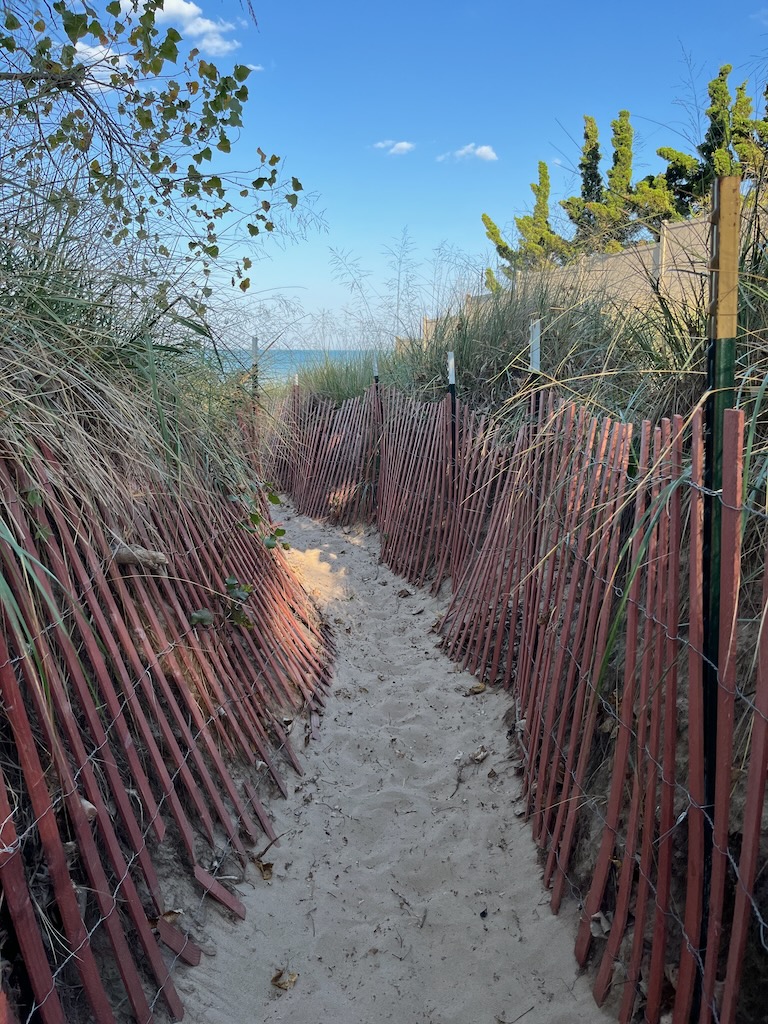
the place where God all but reaches down and swoops me into God’s arms is at the shoreline, where the vault of blue heaven is vast, is infinite, where the water’s edge might take on any one of uncountable modes: it might be uncannily calm, so calm the ripple is but a purling, a burbling so barely perceptible it’s as if the lake is tickling the sand; or it might be roiling and cacophonous, so deafening you can barely hear the words rising from your own throat. 

i could stand there all day, my toes planted in sand, my head tilted back, eyes wide. heart thrust forward and up, up. 

i’ve been walking there each day with my beloved. our footfalls in the sand the only sign we’ve been by. sometimes, if i go alone, i curl small as a hedgehog and settle into the grasses that rise from the hillocks of sand. i stay till the last of my prayers are unfolded, laid at the lap of the One Who Is Listening.

it’s as holy a place as i know. 

to feel God reach down and hold you, to know that the vastness above is deep and wide and forever enough to absorb each and every whisper and plea, to know that the deepest cries of your heart might be heard, to feel the soothing that comes as if your trembling shoulders are now wrapped in angora skeins, that is to me the very essence of a God who’s bigger and deeper, more infintely tender and close, than anything or anyone i could ever, ever imagine. or behold.

some days i need a God of extra-big volume and size. a God big enough to hold me, to press against me so firmly that all of my worries, like wrinkles, are melted away. those are the days i look to the heavenly dome. where mine is a God who knows me inside and out. sometimes my insides are so very scrambled and messy. 

it’s the closest i’ve come to that magnificent image of saint john of the cross, the one who rested his head against jesus’ chest at the very last supper, who let it be known that he was listening for the heartbeat of God. an indelible image that’s become a life-giving instructive (a particularly celtic one) for us all: to listen wherever we go for the unending pulsebeat and presence of God.

sometimes, inside the rooms of a house your worries can clang around noisily, too noisily. they can crowd out all of the air, and make you want to climb out of your skin. that’s where the heavens come in, where the shortest reach between me and my God is the indigo dome of the night at the beach, or the undulations of blues and grays in mid-afternoon. dawn at the water’s edge is a whole other slide show, one played out in the fieriest streaks of the rosy-red color wheel. 

and those are the days i all but run to the shoreline, to the water’s edge, where the alchemy of sand, sea, and sky are stirred into a medicinal balm, a sacred balm, like no other. and the God to whom i run always, always is there for me.


here’s a little extra beauty from the late poet anne sexton, whose story is drenched in struggle and sorrow, but who reached for the light coming in through the cracks. i tell a little bit of her story down below, but first, the poem:

Welcome Morning

There is joy
in all:
in the hair I brush each morning,
in the Cannon towel, newly washed,
that I rub my body with each morning,
in the chapel of eggs I cook
each morning,
in the outcry from the kettle
that heats my coffee
each morning, 
in the spoon and the chair
that cry “hello there, Anne”
each morning,
in the godhead of the table
that I set my silver, plate, cup upon
each morning.

All this is God,
right here in my pea-green house
each morning
and I mean,
though often forget,
to give thanks,
to faint down by the kitchen table
in a prayer of rejoicing
as the holy birds at the kitchen window
peck into their marriage of seeds. 

So while I think of it,
let me paint a thank-you on my palm
for this God, this laughter of the morning,
lest it go unspoken. 

The Joy that isn’t shared, I’ve heard,
dies young.

  • Anne Sexton
anne sexton

sexton, a 20th-century american poet, was considered one of the Confessional poets, along with maxine kumin, sylvia plath, and robert lowell. after the birth of her first daughter, she suffered from post-partum depression, had her first so-called nervous breakdown, and was admitted to a psych hospital. she suffered depression the rest of her life, a life that ended in suicide when she was 45.

although her poetry was criticized by some as “soap opera-ish,” others praised it for the ways it expressed “the paradoxes deeply rooted in human behavior and motivation. her poetry presents multiplicity and simplicity, duality and unity, the sacred and the profane.”

one of sexton’s earliest champions, erica jong, reviewing her 1974 The Death Notebooks, argued for sexton’s poetic significance, claiming her artistry was seriously overlooked: “she is an important poet not only because of her courage in dealing with previously forbidden subjects, but because she can make the language sing. of what does [her] artistry consist? not just of her skill in writing traditional poems … but by artistry, i mean something more subtle than the ability to write formal poems. i mean the artist’s sense of where her inspiration lies …there are many poets of great talent who never take that talent anywhere … they write poems which any number of people might have written. when anne sexton is at the top of her form, she writes a poem which no one else could have written.”

where are the places in your world where your prayers feel especially heard? where a holy comfort might enwrap you? and you just might feel held? and, thinking of sexton’s poem, if you were to write a litany of morning joys, what would be among your joys?

prayers for this country as we cross over the threshold of this next election. prayers for peace, prayers for truth, prayers for grace….

a little bit of wonder. . .

since this is my time of quiet interlude, and my brain is on inhale, i come tiptoeing with just a couple morsels worth leaving on the table, as if notes scribbled in the night to greet you when the morning comes. these are deliciousnesses i plucked during the week, one from hermann hesse on wonder, and a prayer poem from john o’donohue looking at light from every angle….oh, and because it was beloved e.b. white’s birthday this week, a little bit from the obit he once wrote for the new yorker when his dog daisy met her demise on a new york city sidewalk when a taxi cab jumped the curb…


hermann hesse, the great german-swiss poet, novelist, and painter, whom some consider “the eternal patron saint of wonder,” on that very subject itself…

“Wonder is where it starts, and though wonder is also where it ends, this is no futile path. Whether admiring a patch of moss, a crystal, flower, or golden beetle, a sky full of clouds, a sea with the serene, vast sigh of its swells, or a butterfly wing with its arrangement of crystalline ribs, contours, and the vibrant bezel of its edges, the diverse scripts and ornamentations of its markings, and the infinite, sweet, delightfully inspired transitions and shadings of its colors — whenever I experience part of nature, whether with my eyes or another of the five senses, whenever I feel drawn in, enchanted, opening myself momentarily to its existence and epiphanies, that very moment allows me to forget the avaricious, blind world of human need, and rather than thinking or issuing orders, rather than acquiring or exploiting, fighting or organizing, all I do in that moment is “wonder,” like Goethe, and not only does this wonderment establish my brotherhood with him, other poets, and sages, it also makes me a brother to those wondrous things I behold and experience as the living world: butterflies and moths, beetles, clouds, rivers and mountains, because while wandering down the path of wonder, I briefly escape the world of separation and enter the world of unity.

. . . “Our universities fail to guide us down the easiest paths to wisdom… Rather than teaching a sense of awe, they teach the very opposite: counting and measuring over delight, sobriety over enchantment, a rigid hold on scattered individual parts over an affinity for the unified and whole. These are not schools of wisdom, after all, but schools of knowledge, though they take for granted that which they cannot teach — the capacity for experience, the capacity for being moved, the Goethean sense of wonderment.”

“A leaf of grass is no less than the journey work of the stars.”

Hermann Hesse

and from the late great irish poet john o’donohue…

For Light

Light cannot see inside things.
That is what the dark is for:
Minding the interior,
Nurturing the draw of growth
Through places where death
In its own way turns into life.

In the glare of neon times,
Let our eyes not be worn
By surfaces that shine
With hunger made attractive.

That our thoughts may be true light,
Finding their way into words
Which have the weight of shadow
To hold the layers of truth.

That we never place our trust
In minds claimed by empty light,
Where one-sided certainties
Are driven by false desire.

When we look into the heart,
May our eyes have the kindness
And reverence of candlelight.

That the searching of our minds
Be equal to the oblique
Crevices and corners where
The mystery continues to dwell,
Glimmering in fugitive light.

When we are confined inside
The dark house of suffering
That moonlight might find a window.

When we become false and lost
That the severe noon-light
Would cast our shadow clear.

When we love, that dawn-light
Would lighten our feet
Upon the waters.

As we grow old, that twilight
Would illuminate treasure
In the fields of memory.

And when we come to search for God,
Let us first be robed in night,
Put on the mind of morning
To feel the rush of light
Spread slowly inside
The color and stillness
Of a found word.

~ John O’Donohue ~

(from To Bless the Space Between Us)


and, lastly, in blessing for e.b. white, who gave us charlotte’s web, and stuart little, and whose birthday was july 11, 1899, here’s the beginning of the marvelous obit he wrote in the new yorker when his dog, daisy, died. i can’t leave the whole thing here because it’s locked in the new yorker archives and you can only find it with a subscription, but here’s how it begins….


what deliciousness did you find this week??

happy birthday across-the-way….

sixteen.

sixteen years old. old enough to drive a car, the chair now is. not quite old enough to vote, but we’ve stayed away from politics all these years; allowing only goodness, grace, to be our guide––even in those rare few times we’ve wandered in the public square, celebrated the election of a president, felt crushed by the words and ways of another.

we’ve stood watch here as the world crushed us (i can still see the image of that precious little two-year-old, the syrian toddler––alan kurdi was his name, the little boy in the bright-red T shirt, the little black sneakers, and scrunched-up navy pants––washed up on the sands of the aegean sea, trying to escape a war’s unimaginable horrors and terrors). we’ve felt the crushings, too, of close-to-home heartaches, the ones not felt much beyond our own intimate borders, but more piercing than all the rest sometimes. 

why do we invite in crushings here? because it’s how i’m wired, i suppose. i’ve always felt hurts so, so deeply (some say too deeply; to them i say not sorry). and i have always wished for a place where tender comforts, heart healings, might occur. where the one who’s hurt could find a featherdown place to curl into. to be tucked under fuzzy afghans. handed warm mugs of tea. and a bowl of clementines, for when the tears paused long enough to give way to nibbling. maybe it’s the nurse in me, the heart of me. i can’t bear to see, to hear, to feel, to imagine hurting. but i will witness every time. for every hurt needs witness. needs bearing. needs extra body parts––shoulders to lean on, hands to squeeze, eyes to gently smile––to bear and share the load.

sometimes, i’ve brought silly here. not because i’ve any proclivity for clowns or clownishness. but because life not seen through comic lens is sometimes too unbearable. to laugh is to lighten the load. to be lifted by the effervescence of a good giggle. or even a guffaw. there’s alchemy and medicine in the sound of joy rising from the lungs.

in sixteen years, we’ve held up to the candlelight life’s beginnings and endings and all in-betweens: goodbyes and homecomings, births and death, and the littlest flickerings of the everyday. 

i’ve uncorked a bit of my soul here, let you see my heart’s wanderings as i moved deeper and deeper, bolder and bolder into saying aloud what i was sometimes plenty timid to whisper. somehow, over the years, the sacred i call God––God, a name that resonates a tenderness to me, a name whose very uttering fills me with a knowing, a hope––has pulsed so palpably through my every day, i now put breath to it without too much trembling. and in words––i hope––that do not close doors. i’m more intent than ever to draw forth the wisdom, the wonder, the light from any path that winds toward God, Allah, Adonai, Divine and Holy Wisdom. i reach for the doorways, have no use for locks on doors.

i’ve brought tinkerings at the cookstove here, too. in part because i will always be trying to find my way back from a dark, dark place when i was just 18, and, for reasons that escaped me at the time, i’d somehow decided i’d see how little food i could swallow in a day. it’s a place that filled me with cringing shames for years, and years. and tangled me in terrible knots. not knowing how to eat, being daunted by and quaking in the face of simple food, is a scourge i’d wish on no one. the question i’d long asked, and which was long asked of me: how does the homecoming queen find herself riding an elevator to a full-blown psych ward? (1975 was back in the day before anyone really knew what anorexia was; and there were no such eating disorder programs as there are today. and the movie “one flew over the cuckoo’s nest” had just come out on the very big screen, so it set the stage for a most awful fright.) i can type those sentences now because the years have gentled my shame, and slowly, faithfully, i’ve found my way to a shore of my own. a shore where olive oil doesn’t scare me anymore. and where just last week i drizzled honey (on dorie greenspan’s sweet & smoky roasted carrots*). and it seems that when you’ve struggled so to feed yourself, you find a quiet certain joy in feeding those you love. (and maybe by osmosis you’re hoping to absorb some ease…)

i didn’t intend for this birthday note to grow so confessional. but over all these years, you’re the ones who’ve made this place into the sacred, gentle, quiet space i once dreamed of. and always believed in. you’ve shown me, though your unending kindness, that what i write here is safe here––and i will protect to the end your safety to say here what you will. and, hard as it might be to imagine (given the crude world in which we live), never once in all these years have i found a harsh or mean-spirited comment left here at the so-called “old maple table.” (it would crush me if i found one.) your gentle graces, your heartfelt, heartfelt notes and comments, as well as your incredibly heavenly occasional snail mails, have emboldened me to tell only truth here. life is short, too short, we know. and why waste a day fudging around the edges when what draws us whole––and into each other’s embrace––is saying who we are, and what hurts us, and what makes us giggle? and aren’t we all, in truth, wobbly creatures at the core, only slowly ascending from all the snags and quirks that make us so delightfully who we are? 

so here’s to truth. and sixteen, a number imbued with introspection, and spiritual purity, and a sign of good things to come, according to those who study numbers, find meaning therein. 

may this next whirl around the sun bring blessings to us each and all…

i have an especially lovely birthday present for all of you, one i will leave here on the table (down below). my friends at the SALT project dug it up from wendell berry’s bookshelf, and it’s a beauty like no other. it’s called “the birth (near port william)” and as you’ll see, it’s a nativity poem for all. happy blessed birthing day, for whatever it is you’ll birth today….(the poem is long, so i will leave it at the very bottom here….) (p.s. because the formatting itself is lovely and i can’t get it replicated here, and because you might love the SALT project, i’m leaving the link to their page here.)

one other gift, before i leave you the poem. little alan kurdi’s father, the only one of the family of four who survived the escape in a rubber boat back in the early autumn of 2015, a few years later started a foundation to help children whose lives have been torn apart by war. it’s yet another miracle of the human spirit’s capacity to rise from the deepest, darkest ashes. you can find out more about the kurdi foundation here.

and another treat: the other evening i time-traveled to amherst, mass., for a birthday celebration in the glorious home of emily dickinson, the great butter-yellow house on the hill, known as the homestead, and during that hour and a half of marvelousness, one of curators mentioned that emily’s beloved sister-in-law susan had written emily’s obituary, which was published in the springfield republican on may 18, 1886. immediately curious, i asked for the link, and here tis, with some of the most lovely writing, and most charmed intimacies of emily’s life, written in the immediate wake of emily’s death by the one who perhaps knew her most dearly…. https://www.emilydickinson.it/edobituary.html

here is but one passage i found delectable…

As she passed on in
life, her sensitive nature shrank from
much personal contact with the world,
and more and more turned to her
own large wealth of individual resources
for companionship, sitting thenceforth, as
some one said of her, “In the light of
‘her own fire.” Not disappointed with the
world, not an invalid until within the past two
years, not from any lack of sympathy, not be-
cause she was insufficient of any mental work
or social career – her endowments being so ex-
ceptional – but the “mesh of her soul,” as
Browning calls the body, was too rare, and the
sacred quiet of her own home proved the fit
atmosphere for her worth and work.

and the obit ends thusly:

To
her life was rich, and all aglow with God and
immortality. With no creed, no formulated
faith, hardly knowing the names of dogmas,
she walked this life with the gentleness and
reverence of old saints, with the firm step of
martyrs who sing while they suffer. How
better note the flight of this “soul of fire in a
shell of pearl” than by her own words? –

Morns like these, we parted;

Noons like these, she rose;

Fluttering first, then firmer,

To her fair repose.

*oh, and those carrots drizzled with honey? dorie greenspan’s sweet + smoky roasted carrots you’ll thank my sister-in-law, brooke, who sent them my way…

and that, dear friends, is the stack of gifts i have for you this blessed early morn…..(one question, and then wendell berry’s poem…)

so here’s the question: how did you find the chair?

“THE BIRTH (NEAR PORT WILLIAM),” BY WENDELL BERRY

They were into the lambing, up late.
Talking and smoking around their lantern,
they squatted in the barn door, left open
so the quiet of the winter night
diminished what they said. The chill
had begun to sink into their clothes.
Now and then they raised their hands
to breathe on them. The youngest one
yawned and shivered.

                         “Damn,” he said,
“I’d like to be asleep. I’d like to be
curled up in a warm nest like an old
groundhog, and sleep till spring.”

“When I was your age, Billy, it wasn’t
sleep I thought about,” Uncle Stanley said.
“Last few years here I’ve took to sleeping.”

And Raymond said: “To sleep till spring
you’d have to have a trust in things
the way animals do. Been a long time,
I reckon, since people felt safe enough
to sleep more than a night. You might
wake up someplace you didn’t go to sleep at.”

They hushed awhile, as if to let the dark
brood on what they had said. Behind them
a sheep stirred in the bedding and coughed.
It was getting close to midnight.
Later they would move back along the row
of penned ewes, making sure the newborn
lambs were well dried, and had sucked,
and then they would go home cold to bed.
The barn stood between the ridgetop
and the woods along the bluff. Below
was the valley floor and the river
they could not see. They could hear
the wind dragging its underside
through the bare branches of the woods.
And suddenly the wind began to carry
a low singing. They looked across
the lantern at each other’s eyes
and saw they all had heard. They stood,
their huge shadows rising up around them.
The night had changed. They were already
on their way — dry leaves underfoot
and mud under the leaves — to another barn
on down along the woods’ edge,
an old stripping room, where by the light
of the open stove door they saw the man,
and then the woman and the child
lying on a bed of straw on the dirt floor.

“Well, look a there,” the old man said.
“First time this ever happened here.”

And Billy, looking, and looking away,
said: “Howdy. Howdy. Bad night.”

And Raymond said: “There’s a first
time, they say, for everything.”

                                   And that,
he thought, was as reassuring as anything
was likely to be, and as he needed it to be.
They did what they could. Not much.
They brought a piece of rug and some sacks
to ease the hard bed a little, and one
wedged three dollar bills into a crack
in the wall in a noticeable place.
And they stayed on, looking, looking away,
until finally the man said they were well
enough off, and should be left alone.
They went back to their sheep. For a while
longer they squatted by their lantern
and talked, tired, wanting sleep, yet stirred
by wonder — old Stanley too, though he would not
say so.

          “Don’t make no difference,” he said
“They’ll have ’em anywhere. Looks like a man
would have a right to be born in bed, if not
die there, but he don’t.”

                         “But you heard
that singing in the wind,” Billy said.
“What about that?”

                         “Ghosts. They do that way.”

“Not that way.”

                         “Scared him, it did.”
The old man laughed. “We’ll have to hold
his damn hand for him, and lead him home.”

“It don’t even bother you,” Billy said.
“You go right on just the same. But you heard.”

“Now that I’m old I sleep in the dark.
That ain’t what I used to do in it. I heard
something.”

               “You heard a good deal more
than you’ll understand,” Raymond said,
“or him or me either.”

                        They looked at him.
He had, they knew, a talent for unreasonable
belief. He could believe in tomorrow
before it became today — a human enough
failing, and they were tolerant.

                                 He said:
“It’s the old ground trying it again.
Solstice, seeding and birth — it never
gets enough. It wants the birth of a man
to bring together sky and earth, like a stalk
of corn. It’s not death that makes the dead
rise out of the ground, but something alive
straining up, rooted in darkness, like a vine.
That’s what you heard. If you’re in the right mind
when it happens, it can come on you strong;
you might hear music passing on the wind,
or see a light where there wasn’t one before.”

“Well, how do you know if it amounts to anything?”

“You don’t. It usually don’t. It would take
a long long time to ever know.”

                                 But that night
and other nights afterwards, up late,
there was a feeling in them — familiar
to them, but always startling in its strength —
like the thought, on a winter night,
of the lambing ewes dry-bedded and fed,
and the thought of the wild creatures warm
asleep in their nests, deep underground.

Wendell Berry

**sixteen, in case you wondered, is how many years the chair has been this quiet little place where these days we gather every friday morn. or at least that’s when i pull up a chair. you’re welcome to stop by any time, stay as long as you’d like. or, for years and years….’twas launched, the chair was, on 12.12.06, with this little post…