an attentive life
because i’m motoring up to my college reunion today, here’s an essay i wrote for the summer issue of marquette magazine, in which i realize how that jesuit curriculum was the birthing ground of paying attention, most especially, for me, in the college of nursing…
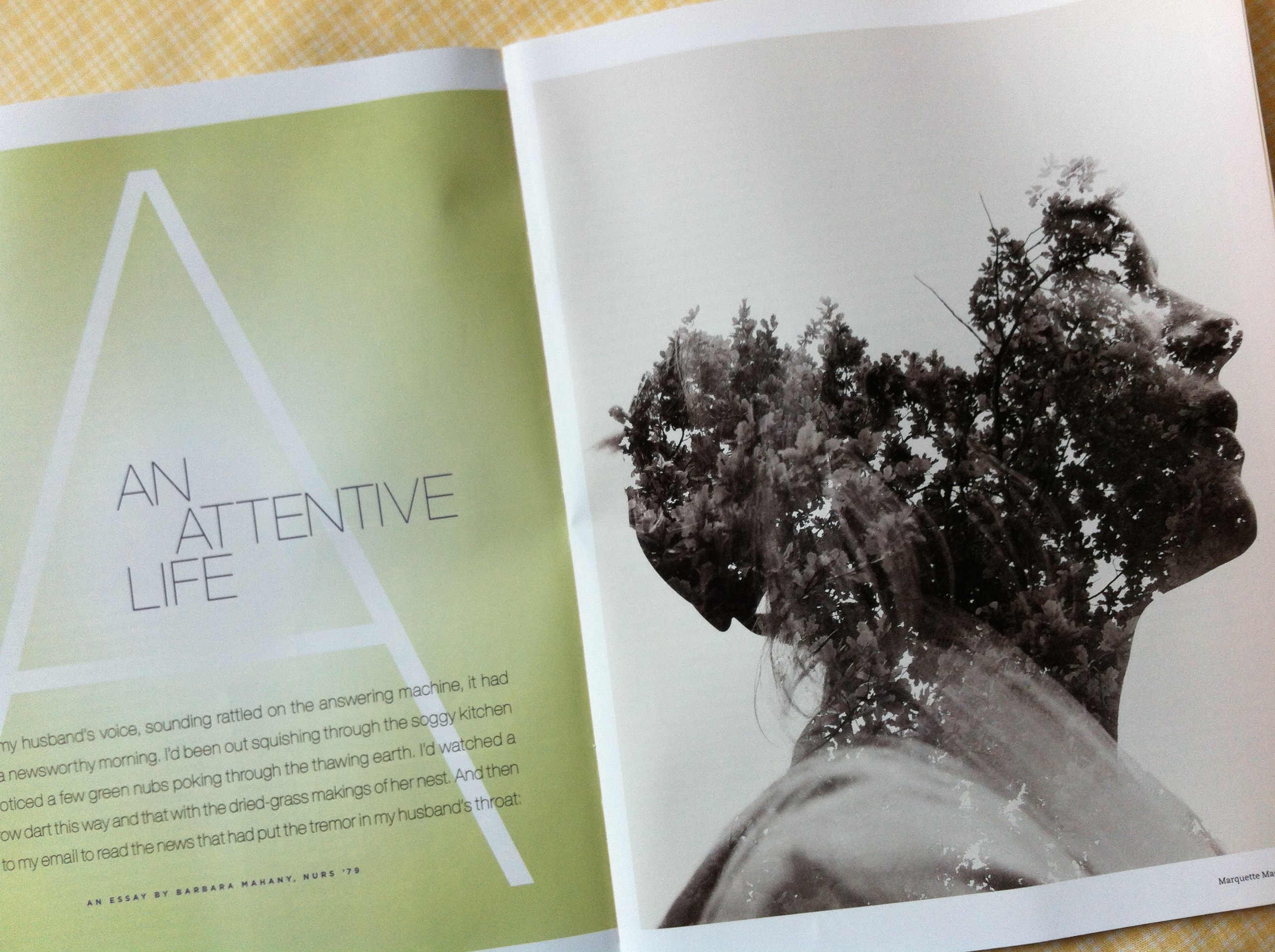
An Attentive Life
An Essay By Barbara Mahany, Nurs ’79
Until I heard my husband’s voice, sounding rattled on the answering machine, it had hardly been a newsworthy morning. I’d been out squishing through the soggy kitchen garden. I’d noticed a few green nubs poking through the thawing earth. I’d watched a mama sparrow dart this way and that with the dried-grass makings of her nest.
And then I scrambled to my email to read the news that had put the tremor in my husband’s throat: A dear friend, one who’d just finished a year of god-awful chemo, a friend who is mother to a 17-year-old who only a week ago had scored the trifecta of Ivy League acceptance letters and to a 13-year-old who’s not too tough to cry when soccer flattens him, had just gotten word that her cancer is back. Back with a vengeance. And her doctors now narrow her hope: only to stretch out her days so, for now, she can pack her daughter’s college trunk and send her son back onto the soccer field for one more season.
The words that won’t stop rattling through my breath, my brain, my every heartbeat are these: The holiest way to live this blessed life is by paying full-throttle attention.
If our days are numbered —and they are, though it sometimes takes the urgency of a day like today to sharpen the edge of that raw truth —we really can’t afford not to notice, not to bristle at the brush strokes of the divine that sweep up against us, leave us with goose bumps, remind us that the holy is all around and that if we listen, really listen, we just might hear the sacred breath that whispers, “Here I am.”
It took me the better part of a half-century to figure it out, but I’ve come to believe that prayer is the practice of paying attention.
Like the chambered nautilus I unearth from the sandy shore, the uncoiling of wholly attentive prayer is at once simple yet intricate. A discipline never easy, nor is it insurmountable. It’s a mindfulness, a sensory awakening that opens all the channels coursing straight to the pulse point deep inside, the one that attunes us to true knowing. It can feel sometimes as if someone is squeezing our hand in the dim darkness of our days or wrapping us in mighty muscled arms that will not let us stumble or turn to run and hide.
At heart, the prayer of paying attention is a deeply human act that ushers in the otherwise unknowable. It’s what fills in the emptiness of our otherwise hollow living-breathing selves.
It comes in many forms. It’s the wide-eyed scanning of sky that prompted me, one late summer’s night while driving home through a leafy woods, to notice the rising cheddar wheel of a moon and drive like a madwoman to the edge of a lake, where I watched that lunar orb ooze tangerine strands across the inky waters, arcing toward the high point of heaven’s dome. Slack-jawed, I marveled all the while.
Or it’s the keen-eared concentration that allowed me not to miss when a man sitting down the row in a shadowy auditorium mentioned that, soon after his wife died, he explained to his young son: “The reason people die is because it means we have a limited number of days, so how we live matters.”
I can’t imagine the text of my life absent such heaven-sent wonder and wisdom.
Mary Oliver, the poet saint, writes: “Attentiveness is the root of all prayer.” And reminds us that our one task as we walk the golden-glowing woods or startle to the night song of the spring peepers rising from the wetlands is “learning to be astonished.”
Ever astonished.
“I want to live my life in epiphany,” says poet and Renaissance scholar Kimberly Johnson. “I want all my pores open.” This way of living at full attention, she says, “is unmediated experience. My antennae are tuned to stuff that exists beyond the social sphere.”
It’s why she’d gladly spend a day nestled beside a gurgling brook on a mountain trail. It’s a way to gulp down undiluted holiness, never watered down, not dimmed by the cacophony of a world that seems to be forgetting how to listen.
The holiest way to live this blessed life is by paying full-throttle attention.
Celtic tradition puts a name to the places in the world where the veil between heaven and earth is lifted, where the whispers of the divine are most discernible: “Thin places,” the Celts believe, are the places to which we are pulled as if tide pools where we can bathe in that for which we are so parched.
The first time I heard the phrase, I was walking between rows of runner beans with a farmer friend whose firstborn son, a U.S. Marine home on leave from Iraq, had been killed when his old car missed the bend in a country road and he drowned in a pond not five miles from his mother’s central Illinois farm. My farmer friend pointed to the hayloft of the old barn, a gap-toothed slat-roof barn where shafts of light streamed in, a mosaic of illumination and shadow. “That’s my thin place,” she told me. “That’s where I go to cry in the arms of God.”
Curiously, Celts and Jews and Ignatius Loyola, among others, share that pulsing sense that every moment of the day — the most ordinary moments of every day — are vessels of the holy. And all we need do to anoint that holiness, to make it evident, unmistakable, is to bless it with our attention. And our simple prayer.
So for Jews, there are some 100 blessings stitched across the hours of the day, from the blessing for awaking to the one for slipping on undergarments. In Celtic tradition, prayers are whispered for getting up, lighting the fire, milking the cow and on through the day, until the prayer for snuffing out the candles when the house is darkened for the night.
A glorious expression of that Celtic belief in abounding holiness is the insistence that we “learn to play the five-stringed harp,” that being the five senses that will bring us nose to nose, skin to skin, ear to ear with the divine.
In the Ignatian way, the credo is clear: Find God in all things. Not only all good things. All things. The great Jesuit poet Gerard Manley Hopkins wrote: “… for Christ plays in ten thousand places … ” Thomas Merton put it: “The gate of heaven is everywhere.”
In a word, it’s “hierophany,” the place where secular and sacred meet. It’s all around, and it’s a belief that dates back to ancient Greece. We’re not tripping over a novel concept here. This is no New Age enlightenment.
“It’s one of the most fundamental spaces in my life, this space where the horizontal, the secular, meets the vertical, the ultimate; literally, the shape of the cross,” says Guggenheim Fellow, poet and best-selling author Eliza Griswold, the journalist who wrote The Tenth Parallel: Dispatches from the Fault Line Between Christianity and Islam. “That’s poetry, where everyday time is punctured by the sacred. And my calling is there, the places where sacred and secular meet.”
I’ve long been a student in the great school of God’s world as it surrounds me. I’ve long been hellbent on breaking open the fragile — and the monumental — offered up by the limbs and the leaves and the rippling streams and the star-stitched night sky.
There is metaphor all around. It’s deep and it’s profound, and I am drinking it in as if cool waters through a straw.
And more than in John Muir’s woods or on the banks of Thoreau’s Walden Pond, my ears have perked to the scritch scratch of heaven on earth right here in the dappled sunlight as it pools across the wide pine planks of my old house or plays peekaboo among the tangled vines of my rambunctious secret garden just outside the kitchen door.
I needn’t travel far to find the holy. Though it did take time — the better part of decades — to learn to listen for the sacred murmurings, to let them soak deep down to where I was hungriest, most hollow, to figure out that all along I’d had the fine-boned instrument to draw the music in.
And, recently, it struck me that my paying-attention curriculum, the part that came from syllabus as much as natural-born curiosity, began in the halls of Marquette’s College of Nursing, back at the old college, the one appended to St. Joe’s Hospital. There, in shiny linoleum-tiled classrooms in the fall of 1976, the whole lot of us began to learn to see the world through a nurse’s dare-not-miss-a-detail eyes.
My very first assignment, once that white cap had been bobby-pinned to my curly locks, was to bathe a woman who was dying of a cancer whose origin I can’t recall. I was taught, straight off, to look deep into her eyes, to read the muscles flinching on her face, to hear the cracking of her words as she tried to tell me how warm she liked her bath and which limb hurt too much for me to lift.
And on and on the learning went. As I watched the waning light in the eyes of a 15-year-old boy at the hour of his death. As I gauged the depth of blue circling the lips of a 6-year-old girl with cystic fibrosis. As I buried the sobs of a wailing father against my shoulder while he absorbed the diminuendo of his 12-year-old daughter’s final breaths. At the crosshairs of life and death, I learned to live a life of close examination.
Some three decades ago, because by then I was working in a newspaper newsroom and forgot to pay attention to the paperwork of my life, my nursing license expired. So, short of retaking my boards, I can’t claim to be a registered nurse any longer.
But, the truth is, I needn’t hold a license to practice the exquisite art of paying attention. It’s a hard-won curriculum, indeed. But it’s one that’s dissolved the hard edge between heaven and messy earth. It’s the undercurrent of all my prayer. And it’s what aligns my every breath with all that is most holy.
Barbara Mahany, Nurs ’79, once a pediatric oncology nurse, is a freelance journalist and the author of Slowing Time: Seeing the Sacred Outside Your Kitchen Door (Abingdon Press), to be published in October 2014.
and how, dear friends, did you learn to pay exquisite attention?

 pull up a chair