pull up a chair

where wisdom gathers, poetry unfolds and divine light is sparked…

Tag: mary oliver

woozy

if this white diet lunch (white bread, white turkey, clear chicken broth) looks blurry, that’s because 10 days of bland’ll blur you…

with every key i type, my little self gets woozier. i am a poster child today for the prehistoric side of medicine, in which (as one dear friend has said) we can zap folks into outer space and land them on the moon, but we do not know how to clear out one’s insides short of filling them with Drain-O, and starving them besides. 

yes, yes, i’ve had this date on my calendar for months now. after my last attempt at this adventure in inner exploration got canceled at the last minute when my doctor got around to reading my medical history and realized i have uncharted and “torturous” insides. so they signed me up for the Drastic Plan, not the ordinary one for ordinary insides, but the special class for those who present gastroenterologists with high hurdles and sinuous turns in which to get tangled. 

they are knocking me flat out, with full-strength, full-bore anesthesia, because who in the world wants to be even half-awake when dead ends and cul-de-sacs are bumped into. 

i’ve had a guide or two, holding my hand through this gut-wrenching adventure. i was pointed to the aptly named White Diet, for all you are allowed to eat are things the color of freshly-fallen snow, a few of which have not touched my lips in half a century: white bread, white potato, white cottage cheese, white turkey slices, white insides of cucumber (oddly, though they must be peeled and seeded). if it’s white, it’s allowed. but only for a week. then one moves onto the part where things get serious, and clear. for three days now i’ve sustained myself on black coffee (color’s back!), clear apple juice, clear chicken broth, clear electrolyte gatorade. i tried coconut water and i gagged. and that’s as far as i will go in the TMI department (that’s too-much-information, mom!)

i am thus waving my white flag here, and surrendering to the woozies. before i pass out here at the keyboard (fear not, my trusty driver and lifelong handholder will get me safely to the hospital and back), i am going to fling you one or two juicy morsels (both from Mary Os) i found for you this week, and then i shall quietly slink away to await the end of this torturous two weeks. 

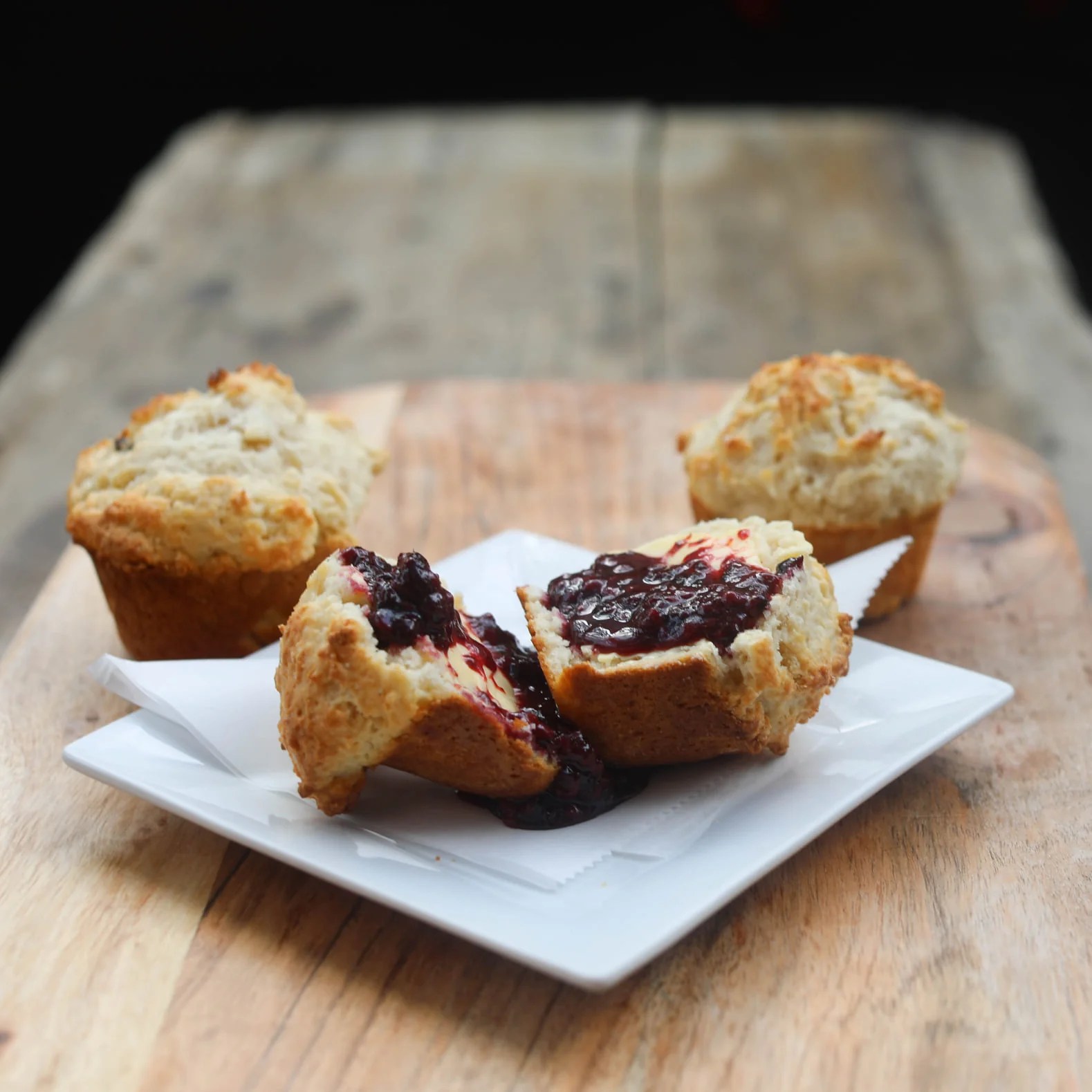
here’s an irony: i stumbled on a top-secret recipe for true irish scones, and because i occasionally indulge in self-torture (kidding, mom!) i am passing it along. because it looks delicious (cream and irish butter have a way of working their charms) and because a girl can dream even when she’s starving. this comes from my friends at Food 52, who might have snuck it out of someone’s east village kitchen:

Copycat Mary O’s Irish Soda Bread Scones
By Nea Arentzen
these irish soda bread scones were inspired by Mary O’s, an irish soda bread shop in new york’s east village not named for one of the chair’s patron saints of poetry, the other Mary O (only in new york would you find a specialty soda-bread shop). apparently, they serve theirs with homemade blackberry jam and Kerrygold butter, but Nea, the baker here, opts for store-bought strawberry jam instead. either way, she writes, you can’t go wrong. she adds this baking note: “the dough comes together quickly and all in one bowl, then i scoop it into mounds in a cupcake tin for extra height and stability.”
Serves
12 large scones
Prep time: 10 min
Cook time: 40 min
4 cups (480 grams) all-purpose flour
1/2 cup (100 grams) granulated sugar
4 teaspoons baking powder
1/2 teaspoon baking soda
1 1/2 teaspoon kosher salt
3/4 cups (170 grams) unsalted butter, cold and cut into cubes
1 cup raisins
2/3 cups buttermilk (or milk plus 1/2 teaspoon lemon juice)
2/3 cups heavy cream, plus more for egg wash
1 egg yolk
strawberry jam, to serve
softened butter, to serve
flakey sea salt, to serve

1. Heat the oven to 425 degrees F with a rack placed in the center position. Generously grease a 12 cup cupcake tin.

2. In a large bowl, stir together the flour, sugar, baking powder, baking soda, and salt. Add the cold, cubed butter and press into the flour with your fingers until it resembles coarse sand and no large butter clumps remain. Do this quickly as you don’t want the butter to have time to soften too much.

3. Stir in the raisins, then drizzle in the buttermilk and cream. Use your hands to scoop and fold the dough together until the flour is absorbed, trying to mix and press as little as possible. Gently scoop the dough into the cupcake tin, evenly dividing between the 12 cups.

4. In a small bowl, mix the egg yolk with 2 tablespoons heavy cream. Brush over each scone. Bake until golden brown and a toothpick inserted into the center comes out mostly clean, 22 to 25 minutes. (If using a kitchen thermometer, it should read at least 190 degrees F.)

5. Serve warm with jam, butter, and flakey sea salt.

and now for this bit of inspiration from another most beloved Mary O:

i cannot leave this post without sending the biggest birthday trumpet blast to two of my beloveds who happen to have back-to-back birthdays, auntie M today, and sweet P yesterday. the world, my world, is a taste of heaven here because their hearts beat alongside mine. i love them both with every ounce i’ve got.

taking a cue from Mary O, what noble things are you thinking of this week? and what’s the most improbable thing you’ve tried lately?
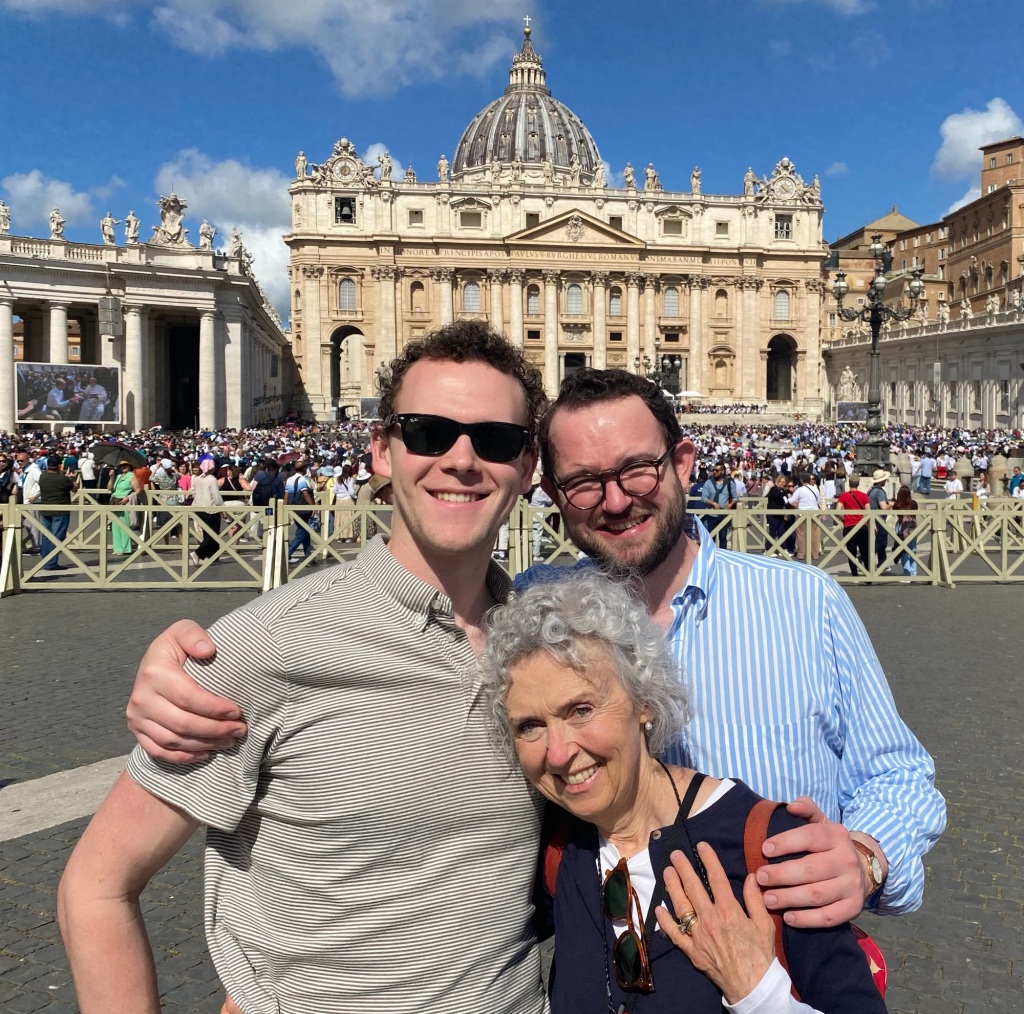
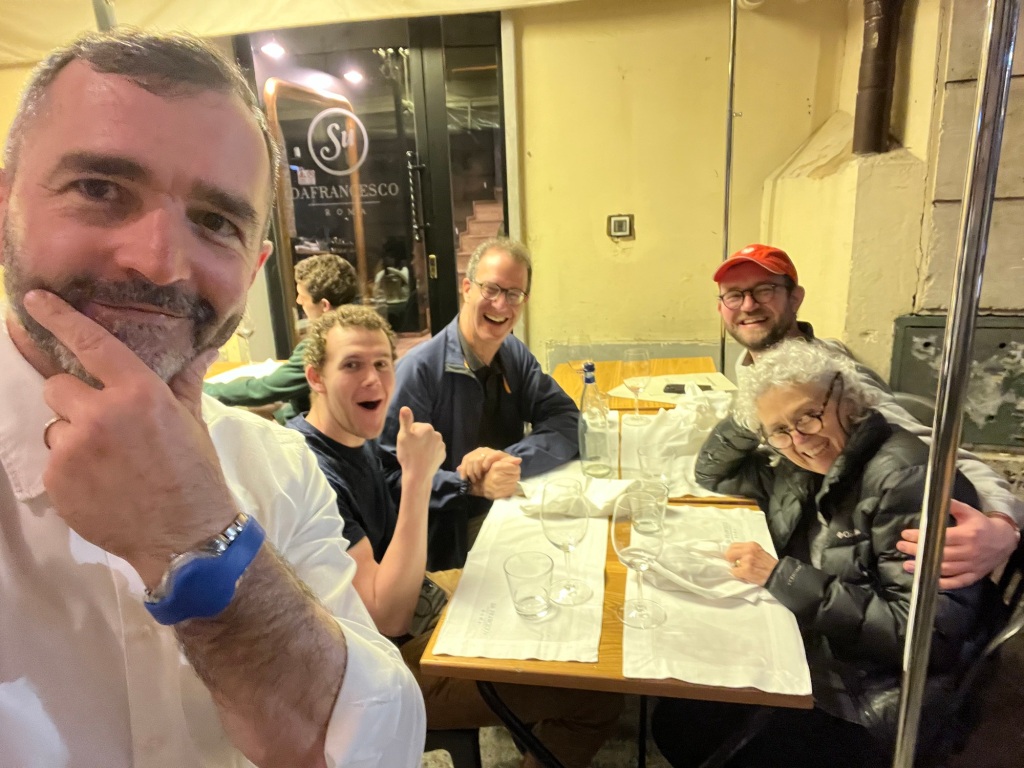
sometimes, joy makes you wait. . .

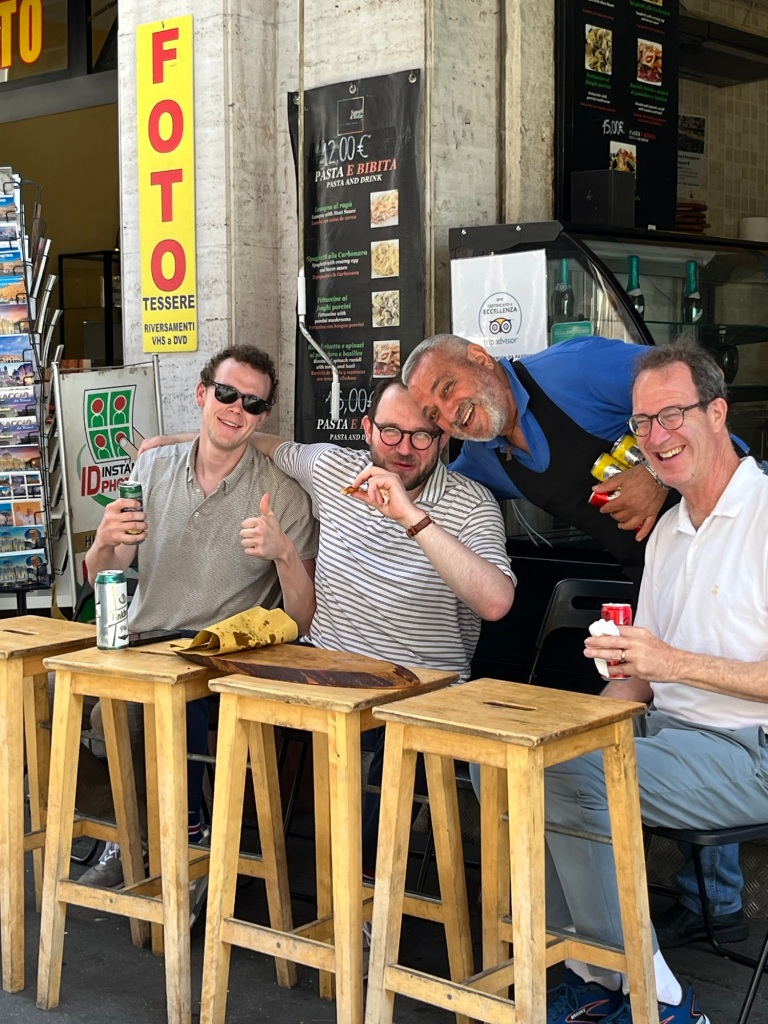
A year ago, I was crushed. Four of us were supposed to be in Paris, but one of us never made it on a plane. Passport tangles tangled him. We tried every option known to humankind, but after days of holding our breath, we faced the cold hard inevitability: there would be no four of us in Paris. No four of us encircling the cafe table, as I’d pictured it, prayed for it, since the day the doctor told me the thing in my lung was cancer. And all I wanted in the world was to be held tight, held together, by my boys. My beautiful beautiful beautiful boys.

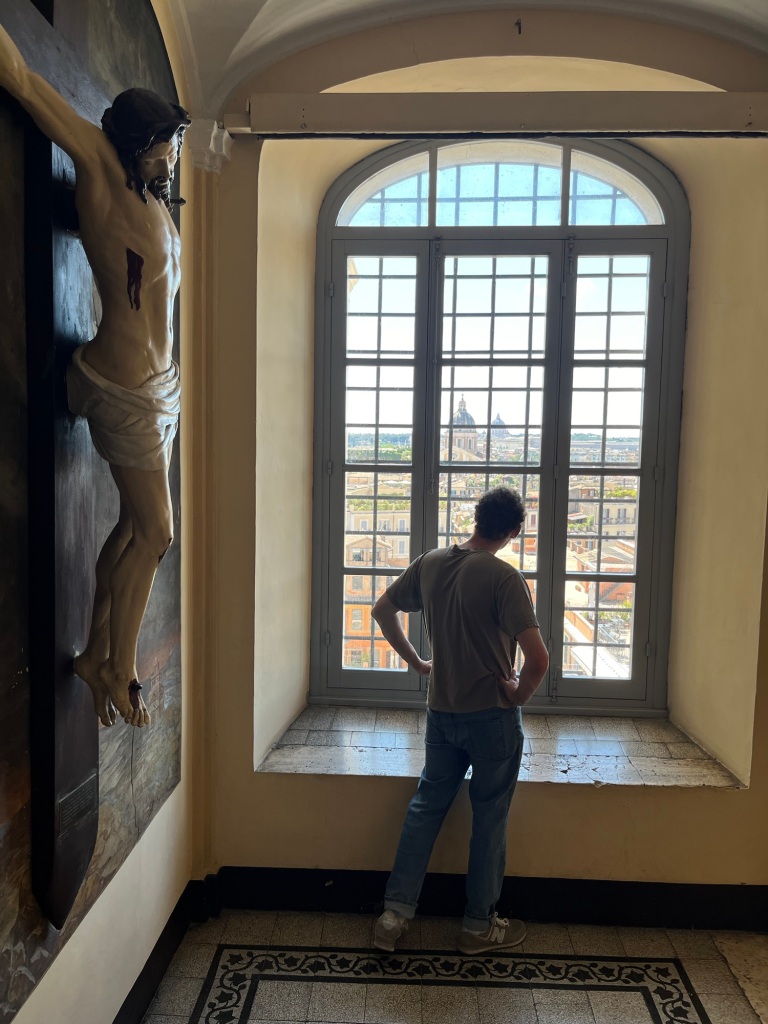
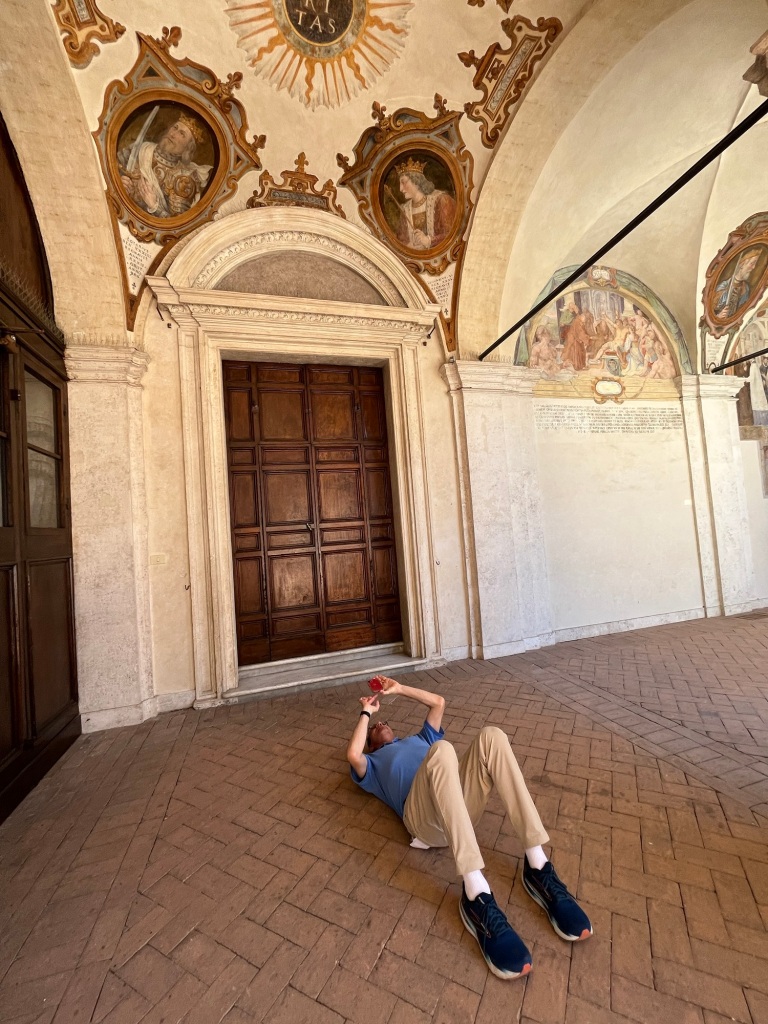
We were determined to try again. This year: Roma. We made the law professor with the failed passport get in line early, and expeditedly, for a new-spangled one. He complied.

I held my breath anyway. The closer we got to takeoff, the harder I held all the breath in my chest.

But Monday night, two planes, carrying four people, were crossing the globe, flying through the night, pointed toward Rome.

Ever since, I’ve been inhaling in double time, breathing as deep as a girl with 1.5 lungs can possibly breathe. Because this is the stuff that makes my life hum like a mezzosoprano, like a nightingale, like the merriest mama that ever there was. We are, the four of us, entangled as one, under the blue blue of Italy’s sky.

Sometimes the unthinkable happens. And you stumble and bumble, and shed tear upon tear. But then you pick up the pieces. You make the most of what’s there in your midst, and try to not ache for what’s missing.

And life, every once in a while, gives you a rare second chance. And you realize the heartache of the past has only hollowed more space in your heart, so that when the rushing in comes in, you’ve all the more capacity for unparalleled joy.

I am giddy and dizzy and pulsing with joy. It’s the sweetest sonata that I’ve ever sung.

It’s the song of my deepest prayer answered: dear God, give me sumptuous sumptuous time with my most blessed and beautiful beautiful boys.

Amen.


A perfect poem for this moment:

Mary Oliver’s “Mindful”

Everyday
I see or hear
something
that more or less

kills me
with delight,
that leaves me
like a needle

in the haystack
of light.
It was what I was born for —
to look, to listen,

to lose myself
inside this soft world —
to instruct myself
over and over

in joy,
and acclamation.
Nor am I talking
about the exceptional,

the fearful, the dreadful,
the very extravagant —
but of the ordinary,
the common, the very drab,

the daily presentations.
Oh, good scholar,
I say to myself,
how can you help

but grow wise
with such teachings
as these —
the untrimmable light

of the world,
the ocean’s shine,
the prayers that are made
out of grass?

What are the somethings for which you’ve had to wait for what felt an unbearable wait?

sunshine girl

i tend toward the grays. and i don’t mean the pewter locks atop my head. i refer here to my meteorological preferences.

i’m of celtic persuasion, which means a pigeon-colored sky, preferably with mists rolling in, a landscape without shadow, for clouds are in the way, that’s the sort of day that wraps me like an afghan dropped from heaven’s hutch, makes me feel cozied by the hearth, deeply much at home. 

give me a gray day and i all but purr. 

this week, though, has been anomaly. the sunbeams of this latest swatch of springtime have been pouring in full proof, and voluptuously so. sunbeams so pure, so concentrated, i’ve bridled the urge to stick out my tongue and lick them––as if a gelato on a cone. or gulp, as if a nectar in the most delicate cut-glass flute that ever was.

it wasn’t lost on me how novel it was for me to be fixated––and bedazzled––by the motes of sunlight shafting in. it shook me from some rafters i’d not even realized had boxed me in. i was paying attention to my paying attention. an attunement to the nth power. and the simple substance that transfixed me was but one of that elemental trilogy: sunlight, water, air. 

to live in a state of fine-grained attentiveness is the instructive of every sage or prophet who’s walked this sunlit earth. for us to notice celestial shifts, as winter turns to spring, as the great star is jimmied higher into sky, must be God’s rapturous delight.

and i must have been more sun-starved than i realized after a long and washed-out winter, for i couldn’t keep myself inside the house this whole week long. i was all but stripping bare my crepe-papery arms and legs, so my famished flesh could guzzle sun. and, every chance i got (and even those i didn’t have), i found myself down on my knees, at the garden’s edge, wherever tender growing things gave me excuse to coax and coddle and slapdash in the dirt. 

from nearly sun-up to sundown, i was out and about, clocking miles on my soles, slip-sliding along a river trail, dodging red-winged blackbirds who tried to perforate my noggin. and, when my legs and knees were tuckered out, i sat splotched in sprees of golden light as i perched, robin-like, atop a rock or stoop, keeping watch on flutterings in trees. 

i’m not typically a sunshine girl. despite a nomenclature suggesting otherwise.

my papa and me (aka his “sunshine girl”)

long long ago, there was a fine irishman––my witty papa––who pinned a moniker on me back in the days when i’d take him by the hand and maybe reach just beyond his knees. he called me his sunshine girl, his one and only, and it’s a name that makes my knees go limp even to this day. 

i’ve not heard his voice in 43 years, but i can see the glint in his eyes, the way the pilot light burned bright and brighter, as he warmed up to pronounce the words, deeming me his sunlit girl. 

i rather fail my reputation.

in the long years of his absence, i’ve grown more inclined to sunshine’s shadowless counterpart, the days some define as “the color of bad weather.” i protest, tend to be of a mind with leo da vinci, the polymath and painter, who insisted “a gray day provides the best light.”

though not this golden-glowing week. and not without exception.  

like the poets emily D and annie dillard, i like my light in slants, or as dillard put it once: “i’m a collector” of such angled penetrations. the oblique is how i see things best.

most days, pure drenched feels too exposed. the white light of summer’s height makes me wither. 

springtime, though, is tender season. and the sunlight comes in slant, in perfect concentration. and every once in a rare while, in days as delicious as the sun-drenched string that was this week, i’ll gulp my yearly dose of solar plenty. and i’ll gulp it without pause. 


speaking of sunshine and the irish, here’s a line that made me laugh aloud this week:

“the sad truth is that, like fish, the looks of the irish are not improved by sunshine . . .”

—Niall Williams, This is Happiness, page 193


and as is my wont, i’ll bring mary oliver into the conversation, as she came to mind more than once when i was down on my garden knees this week: in “the summer’s day,” she writes:

“I don’t know exactly what a prayer is. /  I do know how to pay attention, how to fall down / into the grass, how to kneel down in the grass, / how to be idle and blessed.”

and, lastly, i zoomed into a poetry conversation with the poet (and yale institute of sacred music professor) christian wiman the other day, and he was asked to read a poem that shocks right through him, and here’s the one he read: 

Prayer
by Carol Ann Duffy

Some days, although we cannot pray, a prayer
utters itself. So, a woman will lift
her head from the sieve of her hands and stare
at the minims sung by a tree, a sudden gift.

Some nights, although we are faithless, the truth
enters our hearts, that small familiar pain;
then a man will stand stock-still, hearing his youth
in the distant Latin chanting of a train.

Pray for us now. Grade 1 piano scales
console the lodger looking out across
a Midlands town. Then dusk, and someone calls
a child's name as though they named their loss.

Darkness outside. Inside, the radio's prayer —
Rockall. Malin. Dogger. Finisterre.

(the four names in the last line are towns called out on BBC radio’s nightly “shipping forecast” for the various seas around the british isles, waters divided into 31 sea areas, including rockall, malin, dogger, and finisterre. the broadcast litanies, especially the late-at-night ones, are for many britons––including carol ann duffy––a familiar touchstone: the announcer’s voice reciting the sea areas all around the islands, one by one, forecasting the weather. and, higher up, minims are the half-notes in a page of musical notation)

of all the meteorological options, which one most floats your boat? and how and why?

hungry for color

it hits this time of year, at this point in the turning of globe when we’re deep in shadow, and the world out our window is endlessly, endlessly, drainingly gray. even i, a self-proclaimed fangirl of the cloudiest day, a girl who thrills at billows of fog, those days when the sunlight can’t find its way in — even i get a bit itchy for hues beyond pigeon and charcoal and smoke, all close kin in the family of gray.

which is precisely why that shock of scarlet and pink boldly inserts itself in the february calendar. we need a little color. and the heart-shaped holiday brings it on. coils and coils of red, beribboned with oyster pink or flamingo. maybe even dashes of fuchsia.

i detected this color deficiency (more of a self-diagnosis) when i realized that all through the week i was clicking and clicking on dizzying droplets of anything resembling “other-than-gray.” and when i caught myself daydreaming, once again, of a riotous, bouquet-gathering, summery cutting garden — zinnias and cosmos and blue bachelor’s buttons all rising up like a botanical box of jazzy crayolas (preferably the 64-pack in which those waxy rainbow-hued sticks stand shoulder-to-shoulder as if choir-robed darlings marched into their multi-row loft).

and so, in hopes of sating your own chromatic hungers, i bring you a compendium of colors from a painter, a cook, a maven of tulips, and a poet.


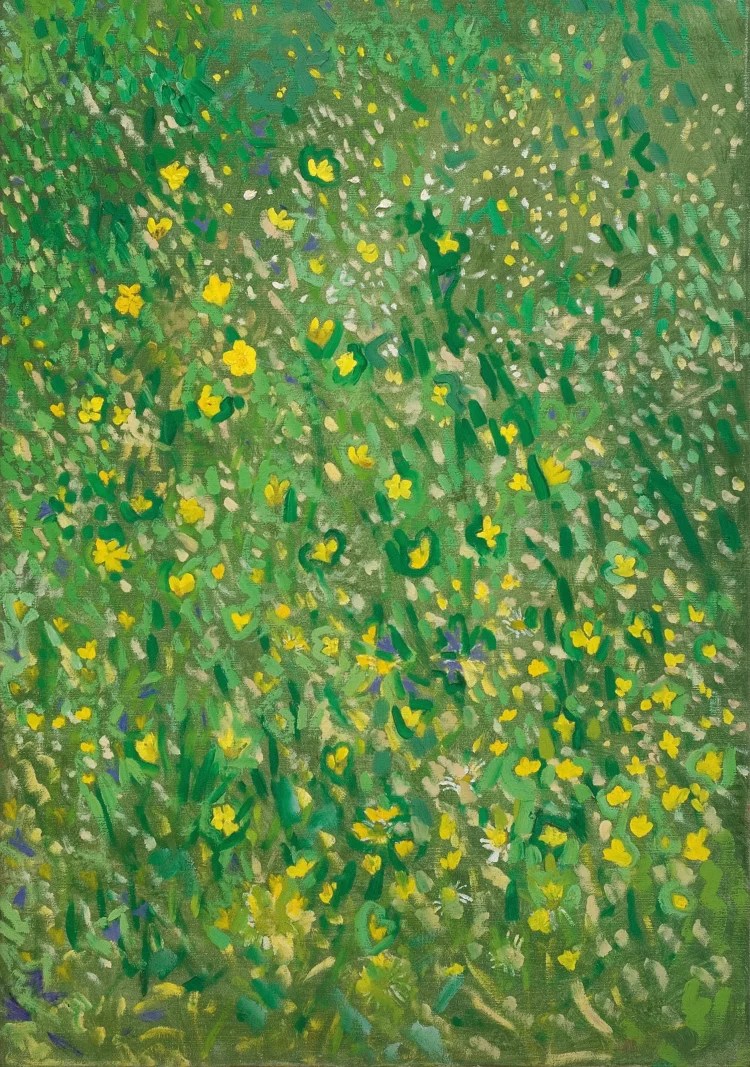
jean cooke’s “The Blumenthal,” 1995

first up: the painter, whose style of garden i aim to emulate, mostly because it’s been said that her “rambling garden was unkempt to imperfection.” jean cooke is her name, and she was considered one of britain’s greatest woman painters of the twentieth century. described, too, as a remarkable, bird-like woman, the london gallery that shows her work, goes on to describe her “ungardening” thusly:

Cooke’s neglect of her garden—she sometimes called it ‘ungardening’—was partly a reflection of her priorities: her painting and the care of her children. Beyond these demands there was little energy to give less pressing concerns. Grass went unmown, fences unmended and trees unpruned. But the messy garden was not entirely accidental. The disarray was cultivated over an extended period of time and helped Cooke to create a new subgenre in works such as The Wild Plum Tree, which drew upon aspects of both landscape and garden painting traditions. Whereas Claude Monet’s waterlily pond was scrupulously tended, Jean Cooke’s rambling garden was unkempt to imperfection just as her painting required. Whereas earlier paintings such as Grassland had used the Sussex coastline to create landscape-scale wilderness, by the mid-eighties when she began painting spring blossom in earnest her own garden had achieved a similarly expansive quality.

piano-nobile gallery
jean cooke at work in her unkempt imperfection

and in a nod to cupid’s holiday cusping on the near horizon, here’s a tad of insight, should tulips be the thing you choose to send your true love:

“rococo”

“As far as I’m concerned, …[tulips] are the best, indeed the only flowers to send or receive on Valentine’s Day. Wild, irrepressible, wayward, unpredictable, strange, subtle, generous, elegant, tulips are everything you would wish for in a lover. Best of all are the crazy parrot tulips such as ‘Rococo’ with red and pink petals feathered and flamed in crinkly lime-green. ‘When a young man presents a tulip to his mistress,’ wrote Sir John Chardin (Travels in Persia, 1686), ‘he gives her to understand by the general red color of the flower that he is on fire with her beauty, and by the black base that his heart is burned to coal.’ That’s the way to do it.”

– Anna Pavord, wonderful British garden writer and bulb lover, in The Curious Gardener: A Year in the Garden, 2010

on the subject of wild women who tend toward the vivid end of the paint pot, there is the utterly marvelous and delicious emily nunn, formerly of the new yorker and the chicago tribune. she is a food writer like no other, and in recent years she has devoted her not-inconsiderable genius to the subject of salads. her newsletter often has me giggling straight off my chair. and her salads are beyond delicious more often than not. it delights me to introduce you to the one and only emily nunn’s department of salads, along with a peek at but one of emily’s many-hued produce concoctions….


and finally, let’s wrap this up with a wonder from mary O that i had never seen before, from a slim little volume i’d not known of till just last week when a wonder of a woman hosted a candlemas gathering and asked us all to bring a.) a candle, and b.) a poem about light. and thus i discovered house of light, mary oliver’s 1990 collection of poems. since the subject of this one is van gogh, it seems perfectly suited as a prescriptive for those who find themselves suffering a little color deprivation.

EVERYTHING   by Mary Oliver

No doubt in Holland,
when van Gogh was a boy,
there were swans drifting
over the green sea
of the meadows, and no doubt
on some warm afternoon
he lay down and watched them,
and almost thought: this is everything.
What drove him
to get up and look further
is what saves this world,
even as it breaks
the hearts of men.
In the mines where he preached,
where he studied tenderness,
there were only men, all of them
streaked with dust.
For years he would reach
toward the darkness.
But no doubt, like all of us,
he finally remembered
everything, including the white birds
weightless and unaccountable,
floating around the towns
of grit and hopelessness––
and this is what would finish him:
not the gloom, which was only terrible,
but those last yellow fields, where clearly
nothing in the world mattered, or ever would,
but the insensible light.

and with that i shall wonder, where did you find color this week?

jean cooke’s “springtime through the window,” 1980s

in which we pause to remember one who would bristle at being called the patron saint of anything. . .

She stretches from Sharon Olds’ Stag’s Leap to Christine Valters Paintner’s Dreaming of Stones on my bookshelf. Sixteen volumes in all. And that’s just the poetry. Doesn’t count her essays, housed on a whole other shelf. I am talking, of course, of the poet I call my “patron saint of paying attention.” Mary Oliver. 

You might also say she’s the poet master of astonishment. She breaks me out in goosebumps and wonder. Line after line after line.

Oh, I’ve heard her poetries dismissed for their “surface simplicity and populist reach.” But when it comes to stirring my soul, I’ve no need for the critics. I side with those who, as was written in her New York Times obituary, find that “her poems, which are built of unadorned language and accessible imagery, have a pedagogical, almost homiletic quality.”

I call them holy. 

Give me a writer who can write of the “uncombed morning,” or confess that “sometimes I am that quiet person down on my knees.” Or cobble together words into a stanza that reads: “All things are inventions of holiness / Some more rascally than others.” Give me that writer and I’ll hitch my starship any last day.

These days, this long hard season, I seek saving grace wherever it falls. I find it in an evening’s sky punctuated by dragonflies drifting and darting in parabola. I find it in any sentence that ends “unlikely distant metastasis.” And I most certainly find it in the poet who reminds me: “So quickly, without a moment’s warning, does the miraculous swerve and point to us, demanding that we be its willing servant.” 

Count me willing.

Emily D. taught me to look for and love the slant, the wisdom that slides in on a steep-edged, improbable angle. Mary O does that every time. I am reading of a bluefish being washed at the water’s edge, and suddenly I am remembering to be on the lookout. To find God, the Holy, in all of creation. Or, as Emerson put it: “To attend all the oratorios, the operas, in nature,” in life, in the day upon day. 

Mary O is the one who puts her ink to the sacred as it spills across creation’s page. How else to describe the one who, when writing of a lone seal pup found on a desolate beach, muses: “. . . maybe / our breathing together was some kind of heavenly conversation / in God’s delicate and magnifying language, the one / we don’t dare speak out loud, / not yet.”

Pay attention to how she places that very last line. The barbed last hook. The one that sticks in your craw just a little bit longer. Whispers a gossamer faith. Mary O was a theologian of the barest brushstroke. You’d barely know you were shaken, but then you quake through to your deepest marrow. 

Mary Oliver’s birthday is September 10. She would have been 88.

And here, in her poem “Messenger,” she describes her life’s work:

My work is loving the world.
Here the sunflowers, there the hummingbird—
equal seekers of sweetness.
Here the quickening yeast; there the blue plums.
Here the clam deep in the speckled sand.

Are my boots old? Is my coat torn?
Am I no longer young, and still half-perfect? Let me
keep my mind on what matters,
which is my work,

which is mostly standing still and learning to be
astonished.
The phoebe, the delphinium.
The sheep in the pasture, and the pasture.
Which is mostly rejoicing, since all the ingredients are here,

which is gratitude, to be given a mind and a heart
and these body-clothes,
a mouth with which to give shouts of joy
to the moth and the wren, to the sleepy dug-up clam,
telling them all, over and over, how it is
that we live forever.

—by Mary Oliver


Seeing Not Looking

Celtic scholar Esther de Waal considers Thomas Merton’s practice of contemplative photography:   

Thomas Merton was of course a writer and a teacher, and a poet, but he was also a photographer, and it is from his photographs that we learn much about how he saw the world, and how he prayed—and the two are of course intimately connected…. He handled a camera as an artist would, and used it as an instrument of delight and perception. It was in the later 1950s that the journalist John Howard Griffin [1920–1980] visited Merton in his hermitage. He had his camera with him and … let [Merton] keep it on extended loan. At first when Merton sent him the negatives, John Howard Griffin was puzzled, for [Merton’s] view was so different from that of most people. Merton photographed whatever crossed his path—a battered fence, a rundown wooden shack, weeds growing between cracks, working gloves thrown down on a stool, a dead root, a broken stone wall. He approached each thing with attention, he never imposed, he allowed each thing to communicate itself to him in its own terms, and he gave it its own voice.  

Later on when he was out in the woods with a young friend, Ron Seitz, both with their cameras, Merton reprimanded him severely for the speed with which he approached things. He told him to stop looking and to begin seeing:  

Because looking means that you already have something in mind for your eye to find; you’ve set out in search of your desired object and have closed off everything else presenting itself along the way. But seeing is being open and receptive to what comes to the eye…. [1] 

He used his camera primarily as a contemplative instrument. He captured the play of light and dark, the ambience, the inner life. But above all he struggled towards an expression of silence through the visual image, so that his photographs show us that ultimately his concern was to communicate the essence of silence. 


it’s the month of Elul in the Jewish calendar, a month for accounting of the soul before the high holidays, Rosh Hashanah, the new year, and Yom Kippur, the day of atonement. i’ve been deep in soulful accounting, and bring along this prayer from the blessed Rabbi Nachman, who taught that life should be lived with joy. and centered in prayer.

A Prayer of Rabbi Nachman of Bratslav (1772-1810)

Grant me the ability to be alone;
may it be my custom to go outdoors each day
among the trees and grass – among all growing things
and there may I be alone, and enter into prayer,
to talk with the One to whom I belong.
May I express there everything in my heart,
and may all the foliage of the field –
all grasses, trees, and plants –
awake at my coming,
to send the powers of their life into the words of my prayer
so that my prayer and speech are made whole
through the life and spirit of all growing things,
which are made as one by their transcendent Source.
May I then pour out the words of my heart
before your Presence like water, O God,
and lift up my hands to You in worship,
on my behalf, and that of my children!


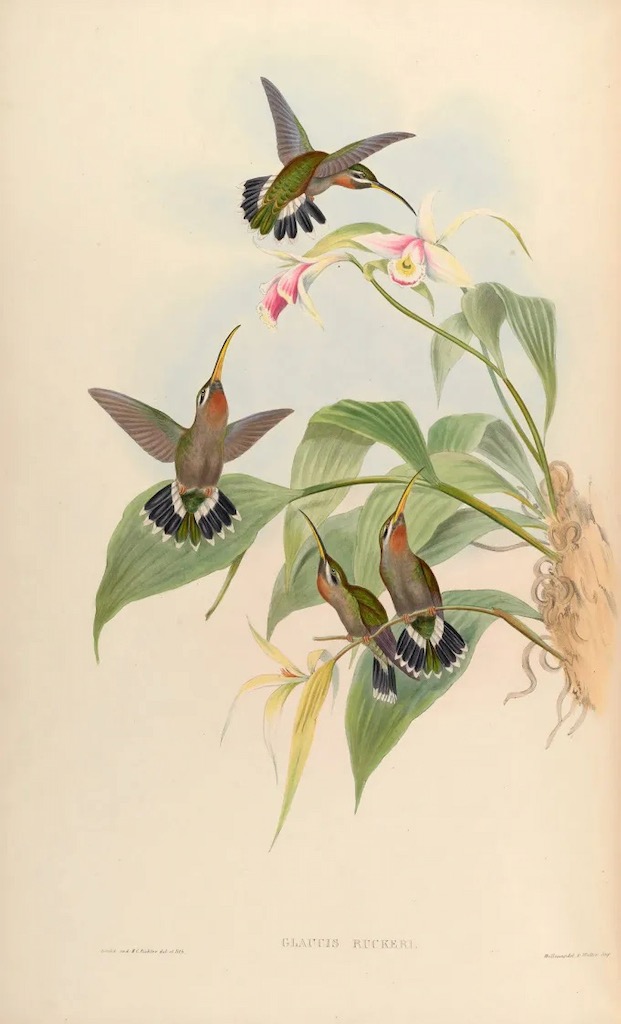
hummingbird photo (above) by shelia zimmerman, sister of my beloved late friend mary ellen sullivan, may her memory be a blessing, (and it is. every day.)

happy blessed sunday birthday to a personal patron saint of mine, mark burrows.

looks like i was in the mood for capitals this morning, maybe just to prove i know how to find the shift key. hope you don’t mind the tall letters every once in a while. i do understand how it makes a sentence filled with proper nouns a bit easier to read…..

let’s play a bit of book group: what are some of your favorite Mary O lines, or words, or phrases?

p.s.s. i almost forgot: i’m taking The Book of Nature on the road this weekend. sunday afternoon, in fact, when i’ll be at Winnetka’s Book Stall at 2 p.m. for a book talk canceled last spring and now back on the calendar. problem is my little voice has gone missing again, and my vocal cord injections are on the books for tuesday, so it’ll be a bit squawky but the show must go on. it’s also Printers Row LitFest this weekend, so lots of getting pulled in several directions. wherever you are, have a lovely blessed almost-autumn weekend.

our job is to savor. . .

i’ve been especially partial to summer for precisely three decades — or 10,958 days — now, for my firstborn was born on the very first full day of the season precisely 30 years ago yesterday. i fell instantly in love. deliriously so. with my firstborn, yes, but also with the way the summery light slanted in on the long june morning i waited for him, and the new days thereafter, and every start of summer since, as it always brings me back to the solstice when the dial on my summer-savoring machine was cranked up infinite notches. 

truth is, i’ve savored summer’s start for as long as i can remember: it was the day my mama picked us up at the schoolhouse gate, end-of-year report cards in hand, and took us out for grilled cheese and fries. it was the day we trotted into the library and signed ourselves up for the summer reading brigade, an adventure i thought of as something of a secret society that promised me long afternoons with nose curled in a book, and the sheer delight of marching up to the children’s librarian with my summer-reading-club card, and my latest finished book, awaiting the inky stamp she’d press onto my card that felt like a passport, proof to me and the world that i was a serious reader. (or so i imagined.)

i was told just the other day that more than ever my job is to savor, that i’d make more room in my life, proportionally diminish the grief (that a diagnosis of cancer inevitably brings) if i made a point of savoring those joys that i love, each and every day. 

grief, this wise person explained, doesn’t ever go fully away. the things that bring it on, the things that break our hearts into pieces, can’t be erased. but they can settle into nooks and crannies of our souls where they might go quiet, or lose some of their sting. and, yes, it’s true too that those slumbering griefs will still make unannounced appearances all on their own schedule and of their own accord. grief, i’ve found over the many, many years, likes to catch you in the throat when you are, say, stumbling down a grocery store aisle, and suddenly you see the thing that makes you think of your long-gone papa, or the baby you lost, or your life before you worried about cancer cells running amok. 

but, the wise person explained, the more room we make in our life for those things that aren’t grief, the more alive and less strangled we might feel. 

so, savor it is. specifically, savor this summer, the unspooling of week upon week with barely an inkblot on the docket. no deadline, no due date. just one simple job: to savor.

it’s not such a tough assignment: conjure the things you love, the things that bring in the joy — or the peace or the grace or the wonder — as the tide to the shore, as the river that flows only forward and over the rocks and onto the sea. 

it’s a job, in fact, that belongs to all of us always. it’s just that cancer — or any one of those indelibly stamped diagnoses, or the sudden loss of someone or something you love — sharpens the urgency and the focus. if you don’t want to be strangled, if you’re searching for a light to come in through the cracks, a place to begin is racking up joys. an abacus of joy, one bead at a time. joy counting in plainest arithmetic. intricate, intricate calculus of the heart and the soul.

my joys are so, so simple. they rise from the garden, from the mud stained on my knees and under my fingernails. they are stirred at the cookstove. they flutter my heart when i curl into my old wicker chair and listen to mama wren warbling to her babies. 

when i lean my head against the chest of the boy i once birthed, when i drink in the tick and the tock of his heart, the surest steadiest lullaby i’ve ever known. when someone i love calls on the phone. or leaves a note tucked in the box by the door. when the sunset dizzies me.

the point, i’m told, is to root myself in all the things that make me feel most alive. the ones that slow the pounding in my heart. the ones that might make me giggle. the ones that make me know someone out there is listening. 

here’s to summer, the season when savoring is fresh in the air.


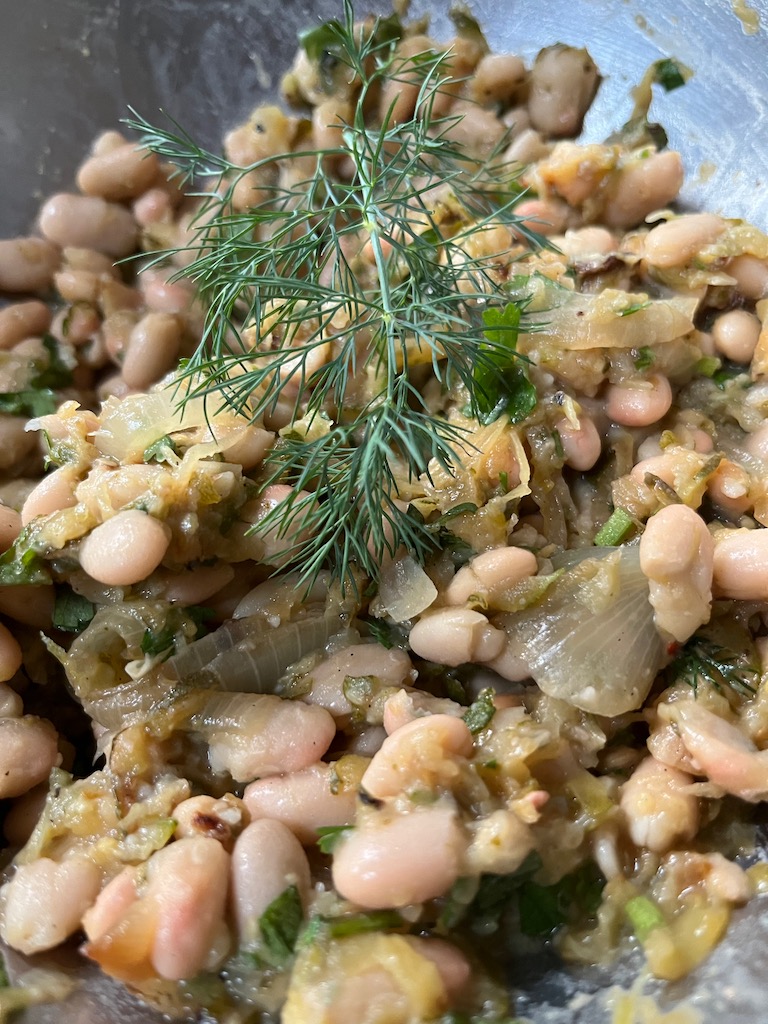
and here’s a roadmap to joy that converges multiple routes: herbs from the garden, simmering caramelized onions, squeezing a lemon, and summery salad. it’s nutritious and delicious and it comes from my friends at NYT Cooking, where they never ever lead me astray, nor off the path of the straight road to Joy. 

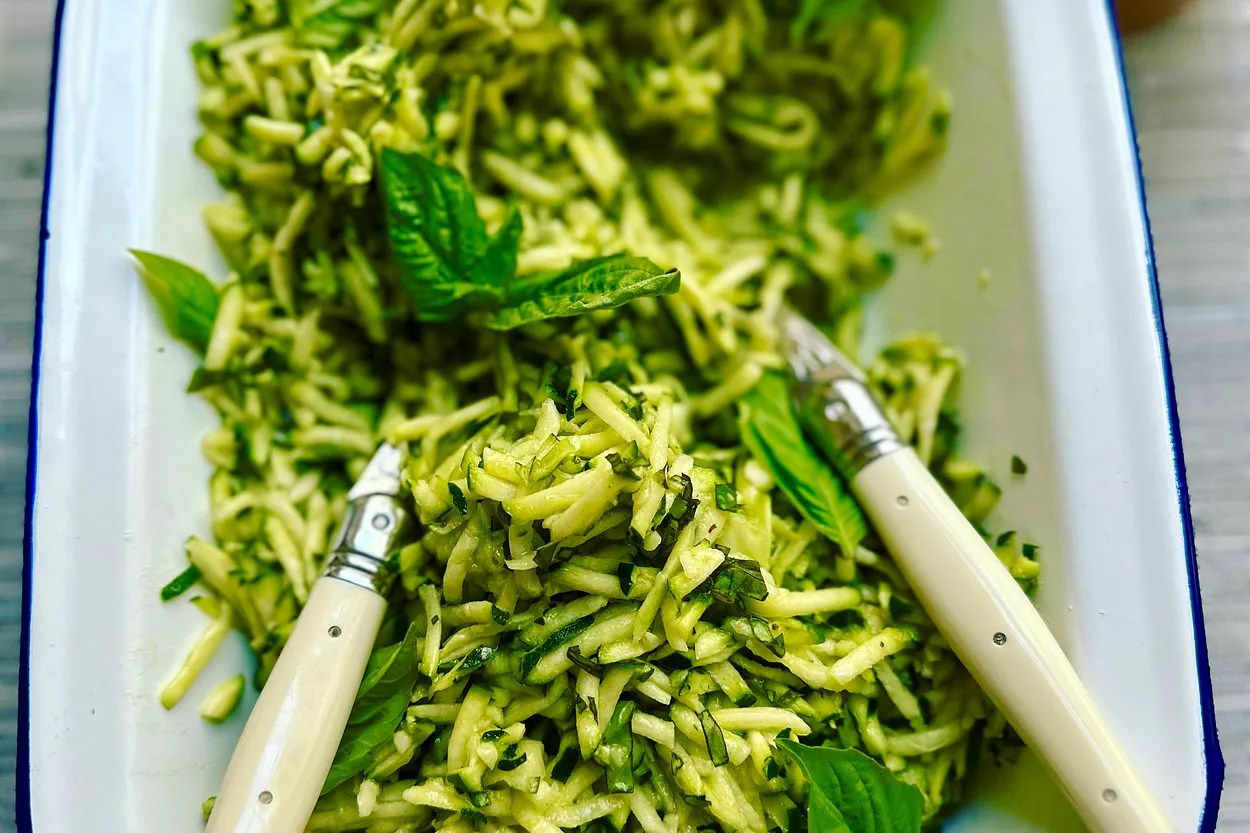
it’s not a pretty salad in a rainbow-y sense, but oh my it’s delicious. i promise. sometimes joy comes in plain clothes and drab colors (it can be sneaky like that….) here’s to joy, however it comes…`

Caramelized Zucchini and White Bean Salad
By Yossy Arefi for The New York Times
Time: 45 minutes, plus cooling and chilling
Yield: 6 servings

Start with a big pile of shredded zucchini and onions, and marvel at how much it cooks down as it browns and caramelizes. Toss that potent blend with creamy white beans and herbs –– it’s easy as that! The mint adds brightness, and pairs well with other soft herbs, like parsley, dill and basil. The caramelized zucchini mixture makes a great base for bean salad, but it can be used in many other ways: Make a big batch and toss it with pasta, serve it on top of ricotta-slathered toast, or top a flatbread with it; you really can’t go wrong, says the Times.

INGREDIENTS

2 large zucchini, shredded on the large holes of a box grater
1 large yellow onion, thinly sliced
4 tablespoons olive oil
1⁄2 teaspoon red-pepper flakes
Kosher salt and freshly ground pepper
2 (15-ounce) cans white beans, like cannellini, rinsed
1 lemon, plus more if needed
1⁄2 cup roughly chopped mint
1⁄2 cup roughly chopped parsley, dill or basil

PREPARATION 

Step 1
Wrap the shredded zucchini in a clean kitchen towel and gently squeeze it to remove excess moisture. 

Step 2
In a large nonstick skillet over medium-high heat, combine the zucchini and onion with 3 tablespoons olive oil, the red-pepper flakes, 1 teaspoon salt and a few grinds of pepper. Cook the mixture, stirring occasionally, until the water has evaporated and the zucchini and onion turn golden brown, 25 to 30 minutes. You will have to stir more often toward the end of cooking to prevent burning. 

Step 3
Add the cooked zucchini mixture to a large bowl along with the beans. Zest and juice the lemon over the top and add the remaining 1 tablespoon of olive oil; stir gently to combine. Let the mixture cool to room temperature, then add the herbs and stir gently. Season to taste with salt, pepper and additional lemon juice, if desired. Serve at room temperature or cold. 


someone wise sent this beauty…

A Prayer

Refuse to fall down
If you cannot refuse to fall down,
refuse to stay down.
If you cannot refuse to stay down,
lift your heart toward heaven,
and like a hungry beggar,
ask that it be filled.
You may be pushed down.
You may be kept from rising.
But no one can keep you from lifting your heart
toward heaven
only you.
It is in the middle of misery
that so much becomes clear.
The one who says nothing good
came of this,
is not yet listening.


and, as she so often does, mary oliver preaches:

The Summer Day

Who made the world?
Who made the swan, and the black bear?
Who made the grasshopper?
This grasshopper, I mean —
the one who has flung herself out of the grass,
the one who is eating sugar out of my hand,
who is moving her jaws back and forth instead of up and down —
who is gazing around with her enormous and complicated eyes.
Now she lifts her pale forearms and thoroughly washes her face.
Now she snaps her wings open, and floats away.
I don’t know exactly what a prayer is.
I do know how to pay attention, how to fall down
into the grass, how to kneel down in the grass,
how to be idle and blessed, how to stroll through the fields,
which is what I have been doing all day.
Tell me, what else should I have done?
Doesn’t everything die at last, and too soon?
Tell me, what is it you plan to do
with your one wild and precious life?

+ Mary Oliver


what will you savor as summer begins its unspooling?

catching my breath . . .

raspberry, three years in the making…

catching my breath is something i do quite often these days. my breath runs away from me. or it gets lost deep down inside me, down where the sacs of my lungs are no longer, i sometimes imagine. and i steady myself in ways i like to think are inconspicuous: i lean against walls, i grab onto the arm of whomever i’m walking with. i plop swiftly onto the nearest flat plane. i lurch to a pause in the thick of a sentence, one that never would have stopped me before.

but the breath i’m catching this week is the breath that comes from deeper than lungs. it’s the breath of being home, of feeling swept into the holy embrace of the nooks and crannies you know by heart. the ones on which you’ve been keeping watch for whole long decades. the ones you sense keep watch on you. 

especially the ones in the garden, the patch of earth you call your own. where every square inch is a story unfolding, a story that bedazzles me, that fills me with wonder, a story that feels like watching the impossible prove the possible: like how, after three years of being nothing but prickly canes and leaves, does the raspberry bush know to put forth teeny tiny clusters of what will be sunbursting shades of fat juicy berries? or how, out of the stark and bare ground, does the fern know to jut forth frill upon frill of feathery fronds, tight curled into commas that only slowly relent? and how, pray tell, does the red-breasted robin know right where in the grass to pluck out a worm? (here’s a hint: the robins can hear the slithering of the worm underground. how’s that for astonishing wonder?!?!)

because i’m sauntering at the slowest of paces these days, i find my long silent spells in the garden particularly punctuated by questions like these. and the answers that come, given their long-winded meanders and the places they take me along the circuitous way, give me plenty of time to consider how all of creation proclaims the one certain truth i need in these days: there is an animating force, beyond comprehension, and as it choreographs the turning of this holy earth and the unfolding of wonder, so too it keeps watch over me. which is just another way of saying the God who greens the world is the very God who, so too, keeps me so tenderly, tenderly close. 

being home, being back in my garden, is the closest i know to curling into the palm of my God’s holy clutch.

we’re only home for the shortest of spells, which is why i’m so busily catching my breath here. last week we were away for a longer stretch of days––truth be told––than i’d felt ready to be, but it was the graduation of that boy i so love. and it was, uncannily, at the very same time, ultimate frisbee, the national championship. for three days in the sun, and the rain, perched on the sidelines, and under the power lines, in picturesque obetz, ohio. and in a few more days we are going away again: to the city of lights and baguettes and the eiffel tower. it’s a rare trip for the whole motley lot of us, and i can’t think of a quartet to which i’d rather belong. even if it means this ol’ homebody is going to have to uproot her slowpoke of a self once again. 

a part of me aches to leave so soon. i am, after all, the queen of the homiest homebodies. but, as i work to absorb the wisdoms this hard chapter brings, i will trust my ferns to unfurl, and my not-yet berries to fatten. i will leave the robins and cardinals in charge. and i will inhale the city of lights, and a few baguettes besides. 

i long to be home again. home for a long quiet summer. where my breath will be caught, and my lungs will be filled, and, holy God willing, i will be deeper than ever before. 


a few treasures before i go….

And I am thinking: maybe just looking and listening
is the real work.
Maybe the world, without us,
is the real poem.

Mary Oliver (an excerpt from “The Book of Time”)

and this from my friends at SALT Project, who this week bring us denise levertov’s poem about caedmon, the earliest english-writing poet whose name we know, though only one of his compositions—translated as “caedmon’s hymn”—survives. caedmon was a seventh-century northumbrian cowherd, our SALT friends tell us, “who took care of the local monastery’s cattle, and who wasn’t much of a talker or a singer (cowherds would sometimes sing to pass the time, keep the cattle close, and keep predators away).” but “one night in the cowshed, the story goes, an angel inspired him to sing about creation—and he never looked back. convinced he was divinely called, the monastery took him in as a monk, and he wrote lyrics for songs on Genesis, Exodus, the New Testament, and more, always honoring God the Creator. so when it comes to the English language, the earliest poet we know of was a composer praising creation.”

in “caedmon,” levertov imagines that fateful night, to tell the story of an ordinary, humble person who’s given the courage to speak, create, and sing.

*one other note, from SALT: “a twist / of lit rush” refers to a rushlight, an old, inexpensive sort of candle (essentially a wick of rush drenched in fat).

Caedmon

All others talked as if
talk were a dance.
Clodhopper I, with clumsy feet
would break the gliding ring.
Early I learned to
hunch myself
close by the door:
then when the talk began
I’d wipe my
mouth and wend
unnoticed back to the barn
to be with the warm beasts,
dumb among body sounds
of the simple ones.
I’d see by a twist
of lit rush the motes
of gold moving
from shadow to shadow
slow in the wake
of deep untroubled sighs.
The cows
munched or stirred or were still. I
was at home and lonely,
both in good measure. Until
the sudden angel affrighted me — light effacing
my feeble beam,
a forest of torches, feathers of flame, sparks upflying:
but the cows as before
were calm, and nothing was burning,
               nothing but I, as that hand of fire
touched my lips and scorched my tongue
and pulled my voice
                                        into the ring of the dance.


+ Denise Levertov


how do you catch your breath?

a heavenly friend arrived at my door with a library of my books, in miniature.

p.s. i promise a few picture postcards from paris….

happy blessed day to my beloved jan, safe harbor for so many years. may this year bring you those things of which you dream….

the itch that comes in not-yet-spring

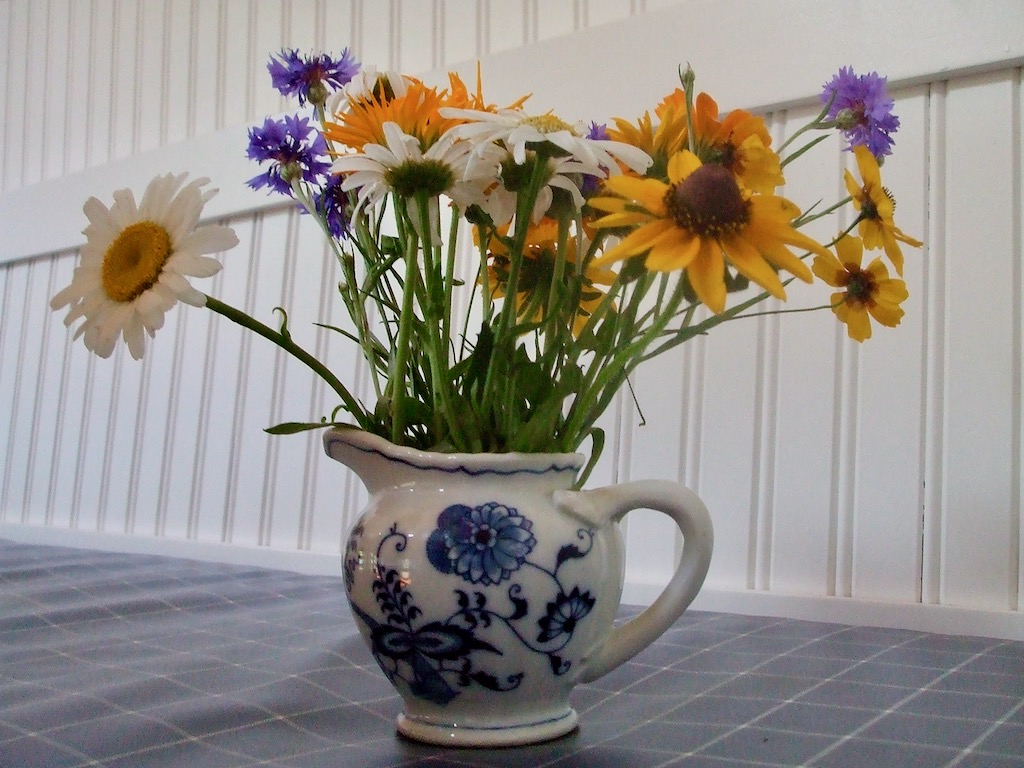
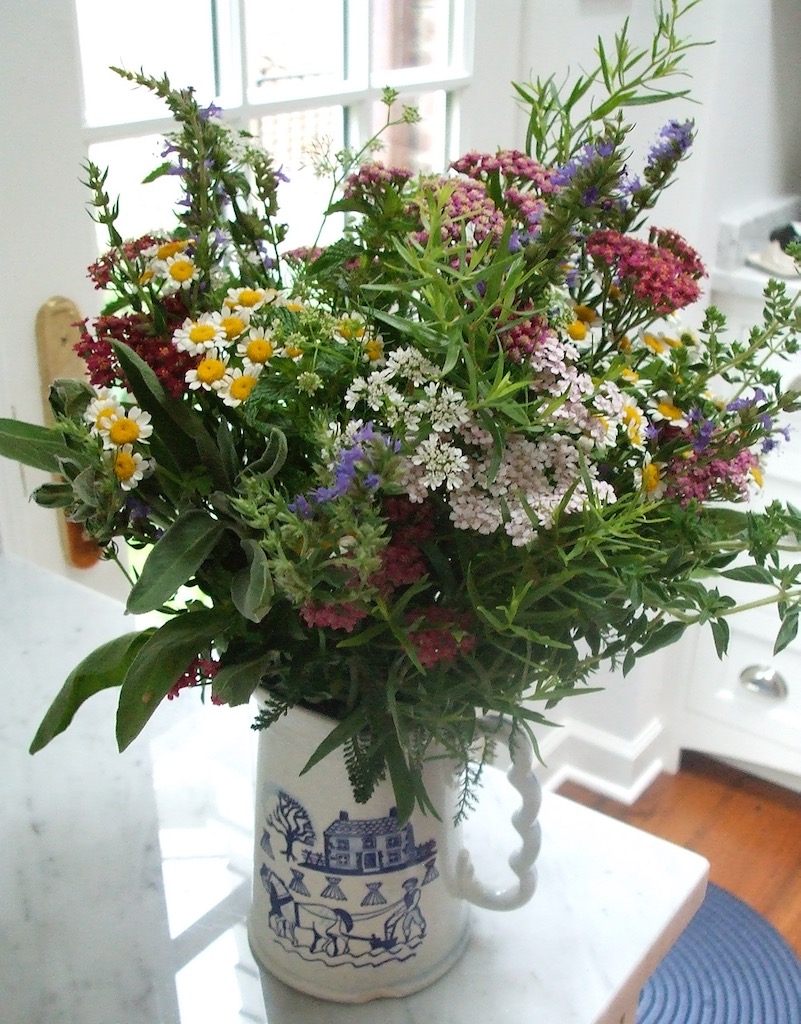
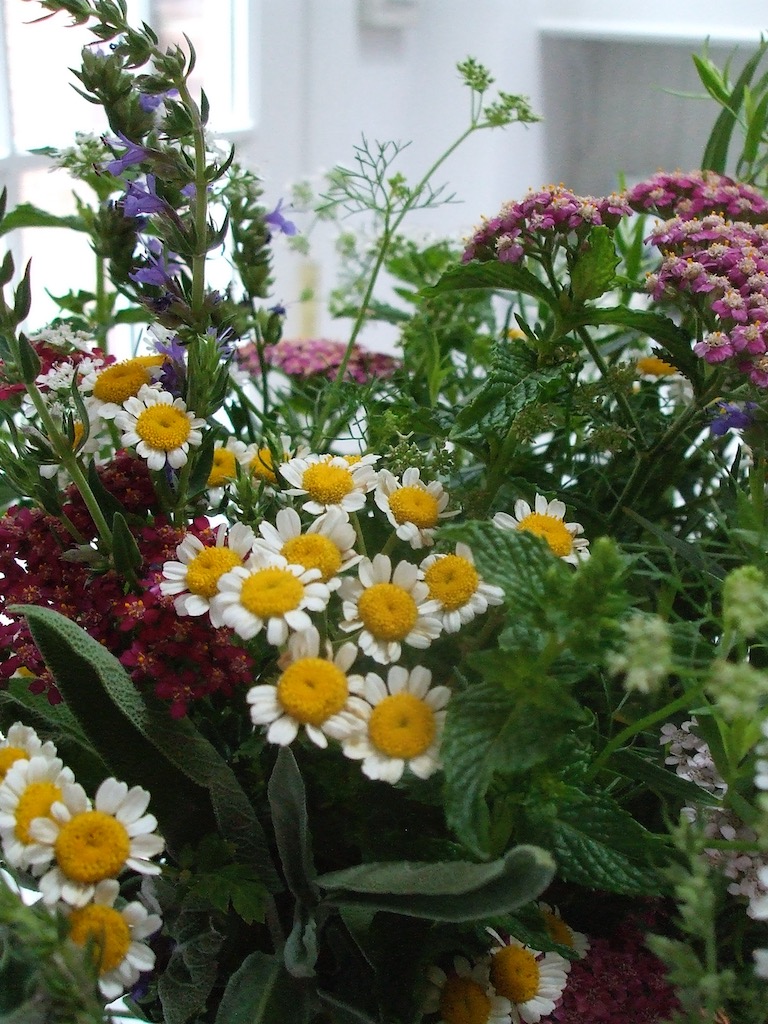
in which, once again, i bring you a wee bouquet, this time an assemblage from the springtime garden. . .

it creeps in unawares, something like a mosquito circling your pillow deep in the night. barely there at the edge of your consciousness, then suddenly smack dab and nettlesome straight in your face. 

it’s the itch that comes in the chill of not-yet-real-spring. in the the days when drab is the only real color you see out your window. when the world seems to be broadcasting its thousand ways to be brown. or gray. or washed-out leftover green. at least that’s how it is in my humble neck of the woods. 

a week or so ago i finally managed to heave the bundles of pine that had all but petrified over the winter. and all that was left in the pot by the door was left-behind scraps of last autumn’s sheddings. and then suddenly, smack dab like the pesky mosquito, i could stand it no longer. 

the drab had taken its toll, the drab stirred me to action: to pick up my keys, lope to the wagon, and drive into the distance. i passed garden store numero one, where the guys were heaving large satchels of loam, with nary a pansy in sight. i motored on, further south, and a wee bit west, into the lot of the big box store, where an old man shivered inside the cash register shack, and the very bare shelves carried only one thing: the bright yellow fluttering faces i’d suddenly craved.

i snatched up three little flats, and carried them home, where the itch of not really spring has been quelled for the moment. it’s too cold for the trowel, so i’ll leave them perched where they are. but my morning’s botanic adventure, the first of the season, is giving me reason to hope. and hope is the thing that animates the first blush of spring.

once the snowflakes recede, and the thermostat warms, once march turns to april, and brings on the palette of exuberant spring, we might actually, actually turn the page on old winter.

don’t hold your breath. . . . or put away your mittens. . .


it seems my mailbox in the middles of the week finds itself with flag up, and something luscious tucked inside. this poem from joyful, wise, and wonderful lamcal, who has been a font of wonder for me for all the years she’s been pulling up a chair.

this is actually anne sexton’s poem, the 20th-century american poet known for her highly confessional works, though this confession radiates with joy.

if i was ever pushed to pick the one sub-genre of poetry that most speaks to me, it’d surely be domestic poetries. those quotidian hours and ordinary nooks and crannies of our everyday lives that are made sacramental through the simple holy practice of paying attention. perhaps you’ll consider joy the next time you towel off in your cannon bath towel, or make a chapel of your eggs. oh, anne sexton, thank you. and, even more so, lamcal. xoxo

Welcome Morning

There is joy
In all:
In the hair I brush each morning,
In the Cannon towel, newly washed,
That I rub my body with each morning,
In the chapel of eggs I cook
Each morning,
In the outcry from the kettle
that heats my coffee
Each morning,
In the spoon and the chair
That cry “hello there, Anne”
Each morning,
In the godhead of the table
That I set my silver, plate, cup upon
Each morning.
 

All this is God,
Right here in my pea-green house
Each morning
And I mean,
Though often forget,
To give thanks,
To faint down by the kitchen table
In a prayer of rejoicing
As the holy birds at the kitchen window
Peck into their marriage of seeds.
 

So while I think of it,
Let me paint a thank-you on my palm
For this God, this laughter of the morning,
Lest it go unspoken.
 

The Joy that isn’t shared, I’ve heard,
dies young.

       —Anne Sexton


and since april (on the morrow) is poetry month, why not one more, from one of my patron saints of poetry, mary oliver? the line i’ve emphasized in bold is the one i know by heart. i live for holiness visible, entirely. i’m guessing you do, too.

not yet in bloom, but wishful thinking…

Leaves and Blossoms Along the Way

If you’re John Muir you want trees to
live among. If you’re Emily, a garden
will do.
Try to find the right place for yourself.
If you can’t find it, at least dream of it.

When one is alone and lonely, the body
gladly lingers in the wind or the rain,
or splashes into the cold river, or
pushes through the ice-crusted snow.


Anything that touches.
 

**God, or the gods, are invisible, quite
understandable. But holiness is visible,
entirely.
 

Some words will never leave God’s mouth,
no matter how hard you listen.
 

In all the works of Beethoven, you will
not find a single lie.
 

All important ideas must include the trees,
the mountains, and the rivers.
 

To understand many things you must reach out
of your own condition.
 

For how many years did I wander slowly
through the forest. What wonder and
glory I would have missed had I ever been
in a hurry!
 

Beauty can both shout and whisper, and still

it explains nothing.

The point is, you’re you, and that’s for keeps.
 

~ Mary Oliver ~

(Felicity)


c.s.lewis

and, finally, because this took my breath away in that way that only the Inklings could and can, here’s c.s. lewis trying to put language to the ineffable, talking about “the inconsolable longing for we know not what.”

he’d felt this longing his whole life – it came to him during moments of almost unbearable beauty: “[t]hat unnameable something, desire for which pierces us like a rapier at the smell of bonfire, the sound of wild ducks flying overhead, the title of The Well at the World’s End, the opening lines of ‘Kubla Khan’, the morning cobwebs in late summer, or the noise of falling waves.”

have you ever heard a lovelier expression for a searching for the sacred, no matter what name you put to it? i call it Holy God. and in my heart, i genuflect each time i utter those blessed words.


what visible holiness did you stumble upon this week, and might the itch to bring on springtime have buzzed by your nose this week? how’d you satisfy the itch?

lite summer fare

instructions for a summery day: kick off your shoes, wiggle your toes; tiptoe through dewy grass in the quiet hours when all the birds are deep in morning song; find an old wicker chair; plant your bum.

more instructions: have fat mug nearby filled with whatever fuels you; look out upon this blessed sun-drenched day. whisper thank you, thank you, thank you. keep whispering.

before you wander off into this holy day, a sermon in verse from that high priestess of poetry, mary oliver.

Little Summer Poem Touching the Subject of Faith

Every summer
I listen and look
under the sun’s brass and even
into the moonlight, but I can’t hear

anything, I can’t see anything —
not the pale roots digging down, nor the green stalks muscling up,
nor the leaves
deepening their damp pleats,

nor the tassels making,
nor the shucks, nor the cobs.
And still,
every day,

the leafy fields
grow taller and thicker —
green gowns lofting up in the night,
showered with silk.

And so, every summer,
I fail as a witness, seeing nothing —
I am deaf too
to the tick of the leaves,

the tapping of downwardness from the banyan feet —
all of it
happening
beyond any seeable proof, or hearable hum.

And, therefore, let the immeasurable come.
Let the unknowable touch the buckle of my spine.
Let the wind turn in the trees,
and the mystery hidden in the dirt

swing through the air.
How could I look at anything in this world
and tremble, and grip my hands over my heart?
What should I fear?

One morning
in the leafy green ocean
the honeycomb of the corn’s beautiful body
is sure to be there.

~ Mary Oliver ~

(West Wind)

amen. now, go in peace….*

*there is a breathtakingly beautiful dismissal i’ve heard at the end of mass, but i cannot for the life of me find it here this morning, so when i do i will tiptoe back and leave it here…..my dear friend connie, who was sitting beside me the morning i heard it, and immediately unzipped my backpack to reach for a pen to scribble it down so i’d never forget it, she’ll help me find it. i know she will. because she finds answers for everything.

and here it is (thank you beloved connie and Kat!!!):

Life is short. We don’t have much time to gladden the hearts of those who walk this way with us. So, be swift to love and make haste to be kind.

Henri-Frédéric Amiel

what will you do to make this fine summer’s day the magnificent gift that it is?

p.s. there are a thousand summer birthdays to celebrate in june, and one someone i love — a blessed friend of this old chair — is birthdaying on the 28th. happy blessed day my beautiful hilarious and ever wise friend. xoxoxox

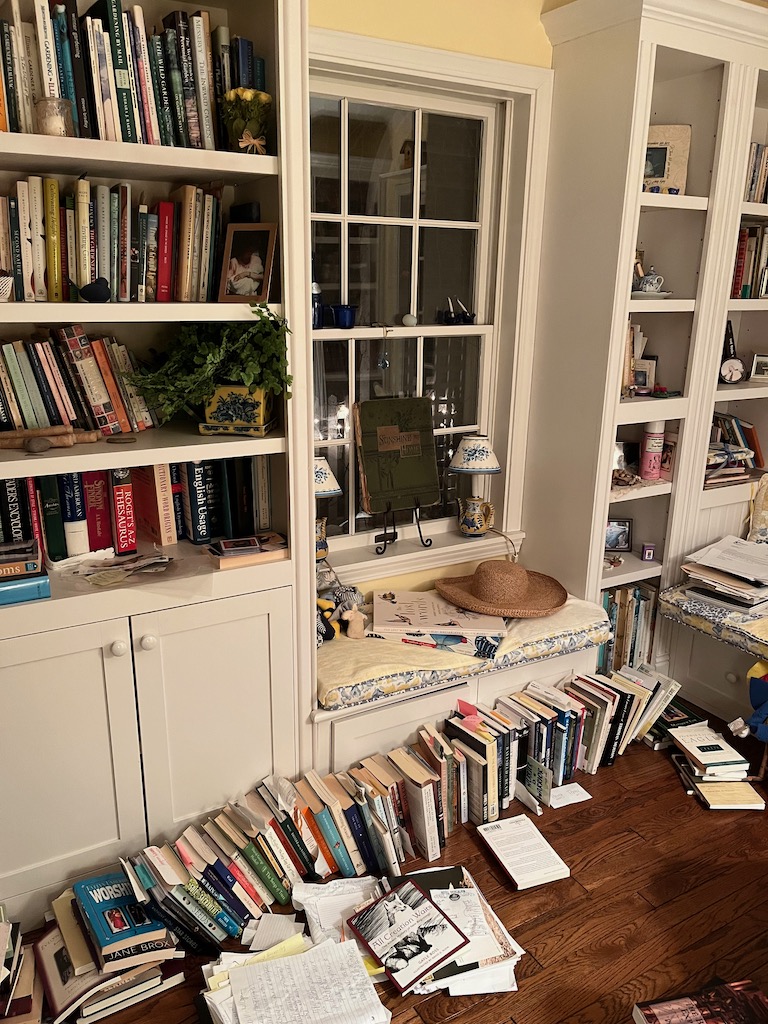
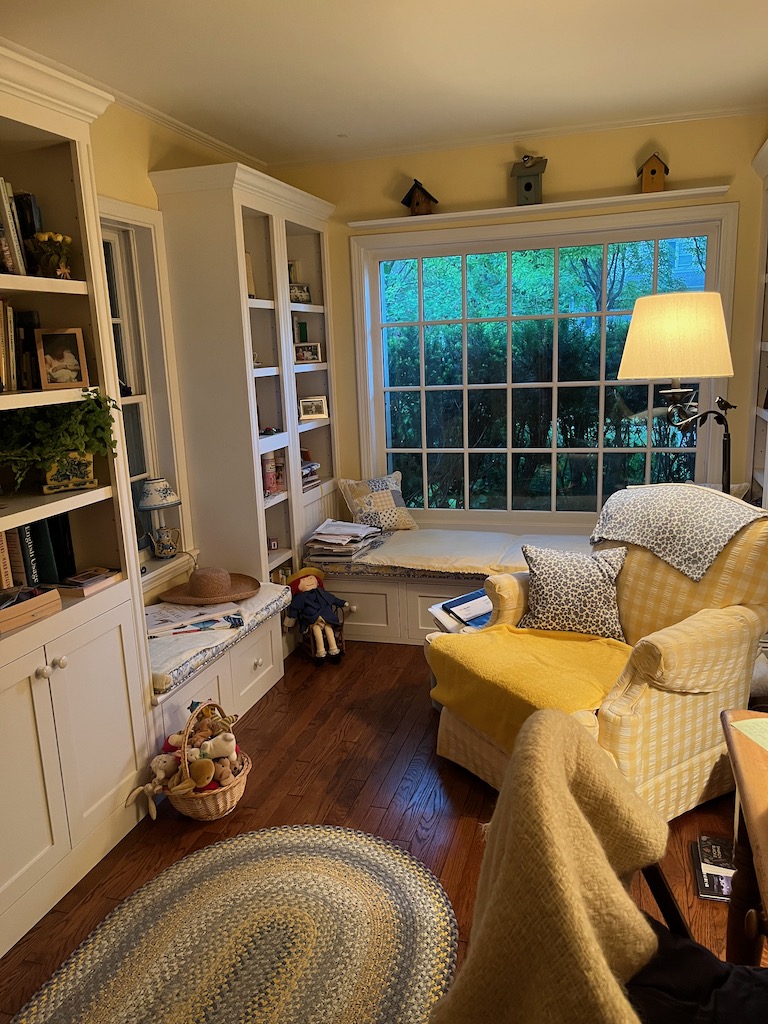
p.s.s. here’s a little before and after picture show: my book-bestrewn office got a little makeover yesterday, when our beloved james the dream-builder showed up with a bespoke bookcase that houses not only the antique clock we inherited from fair haven, new jersey, but also all my poetry books and all my religion books, thus freeing the floor of its book-holding duties. here’s a little before, after, and a pic of james’ glorious solution.

thank you, james!!!!!!!!!!!!!!!!! we love you to pieces. xoxox

let the page turn begin…

summer read

the summer porch is back in business, the sacred art of staring through screens into the first light of dawn and the lingering hours of twilight into starlight and moonlight. there’s a big old wicker chair in there, once dragged in from the hand-me-down bin, one pointed straight into the white pine and the little bird house on a pole where all day long the sparrows or chickadees flit and dart and chatter. i’ve taken up my position therein, and as many hours as the day will allow, that’s where you’re most likely to find me.

even this weekend. by day’s end, long after nightfall, both boys i birthed will be asleep in this old house (thunderstorms, don’t dare fudge our flight paths). the older one is flying home late tonight to be here when the not-so-little-anymore one walks across the graduation stage on sunday. it’s a weekend that’ll be packed with as much high-altitude soaring as we — and a host of jubilant high-schoolers — can possibly pack in, but just as emphatically i plan on planting myself for a few long hours of soulful conversation out there in the room on the verge of the garden. there’s a whole lot of catch-up to catch up on, the sort best done when knees rub against knees, when the folds of skin on someone’s face are squinched or softened in real time, right before your eyes.

i admittedly won’t be doing much turning of pages this weekend — not the literal kind, anyway. in the midst of a real-life page turn, bound pages are usually put aside. so while i dash off to fill the fridge, pin up the welcome home and happy graduation signs, and pick up the rented white dinner jacket (it’s new trier, and that’s the way they’ve done graduation since at least 1936), i am leaving you with the summer reading roundup i wrote for the chicago tribune.

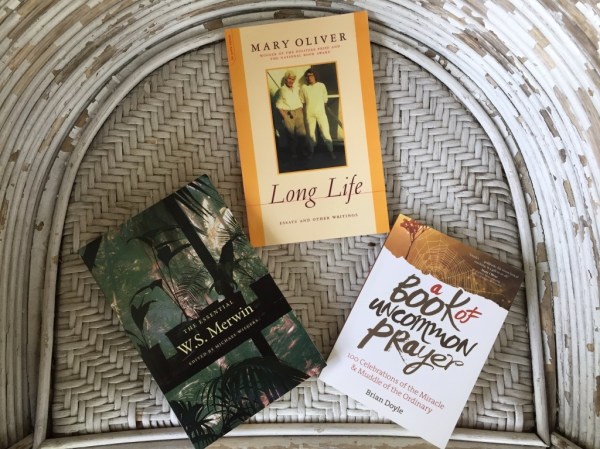
it apparently ran in the paper a couple weeks ago (saturday, may 18), but for the life of me i can’t find it, so here tis, in its original form. my lovely editor asked me to pick three books i’d want to slow read this summer, three that might especially stir the soul, so i went with three whose glorious magnificent writers are no longer among us. mary oliver and w.s. merwin both died within the past few months — mary O. in january, merwin in march. brian doyle died just two years ago; he was only 60.

i promise you a sumptuous summer — at least in the reading corner — should you crack open any one of these…

Pause to reflect on three greatssoul books summer

By Barbara Mahany

There are those for whom summer reading is synonymous with plot-thick page-turners, guzzled beachside or poolside, covers splattered with sunscreen. For others, the indolent season takes an opposite tack: it’s all about catch-up, savoring deep dives into the life lists of authors who’ve long been our polestars. Especially when death brings the coda, in the wake of a beloved author’s last penned utterance. It’s in the spirit of relishing these now-extinguished luminaries’ earlier works, titles forgotten or celebrated, that these three collections constitute a summer’s holy trinity…

The Essential W.S. Merwin

By W.S. Merwin, edited by Michael Wiegers, Copper Canyon, 200 pages, $18

The fittingest way to fill the silence that followed the death in March of W.S. Merwin, the late great Poet Laureate of the United States, who had received every major literary accolade, including two Pulitzer Prizes and the National Book Award, is to crack open the collection of his poems and prose deemed “Essential.” 

Apt title, indeed, as this definitive distillation traces a poetic legacy that’s been said to have “changed the landscape of American letters,” a compilation spanning seven decades of Merwin’s often spare unpunctuated poetry, translations, and lesser-known prose narratives. 

Merwin was, is, and always will be essential. 

“Through daily practice and attention, [Merwin] has created an incredible model for a way of existing on earth,” writes Michael Wiegers, editor-in-chief of Copper Canyon Press, who was tasked with culling nearly 50 books of Merwin poetry and another eight books of his prose. “His poems have defined for future generations what is possible in poetry and in life.”

That truth resonates through these breathtaking pages, be it Merwin’s urgent pleas to attend to this imperiled planet, or his heart-piercing excavations of the unconscious, as in his miracle of a three-line poem, “Separation,” exposing the raw edge of grief. It’s poetry turned saving grace: “Your absence has gone through me / Like thread through a needle. / Everything I do is stitched with its color.” 

Poring slowly over these pages—essential as they are—just might be the wisest prescriptive, balm for the soul, in the wake of the poet’s final absence. 

Long Life: Essays and Other Writings

By Mary Oliver, DaCapo, 120 pages, $16

The January death of Mary Oliver, Pulitzer Prize-winning poet, high priestess of seeing the sacred in the natural landscape—be it weeds poking through asphalt, or a goosefish stranded at low tide—prompted a great reprise of her most memorized lines, among them, “Tell me, what is it you plan to do with your one wild and precious life?”

But her 2004 “Long Life: Essays and Other Writings,” a slim and lesser-referenced volume, holds a cache more than worthy of slow reading, pen in hand for all the underlining and asterisk-ing that begs to be inked. Poems, Oliver calls her “little alleluias,” a “way of offering praise to the world.” Prose, she explains, is more cautious, flowing forward “bravely and, often, serenely, only slowly exposing emotion.” 

You’ll find those alleluias sprinkled throughout “Long Life”—and they will take your breath away, even if only a single line, such as this untitled dab: “All the eighth notes Mozart didn’t have time to use before he entered the cloudburst, he gave to the wren.”

But it’s the essays, slowly unspooling, that might hold you in rapt attention, even on a lazy summer’s afternoon. Take, for instance, her introduction to Ralph Waldo Emerson, the great New England Transcendentalist, whom Oliver refers to as “a failed churchman,” as she extols his genius, and reminds us “the heart’s spiritual awakening is the true work of our lives.”

Traversing the few-square-mile landscape of her Cape Cod environs, Oliver finds beauty—and wisdom and prayer—in the quotidian: the town dump, the rain, her mud-caked dog. She never fails to see the sacred. And she declares, almost as anthem: “I walk in the world to love it.”

A Book of Uncommon Prayer: 100 Celebrations of the Miracle & Muddle of the Ordinary

By Brian Doyle, Sorin Books, 192 pages, $14.95

This might be the book to reach for on the rainiest, gloomiest of summer days. For it will soon have you humming. It’s joy, it’s whimsy, it’s bursting-at-the-seams blessing upon blessing. 

Tucked in this gem of a pocket-sized book, you’ll find a centenary of prayers for cashiers and checkout-counter folk, in celebration of the wicked hot shower, for little brown birds in lavender bushes, for folks who all day long “hold up STOP signs at construction sites & never appear to shriek in despair or exhaustion,” for opossums, “you poor ugly disdained perfect creatures.” And—take a breath!—in thanks for “hoes & scythes & spatulas & toothbrushes & binoculars & the myriad other tools & instruments that fit our hands so gracefully & allow us to work with a semblance of deftitude.”

And that’s just the start of it. 

No wonder Mary Oliver (see high priestess of poetry, above) praised his “passion for the human, touchable, daily life.” And Cynthia Ozick declared that “to read Brian Doyle is to apprehend, all at once, the force that drives Mark Twain and Walt Whitman and James Joyce and Emily Dickinson and Francis of Assisi and Jonah under his gourd.” 

Doyle, a poet, writer, and longtime editor of the esteemed Portland Magazine at the University of Portland, died in May, 2017, of complications from brain cancer. He’d won three Pushcart Prizes, and the American Academy of Arts and Letters Award in Literature. 

If you wake up and the day happens to be sunny, not rainy, turn to page 66, where you’ll find that Doyle—the prayerful poet for all occasions—has penned a very fine prayer of thanks for suntan lotion. “Which smells good; which smells like relaxed; which smells like giggling children in peculiar and hilarious bathing suits; which smells like not-working; which evokes summer…”

You might be tempted to pen Prayer No. 101: Prayer of lamentation for the inimitable, irreplaceable Brian Doyle. And so, amen.

Barbara Mahany’s latest book,“The Blessings of Motherprayer: Sacred Whispers of Mothering,” was published last April. Twitter: @BarbaraMahany

what’s on your summer reading list?