with planes crashing into helicopters, and bodies falling into the potomac, and DEI blame being cast with no evidence in sight, i am in no mood to add more noise to the prattle. why tragedy needed to take a sharp turn into retribution, why our skies feel suddenly shaky, is only adding to the despondency i struggle to keep at bay.
i heard stories this week of kids i love, one in far off thailand teaching english in remote villages for the peace corps, terrified that the freezing of federal funds would shatter their dreams in the making. i’ve heard stories of dish washers and cooks in chicago’s little village, a mostly mexican corner of the city, afraid to show their face on the streets, forgoing paychecks in lieu of being handcuffed and torn from the families they love.
we live in a rippling circle of fear and confusion, a darkness is shrouding day after day.
in my teeny-tiny circle of life closer to home, some of that darkness is countered by flickering light. i find good reason for joy. feel wishes come blessedly true. i’ve lived to see a day i had prayed and prayed for, for one of my boys. and i am witness to the fire burning in the dreams of another.
just days ago, i was holed up in a rambling old house on the shore of one great lake with four glorious women whose lives have been marred and scarred by tragedy, and yet, they’ve risen. they’ve written their way through darkness toward light. and they are magnificent. and so so brave. (one wrote the searing memoir while you were out; two others are soon coming with masterpieces all their own. a fourth, i hope, will someday publish her stories that cut to the bone.)
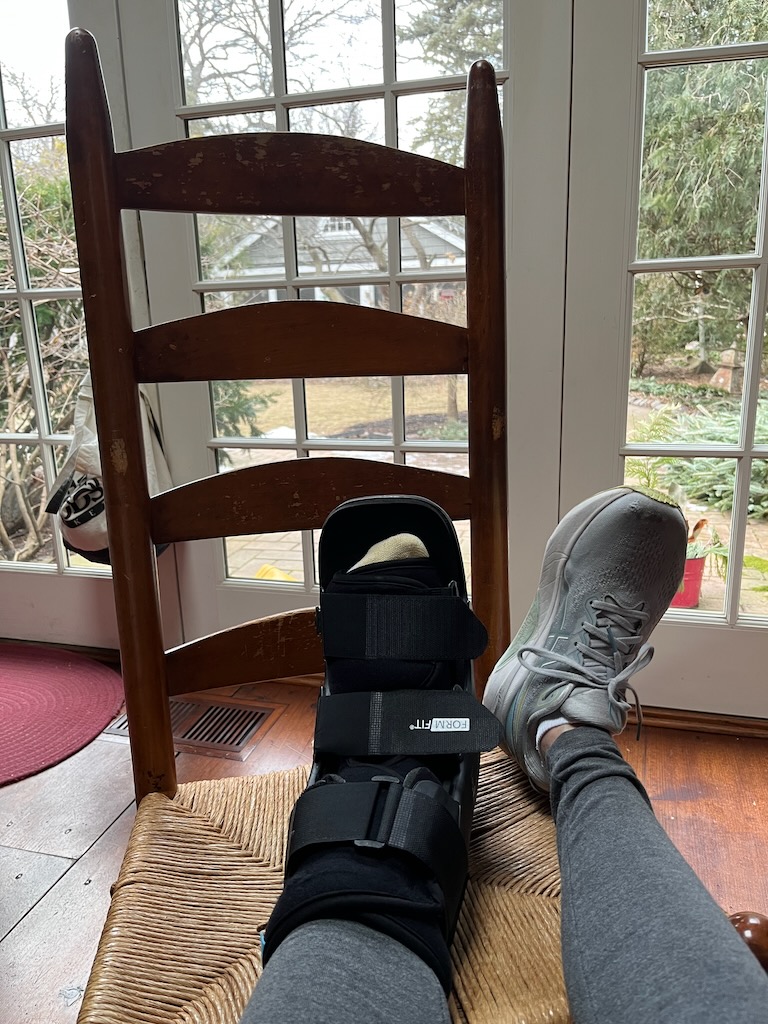
i hobbled home, after an otherwise uneventful walk on a stone-sprinkled beach, with an unhappy ankle.and a quick trip to the foot doc had me strapped into what feels like a leaden boot, and has curtailed my daily constitutionals for the next few weeks. but that’s not all: before week’s end, the resident triathlete in this old hovel had his knees poked and prodded and subjected to space-age medicine, and thus we’ve declared this the hobbledy house. indeed, we are a hobbling, most humbled pair, trading ice packs and heating pads, advil and tylenol, as prescribed by our duet of doctors.
and so my offerings this week rest on the shoulders of others far wiser, less wobbly, than me. cumulatively, they compound the point that we are the solution to the miasma that abounds.
this is our time, of all the times in our lives, to dig down deep as we can, and pull out the fiercest, finest truths we believe in. we must make true the life that ought to be. take it from this collection of seers and sages: clifton, mandelstam, rilke, and trommer, poets all.
In the bigger scheme of things the universe is not asking us to do something, the universe is asking us to be something. And that’s a whole different thing.
— Lucille Clifton
“What tense would you choose to live in?” the poet Osip Mandelstam once asked his journal, before answering his own question. “I want to live in the imperative of the future passive participle—in the ‘what ought to be.’”
Let this darkness be a bell tower and you the bell. As you ring, what batters you becomes your strength.
So I can’t save the world— can’t save even myself, can’t wrap my arms around every frightened child, can’t foster peace among nations, can’t bring love to all who feel unlovable. So I practice opening my heart right here in this room and being gentle with my insufficiency. I practice walking down the street heart first. And if it is insufficient to share love, I will practice loving anyway. I want to converse about truth, about trust. I want to invite compassion into every interaction. One willing heart can’t stop a war. One willing heart can’t feed all the hungry. And sometimes, daunted by a task too big, I tell myself what’s the use of trying? But today, the invitation is clear: to be ridiculously courageous in love. To open the heart like a lilac in May, knowing freeze is possible and opening anyway. To take love seriously. To give love wildly. To race up to the world as if I were a puppy, adoring and unjaded, stumbling on my own exuberance. To feel the shock of indifference, of anger, of cruelty, of fear, and stay open. To love as if it matters, as if the world depends on it.
how might you begin to try — not to save the world, nor even your own sweet self — to practice opening your heart, to be gentle with your insufficiencies, to take love seriously, give wildly, and live in the imperative of the future passive participle, in what “ought to be”?
this moment in america is one that won’t be bracketed by a solitary summer. this is one of those moments when first the rumbling comes, the thrumming down below our soles. and then the shift begins to come, tectonic shift (or so you pray). wake up, america. it’s been too long now. all of a sudden the rush of history — long overdue, long overspent in costs of brokenness, of cruelty, of gravest injustice — it’s washing over us, washing something from our eyes.
maybe we will see now.
maybe, beneath the din, beneath the shouts and shattering of glass, we will at last hear the whispers and the cries. it’s been too long now. far, far too long.
this summer reminds me of the summer when i was 11. i remember riding in the front seat of our wood-sided station wagon, stopped at a red light, when the news came on. i heard the word assassinate once again. this time, bobby kennedy; last time, only months before, martin luther king, jr. assassinate is an ugly word. a word that scares a kid. a word that makes you freeze inside your bones, a word that makes you afraid to breathe, not sure where or why all these bullets seem to be soaring through the darkness, piercing people’s brains. it’s a word i’d heard too often in the first half of 1968.
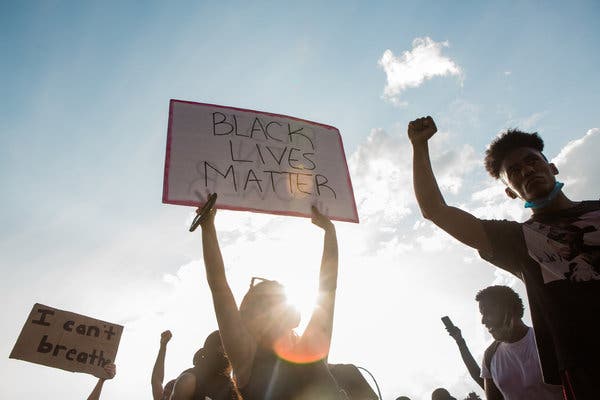
in the summer of ’68, america took to the streets. in this, the summer of 20-20, we’re at it once again. we should be. what we’ve seen is wrong, and ugly, and violent. and shattering. imagine — just imagine — what we’ve not seen. that scares me. really scares me. leaves my heart — yours too, i’m guessing — in shards. leaves me — you, too? — gasping.
i’m not so much a take-to-the-streets kind of someone. i’m more turn-the-page and pound-on-heaven’s-door. i inhale words to rouse my soul the way others pound the pavement. i feel a deep-down curdling, a rage, when i read the words of poets who are witness to the unimaginable. i wipe away streams of tears. sit motionless, not breathing, when i get to the end of a line that’s just shot through me like a rock to the side of the head.
the transportive power of poetry — its capacity to draw us into the kitchen where the shouting comes, or the bedroom where the wailing rises up, or the street where blood is spilling — it’s what moves me. its ugly truths can mark me for a lifetime, scenes and moments seared indelibly, ones my eyes and ears have never witnessed but which, nevertheless, i’ll never shake.
maybe that’s why — when i got an email the other day from a most beloved poetry professor of mine, elisa new, creator of Poetry in America, now a public-television series, i read these words so closely, considered them instruction for this long, hot summer ahead. maybe, too, for you.
this is what lisa (who is also a professor of american literature at harvard, and something of a polyglot of poetry and poets) wrote:
Protest is the voice of the people, elevated and offered to society at large. The protests we are hearing fulfill art’s, and especially poetry’s, greatest function—which is to make human beings truly audible to one another, to let them hear one another’s humanity and take in one another’s pain. The opposite of hearing the human voice is denying, muffling, strangling its cry: that is what we saw with deadly and literal explicitness in the murder of George Floyd, and in the appalling murders of Breonna Taylor and Ahmaud Arbery and so many others. Killings committed by deputed servants of the public good implicate the public, and they require us to reckon with the full gravity of what these acts represent. Their stain is on us all, and any institution, large or small, that endeavors to serve the public good must accept its own responsibility, and review its own past failings, in an effort to do better.
The voices we hear on the streets of our cities right now are doing as poets [since before the American founding] have done: decrying injustice, asking for redress, but also: telling the particular stories, naming the particular names, with every city and region and neighborhood now being brought to account by its own residents. On these streets, as on the page and in songs and performances, what we are now hearing is not abstract. It is the sound of people mustering language in its highest forms for the largest civilizational ends.
And so in the work of 20th century poets such as Claude McKay, Robert Hayden, Gwendolyn Brooks, Maya Angelou, Audre Lorde, Lucille Clifton, and June Jordan, and in the work of so many writing today—Rita Dove, Claudia Rankine, Evie Shockley, Terrance Hayes, Jamaal May, Clint Smith, Joshua Bennett, Kendrick Lamar and so many others—Black American poets have continued to carry what Langston Hughes, seventy years ago, called “a heavy load”—of “dream[s] deferred” and plain truths denied.
“…to make human beings truly audible to one another, to let them hear one another’s humanity and take in one another’s pain.”
the power of poetry. of witness.
in the spirit of gathering up a cadre of page-turning protestors, of dialing up our capacities for empathies, i’ve begun to gather something of a 20-20 summer reading list. any of the poets named above would be a place to begin.
but i turn, always, always, to lucille clifton, a poet who doesn’t believe in upper case or think much of punctuation, but whose words might never ever leave you. here are but two that leave me breathless….
and, then, there is claudia rankine, whose words will push you to the edge of your chair. the place to begin would be her 2014 citizen: an american lyric, voted the book — not the poetry book, but the book — most likely to endure in the literary canon of a decade from now by the literati at literary hub, a virtual public square for bibliophiles and word junkies of every stripe. the good folk at LitHub wrote of citizen:
It is a special hybrid of a book, part poetry, part critical essay—the book won the 2014 National Book Critics Circle Award in Poetry, and was a finalist for the same award in Criticism—making use of screenplay form, screengrabs, art, and iconic pop culture images. It is a complex assessment of racism in contemporary America, on both a micro and macro scale, addressing Rankine’s own experiences, as well as stories of Serena Williams, Zinedine Zidane, stop-and-frisk, President Obama, Hurricane Katrina, police violence—the whole heartbreaking, embarrassing litany of examples of American prejudice, or at least as close as we’ve gotten in recent memory. Rankine won a MacArthur in 2016, but most of us have been calling her a genius for years.
The book is also artful, beautiful, sometimes funny, subtle when subtlety is required, razor sharp when that better suits her needs. It investigates memory and identity and the nature of narrative and self-doubt and self-expression. I don’t know anyone who has read it who was not profoundly moved by it. As Dan Chiasson put it in The New Yorker, “The realization at the end of this book sits heavily upon the heart: ‘This is how you are a citizen,’ Rankine writes. ‘Come on. Let it go. Move on.’ As Rankine’s brilliant, disabusing work, always aware of its ironies, reminds us, ‘moving on’ is not synonymous with ‘leaving behind.’”
–Emily Temple, Senior Editor, LitHub
and i will leave you with langston hughes, and his 1927 masterwork.
song for a dark girl
Way Down South in Dixie (Break the heart of me) They hung my black young lover To a cross roads tree.
Way Down South in Dixie (Bruised body high in air) I asked the white Lord Jesus What was the use of prayer.
Way Down South in Dixie (Break the heart of me) Love is a naked shadow On a gnarled and naked tree.
break the heart of me, indeed.
how do you join in the protest, the urgent call of this american moment?
our friends at wordpress have birthed a new way to post, and i am just getting used to its kinks and trick-box. for the life of me, i can’t find where you add images. so i will poke around and see if i can figure this out. for now, these are my words….(figured it out!) and photo above by Gabriela Bhaskar for The New York Times…



 pull up a chair