pull up a chair

where wisdom gathers, poetry unfolds and divine light is sparked…

Tag: interfaith journey

the quickening of september

if i were truly of the prairie, rooted into its undulating loam, rather than a citizen merely plopped here by geography, because it’s the place i call home, i’d know the turning of the celestial wheel and its interplay with earth as robustly as the marrow that courses my bones. alas, my knowing is fainter than that. and yet, still, each september i feel it. the angle of light shifts, and the lens does too. it’s amber now, or so i seem to imagine. the days are drenched, more and more, in molasses hue. and the air holds a chill one minute, a warming the next.

the season itself is playing meteorological tug-of-war: do we want to let go? do we want to surrender? or shall we hang on with the last of our oomph?

ah, but the signs, they abound. and they quicken my spirit, each and every one. the school bus sightings, for one. they lumber the streets now, that slow serpentine crawl, disgorging couplets of children at most any corner. i’m detached from the school calendar now. it’s merely there at the edge of the frame. but, nonetheless, i notice.

my cooking’s changed too. i simmered this week. slow stirring a vegetable stew. i spent a good chunk of hours stationed by the stove, overseeing allium play sidekick to eggplant, to pepper. offering up its essence to add just a pique to the whole.

but mostly i feel the turning of earth in the garden, the plot that keeps me most rooted in the wonder, the majesty, the undying wisdom that is the sacred whole of creation. i felt it in the proliferation of spider webs, those silken geometries of arachnid architectures. the uncanny way the eight-legged thing knows to construct its trapping, and in the process makes beauty of pace-pausing proportion. i felt it in the crisping of blooms, and the heads of hydrangea and black-eyed susan starting to droop, the weight of their long season now taking its toll. a last gasp before death.

i hear it just now in the distant cloudcall of the goose, threading the sky, signaling autumn. it’s a cry that can shroud me in goosebumps. a call to prayer if ever there was.

september is when i feel myself beginning to curl like the nautilus, inward spiral, expanding the chambers within. making room for the quiet, the sacred, to come.
thirty some years into a spiritually-braided marriage, i know september to be the season of awe. quite literally. liturgically speaking. we are in the hebrew calendar’s month of elul, counting the days till the high holiness of the jewish new year. according to jewish tradition, it is the month for contemplating the question, “how should i live the existence that i am.”

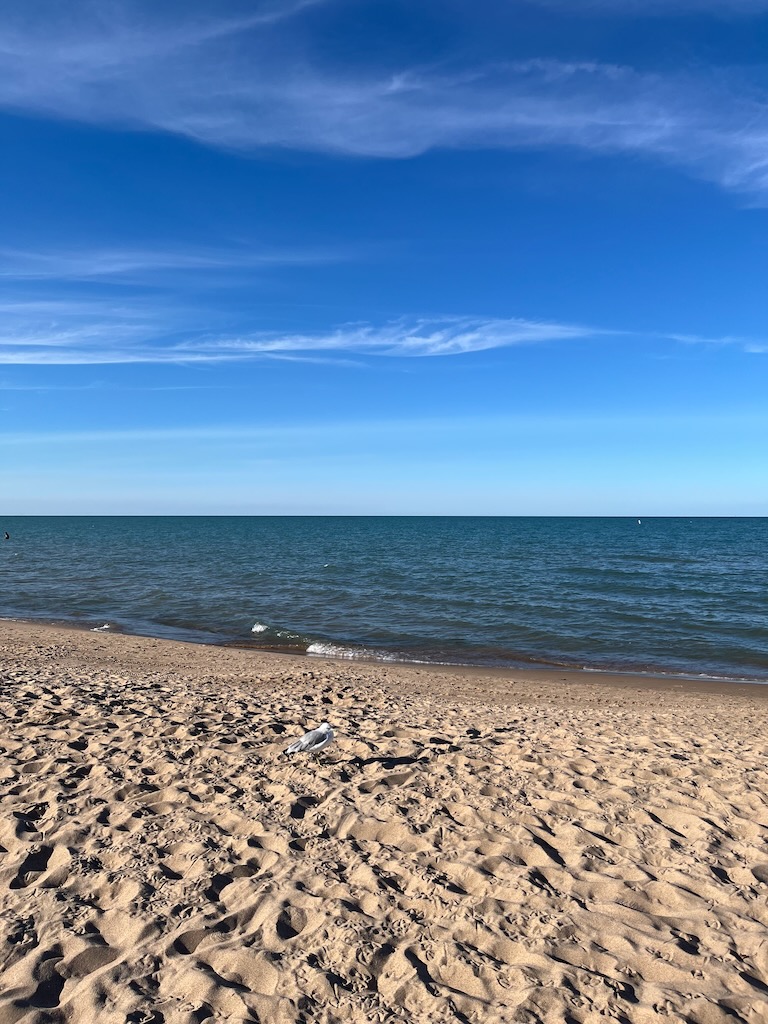
just the other day, i –– along with a rabbi i love and a gathering of women –– walked to the water’s edge, recited three blessings, and dropped into the water, into the great lake michigan. it was a cleansing, a beginning anew, a rite of purification. it was a mikveh, an ancient ancient tradition that is symbolically a turning of the page.

the question at the core of elul, “how should i live the existence that i am,” is one that especially quickened for me in a paragraph i read this week that had little to do with religion, and everything to do with the holiness of how we live our lives. it was the beginning of a review of a children’s picture book, and it was written by one of the high priestesses of everyday cultural commentary, maria popova.

she was writing about kamau & zuzu find a way, an “uncommonly soulful” story of a little boy and his grandmother who, somehow, find themselves living on the moon.

popova begins her essay this way:

The astonishing thing is that not one human being who ever lived has chosen the body, brain, place, or time to be born into, and yet in the narrow band of freedom between these chance parameters, we must find a way to live lives of substance and sweetness. Chance deals the hand and we must play it, and in how we choose to play it lies the measure of who we are.

“we must find a way to live lives of substance and sweetness.

“chance deals the hand and we must play it, and in how we choose to play it lies the measure of who we are.”

those are the questions i shall carry into my fading garden, and under the dome of a sky now rife with the cries and the calls of the flocks flying as one, in the migrational river that carries them faraway home.

in the quiet of your own soul, that’s the question for today: how do you choose to play the hand that chance has dealt you? what will be your sweetness and your substance?

into the depths and the darkness…

i hadn’t set out to burrow into the darknesses of history this week. but i’ve been traversing trails darker and darker, as i’ve turned the pages of jewish history, a history i entered into on sunday when i listened to a priest tell a story of holy week. drawing from the work of early christian scholars, the priest i was listening to closely laid into a tight and stark timeline an account of holy week, one i’d never quite followed so closely, one which even more poignantly drew me into the jesus for whom judaism held the holiest code.

one curiosity led to another, and notes were exchanged between the priest and i, and books were requested from the library. while i awaited the books, i wandered upstairs to the bookcase where my husband keeps his collection of jewish-themed books, from the big book of jewish humor to the wisdom of the Talmud, from chaim potok to martin buber. that’s where i found the big fat doorstopper of my people: the story of the jews, the majestic 522-page historical tome written by abba eban, the late great israeli statesmen and scholar of hebrew and arabic languages (he was fluent in 10 languages).

i pulled the book from the shelf, and started to read, and soon i was typing line after line of notes as i turned the pages of eban’s telling of jewish history, from the drama of abraham through the rise of christianity, and on through the crusades of the middle ages, through the founding of israel, straight through to the state of the middle east when eban’s book was published in 1968.

these are but some of the notes i typed, ones especially relevant to this holy week:

Jesus meticulously kept Jewish law, made pilgrimage to Jerusalem on Passover, ate unleavened bread, uttered blessing when he drank wine. “He was a Jew in word and deed.” Articulated ideas of the masses. Sermon on the Mount: “I have not come to destroy Law but to fulfill it.”

with each page’s turning it felt apt to be tracing more and more deeply the story of the jews in this particularly blessed week where our house is filled with the rhythms, once again, of passover and passion week. after spending each saturday of the year studying torah, portion by portion with a collection of inquiring minds at our synagogue, it seemed as if eban was giving me a glimpse of the whole jigsaw puzzle i’d been studying piece by piece.

but the longer i read, the darker it grew. in the name of one holy God, we have persecuted, and burned at the stake. we’ve thrown the holiest texts of the jews onto the pyres of history. we’ve forced them into ghettoes, ordered them to stay in their homes with shutters drawn on easter sunday. ordered them to wear badges, so identifying themselves as followers of the One Holy God. we’ve told centuries and centuries of stories making them out to be the ones who crucified jesus. who betrayed him in the garden, who led him before pontius pilate, mocked him and crowned him with thorns. those stories, lost in translation, lacking full context, miss plenty of points. those stories have been turned into stones to torture the jews.

Jesus meticulously kept Jewish law, made pilgrimage to Jerusalem on Passover, ate unleavened bread, uttered blessing when he drank wine. “He was a Jew in word and deed.” Articulated ideas of the masses. Sermon on the Mount: “I have not come to destroy Law but to fulfill it.”

i weep at the decimations of history, at the evil and the distortion that drives the worst of humanity. at the fact that we wage such wars under the flag of God, and of church. how dare we.

i’m 239 pages in; i’ve just read through the crusades, and the development of the ghetto in medieval europe, where “jewry was sealed off by a bolted gate.” today, i’ll put down eban, and i’ll pick up the way of the cross, by caryll houselander, the anglican mystic and artist, who curiously worked as a counselor of war-traumatized children, the war in question being the one where hitler sought to exterminate (what a detestable verb) the entire jewish population, a hatred that never seems to die.

i will read, as i always do, each station along the way of the cross, to the mount where jesus was nailed to a cross and left to die between two criminals, one who sought forgiveness and one who scoffed.

i will weep as i turn those pages, just as i’ve wept through the pages of my people.

i will ask, louder and louder, how might we have been so very wrong? and how have we dared demonize a holy people, a chosen people, a people whose truth jesus so ardently tried to tell? jesus’s holiest command, “love as you would be loved,” is in fact the jews’ central command, found in leviticus, and taught by the great hillel to be the greatest of all.

a marvelous story, in fact, is told of hillel, the gentle sage, who once was confronted by someone who wanted him to teach the whole of the Torah while standing on one foot, and to which hillel is said to have replied something along the lines of “what is hateful to you, do not do to your neighbor. that is the whole Torah; the rest is the explanation of this—go and study it!”

what is hateful to you, do not do to your neighbor.

love as you would be loved.

Father, forgive us for all of our sins, for which there are so, so many.

who taught you to love as you would be loved? and how did you see that played out in the fine grain of your life?

because friday is the day we pull up a chair, i’ve written on 17 good fridays now, and each year i seem to find a new way in. here are a few others:

way of sorrows
 
jesuit girl with jewish soul

into the depths

silence on the day that darkens

love story of unlikely plot line

IMG_1321

it all started when the dishwasher broke. well, not the whole story. but this latest installment in the look-back machine.

the little green light on the old reliable dishwasher, the one that’s scrubbed up after graduations (grade school, high school, college) and christmas and bar mitzvahs (twice), the one that’s worked monday through sunday for a good 13 years, it started to blink incessantly. i tried every trick in the book but could not get the blinking to cease. so i looked it up in that all-purpose answer box, the internet, and discovered the blink that won’t stop is short for “call the repairman.” so i did.

when he arrived in the depth of the latest cold snap, the kind man with the toolbox asked for the instruction manual (not so sure it’s a very good sign when the repairman wants to check the manual). that’s what led me to the cobwebby corner of the basement, where one creaky file drawer led to another and suddenly i was staring at a row of neatly filed manila envelopes, each one bearing my scribble. each one with a label of sorts: “bk beginning,” “+BDK msgs,” “memories — BAM/BK.”

this certainly wasn’t the clue to how to work the dishwasher, but i was decidedly sidetracked there in the dark in the basement. i reached for the stash titled “memories,” and out slid a slice of my long-ago past.

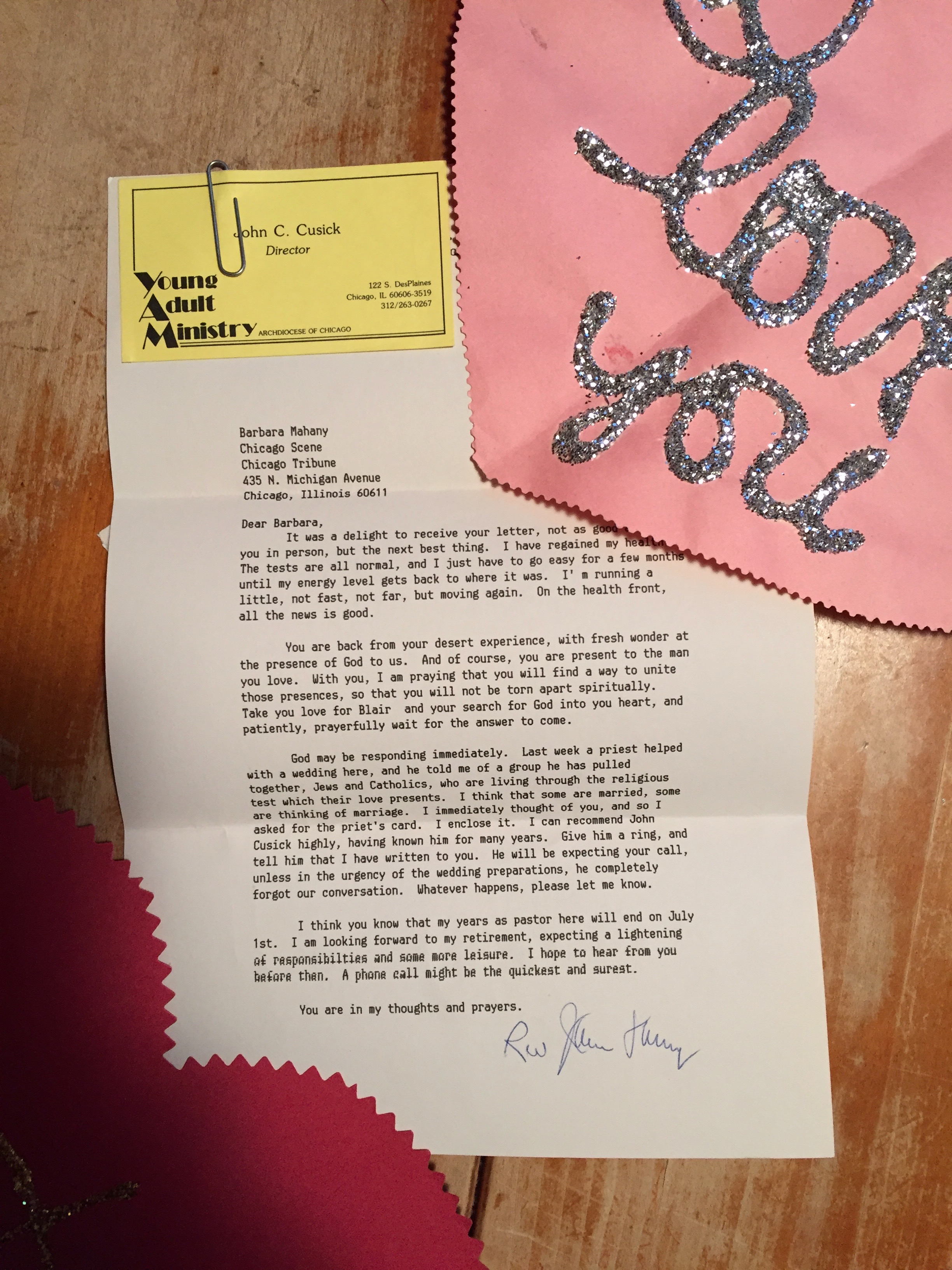
the very first thing i found, in a crisply typed envelope addressed to me at the chicago tribune, was a letter from one of the loveliest priests that ever there was. a long lean gray-bearded runner with the gentlest dark-blue eyes, an irishman who walked about the neighborhood in his irish cable-knit sweater, doffing his irish-wool cap and pausing to  listen to all sorts of sidewalk confessions. father fahey was his name, father john fahey, and the letter i held in my hands, the letter he’d typed in april of 1989, it literally, was a letter that would change my life.

not too many weeks before he’d written the letter, that gentle-souled priest had answered the door of the rectory, and ushered in me and the tall bespectacled fellow i’d fallen in love with. the one who was decidedly jewish, and not at all sure what to do with an irish catholic — this one, in particular. we’d knocked on the rectory door because we were looking for answers, looking for a way for a jew and a catholic to begin a journey we never wanted to end. we had an inkling that we’d found in each other something we might have always been looking for. except for the part where i was catholic and he was jewish. that twist in the narrative plot was making it tangled.

we knew father john to be wise, the sort of soft-spoken fellow to whom you could bring your worries and woes. so we climbed the grand winding staircase behind him, and sat ourselves down across from his armchair, up in his study at the top of the stairs. father john listened. and spoke only three words: “follow your bliss,” he told us, as if a buddhist koan we were to decipher. we’d climbed to the top of the priestly stairs to be handed a three-word instruction.

well, then.

we tucked those words snugly into our pockets and chit-chatted just a little bit longer. then we left and, some weeks later, the letter arrived. paper-clipped to the letter was the “business card” of another priest (do priests have business cards? well, in this case, in the case of a priest who always claims “i’m in the god business,” a business card it was).

gentle john the priest wrote that i should “take [my] love for Blair, and [my] search for God into [my] heart, and patiently, prayerfully wait for the answer to come.”

and then, in the very next paragraph, he typed: “God may be responding immediately.”

holy cow! that is some service!

father john then proceeded to tell me that he’d just bumped into a priest who happened to mention that he’d pulled together a group, “jews and catholics, who are living through the religious test which their love presents.”

“i think that some are married,” father john wrote, “some are thinking of marriage. i immediately thought of you, and so i asked for the priest’s card.” call him, he tells me.

and so i do, i do call the priest with the business card, and the tall bespectacled one and i knock on his rectory door. and he, too, ushers us in, and sits us down in chairs, and tells us words we’ll never forget: “i’m in the god business. god is love. you’re in love, so how can i help you?”

we explain; he responds: “there’s one God. you both pray to the same God, but you pray in two different languages.” he paused long enough to shoot us a look that meant he meant business. in short order, he shooshed out the door: “go with God and go in love.”

so we did. the priest with the business card has been there all along the way. and so was a rabbi, the one who two years later would marry us (along with another priest, an old friend of the family). they were both there in our tiny back garden, in the days just after 9-11 when the whole world shuddered, but we cradled a newborn baby, and it was the day for the baby’s blessing, which is like a baptism, but it comes in two religions. they were there at two first communions, and two bar mitzvahs. they’ve been there again and again.

and that was 30 years ago. and 31 years ago tonight, the tall bespectacled one walked into my apartment for the very first time. i can still see him rolling up the sleeves of his white brooks brothers button-down. can still see him taking a seat at my tiny circle of a kitchen table, can remember how while i pulled foil-wrapped salmon packets from out of the oven, he told me of a thai soup he’d eaten the night before and how it “was a symphony of flavors.” i remember my ears perked at the description. i remember how something else perked at the rolling up of the sleeves.

i can’t say i’d spent much time before then considering the notion of love at first sight, but i know i felt a thump in my chest that night, almost the minute he walked in the door. and sitting here now at this old, scratched maple table, listening to him pull the carton of milk from the fridge and the special K from the pantry, i can conjure that thump in a heartbeat.

and i gaze over at that letter, the one father john typed, sealed, and slipped into the mail chute all those years ago. and father john is gone now. (by the way, he too followed his bliss, left the priesthood, married a widow (his best friend’s widow), moved to northern california, and died a few years ago…) but his letter, unearthed just this week from the dark of a drawer in the basement, it’s a treasure.

no wonder i saved it.

it saved me.  and us.

happy 31 years to the bespectacled one, though this day does not mark the day that you fell for me. that would come later, months later. i’m the one who counts this day as the very beginning. i knew what i knew when i knew it. in time, you knew it too. 

IMG_1319

the old maple table dressed up for the day of hearts

will you tell a love story?