
pull up a chair

where wisdom gathers, poetry unfolds and divine light is sparked…

Tag: everyday heroes

lucy’s story: what you didn’t yet read

there is more. there is always, always more.

sometimes, when i am writing a story for the newspaper, it actually hurts to leave out whole chunks of what i’ve gathered. a hundred thousand times i’ve cut and cried, leaning mightily on the words of one mr. hemingway: “a story’s only as good as what you leave on the cutting room floor.” it’s a line we whisper to ourselves as we wave goodbye to bits and threads we love, but cannot use. only so much you can squeeze onto those blank white pages, before they wrap the next day’s fish. or, in the case of my mother, line her birdcage.

lucy’s story, the one i told on mother’s day, is one of those ones that would have left me aching, feeling unfinished, if not for this holy sacred place where there is always room to finish every story.

my job, as storyteller, is to propel the reader through the piece, to condense, refine, suggest, spell out, depending on the day and space.

my preference, as storyteller, is to meander. to take my time, peek in corners, poke beneath the covers. listen. really, really closely. let whole thoughts unspool, and not just cut and grab.

i understand, of course, that readers mostly want to get to the point, and then move on to tidy up the kitchen table, get the kiddies out the door, pick up the dry cleaning. be done with it.

but this place here, this table with so many chairs, is wholly discretionary. you take it, or you leave it. this is whipped cream and maraschino cherries. you don’t have to pick just one, eenie-meenie-minie-moe.

so curl up, rest your chin on your palms, and your elbows on the table’s edge.

there is more to tell you about blessed lucy, and her mama rosa, the two i introduced you to just yesterday, or if you picked up a chicago tribune, you might have met them back on mother’s day.

for you just joining us, lucy graduated saturday with a degree in bioengineering from the university of illinois at chicago. she’s been in a wheelchair since she was 9. she found out when she was four that she had a rare degenerative disease, spinal muscular atrophy, which has left her arms and legs rag-doll limp, unable even to turn the pages in a heavy book, sometimes too tired to lift a peanut-butter sandwich to her lips.

her mama, rosa, has been the arms and legs that lucy cannot use. for six years. all through college.

she has opened doors, laid out books and papers, cut up lucy’s breakfast, lunch and dinner. at night, she rolls her, side-to-side, three times before the dawn.

i condensed all of this in the story. but what i didn’t get to spell out were some of the everyday obstacles that would have felled a lesser duo.

for instance, lucy and her mama–who is not fluent in english–rode the CTA’s blue line train every day to campus, a one-hour ride if all unfolded as it should have. but, often, it did not.

sometimes, the elevator in the train station near campus wouldn’t work, so lucy and her mama would have to re-board the next incoming train, take it on downtown, where they would transfer to another line, and take that train back out to campus, to a station that didn’t require an elevator.

or, sometimes, when it rained, lucy would worry that the rain would muck up the battery that operates her wheelchair, which would loosen the cable to her joystick, and she’d be stuck–with a 420-pound wheelchair that her mother couldn’t push if she wanted to.

just last week, riding in for her very last exam, a two-hour grueler in her hardest class, lucy spilled a bit of gatorade from the bottle she was sipping during the ride. the sticky liquid got into the battery of her wheelchair, and when they got to campus, to take the exam, the wheelchair wouldn’t work. they had to turn around, go home, get the back-up chair, and start the trip again.

“good thing i hadn’t gotten around to giving away the old chair,” she said matter-of-factly. good thing, too, she added, she’d originally set out for campus four hours before the exam.

earlier in the semester, the only elevator in the building where she took her hardest class was broken for a week. she had to miss a whole week’s lectures, relying on the notes that someone else took for her, never quite totally grasping every concept in a class called Pattern Recognition, which has something to do with understanding how an automated machine–say, an MRI–analyzes data to make a diagnosis.

for a woman who takes half an hour just to write one page of painstakingly-looped letters and words and sentences, she said there was nothing she could do but watch closely as her lab partners precisely measured out chemicals–in fractions of a milliliter, sometimes–with the glass pipettes that are so essential and so taken for granted in every science lab.

same thing, she said, when it came to intricate wiring that had to be tracked and secured for circuit panels in a bio-instrumentation lab. she watched, and absorbed without the tactile learning that comes from fingering each wire, screw and micro-tool.

but what sticks with me as much as the heartache over how hard her road was, and how she not once complained, is what lucy had to say about her unshakable faith, once lost, now found. and a friend whose light still illuminates her way.

“when i was little i was real religious,” said lucy, sitting in a study room in the engineering building at UIC last week. “when i stopped walking, i became an atheist at the age of nine.

“i was depressed from nine to 15. ‘why did i have to be born with a disability?’ i kept thinking.

“but then i thought about how would the world be different if everyone was perfect? would everybody be super vain? they would never think of helping anybody else. what if? when i finally accepted my disability, it felt like a lot of bricks had been lifted off me.”

lucy, who is 24 now, says she wouldn’t change one thing in her life. “i’m not blind, i can hear, i can speak, i can use my mind. i think i finally just got tired of being depressed. i thought, ‘i’m never gonna walk, why be sad about it?’ being sad about it, isn’t going to change it.”

it was a college religion class, one on catholicism, actually, that really opened her heart, she says. the class was assigned to read one of the writings of Pope John Paul II, who suffered from parkinson’s disease. the writing, an encyclical titled, “The Gospel of Life,” she says, revolutionized her thinking about her own disabilities.

“i used to feel like a disability was a punishment. after reading the pope, i realized it’s another beautiful form of life.”

reading the pope’s words, she said, “kind of helped me bring my faith back in God.”

her mother, rosa, never lost it. even though she says her deepest desire is to see lucy stand and walk.

“you know why i think God is very good,” rosa asks. “lucy cannot walk; my other daughter can. what i can’t see in one, i see in the other.” it is the same, she says, with her two sons, one of whom is in a wheelchair (and a freshman at the university of illinois at urbana-champaign), and one of whom is not.

this, from a mother who must speak up for her daughter in the cafeteria line, because lucy’s disease won’t allow her to speak much louder than an amplified whisper. she can’t bark out a request for the baked ziti that is her very favorite lunch.

the one thing that lucy still misses, she says, is her privacy.

“before i’d hide notes all over my room. after i stopped walking, i couldn’t keep anything hidden. everybody always had to know everything.”

lucy says she learned patience from her best friend, giovanna, whom she met when she was eight, and who died when she was 13, from SMA, the same disease that lucy has.

“she taught me to have patience. i didn’t want people to help me, i wanted to do everything for myself. when i first met her i could walk. to all of a sudden be in a wheelchair…”

it was practically unbearable, lucy says. giovanna, she adds, “taught me determination.”

giovanna was full of grace, as lucy tells it. and giovanna, i think, bequeathed her grace to lucy.

and that is most of what i wanted to tell you about two fine souls who rolled into my life last week, and now will never leave.

one of them, a woman who finds justice in the divine equation that has two of her four children in wheelchairs, motoring around college campuses, refusing to rein in their dreams, now inspiring far beyond the boundaries of their colleges.

the other, a woman who sees the wisdom–and the beauty–in a world where our imperfections compel us to reach beyond our limits, to be each others’ arms and legs and hopes and dreams.

those are the lessons i learned at work this week.

it is no wonder why i call this storytelling business not just a job but a holy sacred calling. how blessed i am.

how blessed, lucy and rosa trevino, not trapped at all by a life in a 420-pound chair on wheels. but rather, teaching as they roll, inspiring as we lope behind, trying to catch their holy shining wisdom.

bless you if you stayed to read this story. it was long, i know. but it feels so deeply essential. your thoughts….

the photo above is one i took at lucy’s graduation. months ago, she ordered that certificate of gratitude for her mother, just for graduation day. because the print is small, i’ll spell it out: “thank you for all your love and support. i would not be where i am today if it wasn’t for you. i feel so grateful to have you in my life. today is my day, but i dedicate it to you.”
and then she signed it, lucy trevino. it took minutes to push the pen through those 11 proud but simple letters.
the lilac chiffon you see behind the certificate, and the sturdy hands, those belong to rosa, who was beaming all day saturday, mexican mother’s day.
lucy’s story

i promised, and i always try to keep a promise. i told you i would have something beautiful and wonderful for you to read, to start your week, to tuck in your heart. to give you wings, in the hours and the minutes when you feel empty, out of gas and maybe even hope.

a week ago this morning, i dialed the number to a woman whose name i’d just learned was lucy trevino. a soft, clear voice answered. i told her who i was and why i was calling. she nearly squeaked: “i can’t believe this. i can’t believe you would think of writing my story.”

i thought, all right. thought all week, and can’t stop thinking. every once in a rare while, i get to tell a story that i can’t help but think might change some lives, might plant a holy seed, where one is needed. you never know when you cast a sacred pebble in the waters, just how wide and far that rippled ring will flow.

sometimes, i make a wish, or maybe really it’s a prayer, as i stand at the water’s edge, about to make my toss. whispering, blessing each and every word and sentence, praying that the story finds its way to where it deeply does belong.

i prayed wholly and mightily on this one. lucy trevino and her mama, rosa, are magnificent beyond words. they are humble, shy, but fierce when it comes to not being teetered off the narrow path to their undying dream.

as promised, i share with you a story i believe in with all my heart. it’s a bit longer than we usually meander here, but i want you to always have a place to find it, when you need a little oomph toward your own dreams.

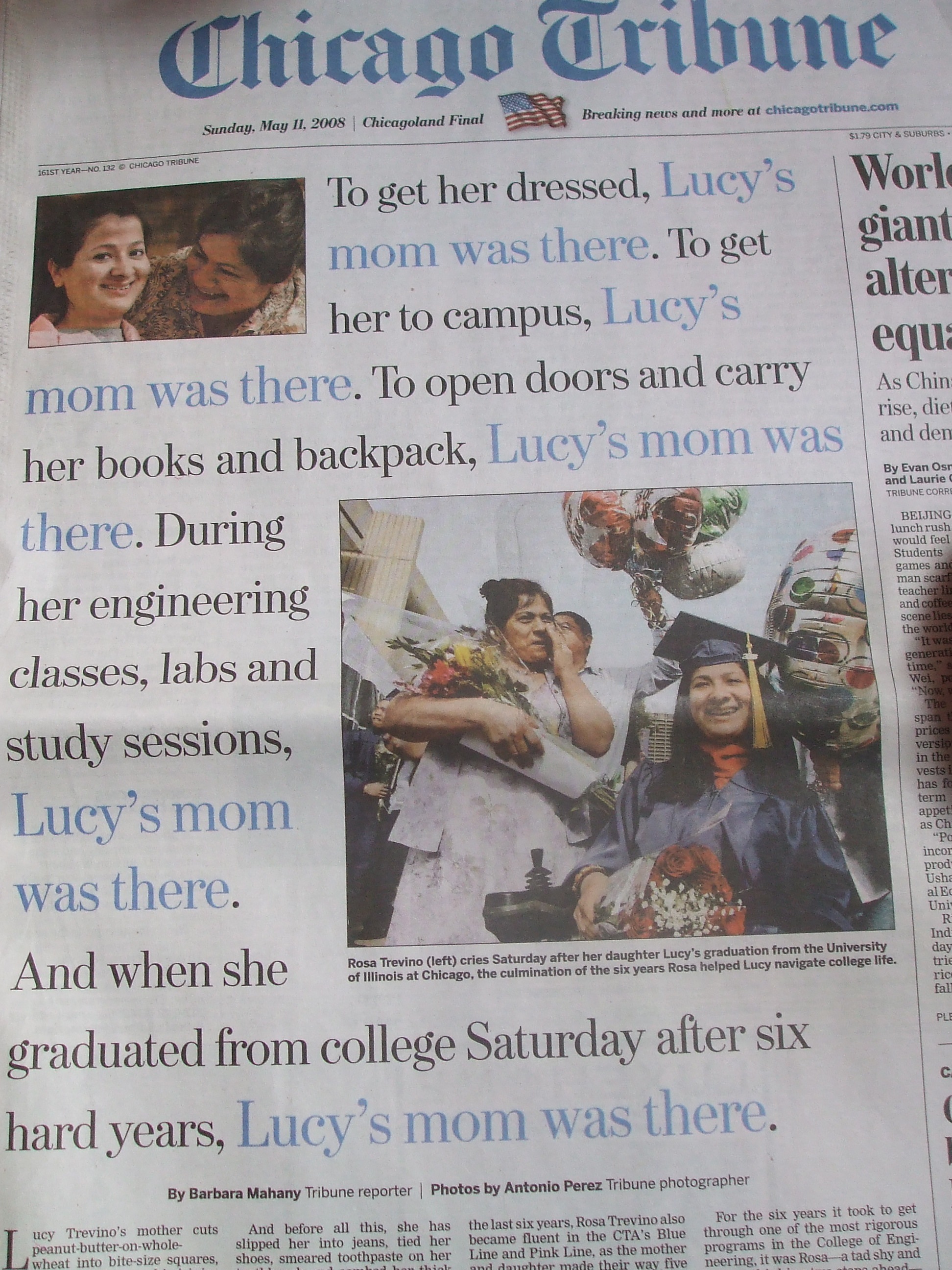
from the chicago tribune….

Lucy’s mom was there

By Barbara Mahany | Tribune reporter
May 11, 2008

Lucy Trevino’s mother cuts peanut-butter-on-whole-wheat into bite-size squares, unscrews a strawberry-kiwi juice and holds the bottle to her daughter’s lips so Lucy can get through lunch and make it back to class.

 She riffles through Lucy’s lavender backpack to find the lab report for BioE 494, bioengineering-based physiology. When the cell phone rings, she holds it to her daughter’s ear. She zips her coat. Unfolds a tissue, puts it to her mouth, trying to be discrete, so Lucy can ditch a wad of gum.

And before all this, she has slipped her into jeans, tied her shoes, smeared toothpaste on her toothbrush and combed her thick black hair into a perfect ponytail.

Lucy Trevino’s mother was right behind her firstborn daughter all through college—sometimes trying to shove through mounds of snow, or maneuver up an icy ramp if her motorized wheelchair balked. When they got stuck, her mother pulled out her cell phone to call maintenance and ask if someone could please come clear the walks.

Over the last six years, Rosa Trevino also became fluent in the CTA’s Blue Line and Pink Line, as the mother and daughter made their way five days a week from home, a red-brick two-flat in Cicero, to the University of Illinois at Chicago.

Lucy Trevino graduated Saturday from UIC with a degree in bioengineering, and the dean stopped the commencement of the Class of 2008 to tell of the Trevinos’ triumph. He barely made it, he said, without breaking into tears.

For the six years it took to get through one of the most rigorous programs in the College of Engineering, it was Rosa—a tad shy and always thinking two steps ahead—who got her daughter to every class, lab and study session. She knew which text and notebook to lay on Lucy’s desk. And she turned the pages when a heavy book tired Lucy’s hands.

For two or three hours, as Lucy absorbed lectures in calculus or thermodynamics or circuit analysis, Rosa sat not far away, just in case Lucy needed a sip of water or began choking.

Lucy, who is 24, was told she had a rare genetic degenerative disease, spinal muscular atrophy, when she was 4. SMA is a progressive disease that withers the muscles that control the arms, legs and lungs, and can make breathing a struggle.

Lucy’s type of SMA usually takes away your ability to walk by the time you’re in your teens—she began using a wheelchair at age 9—but unlike some other types, doesn’t necessarily affect life span.

Lucy, who is the oldest of four, has a younger brother, Hugo, who has the same disease. He, too, uses a wheelchair; he’s a freshman at the University of Illinois at Urbana-Champaign, studying architecture.

Parental dedication

“Lucy’s story is about the sacrifices our mothers make for all of us,” said Pete Nelson, interim dean of UIC’s engineering college. Trevino’s teachers, he said, “were pounding down my door” to ask for some recognition for this mother-daughter feat of unconditional devotion.

At UIC, where nearly a third of the students are the first in a family to go to college, Nelson said it’s not uncommon to hear tales of parents working two or three jobs, sending money from overseas and just plain struggling so their kids can get what parents weren’t afforded.

“But this is sort of the pinnacle in terms of the amount of dedication,” Nelson said. “This is what makes this business worthwhile.”

One of the professors pounding on Nelson’s door was Michael Cho, who teaches mostly graduate courses in cell and tissue engineering, but who has gotten to know—and has been amazed by—the ubiquitous mother-daughter duo, so often spotted wending their way up a ramp, on or off an elevator, or tucked away studying in some secluded corner.

“The first thing that comes to my mind is this can’t be anything else but a mother’s love,” Cho said. “It goes beyond commitment. It is sacrificial love. And I am just overwhelmed. It’s not just one month or one semester. It’s every day for the last four years that I can think of.”

In fact, it’s six years, because Lucy had to take time off when she got really sick her junior year; she suddenly couldn’t lift her arms and was quickly losing memory.

It took months before a sleep test showed she stopped breathing 30 times an hour when she was asleep. She now sleeps with a machine that helps her breathe, and, within a week of using it, she said, she regained her memory, if not her arm strength.

“Ever since I was little, I loved science,” said Lucy, who shares her mother’s deep cocoa-colored eyes and rolls around campus in a purple wheelchair with back wheels that sparkle, like fireworks, with tiny neon bits. “Because I went to doctors a lot and had a lot of medical exams, I would always wonder, ‘How do those devices work?’ ”

In her senior year at Morton West High School in Berwyn, Trevino learned from a counselor about a summer camp in bioengineering at UIC, so she signed up, and found her life’s work.

She once dreamed of working to find a cure for her own disease, but decided “it would be too stressful if I couldn’t find it.”

The first one in her family to ever go to college, Lucy Trevino said she was “too afraid” to venture down to the U. of I. in Urbana-Champaign, where there’s a whole dorm for students with disabilities, and the nation’s oldest college-level disabilities-services program provides trained personal assistants, physical therapy, even wheelchair repairs.

“I didn’t know if I should risk going all the way down there,” she said.

Sticking closer to home seemed like a better plan. But because UIC doesn’t have a personal-assistants program, she was stuck trying to find someone who could help her in a thousand little ways and be there whenever she needed.

“In college, you have such a crazy schedule. You stay after to study with other students. You need to talk to a professor. I was like, ‘Oh, my gosh, how am I going to find someone who’s going to put up with all of that?’

“My mom was like, ‘Well, I guess I’ll just go with you.’

“And then it was getting closer to the start of the first semester, and I still hadn’t found anybody. She said, ‘How would you feel if I went with you?’ I was like, ‘Oh, my gosh, would you?’ ”

Because Rosa Trevino, who is 47 and moved from Mexico when she was 17, had two children with special needs, she had long since become a stay-at-home mom, giving up a series of baby-sitting jobs. Rosa’s husband, Hugo, retired last year after 32 years as a CTA bus driver. Rosa herself had never even been to high school.

On the day back in 1987 when doctors said her little girl would “someday need a wheelchair,” Rosa recalled, crying at the memory, she promised herself she would do “everything I can.”

Mother keeps busy

Even if that meant sitting through more than 2,100 hours of 51 classes, countless study sessions and hourlong train rides, back and forth, each day. Most often, Lucy said with a laugh, her mother spends time cutting recipes and coupons, because she gets bored with all the bioengineering in a language she doesn’t fully understand.

At first, Lucy admitted, going to college with her mother wasn’t exactly without its bumps.

“I had never spent so much time together with my mom. We would sometimes get on each other’s nerves,” she said, chuckling. “But then we got to know each other really well. We’re like best friends. Now I tell her everything. Before I wouldn’t tell her everything that happens when you have a disability. People who aren’t in a wheelchair can’t understand. But now, since we do everything together, she knows.”

Semester after semester, year after year, Lucy and her mother found a way. She passed 400-level exams. She wrote up labs that took her twice the time of everyone else, simply because the pushing of a pen on paper is so hard for her.

Once, a civil engineering professor noticed that because of Lucy’s wheelchair, she couldn’t write on her desk. He challenged her to design a lightweight writing table. Then he went and built it. She got an A.

Mostly, the Trevinos relied on each other, and on unflagging faith.

“One time, I think in the night, almost for an hour, I cried to on high, ‘Why me? Why me?’ ” Rosa said. “I heard a voice, ‘Why not me?’ ”

For those who watched their unswerving perseverance, the simple fact that the Trevinos never stumbled inscribed a lasting honor on Lucy’s college transcript.

“One time last year,” Lucy said, “a student told me she’d felt like ditching class, staying home. But then she looks and says, ‘There’s Lucy, she’s always here. There’s nothing wrong with me. I’m just lazy.’

“Wow, I didn’t even think that anyone noticed me.”

In the very end, on a Mother’s Day weekend in the red-carpeted UIC Pavilion, as Nelson saluted a student and a mother who had taught them all a lasting lesson, a sea of Lucy’s blue-gowned classmates rose and nearly drowned out the dean with a thunderous two-minute ovation. Chances are Lucy and Rosa Trevino finally understood how very much a whole college noticed.

your thoughts, my blessed friends? if you can even muster words…. next meander: lucy’s backstory, what i didn’t get to say in the paper…