pull up a chair

where wisdom gathers, poetry unfolds and divine light is sparked…

Tag: Christian Wiman

in the tabernacle of an autumn’s night

these are days of awe, all right. the earth and heavens––at least here on the northern half of the globe—are turning in, the shadows growing longer. yet the last gasps of summer’s bounty do not fade without an exuberance of autumn. the sky somehow seems more star-stitched. and the moon, the moon at its most zaftig of the month bathes all in amber wash. 

it’s as if all is ringing out in exclamation. one tree more golden than the next. berries so abundant on the bough, the boughs are bent in botanic downward dog.

i can almost hear the whisper of the woods, and even my ramshackle garden, calling out, don’t forget us, don’t forget how glorious we were and are, the delights and wonders we’ve offered since the symphony of spring began: the perfumes, the unfolding petals, the sweetness of the fruits, the earthly prayer of wind rustling through the leaves. 

it’s a paean in minor key––part elegy, but mostly gratitude and grace.

to partake of it is holy.

the other night i stepped into the chill of just-past dusk, ferrying a crumb-strewn pizza box to the recycling bin, and before two footfalls had crossed the bricks, the haunting whoot-whoo-whoo of a great horned owl called out from somewhere in the trees. 
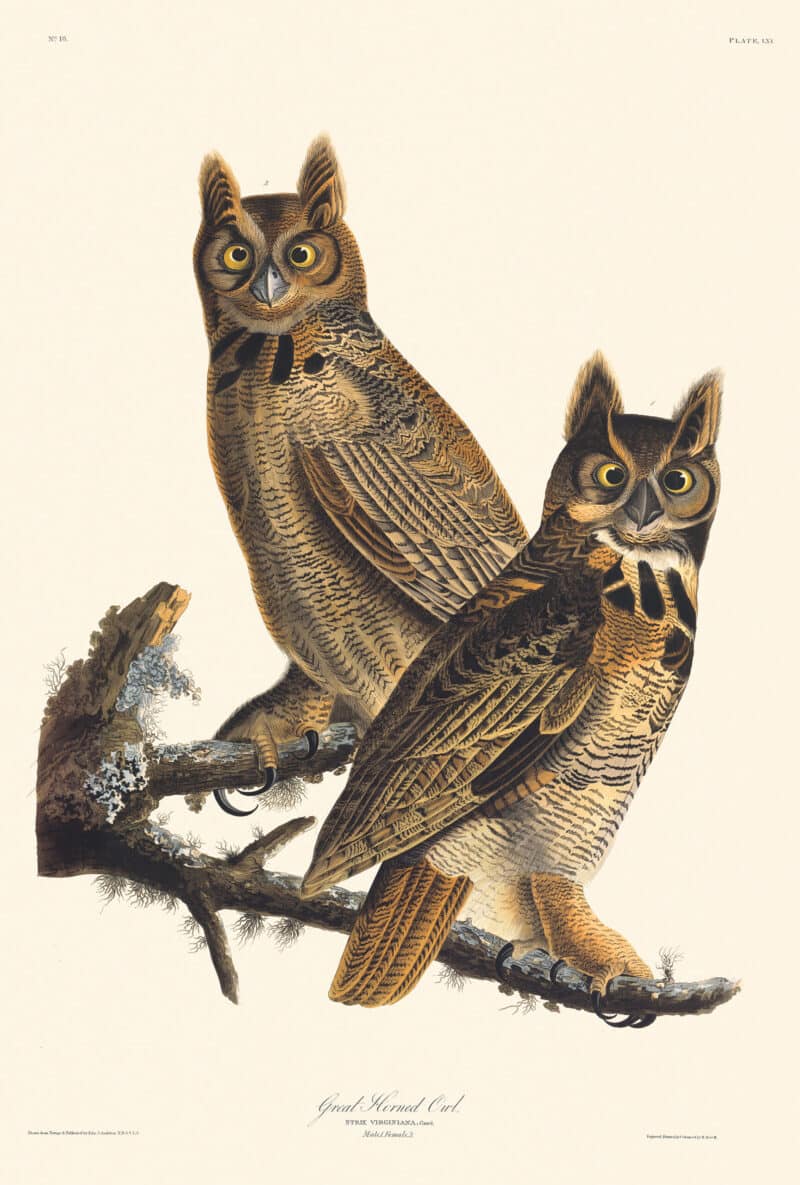
john james audubon: great horned owl

owls might be my spirit bird. i learned reverence for owls from my grandma lucille, who wore one in a jeweled brooch she pinned to her bosom, and tucked in many a nook and cranny of her ivy-covered house. far back as i can remember, the front of her ice box was forever festooned with strigiform, a magnet onto which she’d glued an owlish silhouette cut from felted wool and adorned with alphabet-letter pastas as its eyes and ears and markings. not one for idling, my grandma once or twice was spied by little me with ear pressed hard to windowpane, rapt by the nightcall from the woods.

i too stand rapt. 

of all the notes that rise from avian throats, the owl’s are the ones that stir me deep down where the prayers rise up. at the first of the whoot-whoo-whoo the other night, i felt myself break out in goosebumps. then i lifted my eyes, drank in the light of that nearly full hunter’s moon, and prayed. mightily. 

i sometimes think that trips to the recycling bin are my surest daily invitation into prayer. into the cloak of night. against the silence of a day gone hush. the tabernacle in which i offer up my nightly office is one that stations me on the cracked concrete slabs of my alley. trash cans line the side aisle. and the nave is vast. is infinite. in between where trees and old garages block the view, the sky opens wide and deep. here where i live, sky is a bit of a commodity. sunsets aren’t free for the viewing, blocked by those mainstays of suburbia: house and tree and fence. but the night sky, the obsidian up above, is blocked by no one or nothing and it is enveloping enough to soak up my every verse of prayer. 

and so i stood there flinging madly. add-on after add-on. a madwoman hungrily hanging her prayers out to dry. as if a clothesline of prayer i string across the alley, flinging each one skyward as i inch my way down the line. 

it’s a sacred thing to stand beneath a wheel of yellow moon, with a whoot-whoo-whoo as chorister, and to pour out your insides to the heavens. 

i pray the heavens heard.


here’s a bit of what else stirred me this week . . .

vassar miller was an american poet and writer, who served as poet laureate of texas in 1982 and 1988. born with cerebral palsy, her father encouraged her from a young age to write by typewriter, which she did prodigiously. and powerfully. she once said that the purpose of her life was “to write. and to serve God.” it brings me great joy to bring her here to this holy table.

Morning Person

God, best at making in the morning, tossed
stars and planets, singing and dancing, rolled
Saturn’s rings spinning and humming, twirled the earth
so hard it coughed and spat the moon up, brilliant
bubble floating around it for good, stretched holy
hands till birds in nervous sparks flew forth from
them and beasts — lizards, big and little, apes,
lions, elephants, dogs and cats cavorting,
tumbling over themselves, dizzy with joy when
God made us in the morning too, both man
and woman, leaving Adam no time for
sleep so nimbly was Eve bouncing out of
his side till as night came everything and
everybody, growing tired, declined, sat
down in one soft descended Hallelujah.

+ Vassar Miller


and this beauty from christian wiman…

Prayer
By Christian Wiman

For all
the pain

passed down
the genes

or latent
in the very grain

of being;
for the lordless

mornings,
the smear

of spirit
words intuit

and inter;
for all

the nightfall
neverness

inking
into me

even now,
my prayer

is that a mind
blurred

by anxiety
or despair

might find
here

a trace
of peace.

Christian Wiman, “Prayer” from Once in the West, published by Farrar, Straus and Giroux. Copyright © 2014 by Christian Wiman.

what stirred you to awe this week?

extra special edition: glorious books for the soul

IMG_1042

this is the second of two posts today because, silly me, when i posted season of stillness earlier this morning i didn’t realize the latest edition of my chicago tribune roundup of books for the soul — really fine books for the soul — was already posted online. egad. 

so here tis, a double dose for this friday snuggled in the depths of hanukkah and advent and  however you mark the deepening of winter to come….

if you put just one book on your wish list, or your giving list, i’m thinking i’d pick one of these. see if you can guess which would be my number one? 

Christian Wiman’s memoir reflects on years as editor of Chicago-based Poetry magazine, plus Anne Lamott, Elaine Pagels

Barbara Mahany

“He Held Radical Light” by Christian Wiman, Farrar, Straus and Giroux, 128 pages, $23

The epigraph, perhaps, whispers the secret of what’s to come in the pages of poet Christian Wiman’s latest soul-searing memoir, “He Held Radical Light.” The epigraph, from Juan Ramon Jimenez, reads: “The world does not need to come from a god. For better or worse, the world is here. But it does need to go to one (where is he?), and that is why the poet exists.”

So begins Wiman’s wrestling with art and faith, faith and art, driven by the question, “What is it we want when we can’t stop wanting?”

The book follows Wiman’s earlier, brilliant memoir, “My Bright Abyss,” composed in the wake of his 2011 bone marrow transplant. In this latest work, Wiman — who teaches religion and literature at the Yale Institute of Sacred Music and Yale Divinity School — offers a volume that is part memoir (his years as the Chicago-based editor of Poetry magazine), part anthology (a compendium of poems lucidly critiqued), and, delightfully, a recounting of close encounters of the most curious kind with a Who’s Who of Poetry. He recalls Mary Oliver stuffing half a dead pigeon in her pocket, Seamus Heaney leaning in at a crowded dinner table and beginning an intimate conversation about faith, and A.R. Ammons refusing to read in front of an audience.

Early on in this book that reads like an unfiltered tete-a-tete, Wiman writes that when he left college, he set out to be a poet who would write “a poem that would live forever.” He has done that with this magnificent, radiant memoir.

“Almost Everything” by Anne Lamott, Riverhead, 208 pages, $20

Before you’ve turned even two pages in Anne Lamott’s newest, “Almost Everything,” you might hear yourself thinking aloud that, surely, she’s been peeking in through our windows, diagnosing the terrible straits of our souls. And, thus, she’s dive-bombed this balm straight down the chimney, just in the nick of sweet time. How’d she know how hopeless it’s felt? How bottomless? How’d she know these were the words we so needed?

Over the decades, through her 10 earlier nonfiction books, plenty of us have grown to trust Lamott’s spiritual compass. We settle in quickly here, knowing just around the next sentence she might pry open our heart, and pack in truths we will mull long after we’ve put down her pages.

“It is hard here,” she writes, with bracing honesty, and by “here,” she means this moment on planet Earth. Her subject is hope; she offers it in lines like this: “our beauty is being destroyed, crushed by greed and cruel stupidity. And we also see love and tender hearts carry the day.” Again and again, Lamott steers us in and out of the canyons and potholes of despair.

“We have all we need to come through,” she assures. “Against all odds, no matter what we’ve lost, no matter how many messes we’ve made over time, no matter how dark the night, we offer and are offered kindness, soul, light, and food, which create breath and spaciousness, which create hope, sufficient unto the day.”

“Why Religion?” by Elaine Pagels, Ecco, 256 pages, $27.99

Elaine Pagels, one of the great voices in American theology, plunges her reader into an abyss of grief before even the midpoint of her latest work, “Why Religion? A Personal Story.” But fear not.

As Pagels masterfully interweaves her personal story with her profound insight honed through by a career in academia, she offers her reader a lifeline toward hope, toward light after darkness. Along the way, she answers her titular question — Why religion? — by illuminating an ancient truth of human experience: religion, a construct of cultural beliefs and traditions, holds at its core the power to “heal the heart.”

In “Why Religion,” Pagels, the Harrington Spear Paine Foundation Professor of Religion at Princeton University, departs from the scholarly writing that propelled her earlier works, “The Gnostic Gospels” and “Beyond Belief,” to critical and popular acclaim. Here, in a memoir that wrenchingly recounts the slow death of her 6-year-old son, Mark, and a year later the mountain-hiking accident that killed her physicist husband, Heinz, she bares her incomprehensible, nearly unbearable grief.

Pagels’ fluency and nimble excavation of the wisdom found in the Gnostic Christian texts is what gives her — and her readers — a certain glimpse of a redemptive truth, and an exit route from the griefs that are sure to come to us all.

Barbara Mahany’s latest book,“The Blessings of Motherprayer: Sacred Whispers of Mothering,” was published last spring.

Twitter @BarbaraMahany

all i wanted for Christmas

sugarplum visions

the children were nestled all snug in their beds, while visions of sugarplums danced in their heads….

and downstairs, in the inky edge of night, the mama, tapping away at her keyboard, heard a sigh go up from her heart: the one thing she wanted for Christmas, beds filled with sleeping lumps, and the souls who animate those lumps, they were all there.

indeed, the floors of those sleeping rooms, they are strewn with piles of things not normally there, and the fridge seems to have been attached to an invisible magnet, one that sucks out all the contents on a near hourly basis. juice that i swore was just there is now nowhere in sight, only a bottle drained of all but a sip (why does no one ever dare to take the very last sip?) perched on the shelf, lonely and wanting.

i can’t yet claim hours of conversation, for those unspool only in my imagination. the fact of the matter is that the so-called legal scholar (aka kid who just finished his first semester of law school and the mega exams entailed), he is sleeping as if there’s no tomorrow (and no daylight worth knowing). why, i think he’s been zapped with a wand that makes him allergic to daylight, curled up like a ball till the sun sets, then rising and hungry for breakfast. and then, without pause, lunch, followed by dinner….and into the night. (see paragraph above, the one referring to refrigerator magnet).

the little one (aka high schooler, who likely doesn’t take too kindly to being called “little” anymore, so let us anoint him “kid brother”), he is just wrapping up his last days of school for the calendar year, yet to partake of the hibernation behavior, though i fear it’s just around the bend.

thus, i might well need to own up to the reality here, and dash away all these visions of bonbons passed around the keeping room, while the logs crackle in the hearth, and i in my kerchief sate my hungers with hours and hours of huddled merriment.

so far, it’s been me alone in the kitchen, baking up a storm for a whole phalanx of teachers and friends up and down the block. oh, and there’s the last-minute clicking for Christmas, that early-21st-century ritual in which one scrolls the pages of amazon prime for just the right gift to arrive, yea, in the St. Nick of time (all because no one remembered to churn out their Christmasy wish list till you got on your knees and begged).

despite the aforementioned obstacles and roadblocks to poetic visions, still it seems that Christmas has seeped in through the cracks.

my heart is filled with the swirl of hopes and dreams and wishes that annually descend. i want so very little. just that rare touch of magic to remind me that we’ve something to do with the magic-making in our wee little lives. ours is the heart with the dial we can turn. we can go quiet, go deep. or we can be distracted, knocked off our course. we can get stuck in the ditch. throw up our hands in surrender. or we can quietly, decidedly, stitch our days with those rare few things that point us toward the heavenly pin lights, that open our ears to the morning song of the red bird, and the haunting cry of the owl in the night.

Christmas, indeed, comes most deeply in the cavernous vessel, the heart, where once we launched our long-ago wishes, and now we kindle wisps of dreams come tumbling true. it’s the room that is ours alone, the place where we stash our hopes and our prayers. it’s the quiet place, the place that sometimes can go still enough that we hear the sacred whisper. the one that births love. the one that puts breath to holy murmur.

Christmas, when we truly still and truly partake of the silence, it’s as close as i come to tiptoeing into the manger, huddling off to the side, beholding the newborn babe, the mother who cradles him, the carpenter and the shepherds who stand guard, and the heavenly light that illuminates all.

and that’s the magic i yearn for in the deepest heart of Christmas.

merry blessed Christmas. may your holy night be filled with deep still silence, deep enough to stir your prayers, and fill your soul with heavenly hope.

what’s on your wishlist this Christmas?

and, before i go, a few books for the soul, Yuletide or otherwise….(pasted below, in case you’re too tired to click on over….) 

books for the soul Yuletide 2017

New reads bearing Yuletide joy

By Barbara Mahany/Chicago Tribune

The assignment, “pluck books that stir the soul, and tell us how they do so,” is one that only gets richer, the bookshelves more crowded. And yet, the very definition of the soul — ineffable, always — is ever shifting. Certainly, it’s the catch-basin for all that’s sacred, a place of countless entry points. Vladimir Nabokov once instructed that “a wise reader reads the book of genius not with his heart, not so much with his brain, but with his spine. It is there,” he wrote, “that occurs the telltale tingle.”

For Christmas, here’s a special installment of our regular roundup of spiritual books.

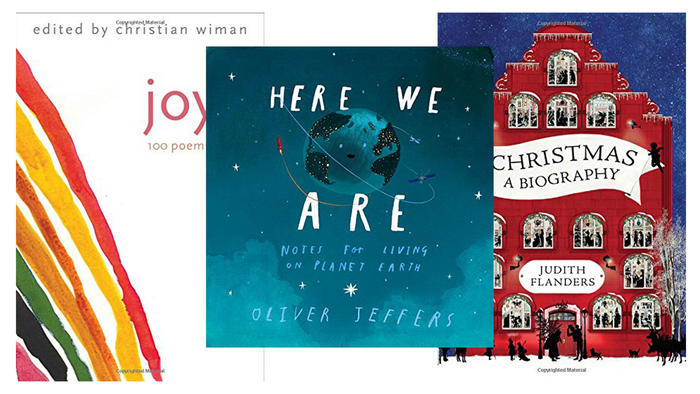
“Joy: 100 Poems,” edited by Christian Wiman, Yale University, 232 pages, $25

Amid the darkness of this season — nay, this moment in history — this book of poems is certainly prescriptive, the antidote to deepening psychic ails. As the soul, perhaps, is gasping for breath, along comes Christian Wiman to settle us down for a tutorial in joy.

Wiman, best known for meditations on mortality (“My Bright Abyss”), once editor of Poetry magazine, and now professor of the practice of religion and literature at the Yale Institute of Sacred Music, is not one to come lazily or loosely to so imperative a subject.

Wiman’s own history of mortal sufferings — diagnosed at 39 with a rare, painful and incurable cancer — makes him a sharp-eyed explorer, on vigilant watch for those shimmering shards of joy along the circuitous climb.
In this anthology of poetry and prose drawn from the 20th century until now, Wiman asks what joy is. Rather than laying down a solid definition, he provides proof of joy’s existence in poems that offer that jolt of knowing: Joy is here. And here. And here.

Often, joy limns the border of spiritual ecstasy, and so the poetry here weaves from secular to sacred. The ordinary — pond frogs in song at dusk, the peeling of a grapefruit, a beloved poised at the kitchen sink — erupts into the extraordinary.

In an introduction worthy of memorization, Wiman writes: “Joy is the only inoculation against the despair to which any sane person is prone.”

“Christmas: A Biography” by Judith Flanders, Dunne, 256 pages, $24.99

Biographies of inanimate objects — or is a holiday animate, especially one so exploited by commercial pressures? — pique particular interest. And so, with the season in full overdrive, British journalist and social historian Judith Flanders has published “Christmas: A Biography,” an encyclopedic exploration that drills down on the Victorian period and mines the centuries to trace the roots of Yuletide tradition, tossing in ample dollops of esoterica along the way. (St. Francis of Assisi is credited with building the first Christmas stable, complete with manger, ox and ass, in 1223; the first decorated indoor tree appears in 1605 in Strasbourg, France.)

While born of Roman and pagan roots, it didn’t take long for Christmas to find firm anchor in religion. And though its secular underpinnings are indisputable, Flanders — and much of history — comes to this conclusion: “Whatever was happening in the world that was wrong … Christmas would bring it to a halt for a period of peace and companionship.”

Christmas, Flanders writes, offers a wonderful “illusion of stability, of long-established communities, a way to believe in an imagined past … while unconsciously omitting the less desirable parts of those times.”

Amid this many-chaptered history, deep in the consideration of Christmas, its historical and societal implications, there arises a sharp-edged silhouette of its quieter sacred pull. As so often happens when confronting truths, the chaff falls away, and we are left seeing more clearly what is worth holding onto.

“Here We Are” by Oliver Jeffers, Philomel, 48 pages, $19.99

Imagine the father of a newborn child, bent over his drawing table, putting words and color to the page, explaining to his infant son, through the medium he knows best, the ways of the globe on which the babe has just arrived. A manifesto, really, laying out the few fine things the father believes in: kindness, tolerance, care for the planet.

Now, imagine that father is a deeply beloved children’s book author and illustrator. “Here We Are: Notes for Living on Planet Earth” is in fact the latest treasure from Oliver Jeffers, the Belfast-bred creator of the best-seller “The Day the Crayons Quit.”

Something of a user’s guide to being alive and to life on Earth, Jeffers brilliantly uses pen and paintbrush to explore profound and puzzling questions, establishing straight off that the wisdom imparted here is wisdom for us all. You needn’t be a tot to profit from a gentle nudge like this one: “(U)se your time well. It will be gone before you know it.”

Or this, on a purple-soaked page depicting Earth amid the stars, a page that rightly situates our teeny dot against a vast universe: “It looks big, Earth. But there are lots of us on here (7,327,450,667 and counting) so be kind. There is enough for everyone.”

Barbara Mahany’s latest book, “Motherprayer: Lessons in Loving,” was published in April.