pull up a chair

where wisdom gathers, poetry unfolds and divine light is sparked…

Tag: Brian Doyle

as one year sighs its last, and another stirs anew, wish upon a star and then some…

this blessed string of days we’ve called “a year,” is drawing now its last deep breaths. it’s almost time to begin again, or so we imagine in the geometry of the mind, a flatter-planed sphere that sees the year going round and round like vinyl spinning on a phonograph. ascension is not in the equation.

in the geometry of the soul, though, each new turn––we hope, we pray––is not mere spin, but spiral, ascension its sure distinction. it’s the ever-incremental accumulation of loft we’re after. loft attained, most often, the hard way. we stumble, skin our knees, hold our nose and hold our breath while the doctor jabs the needle. from year to year, there is, we hope, at least the humblest modicum of lessons learned. year by year, we aim for wiser.

and so in this year now waning to its close, its hardest lessons came in scans and calls not returned, in snubs and deaths that came too, too soon. but it brought too the sorts of hallelujahs that remind us that good patience, in time, brings resolution, brings peace, brings love come home. the long lost friend we found again. the one hard heart that finally softened, seemed to learn a whole new lexicon, the language of delight at last unfiltered.

i am letting all the lessons settle in, knowing they’re the elements of accumulating wisdom. one year to the next, wiser, gentler, quieter, deeper.

or so we pray.

and in this quiet space––this most delicious time of yuletide, the time beyond the noise, the shopping, the dishes scrubbed and put away––i am inviting the past year to wash over me, to sift through the sediment, to save the gems, rinse away the detritus.

i’m adopting my deep-breathing posture, the one that has me curled under blankets in my red-checked armchair, the fire crackling, the tree twinkling, my boys all ringed around me.

and i’m leaving here at the table two shimmering gems: one, something of a wish upon a star and the discovery that the star is us; and the other a truth of which i cannot be reminded too many times….

here’s the first…

azita ardakani, an iranian-born social activist and communications guru, wrote this “once upon a time” for maria popova’s the marginalian. it’s part poem, part lullaby, and part creation myth with a dash of astronomical science. it reads a bit like a children’s book, and, like all the best and deepest pages penned to a child, it ends in revelation: the true wonder that the star upon which we wish is, in fact, a little bit of us. we are our own wish come true. or, we can be, especially if we aim for spiral and not spin…

Once upon a time,
In a place far far away,
The darkness drifted.
The darkness knew no time.
Reaching for infinity, only knowing beyond.
One day in the web of inky forever, it asked itself, can I see you?
It waited, and waited, and then, answered, a star.
And then another, and another, and, another.
Another was where it began,
and as the star beings asked to be born to meet the darkness from which they came, one particular planet created water so it too could reflect the stars back to themselves.
The stars seeing their reflection were filled with joy and delight.
Curiosity was born in their light millions of years away.
One by one they made their way down, to touch the ocean, to see themselves.
The soil darkness watched with awe as the stars arrived,
A heart’s desire asked: Can I see you closer?
The water stars stretched onto the soil, and mixed into the clay, and became,
everything.
Yes you too, coyote who hears this, wise owl, mouse and rabbit, you too sleeping fawn, you too tree and root and seed, you too nested flight, and you too, sitting two legged.
Mixed from clay and star, flesh and life, a hollow canal opened so breath too could reach back to the darkness.
Missing the beginning, it exhaled a bridge, home.
The star water became everything we know, and you? The story of us?
Well, to experience the closest thing to the very beginning of star meeting water, we learned to create a small ocean inside of us, where it could all be felt, all over again.
Once upon a time, in a place far far away, the darkness drifted, and you drifted inside it.
You were the wish you once wished for.
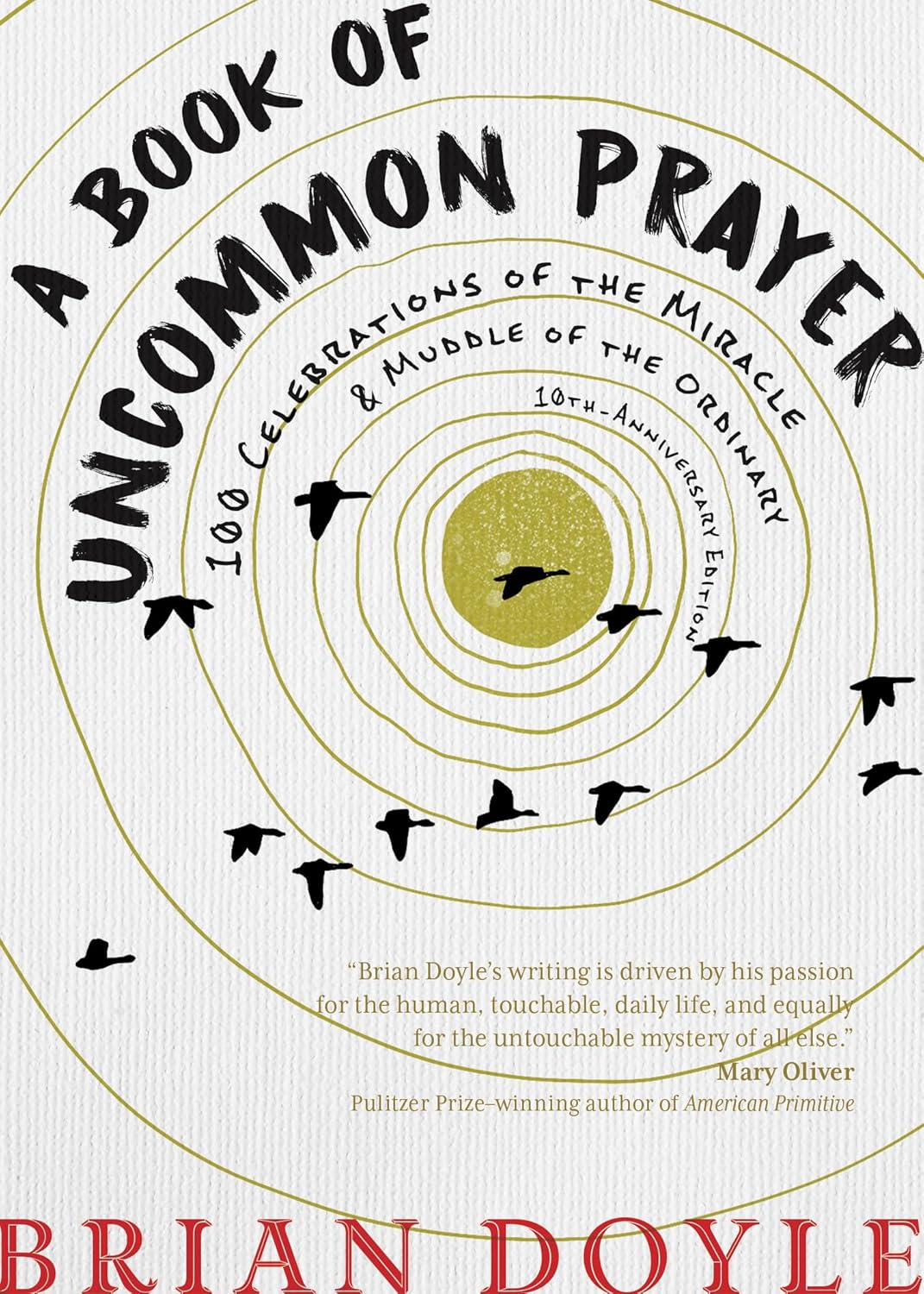

i count the late, great (astonishing) brian doyle among the favorite soul seers i have ever read. he finds words that burrow deep into the places in my soul that might never before have been struck or stirred. in his too-short time on earth, he saw wonder, plumbed wisdom in the unlikeliest of places. from prayers for cashiers and checkout counter folks, to prayers for robert louis stevenson on his birthday, and prayers for the greatest invention ever, the wicked hot shower, all found in his marvelous, marvelous, A Book of Uncommon Prayer: 100 Celebrations of the Miracle & Muddle of the Ordinary. these are the first lines of one with the magnificently brilliant title, “Furious Prayer for the Church I Love and Have Always Loved but Which Drives Me Insane with Its Fussy Fidgety Prim Tin-Eared Thirst for Control and Rules and Power and Money Rather Than the One Simple Thing the Founder Insisted On.” and it’s a fine fine note on which to both end and begin a year….

Granted, it’s a tough assignment, the original assignment. I get that. Love — Lord help us, could we not have been assigned something easier, like astrophysics or quantum mechanics? But no — love those you cannot love. Love those who are poor and broken and fouled and dirty and sick with sores. Love those who wish to strike you on both cheeks. Love the blowhard, the pompous ass, the arrogant liar. Find the Christ in each heart, even those. Preach the Gospel and only if necessary talk about it. Be the Word. It is easy to advise and pronounce and counsel and suggest and lecture; it is not so easy to do what must be done without sometimes shrieking. Bring love like a bright weapon against the dark… And so: amen.

bless us all. and may your new year bring you loft and leaven.

any wisdoms you acquired this year, with a story to share?

when you find the sages on your shelf echoing one essential truth. . .

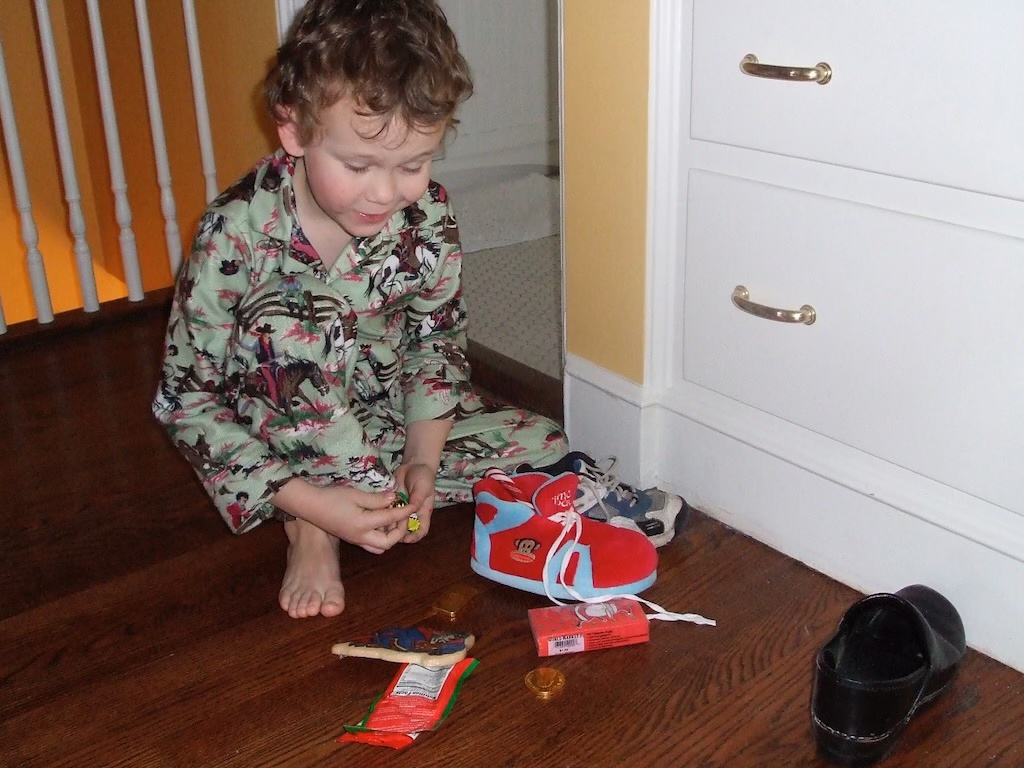
not so very long ago, within the reach of my old brain folders, this was the morn i had my boys set out shoes (sometimes admittedly smelly sneakers), which i filled with clementines and tinfoil-wrapped chocolates. the feast of st. nick, the jolly soul who in long-ago times filled the shoes of girls and boys with trinkets from his pouch. the original arbiter of good v. not-so-good; a lump of coal you did not want to find tucked in the toe of your wooden clog.

december, it seems, is a month punctuated with tradition. we embroider advent’s waiting, the dim day-by-day darkening with the kindled flickering of myth and lore and wonder gathered round the globe. every land, it seems, is looking for a bit of light amid the darkness.

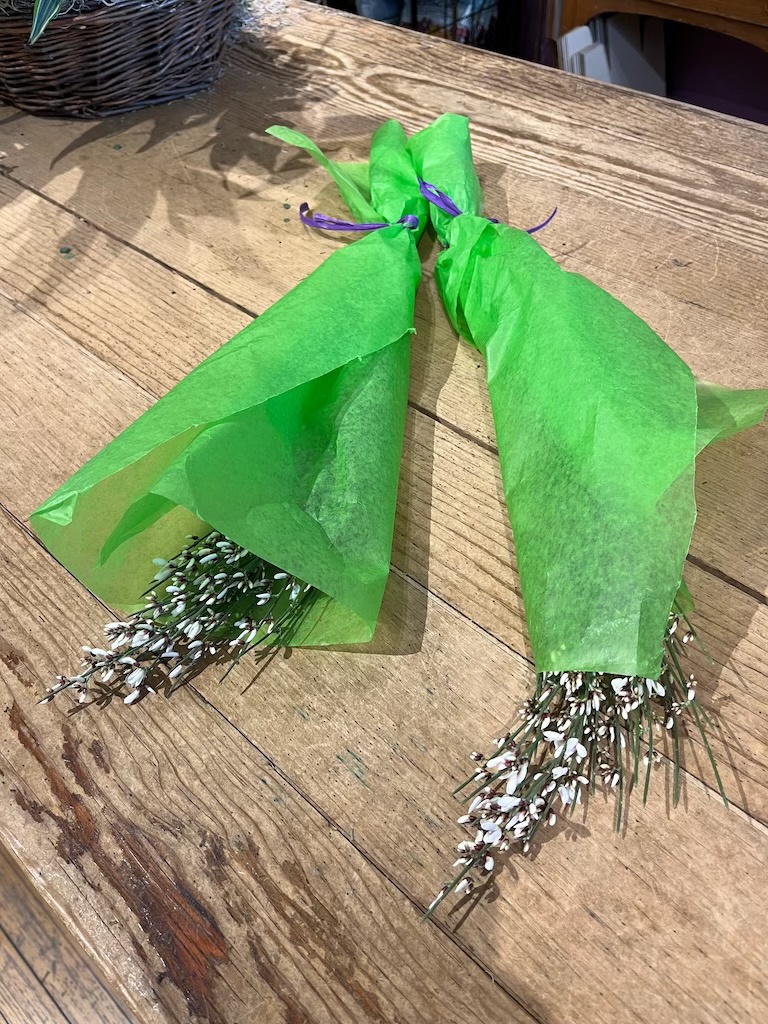
i learned only this week of december fourth’s “barbara branch,” when the german tradition is to give the branch of a flowering tree to a barbara and await its blossoming by christmas. the story goes that barbara, who would become a saint and then later (at my tender and impressionable age of 9 or 10) be stripped of her sainthood (for reasons i never quite grasped but the good ol’ Church did it anyway), dear barbara back in medieval times was such a beauty that her wretched father locked her in a tower whenever he went away. and when she refused to marry some princely fellow, because she preferred to marry Jesus Christ (plenty of saints chose that path) he sent her off to prison, awaiting beheading. on the way to prison, so the story goes, a cherry branch snagged against her skirt, so wise and wily barbara clutched the branch and carried it along to her cell, whereupon every few days she watered it with drops from her scantly-filled drinking glass. and don’t you know that on the day she was burned at the stake and then beheaded, the branch blossomed. and so we barbaras carry on the blossoming, with branches awaiting bloom. my mother is a barbara, and she now has a dear friend where she lives who also happens to be a barbara. so this barbara brought those barbaras branches awaiting bloom. 

and so december goes. 

but really what i find myself thinking here this morning is how the sages i have come to know and love find themselves in conversation across space and time. how their wisdoms interlace and amplify, and to my mind underscore the eternal in their simple truths. 

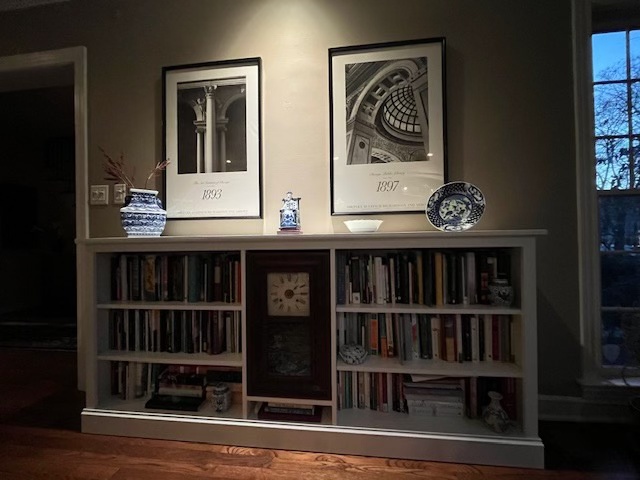
the sages shelf: poets, left; mystics and sages to the right

the two i’ve drawn from my shelf this week are brian doyle, the beyond-brilliant late great essayist and longtime editor of portland magazine, who died of a brain tumor not too many years ago. his wisdoms cannily or not line up with those of dorothy day, the radical pacifist and co-founder of the Catholic Worker movement, devoted to the poor, the hungry, the broken, and now on the road to sainthood, though she famously protested that labelling when she once snapped: “don’t call me a saint. i don’t want to be dismissed so easily.” (a sassy saint she’ll be, patron saint of sassiness among her zillion virtues.)

i found myself pulling dear brian off my sages shelf this week, and zeroed in on this passage in particular from his magnificent one long river of song: notes on wonder (a book whose praises i once sang in the pages of the chicago tribune, back when i wrote a column called “books for the soul”): 

This is what I know: that the small is huge, that the tiny is vast, that pain is part and parcel of the gift of joy, and that this is love, and then there is everything else. You either walk toward love or away from it with every breath you draw. Humility is the road to love. Humility, maybe, is love.

he echoes the essence of dorothy’s wisdom, an epiphany of hers long etched on my heart. this simple, simple code: “by little and by little.” 

her biographer, robert ellsberg in dorothy day: selected writings, elucidates: “simply, it consisted of performing, in the presence and love of God, all the little things that make up our everyday life and contact with others. from therese [of lisieux, yet another saint, the one who inspired dorothy], dorothy learned that any act of love might contribute to the balance of love in the world, any suffering endured in love might ease the burden of others. . . we could only make use of the little things we possessed—the little faith, the little strength, the little courage. these were the loaves and fishes. we could only offer what we had, and pray that God would make the increase. it was all a matter of faith.”

what i’ve come to know, through the alchemies of age and maybe cancer, is that my one holy task here is to live by love, little by little, day by day, for as many days as i have. if i can be a little flame, if i can choose love, choose joy, choose kindness at each and every turn and each and every choice, then my swift life here will have left some mark and measure. if each one of us might tip the balance, bend the arc toward justice, then our existence holds holy purpose. the choice becomes so clear, so finely-grained focused: i aim to walk closer and closer to the holiness i was––we were all––meant to be. and to find unending bliss within.

so help me God. 

one more brian doyle: in a brilliant, brilliant essay (found in One Long River, p. 12) about two strangers holding hands as they leapt from the south tower on sept. 11, doyle wrote: “their hands reaching and joining are the most powerful prayer i can imagine, the most eloquent, the most graceful. it is everything we are capable of against horror and loss and death. it is what makes me believe we are not craven fools and charlatans to believe in God, to believe that human beings have greatness and holiness within them like seeds that open only under great fires, to believe that some unimaginable essence of who we are persists past the dissolution of what we were, to believe against such evil hourly evidence that love is why we are here.”

i don’t know why i even try to say what has been so magnificently, unforgettably uttered already. brian doyle’s truth i feel unfolding in me every blessed day. i feel those seeds breaking open in the roaring furnace that is a cancer in your lungs.


because, why not, two Advent poems from emily d. or at least two poems worth contemplating in this season of anticipation, of heightened awaiting, of soul on the lookout for wonder coming….(Advent reflection on the poems, from my friends at the Salt Project, down below, but first, emily, the belle of amherst:)

“The Infinite a sudden Guest” (1309)

The Infinite a sudden Guest
Has been assumed to be —
But how can that stupendous come
Which never went away?

“Tell all the truth but tell it slant — “ (1263)

Tell all the truth but tell it slant —
Success in Circuit lies
Too bright for our infirm Delight
The Truth’s superb surprise
As Lightning to the Children eased
With explanation kind
The Truth must dazzle gradually
Or every man be blind —

+ Emily Dickinson

and here’s what my friends at Salt Project say about both…

These two Dickinson poems are perfect meditations for Advent:

The first as a provocative play on one of the season’s mysteries (How can we “wait” for someone who is also present to us, and in us, even as we wait?); and the second as a window into the many ways the Advent and Christmas stories testify to a God who comes in ways that are somewhat softened, accessible, “slant,” camouflaged, even hidden.

An ordinary baby in an ordinary backwater town, signaled by a star so faint that only Magi can spot it (Herod’s assassins can’t!), and announced not to the powerful in Jerusalem but to nameless shepherds on a forgotten hillside, watching their flocks by night.

It’s as the old carol has it: “Veiled in flesh the Godhead see, Hail th’ incarnate Deity!” (that’s from “Hark the Herald Angels Sing”). Veiled, hidden, not so God disappears but precisely so God may appear — or rather, so we may see. The Truth must dazzle gradually…

what simple sages’ truths have you found echoing of late?

blessings to teresa p for teaching me all about BBs, barbara branches!

on the subject of ephemerality…(and other long-lasting truths)

IMG_1479

in an already cruel april, this seems the cruelest of april’s jokes, this pillow fluff falling from the skies, soft as it is, quick as it is to melt on the tongue (i know; i was just out there with mouth wide open, agasp at the softness, the quiet of this particular snow). this meringue of ice crystals clasping the prayer hands of all the buds just on the verge. the leaden sting of waking up not just to a snow-falling morning, but doing so in the latter weeks of april when the earth has finally, triumphantly, broken through the thawing crust, when the whole globe is aching, is straining, is trying to muster resilience and make it to the other side…

IMG_1476instead, a lesson in ephemerality. the suddenness of slipping away. magnolia? velvety perfumed petals, now on ice. spring beauties, flash-frozen. i dashed out last night, clippers in hand, on a late-night salvation run through the garden. trying to save the soon-to-be stricken.
in any april, a snowfall is crushing. this april, it might knock the last breath of wind out of these tired old lungs. this is the april when we’d already drawn in, drawn quiet. when we were down on our knees, some of us, begging the earth to come to the rescue in the form of easter-egg pastels rising up amid the bursting-forth green synonymous with spring.

when the news pages read apocalyptic — when a zoo in the german town of neumünster is making a sacrifice plan of which animal to feed to another; when krakatoa, the great indonesian volcano, sent “violent puffs” (plumes of smoke and ash and flame) into the skies above the sundra strait, making like some sort of mountainous dragon; when the red-ringed virus crushes our hearts, day after day — we need something akin to a life rope.

the ephemerals of spring carry the whiff of that promise. it’s the evanescence — the now-it’s-here, now-it’s-goneness — that cups the germ of its beauty. the japanese, long wise to this notion in its cherry-blossom iteration, teach this as the truth of the sakura season, in an island nation that maps the bloom from first hint to full blossom.

and, now, it’s all gone. or buried under inches of snow here in the middlelands, here along the lapping shore of lake michigan (where these days it is so very quiet, i could count out the waves by the minute).

so we will need to turn inward again, further and deeper inward. i’ve taken up morning prayer (the serious kind, with flickering candle, the turning of pages, sliding a ribbon from section to section in the book of common prayer). i’ve taken up sourdough baking. and, soon as we can rustle up some plain white rice (the boys protest my usual brown), the homebound college kid and i are honing in on the original nursery confection, from-scratch, stirred-in-a-pot, rice pudding.

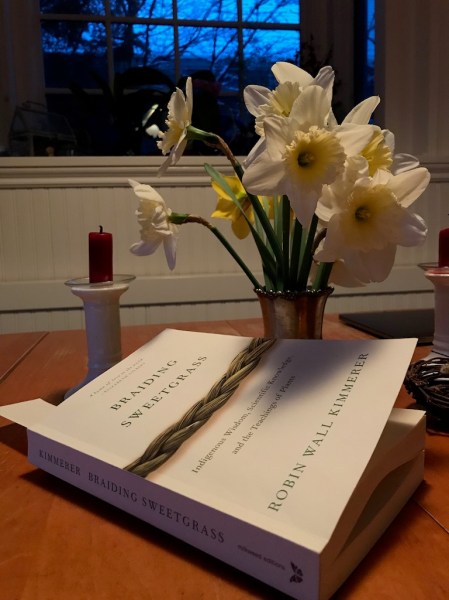
braiding sweetgrassamid my red-ringed survival plot, i’ve stumbled into a global book discussion group through my friends at emergence magazine. we’re reading the breathtakingly beautiful robin wall kimmerer’s braiding sweetgrass: indigenous wisdom, scientific knowledge, and the teachings of plants. kimmerer is a mother, scientist, botany professor, and member of the citizen potawatomi nation. each week, these past corona weeks, i find myself in small-group clusters that stretch from bern, switzerland, to tribeca, from the mexican countryside to south portland, maine.

this week we read a chapter titled, “the honorable harvest,” a framework for living centered on the insistent question that arises for kimmerer — and for us, i would argue, as we ache to plot a way forward, out of this corona siege into a recalibrated symbiosis with the world all around — as she pulls fat white bulbs of leek from forest floor:

“if we are fully awake, a moral question arises as we extinguish the other lives around us on behalf of our own. how do we consume in a way that does justice to the lives that we take?” kimmerer asks (italics, for emphasis, are mine). kimmerer, a plant scientist who lives and breathes indigenous wisdom, turns to her ancestral instruction for answers.

“collectively, the indigenous canon of principles and practices that govern the exchange of life for life is known as the Honorable Harvest,” she writes, and goes on to say that the guidelines aren’t in fact written down, but rather reinforced in small acts of daily life (the best such codes anyway). if you were to list them, and i will, she writes that they might look something like this (and, again, i’d add that there is here a particular resonance for mutual reciprocities in the age of corona, when hoarding — and stripping bare grocery store shelves — seems an instinct worth batting down):

know the ways of the ones who take care of you, so that you may take care of them.

introduce yourself. be accountable as the one who comes asking for life.

ask permission before taking. abide by the answer.

never take the first. never take the last.

take only what you need. 

take only that which is given.

never take more than half. leave some for others. 

harvest in a way that minimizes harm.

use it respectfully. never waste what you have taken.

share.

give thanks for what you have been given. 

give a gift in reciprocity for what you have taken. 

sustain the ones who sustain you and the earth will last forever.

brian doyle long riveri’ve one more morsel for the week, and it’s one worthy of its own post, but i’ll tuck it here instead (if i change my mind, you’ll see so in a subsequent post). my wonderful six-year gig plucking and reading and extolling the wonders of books for the soul for the chicago tribune has come to a close (slashed budgets, new owners, no money for freelancers), and the last of my tribune reviews is, fittingly, a book that deserves a trumpet blast. it’s a collection of breathtaking essays from the late, great brian doyle, and it’s titled, one long river of song: notes on wonder. if you are looking to survive this red-ringed siege with your heart and soul intact, read it. if you’re a high-minded soul and hope to emerge more vibrant and alive than ever, read it.

here’s but a bit of what i wrote:

At turns in “One Long River of Song,“ we discover Doyle the psalmist (singing the wonders of raptors and hummingbirds, otters or three-legged elks), Doyle as God’s acolyte (from the prayers to his unborn children to the one starkly titled, “Last Prayer”), Doyle as run-on sentence humorist (antics with his rambunctious brothers, basketball with toddler teammates). Over and over, his musings are canticles of joy, punctuated with occasional double-shots of heartbreak and humility. It’s the textured layering, the leap from shadow to light, that keeps the reader alert, and ever absorbing.

Always, emphatically, there comes wisdom; it’s a signature move, one you can count on. Have your pens aimed and ready.

It’s gospel of the ordinary, the shoved-aside, the otherwise overlooked. And at the heart of it, that ineffable and necessary unction, a holiness you can all but hold in your palms.

and with that, i will tiptoe away, to spend my day turning pages, stirring puddings, and awaiting the melt of the ephemeral snow…

bless you all. be safe. and be blessed….

since this morning is a bit of potpourri, have at it. leap in with any thoughts about anything corona. about the beauty of evanescence in your life and your world. about the honorable harvest and how you intend to live it….

let the page turn begin…

summer read

the summer porch is back in business, the sacred art of staring through screens into the first light of dawn and the lingering hours of twilight into starlight and moonlight. there’s a big old wicker chair in there, once dragged in from the hand-me-down bin, one pointed straight into the white pine and the little bird house on a pole where all day long the sparrows or chickadees flit and dart and chatter. i’ve taken up my position therein, and as many hours as the day will allow, that’s where you’re most likely to find me.

even this weekend. by day’s end, long after nightfall, both boys i birthed will be asleep in this old house (thunderstorms, don’t dare fudge our flight paths). the older one is flying home late tonight to be here when the not-so-little-anymore one walks across the graduation stage on sunday. it’s a weekend that’ll be packed with as much high-altitude soaring as we — and a host of jubilant high-schoolers — can possibly pack in, but just as emphatically i plan on planting myself for a few long hours of soulful conversation out there in the room on the verge of the garden. there’s a whole lot of catch-up to catch up on, the sort best done when knees rub against knees, when the folds of skin on someone’s face are squinched or softened in real time, right before your eyes.

i admittedly won’t be doing much turning of pages this weekend — not the literal kind, anyway. in the midst of a real-life page turn, bound pages are usually put aside. so while i dash off to fill the fridge, pin up the welcome home and happy graduation signs, and pick up the rented white dinner jacket (it’s new trier, and that’s the way they’ve done graduation since at least 1936), i am leaving you with the summer reading roundup i wrote for the chicago tribune.

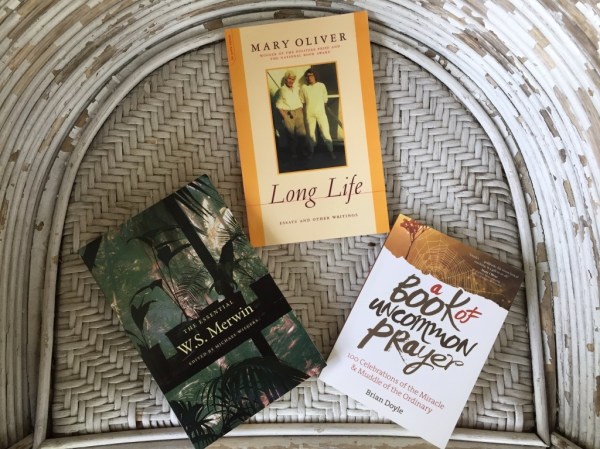
it apparently ran in the paper a couple weeks ago (saturday, may 18), but for the life of me i can’t find it, so here tis, in its original form. my lovely editor asked me to pick three books i’d want to slow read this summer, three that might especially stir the soul, so i went with three whose glorious magnificent writers are no longer among us. mary oliver and w.s. merwin both died within the past few months — mary O. in january, merwin in march. brian doyle died just two years ago; he was only 60.

i promise you a sumptuous summer — at least in the reading corner — should you crack open any one of these…

Pause to reflect on three greatssoul books summer

By Barbara Mahany

There are those for whom summer reading is synonymous with plot-thick page-turners, guzzled beachside or poolside, covers splattered with sunscreen. For others, the indolent season takes an opposite tack: it’s all about catch-up, savoring deep dives into the life lists of authors who’ve long been our polestars. Especially when death brings the coda, in the wake of a beloved author’s last penned utterance. It’s in the spirit of relishing these now-extinguished luminaries’ earlier works, titles forgotten or celebrated, that these three collections constitute a summer’s holy trinity…

The Essential W.S. Merwin

By W.S. Merwin, edited by Michael Wiegers, Copper Canyon, 200 pages, $18

The fittingest way to fill the silence that followed the death in March of W.S. Merwin, the late great Poet Laureate of the United States, who had received every major literary accolade, including two Pulitzer Prizes and the National Book Award, is to crack open the collection of his poems and prose deemed “Essential.” 

Apt title, indeed, as this definitive distillation traces a poetic legacy that’s been said to have “changed the landscape of American letters,” a compilation spanning seven decades of Merwin’s often spare unpunctuated poetry, translations, and lesser-known prose narratives. 

Merwin was, is, and always will be essential. 

“Through daily practice and attention, [Merwin] has created an incredible model for a way of existing on earth,” writes Michael Wiegers, editor-in-chief of Copper Canyon Press, who was tasked with culling nearly 50 books of Merwin poetry and another eight books of his prose. “His poems have defined for future generations what is possible in poetry and in life.”

That truth resonates through these breathtaking pages, be it Merwin’s urgent pleas to attend to this imperiled planet, or his heart-piercing excavations of the unconscious, as in his miracle of a three-line poem, “Separation,” exposing the raw edge of grief. It’s poetry turned saving grace: “Your absence has gone through me / Like thread through a needle. / Everything I do is stitched with its color.” 

Poring slowly over these pages—essential as they are—just might be the wisest prescriptive, balm for the soul, in the wake of the poet’s final absence. 

Long Life: Essays and Other Writings

By Mary Oliver, DaCapo, 120 pages, $16

The January death of Mary Oliver, Pulitzer Prize-winning poet, high priestess of seeing the sacred in the natural landscape—be it weeds poking through asphalt, or a goosefish stranded at low tide—prompted a great reprise of her most memorized lines, among them, “Tell me, what is it you plan to do with your one wild and precious life?”

But her 2004 “Long Life: Essays and Other Writings,” a slim and lesser-referenced volume, holds a cache more than worthy of slow reading, pen in hand for all the underlining and asterisk-ing that begs to be inked. Poems, Oliver calls her “little alleluias,” a “way of offering praise to the world.” Prose, she explains, is more cautious, flowing forward “bravely and, often, serenely, only slowly exposing emotion.” 

You’ll find those alleluias sprinkled throughout “Long Life”—and they will take your breath away, even if only a single line, such as this untitled dab: “All the eighth notes Mozart didn’t have time to use before he entered the cloudburst, he gave to the wren.”

But it’s the essays, slowly unspooling, that might hold you in rapt attention, even on a lazy summer’s afternoon. Take, for instance, her introduction to Ralph Waldo Emerson, the great New England Transcendentalist, whom Oliver refers to as “a failed churchman,” as she extols his genius, and reminds us “the heart’s spiritual awakening is the true work of our lives.”

Traversing the few-square-mile landscape of her Cape Cod environs, Oliver finds beauty—and wisdom and prayer—in the quotidian: the town dump, the rain, her mud-caked dog. She never fails to see the sacred. And she declares, almost as anthem: “I walk in the world to love it.”

A Book of Uncommon Prayer: 100 Celebrations of the Miracle & Muddle of the Ordinary

By Brian Doyle, Sorin Books, 192 pages, $14.95

This might be the book to reach for on the rainiest, gloomiest of summer days. For it will soon have you humming. It’s joy, it’s whimsy, it’s bursting-at-the-seams blessing upon blessing. 

Tucked in this gem of a pocket-sized book, you’ll find a centenary of prayers for cashiers and checkout-counter folk, in celebration of the wicked hot shower, for little brown birds in lavender bushes, for folks who all day long “hold up STOP signs at construction sites & never appear to shriek in despair or exhaustion,” for opossums, “you poor ugly disdained perfect creatures.” And—take a breath!—in thanks for “hoes & scythes & spatulas & toothbrushes & binoculars & the myriad other tools & instruments that fit our hands so gracefully & allow us to work with a semblance of deftitude.”

And that’s just the start of it. 

No wonder Mary Oliver (see high priestess of poetry, above) praised his “passion for the human, touchable, daily life.” And Cynthia Ozick declared that “to read Brian Doyle is to apprehend, all at once, the force that drives Mark Twain and Walt Whitman and James Joyce and Emily Dickinson and Francis of Assisi and Jonah under his gourd.” 

Doyle, a poet, writer, and longtime editor of the esteemed Portland Magazine at the University of Portland, died in May, 2017, of complications from brain cancer. He’d won three Pushcart Prizes, and the American Academy of Arts and Letters Award in Literature. 

If you wake up and the day happens to be sunny, not rainy, turn to page 66, where you’ll find that Doyle—the prayerful poet for all occasions—has penned a very fine prayer of thanks for suntan lotion. “Which smells good; which smells like relaxed; which smells like giggling children in peculiar and hilarious bathing suits; which smells like not-working; which evokes summer…”

You might be tempted to pen Prayer No. 101: Prayer of lamentation for the inimitable, irreplaceable Brian Doyle. And so, amen.

Barbara Mahany’s latest book,“The Blessings of Motherprayer: Sacred Whispers of Mothering,” was published last April. Twitter: @BarbaraMahany

what’s on your summer reading list?