pull up a chair

where wisdom gathers, poetry unfolds and divine light is sparked…

Tag: books for the soul

road trip reads

IMG_7946

any minute now, we’re piling in the red wagon and pointing it south, straight to louisville, kentucky, the state of grace in which i was born. we’re headed down for a memorial for a beloved uncle who died at 91 earlier this summer. he was known as “secretary of the interior” in blue-grass country, and they didn’t mean affairs of domestic geography so much as affairs of chintz and raw silk and impeccable antiques culled from trips around the world. more than 40 such trips circumnavigating the globe. a lifetime procuring the beautiful, as head of interior design for decades at louisville’s grand old department store.

despite the fact that it’s my beloved architecture critic’s birthday tomorrow, he insisted he was driving my mama and moi and devoting much of his day to interstates and trucks barreling past him, passing as they often do on the left. by sundown tonight, though, we’ll be checking into a sublime historic hotel, the brown hotel, and that alone will make this a trip to remember.

while we’re motoring i thought i’d leave a few books here on the table. i’ve not kept up with posts from my tribune roundups of soulful books. so here, a culled list of favorites from the last two distillations, a potpourri of books i particularly loved.

Buechner 101 by Carl Frederick Buechner, Frederick Buechner Center, 170 pages, $15.99

Maybe once a generation, or once every few generations, someone is born with gifts literary and sacred in equal measure. A translator, perhaps, of the highest calling. One who can at once lift our souls and our sights by virtue of the rare alchemy of the poetic plus the profound. Therein lies the prophet. Therein lies Frederick Buechner, at 90, one of the greatest living American theologians and writers.

In these collected works, “Buechner 101: Essays and Sermons by Frederick Buechner” — including excerpts from his Harvard Divinity School lectures, “The Alphabet of Grace”; a searing essay on his daughter’s anorexia; a seminary commencement address on the hard truths of pastoring a flock of believers, doubters and everyday sinners — we are immersed in the depth and breadth of this rare thinker’s gifts.

Anne Lamott, in her introduction, admits to being blown away by Buechner’s capacity “to be both plain and majestic” at once. She ranks him side-by-side with C.S. Lewis, then declares, “No one has brought me closer to God than these two men.” That alone might make you rush to pore over these pages.

This world sorely needs a prophet who reminds us to not give up our search for holiness amid the noise and hate and madness all around. Buechner, though, says it in words that shimmy through the cracks, burrowing deep within us, reverberating long after the page is turned. He writes: “We must learn to listen to the cock-crows and hammering and tick-tock of our lives for the holy and elusive word that is spoken to us out of their depths. It is the function of all great preaching, I think, and all great art, to sharpen our hearing precisely to that end.”

And it is that very sharpening that we find, paragraph upon paragraph, page after page, in Buechner 101.

Our Father by Rainer Oberthür, illustrated by Barbara Nascimbeni, Eerdmans Books for Young Readers, 58 pages, $16

The questions are pure. The questions, profound. From the child’s script, the surest path to heaven. And from the start, “Our Father,” a breathtaking peeling back of a foundational prayer of so many Christian religions, shimmers with a simplicity that can’t help but catapult our sacred questions to the highest heights.

Before beginning a line-by-line, word-by-word, meditation on the Lord’s Prayer, as it’s often called, this extraordinary picture book frames the prayer in the context of how it responds to the most essential — and possibly unsettling — questions: Where did the world come from? Why does it exist? Why am I here? Why do people die? What happens afterward?

In a voice that exudes comfort and heart-to-heart closeness the reader is told that these really are questions about God: Where is God? Why can’t I see God? How can I talk to God?

Are these not the very questions pondered by legions of theologians? And yet, the answers found here — in a children’s book from a Grand Rapids, Mich., publishing house with a long tradition of searching the globe for particularly illuminating children’s text and illustration — are perhaps among the clearest ever penned.

Which is what makes this a book for the soul young or old or anywhere in between. Each line — alongside charming illustrations that beg to be studied closely — becomes a prayerful exegesis, unfurled in words that speak to the pure heart of the child. It’s a book that will lull you into the sure and safe cove that is a building block of faith. And, chances are, you’ll never again murmur mindlessly the words of “Our Father.” Instead, you’ll be awakened to the depths of its timelessness and its capacity to enfold the answers to all our deepest questions.

Circle of Grace by Jan Richardson, Wanton Gospeller Press, 182 pages, $16

Blessings, an ancient literary form, “illuminate the link between the sacred and the ordinary,” Jan Richardson writes in her breathtaking “Circle of Grace: A Book of Blessings for the Seasons.” Often poetic and pulsing with the rhythms of invocation and incantation, blessings “use ordinary language in ways that can become extraordinary, offering words that arrest our attention and awaken us to how the holy is at work in our very midst.”

Before carrying us through the liturgical year, blessing by blessing, Richardson writes in her introduction that a good blessing “shimmers with the mystery that lies at the heart of God.” And then, she unspools “good blessing” upon “good blessing,” one after another shimmering, in ways that might make you weep, so tenderly, so astonishingly, do they slip into the hollows of the soul.

Richardson, a writer, artist and ordained Methodist minister, belongs among the most treasured spiritual lights on the bookshelf. Her words trace that thin line that courses the topography of the soul. She knows the way into the deepest interiority, into the mysteries of life, of grief, of wonder. Your breath will be taken, again and again. And you will return, again and again, to these pages, pulled by the magnetism of her words, her capacity for imbuing the everyday with the sacred.

A blessing, she writes, “is something wild. It leads us where we did not imagine to go, and never in a straight line.” It does so, in Richardson’s hands, by lifting the quotidian hours of our lives — the waiting for night to end, the unimagined grace of coming home — and making abundantly clear a profound holiness.

Becoming Wise by Krista Tippett, Penguin Press, 288 pages, $28

If you, like me, read with a pen at the ready, you’ll likely run out of ink on this one. If you measure the worth of a book by the volume of scribbles you pen in the margins, the stars emphatically drawn, and the sentences underlined, Krista Tippett’s “Becoming Wise: An Inquiry into the Mystery and Art of Living” — a compendium of wisdom, at once intimate and expansive — stands a serious shot of emerging both splattered and cherished.

Tippett, the Peabody Award-winning radio host and National Humanities Medalist, is a master of what she terms “generous listening,” an act “powered by curiosity,” and a “willingness to be surprised, to let go of assumptions and take in ambiguity.” Sadly lacking in the modern-day public square, it’s an art Tippett has practiced and honed in her years hosting National Public Radio’s “On Being,” a program and podcast launched in 2003 as “Speaking of Faith,” in which she’s generously listened to — and deeply questioned — some of the most luminous minds on the planet.

From this lifetime of rich conversation, Tippett elicits a poetic inquiry, interwoven with memoir. What does it mean to be human? What matters in a life? What matters in death? And, in the end, wisdom is what Tippett seeks. “Wisdom leavens intelligence, and ennobles consciousness, and advances evolution itself,” she writes.

The book, called “a master class in the art of living,” draws from conversations with poet Elizabeth Alexander, physicist Brian Greene, civil rights veteran John Lewis, physician Rachel Naomi Remen, chef Dan Barber, playwright Eve Ensler, and humanitarian Jean Vanier — to name only a partial roster of her fellow seekers of wisdom.

what titles top your summer reading list? 

tender is the earth

IMG_7423

i am submitting to the tilting of the earth. as the oozy patch of mud that is my very own fraction of acreage leans into the less-diluted rays of the great burning star that is the sun, pivot point of the universe, as adagio quickens, and feathered choristers raise their warbles by decibels upon decibels, i allow myself to be wrapped in the soft skeins of earth unfurling, earth letting loose its tight and clenched long-winter’s grip.

i am brushing up against its tendrils, its newborn threads, as i tiptoe down my bluestone walk. as i plop my bum on bluestone stoop, the one that hasn’t yet released its wintry chill. i crouch down low, and run my fingertips across the frilly tops of fronds, just beginning to poke beyond the crust of earth, just beginning to contemplate the art of opening, sun salutation of the new spring garden.

i can’t get close enough — save for rolling in the dewy grass, smearing fists of mud across my knees and elbows. or climbing up a tree, to discover how it feels to be a bird, warbling across the heavens, toes clinging to the bough.

all in all, my daily pull is to the pulse point where earth and sky entwine, where winter’s hibernation gives way to springtime’s insistent release. i drink in the lessons, the unspoken parable: it’s letting-go time, it’s time to uncoil, time to put aside the winter pose — one born of sorrow, yes, and a hollowed-out sense of quietude — time to practice the gentle nudge, bow down low to the invitation, the one that whispers, “i offer healing, if you lean in close, breathe deep the wholeness, the promise, of the season.”

i allow myself, day upon day, hour after hour, to be soothed by the blessed balm of earth at its tenderest. of earth when heaven first begins to draw forth what’s been tucked inside for all the weeks and months of darkness.

it’s dawned on me, as i make my daily rounds of close inspection, that the truth of springtime is that of revelation, long-held secrets breaking through the cloak that kept them shrouded, not seen, forgotten.

the beautiful, come springtime, is no longer under wraps. those yellow petals clinging to the branch? the tight buds of hyacinth just periscoping through the earth? it’s all creation trumpeting its truths. it’s all been there all along, sacred DNA tightly wadded, awaiting heaven’s cue.

and now it’s come, the call to rise and shine and strut the fresh-born splendor; must have tiptoed in while we were napping. so now, perhaps, it’s time for us to ponder too what’s been hiding deep inside of all of us, while we waited out the winter.

and while i wonder what the days and weeks ahead might bring, what beauties might be on the cusp, i’m savoring this tender interlude, these holy blessed hours when all the earth is gentle invitation, and balm for where the winter wore me raw.

i seem to be transfixed — you might call it “stuck” — by the slow unfolding out my door and windows. day by day, week by week, i’m keeping watch. mesmerized would be the word. drinking deep the healing offered by this holy blessed earth, the one so alive in spring. 

since my offering feels thin today, i’ll add to it with two addenda. the first is a celebration of a blessed angel among us, the cook in the night kitchen of what was once called children’s memorial hospital (and now has someone’s too-long name attached). just last night she wrapped up 50 years on the job. a half century of serving up love and prayer, with a side of oozy grilled cheese. one of my beloved nurse friends let me in on the chapter’s ending, so i dug into my archives and found this story i wrote for the chicago tribune in 2009, when she’d been on the job for a mere 43 years. 

to whet your appetite, perhaps, here are the first few paragraphs of miss bettye tucker’s story: 

One by one, night light by night light, the rooms go dim in the not-so-hushed place where sick children, broken children, dying children, finally fall into sleep.

One by one, room by room, the big people who’ve held little hands, dried tears and rocked fevered babies all day long at Children’s Memorial Hospital surrender for a moment their long night’s watch.

It is time for all the keepers of the children–the parents, the nurses, the doctors, the ones who mop the floors, the ones who keep the respirators breathing in and out–to be fed by the comfort-slinging cook in the night kitchen.

This much-loved healer with a soup pot and a prayer is known to all as, simply, Miss Bettye.

bettye tucker

miss bettye tucker

the other offering is the latest of my roundups of books for the soul, with works that blew my mind from rabbi jonathan sacks, and a patron poet-saint of the chair, dear mary oliver.

what lessons do you learn from keeping watch on early spring?

grape hyacinth

soulful pages: latest edition

roundup jan

i sometimes forget to post my roundups of soulful books here at the table, so this morning i am delivering the latest edition, which will run in this sunday’s printers row journal, the chicago tribune’s literary supplement. you’ll find it online now, right here, but i’m saving you the click, and posting below. and as the spirit moves me, i just might post a second post this morning…..i’ve a hankering to write about proper porridge. stay tuned. (turns out i decided to also post here — way down below — the tribune’s holiday gift guide roundup of what you might say were the six soulful books that most vociferously leapt off my bookshelf last year…) so lots of soulfulness to muse this wintry morning. put the kettle on, grab the fuzzy afghan, and commence the art of curling up with a great good tome….

Spiritual roundup: ‘Sabbaths 2013’ by Wendell Berry, more
Barbara Mahany

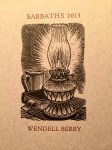
Sabbaths 2013 by Wendell Berry, Larkspur, 36 pages, $28wendellberry sabbaths

There are rare few times in the unfolding of our quotidian lives when we hold something in our hands and know, right away, that it’s sacred. To hold “Sabbaths 2013,” a hand-bound volume of Kentucky poet Wendell Berry’s poems in handset type with wood engravings by Wesley Bates, is to behold the sacred.

It’s as all the finest books on our shelves should be — a work of art, of exquisite attention, at every step of the bookmaking process. Larkspur Press in Monterey, Ky., is that rarest of small-press publishing houses. Gray Zeitz, the founder, is described as “bewhiskered, aproned, and ink-smudged.” He sets type by hand on clamshell printing presses, and his place of creation is said to be equal parts library, museum and workshop. Larkspur’s tagline: “Creating fine books one letter at a time.”

Certainly, these poems of Berry deserve to be unspooled with such care. Each of the 20 poems is a meditation, the closest we might come to modern-day Scripture. To encounter these lines is to brush up against the beautiful, the breathtaking, rooted in the everyday — the birthing barn, the generations-worn kitchen table, the old dog with her gray muzzle.

Consider, for instance, just this one line: “The years / have brought him love and grief. / They have taught him that grief / is love clarified, appraised / beyond confusion, affirmed, lifted / out of time.”

Stripped: At the Intersection of Cancer, Culture and Christ by Heather King, Loyola, 224 pages, $14.95

Cancer is hardly the landscape where one might expect soliloquies on prayer. But prayer, the down-on-your-knees, heart-wide-open petitions that spring from the raw fear of dying and death, is what makes “Stripped” (the author originally titled it, “Stripped: Culture, Cancer, and the Cloud of Unknowing”) very much a book for the soul — and not only for those who’ve been excoriated by the words, “You have cancer.”

More than anything, it’s the quality of King’s writing that catapults this book off the shelf. Her words are sharp-edged as any surgeon’s knife, and, as with all the most powerful writing, hers has the capacity to slip in wisdoms and enlightenments without notice. You’re busy laughing, or wiping away a tear, and suddenly you realize you’ve pulled out a pen to underline words to keep for the ages.

This is not a cancer saga you’ve read before, and where King’s faith takes her is a place few might choose. (She submits to surgery, but decides against radiation or chemotherapy — decisions she made 15 years ago now, and she’s still alive to write about it.) It’s the journey, the straight-shooting, no-punches-pulled, intimate cry of her heart, that makes this a most soulful expedition. One you’ll not soon forget.

Inside Time: A Chassidic Perspective on the Jewish Calendar, based on the works of the Lubavitcher Rebbe, adapted by Yanki Tauber, Meaningful Life Center, 3 volumes, 944 pages, $54.99

It would be shortchanging this three-volume set to call it simply a meditation on time. More apt would be to call it meditations within meditations, a Russian doll of deep thinking on the sacred nature of time and the particulars of the Jewish calendar. What’s found here is a collection of deeply thoughtful essays, exploring the soul of time as defined by the Torah and seen through the lens of Hasidic teaching. You needn’t subscribe to a Lubavitch world view to be enlightened by the epiphanies found in these pages.

At heart, in Volume One, “Time and Its Cycles,” is the notion that Creation wasn’t a divine one-time act, but rather that God creates the world anew in every moment. (Volume Two considers the Jewish calendar from Rosh Hashana to Purim; Volume Three, Passover to Elul.) This notion of perpetual creation, Rabbi Tauber argues, is a powerful antidote to the hopelessness that plagues so much of the modern-day landscape. Most powerful of all, he writes, is the corollary that time is wholly concentrated in the here and the now, inviting a fine-tuned focus on mindfulness.

Consider this instruction, drawn from one of the many charming stories Tauber tells to illustrate his teachings: “We cannot make our days longer, nor can we add additional hours to our nights. But we can maximize our usage of time by regarding each segment of time as a world of its own.”

For the student eager to burrow deep into the great vault of Jewish sacred text, this is a book to hold our attention for a very long time.

Barbara Mahany is the author of “Slowing Time: Seeing the Sacred Outside Your Kitchen Door.” Twitter: @BarbaraMahany

Copyright © 2016, Chicago Tribune

p.s. as i’ve spent the last hour riffling through my files to see how very many times i’ve not posted those soulful roundups here, i realize i must have some reticence about taking up space at the table when the roundups are not too hard to find on the tribune website. looks like i’ve only posted five of 10 roundups, or even included a link. oh my! one you might want to look up would be the gift guide, in which i picked the six books that most leapt off the shelf last year, in the soulfulness department. you can find that roundup here. or, on second thought, maybe i should post it here……

Gift guide: Books for the soul
From a book by Pope Francis to an anthology of world religions, these 6 books are ideal for the spiritual-minded.
By Barbara Mahany

It’s a glorious expedition to survey the spiritual landscape of this year’s books for the soul, to pluck the ones with richest deepest resonance. Poets and scholars, a pundit and pope, all rise to the top.

Consolations: The Solace, Nourishment and Underlying Meaning of Everyday Words by David Whyte, Many Rivers, 247 pages, $22

Poet and philosopher David Whyte constructs an alternative dictionary of 52 words — an abecedarian that stretches from “alone” to “vulnerable” — and, in so doing, invites the reader to explore the depths of each entry, beyond the semantic surface, burrowing into the poetic and the profound. It’s a form of prayerfulness, the meditative powers of contemplating a single word. Whyte takes us there in plainspeak, though his is a language that pulses with counterpoints of shadow and illumination. Surely, a certain road to soulfulness is paved with unexpected poetries and luminescence at every bend. Whyte takes you there by heart.

The Norton Anthology of World Religions: Volume 1 and 2, W.W. Norton, 4,448 pages, $100

Weighing in at 8.4 pounds, a whopping 4,448 pages, and tucked in a tidy two-volume book pack, this massive and monumental Norton Anthology, edited by Pulitzer Prize-winner Jack Miles, holds inspiration for more than one lifetime. At heart, writes Miles, it’s an invitation “to see others with a measure of openness, empathy, and good will. … In that capacity lies the foundation of human sympathy and cultural wisdom.” With more than 1,000 primary texts — Volume 1 covers Hinduism, Buddhism, Daoism; Volume 2, Judaism, Christianity and Islam — this is an instant classic.

The Road to Character by David Brooks, Random House, 320 pages, $28

Before diving into modern-day parables in the form of biographies — ranging from Augustine to George Eliot to Dwight Eisenhower to Dorothy Day — David Brooks, columnist for The New York Times and opinionator for this oft-imploding globe, pens as fine an exegesis on sin as has been written in recent times. Our sin: “self-satisfied moral mediocrity.” It’s in those character studies of some of history’s greatest thinkers and leaders, 10 in all, that Brooks lays bare what it takes to cultivate deep moral character. And isn’t a moral core, tested in everyday trials, our one best hope at an everlasting soul?

Map by Wislawa Szymborska, translated by Clare Cavanagh and Stanislaw Baranczak, HMH, 464 pages, $32

Here, for the first time, is the English translation of all of the poems of Nobel Laureate Wislawa Szymborska’s last Polish collection, including previously unpublished works. In all, “Map” gathers some 250 poems written between 1944 and 2011. While Szymborska, who died in 2012, focuses her attention on quotidian subjects — an onion, a cat — she plumbs them to probe life’s big questions — love, death, and passing time. And while she might not be as widely read in America as poets Mary Oliver and Mark Strand, her words bore deep. She is poet serving as spiritual guide.

Encyclical on Climate Change and Inequality: On Care for Our Common Home by Pope Francis, Melville House, 192 pages, $14.95

This breathtaking amalgam of urgency and poetry mines the spirit and appeals to the moral core. It’s as essential a soul-stirring read as any recent manuscript. Billed as the pope’s pontifications on the environment, it is in fact a sweeping letter addressing a spectrum of global sins. The Guardian termed it “the most astonishing and perhaps the most ambitious papal document of the past 100 years,” bespeaking its relevance beyond the walls of the Roman Catholic Church.

In the Shelter: Finding a Home in the World by Padraig O Tuama, Hodder & Stoughton, 192 pages, $23.95

This quiet book of contemplations by Belfast-based poet, theologian and peace worker Padraig O Tuama barely stirred a ripple in the marketplace of books, but where it counts — in the hearts of those blessed to turn its pages — it swiftly became a treasure. More deserve to be stirred by its deep currents. Putting to work poetry and gospel, side by side with story and Celtic spirituality, O Tuama explores ideas of shelter along life’s journey, opening up gentle ways of living well in a troubled world. The reader can’t help but be drawn in, slip-sliding into the harbor of the author’s soulful words.
Copyright © 2015, Chicago Tribune

A version of this article appeared in print on November 29, 2015, in the Printers Row section of the Chicago Tribune with the headline “Food for the soul – Poetry and profundity in these true gifts” 

catching the elusive slipstream and other hints of holiness

angel

more than once this week, i’ve felt shivers run my spine. more than once this week, i felt myself suspended in some holy sort of hammock. i’ve giggled. and more than once, i’ve wanted to dash to the telephone, to call my blessed friend. and then, stopped cold, i remembered phone lines don’t go to where she is. wherever she is.

my friend died not two weeks ago.

but that didn’t stop me from feeling her as close to me this week as if we were, as we so often were, huddled on the couch, under the buffalo-check blanket that might belong in a horse barn, but kept us warm through many a long winter’s afternoon when, curled up with mugs of tea and bowls of clementines, we coursed across the landscape of our lives, our hearts, our souls.

death when it’s new can be like that. out of the blue you bump into the reality — a cement-block wall, almost — that the someone you want to reach for, the someone you’ve always reached for, isn’t there. it’s as if your mind is playing tricks with you, taunting, teasing, playing hide-and-seek. maybe it’s just me, but i push my imagination as far and deep as it will go, all but see and hear the someone right before my eyes. convince myself one day the phone will ring, and the someone will be there, and at last i’ll hear, “trick’s up. i was only hiding.”

but in moments when i wasn’t playing mind games, when i’ve been going about the business at hand, i’ve suddenly had a certain sense that something, some holy force, had slipped beneath me, inside me, and propelled me or the world around me in inexplicable ways. well, i’ve an explanation, but it defies logic, and laws of physics.

take, for instance, the fact that all summer i’ve been drudgingly tapping keys on my keyboard, slowly uprooting words from deep down underground. i’d type my way to the end of sentences, but really, i was all but lost. form was formless, and all swirled foggily around me. i was trying to find the words, the shape, the essence of some elusive book. i knew what i wanted it to be, but somehow i couldn’t find the path. i’d get distracted, spend long spells away from the keyboard. i started to think nothing would ever come. i thought a bit about my capacities for swirling foam in coffee at the local barista bar. maybe, after all, that was better use of my waking hours.

but then, this week, once again i sat down. opened up a document, one that had no name, and suddenly — slowly at first, but building in speed and force — i’d renamed it “chapter 1.” it’s finished now, and sits waiting on my computer. it’s been followed, swiftly, by chapters 2 and 3, now almost written down to the very last period.

where’d that slipstream come from, i wondered? i didn’t think too hard to pounce upon my answer.

and in another breathtaking moment of serendipity, a fellow i love, a post-college living-in-a-new-city sort of fellow, he was out and about recently, and struck up animated conversation with a lovely lass. they weren’t too deep into conversation before it was revealed that, out of all the souls who inhabit this giant metropolis, they both just happened to share in common a deep love for our beloved friend who had just died. the fellow had known and loved our friend his whole life long, called her his “spiritual godmother”; the lass was one of her devoted students, one of the very few she’d tucked tightly under her wing, imparting the intricacies of her craft even as her cancer spread and spread. the meeting of the two — the fellow and the lass — could not have been more random, impossibly so. and the depth of their first conversation was, apparently, the sort that glimmers on the prairie.

now i can’t claim to be one of those folks who frankly believes that angels have wings and hover over us. but i do believe in souls that never really fade, and i do believe in forces of holiness and miracle. i’ve spent decades trying to figure out just what happens when someone you love dearly dies. what happens after the last breath comes, and stillness fills the room? i promise to let you know when i nail that one. but until then, i’ll side with the folks who believe that holiness is a force of life abundantly present, and animating all the hours of our day. maybe the work to be done is on our side, maybe it’s about opening ourselves through a particular level of prayerfulness, maybe it’s about a soul so porous we’re a filter, a catch basin, for all that’s good and beautiful and buoyant. maybe thinking aloud about all this is the dumbest thing i’ve ever done. or maybe, in putting words to wondering, we might — together — stumble on some truth, some shimmering shard of wonder, of heaven tumbled down to earth.

i can only hope. and pray. and keep watch for the gentle brilliant touch of my beloved slipped-away friend.

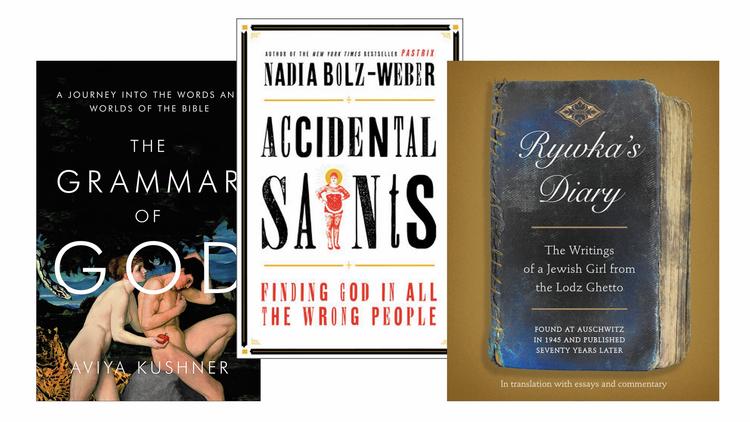
as is so often the case, i had no intention to write a word of this. but the words came anyway. so here we are. i’d been thinking that i was so intent on getting back to chapter 3 and 4, i’d just post the latest edition of my chicago tribune roundup of books for the soul. that might have been the safer, wiser bet. or maybe not. a short bit of one of the reviews was cut for space, so i’ll post the link to the latest roundup here, and down below, i’ll include the unedited version of the first review, the glorious, The Grammar of God: A Journey into the Words and Worlds of the Bible, by Aviyah Kushner, which i loved.

soul-roundup-jpg-20151008

The Grammar of God: A Journey into the Words and Worlds of the Bible
By Aviya Kushner, Spiegel & Grau, 272 pages, $27

The highest praise for a book, perhaps, is tucking it into a slot on your bookshelf where you’ll always be able to effortlessly slide it out, lay it across your lap, and soak it up for a minute or a long afternoon’s absorption. The Grammar of God: A Journey into the Words and Worlds of the Bible, Aviyah Kushner’s poetic and powerful plumbing of both the Hebrew and English translations of the Bible, now rests in just such an easy-to-grab spot in my library.

In a word, it’s brilliant. And beautiful.

Kushner, a poet and journalist who grew up in a Hebrew-speaking home where dinner-hour debate often pivoted on the meaning of the Bible’s original Hebrew text, went off to the Iowa Writers’ Workshop back in the summer of 2002, and found herself in novelist Marilynne Robinson’s class, parsing the Old Testament. Kushner barely recognized the text in English translation.

Therein was launched a trek into language and belief that took Kushner around the globe. She draws on grammarians and lexicographers across the millennia to lay out this roadmap into the depths of sacred text. Not lost is her insistence that much is lost in translation, and even if you’ve no interest in religion, the linguistic excursion here is not to be missed.

Most essentially, Kushner lifts the veil for all of us who don’t know ancient Biblical Hebrew. She pulls us deep inside etymology and history and meaning. And as a Kirkus review so aptly put it, Kushner’s first book is, in the end, “a paean, in a way, to the rigors and frustrations — and ultimate joys — of trying to comprehend the unfathomable.”

how have you brushed up against the holiness of someone you’ve loved, no longer right here among us?

the book bench at summer’s close

book bench august

as this summer draws to its quiet close, there tiptoes in this latest roundup of books for the soul — from the pages of the chicago tribune, where i cull through a stack of offerings every month. this lands in my mailbox at a moment when i too am feeling quiet. in this old house, we’re sinking back into the sacred rhythm of whispered dawn followed by momentary rustle as that new-to-high-school boy is shuffled out the door. then it’s quiet again. for too-short a spell.

before the pace picks up — or maybe to keep it at bay — i’m headed out to my book bench to soak in the succulence of summer’s end. here’s hoping you, too, have a quiet place to curl into human comma, turning the pages perhaps of a book that fills your soul. here, a few titles you might want to slip into your book bag. or ferry to your favorite reading nook. no matter your choosing, may you be blessed abundantly as we reach the summer’s closing chapter…

from the pages of Printers Row Journal, the Chicago Tribune’s literary supplement…

soul roundup august

Spiritual roundup: ‘Encyclical on Climate Change and Inequality’ by Pope Francis, more
By Barbara Mahany

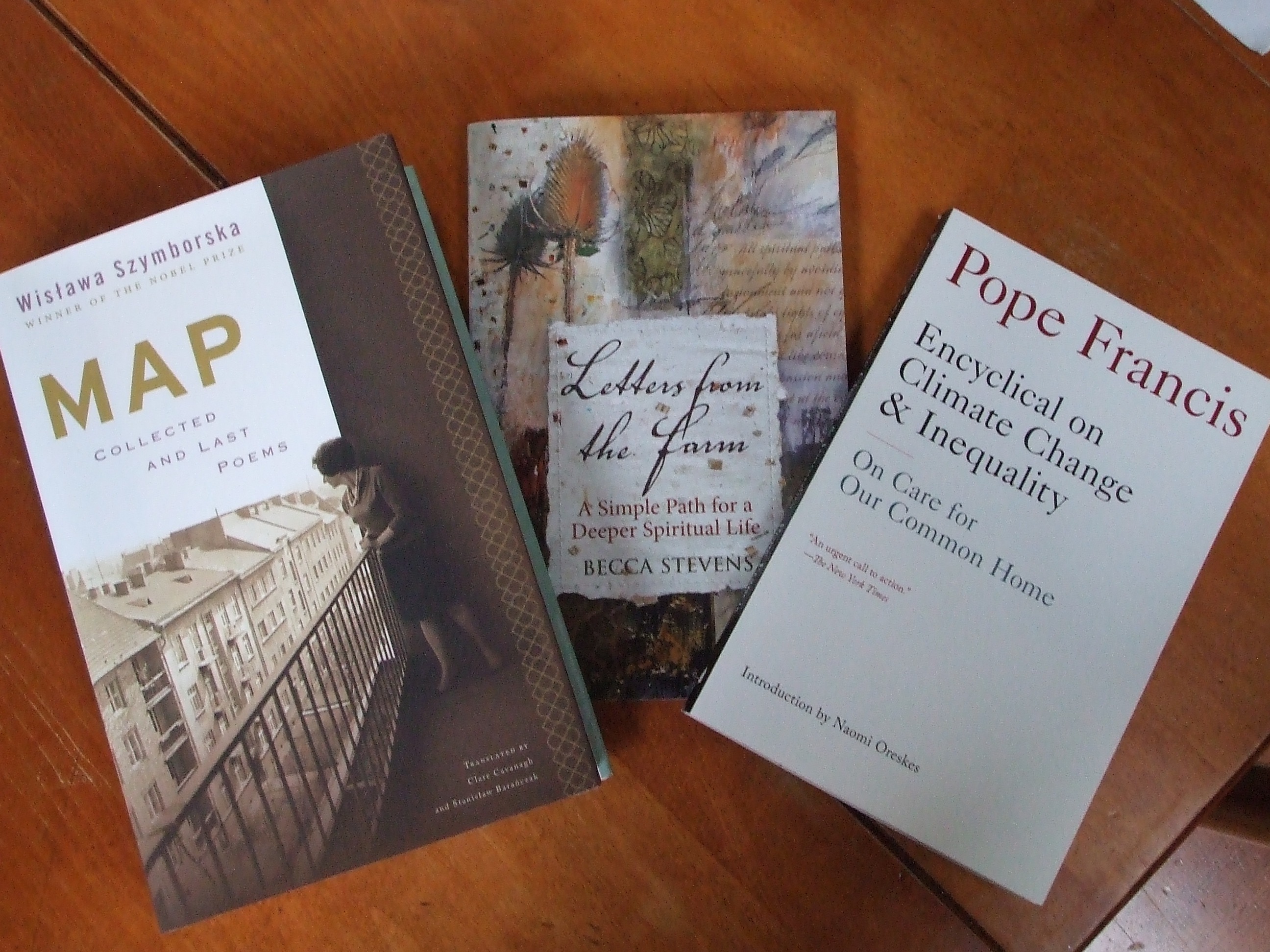
Encyclical on Climate Change & Inequality by Pope Francis, Melville House, 167 pages, $14.95

Naomi Oreskes, professor of the history of science at Harvard University, begins her introduction to this particular printing of Pope Francis’ latest encyclical by reminding us “(h)istorians looking back often recognize turning points, but ordinary people living through them rarely do. Sometimes, however, a book catalyzes thought into action.” She goes on to count “Uncle Tom’s Cabin” and “Silent Spring” as two such masterworks. And then she deftly tucks “Encyclical on Climate Change & Inequality: On Care for Our Common Home” onto that same rare call-to-action bookshelf.

As it should be.

This breathtaking amalgam of urgency and poetry mines the spirit and appeals to the moral core. Billed as the pope’s pontifications on the environment, it is in fact a sweeping letter addressing a spectrum of global sins, not the least of which is summed up in Francis’ declaration that “(t)he earth, our home, is beginning to look more and more like an immense pile of filth.”

That a secular publisher, Melville House, chose to print in its entirety the papal document — termed by The Guardian “the most astonishing and perhaps the most ambitious papal document of the past 100 years” — bespeaks its relevance beyond the walls of the Roman Catholic Church. Where it stirs the soul, though, is in its majestically crafted sentences that wholly illuminate the understanding that nature is “a magnificent book in which God speaks to us and grants us a glimpse of his infinite beauty and goodness.”

Coupled with the pope’s insistence that pillaging the planet exacts too costly a toll on the world’s poor, this work drills home the plea that we “hear both the cry of the earth and the cry of the poor.”

Map: Collected and Last Poems by Wislawa Szymborska, translated from the Polish by Clare Cavanagh and Stanislaw Baranczak, edited by Clare Cavanagh, Houghton Mifflin Harcourt, 447 pages, $32

 
When awarding Wislawa Szymborska the Nobel Prize in Literature in 1996, the Nobel commission called her “the Mozart of poetry.” But they didn’t stop the invocation there, adding that her elegant, precise works held “something of the fury of Beethoven.”

All of which is to underline the supreme sadness that one of Europe’s greatest recent poets is not better known this side of the Atlantic. “Map: Collected and Last Poems” could right that.

Here, for the first time, is the English translation of all of the poems of Szymborska’s last Polish collection, including previously unpublished works. In all, “Map” gathers some 250 poems written between 1944 and 2011.

While Szymborska, who died in 2012, focuses her attention on quotidian subjects — an onion, a cat — she plumbs them to probe life’s big questions — love, death, and passing time. And while she might not be as widely read in America as poets Mary Oliver and Mark Strand, her words bore deep into a shared soulful landscape. She is poet serving as spiritual guide.

Consider, for instance, this one stanza from the poem “Nothing Twice”:

“Why do we treat the fleeting day/ with so much needless fear and sorrow?/ It’s in its nature not to stay:/ today is always gone tomorrow.”

Is that not a call to savor the one holy hour that is upon us? To not fritter away a single day?

We can only hope that hers becomes a household name, in any house that believes poetry is direct line to the depths of the human spirit. This tome is the place to begin.

Letters from the Farm by Becca Stevens, Morehouse, 160 pages, $18

“Letters from the Farm: A Simple Path for a Deeper Spiritual Life” is one of those quiet books that slips across the transom. You couldn’t predict from its cover — nor from the measure of its page count — just how much it holds inside. You needn’t read too far to realize its heft.

Stevens is an Episcopal priest and the founder of Thistle Farms, a community of women who have survived sex trafficking and addiction. Rooted outside Nashville since 2001, it is in fact a farm, one where herbs and teas and thistle are grown and made into bath and body care products distributed nationally. And it is from this plot that Stevens reaps much wisdom.

Her redemptive truth: “Love heals.” She writes: “I’m not called to change the world. I am called to love it.”

It’s the take-your-breath-away simplicity of Stevens’ letters that makes you take sharp notice. Count her emphatically in the Anne Lamott tradition of unexpectedly walloping you over the head, or in the heart, with a sentence so profoundly wise, so steeped in substance, you could pause and spend a few days burrowing into the truth of it.

Her stories from the farm — and from her travels to Africa and around the United States — are raw and rugged. When she writes of a woman locked in a lightless closet for four months, or mentions another woman who slept in a bathtub, night after night, to avoid “being raped before sunrise,” she stirs a knowing grittiness into what she calls her stack of “love letters to God.” Her prose unsettles in the most profound ways. And that is a very good thing.

Barbara Mahany is the author of “Slowing Time: Seeing the Sacred Outside Your Kitchen Door.” Twitter: @BarbaraMahany
Copyright © 2015, Chicago Tribune

praise be to youyet another lovely edition of the pope’s encyclical arrived post-deadline, but it’s one worth considering. footnotes unspool across the bottom of each page, and, as with the melville house edition, (above), it’s an exact reprinting of the original, pressed between hard-bound covers.

“Praise Be To You: Laudato Si’ On Care for Our Common Home,” by Pope Francis (Ignatius Press, $14.95)

and what might you carry to your book bench?

books for the soul: the february roundup

ct-spiritual-roundup-jpg-20150212

i know, i know: it’s march already. half way into the month, and i’m finally getting around to hauling over the long-ago promised february roundup of books for the soul. 

as i mentioned a few weeks back, a marvelous new assignment sent my way by my old beloved newspaper, the chicago tribune, is to read and round up a trinity of books for the soul every four to six weeks. since i’ve always believed in coloring outside the lines, my definition of what stirs the soul is a sweeping one.

already, i’ve crept through picture-book shelves, and poetry tomes. i’m perusing the landscape of brilliant nature writing. and don’t be surprised if, one month, you find a book with very few words at all, allowing images — sketched or caught by the lens of a camera — to do all the soulful lifting.

truth is, the soul, i do believe, is stirred far beyond the walls — or pages — of where you might expect to bow your head, bend knee, and offer up a vesper or three.

in fact, it’s in the least-expected nooks and crannies where i’m most likely to find my breath swept away, and my soul most deeply stirred.

stumbling on astonishment, to paraphrase the beloved poet saint mary oliver. 

so, before the march roundup hits the news stands, here are the three titles i found soulful in february.

The Norton Anthology of World Religions, Vols. 1 and 2

Edited by Jack Miles, Wendy Doniger, Donald S. Lopez Jr., James Robson, David Biale, Lawrence S. Cunningham, Jane Dammen McAuliffe, W.W. Norton, 4448 pages, $100

Weighing in at 8.4 pounds, a whopping 4,448 pages, and tucked in a tidy two-volume book pack, this massive and monumental Norton Anthology, edited by Pulitzer Prize winner Jack Miles, holds inspiration for more than one lifetime. At heart, writes Miles, it’s an invitation “to see others with a measure of openness, empathy, and good will. … In that capacity lies the foundation of human sympathy and cultural wisdom.”

Sign me up.

With more than 1,000 primary texts — Volume 1 covers Hinduism, Buddhism, Daoism; Volume 2, Judaism, Christianity and Islam — this instant classic allows readers to discover religions’ common threads, to plumb the sharp-edged distinctions, and to drink from the pure well of original text, not watered down through centuries or millennia of interpretation, clouded or otherwise.

In a world where religion too often divides, this portable library of foundational works is intended “for readers of any religion or none.” Skeptics needn’t stay away. Scholarly texts, buttressed by timelines, glossaries, maps, and handy pronunciation guides, rub up against essays, poems, even hip-hop lyrics, all serving to define, expand and illuminate faith.

Beginning with the brilliant 46-page “poetic prelude” by Miles — a former Jesuit seminarian, now distinguished professor of English and religious studies at the University of California, Irvine, who won his Pulitzer for his biography of God, no less — this foot-crushing tome is worth its weight, and its price tag, in wisdom — and enlightenment, of the truest kind.

Flunking Sainthood Every Day: A Daily Devotional for the Rest of Us

By Jana Riess, Paraclete, 328 pages, $23.99

If you’re inspirationally inclined — meaning you tend to rip wisdom-steeped paragraphs out of whatever your read and pin them prominently wherever they’ll stir you to action (the pantry, the dashboard, tucked under the toothpaste) — this little book has, effectively, hauled out the scissors, mastered the clipping and pasting, and packed a year’s worth of finely curated wisdom into its pages.

And these aren’t your everyday inspirers, the usual host of holy thinkers. Here, you’ll find the likes of Marmee from Louisa May Alcott’s “Little Women” or A.A. Milne’s “Winnie the Pooh.” You’ll find Annie Dillard at her literary best, and St. Augustine of Hippo, C.S. Lewis and Thomas Merton, for a sweep through the centuries. Kathleen Norris and Desmond Tutu are among the enlightened. The index at the back of the book will help you put your finger on thinkers from Angelou, Maya, to Singer, Isaac Bashevis.

It’s a book of daily readings centered on 12 spiritual practices Jana Riess explored in her wry and deeply humble 2011 memoir, “Flunking Sainthood: A Year of Breaking the Sabbath, Forgetting to Pray, and Still Loving My Neighbor.” Riess made it abundantly clear back then that trying and failing is more or less the whole point. And in her latest work, she offers day-by-day “courage to laugh at our shortcomings as we pick ourselves up to try, once again, to inch just a little closer to God.”

While it’s written with an eye and an ear to Christianity, this is a book that transcends denominations.

St. Peter’s B-list: Contemporary Poems Inspired by the Saints

Edited by Mary Ann B. Miller, Ave Maria, 266 pages, $15.95

Cracking open the pages of this collection, you have every reason to suspect you’re about to encounter a churchy gathering of dusty old lives of the saints, in stanza and verse.

You will discover — on the first line of the first poem — you’re blatantly wrong. You find yourself reading about dishes in the sink and bickering. Tumbling along to the book’s next poem, you’re reading about straitjackets and a baby who “screams and / won’t go down.”

And yes, the verse — from poets Mary Karr to Dana Gioia — is interspersed with language lifted straight from prayer, familiar prayer, prayer some of us learned by heart long ago. But the words and images volley so swiftly from the banal, the earthly, to the sacred, the heavenly, that you are ever startled.

And yes, saints are mentioned in many — but not all — of the poems. And not in ways you’ve encountered them before. Thus, it becomes a passing parade of modern-day wise folk with something to teach, a story to tell.

“(T)he lives of the saints cannot be understood unless seen as works of art, as poems,” writes Rev. James Martin, the Jesuit thinker and writer, in the afterword. “The most important truths about God are not reached with definitions and proofs but by poems and stories. And by people: the saints. That is why this book is a treasure. These poets take the lives of the saints as they are meant to be understood: as poems. From human works of art they draw out literary ones.”

Barbara Mahany is the author of “Slowing Time: Seeing the Sacred Outside Your Kitchen Door.” Twitter: @BarbaraMahany

Copyright © 2015, Chicago Tribune

i don’t think this will work unless you’re a subscriber to the Tribune’s Sunday literary supplement, Printers Row Journal. but here’s the link, just in case. 

and, please, pass along any titles anywhere if you’ve found they stir your soul. my only stipulation is that the books need to have been recently published, meaning within the last few weeks, or months at most….

soul pickings…

book pickings

pray tell, you might ask, what is she doing now? perhaps, given the tower of pages above, i’m devising a rube-goldbergian contraption for felling the wintertime ants that dare to cross my kitchen table. or, perhaps, it’s the latest in literary aerobics: hoist this pile off the tabletop and see how many jumping jacks i can count — before dropping the load on my poor baby toes, or tumbling under the weight of the heart-pumping challenge.

or, perhaps this: in the plummest assignment a girl could dream up, my old newspaper, the chicago tribune, has asked me to basically peruse the literary all-you-can-eat and fill my tray with the juiciest morsels — month after month after month. now, you’ll not find me weighing the caloric wonders nor the narrative arc of sultry page turners. and i won’t be digesting the latest in graphic novels, or avant-garde fiction. my little assignment, which runs on the pages of the tribune’s literary supplement, printers row journal (special subscription only), is called “round up: books for the soul.” and i’ll be lassoing soul-stirrers every four to six weeks.

and, in case you hadn’t already guessed, my definition of soul is a broad one, a deep one, so watch out bookshelves, i’m coming right at you. i’ve been asked to mine the lists of just-published pages to pluck out the ones that stir me — and maybe you — the most deeply. in my book, that means children’s picture books are near the top of the pile. and so too is the 8.4-pound, 4,448-page, two-volume whopper, the norton anthology of world religions, a collection i could — and i will — spend the rest of my days inhaling. it means poetry and essay, and even a book of black-and-white images with very few words, if that finds a way to the depth of the place that stirs us, inspires us, sets us wanting to right the world’s wrongs (or at least to course-correct the fumblings that hold us back from all whom we were meant to be).

at the moment, i’m whittling my latest short list down to the final three, and i’ll be defending my picks in short pithy blurbs — all to be handed over to my editor by monday morn. while i can’t let on here what’s next on the docket, i can pass along the trinity of titles that were picked for the perch of the new year, the first installation in what promises to be a perpetual devotion.

a marvelous and hilarious side note on the list just below. when dear, marvelous, and often quite wacky anne lamott spied the review online (i had no idea it had even been edited, yet alone posted) she went bonkers with joy, and declared it “the single best review anyone has ever gotten in the history of publishing,” which made me chuckle on an otherwise gloomy new-year’s-eve day, and slam-dunked my certainty that hyperbole is a jocular, life-giving art. when last i checked, a mere 24,362 of annie’s beloved friends had “liked” the review on facebook, and i for one was simply tickled that ms. lamott felt the love, as it were. (may we all know the joy of being loved out loud, over and over and over again….)

here, with no further ado, is my first round of round ups: books for the soul. i cannot emphasize emphatically enough how wonderful each title is. nor how very much i love this assignment that has me back in the news pages i love. (i’ll post the link, but i don’t think it will work if you don’t already have a tribune subscription. just in case, though, click here.)

Round Up: Books for the Soul 
By Barbara Mahany

Small Victories: Spotting Improbable Moments of Grace
By Anne Lamott, Riverhead Books, 304 pages, $22.95

Anne Lamott is practically a household word in the peeling-back-the-soul department. She’s utterly disarming. She’s hysterically funny. One minute, you’re falling off your chair laughing, and the next, you’re gasping for air, because Lamott has just unfurled a sentence that cuts straight to the heart of what you really needed to know. She’s been doing that for so many books now (this is her ninth nonfiction title), I keep thinking she’ll run out of ways to take my breath away.

Which is why I didn’t expect to see her latest collection of essays tumble into my short list of soulful treasures. I was wrong, so wrong. Lamott is one in a million. Who else would make this leap, writing of a moment that’s so serene and holy, “I was sure I was going to end up dating the Dalai Lama.” Or: “I thought such awful thoughts I cannot even say them out loud because they would make Jesus want to drink gin straight out of the cat dish.”

Hers is an inimitable mix of irreverence and deep-down holy wisdom. Her wit is so sharp, her synapses fire so quickly, she deftly connects the dots and vaults across the spiritual landscape like nobody else. Never suspecting we’re about to come around some light-drenched bend, we practically sputter when she steers us head-on into one of her wild-eyed illuminations.

Lamott grounds the holy in the messy, hilarious, madcap adventure that is her life. And she sees the truth so piercingly perceptibly, we’re left slack-jawed and wiser in her wake.

Paradise in Plain Sight: Lessons from a Zen Garden
By Karen Maezen Miller, New World Library, 192 pages, $15.95

This little slip of a book, like the best of all soulful books, slips deep in your soul practically unnoticed. Suddenly, you’re sitting bolt upright, because you’ve been reading quietly along and you realize you’ve just inhaled a sentence that packs a spiritual wallop.

As in: “We live stupefied by our own deep terror, our unmet fears. Out of fear, we crush our own spirits, break our own hearts and — if we don’t stop — rot our own flesh,” writes Miller, a Zen priest and teacher, in an essay about crossing the threshold of fear. “All that is ever required of us is that we lift one foot and place it in front of the other.”

Miller’s plainspoken wisdom, the essence of her Zen Buddhist practice, is couched in the story of discovering and tending a long-neglected 100-year-old Japanese garden, the paradise in her own Southern California backyard. Amid a landscape of rocks and ponds and pines and orange trees heavy with fruit, Miller doles out Zen lessons on fearlessness, forgiveness, presence, acceptance and contentment.

“This book isn’t really about Zen, and it isn’t really about gardening,” writes Miller in the prologue. “It might seem like I’m talking to myself, but I’m talking to you. Now, about this paradise. You’re standing in it.”

Indeed, you needn’t be a gardener, nor inclined to long hours of meditation, nor a disciple of Zen. And you certainly needn’t travel to the nearest Japanese garden to unearth the truths Miller so generously lays at your mud-sodden soles.

The Lion and The Bird
By Marianne Dubuc, Enchanted Lion Books, 64 pages, $17.95

A so-called children’s book, a picture book, among the most soul-lifting books of the year? Why, yes. Emphatically yes.

Tripping upon this marvel of a book, by French Canadian designer and illustrator Marianne Dubuc, is to tumble into a tale of unforgettable tenderness — the story of a lion who finds a wounded bird in his garden one autumn day and nurses it back to flight, a winter’s convalescence of warmth and friendship that banishes loneliness, for lion and bird. It’s one that tears at and stitches together again the heart.

Words here are spare, as are the pencil-shaded drawings, and thus the tempo is slow, the mood quiet. It’s the intimate details that draw in the reader, and thus the reader’s heart — the wounded bird pecking seed off a dinner plate, little bird dozing the night away curled inside lion’s bedside slipper, bird peeking out of lion’s winter cap as the two lumber off for a romp in the snow.

By spring, when bird is healed and its flock returns, a nod to the sky is all lion needs to know that it’s time for bird to leave, to put flight to his wings. And so, the summer is passed — lion alone. Come autumn, lion can’t help but wonder, can’t help but study the canvas of sky. And then, after two achingly empty pages, a musical note exalts on a page. There’s bird, perched on the limb of a tree. Lion’s heart leaps — and so does the reader’s.

It’s a lesson in unspoken, ineffable love. And it unspools in gentlest wisps. Sometimes, that’s all the soul needs.

Barbara Mahany is the author of Slowing Time: Seeing the Sacred Outside Your Kitchen Door (Abingdon Press, Oct. 2014). Twitter: @BarbaraMahany

and what books would you add to a list of those fine for the soul? even though i’m limited to just-published titles, you can add all-time favorites, classics, can’t-live-withouts to this ever-lengthening list…..(and i promise to keep posting once the round ups take their twirl in the tribune…)