pull up a chair

where wisdom gathers, poetry unfolds and divine light is sparked…

turning inward, turning back

these times call for pronounced postures, for intention. ultimately we want to reach out, to be the bridge, the peacemaker. or, maybe little more than one flickering flame amid the global shadow. but first, in aim of fortification, we turn in. it’s where we stoke the fire, clarify the vision, and maybe just maybe find the peace, the calm, from which to set forth.

i’d call myself a quietist. one of the ones who finds the solitude and silence a necessary interiority. it is the place of prayer, of wisdom seeking, reaching far beyond the bounds of life as i know it, and drawing in pole stars to point the way. more and more, i start to think i subscribe to the church of the bookshelf. an eclectic crowd of thinkers and seers, the holy well from which i draw.

the noise of the world is beyond cacophony these days. rafters are rattling, pots and pans are clanging. all of which pushes me into the cracks of the world, where i poke around endlessly, sniffing out wisdoms like a mouse after cheese. i’m intent.

this week i turn east, and i turn back in time. way back, and way east. east to india. back to the first century of the common era, roughly 55 CE.

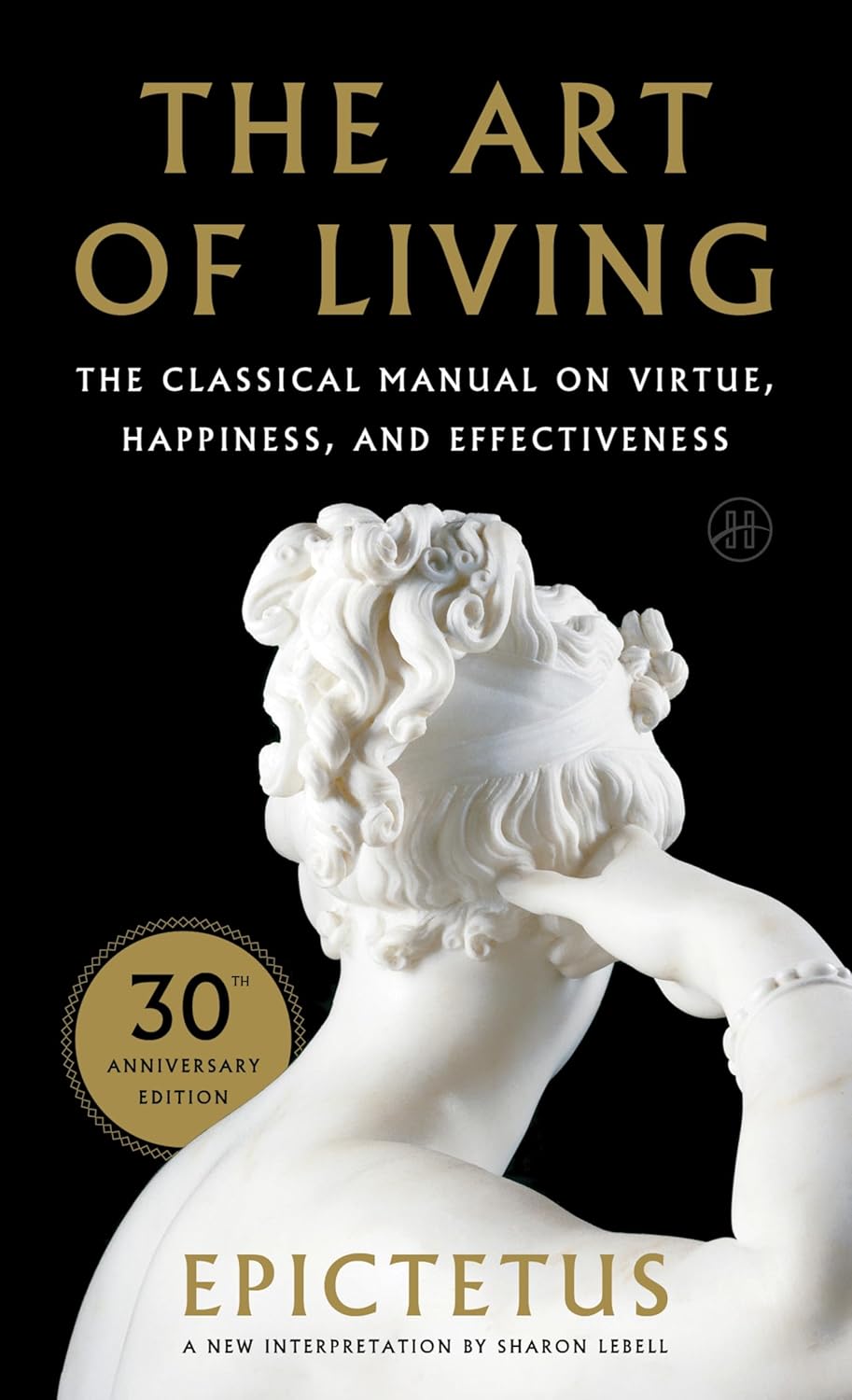
epictetus, the unsung stoic, goes first. he was as unlikely a pole star as they might come: born a slave, a slave with a limp, he carved out 93 instructions, bound them as a book, slapped on a catchy title (the art of living), one that came with a wallop of staying power (we’re still seeking the art), and all these millennia later, we’re still turning its pages.

a marvelous philosopher and musician, a northern californian by the name of sharon lebell, back in 1995 took a crack at translating epictetus anew. her translation stuck, and it’s now considered a classic. i found epi’s wisdoms rather timeless, and in keeping with survival in tumultuous times.

here’s epictetus:

Caretake This Moment

Caretake this moment.
Immerse yourself in its particulars.
Respond to this person, this challenge, this deed.

Quit the evasions.
Stop giving yourself needless trouble.
It is time to really live; to fully inhabit the situation you happen to be in now.
You are not some disinterested bystander.
Exert yourself.

Respect your partnership with providence.
Ask yourself often, How may I perform this particular deed
such that it would be consistent with and acceptable to the divine will?
Heed the answer and get to work.

When your doors are shut and your room is dark you are not alone.
The will of nature is within you as your natural genius is within.
Listen to its importunings.
Follow its directives.

As concerns the art of living, the material is your own life.
No great thing is created suddenly.
There must be time.

Give your best and always be kind.

~ Epictetus ~
(Epictetus: The Art of Living a New Interpretation by Sharon Lebell.)

Arundhati Roy

the next wise soul i bumped into this week was arundhati roy, the booker prize-winning novelist, who grew up and lives still in india; delhi specifically these days. she’s getting plenty of ink of late because her latest work, her first memoir, Mother Mary Comes to Me, has just been published. it’s an exploration of her complex relationship with her “iconic” and “extraordinary” mother, whom she describes as both “my shelter and my storm.”

roy’s 1997 novel, The God of Small Things, is what won her the booker prize for fiction, which in this mercenary worldly equates with that murkily-defined “success,” and its often evil twin, fame. roy, wise woman, wasn’t having it. she was not one to be deluded, or seduced, by such worldly measures. as she tells it she was keenly influenced by an uncle, a beloved uncle, who was one of india’s first rhodes scholars for his work in greek and roman mythology, but gave up his academic pursuits to start a pickle, jam, and curry-powder factory with his mother. and to build balsa-wood model airplanes in his basement.

not surprisingly, someone schooled in the shadow of such an uncle might have strong instincts on the “right” definition of success. and in a conversation with an old friend, arguing that “recognition is not the only barometer of brilliance or human worth,” she noted the friend’s eyebrow arching. skepticism, in full display. so roy did what any cocktail debater might do: she pulled the paper napkin out from under her drink, and a pen from her purse, and began to scribble.

what she wrote amounts to a gospel of success that belongs not on half-soggy paper, but a granite slab somewhere:

To love. To be loved. To never forget your own insignificance. To never get used to the unspeakable violence and the vulgar disparity of life around you. To seek joy in the saddest places. To pursue beauty to its lair. To never simplify what is complicated or complicate what is simple. To respect strength, never power. Above all to watch. To try and understand. To never look away. And never, never to forget.

sometimes i think i’m a broken record, saying over and over—and over—such a few simple truths. 

never get used to the unspeakable violence and vulgar disparity of life around you.

seek joy in the saddest places.

never simplify what is complicated or complicate what is simple.

respect strength, never power.

above all, watch.

never look away.

love.

love.

love.

what inscription might you add to a granite wall of truths?

p.s. i hyperlinked to a marvelous interview with sharon lebell above (i love her whole story, how she was drawn to study philosophy, inspired by a neighbor with more books than she’d ever seen, and how she found those first classes in philosophy “exercises in obfuscation” — might that describe much of the noise here on planet Earth in the year 2025?). here is just one of the grafs from that interview you might find as delicious as i did….

Epictetus drew me in particular because in the mid-1990s he was the unsung Stoic. People had heard of Marcus, of Seneca. No one, except the cognoscenti, had heard of Epictetus or could pronounce his name. I liked his humble background: he wasn’t an emperor or a big cheese. As a former slave with a limp, he was someone who wasn’t expected to have a voice, but he used his voice anyway. He was a relatable everyman trying to figure out best practices for getting through the day.  Since I am female, this mattered a lot. Many philosophers invoke male experience as a stand-in for the universal human experience. Epictetus did not, of course, address females when he taught, but his teachings have an inclusive, of-the-people feel.”

sodden, sodden week

i come this week with sodden heart, afraid for the world we are (no longer becoming but present in the now), fearful of what’s to come. 

once again, a week of news bulletins, and the voices of mass-shooter psychologists filling the airwaves, unfurling the narrative in their cable-news staccato. i didn’t write of the children of annunciation church two weeks past, because i had no words vast enough to reach the depths of it. and i didn’t want to add empty noise.

but a woman i’ve come to love for the purity of her heart, and her inextinguishable humor (mother of five, breast cancer survivor, sister of a brother who died too young, neighbor of annunciation, and one as likely to freely shed tears as to find the hilarity in the everyday) found out that at the moment the first bullets shattered the stained glass of annunciation church, the children in the pews were just beginning to recite psalm 139. 

one of the most ancient prayers, it begins: 

Lord, you have probed me, you know me:

    you know when I sit and stand;
    you understand my thoughts from afar.

You sift through my travels and my rest;
    with all my ways you are familiar.

Even before a word is on my tongue,
    Lord, you know it all.

Behind and before you encircle me
    and rest your hand upon me.

Such knowledge is too wonderful for me,
    far too lofty for me to reach.

and it includes a line i consider one of the most beautiful of all sacred text: 

II
You formed my inmost being;
    you knit me in my mother’s womb.

I praise you, because I am wonderfully made;
    wonderful are your works!
    My very self you know.

My bones are not hidden from you,
When I was being made in secret,
    fashioned in the depths of the earth.[e]

Your eyes saw me unformed;
    in your book all are written down;
    my days were shaped, before one came to be.

III
How precious to me are your designs, O God;
    how vast the sum of them!

Were I to count them, they would outnumber the sands;
    when I complete them, still you are with me.

When you would destroy the wicked, O God,
    the bloodthirsty depart from me!

Your foes who conspire a plot against you
    are exalted in vain.

i can barely get past the line about being knit in my mother’s womb. and it turns out neither could my friend laura. 

she recites it here, a reading worth hearing, as you absorb the words….

then came this wednesday, and with it an assassination and yet another school shooting. and then, thursday, the twenty-fourth anniversary of 9/11. another tragedy, another thread that over the years has brought its tragedy into full view as a woman i have come to love lost her father in that tower that day. and because i know of the layers and layers of tragedy it brought, it is so much more to me now than a terrible day in our national story. as with any violent death, the shrapnel is of the never-ending sort, carnage upon carnage, year after year. flesh shredded, souls shattered, psyches never ever re-settled. 

and so, this poem, with its title so apt: “Try to Praise the Mutilated World.” mutilated we are, all right. 

this poem, it seems, made its way to light in the immediate wake of 9/11 quite by accident, when the poetry editor at the new yorker, who happened to be reviewing an advance copy of the poet’s newest book (at the time) was asked by david remnick, the new yorker’s editor, to find a poem fitting for a special edition of the magazine to be printed and published within days of the tragedy. it was printed on the last page of that issue, as we all scanned the mutilations that hadn’t yet fully revealed themselves. isn’t that always the case with tragedy? the revelations, not unlike a land mine, explode and explode, unseen until the moment of detonation, whenever that comes. 

adam zagajewski, a polish poet who died in 2021, had written the poem with no particular occasion in mind. over the last two dozen years, it’s become his most famous poem, and a poem often pulled from the files to mark this sad, sad day. his choice of the word mutilation is most apt, a word not too too often pulled into text. twinning it with the verb “to praise,” is wholly disturbing. what is there to praise? maybe the work is in the “try.” maybe that’s the instructive, meant to be just beyond our reach. try to praise….

there is work to be done here. there is always work. and maybe if we can remember june’s long days, and the wild strawberries, and the gentle caring of one stranger for another, we can remember why we must weep at the sound of gunshot, and why we must not surrender. this world, mutilated in so many ways, is still a world rife with wonders. 

might we add but a single drop of sweetness to the bitter, bitter taste in our mouths….

Try to Praise the Mutilated World

By Adam Zagajewski

Try to praise the mutilated world.
Remember June’s long days,
and wild strawberries, drops of wine, the dew.
The nettles that methodically overgrow
the abandoned homesteads of exiles.
You must praise the mutilated world.
You watched the stylish yachts and ships;
one of them had a long trip ahead of it,
while salty oblivion awaited others.
You’ve seen the refugees heading nowhere,
you’ve heard the executioners sing joyfully.
You should praise the mutilated world.
Remember the moments when we were together
in a white room and the curtain fluttered.
Return in thought to the concert where music flared.
You gathered acorns in the park in autumn
and leaves eddied over the earth’s scars.
Praise the mutilated world
and the gray feather a thrush lost,
and the gentle light that strays and vanishes
and returns.
(Translated, from the Polish, by Clare Cavanagh.)


a closing thought from jeremiah johnson, co-founder of the Center for New Liberalism, who writes on his substack Infinite Scroll, where he ponders the politics of posting and the dynamics of the social internet: 

As much as you can, resist the hysteria. Refuse to participate in it, refuse to make the polarization worse. The purpose of liberalism is to allow us to disagree with someone without discriminating against them, without harassing them, without killing them. It’s a precious thing, perhaps the most precious thing our civilization has achieved. Every time you break bread in peace with an outsider, every time a Catholic and Protestant shake hands, it’s a miracle. Don’t take it for granted.

what might you find to praise in this mutilated time and this week of mutilation?

crushed by a word

cairn

let me begin by saying i have no business commenting on national affairs. and i confess to brandishing naivete at the highest level. but, in that way i always do come friday mornings, i scan the week and pluck the one particular thing that zings me the most. this week it’s war. it’s the word war. it’s opting for war instead of defense, it’s heralding a drive toward muscularity of the violent sort.

i’ve been studying Torah week after week for a few years now, more than long enough to know this tendency toward warring, toward violence, be it in the name of protection or crushing the opposition, stealing land, or seeking fortune, is as hard-wired into the human species as can be.

and yet…

and yet, there are those who’d see a rock and build it into a cairn, a path marker signaling to the stranger who comes behind, this is the way. this is the way toward a holiness, a holy place.

and there are those who see a rock and stoop to pluck it from the ground and fling it. where it lands, be damned. who or what it shatters, oh well.

i grew up on a street where there were rock flingers and cairn pilers. some of us played in the woods, being careful not to step on the trillium. some rode their bikes through the woods, fast and furious and zooming off logs piled for the purpose of velocity. crushing was part of the point. speed, the aim.

i live now in a country where the department of defense is considering a change of name, department of war. for all i know it’s happened overnight in one of those postings that now serve as executive orders. of all the countless assaults in a nation where rockets red glare once was a line in a patriotic hymn, why is one three-letter word so crushing to me?

because at heart i want to build cairns. i don’t want to be of a nation that only sees force as the way out. i know there’s a God seen as vengeful in the pages of ancient sacred text. but i know there came in time a Godly voice who took to the mountaintop and spoke: blessed are the peacemakers, blessed are the poor in spirit. blessed are the meek, the humble, the merciful.

that’s my tribe. by creed and by blood. but mostly by spirit.

and as the years accrue, as i have deepened into a sacred hollow, found my peace and my bliss there, i cannot fathom nor abide a mindset that heralds its predilection for bombs, for guns, for ballistics.

is there not might in the pen—the aphorism says that there is, that it’s mightier. is there not might in working it out, coming to the table with an understanding that we are but one tiny blue marble in the vastness of space, and we’ve been adorned with more than plenty, and all we need do is work out our share. the lines drawn in the sand are just that: subject to rearranging winds.

we needn’t turn into hermits, each in our own secluded and faraway hut (though it’s an idea that sometimes appeals to me). but we might be a village. a village where my empty cupboard is stocked when i need it by yours. where my faltering gait is held steady by you, because you respond to the impulse as hardwired into us as the rock-flinging one, the one that rushes to pluck the fallen from the sidewalk.

i am wise enough to know that’s not necessarily the dominant instinct, the peacemaking one. but i know there are ways to bolster it. it might be in following the lead of the everyday saints in our midst, the ones who rush to wherever there’s pain, or loss, or lacking. or the ones who quietly, quietly get the job done. it might be deep in the countless pages of ink poured over the millennia, the ones that brilliantly brilliantly illuminate a holier truth. the way toward blessedness is the path of the peacemaker.

i know my weighing in on the matter verges on silly. who am i but one breath in the wilds?

and all i’m saying is i am crushed, crushed, by one three-letter word.

and so very much more…

a choice: what crushed you this week? or what bolstered you?

i happen to have a big brother, his name is john, and he is marking a big birthday today. and so, i pause for a moment here (sometimes he pulls up a chair) to send a boatload of blessings and love. he’s been looking out for me since my beginning….(in this very old photo, he is kindly helping me climb into a little red car; he in red cap, me in the blue….)

this is from one of our ol’ home movies, a famous scene in family lore. i am soon either pushed over or assisted into car, depends on your perspective. since it’s his birthday, let’s give dear john the benefit of the doubt: he’s assisting. (though the next frame has me splat on the ground!)

add this to your constellation of poetries

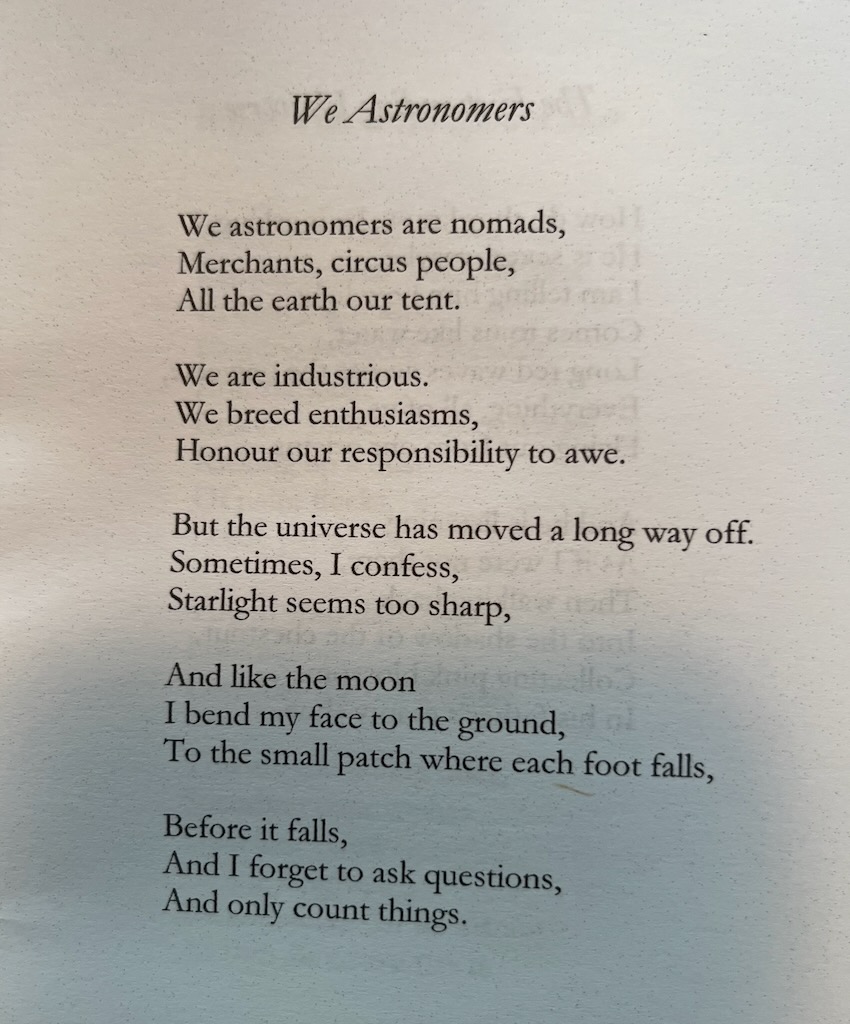
rebecca elson: astronomer + poetess

i’ve been on rooster time for weeks now, though there’s no rooster pecking about the nearby yards. the rooster resides in my little noggin where it cock-a-doodle-doos round about four, and i patiently wait till five. as if the nuns have granted permission and at last i can dash out from under the bedsheets and into the playground that is my kitchen table at that early early hour.

ostensibly i’m up to write, to think, to edit. and i do get to that. i always do. but first i soften into morning turning pages. in other words: i read.

it sometimes seems my mission here is morphing into something more along the lines of slipping poets under your noses; writers, too. any weavers of wonder i happen to happen upon. this week i happened upon an astronomer poet, a brilliant soul who died too soon at 39. she spent her life mesmerized by the heavens, and hers was the gift of reaching into the stars, scooping up a glug of moon, and giving us a taste.

her name was rebecca elson (1960-1999), a canadian-american who at 16 began her studies at smith college, and would go on to earn her PhD from the university of cambridge, somehow fitting in years at radcliffe college and harvard teaching creative writing as well as an expository writing course on science and ethics. at cambridge’s institute of astronomy she was awarded an isaac newton studentship, meaning they paid for her to be there. it’s where she died, amid a field of star embers, i do hope.

her posthumously-published slim volume of poetries and extracts from her notebooks is titled a responsibility to awe (carcanet press, 2001). that title alone is poetry, and tells you all you need to know. in four short words, some might argue, it lays out our holy purpose. our one assignment while we’re here on planet earth, that little orb floating amid a universe of burning flecks of star dust and helter-skelter sky litter (though there’s nothing remotely litter-ish in even one celestial orb, from jupiter to milky way, to the not-yet-named planet L 98-59 f (identified just last month!, the fifth such planet in a splotch of far-off space unpoetically named L 98-59, a system of “remarkably diverse worlds.” little f is orbiting so close to its star, it’s possible liquid water might exist there, the scientists tell us.)

back to rebecca, known to those who loved her as becky. soon as i read the words astronomer and poet coupled in a pair, i was drawn magnet-like to snatch up a copy of her awe-struck works. it’s considered a contemporary classic, in the world of poetries. and not a line of it disappoints. among the pages that left me awe-struck: an ode to discovering zero; another asking what if there were no moon? (her reply: “there would be no months / a still sea / no spring tides / no bright nights / occulations of the stars / no face / no moon songs / terror of eclipse / no place to stand / and watch the Earth rise.”)

a mind as facile and deep as one that imagines darkest night, scans heavens for answers to questions others never even think to ask, is a mind i want to enter. to add my footprints to the paths that have traversed it. as if, in poring over her way of seeing, i too might see more vividly.

that rebecca/becky died too young of a cruel cancer (isn’t every one a cruel one?) added but another element to my quest to know her by her words. her masterwork is considered her six-stanza poem, “antidotes to fear of death.” she begins (as only a star-studier might): “sometimes as an antidote / to fear of death / i eat the stars.”

from there, extracts from her notebooks follow, and we almost watch a mind at work. as she cobbles poetries, we see the words struck out, the finer ones she chose instead. we see, in a swatch titled “origins,” her change of mind, in the line “shaken in the dark soil soul of space.” soil, a richer word (more unexpected) than soul here. we see adjectives get ditched, as she pares and pares her lines. titles of poems are revised. it’s a nimble mind, exercising in the gym, and we are peering through the windows.

two years after elson’s death, the economist, in 2001, named responsibility to awe (her one published poetry volume, though she published 56 scientific papers in her short life) a “book of the year,” writing “with great poignancy, she shows us the world through the eyes of a human being faced by her finite time.”

the bulletin of the american astronomical society, in their roster of supernovae gone dark, described the breadth of elson’s scientific research, her work ranging from “a search for stars in the halo of our own galaxy to regions of rapid star formation halfway across the Universe. She set strong limits on the contribution normal stars could make to the Milky Way’s dark matter halo, using counts from the Hubble Deep Field to rule out a significant stellar component.”

maria popova, who first pointed me to the poet-astronomer, calls her poem “antidotes to fear of death,” a “stunning cosmic salve for our creaturely tremblings of the heart.” she recorded a recitation of it, set against the mournful strains of cello, for her 2020 “universe in verse” extravaganza, popova’s “annual charitable celebration of the science and splendor of nature through poetry.”

elson, whose book now rests beside me, belongs in that rare constellation, a favorite of mine, of those who study the cosmos and, side-by-side the formulae and theorems, see the poetry, and draw it forth: loren eiseley, lewis thomas, robin wall kimmerer. they and their ilk (there are more and more) hold a sacred space on my bookshelves. without them, there are volumes i’d not see, musics i’d not hear.

the back jacket of responsibility to awe says it best, describing elson’s work as “a book of poems and reflections by a scientist for whom poetry was a necessary aspect of her research, crucial to understanding the world and her place in it, even as, having contracted terminal cancer (non-hodgkins lymphoma, diagnosed at 29), she confronted early death.” the text goes on to say that elson was an astronomer whose work took her “to the boundary of the visible and measurable.” isn’t that the space we’re all drawn to, meant to explore? isn’t that where theologians and mystics ply their minds? isn’t that where simple us might wonder too?

in the end, elson, like all who dare to ponder deep beyond the lunar surface, was “undeterred by knowing how little we can know.”

and thus we all now have our one assignment: to search undeterred for what we can. knowing there is majesty in the mystery, and beauty far beyond what we’ve yet glimpsed. our responsibility, of course, is always, always to awe.

where did you stumble into awe this week?

i’ll leave you with a page. . .

have a blessed, awe-filled week….


oh, i promised my dear friend wini i’d share this wonderment she is bringing to town (town being chicago, or the northern environs to be specific). wini is a poet, and she’s worked closely with, and had one of her poems judged “best in class” by the marvelous poet rosemerry wahtola trommer. wini, who makes things happen, invited her and now is inviting all of us for a day of poetries. part workshop, all wonder, it promises to be a day to remember. here are the details, courtesy of wini:

Come experience the gorgeousness of poet, teacher, and storyteller Rosemerry Wahtola Trommer. This event is about more than just poetry; it’s a chance to listen to what is true in your heart and open to “The all of it — the Beauty and Sorrow.

It is beyond lovely to be in-person with Rosemerry, and truly what a treat to sit in community again with like-minded people, and to uplift and celebrate each other’s beauty and light.

I hope you’ll join us. It would be so lovely to see you again.

  • When: Saturday, September 27, 9:00 a.m. – 3:00 p.m. (lunch included)
  • Where: Valley Lo Club, Glenview, IL
  • Details: Three different ticket prices are available.

Buy your ticket here

thank you, wini, for bringing this priceless gift…..

acquiring acquaintances: another name for pen pals

it started because months, or maybe years, ago, i stumbled onto a poem that took my breath away. it was written by a poet i’d not known of, didn’t think i’d ever read. but the poem, titled “Nativity,” stayed with me, a poem that paints the first Christmas scene in strokes and shades that settled deep into my marrow, and forever more are the Christmas i imagine.

it’s a poem that lays the baby Jesus in a rough-sawn barn, the air pungent with animal. “the wind tugging at the shutters.” there is nothing gilded about it. and it was written, i knew right away, by someone at ease with being small, tucked off in a corner keeping watch. it was written, i could tell, by someone whose very veins course with humility, and understood a God who preached the same, a God who asks us to get about the business, the holy business, of loving as we would be loved without noise or bombast or folderol.

the poet’s name is kenneth steven.

it turns out he lives on an isle on the scottish west coast, a place where the wind might tug at shutters. and it turns out he is something of a polymath: a poet, a painter, a children’s book writer, a translator of great works. and, above all, something of a pilgrim, a pilgrim seeking the quiet beauties that punctuate the everyday. he calls them “atoms of delight.”

and he writes of pilgrimage: “the word is often used to describe the journey to a shrine or sanctuary in search of spiritual transformation, which is a meaning i acknowledge. but now pilgrimage has become a much bigger thing for me; it has gone far beyond that rather heavy and medieval sense of going on a journey to visit a holy site. why shouldn’t it be about a walk to a hill loch to listen to the impossibly beautiful singing of red-throated divers? why shouldn’t it be about a child running into the forest in the early morning to find the treasure they dreamed of? these are journeys of the heart, seeking the profoundly precious places where little miracles happen. and why shouldn’t it be about panentheism—the finding of God in all things?”

it’s not hard sometimes to recognize a kindred soul.

what is hard is to imagine finding yourself in conversation with such a kindred someone. but that’s what’s happened. kindness is the thing that opened the door, his kindness. in a world ruled by transaction, where fees are paid and contracts signed for any exchange of goods—be it words or bricks or lumber—kenneth steven lives otherwise.

i found that out not long ago, when, during the editing phase of my next book, i dove into the task called “permissions,” in which for any chunk of text—poetry or prose or lyrics to a song—beyond a certain measure, you must secure permissions from its author. this can be a costly exercise. and it is always one that makes me quiver, wondering what walls i’ll encounter, and what cold-shouldered hubris i might have to tiptoe through.

it’s that poem, “Nativity,” that’s stayed with me all these years. and i’d included the whole of it, eight lines, at the start of an essay that i hope to include in the book.

wondering if i was whistling into the wind, i sent off a proper letter, the digital kind, and shipped it cross the sea. i’d no idea if mr. kenneth steven would ever reply. but, lo and behold, come monday morning, there he was, tucked kindly in my mailbox. and more than generously writing: “of course you are more than welcome to use the poem. i’m sure you’ll mention where you found it.”

and thus, with the stroke of his generous heart, a friendship has unfolded. and a treasure trove of poetries have now brushed through me. and i am richer for this scottish friend who, as a boy, awoke one night at midnight, and hearing a great and ferocious wind, hurriedly dressed and left the house, where he climbed a hill in howling winds, before crossing through a field to reach his favorite tree, where he knew the horse chestnuts would be falling, and he was out to save them, to gather them up. “i felt given a whole world,” he writes in an essay about the midnight escapade. “it was about the autumn and the big winds, and the thrill of running up that long hill and entering the field at last at what felt like the middle of the night.” and the indescribable delight of knowing “that all this treasure was mine.” the treasure: a cloth bag of chestnuts shaken from the limbs, their deep and woody smell, orbs that looked as though they were made of shoe leather.

befriending him, he who writes me every day now, sometimes more than once a day, is magical. is akin to befriending any of the authors from my childhood who’ve long entranced me, drew me into storybook tableaus: tasha tudor; e.b. white; frances hodgson burnett, who wrote the 1911 children’s classic, the secret garden, a book that featured my holy trinity—an orphaned girl, a padlocked garden, and a robin redbreast that finds the key—and once prompted me to fake a fever so i could skip church one sunday to stay at home and turn its pages.

long ago, when i’d be asked if i’d ever want to write a book, i demurred, brushed away the thought. didn’t think i could hold a thought long enough to pen more than a few pages. i didn’t know, though, that the magic of a book comes in all the threads unspooled along the way. threads that carry me to places far and wide, and to souls i’d never otherwise know. but words, like little birds, or prairie seeds, catch on the wind and settle into fertile loam. and we are richer for them.

in much the way, my beloved chairs, through all the words and all the years, have become my dearest treasures.

bless you.

love, bam

have you a penpal in this digital, globe-crossing, email world? someone you’ve not met but who seems a certain friend?

i promised kenneth i would share word of his beautiful meditative podcast, Imagining Things, on the patreon platform. recorded in a studio that seems to be just behind his island home, you can sometimes hear the scottish winds blowing off the atlantic, and a bird or two not far away. (or maybe i’m imagining.) and of course he speaks in a scottish-soaked timbre, and in between reflections he shares poems that will make you hit rewind so you can listen once again, so breathtaking are the lines.

his latest book, one that should be landing on my front stoop within days, is Atlantic: Selected Poems of Faith. but i’m already deep into Atoms of Delight: Ten Pilgrimages in Nature, and Iona: New and Selected Poems.

prodigal professor

i poured myself out of bed minutes before three last night, as i seem to do like an old swiss clock. and in the murk of the dark, as i stumbled toward the bathroom, a thought crept forth reminding me this wasn’t any old middle-of-the-night trip to the bathroom, this was a night in which the professor was in the house. sleeping under this old roof. back in the room where he grew up.

it’s been 13 years, and a whole lot of law school, and bar exams, and zigzagging across the country. there’ve been trips to the ER that scared the behoozies out of me, and weeks that were hard, and hours that were glorious, but the kid with the dream, the kid who with all his heart was hoping to get back to this middle-of-america, one-of-a-kind american city, that happens to be “home,” is back. for at least a year, an equation my mind is still trying to absorb. any time he’s been here in all these years, it’s only been for a day or two, a week at the most. there was always an end date, a date he’d be leaving, and we’d be back to texting and calling. and missing.

he drove 12 hours to get here. he and a car stuffed to the gills with law tomes and professorial garb. and he’s here now, a truth i witnessed just now with my very own eyes as i tiptoed in the dawn’s thin light past the old room where he’s slumbering. i saw the lump in the bed: proof!

truth is, what prompted him most to want to come home, is that he, like the rest of us, had the behoozies shaken out of him by whatever it is that lurked/lurks in my lungs. we all know the grains of time are gliding from one end of the dial to the other. it’s a subtraction, no matter how you cut it. and so we are hellbent on making addition of it. in the best ways possible. in filling the vessel of time with pure unfiltered joy. pushing our hearts to our sleeves. living a life of heart-thumping gratitude. that’s a word so over-spun it’s lost what it means, but when you get to the heart of it, it’s living a life where the thin veil is lifted, the veil between heaven and earth, and the presence of God, of love, is palpable, is visible in the form of the wonders in which we’re immersed: the soft morning sounds, the laughter of knowing each other by heart, the hand reached across a table and squeezed.

so happens the kid got an invite to teach for a year at a law school not too far away. south bend, indiana, a destination i could reach by lunchtime if i decided at 10 in the morning to head there. he’s moving into an old farmhouse tomorrow, a house out in the country, where apples and peaches hang from the limbs in the orchard out back, and raspberries grow fat on the brambles. it’s a genius invention called a sabbatical home, where one professor hopscotches away, leaving behind a fully-furnished, fully-equipped home (straight down to the pioneer-grade hearth in the hoosier kitchen), and another professor on the visitor’s wheel moves in. keeps the place running, the lights on, till the semester ends.

it’s not lost on me how hard he worked to get here, nor the one or two strokes of pure chance that propelled this along. in these months when i’ve whittled my life to those rare few things that truly matter, being the four of us—mom, dad, and two kids, together, rolled in a ball—is at the tippy top of the list. i’ve imagined the hour when i take my last breath, and what i know is that the last faces i want to see in this life are the three of them, circling round me. i’ll promise to haunt them. and, so help me, i’ll do it. the friendliest ghost there ever was.

for now, though, i’m here and i’m kicking. we all are. and we’re holding on. and i am ever so grateful to the university of notre dame for bringing my beautiful beautiful boy, the professor, back home where we all belong.


radon update, for anyone who wondered: we’re not out of the darn woods yet. in fact, the trail is only more twisted. the little disc i bought on the internet, the one reputed to be so accurate, it’s still flashing bright red, a color that signals far more than caution. it’s readings are high, scary high. but the actual professional radon tester is now on the third round of testing, and each time we’ve passed with enough room to breathe. she’s now as curious as i am as to why the disparity in readings, and we’re about to be stuck in the balance of deciding what to do. it’s no small feat to remediate for radon, though i don’t think it entails knocking out the basement out from under us. my date with the pulmonologist has been moved up from november to next month, and maybe they’ll know from looking into my lungs if there’s any sign of radon’s wreaked havoc. once again: uncertainty, the state of existence i dwell in.

that’s the news from here at the house that might be glowing.

love, babs

do you have a prodigal story?

public health announcement: check your darn radon

so, in the latest twist and turn over here in medical odyssey land, a very fine pair of doctors looked into my lungs the other day, and saw yet another odd thing. and the oddest thing is, they don’t think it’s cancer in the other lobe, but they do think it might be radon. RADON! the number one cause of lung cancer in never smokers.

because we were zooming, the doctors were able to see the room behind me, and a room you might note for its decidedly not modern detail. it’s a fairly old house, though not old by historic standards. it’s 1941, which means it’s older than 1970 when homes started to be built with attention to radon, a radioactive gas naturally occurring in the earth. i’ve been breathing here for twenty-two years.

the good doctors wanted to know if we’d ever checked for radon. yes, yes, i quickly answered, sounding just like the girl who sat near the front of the classroom, waving her hand whenever she knew the answer—especially when she knew it faster than everyone else. (i am poking fun at myself here, lest you not see that!) anyway, back to the radon and the trusty detector i got two years ago when i first learned i had mysterious lung cancer. soon as the doctors finished their question, i pointed straight to the detector so the good doctors could see where i’d tucked it. um, not so good, they replied in unison.

the very good doctor explained that radon can only be detected in the first few inches off the ground, and it has to be measured at the lowest point in the house, where the foundation rubs up against ol’ mother earth. that meant the basement. where i’d never measured, even though i’ve been down there an hour a day walking on the treadmill for as long as we’ve lived here, all twenty-two years.

don’t you know that the second we got off the phone i was lickety-split in the basement with that little detector that until then had always flashed green, giving me the falsest assurance that all was well at chez 522.

took but five minutes for that ol’ detector to turn yellow (not so good) then red (get outa here folks!). and as i felt my heart sinking, and my tummy beginning a series of flipflops, i scampered back up the stairs, to report the damage to my fellow breather in this old house.

any minute now the radon detector lady is going to be knocking at the door with her super-duper testing devices. she’ll track our radioactive gas over the weekend, and come back monday to fetch it and read it. she will write up her report and pass it over to the very kind guy who will come to our rescue, apparently boring a hole through to the earth below, sucking out the noxious gas, and blowing it out through the roof. the mechanics of this are unbeknownst to me, but whatever they want, they can do. PVC pipes running through the living room? no problem. please, just save what’s left of my lungs.

in the meantime, i’ve let my doctor know the results of my home-testing detector, one thought to be accurate. and she’s snared me an appointment with the top pulmonologist at U of C, though i can’t get in till november. i’m thinking this stuff they see in my right upper lobe (my left lower is the lobe now missing) might explain why i get so exhausted, and why i sometimes feel pale as a semi-ghost. and why when i try to breathe and talk and walk, one of the three has to go.

so why i am divulging all this before i know more, before i have answers? because my doctor, who i loved at first sight, told me that too few people are aware of the dangers of radon; i know that, for me, it was merely what sounded like an infomercial droning on in between dramas, or noise on the car radio.

but, people, it’s real. and i have the holes in my lung to prove it, it seems.

my doctor, already known as the world pioneer of a particular lung cancer mutation, suggested we team up together for an awareness campaign. i’m all in. and i wasn’t willing to wait for definitive answers. i’m starting with this, and with you, my beloved, breathable chairs.

what i know is this: my lung is missing a part, my breathing doesn’t come easy too often of the time, and my detector is flashing red rings. i don’t want any of that to happen to you.

my doctor says that chicago is especially bad, with higher naturally occurring radon than other places. but she says that too few of us know. too few of us think of it.

here’s what the EPA, that now shaved-to-the-bone federal department charged with saving our air among other things, has to say about radon: “Radon is a radioactive gas that forms naturally when uranium, thorium, or radium, which are radioactive metals break down in rocks, soil and groundwater.”

gets a wee bit more vivid when you turn to plain ol’ google, now powered by AI: “Radon is a naturally occurring radioactive gas, invisible and odorless, produced by the breakdown of uranium in soil, rock, and water. It can seep into buildings, particularly through cracks and openings in foundations, and accumulate indoors, posing a lung cancer risk if inhaled. Testing and mitigation are crucial for managing radon exposure.”

radioactive, invisible, risk, and crucial, are all words that grab my attention. mightily.

it’s never too early to be warned of a risk that might mess with your lungs, so while i wait for vicki the radon detector to knock on the door, i want you to know that if you happen to live in an old house (the kind i’ve always loved best), and it sits on the ground, or worse yet, was plopped in a hole in the ground (the standard for two-story-or-more construction), you might wanna look into your radon.

i’ve no desire to be the poster child for radioactive invisible gases that can eat away at your lungs, but if that’s who i am then so be it. i offer my troubled breathing for your protection. please, please consider it.


and because that’s rather a dark chunk of news to drop on your laps this morning, i bring you one magnificent poem to even things out.

barbara ras

appropriately, it’s titled, “you can’t have it all,” and it’s glorious…..the poet is barbara ras, an american poet, translator, and publisher, born in new bedford, mass., and traveled extensively in central america. she’s been honored with the walt whitman award, and both guggenheim and breadloaf fellowships. her most recent poetry collection is The Blues of Heaven (University of Pittsburgh Press, 2021), preceded by The Last Skin (Penguin Books, 2010), One Hidden Stuff (Penguin Books, 2006), and her first collection Bite Every Sorrow (Louisiana State University Press, 1998). soon as my radioactive gas is dashed from this ol’ house and my edits are all wrapped up, i am diving deep into ras…..

YOU CAN’T HAVE IT ALL
by Barbara Ras

But you can have the fig tree and its fat leaves like clown hands
gloved with green. You can have the touch of a single eleven-year-old finger
on your cheek, waking you at one a.m. to say the hamster is back.
You can have the purr of the cat and the soulful look
of the black dog, the look that says, If I could I would bite
every sorrow until it fled, and when it is August,
you can have August and abundantly so. You can have love,
though often it will be mysterious, like the white foam
that bubbles up at the top of the bean pot over the red kidneys
until you realize foam’s twin is blood.
You can have the skin at the center between a man’s legs,
so solid, so doll-like. You can have the life of the mind,
glowing occasionally in priestly vestments, never admitting pettiness,
never stooping to bribe the sullen guard who’ll tell you
all roads narrow at the border.
You can speak a foreign language, sometimes,
and it can mean something. You can visit the marker on the grave
where your father wept openly. You can’t bring back the dead,
but you can have the words forgive and forget hold hands
as if they meant to spend a lifetime together. And you can be grateful
for makeup, the way it kisses your face, half spice, half amnesia, grateful
for Mozart, his many notes racing one another towards joy, for towels
sucking up the drops on your clean skin, and for deeper thirsts,
for passion fruit, for saliva. You can have the dream,
the dream of Egypt, the horses of Egypt and you riding in the hot sand.
You can have your grandfather sitting on the side of your bed,
at least for a while, you can have clouds and letters, the leaping
of distances, and Indian food with yellow sauce like sunrise.
You can’t count on grace to pick you out of a crowd
but here is your friend to teach you how to high jump,
how to throw yourself over the bar, backwards,
until you learn about love, about sweet surrender,
and here are periwinkles, buses that kneel, farms in the mind
as real as Africa. And when adulthood fails you,
you can still summon the memory of the black swan on the pond
of your childhood, the rye bread with peanut butter and bananas
your grandmother gave you while the rest of the family slept.
There is the voice you can still summon at will, like your mother’s,
it will always whisper, you can’t have it all,
but there is this.


most importantly of this fine day, it’s my beautiful beautiful miracle boy’s 24th birthday. two dozen sumptuous years of loving the kid whose insistence on “seeing the world” prompted us leap outa the nest, and spend a year of thinking sumptuously in yet another one of the current administration’s targeted campuses, the one in cambridge, MA. he is perhaps the sweetest soul on the planet, with the tenderest heart. he’s the first to reach for my hand any time there’s a step to descend or a sidewalk that might be riddled with bumps. his birthing, two dozen years ago on the night just passed, was dicey there for a while, but with every drop of sinew and soul that i had, i did what the doctor ordered and got him delivered to safety, soon nestled as close to my heart as any human can be. happy birthday, teddster. love, love, love, your ol’ mama.

is that not a face you could love till the end of all time?

ode to summer’s drippiest fruit: the tomato

in which we begin with news: ol’ babs signed a book contract yesterday; the book, it so happens, is already written (sorta unfurled swiftly, once i started to type), and already back from being edited (the contract was agreed upon back in may, but these things take time to get shuffled around the publisher’s desk.) and now i’m knee-deep in responding to edits, cranking the dial in an attempt to make it worthy of the paper on which it shall be printed, and the bookshelves on which it might take up real estate. more details shall come but what i can tell you now is that the working title is When Evening Comes: An Urgent Call to Love, and the epigraph pretty much points to the heart of the book:

“When the evening of this life comes,” says St. John of the Cross, “you will be judged on love.” The only question asked about the soul . . . “Have you loved well?”
––Evelyn Underhill, The House of the Soul

in a nutshell, it’s a collection of essays exploring the spiritual awakening and very real tremblings that come with cancer. a subject with which i’ve been living for the last two years. so, while i’m deep in the fine art of toiling over the words that will or won’t wind up in the book, i leave you today with the simple tomato, summer’s drippiest fruit, and my all-star contender for the juiciest mouthful of summer.

it’s summer and living is easy. and beginning to drip down our chins. at least in the tomato aisle, that is. because i am deep in the task laid out above, i am leaving you today with the simple tomato. and pablo neruda’s sumptuous ode…

my recipe is this:

pluck the reddest orb faintly tender to the touch. 

slice, or halve into hemispheres, if you’re the poet neruda.

sprinkle with a dusting of sea salt.

add a grind or three of tellicherry peppercorns.

lean over sink.

employ your top teeth and your jaw.

clamp down.

dribble.

repeat. 


and now for the ode, one of the many neruda wrote in the later chapters of his life. what’s more than charming—and so very wise—is that neruda, the chilean poet and nobel laureate, wrote odes to the simplest things, training a poet’s eye—and thus ours—on the wonders right before us. it’s a lifework worth emulating.

while poking around, i found a marvelous ode to the odester on the website of a chap named huck gutman, who happens to be not only a professor of english at the university of vermont, but the former chief of staff to bernie sanders. who knew?!?!

of pablo neruda, the great chilean poet, huckman writes that he is particularly fond of his late ‘odes’. he goes on:

the good poet pablo

“I love these poems in praise of his socks, his suit, lemons, and other everyday objects.  They speak to me very powerfully about the wonderful world we inhabit.  His aim, as I say in the long introduction to his poem, was to speak to those he lived with about the shared wonder of our world.  He set out to speak not to intellectuals or ‘lovers of poetry,’ but to his neighbors in the small coastal town in northern Chile where he lived.  The language of his odes is simple, the imagery rich but drawn from the experience all humans share. In a century when too frequently poetry seems divorced from the concerns and language of everyday life, Neruda embraced the commonplace and made it uncommon, though still shared. 

 “Neruda’s love of the richness of the world was hard-earned.  He lived a full life, of sorrow and suffering as well as joy and love.  He was acquainted with alienation and oppression, with persecution and exile; he also knew the glories of tomatoes. 

 “One of his close friends was Salvador Allende, the socialist who was elected President of Chile and then overthrown by Chile’s right-wing military (with, tragically, the collusion of the American CIA).  Neruda, already ill with cancer, died shortly after Allende perished in the coup which ended both his presidency and Chilean democracy.” 

Ode to Tomatoes 
by Pablo Neruda

The street
filled with tomatoes,
midday,
summer,
light is
halved
like
a
tomato,
its juice
runs
through the streets.
In December,
unabated,
the tomato
invades
the kitchen,
it enters at lunchtime,
takes
its ease
on countertops,
among glasses,
butter dishes,
blue saltcellars.
It sheds
its own light,
benign majesty.
Unfortunately, we must
murder it:
the knife
sinks
into living flesh,
red
viscera,
a cool
sun,
profound,
inexhaustible,
populates the salads
of Chile,
happily, it is wed
to the clear onion,
and to celebrate the union
we
pour
oil,
essential
child of the olive,
onto its halved hemispheres,
pepper
adds
its fragrance,
salt, its magnetism;
it is the wedding
of the day,
parsley
hoists
its flag,
potatoes
bubble vigorously,
the aroma
of the roast
knocks
at the door,
it’s time!
come on!
and, on
the table, at the midpoint
of summer,
the tomato,
star of earth,
recurrent
and fertile
star,
displays
its convolutions,
its canals,
its remarkable amplitude
and abundance,
no pit,
no husk,
no leaves or thorns,
the tomato offers
its gift
of fiery color
and cool completeness.

which lines made you marvel? what’s making your mouth water these days?

tomato madness: slow-roasted cherries from the vine out back

summer’s height: the magpie edition

alas, the tuxedo-clad bird, decked out in what seems at swift glance a crisp white bib, along with obsidian jacket and tails, is reputed to be a plunderer of shiny baubles, be it crumples of tinfoil or pop tops of aluminum cans. as such, its reputation is nastier than it deserves. it’s thought to be a mischievous thief, a rapscallion of the ornithological world. one who surveys the landscape for the juiciest morsel to scavenge.

in that case, i am showing my magpilian virtues this week. i am, in summer’s height, plucking and gathering, assembling but a brief collection of baubles for your consideration.

lest we let the poor magpie’s reputation flounder down at the bottom of the seed barrel, science leaps to its rescue with news from the university of exeter that, in fact, the ‘pie is not a thief. it’s been exonerated by exeter’s ornithologists, it seems. according to a study published in the journal Animal Cognition, the bird is merely curious, and actually suffers from a malady known as neophobia, fear of new things.

here’s how the ornithologists explain it:

“The Exeter University study found that magpies were actually more cautious and less likely to approach shiny or novel objects, even when food was nearby. In 64 tests, magpies only made contact with shiny objects twice, picking up a ring and immediately discarding it. This behavior suggested they were trying to determine if the rings were food, rather than expressing an attraction to their shine.”

if only shakespeare had known. over and over, the bard plucks at the so-called plunderer.

“And chatt’ring pies in dismal discords sung;”

this, from Henry VI, Part 3 (Act V, Scene 6, Line 45), but one example.

again and again, shakespeare draws on the corvids—the raven, crow, rook, jackdaw, jay, and magpie—luring them into his scripts. and except for the blue jay, they often appear, according to those of the literary cognoscenti, the ones who read the bard closely, “together in ominous flocks to plunder the dead.” the magpie, specifically, was thought to be “possessed by the devil and channeled his evil words while chattering,” an idea traced back especially to king henry who in Henry VI pulls out “chattering pie” as the cutting-est put-down he knows for his archnemesis, the dastardly duke of york.

audubon’s plate 357, american magpie

nearly a quarter century later, j.j. audubon himself attempted to rehabilitate the bird’s roguish reputation, writing in his journal, the birds of america, of the american magpie in plate 357:

“It is extremely shy and vigilant in the vicinity of towns, where it is much molested, but less so in country places, although even there it is readily alarmed. When one pursues it openly, it flits along the walls and hedges, shifts from tree to tree, and at length flies off to a distance. Yet it requires all its vigilance to preserve its life; for, as it destroys the eggs and young of game birds, it is keenly pursued by keepers and sportsmen, so that one might marvel to find it maintaining its ground as a species, and yet it is not apparently diminishing in most parts of the country.” 

all this to say that at this sauna-like point in the summer, when the air outside is thick enough to cut with a butter knife, and the sweltering has us curling up in arboreal shadows, i come bearing plundered fruits. i am the magpie of ill repute, the one before the reputational rescue. (a warning: not all fruits are sweet. some, too bitter for words, though words are one sure means of conveying even a hint of the harshness.)


joanna macy

for the third week in a row, i come bearing tribute to a great woman whose death leaves us once again with a great voice silenced, and a soul we pray lives on. joanna macy, the buddhist ecophilosopher and translator of rilke, died over the weekend at 96. four years earlier, in conversation with krista tippett, on the occasion of her and anita barrows’ then-new translation of rilke’s Letters to a Young Poet, macy had this to say about living in the moment, and opening ourselves to the beautiful, during this moment in history she refers to as the Great Unraveling:

Well, it seems clear that we who are alive now are here for something and witnessing something for our planet that has not happened at any time before. And so we who are alive now and who are called to — who feel called, those of us who feel called to love our world — to love our world has been at the core of every faith tradition, to be grateful for it, to teach ourselves how to see beauty, how to treasure it, how to celebrate, how — if it must disappear, if there’s dying — how to be grateful. Every funeral, every memorial service is one where you give thanks for the beauty of that life or the quality of what — and so there’s a need, some of us feel — I know I do — to what looks like it must disappear, to say, “Thanks, you were beautiful. Thank you, mountains. Thank you, rivers.”

And we’re learning, how do you say goodbye to what is sacred and holy? And that goodbye has got to be — has got to be in deep thanksgiving for having been here, for being part of it. I kind of sound like I’m crying, and I do cry, but I cry from gladness, you know. I’m so glad to recognize each other. You can look in each other’s face, see how beautiful we are. It’s not too late to see that. We don’t want to die not knowing how beautiful this is.


the thing about being a magpie in human form, is that shiny objects—the true kind, the sort that carry weight and depth all on their own, shininess aside—come all but hiding under rocks. i never know where i’ll spy one. might be bound between the covers of a great book, or might simply be scrolling along when i’m stunned in my own tracks. and so it was when i came upon this sumptuous reply to a post from suleika jaouad in her isolation journals recounting her recent breathtaking birthday trip to tunisia, where she spent much time during her childhood summers. someone named kim wrote this, and set me off on my own voyage into the uninvited beauties that populate and punctuate my world:

In my own world, beauty doesn’t knock. She slips in uninvited—smelling faintly of burnt sugar & sandalwood. She hides in the scorch on toast, the chipped bowl I can’t let go of, the silver cutlery I keep polished for no one but me. I light incense for no reason. I turn the spoon the right way in the drawer. I whisper thank you to the kettle like it’s an old friend who stayed.

you never know where poets are poking about…

but, oh, the reverie in my mind as i, too, considered the beauties too many to count…


i’m going to wade into troubled waters here, and there is nothing but tragedy and horror in the words i feel compelled to leave as the lingering ones of the week.

we cannot let ourselves be living in a world that has children too malnourished to let out a whimper, children whose every rib you could count as if an x-ray with the barest of flesh. in a world of abundance, a world where each night alley dumpsters are spilling with portions too overzealous for even a glutton, in a world where essential nutrition can be picked into space-food sticks, or gel packets meant for mass distribution, there is NO godly or ungodly reason for children or infants or mothers or fathers or the ones who’ve borne them to wither away, for flesh and sinew to waste (the medical term for the breaking down of tissue as the body desperately seeks energy), for breathing to be labored because even the muscles of the chest wall have wasted, and the barest of life-sustaining functions are on their last gasp.

read this statement below, issued yesterday by Philippe Lazzarini, the Commissioner-General of the United Nations Relief and Works Agency, and decide what you might do to respond to the cry of this so-broken world:

“People in Gaza are neither dead nor alive, they are walking corpses…. One in every five children is malnourished in Gaza City as cases increase every day. When child malnutrition surges, coping mechanisms fail, access to food & care disappears, famine silently begins to unfold. Most children our teams are seeing are emaciated, weak & at high risk of dying if they don’t get the treatment they urgently need…. Parents are too hungry to care for their children. Those who reach UNRWA clinics don’t have the energy, food, or means to follow medical advice. Families are no longer coping, they are breaking down, unable to survive. Their existence is threatened.”

we cannot look away. what will we do?

light and shadow, in perpetual dance

all you need do is glance toward the sky, eyes skimming over the players on high. sunlight and cumulus. sunlight and cirrus. sunlight and nimbostratus. sunlight and cloud ever in play, in duet, in doh-si-doh of shadow and light. 

there’s a truth being told there, a universal and organizing principle of all creation. on the first day, in the second verse, there was darkness, darkness hovering over the deep. in the third verse, light. God commanded it. and God saw that it was good. 

in our lives, the leitmotif is a given. light will come. shadow will follow. light will come again. 

so it was in my reading this week, when first i tumbled deeply into a luminous shaft, a boreen* of writings from a norwegian bishop and monk, erik varden, whose power as a writer was pointed out to me by a poetry friend whose taste i know to be exquisite and deep. i swiftly realized the bishop’s thinking and writing are everything they were billed to be: rare. exquisite. deep. radiant.

but then, hours later, shadow: i began reading a string of sentences posted from the account of one of my lifeline poets, someone you might call a patron saint of heartbreak and healing, of being more alive than you’ve ever imagined. i started to read, as if it were just another brilliant post: “Whenever I leave this world, whether it’s sixty years from now, I wouldn’t want anyone to say I lost some battle. I’ll be a winner that day.” and then i got to these words: “Andrea Gibson was a winner today. On July 14th, at 4:16AM, Andrea Gibson died…” and my legs stopped moving, and my breath was caught in midstream, and i read and read again. and then my fingers started to tremble, and my knees too. 

andrea gibson

andrea gibson, 49, colorado poet laureate in 2023, queer activist (they/them/their pronouns), who had been diagnosed with stage 4 ovarian cancer in 2021, not long after they’d started a newsletter titled “Things That Don’t Suck,” had many, many times pried open my heart, pulled out the unspoken words and the fears and set them soaring. when i too found out what it is to live with cancer as one of the nouns in my story, i drew andrea into my innermost circle. the ones who know, without you uttering a word, just what you’re thinking, you’re feeling, you’re praying. the ones who some days save you. because even though the cyberworld is distant and intangible, it works in mysterious ways, and someone with whom you’ve never breathed the same air can become someone whose voice you can hear as you flutter to sleep, and whose courage you conjure as they glide you into the sarcophagus that is your biannual CT scan.

light. shadow. light from shadow. shadow deepening light. it’s the dance of the duet, interminably entwined. one is always more beautiful because of the other’s presence, because the duet is perpetual. 

first, this week’s light:

that monk on a bicycle, spotted cycling through the garth just beyond the cloister, is all it took for me to want to whisper my vows, and cycle along. 

as i’m quick to do, i signed up for bishop varden’s website, coram fratribus, a name derived from his episcopal (meaning “of the bishop”) motto, coram fratribus intellexi, latin for “understanding with my brothers.” because the bishop is shepherd of a flock spread across 22,000 square miles in the north of norway, extending beyond the polar circle, he sees his site as a way to speak to the diaspora, to think aloud of those things he finds beautiful or challenging, to gather his flock into a communion of thought. specifically, i felt my heart quicken as i burrowed into the bishop’s collections of writings under the tabs “life illumined,” and the shorter jottings under “notebook,” which he describes thusly: 

“To scribble in the margins of texts is an ancient practice. There are people, these days, who make an academic career out of studying ancient marginalia. Any exercise of reading is fundamentally conversational. The notes collected here are brief responses to impressions received not just through books, but also through encounters, art, music, and films.”

now you see why i, a marginalian of long practice, swoon?

before i get to the paragraph in “life illumined” that drew me deep into thought, let us pause to note why we see that little outline of an owl, in the upper right corner, and hovering over every page of the site. the good bishop describes that choice thusly (emphasis mine from here on in): 

“The emblem of the site is an owl. The owl does not just wing you back to the front page. It has for centuries been a symbol of the monk. Why? Because it watches in the night, when most people sleep; because it is able to see in the dark, discerning movements and patterns, foundations of meaning, where the human eye perceives only vaguely. I am fond of this Italian doggerel:

“Sopra una vecchia quercia
c’era un vecchio gufo:
più sapeva e più taceva,
più taceva e più sapeva.

“In an old oak tree
there sat an old owl:
the more it knew, the silenter it was;
the silenter it was, the more it knew.”

what fluttered into my mailbox the other morning was a page of the monk’s notebook on the nightingale, complete with an ancient poem (from the early middle ages, written by alcuin of york, an adviser to charlemagne) mourning the absence of the wild creature and its delicate throat. a recitation in english and latin, and including a recording of the nightingale’s song. that alone was more than beautiful enough. and then my poking and peeking accelerated, and that’s how, under the “life illumined” tab, i found a break-me-open paragraph on learning to pray.

in an essay focused on the simplicity of jesus’s prayer, and the universal cry of all believers, “lord, teach us to pray,” varden paints the scene of 72 disciples who learned not simply by listening to the words of jesus in prayer, but in witness to his consuming attention to the ways and will of God. varden expounds: 

“Jesus’s teaching on prayer amounted to more than the provision of a text for recitation, that is clear. It was the sight of Jesus praying that made the disciples wish to learn prayer. The words of prayer, which touch our reason and orient our will, point towards the breaking-open of our heart, the transformation of our being as we dare to aspire, even in this life, to ‘become participants of the divine nature’.”

it is the breaking open of the heart, indeed, where the truest serum of our souls pours out. only in the last couple years have i understood that as profoundly as i do now. and, yes, that breaking so often comes with pain, or in pain, or through pain. but i’ve learned now how it truly is the propellent, the force that pushes us deeper into sacred truths than we might otherwise venture. without the breaking open, we might cling to the safer and shallower waters.

the bishop goes on. takes us beyond merely the breaking, and makes the point of its purpose. be it through prayer or through living, the breaking open is the vehicle for those who dare to aspire, in the here and now, to become participants of the divine nature. to inch as close as we can in this lifetime to something akin to sacred. i found a redemptive resonance in that line because at heart, even for the quiet ones among us, we are a people of communion, and there is a heartening, an emboldening, that comes in finding that your purpose, your aim, is not yours alone, but shared in common understanding with at least some of your sisters and brothers.

let us be broken open, then, if it points us toward our holiest purpose. through the break in the clouds, the light comes.

and onto the shadow, the eclipsing shadow…

less than one month shy of her fiftieth birthday, andrea gibson, the poet who boldly faced the coming of her death, who has been amplifying wonder, making us see the unseen, relish the oft-overlooked, took her last breath in the wee hours of monday morning.

i have been relishing her, here and in my everyday, for years now. curiously, her presence in my life spans almost precisely the arc of time in which i’ve been in the company of my own cancer. 

the month before my lung surgery, when the world felt overwhelmingly like the depths of a cave, i wrote of andrea and lines i’d inscribed on my heart: 

thanks to a friend i love with my whole heart, i stumbled on another wise soul with buckets of beauty to grace the world. a poet-activist-performer named andrea gibson, now a cancer survivor whose words might take your breath away. andrea identifies as queer, and uses the pronoun “they;” and they are known for their trademark honesty and bare-naked vulnerability, traits i find irresistible and blessed beyond words. here are just a few lines i couldn’t keep from scribbling down:

when it comes to hearts i want always to be size queen…

i love you because we both showed up to kindness tryouts with notes from the school nurse that said we were too hurt to participate….

when your heart is broken, you plant seeds in the cracks and pray for rain.

before i die, i want to be somebody’s favorite hiding place, the place they can put everything they know they need to survive, every secret, every solitude, every nervous prayer, and be absolutely certain i will keep it safe. i will keep it safe.

andrea gibson

and nearly a year ago, in a musing about scan time’s equal measures of shadow and light, i shared lines that kept me from drowning.

and just a little more than a month ago, i wrote about them and a poem i called more than enough:

yesterday, thursday, this slipped into my mailbox from andrea’s wife, meg:

A couple years ago, Andrea said, “Whenever I leave this world, whether it’s sixty years from now, I wouldn’t want anyone to say I lost some battle. I’ll be a winner that day.”

Whatever beast of emotion bucks or whimpers through you right now, I hope you can hold that line beside it: Andrea didn’t lose anything. If you had been here in our home during the three days of their dying—if you’d seen dozens of friends drift in to help, to say goodbye, to say thank you, to kiss their perfect face, if you’d felt the love that floored every hospice nurse—you would have agreed. Andrea won.

I won’t sugarcoat the fact that they desperately wanted more time on this planet that they loved so much. This planet of squirrels and romance and basketball and moonlight.

But the time they had was significant, prismatic, and wild. It was full of trampolines and mountain ranges, stage lights and pants-peeing laughter. In their words, they “juiced the sun for every holy drop.” One of the last things they said before dying was, “I fucking loved my life.” Their conviction stunned the room.

If Andrea’s life was a poem (and it was), could there be a better last line?

a little backstory, again from meg: 

In 2021, before the diagnosis, Andrea announced they were writing a newsletter, titled Things That Don’t Suck. A few weeks later, we learned they had ovarian cancer.

At first, Andrea said, “What a terrible time to be committed to writing about what doesn’t suck.” Then, almost immediately, they shifted their perspective and said, “What a perfect time.”

And so, this space was born. Part journal, part poetry, part pep talk, part treasure hunt. It became an archive of Andrea’s ability to find beauty in unlikely places, to wring gratitude from even the hardest hours. A museum of how they danced through their diagnosis, always turning their compass toward joy. It fostered a community they deeply loved.

And Andrea wanted all of it to continue.

meg tells us it will. there are reams and reams of unpublished writings, lines scribbled under the silvery light of the moon on those nights when sleep wouldn’t come. pages poured into volumes tucked away. a memoir, unfinished. half-written poems. a documentary coming this fall. 

and meg promises this: 

And there are stories of our life, and of the last months, that I, as their partner, and as a writer, feel both lucky to carry and uniquely able to tell.

As gut-wrenching, impossible, and tear-soaked as this moment is, I’m grateful beyond measure that they were so prolific. Through their books, their reels, their interviews, their albums, Andrea’s incredible mind will reverberate for a century—I’m sure of that.

and so, in the presence of the bishop monk, and the absence of the poet prophet, we shall go on. awake in the light and the shadow. and the shadow that deepens the light. 


in case you’re curious, a bit more about dear bishop varden:

it was only after absorbing so much of his writing that i circled back to learn a bit of his origin story. 

varden was born into a non-practicing lutheran family in a small village in the south of norway, and would go on to earn a doctorate in theology and religious studies at the university of cambridge, and further study in rome. a convert to catholicism at 19, he was drawn to the monastic life, and joined the mount saint bernard abbey, a cistertian monastery, in charnwood forest, in leicestershire, england. he was called to rome to be a professor of syriac language, monastic history, and Christian anthropology. and two years later, returned to the abbey when he was named its eleventh abbot. and, in 2019, pope francis named him bishop of trondheim, a nearly 22,000-square-mile prelature north of the polar circle in norway.

mount saint bernard abbey, varden’s home monastery, is where the only Trappist beer is brewed in all of England, under the name Tynt Meadow English Trappist Ale. beer to the trappists is no earthly distraction. the belgian trappists have a saying: “Beer should be liquid bread, not coloured water.”

and here’s a morsel, this one on the theology of beer, as spoken at the blessing of the monk’s brewery on st. george’s day, 2018. from Dom Erik’s address:

“One of the fascinating things about beer, is that this (potentially) sophisticated beverage is made of the simplest ingredients. By being refined to manifest their choicest qualities; by being brought together in a favourable environment; by mingling their properties and so revealing fresh potential; by being carefully stored and matured, the humble malt, hops, yeast, and water are spirit-filled and bring forth something new, something nurturing and good, that brings joy to those who share it. Considered in this perspective, the brewery provides us with a parable for our monastic life, with the Lord as virtuoso brewmaster. The Scriptures favour wine as an image of the Gospel – but that is culturally conditioned; beer, it seems to me, is a much neglected theological symbol.” 

*boreen, you might recall from a few weeks ago, is the old irish word for what we might call a pothole, a rabbit’s hole, but in ireland, an island etched with cowpaths, it’s a word derived from a meandering side path when the cow decides to venture off on her own….if language is a cumulative patchwork, boreen is a word now in my lexicon….

you’ll find a veritable font of andrea’s spoken word poems, and writings at their website, andrea gibson.org. spend some good time there.

where did you find light and shadow this week?