the welcome-to-summer sign i used to tape to the back door, welcoming home from the school year two dearly sweet boys
used to be i’d know it was summer because the cascade of papers to sign suddenly ceased, and the calendar miraculously uncluttered, and boys in the morning no longer groaned. used to be i’d know it was summer cuz something sparkled in the air, and i’d wait at the sidewalk outside the school with all the other parental units, and i’d replay some version of the last-day-of-school from my own long-ago days. i’d do not unlike my own mama had done: make grilled cheese, a decidedly not-packable school lunch; head straight to the library to sign up for summer reading; clang the bell on my bicycle to make sure it was ready for the rides just ahead (the ones down our dead-end lane that wiggled through woods and that was, in effect, our playground).
but this week it came to me only vaguely while downward dog in the garden (pulling some weed, not practicing zen). it was noontime-ish, and the street was more filled with chatter than is usual. i saw a few kids stream by sans backpacks, with that face of liberation that’s fairly unmistakable. and then, before i had a chance to ask, the adorable just-post-first-grader across the street came barreling down her driveway, arms waving like windmills, and she announced to anyone listening (mostly to the upside down me) that it was the last day, and she was going to get ice cream!
so, welcome to summer.
back in 2008, when my boys were six and fourteen, i wrote here on the chair something of a summer manifesto, or maybe simply a wish list. as is my wont, i spelled out the few things i hoped to commit to, the ways i intended to savor the season of indolence, of plenitude, of que sera sera.
my list for “slathering yourself in summerness,” wasn’t too long, and these were a few of the things i promised to make of my summer: go to bed with all windows wide open. wear summer pjs. fall asleep to nightsounds.
wake up, start all over again. only scramble it up. do something brand-new each day. something you always wanted to do, but couldn’t find the time for back in the days when lost mittens had to be located, and snowboots mucked up the hall.
the world back then didn’t scare me as much as it does now (or maybe i just don’t remember), so maybe it matters even more now to squeeze every drop of summerness, of savoring, from the rind of the day. “these molecules of the ordinary,” as cookbook writer nicole taylor recently put it (in this new york times article on cooking for juneteenth), can be, beg to be, made into moments of unbridled joy. to be lifted from the humdrum and unnoticed, into the sacramental.
i think of my friend mary ellen, no longer here, who so savored summer, who strapped on her roller blades, cut back her work days, and jollied her way from june to september. she was prescient and we didn’t know it. her summers were numbered; each one counted more than we knew.
i seem to have flung myself into summer, into this reprieve post-book-editing, by playing in the dirt. i’m outside all day every day when there’s sunshine, and even for bits when it rains. by the time i waddle to the backdoor, my clogs caked in mud, my arms scraped and fingers torn from whatever obstacle the garden’s presented, i all but need a tub to climb into, one right at the door.
i find healing out there where the bumblebees buzz, and the stems and the leaves reach for the sky. i’m away from the news, and i can pretend the world begins and ends where my ferns do their unfurling, and the cardinal belts out his evensong arias.
but even my sanctuary isn’t without its assaults. yesterday, i found out there will soon be a six-foot solid cedar fence cutting off the light and the breeze on one side of our yard, the side that happens to run along our screened-in porch, where the light and the breeze have always been essential to the magic. i tried hard not to cry. but then i came in the house and the full-throttle sting hit me: no more dance of the sun beams just before dusk, as the dollops of pure golden light all but ignite where they land. no more taking in the sweep of green as far as my eye can see. i suppose i’ll dig a new garden, hard along the fence line. and i’ll fill it with plants that delight in deep shadow. the woods are filled with them, at least the parts where the sun doesn’t find its way in. i’ve known for years it was coming, so i tried to be brave. but deep down inside it hasn’t stopped throbbing.
i was going to make a new list here, one filled with summer promises. but maybe i’ll keep it to this, the simplest version of prayer: dear maker of sunlight and breeze, help me to savor, every succulent drop of the indolence and plenitude synonymous with this one holy summer…..
what will you promise yourself to do with this one incoming summer?
mothering, a verb that has always spoken to me for its broad application, its attachment to acts and not to a particular gender, doubles its duty as a descriptive of those acts as life-giving, as loving. now attach it to earth, allow it to describe the essence of so much of creation––and our place in it––and the whole shebang snaps into sharp focus: mothering earth embraces us, wraps us in her proverbial arms, allows us to rest our weary head against her bosom, her heartbeat. she holds us till the shaking ceases. she brushes the nettles from our hair, sets us back on our steadying way.
it’s a notion i found in pablo neruda’s “i ask for silence,” a poem that speaks to the stillness––the oasis from sound, from stirring––my soul is seeking.
. . . But because I ask for silence, don’t think I’m going to die. The opposite is true; it happens I am going to live.
To be, and to go on being.
I will not be, however, if inside me, the crop does not keep sprouting, the shoots first, breaking through the earth to reach the light; but the mothering earth is dark, and, deep inside me, I am dark. I am a well in the water of which the night leaves behind stars and goes on alone across fields.
It’s a question of having lived so much that I want to live a bit more.
Pablo Neruda, an excerpt of “I Ask for Silence” from I Explain a Few Things: Selected Poems
and, as neruda knows, so my unspokenness knows.
i find myself pulled into the garden, and soon down to my knees. muddy knees, grass-stained knees, be damned. i go down to the lilliputian place. where a dragonfly the color of limes is hovering; his shadow eclipsing the fat bud of a peony who might think the hoverer an alien from outer cosmos. where worms wriggle, endlessly defying geometries; i sense their delights, the deliciousness they find in the loam i’ve kneaded and kneaded over the years.
it is the apothecary without pills, mothering earth and her patches of garden. its potions are in the perfumes of the peony, the fading scent of the lilac now past bloom, past seduction. mothering earth’s elixirs are the stillness so still you can tell when the breeze barely moves. it’s the air, unfiltered. chilled or warmed by rivers of winds surging around the marble that’s ours, the blue marble. its dramas––ones that delight, ones that stir sorrow––are the openings and closings, the risings and fallings, of all that makes its home there, a cast not limited to botanicals. a cast of birds and butterflies, those wiggly worms and the many-appendaged crawlers (some call them creepy, i do not).
i retreat to mothering earth when the world all around and within gets too vicious, too ragged, too worn. my preferred posture is bent, and down low. i want to put my ear to the thrum of the grass growing and the roots deepening. i want to catch the morning light as it first drapes across the fronds of my ferns now at full mast.
i’ve been wobbling for weeks now with a dizzying, one that comes with heart pounding and queasiness in waves that feel pacific-sized. i’m convinced it’s the aftermath of christmastime’s covid, the red-ringed virus that finally caught up with me, never-minding my double masks and double boosters. it’s slowing me down, some days more than others. and being out where the breeze blows, and the sun shines in unbroken beams, it steadies me. long as i don’t do backbends or bows from the waist.
once a child of make-believe times and places, i retreat to that familiar fiefdom even now. even now with my own children long past making believe, long past six-feet, if anyone’s measuring. all week i’ve been building a gurgling fountain, a simple one, made from a moss-covered planter, filled with river rocks i’ve gathered from magical places over the years. in my imagination i’m building not simply a gurgler but a cavalcade of sound that will soothe me, cast its magical spell upon all who catch the music of water plashing on rocks. i am building a way station for birds and chipmunks, a place for even the hosta to dip her thirsty leaves. and i can get determined, refuse to give up, refuse to order a ready-made one from a catalog. determined is sometimes a polite way, a watered-down way, of saying i’m a wee bit obsessed. i can hear the gurgle in my mind’s ear, and despite a shorted-out extension cord, and a pump that gave up the ghost, i’ve not yet abandoned my plot. i’ll get to gurgling before the sun sets to signal shabbat this evening.
it’s all the perfect balm after weeks of editing, weeks of being torn by the news. i pay no attention to news when i’m flesh to flesh with mothering earth. my news of the day is which bloom is on the brink, and which is waning. the choreography of this mothering plot, it’s ceaseless.
sometimes we all need to be mothered. mothering earth mothers me.
and i bask in her stillness.
where have you found your stillness, your healing balms, of late?
well, here’s a first for the ol’ chair: a talkie, in the old vernacular. in other words, not just a picture but a gurgling picture……
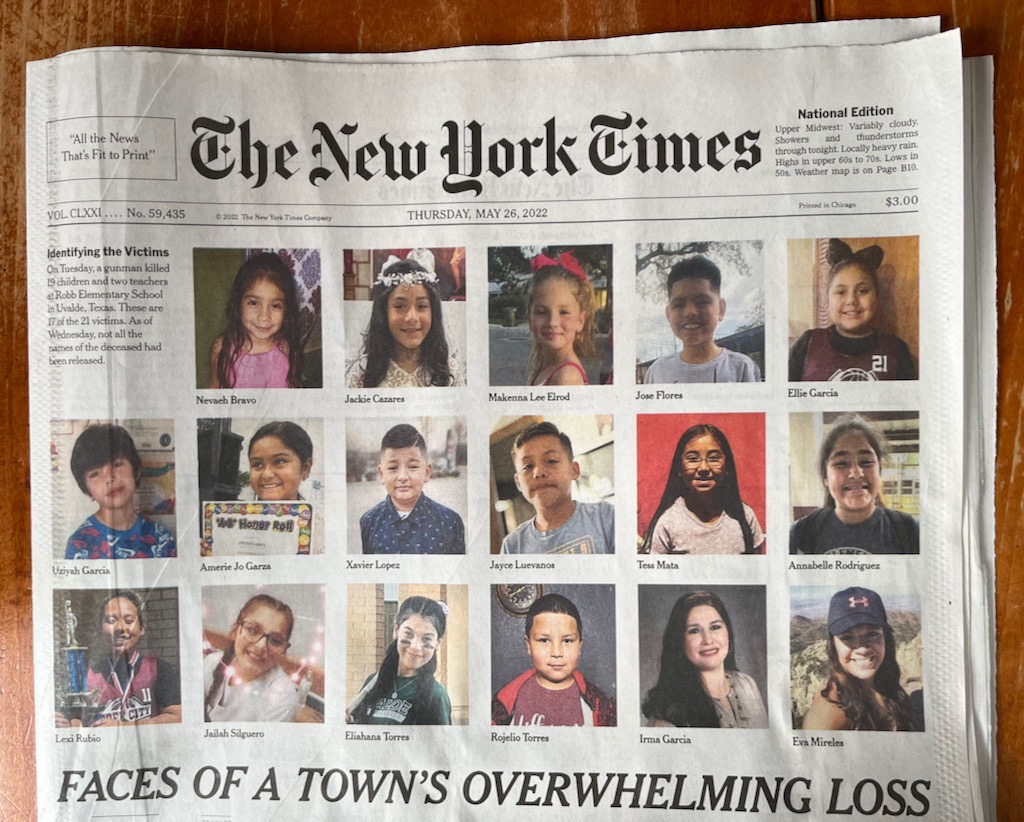
you might want to look away. but the horrors of the last two weeks demand we do more than pause and pick right up again. this week, the place was a school in a small town in texas, a fourth-grade classroom the site of the worst of it. ten days before, it was a supermarket in buffalo, new york.
ever since my second or third day on the job at the chicago tribune, i’ve been writing obits, those few short sentences or maybe a handful of paragraphs in which we try to capture the essence of who someone was. it’s a record for the ages, ones that used to be pasted into the pages of a family album, or carefully scissored out of the paper and tucked in the page of a bedside book or a bible. or a wallet. the ones in wallets always choked me up the most, when years later someone would pull out from their purse or their back pocket a worn leather billfold, and know right where to reach for the newspaper clipping of someone they’d loved. sometimes you found out the words you wrote in a newspaper stuck around for a very long while.
i’m afraid the someones who can change things are looking the other way, too many of them. and i won’t make even a ripple sitting here tapping out postage-stamp-sized obits for each of the 32 souls now departed, now torn from the ones they so dearly loved, the ones they would have clung to, if given half a chance. but to read of the simple quotidian joys, to assemble the notes of how and for what they were remembered, was and is a devotional gesture. it’s a genuflection in short sentences, a way to begin to absorb the hell we have wrought here.
no one should have to worry that running into the store for strawberries for shortcake might be our very last act. or that hiding in the closet of your fourth-grade classroom will be the place where you take your very last breath. something is wrong here. very very very very wrong. something is twisted and cruel and the drip-drip-drip of it all is anesthetizing, a toxic numbing takes hold. you can start to not notice.
the postage-size stories that follow are what i could find on each of the 32 victims, those from uvalde and those from the massacre in buffalo. it’s a long list, and you might not make it to the end. i’m writing it anyway. because to tell even a wisp of their stories is to begin to make real the horror of all that’s lost. their stories are utterly ordinary, a fourth-grader who swooned for a second baseman, a grandpa who ran in a store for a birthday cake.
yesterday’s news snapped into the sharpest focus the dimensions of grief we can’t grasp: the husband of one of the two uvalde teachers died of a massive heart attack in the wake of his wife’s murder. they’d been together for 24 years; high school sweethearts who married, and had four children. that’s what grief can do.
here are their stories, first the children and teachers of texas, and on to buffalo and the ten who died there…
In which, in a posture of reverence, we pause in silence to first hold up each of the 22 blessed ones who died in the massacre at Robb Elementary School in Uvalde, Texas….
Here’s the little we know:
Irma Garcia, 48, a fourth-grade teacher at Robb Elementary, a mother of four, had been married to her high school sweetheart, Joe, for 24 years. Irma died in the slaughter inside the school. Joe died of a fatal heart attack on Thursday. Their four children, two sons and two daughters, range in age from 12 to 23.
Eva Mireles, 44, a fourth-grade teacher who co-taught with Irma Garcia. Her daughter Adalynn posted this on Twitter on Wednesday: “Mom, you are a hero. I keep telling myself that this isn’t real. I just want to hear your voice,” the tribute read. “I want to thank you mom, for being such an inspiration to me. I will forever be so proud to be your daughter. My sweet mommy, I will see you again.”
Amerie Jo Garza had just turned 10. She tried to use her cell phone to call police during the shooting. Her father, Angel Garza, is a medical aide who rushed to the school, and he told this story to CNN:
After arriving at the scene, he saw a girl covered in blood who told him that someone had shot her best friend. When Garza asked who her best friend was, the girl replied, “Amerie.” His daughter.
“I just want people to know she died trying to save her classmates,” said Amerie’s father. “She just wanted to save everyone.”
Xavier Lopez, who was 10, had just been lauded at the school’s honor roll ceremony. He was funny, never serious, and he had a smile….a smile, his mother said, she would “never forget.”
Uziah Garcia, also 10, and “full of life.” He loved anything with wheels. “The sweetest boy that I’ve ever known,” said Uziah’s grandfather.
Jose Flores Jr., 10, loved baseball, video games, and was “an amazing big brother,” especially to his baby brother. “He would just be like my little shadow,” Jose’s mother, Cynthia, said. “He would just be helping me with the baby. He had a thing with babies, like my friends’ babies. He just had a thing with babies. He was always nice.” His sister, Endrea, was in another fourth-grade classroom. She survived.
Lexi Rubio, 10, made the All-A honor roll. She loved baseball and basketball and wanted to be a lawyer when she grew up. “Please let the world know we miss our baby,” said her father through tears. “All I can hope is that she’s just not a number. This is enough. No one else needs to go through this.”
Tess Marie Mata, 10, had been saving her money to go to Disney World, according to her sister, Faith. She loved Ariana Grande, TikTok dances, and the Houston Astros, especially second baseman José Altuve.
Nevaeh Alyssa Bravo was 10. She put a smile on everyone’s face. Navaeh is heaven backwards.
Eliana ‘Ellie’ Garcia was 9, just about to turn 10. She dreamed of becoming a teacher, but in fourth grade she loved the movie “Encanto,” cheerleading, and basketball. She was the second oldest of five girls in her family.
Annabell Guadalupe Rodriguez was 10. She died in the same classroom as her cousin, Jacklyn Jaylen Cazares.
Jacklyn Jaylen Cazares, “a little firecracker,” according to her father Jacinto, was “full of love and full of life. She would do anything for anybody.” She was 9, and died in the hospital almost three hours after the shooting.
Eliahana ‘Elijah’ Cruz Torres was 10. “Our baby gained her wings,” said her aunt Leandra Vera.
Jailah Nicole Silguero was remembered as “a bespectacled 10-year-old,” whose mother Veronica Luevanos posted updates to Facebook all through Tuesday night into the wee hours of Wednesday. She’d started posting in the hours when she didn’t know what had happened to her daughter, and she was begging for answers. When Jailah’s mother finally found out, she wrote: “I’m not ready for this,” with an image of a broken heart, and a link to Jailah’s obituary. Just before 3 a.m., Veronica wrote: “I’m so heart broken.” Later she added: “My baby you didn’t deserve this neither did your classmates. R.I.P my beautiful angel.”
Jayce Luevanos, 10, whose cousin Jailah (above) was also killed, lived with his grandfather, and every morning Jayce made his grandpa a pot of coffee.
Miranda Mathis was 11, and very smart. Her best friend was her brother, who was in another classroom when the gunfire broke out in Miranda’s classroom.
Makenna Lee Elrod was 10. She loved to dance and sing and she “made friends everywhere she went.” She was beautiful, smart, and funny, and her smile “would light up a room.”
Layla Salazar, 10, won six blue ribbons at her school’s field day. Her father, Vincent Salazar, shared a video of his daughter on Facebook; he captioned the video: “Run with the angels baby!”
Alithia Ramirez had just turned 10. When her parents welcomed Beto O’Rourke into their home in the hours after the shooting, birthday balloons and her artwork were still taped to the walls. “They want the world to know what a beautiful, talented, happy girl she was,” O’Rourke wrote.
Maite Rodriguez’s age is unknown at this time, though there is a photo of her proudly holding her honor roll certificate in front of the school banner. Her mom’s cousin, Raquel Silva, wrote on Facebook, on behalf of Maite’s mother, Ana: “It is with a heavy heart I come on here on behalf of my cousin Ana who lost her sweet baby girl in yesterday’s senseless shooting. Our hearts are shattered.”
Rojelio Torres, who was 10, was not identified nor his family notified till almost 12 hours after the shooting. His aunt Precious Perez told a local TV station: “We are devastated and heartbroken. Rojer was a very intelligent, hard-working and helpful person. He will be missed and never forgotten.”
and, just 10 days before, 10 more lives gunned down in the aisles of a grocery store.
Pearl Young, 77, a grandmother to eight, spent every Saturday morning volunteering at a food pantry run by her church. A “strict but loving” mother, she still worked as a high school substitute teacher. She was, her son Damon Young said, “full of joy. She just loved life, and she loved the church.” She’d stopped at the Tops Friendly Markets after going out to breakfast. Her son was going to pick her up, but suddenly her text messages stopped, and Damon’s phone filled instead with news alerts about the hell unfolding inside the store.
Ruth Whitfield, 86, was “a blessing for all those who knew her,” said her son, the retired Buffalo fire commissioner, Garnell Whitfield. Ruth had stopped at the Tops after caring all day for her husband of 68 years in the nursing home where he now resides. She was the mother of four, and doted on her family––especially her husband, constantly cutting his hair, ironing his clothes, dressing him and shaving him. “There’s very few days that she did not spend time with him attending to him,” her son said. “She was his angel.”
Andre Mackniel, 53, went to the Tops to get a birthday cake for his son. He was “selfless and generous,” a loving father and grandfather who used “to check in on everyone.” On Facebook, Mackneil’s fiancee wrote this: “Today my baby was born but today my soul mate was taken. How do I tell my son his daddy’s not coming home? How do I as a mother make it ok? Someone please tell me because I really don’t know,” she wrote.
Katherine ‘Kat’ Massey, 72, “the glue” of her very close family, had stopped at the Tops and asked to be picked up in 45 minutes. When her brother came by to get her, he saw police putting up crime tape. She sometimes wrote for the local newspaper, and one of the topics she was most concerned about: guns.
Celestine Chaney, 65, was described by her son as a “survivor,” who twice had survived brain aneurysms. Her son, Wayne Jones, said that when he was 12, he was twice called out of school to rush to the hospital, where he was told his mother wouldn’t make it through the day. His grandmother, he says, made him “go to the foot of the bed and pray.” She later survived breast cancer, but she didn’t make it out of the grocery store. “She was a beautiful person, a spunky, independent woman,” Jones said of his mom. “The life of the party, just a joy to be around.”
Margus D. Morrison, 52, was a school bus aide, a lovable guy who liked to joke. His younger brother Frederick, who said the two were “tight like best friends,” couldn’t find many words in the wake of the killing. But he did say this: “It hurts me so much right now because I wasn’t expecting to lose him.”
Heyward Patterson, 67, was at the Tops because he often drove members of his church to the store, helping them load their groceries, and then taking them home. “That’s what he did all the time,” his cousin Deborah Patterson said. “That’s what he loved to do.” He was gentlemanly, and sprightly, a “real-life, down-to-earth man.” He was a deacon in his church, and loved to sing. One relative compared him to Smokey Robinson ––“only better.”
Aaron Salter Jr., 55, a retired Buffalo police officer, was described by the Buffalo Police Commissioner as “a hero in our eyes.” He was the security guard on duty at the Tops, and he tried to take down the gunman, to spare any lives. “I’m pretty sure he saved some lives,” the commissioner said.
Roberta Drury, 32, the youngest of four siblings, had moved from Syracuse to Buffalo to help her older brother who was undergoing treatment for leukemia, and to help care for his children. Once her brother had gotten through the treatment, she’d decided to stay on and help him rehab an old bar he had bought. The Washington Post reported that as an African American child adopted at 18 months into a White family, Roberta (known as Robbie) was “no stranger to racism.” In her family, “race never mattered,” said her sister, Amanda. “So this is just ugly on a level that as a family we can barely wrap our heads around.”
Geraldine Talley, 62, was described as “the sweetest.” An avid baker, her Facebook page was filled with desserts she made for the people she loved: cream cheese apple cinnamon bread pudding, peanut butter pie, strawberry filled cupcakes. She had gone to the Tops with her fiance to get sandwich meat for a picnic down by the waterfront, and she sent him to grab a certain tea. That’s when the shooting started. According to family members, her fiance started calling her name, but didn’t see her, and then hid inside a freezer. The gunman shot the door off the freezer, but the fiance survived, and Geraldine died in the store.
may their memories be a blessing, and may their names and their stories not soon fade into the cavernous silence….
whilst i take a necessary romp through the copy editing room––chasing errant commas, untangling knotted sentences from my book in the making––i bring you a lexicographic exercise all your own, a few old words to haul from the crypts of time….
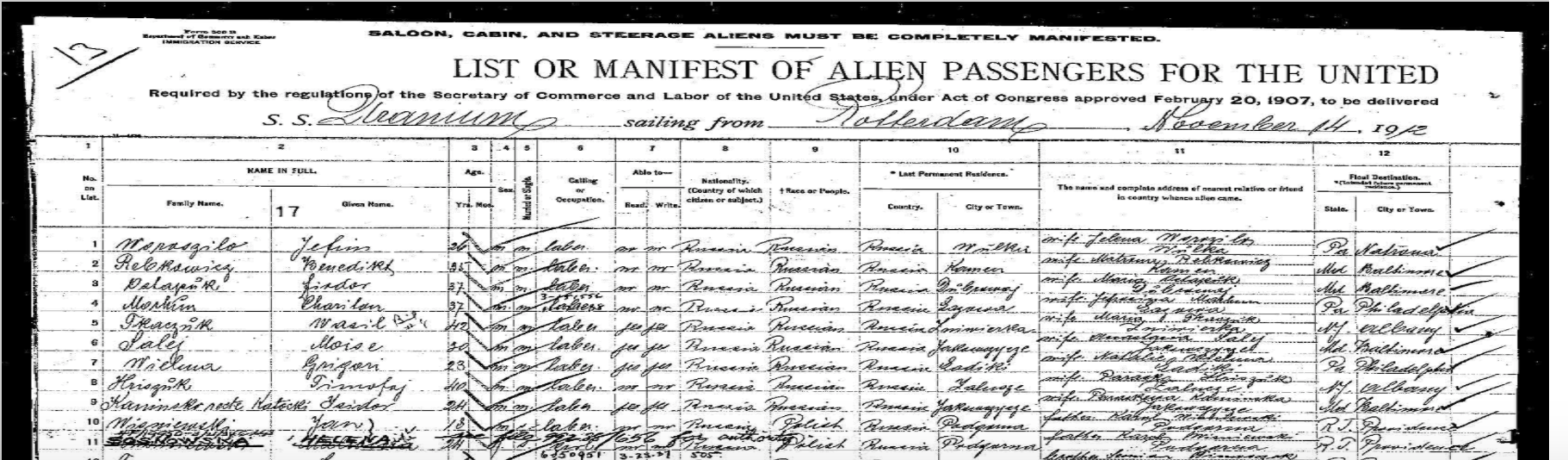
traipsing through the big apple for the last deliriously heavenly string of days, i found myself in the tenement museum on the lower east side, just a hop and a skip from 53 suffolk street, the very tenement where my children’s great grandfather settled in and built a life—running a bakery and fathering four children of his own, the baby of whom was my father-in-law who grew up to be a newspaper editor and publisher on the jersey shore and the father of my beloved. isidore kaminski, once a wheelmaker in the russian czar’s army, found his way to delancey and suffolk streets upon arrival to these shores via the SS Uranium, direct from the port of rotterdam, where he was leaving behind the austro-polish-russian city of ostrołęka—and a young wife he’d soon beckon to america.
the corner of delancey and suffolk streets, lower east side
while awaiting our illustrious tour guide who would provide a peek inside grandpa izzie’s early days, and the squalid life crammed inside three shotgun rooms measuring all of barely 300 square feet, we idled in the decidedly excellent gift shop. among the many many tchotchkes that beguilingly glimmered to catch my eye, the one i grabbed was none other than the little book of lost words: collywobbles, snollygosters, and 86 other surprisingly useful terms worth resurrecting, by a fellow named joe gillard, the creator of “history hustle,” an online history publication for the digital age.
it is so packed with deliciousness (of a literary ilk) it nearly made me drool (in a purely literary way). and so whilst i deep dive into the copy edits that just landed on my desk, for this latest book of mine in the making, i thought i’d let you frolic in a wordly romp all your own.
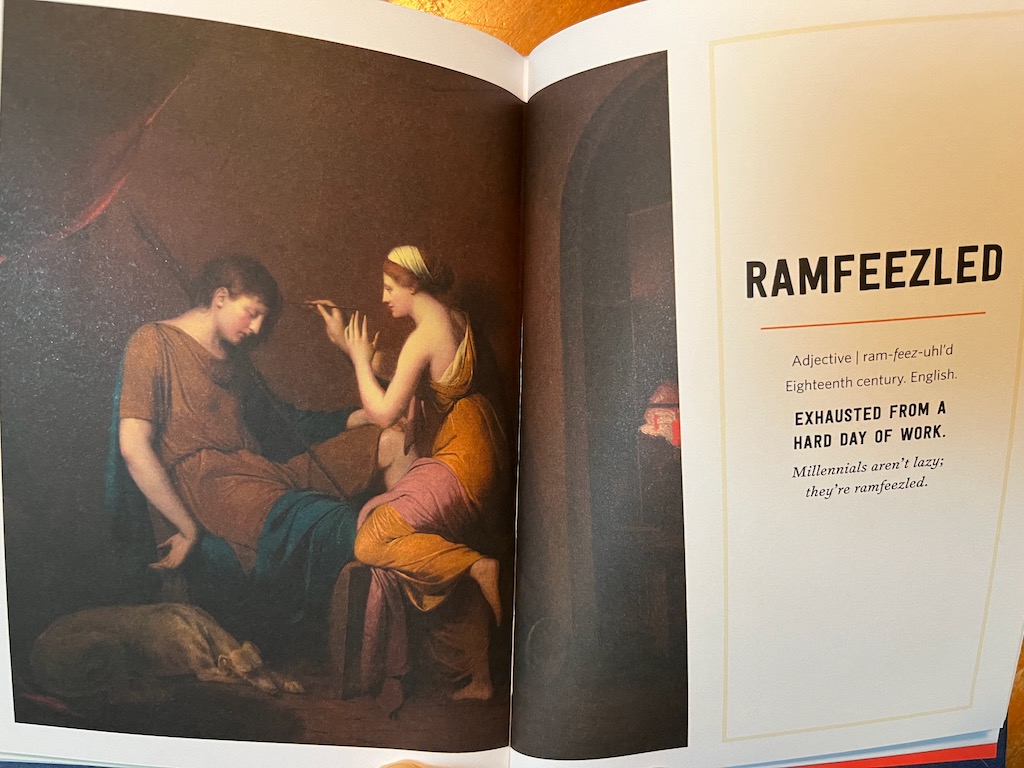
ramfeezled: exhausted from a hard day’s work
herewith a short list of words we must work to resurrect, to bring back into daily conversation at dinner tables, water coolers, and playlots all across the land. they run from A (absquatulate: to run off with someone in a hurry; to abscond) to W (wamblecropt: severe digestive discomfort). and i hereby pledge to bring you the best of the bumper crop, the ones sure to whirl off your lips or are so dreamily defined as to demand daily exercise.
so, settle in, grab your mugs, and repeat after me:
akrasia: (ancient greek) the act of knowing you shouldn’t be doing something, but doing it anyway. deliberately acting against good judgment.
amphigory: (19th-century english) a piece of writing that appears to have meaning but is really just foolish nonsense. (i know nothing about amphigory. ahem.)
betweenity: (18th-century english) being in the middle, or between things.
collywobbles: (19th-century english) stomach pain or sickness from nervous anxiety. (can’t imagine.)
flapdoodle: (again, 19th-century english) foolish or blatantly false ideas or words. (we seem to be living through an outbreak.)
honeyfuggle: (19th-century english. dialect) to compliment or flatter someone to get something you want. (who would do such a thing?!)
mayhap: (16th-century english) perhaps, possibly.
ninnyhammer: (16th-century english) a fool.
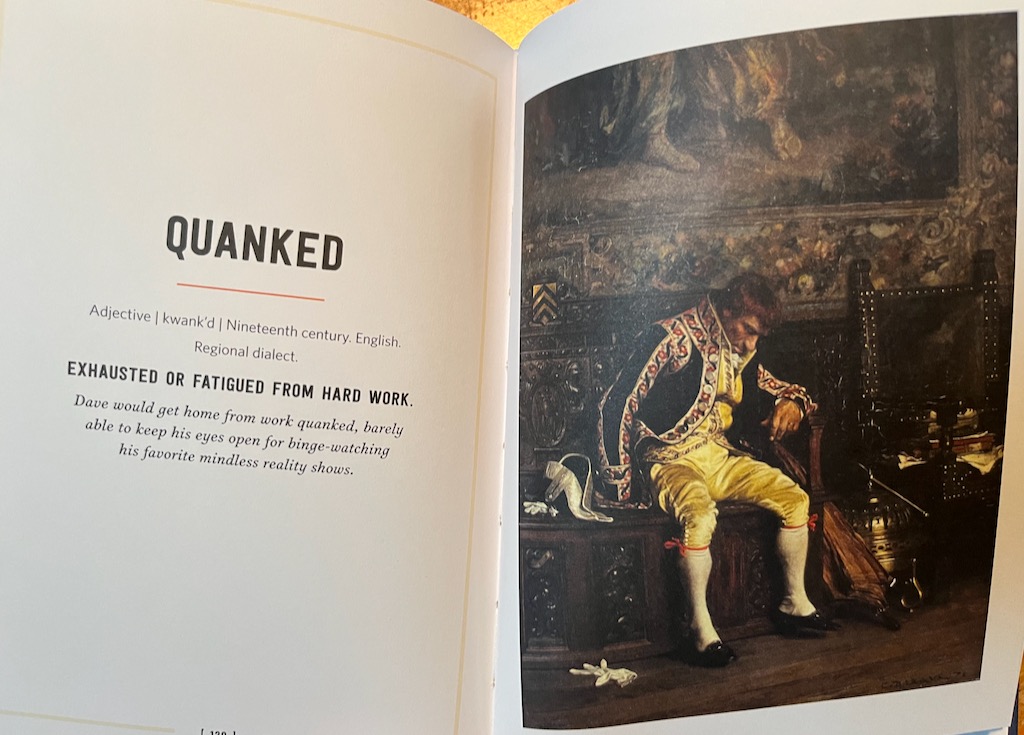
quanked: exhausted or fatigued from hard work
prickmedainty: (16th-century english. dialect) an overly nice person.
quafftide: (16th-century english) the time for drinking alcohol. (i admit to being a fool for Q words. i find them poetic to no end, nearly every time…)
quanked: (19th-century english) exhausted or fatigued from hard work.
sloom: (19th-century scottish) a light, gentle sleep.
snollygoster: (19th-century english. american slang) a dishonest, corrupt, and unprincipled person. esp. a politician. (again, we’re overpopulated here.)
somewhile: (12th-century english) at some other time, sometimes. (this might be the word i’ll work hardest to revive. although betweenity might be my runner-up.)
sonntagsleerung: (early 20th-century german, medical terminology) the depression one feels on sunday before the week begins. (i remember it well from days gone by.)
uhtceare: oot-kee-ar-uh (10th-century old english) lying awake in bed feeling anxious. (can’t imagine.)
i leave you now, mayhaps, to breathe life into these dusty, musty old bits of archaica. call me a ninnyhammer, but i’ve a hunch we can make this happen….or else we’ll all get quanked from trying….
any favorite old words you’d nominate to bring back to the daily lexicon? was there a word or words you always heard growing up, one whose very utterance to this day sweeps you back in time to the particular place or someone from whose lips it fell?
ultracrepidarian: a person with opinions on subjects beyond their knowledge
and, yes, yes, i do note that among the pages i’ve made into pictures i seem to have plucked a preponderance of words expressing sheer exhaustion. coincidence not missed on me….
it’s been 792 days since that red-ringed virus shut down the world as we know it. all sorts of events got pushed off to the side, and plenty others — too many others — happened anyway, though no one was allowed to gather, to convene to absorb each other’s pain or amplify the joy of sweet triumphs large or small or somewhere cozily in the middle.
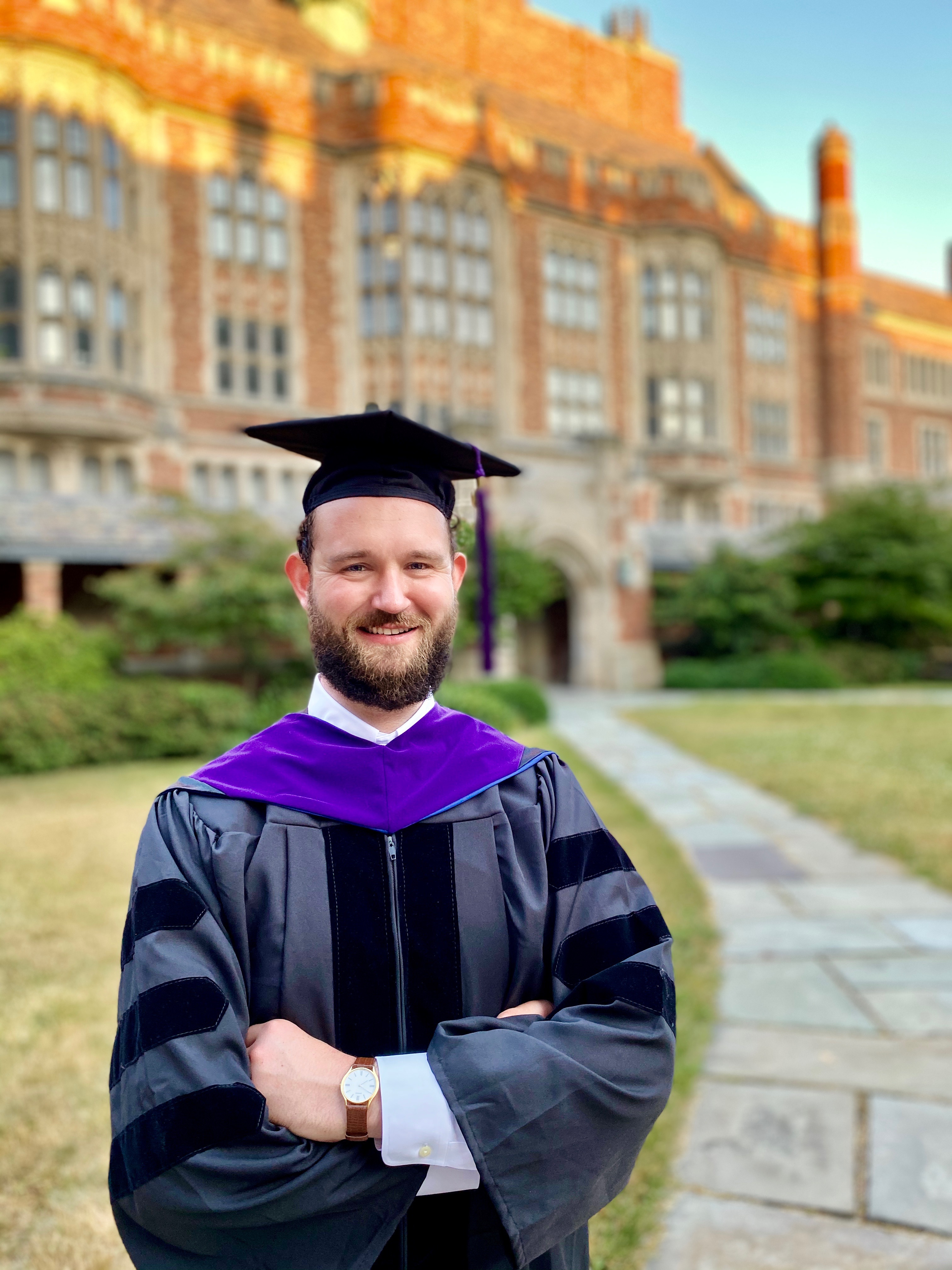
a kid i love made it across one of the toughest finish lines of his life back in may of 2020. turned in a book-length dissertation, crossed off the last of the law school to-do’s, and promptly slept in the morning his law school zoomed some semblance of quasi graduation.
they promised they’d make it up down the road, whenever ol’ covid relinquished its grip, let humans be human again. that moment, allegedly, is now. (though a good part of me is not so sure the grip is much relinquished as we were dashing to the pharmacy the other night for a friend who fell ill with covid for the third time since this all started and needed us to grab a prescription of paxlovid, the anti-viral wonder drug, and on our one little block, house after house is sealed shut for the cases of covid brewing inside.)
so we’re leaping into the unknown, taking our chances, flapping our wings new york way, and motoring up interstate 95, along the connecticut coast, where, come saturday morning, all four of our little family will convene with all the gusto we can muster there on an old campus where the classes of 2020 and 2021 get to make it official.
after all that separation, the simple magnificence of being together, being able to see the gleam in the eyes of the ones we love most, being able to wipe away a tear in real time, squeeze hands while walking through nothing so fancy as a parking garage: that is the definition of blessing.
despite its many deprivations, one good thing about these pandemic years is that it’s made the simple miracle of being together all the sweeter, more succulent.
there is catching up to be done, in the wake of red-ringed abductor of so many lives and so very much living.
so, two years after the fact, we are ditching long distance, saying no thank you to zoom. doesn’t matter to me if it’s two years too late. we’re going to be there. we’re going to hear that kid’s name when it’s called, and we’re going to watch that lope i know so well as he makes his way across the stage. i imagine i’ll be rifling through a cerebral cortex of memories, the late nights we stayed on the phone, the trips to the emergency room, the hours and hours i worried about how many days he’d gone without sleep, fueled on coffee and fumes. and i know i’ll be thinking all the way back to the start of it all, back to the very last thing he said to us, there on the sidewalk the morning we left him at law school, after we’d moved him in, made the requisite rounds of trips to IKEA for bookshelves that would not withstand the weight of all his books. he gave his papa a sturdy handshake, looked him in the eye, and said with all the certainty we had worked for and prayed for all those years: “thank you for everything; i’ll take it from here.”
and he did. and he does…
and that is the joy and the love beyond words that will be pulsing so loudly as i sit on the edge of my chair gulping back tears and holy hallelujahs.
God bless you, always, sweet Will. and thank you. love, always, your very own mama.
cap, gown, and hood in 2020 — but no ceremony. will add the real deal once it happens…
once the adrenaline died down, more fire-hydrant surge than all-out combat, once i paused my pounding on the window, realized how close i’d come to thrusting my fist right through the glass, shattering and bleeding sure to pre-empt the rescue i’d attempted, once i took a breath, my first impulse was to think maybe i’d jinxed it.
it must be my fault for letting out their secret. maybe i shouldn’t have extolled the wonders of the nest right before my eyes.
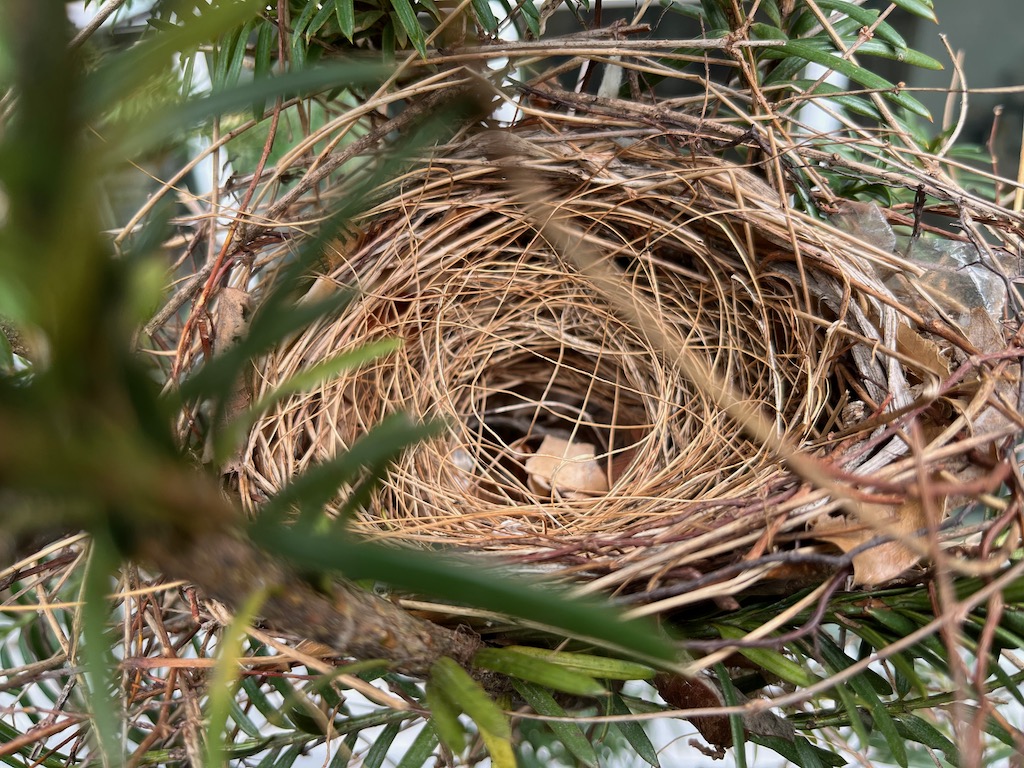
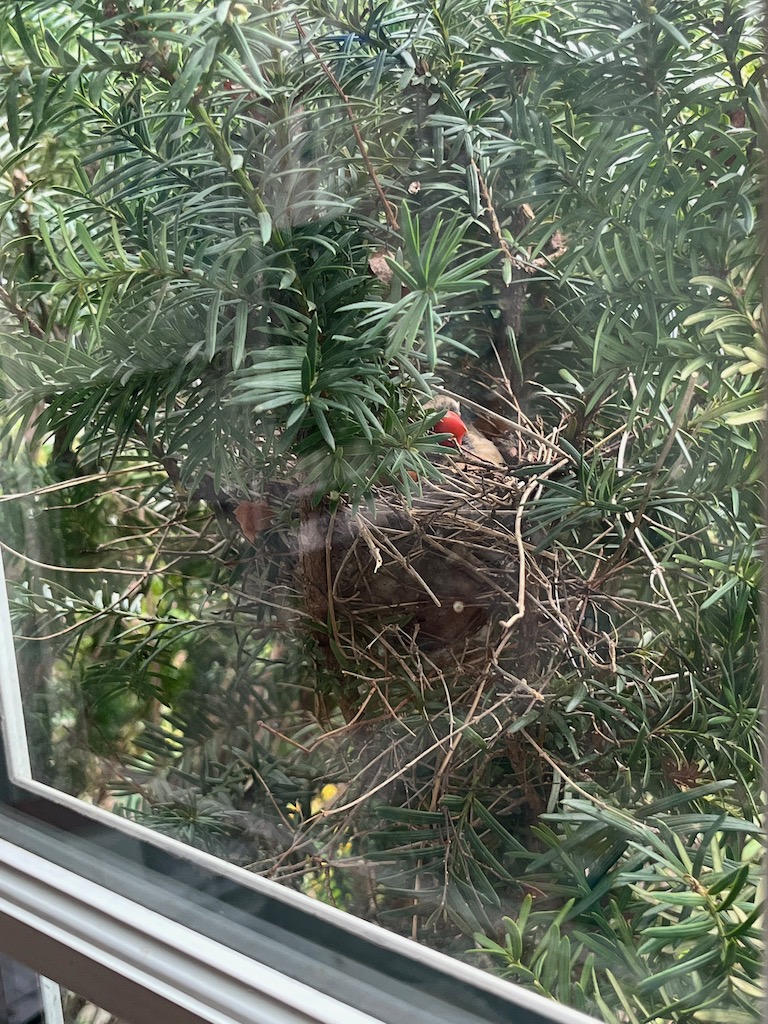
here’s what happened: mama and i were, as we’d been for weeks, co-existing peacefully, she on her side of the glass, blanketing her babies in her downy feathers, me tap-tapping away here on the word-churn machine. it was late saturday afternoon, just one short day and a half after i’d spun the tale of how mama cardinal and i were expectantly working toward our deadlines: mine, a book in the making; hers, a clutch of eggs.
she’d been on the nest 15 days and counting. i delighted at the way she punctuated our shared workspace –– seemingly out of the blue –– by belting out an abbreviated string of song, as if she’d suddenly been overcome by the jubilance of nesting. any day now, i would have heard the wee peep-peep-peeps of nestlings, seen the blur of pointy beaks thrusting skyward for an airdrop of worm.
but then, at nearly six o’clock that fateful evening, without so much as a peep of warning, in those final hours of what eliot so rightly termed “the cruellest month,” there suddenly arose from the bushes such squawking as i’ve never heard. i turned and saw furiously flapping wings — mama and papa both, each on separate branches of the ordinary evergreen that for two weeks now had been the nursery for their nest, the closest i had ever come to northern cardinal observation deck, a broodling in the works. while the two of them squawked and flapped, i noticed the third player in this late-breaking drama. it was furry, brown, and little. its stripe down the back gave it away: a chipmunk. a very hungry and extremely nasty chipmunk, if you don’t mind my editorializing. i leapt into life-guard mode, pounded hard as i could pound from my side of the glass. gave a holler to my own mother, ensconced in her armchair in the other room. as if she could help me here in dire land. at first my pounding seemed to confound the furry one, he turned down the branch, as if in exit. but then, he must have had a second thought, for up he turned, and scampered head-first into the nest. oh, dear god, such horror i’ve not witnessed. this was full-tilt assault. this was nature at its cruelest. and i stood witness. after plumbing the hollow of the nest, the hungry varmint turned and ran. i couldn’t swear to what i saw, but it would not be wrong to think i saw him clutching something in his mouth.
poor mama sat there flapping. her squawks slowing but not quieting. she circled the branch a few lonely times and then resumed her post. we both tried to catch our breath. i tried to convince myself that all was not lost, perhaps the casualty count was one and only one. and, besides, mama stood her post straight through to nightfall, never once lifting her belly from what she surely must be guarding with her life. only then, when darkness eclipsed my keeping watch, did i surrender too; turned off my desk lamp, whispered benediction, and tiptoed off, unsure of what the dark would bring.
alas, when dawn came, i threw off my blankets and hurried down the stairs. no mama. i’d thought i heard a muffled squawk not too too long after dark. i now presume the furry thing returned, finished the deed. the dastardly, dastardly deed.
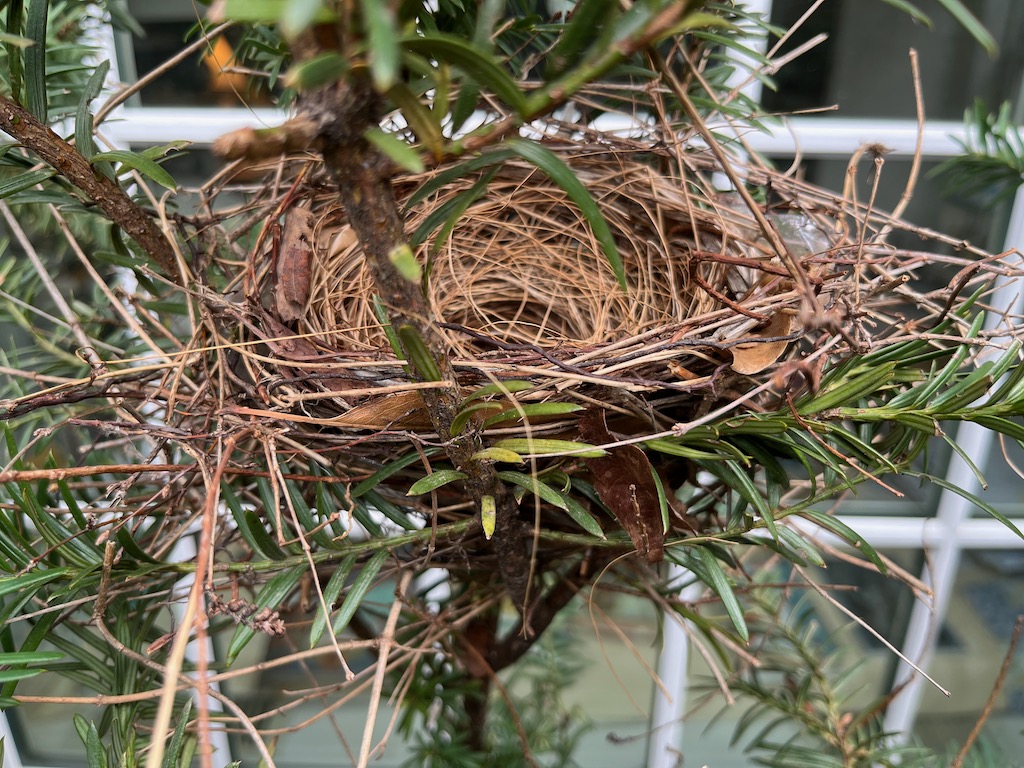
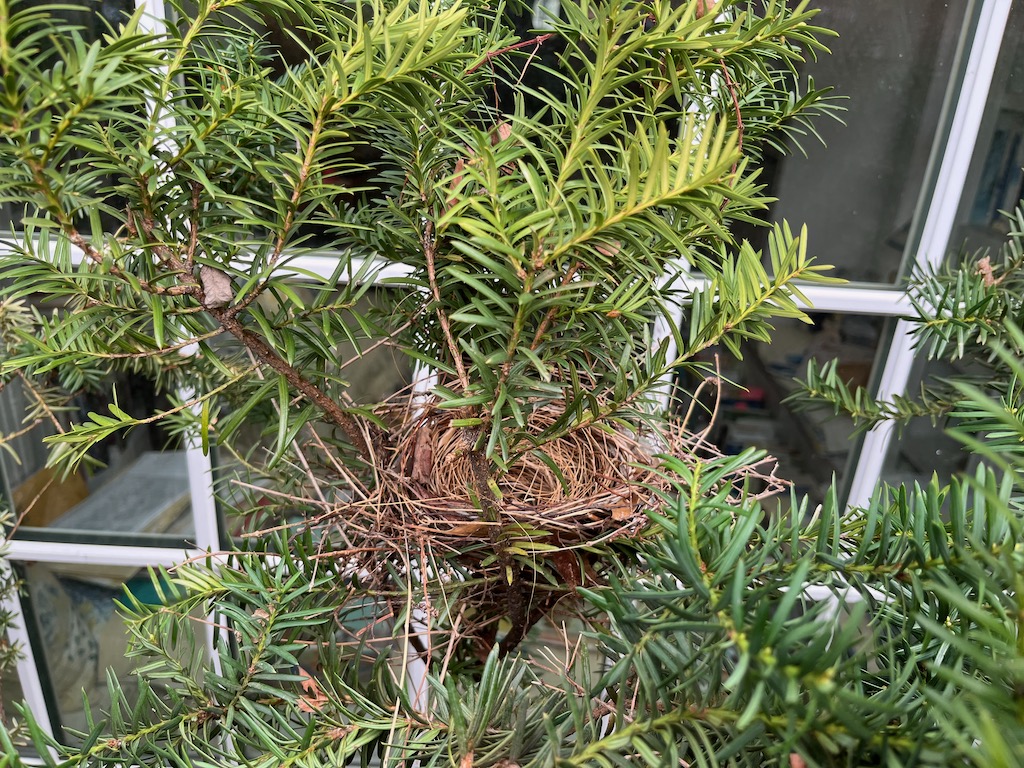
and so, the nest is empty. quite literally as i have just now hauled a step ladder out the door and, clinging for dear life, i climbed and pulled back branches, and indeed there is not a sign of life. just the artistry of their construction, right down to the shiny cellophane they might have thought to employ as something of a rain guard, what with all the rainy weeks of april.
turns out, the cardinals never had more than a one in three chance at making it out of the nest. despite their predilection for deeply tucking away their vernal constructions — remnants of a summer past, a bricolage of bits, dried grasses, thread-thin sticks, that cellophane wrapper perhaps from someone’s pack of cigarettes — the northern cardinal ranks near the sorry cellar of the nesting-survival charts, a long tumble down from the ash-throated flycatcher who scores the highest chance of flying from the nest, with seven of ten baby flycatchers flying. only the lowly house sparrow (11 percent chance) and the european starling (16 percent) fare worse than the red birds, and both sparrow and starling are invaders, anyway, non-native species snuck in as unintended cargo on some north america-bound vessel.
it hurt to sit here the first few days, the silence pounding in my ear. the absence of mama’s brown and red tail feathers protruding from the tuft of evergreen in which she so adeptly hid her nest.
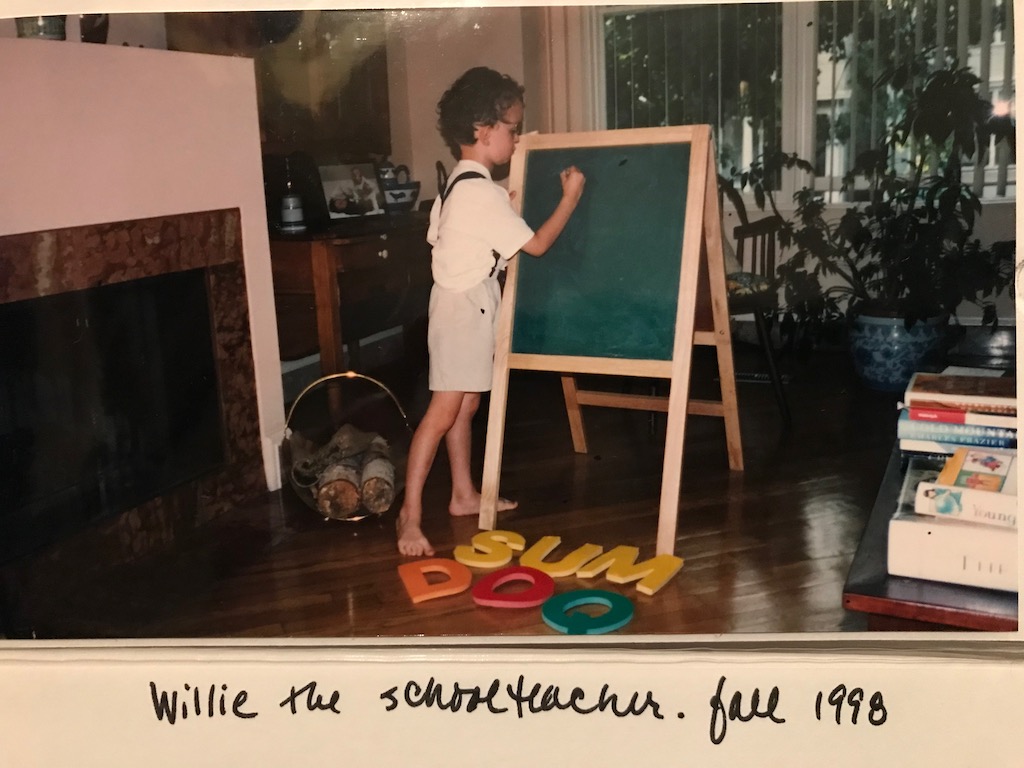
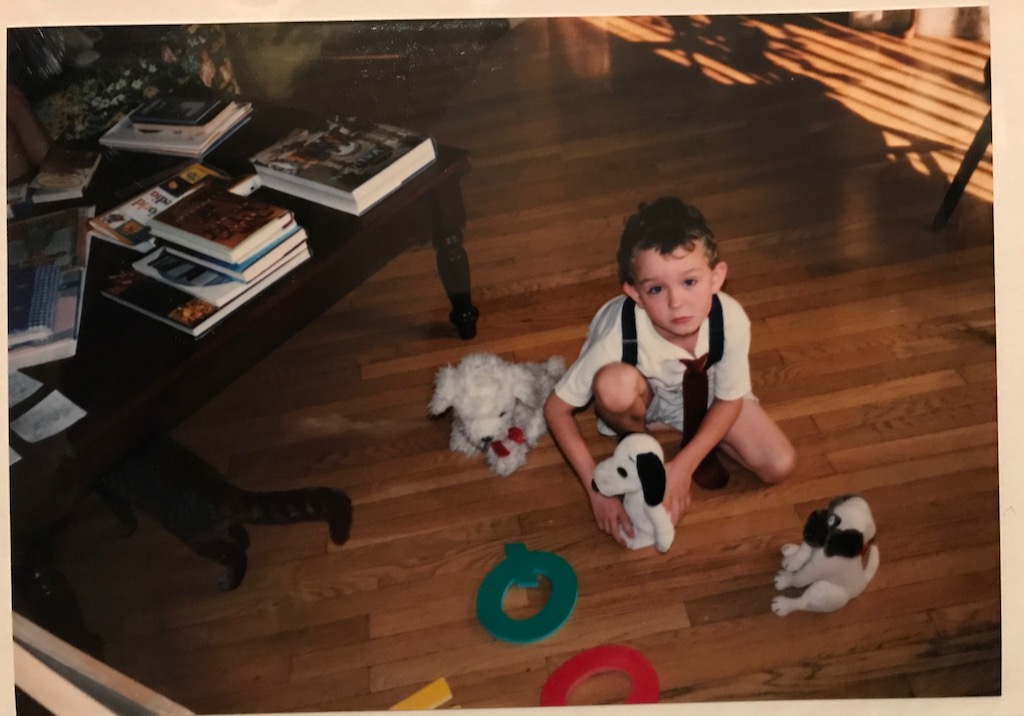
and then i started to consider my own empty nest, a consideration that comes, of course, as mothering day approaches. i think as much now about mothering as i ever have. though it consumes fewer hours of my focus, and fewer drives hither and yon, my fascination only deepens. i think often of how rare — how blessed — it is to know so fluently the whole makings of any life, let alone these two i love so dearly. day by day, it seems, the adventures pick up pace. the twists and turns in their narratives expand my own sense of being alive, being witness to lives unfurling each according to his own storyline. from my perch here at the old homestead, where i am reliably on watch and ever present, i follow two young men carving out paths that couldn’t be more different and yet entwine in ways that make me see the shared origins loud and clear and undeniably. the little boy who once could stare at a tv screen for interminably long times, he is carving out a path to be the very voices, the very storytellers, he once listened to. and the one who once set up an easel in the living room, encircled the room with every stuffed critter from his toy box, donned suspenders and necktie, scooped up a clutch of alphabet letters, and commenced a lecture on the fine points of S-U-M and Q, he looks toward a life in lecture halls filled with legal scholars in the making. let the record show it was snoopy who got first crack at his fledgling professorial skills.
my job here — simply loving through and through — will never ever be done. they might not need me (not so often anyway) to rouse them from their slumbers, to ferry them to the school house door, to shiver on their sidelines, but i’ve come to understand that my unique brand of loving means i’ll never find a way to lay aside aside my worries and my sometimes overly rambunctious fears. the phone calls these days are farther in between, the texts often unanswered, but my contemplations and my prayers deepen by the month. i’ve started worrying in a whole new way about this world we’re leaving to their keeping. i once held out hope that they could right our many, many wrongs. but now i wonder if we’re too far gone, this world so broken in so many places.
i look to mama bird, and her now hollowed nest. there is stunned silence out my window. no flicker of a sighting of mama now at it once again. she makes me think hard about the seasons of mothering, how some are full to bursting, and others pulse with a kind of aching, a sorrow for the hours out of reach, a longing for the more tactile days when every flinch and whimper was within our watch. her empty nest makes me think hard about the one i call my own, at once emptier and fuller than i can sometimes truly comprehend.
no wonder mothering never ever loosens its holy grip on me.
may your motherings be ever blessed, in whatever ways you love and hold those you count as your dearest rarest treasures.
amid a season of war and worry, on the very day when steam was all but rising from this keyboard––a deadline looming, conveyor belts of verbs and nouns at high production––there came a rustling in the bushes just beyond the panes of glass that stretch between my bookshelves.
the morning was punctuated with the sounds of preoccupation, the faintest plink barely tapping at the glass, more than the usual chatter between birds. over and over, takeoffs and landings from bush to branch to nearby picket fence. the occasional outburst of trills and warbles.
it was the quiet of the sound that most intrigued me, the sound of trying to be unnoticed, hard at work in the art of concealment, a most necessary survival skill when up against the odds of danger, in a world where prowling cats and coons, thunderstorms and untimely freezes are another name for doom.
because i knew my role in this rare showing was to be as discrete and invisible as possible, i barely shifted my eyes, dared not tiptoe near the glass, for fear of spooking, for fear of shutting down production.
turned out, the faintest murmurings were these: the sound of wing brushing up against the glass, the sound of branches being jostled to make way for the laying down of bits of grasses, dried and brown and wholly unremarkable.
but what was done, over the course of a single day, was not only wholly remarkable and breathtaking. it was only the beginning.
mama and papa–a pair of cardinals i know by name–had for the first time in all my decades decided to grace me with a front row seat on their reproductive spring: they’d chosen my very ordinary, very ungroomed evergreens, as the very spot to build their nest. it just so happens to be up against the glass, as if the window to the nursery in the maternity ward, the ones where long ago fathers pressed their nose against the glass to get a first peek at the progeny newly birthed and swaddled, the hard labor shielded from the men not allowed near delivery, too faint for such primal birthings.
over all my years, i’ve spied robins all but nesting in the public square. i’ve seen sparrows busily and noisily stuffing gutters and cracks in this old house with the makings of a nest. but never ever had i figured out just where it is the cardinals go to replenish the species.
i now know why. my guess is they’re the high scorers in the game of hide-and-seek. their nest, literally up against the glass, is all but impossible to see from the other side of the bushes, and wedged in in such a way that i cannot for the life of me peek into the bowl of the nest (believe me, when mama flits off to grab a seed, to relieve her feathered bum from all its incubating, i’ve climbed atop my window seat to try to fetch a look).
we’ve come to work in synchrony, mama cardinal and moi. i tap quietly at my keys all day long while she goes about her warming of those eggs all day long. once the sun goes down, i leave the premises, turn off the lights, shuffle off to the old maple table in the kitchen–not wanting a brood of mixed-up baby birds to mistake my desk lamp for a never-setting sun.
far as i can tell, and i tell you my guess here is based on scantest evidence, there’s not yet a clutch of little beaks to fill with bits of worms. each day, though, the drumbeat picks up pace. it’s been two whole weeks, and surely we must be getting close.
it’s a blessed thing, a most blessed thing, a thing that fills my soul, to be witness to the against-all-odds timeless knowings of the feathered flocks. those little birds know nothing of the ravages that tear apart the human flock. theirs is a universe––far as we know, and maybe i’m just wishful thinking––without the sorts of strife, without the demonic ingenuities to dream and build and drop a bomb. do birds know worry? does mama bird go about her business without the slightest hint of begrudgement? is she already plotting her grocery list? does she count her clutch, scan for misshapen egg, dread the day those baby birds take flight and leave the nest?
such are the questions that reel through my mind, as mama bird and i go about our tasks this one most blessed spring. it’s a wonder when grace comes tapping at the window pane. as if the heavens know just who and when needs holy balm far far from the madding crowd.
what grace has brushed you by this spring? what’s caught you unawares? what quiet has so startled you, and awakened you from your worldly slumbers?
it started over matzo and maror, the staples of passover, when amid cups of wine (they’re commanded, four of them), i started to pepper my mate with question upon question (more than four of my own; again, four are commanded). i was asking about seders of his long-ago past, curious about each of the characters, and the long journey from shtetl to tenement to, well, ivy league colleges and a pulitzer prize. because i tend to poke around in the vaults of history, root around for tidbits and clues, i remembered i’d once tucked away what we thought were steerage records of one isidore kaminski’s arrival on nov. 14, 1912 from russia by way of rotterdam, on the s.s. uranium.
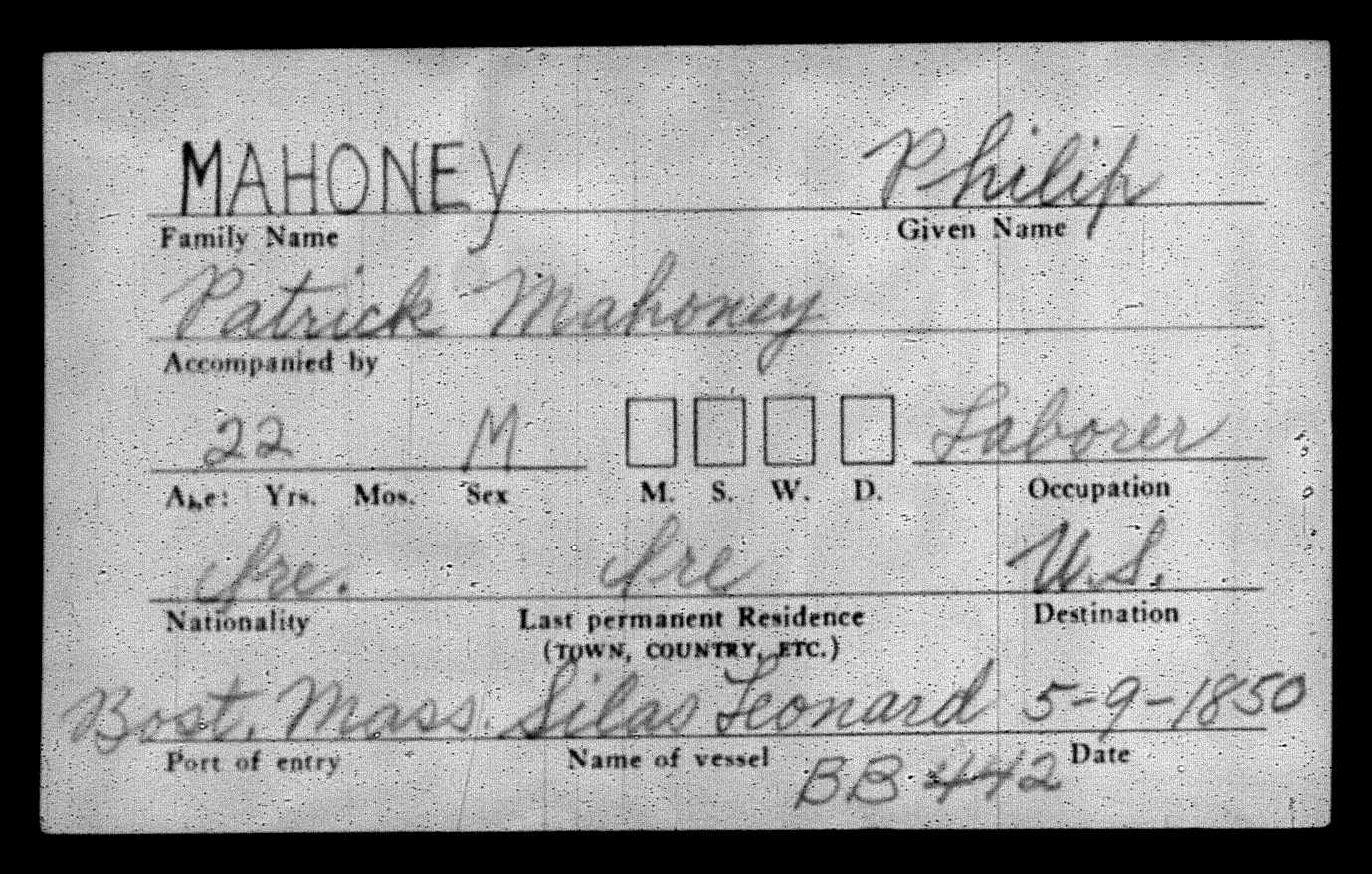
and upon pulling that sheaf from my stash, i felt my curiosities piquing. i was suddenly hot in pursuit of my own irish peoples. and, lo and behold, i found philip mahoney himself arriving in boston harbor on may 9, 1850, on the silas leonard, a steerage ship that only three years later would be shipwrecked off the coast of newport, rhode island.
the deeper i look the likelier i see how often the fact of my existence is but a long, long series of near misses and narrow escapes.
and, often, when poking around long-ago times when survival was iffy, the tales you unearth can knock you back for a while. it’s the price of paying attention. and i welcome it, though it might take a few days, maybe some months to really distill all i discovered this week.
best of all, i discovered a long-lost cousin, a cousin whose tales criss-cross the pages of the new york times, among other adventures. we share a great grandmother and great grandfather. tragedy struck his branch of the tree right from the start, when our great grandmother died birthing joe’s grandmother. my grandfather would have been seven, left without a mother and with a newborn baby sister. i am still filling in all of the pieces of a story far sadder even than that. i am imagining––enlivening––all of the characters in each of the plots, thrusting myself back in time, peeking out from under the tables and around all the corners.
that’s what is often the case for those of us who find ourselves compelled by the stories of the past, stories we know in some way inform who we are and how we got to this moment. the few cousins i’ve met along the way, one of them one of the true treasures of my life, all seem to share a gnawing curiosity, a wanting to fill in the blanks. to step back from the present and take in the whole sweep of the story.
it’s how i discovered an uncle had died in the great battle of iwo jima, slashed with a bayonet in the deep of night before he could leap from his tent. it’s how i filled in so many missing pieces of the grandmother my own father so rarely spoke of, a silence i sensed was fueled by a heart so broken by her absence he chose to stay mostly wordless when it came to talk of her. though he did tell me once––and with my father the less he said, the more emphatically you knew he meant it––that he saw so much of his mother in me.
i am fairly certain i get lost in the mists of family history in my feeble attempt at resurrections. oh, what i wouldn’t give to sit at an old maple table, fueled by tea for the women, scotch for the men, and indulge in the swirl of their stories. maybe it’s reaching deep into the vaults––frustrating as it is to run into the dead ends and cul-de-sacs of hard-to-read 18th-century cursive and records gaping with holes––maybe it’s reaching back into time, barely brushing up against the most basic of biographies, that fills in a sense of just who i am, and propels me to make of my one little life just a little bit more than i otherwise might.
maybe it’s that the long sweep of history puts me more squarely in my place, highlights how tiny a dot is my place in the long ellipsis of genetics and time.
this week i spent a long time looking at the mahany side of my family, a side i knew too little about, a side whose story is much sadder than i ever realized. my dad said so very little, and my dad was gone way before i’d asked even a tenth of my questions. the last significant thing i remember my dad saying to me, one day not long after his very last christmas, was “kid, you have a real sense of history.”
indeed, it seems it’s a hunger.
and all these years later, i’m still trying to ask my next question, to find the stories he never told.
with all the love in my heart, this one is in its own way a love note to my dear beloved p. shannon, a third cousin who more than anyone i know has taken me by the hand deep into the vaults, and pointed the light at each and every turn. bless you paddy, i will adore you till the way end of time…..
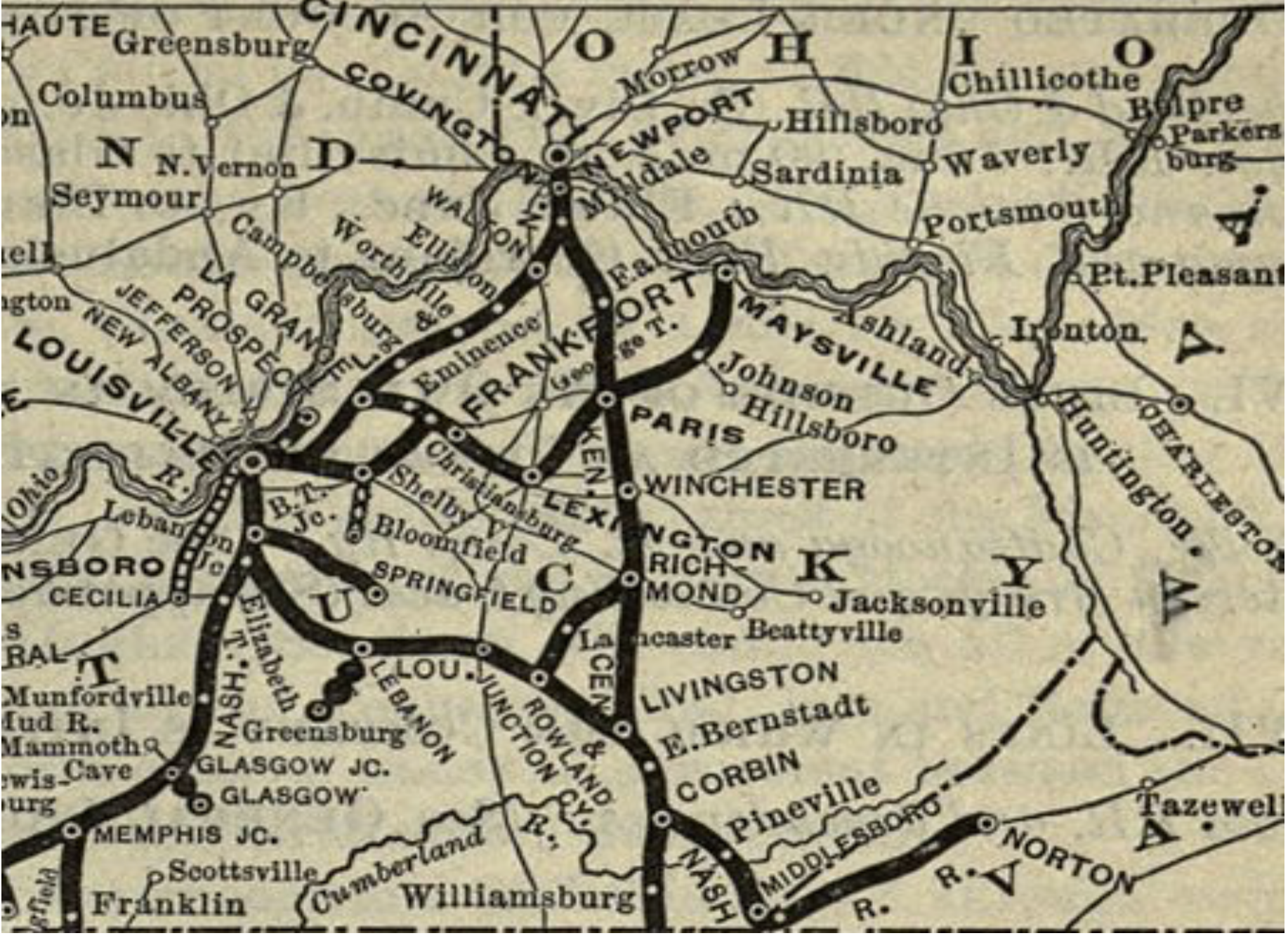
the map above is the rail line through kentucky where my choochoo papa (my paternal grandfather) was the locomotive engineer for the Louisville & Nashville Rail Road at the early age of 26 until his retirement some 50 years later. he––along with my dad and the grandma i never knew––started out at the little dot on the map marked “paris,” as in kentucky not france, a dot on the map that will forever be my old kentucky home.
manifest of the s.s. uranium that carried our boys’ great grandfather to america in 1912my great-great-great grandfather’s record of arrival from ireland in 1850
have you poked around in the attic of your own family’s history? are you propelled by curiosities? i suppose, after a lifetime of bylines, i’ve left more than my share for some curious soul in generations to come. have at it, sweet girl, i only wish i could join you…….
we are tellers and re-tellers of story, a people long bound by the unspooling of truths told in text or in verse, around table or hearth, under moon and star or plaster and beam.
in the geometry of time, there lies both wisdom and instruction in the unfurling of the year, an unfurling that might feel like a circle but that i see as a spiral. year after year, we return to texts––familiar texts––that draw us in more and more deeply, the more closely we pay attention.
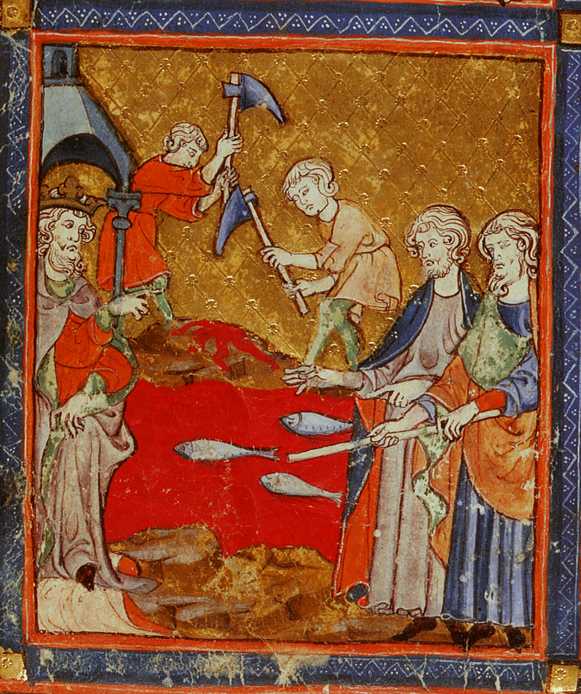
so it is––as i fill my house with matzo and shred it of breadcrumbs, as i shop for both lamb and shank bone, as i steam mounds and mounds of asparagus––that once again we come to this holy stretch of time endowed with foundational story, ancient stories both christian and jewish. the story of a savior who wept in a garden, and soon was betrayed, then flogged and stripped and pierced with a crown of thorns. a humiliation as severe as any i’ve ever read. certainly more than any i’ve ever known. and at the same time in this house, we read and retell the story of the enslaved jews finding their way out of bondage, crossing an isthmus, a sand bar in a sea of reeds, but not before witnessing the scourge of ten plagues.
the beauty of these texts, and any text meant for endless curiosity––these texts, as if prisms we hold to the light, turning and turning for the making of new rainbows––is that each year some new fragment may catch our attention. new rainbows might scatter against the walls of our soul.
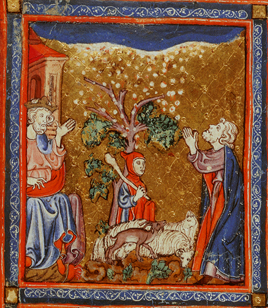
so it is that this year i am thinking anew of the plagues: water turning to blood, frogs, lice, flies, livestock pestilence, boils, hail, locusts, darkness, and the killing of firstborn children.
i remember how at the long seder table where my boys grew up, the table would be scattered with wee plastic frogs and broad-winged bugs; ping pong balls would serve as hail. and red food dye would be splattered on plates. the detail was never lost.
and only this year––a year when both those boys who once squirmed at the bugs and squealed at the blood will be hundred of miles away––only this year have i come to pay closer attention to what the plagues might have meant to the story we’re commanded to tell.
according to a wise, wise rabbi whose wisdom i found myself reading the other day, the plagues are “commonly read as punishments levied against the egyptian people for the terrible suffering they forced upon the israelites,” writes sharon brous, the senior rabbi and founder of IKAR, a jewish congregation in los angeles, a rabbi who calls it her life’s work to re-animate religion. oh, that we animate it, this vein in our lives that seems to either be bent to fit particular agendas, or shoved to the side altogether.
but, writes rabbi brous, there is another way to interpret the plagues, and God’s intent therein (and here’s where i buckle my seatbelt, and begin my own homegrown rocket ride): what if the plagues, the sufferings, are meant not to punish but rather to tender the heart. to grow compassion. to breathe and breed empathies.
we need turn to the 16th and 17th centuries, to the wisdom of a venetian scholar and rabbi named obadiah ben jacob sforno, to find the seeds of this thinking: sforno argued in his commentary on the text of exodus that the plagues were actually brought to awaken the conscience of the oppressor, “to increase the chances that pharaoh would finally see the light and become a genuine penitent.”
“in other words,” writes brous, “what God desired was a true change of heart. God wanted pharaoh and his people to take responsibility for the injustices they committed. tell the truth. make amends. offer reparations. chart a new course, together with the israelites.”
in a world as plagued as ours currently is––war and pillage, pandemic and pestilence, fire and flood and drought––in a world where it’s too too easy to turn our backs on the sacred, to point to the suffering and insist there’s no God so hard-hearted to look the other way so therefore there must be no God, in a world as replete with reasons not to believe, what if the radical notion, the one that’s hardest to come by, is the dawning idea that with each and every suffering we grow more and more tender.
there’s the crux, the hard part: to allow the suffering to tender us, not to harden. not to let horrors metastasize, not to let hurt spread like a cancer, nor turn us into walking, talking cess pools of resentment, to leave us every morning, noon, and night with the afterburn of bitterness there on our tongues.
imagine ten of your own plagues: the time you were double-crossed; the time you discovered a terrible truth, a truth that was crushing; the dying and death of someone you loved. the remembering and never forgetting of a time you caused the suffering. the lie you let grow. the cruel innuendo that crossed your own lips. count your own ten.
now, consider the pain that you felt. how it awoke you in the night. how it haunted you by the day. how it felt like a nest of hornets let loose in your soul.
now imagine that the pain didn’t harden. imagine it worked to loosen the loam of your soul. allowed room for new seeds to be planted there. tender sproutlings of purer compassion. how, ever after, you knew what it meant to grieve in a bottomless way. how, ever after, you knew how tempting it was to turn away and never turn back. how, ever after, you knew the muscularity demanded to rise up and out from the darkness.
consider how those plagues pushed you––not without ache, not without wishing you could wish it away––toward a deeper, broader understanding of and connection with the suffering all around.
imagine if the resonance of your own hours of suffering allowed you to look upon the sins and the suffering all around and find common ground, feel your heart open not close.
imagine if the world’s suffering was meant to do the same. imagine if all this is an exercise in tendering our holiest vessel: the one heart made as a chamber for the sacred to dwell.
what if, instead of growing bitter and hard over time, we grow softer and sweeter? what if we return to the text––the suffering and crucifixion of the one born to teach and live love, the freeing of an oppressed people made to witness hardship upon hardship, ten plagues in all––what if we return to the text and find, for the very first time, a wisdom to carry us on? into a world that never seems to pause in its inflicting of pain.
what if, in feeling the pain, we are moved to be the agent of balm, of healing, of lifting the other out of a pain we know all too well? tikkun olam. “repair the world.” mend the tatters. reimagine the whole.
there must be wisdom, must be reason we circle again and again to the same lines of text, as if we’re meant to meet it again with whomever we are one year to the next. this year the lines that most drew me in were the ones that ask why in the world would ours be a God who not only allows but inflicts plague upon plague, hurt upon hurt.
my knowing next year might differ. but this year i’ve come to dwell on the thought that no one escapes a life stitched with sufferings. and if the sufferings come, how might they make of us souls that pulse with compassion. communion, after all, is the holiness we seek. oneness. with God, with ourselves, and the whole of humanity circling this earth in this long, dark hour.
what plagues move you to compassion? (a question to answer deep in your soul in these entwined holy hours ahead….)
i cannot let this day pass without remembering my beautiful mother-in-law whom i last saw on this day, her birthday, a year ago. we keep her flame alive, very much alive, in the telling and re-telling of her stories. may they never end…..
*the question of the israelites and the plagues––whether they witnessed them or endured them––was a question that prompted much discussion at dinner last night. one of those rabbit holes into which we fall at our house because one of us––either the jew or the catholic––is always fairly new (or newer) to a story, and wonders about it in ways that have never quite struck the one to whom it is more familiar. i’d assumed––wrongly, it turns out––that to be in egypt at the time of the plagues meant to endure them but a closer read of the story made clear that, according to Exodus, for at least some of the plagues, the israelites were protected. certainly, i knew that the whole point of the “passover” was that Jews were to mark the doorways to their home with the blood of a sacrificed lamb, and the angel of death would know to pass over, sparing the firstborn son. i hadn’t realized––nor had my tablemate––that plagues one through three seem to have been endured by all, and four through ten were endured only by the egyptians, except for those who were penitent and thus spared the wrath.
plague of water turned to bloodplague of boilsplague of hail
snapshot of the writing garage moments after final manuscript submitted
waiting has been the posture of the week here at book-making headquarters. which, for someone wired like me, means clicking my phone every few minutes, checking to see if there’s yet a reply. forcing myself into tasks—say, cleaning the bathtub, sorting the wash––that will keep me and my antsy fingers away from the checking, reminding myself simply to breathe.
it might come as little surprise––after keeping you in the loop here as i’ve loped toward the publishing finish line––that the reply i am so, so anxiously awaiting is the one from the editor who will, ultimately, thumbs-up or thumbs-down that collection of words i refer to as my latest book. a book whose making has certainly silvered a few more of my hairs. a book i turned in sunday night, with hours to spare before the monday deadline. the first editor, a true godsend with whom i’ve been back-and-forthing for the last four weeks, gave it a solid thumbs up, but the one we now await is the one who a.) moves it along. or b.) asks for more rewrite still. or, i suppose, in the doomsday version (one i’m apt to imagine) c.) she simply throws up her arms and shrieks, “i’ve no clue at all why this was a book i thought worthy of printing!”
over the last few weeks, in this latest batch of dispatches from here in the writing garage (this appendage to our old house began its existence as a place where mid-century cars sputtered fumes, not too distant, i suppose, from its now housing a sputtering writer), i’ve pulled back the curtain a bit on just how it is that thousands of words find their way onto pages soon to be glued, bound, sewn, or whatever is the latest technology for keeping the papers from scattering. (imagine if in buying a book, you were handed an assemblage of pages and told to shuffle them into just the right order before you sat down to read; binding, clearly a nifty invention….)
one of the lists i’ve been making this week is something of a manifesto, of how––should i ever find myself in the editor’s desk––i might try to alleviate the suffering of a writer whose tender self and soul would be under my watch. it’s hardly a stretch to assume that most who assign themselves to the occupation of putting words on the page tend to find their hearts rising and falling in some measure with the way those words are met by editors and loved ones and even anonymous readers.
i’ve suffered at the hands of all the above. i’ve winced as editors killed my “little darlings,” the newsroom nickname for those snazzy bits of sentence or prose that the writer pretends makes him or her the star of the class, only to find the darling is unceremoniously flung to the cutting room floor, where it lands with an unceremonious thud. i’ve gulped as my father-in-law dialed long distance to suggest i might need a refresher stretch on the therapist’s couch as he thought something i’d penned right here on the chair, after our firstborn sauntered off to college, was far too depressing, and a sure sign that i’d teetered over the edge. and, back in my newspaper days, i had readers pen letters in what used to be a telltale chickeny scratch, often in recycled envelopes (in the digital age, it’s now hard to predict when an incoming email is going to explode with invective), all but insisting i leap from my desk in the tribune tower, run––not walk––three blocks east, and jump in the big cold lake. with stones tied to my ankles.
it can be not so pretty, this audacity to say what you think. or you feel. or what you pray. to put into words the otherwise ineffable. to sometimes see sentences there on the screen that you simply hadn’t realized were in you until they arose, one tap-tap at a time.
it’s one thing to put words to breath, in conversation over breakfast or lunch or sitting alongside a friend on a bench or a swing, and to know that those words won’t leave a trace––except in the memory of the one to whom they were spoken. to dare to put ink (or pixels on a screen) to those thoughts––sometimes half-baked, sometimes raw, sometimes with too many dashes or commas––is, when you pause to think about it, rather a bold expedition. seatbelts ought be required.
anyway, my manifesto would begin with one or two basics: don’t forget that the one on the waiting end is likely on needles and pins; offer kind words even when pointing out stumbles and weak spots; and please remember how daunting it is to play at this game. it’s not too much of a stretch to extend my manifesto beyond the wordsmithing game. it’s a very short list that might apply to the wider world as we seem to be slipping deeper and deeper into an age of too-little regard for the human species with whom we share this moment in time.
it takes so very little.
what would you include on a Manifesto for Minimal Kindness, editorially or otherwise?
note that in the snapshot above, compared to one shared a couple weeks back, the stacks in the writing garage only grew higher and higher as the days ticked by, one after another en route to that finish line...good news is the other writer who lives in this house wandered into the room last night, eyed the bowing shelves, the shelves all but groaning under the weight, eyed the impossible hopscotch of books, and declared: “you need more shelves.” so i guess my disarray just might save me after all.











 pull up a chair