pull up a chair

where wisdom gathers, poetry unfolds and divine light is sparked…

the littlest tree and the beating heart of Christmas . . .

shuffling in from the tree lot––the Christmas tree lot––with the littlest tree that nearly ever there grew, and once i’d kerplunked the pitiful seedling in its far-too-big tree stand (the yuletide equivalent of a saggy pair of dungarees slipping down to the knees of an undersized tot), i sat right down to pen my apologia to my faraway boys.

my mea culpa unfolded thusly: 

sweet boys, we have adopted this year, from the neediest Christmas tree farm, the wee littlest tree you ever did see. he very much wanted a home, and we shall be taking name nominations starting now. he’s an inflationary victim, the poor little sprout (there’s a name, Sprout!), as trees are in short short supply (and they’re short!). we’ve gussied him up with a santa cap, cranberry ropes (don’t tell him they’re wooden), and the lovely quilted skirt that will soon be an heirloom. a standard-sized tree topped 200 bucks this year, and for two weeks of Christmas that is not allowed. (just think, your tree funds will be shifted to the beef tenderloin fund, which is much more delicious anyway.) the little fellow smells just like the woods, and i am certain a bird might land in him soon. i beg your mercies in embracing this little guy. he tried with ALLLLL his might to grow like the big guys, but he just didn’t have it in him, and here in this house we love the ones on the margins, even the trees. xoxoxox deepest apologies if you are duly disappointed…

xox 

didn’t take but a minute for the one i might forever call our “little one” to ping right back: 

I like underdogs

and then:

This tree seems like a underdog

and so my upside-down day was snapped into crystal-clear focus: the message of Christmas delivered, and echoed. 

it’s all about heart, and dimensions don’t matter. nor superlatives. nor getting it right. nor any of the vexations that sometimes tangle me in my own unlit strands.

never mind the panting toward some imaginary finish line, as once again our festival of lights and our feast of nativity wedge their way into the same single overbooked week. never mind the slab of brisket i need to fetch from the butcher, or the welcome-home mac-n-cheese i need to slide in the oven, while dashing to an incoming plane at an airport many miles south (after picking up grammy plenty miles north, making for a 78-mile loop on a holiday weekend afternoon). and never mind the onerous chore that just yesterday had us signing last wills and testaments, which i can assure puts something of a damper on the jolly spirit of christmas. (one of those “responsible-grownup” tasks right up there with root canals!)

all of it vanished, the panting, the worries, the how-will-get-it-all-dones, in the flick of a text (the modernday spin on a wink of the eye, and a twist of the head, as clement c. moore immortally put it). 

the kid needed no convincing. no need to shovel lament. he was ready to love the littlest tree.

in years past i’d taken some ribbing––and serious protest––for my proclivities toward picking the spindliest trees. so i figured a misshapen midget of a fraser fir might have me taking my Christmas out in the doghouse (and since we’ve no dog, the fair equivalent might have been sheltering under the seed trough). 

thus, i’d decided to nip protests in the bud, devised my long-winded defense. 

and the lightning-quick reply––I like underdogs––made me see what should have been clear all along: the kid with the very big heart needs no convincing, no urging to consider the plight of the nearly forgotten. 

This tree seems like a underdog

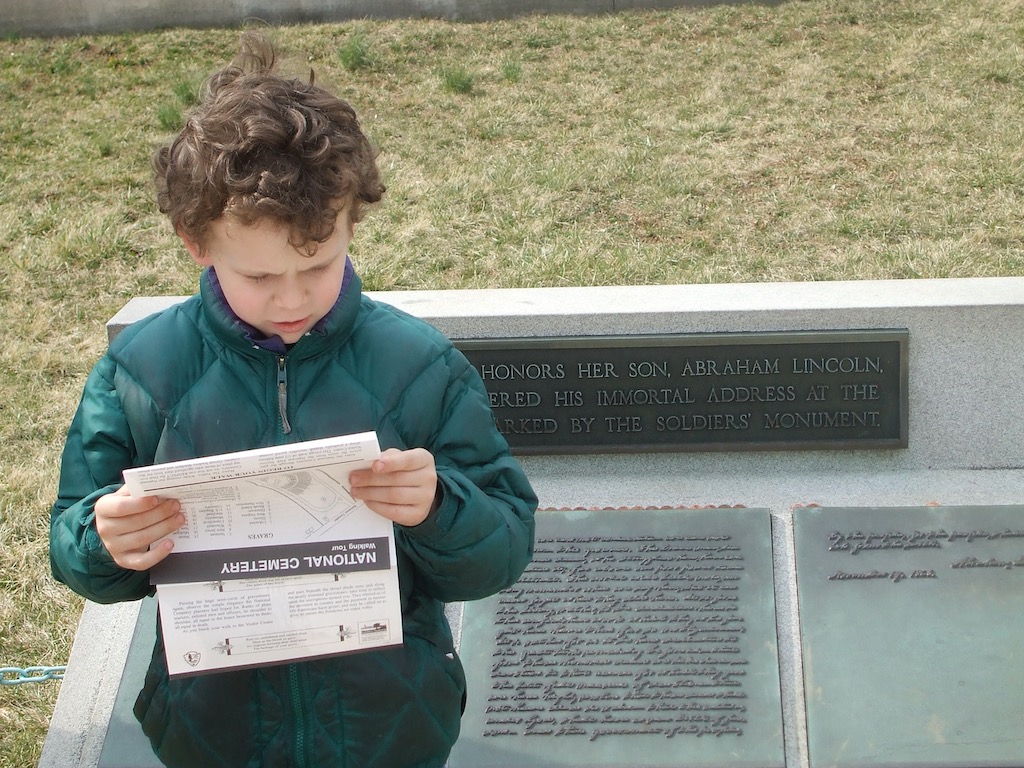
he’s the kid who long, long ago taught me to watch out for worms, who led me on moon walks, and insisted he stand on the very same spot where abraham lincoln once stood so he could recite the line from the gettysburg address that made him break into tears every time: “we can not dedicate, we can not consecrate, we can not hallow this ground.” and, on that gray pennsylvania day in 2009, when we asked why the tears, he choked out what to him seemed blatantly obvious, “it’s the soldiers.” a sadness too big for his second-grade heart.

he’s 21 now. old enough to drink, drive, and drop a vote in the ballot box. and that heart, it only grows bigger. 

hearts have a way of finding each other, the truest hearts anyway.

so, once again, he’s pointed the way to the bright heart of the season. and the littlest tree, the tree with no name yet, will stand tall and stand proud on its upturned crate. because in this old house, underdogs are always, always the heroes. 

and ours is now dressed in mighty regalia: santa cap, blinking lights (they’ll be switched out, soon as i get to the Christmas light store), and string upon string of bright wooden berries. and up on the milk crate, he’s gotten some inches. our sorry old tree isn’t so sorry, hauled in from the cold, given due glory.


here’s a beauty of a poem, just because it stirred me. . . a poem about rising up, about beauty from ashes. . .

such beauty from ashes
by carolyn marie rodgers**

and we are singing our hearts out, and
our souls are in our eyes,
and they are beautiful souls.
they are souls of truth.
they are souls of love.
they are souls of faith.
they are souls of hope.
and we have conquered a little corner in the
world of fear.

and we have stepped up and forward,
    and we have torn down walls.
we have smashed sound barriers between us.
we have dared again and again and yet again to dream,
and our dreams have finally taken material form.
we have changed our hearts.
we have altered and changed our minds,
and because of this, we now have some
    valor and strength,
and we are threatening to change the world.
that it     might be a better place.
For us and for all god’s children.
for all that we are.
for all that we might be
we have done it.
And we rise now as one voice, with many harmonies,
Through the mystery and beauty of harmony.
One voice

    Though many, for one, for all.
For all the earth to grow and know,
From the mounds of ashes of our dead, our martyred,
Our lambs, our sacrificed, those who died and have been dead
So long, so long they are no more than, nor any less than,
Sacred memories. Mountains of ashes, of our sweet, beloved,
Beautiful dead.
Today, what beauty we now have, to gain strength from to continue on,
Beauty,
From ashes.

***

**Born in Chicago on December 14, 1940, Carolyn Marie Rodgers was born to Clarence Rodgers, a welder, and his wife, Bazella. The last born of four children, her family had moved from Little Rock, Arkansas to Chicago’s South Side, where Rodgers grew up. Early in her career, Rodgers was associated with the Black Arts Movement, attending writing workshops led by Gwendolyn Brooks and through the Organization of Black American Culture. Rodgers’s poetry collections include Paper Soul (1968); Songs of a Black Bird (1969), which won the Poet Laureate Award of the Society of Midland Authors; her best-known book, how i got ovah: New and Selected Poems (1975), a finalist for the National Book Award in 1976; The Heart as Ever Green: Poems (1978); and Morning Glory: Poems (1989).

Rodgers’s poetry addresses feminist issues, including the role of Black women in society, though her work evolved over time from a militant stance to one more focused on the individual and Christianity. Other themes she explored in her poetry include mother-daughter relationships, relationships between Black men and Black women, street life, and love. In addition to poetry, Rodgers wrote plays, short stories, and essays. She worked as a book critic for the Chicago Daily News and as a columnist for the Milwaukee Courier.

Rodgers founded Third World Press in 1967 with Haki Madhubuti, Johari Amini, and Roschell Rich and began Eden Press with a grant from the Illinois Arts Council. She was as a social worker through the YMCA and taught at various colleges. She was inducted into the International Literary Hall of Fame for Writers of African Descent in 2009 on the campus of Chicago State University. She died in 2010 in Chicago, at the age of 69.

—abridged bio taken from the Poetry Foundation


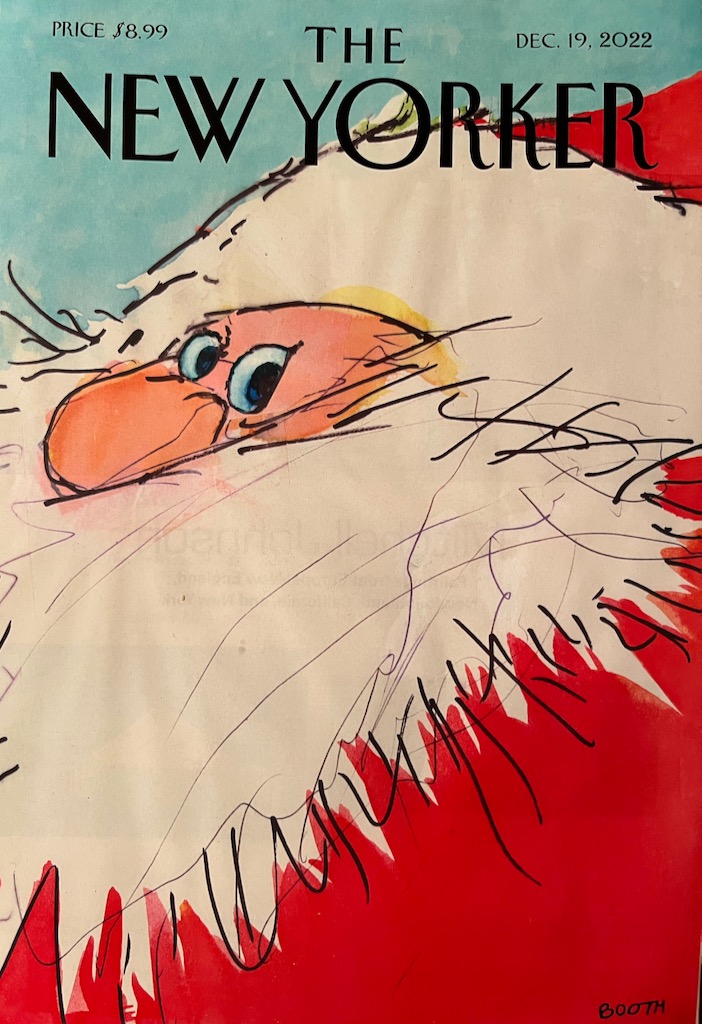
and here is the heavenly late cartoonist George Booth’s last New Yorker Christmas cover. . .  

i seem to be reverting to smorgasbord here at the chair, leaving more than one thing, as i meander through the week collecting my morsels. likely comes from thinking a little isn’t enough. making sure there’s at least enough. today, a tale, a poem, and a drawing. oh, and a question, always a question:

has a little bit of Christmas leapt out from the cracks or the corners of your life, surprised you, taken your breath away just a bit because suddenly, amid the blur, you saw crystal clear the beating heart of the season?

merry almost everything. . .

sixteen.

sixteen years old. old enough to drive a car, the chair now is. not quite old enough to vote, but we’ve stayed away from politics all these years; allowing only goodness, grace, to be our guide––even in those rare few times we’ve wandered in the public square, celebrated the election of a president, felt crushed by the words and ways of another.

we’ve stood watch here as the world crushed us (i can still see the image of that precious little two-year-old, the syrian toddler––alan kurdi was his name, the little boy in the bright-red T shirt, the little black sneakers, and scrunched-up navy pants––washed up on the sands of the aegean sea, trying to escape a war’s unimaginable horrors and terrors). we’ve felt the crushings, too, of close-to-home heartaches, the ones not felt much beyond our own intimate borders, but more piercing than all the rest sometimes. 

why do we invite in crushings here? because it’s how i’m wired, i suppose. i’ve always felt hurts so, so deeply (some say too deeply; to them i say not sorry). and i have always wished for a place where tender comforts, heart healings, might occur. where the one who’s hurt could find a featherdown place to curl into. to be tucked under fuzzy afghans. handed warm mugs of tea. and a bowl of clementines, for when the tears paused long enough to give way to nibbling. maybe it’s the nurse in me, the heart of me. i can’t bear to see, to hear, to feel, to imagine hurting. but i will witness every time. for every hurt needs witness. needs bearing. needs extra body parts––shoulders to lean on, hands to squeeze, eyes to gently smile––to bear and share the load.

sometimes, i’ve brought silly here. not because i’ve any proclivity for clowns or clownishness. but because life not seen through comic lens is sometimes too unbearable. to laugh is to lighten the load. to be lifted by the effervescence of a good giggle. or even a guffaw. there’s alchemy and medicine in the sound of joy rising from the lungs.

in sixteen years, we’ve held up to the candlelight life’s beginnings and endings and all in-betweens: goodbyes and homecomings, births and death, and the littlest flickerings of the everyday. 

i’ve uncorked a bit of my soul here, let you see my heart’s wanderings as i moved deeper and deeper, bolder and bolder into saying aloud what i was sometimes plenty timid to whisper. somehow, over the years, the sacred i call God––God, a name that resonates a tenderness to me, a name whose very uttering fills me with a knowing, a hope––has pulsed so palpably through my every day, i now put breath to it without too much trembling. and in words––i hope––that do not close doors. i’m more intent than ever to draw forth the wisdom, the wonder, the light from any path that winds toward God, Allah, Adonai, Divine and Holy Wisdom. i reach for the doorways, have no use for locks on doors.

i’ve brought tinkerings at the cookstove here, too. in part because i will always be trying to find my way back from a dark, dark place when i was just 18, and, for reasons that escaped me at the time, i’d somehow decided i’d see how little food i could swallow in a day. it’s a place that filled me with cringing shames for years, and years. and tangled me in terrible knots. not knowing how to eat, being daunted by and quaking in the face of simple food, is a scourge i’d wish on no one. the question i’d long asked, and which was long asked of me: how does the homecoming queen find herself riding an elevator to a full-blown psych ward? (1975 was back in the day before anyone really knew what anorexia was; and there were no such eating disorder programs as there are today. and the movie “one flew over the cuckoo’s nest” had just come out on the very big screen, so it set the stage for a most awful fright.) i can type those sentences now because the years have gentled my shame, and slowly, faithfully, i’ve found my way to a shore of my own. a shore where olive oil doesn’t scare me anymore. and where just last week i drizzled honey (on dorie greenspan’s sweet & smoky roasted carrots*). and it seems that when you’ve struggled so to feed yourself, you find a quiet certain joy in feeding those you love. (and maybe by osmosis you’re hoping to absorb some ease…)

i didn’t intend for this birthday note to grow so confessional. but over all these years, you’re the ones who’ve made this place into the sacred, gentle, quiet space i once dreamed of. and always believed in. you’ve shown me, though your unending kindness, that what i write here is safe here––and i will protect to the end your safety to say here what you will. and, hard as it might be to imagine (given the crude world in which we live), never once in all these years have i found a harsh or mean-spirited comment left here at the so-called “old maple table.” (it would crush me if i found one.) your gentle graces, your heartfelt, heartfelt notes and comments, as well as your incredibly heavenly occasional snail mails, have emboldened me to tell only truth here. life is short, too short, we know. and why waste a day fudging around the edges when what draws us whole––and into each other’s embrace––is saying who we are, and what hurts us, and what makes us giggle? and aren’t we all, in truth, wobbly creatures at the core, only slowly ascending from all the snags and quirks that make us so delightfully who we are? 

so here’s to truth. and sixteen, a number imbued with introspection, and spiritual purity, and a sign of good things to come, according to those who study numbers, find meaning therein. 

may this next whirl around the sun bring blessings to us each and all…

i have an especially lovely birthday present for all of you, one i will leave here on the table (down below). my friends at the SALT project dug it up from wendell berry’s bookshelf, and it’s a beauty like no other. it’s called “the birth (near port william)” and as you’ll see, it’s a nativity poem for all. happy blessed birthing day, for whatever it is you’ll birth today….(the poem is long, so i will leave it at the very bottom here….) (p.s. because the formatting itself is lovely and i can’t get it replicated here, and because you might love the SALT project, i’m leaving the link to their page here.)

one other gift, before i leave you the poem. little alan kurdi’s father, the only one of the family of four who survived the escape in a rubber boat back in the early autumn of 2015, a few years later started a foundation to help children whose lives have been torn apart by war. it’s yet another miracle of the human spirit’s capacity to rise from the deepest, darkest ashes. you can find out more about the kurdi foundation here.

and another treat: the other evening i time-traveled to amherst, mass., for a birthday celebration in the glorious home of emily dickinson, the great butter-yellow house on the hill, known as the homestead, and during that hour and a half of marvelousness, one of curators mentioned that emily’s beloved sister-in-law susan had written emily’s obituary, which was published in the springfield republican on may 18, 1886. immediately curious, i asked for the link, and here tis, with some of the most lovely writing, and most charmed intimacies of emily’s life, written in the immediate wake of emily’s death by the one who perhaps knew her most dearly…. https://www.emilydickinson.it/edobituary.html

here is but one passage i found delectable…

As she passed on in
life, her sensitive nature shrank from
much personal contact with the world,
and more and more turned to her
own large wealth of individual resources
for companionship, sitting thenceforth, as
some one said of her, “In the light of
‘her own fire.” Not disappointed with the
world, not an invalid until within the past two
years, not from any lack of sympathy, not be-
cause she was insufficient of any mental work
or social career – her endowments being so ex-
ceptional – but the “mesh of her soul,” as
Browning calls the body, was too rare, and the
sacred quiet of her own home proved the fit
atmosphere for her worth and work.

and the obit ends thusly:

To
her life was rich, and all aglow with God and
immortality. With no creed, no formulated
faith, hardly knowing the names of dogmas,
she walked this life with the gentleness and
reverence of old saints, with the firm step of
martyrs who sing while they suffer. How
better note the flight of this “soul of fire in a
shell of pearl” than by her own words? –

Morns like these, we parted;

Noons like these, she rose;

Fluttering first, then firmer,

To her fair repose.

*oh, and those carrots drizzled with honey? dorie greenspan’s sweet + smoky roasted carrots you’ll thank my sister-in-law, brooke, who sent them my way…

and that, dear friends, is the stack of gifts i have for you this blessed early morn…..(one question, and then wendell berry’s poem…)

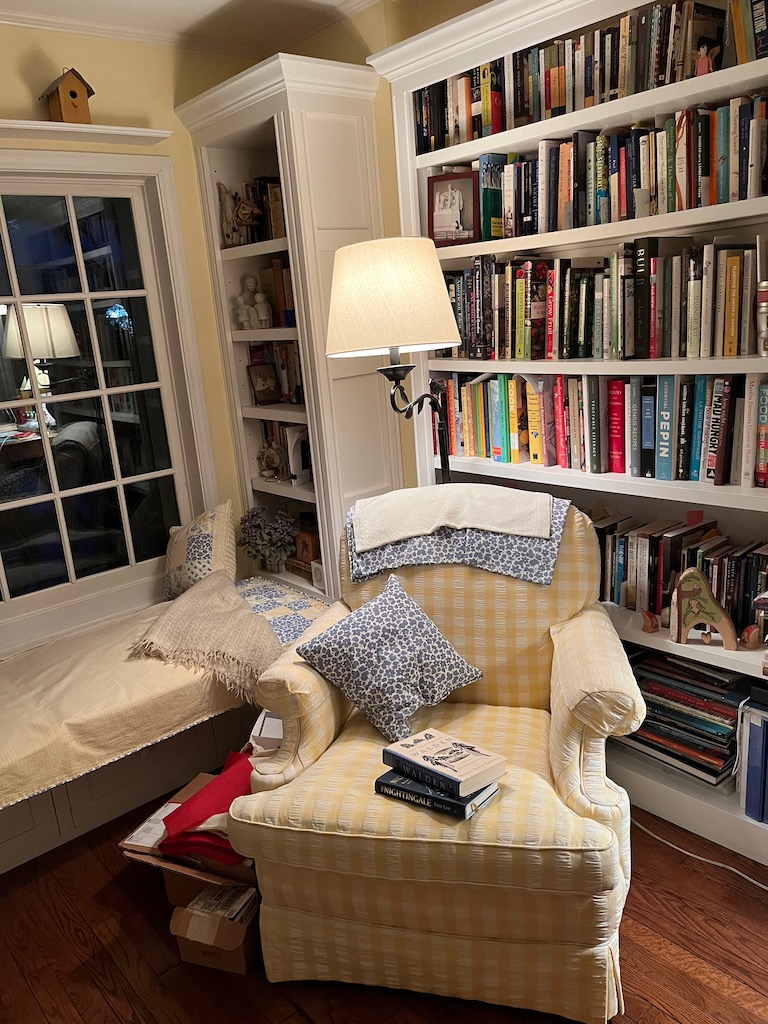
so here’s the question: how did you find the chair?

“THE BIRTH (NEAR PORT WILLIAM),” BY WENDELL BERRY

They were into the lambing, up late.
Talking and smoking around their lantern,
they squatted in the barn door, left open
so the quiet of the winter night
diminished what they said. The chill
had begun to sink into their clothes.
Now and then they raised their hands
to breathe on them. The youngest one
yawned and shivered.

                         “Damn,” he said,
“I’d like to be asleep. I’d like to be
curled up in a warm nest like an old
groundhog, and sleep till spring.”

“When I was your age, Billy, it wasn’t
sleep I thought about,” Uncle Stanley said.
“Last few years here I’ve took to sleeping.”

And Raymond said: “To sleep till spring
you’d have to have a trust in things
the way animals do. Been a long time,
I reckon, since people felt safe enough
to sleep more than a night. You might
wake up someplace you didn’t go to sleep at.”

They hushed awhile, as if to let the dark
brood on what they had said. Behind them
a sheep stirred in the bedding and coughed.
It was getting close to midnight.
Later they would move back along the row
of penned ewes, making sure the newborn
lambs were well dried, and had sucked,
and then they would go home cold to bed.
The barn stood between the ridgetop
and the woods along the bluff. Below
was the valley floor and the river
they could not see. They could hear
the wind dragging its underside
through the bare branches of the woods.
And suddenly the wind began to carry
a low singing. They looked across
the lantern at each other’s eyes
and saw they all had heard. They stood,
their huge shadows rising up around them.
The night had changed. They were already
on their way — dry leaves underfoot
and mud under the leaves — to another barn
on down along the woods’ edge,
an old stripping room, where by the light
of the open stove door they saw the man,
and then the woman and the child
lying on a bed of straw on the dirt floor.

“Well, look a there,” the old man said.
“First time this ever happened here.”

And Billy, looking, and looking away,
said: “Howdy. Howdy. Bad night.”

And Raymond said: “There’s a first
time, they say, for everything.”

                                   And that,
he thought, was as reassuring as anything
was likely to be, and as he needed it to be.
They did what they could. Not much.
They brought a piece of rug and some sacks
to ease the hard bed a little, and one
wedged three dollar bills into a crack
in the wall in a noticeable place.
And they stayed on, looking, looking away,
until finally the man said they were well
enough off, and should be left alone.
They went back to their sheep. For a while
longer they squatted by their lantern
and talked, tired, wanting sleep, yet stirred
by wonder — old Stanley too, though he would not
say so.

          “Don’t make no difference,” he said
“They’ll have ’em anywhere. Looks like a man
would have a right to be born in bed, if not
die there, but he don’t.”

                         “But you heard
that singing in the wind,” Billy said.
“What about that?”

                         “Ghosts. They do that way.”

“Not that way.”

                         “Scared him, it did.”
The old man laughed. “We’ll have to hold
his damn hand for him, and lead him home.”

“It don’t even bother you,” Billy said.
“You go right on just the same. But you heard.”

“Now that I’m old I sleep in the dark.
That ain’t what I used to do in it. I heard
something.”

               “You heard a good deal more
than you’ll understand,” Raymond said,
“or him or me either.”

                        They looked at him.
He had, they knew, a talent for unreasonable
belief. He could believe in tomorrow
before it became today — a human enough
failing, and they were tolerant.

                                 He said:
“It’s the old ground trying it again.
Solstice, seeding and birth — it never
gets enough. It wants the birth of a man
to bring together sky and earth, like a stalk
of corn. It’s not death that makes the dead
rise out of the ground, but something alive
straining up, rooted in darkness, like a vine.
That’s what you heard. If you’re in the right mind
when it happens, it can come on you strong;
you might hear music passing on the wind,
or see a light where there wasn’t one before.”

“Well, how do you know if it amounts to anything?”

“You don’t. It usually don’t. It would take
a long long time to ever know.”

                                 But that night
and other nights afterwards, up late,
there was a feeling in them — familiar
to them, but always startling in its strength —
like the thought, on a winter night,
of the lambing ewes dry-bedded and fed,
and the thought of the wild creatures warm
asleep in their nests, deep underground.

Wendell Berry

**sixteen, in case you wondered, is how many years the chair has been this quiet little place where these days we gather every friday morn. or at least that’s when i pull up a chair. you’re welcome to stop by any time, stay as long as you’d like. or, for years and years….’twas launched, the chair was, on 12.12.06, with this little post…

’tis always the season for futzing . . . (at the cookstove, anyway . . .)

a hundred thousand years ago, at a bend in my life when i was mostly a dreamer, and under a rather dark cloud, i hoped i might grow up to be the sort of someone with friends who come for saturday lunch. i’d also hoped i’d live in a house where the walls were stacked in books, rows upon rows of them. and, for reasons that escape me, i dreamed of a bespectacled mate, one with his nose often in books; something of the professorial sort. check, check, and check, lo and behold.

not a day goes by that i don’t all but bend my creaky knees, and press them against the floorboards, whispering not only thank you’s, but practically screeching, holy mackerel how did my dimly-lit hopes come tumbling true?

but about that saturday lunch: there is something in particular about company lunch on a saturday that seems so, well, civilized. cultured, even. people with big ideas come for lunch. to get a jump on the thinking perhaps. to cogitate and prognosticate by the light of the sun. (people who want to plop on a couch inhaling hotdogs and football, they come for lunch too, but they’re not the ones of my attention today.)

dinner by candlelight is a whole nother thing, a thing that might entail the tucked-away china and silver. lunchtime, though, is cozier, maybe with a soupçon of euro-sophistication (it’s long been a way of life in paris, barcelona, or rome to insert a midday pause in the chaos, and relish a slow, sumptuous feast, unfurled in the afternoon’s heat.) and, besides, anything more haute than PB&J suggests true commitment to kitchen wizardry.

those who come for lunch, maybe can’t wait.

lunchtime company kicks off their shoes. settles in for old-fashioned simple foods. bounties built on the basics: soup, cheese, bread, fruit, unfettered sweets. (i suppose my tastes––even in menus––tend toward the monastic.)

but it’s not something i’ve ever done much of. not the sitting-down sort of a lunch. the lunch that’s not pulled from a grease-splattered paper sack, or laid out on the rickety old door of a table i refuse to retire out on our porch (the protests rise higher and higher, summer after summer, as the rickety door grows more and more rickety, but i like it too much to admit its demise).

at six-point-five decades and counting, i am still very much stumbling along. trying to make good on a few more of my dreams before my time is expired.

so it’s no small deal that company’s coming for lunch on the morrow. this particular company is coming with a wee baby, the most scrumptious sort of company i can imagine (especially since i’m not seeing any babes anywhere on the horizon here at this old house). this company is someone i dearly love though i’ve only just known him for the last several months (it was pretty much love at first zoom). he’s a new papa who is achingly in love with his new baby boy. and because he wrote me a bracingly beautiful, deeply vulnerable, letter the other day, i know this lunch will commence in the deep end, where feelings hew close to the heart, and eloquent words are put to the truths. i imagine there might be a tear or two, adding a droplet of salt to the menu.

in dreaming up the sort of lunch that might set the mood for the day, i settled on high comfort: grilled cheese and tomatoey soup, though i’m taking both up a whole notch.

grilled cheese is truly straightforward: bread + butter + cheese. sizzle low and slow for high-level melt. my aim is to dream up a scheme to make these ahead, and slice them into fingers, thus giving me the chance to stack them into a geometry of puzzling dimension (think: jenga of oozy-cheese strips).

and the soup prompted a deep dive into the cookery books, where i’ve settled on a non-negotiable trinity: san marzano tomatoes (tinned, as the lovely brits would put it), basil in leaves and stems, and rind of parmesan. a dribble of red-pepper flakes, an ooze of olive-y oil, a few cloves of garlic, and an overnight slumber in the fridge should provide a bowlful of summer in the darkening days of early december.

because i’m an inveterate futzer, and usually can’t manage to leave well enough alone, i almost never take one recipe’s word for the matter. i like to peruse and muse, and mix things up, culling my plot till it’s just the right calibration. in my mind, i’m cooking before i ever step near the cookstove, before i’ve laced up my apron strings.

because we’re at the cusp of the darkening season, with a few more weeks till the longest, darkest night of them all, it seems a fine moment to haul out the soup pot, and commence the stirring.

here, should you have reason for a saturday lunch, and find yourself in the mood for a summery bowl, is my game plan for provencal tomato, basil, parmesan soup, brought to you by a cooking collective.

Tomato, Basil, Parmesan Soup, a collective effort…

call me a futzer, or call me a fiddler (or maybe even a muddler), i cannot keep from plucking a little this, a little that, to reach for the stars. And so it goes at the cookstove, when more often that not i stand with an array of roadmaps and mull over the smart way to go. a parmesan rind from Column A, stems of basil from B. 1 + 1 = 3 in my arithmetic book. 

here’s my final equation, when the assignment was a splendid tomato basil soup with undernote of parmesan for saturday lunch with a friend….

Provençal Tomato, Basil, Parmesan Soup

By Martha Rose Shulman and Ali Slagle and Babs

Time: 1 hour
Yield: Serves four 

Martha learned to make this soup years ago when she lived in France. She tells us that if there are no fresh tomatoes at hand, use canned. And she thickens with rice or tapioca, which we’re forgoing, at least on the first go-round. Ali chimes in: “What if you could have a tomato soup that was as plush as a cream of tomato but tasted like pure tomato? Enter Parmesan. Simmering tomatoes with a Parmesan rind is like seasoning a bowl of soup with a shaving of cheese 100 times over. It gives the soup an undercurrent of savory fat and salt that only bring out tomato’s best sides. Many specialty groceries sell containers of rinds, but if you can’t find any, stir 1⁄2 cup grated Parmesan into the final soup (or cut off the rind of a wedge you’re working through). Rinds will keep in the freezer for forever, so start saving.” Babs echoes and amplifies both, having plucked the very best bits from each of the kitchen geniuses.

INGREDIENTS
1 tablespoon extra virgin olive oil
1 medium onion, chopped
4 to 6 garlic cloves (to taste), minced
1/2 tsp. red-pepper flakes
Salt to taste
2 (28-ounce) cans whole peeled San Marzano tomatoes with juice, or 4 pounds tomatoes, cored and diced
Pinch of sugar (optional)2 large sprigs basil, or about 16 leaves, plus 2 tablespoons slivered basil for garnish
[i’m skipping Ali’s call for 1 quart water (or 1/2 wine, 1/2 water), because i’m doubling up on San Marzano tomatoes]
6 ounces Parmesan rind
 Freshly ground pepper to taste
1⁄4 cup rice or tapioca (optional; i’m trying without it. if necessary, we’ll float our grilled cheese bits in the tomatoey pond.)

For the Garnishes
Garlic croutons (thin slices of baguette, lightly toasted and rubbed with a cut garlic
Grated or shaved Parmesan 

PREPARATION
—Heat oil over medium heat in a large, heavy soup pot or Dutch oven. Add onion. Cook, stirring often, until tender, about five minutes. Stir in half the garlic and a generous pinch of salt. Cook, stirring, until fragrant, about 30 seconds to a minute. Add the tomatoes, sugar (if adding), basil sprigs or leaves and remaining garlic. Cook, stirring often, until tomatoes have cooked down and smell fragrant, 15 to 20 minutes. 

––Add Parmesan rind and salt to taste. Bring to a simmer, cover and reduce the heat to low. Simmer 30 minutes. (If adding the tapioca or rice, add it at the 15-minute mark, then simmer for the remaining 15 minutes until tapioca is tender and the soup fragrant.) Remove basil sprigs and Parmesan rind. Puree in a blender in small batches, taking care to place a towel over the top of the blender and hold it down tightly. (Martha adds: If you used fresh unpeeled tomatoes and want a silkier soup, put through a strainer, using a spatula or the back of a ladle to push the soup through.) Return to the pot, add pepper to taste and adjust salt. Serve garnished with garlic croutons and/or Parmesan, if desired, and slivered basil leaves. If serving cold, refrigerate until chilled. 

Tip:
 Advance preparation: The soup will keep for two or three days in the refrigerator and can be frozen. 

what wintry recipe will you be bringing to your lunchtime table?

leftovers . . . (and a few other morsels besides)

the dishes are mostly done––except for a few errant goblets. the cutting board is oiled and tucked away for a well-deserved slumber. the beds at the top of the stairs are finally all full, and certainly rumpled. (a triple delay between newark and o’hare made me wonder if boy No. 1 would ever get home.) along the day, no one got cut, or burned, or splashed with red wine, and other than bellies too full, we escaped without harms.

it was in fact as hilarious and raucous and savorable a day as ever could be––testament to julian of norwich’s promise that all shall be well, and all shall be well, and all manner of thing shall be well. (i need to inscribe that on my kitchen wall, as i fret and perseverate and plot and re-plot my time charts and checklists, clocked to the quarter hour.)

my prayer is that your day, too, rolled out without a hitch. or at least no unfixable hitches. i know there were empty chairs, and hollowed hearts to go with them. i know some forsook big birds, and all the fussing. but deep down i hope a trickle of grace and gratitude slipped in through one of the cracks.

while the rest of the world races to the mall, or speed dials black-friday shopping deals on their keypads and phones, i’m taking to the woods, or the simple turning of pages. and i’m leaving just a few morsels here.


poets corner: first up, from ross gay, the bloomington, indiana-based poet whose “catalog of unabashed gratitude” is a fine place to begin:

“And thank you, too. And thanks
for the corduroy couch I have put you on.
Put your feet up. Here’s a light blanket,
a pillow, dear one,
for I can feel this is going to be long.
I can’t stop
my gratitude, which includes, dear reader,
you, for staying here with me,
for moving your lips just so as I speak.
Here is a cup of tea. I have spooned honey into it.”


nature beat: once upon a time in november of 1947, a poet by the name of jack kerouac sat at his mother’s kitchen table in the working-class ‘hood of ozone park in new york city. he’d just coined the term “beat,” (a word in which he saw double meaning, derived from both “beaten-down” but also “beatitude”), and while waiting to see if he might ever get anything published, he unleashed these lines on november’s harsh winds and inked them into his journal (posthumously published as Windblown World: The Journals of Jack Kerouac, 1947–1954):

Powerful winds that crack the boughs of November! — and the bright calm sun, untouched by the furies of the earth, abandoning the earth to darkness, and wild forlornness, and night, as men shiver in their coats and hurry home. And then the lights of home glowing in those desolate deeps. There are the stars, though! high and sparkling in a spiritual firmament. We will walk in the windsweeps, gloating in the envelopment of ourselves, seeking the sudden grinning intelligence of humanity below these abysmal beauties. Now the roaring midnight fury and the creaking of our hinges and windows, now the winter, now the understanding of the earth and our being on it: this drama of enigmas and double-depths and sorrows and grave joys, these human things in the elemental vastness of the windblown world.

Jack Kerouac, 1947

storybook corner: i stumbled onto a wonder from nobel-prize winning polish novelist olga tokarczuk the other day, a mostly-picture book titled the lost soul. it’s the tenderest story of a man who’s lost his soul, and in the whole book there are only four pages of text (and three of those are barely a few lines long). the story picks up here:

“once upon a time there was a man who worked very hard and very quickly, and who had left his soul behind him long ago.” a paragraph later we find that “during one of his many journeys, the man awoke in the middle of the night in his hotel room and he couldn’t breathe. . .”

he visits a wise, old doctor who tells him: “if someone looked down on us from above, they’d see that the world is full of people running about in a hurry, sweating and very tired, and their lost souls, always left behind, unable to keep up with their owners. the result is great confusion as the souls lose their heads and the people cease to have hearts. the souls know they’ve lost their owners, but most of the people don’t realize that they’ve lost their own souls.”

the wise old doctor’s prescription: “you must find a place of your own, sit there quietly, and wait for your soul.”

and so the man waits. and waits. and waits some more. and with nary another word, we finally see his soul come knocking at the door of a little cottage on the edge of the city, where the man had gone to sit in pure quiet.

and here’s the happy ending: “from then on they lived happily ever after, and john (the man) was very careful not to do anything too fast, so that his soul could always keep up with him. he did another thing too––he buried all his watches and suitcases in the garden. the watches grew into beautiful flowers that looked like bells, in various colors, while the suitcases sprouted into great big pumpkins, which provided john with food through all the peaceful winters that followed.

and may this day in the wake of so much blessing be filled to the brim with the pure joy of savoring –– all without timetables, and stopwatches, and sinks to be scoured.

which will be the first leftover you sink your fork into???

a jump on counting my blessings . . .

photo by will kamin*

the days of late have been plenty gray, sodden gray, gray the color of chimney ash. 

the gray started seeping into me especially this week when someone i love lost her father who might have qualified as one of the dearest men on earth. he was 97 and as alive and filled with curiosity and charm as anyone whose tales i’ve ever known through the close transitive property of one shared soul. i’d never met him, though i longed to, but he came alive to me because his daughter, our very own amy of the chair, told the most animated love-drenched stories of him. his last name was neighbour, and i am pretty sure his amy must have grown up thinking the whole world was singing along with mister rogers when the sweatered one belted, “won’t you be my neighbour?” because who wouldn’t want to be hub neighbour’s neighbor??

the grayness, though, started to shatter when i looked up late yesterday afternoon and saw not one, not three, but six scarlet cardinals circling round my feeder, taking turns at the 0s where the seed dribbles down for the plucking. 

that’s all it took to remind me to count my blessings. 

so i begin with six: cardinals, all in a ring, chasing away the murky gloom of twilight, chasing away the murky shadow that’s been eclipsing a chunk of my soul. . .

more blessings: 

the boy driving home from college on sunday. the dinner i’ll serve, a birthday feast for my very own mama who turned 92 this week, and who longs for birthdays to end, so she can “go home,” to the heaven she pines for. . .

the boy flying home on thanksgiving morn, when his hours among us are brief, too brief, but at least he’ll be here long enough for me to reach under the table and give his fingers a squeeze. and that hallowed night i’ll fall asleep to the sounds of two boys in two ‘cross-the-hall rooms rustling the sheets of their boyhoods, snug in their long-ago beds. . .

the faraway cousin who bathes me in books, this week’s batch a quartet on the birds and wild herbs and trees and critters of ireland, complete with marvelous lore and legend. (according to one celtic telling, the robin is the bird thought to bring comfort to the wounded and suffering. and here’s my favorite part: the plump little bird came to boast its red breast, according to the heavenly irish, when it pulled either a thorn from Jesus’s crown while he hung on the cross, or a nail from his hands or his feet, so Jesus’s blood spattered on the robin and thus it became red-breasted.) . . .

the husband who sits across from me at dinner each night, fielding my curiosities and never ever failing to say thank you for a dinner he always claims “delicious,” (even, i swear, when it’s not). and who, even after all these years, can set my heart soaring because of the way he captures a thought or a phrase, and whose unheralded kindnesses often only i witness. . .

these lines i read from rabbi jonathan sacks’ posthumously published, studies in spirituality: a weekly reading of the jewish bible (more on this some other friday), in a chapter on judaism as a religion of listening . . .

“If I were asked how to find God, I would say: Learn to listen. Listen to the song of the universe in the call of the birds, the rustle of trees, the crash and heave of the waves. Listen to the poetry of prayer, the music of the Psalms. Listen deeply to those you love and who love you. Listen to the words of God in the Torah and hear them speak to you. Listen to the debates of the sages through the centuries as they tried to hear the texts’ intimations and inflections. 

“Don’t worry about how you or others look. The world of appearances is a false world of masks, disguises, and concealments. Listening is not easy. I confess I find it formidably hard. But listening alone bridges the abyss between soul and soul, self and other, I and the Divine.”

Rabbi Jonathan Sacks

the poet friend who’s found the courage to once again plunk herself at my so-called kitchen table writing school (virtually, this go-around), so we can try to chase away whatever demons spook her into thinking she can’t write when in fact she writes in a way that takes my breath away. . .

the friend who never fails to ping me when there’s a glorious moon rising or looming out my late-night window. . .

every single one of you who pulls up a chair. for all these years, known or unknown, you have graced me and blessed me. . .

that’s more blessings than i can count, and i am only just beginning. 

what lines are you adding to your litany of gratitudes this year?

*photo by will kamin, from his AP art photo portfolio from his senior year of high school. now professor kamin, our very own assistant professor of law….

please keep our amy in your prayers. and the soul of her papa.

slow birding

A force in us drives us to the untamed. We dream of the wild, not the domestic, for it is wildness that is unknown….It can be a daily need, a desire to connect with the wind, to live facing the unexpected.

What will bring us wildness in the places we live, domesticated with warmth and culture? For some, icy branches scratching together will suffice. A glimpse of a gibbous moon or a pomegranate-stained evening sky might help. But more than these, more than perhaps anything else, are the birds. These winged dinosaurs that have given up stored fat, hollowed their bones, and made many other compromises for flight––these organisms connect us with here and there, with then and now, as they chatter outside our windows or soar past our lives. 

Slow Birding: The Art and Science of Enjoying the Birds in Your Own Backyard by Joan E. Strassmann

i surrender my soul to anyone who looks out the window and sees so vastly, so deeply. someone who understands that the pulsebeat of all creation––timeless creation––is as near as the fluttering in the branch that scrapes against the panes of our window. 

joan strassmann, an animal behaviorist and beloved professor, is the someone who penned those words. she penned them in her new book, Slow Birding, a title that immediately caught my eye (and when i mentioned it to my birdwatching mother, she swiftly informed me she’s been slow birding forever; so much for novel ideas). strassmann writes that she, like my mother, has been a slow birder all her life, not one of those birders frantically motoring hither and yon for a quick glimpse through the binocular lens, a scribbled addition to the “lifelist,” and then onto the next spotting. strassmann is not about “spotting.” she’s about slow-paced study. about taking the time to delight in the humors, startle at the spats (as even regal papa cardinal squawks away the lowly sparrowly choristers), marvel at the parabolas of flight, as feather takes on the wind. she’s all about absorbing the wonder. 

here at my cloister-in-the-making, where the walled garden soon will be serpentined with climbing hydrangea, where an elegant and capacious shingle-roofed bird B+B has been ceremoniously mounted on an elegant hand-carved post (the resident architecture critic thought it would be nifty if the scrolled brackets of the house were matched by post brackets that echoed the scrolling; and our beloved jim the builder obliged), it’s the feathered flocks that spring the whole place to life, to effervescent animation: the crimson troupe of cardinals, the squawking trio of jays, the countless sparrows, the occasional and pesky grackles, the ominous hawk.

with a mind toward soothing and stoking the soul, we’ve pared our dwelling here in this old house to an unfettered few balms: armchairs are ample and poised for conversation, a fireplace crackles with logs from the forest, books line the walls, hours are filled with the quiet of pages turning and spices simmering on the near-ancient cookstove. 

it’s the birds who bring the wild to our windowsills and put flight to our wondering. my housemate here, the aforementioned architecture critic, a man who makes an art of the rhythm of routine, has made it his solemn and devoted morning chore to scoop up a tin of seed and ferry it out to the flocks. whenever i can manage to beat him to the punch, i punctuate my seed dumping with a cheery call to the flocks, to let them know that breakfast is served. i refer to my birds in the diminutive. “here, sweeties,” i call, much to the dismay, i fear, of the neighbors. (but, oh well, they put up the fence so i can do as i wacky-well please in my now-secret walled garden.)

and even though our birding has always been slow, i find strassmann’s intentionality, her keen and fine-grained observations of the ways of each and every genre of bird, has me upping my game. putting down distraction, training my eye out the window for longer and longer spells of the day. taking note of peculiar particulars i might otherwise miss. (it’s excellent training for the whole of one’s closely examined and attentively-lived sole chance at life.)

strassmann passes along the wisdom of famed ornithologist margaret morse nice whose instruction is at once spare yet richly complex: sit still and watch. draw what you see, perhaps, the singular birds who flutter and flit. befriend them. scribble notes in a journal you keep by the window. 

but why a whole book, a 334-page book, if the instruction itself is so brief? well, strassmann explains that she delves into the intricacies of sixteen birds––and five bird-watching places––because to know the ways of the birds, to know each particular one’s biological story, is to illuminate all the more what we might otherwise be utterly missing out yonder. and thus we might look and look more closely.

the stories, obtained over the lifetimes of various ornithologists who trained their lenses on a single question or puzzle or species, might leave you oohhing and ahhing and racing to windows.

for instance: blue jays––noisy, bossy––are “the most american of birds, occurring in every state” (though not a single state claims the jay as its state bird); the american robin is the “earthworm whisperer,” and when a robin cocks its head toward the earth, it’s listening for the rustle of the underground worm; the ubiquitous sparrow is a bird with roots in bethlehem (yes, that bethlehem), and once was considered a pot-pie delicacy (thankfully those days are behind us––and the sparrow); and finally, the cardinal has reason for chasing after the reddest of berries: the carotenoids in the fruits make for a deeper red of its feathers (and not only that, but the redder the cardinal, the more desirable it’s regarded in the feathered fiefdom of red-bird mating).

it’s all endlessly wondrous to me, the alchemy of poetry and science and feather on air, the proximity of the wild, the animations of beings both social and singular. 

there is something about the delicate ways of the avian world, something about the simple existence of seed and nest, flight and song, that stirs in me an exercise of the prayerful. it’s as close as i come to the wild day in and day out, and it draws me every time into a marveling that makes me sense i’ve been brushed by the holy divine. 

what will you do slowly today?

the other night i was blessed to sit and listen in proximity to pádraig ó tuama, who among many wonders spoke about how he loves birds and irish names for birds, and i was enchanted. because he’s as kind and generous as he is brilliant, yesterday afternoon he sent me the poem he’d read—“now i watch through an open door”––with the irish names for various birds woven into the poetry, and so i am including here the last stanza, with the names highlighted and i’m adding a little glossary below, so you too might be enchanted by the names the irish put to their birds…..

Oh forest flame, oh young light on the old oak,
oh small brown druid I hear
but never see. Oh red king of the morning, oh dainty feet
among the dungheaps, and fierce goose
with fierce goslings, oh muscled hare, russeted
by the long evening. Oh my
low deer, powerful and insignificant,
oh glen, oh magnificent.

irish names for birds:

*goldfinch: “bright flame of the forest” 

*wren: “brown druid”

*chaffinch: “red king”

barn owl: “graveyard screecher”

red wing: “little red one of the snow”

meadow pipit: “little streaked one of the bog/moor”

kestrel: “wind frolicker”

bullfinch: “little scarlet one of the woods”

greenfinch: “little green one of the oak tree”

oh, sigh, oh magnificent irish….

one last thing: i’ve been invited by a dear friend, the poet mark burrows, to partake of a celebration of the great austrian-bohemian poet rainer maria rilke, on dec. 4, rilke’s birthday. i quake to tell you that we’ll be in conversation with none other than pádraig ó tuama, and the details are spelled out in the flyer below. and you can find out more and register for the free zoom program here. (you’ll need to scroll down a wee bit; it’s the third in the roster of events…) (my favorite part of the flyer is where it notes the time of the event in ireland! be still my ol’ irish heart….)

and that, dear friends, is it for the week. be well, and be slow….

george booth has died and other news of the week…

George Booth, the New Yorker cartoonist who created a world of oddballs sharing life’s chaos with a pointy-eared bull terrier that once barked a flower to death, and sometimes with a herd of cats that shredded couches and window shades between sweet naps, died on Tuesday at his home in Brooklyn. He was 96.

so begins the new york times obituary of a man who infused my childhood. no, he didn’t frequent the five-and-dime in our leafy little town. he didn’t populate the pews of our native church. he came in the mail. every week. and in the weeks when he graced the cover, or was tucked inside the confines of william shawn’s new yorker (known as “the holy grail for cartoonists”), you could count on tracking down my mother if you traced the vapors of her out-loud laughing to where you’d find her giddily all but hiding behind the glossy pages of the slick. she would laugh, back then and even now, in a way that made you think there was something almost-naughty about those pages, which of course made us, her troupe of five, scamper to its pages soon as she abandoned it on the stack of mail, where hours later our ad man of a dad (who never met a joke or pun he didn’t relish) would saunter on the scene and chuckle at whatever was the funny. 

george booth proved to us that our mother — the very one who trained us to eat our peas and lima beans without complaint, and never tell a lie, to ne’er ignore the dinner bell, and always look both ways –– had a secret compartment full of almost-naughty humor. and if we kept close watch, we too might figure out the shortcut to some eternally redemptive funny bone. 

thus, coming upon the news that mr. booth has died this week, and that his wife of 64 years had died a mere six days earlier (such tales of love and lives that end in stunning unison nearly always make me weak at the knees), i felt a thud to the heart that only certain deaths elicit. 

there is a minor cast of characters in every childhood — the names that brought applause, the ones whose books most frequently recurred, the ones whose movies brought us the rare chance to blow a bedtime  –– who indelibly marked our evolution, and maybe formed the foggy outlines of who we aimed to be when we grew up. or at least what attributes we might try on for size. 

if i close my eyes and tick through the litany of those my mother ushered in, the ones held up in near heroic halo, it’s george booth & co., the new yorker cartoony cast; peg bracken, she of the i hate to cook cookbook; it’s doris day and julia child, all of whom made my mother giggle. it must have been the giggle that so allured. it was a merriment i must have longed for, and long for still. laughter belongs to a human register all its own, audible proof of joyful stirring deep inside. w. h. auden once observed: “among those whom i like or admire, i can find no common denominator, but among those whom i love, i can: all of them make me laugh.”

thank you, mr. booth, for bringing laughter, so much muffled laughter, to the house where i grew up.

in other news, i find myself absorbing the miracle of 70-degree november days. took me a long time — too long — to learn to freeze-frame pure joy and deep-down contentment. but now the hours of my days are as if beads threaded on a string, not unlike the rosaries i long ago learned to pray: mysteries joyful, sorrowful, glorious, and luminous. not a bad paradigm for living. learn to live bead by bead, moment to holy saturated moment. allow each orb to shine in all its constitution, be it radiant or shadowed or somewhere in between. and the beauty of these days, when the leaves are blazing paint-pot hues –– aubergine and persimmon, pure gold and harvard crimson –– they tap me on the soft shell of my soul, and whisper: this is holy time. behold it well. 

george booth would make me laugh at that. but he’s no longer here. so it’s on us to find the humor hidden in the chaos of the every day. 

who comprised the minor cast of characters in your growing up years? who made your mama laugh or cry, who or what did you aspire to be when you grew up and moved away from home?

this is booth’s cartoon in the immediate wake of 9/11, when the new yorker had decided no cartoons for that issue, but george submitted this anyway; the cat covering its face with its paws, the usually animated fiddle-playing miss rittenhouse (a recurring character modeled after booth’s mother), head down, hands clasped in prayer, sadly silenced by it all.

musings on sainthood . . .

soon-to-be-beheaded st. babs

i’m actually in amherst, massachusetts, this morning, about to traipse over to the homestead, the butter-yelllow brick house where emily dickinson was born and penned her nearly 1,800 poems, and i’m even hoping for a peek into the upstairs room where it all flowed from her inkwell, a room not normally on the itinerary of those who tiptoe in hushed tones through the hallways of emily’s house on the hill. but with an eye toward next week’s all saints day (a day that’s always captured my imagination), i spent a bit of this week musing on sainthood, just another name for what this world needs abundantly, urgently, in the form of plain old honest-to-goodness holiness, empathy, unheralded kindness, and megadoses of humility.


saint (n.)

early 12c. as an adjective, seinte, “holy, divinely inspired, worthy of worship,” used before proper names (Sainte Marian Magdalene, etc.), from Old French saint, seinte “holy, pious, devout,” from Latin sanctus “holy, consecrated,” past participle of sancire “consecrate.” It displaced or altered Old English sanct, which is directly from Latin sanctus.


i’ve had my eye on the saints since i was a wee thing. in the catholic imagination of my first and second grade, i thought hard about the haloed ones held up in the pages of my religion books. we were schooled to be demure, kind (endlessly kind), and enamored with Jesus (always dashingly handsome with his ambered skintones and long flowing locks in the full-color catechism primers, which wisely omitted most of the stories of tortures to which the anointed had had to submit). 

every night, i prayed to be saintly and attempted what i thought might be a postural shortcut: i began by smoothing my patchwork covers, then i’d lie as still as the mummies that scared me in the darkened chambers of chicago’s labyrinthine field museum of natural history, and then––the clincher––i clasped my hands in my best saintly imitation and hoped to move not even a squiggle during the night, to awake still clasped in prayerful pose. it seemed the first in a series of requisite feats on the dusty pilgrimage to sainthood.

by day, i practiced my fledgling aspirations on a lady bug, my fumbled attempt at assisian communing with all of creation. i built her a village––complete with steepled church––and ordained her high priestess of the cardboard hamlet. i checked on her last thing at night, and first thing in the morning, making sure her wings still opened and closed, and that she hadn’t succumbed to inside air. then i let her go. opened the window and unfurled the chant: “go little lady, go free!” and off into the orchard behind our house she flew, the happiest well-loved ladybug that ever there was. 

since i’ve long been an ecumenicist at heart, and don’t subscribe to any of the ecclesial hoops and tangles that dictate who’s in and who’s out in the saintly department, i go about my saint-watching by intuition and impulse. i know a saint when i see one or sense one. a saint to me is just another name for someone whose deep-down goodness is pure as pure can be. while catholics insist on a step-ladder to sainthood, other world religions seem just as intent on holiness but without the boxes to check. according to page 8033 of the thomson gale encyclopedia of religion (2nd edition):

“Historians of religion have liberated the category of sainthood from its narrower Christian associations and have employed the term in a more general way to refer to the state of special holiness that many religions attribute to certain people. The Jewish hasid or tsaddiq, the Muslim waliy, the Zoroastrian fravashi, the Hindu rsi or guru, the Buddhist arahant or bodhisattva, the Daoist shengren, the Shinto kami and others have all been referred to as saints.”

the best of the saints (hasids, waliys, fravashis, gurus, bodhisattvas, shengrens, kamis), in my book, are the quotidian ones. the ones whose everyday garb keeps them from being noticed. except for their kindness, the certain radiance they leave in their wake, the sense that something holy has just brushed by, you might not notice the saintly among us. 

but they leave behind a mark, a certain mark, a change of heart, a new expanse of seeing. we become better, bigger of heart and soul, kinder, gentler, maybe quieter, certainly softer, because of them. that’s saintly to me. 

among the saints i’ve known in my life, there was the old wrinkled man who perched on a fire hydrant befriending the pigeons. “i’m really advertising to the public how easy it is to be good without an attitude; it’s just as easy to show decency as it is to hate today,” joe zeman, the pigeon man of lincoln square once told me. 

and there was the foster mother who’d taken in nearly 100 newborns, and who was sitting by a hospital crib when she looked up and told me: “i’m no mother teresa,” she insisted, wrapping her fingers around a metal rung of the crib, as her littlest toddler was being infused with drip after drip of cancer-fighting chemo. “i always think of something i saw in the New World (a catholic newspaper) in which a columnist was saying, `i’d hate to be in line at heaven’s gate behind mother teresa when God looks down and says, `you could have done more.’”

even now, when it’s no longer my job to scour the landscape in search of those sorts of souls whose goodness leaps off the newspaper page, i find saints in the unlikeliest places: behind the cash register at the grocery store; in the catering office of my college kid’s dining hall; at a check-in gate at america’s busiest airport; in the lady down the alley who never dresses in anything fancier than her mud-stained sweats but who routinely writes checks for thousands of dollars for families in trouble, be it escape from afghanistan or domestic abuse. (a secret i discovered only by listening closely, and connecting a dot or two.)

so what makes a saint a saint, or a hasid a hasid, or a bodhisattva a bodhisattva

is it answering to an otherworldly call, the whisper of the holy divine? is it believing that the glimmering lights of the public square are simply distractions; turning instead to a quieter code, one infused with boundless empathy more than anything: love as you would be loved? is it the courage to call out injustice, to muster the chutzpah to say, “this isn’t right. you’re treating her poorly. your words are scarring her, leaving welts where they’ve hit her.” is it emanating a peacefulness, a serenity, that comes from knowing yours is a timeless eternal, a blessing for ever and all time?

what makes a saint a saint, what makes holiness holy? 

it’s a question worth asking, but mostly it’s a question to put to work. what are the scant few things you might include in, say, a manual for the would-be saint, the very title of a poem i left here on the old maple table a few years ago, after coming upon them in a book i was reviewing for the tribune. i’ll leave the first lines here again, as a place to begin your own musings on sainthood. 

Manual for the Would-Be Saint
by Susan L. Miller

The first principle: Do no harm.
The second: The air calls us home.
Third, we must fill the bowls of others
before we drain our own wells dry.
The fourth is the dark night; the fifth
a subtle scent of smoke and pine.
The sixth is awareness of our duties,
the burnt offering of our own pride.
Seventh, we learn to pray without ceasing.
Eighth, we learn to sense while praying.
The ninth takes time: it is to discover
what inside the seed makes the seed increase.

(the poem goes on for 14 more lines…but you might be inclined to pen your own…)

because i’m so worried about the world, and the evils and horrors that seem to be steamrolling goodness, i’m thinking we might put forth a collective effort here, outline a framework for how we might bring a bolus of holiness into this world. have at it. i’ll chime in too…

what do you see or sense when you encounter someone you’re sure is steeped in a certain holiness, another name for the sainted?

emily d., the belle of amherst

contemplating hope . . .

In Any Event

If we are fractured
we are fractured
like stars
bred to shine
in every direction,
through any dimension,
billions of years
since and hence.

I shall not lament
the human, not yet.
There is something
more to come, our hearts
a gold mine
not yet plumbed,
an uncharted sea.

Nothing is gone forever.
If we came from dust
and will return to dust
then we can find our way
into anything.

What we are capable of
is not yet known,
and I praise us now,
in advance.

Dorianne Laux

i am contemplating hope, as it seems to me — and maybe to you, too — that we are living in a darkening world. a world whose headlines are chasing me away, whose headlines often sicken me. i find myself feeling the urge to draw within, to curl into a tight mollusk, a chambered nautilus of the soul. i look at flickers of the news and hear the echoes of history, a boomerang of hideousness i never dreamt would come this way again. 

i am giving thought to how to live in a world where darkness gathers, how to keep an ember glowing. in my soul and in my world. can random acts of kindness be enough to keep the incandescence from extinguishing? is unending prayer enough to shift the course of history, to undermine the ugliness that seems without end or purpose? has it ever been?

i’d been thinking more humility was the desperately-needed imperative, the very thing this self-obsessed world — intoxicated by celebrity, by overblown parading in the public square — most emphatically calls for. i still think so. humility in a world of supersized ego is as countercultural as can be. and it just might expand our gaze, allow us to see past our own blinding appetites, make us more willing to quietly, determinedly turn the other cheek. to be the necessary instruments of peace, to sow pardon where there’s injury, love where there’s hatred. it’s a centuries-old prayer, the prayer of st. francis, and it is true for me each and every morning. now more than ever.

but read a little further in the prayer, and it calls for hope where there’s despair. 

despair is spreading like a cancer. it undergirds the cynicism everywhere. it’s the magnetic pull toward apathy. it’s surrender punctuated with slamming of the door. it snuffs out every shard of light.

so now i’m thinking hard about hope, the counterforce of gloom, despondency, profound sorrow (each and every one, another name for despair). where does hope begin? how might we stir it? feel its updraft catch beneath our wings? 
i don’t have answers. 

in time, though, i may stumble on inklings.

but there are poets, now and ever. poets like dorianne laux, whose words came to me this week and made me feel that fetal kick that might be where hope begins. when someone wiser and deeper draws the faint outlines of the life ropes we just might need. 

dorianne laux

dorianne laux, who worked as a waitress, a sanitorium cook, a gas-station manager, and a maid before getting a BA in english at 36 from mills college in oakland (and has gone on to be a pulitzer finalist, and a guggenheim fellow), and who is absolutely one of my most beloved poets, begins with “fractured” in the poem above. 

fractured is how i sometimes feel. fractured has sharper edges than just plain broken. fractured is what bones do when they split and crack. sometimes hairline, sometimes compound. fractured makes a snapping sound. fractured is low-down broken. sometimes shattered.

but dorianne doesn’t leave us at fractured. she turns our gaze swiftly toward the stars, which are fractured too, but into pretty little points. and it’s the points of stars where the shining, twinkling comes. it’s where the light pings or oozes i don’t know which; i’m not a physicist of the heavens. i’m only someone who watches and wonders. maybe it’s where the light –– twinkling, shining –– bounces off the brokenness. it’s the brokenness that makes for the dizzying luminescence. stars in their brokenness are bred to shine in every direction. maybe that’s something to think about.

and then dorianne goes on to tell us that it’s not time yet to lament. “there is something more to come,” she promises. 

our hearts still are goldmines to be plumbed. our little bitty self-contained vessels of all that’s good, all that’s holy; no one’s got a right to reach in and steal those hearts, to tap those hearts of all that’s bottled up inside. all the sweet succulence of all the kindness we’ve known in our whole lives. all the times we’ve been forgiven. all the times someone gentle looked our way and whispered words that might have made us feel beautiful, and seen. don’t abandon those sacred hearts, turn over the keys to whatever evil awfulness might flatten you. guard those good and plenty hearts as if your life depended on it, as if the good world depended on it. because it does, it does. 

and so, dorianne was just the lifeline i needed as i began to consider hope, as i set out to figure out how to live wisely and luminously in a world where dark skies are growing denser in the distance. 

my considerations of hope are only just beginning.

What we are capable of
is not yet known,
and I praise us now,
in advance.

where do you find hope? does it come in faint traces, or in bold strokes that sometimes bowl you over? do you sometimes feel the hairline fractures in your heart or your soul? 

i let it rip this week. once upon a time, this would be the very sort of meander my mother-in-law would have met with deafening silence. too dark, she’d diagnose it. and leave me to second-guess the whole day long. should i have held back? but to ignore the chasms that rend us apart, push us away from one another, to ignore the fallout that inevitably shrouds the tender among us is to let the rot seep in till it’s too, too late. i am determined in my searching for hope. and thank you, dorianne, for pointing me in hopeful direction….

something screwy happened when i was typing and all of the sudden everything shrank. i tried and tried to fix it, but it might still be screwy. i’ll keep trying to fix it. till then, put on your magnifying lenses……

turning the page with a tug and a pull

we are definitely turning the page here at this old shingled house. the bespectacled architecture critic no longer calls me from the office at 8 at night, saying he’ll be stuck writing for a few more hours. there are no carpools to coordinate, no getting up at 5 in the morning for soccer matches in kingdom come. i’ve gotten used to the new geographies in my head, the ones that have me simultaneously keeping track of news, weather, and covid in new york city and the middlelands of ohio, the current turfs of both of our birthlings. 

somehow, without notice, without even a sign posting the warning, we’ve moved into the loveliest calmest quietest chapter of our married life that ever there was. (do not think of even uttering a syllable of the R word, the one synonymous with hanging up one’s professional hat; one of us has no intention of putting away the keyboard and the other seems to have taken up full-time swimming, biking, and running across finish lines). underscoring the shift, this year we’ll be racking up plenty of lasts in the kid department: the last college drop off. last parents weekend. last winter and spring breaks. last graduation. last packing up the dorm room. last whopping tuition bill. 

we are, very much so, on the final verge of true empty nesting.

it’s a mix tinged with poignancy, and a good measure of disbelief. time passes so swiftly, you suddenly realize. after years and years of thinking the routines will never be broken. poof, and they’re gone! 

we’re late to this party, only because i found myself in a delivery room when others i knew were there awaiting their grandbabies, but i was there because of what felt and always will feel like i somehow squeaked through the maternity ward as the very last egg was being cleared from the deck. and, as with so much in my life, i’ve been soaking it in from every which angle, taking none of it lightly, extracting as much as i possibly could at every twist, turn, and trial along the way. 

ours, these days, is a quiet life by choice. my favorite hours are nestled in books and on my knees in the garden, over coffees with people i love, and the dinners at the end of the day when we weave together the threads we’ve both followed all through the day. i know full well that every drop of it is pure blessing, a benevolence no one deserves, for life is not doled out in rewards and punishments. we just get what we get, and it’s ours to savor or squander. i’ve had more than enough hours staring into the shadowed abyss, imagining sudden endings, to perk up my relishing gears. (the bright side of being a doomsayer is that any and every happy ending is reason for rousing hallelujah. don’t mind my scrambled up wiring. seven decades in, it works for me just as it is.) 

anyway, this weekend’s the last-ever parents weekend, that glorious mix of scintillating speakers and professorial panels, long strolls across a campus straight out of the picture books, and delivering a pile of groceries and pies and blankets and boots only a college kid’s idiosyncratic tastes would relish or request (who else would send a middle-of-the-night text asking for portwine spread cheese, rubber-soled boots, and someplace good to go out for dinner?). i plan to savor every sweet drop, knowing not long from now i’ll pine for the chance to make-believe i’m a kid savoring college. (as long as i don’t peek in the mirror, and wonder who in the world is the one with the locks now the color of silvery moon.)

i know, because life has taught me over and over, whole new adventures await, and none of this will ever get dull. but i’ve loved this part where you hover fairly closely over the shoulder of the kids you’ve brought into the world, and feel your heart grow by the week and the month and the year. i know, because life is already teaching me, each of their new adventures becomes vicariously mine, and therein lies a whole nother joy. but now, here i am at the precipice looking both ways. and mostly i’m grateful for this heart that finds it hard to let go….


because we’re motoring back and forth in three short days (the weekend cut short by a work trip to houston for the one more apt to be running or riding these days), i’m keeping this short, and will leave you instead with two little morsels: a peek inside the little book that landed on my stoop the other night, and a soup i plan to make on one of the autumnal days next week when the critic is chowing down on texas barbecue. slow cooking is in sync with my slow, savoring ways. 

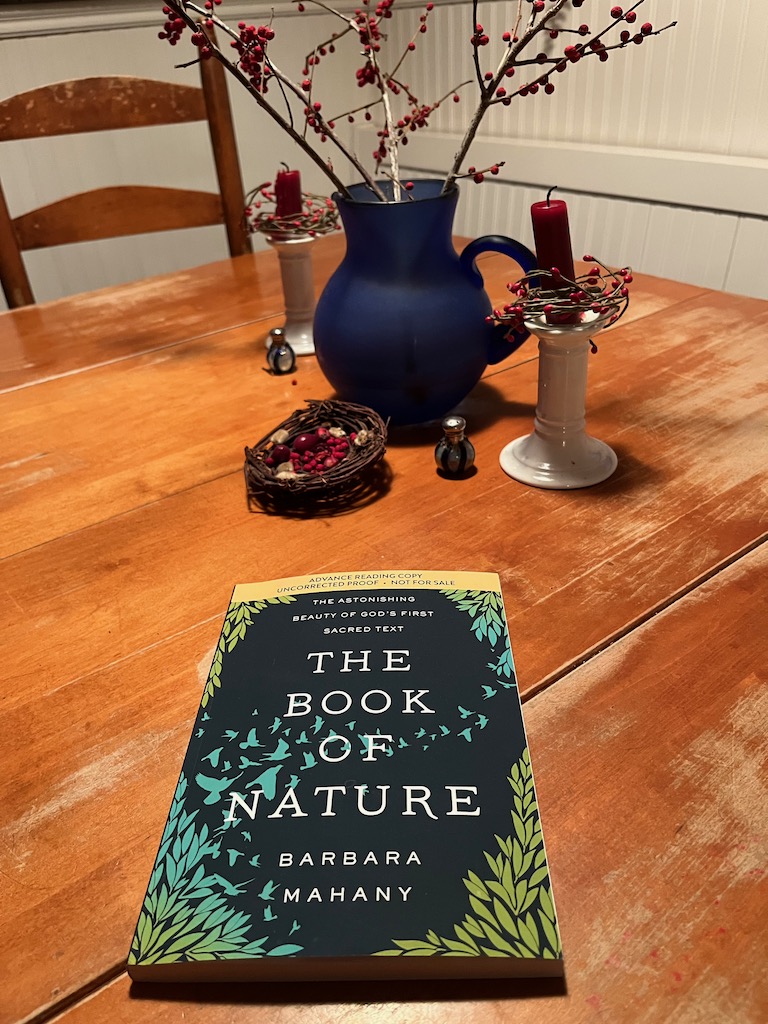
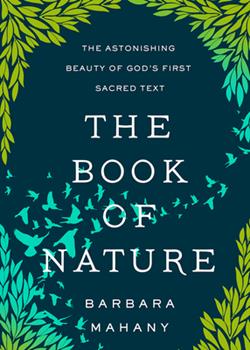
first, a peek at the Advanced Reading Copy of The Book of Nature, with a look at the cover, the table of contents, and the first page of the foreword.


photo by Bobbi Lin, NYT

Creamy Cauliflower Soup With Harissa Tomatoes
By Melissa Clark, The New York Times
Yield: 6 servings

INGREDIENTS
1 large head cauliflower (about 3 pounds), trimmed and cut into 1-inch florets (about 12 cups)
Kosher salt (such as Diamond Crystal) and freshly ground black pepper
1-1⁄4 teaspoons ground coriander
7 tablespoons extra-virgin olive oil, plus more for serving
1 small bunch thyme (about 10 sprigs)
1 pound plum tomatoes, halved, seeds scooped out
2 to 4 tablespoons harissa paste
3 large bunches scallions, whites and greens thinly sliced (about 21⁄2 cups)
1 jalapeño, seeded (if desired) and coarsely chopped
4 large garlic cloves, finely chopped
1-1⁄2 teaspoons ground cumin
1 tablespoon tomato paste
6 cups vegetable stock
3⁄4 cup chopped cilantro leaves and tender stems, plus more for optional garnish
1 lemon

PREPARATION
Step 1
Heat oven to 425 degrees and line 2 sheet pans with parchment paper.
Step 2
In a large bowl, combine cauliflower, 1 teaspoon salt, a large pinch of black pepper, 3⁄4 teaspoon ground coriander, 3 tablespoons oil and half the thyme sprigs, tossing everything until well coated. Spread the cauliflower evenly across one of the prepared pans.
Step 3
Using the same bowl (no need to wash it first), combine halved tomatoes, 1 to 2 tablespoons of harissa (depending on how spicy your harissa is; taste it first), 2 tablespoons olive oil, a large pinch of salt and the remaining thyme sprigs, and toss gently until the tomatoes are well coated. Spread tomatoes on the other baking sheet, cut-side up.
Step 4
Place both sheet pans in the oven and roast for 20 minutes, then stir the cauliflower but not the tomatoes. Continue to roast until cauliflower is golden brown and tender, 15 to 20 minutes longer (35 to 40 minutes total roasting time). Transfer cauliflower pan to a rack, and discard thyme sprigs.
Step 5
Using tongs, gently flip tomatoes over so their cut sides are down. Using the tongs, pinch off the tomato skins – they should slip right off – and discard. Brush 1 to 2 more tablespoons of harissa onto tomatoes and continue to roast until shriveled and condensed, about 15 to 25 minutes (35 to 45 minutes total roasting time).
Step 6
While tomatoes are roasting, make the soup: In a large pot, heat the remaining 2 tablespoons oil over medium. Add scallions (saving 1⁄4 cup scallions for serving) and jalapeño, and cook, stirring occasionally, until soft and lightly colored, 5 to 7 minutes. Stir in garlic and cook for 1 minute. Add another 1 1⁄2 teaspoons salt, black pepper to taste, cumin and tomato paste, and cook until tomato paste darkens and caramelizes, 2 to 3 minutes.
Step 7
Stir in roasted cauliflower and stock, and bring to a simmer. Cook, partly covered, over medium-low heat until all vegetables are very tender, 15 to 20 minutes. Turn off the heat. Using an immersion blender, purée the soup until smooth. (Alternatively, you can purée it in batches in a food processor or blender.)
Step 8
Transfer the roasted tomatoes into a mixing bowl and add cilantro. Using a Microplane or other fine grater, grate zest from about half the lemon into the bowl, then stir in 1⁄2 teaspoon coriander and reserved scallions.
Step 9
Using a fork or spoon, break up some of the tomatoes as you combine everything. Cut the lemon in half and squeeze a little into the tomatoes, then taste and add more salt and lemon juice as needed. It should taste well seasoned and a little tangy.
Step 10
To serve, squeeze in the juice from half the lemon. Taste and add salt, pepper and lemon if needed. Ladle soup into individual bowls and dollop harissa tomatoes on top; top with olive oil and more cilantro, if you like.

how do you savor the most succulent parts of your life? and do you, like me, find turning the page a bit of a tug and a pull?