pull up a chair

where wisdom gathers, poetry unfolds and divine light is sparked…

Category: seeking wisdom

brokenness abounds.

the siege of rebar and rubble seems endless. there are shards on our streets, and in our hearts.

the images stun me every time. images find their way in where words sometimes take roundabouts. of all the thousands and thousands of words that have passed before my eyes this summer past, that have sometimes settled into the nooks and crannies of my brain where i can’t shake them out, the images are otherwise: immediate, gut punch. they demand no absorbing. they are all but instant. as fast at it takes for the pupil, retina, and occipital lobe to zap into action. 13 milliseconds; a measure i can’t even measure. another name for instant.

no wonder we feel assaulted. the assault is everywhere.

this week i felt gutted. i am almost ashamed to hold up images of war against images of destruction that i cannot shake. the destruction that gutted me most this week was wrought by the sin of hubris, of addiction to power and greed. what’s rebuilt will not be a hospital for the deathly ill, the dying, the shattered. it will be for the clinking of crystal, and the lifting of forks that are gilded.

in a world of brokenness, we go dizzy sometimes thinking that all there is is evil. we don’t know how to stop it. which is why i spend my hours poring over the pages of sages and everyday saints, not the ones beatified and sanctified, the ones ushered into the hallowed halls of a hierarchy that’s laid out miles and miles of rules and red tape. the saints i search for are the ones whose names you would never ever know, the ones who populate the checkout lines at the grocery, who drive the buses and never fail to wait for the kid loping to the bus late and frantic, or the lady with the pail of cleaning supplies and the limp that won’t let her hurry.

henri nouwen

henri nouwen was a dutch-born priest, psychologist, and theologian who left the vaunted podiums of yale and harvard divinity schools to devote his life to those who might be seen as broken, broken of mind by worldly measure but not of spirit. he became pastor of l’arche daybreak, an interfaith, non-denominational, shared community where both the intellectually challenged and the not intellectually challenged live as one. it consists of eight homes, an old barn, and 13 acres in the rolling hills of ontario, about an hour north of toronto. its core belief is that beneath every brokenness there is light. radiant light.

henri nouwen is no longer; he died of a heart attack at 64 in 1996. but his books, some 39 translated into 35 languages, live on. his radiance, his wisdom, is without end.

nearly every morning, i read henri. he glides into my inbox deep in the night, awaits my morning. he sets me straight for the day. this week, one morning, he reminded this:

Everyone is a different refraction of the same love of God, the same light of the world, coming to us. We need a contemplative discipline for seeing this light. We can’t see God in the world, only God can see God in the world. That is why contemplative life is so essential for the active ministry. If I have discovered God as the center of my being, then the God in me recognizes God in the world…. The spiritual life requires a constant and vigilant deepening and enlivening of the presence of God in our hearts.

if we can look into the brokenness, beyond the brokenness, if our guiding principle is a belief that the Sacred is inextinguishable, cannot be broken, then we might, just maybe, find fortitude in setting our sights on seeing the God in our midst.

i know the nature of God is twisted and sometimes torn, depending on our stories, our pasts, those who taught us or not. i know that some refuse to utter God’s name, and some to deny God’s presence. but i use the name, the knowing, as that for which there are no words. the inexpressible, the depths that defy expression. i know God as the tender force that draws even strangers together. i know God as the hay bale into which i fall when i am afraid. i know God when i look into the eyes of pain without end, and a glimmer is caught, and love is made real, and by only the grace of God we pull each other out of the darkness, the impossible darkness. i know God as the depth and the light of me.

so when henri nouwen reminds me that if i keep God in my center, if i sense the palpable presence as often as i turn my attention that way, then i am equipped for what so often feels impossible: i can search for and find the sparks of the Divine in most any tableau i encounter. in the joyous laughter of the jamaican nurses who love my mama, who make her giggle like a schoolgirl. in the friend down the lane who is crushed and crushed again and again by the cruelties of someone she birthed, someone she will love fiercely forever—no matter the cost. in my absolute favorite grocery store checker, the one with the pink or purple hair, the multiple piercings, and more ink on her skin than it took to write Webster’s first dictionary, the one who holds my hand tight as the tears pour down her cheeks as she tells me the tale of her beloved who’s died, as she tells me how hard it is to still be alive.

these days i’ve shifted my orientation, my seeing. i’ve slipped out of the worldly paradigm, a paradigm that crushes me daily. i’ve moved into the realm of the sacred, the holy. the only way forward, as the rubble and rebar compounds, is to do as nouwen teaches: seek the sacred, be it the faintest of sparks or a bonfire. seize it, hold onto it as long as you can. even amid the rubble there will be the faintest stirring from under the dust, under the twisted steel rods. when the broad view, the overview, dares to pummel us, for all we can see is the evil, the hubris, the cruelest of cruelties, maybe the wisdom is in shifting our sights to whatever is holy and unfurls right before us: the faintest of kindness, of improbable light, of love that refuses to whimper or die.

the world beyond our reach is going to break us every time, but the world we can touch, the world we can sense with all our own God-given senses, that just might be what saves us. and the way we too can take part in the saving.

may it be so.

what broke you this week? and more urgently: what stirred you to see the Sacred?

the images above are of gaza, kyiv, washington, d.c. can you tell which is which?

turning inward, turning back

these times call for pronounced postures, for intention. ultimately we want to reach out, to be the bridge, the peacemaker. or, maybe little more than one flickering flame amid the global shadow. but first, in aim of fortification, we turn in. it’s where we stoke the fire, clarify the vision, and maybe just maybe find the peace, the calm, from which to set forth.

i’d call myself a quietist. one of the ones who finds the solitude and silence a necessary interiority. it is the place of prayer, of wisdom seeking, reaching far beyond the bounds of life as i know it, and drawing in pole stars to point the way. more and more, i start to think i subscribe to the church of the bookshelf. an eclectic crowd of thinkers and seers, the holy well from which i draw.

the noise of the world is beyond cacophony these days. rafters are rattling, pots and pans are clanging. all of which pushes me into the cracks of the world, where i poke around endlessly, sniffing out wisdoms like a mouse after cheese. i’m intent.

this week i turn east, and i turn back in time. way back, and way east. east to india. back to the first century of the common era, roughly 55 CE.

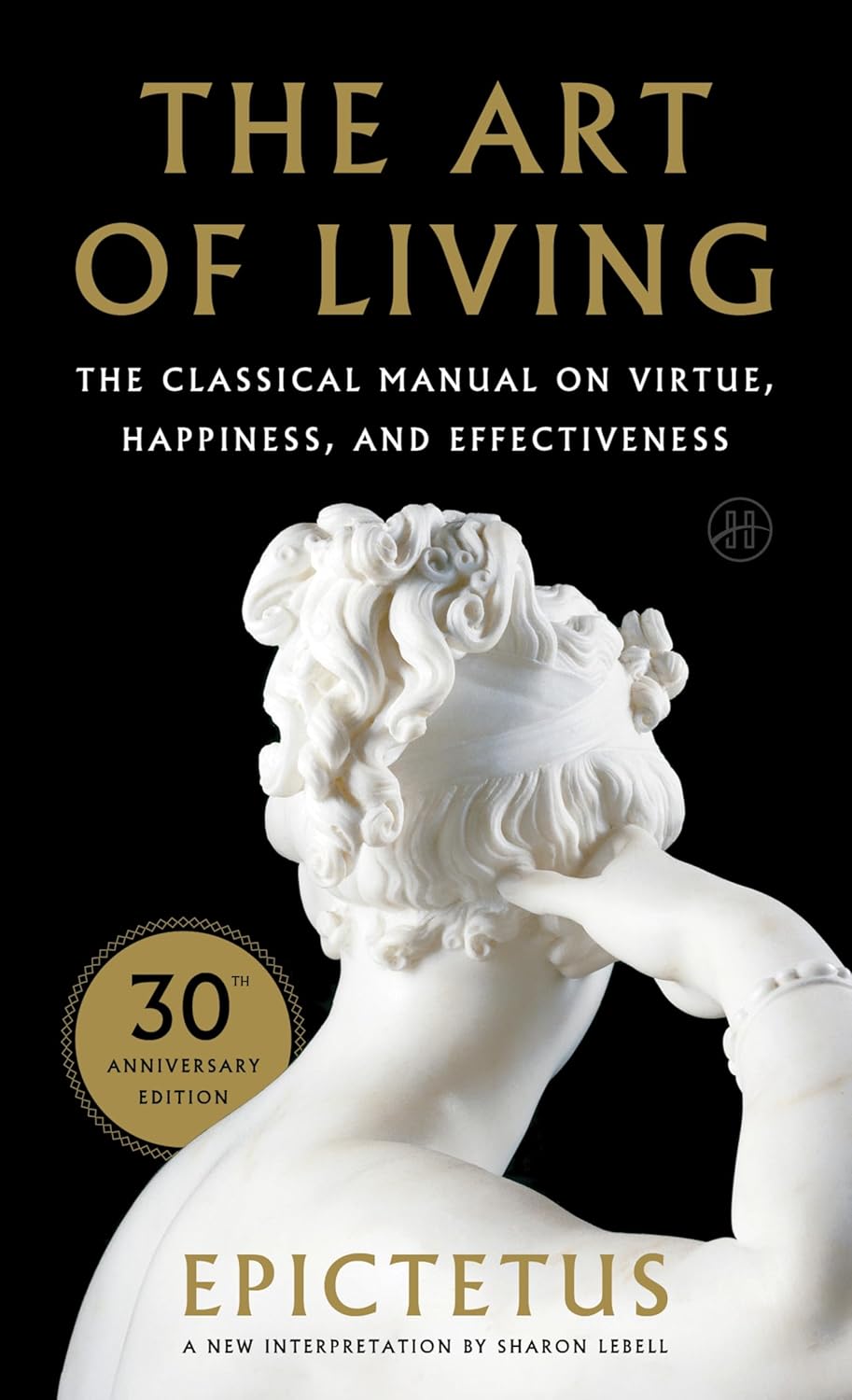
epictetus, the unsung stoic, goes first. he was as unlikely a pole star as they might come: born a slave, a slave with a limp, he carved out 93 instructions, bound them as a book, slapped on a catchy title (the art of living), one that came with a wallop of staying power (we’re still seeking the art), and all these millennia later, we’re still turning its pages.

a marvelous philosopher and musician, a northern californian by the name of sharon lebell, back in 1995 took a crack at translating epictetus anew. her translation stuck, and it’s now considered a classic. i found epi’s wisdoms rather timeless, and in keeping with survival in tumultuous times.

here’s epictetus:

Caretake This Moment

Caretake this moment.
Immerse yourself in its particulars.
Respond to this person, this challenge, this deed.

Quit the evasions.
Stop giving yourself needless trouble.
It is time to really live; to fully inhabit the situation you happen to be in now.
You are not some disinterested bystander.
Exert yourself.

Respect your partnership with providence.
Ask yourself often, How may I perform this particular deed
such that it would be consistent with and acceptable to the divine will?
Heed the answer and get to work.

When your doors are shut and your room is dark you are not alone.
The will of nature is within you as your natural genius is within.
Listen to its importunings.
Follow its directives.

As concerns the art of living, the material is your own life.
No great thing is created suddenly.
There must be time.

Give your best and always be kind.

~ Epictetus ~
(Epictetus: The Art of Living a New Interpretation by Sharon Lebell.)

Arundhati Roy

the next wise soul i bumped into this week was arundhati roy, the booker prize-winning novelist, who grew up and lives still in india; delhi specifically these days. she’s getting plenty of ink of late because her latest work, her first memoir, Mother Mary Comes to Me, has just been published. it’s an exploration of her complex relationship with her “iconic” and “extraordinary” mother, whom she describes as both “my shelter and my storm.”

roy’s 1997 novel, The God of Small Things, is what won her the booker prize for fiction, which in this mercenary worldly equates with that murkily-defined “success,” and its often evil twin, fame. roy, wise woman, wasn’t having it. she was not one to be deluded, or seduced, by such worldly measures. as she tells it she was keenly influenced by an uncle, a beloved uncle, who was one of india’s first rhodes scholars for his work in greek and roman mythology, but gave up his academic pursuits to start a pickle, jam, and curry-powder factory with his mother. and to build balsa-wood model airplanes in his basement.

not surprisingly, someone schooled in the shadow of such an uncle might have strong instincts on the “right” definition of success. and in a conversation with an old friend, arguing that “recognition is not the only barometer of brilliance or human worth,” she noted the friend’s eyebrow arching. skepticism, in full display. so roy did what any cocktail debater might do: she pulled the paper napkin out from under her drink, and a pen from her purse, and began to scribble.

what she wrote amounts to a gospel of success that belongs not on half-soggy paper, but a granite slab somewhere:

To love. To be loved. To never forget your own insignificance. To never get used to the unspeakable violence and the vulgar disparity of life around you. To seek joy in the saddest places. To pursue beauty to its lair. To never simplify what is complicated or complicate what is simple. To respect strength, never power. Above all to watch. To try and understand. To never look away. And never, never to forget.

sometimes i think i’m a broken record, saying over and over—and over—such a few simple truths. 

never get used to the unspeakable violence and vulgar disparity of life around you.

seek joy in the saddest places.

never simplify what is complicated or complicate what is simple.

respect strength, never power.

above all, watch.

never look away.

love.

love.

love.

what inscription might you add to a granite wall of truths?

p.s. i hyperlinked to a marvelous interview with sharon lebell above (i love her whole story, how she was drawn to study philosophy, inspired by a neighbor with more books than she’d ever seen, and how she found those first classes in philosophy “exercises in obfuscation” — might that describe much of the noise here on planet Earth in the year 2025?). here is just one of the grafs from that interview you might find as delicious as i did….

Epictetus drew me in particular because in the mid-1990s he was the unsung Stoic. People had heard of Marcus, of Seneca. No one, except the cognoscenti, had heard of Epictetus or could pronounce his name. I liked his humble background: he wasn’t an emperor or a big cheese. As a former slave with a limp, he was someone who wasn’t expected to have a voice, but he used his voice anyway. He was a relatable everyman trying to figure out best practices for getting through the day.  Since I am female, this mattered a lot. Many philosophers invoke male experience as a stand-in for the universal human experience. Epictetus did not, of course, address females when he taught, but his teachings have an inclusive, of-the-people feel.”

crushed by a word

cairn

let me begin by saying i have no business commenting on national affairs. and i confess to brandishing naivete at the highest level. but, in that way i always do come friday mornings, i scan the week and pluck the one particular thing that zings me the most. this week it’s war. it’s the word war. it’s opting for war instead of defense, it’s heralding a drive toward muscularity of the violent sort.

i’ve been studying Torah week after week for a few years now, more than long enough to know this tendency toward warring, toward violence, be it in the name of protection or crushing the opposition, stealing land, or seeking fortune, is as hard-wired into the human species as can be.

and yet…

and yet, there are those who’d see a rock and build it into a cairn, a path marker signaling to the stranger who comes behind, this is the way. this is the way toward a holiness, a holy place.

and there are those who see a rock and stoop to pluck it from the ground and fling it. where it lands, be damned. who or what it shatters, oh well.

i grew up on a street where there were rock flingers and cairn pilers. some of us played in the woods, being careful not to step on the trillium. some rode their bikes through the woods, fast and furious and zooming off logs piled for the purpose of velocity. crushing was part of the point. speed, the aim.

i live now in a country where the department of defense is considering a change of name, department of war. for all i know it’s happened overnight in one of those postings that now serve as executive orders. of all the countless assaults in a nation where rockets red glare once was a line in a patriotic hymn, why is one three-letter word so crushing to me?

because at heart i want to build cairns. i don’t want to be of a nation that only sees force as the way out. i know there’s a God seen as vengeful in the pages of ancient sacred text. but i know there came in time a Godly voice who took to the mountaintop and spoke: blessed are the peacemakers, blessed are the poor in spirit. blessed are the meek, the humble, the merciful.

that’s my tribe. by creed and by blood. but mostly by spirit.

and as the years accrue, as i have deepened into a sacred hollow, found my peace and my bliss there, i cannot fathom nor abide a mindset that heralds its predilection for bombs, for guns, for ballistics.

is there not might in the pen—the aphorism says that there is, that it’s mightier. is there not might in working it out, coming to the table with an understanding that we are but one tiny blue marble in the vastness of space, and we’ve been adorned with more than plenty, and all we need do is work out our share. the lines drawn in the sand are just that: subject to rearranging winds.

we needn’t turn into hermits, each in our own secluded and faraway hut (though it’s an idea that sometimes appeals to me). but we might be a village. a village where my empty cupboard is stocked when i need it by yours. where my faltering gait is held steady by you, because you respond to the impulse as hardwired into us as the rock-flinging one, the one that rushes to pluck the fallen from the sidewalk.

i am wise enough to know that’s not necessarily the dominant instinct, the peacemaking one. but i know there are ways to bolster it. it might be in following the lead of the everyday saints in our midst, the ones who rush to wherever there’s pain, or loss, or lacking. or the ones who quietly, quietly get the job done. it might be deep in the countless pages of ink poured over the millennia, the ones that brilliantly brilliantly illuminate a holier truth. the way toward blessedness is the path of the peacemaker.

i know my weighing in on the matter verges on silly. who am i but one breath in the wilds?

and all i’m saying is i am crushed, crushed, by one three-letter word.

and so very much more…

a choice: what crushed you this week? or what bolstered you?

i happen to have a big brother, his name is john, and he is marking a big birthday today. and so, i pause for a moment here (sometimes he pulls up a chair) to send a boatload of blessings and love. he’s been looking out for me since my beginning….(in this very old photo, he is kindly helping me climb into a little red car; he in red cap, me in the blue….)

this is from one of our ol’ home movies, a famous scene in family lore. i am soon either pushed over or assisted into car, depends on your perspective. since it’s his birthday, let’s give dear john the benefit of the doubt: he’s assisting. (though the next frame has me splat on the ground!)

among those unafraid to ask the unanswerable

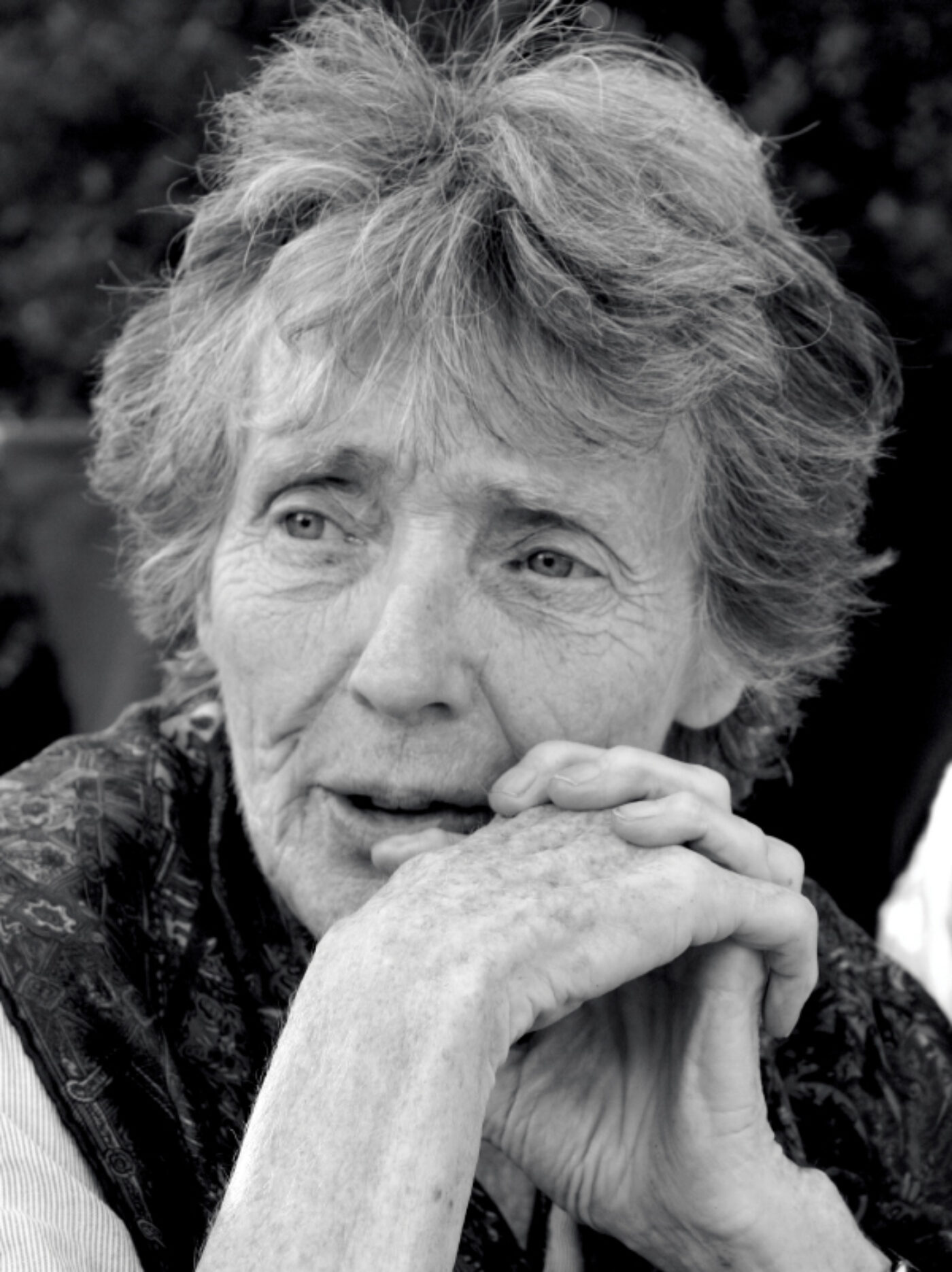
fanny howe (photo by lynn christoffers)

If the intensity of my curiosities in this world were put to trial, and I was pressed to answer what question stirs me most, it would be the realm of the God I reach for as my North Star. I ruminate on the presence of God, the proximity of what I know as tender ballast, and though the edge of my knowing falls into a liminal mist, I aim anyway to live by what seems to be the timeless code of a just and loving, most merciful God. 

Poetry, a gossamer web of knowing and unknowing, seems to be the closest frame through which to ask those questions, to rummage in the dim light and the darkness. It’s the poetry that rubs up against what seems true, and then falls swiftly away, that for me lasts and lingers. More so than sacred Scripture, I find myself venturing closest to the heavens when I follow poets unafraid to ask the unanswerable. The poets, so often, are my priests, my conduits from this much-battered planet to the uncharted heavens. Palpably alive and paying attention to the tiniest shards among us—the broken clock, the fallen sparrow, the furrow of a brow—the poet then leaps beyond or into, catapulting us into the vast, where the questions linger and the answers merely hover. Epiphany sometimes strikes. And we go forth, fortified.

I am particularly taken by those poets unafraid of doubt. As, truth be told, we live in mystery. It is those willing to expose their wrestling, their quest to question, that I find most resonant. Most true.

And when one of those poets dies, a volume closes; the possibility of question falls silent. We no longer knot our life raft to her fearless oceangoing vessel.

The world of poetry, from Ocean Vuong to those on the masthead at The Paris Review, mourned the loss this week of Fanny Howe (1940–2025), who died on Wednesday at 84. Over recent months, Howe, the daughter of an Irish playwright and a Harvard legal historian whose family traced its roots to the Boston Brahmin Quincy family, had been in conversation with the poet and translator Chloe Garcia Roberts, as part of the review’s Art of Poetry series. In a prelude I found as delicious as some of the conversation itself, Roberts sets the stage thusly in a piece published just last month: 

“Howe has a sparrowlike figure and a blue peregrine stare. We met for this interview every few weeks over the course of several months from fall to spring, as she was moving out of her garden-level apartment in Cambridge into an assisted living facility just down the road. I would arrive midmorning, bearing scones and coffee with extra sugar cubes wrapped in napkins, and we’d talk each time for an hour or so. Our conversations circled family, motherhood, failure, race, and faith. After we were done recording, we’d gossip about the poetry scene and the succession of Pope Francis.”

And from there begins the interview, from which I pluck just a few snippets, and some of the Review’s own words (emphasis mine):

“I’d always been looking for a revelation that would open the whole universe for me and make it all have sense,” began Howe, who described herself as a “pagan Catholic,” and who converted to the faith at forty-one, counting among her guides Simone Weil, Giorgio Agamben, and the monks of Glenstal Abbey** in County Limerick, Ireland, with whom she stayed every summer for twenty years and whom she later watched on TV every Sunday, her personal Mass. 

Howe was the author of an astonishing body of work—including twenty-five books of poetry, twelve novels, two story collections, and also essays, pulp romances, and young adult fiction. Her poems often enact the shock of belief, taking their power not from their devotional qualities—in fact, Howe avoided words like devotion and prayer—but their combination of faith and doubt. “I would think of poetry as a place where you connect your doubts to the things you don’t doubt,” she said. “Free-floating doubt wouldn’t trigger the lightning that contradiction does.”

In one of the hours of interviews, Howe let on that she considered it her “job” to be antidote to cynicism. When Roberts asked her to say more, she elaborated:

fanny in 1972 with her son, maceo

If I could say I was assigned something at birth, it would be to keep the soul fresh and clean, and to not let anything bring it down. And that’s the spirit of childhood, usually. Once you know that that’s what you’re doing, even when you’re walking through a war field, you’re carrying something to keep it safe. It’s invisible but you know it’s there, and it’s a kind of vision and a weight. 

(You can listen to Howe, warbly voice and all, speak those very words here.)

Is it not all of our jobs—or certainly the job of some of us—to labor to keep the soul fresh and clean, to strain to not let anything bring it down? It is our singular entity, the one form over which we and we alone can steer the vessel, make the choices, choose love not hate, choose silence not bitter words, it is ours to keep, to draw in all the light we can muster. Our bodies, I’ve learned, are not under our control. Pathogens come, and cancers too. We crumble under the weight of time and toil. Our skin wrinkles, breaks out in bumps. But not our soul. Our soul is eternal, is timeless. Our soul is what we make of it. 

The work of my soul is abetted, most often, by those whose words I read, by those whose way of being I watch. It is, so often, in the smallest, quietest of kindnesses. The triumphs of spirit over the temptations to turn away, to forgo the sharp edge, the blunt force. 

Ours is an ongoing work in progress. 

In her role as perhaps a patron saint of doubt within the amalgam of faith, Howe staked her claim in her introduction to George Bernanos’s 1937 novel of the 14-year-old French peasant girl, Mouchette: “Like a healthy human heartbeat, which has an intrinsic irregular system, the body of an artwork gets its vitality from a rhythm based in uncertainty. (Sick hearts have a dull regular thump.)” 

Among the many lauds that poured forth in the wake of her death, Kazim Ali, the poet and co-founder of the small indie press, Nightboat Books, wrote this of Howe, the first author Nightboat published:

It would be wrong to say she was a polar star or a beacon in the darkness, because Fanny believed in mystery, in unknowing, in bewilderment. She didn’t mean to shine a light, but rather to see in the darkness.

Fanny once told me, in our life-long conversation about God, literature, and the world, that she thought Gnosticism was evil. What she found so evil was the belief that the material world was inferior to, or somehow separate from, the spiritual one. This world was the world to Fanny. “Human was God’s secret name,” she said in one poem. “If this life isn’t enough, then an afterlife won’t be enough,” she said in another. 

To live in this rich, infinite world was the most important thing to her. “One cathedral is equal to the sky,” she wrote. And to God, she begged, “no answers, please, to any of my questions.”

Her life and work were conjoined in a long, lucid series of questions. How lucky we all are to have heard her askings.

may her askings live on, and her memory be a blessing. rest in knowing, dear fanny.

other than life itself and living, how have you encountered wrestling with doubt? is it a plain that animates you, or is it a space from which you run? (as always these questions are meant to be considered in the solitude and sanctity of your own quiet womb.)

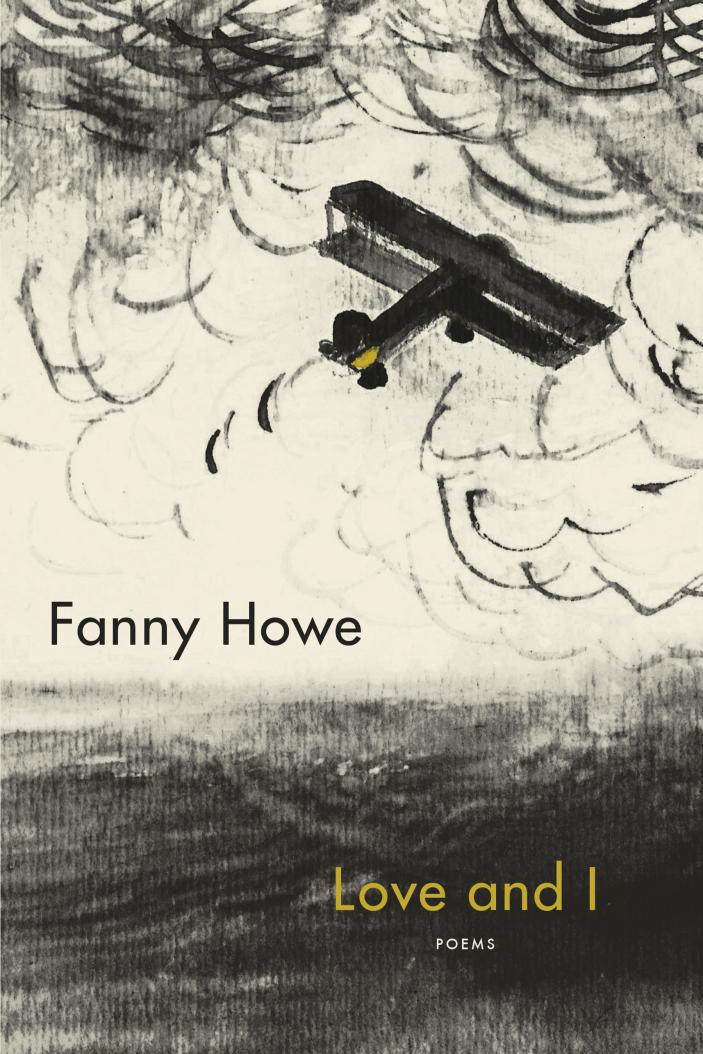
i nearly forgot! should you choose to dig in to a bit of fanny howe and her wrestling with faith, the two books you might seek (mine is coming from interlibrary loan) are Love and I: Poems (2019) and Gone (2003). in both she writes about her conversion to Catholicism, and her relationship to faith.


**because i’ve not found many a rabbit hole into which i’ve chosen not to burrow, my reading of howe led me to Glenstal Abbey, a place i now dream of tucking into for a fulsome contemplative spell. it’s a benedictine monastery in county limerick, ireland, housed in a 19th-century normanesque castle, surrounded by 500 acres of farmland, forests, lakes, and stream. you might just want to join me there…(and you can tune in any time for matins, lauds, vespers, compline, or daily Mass, in both recordings and livecam.) 


and one more thing before i go. it seems bishop marian budde, she who gained fame (and infamy in some quarters) presiding over the prayer service at washington’s national cathedral following the inauguration, has now launched a substack, where she will gather her writings, and broaden the scope of her reach. she introduces herself with these words. . .

“On January 21, 2025, the day after President Trump’s inauguration as our 47th president, I chose to conclude my sermon at a Prayer Service for the Nation, held at the Washington National Cathedral, with a call for mercy:

“Let me make one final plea, Mr. President. Millions have put their trust in you and, as you told the nation yesterday, you have felt the providential hand of a loving God. In the name of our God, I ask you to have mercy upon the people in our country who are scared now.”

she stirred up good trouble with those words. and in her new space on substack, she lays out her mission—”to live as best we can according to the highest aspirations of humankind revealed to us in Jesus” (also in Gandhi, in Buddha, in Brahma, in Allah, in Yahweh)—with this litany:

  • to recognize the inherent, God-given dignity of every human being
  • to love our neighbors as ourselves, and even to love our enemies
  • to share what we have and to strive for an equitable and just society
  • to refrain from evil and refuse to hate
  • to be mindful of the power of our words, and to speak without malice or contempt
  • to forgive, as we have been forgiven
  • to live in hope
  • to be willing to sacrifice, even our very lives, for the sake of love.

she concludes with these words:

“In this space, I hope to encourage a kind of human discourse in which we don’t have to see the world the same way, but we can all agree that we all belong in this world.

“In a culture of contempt, may we speak with dignity.

“In a world of mean-spiritedness, may we act with kindness and love.”

how might you stir good trouble today?

in search of the common

in which we take a hard look at the crumbling discourse in this country, and consider a solution or two….

i’ll be honest. these are hard times. i pick up the news and feel pummeled by each new blow. i see pillars of democracy crumbling one after another. jeff bezos and the washington post, only the latest. i read of law firms—white shoe ones, meaning old-guard firms who take on some of the highest-profile clients, the most complex cases, aka “the elite”—being stripped of security clearance, being considered for criminal investigation only because they represented a client the current administration has inked onto the enemies list. 

i see revenge as the rule of the day. 

i’m sickened.

i’ve never prayed to a God of revenge. 

but i read, too, that there are stirrings of hope. faint, yet beginning to stir. 

you might call it an occupational hazard, but i happen to pay attention to the ways we get news and i worry desperately that we all cower in distant silos. (getting more distant by the day.) i get my news and you get yours and, often, ne’er the twain shall meet. 

so how do we have a shared conversation? how do we sit down to the same old table and begin to listen? how do we reach across the table, and in a quiet, unquivering voice, utter the words, “i hear your point”? or the certain conversational lubricant, “say more”? or the nervier, and necessary, “that’s not actually true”?

i hold onto my hunch that most of us want what we think is fair, is just. and i’m not giving up on my fervent belief that if you saw me bleeding on a sidewalk, you would not ask first how i voted and then decide whether or not to lift me off the ground. 

i’m fairly certain that in the nearly two decades we’ve been pulling up chairs here, some of us do get our news from different silos. i try to tread lightly. i respect divergence of thought. but the problem, as i see it, is that we are all being fed news in the flavors most to our liking. and that’s not the way the news is supposed to work. it’s not the way it worked for the time i was one of the ones writing what counted as news. and not in the newsroom i knew.

so here’s the jam: if the news you’re being fed is slanted, if some of it’s filtered out, and some of it’s twisted, if both sides aren’t fairly presented, it’s not any sort of surprise that conclusions are drawn, and wedges are wedged. 

“…without fear or favor…”

these days, the ones helming the news––the owners, the billionaires who thought it a romp to claim a slot on the masthead––they seem to be in it for hard, cold cash. the one with the most wins. cozying up to power seems a game to which we’re not invited. to get there, you need to fly in your private jet, hopefully not one of the ones making a mess on the runways. 

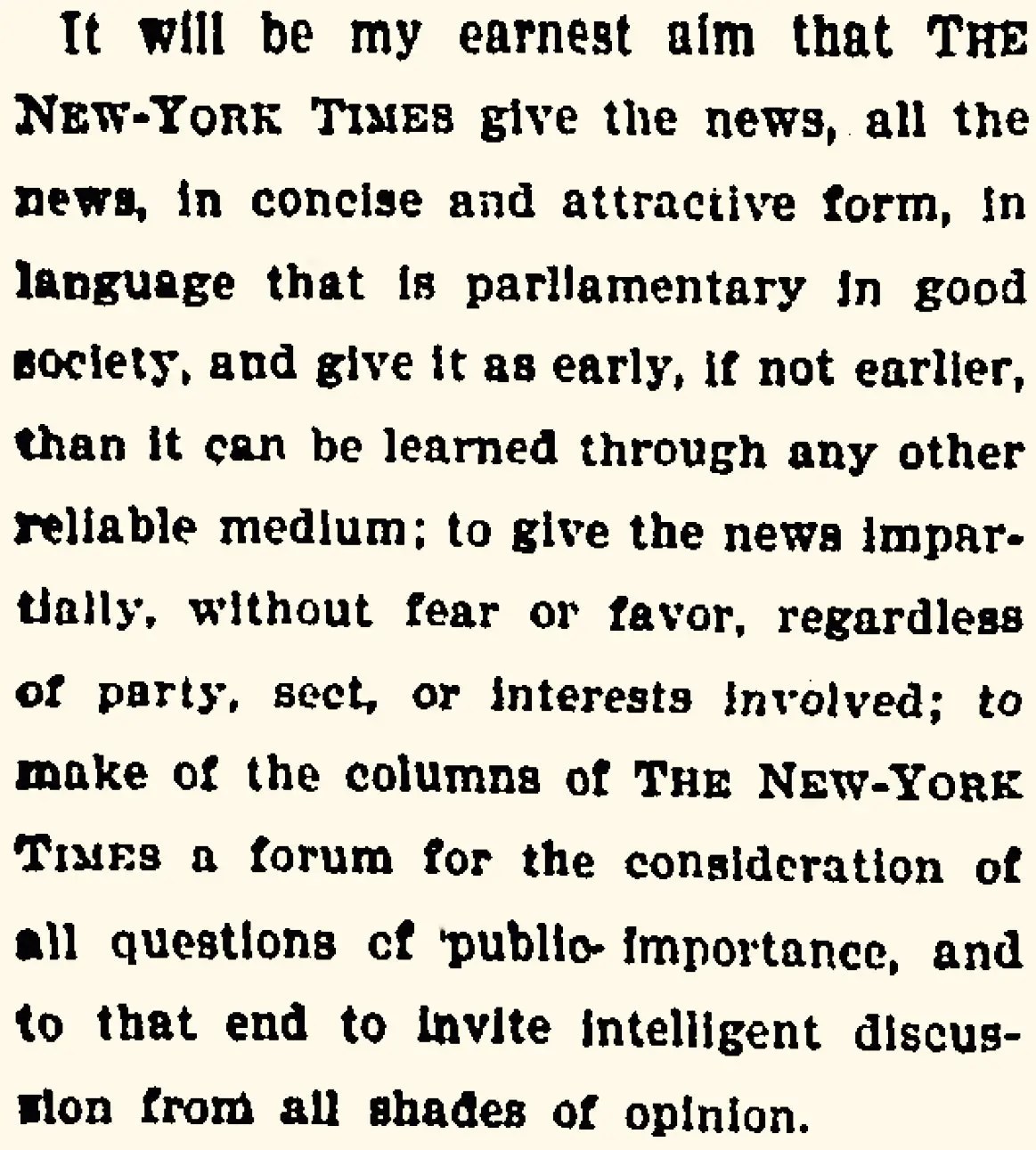
so much for democracy dying in darkness. or that now quaint-seeming declaration of adolph s. ochs in april of 1896, that his newspaper, the venerable new york times, would “give the news impartially, without fear or favor.” 

good journalists hold firm to those words. good journalists have died defending those words.

you don’t get into the news biz––chasing after crooks and pols, climbing rickety stairs in darkened hallways, knocking on doors knowing full well you might find a muzzle pointed at the bridge of your nose––because it’s a sure way to raise your heart rate. or just cuz you’re nosey.

you get into the news biz cuz you’re a mad dog for the truth. and the fair telling of stories. you dig and you dig till you find that shimmering shard that, to your best knowledge, and according to more than one reliable source, is unassailably true. i sat beside folks in the newsroom who thought nothing of holing themselves in the dungeons of city hall or the bowels of bureaucrat mazes, riffling through file after file to track down the name and the dollar amount on contracts that might or might not have been legal. that might have unearthed wrongful convictions. or identified bodies dumped on the roadside. and those subterranean scribes had the pallor to prove it, after months and months under the glow of flimsy fluorescent lights. and cups of stale coffee. (we’ll leave the bottles of whiskey for another day.)

these days, the ones coursing the landscape with their reporter pads and pens, their itty-bitty microphones and their smartphone recorders, are plenty besmirched. discounted as little more than rousers of rabble. there’s a strong scent of disdain souring the air. 

that’s an unfair and erroneous swipe at all those who abide by the time-tested codes. you might have heard that, um, democracy dies in darkness. and the reporters i know refuse to turn off their flashlights.

my little screed here won’t make a dent. but i cannot give up. none of us can. my faintest hope is that even one someone who reads this might take up the dare: fight fallacy and fiction with verifiable fact. there was an old maxim in the newsroom, one that we more or less lived by: if your mother tells you she loves you, check it out. 

check your sources for news. read beyond your usual silo. sit down at a table and listen. exercise your ears more than your tongue. 

at least for now, it’s a place to begin….

p.s. i know there is a good handful of journalistic heroes who pull up a chair, so if any of you wander by today or tomorrow or anytime soon, feel free to pen your prolific and profound views on the state of news consumption in america, and how it might be at least part of the root of what’s tearing us apart….


only one poem this week, and it’s a wonder from a poet who is a chicago legend, a hero in Black arts…..it’s an ode to books, which is a great place to begin a grounding in knowledge, and finding common language…..be sure to get to the last line, where i’m guessing you’ll let out a sigh. as i did. so much in common….

So Many Books, So Little Time
by Haki R. Madhubuti

My sanctuaries are liberated lighthouses of shelved books,
featuring forgotten poets, unread anthropologists of tenure-
seeking assistant professors, self-published geniuses, remaindered
first novelists, highlighting speed-written bestsellers,
wise historians & theologians, nobel, pulitzer prize, and american book
award winners, poets & fiction writers, overcertain political commentators,
small press wunderkinds & learned academics.
All are vitamins for my slow brain & sidetracked spirit in this
winter of creating.

I do not believe in smiling politicians, AMA doctors,
zebra-faced bankers, red-jacketed real estate or automobile
salespeople, or singing preachers.

I believe in books.
It can be conveniently argued that knowledge,
not that which is condensed or computer packaged, but
pages of hard-fought words, dancing language
meticulously & contemplatively written by the likes of me & others,
shelved imperfectly at the level of open hearts & minds,
is preventive medicine strengthening me for the return to my
clear pages of incomplete ideas to be reworked, revised &
written as new worlds and words in all of their subjective
configurations to eventually be processed into books that
will hopefully be placed on the shelves of libraries, bookstores, homes,
& other sanctuaries of learning to be found & browsed over by receptive
booklovers, readers & writers looking for a retreat,
looking for departure & yes spaces,
looking for open heart surgery without the knife.

—Haki R. Madhubuti, who turned 83 this week, is a poet, writer, and educator, who in 1967 founded Chicago’s Third World Press, the largest independent Black-owned press. He’s regarded as an architect of the Black Arts Movement. Born Donald Luther Lee, he changed his name in 1973 after traveling to Africa: “Haki” means “justice” or “rights,” while “Madhubuti” means “precise, accurate, and dependable.” Both names are derived from Swahili. Of his renaming, Madhubuti explained at the time that he wanted to arrive at a new definition of self.

have you had any hard conversations of late? were you afraid to go there? what peaceable tools did you use to navigate? how did it go? will you try again?

no whistling in the dark here. but maybe some chocolate…

these are dark times. chaotic times. times so upside down and alarming, i’m groping for what i can do. sometimes i think the solutions are way, way above my paygrade. 

what i know i can’t do is whistle in the dark. blather on about incidental ponderings, pretend that all this will soon go away. it feels as if we’re witnessing wide-eyed the wielding of sledge hammers to bedrock pillars of democracy. who are these 19-year-olds re-writing code in the department of treasury? why in the world would anyone waste a minute of breath renaming a mountain, a gulf, except for extreme case of hubris? and what of claiming gaza, the land of a people who have sustained unthinkable horrors to simply exist on the land of their ancestors, a land now so deeply bloodied i fear it seeps to the core of the planet? to say nothing of erasing the existence of aid to the poor, the hungry, the marginalized around the globe. to strike language and data from federal websites, all but telling vast swaths of humanity they’ve been expunged. to imagine the labs where cures for disease are suddenly stalled, where lives––like mine––depend on those cures.

i have aimed from the beginning not to bleed into politics here. and i still hold firm to that core. what i address here, what i disdain here, is something far more foundational, a vengeance fueled by a mindset that it’s always always us v. them. a philosophy of division, of payback in the cruelest of iterations. a credo of greed. let the weak be weakened, and the few take the pot. and let it all be built on a mound of mistruths, fictions of wild proportion. 

we’ve an unspoken bond here at this table that once a week i will leave some platter of words that might open a window. even a crack. let light in to our collective souls. so maybe in these dark times my place is shifting. maybe i’m meant to listen in silence, to keep close watch, to defend the tenets of the God of justice and love. a God whose wisdom is not twisted, turned on its head, shoved to the side for malevolent purpose. 

maybe the chair, in these dark and cruel times, is simply a place to swing by, to listen for voices wiser and keener than mine. maybe the chair is a place to come catch your breath. to embolden your spirit. to find brief reprieve. 

until the darkness lifts––and wise and faithful souls believe that it will, that We the People in our undeniable goodness and courage shall overcome––i’ll do what i quietly can. my platter today comes with two poems and a slather of chocolate. yes, chocolate. though in this case, it’s the priceless morsel of the story behind katie hepburn’s very own chocolatey brownies that might best the brownies themselves. you decide. 


a beauty of a new poem found on diana butler bass’s straight-talking, life-sustaining, deeply soulful the cottage….

WHAT COMES NEXT
by Rosemerry Wahtola Trommer

Love relentlessly.
—Diana Butler Bass

Love relentlessly, she said,
and I want to slip these two words
into every cell in my body, not the sound
of the words, but the truth of them,
the vital, essential need for them,
until relentless love becomes
a cytoplasmic imperative,
the basic building block for every action.
Because anger makes a body clench.
Because fear invokes cowering, shrinking, shock.
I know the impulse to run, to turn fist, to hurt back.
I know, too, the warmth of cell-deep love—
how it spreads through the body like ocean wave,
how it doesn’t erase anger and fear,
rather seeds itself somehow inside it,
so even as I contract love bids me to open
wide as a leaf that unfurls in spring
until fear is not all I feel.
Love relentlessly.
Even saying the words aloud invites
both softness and ferocity into the chest,
makes the heart throb with simultaneous
urgency and willingness. A radical pulsing
of love, pounding love, thumping love,
a rebellion of generous love,
tenacious love, a love so foundational
every step of what’s next begins
and continues as an uprising,
upwelling, ongoing, infusion
of love, tide of love, honest love.


an ode to kindness….aptly titled…

Small Kindnesses

I’ve been thinking about the way, when you walk
down a crowded aisle, people pull in their legs
to let you by. Or how strangers still say “bless you”
when someone sneezes, a leftover
from the Bubonic plague. “Don’t die,” we are saying.
And sometimes, when you spill lemons
from your grocery bag, someone else will help you
pick them up. Mostly, we don’t want to harm each other.
We want to be handed our cup of coffee hot,
and to say thank you to the person handing it. To smile
at them and for them to smile back. For the waitress
to call us honey when she sets down the bowl of clam chowder,
and for the driver in the red pick-up truck to let us pass.
We have so little of each other, now. So far
from tribe and fire. Only these brief moments of exchange.
What if they are the true dwelling of the holy, these
fleeting temples we make together when we say, “Here,
have my seat,” “Go ahead—you first,” “I like your hat.”
Danusha Laméris


and now, for katie’s brownies, the story of which first appeared in the letters to the editor of the new york times….

July 6, 2003

To the Editor:

Re the death of Katharine Hepburn last Sunday: For many decades, my father used to walk across town to do his food shopping on Second Avenue. He often shopped at a Gristede’s around the corner from Miss Hepburn’s town house on East 49th Street.

One day he suddenly came face to face with Miss Hepburn, who was also picking up groceries. He acknowledged her with a nod, and she responded in kind. He began thinking of her as a neighbor.

In 1983, my senior year at Bryn Mawr, Miss Hepburn’s alma mater, I was frustrated and was doing poorly, and at Christmas break, I decided to quit. I had the romantic notion of running away to Scotland to write screenplays. My father was frantic. My mother had died two years before, leaving him with all the responsibility for his headstrong daughter.

He knew that Miss Hepburn had gone through her own struggles at Bryn Mawr, so he wrote her a letter asking her to intervene. ”She’s a great admirer of yours, and perhaps she’ll listen to you,” he wrote. On the way to the grocery store, he dropped the letter in her mail slot.

At 7:30 the next morning, the phone woke me up. I answered it and heard that famous voice, crackling with command. ”Is this the young woman who wants to quit Bryn Mawr?” I said it was. ”What a damn stupid thing to do!” she snapped. She went on to give me a lively lecture, the gist of which was that I had to finish my studies and get my degree, and after that I could do what I wanted to do. There was no arguing with her imperiousness. Then she said she wanted to meet us for tea.

The day of our appointment was gray and wintry. Walking the long blocks to Turtle Bay, my father and I didn’t speak much. It felt as if we were about to meet the Queen.

Miss Hepburn greeted us warmly. With casual hauteur, she provided us with tea and some of her famous brownies. Though she was in her 70’s, she had a youthful look, enhanced by her girlish clothes: a turtleneck, a black cardigan and shabby khaki-green pants.

We talked about many things, including Bryn Mawr. She said that she was miserable there and still had nightmares about it, but she was glad she went. At the end of the afternoon she told me, in a rather grim tone, ”You’re smart.” It was a compliment, but also an admonition not to be foolish in the future.

My father was invited to visit her a few times after that. Once, he had heard that she was recovering from a serious car accident, and he stopped by to drop off a package of homemade brownies and a get-well note. To his surprise, he was ushered in and invited into her boudoir, where she greeted him in her nightgown. She sampled his brownies.

”Too much flour!” she declared. She then rattled off her own recipe, which he hastily wrote down. ”And don’t overbake them! They should be moist, not cakey!”

I’ll always be grateful to Miss Hepburn for making me stick it out at Bryn Mawr and for giving me these rules to live by: 1. Never quit. 2. Be yourself. 3. Don’t put too much flour in your brownies.

KATHARINE HEPBURN’S BROWNIES

1/2 cup cocoa
1 stick butter
2 eggs
1 cup sugar
1/4 cup flour
1 cup broken-up walnuts or pecans
1 teaspoon vanilla
pinch of salt

Preheat oven to 325 degrees. Melt butter in saucepan with cocoa and stir until smooth. Remove from heat and allow to cool for a few minutes. Mix in eggs, one at a time. Add sugar, flour, nuts, vanilla and salt. Pour into a greased 8×8 square pan. Bake 40 minutes. ”Don’t overbake!” They should be gooey. Let cool (an essential step) and cut into bars.

Heather Henderson
St. Paul, Minn.

how, pray tell, are you finding your way? chocolatey or otherwise…

as one year sighs its last, and another stirs anew, wish upon a star and then some…

this blessed string of days we’ve called “a year,” is drawing now its last deep breaths. it’s almost time to begin again, or so we imagine in the geometry of the mind, a flatter-planed sphere that sees the year going round and round like vinyl spinning on a phonograph. ascension is not in the equation.

in the geometry of the soul, though, each new turn––we hope, we pray––is not mere spin, but spiral, ascension its sure distinction. it’s the ever-incremental accumulation of loft we’re after. loft attained, most often, the hard way. we stumble, skin our knees, hold our nose and hold our breath while the doctor jabs the needle. from year to year, there is, we hope, at least the humblest modicum of lessons learned. year by year, we aim for wiser.

and so in this year now waning to its close, its hardest lessons came in scans and calls not returned, in snubs and deaths that came too, too soon. but it brought too the sorts of hallelujahs that remind us that good patience, in time, brings resolution, brings peace, brings love come home. the long lost friend we found again. the one hard heart that finally softened, seemed to learn a whole new lexicon, the language of delight at last unfiltered.

i am letting all the lessons settle in, knowing they’re the elements of accumulating wisdom. one year to the next, wiser, gentler, quieter, deeper.

or so we pray.

and in this quiet space––this most delicious time of yuletide, the time beyond the noise, the shopping, the dishes scrubbed and put away––i am inviting the past year to wash over me, to sift through the sediment, to save the gems, rinse away the detritus.

i’m adopting my deep-breathing posture, the one that has me curled under blankets in my red-checked armchair, the fire crackling, the tree twinkling, my boys all ringed around me.

and i’m leaving here at the table two shimmering gems: one, something of a wish upon a star and the discovery that the star is us; and the other a truth of which i cannot be reminded too many times….

here’s the first…

azita ardakani, an iranian-born social activist and communications guru, wrote this “once upon a time” for maria popova’s the marginalian. it’s part poem, part lullaby, and part creation myth with a dash of astronomical science. it reads a bit like a children’s book, and, like all the best and deepest pages penned to a child, it ends in revelation: the true wonder that the star upon which we wish is, in fact, a little bit of us. we are our own wish come true. or, we can be, especially if we aim for spiral and not spin…

Once upon a time,
In a place far far away,
The darkness drifted.
The darkness knew no time.
Reaching for infinity, only knowing beyond.
One day in the web of inky forever, it asked itself, can I see you?
It waited, and waited, and then, answered, a star.
And then another, and another, and, another.
Another was where it began,
and as the star beings asked to be born to meet the darkness from which they came, one particular planet created water so it too could reflect the stars back to themselves.
The stars seeing their reflection were filled with joy and delight.
Curiosity was born in their light millions of years away.
One by one they made their way down, to touch the ocean, to see themselves.
The soil darkness watched with awe as the stars arrived,
A heart’s desire asked: Can I see you closer?
The water stars stretched onto the soil, and mixed into the clay, and became,
everything.
Yes you too, coyote who hears this, wise owl, mouse and rabbit, you too sleeping fawn, you too tree and root and seed, you too nested flight, and you too, sitting two legged.
Mixed from clay and star, flesh and life, a hollow canal opened so breath too could reach back to the darkness.
Missing the beginning, it exhaled a bridge, home.
The star water became everything we know, and you? The story of us?
Well, to experience the closest thing to the very beginning of star meeting water, we learned to create a small ocean inside of us, where it could all be felt, all over again.
Once upon a time, in a place far far away, the darkness drifted, and you drifted inside it.
You were the wish you once wished for.


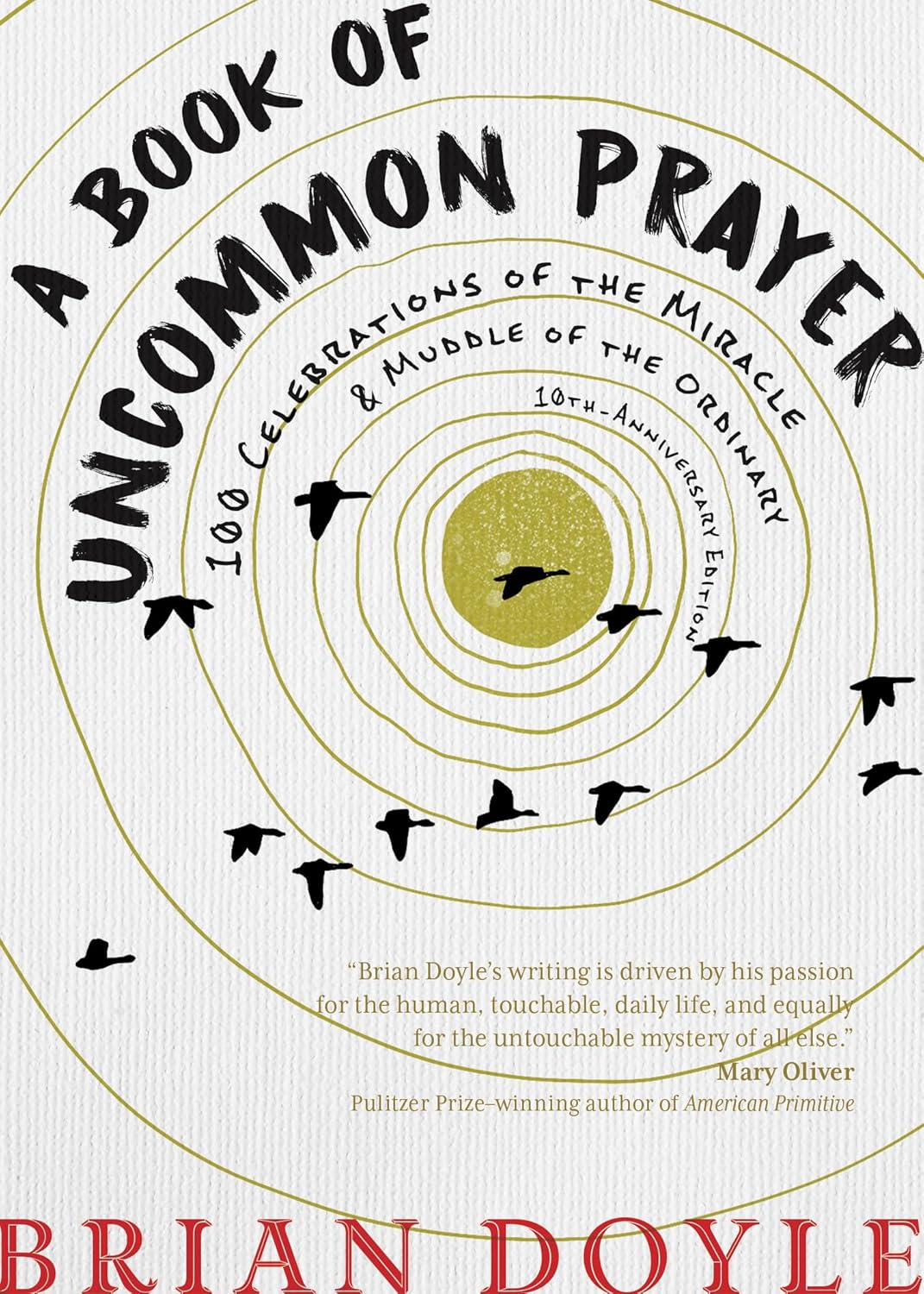
i count the late, great (astonishing) brian doyle among the favorite soul seers i have ever read. he finds words that burrow deep into the places in my soul that might never before have been struck or stirred. in his too-short time on earth, he saw wonder, plumbed wisdom in the unlikeliest of places. from prayers for cashiers and checkout counter folks, to prayers for robert louis stevenson on his birthday, and prayers for the greatest invention ever, the wicked hot shower, all found in his marvelous, marvelous, A Book of Uncommon Prayer: 100 Celebrations of the Miracle & Muddle of the Ordinary. these are the first lines of one with the magnificently brilliant title, “Furious Prayer for the Church I Love and Have Always Loved but Which Drives Me Insane with Its Fussy Fidgety Prim Tin-Eared Thirst for Control and Rules and Power and Money Rather Than the One Simple Thing the Founder Insisted On.” and it’s a fine fine note on which to both end and begin a year….

Granted, it’s a tough assignment, the original assignment. I get that. Love — Lord help us, could we not have been assigned something easier, like astrophysics or quantum mechanics? But no — love those you cannot love. Love those who are poor and broken and fouled and dirty and sick with sores. Love those who wish to strike you on both cheeks. Love the blowhard, the pompous ass, the arrogant liar. Find the Christ in each heart, even those. Preach the Gospel and only if necessary talk about it. Be the Word. It is easy to advise and pronounce and counsel and suggest and lecture; it is not so easy to do what must be done without sometimes shrieking. Bring love like a bright weapon against the dark… And so: amen.

bless us all. and may your new year bring you loft and leaven.

any wisdoms you acquired this year, with a story to share?

the chair is old enough to vote. . .

i’ve raised a blog, it seems, from birth to the verge of being grown-up. eighteen years: 12.12.06 it all began. 1,200 posts before today, so this––wondrously (to me, anyway)––is 1,201. at first i tended it, this conversation, this wondering aloud, this occasional epiphany, every weekday for a year, then chiseled it down to thrice a week. and then, yet again, i distilled it: once weekly––religiously every friday morn. here and there i’ve taken rare short breaks. a bit of summer breather once or twice.

and yet, kept on. and on and on. (sometimes wondering if maybe i should just be quiet.)

cycled through waves who’ve pulled up chairs in ebb and flow as of the tides. friends who’ve come to stay awhile, then shuffled off for one reason or another. at least a few i’ve deeply loved have died; angels still among us. some who’ve pulled up a chair have never ever strayed. here from the beginning, faithful as the day is long. bless them. bless and bless and bless them. 

i too have ebbed and flowed. waded into deep and deeper waters. shed old fears, grew courage. been puzzled. pondered. hatched new fears. wobbled. stumbled. inhaled courage again, again, and again. i’ve wondered and worried aloud. weathered aching heart, and phone calls and headlines that left me breathless. i’ve loved and loved some more. i intend to never stop. 

my school at first was all that unfolded under this old roof, where creaky twisting stairs and a nearly antique Garland stove––six burners, flattop, quasi-oven, a behemoth you’d find at any all-night diner––came to animate so many stories. it was my boys from whom i mostly learned and learned the most. and learned and learned again. and of course the holy earth and heavens high above: the gardens, the birds, the trees, the stars and moon, the dawn and dusk and nighttime’s inky darkness that never fail to draw me in. the book of nature, i’ve come to read, where lessons rise and fall season after season after season. i found a holy peace in this old house and the ramshackle plots where i kneel with trowel and soul wide open. i’d been chasing that peace for years. 

i seem to have stumbled into a new teacher these days, one i’d never thought could bring such knowing: it comes with darkness, yes, though i’m reminded that darkness is the embryonic space where stirrings first begin. and it’s nighttime’s darkest hour when stars most brightly shine. stripped of distraction, of the nettlesome sorts of things that blur our everyday, it denudes us to our barest essence. it’s cancer (even when i do not name it here it’s ever present in my rumblings, and has catapulted me to highest most-reverent attention). mine is an especially wily iteration, one that doesn’t follow rules. and brings me squarely into the land of uncertainty. where i, a girl who likes to know things, am finding out how not knowing whittles the knowing to one or two immutables: love is the force that triumphs over all; its alpha and omega, the God who dwells within. within me, and you. and even all the ones who make us want to scream and run for cover. 

here’s what i know 18 years in: there is nothing that love––true, deep love in all its iterations––cannot infuse. and in the infusing, molecules are stirred, shifted, and forms reshaped, dissolved, emboldened, made new. i’ve felt mountains move. i’ve felt fear melt away, like butter on hot biscuits. i’ve felt surrender––holy, holy “thy will be done.”

and a life well lived is one in which we love as unstintingly, as capaciously, as we might never have known possible. to live a life of loving is to scatter the few seeds that might blossom in our wake, that might rise in the seasons beyond us. it is the deepest mark i hope and pray to leave: to know my heart, my soul, has found a way in, forever in, to those whose lives i might have touched. 

it all becomes so spare, so simple, in the end. when you realize your days––for as long as they stretch––are your one rare turn to hone the art of loving, as it is meant to be. as it is meant to make the holy difference. to trace the path from here to heaven. 

that’s some of what i’m thinking eighteen sweet years in.

and now, because the older i get the more i glean from the wisdom of those who’ve left their trace, here’s my birthday bouquet to ponder for the day, the week, the hour…an indelible quote, a poem to make you laugh, and one to maybe melt you….

first, a quote from the french philosopher and playwright gabriel marcel, from the mystery of being:

“You know you have loved someone when you have glimpsed in them that which is too beautiful to die.”


a poem that might make you laugh, and certainly leave you with a smile:

Emily Dickinson at the Poetry Slam
BY DAN VERA

I will tell you why she rarely ventured from her house. 
It happened like this:

One day she took the train to Boston,
made her way to the darkened room,
put her name down in cursive script
and waited her turn. 

When they read her name aloud
she made her way to the stage
straightened the papers in her hands —
pages and envelopes, the backs of grocery bills,
she closed her eyes for a minute,
took a breath, 
and began. 

From her mouth perfect words exploded,
intact formulas of light and darkness.
She dared to rhyme with words like cochineal
and described the skies like diadem. 
Obscurely worded incantations filled the room
with an alchemy that made the very molecules quake.

The solitary words she handled
in her upstairs room with keen precision
came rumbling out to make the electric lights flicker.

40 members of the audience 
were treated for hypertension.
20 year old dark haired beauties found their heads
had turned a Moses White.

Her second poem erased the memory of every cellphone
in the nightclub,
and by the fourth line of the sixth verse
the grandmother in the upstairs apartment 
had been cured of her rheumatism. 

The papers reported the power outages. 
The area hospitals taxed their emergency generators
and sirens were heard to wail through the night.

Quietly she made her way to the exit,
walked to the terminal and rode back to Amherst. 

She never left her room again
and never read such syllables aloud. 


and finally, a christmas poem that just might melt you, as it melted me. . . 

Kenosis
by Luci Shaw

In sleep his infant mouth works in and out.
He is so new, his silk skin has not yet
been roughed by plane and wooden beam
nor, so far, has he had to deal with human doubt.
He is in a dream of nipple found,
of blue-white milk, of curving skin
and, pulsing in his ear, the inner throb
of a warm heart’s repeated sound.
His only memories float from fluid space.
So new he has not pounded nails, hung a door
broken bread, felt rebuff, bent to the lash,
wept for the sad heart of the human race.

thank you, with all my heart, for pulling up a chair, be it only for awhile, or for some or all these years. i am holding especially close against my heart this morning ginny, my once closest reader (my beloved mother in law who was quick to call if she liked what she’d read, and deafeningly silent if she did not!), mary ellen, and ceci, who waft over my shoulder, angels to my every day….and especially to my boys, who animate each and every pulse of my heart and every breath i breathe….(and certainly to will, who got this whole thing started, when he insisted i could do it, and built the website to make it happen….)  xoxo love, bam

how did you find the chair?

when you find the sages on your shelf echoing one essential truth. . .

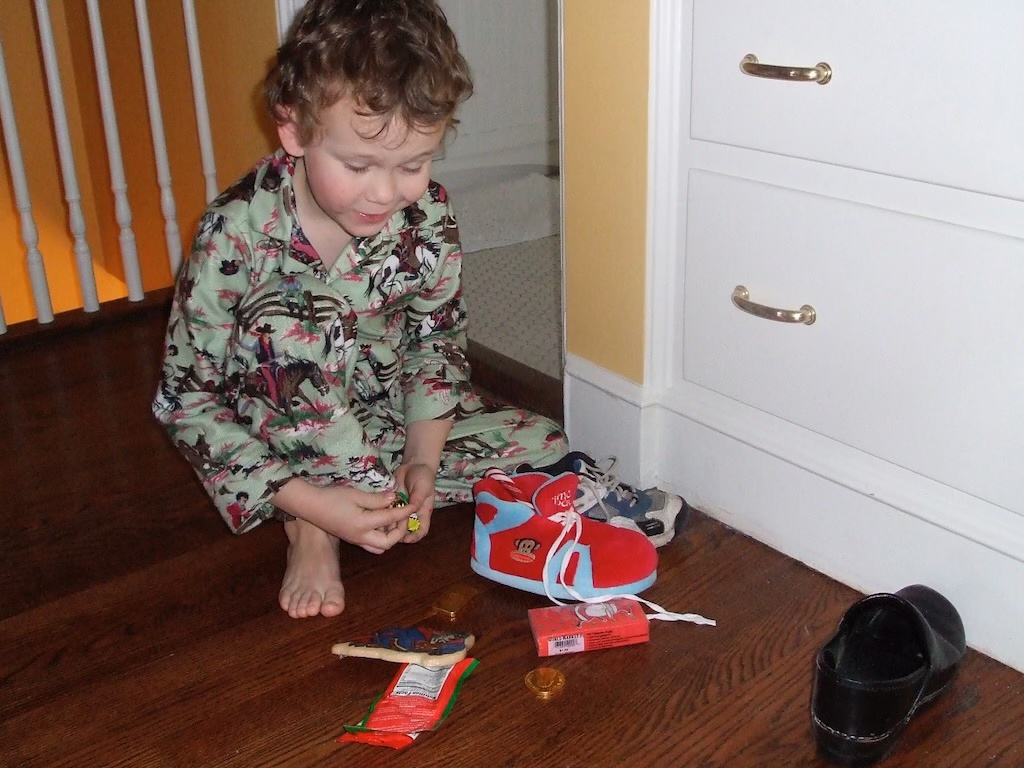
not so very long ago, within the reach of my old brain folders, this was the morn i had my boys set out shoes (sometimes admittedly smelly sneakers), which i filled with clementines and tinfoil-wrapped chocolates. the feast of st. nick, the jolly soul who in long-ago times filled the shoes of girls and boys with trinkets from his pouch. the original arbiter of good v. not-so-good; a lump of coal you did not want to find tucked in the toe of your wooden clog.

december, it seems, is a month punctuated with tradition. we embroider advent’s waiting, the dim day-by-day darkening with the kindled flickering of myth and lore and wonder gathered round the globe. every land, it seems, is looking for a bit of light amid the darkness.

i learned only this week of december fourth’s “barbara branch,” when the german tradition is to give the branch of a flowering tree to a barbara and await its blossoming by christmas. the story goes that barbara, who would become a saint and then later (at my tender and impressionable age of 9 or 10) be stripped of her sainthood (for reasons i never quite grasped but the good ol’ Church did it anyway), dear barbara back in medieval times was such a beauty that her wretched father locked her in a tower whenever he went away. and when she refused to marry some princely fellow, because she preferred to marry Jesus Christ (plenty of saints chose that path) he sent her off to prison, awaiting beheading. on the way to prison, so the story goes, a cherry branch snagged against her skirt, so wise and wily barbara clutched the branch and carried it along to her cell, whereupon every few days she watered it with drops from her scantly-filled drinking glass. and don’t you know that on the day she was burned at the stake and then beheaded, the branch blossomed. and so we barbaras carry on the blossoming, with branches awaiting bloom. my mother is a barbara, and she now has a dear friend where she lives who also happens to be a barbara. so this barbara brought those barbaras branches awaiting bloom. 

and so december goes. 

but really what i find myself thinking here this morning is how the sages i have come to know and love find themselves in conversation across space and time. how their wisdoms interlace and amplify, and to my mind underscore the eternal in their simple truths. 

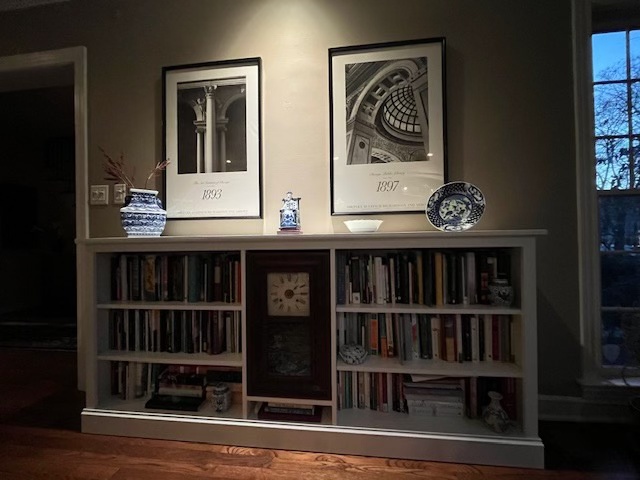
the sages shelf: poets, left; mystics and sages to the right

the two i’ve drawn from my shelf this week are brian doyle, the beyond-brilliant late great essayist and longtime editor of portland magazine, who died of a brain tumor not too many years ago. his wisdoms cannily or not line up with those of dorothy day, the radical pacifist and co-founder of the Catholic Worker movement, devoted to the poor, the hungry, the broken, and now on the road to sainthood, though she famously protested that labelling when she once snapped: “don’t call me a saint. i don’t want to be dismissed so easily.” (a sassy saint she’ll be, patron saint of sassiness among her zillion virtues.)

i found myself pulling dear brian off my sages shelf this week, and zeroed in on this passage in particular from his magnificent one long river of song: notes on wonder (a book whose praises i once sang in the pages of the chicago tribune, back when i wrote a column called “books for the soul”): 

This is what I know: that the small is huge, that the tiny is vast, that pain is part and parcel of the gift of joy, and that this is love, and then there is everything else. You either walk toward love or away from it with every breath you draw. Humility is the road to love. Humility, maybe, is love.

he echoes the essence of dorothy’s wisdom, an epiphany of hers long etched on my heart. this simple, simple code: “by little and by little.” 

her biographer, robert ellsberg in dorothy day: selected writings, elucidates: “simply, it consisted of performing, in the presence and love of God, all the little things that make up our everyday life and contact with others. from therese [of lisieux, yet another saint, the one who inspired dorothy], dorothy learned that any act of love might contribute to the balance of love in the world, any suffering endured in love might ease the burden of others. . . we could only make use of the little things we possessed—the little faith, the little strength, the little courage. these were the loaves and fishes. we could only offer what we had, and pray that God would make the increase. it was all a matter of faith.”

what i’ve come to know, through the alchemies of age and maybe cancer, is that my one holy task here is to live by love, little by little, day by day, for as many days as i have. if i can be a little flame, if i can choose love, choose joy, choose kindness at each and every turn and each and every choice, then my swift life here will have left some mark and measure. if each one of us might tip the balance, bend the arc toward justice, then our existence holds holy purpose. the choice becomes so clear, so finely-grained focused: i aim to walk closer and closer to the holiness i was––we were all––meant to be. and to find unending bliss within.

so help me God. 

one more brian doyle: in a brilliant, brilliant essay (found in One Long River, p. 12) about two strangers holding hands as they leapt from the south tower on sept. 11, doyle wrote: “their hands reaching and joining are the most powerful prayer i can imagine, the most eloquent, the most graceful. it is everything we are capable of against horror and loss and death. it is what makes me believe we are not craven fools and charlatans to believe in God, to believe that human beings have greatness and holiness within them like seeds that open only under great fires, to believe that some unimaginable essence of who we are persists past the dissolution of what we were, to believe against such evil hourly evidence that love is why we are here.”

i don’t know why i even try to say what has been so magnificently, unforgettably uttered already. brian doyle’s truth i feel unfolding in me every blessed day. i feel those seeds breaking open in the roaring furnace that is a cancer in your lungs.


because, why not, two Advent poems from emily d. or at least two poems worth contemplating in this season of anticipation, of heightened awaiting, of soul on the lookout for wonder coming….(Advent reflection on the poems, from my friends at the Salt Project, down below, but first, emily, the belle of amherst:)

“The Infinite a sudden Guest” (1309)

The Infinite a sudden Guest
Has been assumed to be —
But how can that stupendous come
Which never went away?

“Tell all the truth but tell it slant — “ (1263)

Tell all the truth but tell it slant —
Success in Circuit lies
Too bright for our infirm Delight
The Truth’s superb surprise
As Lightning to the Children eased
With explanation kind
The Truth must dazzle gradually
Or every man be blind —

+ Emily Dickinson

and here’s what my friends at Salt Project say about both…

These two Dickinson poems are perfect meditations for Advent:

The first as a provocative play on one of the season’s mysteries (How can we “wait” for someone who is also present to us, and in us, even as we wait?); and the second as a window into the many ways the Advent and Christmas stories testify to a God who comes in ways that are somewhat softened, accessible, “slant,” camouflaged, even hidden.

An ordinary baby in an ordinary backwater town, signaled by a star so faint that only Magi can spot it (Herod’s assassins can’t!), and announced not to the powerful in Jerusalem but to nameless shepherds on a forgotten hillside, watching their flocks by night.

It’s as the old carol has it: “Veiled in flesh the Godhead see, Hail th’ incarnate Deity!” (that’s from “Hark the Herald Angels Sing”). Veiled, hidden, not so God disappears but precisely so God may appear — or rather, so we may see. The Truth must dazzle gradually…

what simple sages’ truths have you found echoing of late?

blessings to teresa p for teaching me all about BBs, barbara branches!

unearthing the wisdoms entwined in the past. . .

in which these uncharted times have me leaning on the wisdoms of great minds and expansive souls who’ve navigated their own immensely dark and tough times…

more and more i find history is my balm. i think back to the eras of darkness across the arc of time and the indomitable human spirit that has never yet been extinguished, no matter the force of the counterwinds. 

albert camus

curiously, albert camus––whom i’d never thought of as any sort of balm––has served well in that role. though considering the era in which he was writing, it’s no wonder it was darkness he saw through, shone a fierce beam of light on the way through the horrors of europe during the holocaust. 

so often it’s the artists and writers, the makers of films and penners of poems, the ones endowed with an eye to see beyond the occlusions, the ones who imagine what others can’t conceive, who cast the lifeline beyond the capacities of strategists and political operators, power brokers and thieves. 

in his 1940 essay titled “the almond trees” (a species that brilliantly blooms in winter), found in his Lyrical and Critical Essays, camus weighs in on happiness, despair, and how to amplify our love of life.

only twenty-seven when he wrote this, here is the french-algerian philosopher who gave us the plague, the fall, the stranger,and the myth of sisyphus:

We have not overcome our condition, and yet we know it better. We know that we live in contradiction, but we also know that we must refuse this contradiction and do what is needed to reduce it. Our task as [humans] is to find the few principles that will calm the infinite anguish of free souls. We must mend what has been torn apart, make justice imaginable again in a world so obviously unjust, give happiness a meaning once more to peoples poisoned by the misery of the century. Naturally, it is a superhuman task. But superhuman is the term for tasks [we] take a long time to accomplish, that’s all.

Let us know our aims then, holding fast to the mind, even if force puts on a thoughtful or a comfortable face in order to seduce us. The first thing is not to despair. Let us not listen too much to those who proclaim that the world is at an end. Civilizations do not die so easily, and even if our world were to collapse, it would not have been the first. It is indeed true that we live in tragic times. But too many people confuse tragedy with despair. “Tragedy,” [D.H.] Lawrence said, “ought to be a great kick at misery.” This is a healthy and immediately applicable thought. There are many things today deserving such a kick.

echoing the sentiments of an earlier manifesto written in the immediate wake of the first world war, the 1919 “declaration of the independence of the mind,” again by a french philosopher, this time romain rolland––and signed by such luminaries as bertrand russell, albert einstein, bengali poet and nobel laureate rabindranath tagore (a favorite of mary oliver), social worker and activist jane addams (chicago’s own), upton sinclair, and hermann hesse––camus argues that this “kick” is to be “delivered by the deliberate cultivation of the mind’s highest virtues”:

If we are to save the mind we must ignore its gloomy virtues and celebrate its strength and wonder. Our world is poisoned by its misery, and seems to wallow in it. It has utterly surrendered to that evil which Nietzsche called the spirit of heaviness. Let us not add to this. It is futile to weep over the mind, it is enough to labor for it.

But where are the conquering virtues of the mind? The same Nietzsche listed them as mortal enemies to heaviness of the spirit. For him, they are strength of character, taste, the “world,” classical happiness, severe pride, the cold frugality of the wise. More than ever, these virtues are necessary today, and each of us can choose the one that suits him best. Before the vastness of the undertaking, let no one forget strength of character. I don’t mean the theatrical kind on political platforms, complete with frowns and threatening gestures. But the kind that through the virtue of its purity and its sap, stands up to all the winds that blow in from the sea. Such is the strength of character that in the winter of the world will prepare the fruit.

elsewhere in lyrical and critical essays, we find the line that practically serves as camus’s epigraph: “in the depths of winter, i finally learned that within me there lay an invincible summer.” 

toni morrison

no less than toni morrison takes the baton, elaborating that the task of the artist is as a grounding and elevating force in turbulent times, in her essay titled “no place for self-pity, no room for fear,” included in the 150th anniversary issue of the nation, the monthly founded by abolitionists in 1865, not long after the adoption of the thirteenth amendment abolishing slavery.

morrison writes:

This is precisely the time when artists go to work. There is no time for despair, no place for self-pity, no need for silence, no room for fear. We speak, we write, we do language. That is how civilizations heal.

I know the world is bruised and bleeding, and though it is important not to ignore its pain, it is also critical to refuse to succumb to its malevolence. Like failure, chaos contains information that can lead to knowledge — even wisdom. Like art.

marcus aurelius

and finally let us turn way back the clock to ancient wisdoms, in this case those of good ol’ marcus aurelius, the roman emperor whose meditations were suggested to me the other day by one of my more astute and heavenly comrades. the meditations, written in the late second century of the Common Era during the emperor’s military campaigns against germanic tribes along the danube, are thought to be a window into his inner life, uncannily recognizable to our own deep-down whisperings. i borrowed the stoics from the library, but have already decided i need a paper copy all my own, the better for underscoring and stars in the margins. here’s but one of marcus’s wonders, from book II of his meditations, thought to be written in about the year 170 C.E. (uncanny how true wisdom is timeless, as this fits the november of 2024 as fulsomely as it fit nearly two millennia ago):

Begin the morning by saying to thyself, I shall meet with the busybody, the ungrateful, arrogant, deceitful, envious, unsocial. All these things happen to them by reason of their ignorance of what is good and evil. But I who have seen the nature of the good that it is beautiful, and of the bad that it is ugly, and the nature of him who does wrong, that it is akin to me, not [only] of the same blood or seed, but that it participates in [the same] intelligence and [the same] portion of the divinity, I can neither be injured by any of them, for no one can fix on me what is ugly, nor can I be angry with my kinsman, nor hate him. For we are made for co-operation, like feet, like hands, like eyelids, like the rows of the upper and lower teeth. To act against one another then is contrary to nature; and it is acting against one another to be vexed and to turn away. 

what timeless wisdoms do you find anchoring, or elevating? and where might lie your invincible summer; how might you summon it?

here’s a challenge: imagine what’s possible. work toward it. begin with a baby step.