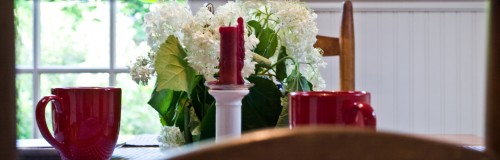
pull up a chair

where wisdom gathers, poetry unfolds and divine light is sparked…

Category: savoring moments

a narrative twist and the wisdoms that come in its wake

when last we pulled up a chair, we were a gladsome foursome giddily gadding about the eternal city. unbeknownst to us, a fifth was among us. a red-ringed hanger-on who might have climbed aboard on the plane that flew through the night. or perhaps in the crowds in one art-ringed room or another.

but by nightfall one friday ago, a mere four days into our roman romp, one among us was lying flat on his back when he plaintively asked, “could you feel my head?” and suddenly the tiniest of sniffles i’d been hearing for the past two days, and the uncharacteristic naps that were beckoned mid-morning and again mid-afternoon snapped into sense, and a not-so-subtle hypothesis bolted into my brain: “this couldn’t be covid, could it?!?”

and with that, lickety split, i leapt out the door and wiggled my way through ancient streets and crowds thick with myriad tongues. i found myself a farmacia and in the clearest italian i knew, asked, “covid test?” the farmacista knew too. it seems the red-ringed word is universally understood. she handed me the prova covid, i handed her euros, and off i flew.

didn’t take more than a minute for that dreaded double line to flash into sight. bright purple it was, as my pictures of rome in quartet whirled down the drain. we had among us a covid-plagued fellow, the very one who had spent weeks and weeks planning and plotting. signing us up for this tour and that. and now, the poor chap was confined to a room at the back of the Airbnb, and i was moved to the couch.

i felt my heart crack.

i pictured a big pink eraser descend from above, dashing our roman holiday and turning our fine little appartamento into a quarantined clinica covid. i feared, right away, that the dastardly viral intruder would tear us asunder. that i, too, would be felled. and then boy 1 and boy 2.

i reached for my phone and dashed off a text to my beloved american doctor. as the sun set in rome, it was just reaching its midday peak in the states, so, lo and behold, she swiftly wrote back. told us they’re basically treating covid as a head cold these days, and that 24 hours after the fever broke or symptoms abated, our chief travel guide would enter the five-day mask-and-distance phase. and the rest of us should hope for the best.

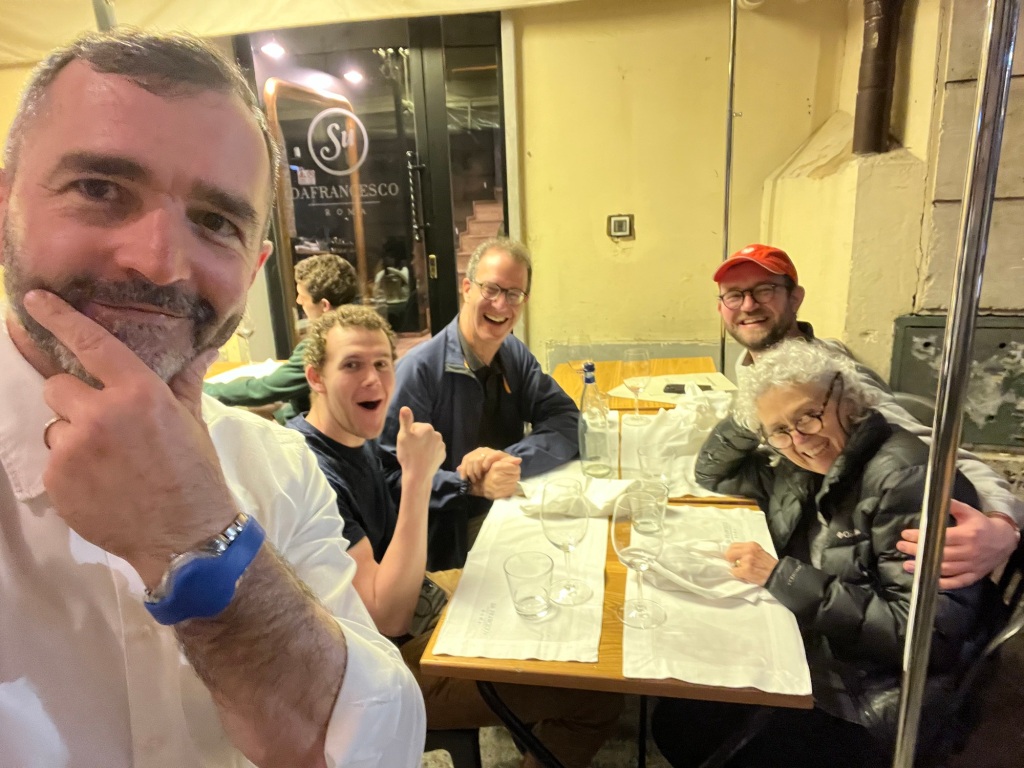
without delay, the ailing one and i both reached for our phones to alert the dear friends with whom we’d shared the previous evening of rooftop aperitifs and a long and lovely roman dinner. and, belly flip-flopping all the while, i texted the sorry update to our boys, who’d gone out with a professorly friend for pastas and spritzes and whatever else might unfold on a friday night in glorious rome when you’re young and with nary a care.

i couldn’t sleep. so i lay there on my couch till the wee hours, listening for the boys’ signature voices and the clomp of their feet on the stone-cobbled street down below. when in they wandered, i confirmed that they’d seen the bum news spelled out on their phones. and we figured the weekend engagements — a guided tour of the colosseum and forum, as well as a lazy sunday lunch on our friends’ rooftop terrace (which had been the imagined highlight of the trip to little old me) — had gone up in vatican smoke.

but here’s where the story once again takes a turn, rises into the allegorical, and makes of one player a hero: assuming the boys would never in a million years awake for an early-morning architectural tour of ancient roman ruins, i’d already scratched the colosseum and forum off the list. so wasn’t i proven to be the fool when, with an hour to spare before the already-paid-for tour, the bedroom door cracked open and out strolled a towel-clad gent on his way to the shower. as he sauntered sleepily past me, he uttered only three words that soon set the tone for the day and all those that followed: “when in rome. . .”

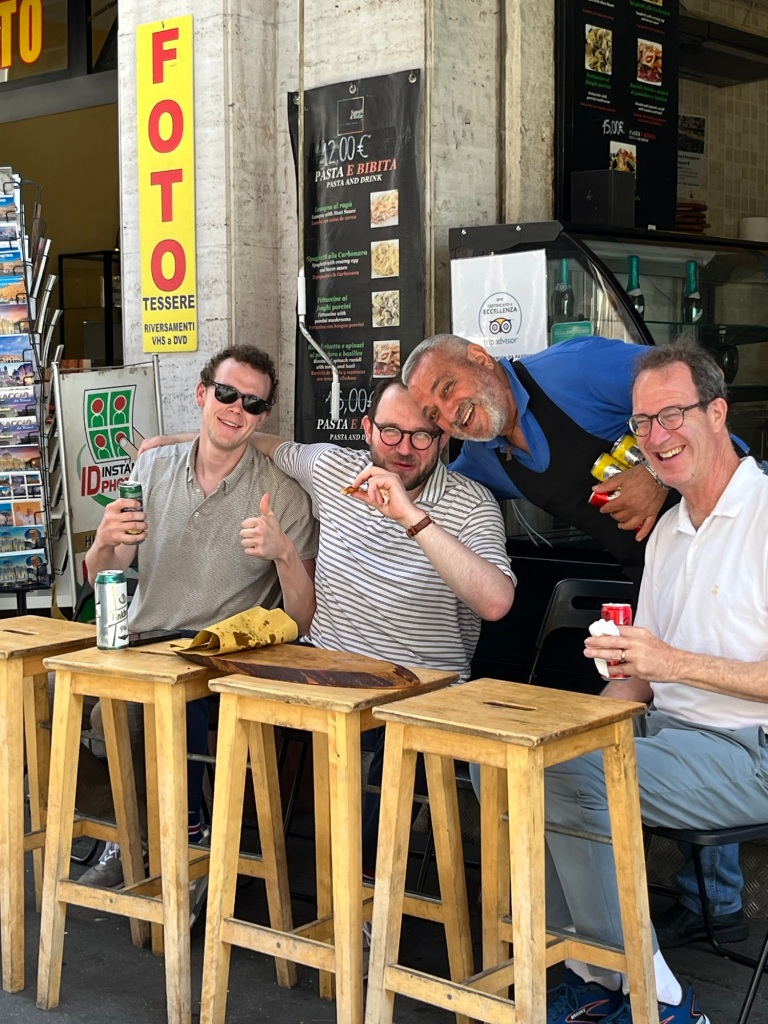
and so we were off. if he, a boy who’d slept a mere few hours, could pull himself off the pillow to make good on his papa’s pre-ordained plot for the day, certainly boy No. 1 could follow, and i — who had originally declined a tour of what i referred to as “the ancient blood bath” and imagined instead a leisurely morning alone — could step into gear. turned out we missed the guided part of the tour, but we managed to get into the old ruin and carried on the self-guided way. all that walking and gawking made us hungry, so kid No. 2 called time-out and guided us through the meandering streets to an osteria that he’d been told had the very best food in all of roma (and it certainly did)*. and then, bellies full and sunscreen slathered, we climbed to the tippy top of the palatine gardens, and all of rome lay majestically, magnificently sprawled out before us.

the boy’s simple instructive “when in rome. . .” is the essence of carpe diem, the code by which he not only lives but inspires. he’s a mere 22, a kid born just before 9/11, a kid whose years have been punctuated by the horrors of parkland and sandy hook, a kid who cowered inside our cambridge apartment the terrible week of the boston marathon bombing when we could watch the police helicopters whirring in the sky just out our windows, a kid who went to college during covid and got sent home for half a semester to watch pre-recorded lectures on the laptop perched on the covers of his boyhood bed.

he’s emerged with an unshakeable knowing that life comes around but once, and you’d better seize it while you can. because there’s no cinch on tomorrow. which pretty much is the truth it’s taken me decades — and a medical scare of whopping proportion — to figure out.

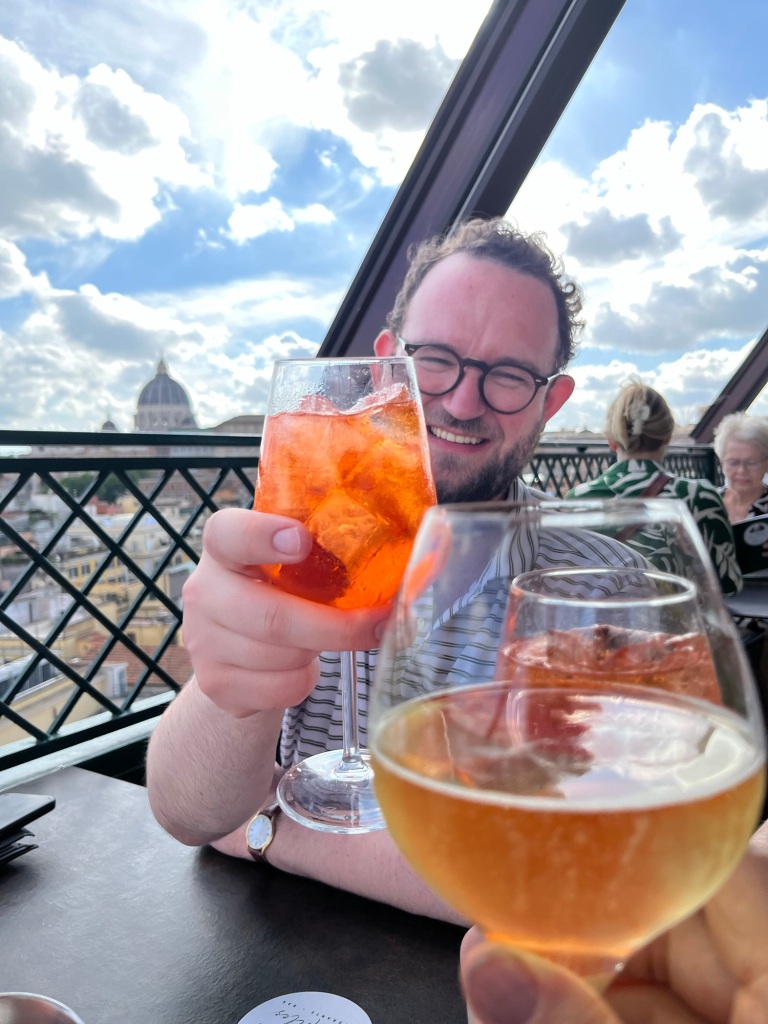
we talked plenty (be it discoursing eternal verities or swapping silly serendipities) as we wound through the ancient streets of rome (his hand always reaching for mine, to make sure i didn’t wobble or fall), as he insisted we mosey down the block to the corner watering hole for spritzes at dusk, as he and his brother led us hither and yon to the best eats in the city. and his ironclad creed is that life is to be lived to the fullest.

my number one teacher in rome was the kid who grew in my womb long after the doctors insisted there’d never be another; an odds-breaker ever since, a kid who dwells in the joy of exclamation. and his lesson is one i’ll not tuck away on a shelf now that we’re home. nor ever.

it’s a beautiful and glorious thing when the teacher appears in the form of a kid who serves up his lessons with spritzes and leads you through rome on a quest for flavors you’ll never forget.

bless you, and thank you, dear T.


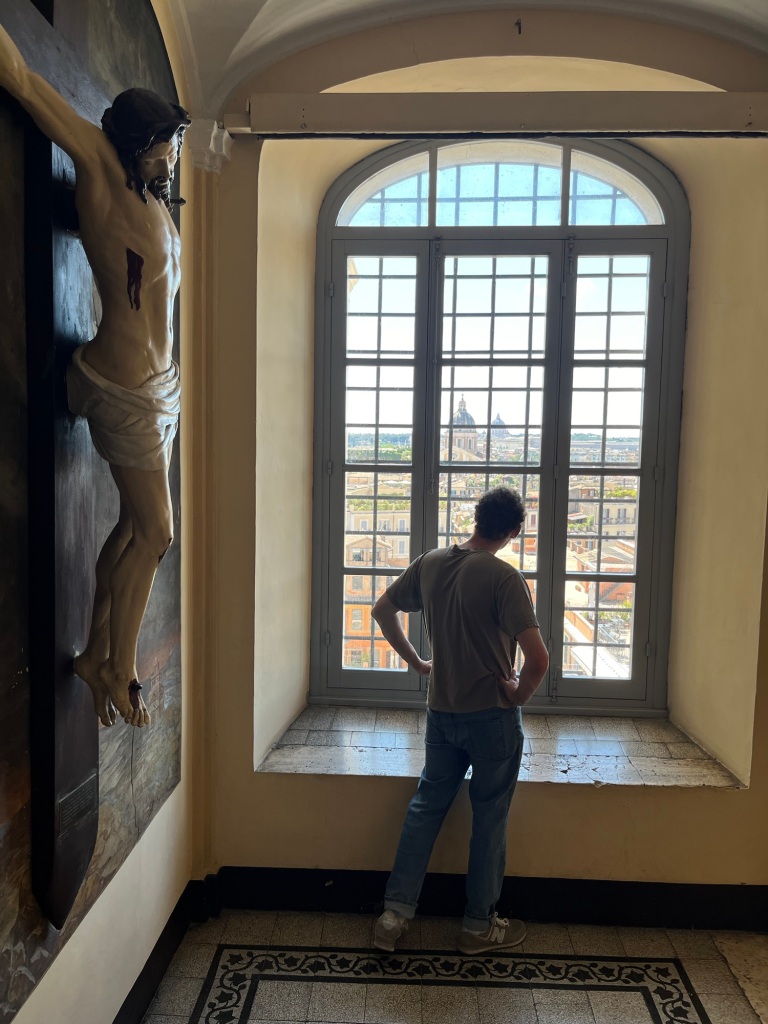
post script: our covid-afflicted fellow made it through mostly unscathed, and is now back among the unmasked. once his fever broke, and 24 hours had passed, he made the most of his unfettered hours to stand and absorb the architectural wonders of rome for as long as his big ol’ heart desired. none of the rest of us ever tested positive. though we missed the rooftop lazy sunday lunch of our dreams, we now have reason and incentive to return. i brought a good chunk of rome home in my heart.

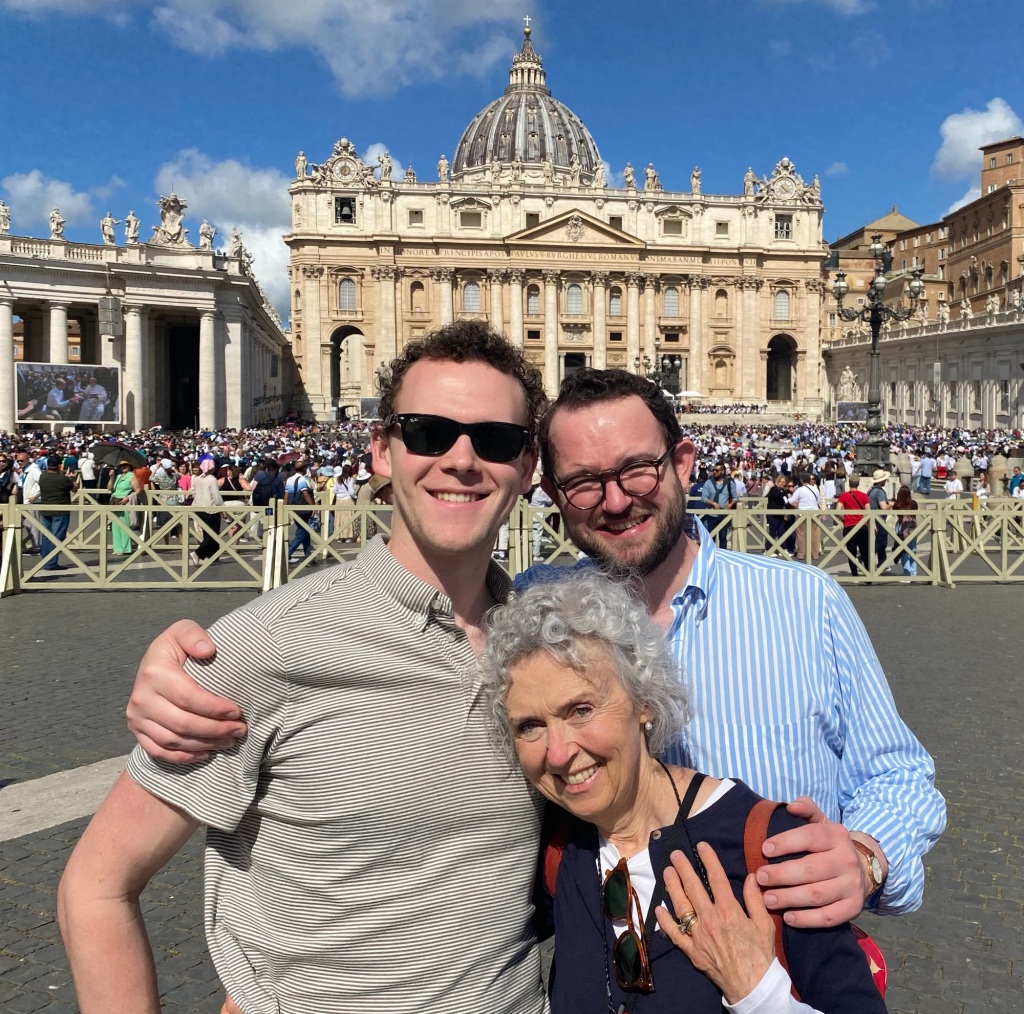
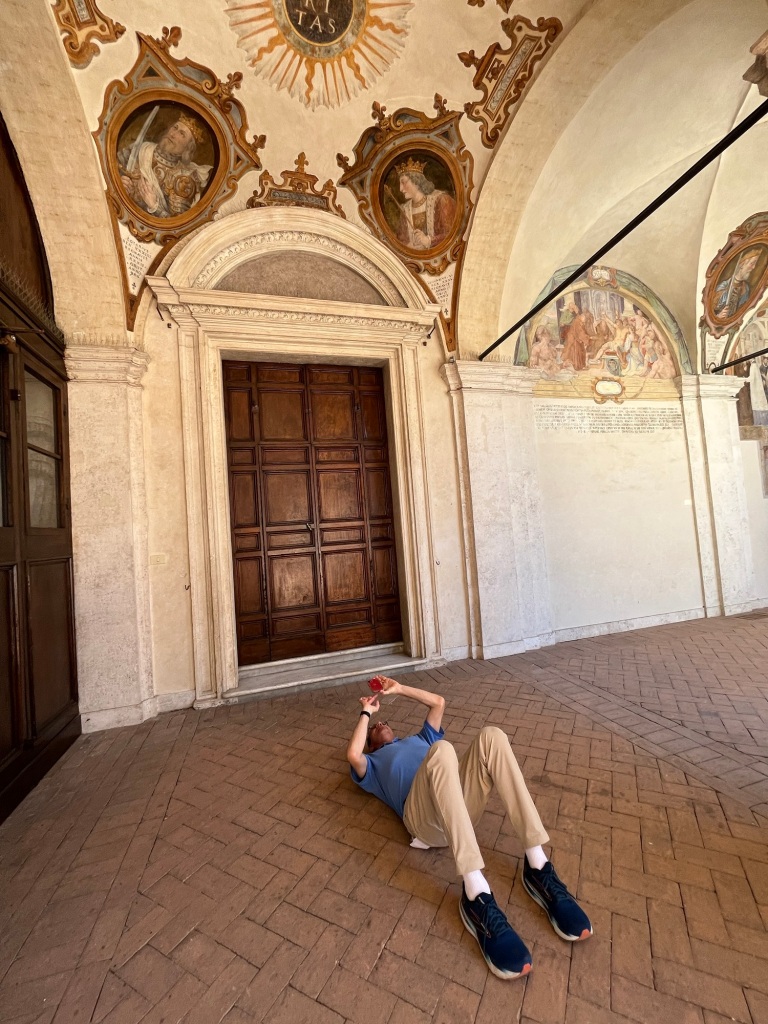
me and my boys, ala sunset spritz

what wisdoms have come your way in the wake of a narrative twist?

*in case you find yourself in the eternal city any time soon, the best food we inhaled in rome was at the little osteria il bocconcino, just up the hill and around a few bends from the colosseum. if you ask the boys, there are multiple other contenders as well. every bite, in a word, was sublime.

sometimes, joy makes you wait. . .

A year ago, I was crushed. Four of us were supposed to be in Paris, but one of us never made it on a plane. Passport tangles tangled him. We tried every option known to humankind, but after days of holding our breath, we faced the cold hard inevitability: there would be no four of us in Paris. No four of us encircling the cafe table, as I’d pictured it, prayed for it, since the day the doctor told me the thing in my lung was cancer. And all I wanted in the world was to be held tight, held together, by my boys. My beautiful beautiful beautiful boys.

We were determined to try again. This year: Roma. We made the law professor with the failed passport get in line early, and expeditedly, for a new-spangled one. He complied.

I held my breath anyway. The closer we got to takeoff, the harder I held all the breath in my chest.

But Monday night, two planes, carrying four people, were crossing the globe, flying through the night, pointed toward Rome.

Ever since, I’ve been inhaling in double time, breathing as deep as a girl with 1.5 lungs can possibly breathe. Because this is the stuff that makes my life hum like a mezzosoprano, like a nightingale, like the merriest mama that ever there was. We are, the four of us, entangled as one, under the blue blue of Italy’s sky.

Sometimes the unthinkable happens. And you stumble and bumble, and shed tear upon tear. But then you pick up the pieces. You make the most of what’s there in your midst, and try to not ache for what’s missing.

And life, every once in a while, gives you a rare second chance. And you realize the heartache of the past has only hollowed more space in your heart, so that when the rushing in comes in, you’ve all the more capacity for unparalleled joy.

I am giddy and dizzy and pulsing with joy. It’s the sweetest sonata that I’ve ever sung.

It’s the song of my deepest prayer answered: dear God, give me sumptuous sumptuous time with my most blessed and beautiful beautiful boys.

Amen.


A perfect poem for this moment:

Mary Oliver’s “Mindful”

Everyday
I see or hear
something
that more or less

kills me
with delight,
that leaves me
like a needle

in the haystack
of light.
It was what I was born for —
to look, to listen,

to lose myself
inside this soft world —
to instruct myself
over and over

in joy,
and acclamation.
Nor am I talking
about the exceptional,

the fearful, the dreadful,
the very extravagant —
but of the ordinary,
the common, the very drab,

the daily presentations.
Oh, good scholar,
I say to myself,
how can you help

but grow wise
with such teachings
as these —
the untrimmable light

of the world,
the ocean’s shine,
the prayers that are made
out of grass?

What are the somethings for which you’ve had to wait for what felt an unbearable wait?

scan time

so, some months ago now, in the days not long after my first follow-up lung scan (they come at six-month intervals) when i was marinating, once again, in the new measure of time that comes when they’ve peered under your ribs and found something not welcome there, i started to think of how this close watch-keeping snaps me into an attention that echoes an ancient spiritual practice. i started to think of how taking my life in abbreviated brackets of time, six months per dose, compels me to pay attention to the nth power, to relish each and every bead of time, from the quotidian to the ones that break you out in goosebumps.

so i did what i do: i sat down to start typing. i peeled back my shy parts, and let the raw truth come tumbling onto the page (aka screen). i try to put things in words because maybe just maybe there’s someone out there looking for someone who knows how it feels, how scary it is, and how maybe just maybe there’s a way to turn that fear into fuel: to be more alive than before the word cancer came barging into our lives. that i found it, and find it, a spiritual tether, to live my life in what i think of as scan time, well, maybe it was worth saying aloud.

so america magazine, the journalistic home base of the american jesuits, an order of priestly folk known for their piercing intellects and forward-thinking ways (although when my sweet husband once asked a priest friend of ours if he was a jesuit, the friend — a diocesan priest, who grew up in his father’s south side chicago tavern — shot right back with “no, i’m a real priest,” which tells you how jesuits are regarded in some corners), decided to print my little essay in their june issue, and unbeknownst to me it showed up online last night.

i’m a bit shy about social media these days, but the chair is a place i think of as safe, the closest virtual approximation to the old maple table scattered with mugs and spoons and the crumbs from someone’s lemon-blueberry bread. so, i’m leaving it here. with big thanks to america magazine, and an even bigger prayer that that one someone (someone living in her or his own scan time) just might find it, and welcome the company…

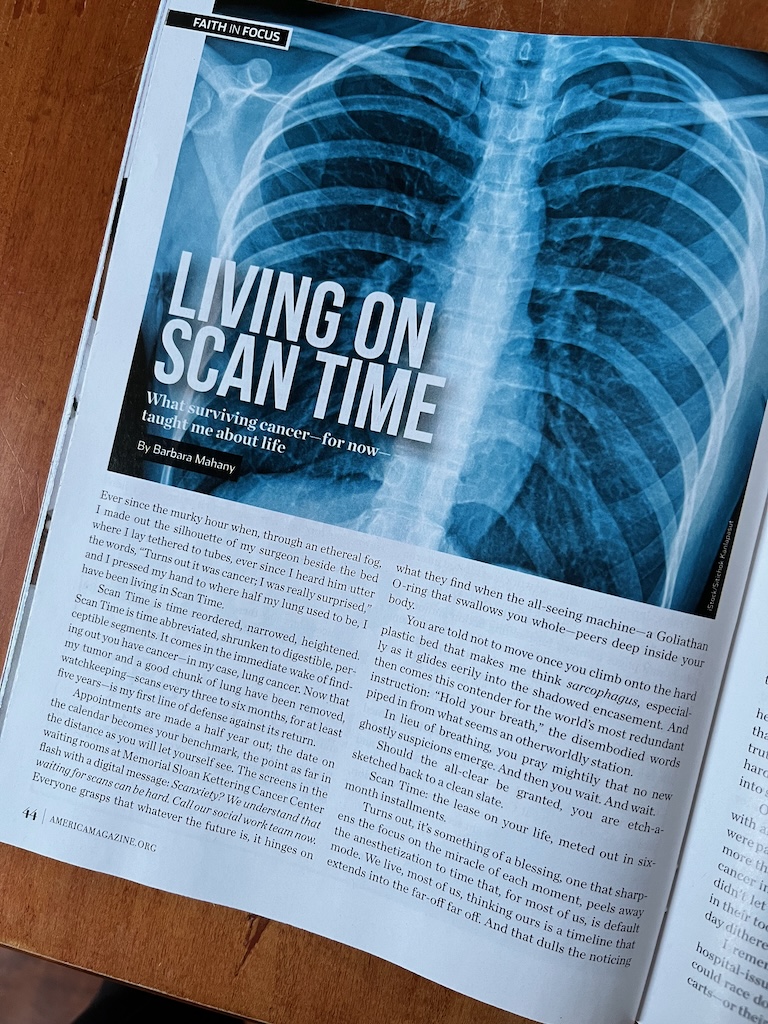
Living on Scan Time: My life after a cancer diagnosis
Barbara Mahany
May 16, 2024

Ever since the murky hour when, through an ethereal fog, I made out the silhouette of my surgeon beside the bed where I lay tethered to tubes, ever since I heard him utter the words, “Turns out it was cancer; I was really surprised,” and I pressed my hand to where half my lung used to be, I have been living in Scan Time.
 
Scan Time is time reordered, narrowed, heightened. Scan Time is time abbreviated, shrunken to digestible, perceptible segments. It comes in the immediate wake of finding out you have cancer—in my case, lung cancer. Now that my tumor and a good chunk of lung have been removed, watchkeeping—scans every three to six months, for at least five years—is my first line of defense against its return.
 
Appointments are made a half year out; the date on the calendar becomes your benchmark, the point as far in the distance as you will let yourself see. The screens in the waiting rooms at Memorial Sloan Kettering Cancer Center flash with a digital message: Scanxiety? We understand that waiting for scans can be hard. Call our social work team now. Everyone grasps that whatever the future is, it hinges on what they find when the all-seeing machine—a Goliathan O-ring that swallows you whole—peers deep inside your body.
 
You are told not to move once you climb onto the hard plastic bed that makes me think sarcophagus, especially as it glides eerily into the shadowed encasement. And then comes this contender for the world’s most redundant instruction: “Hold your breath,” the disembodied words piped in from what seems an otherworldly station.
 
In lieu of breathing, you pray mightily that no new ghostly suspicions emerge. And then you wait. And wait.
 
Should the all-clear be granted, you are etch-a-sketched back to a clean slate.
 
Scan Time: the lease on your life, meted out in six-month installments.
 
Turns out, it’s something of a blessing, one that sharpens the focus on the miracle of each moment, peels away the anesthetization to time that, for most of us, is default mode. We live, most of us, thinking ours is a timeline that extends into the far-off far off. And that dulls the noticing of each never-again day.
 
But when you’re told you’ve got cancer, when you feel the iron weight of that sentence fall with a thunk on your every breath, the bracketed finiteness of time—of life itself—now doled out in measures of half a year per dose, it amplifies everything. Each pulsebeat of living is magnified, glorified. It’s time distilled to its most sacred concentration.
 
And it draws out a knowing that’s deep and profound, one that’s not too dissimilar to an ancient spiritual practice that understands the holiness in contemplating our death. Or, in my case, contemplating the reduction of time, the days I count on my half-year watch. At first glance, that might sound morbid. But it’s emphatically the opposite.
 
Memento mori is the age-old practice of remembering that you will die. It’s an ancient philosophical thread, a spiritual practice woven across time and traditions (be they moral or religious traditions) from early Stoicism to medieval Christianity, from ancient Judaism to the central teachings of Buddhism.

St. Benedict of Nursia, in his sixth-century book of precepts known simply as the Rule, exhorted his monks to “keep death daily” before their eyes. It’s an awareness that winds its way through most world religions, although barely so in the West, where we do all we can to push away any whiff of dying or death.
 
To understand that our days are not infinite, not a bottomless pour, spilling one after another so dizzyingly that we are numb to each dawn’s awakening, is to tight-squeeze our focus on how precious this time of ours is. Pope Francis, in his apostolic exhortation “Laudate Deum,” posed three critical questions: “What is the meaning of my life? What is the meaning of my time on this earth? And what is the ultimate meaning of all my work and effort?”
 
Those questions take on an inescapable edge when held up in six-month increments. We’re a simpler people than we sometimes pretend. We’re keener at grasping hard truths when they’re pressed up against us. Cancer presses hard truths. Scan Time sharpens focus, propels us deep into seizing the day. Seizing each blessed day.
 
Once upon a time, I was a nurse who took care of kids with all sorts of cancers. Back in the days before scanners were part of every oncologist’s medical tool kit, I remember more than anything how those kids somehow eclipsed the cancer in their lives. They shoved it out of the viewfinder, didn’t let it intrude on however many days were counted in their too-short lives. Theirs was an innate genius—not a day dithered away—that echoes across the decades.
 
I remember how kids with an amputated leg and a hospital-issued pair of crutches clocked how swiftly they could race down the hall, without crashing into medicine carts­­—or their nurses. Or how, as soon as the retching from chemo ended, they’d order up midnight pizzas and hunker down in the supply closet for a tête-à-tête with their IV poles and their bald co-conspirators. Or how, one Halloween, one of my favorites, a 12-year-old with a tumor lodged in her spine that left her paralyzed from the waist down, didn’t let that stop her from slopping papier-mâché all over her bedsheets, as she crafted me a green, tempera-painted pumpkin head and crowned me her Irish Pumpkin Queen.
 
Those children made time count. And they didn’t need scans to prompt it. All these years later, I draw on their wisdom, though I lean on the scanner—a machine that might see what is inside me but not what lies down the road.
 
Scan Time, I’ve realized, propels me to live sacramentally, to hold time to the light, to behold its shimmering brilliance, the facets of my life I consider most indispensably sacred. And to enfold myself in each anointed hour..
 
I might be mesmerized by a butterfly. Might sit down to pen that long-overdue confession. Might devote my perishable days to those few souls I cannot bear to leave behind, revel in the litany of whimsies we’ve long promised we’d get to, indulge with abandon. Or maybe I’ll travel to pockets of the world where my heart and my hands—and my long-expired nursing license—might be put to good use.
 
Scan Time is palliative, too; it offers something of a balm. Where the arithmetic of five-year-survival rates sets me to trembling as I weigh cold, hard probabilities, I’m washed in some iteration of calm when I set my sights on half a year at a time. Like a mountain climber trekking past mile marker after mile marker, I keep my eyes on the immediate path and don’t try to peek around circuitous, unseeable bends.
 
Yet underpinning each round is the knowing this might be the last, the one with expiration. One of these rounds, you suppose, the call won’t be so freeing. And time then will shift again. Day after day the distilling comes, until each last minute holds all that you love, all that desperately matters.

(reprinted exactly as it appears on the pages of the june 2024 issue of america: the jesuit review of faith and culture)

for the record, my latest scan looked clean. and, in the spirit of seizing the days, we’re off to rome in just a few days. the four of us, G-d willing. we have four valid passports among us, and after having to leave one of us behind last year when a passport was found wanting, (not in accord with the french rule that your passport must be valid for 90 days after leaving the country, and our firstborn’s was a mere few days short) this adventure in world travel is one big giant hallelujah.

what are the forces in your life that propel you to seize each and every day? and or any other thoughts that might be burbling about in your beautiful minds….

sunshine girl

i tend toward the grays. and i don’t mean the pewter locks atop my head. i refer here to my meteorological preferences.

i’m of celtic persuasion, which means a pigeon-colored sky, preferably with mists rolling in, a landscape without shadow, for clouds are in the way, that’s the sort of day that wraps me like an afghan dropped from heaven’s hutch, makes me feel cozied by the hearth, deeply much at home. 

give me a gray day and i all but purr. 

this week, though, has been anomaly. the sunbeams of this latest swatch of springtime have been pouring in full proof, and voluptuously so. sunbeams so pure, so concentrated, i’ve bridled the urge to stick out my tongue and lick them––as if a gelato on a cone. or gulp, as if a nectar in the most delicate cut-glass flute that ever was.

it wasn’t lost on me how novel it was for me to be fixated––and bedazzled––by the motes of sunlight shafting in. it shook me from some rafters i’d not even realized had boxed me in. i was paying attention to my paying attention. an attunement to the nth power. and the simple substance that transfixed me was but one of that elemental trilogy: sunlight, water, air. 

to live in a state of fine-grained attentiveness is the instructive of every sage or prophet who’s walked this sunlit earth. for us to notice celestial shifts, as winter turns to spring, as the great star is jimmied higher into sky, must be God’s rapturous delight.

and i must have been more sun-starved than i realized after a long and washed-out winter, for i couldn’t keep myself inside the house this whole week long. i was all but stripping bare my crepe-papery arms and legs, so my famished flesh could guzzle sun. and, every chance i got (and even those i didn’t have), i found myself down on my knees, at the garden’s edge, wherever tender growing things gave me excuse to coax and coddle and slapdash in the dirt. 

from nearly sun-up to sundown, i was out and about, clocking miles on my soles, slip-sliding along a river trail, dodging red-winged blackbirds who tried to perforate my noggin. and, when my legs and knees were tuckered out, i sat splotched in sprees of golden light as i perched, robin-like, atop a rock or stoop, keeping watch on flutterings in trees. 

i’m not typically a sunshine girl. despite a nomenclature suggesting otherwise.

my papa and me (aka his “sunshine girl”)

long long ago, there was a fine irishman––my witty papa––who pinned a moniker on me back in the days when i’d take him by the hand and maybe reach just beyond his knees. he called me his sunshine girl, his one and only, and it’s a name that makes my knees go limp even to this day. 

i’ve not heard his voice in 43 years, but i can see the glint in his eyes, the way the pilot light burned bright and brighter, as he warmed up to pronounce the words, deeming me his sunlit girl. 

i rather fail my reputation.

in the long years of his absence, i’ve grown more inclined to sunshine’s shadowless counterpart, the days some define as “the color of bad weather.” i protest, tend to be of a mind with leo da vinci, the polymath and painter, who insisted “a gray day provides the best light.”

though not this golden-glowing week. and not without exception.  

like the poets emily D and annie dillard, i like my light in slants, or as dillard put it once: “i’m a collector” of such angled penetrations. the oblique is how i see things best.

most days, pure drenched feels too exposed. the white light of summer’s height makes me wither. 

springtime, though, is tender season. and the sunlight comes in slant, in perfect concentration. and every once in a rare while, in days as delicious as the sun-drenched string that was this week, i’ll gulp my yearly dose of solar plenty. and i’ll gulp it without pause. 


speaking of sunshine and the irish, here’s a line that made me laugh aloud this week:

“the sad truth is that, like fish, the looks of the irish are not improved by sunshine . . .”

—Niall Williams, This is Happiness, page 193


and as is my wont, i’ll bring mary oliver into the conversation, as she came to mind more than once when i was down on my garden knees this week: in “the summer’s day,” she writes:

“I don’t know exactly what a prayer is. /  I do know how to pay attention, how to fall down / into the grass, how to kneel down in the grass, / how to be idle and blessed.”

and, lastly, i zoomed into a poetry conversation with the poet (and yale institute of sacred music professor) christian wiman the other day, and he was asked to read a poem that shocks right through him, and here’s the one he read: 

Prayer
by Carol Ann Duffy

Some days, although we cannot pray, a prayer
utters itself. So, a woman will lift
her head from the sieve of her hands and stare
at the minims sung by a tree, a sudden gift.

Some nights, although we are faithless, the truth
enters our hearts, that small familiar pain;
then a man will stand stock-still, hearing his youth
in the distant Latin chanting of a train.

Pray for us now. Grade 1 piano scales
console the lodger looking out across
a Midlands town. Then dusk, and someone calls
a child's name as though they named their loss.

Darkness outside. Inside, the radio's prayer —
Rockall. Malin. Dogger. Finisterre.

(the four names in the last line are towns called out on BBC radio’s nightly “shipping forecast” for the various seas around the british isles, waters divided into 31 sea areas, including rockall, malin, dogger, and finisterre. the broadcast litanies, especially the late-at-night ones, are for many britons––including carol ann duffy––a familiar touchstone: the announcer’s voice reciting the sea areas all around the islands, one by one, forecasting the weather. and, higher up, minims are the half-notes in a page of musical notation)

of all the meteorological options, which one most floats your boat? and how and why?

the pretty way

long a proponent of “the pretty way,” the winding way to wherever i’m headed, i am up against the GPS current, the Waze current, those little voices that come out of the ubiquitous boxes in our lives that try to tell us what to do––and the shortest, fastest, sometimes blandest way to do it.

it’s one thing when running late to a doctor’s appointment on a rainy afternoon when the roads are under construction. but not so when the afternoon is a span of time unmoored from anything else, except an eventual need to show up somewhere.

i am seizing one of those days today, as i drift north and a little bit west and steer myself toward a corner of the world i’ve never seen, a corner called “the driftless” (and if i ever employed my caps lock key, that d would be a D, as in a capital proper-name letter). it’s a corner as dramatic as any in these middlelands of the continent, a chunk of 8,500 square miles described as “a sudden maze of hills” and bluffs and valleys below, rising out of the flatlands of southwestern wisconsin.

it’s the land that time (or at least a good chunk of the ice age) forgot. while the glaciers of 500 bazillion years ago steamrolled the behoozies out of the rest of these parts, they never rolled through the driftless, leaving time to do its thing: cold water streams kept on carving through rock, sculpting and clearing and doing as they pleased. the meltwater from parts beyond incised valleys and bluffs, sinkholes and springs, caves and labyrinthine cave systems. and so, in the midst of a topography best described as pancake, suddenly there is capital D drama.

i could do with a good dose of topographical drama. and today’s the day i’m making it happen. because there’s not a Siri in the world who will point me the ways i want to go, i’ve had to revert to pen and ink, and scribbled my route onto an index card. 90 to 20 which turns into 69, quick right onto 81, then city road G/N and, at last, onto 23. u.s. highways and state roads, roads with alphabetical options, and streets with no names at all. that’s how i’ll get where i’m going.

and all the while i will marvel, and gawk. might even put the car in reverse, to gawk all over again (don’t tell the designated “careful driver” in the family, he who would insist on seizing my wheel).

it’s all a way of seizing time. of gulping down as much as you can of the wonders not too far beyond our very own windows. for the most part, my days trace and re-trace old, familiar routes. and for a homebody like me, that’s a very fine thing. if given my druthers, i’d stay curled in my window seat for hours on end. but, when distant parts call, i’m intent on getting there my way.

which is always, always the wiggledy way.

the way that makes me so blessedly thrilled to be drinking it in.


luci shaw is as dear a soul as she is a fine poet. and this morsel from luci fell on my path this week, in a resurrected interview with Image Journal. here’s luci’s take on why we write:

I have a magnet on my file cabinet that says, Write to learn what you know. So often the physical jotting of words in a journal or on a screen is like a key opening a lock. We know more than we know. When that door is opened, we find unsuspected treasures that can become available to others in our writing. This is a mystery. Because words and ideas have been recorded for centuries, they are available to enlarge our own thinking. We can connect with the words of the great writers of the past—Shakespeare, Milton, Spenser, Dante, Donne—because they were written down and preserved. It is magical to realize that their ideas are still flying, reaching over hundreds of years into our lifetimes, and as we read them, their revelations are transferred into our modern minds. I just wrote a poem inspired by a saying of Tertullian, an early church father, about birds, and the cross they make with their wings when flying.


and a little dose of poet and zen monk jane hirshfield to wind up the week….

To Drink

I want to gather your darkness
in my hands, to cup it like water
and drink.
I want this in the same way
as I want to touch your cheek—
it is the same—
the way a moth will come
to the bedroom window in late September,
beating and beating its wings against cold glass;
the way a horse will lower
his long head to water, and drink,
and pause to lift his head and look,
and drink again,
taking everything in with the water,
everything.
––Jane Hirshfield

how might you make the most of time today?

p.s. i’m headed to mineral point, wisconsin, for a weekend of Book of Nature extravaganzas, beginning with a saturday morning nature hike through a wooded (and likely muddy) preserve, followed by an afternoon book talk in a charming book store called The Republic of Letters, followed by a gathering at a new cook shop, followed by my first from-the-pulpit sermon at Trinity Episcopal Church on sunday morning. then it’ll be back home the windiest way i can wiggle…(here’s a little recording the mineral point chamber of commerce posted who knows where…)

time travel

the other morning, when the clouds were especially bumpy, i boarded a plane, paid no mind to the bumps, and flew 612 miles to turn back the clock to “before time,” and seize a few of the most important days of my life. 

what might those days be, you wonder? those days are nothing so fancy as plain old ordinary quotidian days side-by-side with a law professor who happens to be my firstborn. and whose life all those hundreds of miles away from where i usually lay my head on my pillow feels too far for a mama trying to seize every blessing from every old day. 

i count myself among the blessed, having birthed a human who happens to be one of my favorite of the whole species. he is 30 and i am double that-plus. and all these decades in, i still purr like a happy cat when he and i are curled like bookends on either side of the same couch. or side-by-side in the front seat of a car, him at the wheel, motoring hither and yon as together we trace some curiosity. or attend to a plain old errand. 

a year ago at exactly this time i was here slicing open boxes, stacking sheets on shelves, and filling a fridge, moving him in at the start of his professorial life. it was just weeks before i had surgery, and before i had any idea what the surgeon would tell me as i lay there coming out of an ethereal fog. in fact, it was during my week here in DC that i tried to casually mention that i was going to be having a little surgery. and so, this week in time and place holds some sort of magical power for me: it allows me to suspend time, to return to “before,” and to savor the simple insatiable union of mother and manchild. 

only, truth is, there’s a twist this time round. and that twist takes it up a notch. or many a notch. 

i know now, in a way i didn’t know then, how very precious even one day is. and how, if you told me i had only a certain number of days, and then asked me how i would want to seize the most of those days, i would tell you the one thing i wanted most emphatically was to be as close as i could be to the people whose lives have left the deepest mark on me. 

this year, i know a bit more about the arithmetic of life. and how, no matter how many days there are, there are a precious few categories for which there are never enough. and how, simply hearing the sounds––even the humdrum ones, maybe especially so––of someone you love shaking off the bedsheets in the other room, awaking to another day, watching that someone in real time, in the flesh, go about the unspoken routines that make for a day––grabbing the keys from the bowl, looping back for one last chug of coffee, turning down a particular street to get to work, all those incidentals that make a life a life––those are the things i want to take in in real time. to press them to my knowing. to be entwined with.

and so, as the calendar rolls back to that seminal season when everything changed, i wanted to slip in between time and enter a netherworld in which i could plant one foot in “before time,” when i wasn’t someone who’d been told she had cancer, and “after time,” another name for now, when i do know that the blessing of cancer, or any leaden-weighted diagnosis, is that nothing means more than time. unfettered, ordinary, spectacular, magnificent hour-upon-hour doing the things that make a life a life. 

because these are the hours i will never ever regret or forget. and i don’t ever want to wish i’d made more time for time. 


while i marinate in the hours and days before me, before i board the homebound plane, here are a few things worth pondering. all of which make for this most beautiful mosaic we call our sweet fine lives. . .

this sweet gem is an excerpt from the very lovely susan cain’s Bittersweet

Franz Kafka was one of the great European novelists of the twentieth century. But there’s another story, this one written not by Kafka but about him, by the Spanish writer Jordi Sierra i Fabra. This story is based on the memoirs of a woman named Dora Diamant, who lived with Kafka in Berlin, just before his death.

In this story, Kafka takes a walk in the park, where he meets a tearful little girl who just lost her favorite doll. He tries and fails to help find the doll, then tells the girl that the doll must have taken a trip, and he, a doll postman, would send word from her. The next day, he brings the girl a letter, which he’d composed the night before. Don’t be sad, says the doll in the letter. “I have gone on a trip to see the world. I will write you of my adventures.” After that, Kafka gives the girl many such letters. The doll is going to school, meeting exciting new people. Her new life prevents her from returning, but she loves the girl, and always will.

At their final meeting, Kafka gives the girl a doll, with an attached letter. He knows that this doll looks different from the lost one, so the letter says: “My travels have changed me.”

The girl cherishes the gift for the rest of her life. And many decades later, she finds another letter stuffed into an overlooked cranny in the substitute doll. This one says: “Everything that you love, you will eventually lose. But in the end, love will return in a different form.”


and, lastly, this: wisdom from The Dhammapada, a collection of sayings of the Buddha in verse form and one of the most widely read and best known Buddhist scriptures.

With gentleness overcome anger – with generosity overcome meanness – with truth overcome deceit – Beware of the anger of the mind – master your thoughts – Let them serve truth – the wise have mastered body, word and mind – the wise harm no one. 

The Dhammapada*

“the wise harm no one…” let us be wise, be gentle, be generous.


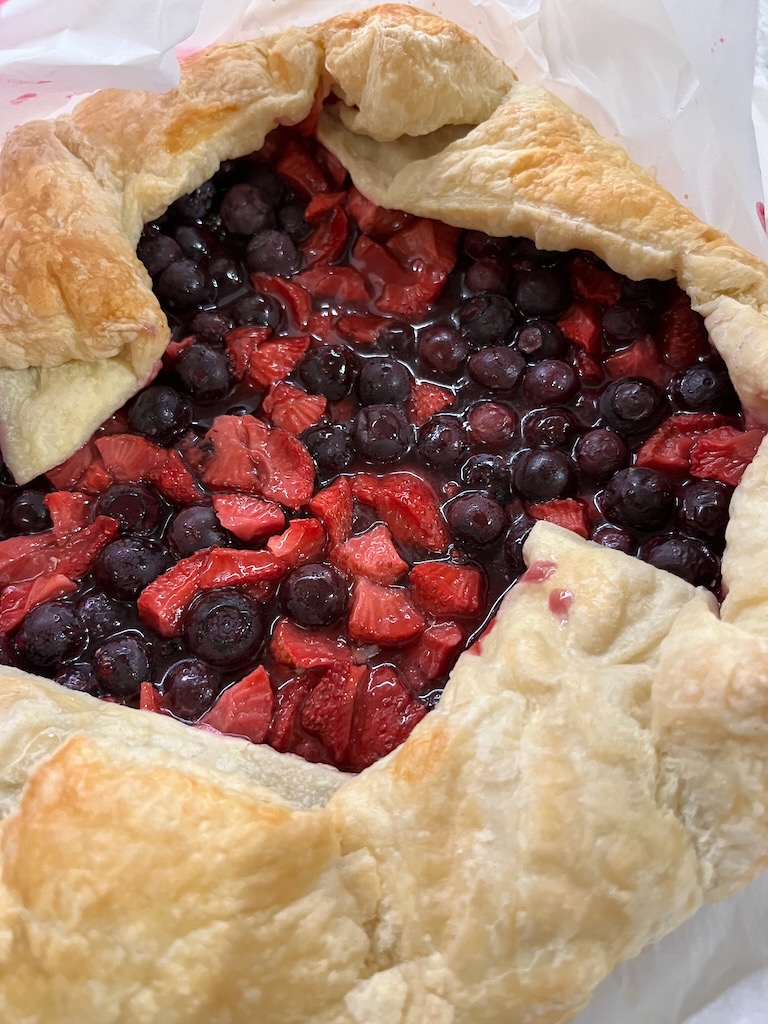
and speaking of generosity one of our beloved beloved chairs who lives not far from where i sit typing here in DC motored over yesterday to spend a good chunk of the day traipsing through a franciscan monastery that took our breath away (and not only because of the paths up and down hills) and who delivered this glorious berry-filled galette to me and my sweet professor, whom she knew when he was a mere wee lad of kindergarten age…generosity abounds at the chair, and i love you all for it.

pjt’s very magnificent very-berry galette

and how might you choose to seize a day, any old day, in the magnificent story of your sweet and blessed life?

incandescence

There must be always remaining in every one’s life some place for the singing of angels, some place for that which in itself is breathlessly beautiful and, by an inherent prerogative, throws all the rest of life into a new and creative relatedness, something that gathers up in itself all the freshest of experience from drab to commonplace areas of living and glows in on bright white light of penetrating beauty and meaning — then passes.

— Howard Thurman

my relationship with time shifted this year. living does that. somewhere along the line, a rock is thrown. it shatters what it hits. and as you stumble to pick up the pieces, you start to see that you won’t get it back to what it was. the picture window is no longer. instead, the shards are what you hold. 

i’m beginning to practice gathering the shards, holding each to the light. being careful not to get cut on the sharp edges, the piercing edges. knowing the shards are what’s left, i find it easier to lift each one, position it in front of the flame, turn it this way and that, and watch for the incandescence. 

it’s called seizing the day. 

it’s why we watch babies, stare at them mesmerized. they are our sages, the ones whose every dandelion, every dust mote floating by, is a new encounter. can you imagine emerging from the dark wet womb and suddenly feeling fleshy arms cradling you, soft lips kissing you? can you imagine finally putting form to the face from which that one murmuring voice has been coming? 

babies seize everything because it’s all new. the rest of us learn to seize things when we start to realize they won’t last forever. 

if only we all realized how fragile a life this all is. we would be kinder to it. we would be kinder to ourselves maybe. we’d let go of the hurts that poison us. we’d shake off the fears that strangle us. we’d dig down deeper maybe, and let all the beauties out. and, critically, we’d let more in. 

and so, with my understanding of time now deepened, my frame of time shifted, i am more determined than ever, and finding it far less arduous, to step out of my old, afraid ways and into the incandescence of each and every shard. each and every blessing called “this day.” this holy day.

i am, as thurman writes above, keeping an ear out for the singing of angels, and allowing the bright white light of this most blessed life to enfold me, to behold the breathlessly beautiful. before it passes. 

where are you seeing the incandescent? are you letting it in?

and happy blessed blessed new year. while my seat belt is buckled for the year ahead, let us hold hands, and bump our way along, scaffolded by those few fine things we know to be immutable and imperative.

note to true wonder: the bottom photo i took driving home from your farm all those blessed years ago. yes, i drove and clicked. and how it happened, i still wonder. but that heartland panorama i do love. and the heartland farmer.

a mother’s heart finds its place in a canyon of moving boxes

dispatch from 20009: in which canyons of boxes in every room are ours to conquer, moi and the one i birthed first. . .

i write to you this dawn from the singular place on the planet i wanted to be this week, a point on the map now highlighted in illuminating shades of radiant. a kid i love is a professor now, and i am here where, in my book, a mother belongs: by his side, tearing open his boxes, tallying the lost and found, turning a blueprint of rooms into a place called home. 

i’ve planted the kid in five points on the map since the day he left home for college, and each one for its season became a place i peered in on, checking the weather, counting the miles, watching police reports. his dot became mine by extension. 

i’ve spent years now considering places called amherst and new haven, portland, manhattan, and now the nation’s capital, specifically adams morgan, a neighborhood where RBG graces the banners that waft from the light poles, with the words “live your truth.”

the kid has decidedly hopscotched across the country over the course of the last decade. but his itinerant days might be over, as a tenure-track post prompts me to think i’d better get used to the latest in zip codes. and, anyway, unpacking boxes, finding places on shelves, has become my sub-specialty. it’s a task i take on with all the love in the world. i don’t think i’ll ever extinguish the place in my heart that tells me my number one job on the planet is to soften the blows, trod the circuitous path, keep stretching my arms clear across the landscape, and always, always find space and time for side-splitting giggles and tears when they spill from both of our eyes. 

the kid is 29 but nowhere in the manual i was handed in the delivery room can i find a line telling me there’s a time when the mothering stops. mothering over the decades is a three-dimensional wonder: it deepens and widens, is layered with strata of life’s most wrenching and glorious moments. just last night as we were giggling and whispering our way to sleep––me on un-sheeted bed (we’re working our way from kitchen to bedroom), him on inflatable mattress––i told him how even though i see the professorial glasses he wears these days and feel the heft of his six-foot-three pillar of flesh and bone when he wraps his arms around me, i also see plenty often a flashing picture show of his life at various points along his continuum: i see––clear as clear could be––the wet and squirmy little thing placed in my outstretched arms the very first time; i see the six-month-old who let out a belly laugh for the very first time; i see the toddler who looked up from the kitchen table one breakfast and asked, as if it was the most ordinary of questions for a three- or four-year-old, “mommy, what is facetious?” meaning what does it mean, this very long word not normally found in preschool vocabulary. and, yes, i see the kindergartener who set up a lecture hall in our living room, with a circle of stuffed-animal pupils, a chalkboard and easel, and 26 spongy alphabet letters. the professor wore suspenders and tie and bare feet, and instructed his class on the fine points of D, O, and Q.

it’s a curious thing, this mothering the grown human being. there are those, i’ve been told, who believe a mother’s role is to step into the distant background, loosen the grip on the ups and the downs of those you’ve loved every day of their lives. i’m not among them, though i can go––and i have––whole weeks without more than a short burst of texting. i find it only gets richer and richer, the closest i know to “love as you would be loved.” mothering to me is a spectacular testing ground: day after day, i re-define and refine the extraordinary intricacies of loving, of where to position myself in the tableau of his life, how much of the weight to bear, and when to stand silent and when to come running. 

what i know, after a lifetime of fumbles, of occasional hits and plenty of misses, is this: the width of my brain has only grown wider over the years, as each of my boys carry me into realms i’d otherwise never explore. and my heart and my soul, they’ve at once defied the laws of physics, both deepening and rising to depths and heights i’d never ever imagined. and so, as long as i’m needed and able, i shall tear away the endless strips of packing tape till my fingers are raw and my boy has a place to call home, his very own faraway home. six hundred miles from mine.


since i’ve been busy unpacking this week, i’ve not had much chance to gather up a commonplace-y bouquet. but i did find this, from the late great bard, leonard cohen, on sainthood:

“What is a saint? A saint is someone who has achieved a remote human possibility. It is impossible to say what that possibility is. I think it has something to do with the energy of love. Contact with this energy results in the exercise of a kind of balance in the chaos of existence. A saint does not dissolve the chaos; if he did the world would have changed long ago. I do not think that a saint dissolves the chaos even for himself, for there is something arrogant and warlike in the notion of a man setting the universe in order. It is a kind of balance that is his glory. He rides the drifts like an escaped ski. His course is the caress of the hill. His track is a drawing of the snow in a moment of its particular arrangement with wind and rock. Something in him so loves the world that he gives himself to the laws of gravity and chance. Far from flying with the angels, he traces with the fidelity of a seismograph needle the state of the solid bloody landscape. His house is dangerous and finite, but he is at home in the world. He can love the shape of human beings, the fine and twisted shapes of the heart. It is good to have among us such men*, such balancing monsters of love.”

Leonard Cohen

“achieved a remote human possibility. . . ” contemplate that for a while….


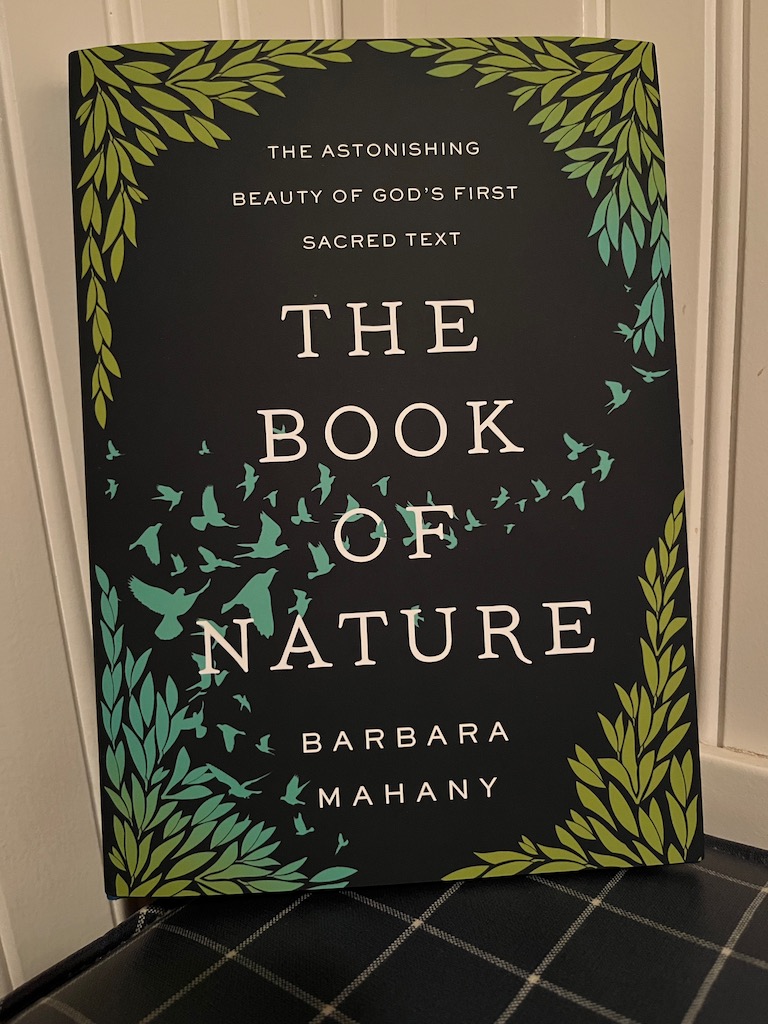
in book news: it seems hard copies of The Book of Nature have been plopping onto front stoops all over these united states, and heavenly folk, especially friends of the chair, have been sending along snaps, each of which makes my heart do a little bit of a gallop. it’s still a couple weeks till the official pub date––the vernal equinox, march 21; bring on the springtime, bring on the book!––so these early sneak-peek arrivals are both surprise and delight. and i am hoping to set that book soaring with a grand circle of chairs, as night falls on that first day of spring. see here for more details, should you be so inclined. (we’re gathering on march 21 at 7 p.m. central time, via zoom, one of the rare silver linings to emerge from our years in pandemic––or at least i count it as a silver lining, bringing me poets and thinkers from all across the globe.)

before i get back to uprooting books from their boxes, here’s the question (to ponder or drop us your thoughts): of all the mothers you’ve known or watched from some distance or close proximity, what are/were the defining qualities that allowed you to see and see clearly just what it means to love in the deepest mothering way? (and, remember, mothering for me is a verb not tied to any particular gender or state of procreativity, but rather to any and all who love with a tender loving attention and care, and the undying prayer that in some way they might both lighten another’s load and magnify the wonder of being alive…)

slow birding

A force in us drives us to the untamed. We dream of the wild, not the domestic, for it is wildness that is unknown….It can be a daily need, a desire to connect with the wind, to live facing the unexpected.

What will bring us wildness in the places we live, domesticated with warmth and culture? For some, icy branches scratching together will suffice. A glimpse of a gibbous moon or a pomegranate-stained evening sky might help. But more than these, more than perhaps anything else, are the birds. These winged dinosaurs that have given up stored fat, hollowed their bones, and made many other compromises for flight––these organisms connect us with here and there, with then and now, as they chatter outside our windows or soar past our lives. 

Slow Birding: The Art and Science of Enjoying the Birds in Your Own Backyard by Joan E. Strassmann

i surrender my soul to anyone who looks out the window and sees so vastly, so deeply. someone who understands that the pulsebeat of all creation––timeless creation––is as near as the fluttering in the branch that scrapes against the panes of our window. 

joan strassmann, an animal behaviorist and beloved professor, is the someone who penned those words. she penned them in her new book, Slow Birding, a title that immediately caught my eye (and when i mentioned it to my birdwatching mother, she swiftly informed me she’s been slow birding forever; so much for novel ideas). strassmann writes that she, like my mother, has been a slow birder all her life, not one of those birders frantically motoring hither and yon for a quick glimpse through the binocular lens, a scribbled addition to the “lifelist,” and then onto the next spotting. strassmann is not about “spotting.” she’s about slow-paced study. about taking the time to delight in the humors, startle at the spats (as even regal papa cardinal squawks away the lowly sparrowly choristers), marvel at the parabolas of flight, as feather takes on the wind. she’s all about absorbing the wonder. 

here at my cloister-in-the-making, where the walled garden soon will be serpentined with climbing hydrangea, where an elegant and capacious shingle-roofed bird B+B has been ceremoniously mounted on an elegant hand-carved post (the resident architecture critic thought it would be nifty if the scrolled brackets of the house were matched by post brackets that echoed the scrolling; and our beloved jim the builder obliged), it’s the feathered flocks that spring the whole place to life, to effervescent animation: the crimson troupe of cardinals, the squawking trio of jays, the countless sparrows, the occasional and pesky grackles, the ominous hawk.

with a mind toward soothing and stoking the soul, we’ve pared our dwelling here in this old house to an unfettered few balms: armchairs are ample and poised for conversation, a fireplace crackles with logs from the forest, books line the walls, hours are filled with the quiet of pages turning and spices simmering on the near-ancient cookstove. 

it’s the birds who bring the wild to our windowsills and put flight to our wondering. my housemate here, the aforementioned architecture critic, a man who makes an art of the rhythm of routine, has made it his solemn and devoted morning chore to scoop up a tin of seed and ferry it out to the flocks. whenever i can manage to beat him to the punch, i punctuate my seed dumping with a cheery call to the flocks, to let them know that breakfast is served. i refer to my birds in the diminutive. “here, sweeties,” i call, much to the dismay, i fear, of the neighbors. (but, oh well, they put up the fence so i can do as i wacky-well please in my now-secret walled garden.)

and even though our birding has always been slow, i find strassmann’s intentionality, her keen and fine-grained observations of the ways of each and every genre of bird, has me upping my game. putting down distraction, training my eye out the window for longer and longer spells of the day. taking note of peculiar particulars i might otherwise miss. (it’s excellent training for the whole of one’s closely examined and attentively-lived sole chance at life.)

strassmann passes along the wisdom of famed ornithologist margaret morse nice whose instruction is at once spare yet richly complex: sit still and watch. draw what you see, perhaps, the singular birds who flutter and flit. befriend them. scribble notes in a journal you keep by the window. 

but why a whole book, a 334-page book, if the instruction itself is so brief? well, strassmann explains that she delves into the intricacies of sixteen birds––and five bird-watching places––because to know the ways of the birds, to know each particular one’s biological story, is to illuminate all the more what we might otherwise be utterly missing out yonder. and thus we might look and look more closely.

the stories, obtained over the lifetimes of various ornithologists who trained their lenses on a single question or puzzle or species, might leave you oohhing and ahhing and racing to windows.

for instance: blue jays––noisy, bossy––are “the most american of birds, occurring in every state” (though not a single state claims the jay as its state bird); the american robin is the “earthworm whisperer,” and when a robin cocks its head toward the earth, it’s listening for the rustle of the underground worm; the ubiquitous sparrow is a bird with roots in bethlehem (yes, that bethlehem), and once was considered a pot-pie delicacy (thankfully those days are behind us––and the sparrow); and finally, the cardinal has reason for chasing after the reddest of berries: the carotenoids in the fruits make for a deeper red of its feathers (and not only that, but the redder the cardinal, the more desirable it’s regarded in the feathered fiefdom of red-bird mating).

it’s all endlessly wondrous to me, the alchemy of poetry and science and feather on air, the proximity of the wild, the animations of beings both social and singular. 

there is something about the delicate ways of the avian world, something about the simple existence of seed and nest, flight and song, that stirs in me an exercise of the prayerful. it’s as close as i come to the wild day in and day out, and it draws me every time into a marveling that makes me sense i’ve been brushed by the holy divine. 

what will you do slowly today?

the other night i was blessed to sit and listen in proximity to pádraig ó tuama, who among many wonders spoke about how he loves birds and irish names for birds, and i was enchanted. because he’s as kind and generous as he is brilliant, yesterday afternoon he sent me the poem he’d read—“now i watch through an open door”––with the irish names for various birds woven into the poetry, and so i am including here the last stanza, with the names highlighted and i’m adding a little glossary below, so you too might be enchanted by the names the irish put to their birds…..

Oh forest flame, oh young light on the old oak,
oh small brown druid I hear
but never see. Oh red king of the morning, oh dainty feet
among the dungheaps, and fierce goose
with fierce goslings, oh muscled hare, russeted
by the long evening. Oh my
low deer, powerful and insignificant,
oh glen, oh magnificent.

irish names for birds:

*goldfinch: “bright flame of the forest” 

*wren: “brown druid”

*chaffinch: “red king”

barn owl: “graveyard screecher”

red wing: “little red one of the snow”

meadow pipit: “little streaked one of the bog/moor”

kestrel: “wind frolicker”

bullfinch: “little scarlet one of the woods”

greenfinch: “little green one of the oak tree”

oh, sigh, oh magnificent irish….

one last thing: i’ve been invited by a dear friend, the poet mark burrows, to partake of a celebration of the great austrian-bohemian poet rainer maria rilke, on dec. 4, rilke’s birthday. i quake to tell you that we’ll be in conversation with none other than pádraig ó tuama, and the details are spelled out in the flyer below. and you can find out more and register for the free zoom program here. (you’ll need to scroll down a wee bit; it’s the third in the roster of events…) (my favorite part of the flyer is where it notes the time of the event in ireland! be still my ol’ irish heart….)

and that, dear friends, is it for the week. be well, and be slow….

the sodden state of summer’s back-to-school days . . .

it’s been getting heavier and heavier all week. my heart, that is. the boy i love—or one of ‘em anyway—is heading off again. one last time. to school, that is. we’ll be playing follow-the-leader, interstate-style, this weekend, when he pushes off with a trunk filled to the gills, and i follow not far behind with a wagon equally jammed. i’m enlisted only for my skill at hospital corners (a nurse’s way of tucking in bedsheets), and my knack for stuffing things in the teeny spaces that qualify as dorm-room closets. 

all week, amid a blur of other complications, i’ve felt my heart grow heavy with tears not yet spilled. the country roads the whole way home––just me and some fine book on tape––will make for a bucolic sponge for salt-water spillage. 

that boy is the best of company, that boy of the very big heart and the disposition best described as super chill, and ever animated. the boy fills this old house, and every heart in it.

so, once he’s left behind, back here at the homestead it’ll feel hollow once again till we get used to the long pauses of silence, till we get used to a room where the door isn’t sealed shut to hide the disarray inside. 

a wise someone once told me that if i thought high school blurred by in a blink, i’d find college blurred in half a blink. and so it is. eight years after dropping off his big brother one last time, it’s time for the caboose to part as well. this is it: the end of tuition checks and dorm vernacular, the end of considering time in back-to-school and semester allotments.

there’s perhaps a better chance that this one will find his way back home, to call sweet chicago the place where he belongs. but till then, nine months will trickle by. 

it’s the leave-taking that always bumps me up. the saying goodbye is not my strong suit. my trouble in that department dates back to when i was five and my papa got a big new job in a city far away, and every sunday night for the rest of a school year, he slid behind the wheel of his turquoise ford falcon and headed down the drive while i sat slumped on the concrete stoop there in the garage. i remember crying till my cheeks hurt. and going to bed with tummy aches. till he came home on friday nights.

nowadays i cry while spritzing the bathroom mirror, and when luring dust bunnies out from under the college kid’s bed, once he’s emptied it, once he’s faded into the faraway. then i try to find my way again, to find the joy in silence, in the slower pace with which the fridge and pantry empty, in the fewer loads of laundry. in that bathroom mirror that never splatters.

it’s come and go, all life long. and we’re wise to make the most of those blessed hyphens in between.

in the weeks ahead, i’ll be busy plotting my new cloister garden as a six-foot wall is being erected (straight through a chunk of what had been my garden, and hard up against our once-breezy screened-in summer porch) even as i type. i’m thinking of it as my monastery wall––the cedar barricade shutting out all the troubles of the world. but the thing i’ll miss most is the slant of sunlight at the twilight hour, as the great orb sinks low and the shafts of light get long and longer. it’s a golden glow that makes my summer porch seem gilded with celestial stardust. 

and because the last round of page proofs got delayed till next week, i’ll fill my quiet hours with the intense concentration those pages demand. and then it’s off to the printer as i await the day the box of books lands plop on my doorstoop. 


cook’s corner: here’s a truly nifty thing i bumped into this week (if meat lovers thrill to find a way to use every bit of the beast, from tongue to tail, then we who love the produce patch thrill just as mightily to find there’s more to the vine than just the fruits!). as one with a plethora of tangled vines, and one who sniffs deeply of my finger tips after plucking my daily tomato harvest, this enlightenment brings double the delight from those vines. and it’s all about the leaves…

How to Cook with Tomato Leaves

Tomato leaves contain 2-isobutlythiazole, a compound responsible for the plant’s distinctive aroma. Commercial tomato products, like ketchup, often include an isolated form of that compound to boost fresh tomato flavor.

If you have a garden full of tomatoes, though, you’ve got a great source of 2-isobutlythiazole right in your backyard. Here’s how to use tomato leaves to boost your sauce’s flavor.

1. When you harvest your tomatoes, pluck a handful of leaves from the plant.

2. Toss the leaves into the sauce and steep them for 10 minutes.

3. Remove and discard the leaves. 

Taste your sauce, and you’ll find that the tomato flavor has been both heightened and made more complex and earthy.


commonplacing:

from poet and pacifist William Stafford, found in his son Kim Stafford’s intimate portrait, Early Morning: Remembering My Father:
every day Stafford would write a page in his journal, his response to what he called “the emergency of being alive.” 

we are all of us deep in the emergency of our being alive…


a little bit of Buechner, in memory of the blessed man who died at 96 on monday. 

Frederick Buechner

a few years back, in 2016 to be precise, i counted a new collection of writings from theologian frederick buechner, with introduction by anne lamott, as one of the best books for the soul that year. his death this week made me pull that review from the shelf, and perhaps it’ll prompt you to pull a bit of buechner from your own bookshelf or that of your nearest library. 

Buechner 101: Essays and Sermons by Frederick Buechner

By Carl Frederick Buechner, Introduction by Anne Lamott, Frederick Buechner Center, 170 pages, $15.99

Maybe once a generation, once every few generations, someone is born with gifts literary and sacred, in equal brilliant measure. A translator, perhaps, of the highest calling. One who can at once lift our souls and our sights, by virtue of the rare alchemy of the poetic plus the profound. Therein lies the prophet. Therein lies Frederick Buechner, at 90, one of the greatest living American theologians and writers.

In these collected works, Buechner 101: Essays and Sermons by Frederick Buechner — a table of contents that includes excerpts from his Harvard Divinity School lectures, The Alphabet of Grace; a searing essay on his daughter’s anorexia; a seminary commencement address on the hard truths of pastoring a flock of believers, doubters and everyday sinners — we are introduced to, or immersed in, the depth and breadth of this rare thinker’s literary and soulful gifts. 

Anne Lamott, in her introduction, admits to being blown away by Buechner’s capacity “to be both plain and majestic” at once. She ranks him side-by-side C.S. Lewis, then declares, “No one has brought me closer to God than these two men.”

That alone might make you rush to pore over these pages. What I know is that this world sorely needs a prophet who reminds us to not give up our search for holiness amid the noise and hate and madness all around. Buechner, though, says it in words that work as poetry, shimmying through the cracks, burrowing deep within us, reverberating long after the page is turned. He writes: “We must learn to listen to the cock-crows and hammering and tick-tock of our lives for the holy and elusive word that is spoken to us out of their depths. It is the function of all great preaching, I think, and all great art, to sharpen our hearing precisely to that end.”

And it is that very sharpening that we find, paragraph upon paragraph, page after page, in Buechner 101


poet’s corner:

two poems worth pressing against your heart…

Field Guide

Once, in the cool blue middle of a lake,
up to my neck in that most precious element of all,

I found a pale-gray, curled-upwards pigeon feather
floating on the tension of the water

at the very instant when a dragonfly,
like a blue-green iridescent bobby pin,

hovered over it, then lit, and rested.
That’s all.

I mention this in the same way
that I fold the corner of a page

in certain library books,
so that the next reader will know

where to look for the good parts.

––Tony Hoagland

Moon

The moon is full tonight
an illustration for sheet music,
an image in Matthew Arnold
glimmering on the English Channel,
or a ghost over a smoldering battlefield
in one of the history plays.

 It’s as full as it was
in that poem by Coleridge
where he carries his year-old son
into the orchard behind the cottage
and turns the baby’s face to the sky
to see for the first time
the earth’s bright companion,
something amazing to make his crying seem small.

 And if you wanted to follow this example,
tonight would be the night
to carry some tiny creature outside
and introduce him to the moon.

And if your house has no child,
you can always gather into your arms
the sleeping infant of yourself,
as I have done tonight,
and carry him outdoors,
all limp in his tattered blanket,
making sure to steady his lolling head
with the palm of your hand.

And while the wind ruffles the pear trees
in the corner of the orchard
and dark roses wave against a stone wall,
you can turn him on your shoulder
and walk in circles on the lawn
drunk with the light.
You can lift him up into the sky,
your eyes nearly as wide as his,
as the moon climbs high into the night.

––Billy Collins


listening nook: because i’ll be coursing through the countryside in my red wagon this weekend, i’m bringing my reading nook on little discs. here’s the stack assembled from the library shelves:

A River Runs Through It, Norman Maclean: i once was graced to work alongside Norman’s son John, a fine fine bespectacled gent with a much quieter, more studious demeanor than many of the newsroom characters. his father’s masterwork  stands as one of the great “evocations of nature’s miracles…and a probing of human mysteries.”

The Abundance, Annie Dillard: a landmark collection from the writer i consider my north star.

Five by Fitzgerald, F. Scott Fitzgerald: i’m ever trying to expand and deepen my knowledge of the American canon and F. Scott deserves more of my attention. 

Dear Ann, Bobbie Ann Mason: mason, like me, is a kentucky native, so i feel it my native obligation to inhale her prose and her poetic ways of unspooling a story. i read my first bobbie ann mason so long ago, and it’s been ages since, so where better to reacquaint ourselves than the rolling countryside of the heartland we both call home?

Wallflower at the Orgy, Nora Ephron: ephron makes me laugh so hard i’d best keep an eye out for rest stops along the way. en route to one parents’ weekend, we listened to Heart Burn, her tale of woe from her years married to and divorcing from none other than journalistic legend Carl Bernstein. we loved listening so much we were sort of bummed we had to stop the car in ohio, where our kid was a freshman in college, and couldn’t roll along till, say, the atlantic seaboard, where we could have gotten a few more hours of ephron under our belts….


a bit more buechner, because there’s never enough:

“What we hunger for perhaps more than anything else 
is to be known in our full humanness, and yet that 
is often just what we also fear more than anything else. 
It is important to tell at least from time to time the secret of who we truly and fully are . . . because otherwise we run the risk of losing track of who we truly and fully are and little by little come to accept instead the highly edited version which we put forth in hope that the world will find it more acceptable than the real thing. It is important to tell our secrets too because it makes it easier . . . for other people to tell us a secret or two of their own . ”

Frederick Buechner

and with that, this week’s edition of the chair gazette is a wrap. question of the week: how will suck the succulence out of summer’s august sweetness?

college kid this week, on the brink of one last back-to-school.