i emerge here from a day of prayer, a day of poring over the sins of my soul, and the sins of us all collectively. it is a day that’s not easy to leave behind. certainly not this year.
Yom Kippur, the day of atonement, opened with the rabbi once again sharing shattering news. a horror in manchester, england, he told us, without details, had left more than one dead.
morning light streamed in.
i felt us all move in closer, a natural deeply human instinct to harbor each other. it’s those natural instincts that tend to get drowned out on ordinary days, days when it’s noisy, days when we’re so distracted we don’t pay attention to the sound of our breath, the warmth of our skin, the deeply human instinct to run toward, not away, from someone who’s hurting.
we live in a world so distant now from the original vision. from an edenic world where boughs were bent from the heaviness of their fruits, where the silence allowed for the chorus of chirring and chirping to rise from the underbrush, from the branches. in the beginning, in the genesis, after the cascade of wonders—light, darkness, seas and sky, dry land and waters, seed-bearing plants and fruits with seeds buried inside, two great lights in heaven’s vault, the demarcation of day and night, teeming waters and birds filling the air, wild beasts and slithering, down-on-the-ground ones—the one who’d imagined it all, the one we name God, God looked down and saw still a void. how would the garden be tilled? how would it be kept?
and so God made beings in God’s own image, so genesis tells us. and for a short flash of time, man and woman lived in peaceful accord. but temptation arose. and it all shattered and changed. eden was no longer. the man and the woman were banned.
and all these millennia later, we are a people plagued by temptation. temptation of power, of greed, of malice and evil, of hurtful whisper, and weapons of war.
we have fallen so far from the garden of peace and tranquility.
and so, on Yom Kippur, we atone. all world religions, as far as i know, hold confession at the core, are built on the knowing that we will go wrong, exercise evil, traffic in hate.
and so, through the day, over and over and over again, we confess. we confess in short form and long form. we confess and confess, each go at it grating closer and closer to the core.
against the backdrop of the world in which we are living, these are a few of the confessions we prayed:
“The ways we have wronged you by hardening our hearts; and the harm we have caused in Your world through careless speech.”
“The ways we have wronged You by giving in to our hostile impulses; and the harm we have caused in Your world through inflexibility and stubbornness.”
or this, one of the pleas to the Almighty and Merciful, Avinu Malkeinu:
“Avinu Malkeinu, halt the reign of those who cause pain and terror.”
so ardently we confess and we pray.
to enter the sanctuary, be it the one of a synagogue or the one under the heavens in my own backyard, is to submit to a paradigm other than the distortions of a world ruled by greed, and power, and envy, and lust.
in these past godawful years, when i can almost hear the walls of decency and democracy crumbling, i retreat more and more into the sanctuary. the voice to whom i answer is that of the Merciful, Benevolent God, a God who is gentle, and tender, a God who seeps into the deepest parts of me, the parts where i surrender, where i know my place is so, so small, and yet, whatever light i can bring to this world, whatever infinitesimal flickering flame, it matters. because we are not the only flame. we inch closer together when word comes, once again, of horror and chaos and evil upon evil. we are many, many flames. or we can be. if we so choose.
it is a mighty thing to stand and sit through a day when over and over we confess our sins, our evils, our hurt-making acts. we are a nation that could do with a day of atoning.
and i am blessed that i, a lifelong believer in God’s tender mercy, was asked to atone for the sins of my own and the sins of us all.
i enter quietly back into this shattered, and shattering world.
i will not extinguish my faint little flame.
what will be your flame this holy day?
i leave you with words of john lewis, the late great hero of civil rights and warrior for justice:
Every human personality is something sacred, something special. We don’t have a right, as another person or as a nation, to destroy that spark of divinity, that spark of humanity, that is made and created in the image of God. —John Lewis
and should you care to be moved by one of the gentlest, fiercest spirits ever to walk among us, this beautiful interview, recorded just last week, of jane goodall, the great primatologist and anthropologist who died at 91 on wednesday. bless her, she was deep in her last book tour when her blessed heart beat its last.
i remember how, when there was a jane goodall special on national geographic, my mother would huddle us around the TV, for she was someone worthy, and i always found her a brilliant source of hope, kindness, an uncanny attunement with nature and nature’s creatures. i have prayed all my life to live to be a wise grace-filled woman like her…..wrinkles worn with dignity, hair whitened by the sun, wrapped in her shawl, at once wise and funny, of the moment and yet timeless. . . .
all you need do is glance toward the sky, eyes skimming over the players on high. sunlight and cumulus. sunlight and cirrus. sunlight and nimbostratus. sunlight and cloud ever in play, in duet, in doh-si-doh of shadow and light.
there’s a truth being told there, a universal and organizing principle of all creation. on the first day, in the second verse, there was darkness, darkness hovering over the deep. in the third verse, light. God commanded it. and God saw that it was good.
in our lives, the leitmotif is a given. light will come. shadow will follow. light will come again.
so it was in my reading this week, when first i tumbled deeply into a luminous shaft, a boreen* of writings from a norwegian bishop and monk, erik varden, whose power as a writer was pointed out to me by a poetry friend whose taste i know to be exquisite and deep. i swiftly realized the bishop’s thinking and writing are everything they were billed to be: rare. exquisite. deep. radiant.
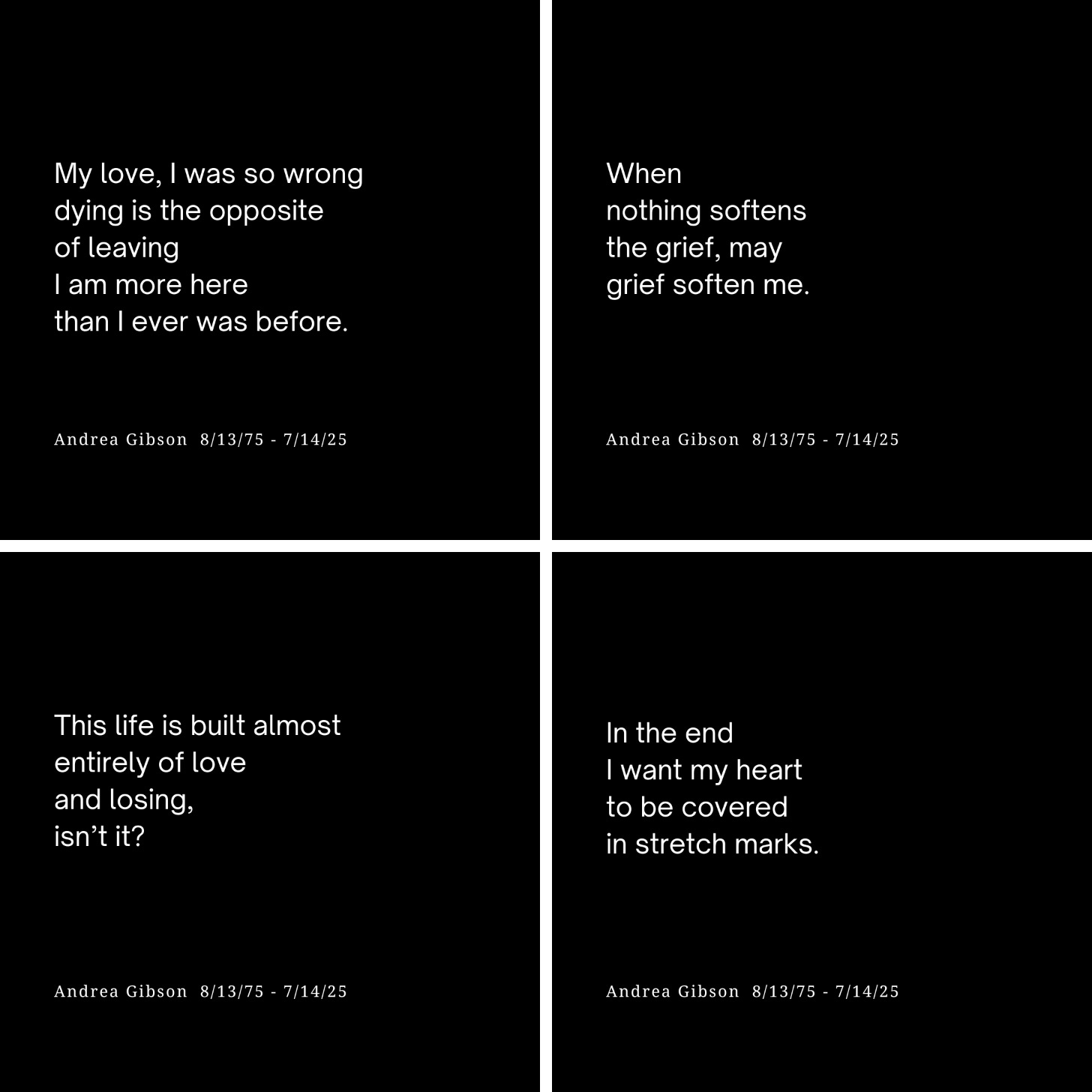
but then, hours later, shadow: i began reading a string of sentences posted from the account of one of my lifeline poets, someone you might call a patron saint of heartbreak and healing, of being more alive than you’ve ever imagined. i started to read, as if it were just another brilliant post: “Whenever I leave this world, whether it’s sixty years from now, I wouldn’t want anyone to say I lost some battle. I’ll be a winner that day.” and then i got to these words: “Andrea Gibson was a winner today. On July 14th, at 4:16AM, Andrea Gibson died…” and my legs stopped moving, and my breath was caught in midstream, and i read and read again. and then my fingers started to tremble, and my knees too.
andrea gibson
andrea gibson, 49, colorado poet laureate in 2023, queer activist (they/them/their pronouns), who had been diagnosed with stage 4 ovarian cancer in 2021, not long after they’d started a newsletter titled “Things That Don’t Suck,” had many, many times pried open my heart, pulled out the unspoken words and the fears and set them soaring. when i too found out what it is to live with cancer as one of the nouns in my story, i drew andrea into my innermost circle. the ones who know, without you uttering a word, just what you’re thinking, you’re feeling, you’re praying. the ones who some days save you. because even though the cyberworld is distant and intangible, it works in mysterious ways, and someone with whom you’ve never breathed the same air can become someone whose voice you can hear as you flutter to sleep, and whose courage you conjure as they glide you into the sarcophagus that is your biannual CT scan.
light. shadow. light from shadow. shadow deepening light. it’s the dance of the duet, interminably entwined. one is always more beautiful because of the other’s presence, because the duet is perpetual.
first, this week’s light:
that monk on a bicycle, spotted cycling through the garth just beyond the cloister, is all it took for me to want to whisper my vows, and cycle along.
as i’m quick to do, i signed up for bishop varden’s website, coram fratribus, a name derived from his episcopal (meaning “of the bishop”) motto, coram fratribus intellexi, latin for “understanding with my brothers.” because the bishop is shepherd of a flock spread across 22,000 square miles in the north of norway, extending beyond the polar circle, he sees his site as a way to speak to the diaspora, to think aloud of those things he finds beautiful or challenging, to gather his flock into a communion of thought. specifically, i felt my heart quicken as i burrowed into the bishop’s collections of writings under the tabs “life illumined,” and the shorter jottings under “notebook,” which he describes thusly:
“To scribble in the margins of texts is an ancient practice. There are people, these days, who make an academic career out of studying ancient marginalia. Any exercise of reading is fundamentally conversational. The notes collected here are brief responses to impressions received not just through books, but also through encounters, art, music, and films.”
now you see why i, a marginalian of long practice, swoon?
before i get to the paragraph in “life illumined” that drew me deep into thought, let us pause to note why we see that little outline of an owl, in the upper right corner, and hovering over every page of the site. the good bishop describes that choice thusly (emphasis mine from here on in):
“The emblem of the site is an owl. The owl does not just wing you back to the front page. It has for centuries been a symbol of the monk. Why? Because it watches in the night, when most people sleep; because it is able to see in the dark, discerning movements and patterns, foundations of meaning, where the human eye perceives only vaguely. I am fond of this Italian doggerel:
“Sopra una vecchia quercia c’era un vecchio gufo: più sapeva e più taceva, più taceva e più sapeva.
“In an old oak tree there sat an old owl: the more it knew, the silenter it was; the silenter it was, the more it knew.”
what fluttered into my mailbox the other morning was a page of the monk’s notebook on the nightingale, complete with an ancient poem (from the early middle ages, written by alcuin of york, an adviser to charlemagne) mourning the absence of the wild creature and its delicate throat. a recitation in english and latin, and including a recording of the nightingale’s song. that alone was more than beautiful enough. and then my poking and peeking accelerated, and that’s how, under the “life illumined” tab, i found a break-me-open paragraph on learning to pray.
in an essay focused on the simplicity of jesus’s prayer, and the universal cry of all believers, “lord, teach us to pray,” varden paints the scene of 72 disciples who learned not simply by listening to the words of jesus in prayer, but in witness to his consuming attention to the ways and will of God. varden expounds:
“Jesus’s teaching on prayer amounted to more than the provision of a text for recitation, that is clear. It was the sight of Jesus praying that made the disciples wish to learn prayer. The words of prayer, which touch our reason and orient our will, point towards the breaking-open of our heart, the transformation of our being as we dare to aspire, even in this life, to ‘become participants of the divine nature’.”
it is the breaking open of the heart, indeed, where the truest serum of our souls pours out. only in the last couple years have i understood that as profoundly as i do now. and, yes, that breaking so often comes with pain, or in pain, or through pain. but i’ve learned now how it truly is the propellent, the force that pushes us deeper into sacred truths than we might otherwise venture. without the breaking open, we might cling to the safer and shallower waters.
the bishop goes on. takes us beyond merely the breaking, and makes the point of its purpose. be it through prayer or through living, the breaking open is the vehicle for those who dare to aspire, in the here and now, to become participants of the divine nature. to inch as close as we can in this lifetime to something akin to sacred. i found a redemptive resonance in that line because at heart, even for the quiet ones among us, we are a people of communion, and there is a heartening, an emboldening, that comes in finding that your purpose, your aim, is not yours alone, but shared in common understanding with at least some of your sisters and brothers.
let us be broken open, then, if it points us toward our holiest purpose. through the break in the clouds, the light comes.
and onto the shadow, the eclipsing shadow…
less than one month shy of her fiftieth birthday, andrea gibson, the poet who boldly faced the coming of her death, who has been amplifying wonder, making us see the unseen, relish the oft-overlooked, took her last breath in the wee hours of monday morning.
i have been relishing her, here and in my everyday, for years now. curiously, her presence in my life spans almost precisely the arc of time in which i’ve been in the company of my own cancer.
the month before my lung surgery, when the world felt overwhelmingly like the depths of a cave, i wrote of andrea and lines i’d inscribed on my heart:
thanks to a friend i love with my whole heart, i stumbled on another wise soul with buckets of beauty to grace the world. a poet-activist-performer named andrea gibson, now a cancer survivor whose words might take your breath away. andrea identifies as queer, and uses the pronoun “they;” and they are known for their trademark honesty and bare-naked vulnerability, traits i find irresistible and blessed beyond words. here are just a few lines i couldn’t keep from scribbling down:
when it comes to hearts i want always to be size queen…
i love you because we both showed up to kindness tryouts with notes from the school nurse that said we were too hurt to participate….
when your heart is broken, you plant seeds in the cracks and pray for rain.
before i die, i want to be somebody’s favorite hiding place, the place they can put everything they know they need to survive, every secret, every solitude, every nervous prayer, and be absolutely certain i will keep it safe. i will keep it safe.
yesterday, thursday, this slipped into my mailbox from andrea’s wife, meg:
A couple years ago, Andrea said, “Whenever I leave this world, whether it’s sixty years from now, I wouldn’t want anyone to say I lost some battle. I’ll be a winner that day.”
Whatever beast of emotion bucks or whimpers through you right now, I hope you can hold that line beside it: Andrea didn’t lose anything. If you had been here in our home during the three days of their dying—if you’d seen dozens of friends drift in to help, to say goodbye, to say thank you, to kiss their perfect face, if you’d felt the love that floored every hospice nurse—you would have agreed. Andrea won.
I won’t sugarcoat the fact that they desperately wanted more time on this planet that they loved so much. This planet of squirrels and romance and basketball and moonlight.
But the time they had was significant, prismatic, and wild. It was full of trampolines and mountain ranges, stage lights and pants-peeing laughter. In their words, they “juiced the sun for every holy drop.” One of the last things they said before dying was, “I fucking loved my life.” Their conviction stunned the room.
If Andrea’s life was a poem (and it was), could there be a better last line?
a little backstory, again from meg:
In 2021, before the diagnosis, Andrea announced they were writing a newsletter, titled Things That Don’t Suck. A few weeks later, we learned they had ovarian cancer.
At first, Andrea said, “What a terrible time to be committed to writing about what doesn’t suck.” Then, almost immediately, they shifted their perspective and said, “What a perfect time.”
And so, this space was born. Part journal, part poetry, part pep talk, part treasure hunt. It became an archive of Andrea’s ability to find beauty in unlikely places, to wring gratitude from even the hardest hours. A museum of how they danced through their diagnosis, always turning their compass toward joy. It fostered a community they deeply loved.
And Andrea wanted all of it to continue.
meg tells us it will. there are reams and reams of unpublished writings, lines scribbled under the silvery light of the moon on those nights when sleep wouldn’t come. pages poured into volumes tucked away. a memoir, unfinished. half-written poems. a documentary coming this fall.
and meg promises this:
And there are stories of our life, and of the last months, that I, as their partner, and as a writer, feel both lucky to carry and uniquely able to tell.
As gut-wrenching, impossible, and tear-soaked as this moment is, I’m grateful beyond measure that they were so prolific. Through their books, their reels, their interviews, their albums, Andrea’s incredible mind will reverberate for a century—I’m sure of that.
and so, in the presence of the bishop monk, and the absence of the poet prophet, we shall go on. awake in the light and the shadow. and the shadow that deepens the light.
in case you’re curious, a bit more about dear bishop varden:
it was only after absorbing so much of his writing that i circled back to learn a bit of his origin story.
varden was born into a non-practicing lutheran family in a small village in the south of norway, and would go on to earn a doctorate in theology and religious studies at the university of cambridge, and further study in rome. a convert to catholicism at 19, he was drawn to the monastic life, and joined the mount saint bernard abbey, a cistertian monastery, in charnwood forest, in leicestershire, england. he was called to rome to be a professor of syriac language, monastic history, and Christian anthropology. and two years later, returned to the abbey when he was named its eleventh abbot. and, in 2019, pope francis named him bishop of trondheim, a nearly 22,000-square-mile prelature north of the polar circle in norway.
mount saint bernard abbey, varden’s home monastery, is where the only Trappist beer is brewed in all of England, under the name Tynt Meadow English Trappist Ale. beer to the trappists is no earthly distraction. the belgian trappists have a saying: “Beer should be liquid bread, not coloured water.”
and here’s a morsel, this one on the theology of beer, as spoken at the blessing of the monk’s brewery on st. george’s day, 2018. from Dom Erik’s address:
“One of the fascinating things about beer, is that this (potentially) sophisticated beverage is made of the simplest ingredients. By being refined to manifest their choicest qualities; by being brought together in a favourable environment; by mingling their properties and so revealing fresh potential; by being carefully stored and matured, the humble malt, hops, yeast, and water are spirit-filled and bring forth something new, something nurturing and good, that brings joy to those who share it. Considered in this perspective, the brewery provides us with a parable for our monastic life, with the Lord as virtuoso brewmaster. The Scriptures favour wine as an image of the Gospel – but that is culturally conditioned; beer, it seems to me, is a much neglected theological symbol.”
*boreen, you might recall from a few weeks ago, is the old irish word for what we might call a pothole, a rabbit’s hole, but in ireland, an island etched with cowpaths, it’s a word derived from a meandering side path when the cow decides to venture off on her own….if language is a cumulative patchwork, boreen is a word now in my lexicon….
you’ll find a veritable font of andrea’s spoken word poems, and writings at their website, andrea gibson.org. spend some good time there.
etched on a map, you might not notice; its tucked-away nature is but the flint of its charm: a treasure in almost plain sight. i might have zipped by a thousand times. it only took once for curiosity’s lure to draw me into its fold. and now it won’t let me go.
i’m coming to think of it as my footpath to the wellspring where the sacred stirs me, a nowhere-else-like-it sanctuary under the arbors, carved into the banks of a slow-flowing channel, a serpentine zig and a zag, through patches of woodland and birdsong.
as far back as i can remember, the woods behold wonder to me. my biography would be laced with a trail through woodlands and ponds and gurgling creeks. the never-ending acres of lily of the valley where my papa once drove me as a wee girl of three. the woods across from the house where i grew up, a copse that came to life in my imagination, one day a pioneer’s outpost, the next day a place to pretend i’m laura ingalls wilder in the big woods.
trailheads beckon. the barely-noticed aperture into the brush, where suddenly suburbia is leagues and leagues away. maybe it’s my imaginative overdrive, or my storybook tendencies. but give me a path, and a parting of trees leaning this way and that, and my feet cannot but go forward.
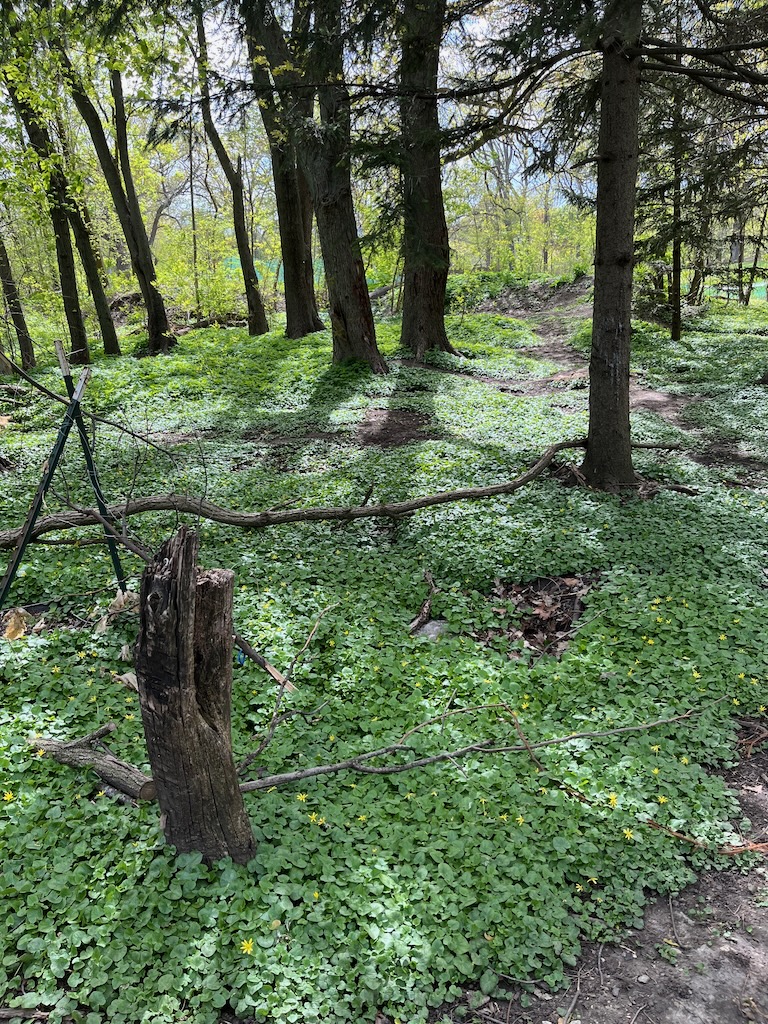
so it was on mother’s day morn when at last i found myself at the trailhead i’d vaguely noticed in the making. trees had been felled, and buckthorn burned by the wheelbarrow full. logs were yanked from where they’d fallen, and laid in a line, woodchips carpeted the paths in between. a woodland trail that meanders along and through a woods both ancient and newly imagined.
enchanted at first footfall, the only way to describe it. the ups and the downs, the dappling of light, and the peek-a-boo shadow. i walked with my eyes and my mouth wide open. over and over i marveled.
it’s a woods best described as delicate, at least in the moment—a petit point of vernal ephemerals stitched into the hillsides. springtime at its tenderest, springtime in may when it’s no longer tenuous.
it’s a place that suddenly holds inexplicable pull on me. enough to lurch me out of my wintry posture, curled over a book or an alphabet keyboard, snug in the nook by the wall-to-wall windows. it’s a place that lured the prayer right out of me. a place to dwell in my quietest stillness.
it’s my axis mundi, you see.
my friend chelsea steinauer-scudder, a breathtaking writer and author of the new book, mother, creature, kin: what we learn from nature’s mothers in a time of unraveling(broadleaf), explains: “i’ve heard countless stories of what i’ve come to think of as axis mundi experiences: encounters that have pulled someone into a deep experience of felt belonging upon the tiny bit of Earth that they find themselves upon.
“…within the study of religion, an axis mundi is a sacred pole, literal or figurative, which is fixed in a particular place, connecting Earth to the realms of heaven, underworld, and divine. “
these holy places might be a mountain (the Mauna Kea on Hawaii’s Big Island, known by the Indigenous peoples to be the umbilical cord, “the place from which the world emerged”), a cosmic tree (Norse mythology), the Ka’aba in Mecca (which pilgrims encircle seven times, as within it is the stone believed to have been handed to Adam as he was banished from Eden, so his sins would thus be forgiven).
or, in my case, an undulating woodland path along what in fact is a sanitation canal, though i pretend for the life of me that it’s an idyllic stream or a creek. one that just happens to shimmer an odd shade of aqua, a phosphoresence that might signal toxins astir.
my friend chelsea goes on to write that “we are a species in need of centers,” and within us there is encoded “an inherent capacity for place-based awe.”
those are the places with gravitational pull. a pull from the deepest well. the sacred well.
or, as chelsea distinguishes between the capital-A Axes Mundi (the most sacred of places so recognized by cultures or religions), and the small-a axes mundi (the ones you and i might call our own), the ones i know best are the quotidian, intimate ones, defined as “small, daily irruptions of majesty, those any-place encounters with the sacred.”
no surprise then that i can’t stay away. it’s an itch that can’t be scratched till i double-knot my sneakers, and try to remember sunscreen (i never do).
and it’s walking through a poem, quite literally. the soundscape a montage of birdsong and trill, punctuated with quarter notes and a screech that scares off the feeble.
these are the verses i walked among on just one of my mornings traipsing along the trail: common yellowthroat; red-bellied woodpecker; swainson’s thrush; red-winged blackbird; northern cardinal; blue jay; goldfinch; baltimore oriole; rose-breasted grosbeak; gray catbird; and a hairy woodpecker to boot. it’s as if the crayola crayon box was suddenly feathered in flight.
and in the flora department, a whole other poem: bloodroot, bluebells, celandine poppy, and columbine. lily of the valley, trout lily, spring beauty, wood anemone, and blue cohosh. jack-in-the-pulpit, shooting star, mayapples, and dutchman’s breeches.
all these names, which whirl in me thanks to the Original Mother Nature who schooled me, got me to wondering who in the world gave the names to the winged flocks and the leafy ones too. the stories behind names are their own wonders. the ones from folklore and legend are the ones that charm me most: jack-in-the-pulpit is said, of course, to resemble a preacher spreading the Good Word; the trout lilies’ mottled leaves resemble the markings of the freshwater fish; and dutchman’s breeches clearly resemble the pantaloons of one who’d also wear wooden shoes.
those, though, are merely the preamble curiosities, the ones that loosen my soul, open me up to the prayer that burbles up whilst sauntering deeper and deeper, per God’s gravitational pull, unwilling to pause till i get there. to the place where i go to feel as saturated with the sacred as i do of the sun when at last i plop onto the stump of a log, and consecrate the most blessed moment of being.
where is your axis mundi?
wislawa szymborska
and before we part, a poem worth pondering, from the late, great polish poet and nobel prize-winner, wislawa szymborska
Life While-You-Wait
Life While-You-Wait. Performance without rehearsal. Body without alterations. Head without premeditation.
I know nothing of the role I play. I only know it’s mine. I can’t exchange it.
I have to guess on the spot just what this play’s all about. |Ill-prepared for the privilege of living, I can barely keep up with the pace that the action demands. I improvise, although I loathe improvisation. I trip at every step over my own ignorance. I can’t conceal my hayseed manners. My instincts are for happy histrionics. Stage fright makes excuses for me, which humiliate me more. Extenuating circumstances strike me as cruel.
Words and impulses you can’t take back, stars you’ll never get counted, your character like a raincoat you button on the run? the pitiful results of all this unexpectedness.
If only I could just rehearse one Wednesday in advance, or repeat a single Thursday that has passed! But here comes Friday with a script I haven’t seen. Is it fair, I ask (my voice a little hoarse, since I couldn’t even clear my throat offstage).
You’d be wrong to think that it’s just a slapdash quiz taken in makeshift accommodations. Oh no. I’m standing on the set and I see how strong it is. The props are surprisingly precise. The machine rotating the stage has been around even longer. The farthest galaxies have been turned on. Oh no, there’s no question, this must be the premiere. And whatever I do will become forever what I’ve done. ~ Wislawa Szymborska ~
(Poems New and Collected 1957-1997, trans. S. Baranczak and C. Cavanagh)
remember that thou art dust and unto dust thou shalt return.
sobering words, as the grainy smudge is pressed upon my brow. it’s the season of shadow in the liturgical calendar, the season for recognizing our mortality, our fleeting time here to attend to the task of our being.
dust to dust, ashes to ashes.
the point of religion, at its wisest, is to strip us to our unfettered incidentality. to put us squarely in our place. we are star dust by chance. but a speck in the great river of time. a mere dot ordained with a task that we trust, we believe, might tip the scales toward goodness, toward light. i believe we’re here to be blessed, to become holiness in flesh form.
six weeks of lent makes it the longest season of the church year outside of ordinary time. i’m no theologian so i’ve not read deeply on that equation, but i have to think it’s telling us something of import if more days are devoted to repenting, to remembering how mortal we are than to filling our heads with the usual noise.
i’ve found myself in recent weeks deep in the writing of a book plumbing the spiritual epiphanies of cancer, which at its heart is a meditation on paying attention, remembering that we will die, and seizing the imperative to live profoundly in the now.
i’ve called it scan time, an abbreviation of time into three- or six-month allotments that serve to focus my seeing. in knowing my time is on the clock, i dive into the work. holy work.
it’s basically living in some iteration of lent from here on in: ashes to ashes. knowing full well that i am dust and to dust i shall return.
it’s a practice of every religion; humility among the highest virtues. recognizing how tiny a dot we are. and admitting how often we falter. putting voice to confession.
judaism distills it on a single day: the day of atonement, as somber a day as there is. a day in which we fast from all things, and scour our soul, confessing our sins from A to Z acrostically. abused, betrayed, been cruel, destroyed, embittered other’s lives. . .
before the naming of each and every one of those sins, both communal and individual, these words from the Yom Kippur prayer book are recited, directed to the almighty and merciful God:
You know the secrets of the universe and the secrets of the human heart. You know and understand us, for You examine our inner lives. Nothing is concealed from You, nothing hidden from Your sight. Eternal One, our God and God of our ancestors, we pray that this be Your will: forgive all our wrongs, pardon us for every act of injustice, help us atone for all our moral failures.
the act of contrition i learned in second grade says it like this:
O my God, I am heartily sorry for having offended Thee, and I detest all my sins because of thy just punishments, but most of all because they offend Thee, my God, who art all good and deserving of all my love.
I firmly resolve with the help of Thy grace to sin no more and to avoid the near occasion of sin. Amen.
and the confession in the anglican book of common prayer is not dissimilar:
Most merciful God, we confess that we have sinned against you in thought, word, and deed, by what we have done, and by what we have left undone. We have not loved you with our whole heart; we have not loved our neighbors as ourselves. We are truly sorry and we humbly repent. . .
sins and ashes aren’t things we like to think about. but, oh, they serve their purpose. and in a world where madness is reigning, where blame is cast but rarely admitted, and hubris has inverted the divine equation, i find myself seeking an alternative paradigm, one that answers not to power and vengeance but to mercy and justice and light.
and for a consideration of not our failings but our goodness, meister eckhart weighs in with this wisdom:
The inner person is the soil in which God has sown the divine likeness and image and in which God sows the good seed, the roots of all wisdom, all skills, all virtues, all goodness—the seed of the divine nature. —Meister Eckhart
a few years back, i dove a bit deeper into musings on the day of atonement, a post found here:
you needn’t have been daubed with ashes, nor live with a scary diagnosis, nor recite an alphabet of sins, to recognize the wisdom of silently examining the state of your soul. and stepping forward to make right where you’ve wronged. it’s becoming countercultural in a world taking shape as it is. the ancient ways, though, have lasted. here we are millennia later, and confession still stirs in the human spirit. it takes nerve and true might to live it. needn’t answer here, but what are the profound memories you hold of learning to say, i am sorry? or any other thoughts on ashes and dust, and the sobering truth of our mortality. . .
p.s. i suppose my publisher would reallllly want me to mention (she sent me a little nudge in the social media department, a department where i’m quite often lacking) that The Book of Nature came out in paperback this week, so you can slip a copy more easily into a backpack or pocket. and it’s cheaper!! looks just like its big sister, only a flimsier–er, more pliable––cover.
when i need to talk to God, and i do plenty often these days, there is one certain place i know God will be waiting. i know it because i feel it. and feeling God is much more than knowing. at least to me it is.
the place where God all but reaches down and swoops me into God’s arms is at the shoreline, where the vault of blue heaven is vast, is infinite, where the water’s edge might take on any one of uncountable modes: it might be uncannily calm, so calm the ripple is but a purling, a burbling so barely perceptible it’s as if the lake is tickling the sand; or it might be roiling and cacophonous, so deafening you can barely hear the words rising from your own throat.
i could stand there all day, my toes planted in sand, my head tilted back, eyes wide. heart thrust forward and up, up.
i’ve been walking there each day with my beloved. our footfalls in the sand the only sign we’ve been by. sometimes, if i go alone, i curl small as a hedgehog and settle into the grasses that rise from the hillocks of sand. i stay till the last of my prayers are unfolded, laid at the lap of the One Who Is Listening.
it’s as holy a place as i know.
to feel God reach down and hold you, to know that the vastness above is deep and wide and forever enough to absorb each and every whisper and plea, to know that the deepest cries of your heart might be heard, to feel the soothing that comes as if your trembling shoulders are now wrapped in angora skeins, that is to me the very essence of a God who’s bigger and deeper, more infintely tender and close, than anything or anyone i could ever, ever imagine. or behold.
some days i need a God of extra-big volume and size. a God big enough to hold me, to press against me so firmly that all of my worries, like wrinkles, are melted away. those are the days i look to the heavenly dome. where mine is a God who knows me inside and out. sometimes my insides are so very scrambled and messy.
it’s the closest i’ve come to that magnificent image of saint john of the cross, the one who rested his head against jesus’ chest at the very last supper, who let it be known that he was listening for the heartbeat of God. an indelible image that’s become a life-giving instructive (a particularly celtic one) for us all: to listen wherever we go for the unending pulsebeat and presence of God.
sometimes, inside the rooms of a house your worries can clang around noisily, too noisily. they can crowd out all of the air, and make you want to climb out of your skin. that’s where the heavens come in, where the shortest reach between me and my God is the indigo dome of the night at the beach, or the undulations of blues and grays in mid-afternoon. dawn at the water’s edge is a whole other slide show, one played out in the fieriest streaks of the rosy-red color wheel.
and those are the days i all but run to the shoreline, to the water’s edge, where the alchemy of sand, sea, and sky are stirred into a medicinal balm, a sacred balm, like no other. and the God to whom i run always, always is there for me.
here’s a little extra beauty from the late poet anne sexton, whose story is drenched in struggle and sorrow, but who reached for the light coming in through the cracks. i tell a little bit of her story down below, but first, the poem:
Welcome Morning
There is joy in all: in the hair I brush each morning, in the Cannon towel, newly washed, that I rub my body with each morning, in the chapel of eggs I cook each morning, in the outcry from the kettle that heats my coffee each morning, in the spoon and the chair that cry “hello there, Anne” each morning, in the godhead of the table that I set my silver, plate, cup upon each morning.
All this is God, right here in my pea-green house each morning and I mean, though often forget, to give thanks, to faint down by the kitchen table in a prayer of rejoicing as the holy birds at the kitchen window peck into their marriage of seeds.
So while I think of it, let me paint a thank-you on my palm for this God, this laughter of the morning, lest it go unspoken.
The Joy that isn’t shared, I’ve heard, dies young.
Anne Sexton
anne sexton
sexton, a 20th-century american poet, was considered one of the Confessional poets, along with maxine kumin, sylvia plath, and robert lowell. after the birth of her first daughter, she suffered from post-partum depression, had her first so-called nervous breakdown, and was admitted to a psych hospital. she suffered depression the rest of her life, a life that ended in suicide when she was 45.
although her poetry was criticized by some as “soap opera-ish,” others praised it for the ways it expressed “the paradoxes deeply rooted in human behavior and motivation. her poetry presents multiplicity and simplicity, duality and unity, the sacred and the profane.”
one of sexton’s earliest champions, erica jong, reviewing her 1974 The Death Notebooks, argued for sexton’s poetic significance, claiming her artistry was seriously overlooked: “she is an important poet not only because of her courage in dealing with previously forbidden subjects, but because she can make the language sing. of what does [her] artistry consist? not just of her skill in writing traditional poems … but by artistry, i mean something more subtle than the ability to write formal poems. i mean the artist’s sense of where her inspiration lies …there are many poets of great talent who never take that talent anywhere … they write poems which any number of people might have written. when anne sexton is at the top of her form, she writes a poem which no one else could have written.”
where are the places in your world where your prayers feel especially heard? where a holy comfort might enwrap you? and you just might feel held?and, thinking of sexton’s poem, if you were to write a litany of morning joys, what would be among your joys?
prayers for this country as we cross over the threshold of this next election. prayers for peace, prayers for truth, prayers for grace….
these are days of awe, all right. the earth and heavens––at least here on the northern half of the globe—are turning in, the shadows growing longer. yet the last gasps of summer’s bounty do not fade without an exuberance of autumn. the sky somehow seems more star-stitched. and the moon, the moon at its most zaftig of the month bathes all in amber wash.
it’s as if all is ringing out in exclamation. one tree more golden than the next. berries so abundant on the bough, the boughs are bent in botanic downward dog.
i can almost hear the whisper of the woods, and even my ramshackle garden, calling out, don’t forget us, don’t forget how glorious we were and are, the delights and wonders we’ve offered since the symphony of spring began: the perfumes, the unfolding petals, the sweetness of the fruits, the earthly prayer of wind rustling through the leaves.
it’s a paean in minor key––part elegy, but mostly gratitude and grace.
to partake of it is holy.
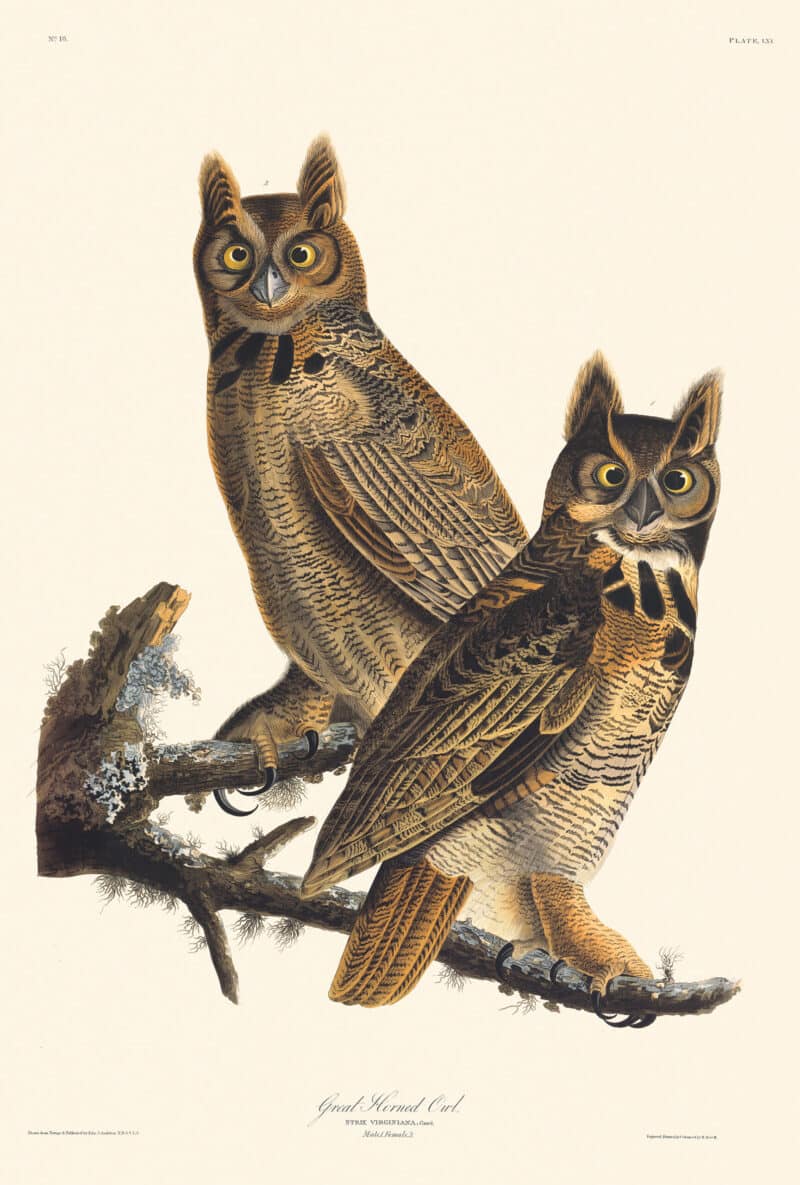
the other night i stepped into the chill of just-past dusk, ferrying a crumb-strewn pizza box to the recycling bin, and before two footfalls had crossed the bricks, the haunting whoot-whoo-whoo of a great horned owl called out from somewhere in the trees.
john james audubon: great horned owl
owls might be my spirit bird. i learned reverence for owls from my grandma lucille, who wore one in a jeweled brooch she pinned to her bosom, and tucked in many a nook and cranny of her ivy-covered house. far back as i can remember, the front of her ice box was forever festooned with strigiform, a magnet onto which she’d glued an owlish silhouette cut from felted wool and adorned with alphabet-letter pastas as its eyes and ears and markings. not one for idling, my grandma once or twice was spied by little me with ear pressed hard to windowpane, rapt by the nightcall from the woods.
i too stand rapt.
of all the notes that rise from avian throats, the owl’s are the ones that stir me deep down where the prayers rise up. at the first of the whoot-whoo-whoo the other night, i felt myself break out in goosebumps. then i lifted my eyes, drank in the light of that nearly full hunter’s moon, and prayed. mightily.
i sometimes think that trips to the recycling bin are my surest daily invitation into prayer. into the cloak of night. against the silence of a day gone hush. the tabernacle in which i offer up my nightly office is one that stations me on the cracked concrete slabs of my alley. trash cans line the side aisle. and the nave is vast. is infinite. in between where trees and old garages block the view, the sky opens wide and deep. here where i live, sky is a bit of a commodity. sunsets aren’t free for the viewing, blocked by those mainstays of suburbia: house and tree and fence. but the night sky, the obsidian up above, is blocked by no one or nothing and it is enveloping enough to soak up my every verse of prayer.
and so i stood there flinging madly. add-on after add-on. a madwoman hungrily hanging her prayers out to dry. as if a clothesline of prayer i string across the alley, flinging each one skyward as i inch my way down the line.
it’s a sacred thing to stand beneath a wheel of yellow moon, with a whoot-whoo-whoo as chorister, and to pour out your insides to the heavens.
i pray the heavens heard.
here’s a bit of what else stirred me this week . . .
vassar miller was an american poet and writer, who served as poet laureate of texas in 1982 and 1988. born with cerebral palsy, her father encouraged her from a young age to write by typewriter, which she did prodigiously. and powerfully. she once said that the purpose of her life was “to write. and to serve God.” it brings me great joy to bring her here to this holy table.
Morning Person
God, best at making in the morning, tossed stars and planets, singing and dancing, rolled Saturn’s rings spinning and humming, twirled the earth so hard it coughed and spat the moon up, brilliant bubble floating around it for good, stretched holy hands till birds in nervous sparks flew forth from them and beasts — lizards, big and little, apes, lions, elephants, dogs and cats cavorting, tumbling over themselves, dizzy with joy when God made us in the morning too, both man and woman, leaving Adam no time for sleep so nimbly was Eve bouncing out of his side till as night came everything and everybody, growing tired, declined, sat down in one soft descended Hallelujah.
it is the soft dawn of a new year here, the jewish new year, an ancient calendar i’ve been drawn into, enfolded by, graced by, for all the decades since i met my beloved. he was the one who caught my eye back in the long ago, leaving the newsroom before sundown on friday nights to go to synagogue. i was moved by that devotion. leaving the newsroom on a friday night, back in the days when the big fat sunday newspaper was being “put to bed,” all the sections laid out, the stories edited, photos cropped and captioned, leaving the newsroom before deadline on a friday night meant you were breaking a mold. and you’d better have had a very good reason.
he broke my mold, all right, that tall bespectacled fellow loping toward the door. broke open a love of sacred creation, broke open an ancient text, the poetries and prayers that rose from the rocky, dusty, sometimes fertile terrain of a land indeed holy.
it would be a couple years before i found out the reason the bespectacled fellow was heading out to synagogue early on those friday nights: that was the hour of the singles’ shabbat service. he was looking to meet a nice jewish girl, and theirs was the six o’clock service. oh, well. that didn’t quite work the way he’d intended.
nor did i ever expect to be so deeply entwined with the religion of ancient ancient times. though there were hints. way back in high school, i asked a jewish friend of mine if i could come to her family’s seder, the passover meal at which the story of the exodus is told and retold. she answered that her family didn’t really mark the occasion, but maybe that year they’d make an exception. so there i was at their table, turning the pages of the exodus story, searching for the hidden matzah at the end of the meal. i came back year after year.
and all these years later, i’m the one who opens the jewish cookbook as the holidays near. over the arc of time, we’ve inscribed customs into the trace of the year: rosh hashanah, the new year, is when lamb stew (a middle-eastern iteration with chickpeas, and raisins, and apples and rice) is on the stove, though this year, just the two of us, we opted for the modern-day jewish classic, chicken marbella from the silver palatecookbook.
i crack open the prayer book too. crack it open weeks and weeks ahead of time, for the prayers are what draw me deep into the currents of the great river of judaism. awaken me to the mysteries and sumptuous beauties all around. remind me to see the miraculous in the most ordinary: the dust mote wafting by, the shadow of a tree, the call to pray “in the moments when light and darkness touch.” sometimes it’s the language, a simple line chiseled over time, that breaks me wide open, like this one: “prayer is our attachment to the utmost.”
let that one filter in…
sometimes i think my blessing is that i am still new to all this, so the way the words are unspooled is still fresh enough to catch my attention, my breath. i am often the one quietly gasping in the pews. or here at my kitchen table.
one last thing before i unfurl my prayer, my tefillah, for the new year: the other night at synagogue, just before the prayer for healing, the rabbi told of a midrash taught over time. she began by pointing to the eternal light that hangs above the arc where the Torah scrolls are kept. she noted that in the ancient temples the light that burned was from a wick floating in oil, specifically olive oil, the only oil allowed to burn in the eternal light. and then she went on to talk about the olive, the abundant small but ubiquitous fruit of the hillsides of the holy land. she noted that the oil from an olive is released only when it’s pressed, and crushed. and then, in that majestic humble way of hers, she taught us a lesson i’ll never forget: “when the olive is crushed it’s brightest light comes forth.”
ponder that the next time you feel the world pressing in from all sides, when you feel crushed. your brightest light might soon be burning.
here is my prayer for the new year. . .
tefillah for a sweet new year in the season of awe…
O One who robes this world in threads of crimson and bronze, who reaches in the paint pot for persimmon, goldenrod, and concord grape, the palette of autumn ablaze,
under newborn moon, under deep black dome of night, i bend my knees and pray…
i ask for blessing abundant. i ask stingily, you might think.
but then, you look around the world, see the tally from which i draw, and realize i’m barely beginning.
i pray first for forgiveness, for the sins of this selfish, self-obsessed culture of course, but more immediately and closer to the bone, for the sins of my own failings: my unwillingness to stray too far beyond the comfortable, to not muster the radical courage to cut a bold swath, to heal what’s deeply broken; for my inability to see my own blind spots; for the flippant dismissals i sometimes make too quickly; for being afraid, to the point that it occludes my seeing and breathing, my being.
i pray for peace, peace of nations and peace of each unsettled heart.
i pray for wisdom to discern that which lasts and that which crumbles over time.
i pray for grace which i define as radiance that will not fade in the face of shadow, will not step aside when life inflicts sharp elbow.
i pray for the hand that reaches out to dry the tears of the one whose cheeks are splotted, streaked, and sodden. even when, especially when, those cheeks belong to a someone we do not know. yet the simple presence of those tears signals how deep, how stinging, the hurt must be, the pain. i pray for the woman who sat beside me at synagogue and could not stanch her tears.
i pray for those who go through life fists clenched, driven by a fury that won’t allow unfurling. won’t release the tendons taut, won’t uncoil the hands God gave so we could do the work of loving, of reaching, and cradling in times of turbulence and tumult.
i pray for the echo of laughter’s peals rising from the kitchen tables, the diner counters, the park benches, those flat plains where good souls congregate to dig down deep and tell their stories.
i pray for morning light to rush in before eyelids flutter open so that when they do all is golden, nearly blinding, in its insistence to start the day awash in luminescence.
i pray for mothers who buried their children this week. i pray for the papas whose hearts were hollowed by deaths too soon, too impossibly inexplicable. i pray for memory to fill in the cracks, to begin to piece together the jagged edges of the shattered vessel that is the grieving heart.
i pray and i pray for the children––afraid, broken, scared out of their wits, looking into a night sky not for stars but for rockets’ red glare.
i pray for silence from the bombs and the hell screech of rockets.
i pray for those pummeled by rain — be it the rain of those rockets or the deluge of storm and hurricane winds.
i pray we see You in the sparks that animate the woods, the streams, the darkened skies. i pray that all the cosmos becomes as if a light-catching prism of holy wonder and wild astonishment that points to the One Creator God.
i pray we see You, too, in the gentle murmur of kindness, of tenderness, of heavenly mercy that is certain trace of Holy Presence.
i pray, dear holy, holy God, for these days of awe to fuel us for the long winter to come. let us stock the larder, fill the shelves that line the walls of heart and soul. let us go forth, each and every blessed day, fully awake to the miracle of those we love, and those we don’t yet know whose lives, like ours, contain untold tragedy as well as untrumpeted triumph, and whose wholeness any day just might depend on the goodness of those who do not pass them by unnoticed.
amen. and thank you.
what lines would you add to our prayer, communally or privately?
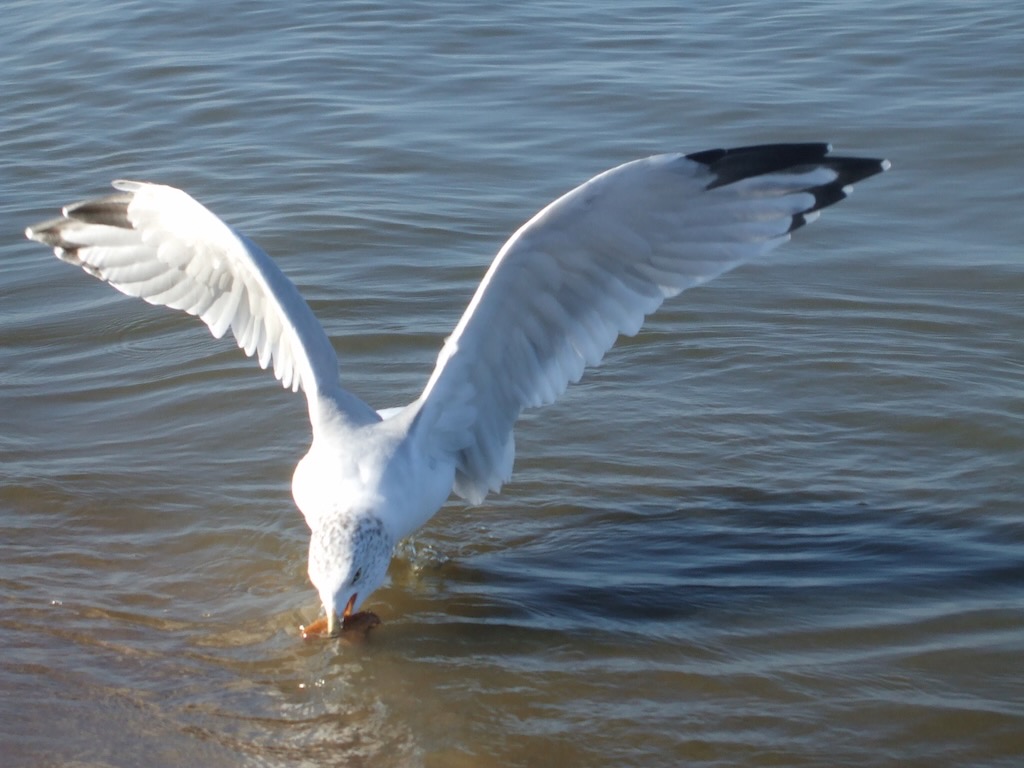
the gull above is diving into lake michigan to gather up a chunk of bread one of us has tossed into the water, a symbolic casting of our sins into the lake in an act of absolution.
the line, “prayer is our attachment to the utmost,” is from rabbi abraham joshua heschel, and the full line is: “unless we aspire to the utmost, we shrink to inferiority. prayer is our attachment to the utmost.”
one in a series of summertime esoterica, in which for no particular reason my attention is drawn to this, that, or the other thing…
deep in my summertime poking-around ways, a pursuit of reading akin to ambling barefoot through dew-sodden grass, i found myself the other day burrowing into a rabbit hole, following the trail of a late-19th-century theologian with radical ideas and gloriously poetic prayers. (i might just as effortlessly follow the trail of what to do with too much zucchini, or why banana-peel-steeped waters are so fine for my fledgling tomatoes…it’s a carousel of wonders here on curiosity row…)
walter rauschenbusch (1861-1918)
the theologian of the week, here in rabbit-hole land, is one walter rauschenbusch, the late 19th-century clergyman and theologian who led the Social Gospel movement in the U.S., and whose work is said to have influenced a litany of great 20th-century social-justice warriors, among them martin luther king jr., desmond tutu, lucy randolph mason, reinhold niebuhr, and george mcgovern. his animating idea was that not just individuals but the whole of society needed to work toward what he termed “the kingdom of God” on earth, a place where justice and peace as well as equal rights and a democratic distribution of economic power were holy and necessary works, ones that demanded constant and unrelenting effort.
rauschenbusch’s radical theology, it seems, was informed by eleven years working as a baptist pastor in NYC’s aptly-named Hell’s Kitchen, where he presided over the funerals of hundreds of children who died from the ravages of impoverishment—malnutrition, domestic violence spurred by overcrowded tenements, or any of the other ills born of economic destitution.
rauschenbusch wrote: “I began to realize that God hates injustice and that I would be quenching God’s spirit within me if I kept silent with all of the social sin of the world around me.”
of the hundreds of children’s funerals over which rauschenbusch presided (many of them for children younger than five), he wrote:
“At each funeral I would find myself crying out to God, ‘Why do the children have to suffer in this manner?’ I recall on one occasion one of the church members, a single father who worked at a factory for 12 hours each day. His daughter was dying at home and calling out for her daddy. The employer refused to allow the father to go home to be with his daughter in her last hours.
“It was not uncommon to see grown men near our church just begging for work, just so they and their families could survive.
“It was in this context that I began to understand sin in a new and radical way. Baptists had always been known as railing and condemning the sins of alcoholism, smoking, gambling, and sexual promiscuity, such as were exemplified in the lives of the many prostitutes who lived and worked very close to our church. . . .
“The radical conclusion that I came to was this: all of these personal sins which were so obvious to everyone were somehow connected to the sin of structural injustice. So many people saw no hope, no way to extricate themselves from their living hell, their dead-end street. So many would resort to alcoholism. Women would feel compelled to become a prostitute so they could feed themselves and their families. Charles Dickens in his writings helped us see and somewhat feel the environment that could ensnare anyone who was trapped in a world of deprivation and desperation.
“The less obvious sins to most Baptists and other conservative leaders were those that were represented by the vast gulf between those who were extremely opulent, you might say ‘filthy rich,’ and the vast majority of people who were barely able (and oftentimes not able) to get by.”
finding wisdoms from the past for these arduous times is, perhaps, too futile a pursuit. but i believe in the endosperm of hope. and rauschenbusch’s prayers––and his theology––seem apt for a dusting off. and, besides, his prayers are beautifully wrought.
my eye was caught first by one of those prayers, the evening prayer (below) but as i kept reading it was the line above––“I began to realize that God hates injustice and that I would be quenching God’s spirit within me if I kept silent with all of the social sin of the world around me.”––and the children’s funerals that informed it, that clutched me at the gut and won’t let go.
here, as a place to begin, is but one of his prayers, with particular resonance for one who delights in all of creation, especially the trials and triumphs just beyond my own back door:
FOR OUR WORLD, OUR EARTH
O God, we thank You for this universe, our great home; for the vastness and richness of our cosmic environment; for the manifoldness of life on the planet of which we are a part.
We are thankful for the morning sun and the clouds and the constellations of stars.
We rejoice in the salt sea and the deep waters and green leaves of grass.
We thank You for our sense by which we experience earth’s splendor.
We would have souls open to all this joy, souls saved from being so weighted with care that we pass unseeing when the thornbush by the wayside is aflame with beauty.
Enlarge within us a sense of fellowship with all that lives and moves and has being in space and time, especially with all who share this earth as their common home with us.
Remembering with shame that in the past, we human beings have all too often exercised high dominion with ruthless cruelty, we admit that the voice of the earth, which should have gone up to You in song, has been a groan of travail.
May we so live that our world may not be ravished by our greed nor spoiled by our ignorance.
May we hand on earth’s common heritage of life, undiminished in joy when our bodies return in peace to You, our Great Mother who has nourished them.
and here is the beginning of his evening prayer:
LORD, we praise thee for our sister, the Night, who folds all the tired folk of the earth in her comfortable robe of darkness and gives them sleep. Release now the strained limbs of toil and smooth the brow of care. Grant us the refreshing draught of forgetfulness that we may rise in the morning with a smile on our face. Comfort and ease those who toss wakeful on a bed of pain, or whose aching nerves crave sleep and find it not. Save them from evil or despondent thoughts in the long darkness, and teach them so to lean on thy all-pervading life and love, that their souls may grow tranquil and their bodies, too, may rest. And now through thee we send Good Night to all our brothers and sisters near and far, and pray for peace upon all the earth.
in the book’s preface, rauschenbusch explained the collection’s genesis: “The language of prayer always clings to the antique for the sake of dignity, and plain reference to modern facts and contrivances jars the ear. So we are inclined to follow the broad avenues beaten by the feet of many generations when we approach God. We need to blaze new paths to God for the feet of modern [women and] men.”
amen, pastor rauschenbusch, amen.
as long as we’re quoting old white men, i admit to being an admirer of the writings of that old-time radio humorist garrison keillor, who has mellowed beyond measure with age. in an ode to summer’s slow pace the other day, he wrote this about morning light, one of the blessings that comes with waking early, a habit i consider essential to the deep breathing of my soul:
It’s a revelation of delight, of our Creator’s delight in His creation, and though we’re brought up to be skeptical, wary of big hopes, prepared to deal with the injustices of life, still the dawn light argues with stoicism and you see the beauty of the ordinary.
what ordinary beauties or big ideas captured your imagination this week?
and here’s a harder question (to ponder in your own soul): what shall we do so as not to stay silent in the face of the social sin of the world?
and happy blessed blessed day to my beloved andrea, who makes me laugh hard and often, and whose goodness seems vaster than the circumference of this big blue globe.(A is one of the chair friends who reads dutifully nearly every week, and more often than not sends along a note that melts me or makes me laugh every time…)
in the long tradition of seekers and sages, silence is a constant. a leitmotif maybe. a rhythm that ebbs and flows. it is into the silence that we surrender to enter the depths of our soul, the unencumbered spaces where whispers are heard, where the stirring comes.
in silence, the earthly noise is muffled. we tune our inner ear, the one that’s tied to the soul. the one that allows the sacred to find its way in.
and so, on this day, this good friday, a day long held in silence for me, i will make room for that long quenching that comes when i am alone in the depths, in the stillness.
this is the first holy week in a very long time where the braiding of the two traditions that animate this old house — jewish passover and christian easter — are not entwined. easter i only recently learned falls on the first sunday after the first full moon following the vernal equinox. passover, though, always begins on a full moon, the 15th day of the month of nisan on the hebrew calendar, and because the lunar and solar calendars are marching to their own separate tunes, every once in a while there is a good bit of moon between the two holidays.
so this year, i will be deep in good friday all day, as i was deep in holy thursday last night, the breathtakingly spare hour when, in a nod to jesus’ last supper, a seder in which he knew he would be betrayed by one of his closest twelve, and retreated to the garden of gethsemane to weep and to pray, the whole church was stripped of ornament and color. the altar was washed, the vestments of priest and deacon and choir were removed. every candle was snuffed. we left the church in thick silence.
my own blessed mother held this day, this good friday, in a reverence that seeped early on into the depths of me. silence was kept from noon till the hour of jesus’ death on the cross, which we somehow had determined was three in the afternoon. and so, all these years later, i keep that silence.
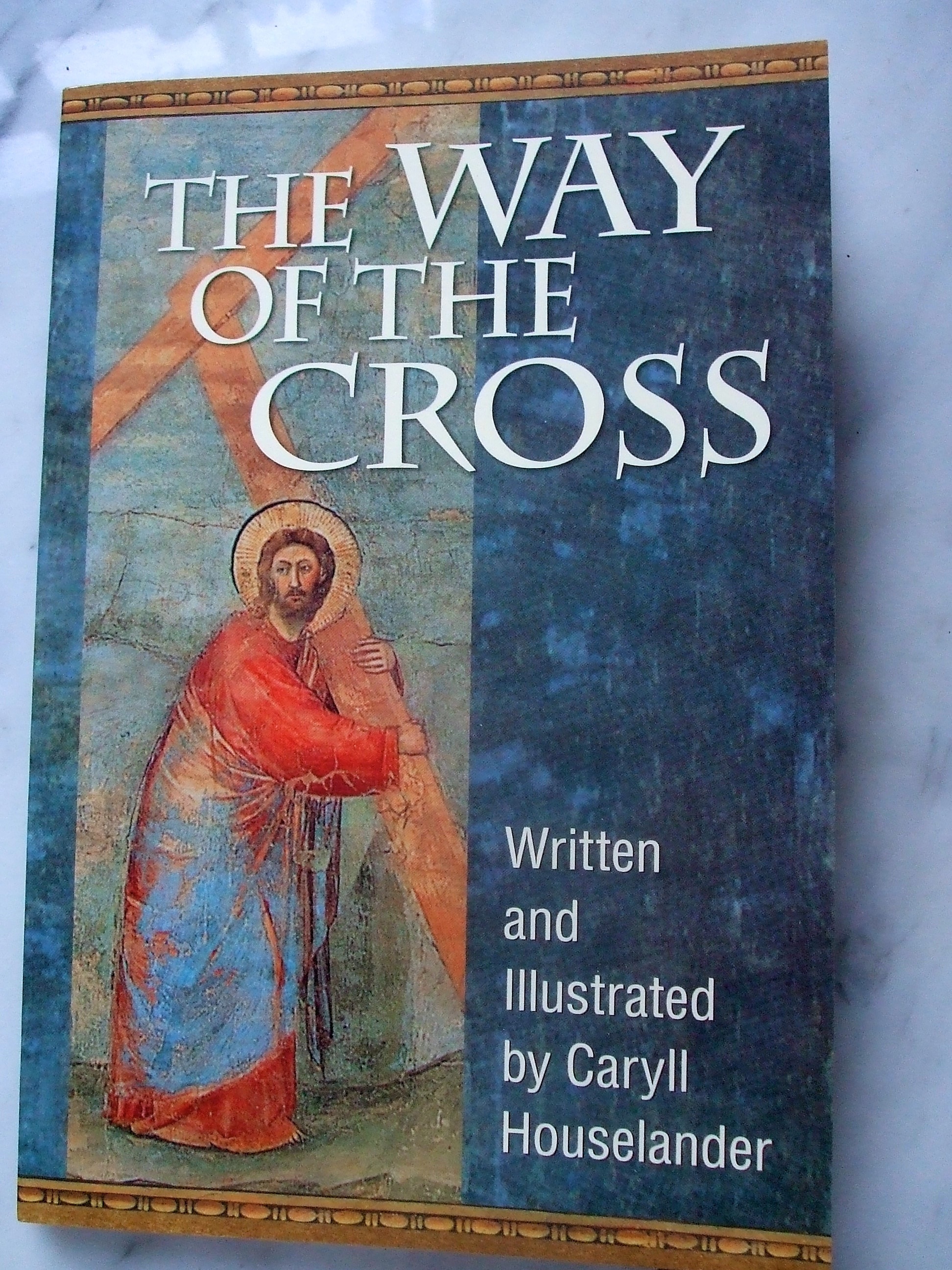
most often i take to my window seat, the perch looking out into the trees. i will pick up my caryll houselander, the 20th-century mystic whose words penetrate me like no other, her meditations on the stations of the cross, the dusty desolate path of jesus’ walk to the hill of golgotha, the hill where he would die.
there is much to pray on and for this year. the brokenness, the darkness, is plenty. and all we’ve got to begin to mend the brokenness, to kindle a flickering light in the darkness, is the small but inextinguishable capacity of whatever antidotes we can muster: the smallest kindness; the rare attention to someone else’s suffering; the unexpected delivery of joy.
we can, in our pointillist way, drop dot upon dot of goodness onto the canvas that is our moment in time on this planet. hope stirs as long as we can stand in the face of darkness, and muscle our few and feeble yet insuppressible defiances: we will not surrender to those forces we know to be counter to the sacred; we will not let all the light be extinguished. we are our own last best hopes for the world we imagine. and i will enter into the silence and the depths of the sorrow today to chart my way toward whatever light i can muster.
so help me God.
because it is increasingly my way to bring you the voices of souls far wiser and deeper than i might ever be, i have gathered up a few who stirred me this week.
first up, henri nouwen, restless seeker, priest and theologian, comes along, as antidote to so much suffering, reminding us–in one of his most indelible passages–to be surprised by joy:
Learn the discipline of being surprised not by suffering but by joy. As we grow old . . . there is suffering ahead of us, immense suffering, a suffering that will continue to tempt us to think that we have chosen the wrong road. . . . But don’t be surprised by pain. Be surprised by joy, be surprised by the little flower that shows its beauty in the midst of a barren desert, and be surprised by the immense healing power that keeps bursting forth like springs of fresh water from the depth of our pain.
henri nouwen
and praying this isn’t too dark, this epiphany from louise erdrich‘s the painted drum:
Life will break you. Nobody can protect you from that, and living alone won’t either, for solitude will also break you with its yearning. You have to love. You have to feel. It is the reason you are here on earth. You are here to risk your heart. You are here to be swallowed up. And when it happens that you are broken, or betrayed, or left, or hurt, or death brushes near, let yourself sit by an apple tree and listen to the apples falling all around you in heaps, wasting their sweetness. Tell yourself that you tasted as many as you could.
louise erdrich
and, bon mot for all who love poetry and find it endlessly a wonder, this from david hinton, chinese literature scholar:
Poetry is the cosmos awakened to itself. Narrative, reportage, explanation, idea: language is the medium of self-identity, and we normally live within that clutch of identity, identity that seems to look out at and think about the Cosmos as if from some outside space. But poetry pares language down to a bare minimum, thereby opening it to silence. And it is there in the margins of silence that poetry finds its deepest possibilities — for there it can render dimensions of consciousness that are much more expansive than that identity-center, primal dimensions of consciousness as the Cosmos awakened to itself. At least this is true for classical Chinese poetry, shaped as it is by Taoist and Ch’an (Zen) Buddhist thought into a form of spiritual practice. In its deepest possibilities, its inner wilds, poetry is the Cosmos awakened to itself — and the history of that awakening begins where the Cosmos begins.
where were you surprised by joy this week? and — only to ask yourself — what might you bring to this world today to turn back the darkness, to begin to mend the brokenness?
this is the little hyacinth that surprised me this week. a bulb tossed aside at the end of last spring, she decided to bloom amid an otherwise forgotten patch along the alley
Now is the season to know That everything you do Is sacred.
~ Hafiz ~
and so we begin. wrapped in the whisper of unknowing. all is vast, and formless. we etch out possibilities, promises, in our mind’s eye. we put shape to what we hope will come, what we worry might come, in the allotment of time we call “the new year.”
as long as humans have been harnessing time, putting order to the rhythms of darkness to light, warming to cooling to warming again, we have imagined our dominion over the hours unspooling. some of us live by clocks. and calendars. and pings and beeps and the showtunes we set to awake us, to remind us to sleep.
i’m especially attuned to the timekeeper beyond the clouds: the solar star. the one around which we turn and spin and revolve in our somewhat elliptical geometries.
what if we returned to a time without second hands, and minutes parsed into fractions, what if we surrendered to shadow and light, allowed the cosmos to do our timekeeping? what if we understood the passage of time by the wrinkles on the backs of our hands, or the ebbing of wisdom that comes with a life lived at attention?
but that is not the world we live in, the moment we live in. we’ve been conditioned, all of us, to count time in blocks, and the newest addition to our arithmetic table is the one we’ve named 2024. and so it shimmers before us: new, unmarked, not yet broken.
not a half day in to this newly-bordered chunk of time, the year threw me a challenge. decided to let me know that my well-laid plans for my first birthday since losing half a lung would not be quite the occasion i’d (for once) carefully plotted (a dinner i’d cook for beloved old friends on the eve thereof, followed by a dinner for three at a charming cafe on the day itself). indeed, they’d be altogether scrapped. our old friend covid decided to drop in unannounced, in the form of a grand exposure (my mate sat for four hours on new year’s eve beside a woman who awoke to a positive test the next morn). and so we did what any respectable citizen would do: we donned our masks for five straight days, steered clear of any and all, and tested accordingly along the way. (so far, so clear.)
i admit to meeting the news with a mighty harumph. and a stinging tear in my eye. in my heart i was crooning something along the lines of “can’t i please catch a fresh start here?” but, alas, covid is covid and there’s no getting around it. so, i cobbled the best that i could: roaring fire all day, long walk under gray cloudy skies; i seized what i could, and turned the page anyway.
and here we are, in what hafiz reminds us is best thought of as “the season to know that everything you do is sacred.”
the new year, i sense, is going to ask plenty of us. i, for one, am strapping on my seat belt. for, as a dear friend reminded me last night, “you may just want, as bette davis said, to ‘tighten your seatbelts. it’s going to be a bumpy night.'”
indeed, it might be. and for such a bumpy spell ahead we shall need to equip ourselves. my plan is to take it slow, and with all the grace i can muster. i’ll bite my tongue when wisest to do so. and speak up with actions not words when that is most warranted. i’ll aim to dollop out goodness all along my way, not unlike hansel and gretel in the woods, leaving behind their breadcrumbs. i’ll imagine droplets of sunlight scattered like shards. and hope to enter and leave each encounter with a soft unspokenness, a sense that something like an angel wing has just wafted by. it’s a big ask, but it’s the litany for which i pray. for i’ve an inkling, like bette, that we’re in for one bumpy night.









 pull up a chair