pull up a chair

where wisdom gathers, poetry unfolds and divine light is sparked…

Category: power of words

keening.

the winds have been howling all night, a rushing, a roaring of air on amphetamines. sometimes the sound rises in pitch, almost a keening, the sound of a soul in mourning.

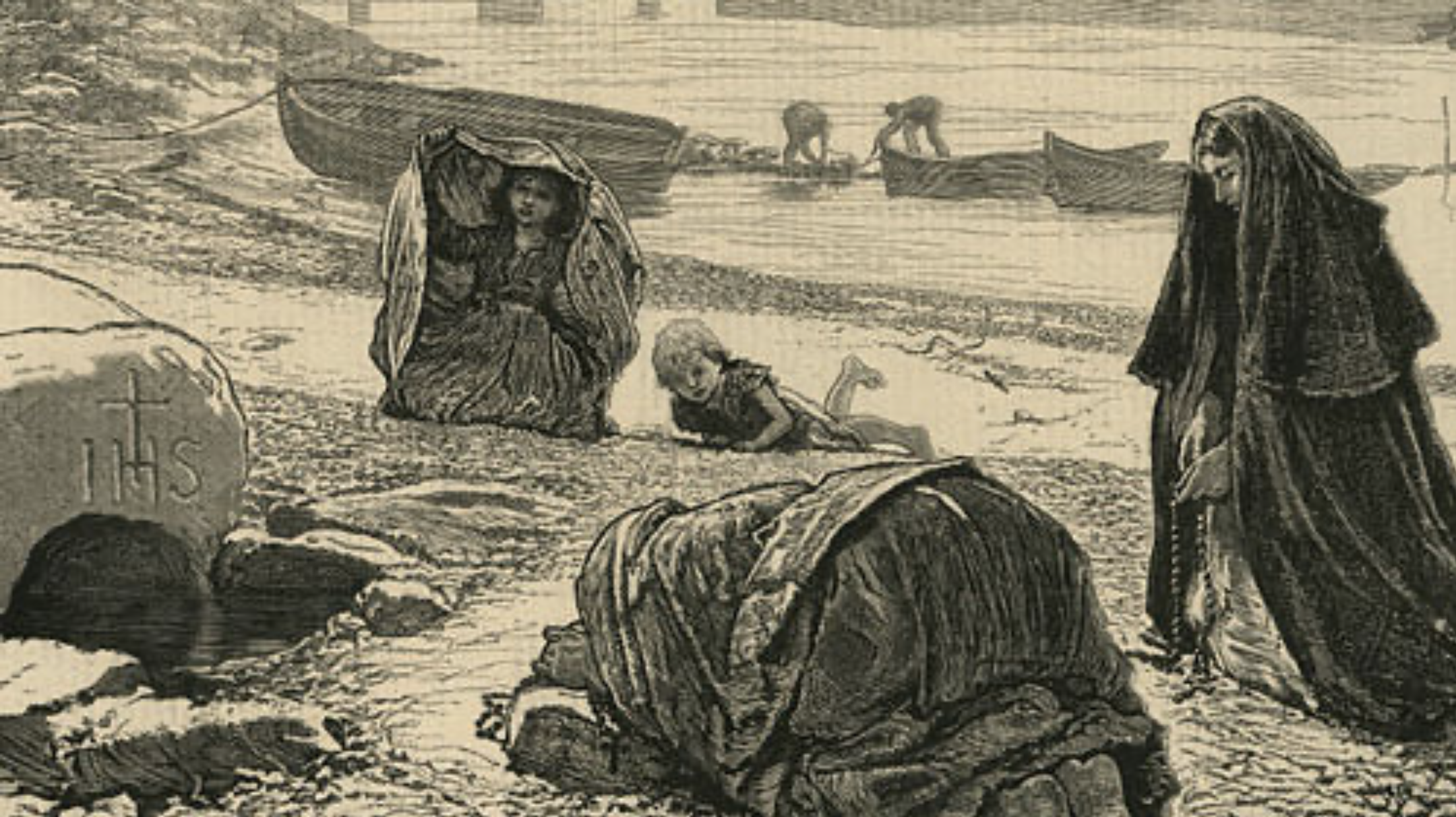
keening, a word that draws me half around the world to the banshees of that faraway island from which my people came (a good half of my people, actually, but it seems the half i’m rooted in). it’s a word that places me in a dark and damp room where a fire roars, and the people are circled in sorrow, cloaked in black woolen wraps. swaying and rocking, the sound that rises up is the sound that lives at the pit of us, the sound that rises when our heart or our soul is shattered. cracked wide open. it’s the ooze of anguish that comes without volition. keening sometimes comes without knowing. it just is. it’s primal. a reservoir so deep inside us it takes velocities of sorrow to tap into it, to draw from its well.

i might have keened once or twice, but i barely remember. both times someone had died, and it felt like part of me did as well. i remember the sound, remember i barely knew where it rose from, or that i’d had it inside.

the God who imagined us imagined so far beyond the imaginable. the God who imagined us gave us a sound, buried it deep, deep inside, where it awaits necessity. there are in our lives times when only that keening will do. that high pitched guttural whoosh that captures the unspeakable, a whoosh that rises and falls, traces the scale from basso, the animal roar, to mezzo soprano, up high where it’s piercing.

and why would the wind be keening?

look around.

listen.

don’t let us dull to the litany.

waking up to find we live in a pariah nation is one. but that’s almost too big for my head. i tend to operate in the finer grain. and the closest i came to keening this week was the news that the poet had been shot through the head.

what poet, you might ask?

the one in minnesota. the one whose first description i read was “37-year-old, mother of a six-year-old, award-winning poet.”

who shoots a poet? how often does the descriptor of a violent death include the word poet?

poets are porous. poets live in the world permeable to the little-noticed. poets process what’s breathtaking and put it, miraculously, to words. poets, the ones i love, the ones whose words put form and frame to unutterable parts of me, they’re among the most gentle-souled humans i’ve known.

renée good was a poet. a mother. and she died at 37, in the front seat of her maroon van we’ve all now watched over and over.
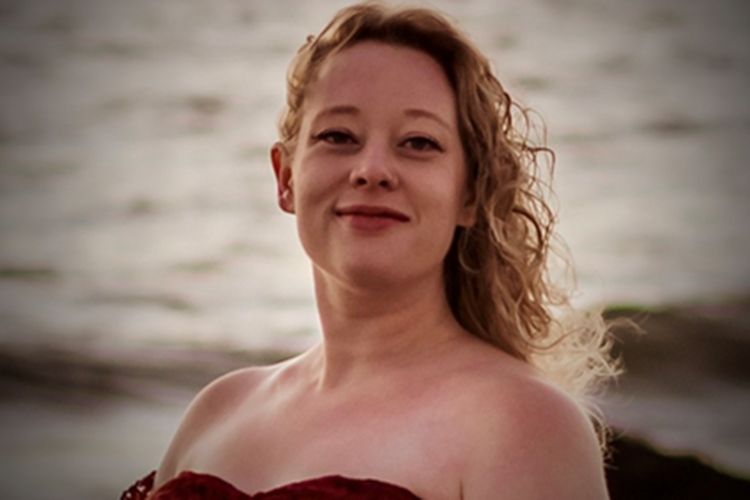
renée nicole good

renée good, back when she went by the name renée nicole macklin, won the 2020 academy of american poets prize. that’s not a prize for a piker. that’s a real-deal prize, a trophy worth tucking on the highest shelf in your house. she won it for a poem curiously titled “On Learning to Dissect Fetal Pigs.” now, that might not be the first thing that stirs me to want to write a poem. but poets begin in curious places sometimes and take us into terrain where wisdom or epiphany comes.

when we become a nation where a poet is shot through the windshield, just minutes after dropping her six-year-old off at school, we need to ask who in the world we’ve become. it only becomes more twisted when we can see for ourselves how the scene unfolded, and the people in charge, the ones holding the guns, the ones not letting a doctor rush to the scene, tell us that we didn’t see what we saw.

i wonder how apt this headline would be: good is dead.

that would be the headline atop the poet’s obituary. rachel good, award-winning poet and mother of three, was shot through the head. by federal agents. who then refused to let a doctor rush to the front seat of her bloodied, bloodied minivan. and waited too many fading heartbeats before giving the okay to call 9-1-1.

no wonder the wind is keening.

no wonder the world is tapping into its most guttural cries.

not long before i’d found myself tripping over the violent death of rachel good, i’d been thinking deeply about poets. thinking about a breed of poets i’d likened to “a tribe of saintesses.” that’s a feminization of saint, an intentional genderizing, if you will, because the poets i’m most drawn to might technically, and in an old-time world, be coined poetesses, and because the ones to which i am most deeply drawn are ones who weave the sacred, even the liturgical, into the vernacular from which they write. because the saintesses to whom i am most drawn are the ones whose verse scans the divine, shimmers at the edge of the ineffable, catches me unaware, but grounds me in a certainty more certain than many a gospel, i turn to them for edification and plain old uplift of my weary soul.

i keep them in close reach.

sitting just beside me here at this old maple table are two such poet saints, the ones whose lines leave me gasping, my spine tingling as if something holy has just wafted by and through me. because it has.

here’s one. her name is kathleen hirsch, and this is from her mending prayer rugs (finishing line press, 2025). it’s the last stanza of her poem “prayer rugs” (emphasis mine):

I bend in blessing toward all that breathes
May each hour enlarge the pattern—
rose dawn, wind song, tender shoots of faith—
that I may see the weft of the hidden weaver.

or, also sitting right by my elbow, jan richardson’s how the stars get in your bones: a book of blessings (wanton gospeller press, 2025), i flip through pages and pluck just one, titled “the midwife’s prayer.” it begins:

Keep screaming, little baby girl.
Keep practicing using those lungs
and do not stop,
because hollering will help
to ease the shock
every time you go through
another birth.

the saintesses, i swear, speak from a godly vernacular. they see deeper than the rest of us, dwell deeper too. their gift is the gift taken away at Babel. while all the rest of us were stripped of the powers of universal understanding, the saintesses kept on. they speak words that speak to all of us—if we listen closely. if we trace our fingers across the lines they offer, sacramental lines, lines that lift off the page, lift us off the page and into the transcendent, where for just a moment we get to reside.

i don’t know the rest of rachel good’s poems. but i know she was a poet. and the silence where once she spun the words of the unspoken, the little-heard voice, that silence now is cacophonous.

and even the winds are keening.


you can read the whole of rachel good’s prize-winning fetal-pig poem here.

and here are the first few lines…

On Learning to Dissect Fetal Pigs
by Renée Nicole Macklin

i want back my rocking chairs,

solipsist sunsets,
& coastal jungle sounds that are tercets from cicadas and pentameter from the hairy legs of cockroaches.

i’ve donated bibles to thrift stores
(mashed them in plastic trash bags with an acidic himalayan salt lamp—
the post-baptism bibles, the ones plucked from street corners from the meaty hands of zealots, the dumbed-down, easy-to-read, parasitic kind):

keening in minnesota on the block where rachel good was killed

what shall we do to quell the need for keening? and what poets draw you into the depths of the Holy?
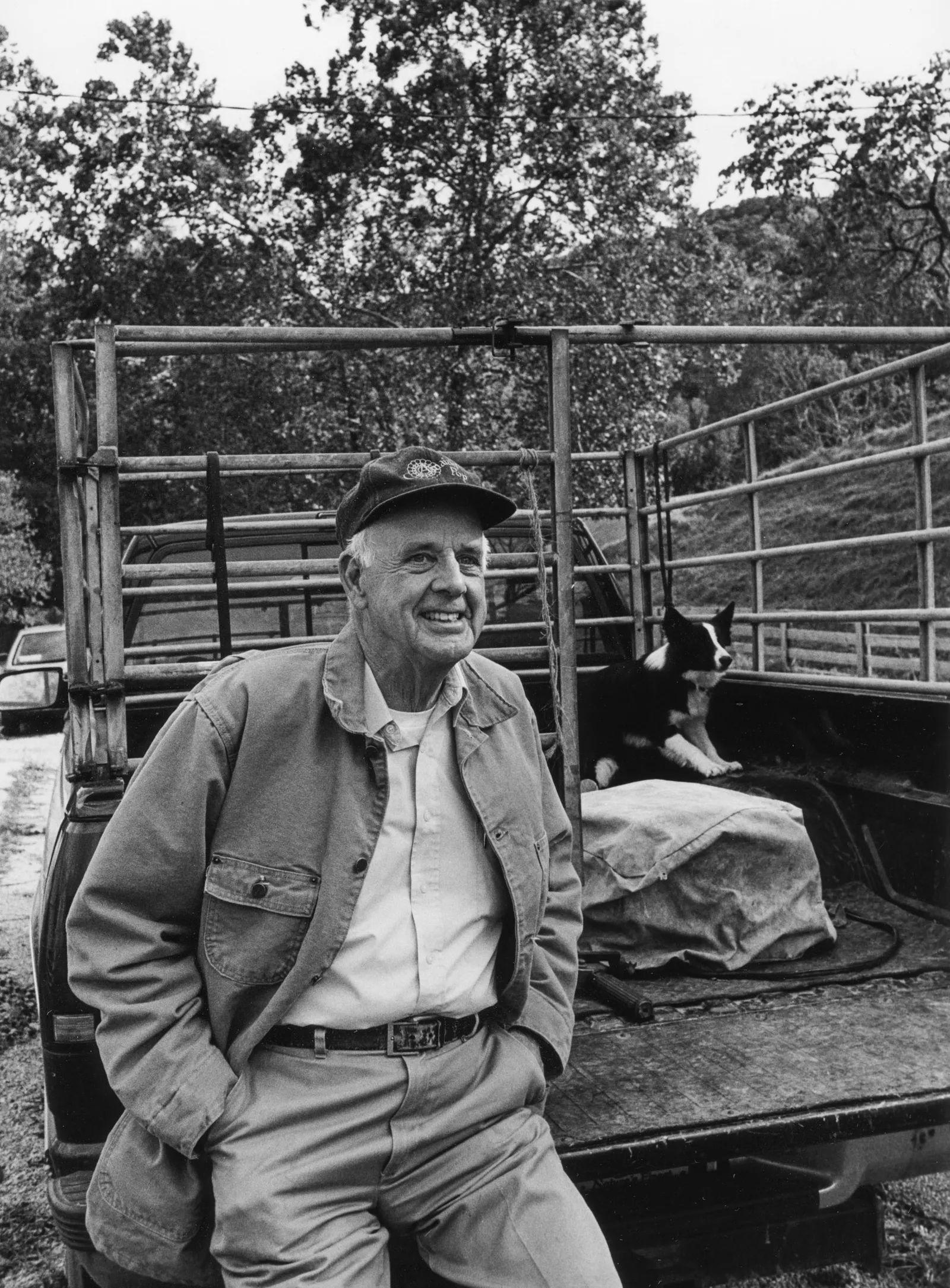
of pickled onions and a particular fondness for kentucky’s homegrown farmer bard

wendell berry

in which the somnolence of summer has settled into its seasonal adagio so much so that pickling a red onion or two, and slow-reading the poetries and musings of one wendell berry is as fever-pitched as it gets around here. welcome to my slo-mo world of the week.

it started when i stumbled on the poem below, a poem that captures the quietude of a couplet of humans who’ve breathed in unison for so long they can fill the silence richly. so it is here in this old house of late, where only two of us now reside. where we know the choreography of most days by heart. and come and go as in a wordless waltz. there’s an ease now, one i never imagined, as i balked mightily long ago about the idea of two lives squeezed under one roof and in a labyrinth of too-tight rooms. but over time, across all these years (near 33), the respirations of our souls have aligned, at least enough to feel our echo in the lines below. those lines, by wendell berry, the poet, novelist, and conservation farmer whom i count as one of my heroes, were just enough to take me down the rabbit hole that is the life and work of kentucky’s homegrown literary treasure. and, besides, mr. berry’s birthday was this week, the fifth of august, wedged, it so happens, between the birthdays of two of the three humans whom i count as pillars holding up my world and whose arrivals to the planet are marked across the week in that steady beat of 4-6-8.

here’s the poem that got me started:

They Sit Together on the Porch
By Wendell Berry

They sit together on the porch, the dark
Almost fallen, the house behind them dark.
Their supper done with, they have washed and dried
The dishes–only two plates now, two glasses,
Two knives, two forks, two spoons–small work for two.
She sits with her hands folded in her lap,
At rest. He smokes his pipe. They do not speak,
And when they speak at last it is to say
What each one knows the other knows. They have
One mind between them, now, that finally
For all its knowing will not exactly know
Which one goes first through the dark doorway, bidding
Goodnight, and which sits on a while alone.

i shared the verse with the one with whom i share these walls, and he wrote back that he found it “haunting,” which made me see the lines anew. and was just enough to prompt a bit more poking around, again reminded how much i love the poetries that come with accumulated lifelong wisdoms. and that’s where i then re-bumped into this 2019 dispatch from the new yorker, a days-long interview between bard and scribe, one distilled and put to paper. it’s worth a read in whole (link below will take you straight to it), but i’ll pluck a few parts should your summer’s day demand a snappier pace than mine (or should a paywall keep you out):

the dispatch, titled Going Home with Wendell Berry, is by amanda petrusich, a new yorker staff writer and writer-in-residence at the gallatin school of individualized study at NYU. a 2016 guggenheim fellow, she writes often about music, and blessedly for us she takes the occasional road trip down kentucky way. in this case, she wound her way to where berry’s farmed for more than four decades, a little town that goes by the name port royal. sixty-three miles from the dot in the blue-grass map my papa called home (paris, KY), and one mile from the meandering kentucky river, it’s a town you might think ol’ garrison keillor pulled from his imagination. (in 2010, its population, according to the U.S. Census, was all of 64 humans.) it’s a town one writer (sandra mcCracken, a singer-songwriter) described thusly (and not too surprisingly given the threadworn quilt that is rural america these days): “Port Royal is a patchwork strip of storefronts, a blink-and-you’ll-miss-it sort of spot made up of a local bank, a post office, a general store with a built-in diner (with little printed signs about their town’s famous author, Wendell Berry), and an old Baptist church. I am sad to report that, like most small towns in our country, Port Royal looks as though it is dying.” 

here’s how the new yorker‘s chronicling of that luscious conversation between journalist (petrusich) and poet (berry) begins:

Two and a half years ago, feeling existentially adrift about the future of the planet, I sent a letter to Wendell Berry, hoping he might have answers. Berry has published more than eighty books of poetry, fiction, essays, and criticism, but he’s perhaps best known for “The Unsettling of America,” a book-length polemic, from 1977, which argues that responsible, small-scale agriculture is essential to the preservation of the land and the culture. The book felt radical in its day; to a contemporary reader, it is almost absurdly prescient. Berry, who is now eighty-four, does not own a computer or a cell phone, and his landline is not connected to an answering machine. We corresponded by mail for a year, and in November, 2018, he invited me to visit him at his farmhouse, in Port Royal, a small community in Henry County, Kentucky, with a population of less than a hundred.

Berry and his wife, Tanya, received me with exceptional kindness, and fed me well. Berry takes conversation seriously, and our talks in his book-lined parlor were extensive and occasionally vulnerable. One afternoon, he offered to drive me around Port Royal in his pickup truck to show me a few sights: the encroachment of cash crops like soybeans and corn on nearby farms, the small cemetery where his parents are buried, his writing studio, on the Kentucky River. Berry’s connection to his home is profound—several of his novels and short stories are set in “Port William,” a semi-fictionalized version of Port Royal—and his children now run the Berry Center, a nonprofit dedicated to educating local communities about sustainable agriculture. Our correspondence would continue, but, before I left, Berry gave me a broadside letterpress of his poem “A Vision.” I think often of some of its final lines, which clarify, for me, what it means to truly know a place:

Memory,
native to this valley, will spread over it
like a grove, and memory will grow
into legend, legend into song, song
into sacrament.

here’s but one of the questions captured from their conversation (with a few lines in bold for emphasis):

Q: Have you always farmed here?

A: Right away, we had a large garden, and we kept two milk cows. We fattened two hogs to slaughter, for our own meat. We had a flock of chickens. And we had some fruit that we produced ourselves, and some that was wild. We were sitting down during that time to a lot of meals that came entirely from under our own feet by our own effort. And our children came up in that way of living. The integration of the various animals and crops into a relatively small acreage becomes a formal problem that is just as interesting and just as demanding as the arrangement of the parts of a novel. You’ve got to decide what comes first, and then you work your way to the revelation of what comes last. But the parts also have to be ordered. And if they’re ordered properly on a farm, something even more miraculous than most art happens: you have sustainability. Each thing supports the whole thing.

and here’s another exchange:

Q: It’s funny, clarity is often undervalued in art. One of the things I admire about your writing, especially the essays, which feel like polemics, is that you’re very clear in your arguments. They’re beautifully supported. In the new book, you talk about how you often read seeking instruction. I’m curious how you balance that idea with reading for beauty, savoring the visceral pleasure of words.

A: You’re being fed in an essential way by the beauty of things you read and hear and look at. A well-made sentence, I think, is a thing of beauty. But then, a well-farmed farm also can feed a need for beauty. In my short story “The Art of Loading Brush,” when Andy Catlett and his brother go to a neighbor’s farm, there’s a wagonload of junk, and it’s beautifully loaded. Andy’s brother says, “He couldn’t make an ugly job of work to save his life.” In the epigraph I use from Aldo Leopold he questions if there’s any real distinction between esthetics and economics.


and here, in case you’re even a little bit hooked, is a poem worth reading in whole. it’s from a 1965 volume of Poetry magazine, and it’s excerpts from an early Berry wonder, titled, “The Handing Down,” a poem about a grandfather and grandson sitting on a porch and the quiet conversation that unspools between them. read those excerpts here.


oh, and about those onions. . . my kid, the one who turned 23 yesterday, finds himself a line cook these days at a chicago eatery of some notoriety; girl and the goat, it’s called, and stephanie izard, who dreamed up the joint seems to have a particular fondness for things pickled. she pickles everything from kumquats to mushrooms to beets. i decided pickled red onions might be a summery thing to do, and besides i like a little crunch amid the strata of my sandwich. and, as with many a task in my kitchen, i pickle the easy way. no cauldrons steaming for me. no sterilizing jars and lids. i dumped a little of this, stirred in some of that, and by next morning, i had a jar of garnet rings shimmering in my fridge. i’m not fond of sugar these days (i never was, and then a dear friend told me cancer is fond of sugar, making it something of a foe of mine, thus i’ve perma-sealed my lips to sugar’s sweetness), so i searched for pickling roadmap that steered clear of the sugar bin. here’s what i found: (and ps i have no real clue what whole30 compliant means, so feel free to disregard.)

what captured your fancy this week, quick-clipped or slow?

there is no peace

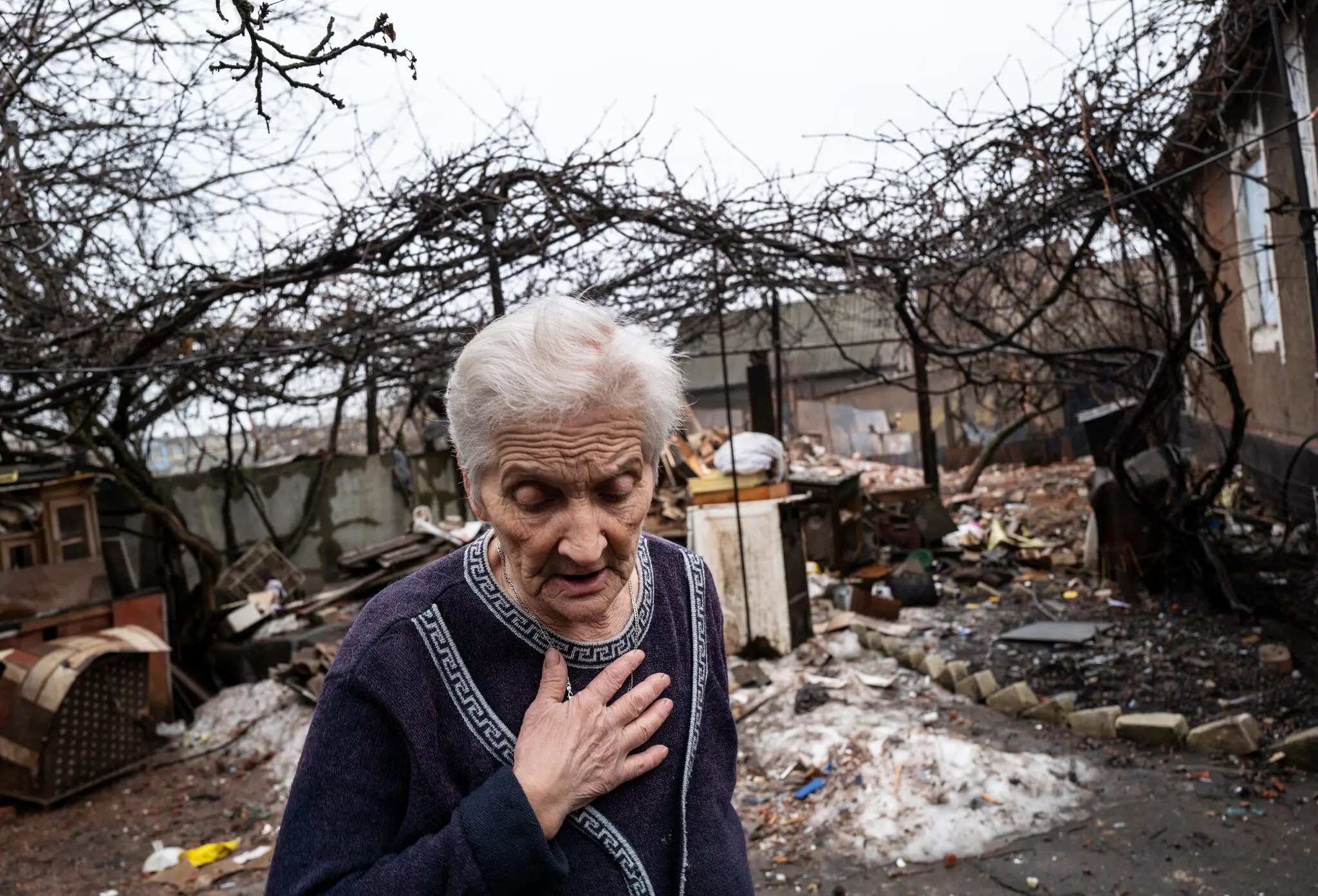
in eastern Ukraine, a woman standing in the ruins of what had been her backyard; photo from lynsey addario for the New York Times

we can’t get away from it, nor should we. as bombs rain from the sky, as hospital wings are mortared, and women in labor carried away, who are we to wonder which can of soup we might open? or which load of laundry to do?

as bodies in masses lie bloodied and dead in the road, escape made folly, how dare we flip through the page of a magazine, looking for words to carry us off? 

as old people, too frail to leave home, are shivering in their now windowless houses, neighbors cutting down trees, building fires for heat and for cooking, boiling snow for buckets of water, who am i to complain about all the times in a week i have to run to the grocery?

those are the questions, some of the questions, that plague us in this war time. war a word that now shrieks from the page. it should have shrieked sooner, shrieked louder, i fear. or maybe i just wasn’t listening, quite closely enough. wars until now have mostly not woken me in the night. but now the war does. 

i’m barely awake in the the murky hours of darkness, and the gnawing dread and the weight of this war are close enough to the thin icy edge of my consciousness that one little stirring brings it all back to mind, to heart. i’m fully awake then, startlingly so. 

i know, because the math now comes without pause, the eight-hour time calculation, i know that in the deep of my night it’s morning in kyiv, and bombs must be pelting again, so how can i go back to the business of sleeping? what if, while i keep my eyes closed, a child is lying cold and afraid––in a half-frozen field, at the back of a church, in a house ripped to shreds along with everyone else who’d been under its roof? except for that one lone child now trapped in the cold grip of terror.

i might sit in an armchair not long after dinner, and it might seem like i’m looking ahead, at the screen where a show rolls along, but i’m not paying attention. i’m wondering what it must feel like to count yourself blessed for crossing a border and leaving all else far, far behind. 

there is no peace on the planet. 

the very words war and peace now carry a weight that expands far beyond what had become almost a throwaway sense. i don’t think i realized before just how much volume they hold. i think i mostly dismissed them. considered them words mostly just holding a place. words with a hint of amnesia. words stripped of their grip on us. 

prayers for peace now hold a meaning that used to escape me. i imagine the day when the bulletin breaks, and we might hear the words, war ends. i pray for that day. i pray mightily. but i am wondering now how prayers in the holocaust felt? 

what prayer do you pray as you count the last seconds you breathe? i pray it’s a good one. and i pray even more that it’s heard on the other end. 

i imagine God is distraught. i know i am. i know nearly every last someone i know is. if they’re paying attention. paying attention to me is a prayer, so i pray it day after day. there are days when i want to turn off my attention. slink off to a safe little cove, wake up when it’s over. when the bulletin comes. 

in the times when my prayers are dried up, when my heart has run out of gas, i try to find someones stronger than me. someones who know how to keep going, how to stare fear in the face, how to not cover their eyes and their ears. i poke around looking for words to sturdy me, to steady my wobbly ways.

there is, so often, no better someone than the gentle-souled farmer who plows his own fields with draft horses and oxen down kentucky way. wendell is his name, wendell berry. and this poem of his––the last poem i read to a friend who was dying––is, like all the best prayers, a quiet wisp of a poem that slips in through the smallest chance it can find. i know this poem by heart, or pretty close anyway. but now, more than in a very long time, it reaches out from the dark and brings a most holy communion. 

i pray that some little child far off in ukraine might be wrapped in the whisper of wing that comes from a wild thing stirring. 

The Peace of Wild Things

When despair for the world grows in me
and I wake in the night at the least sound
in fear of what my life and my children’s lives may be,
I go and lie down where the wood drake
rests in his beauty on the water, and the great heron feeds.
I come into the peace of wild things
who do not tax their lives with forethought
of grief. I come into the presence of still water.
And I feel above me the day-blind stars
waiting with their light. For a time
I rest in the grace of the world, and am free.

Wendell Berry

from New Collected Poems (Counterpoint, 2012)

what brings you strength when you’re feeling wobbly, or weak in the knees?


lynsey addario, whose photo is above, is considered one of the greatest war photographers of the 21st century. she’s a fearless photojournalist, who focuses her work on conflict, human rights, and the role of women in traditional societies. she’s unflinching, she runs toward the scene, whatever it is, so we can all see. she was in the news this week because she took the picture of a family––a mother, her two children, and a church volunteer helping them run––dead in the road trying to escape kyiv. the new york times made the brave and important decision to run the photo–big–across its front page. addario, who is 48 and who was named a macarthur “genius” in 2009 , talked this week about making that photo; here’s what she said:

“I’m a mother, and I when I’m working, I try to stay very focused. I try to keep, sort of, the camera to my eye,” she said. “But of course, it was very emotional. First of all, I had just been sprayed with gravel from a mortar round that could have killed us very easily. So I was shaken up, and when we were told that we could run across the street by our security adviser, I ran and I saw this family splayed out and I saw these little moon boots and puffy coat.”

Addario added that, even though she felt it was disrespectful to take the photo, she thought that she had to.

“This is a war crime,” she said. 

and the world needs to see.

a note: i understand that for some it’s too painful to keep too close a watch. and i understand that our words can’t make a dent in the evil. but against the backdrop of suffering of this magnitude, i can’t imagine turning away.

juneteenth

in which, once again and imperatively, we listen. this time to the words of abraham lincoln, Black activist jadon-maurice forbes, and poets maya angelou and marilyn nelson…

“a proclamation,” it begins, simply, declaratively. a beginning ground deep in the soil of justice. long overdue justice. 

“Whereas, on the twenty-second day of September, in the year of our Lord one thousand eight hundred and sixty-two, a proclamation was issued by the President of the United States, containing, among other things, the following, to wit:

“That on the first day of January, in the year of our Lord one thousand eight hundred and sixty-three, all persons held as slaves within any State or designated part of a State, the people whereof shall then be in rebellion against the United States, shall be then, thenceforward, and forever free; and the Executive Government of the United States, including the military and naval authority thereof, will recognize and maintain the freedom of such persons, and will do no act or acts to repress such persons, or any of them, in any efforts they may make for their actual freedom.”

so begins president lincoln’s emancipation proclamation, issued at the dawn of the new year, 1863.

so why did it take till the 19th of june in 1865 for the slaves of galveston, texas, to find out they were free?

juneteenth, at heart, is the commemoration of that announcement of overdue emancipation— marking the official end of slavery in these united states — a full two and a half years after lincoln’s proclamation. 

quoting from juneteenth.com:

“Later attempts to explain this two and a half year delay in the receipt of this important news have yielded several versions that have been handed down through the years. Often told is the story of a messenger who was murdered on his way to Texas with the news of freedom. Another is that the news was deliberately withheld by the enslavers to maintain the labor force on the plantations. And still another is that federal troops actually waited for the slave owners to reap the benefits of one last cotton harvest before going to Texas to enforce the Emancipation Proclamation. All of which, or none of these versions could be true. Certainly, for some, President Lincoln’s authority over the rebellious states was in question.  Whatever the reasons, conditions in Texas remained status quo well beyond what was statutory.”

why did it take till the 19th of june in 2020 for most of a nation to awake to the lingering injustices, to finally empower one Black activist, jadon-maurice forbes, to write: “Juneteenth, perhaps for the first time, is for all of us.”

for all of us to inventory our souls, to ask the hard, hard questions: what are the isms in my life that put up walls? where are my blinders? what are the ways i acquiesce to otherism? and, most emphatically, how can i break down whatever stands between me and true and unbiased justice for all?

forbes goes on to write:

This is a day that my grandmother taught me to honor as the beginnings of a new life for the African diaspora. She was very close to her African-American heritage and wanted to impart that quality to me. So much so that she would replace my Hooked-on-Phonics books with ones she felt were more suitable — like Imani and the Flying Africans — a fantastic tale of a band of Africans taking to the sky to escape to freedom.

When I think of Juneteenth, I often imagine those winged, black faces breaking their chains and finding freedom. But the true American tale of how slaves were freed is more grounded in a nuanced, complicated, and painful struggle for freedom that has continued for 155 years (read: that means ‘til today). Juneteenth commemorates June 19, 1865, the day the last of the enslaved Africans in America were freed from their chains, having continued to work in bondage for a full two years after Lincoln signed the Emancipation Proclamation.

In many ways, Juneteenth is a bittersweet reminder of what was promised but never delivered to Black folks post-emancipation. It’s a reminder of delayed justice. Every year, even after my nana passed away, we celebrated this holiday. And every year, we do so in honor of progress as much as for a continually delayed sense of justice and equality.

But this Juneteenth is different. Can you feel it? We’re in a rare moment in that the world is coming together to really grapple with that delay. In the last three weeks, millions have taken to the street in honor of George Floyd, Breonna Taylor, Tony McDade, and now, Rayshard Brooks, in addition to the many other Black people who have been killed at the hands of vigilantes or law enforcement. The explosion of protest is in response to a pattern of killings, piled onto the deadly impacts of COVID-19 and four years of Donald Trump.

linger over these unanswered questions. let them settle deep down to where your conscience unsettles you. ask where you might begin. and in the meantime, let maya angelou further stir your soul.

here she is reading “the slave auction,” a poem by frances ellen watkins harper, written in 1854, after harper, a Black poet, witnessed one such auction…

and read the words of poet and author marilyn nelson’s “juneteenth.” nelson, the daughter of one of the last of the tuskegee airmen, was a three-time finalist for the national book award, poet laureate of connecticut, winner of the robert frost medal, and more and more and more. but before you read her poems, read this short bit she wrote on “how i discovered poetry”:

It was like soul-kissing, the way the words
filled my mouth as Mrs. Purdy read from her desk.
All the other kids zoned an hour ahead to 3:15,
but Mrs. Purdy and I wandered lonely as clouds borne
by a breeze off Mount Parnassus. She must have seen
the darkest eyes in the room brim: The next day
she gave me a poem she’d chosen especially for me
to read to the all except for me white class.
She smiled when she told me to read it, smiled harder,
said oh yes I could. She smiled harder and harder
until I stood and opened my mouth to banjo playing
darkies, pickaninnies, disses and dats. When I finished
my classmates stared at the floor. We walked silent
to the buses, awed by the power of words.

and, now as promised, nelson’s poems. first up, “juneteenth,” and then, the riveting “worth.”

juneteenth

With her shiny black-patent sandals
and her Japanese parasol,
and wearing a brand-new Juneteenth dress,
Johnnie’s a living doll.

Juneteenth: when the Negro telegraph
reached the last sad slave…
It’s Boley’s second Easter;
the whole town a picnic.

Children run from one church booth
to the next, buying sandwiches,
sweet-potato pie, peach cobbler
with warm, sweaty pennies.

The flame of celebration
ripples like glad news
from one mouth to the next.

These people slipped away
in the middle of the night;
arrived in Boley with nothing
but the rags on their backs.
These carpenters, contractors, cobblers.
These bankers and telephone operators.
These teachers, preachers, and clerks.
These merchants and restaurateurs.
These peanut-growing farmers,
these wives halting the advance of cotton
with flowers in front of their homes.

Johnnie’s father tugs one of her plaits,
head-shaking over politics
with the newspaper editor,
who lost his other ear
getting away from a lynch-mob.

Worth

For Ruben Ahoueya

Today in America people were bought and sold:
five hundred for a “likely Negro wench.”
If someone at auction is worth her weight in gold,
how much would she be worth by pound? By ounce?
If I owned an unimaginable quantity of wealth,
could I buy an iota of myself?
How would I know which part belonged to me?
If I owned part, could I set my part free?
It must be worth something—maybe a lot—
that my great-grandfather, they say, killed a lion.
They say he was black, with muscles as hard as iron,
that he wore a necklace of the claws of the lion he’d fought.
How much do I hear, for his majesty in my blood?
I auction myself. And I make the highest bid.

how will you mark juneteenth? how will you join in the movement for justice for all?

this american moment: of poetry and protest

photo by Gabriela Bhaskar for The New York Times

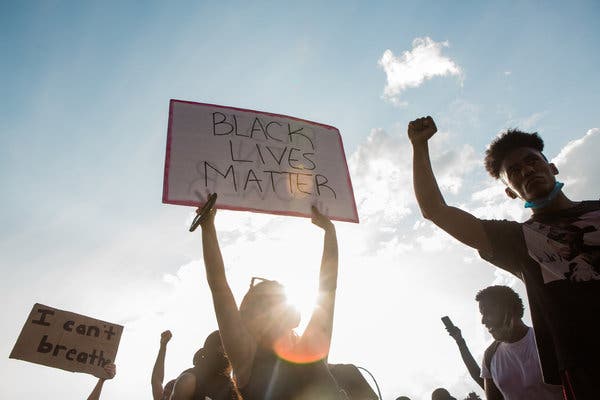
this moment in america is one that won’t be bracketed by a solitary summer. this is one of those moments when first the rumbling comes, the thrumming down below our soles. and then the shift begins to come, tectonic shift (or so you pray). wake up, america. it’s been too long now. all of a sudden the rush of history — long overdue, long overspent in costs of brokenness, of cruelty, of gravest injustice — it’s washing over us, washing something from our eyes.

maybe we will see now.

maybe, beneath the din, beneath the shouts and shattering of glass, we will at last hear the whispers and the cries. it’s been too long now. far, far too long.

this summer reminds me of the summer when i was 11. i remember riding in the front seat of our wood-sided station wagon, stopped at a red light, when the news came on. i heard the word assassinate once again. this time, bobby kennedy; last time, only months before, martin luther king, jr. assassinate is an ugly word. a word that scares a kid. a word that makes you freeze inside your bones, a word that makes you afraid to breathe, not sure where or why all these bullets seem to be soaring through the darkness, piercing people’s brains. it’s a word i’d heard too often in the first half of 1968.

in the summer of ’68, america took to the streets. in this, the summer of 20-20, we’re at it once again. we should be. what we’ve seen is wrong, and ugly, and violent. and shattering. imagine — just imagine — what we’ve not seen. that scares me. really scares me. leaves my heart — yours too, i’m guessing — in shards. leaves me — you, too? — gasping.

i’m not so much a take-to-the-streets kind of someone. i’m more turn-the-page and pound-on-heaven’s-door. i inhale words to rouse my soul the way others pound the pavement. i feel a deep-down curdling, a rage, when i read the words of poets who are witness to the unimaginable. i wipe away streams of tears. sit motionless, not breathing, when i get to the end of a line that’s just shot through me like a rock to the side of the head.

the transportive power of poetry — its capacity to draw us into the kitchen where the shouting comes, or the bedroom where the wailing rises up, or the street where blood is spilling — it’s what moves me. its ugly truths can mark me for a lifetime, scenes and moments seared indelibly, ones my eyes and ears have never witnessed but which, nevertheless, i’ll never shake.

maybe that’s why — when i got an email the other day from a most beloved poetry professor of mine, elisa new, creator of Poetry in America, now a public-television series, i read these words so closely, considered them instruction for this long, hot summer ahead. maybe, too, for you.

this is what lisa (who is also a professor of american literature at harvard, and something of a polyglot of poetry and poets) wrote:

Protest is the voice of the people, elevated and offered to society at large. The protests we are hearing fulfill art’s, and especially poetry’s, greatest function—which is to make human beings truly audible to one another, to let them hear one another’s humanity and take in one another’s pain. The opposite of hearing the human voice is denying, muffling, strangling its cry: that is what we saw with deadly and literal explicitness in the murder of George Floyd, and in the appalling murders of Breonna Taylor and Ahmaud Arbery and so many others. Killings committed by deputed servants of the public good implicate the public, and they require us to reckon with the full gravity of what these acts represent. Their stain is on us all, and any institution, large or small, that endeavors to serve the public good must accept its own responsibility, and review its own past failings, in an effort to do better.

The voices we hear on the streets of our cities right now are doing as poets [since before the American founding] have done: decrying injustice, asking for redress, but also: telling the particular stories, naming the particular names, with every city and region and neighborhood now being brought to account by its own residents. On these streets, as on the page and in songs and performances, what we are now hearing is not abstract. It is the sound of people mustering language in its highest forms for the largest civilizational ends. 

And so in the work of 20th century poets such as Claude McKay, Robert Hayden, Gwendolyn Brooks, Maya Angelou, Audre Lorde, Lucille Clifton, and June Jordan, and in the work of so many writing today—Rita Dove, Claudia Rankine, Evie Shockley, Terrance Hayes, Jamaal May, Clint Smith, Joshua Bennett, Kendrick Lamar and so many others—Black American poets have continued to carry what Langston Hughes, seventy years ago, called “a heavy load”—of “dream[s] deferred” and plain truths denied.

“…to make human beings truly audible to one another, to let them hear one another’s humanity and take in one another’s pain.”

the power of poetry. of witness.

in the spirit of gathering up a cadre of page-turning protestors, of dialing up our capacities for empathies, i’ve begun to gather something of a 20-20 summer reading list. any of the poets named above would be a place to begin.

but i turn, always, always, to lucille clifton, a poet who doesn’t believe in upper case or think much of punctuation, but whose words might never ever leave you. here are but two that leave me breathless….

 slaveships

by LUCILLE CLIFTON

loaded like spoons

into the belly of Jesus

where we lay for weeks for months

in the sweat and stink

of our own breathing

Jesus

why do you not protect us

chained to the heart of the Angel

where the prayers we never tell

and hot and red

as our bloody ankles

Jesus

Angel

can these be men

who vomit us out from ships

called Jesus    Angel    Grace of God

onto a heathen country

Jesus

Angel

ever again

can this tongue speak

can these bones walk

Grace Of God

can this sin live

Lucille Clifton, “slaveships” from Blessing the Boats: New And Selected Poems 1988-2000. Copyright © 2000 by Lucille Clifton.

the lost baby poem

by LUCILLE CLIFTON

the time i dropped your almost body down

down to meet the waters under the city

and run one with the sewage to the sea

what did i know about waters rushing back

what did i know about drowning

or being drowned

you would have been born into winter

in the year of the disconnected gas

and no car       we would have made the thin

walk over genesee hill into the canada wind

to watch you slip like ice into strangers’ hands

you would have fallen naked as snow into winter

if you were here i could tell you these

and some other things

if i am ever less than a mountain

for your definite brothers and sisters

let the rivers pour over my head

let the sea take me for a spiller

of seas        let black men call me stranger

always        for your never named sake

Lucille Clifton, “the lost baby poem” from good woman: poems and a memoir, 1969-1980. Copyright © 1987 by Lucille Clifton.

and, then, there is claudia rankine, whose words will push you to the edge of your chair. the place to begin would be her 2014 citizen: an american lyric, voted the book — not the poetry book, but the book — most likely to endure in the literary canon of a decade from now by the literati at literary hub, a virtual public square for bibliophiles and word junkies of every stripe. the good folk at LitHub wrote of citizen:

It is a special hybrid of a book, part poetry, part critical essay—the book won the 2014 National Book Critics Circle Award in Poetry, and was a finalist for the same award in Criticism—making use of screenplay form, screengrabs, art, and iconic pop culture images. It is a complex assessment of racism in contemporary America, on both a micro and macro scale, addressing Rankine’s own experiences, as well as stories of Serena Williams, Zinedine Zidane, stop-and-frisk, President Obama, Hurricane Katrina, police violence—the whole heartbreaking, embarrassing litany of examples of American prejudice, or at least as close as we’ve gotten in recent memory. Rankine won a MacArthur in 2016, but most of us have been calling her a genius for years.

The book is also artful, beautiful, sometimes funny, subtle when subtlety is required, razor sharp when that better suits her needs. It investigates memory and identity and the nature of narrative and self-doubt and self-expression. I don’t know anyone who has read it who was not profoundly moved by it. As Dan Chiasson put it in The New Yorker, “The realization at the end of this book sits heavily upon the heart: ‘This is how you are a citizen,’ Rankine writes. ‘Come on. Let it go. Move on.’ As Rankine’s brilliant, disabusing work, always aware of its ironies, reminds us, ‘moving on’ is not synonymous with ‘leaving behind.’” 

–Emily Temple, Senior Editor, LitHub

and i will leave you with langston hughes, and his 1927 masterwork.

song for a dark girl

Way Down South in Dixie
(Break the heart of me)
They hung my black young lover
To a cross roads tree.

Way Down South in Dixie
(Bruised body high in air)
I asked the white Lord Jesus
What was the use of prayer.

Way Down South in Dixie
(Break the heart of me)
Love is a naked shadow
On a gnarled and naked tree.

break the heart of me, indeed.

how do you join in the protest, the urgent call of this american moment?

our friends at wordpress have birthed a new way to post, and i am just getting used to its kinks and trick-box. for the life of me, i can’t find where you add images. so i will poke around and see if i can figure this out. for now, these are my words…. (figured it out!) and photo above by Gabriela Bhaskar for The New York Times

those immutable ballasts

super worm mooon

super worm moon 2020, just when we needed a night light

the other night, back in the days when i was still driving to the train most evenings to ferry home the fellow working downtown, back before the red-ringed virus found its way into the glassy tower where he works, back before they–and the rest of the world–sent everyone home, the moon hovered just over the fence line. the moon—big and whole and bright in a way a screen never will be–it stopped me in my tracks.

the moon made me weep the other night.

the moon wasn’t budging. not a kerfuffle in the world could get in the way of the moon doing what it’s done since the beginning of time. and, somehow, that certainty saved me. gave me just enough breath to fill up my soul and my air sacs.

felt like it all but reached out to tap me on the shoulder (or maybe the heart), to save me, to steady me, to give me the something to lean on i needed.

there it was, at the end of a long blurry day, when schools were closing, and produce aisles were beginning to sound a wee bit risky, there it was, taking up more of the sky than i could remember. it was, to my little mind, as if God–or whatever you call the abiding holiness–had pinned it there. just for all of us to see: it wasn’t going anywhere. it had shined before over terrible times. over atomic bombs, and world wars and crusades. it had shined over riots and the night the cities burned down. the moon, and those forces that hold it in place, they weren’t going anywhere. we could count on that one thing.

next morning, just as the sun was peeking over the same horizon–endless cycle, one rising after another–the woodpecker flew to my feeder. as did the cardinals. and the blue jay. their flutterings were not interrupted; they carried on. and so should i, so should we. all of us. maybe more together than we’ve been in a very long time.

maybe, at long last, the glues that bind will come out of hiding. maybe we’ll realize the one true thing is that nucleus of goodness that lives in our hearts. maybe reaching out (elbow-bump style) will be the thing that not only saves us, but carries us onward and upward.

maybe when we’re a little bit rattled, maybe when we’re scared, we can stop all the posturing and pretending we’re not in it together. maybe it’s taking a germ to shake us free from the ugliness, from the us-versus-them, that’s been choking us. truly been making it harder and harder to breathe. maybe this is the germ to wipe out the toxins. or some of them anyway.

in the last few hours, my virtual mailbox, the one i can open without shuffling down the sidewalk, it’s been filling with words from around the world really, words that just might serve to save us, to remind us how much of a difference a kindness will make.

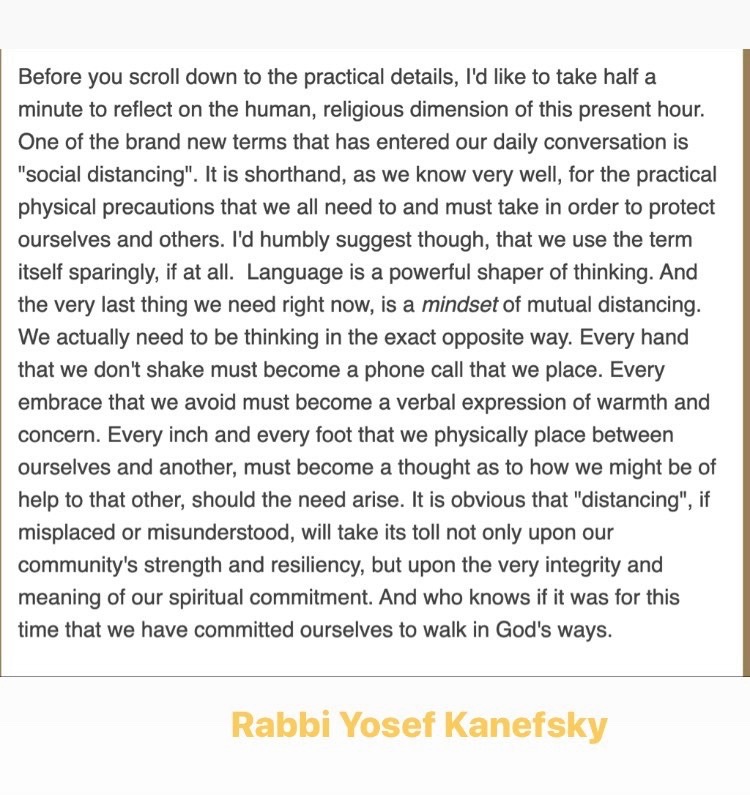
this from a rabbi: rabbi wisdom

this from my priest:

In this time of pandemic, I am reminded of the parts of our scriptures that speak to people who were facing the most frightening thing imaginable in their time–the destruction of Jerusalem or the Temple–apocalyptic scriptures that seem hyperbolic until we too are in a frightening situation and those words of God’s providence and presence amidst crisis are somehow just the thing I was thirsty for but didn’t know it. We couldn’t have predicted that Lent would be a period of unknowing and wilderness in quite this way, but here we are; so we enter in.

right now, when we’re holed inside our houses (or at least that’s where the public health experts hope and pray that we are), when we can’t literally squeeze each other’s hands, words might save us. words are breath put to sinewy cords, words are breath that rises from lungs, from the pit of the soul, really.

words, sometimes, are those intangible tangible ballasts and vessels that break through the barrier, shatter the walls we erect. words put breath to kindness, to empathy, to saying aloud, “i’m just a little bit scared. tell me we’ll all be all right.” words carry joy, carry laughter. words make us laugh out loud–and we can use a good dose of that now. words sometimes make us weep; sometimes in the very best way because they put syllables to the truth of who we are: we’re all alone except for each other, and the one immutable force, the one unconquerable truth is that love wins, love heals, love washes away whatever needs rinsing. love binds. love travels far and wide and without the laws of physics. love is the mightiest breath that ever there was (ask anyone who’s grieving; they’ll tell you the depths of the ache and the anguish, they’ll tell you how sometimes–out of the blue–it’s an updraft that fills them and lifts them again, as if the someone they loved just swept them up by the heart).

so, for the duration of this red-ringed hiatus, let’s put those words to the business of loving. of reaching out. of checking in. of whispering soothing certainties. of making each other laugh out loud. of reminding: the force of our love, collectively, is an immutable, indomitable thing. we might be felled by a fever, but no one, no one can suck the love from our hearts or our souls. together, we rise.

just as the moon and the sun. again and again and again. amen.

if the spirit moves me in these long days ahead, i might post a few extra words here at the chair. maybe down in the comments, maybe in posts that don’t come only on fridays. these are uncharted times, begging uncharted adventures. 

how are you faring, and what are some of the words in days past that have given you hope or joy or a sure sense of belonging to the great and glorious ring of indomitable human family?

public health announcement: the surest equation to “flatten the curve” (that is slow the incline of coronavirus cases) is to minimize contact with those beyond the house where you dwell. this might last for a month; no one can tell us for certain. no need to wipe the grocery shelves clean; no need to hoard (my brother stood in a grocery line behind a woman with a cart filled with new york strip steaks–go figure!). get good sleep. wash your hands. sit in the sun (vitamin D is an immune booster). flush yourself with plain old water; try to keep your mouth from getting dry. the more religiously we can stick to the stay-out-of-crowds plan, the sooner we make it to the days of life after corona….

blessings to my beloved maureen, who sent along the words from the rabbi; to my priest, kat, who is ever wise. blessings to one of our wonderful chair sisters who–egad!–was bitten by a rattlesnake the other day, and is suffering terrible pains (and might be out of the ICU by now). may everyone who wanders by this ol’ table and chairs be safe and well, and surrounded by love. xoxo

notes from poetry school

IMG_2059

“…the great poet should not only perceive and distinguish more clearly than other men [sic], the colours or sounds within the range of ordinary vision or hearing; he should perceive vibrations beyond the range of ordinary men, and be able to make men see and hear more at each end than they could ever see without his help. … it is therefore a constant reminder to the poet, of the obligation to explore, to find words for the inarticulate, to capture those feelings which people can hardly even feel, because they have no words for them; and at the same time, a reminder that the explorer beyond the frontiers of ordinary consciousness will only be able to return and report to his fellow-citizens, if he has all the time a firm grasp upon the realities with which they are already acquainted…

“the task of the poet, in making people comprehend the incomprehensible, demands immense resources of language; and in developing the language, enriching the meaning of words and showing how much words can do, he is making possible a range of emotion and perception for other men, because he gives them the speech in which more can be expressed.”

t.s. eliot, “what dante means to me”

“perceive vibrations beyond the range of ordinary [inhabitants of this moment in time on this place called earth], and be able to make [those souls] see and hear more at each end than they could ever [otherwise] see…”

that’s the essence of it to me. the whole draw toward language, toward poetry in particular, the knowledge that at the far reaches of this thing called our capacities we might — if we work at it, if we think about it — possess the possibility of capturing the ephemeral, the ineffable, the slipping-through-our-fingertips. those quivers of human heart and spirit that shimmer just beneath the surface, but once illuminated prompt us — each and every one of us — to sigh in recognition. “i am not alone.” i too know that pain, that joy, that loneliness. that hallelujah of the heart. the long dark night of the soul.

it’s why from the beginning, in writing — be it the stories i scribbled as a child, sprawled across my bedroom’s braided oval rug, or later in chasing and telling the stories of heartbreak and crime and injustice for the chicago tribune — i reached toward poetics, i reached toward those combinations of words that shattered through the barriers of the every day.

i never set out to write poems, i still don’t (i’ve written one to my name and it’s locked in a drawer, just as my mother tells me she too has reams locked in drawers, some burned along the way), but i have always always sought to understand the work, the magic, that poetics does, so that i too could weave it into the plainspoken sentences as i try to write my way through life.

the more deeply i read, the more deeply i study the powers of poetry, the more amazed i am by its otherworldly capacities. the more i ache to reach its borders.

why write? because we are plopped onto this planet as if a babe in the woods. there are mixed-up trails all around, and we are finding our way, every one of us. some are born with illuminators nearby. some are not. we all stumble onto lessons, onto truths, endure trials and temptations. come out wiser, if we’re paying attention. if we’re listening and keeping close watch. if along the way, we can trace the trails, write what we see and hear and come to understand, well then don’t we begin to serve as cartographers for those in the woods with us? might we cover more of the woods if we all share what we etch in our notebooks?

writers write, painters paint, dancers dance. we all illuminate the coursings of the heart in the movements that most stir us. poetry — the art of distilling the unseen, unheard, but often felt gyrations and quiverings of the heart and soul — poetry enters it all.

we reach beyond the range of the ordinary, we illuminate what’s often lost. we aim to hold it high, to whisper, “behold this holy moment, study its undulations, its depths and inclines. extract a droplet of wisdom.” and go on with your humdrum day.

that’s what i thought about at poetry school last week. that’s what i wrapped myself in. and carried home in my backpack.

***

culled from my notebook:

books you might choose to read, all highly recommended:

scott cairns, Recovered Body (especially, “The Recovered Midrashim of Rabbi Sab”)

denise levertov, The Stream and the Sapphire (poems that wrestle with faith and doubt)

mary karr, Sinners Welcome (her poem, “Descending Theology: Nativity,” reimagining the birth in the barn, leaves me limp, the poem i should read every Christmas morning…)

lucille clifton, Blessing the Boats: New and Selected Poems 1988 – 2000, winner of the National Book Award


how do you try to capture the ineffable? and why does it matter to see and hear what’s beyond ordinary range? your thoughts on eliot’s thoughts up above? 

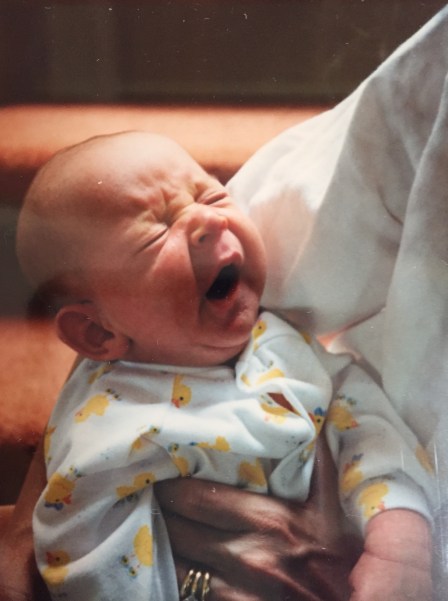
i can’t leave the chair this morning without a cannon’s blast of birthday blessings for my beautiful firstborn, who is off in DC, without an actual mailing address (he’s living in a condo not yet on the market and for some reason the developer can’t give him a reliable street address nor the promise that any mail would actually be delivered…), and who is turning 26 tomorrow. the only thing worse (for the mama, anyway) than a kid having a birthday far far from home, is not being able to send a single care package! so, not that he’d wander by to read this, but i am sending all the love in my heart and then some. i send prayers as well, mountains of them. may this year ahead illuminate all that is good and joyful in you and around you and because of you. i love you to the moon. have since long before you were born. xoxoxoxo

willie yawn

oh, dear God, i love this child, love him far beyond the borders of my humble little heart….

this one’s for…

boy with my heart

you. and you. and you.

my world these days is inhabited, certainly, with hearts that are heavy, hearts that are hurting. one is mourning the loss of her mother, her brilliant and vibrant and unforgettable mother. another will never stop mourning the loss of her daughter. one struggles with a diagnosis that week by week makes it harder to hold a pencil, pour juice in a glass, pray on her knees. another is slowly losing her powers to see.

and then there are all the others, who harbor hurts and shoulder unbearable weights.

i walk through the labyrinth, alongside their lives, seeing their pain, imagining the crushing weight of the worry, wishing more than anything that words — the surest thing i know, short of lifting out my heart and wrapping it round them — could do the work of saying, “i remember. i’m watching. i’m here to listen. you’re not all alone.”

in a world where we all whirl, from birth till the end, in our own little amoebas of space and sentience, where the oceans of life bang up against our shores, where we stand and brace ourselves for whatever comes, never knowing what will wash up next, the one holy grace — short of the cord that ties us to heaven — is the grace of soulmates who listen, who put forth their own shoulders to bear a chunk of the load, who dare to sit side-by-side in the dark, to not say a word when silence is best, and who sometimes, rare sometimes, know just the right words. or they try anyway.

if only we all slowed down long enough. if only we all let down our own layers of armor, those impenetrable sheaths we carry into the day to keep ourselves safe from rocks and arrows, not realizing that our efforts to gird against our own hurts make it all the harder to recognize others’.

if only our words could do the work we wish for. if only we could slither inside someone else’s pain, sidle up close by her side, and whisper just the right curative potion.

if only words could work in the way that we hope and we pray: if words had the power to heal. to lift burden. salve the wounds. rinse away the sting.

maybe, sometimes, they do.

which is why i remember a few short phrases spoken to me in hours of dread. or despair. or unbearable grief. i remember a friend insisting, “you got this,” when she and she alone held that certainty. i remember, in the crowded kitchen of the house where i grew up, not even an hour after we’d buried my father, my uncle leaned into me, rested his hands on my shoulders, looked me deep in the eyes, and said: “the depth of the pain is equal to the depth of the love,” and suddenly my immense and immeasurable grief became bearable. because somehow i now had a framework, a balance of scale, to understand the pain as a pure reflection of love, and in that equation i found the muscle to bear what would be months and months and months of heart-crushing pain.

there’s not a morning that i don’t wake up and tick through an inventory of heartaches and griefs all around. i recite the names of people i love, a litany propelled by pure empathy. i pause on each name and each story, sometimes for longer than others. i imagine how hollow or heavy it feels. and i send up a prayer. and then another and, often, another.

the beauty of prayer is that words — those sometimes stumbling, fumbling, ill-fitting sounds that come from our throats — words when spoken in prayer take on powers that come from far beyond our own soul. words spoken in prayer do immeasurable work. they seep in through the cracks, or so i believe. they settle in deep, and maybe just maybe they send up tender resilient shoots, and one day they’ll bloom. into love. into peace. into the breathtaking power to bear whatever it is we know we cannot bear alone.

and so this fine morning, i offer up words for the ones who i love who are hurting. and hollowed. and certain that no one could ever imagine how lonely it is. or how dark.

this one’s for you.

love, b.

what are words whispered to you over the course of your life that made you know you could carry the load, you could go forth, one tender step at a time? 

inscribe this on your heart…

go_general-800x430

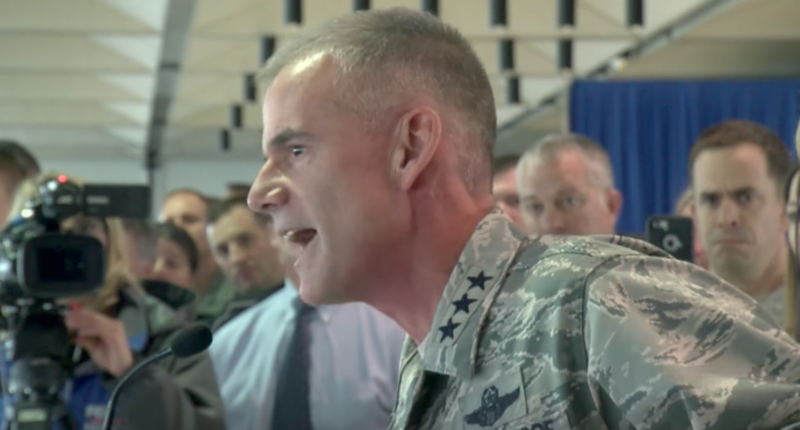
“I‘ve said it before: the area of dignity and respect is my red line. Let me be clear, it won’t be crossed without significant repercussions.” Lt. Gen. Jay B. Silveria, superintendent US Air Force Academy

it’s not too often these days that we hear, loud and clear, the voice of moral conviction. there is so much noise and distraction, a soul like me might get drawn into the deep and unending quiet of the golden-dappled woods. or behind the thick-stone walls of the monastery, where the drone of the outside world can’t drown out the whisper of the One who pries open the doors of our heart.

we need to hear what it sounds like when one sharply-chiseled soul digs down deep and puts a megaphone to moral courage, to standing up and elucidating in no uncertain words what it means to walk the narrow path of decency. no wobbles allowed. no excuses, period.

there is so much garbage spewed these days — so much back and forth and swirling vitriol — it makes me want to give up some days. to crawl into my hole and stay there.

but then, along marches a rare one, and the words i hear are so clear and so fine-hewn in stone, i sit up and notice. i feel the goosebumps rise up. i feel a wafting cloud of relief rise up from my long-slumped shoulders.

oh, yes, this is what moral courage sounds like. this is conviction spewed forth on human breath, i hear myself thinking, the thoughts practically rising to murmurs as i can barely contain the words.

we are long overdue — amid a moral drought, you might say — nearly forgotten, the sound of true and unmuddled moral conviction.

here’s what happened: five cadets at the US Air Force Academy in colorado springs woke up to the words “go home, [racial epithet],” scrawled on the message boards outside their rooms. the superintendent of the academy, a lieutenant general named silveria, wasted no time, drew a sharp red line in the landscape of human decency. he convened an all-campus assembly, 4,000 students, the entire faculty and staff. he stepped to the podium and launched straight in.

have a listen: lt. gen. jay silveria’s unforgettable five-minute red-line moral-clarity speech. 

and here’s some of what he said:

“So just in case you’re unclear on where I stand on this topic, I’m going to leave you with my most important thought today,” he said. “If you can’t treat someone with dignity and respect, then you need to get out. If you can’t treat someone from another gender, whether that’s a man or a woman, with dignity and respect, then you need to get out. If you demean someone in any way, then you need to get out. And if you can’t treat someone from another race, or a different color of skin, with dignity and respect, then you need to get out.”

“If you can’t treat someone with dignity and respect, then get out,” Silveria repeated.

and then the lieutenant general turned on his heels, and left everyone in the cavernous hall — and the country beyond — to stop and think and let that truth sink in. and to remember what it sounds like when a leader is chiseled from the raw stuff of courage and conviction and moral clarity.

i for one am deeply grateful. i for one am so relieved to finally hear someone with the guts to get up and tell it bold and straight and clear, according to the ancient code of decency, the one we should all know and live by heart. every last one of us.

who has been the voice of moral courage in your world this week?

by the time i post this, you might have seen this all over the modern-day public square that is social media, but i am less and less often in that melee these days, having crept toward the quiet of the dappled woods. apologies if this is a repeat for anyone. it’s truly worth a deep sinking in. may your week — and your atoning tonight and tomorrow — be blessed.

the compound interest of love


the arithmetic of love cannot be plotted, nor graphed. nor queued in a line. it explodes, scattershot. sometimes it leaks — drip, drip, drip. sometimes, like a mountain rivulet running hard against rock, it carves its own escape route.

at its most glorious, love multiplies with compound interest.

the email began: “Praying it forward haha.” it went on to explain:

Praying it forward haha – I gave a copy of the book to Lisa because I admire her so much as a Mother, friend, caregiver, person.  After meeting her for lunch and giving her the book she shared that she was looking for work she could do at home – we were looking for someone to do our social media and not so surprisingly she had recently received a degree in that!  Of course we hired her.  She prayed it forward by giving 10 of her friends the book and now here you are – Found!  Lets keep the movement.

the email was from my friend susie, who happens to be a saint. she’s opened two cafes for at-risk teens, one mostly for young men who’ve gotten in trouble and are trying now to stay out. the other for young women; teens who are pregnant, or already mothers. susie gave my book to lisa, who also happens to be a saint. lisa was a social worker who became a chicago cop who was so heartbroken by the homelessness she saw in uptown, a tough chicago neighborhood, she started pulling a sandwich-and-coffee-filled red wagon along the sidewalks to feed whomever she bumped into who might be hungry. then, she opened a cafe, inspiration cafe, to feed their spirits as well as their bellies. but then, two years ago, her then-23-year-old son suffered a still-unexplained anoxic brain injury, which means that a kid with a slight fever somehow collapsed, which stopped his heart long enough to cut off the oxygen to his brain. ever since, lisa has been his full-time, round-the-clock caregiver.

and yet, lisa, when given a single copy of motherprayer, and a work-from-home job for my friend susie, “prayed it forward” by buying and sending copies of motherprayer to 10 friends. one of those friends, a fairy-like sweetheart named wini, wrote to me a few weeks ago. in a breathtaking note, she explained that for some reason she’d not tucked motherprayer into her permanent stack of (mostly untouched) bedside books, but rather she’d picked it up and started to read. she said her friend lisa had sent it, and she figured if it came from lisa, there must be a reason to read it. she wondered a.) how i knew lisa (i didn’t, though i’d known of her cafe and her saintly status in this city of big shoulders),  b.) if maybe we could meet, and c.) maybe would i consider coming to a spectacular space (opened by her friend amy, a famed chicago restaurateur) to talk to a circle of spectacular women. she was thinking, she said, of restarting a soulful speaker series she once ran for eight years. she was thinking she’d call this new series, “finding your heart at Found,” (Found is the name of the spectacular eatery, a place that feels like your favorite eccentric aunt’s quirkily appointed parlor). and then she wondered if maybe i’d consider following up that lunchtime talk with a soulful writing workshop at a heavenly place called tumbledown farm, owned by another one of her heavenly friends, yet another lisa.

2437d6_c2c10c041a844be69d9ed4716cf0a68b

a scene from tumbledown farm. (photo by Lisa Moser)


if you’ve clicked on all of those links i’ve tucked up above, you can see quite clearly why i was and am pinching myself. kindness led to kindness led to miracle led to long-held-dream-finally-come-true.

i will soon be sitting in a farm kitchen, with the sounds of summer and barnyard blowing in through the windows, and i’ll be encircled by blessed women writing into their depths. we’ll punctuate the morning with walks through meadows, plop down against the trunks of trees, chase after chickens. partake of farm-fresh feasting.

sounds magical to me.

and until the email from susie arrived yesterday, the whole tumble of wonders was shrouded in mystery. how did saintly lisa know of motherprayer? how was it that she sent a copy to wini, a woman schooled in healing arts, a woman with the get-up-and-go to have shepherded eight years of soulful speakers (and we’re talking richard rohr here)? and how was it that after years and years of dreaming of somehow finding my way to the blessing of writing circles, and writing into the depths of the human heart, one door had opened into another, and a farm of my dreams — one with roosters and beehives and a cavernous milking barn — had fallen onto my path?

i looked back at the email from susie, i read and re-read that first line: “Praying it forward haha…”

i knew exactly how i wanted to do that, to pray it forward: i’m starting a writing circle for the teen mamas at susie’s cafe (the pictures above were taken there last night at their monthly community dinner, where susie treats everyone like a queen or a king), and i’m imagining a writing circle-slash-monthly-retreat for mothers who are full-time, round-the-clock caregivers for children with profound challenges. (susie, too, has a sister patty, who i love, and who loves writing, and who is the full-time, round-the-clock caregiver for her daughter who has cerebral palsy.) i am, in my imagination, upholstering the writing retreat with every imaginable pampering: fat bouquets of fresh-from-the-garden bunches of flowers, pitchers of waters swimming with slices of lemon and sprigs of fresh mint, sumptuous lunch. crisp, paper-wrapped journals and pens for writing from the heart. a few deep questions, questions meant to uncork all that’s waiting to pour. and more than anything, the holy communion of other mothers who shoulder the same unceasing load of worry and ache and innovation and unstoppable faith. and exhaustion. and a loneliness that’s unfathomable to anyone not bearing the load.

the wheels have already turned, plans are already in the works. because at the heart of this plot are women who heard the holy whisper and made the miracle happen, women who would not and will not be stopped. so neither will i.

it’s the compound interest of love.

“Praying it forward haha..”

there’s your challenge. no need to answer aloud, but maybe, just maybe, let that sweet question settle deep in your heart: how might you pray it forward?

because i know the chairs are soulful folk, i’m thinking that when the time comes i might put out a call for help. perhaps you’ve a few stems from your garden you’d like to share for a fat bouquet. perhaps you make a mean scone. or might dream up some other wonderful way to pamper the mamas for whom a break never comes. (we could make goodie bags, stuffed with pamper-y treats.) i’m thinking i’ll hold the first writing circle for caretaking mamas at my house, in my screened porch this summer. getting away is not easy for these mamas, and going too far is impossible. so we’ll make it short and sweet and close to home. if we wend our way into an irrestistable  bond, maybe we’ll take our circle on the road, and tumble down to tumbledown farm, which is but 45 minutes away. 

p.s. for the fun of it, and to make it easier to follow the trail of good hearts, i bolded the names of each someone who led to another someone in the equation of unbridled love up above. and be sure, while you’re at it, to click on the links (any words underlined and the color of cafe-au-lait) to read layers and layers of goodness from the very good souls up above.

p.s.s. happy blessed birthday tomorrow to slj, an old dear friend of the chair. may your day and your year be filled with compound love.

2437d6_3117842ec2bb4aa3b36702c889c96ffa

a nest on tumbledown farm. reminds me of the cover of a book i know fairly well. be still my heart, most blessed heart…(Photo by Lisa Moser)