pull up a chair

where wisdom gathers, poetry unfolds and divine light is sparked…

Category: unlocking the sacred

add this to your constellation of poetries

rebecca elson: astronomer + poetess

i’ve been on rooster time for weeks now, though there’s no rooster pecking about the nearby yards. the rooster resides in my little noggin where it cock-a-doodle-doos round about four, and i patiently wait till five. as if the nuns have granted permission and at last i can dash out from under the bedsheets and into the playground that is my kitchen table at that early early hour.

ostensibly i’m up to write, to think, to edit. and i do get to that. i always do. but first i soften into morning turning pages. in other words: i read.

it sometimes seems my mission here is morphing into something more along the lines of slipping poets under your noses; writers, too. any weavers of wonder i happen to happen upon. this week i happened upon an astronomer poet, a brilliant soul who died too soon at 39. she spent her life mesmerized by the heavens, and hers was the gift of reaching into the stars, scooping up a glug of moon, and giving us a taste.

her name was rebecca elson (1960-1999), a canadian-american who at 16 began her studies at smith college, and would go on to earn her PhD from the university of cambridge, somehow fitting in years at radcliffe college and harvard teaching creative writing as well as an expository writing course on science and ethics. at cambridge’s institute of astronomy she was awarded an isaac newton studentship, meaning they paid for her to be there. it’s where she died, amid a field of star embers, i do hope.

her posthumously-published slim volume of poetries and extracts from her notebooks is titled a responsibility to awe (carcanet press, 2001). that title alone is poetry, and tells you all you need to know. in four short words, some might argue, it lays out our holy purpose. our one assignment while we’re here on planet earth, that little orb floating amid a universe of burning flecks of star dust and helter-skelter sky litter (though there’s nothing remotely litter-ish in even one celestial orb, from jupiter to milky way, to the not-yet-named planet L 98-59 f (identified just last month!, the fifth such planet in a splotch of far-off space unpoetically named L 98-59, a system of “remarkably diverse worlds.” little f is orbiting so close to its star, it’s possible liquid water might exist there, the scientists tell us.)

back to rebecca, known to those who loved her as becky. soon as i read the words astronomer and poet coupled in a pair, i was drawn magnet-like to snatch up a copy of her awe-struck works. it’s considered a contemporary classic, in the world of poetries. and not a line of it disappoints. among the pages that left me awe-struck: an ode to discovering zero; another asking what if there were no moon? (her reply: “there would be no months / a still sea / no spring tides / no bright nights / occulations of the stars / no face / no moon songs / terror of eclipse / no place to stand / and watch the Earth rise.”)

a mind as facile and deep as one that imagines darkest night, scans heavens for answers to questions others never even think to ask, is a mind i want to enter. to add my footprints to the paths that have traversed it. as if, in poring over her way of seeing, i too might see more vividly.

that rebecca/becky died too young of a cruel cancer (isn’t every one a cruel one?) added but another element to my quest to know her by her words. her masterwork is considered her six-stanza poem, “antidotes to fear of death.” she begins (as only a star-studier might): “sometimes as an antidote / to fear of death / i eat the stars.”

from there, extracts from her notebooks follow, and we almost watch a mind at work. as she cobbles poetries, we see the words struck out, the finer ones she chose instead. we see, in a swatch titled “origins,” her change of mind, in the line “shaken in the dark soil soul of space.” soil, a richer word (more unexpected) than soul here. we see adjectives get ditched, as she pares and pares her lines. titles of poems are revised. it’s a nimble mind, exercising in the gym, and we are peering through the windows.

two years after elson’s death, the economist, in 2001, named responsibility to awe (her one published poetry volume, though she published 56 scientific papers in her short life) a “book of the year,” writing “with great poignancy, she shows us the world through the eyes of a human being faced by her finite time.”

the bulletin of the american astronomical society, in their roster of supernovae gone dark, described the breadth of elson’s scientific research, her work ranging from “a search for stars in the halo of our own galaxy to regions of rapid star formation halfway across the Universe. She set strong limits on the contribution normal stars could make to the Milky Way’s dark matter halo, using counts from the Hubble Deep Field to rule out a significant stellar component.”

maria popova, who first pointed me to the poet-astronomer, calls her poem “antidotes to fear of death,” a “stunning cosmic salve for our creaturely tremblings of the heart.” she recorded a recitation of it, set against the mournful strains of cello, for her 2020 “universe in verse” extravaganza, popova’s “annual charitable celebration of the science and splendor of nature through poetry.”

elson, whose book now rests beside me, belongs in that rare constellation, a favorite of mine, of those who study the cosmos and, side-by-side the formulae and theorems, see the poetry, and draw it forth: loren eiseley, lewis thomas, robin wall kimmerer. they and their ilk (there are more and more) hold a sacred space on my bookshelves. without them, there are volumes i’d not see, musics i’d not hear.

the back jacket of responsibility to awe says it best, describing elson’s work as “a book of poems and reflections by a scientist for whom poetry was a necessary aspect of her research, crucial to understanding the world and her place in it, even as, having contracted terminal cancer (non-hodgkins lymphoma, diagnosed at 29), she confronted early death.” the text goes on to say that elson was an astronomer whose work took her “to the boundary of the visible and measurable.” isn’t that the space we’re all drawn to, meant to explore? isn’t that where theologians and mystics ply their minds? isn’t that where simple us might wonder too?

in the end, elson, like all who dare to ponder deep beyond the lunar surface, was “undeterred by knowing how little we can know.”

and thus we all now have our one assignment: to search undeterred for what we can. knowing there is majesty in the mystery, and beauty far beyond what we’ve yet glimpsed. our responsibility, of course, is always, always to awe.

where did you stumble into awe this week?

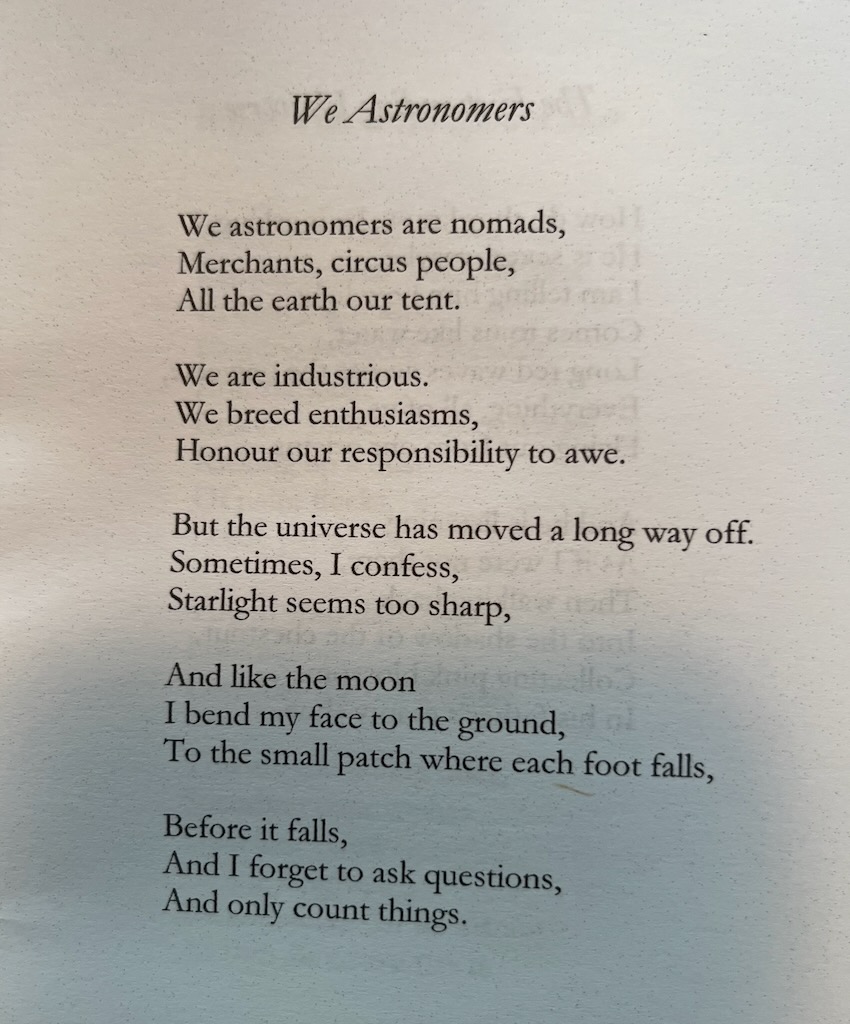
i’ll leave you with a page. . .
have a blessed, awe-filled week….


oh, i promised my dear friend wini i’d share this wonderment she is bringing to town (town being chicago, or the northern environs to be specific). wini is a poet, and she’s worked closely with, and had one of her poems judged “best in class” by the marvelous poet rosemerry wahtola trommer. wini, who makes things happen, invited her and now is inviting all of us for a day of poetries. part workshop, all wonder, it promises to be a day to remember. here are the details, courtesy of wini:

Come experience the gorgeousness of poet, teacher, and storyteller Rosemerry Wahtola Trommer. This event is about more than just poetry; it’s a chance to listen to what is true in your heart and open to “The all of it — the Beauty and Sorrow.

It is beyond lovely to be in-person with Rosemerry, and truly what a treat to sit in community again with like-minded people, and to uplift and celebrate each other’s beauty and light.

I hope you’ll join us. It would be so lovely to see you again.

  • When: Saturday, September 27, 9:00 a.m. – 3:00 p.m. (lunch included)
  • Where: Valley Lo Club, Glenview, IL
  • Details: Three different ticket prices are available.

Buy your ticket here

thank you, wini, for bringing this priceless gift…..

acquiring acquaintances: another name for pen pals

it started because months, or maybe years, ago, i stumbled onto a poem that took my breath away. it was written by a poet i’d not known of, didn’t think i’d ever read. but the poem, titled “Nativity,” stayed with me, a poem that paints the first Christmas scene in strokes and shades that settled deep into my marrow, and forever more are the Christmas i imagine.

it’s a poem that lays the baby Jesus in a rough-sawn barn, the air pungent with animal. “the wind tugging at the shutters.” there is nothing gilded about it. and it was written, i knew right away, by someone at ease with being small, tucked off in a corner keeping watch. it was written, i could tell, by someone whose very veins course with humility, and understood a God who preached the same, a God who asks us to get about the business, the holy business, of loving as we would be loved without noise or bombast or folderol.

the poet’s name is kenneth steven.

it turns out he lives on an isle on the scottish west coast, a place where the wind might tug at shutters. and it turns out he is something of a polymath: a poet, a painter, a children’s book writer, a translator of great works. and, above all, something of a pilgrim, a pilgrim seeking the quiet beauties that punctuate the everyday. he calls them “atoms of delight.”

and he writes of pilgrimage: “the word is often used to describe the journey to a shrine or sanctuary in search of spiritual transformation, which is a meaning i acknowledge. but now pilgrimage has become a much bigger thing for me; it has gone far beyond that rather heavy and medieval sense of going on a journey to visit a holy site. why shouldn’t it be about a walk to a hill loch to listen to the impossibly beautiful singing of red-throated divers? why shouldn’t it be about a child running into the forest in the early morning to find the treasure they dreamed of? these are journeys of the heart, seeking the profoundly precious places where little miracles happen. and why shouldn’t it be about panentheism—the finding of God in all things?”

it’s not hard sometimes to recognize a kindred soul.

what is hard is to imagine finding yourself in conversation with such a kindred someone. but that’s what’s happened. kindness is the thing that opened the door, his kindness. in a world ruled by transaction, where fees are paid and contracts signed for any exchange of goods—be it words or bricks or lumber—kenneth steven lives otherwise.

i found that out not long ago, when, during the editing phase of my next book, i dove into the task called “permissions,” in which for any chunk of text—poetry or prose or lyrics to a song—beyond a certain measure, you must secure permissions from its author. this can be a costly exercise. and it is always one that makes me quiver, wondering what walls i’ll encounter, and what cold-shouldered hubris i might have to tiptoe through.

it’s that poem, “Nativity,” that’s stayed with me all these years. and i’d included the whole of it, eight lines, at the start of an essay that i hope to include in the book.

wondering if i was whistling into the wind, i sent off a proper letter, the digital kind, and shipped it cross the sea. i’d no idea if mr. kenneth steven would ever reply. but, lo and behold, come monday morning, there he was, tucked kindly in my mailbox. and more than generously writing: “of course you are more than welcome to use the poem. i’m sure you’ll mention where you found it.”

and thus, with the stroke of his generous heart, a friendship has unfolded. and a treasure trove of poetries have now brushed through me. and i am richer for this scottish friend who, as a boy, awoke one night at midnight, and hearing a great and ferocious wind, hurriedly dressed and left the house, where he climbed a hill in howling winds, before crossing through a field to reach his favorite tree, where he knew the horse chestnuts would be falling, and he was out to save them, to gather them up. “i felt given a whole world,” he writes in an essay about the midnight escapade. “it was about the autumn and the big winds, and the thrill of running up that long hill and entering the field at last at what felt like the middle of the night.” and the indescribable delight of knowing “that all this treasure was mine.” the treasure: a cloth bag of chestnuts shaken from the limbs, their deep and woody smell, orbs that looked as though they were made of shoe leather.

befriending him, he who writes me every day now, sometimes more than once a day, is magical. is akin to befriending any of the authors from my childhood who’ve long entranced me, drew me into storybook tableaus: tasha tudor; e.b. white; frances hodgson burnett, who wrote the 1911 children’s classic, the secret garden, a book that featured my holy trinity—an orphaned girl, a padlocked garden, and a robin redbreast that finds the key—and once prompted me to fake a fever so i could skip church one sunday to stay at home and turn its pages.

long ago, when i’d be asked if i’d ever want to write a book, i demurred, brushed away the thought. didn’t think i could hold a thought long enough to pen more than a few pages. i didn’t know, though, that the magic of a book comes in all the threads unspooled along the way. threads that carry me to places far and wide, and to souls i’d never otherwise know. but words, like little birds, or prairie seeds, catch on the wind and settle into fertile loam. and we are richer for them.

in much the way, my beloved chairs, through all the words and all the years, have become my dearest treasures.

bless you.

love, bam

have you a penpal in this digital, globe-crossing, email world? someone you’ve not met but who seems a certain friend?

i promised kenneth i would share word of his beautiful meditative podcast, Imagining Things, on the patreon platform. recorded in a studio that seems to be just behind his island home, you can sometimes hear the scottish winds blowing off the atlantic, and a bird or two not far away. (or maybe i’m imagining.) and of course he speaks in a scottish-soaked timbre, and in between reflections he shares poems that will make you hit rewind so you can listen once again, so breathtaking are the lines.

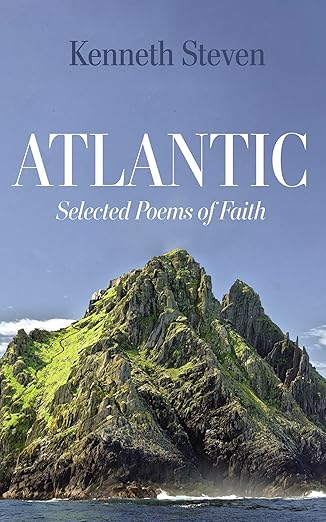
his latest book, one that should be landing on my front stoop within days, is Atlantic: Selected Poems of Faith. but i’m already deep into Atoms of Delight: Ten Pilgrimages in Nature, and Iona: New and Selected Poems.

spring might be sprung, but i’m not springing

vernal equinox out my backdoor

they say it’s spring out there. celestial lines were crossed in the wee, wee hours of yesterday, and, for a flash there, light and shadow fell in equal measure. 

i don’t feel the light though. not in sync with springtime’s beckoning. i’m inclined still to hunker down in winter’s shadow. 

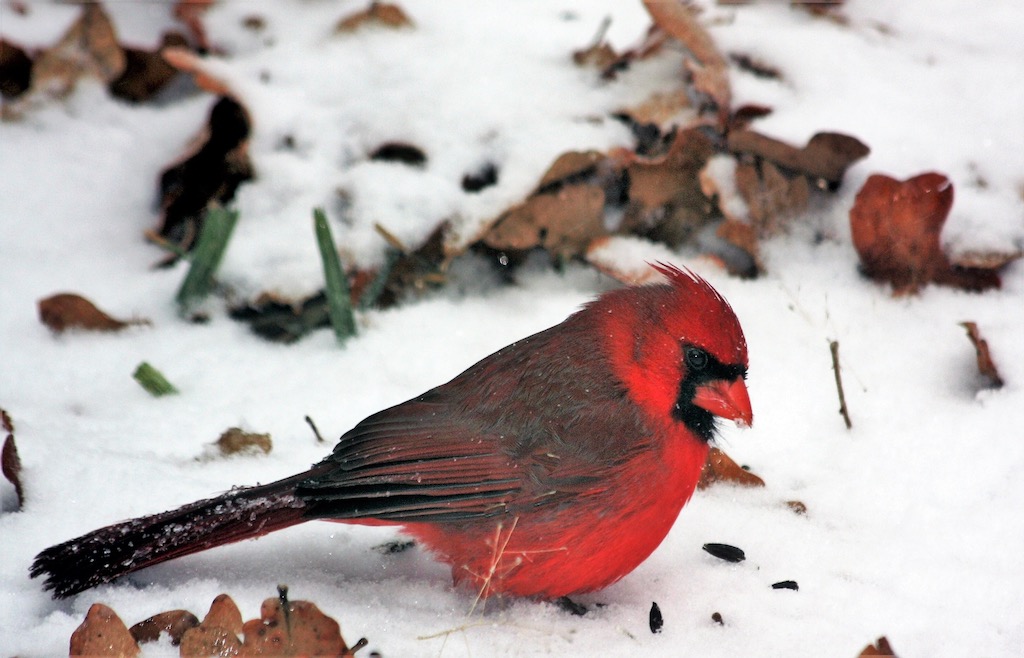
for reasons i can’t quite fathom, i’m not ready this time ’round for the seasonal advance. i still feel wintry in my bones. the light change is too abrupt for me, too ice-white for me. my inner metronome is far too slow for the prestissimo that’s rising. i don’t mind the cardinal’s vernal song, though, rung out from treetops high, and piercing through still-frigid air. but i’m not seasonally adjusted. i’m lagging at least two lopes behind. 

i can’t tell if it’s that my winter felt circumvented. or that i’m wishing for all of time to freeze in place. since the world is rather dire these days, that cannot be a wise solution. in that regard, i’ll take time in double measure. may we all wake up on the morning of eight november, 2028, with a whole new glimmer in our eyes. and the present firmly in the past.

i’m feeling somewhat stuck. hardly welcoming of burgeoning to come. and that’s a most peculiar state for me. 

might the whole universe be toppled on its head, upside down and inside out? 

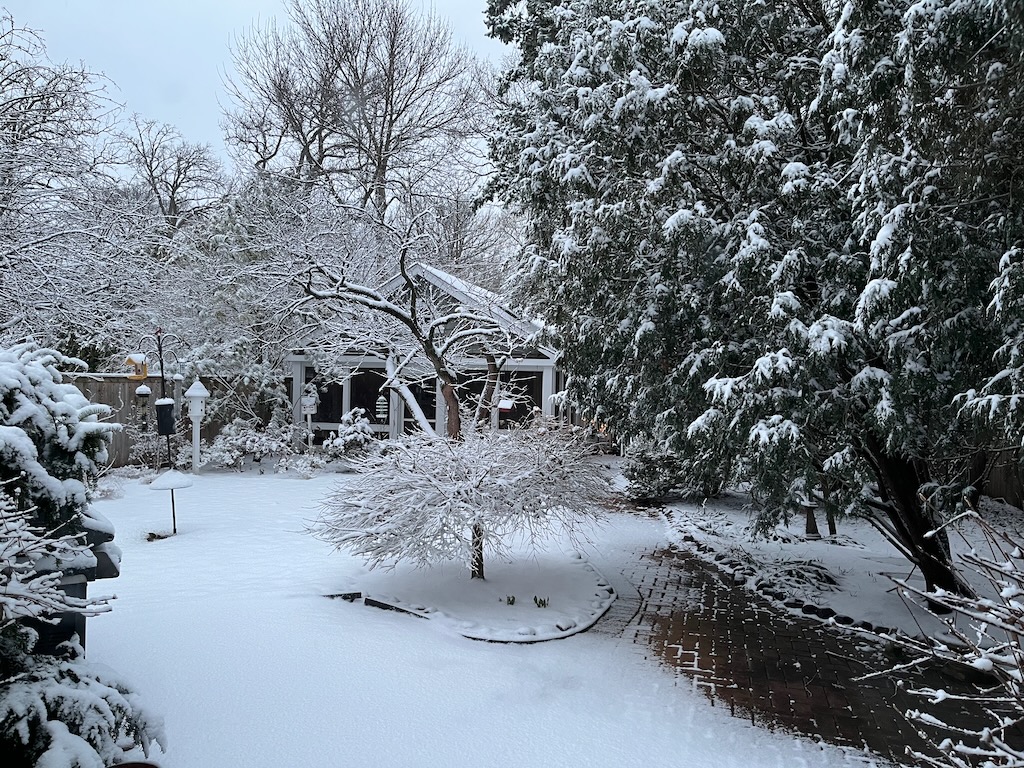
the one sure sign that spring is here is that when i awoke, just hours after equinox, the world i saw was dumped with snow. which in these parts is something of a rite of spring. tulips rise, and snowflakes fall. my mother swears she knows it’s spring when she slides on her winter boots and brushes all the glops of snow off her daffydills. 

no wonder we of the four-quarter year take spring in slow, uncertain sips. there is no fine delineation, as if the calendar and earth set their clocks in synchronous coordination. 

on a day when snows fell in glops, and then proceeded to melt in same-sized gloppings, and on the day when headlines kept insisting the springtime was upon us, i heard a thump at my door, and therein found prescriptive for my seasonal laggings. 

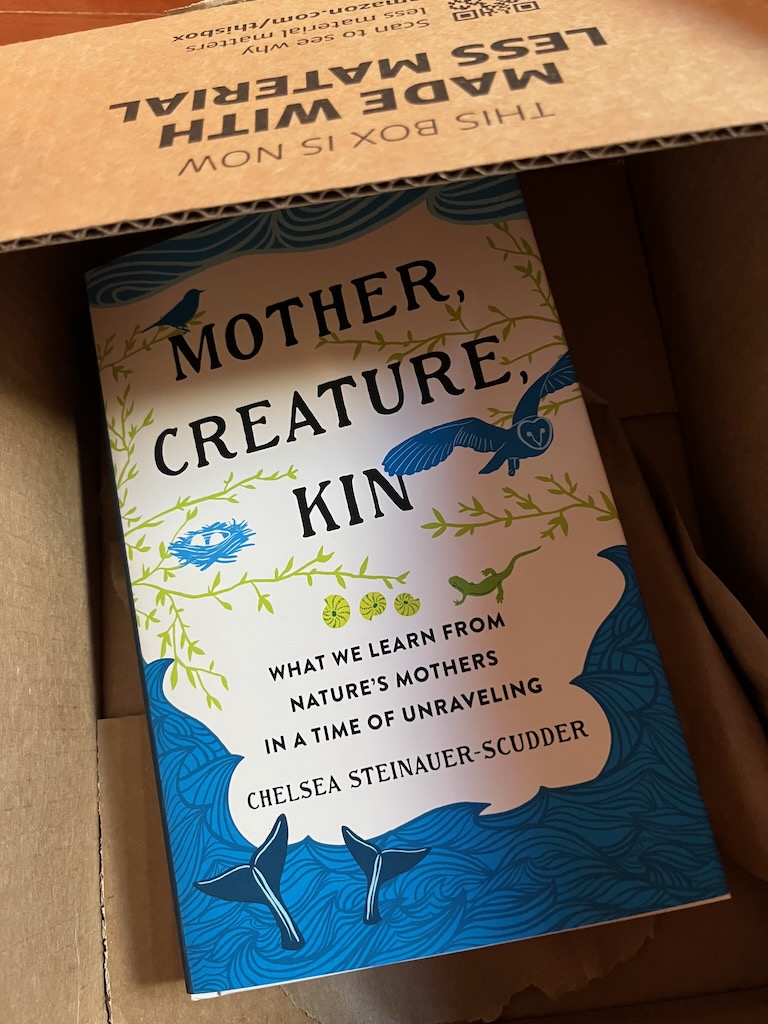
there, in a plain brown box, lay a book i’d been awaiting. my friend chelsea steinauer-scudder, as intelligent and beautiful a writer as could be, became a mother back when she and i were reading books and writing in the zoom rooms that covid carved. i’d first read chelsea in the pages of emergence magazine, a wunder site (online and print magazine, as well as creative production studio) that probes the depths of ecology, culture, and spirituality, and where she was a writer and editor for five years. when i saw she’d be leading reading circles (braiding sweetgrass, among them) and ones for the craft of nature writing, i signed up, and cemented myself to what would otherwise have been a front-row seat. 

chelsea grew up on the great plains of oklahoma and the sandhills prairie of nebraska, where for a time her papa researched bison, fire, and native plant communities, so she comes to her native landscape––language enfolding the sanctity of earth––with what seems an effortless fluency, as if she grew up breathing it. which, of course, she did. and then she went on to harvard divinity school, where she earned a masters in theological studies, and ever since she’s been writing sumptuously, focusing her work, in her words, “on the confluence of relationship to place with experiences of the sacred.”  

her first book, Mother, Creature, Kin: What We Learn from Nature’s Mothers in a Time of Unraveling (Broadleaf Books), is what brought the thud to my front stoop. it’s due out april 8, but my copy landed yesterday. and it might be the cure i needed to lull me into spring. 

a.) it gives me excuse to curl under a blanket for a day or two, and b.) here’s what i’m about to bathe in, passages such as this:

“I wish to invite you into a kind of mothering that is wild and porous. The kind that draws blood, that loves and fears, rejoices and doubts, that exposes where we are most deeply vulnerable and from there stretches us into what is beyond us. I mean the kind of mothering that works within uncertainty and mystery. The kind that leaves soil beneath our fingernails and seeds in our hair.” 

she writes about mothering and being mothered by places. ecological mothering. she defines ecological motherhood as: a shared, place-based responsibility to nurture and support human and more-than-human life. she writes of the karmic cycle of rebirth, a subject aptly plucked from the vernal syllabus. she writes of the silent flight of barn owls, of nursing and endangered right whales, of real and imagined forests, eroding salt marshes, and newly planted gardens. 

she writes that the protagonists of these stories have been teaching her facets of mothering (a verb that she, like me, insists is not tied to gender nor obstetrics). those facets belong to us all, no matter our life’s work: “language, belonging, entanglement, community, edge work, homemaking, and how to think about the future.”

my friend chelsea just might nudge me over my springtime bump, and land me softly on the vernal side….


as i await the vernal skip in my own heart, i scan the literary landscape for those others who, along with chelsea, might nudge me there. and no surprise, i turn to two favorites, the great naturalist and writer, aldo leopold, and the poet mary oliver, who drew the sacred from her every path and passage.

“One swallow does not make a summer, but one skein of geese, cleaving the murk of a March thaw, is the spring.”

aldo leopold

North Country

In the north country now it is spring and there
     is a certain celebration. The thrush
has come home. He is shy and likes the 
     evening best, also the hour just before
morning; in that blue and gritty light he
     climbs to his branch, or smoothly
sails there. It is okay to know only
     one song if it is this one. Hear it
rise and fall; the very elements of your soul
     shiver nicely. What would spring be
without it? Mostly frogs. But don’t worry, he

arrives, year after year, humble and obedient
     and gorgeous. You listen and you know
you could live a better life than you do, be
     softer, kinder. And maybe this year you will
be able to do it. Hear how his voice
     rises and falls. There is no way to be
sufficiently grateful for the gifts we are
     given, no way to speak the Lord’s name
often enough, though we do try, and

especially now, as that dappled breast
     breathes in the pines and heaven’s
windows in the north country, now spring has come,
     are opened wide.

––Mary Oliver

a little peek at what a few other authors have to say of Mother, Creature, Kin. may i call your attention to the one who writes that this beautiful book belongs in the company of works by Ursula LeGuin, Rachel Carson, Terry Tempest Williams, and Robin Kimmerer, to name a constellation of the highest-reaching lights…

are you finding yourself in springlike mode, and what sights and sounds and scents are stirring you there?

a sky so big it holds me

when i need to talk to God, and i do plenty often these days, there is one certain place i know God will be waiting. i know it because i feel it. and feeling God is much more than knowing. at least to me it is. 

the place where God all but reaches down and swoops me into God’s arms is at the shoreline, where the vault of blue heaven is vast, is infinite, where the water’s edge might take on any one of uncountable modes: it might be uncannily calm, so calm the ripple is but a purling, a burbling so barely perceptible it’s as if the lake is tickling the sand; or it might be roiling and cacophonous, so deafening you can barely hear the words rising from your own throat. 

i could stand there all day, my toes planted in sand, my head tilted back, eyes wide. heart thrust forward and up, up. 

i’ve been walking there each day with my beloved. our footfalls in the sand the only sign we’ve been by. sometimes, if i go alone, i curl small as a hedgehog and settle into the grasses that rise from the hillocks of sand. i stay till the last of my prayers are unfolded, laid at the lap of the One Who Is Listening.

it’s as holy a place as i know. 

to feel God reach down and hold you, to know that the vastness above is deep and wide and forever enough to absorb each and every whisper and plea, to know that the deepest cries of your heart might be heard, to feel the soothing that comes as if your trembling shoulders are now wrapped in angora skeins, that is to me the very essence of a God who’s bigger and deeper, more infintely tender and close, than anything or anyone i could ever, ever imagine. or behold.

some days i need a God of extra-big volume and size. a God big enough to hold me, to press against me so firmly that all of my worries, like wrinkles, are melted away. those are the days i look to the heavenly dome. where mine is a God who knows me inside and out. sometimes my insides are so very scrambled and messy. 

it’s the closest i’ve come to that magnificent image of saint john of the cross, the one who rested his head against jesus’ chest at the very last supper, who let it be known that he was listening for the heartbeat of God. an indelible image that’s become a life-giving instructive (a particularly celtic one) for us all: to listen wherever we go for the unending pulsebeat and presence of God.

sometimes, inside the rooms of a house your worries can clang around noisily, too noisily. they can crowd out all of the air, and make you want to climb out of your skin. that’s where the heavens come in, where the shortest reach between me and my God is the indigo dome of the night at the beach, or the undulations of blues and grays in mid-afternoon. dawn at the water’s edge is a whole other slide show, one played out in the fieriest streaks of the rosy-red color wheel. 

and those are the days i all but run to the shoreline, to the water’s edge, where the alchemy of sand, sea, and sky are stirred into a medicinal balm, a sacred balm, like no other. and the God to whom i run always, always is there for me.


here’s a little extra beauty from the late poet anne sexton, whose story is drenched in struggle and sorrow, but who reached for the light coming in through the cracks. i tell a little bit of her story down below, but first, the poem:

Welcome Morning

There is joy
in all:
in the hair I brush each morning,
in the Cannon towel, newly washed,
that I rub my body with each morning,
in the chapel of eggs I cook
each morning,
in the outcry from the kettle
that heats my coffee
each morning, 
in the spoon and the chair
that cry “hello there, Anne”
each morning,
in the godhead of the table
that I set my silver, plate, cup upon
each morning.

All this is God,
right here in my pea-green house
each morning
and I mean,
though often forget,
to give thanks,
to faint down by the kitchen table
in a prayer of rejoicing
as the holy birds at the kitchen window
peck into their marriage of seeds. 

So while I think of it,
let me paint a thank-you on my palm
for this God, this laughter of the morning,
lest it go unspoken. 

The Joy that isn’t shared, I’ve heard,
dies young.

  • Anne Sexton
anne sexton

sexton, a 20th-century american poet, was considered one of the Confessional poets, along with maxine kumin, sylvia plath, and robert lowell. after the birth of her first daughter, she suffered from post-partum depression, had her first so-called nervous breakdown, and was admitted to a psych hospital. she suffered depression the rest of her life, a life that ended in suicide when she was 45.

although her poetry was criticized by some as “soap opera-ish,” others praised it for the ways it expressed “the paradoxes deeply rooted in human behavior and motivation. her poetry presents multiplicity and simplicity, duality and unity, the sacred and the profane.”

one of sexton’s earliest champions, erica jong, reviewing her 1974 The Death Notebooks, argued for sexton’s poetic significance, claiming her artistry was seriously overlooked: “she is an important poet not only because of her courage in dealing with previously forbidden subjects, but because she can make the language sing. of what does [her] artistry consist? not just of her skill in writing traditional poems … but by artistry, i mean something more subtle than the ability to write formal poems. i mean the artist’s sense of where her inspiration lies …there are many poets of great talent who never take that talent anywhere … they write poems which any number of people might have written. when anne sexton is at the top of her form, she writes a poem which no one else could have written.”

where are the places in your world where your prayers feel especially heard? where a holy comfort might enwrap you? and you just might feel held? and, thinking of sexton’s poem, if you were to write a litany of morning joys, what would be among your joys?

prayers for this country as we cross over the threshold of this next election. prayers for peace, prayers for truth, prayers for grace….

amid the dizzyings of springtime…

i imagine it’s been well-established that i am of the homebody persuasion. the sort of girl who thrums inside the cozy confines of space and time i know by heart. to plop behind the wheel and point myself in a direction i’ve not been is, well, to stretch me. to accelerate the tempo of my little heart, to bring on the rumblies in my tummy. and so it was as i set out for The Driftless (a topography that deserves every drop of its capital consonants) a week ago today.

for starters, i got lost. yes, yes, after dutifully trying to follow my index-card directions through country roads and farmer fields, i decided maybe it was safer to let the little voice tell me where to go rather than glancing down and trying to find the numbers i had scribbled. well, news flash: there are TWO mineral points in ol’ wisconsin, and the one i was steered toward was the one in otherwise unmarked farrow field. that little voice announced, “you’ve arrived. your destination is on the right,” whilst i looked up and saw literally nothing but an undulating plot of shaved-off stalks. hmm. this must not be, i intuitively surmised.

i was miles from nowhere, and 67 miles from where i needed to be. where the world’s loveliest host had a turkey meatloaf in the oven, and asparagus steaming in a skillet. ah, but in due time, rollercoastering along country roads, past baby calves (yes, i know it’s redundant, but i like to say it that way) all gathered under little calf-ling igloos, which must be the latest in dairy husbandry for each baby calf had its own domed shelter, and a place to escape the drifting snows, past rock formations that felt prehistoric or laid there by ancient peoples, through towns that time forgot and that i prayed still stuck to old ways, and not the toxic juice that’s infected so very much of old america, i pulled in the gravel lane that was my destination.

and, from the first footfall inside the charming farmhouse, i was home. daffodils and aldo leopold awaited on the bedside table, and the bed itself was a cloud of comforters. each morning that sunrise above greeted me from the kitchen windows. and each morning, it took my breath away, and filled me with holy airs.

the folks i met were as fine and fluent in the poetries of earth as any souls i’ve met along my way. i met a farmer who plows his field with draft horses, and writes letters back and forth with wendell berry (be still my heart!). and another farmer who used to cook at chez panisse. (yes, that chez panisse, the one in berkeley CA, where alice waters revolutionized the kitchen.) i scrubbed pots and pans beside a woman whose heart must pump in gold. and i heard tales of keeping watch on eagles’ nests.

and then, come sunday morning, after hiking through the woods, and talking books in a charming indie book store (where croissants were rising in the ovens behind me), i took to the pulpit in a little country church to deliver what you might call the sermon, but which the priest referred to as a “reflection” since i’ve not passed the sermon-licensing exams. and as i wove threads from the doubting thomas gospel and the book of nature’s sometimes tangible God, i looked out on a congregation of fine souls who were listening in a way i’ve never known: heads cocked, a posture of deep attentiveness, eyes on the pulpit, you could hear a pin drop in that blessed church. and i saw how good souls are hungry for a word of wisdom with their sunday-morning coffee. if this is church, and i do believe it is, may we become a people who know to carve out time to put down phones, dial down the pings, and find our way to wherever it is the holy wisdoms come.

not an hour later, the whole adventure in soul-stretching reached its crescendo when every last soul at the basement coffee hour stood and raised an arm toward me, or laid a hand on my shoulders, and at the behest of the priest, father christian was his name, blessed me with a prayer that had me all but gulping back a walloping sob. when i felt the tiny hand of father christian’s little boy, a kid with special needs, squeezing my left arm, i really truly nearly lost it, as they say. instead, i held his hand and together we squeezed and prayed all the way to the last amen.

and then i motored home, not quite the way i got there. and forever deepened and shifted by the glorious goodness of my new friends who dwell in the driftless.


i came home, of course, to sunlight-blocking moon, and a garden erupting in springtime’s accelerandos. and i spent a good bit of week deep-breathing all of that, and getting mighty muddy too. but i also came home to friends who are grieving inconceivable losses. and when i found this prayer-poem from jan richardson, i knew i needed to pass it along. so, here, too, for all of you is a poem to keep for when grief comes to you or someone you love, or even someone you might not know too well at all. jan is a poet, artist, ordained minister in the united methodist church. i was introduced to her years ago now, by my very own night chaplain (slj to all of you, a regular visitor here at the chair). and as jan’s life was torn open by the sudden death of her husband, she has only deepened. and her work all the more mesmerizing. this is from not long after the death of her husband, when she was coming up on her first valentine’s day without him. her words are among the truest i’ve ever read. she is pure blessing.

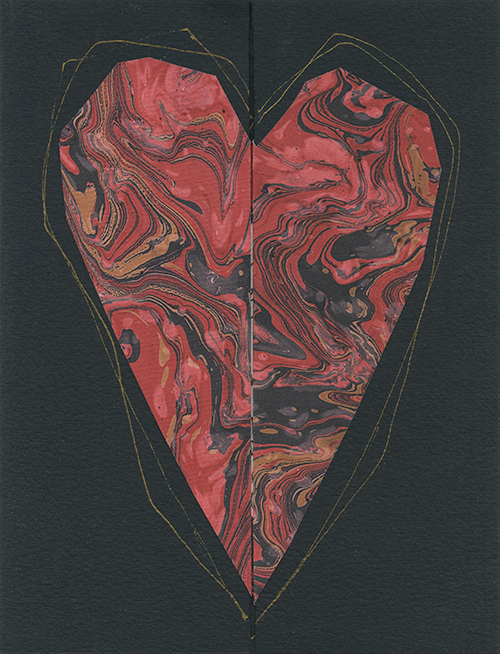
Image: Valentine © Jan Richardson

Blessing for the Brokenhearted

There is no remedy for love but to love more.
—Henry David Thoreau

Let us agree
for now
that we will not say
the breaking
makes us stronger
or that it is better
to have this pain
than to have done
without this love.

Let us promise
we will not
tell ourselves
time will heal
the wound,
when every day
our waking
opens it anew.

Perhaps for now
it can be enough
to simply marvel
at the mystery
of how a heart
so broken
can go on beating,
as if it were made
for precisely this—

as if it knows
the only cure for love
is more of it,

as if it sees
the heart’s sole remedy
for breaking
is to love still,

as if it trusts
that its own
persistent pulse
is the rhythm
of a blessing
we cannot
begin to fathom
but will save us
nonetheless.

—Jan Richardson

This blessing appears in Jan’s book, The Cure for Sorrow.

gremlins seem to be lurking here this morning, so let us see if we can fling this to the cyberwires that carry this from my kitchen table to yours. question for the day, besides “will this work?” is where did you find holiness this week? 

and here is a special wink and nod for the great good souls i didn’t get to mention above: the glass sculptor who sailed the world before planting herself on high street, in downtown mineral point. the ones who’d taught for years and years in alaska before sinking deep roots in driftless loam. the bibliophile who opened an indie bookstore, and thought to attach a cooking school besides. and most of all to jane, my storytelling hostess whose graces left me nothing short of gobsmacked.

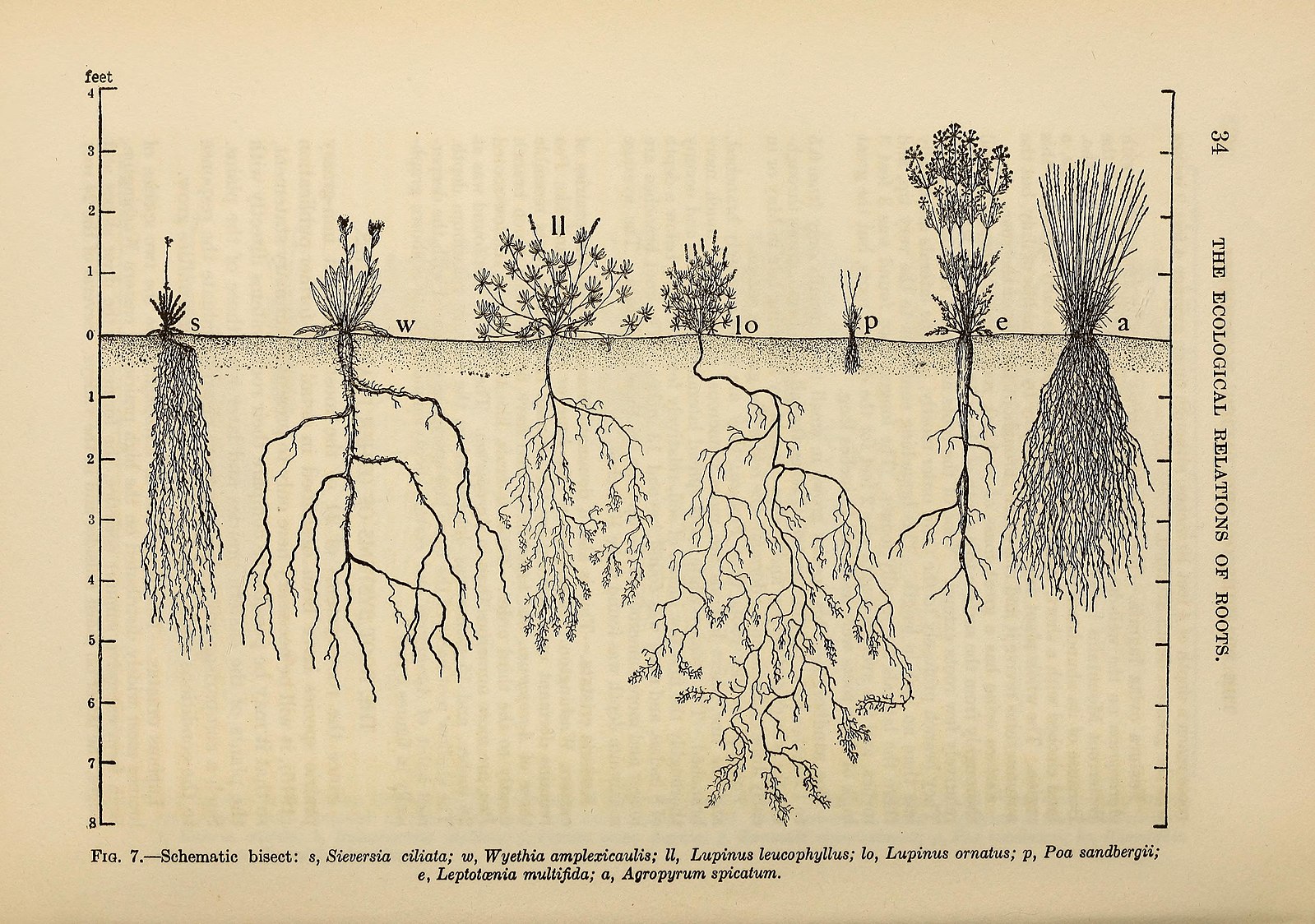
the roots are stirring. . .

sometimes, especially when staring into a tableau best described as blkkh, a monochrome of melted soot + oozy mud, we little people need reminding that there is stirring afoot. underground, that is. deep in this holy earth, particles expand. and multiply. and do those “rooty” things. they set down shoots. reach into the hollows to construct the nutrient highways that, come spring, will rise in daffodil and snowdrop. will punctuate the earthscape in royal-purple crocus and knock-your-socks off cobalt blue.

since ancient times, spurred by the collected wisdoms of those who’ve found themselves at this point in the revolution of the year, at the very midpoint between winter’s darkest longest night — the solstice — and springtime’s resuscitating equinox, the moment when the shadow and the sunlight fall in equal measure, this moment has been marked in ways that promised hope. ancient peoples, too, must have known the dregs of winter trodding on too long, or at least the ancients of the north.

those ancient peoples dubbed this a cross-quarter day, the precise mid-score between the changing of the seasons. and those ancient peoples, ones whose livings came not from sitting in front of keyboard pounding keys, but rather who picked up staff or rod, and herded flocks or fished the seas or tilled the earth, they turned to what they knew best to look for hopeful signs: earth and sea and sky. therein was the stirring from which they drew their wisdoms and their post-it notes from God.

in the case of this cross-quarter day, the one that falls as winter wanes, when springtime hasn’t yet picked up its paces, there might well have been some undercurrent of we-are-running-out-of-steam-here. and so perhaps one wintry day, one wise (and desperate) someone dropped to her knees, pawed the crusty earth just down deep enough to catch a glimpse of tangled rootlets reaching down, down, down. she might have whooped in exclamation, let her fellow desperados know that, lo and behold, all was not lost. the earth had not gone thoroughly to sleep. deep down where earth keeps all its secrets, there was promise stirring.

and so, the peoples celebrated. the peoples, being wise long before we were specks of anyone’s imagination, might have extracted their own wisdoms from this botanic wonder. they might have realized that if the wondrous underbellies of the bulbs were hard at work in ways unseen, we too might seek analogous metaphor in the vicinity of our psyche and our souls. we too might figure out that now, as winter’s grip begins to loosen, our own deep-down growing stirs. even when we think it not. (and we’d be wise, methinks, to bolster that stirring with at least a dab of concentrated meditations, sifting through the questions that might propel our year ahead, steering our own soulful energies to those one or two roots we decide most warrant our attention.)

the ancient israelites (and jews today) called it tu b’shevat, the new year of the trees, so marked by the first blossoming of the almond trees. the celts called it imbolc, a word that means “in the belly,” when the earth’s belly begins its thaw and the seeds below begin their stirring. (the word imbolc comes from Old Irish, and was reference to the ewes beginning to lactate as birthing season comes and the field grasses start to grow.)

indeed, the earth is quickening, the obstetric name for that first sacred stirring from within, when that tiny tiny human limb first garners enough muscular oomph to kick the wall of mama’s womb. i remember sensing it, unsure if it was just a tummy rumble, or the first fetal morse code that someone in there was really in there. in due time, the kicks make clear that it’s no hiccup of the fetal variety.

jews gather for the tu b’shevat seder, a feast of seven fruits and four glasses of wine, beginning with one of deepest red (winter at its fullest) and each successive glass a paler pink till springtime’s wine, all white. the celts, being earthly people, turned to fire and water: the women of the home slept beside the hearth on imbolc’s eve (jan. 31), and checked in the morning for any markings in the ash signifying that saint brigid (a fiery spirit) had wafted by in the night, spreading her imbolc blessings. they headed for the hills, too, and lit bonfires atop the crests, then spent the night leaping over the flames. more docile celts might have settled for kindling a few wicks around the house. but every peoples has its wild ones. and if fire wasn’t your thing, you might wander to the nearest sacred well, and take a dip for purification purposes.

i might let the candles burn today, or perhaps i’ll take a sudsy bath, as i think deep and hard of how i intend to bring my little flickering of light into this world that grows dark and darker by the day….

and on that note i bring you this emboldenment that my blessed firstborn sent along the other day, quoting from his favorite of thomas merton’s writings, raids on the unspeakable.

Be human in this most inhuman of ages; guard the image of man for it is the image of God. You agree? Good. Then go with my blessing. But I warn you, do not expect to make many friends…

Thomas Merton

what might you do today to mark the incoming of light, minute by minute, day by day, till the full birthing comes?

nursing tender things along. . .

barely perceptible nub of palest green, on the first outpost of the left branch of what might once again be my peewee hydrangea…see it?

i found myself crouching down as low as i could go the other day—likely lower than a girl with slits in her side should wisely have gone. but i was intent on inspection. i was searching clumps of stick for little nubs of green. of life. of any sign that the last shrub i planted in the fall — the day before the frost came — had survived the long winter. 

it was a long winter for plenty of us — certainly for my garden, newly planted in the weeks not long after the dreaded fence went up next door, and indeed for me. 

and yet now the season of birth and rebirth is upon us. from every bough and limb, from every red bird’s throat, the song of springtime’s hallelujah bursts forth and keeps on forthing. 

i find myself particularly intent on the tendernesses of this holy spring. i am crouching down low day after day, keeping watch for signs of life, coaxing beauties to unfurl.

poor mama robin laid her egg on a porch railing. oops. fear not, all now is well.

seems a wise posture, that of nursemaid to the birthing earth. it’s one i am learning to mimic as i consider my own deeply tender places, as i picture the convulsions of my poor little lung that likely has no clue what hit it, and why all the folderol and commotion a week or so ago. but it is now doing its darnedest to sew itself back to whole, pressing tight the seams that now are held in place with metal threads. the miracle of the human body is not unlike the miracle of holy earth, and as i slowly walk my garden’s edge, stooping here or there to lend a hand — lifting clematis vine to its fallen trellis, rescuing a robin’s egg mislaid on a railing’s edge — i am breathing in the tender caretaking ways of the God who so tenderly holds us in God’s sacred trusted hand. or so i imagine. none of us has a clue really just what form this God of ours inhabits, so from time to time i apply my storybook imaginings to make it all more apprehensible. i understand the naiveté of picturing a God who scoops me in God’s hand, but somewhere deep in that vision there is a grain of holy comfort. there is an image put to the ineffable. and right in here, i need that image.

i’m not the first to put pictures to my God, and i know i’m not the last. it’s a hard task here on earth to imagine the Divine goodness that inhabits all the cosmos, and surely all the heavens, and then the questions come: is heaven the holy light deep in our hearts? is heaven that palpable knowing that we are held by a goodness beyond our wildest imagination? once upon a time the nuns taught that heaven had a pearly gate, and was carpeted in clouds. oh, lord, they shouldn’t teach such things to wide-eyed little children; it can take a long long time to revise the picture reel inside your head, and why waste time in lala land when God is so much more and vaster and infinitely deeper.

i am spending many chunks of time pondering the presence of God in this messy chapter of my life. what i know is this: when i was deep in the dark tunnel of an MRI that scanned the vessels of my brain, and told not to flinch a single muscle for 45 excruciating minutes, i surrendered to the softest arms i’ve ever known. i imagined them as the arms of God, cradling me. and in that space of utter peace, i rested. and did not flinch, did not cough, did not exercise the itch or cramp in my shoulder; i found the holy wherewithal to do precisely as the doctor ordered. 

and that is how i pass the hardest hours. i go deep down under. into the place where God and angels dwell. i’ve no knowledge of this landscape. it’s all uncharted and unknown. but when i go there i am safe. and i am cradled in what feels like love. and that to me is how it feels when i walk my garden’s edge, crouch down low, and lift a hand to bud or vine or mislaid egg. we are all nurturing each other along. God and all of us. and i’ve no idea just how it works, or what it is. but i know i sense a holiness that i am choosing to call my God.

amen.

(i fully grasp that i’m going out on limbs here, groping along in wholly naked ways, but if i don’t use these hours of my life to plumb the deepest questions, to fumble for the truest answers i know, then what worth will these struggles hold? we have a chance to be our best selves in our darkest hardest hours. and these are mine. so far. so why not open the book and see what stirs? i’m impelled to wonder and to muse aloud….)

mama robin, safely atop her mislaid egg. photo by kerry, who saved the egg and whose porch is mama’s birthing room….

and now a few morsels, as has been my way in this year of gathering up bouquets of wisdoms…

Julian of Norwich, an English anchoress who experienced a vision in 1373 and wrote about it in a work titled Showings or Revelations of Divine Love — the earliest surviving book by a woman in the English language. my friends at the SALT Project (emmy-award-winning visual storytellers with a spiritual bent; check them out) laid this excerpt out as a poem. i found it lovely….

And in this he showed me a little thing
the quantity of a hazelnut,
lying in the palm of my hand, as it seemed.
And it was as round as any ball. 

I looked upon it with the eye of my understanding,
and thought, ‘What may this be?’
And it was answered generally thus,
”It is all that is made.”

I marveled how it might last,
for I thought it might
suddenly have fallen to nothing
for littleness. 

And I was answered in my understanding:
It lasts and ever shall, for God loves it.
And so have all things their beginning
by the love of God. 

In this little thing I saw three properties.
The first is that God made it.
The second that God loves it.
And the third, that God keeps it.


+ Julian of Norwich


 as has been my habit in recent months, i mark the turning of each month by turning to the pages of Henry David Thoreau’s The Journal: 1837–1861. here’s a dreamy entry from the ninth of may when thoreau was 34 and aswirl in the warmth of mid-Spring. (may our warmth please come….) 

May 9. It is impossible to remember a week ago. A river of lethe flows with many windings the year through, separating one season from another. The heavens for a few days have been lost. It has been a sort of paradise instead.

Saw a green snake, twenty or more inches long, on a bush, hang­ing over a twig with its head held forward six inches into the air, without support and motionless. What there for? Leaves generally are most beautiful when young and tender, before insects or weather has defaced them.

These are the warm­-west-­wind, dream­-frog, leafing­-out, wil­lowy, haze days. Is not this summer, whenever it occurs, the vireo and yellowbird and golden robin being here? The young birch leaves reflect the light in the sun.

Mankind seen in a dream. The gardener asks what kind of beans he shall plant. Nobody is looking up into the sky.

a little dictionary for those of us who don’t know our greek: lethe: “forgetfulness,” from the river in Hades that causes drinkers to forget their past.


one more thing a brilliant woman sent me this week when i was inquiring whether a certain “tiny retreat” (that’s how it was billed) had a virtual component, for those of us whose lives are pretty zoom-y these days…..

“Be who God meant you to be and you will set the world on fire.”

Catherine of Siena

finally, a profound note of thanks, to the brilliant and bold mountain-mover of a friend i have in poet and scholar (and my former cambridge landlord) mark burrows, who sent a note to all who were at the zoom book launch a few weeks ago (a lifetime ago!), and who implored you to add a little amazon review to my “languishing” Book of Nature. well, the book isn’t languishing but its state of review sure was. i have no understanding of the algorithms of amazon, but apparently, without reviews, you’re sunk. glub. glub. glub. so mark, unbeknownst to me, rallied the forces and got the reviews boosted from 3 to 11, currently. in a million years i couldn’t have done what he did. in these otherwise upturned days, the human species has shown me in brilliant colors just how magnificently we all can be, and love is pouring forth with the might to rocket me to the holy moon, which was magnificent last night if you happened to notice.

so, thank you, blessed blessed mark. and thank every one of you who in your own magnificent ways has stepped to my side in this curious curious walk through springtime 2023…..

love, bam

in which we return, at long last, to the book-making assembly line…

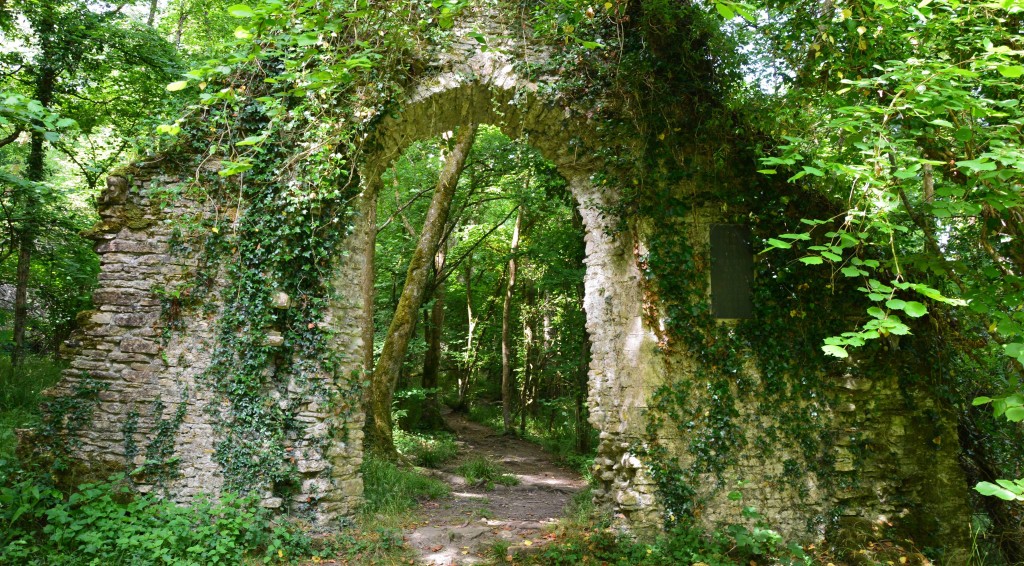
seeing the sacred in nature isn’t typically quite so literal as this ancient relic in the south of england, St. Luke’s Chapel, Ashley Woods, just beyond Abbotsbury in Dorset.

it’s been just shy of a year since last we dropped in on the so-called word factory here at typewriting headquarters, where at the time the bare bones of a book were chugging along the bookmaker’s assembly line, where the supply chain includes alliterations, prepositional clauses, pithy twists of phrase, and occasional insights, all dropped in as the book-in-the-works rolls down the line.

inside the room where the typewriting happens, all was ablur: alphabet keys clacking away, sunlight and moonlight clocking in for their consecutive shifts as the one at the keyboard clackety-clacked, barely noticing the celestial variation as long as the screen stayed aglow.

back then, a precise 37,226 words had been tallied on the factory’s modern-day abacus, the one that spits out the word count with the click of a single key. and there’d been a hard deadline of june. but round about march, it seemed a draft had been drawn to its natural end. so off went the words (59,324) on the pages (110), in hopes of an early editorial read. a bit of a thumb to the wind, to gauge which way it was blowing. or if it was blowing at all.

not long after, all went silent.

and stayed silent. inexplicably, worryingly, for months.

but now, minus the inexplicable tale of the inexplicable months in between, there’s something akin to hope rising. there’s a title, a cover, and even an editor. and, of course, there’s a deadline (more on that in a minute). nothing in the word-factory world seems to come without deadline.

the title, fairly straightforward: The Book of Nature: The Astonishing Beauty of God’s First Sacred Text. the cover, still under wraps. the editor, a writer/scholar/author/professor who i think might be a certifiable genius. but even better, for a writer seeking to braid inter-religious threads: she happens to have been raised jewish, converted to orthodox judaism during her freshman year at columbia, and while studying for her master’s at cambridge in england, she converted again––to anglicanism and, in 2011, was ordained an episcopal priest. these days, she’s an associate professor at duke divinity school, and nonfiction section editor at Image, the journal that, per their website, “fosters contemporary art and writing that grapple with the mystery of being human by curating, cultivating, convening, and celebrating work that explores religious faith and faces spiritual questions.”

bottomline: the newly-appointed editor of my next adventure in bookmaking (she edited my first book too) knows her stuff, is more than fluent in dual religions (encyclopedically versed in the history, practice, and wisdoms of judaism and christianity), and should keep me from tripping into any unforeseen landmines, or swimming too far into the deep end. a good editor is just that: part-lifeguard, part-life-rope, part-landmine detector.

so, soon as said editor drops a pile of edits and queries and what-were-you-thinkings and i-don’t-get-its here on the assembly line (delivery promised for monday), i’ll be working night and day and day and night to whittle down the word count, untangle the knots, piece together the puzzles, and liberally sprinkle the whole kittencaboodle with ample heaps of fairy dust, all in the hopes of a book that won’t be a bomb.

it’s a book about seeing the sacred out in the wilds, which turns out to be the beating heart of an ancient theology, a foundational worldview that long, long ago rooted celts and jews, egyptian hermits and wandering t’ang dynasty poets. and it’s never quite been erased, even if little mention is made of it now. (its disciples would count as diverse a flock as henry david thoreau, annie dillard, mary oliver, and thomas merton, to name but a familiar few.) somewhere along history’s timeline––certainly by the middle ages––it was given a name, The Book of Nature, a text without words, a text built on an alphabet of birdsong and moonrise, raindrops and thundering skies. it arises from a belief that God first spoke through all of creation, and millennia later came a second sacred text, the Book of Scripture. the two books––one wordless, one spilling with words (783,137 in the King James Bible)––ever in conversation.

in the beginning, long before books and literacy, how better to divine wisdom, glean sacred knowledge, than to look to the heavens, the seas, and the stirrings of earth? and now, in an age when words are as likely to be cudgels or wedges, in an age of balkanizations and polarizations and endless debate over turns of a phrase or translation, it’s the wordlessness of this text––the wholly immersive sensuality and rhythms and spirals of heaven and earth, its ubiquity, dynamism, and subtlety––that i count as its genius. and its holy and silent way in.

who’s not felt the goosebumps rise on the nape of the neck when the sandhill crane trumpets across the autumn sky, or the monarchs come in like a cloud, or the lightning bolt scythes through the night? it’s as close as i come to feeling the faint hem of God brush up against me, or enfold me and hold me. there’s a divine animator always at work, always in wait, enraptured, seeking our gaze or our notice. read the great book of creation, run your fingers across its pages and lines, inhale its sights and its sounds and its scents, and you will––perhaps––know something of God, the God who longs for nothing so much as our company, for our sure and undivided attention.

while i strap on my seatbelt, buckle in for the long editing weeks ahead (all will be due by the third week in march), i’ll still post bits here on fridays, mostly a montage of bits that over the years have captured my imagination and my enchantments. it’ll be something of a potpourri till i’m back from book-making adventures. but i promise good morsels.

only the west gable-end wall of the 13th-century chapel remains. of historical note is the fact that the couple who discovered the ruins on their property, restored it, and later chose to be buried beneath its altar, played a pivotal role in saving a Jewish family captured (and later released) during Kristallnacht, or Night of the Broken Glass, the horrific murderous night in November 1938, carried out by the Nazis, who torched synagogues, vandalized homes and shops and schools, and killed close to 100 Jews while sending another 3,000 off to concentration camps.

have you stumbled on anything sacred while out in the wilds?

under the full moon of february, snow moon, consider all this unfolding, unfurling, pushing up toward the deepening light:

Tree sap makes the vertical climb from roots to swell buds, bucks shed their horns, ewes lamb and nannies kid, great  horned owls, bobcats, minks and coyotes mate, and the first northern larks, robins, belted kingfishers, red-wing blackbirds and sand hill cranes return to this northern land I am the current steward of.
–Nance Klehm, ecological systems designer, landscaper, horticultural consultant, permacultural grower, and earth steward

the simple blessing of a snowy morning

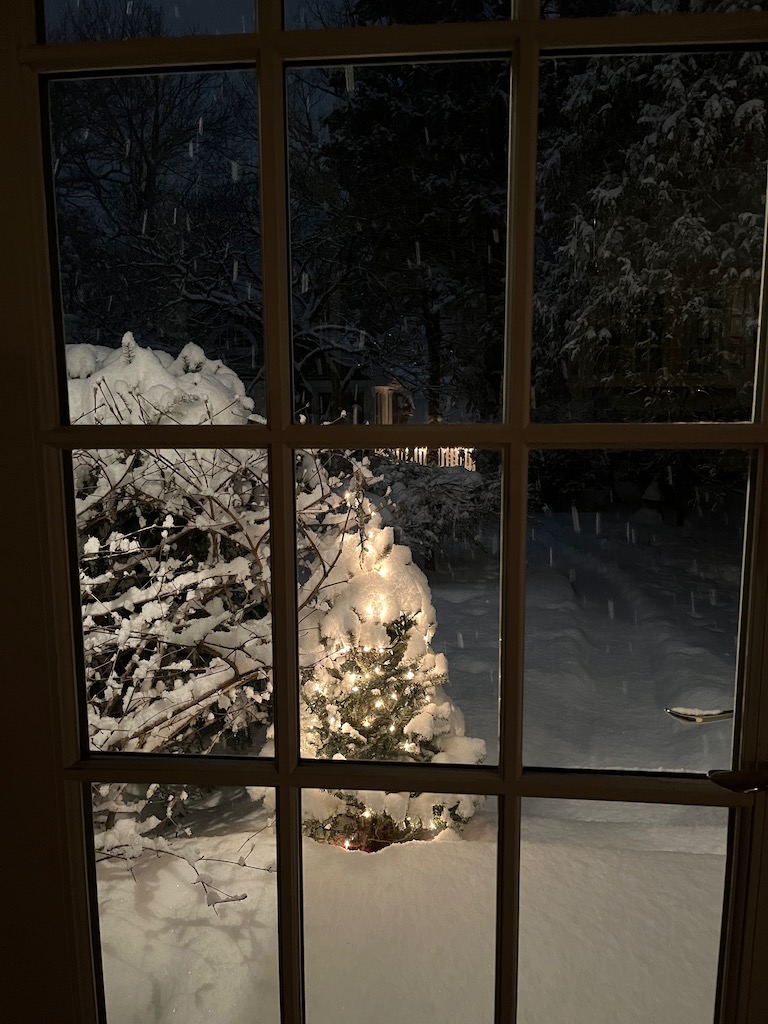
it is as close as i’ve ever come to waking up inside the pages of a picture book, or an enchanted forest, the waking up to fat flakes falling, to heaps and meringues of snow on every flat plane, every bough and twig; even the lumps in the walk get a dollop of beautiful. everything sometimes deserves to be adorned. everything sometimes yearns to be simply lovely.

the days of waking to grace feel numbered of late. more often i awake with a lump in my belly, a worry grown big and bigger in the dark and the tangle of sheets. almost like a sourdough rising, the way the night worries grow. but today is not one of those days. today it begins with nose pressed to the pane. i long to step outside in the thick blue light of it, the silence of it. but i’ve a silly thing about not wanting to mar the tableau, not wanting to plunk my boots in the seamlessness of it all. so i keep to my side of the glass. and i let the snow and the quiet fall unbroken.

i marvel always at the ways the world––grace, God, unseen sacred stirring––steps in just as i need it. the way the prescriptive fills every hunger and hurt. it’s as if all creation is apothecary for the soul. and when we quiet ourselves, and allow its medicinal balms to seep into the cuts and the lumps and aches, the healing comes. the respite of catching our breath, making sense of the madness.

just this morning i awoke with the knowing that a longtime beloved friend had awakened yesterday to find her husband still in his chair from the night before. he’d died, alone. he was 67. no one saw it coming. the night before, wednesday, had been any old wednesday; my friend had made meatloaf for dinner, hadn’t a clue that one single thing was not as it should be. life shatters without making a sound.

my faraway best, best friend is going to surgery next week, her second time in ten years with a surgeon and an oncologist she calls her own. a third friend, one of my bridesmaids, is sitting by her sister’s bedside in dallas, where the cancer has crept into her brain, and where upon finishing a CT scan last week, her sister (four years younger than me) had suffered a stroke. right there on the gurney. right there in the middle of an already terrible cancer.

i ache for every one of them, ache in ways that push against the walls of my heart. ache in ways that crowd every other thought out of my head. ache in ways that make me pay more attention than ever to the most ordinary of miracles.

and this morning i sit here absorbed in the lull that follows an overnight snow. it’s as if all creation understands we need silence between all the noise. we need the holy pause that allows us to catch our broken breath, to be still as we gather up the shards, put the pieces back together again.

the world aims to comfort us; it’s one of its marvels. it aims to shake us to our core, too. another one of its marvels.

how blessed are we that we live in a world of creation, sacred creation, a world where the woods are a balm. where the red bird alights. where snow falls without sound. where, dawn after dawn, the sun rises. and stars stitch the night sky.

the blessings abound. all we are asked is to notice.

dear God, thank you for the balm of this holy morning. may grace fall in thick meringues on the ones i love who are so deeply hurting. and afraid. and alone.

and just like that i looked up, and the red bird came. just beyond my window in a nestle of branches puffy with snow.

God answered. and the red bird flew.

where did you find grace this morning?

in case you need a quiet walk in the wintry woods here’s a little miracle sent my way; last night i gave a talk on the stillness of winter, and opened the evening with this moment of beauty. not all of you live in snowy climes, so here’s your taste of it, too. may it bring you peace, this walk in the snow-laden woods

holy comforter

maybe you haul your wounded self to the water’s edge, to where rocks punctuate the water’s otherwise-unstartled flow, and set things percolating, gurgling. perhaps it’s the roar of the water falling, tumbling down ledges. or the susurrations of a creek rushing through grasses. 

maybe you park your bum in the golden glowing woods, squat on a fallen trunk of maple or oak, a log now home to mosses and mushrooms. or you press your soles to the slope of a mountain, hard against granite or igneous rock, where, as the woodsman John Muir (who advised climbing barefoot) once noted, we’re wise to absorb the sacred essence “with our heels as well as our heads.” 

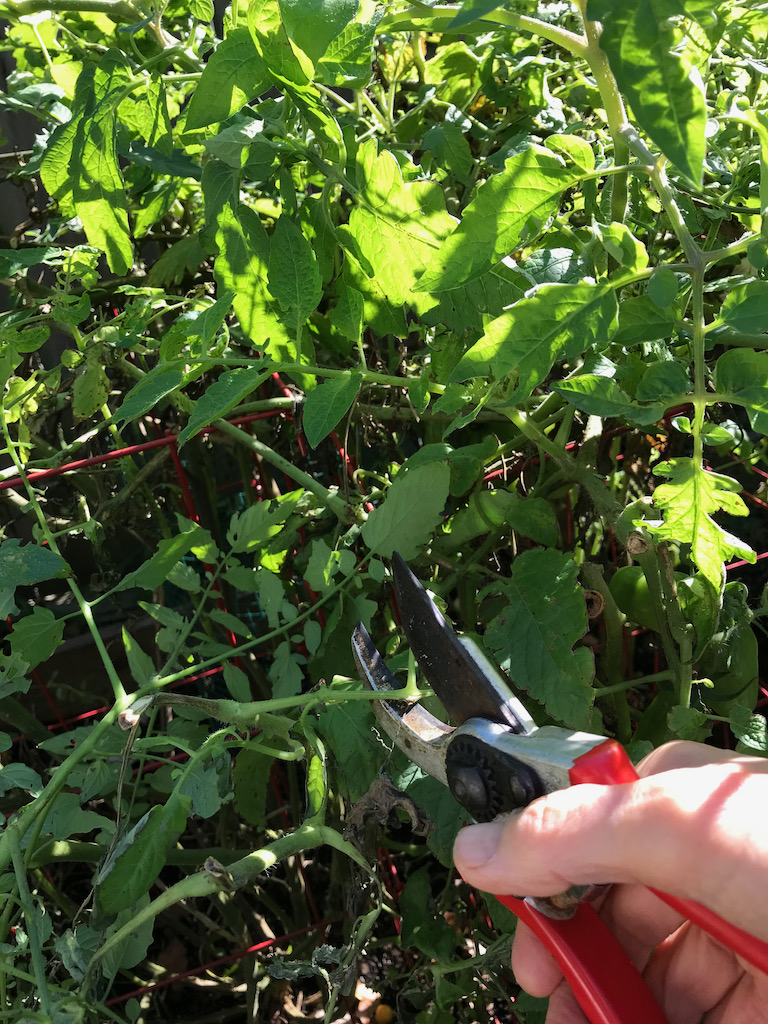
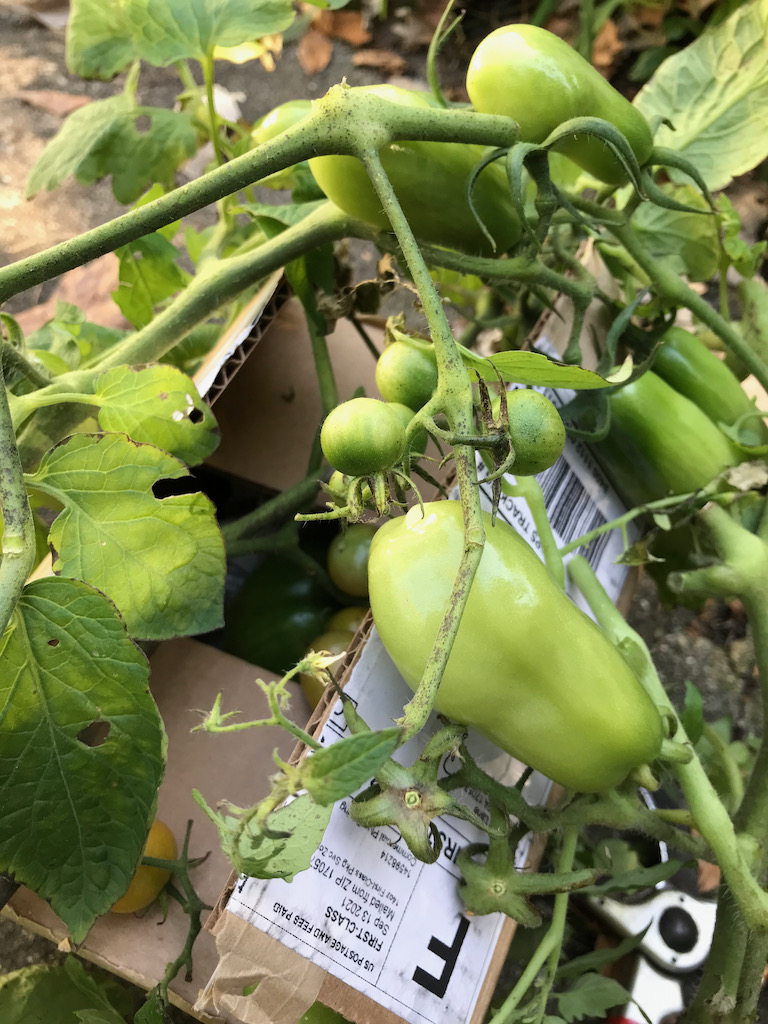
the other morning, knocked about by a phone call i’d been both chasing and dreading, i sought triage and solace out where the autumn light slanted in on my garden’s last gasps. holy comfort i found there with my clippers in hand, untangling my thoughts along with the last of the tomato’s serpentine withering vines, soaking in the morning’s few waning sunbeams. 

i all but wrapped myself in the strands of this earth’s balms. holy comforter, indeed. the warmth of the harvest sun. the unparalleled green. each late-season leaf expiring its last bits of life-giving balm, or what the twelfth-century mystic and herbalist hildegard of bingen termed viriditas, the divine healing power of green. she once wrote, “there is a power that has been since all eternity, and that force and potentiality is green!” in other words, the surging “thereness” of God, life source of all. and, oh, i basked in it the other morning. 

there is something particularly soothing — nay, healing — about the comforts of the late-season garden, about the comforts of each and every season, really. 

it’s as if the earth presses itself hard against my hollowed chest, against the faint beating of my worn-thin heart. it soothes without words, the whole of the creation does. doesn’t try to fill in the silence, offer quick fix. the earth, holy comforter, simply is present. stands in certain unwobbling encounter. makes real the declaration: “i am here.”

benevolent, earth offers healing by multiple choice: should you not feel the radiant heat on the bare skin of your arms, inhale the pungent spice-notes of marigold or spearmint as you break off a stem. or catch the fluttering shadow of october’s south-bound monarch playing with the breeze. or the chatter of sparrows, incessantly sparring. 

each and every sensory channel stands at the ready, inviting the way in. 

there’s a presence, grander, more tender, than i’ve otherwise known. it’s the enveloping bosom of this holy healing earth. or the soft shoulder against which i lay my weary head. 

it’s where i turn when the hurt is too big, or not yet sorted out, not pegged into words. and i’m as certain as anything that it’s the one i call God who enwraps me when i step into the wilds, when i carry my banged-up sorry old self into the balm that is this holy comforter earth. 

***

Glance at the sun. See the moon and stars. / Gaze at the beauty of earth’s greenings. / Now, think. / What delight God gives to humankind / with all these things….

—Hildegard of Bingen

how has any aspect of the whole of creation comforted you of late, or in particular?