
pull up a chair

where wisdom gathers, poetry unfolds and divine light is sparked…

Category: poetry

independent study: the poetry of search

dispatch from 02139 (in which the bleary-eyed one demonstrates that she can rise to fumble with a college paper from 3 till 5 in the morning, return to faux slumber, then get back up and start all over again) …

so here we are, just an hour ago, back before i went to bed the second time, the sky out the front window that looks out over franklin street, and beyond to where the atlantic tickles the shore, it was pitch-black velvet stitched with one french-knot of a star and, dangling just above that, as if buttoned there, one silver crescent of moon.

now, it’s all poufy pink ruffles, backlit in gold, an underskirt of grey inching its way up the legs of the day. the sun rises over boston, over cambridge, over the whole eastern seaboard. the wind in the willows just two yards away, it’s already starting to rustle. the forecast is gloom for today. but when you’re up early, you get the first — sometimes the only — snippets of heaven on earth.

and that’s what i’m looking for here, that’s why i’ve pressed my nose against glass here of late.

oh, i suppose i always knew that behind the story of this trooping off to college, me and my old-fashioned pens and my notebooks (why, i might as well dip quill into inkwell, scritch-scratch my notes onto papyrus, so out-of-date, obsolete, i do seem to be in the land of laptops and iPads), i’d had a hunch that there just might be one other plot line. one other reason for being plucked up and re-planted, half a land mass from home.

i picked up on it early on. back before the start of summer, perhaps, when i first tiptoed through this apartment, spotted the books on the desk of the man who would become my landlord, yes, but more so my lighthouse keeper and guide. he had tall stacks, tomes of poetry, titles that spoke of the sacred. poetry and the divine, it was there in nearly every corner. and i kept poking along.

as i trace my fingers along his bookshelves, in the weeks and months since, i’ve often felt the pull to not leave the apartment, to slide a thin volume off the shelf — any shelf — (there’s wendell berry, thomas merton, a whole thicket of mary oliver, squeezed in between wislawa szymborska, the nobel laureate; there’s e.e. cummings, emily dickinson, and t.s eliot, to run through the c, d and e’s. wallace stevens abounds, as does octavio paz, and a good dash of old robert frost).

i imagine nothing so fine as a seminar for two, if you count bound pages as one half of that pair. i imagine curling up under one of the afghans i’ve pulled from high-above cabinets this week, as autumn’s chill has crept in through the windows. i’ve imagined beginning and launching my poetry school right here where i scramble up eggs, and scrub the sink of its leftover toothpaste.

the school didn’t wait, didn’t dawdle. didn’t put off what october demands (for we pull up stakes, turn back into pumpkins in a mere seven school months).

i knew, back in the summer, that my friend and soon-to-be landlord was writing a book, a book he told me might be the one thing in this world he was meant to make.

the book arrived with a thud on my doorstep this week. it’s titled, “prayers of a young poet: rainer maria rilke,” translated by mark s. burrows.

it’s a beautiful book, a book covered in gold, with a grainy turn-of-the-last-century sepia photo of the great german poet, best known, perhaps, for two works: “letters to a young poet,” published in 1929, and “the book of hours,” in 1905.

“prayers of a young poet” contains, for the first time, rilke’s raw drafts of a cycle of 67 prayers and one long letter written in verse, all penned over the course of three-and-a-half weeks, back in the fall of 1899, in berlin.

they belong, burrows writes, in the genre known as “the poetry of search.”

burrows goes on to tell his afghan-draped pupil that the allure of these prayers is that they give voice to what rilke calls “the stillness between two notes / that don’t easily harmonize.” and there, writes rilke, writes burrows, is where God dwells, within “the dark interval.”

rilke is a poet drawn to the woods, and to the monastery. in these newborn poems, he imagines a monk is the writer, the discoverer of the divine “behind trembling trees,” in the “mushrooms [that] stood up in the forest,” and in the “wet leaves of the blood-red, withering vine.”

but what is pulling me even deeper into the syllabus that spreads across 132 pages is that rilke’s “God,” according to burrows, “is one who is always becoming, ‘the dawning one from whom the morning rose.'”

rilke’s God is not known in intricate trace. rilke’s God is the God of primal darkness, “not sheer absence, but…rather a gesture toward a presence we can ‘sense’ but cannot know.” darkness, burrows writes, is the place of God’s becoming — for rilke, for apostles of rilke.

the poet writes: “I love the dark hours of my being / for they deepen my senses… / From them I’ve come to know that I have room / for a second life, timeless and wide.”

and so, for a student who has dwelled in the murky fog of not knowing for far too long, achingly long, these words come as a trumpet blast of hope.

here, on the pages of a book that landed thwop on my doorstep, i’ve discovered a matchstick to strike in my darkness.

i’m only just 61 pages in, but already i’ve felt its pull, a stirring deep where the pulse begins. i understand that i need to carve out quiet, embroider my days with stillness. it is the poetry of search.

i find it here in the nooks and crannies, the holy sacred rooms this city offers.

in the light-dappled pews of memorial church, on harvard yard, where i slid in yesterday morning, me and my red-strapped backpack, just as the reading began of an amy hempel story that served as scripture.

and, again, just past noon yesterday, when i shoved open the great wood-planked door of the monastery at the bend in the charles river.

i tiptoed in, and found the monks deep in noon song. i fell to my knees on a blue needlepoint cushion. i struck a match, and licked its flame against the wick inside a cobalt blue glass jar.

the blue glowed, a white light of halo within it, behind it. i bowed my head, and did not mind, for once, the not knowing. i am peeling back the poetry of search, and learning that in the darkness of my hours, i just might find what i’ve been waiting for, for so so long.

you can find mark’s rilke book here. who is the author of your most sacred prayer?

must dash (posting this as roughest of  draft); long day of classes, and grammy comes in on the train from portland, maine. big weekend here in 02139.
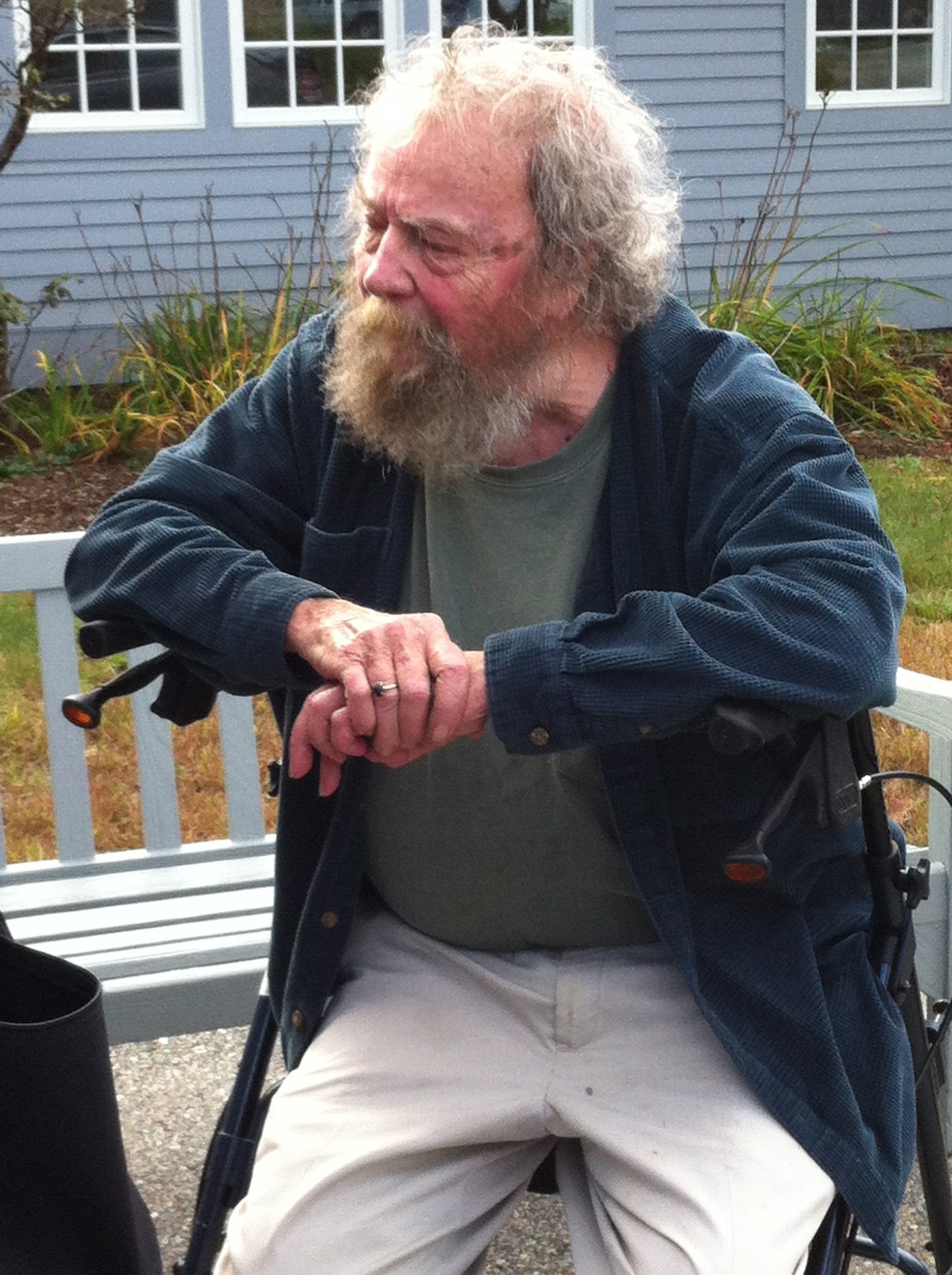
donald hall’s farm

dispatch from 02139, en route to 03287 (in which a flock of fellows and co-vivantes board buses and roll along route 4 into new hampshire, for an audience with a high priest of american poetry)…

back in the faraway house that hums without me now, back in the heat of summer, when the fog was lifting on this year of thinking sumptuously, when i first got a peek at the calendar of what the days and weeks and months would bring, my eye was drawn sharply and swiftly to a little rectangle tucked at the top of the month of october.

it read: field trip to new hampshire farm of poet donald hall.

be still, my hurried heart.

i promise you i am not indulging in the great irish art of embellishment when i tell you i nearly slumped from my chair. i slapped the pine ledge of my writing desk, slapped hard, flat palm against the knotty plank of old french pine. i gasped. i am certain, if memory serves me, i felt a quiver in my arms.

one doesn’t stumble across an invitation to might-as-well-be mecca, the holy place and farmstead of an american poet laureate, just any old friday.

like so many things in my life, i’d come late to donald hall.

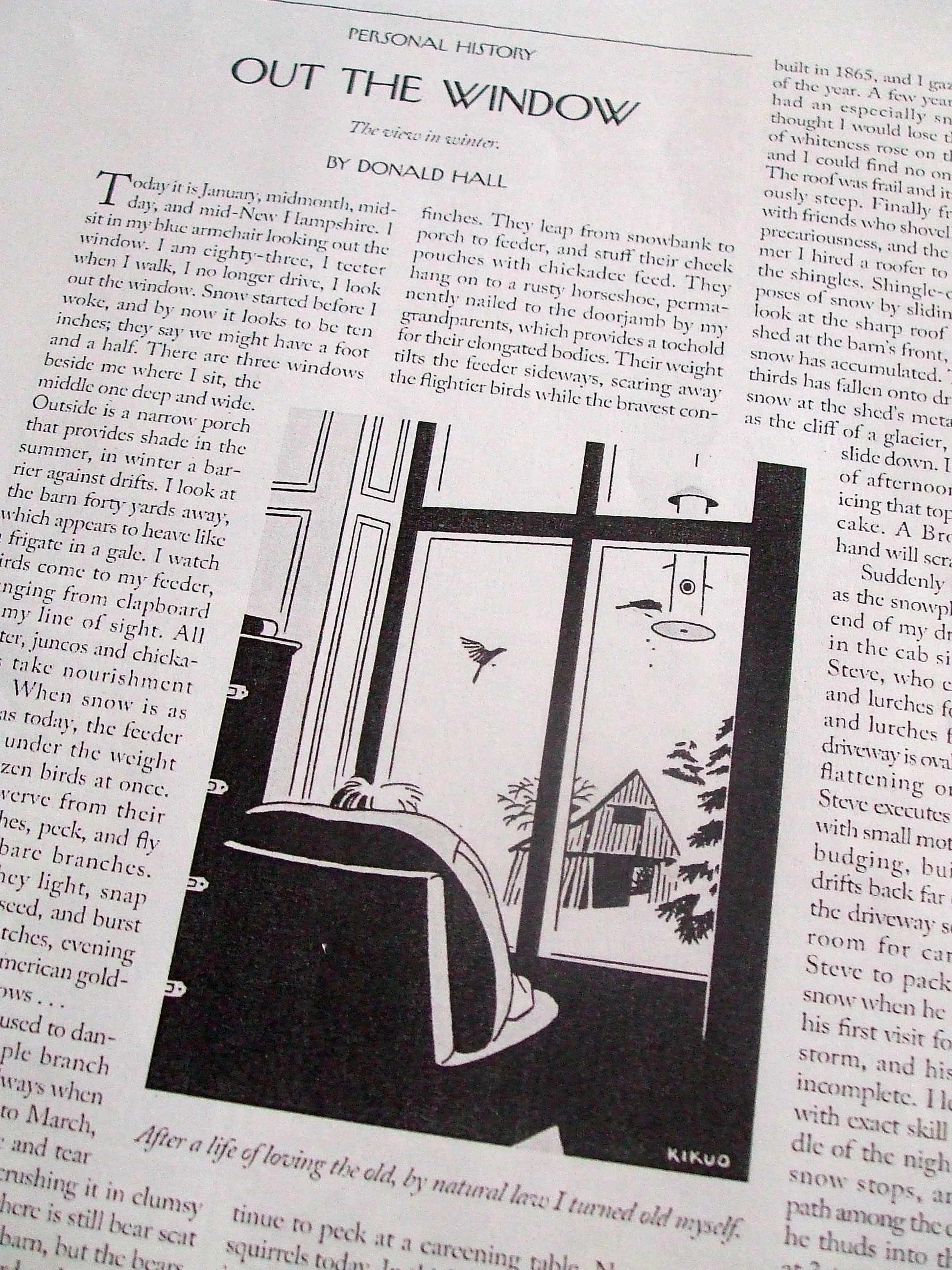
but when i did — stumbling across him in an essay in the new yorker last january, one titled, “out the window,” one you can find here — i sat transfixed by the power of his words.

hall, now 84, was named u.s. poet laureate in 2006, the 14th such poet potentate of the library of congress.

billy collins, himself the poet laureate from 2001 to 2003, once wrote that hall “has long been placed in the frostian tradition of the plainspoken rural poet.”

he has written some 22 books of poetry, at least four biographies, 11 children’s books (most notably, “ox-cart man”), six memoirs, three plays, and more. but it wasn’t till page 40 of the january 23, 2012, new yorker, that i sat up and took hard notice.

he wrote there, straight through to the bottom of page 43, about aging, about growing old in a particular place, his family’s 150-year-old  new hampshire farm, a place he’d long ago committed to memory. knew by heart, by season, by length of light and shadow. knew by fluttering of birds and drifting of snow on the old barn roof.

he wrote words that rocket-launched into my heart, ricocheted around in there, and left me gasping, quite frankly, for air.

take a listen (i’ll offer snippets, a swatch from here and there, all from that one glorious four-page essay)…

“twenty years later,” hall writes on page 41, “my circles narrow. each season, my balance gets worse, and sometimes i fall…my fingers are clumsy and slow with buttons…

“new poems no longer come to me, with their prodigies of metaphor and assonance. i feel the circles grow smaller, and old age is a ceremony of losses, which is on the whole preferable to dying at forty-seven (when his wife, the poet jane kenyon, died) or fifty-two (the age of his father when he died). when i lament and darken over my diminishments, i accomplish nothing. it’s better to sit at the window all day, pleased to watch birds, barns, and flowers. it is a pleasure to write about what i do.

“generation after generation, my family’s old people sat at this window to watch the year. there are beds in this house where babies were born, where the same babies died eighty years later….

“after a life of loving the old, by natural law i turned old myself. decades followed each other….however alert we are, however much we think we know what will happen, antiquity remains an unknown, unanticipated galaxy. it is alien, and old people are a separate form of life…if we forget for a moment that we are old, we are reminded when we try to stand up, or when we encounter someone young, who appears to observe green skin, extra heads, and protuberances.”

i could go on. but, you, please, read for yourself.

check out books from your library. i did. some 17 in all. only just the other day, i checked out two more. and bought one, “life work,” a slender volume i’ll tuck inside my backpack, pull out if i get brave, hand to mr. hall, and ask, shyly, if he’d put pen to a page that is his, but lives on my shelves now.

and since i promised you, long ago, that we would share the glories of this year, i wanted you to have a head start. to spend a swatch of time whirling and swirling inside the poetry of donald hall, while i poke around the clapboard farmhouse, with the narrow porch where the birdfeeder hangs. where, if i’m lucky, i’ll press my nose to the window, deep and wide, where he looks out, keeps watch, as autumn turns to winter, turns to spring, and back to summer.

i’ll drink in the gnarly branches of the maple and the oak, and the “bluing air of afternoon.”  i’ll tiptoe into the cow barn, built in 1865, and scan the hayfields that are the crossbeams and the vaults of a lifetime of pure poetry, born and raised and resurrected in a little town nestled in the mid-hills of new hampshire.

i’ll stand deeply still. inhale and pray. words of thanks, first, for this rare gift. and begging words just after, that whatever’s in the air, the earth, the floorboards, seeps into me, and teaches me to see, out the window, in the ways that mr. hall so clearly sees.

and now, as promised, a few assigned readings:

let’s start with ox cart man, a book that might be tucked on every child’s library shelf.

or this, short one, “the things”

The Things

by Donald Hall

When I walk in my house I see pictures,
bought long ago, framed and hanging
—de Kooning, Arp, Laurencin, Henry Moore—
that I’ve cherished and stared at for years,
yet my eyes keep returning to the masters
of the trivial—a white stone perfectly round,
tiny lead models of baseball players, a cowbell,
a broken great-grandmother’s rocker,
a dead dog’s toy—valueless, unforgettable
detritus that my children will throw away
as I did my mother’s souvenirs of trips
with my dead father, Kodaks of kittens,
and bundles of cards from her mother Kate.

and lastly, though, please don’t stop here…

a poetry corner, where you can curl up, on this fine october day, and drink in the sounds of donald hall in his many forms. please do click on “letter with no address,” written to jane kenyon, his wife who died of leukemia in 1995. you will hear your heart crack.

i promise to post dispatch, post field trip, once we’re back from eagle pond farm, up new hampshire way. if you could visit any poet in the world, who might it be, and why? and feel free to leave a line of poetry here as proof. 

p.s. i realize that if you don’t have a subscription to the new yorker the link above won’t get you directly into the essay, but rather to a bit about the essay. i wish i could get around that, but i can’t. your library will have a back issue of the new yorker, i do believe. if you’re stuck, i will xerox and snail mail. you can send me your address via email.