pull up a chair

where wisdom gathers, poetry unfolds and divine light is sparked…

Category: joy of writing

of pickled onions and a particular fondness for kentucky’s homegrown farmer bard

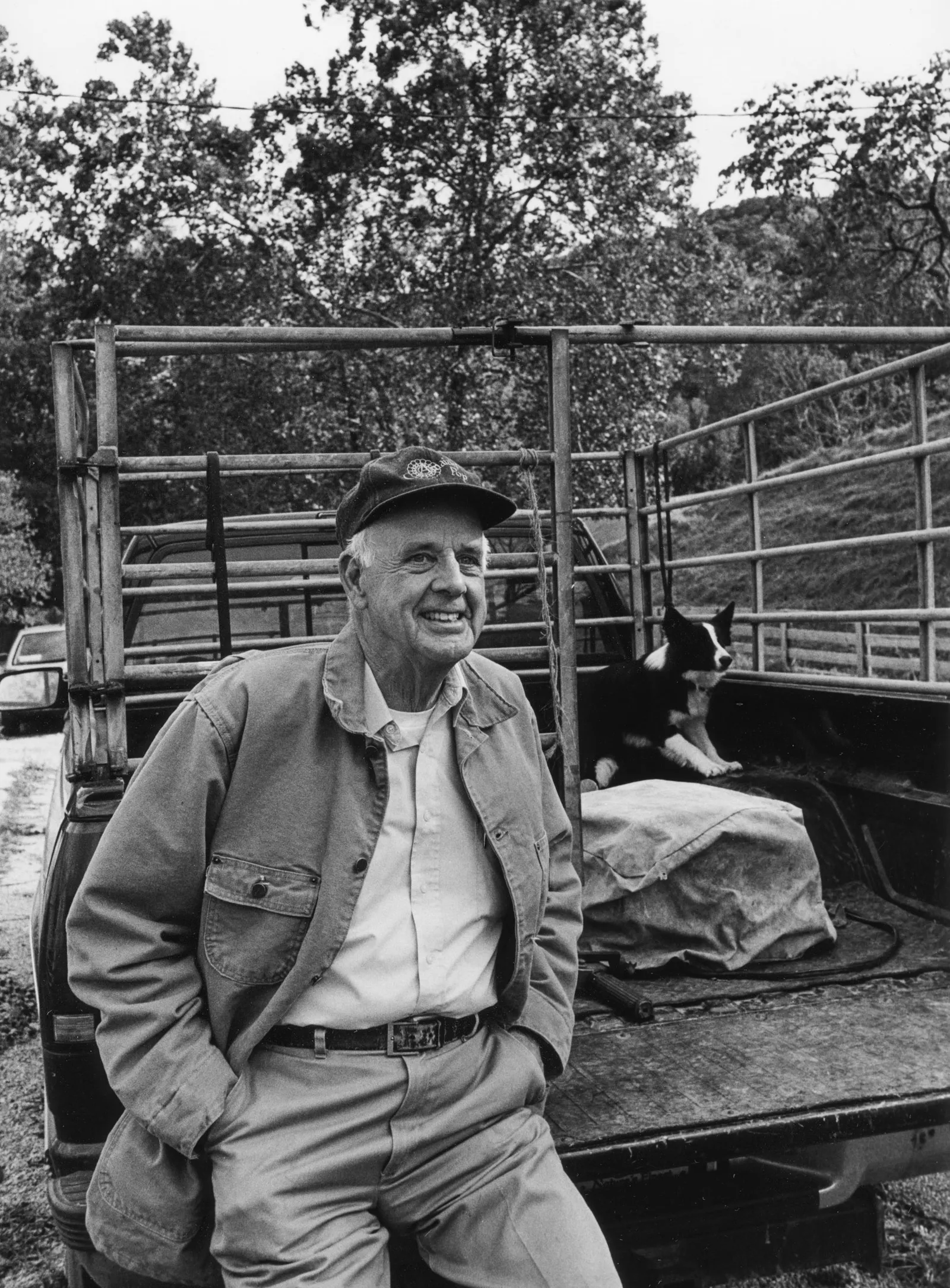
wendell berry

in which the somnolence of summer has settled into its seasonal adagio so much so that pickling a red onion or two, and slow-reading the poetries and musings of one wendell berry is as fever-pitched as it gets around here. welcome to my slo-mo world of the week.

it started when i stumbled on the poem below, a poem that captures the quietude of a couplet of humans who’ve breathed in unison for so long they can fill the silence richly. so it is here in this old house of late, where only two of us now reside. where we know the choreography of most days by heart. and come and go as in a wordless waltz. there’s an ease now, one i never imagined, as i balked mightily long ago about the idea of two lives squeezed under one roof and in a labyrinth of too-tight rooms. but over time, across all these years (near 33), the respirations of our souls have aligned, at least enough to feel our echo in the lines below. those lines, by wendell berry, the poet, novelist, and conservation farmer whom i count as one of my heroes, were just enough to take me down the rabbit hole that is the life and work of kentucky’s homegrown literary treasure. and, besides, mr. berry’s birthday was this week, the fifth of august, wedged, it so happens, between the birthdays of two of the three humans whom i count as pillars holding up my world and whose arrivals to the planet are marked across the week in that steady beat of 4-6-8.

here’s the poem that got me started:

They Sit Together on the Porch
By Wendell Berry

They sit together on the porch, the dark
Almost fallen, the house behind them dark.
Their supper done with, they have washed and dried
The dishes–only two plates now, two glasses,
Two knives, two forks, two spoons–small work for two.
She sits with her hands folded in her lap,
At rest. He smokes his pipe. They do not speak,
And when they speak at last it is to say
What each one knows the other knows. They have
One mind between them, now, that finally
For all its knowing will not exactly know
Which one goes first through the dark doorway, bidding
Goodnight, and which sits on a while alone.

i shared the verse with the one with whom i share these walls, and he wrote back that he found it “haunting,” which made me see the lines anew. and was just enough to prompt a bit more poking around, again reminded how much i love the poetries that come with accumulated lifelong wisdoms. and that’s where i then re-bumped into this 2019 dispatch from the new yorker, a days-long interview between bard and scribe, one distilled and put to paper. it’s worth a read in whole (link below will take you straight to it), but i’ll pluck a few parts should your summer’s day demand a snappier pace than mine (or should a paywall keep you out):

the dispatch, titled Going Home with Wendell Berry, is by amanda petrusich, a new yorker staff writer and writer-in-residence at the gallatin school of individualized study at NYU. a 2016 guggenheim fellow, she writes often about music, and blessedly for us she takes the occasional road trip down kentucky way. in this case, she wound her way to where berry’s farmed for more than four decades, a little town that goes by the name port royal. sixty-three miles from the dot in the blue-grass map my papa called home (paris, KY), and one mile from the meandering kentucky river, it’s a town you might think ol’ garrison keillor pulled from his imagination. (in 2010, its population, according to the U.S. Census, was all of 64 humans.) it’s a town one writer (sandra mcCracken, a singer-songwriter) described thusly (and not too surprisingly given the threadworn quilt that is rural america these days): “Port Royal is a patchwork strip of storefronts, a blink-and-you’ll-miss-it sort of spot made up of a local bank, a post office, a general store with a built-in diner (with little printed signs about their town’s famous author, Wendell Berry), and an old Baptist church. I am sad to report that, like most small towns in our country, Port Royal looks as though it is dying.” 

here’s how the new yorker‘s chronicling of that luscious conversation between journalist (petrusich) and poet (berry) begins:

Two and a half years ago, feeling existentially adrift about the future of the planet, I sent a letter to Wendell Berry, hoping he might have answers. Berry has published more than eighty books of poetry, fiction, essays, and criticism, but he’s perhaps best known for “The Unsettling of America,” a book-length polemic, from 1977, which argues that responsible, small-scale agriculture is essential to the preservation of the land and the culture. The book felt radical in its day; to a contemporary reader, it is almost absurdly prescient. Berry, who is now eighty-four, does not own a computer or a cell phone, and his landline is not connected to an answering machine. We corresponded by mail for a year, and in November, 2018, he invited me to visit him at his farmhouse, in Port Royal, a small community in Henry County, Kentucky, with a population of less than a hundred.

Berry and his wife, Tanya, received me with exceptional kindness, and fed me well. Berry takes conversation seriously, and our talks in his book-lined parlor were extensive and occasionally vulnerable. One afternoon, he offered to drive me around Port Royal in his pickup truck to show me a few sights: the encroachment of cash crops like soybeans and corn on nearby farms, the small cemetery where his parents are buried, his writing studio, on the Kentucky River. Berry’s connection to his home is profound—several of his novels and short stories are set in “Port William,” a semi-fictionalized version of Port Royal—and his children now run the Berry Center, a nonprofit dedicated to educating local communities about sustainable agriculture. Our correspondence would continue, but, before I left, Berry gave me a broadside letterpress of his poem “A Vision.” I think often of some of its final lines, which clarify, for me, what it means to truly know a place:

Memory,
native to this valley, will spread over it
like a grove, and memory will grow
into legend, legend into song, song
into sacrament.

here’s but one of the questions captured from their conversation (with a few lines in bold for emphasis):

Q: Have you always farmed here?

A: Right away, we had a large garden, and we kept two milk cows. We fattened two hogs to slaughter, for our own meat. We had a flock of chickens. And we had some fruit that we produced ourselves, and some that was wild. We were sitting down during that time to a lot of meals that came entirely from under our own feet by our own effort. And our children came up in that way of living. The integration of the various animals and crops into a relatively small acreage becomes a formal problem that is just as interesting and just as demanding as the arrangement of the parts of a novel. You’ve got to decide what comes first, and then you work your way to the revelation of what comes last. But the parts also have to be ordered. And if they’re ordered properly on a farm, something even more miraculous than most art happens: you have sustainability. Each thing supports the whole thing.

and here’s another exchange:

Q: It’s funny, clarity is often undervalued in art. One of the things I admire about your writing, especially the essays, which feel like polemics, is that you’re very clear in your arguments. They’re beautifully supported. In the new book, you talk about how you often read seeking instruction. I’m curious how you balance that idea with reading for beauty, savoring the visceral pleasure of words.

A: You’re being fed in an essential way by the beauty of things you read and hear and look at. A well-made sentence, I think, is a thing of beauty. But then, a well-farmed farm also can feed a need for beauty. In my short story “The Art of Loading Brush,” when Andy Catlett and his brother go to a neighbor’s farm, there’s a wagonload of junk, and it’s beautifully loaded. Andy’s brother says, “He couldn’t make an ugly job of work to save his life.” In the epigraph I use from Aldo Leopold he questions if there’s any real distinction between esthetics and economics.


and here, in case you’re even a little bit hooked, is a poem worth reading in whole. it’s from a 1965 volume of Poetry magazine, and it’s excerpts from an early Berry wonder, titled, “The Handing Down,” a poem about a grandfather and grandson sitting on a porch and the quiet conversation that unspools between them. read those excerpts here.


oh, and about those onions. . . my kid, the one who turned 23 yesterday, finds himself a line cook these days at a chicago eatery of some notoriety; girl and the goat, it’s called, and stephanie izard, who dreamed up the joint seems to have a particular fondness for things pickled. she pickles everything from kumquats to mushrooms to beets. i decided pickled red onions might be a summery thing to do, and besides i like a little crunch amid the strata of my sandwich. and, as with many a task in my kitchen, i pickle the easy way. no cauldrons steaming for me. no sterilizing jars and lids. i dumped a little of this, stirred in some of that, and by next morning, i had a jar of garnet rings shimmering in my fridge. i’m not fond of sugar these days (i never was, and then a dear friend told me cancer is fond of sugar, making it something of a foe of mine, thus i’ve perma-sealed my lips to sugar’s sweetness), so i searched for pickling roadmap that steered clear of the sugar bin. here’s what i found: (and ps i have no real clue what whole30 compliant means, so feel free to disregard.)

what captured your fancy this week, quick-clipped or slow?

all these years later

forty-four cakes. three-thousand-two-hundred-seventy-eight candles. that’s how many cakes and candles we’ve missed since my papa died in the winter of 1981. i counted it up because today would have been his 96th birthday. he didn’t make it past 52. 

all these years later the second of august is still a day i remember.

i remember the sunny sunday mornings when honeydew melon and handmade cards were strewn at his place at the dining room table, birthday brunch a step-up from the requisite eggs, bacon, and toast after ten-o’clock mass. i remember, in the preambles to birthday dinner, the glistening of his pewter mug, summer’s sultry humidity meeting the cold of his ice cubes and tonic and gin. the quarter of lime floating canoe-like near the rim. eight-minute burgers on the grill, corn on the cob littering all of our chins. 

i remember his laugh. 

much, though, fades.

i can’t remember the sound of his voice. or the way he called me barbie. i remember a few lines, but not the ones my brothers often remember. i remember the time he told me he’d prayed and prayed and could not understand why he was driving me to the hospital. i remember the time, driving home from my college graduation, when he told me he’d felt his mother right beside him when they called out the names of those who, like him long before, were graduating with highest latin honors, and he watched me rise from my seat in the crowded arena. 

i remember how one late summer’s afternoon he called me from the office and asked me to meet him for burgers on the outdoor cafe of a place called jerome’s in lincoln park, a place he deemed “kicky.” my papa liked things that were “kicky” or “cool.” my papa, born of a locomotive engineer and a country school teacher in little bitty paris, kentucky, never shed the marvel of being a big-city ad man in the heady era of Mad Men and martini lunches and sixty-second commercials whose jingles and cutlines stoked the soundtrack of america’s bell-bottomed woodstock-and-watergate age. my papa liked to travel the globe. to give speeches in sydney and meetings in munich. he liked his corporate apartment in mid-town manhattan. he loved new york city. a place he never wanted to move us; he’d moved his moptop crew too many times, he and my mama agreed. one more uprooting might do us in. so he more or less made a weekly commute to the big juicy apple.

and home base for all those years was the two-story colonial with all the big trees at the bend in the dead-end lane. he brought the “neat, keen, cool, fab, it’s a blast” to our dutch backdoor, and on in to the big oval table where, at 6:30 sharp each night of the week except for on sunday when we pushed it to 5:30, we sat down for dinner, all seven of us. if there was something new out there in the world, my papa wanted us to know. didn’t matter if it was a word or a box soon to be labeled “hamburger helper.” he was our conduit, our passport, to all that was grander and jazzier than our sleepy little burg one in from the lake. 

those are the things, all these decades later, i still remember––like yesterday. i remember, too, the year after he died when i thought i might never stop crying. how there were nights when i wailed a wild-animal sort of a wail, and bit into my pillow to muffle the sound. i never thought i would know joy again. 

i never thought the ache would stop aching.

but here we are: two kids, a long marriage, and a whole career later. my papa had no idea i––a nurse when he died––would take his and my shared love of words and make a life of it. but the first day i sat down in the chicago tribune newsroom and they told me i needed a password, i knew just what i’d type each time i needed to rev up my desktop computer: my papa’s initials and mine; he was a part of every start to every story. and i never dropped his last name, cuz i wanted my papa to stay in the news. and in print. day after day. byline by byline. 

here’s where i fell short: no matter how many stories i’ve told my boys and the man i love the most, i have not come close to bringing my papa to life. and, believe me, i’ve tried. no story, no matter how animated, no matter the gleam in my eye, can ever, ever come close. the man was a human high-wattage bulb. he was known for his wit. but i remember the tenderest parts. i’ve tried to bring all of it forth over the years. 

but all these years later, it fades. and the truth is, my papa fades too. there’s too much i cannot remember. 

grief and time make for an odd, sometimes cruel calculus. yes, the aching abates most of the time. though the piercing can come and come strong. in a grocery aisle. when a certain song comes on. when you’re trying to tell––or to catch every word of––a particular story. (writing these words here this morning, the tears have come too. if i’ve wallowed in moments, in memories, here, it’s only to make it all last. to live in those moments again.) 

as much as the gasping for air is no longer a part of the grief, so too the frames of a life reel on, and the erasing begins. after so, so many years, you sometimes forget the one who’s no longer there. not always, and not in those crucible moments, when time itself feels condensed and magnified all at once. i too have felt my papa beside me when my firstborn walked a graduation stage; when my firstborn became a professor of law (a profession my papa once yearned for). i’ve watched how tender my so-called “little one” is, especially to my papa’s widow (“grammy” to both of my boys), and i know my papa would melt. but, truth is, ordinary time mostly hurls by, and i don’t remember. and then i might catch myself with a twinge. or i might not catch myself at all. there’s an anesthesia in grief that i never saw coming. maybe it saves us. maybe it’s cruel.

maybe that’s why there are birthdays, even when the someone is gone. especially when someone is gone. they become remembering days. they are days without cakes and no candles. but, in the silent chambers of the heart and the mind and the soul where time knows no rules, those someones return. 

my papa rumbles in me this morning. in the only way i know how, i just brought him back. and i didn’t need to close my eyes, or make a wish, or blow out candles to make it happen.

he’s here. right beside me. in each of these stories. i know it.

happy birthday, dear papa. i love you forever.

at our house, we have an august birthday parade, a 2-4-6-8 of celebrations. so most blessed of birthdays i wish for my brother david (4), my blair(6), my teddy(8). i love you each and all to the moon and mars and beyond.…

tell a story of any someone you miss. any story. any someone. we’ll make this a party.

my papa and me

looking into the darkness

maybe it’s the darkness we’re meant to look into. deep into. maybe halves of the world go darkest once a year, so we become practiced. so not only our eyes but our souls learn to widen the aperture, to let in whatever droplets of light there might be. or maybe it’s the inky darkness itself we’re meant to wrap ourselves in. to not be afraid.

maybe we’re left to our own devices when the darkness comes — and it will come — so we learn to find our way. steady our wobbling, put meat to the muscle that holds us upright. in a lifetime’s ebb and flow of darkness and light, it’s the shadowed chapters that have made me the deeper parts of who i am. maybe we should all look to the roots wriggling down below the frozen crust of earth to see how it’s done, how the growing comes unnoticed, in the tabernacle of earthly darkness.

maybe we’d be wise to consider the hidden work of wintertide, the profound intelligence unfolding where eyes cannot see, where sense cannot reach.

in this year’s darkest hour, i can’t say i was up keeping night vigil, awaiting the nadir of night. i was not out in my yard, kindling sticks and dried-up old leaves, setting a bonfire to keep the darkness at bay. fact is, i was felled by a bug that did have me up moseying about the house in the wee hours, but not to contemplate the darkness.

what i did do, as is my wont (and i did it by daylight), was gather up words, snippets of poetry, that made me think about light and darkness, and the shimmering shards we need to find to keep from tumbling headlong into the abyss.

the world this christmas is dark indeed. more than ever, we need to light our way. and pray that our penumbra illumines the path of those who travel nearby.

a solstice offering…

Let the ordinary be in your hand;
hold it open and imagine a bird landing,
offering all it possesses in trust
to come to you.

Learn to look for the little things
that weigh nothing at all,
but fill the heart with such light
they can never be measured.

-Kenneth Steven*, Seeing the Light 


To go in the dark with a light is to know the light.
To know the dark, go dark. Go without sight,
and find that the dark, too, blooms and sings,
and is traveled by dark feet and dark wings.
 
-Wendell Berry


Holding the Light
 by Stuart Kestenbaum

Gather up whatever is 
glittering in the gutter,
whatever has tumbled 
in the waves or fallen 
in flames out of the sky,

for it’s not only our
hearts that are broken, 
but the heart
of the world as well.
Stitch it back together. 

Make a place where
the day speaks to the night
and the earth speaks to the sky.
Whether we created God
or God created us

it all comes down to this:
In our imperfect world
we are meant to repair
and stitch together 
what beauty there is, stitch it 

with compassion and wire. 
See how everything 
we have made gathers 
the light inside itself
and overflows? A blessing.


i keep watch on a few monastics who dwell in the heart of france. brother laurence, a modern-day mystic, sent along this the other day, a wonder of imagery from the winter’s solstice at Newgrange, a stone-age relic and world heritage site that rises from the earth not too, too far from the irish sea along ireland’s eastern shore. he sent a short video along with this short meditation:

“New Grange is a monumental 5,000 year-old burial mound in Count Meath, Ireland. At sunrise on December 21st, the first ray of direct sunlight from the new-born sun precisely, silently, enters the narrow aperture over the entrance, penetrates into the mound of solid rock and fills the inner chamber with golden light for seventeen minutes. Light overcomes darkness. It is irresistible and yet gentle. As it grows stronger with occasional surges, its intensity increases and the power of its beauty. It communicates purely by itself – the meaning of truth.

“I hope you can take time to watch this short silent video of the phenomenon. It captures a sacred moment, the revelation of God in nature. And it may give you a sense of how the light of Christ, the light of truth, actually enters and changes our world.” (Laurence Freeman, OSB)


and finally, for those among us who find the poetic to be a vessel of the ineffable sacred, this from a Paris Review interview with the late great Louise Gluck. i particularly swooned over the line that a poem “is like a message in a shell held to an ear”…:

From the beginning, Glück cited the influence of Blake, Keats, Yeats, and Eliot—poets whose work “craves a listener.” For her, a poem is like a message in a shell held to an ear, confidentially communicating some universal experience: adolescent struggles, marital love, widowhood, separation, the stasis of middle age, aging, and death. There is a porous barrier between the states of life and death and between body and soul. Her signature style, which includes demotic language and a hypnotic pace of utterance, has captured the attention of generations of poets, as it did mine as a nascent poet of twenty-two. In her oeuvre, the poem of language never eclipses the poem of emotion. Like the great poets she admired, she is absorbed by “time which breeds loss, desire, the world’s beauty.” –Henri Cole


*as this is the second Kenneth Steven poem in as many weeks, you can bet i am following his thread and will be finding out more about this scottish poet and children’s book writer. and gathering up his new book of poems, Seeing the Light, from my favorite friendly librarians….

where are you gathering up shards of light these days?

love letter to the chairs on the occasion of seventeen years

dear chairs, 

a calendar turned the other day, a yearly one. and it turned for the seventeenth time. thus begins the eighteenth year of this little old chair. 

that first day of that first year –– december 12, 2006 –– i faced a blank white screen and a motherlode of trepidation. that screen plus the trembling inside equaled a scarier form of publishing than i’d ever really done before –– and that was 25 years into my stint at the late great Chicago Tribune

to write what at the time was a newfangled thing — a blog, an ugly gutteral word if ever there was — was, to my mind, to take away the filter that might have allowed me to occasionally put my heart to my sleeve in the stories i told and how i told them, but it shielded me from going deeper than that, from willingly baring my soul, where my truest self stirs. 

i was compelled to write the chair because i was convinced that the deepest truths of our lives are played out in the quotidian. on the humdrum stage of our day-after-day domesticities, and the confines of hardly exotic daily rounds. i’d come to believe that the common, plain-wrapped stories of our lives are in fact imbued with the sacred, the lasting, the shared. and more than worth holding up to the light.

i still think so. 

chances are, you and i are not going to find our names chiseled in the roll call of global heroes. we are going to live on in the scant traces we leave behind, the simple kindnesses, the one or two times we mustered just the right words, the softening we brought to someone’s unbearable hour.

and so, i thought then and think now, if this one bracket of time is ours, then perhaps we’d do well to plumb the depths of it. or at least plumb a little more pointedly. root around a bit. not shy from asking the tough question, the true question. search for the sacramental. name the holiness where we find it. shine the light on it. make known the magnificence that runs through the river of each of our lives.

because i firmly believe that, in the end, we are all animated by a few certain yearnings: to love and be loved; to be seen or be heard; to reach out in the darkness and be met with a soft and warm hand to hold onto. some of us live to be stirred, to feel our hearts beating hard against the wall of our chest. to delight in the whimsies of each and any hour. and to know more when we fall asleep than we knew upon waking that day.

so i offered up the stories of my own life’s spool. i scanned the day to day, and plucked the shards that shimmered the most, the ones that seemed to hold the most questions. maybe even a quiet holiness. the ones i’ve described as exuding the most wattage. the ones i thought might resonate a bit more than all the rest. ones worth examining.

and so for 17 years i’ve turned here, plopped my bum on this rickety chair that’s missing a spindle, tapped at the alphabet letters as if i was at once alone and in the company of the dearest of soulmates. i’ve pushed toward the truth, even when i worried you might wriggle a bit. even if i pictured you rolling your eyes. to write the truth is to blot out the worries of just how your words might land. especially if your mother-in-law or your mother is one of the ones reading your words. (i learned not to hyperventilate on the days when only a weighted silence followed a post, when my usually exuberant mother-in-law chose silence as the way of letting me know she was, um, not such a fan of whatever i’d mused that morning.) 

over the years, dear chairs, you’ve chimed in, and made me laugh aloud, and more times than you might imagine you’ve moved me to tears with the words and the wisdoms you’ve brought here. 

and this year, this darn nasty year, you all but kept me from keeling right over. 

the fourth wall, the one they talk about in the theater, the invisible screen that separates actors and audience, it’s non-existent in the realm of writing, or at least in the writing i write here. 

ever since that long ago first morning, i’ve meant for this to be a back and forth, a call and response. yet i never imagined the friendships that would leap off the page, break through the cybersphere and become so very real, some of the dearest in my life. 

whether we’ve sat in the same room never or once, or dozens of times, your very big hearts, your high-soaring souls, your whimsies, your tender ways, have worked their numinous magic in a world that’s sometimes so, so dark: you’ve become true, true friends. the sort you tell truths to, the sort whose hands you reach for when your own are trembling like leaves in an autumn wind. 

so all of this is a long-winded way of simply saying thank you. from the bottom of my very big heart, the one i’ve long worn on my sleeve. where it now shares a space with my soul. 

and thank you to willie, who long long ago, got me started. and to teddy, who long let me tell his collection of growing-up stories. and, of course, to each and every one of you, whether you ever leave a trace, or tiptoe in and out quiet as a mullipuff bobbing on the breeze….

where do you sense the holy in your lives?

photos by Will Kamin, long long ago. xoxo

in which we pause to remember one who would bristle at being called the patron saint of anything. . .

She stretches from Sharon Olds’ Stag’s Leap to Christine Valters Paintner’s Dreaming of Stones on my bookshelf. Sixteen volumes in all. And that’s just the poetry. Doesn’t count her essays, housed on a whole other shelf. I am talking, of course, of the poet I call my “patron saint of paying attention.” Mary Oliver. 

You might also say she’s the poet master of astonishment. She breaks me out in goosebumps and wonder. Line after line after line.

Oh, I’ve heard her poetries dismissed for their “surface simplicity and populist reach.” But when it comes to stirring my soul, I’ve no need for the critics. I side with those who, as was written in her New York Times obituary, find that “her poems, which are built of unadorned language and accessible imagery, have a pedagogical, almost homiletic quality.”

I call them holy. 

Give me a writer who can write of the “uncombed morning,” or confess that “sometimes I am that quiet person down on my knees.” Or cobble together words into a stanza that reads: “All things are inventions of holiness / Some more rascally than others.” Give me that writer and I’ll hitch my starship any last day.

These days, this long hard season, I seek saving grace wherever it falls. I find it in an evening’s sky punctuated by dragonflies drifting and darting in parabola. I find it in any sentence that ends “unlikely distant metastasis.” And I most certainly find it in the poet who reminds me: “So quickly, without a moment’s warning, does the miraculous swerve and point to us, demanding that we be its willing servant.” 

Count me willing.

Emily D. taught me to look for and love the slant, the wisdom that slides in on a steep-edged, improbable angle. Mary O does that every time. I am reading of a bluefish being washed at the water’s edge, and suddenly I am remembering to be on the lookout. To find God, the Holy, in all of creation. Or, as Emerson put it: “To attend all the oratorios, the operas, in nature,” in life, in the day upon day. 

Mary O is the one who puts her ink to the sacred as it spills across creation’s page. How else to describe the one who, when writing of a lone seal pup found on a desolate beach, muses: “. . . maybe / our breathing together was some kind of heavenly conversation / in God’s delicate and magnifying language, the one / we don’t dare speak out loud, / not yet.”

Pay attention to how she places that very last line. The barbed last hook. The one that sticks in your craw just a little bit longer. Whispers a gossamer faith. Mary O was a theologian of the barest brushstroke. You’d barely know you were shaken, but then you quake through to your deepest marrow. 

Mary Oliver’s birthday is September 10. She would have been 88.

And here, in her poem “Messenger,” she describes her life’s work:

My work is loving the world.
Here the sunflowers, there the hummingbird—
equal seekers of sweetness.
Here the quickening yeast; there the blue plums.
Here the clam deep in the speckled sand.

Are my boots old? Is my coat torn?
Am I no longer young, and still half-perfect? Let me
keep my mind on what matters,
which is my work,

which is mostly standing still and learning to be
astonished.
The phoebe, the delphinium.
The sheep in the pasture, and the pasture.
Which is mostly rejoicing, since all the ingredients are here,

which is gratitude, to be given a mind and a heart
and these body-clothes,
a mouth with which to give shouts of joy
to the moth and the wren, to the sleepy dug-up clam,
telling them all, over and over, how it is
that we live forever.

—by Mary Oliver


Seeing Not Looking

Celtic scholar Esther de Waal considers Thomas Merton’s practice of contemplative photography:   

Thomas Merton was of course a writer and a teacher, and a poet, but he was also a photographer, and it is from his photographs that we learn much about how he saw the world, and how he prayed—and the two are of course intimately connected…. He handled a camera as an artist would, and used it as an instrument of delight and perception. It was in the later 1950s that the journalist John Howard Griffin [1920–1980] visited Merton in his hermitage. He had his camera with him and … let [Merton] keep it on extended loan. At first when Merton sent him the negatives, John Howard Griffin was puzzled, for [Merton’s] view was so different from that of most people. Merton photographed whatever crossed his path—a battered fence, a rundown wooden shack, weeds growing between cracks, working gloves thrown down on a stool, a dead root, a broken stone wall. He approached each thing with attention, he never imposed, he allowed each thing to communicate itself to him in its own terms, and he gave it its own voice.  

Later on when he was out in the woods with a young friend, Ron Seitz, both with their cameras, Merton reprimanded him severely for the speed with which he approached things. He told him to stop looking and to begin seeing:  

Because looking means that you already have something in mind for your eye to find; you’ve set out in search of your desired object and have closed off everything else presenting itself along the way. But seeing is being open and receptive to what comes to the eye…. [1] 

He used his camera primarily as a contemplative instrument. He captured the play of light and dark, the ambience, the inner life. But above all he struggled towards an expression of silence through the visual image, so that his photographs show us that ultimately his concern was to communicate the essence of silence. 


it’s the month of Elul in the Jewish calendar, a month for accounting of the soul before the high holidays, Rosh Hashanah, the new year, and Yom Kippur, the day of atonement. i’ve been deep in soulful accounting, and bring along this prayer from the blessed Rabbi Nachman, who taught that life should be lived with joy. and centered in prayer.

A Prayer of Rabbi Nachman of Bratslav (1772-1810)

Grant me the ability to be alone;
may it be my custom to go outdoors each day
among the trees and grass – among all growing things
and there may I be alone, and enter into prayer,
to talk with the One to whom I belong.
May I express there everything in my heart,
and may all the foliage of the field –
all grasses, trees, and plants –
awake at my coming,
to send the powers of their life into the words of my prayer
so that my prayer and speech are made whole
through the life and spirit of all growing things,
which are made as one by their transcendent Source.
May I then pour out the words of my heart
before your Presence like water, O God,
and lift up my hands to You in worship,
on my behalf, and that of my children!


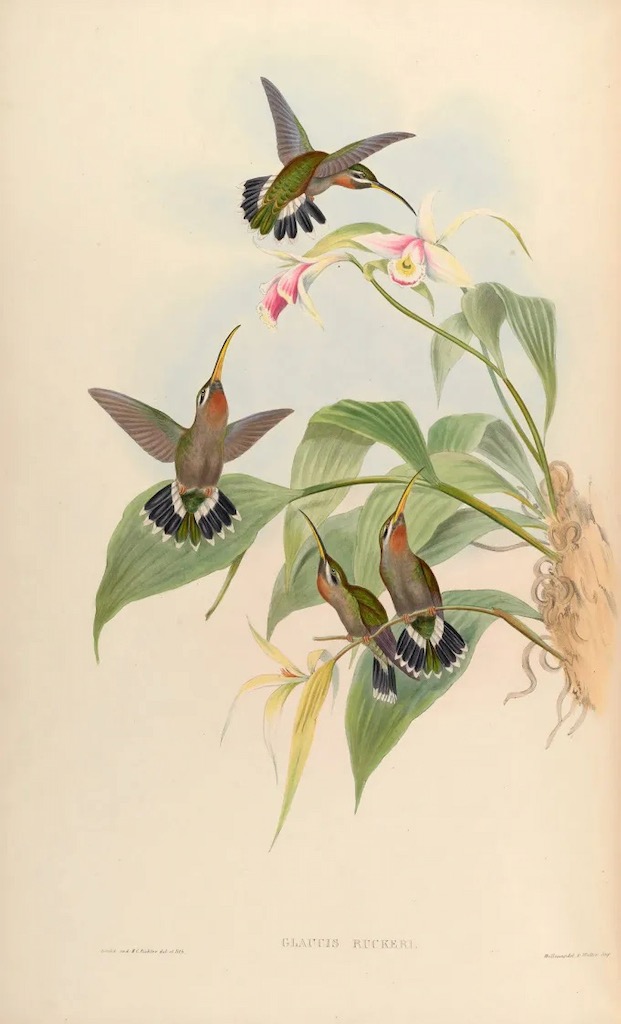
hummingbird photo (above) by shelia zimmerman, sister of my beloved late friend mary ellen sullivan, may her memory be a blessing, (and it is. every day.)

happy blessed sunday birthday to a personal patron saint of mine, mark burrows.

looks like i was in the mood for capitals this morning, maybe just to prove i know how to find the shift key. hope you don’t mind the tall letters every once in a while. i do understand how it makes a sentence filled with proper nouns a bit easier to read…..

let’s play a bit of book group: what are some of your favorite Mary O lines, or words, or phrases?

p.s.s. i almost forgot: i’m taking The Book of Nature on the road this weekend. sunday afternoon, in fact, when i’ll be at Winnetka’s Book Stall at 2 p.m. for a book talk canceled last spring and now back on the calendar. problem is my little voice has gone missing again, and my vocal cord injections are on the books for tuesday, so it’ll be a bit squawky but the show must go on. it’s also Printers Row LitFest this weekend, so lots of getting pulled in several directions. wherever you are, have a lovely blessed almost-autumn weekend.

writing school

we call it “the kitchen table writing school,” and every once in a while someone i love, someone who’s eager to put words to a page with more oomph or less ouch, wanders over and we plunk our bums down on the chairs, pull out pads of paper and pens, and have at it. might be muscular verbs, the lesson of the day. might be fluid lines of poetry. might be all about one-of-a-kind telling details, not a profligate slop of as many descriptives as can fit in a breath, but that one singular––and immediate––detail that telescopes layers of meaning and knowing into a single keen––and immediate––observation. (while i was poking around for a good example, i came across this, and can’t say it one iota better, so here’s this from the gotham writers’ workshop):

A telling detail does what it says: it tells the essence of what it’s describing. Telling details are the scotch tape holding up Susie’s hemline in the back, the tiny piece of ice that never seemed to melt in the bottom of Mom’s martini, the street sign on the corner that still says, to this day, SCHOOL CROSSING, though the school is long gone. A telling detail can speak volumes in a very short amount of time. They help you achieve a golden mean–enough description to paint the picture, but not so much as to weigh it down.

Chris Lombardi

so whilst i’m puttering about in my so-called quiet summery time, i gathered up a few fine thoughts on the subject of writing, a thread that draws together many of us here at the old maple table. so pull out your pens––or your pencils––and follow along…

first up, this delicious bit from rainer maria rilke, from his Notebooks of Malte Laurids Brigge:

“For the sake of a few lines one must see many cities, men and things. One must know the animals, one must feel how the birds fly and know the gesture with which the small flowers open in the morning. One must be able to think back to roads in unknown regions, to unexpected meetings and to partings which one has long seen coming; to days of childhood that are still unexplained, to parents that one had to hurt when they brought one some joy and one did not grasp it (it was a joy for someone else); to childhood illness that so strangely began with a number of profound and grave transformations, to days in rooms withdrawn and quiet and to mornings by the sea, to the sea itself, to seas, to nights of travel that rushed along on high and flew with all the stars — and it is not yet enough if one may think of all of this. One must have memories of many nights of love, none of which was like the others, of the screams of women in labor, and of light, white, sleeping women in childbed, closing again. But one must also have been beside the dying, one must have sat beside the dead in the room with the open window and the fitful noises.”

so luscious is this instruction, i might scribble it onto a square of paper, fold it, and tuck it into my pocket, to pull out and read at regular intervals.


and, in keeping with pens and pencils, naomi shihab nye, one of my favorite poets, plays right along…

ALWAYS BRING A PENCIL
by Naomi Shihab Nye

There will not be a test.
It does not have to be
a Number 2 pencil.

But there will be certain things —
the quiet flush of waves,
ripe scent of fish,
smooth ripple of the wind’s second name —
that prefer to be written about
in pencil.

It gives them more room
to move around.


no less than the great david bowie has this to say about writing:

“Never play to the gallery… Always remember that the reason that you initially started working is that there was something inside yourself that you felt that if you could manifest in some way, you would understand more about yourself and how you coexist with the rest of society. I think it’s terribly dangerous for an artist to fulfill other people’s expectations — they generally produce their worst work when they do that.

“…If you feel safe in the area that you’re working in, you’re not working in the right area. Always go a little further into the water than you feel you’re capable of being in. Go a little bit out of your depth, and when you don’t feel that your feet are quite touching the bottom, you’re just about in the right place to do something exciting.”

go a little bit out of your depth…maybe in writing, and in this thing called living…


and finally there’s nick cave who is something of a mystic, a mystic who happens to be in the business of making music, and lifting words from the soul and onto the page…

“There is more going on than we can see or understand, and we need to find a way to lean into the mystery of things…. and recognise the evident value in doing that, and summon the courage it requires to not always shrink back into the known mind.

“…The luminous and shocking beauty of the everyday is something I try to remain alert to, if only as an antidote to the chronic cynicism and disenchantment that seems to surround everything, these days. It tells me that, despite how debased or corrupt we are told humanity is and how degraded the world has become, it just keeps on being beautiful.”

on the lookout for the luminous as i step into this day, one that began with the rumbling of distant thunder and broke into a light show of celestial proportion, luring me leapingly from under my bedsheets…


and which of these thoughts spark deeper rumblings in you? might it be bowie’s “go a little bit out of your depth? or nick cave’s remaining alert to “the luminous and shocking beauty of the everyday”? or is there a telling detail you stumbled upon this week that won’t let you go? do tell…

(a few gremlins seem to have put my font through the wash, and shrunk it, and while i try to bring it back to size, apologies for the wee wee words here…)

the itch that comes in not-yet-spring

in which, once again, i bring you a wee bouquet, this time an assemblage from the springtime garden. . .

it creeps in unawares, something like a mosquito circling your pillow deep in the night. barely there at the edge of your consciousness, then suddenly smack dab and nettlesome straight in your face. 

it’s the itch that comes in the chill of not-yet-real-spring. in the the days when drab is the only real color you see out your window. when the world seems to be broadcasting its thousand ways to be brown. or gray. or washed-out leftover green. at least that’s how it is in my humble neck of the woods. 

a week or so ago i finally managed to heave the bundles of pine that had all but petrified over the winter. and all that was left in the pot by the door was left-behind scraps of last autumn’s sheddings. and then suddenly, smack dab like the pesky mosquito, i could stand it no longer. 

the drab had taken its toll, the drab stirred me to action: to pick up my keys, lope to the wagon, and drive into the distance. i passed garden store numero one, where the guys were heaving large satchels of loam, with nary a pansy in sight. i motored on, further south, and a wee bit west, into the lot of the big box store, where an old man shivered inside the cash register shack, and the very bare shelves carried only one thing: the bright yellow fluttering faces i’d suddenly craved.

i snatched up three little flats, and carried them home, where the itch of not really spring has been quelled for the moment. it’s too cold for the trowel, so i’ll leave them perched where they are. but my morning’s botanic adventure, the first of the season, is giving me reason to hope. and hope is the thing that animates the first blush of spring.

once the snowflakes recede, and the thermostat warms, once march turns to april, and brings on the palette of exuberant spring, we might actually, actually turn the page on old winter.

don’t hold your breath. . . . or put away your mittens. . .


it seems my mailbox in the middles of the week finds itself with flag up, and something luscious tucked inside. this poem from joyful, wise, and wonderful lamcal, who has been a font of wonder for me for all the years she’s been pulling up a chair.

this is actually anne sexton’s poem, the 20th-century american poet known for her highly confessional works, though this confession radiates with joy.

if i was ever pushed to pick the one sub-genre of poetry that most speaks to me, it’d surely be domestic poetries. those quotidian hours and ordinary nooks and crannies of our everyday lives that are made sacramental through the simple holy practice of paying attention. perhaps you’ll consider joy the next time you towel off in your cannon bath towel, or make a chapel of your eggs. oh, anne sexton, thank you. and, even more so, lamcal. xoxo

Welcome Morning

There is joy
In all:
In the hair I brush each morning,
In the Cannon towel, newly washed,
That I rub my body with each morning,
In the chapel of eggs I cook
Each morning,
In the outcry from the kettle
that heats my coffee
Each morning,
In the spoon and the chair
That cry “hello there, Anne”
Each morning,
In the godhead of the table
That I set my silver, plate, cup upon
Each morning.
 

All this is God,
Right here in my pea-green house
Each morning
And I mean,
Though often forget,
To give thanks,
To faint down by the kitchen table
In a prayer of rejoicing
As the holy birds at the kitchen window
Peck into their marriage of seeds.
 

So while I think of it,
Let me paint a thank-you on my palm
For this God, this laughter of the morning,
Lest it go unspoken.
 

The Joy that isn’t shared, I’ve heard,
dies young.

       —Anne Sexton


and since april (on the morrow) is poetry month, why not one more, from one of my patron saints of poetry, mary oliver? the line i’ve emphasized in bold is the one i know by heart. i live for holiness visible, entirely. i’m guessing you do, too.

not yet in bloom, but wishful thinking…

Leaves and Blossoms Along the Way

If you’re John Muir you want trees to
live among. If you’re Emily, a garden
will do.
Try to find the right place for yourself.
If you can’t find it, at least dream of it.

When one is alone and lonely, the body
gladly lingers in the wind or the rain,
or splashes into the cold river, or
pushes through the ice-crusted snow.


Anything that touches.
 

**God, or the gods, are invisible, quite
understandable. But holiness is visible,
entirely.
 

Some words will never leave God’s mouth,
no matter how hard you listen.
 

In all the works of Beethoven, you will
not find a single lie.
 

All important ideas must include the trees,
the mountains, and the rivers.
 

To understand many things you must reach out
of your own condition.
 

For how many years did I wander slowly
through the forest. What wonder and
glory I would have missed had I ever been
in a hurry!
 

Beauty can both shout and whisper, and still

it explains nothing.

The point is, you’re you, and that’s for keeps.
 

~ Mary Oliver ~

(Felicity)


c.s.lewis

and, finally, because this took my breath away in that way that only the Inklings could and can, here’s c.s. lewis trying to put language to the ineffable, talking about “the inconsolable longing for we know not what.”

he’d felt this longing his whole life – it came to him during moments of almost unbearable beauty: “[t]hat unnameable something, desire for which pierces us like a rapier at the smell of bonfire, the sound of wild ducks flying overhead, the title of The Well at the World’s End, the opening lines of ‘Kubla Khan’, the morning cobwebs in late summer, or the noise of falling waves.”

have you ever heard a lovelier expression for a searching for the sacred, no matter what name you put to it? i call it Holy God. and in my heart, i genuflect each time i utter those blessed words.


what visible holiness did you stumble upon this week, and might the itch to bring on springtime have buzzed by your nose this week? how’d you satisfy the itch?

whilst i wander commonplacely . . .

page from 19th-century commonplace book in which emily and charlotte bronte’s brother, patrick branwell, contributed four pages of poetry and sketches*

“commonplacely . . .”

that is to make an adverb of the adjective “commonplace,” as in “commonplace book,” a descriptive i’ve already tweaked into a transitive verb, “to commonplace,” to partake of the act of commonplacing. the commonplace book, you might recall, is a centuries-old literary tradition of squirreling away snippets and bits of esoterica and wonder, and tucking them into a common place, a journal or diary in days of old, or here on this rickety old laptop in the digital age. 

it’s a habit i’ve taken to voraciously. i am a packrat of linguistic persuasion. or, as my beloved friend amy more poetically put it, as she described her incessant gathering of singular words or wisdoms as that of a magpie, that feathered species known for its “borrowing” proclivities, as it feathers its nest with an assemblage of freshly plucked (and pilfered) shiny objects and upholsteries. 

in flicking my wand over the quaint coinage, commonplace, i’ve taken linguistic liberties to make it an adverb describing the ways i exercise my curiosities and enchantments. i commonplacely gather up bitlets––a wisdom here, a sigh-triggering superword there. and, with pure joy percolating in my heart, i scurry here to bring them to you. 

in the house where i grew up, the only girl amid a huddle of brothers, with a mother who recited poetries as a way of waking us from our long night’s slumbers, and a father who punctuated all conversation with endless puns and wordplay, i come by my affinities maternally, paternally, and i imagine generationally (my grandma mae, a kentucky school teacher whose testing scores earned her a blue-ribbon blurb in the bourbon county news, certainly must have loved a succulent word––and, oh, that i would have known her to have basked in her starlight . . .). 

and so, standing on the shoulders of all of them, i commonplacely bring you this wordly bouquet for your literary delight and soulful ponderings . . .


let us begin with a romp through a sandbox of little-used words, all of which deserve prompt and hearty resuscitation…

from Ounce Dice Trice

a few fine words for times of day: day-peep (dawn), dimity (time of day when daylight dims), dayligone (twilight)

a smattering of “terms of venery” or “nouns of assembly,” collective nouns specific to certain kinds of animals, a tradition that traces its roots back to english hunting in the late middle ages:

a booing of buffaloes

a pioling of pelicans

a skulk of foxes

a smother of spiders

a trembling of goldfish

a scribbitch of papers

a tumbletell of church bells

a snigglement of string


and from a dear friend who might have been spuddling along: 

spuddle: (17th century) to work feebly or ineffectively; to be very busy whilst achieving absolutely nothing.


and now let us turn from singular words to singular wisdoms….

visiting a cemetery atop a sacred mountain three hours from his home in japan, pico iyer, the british-born essayist known for his voluptuous and epiphanic travel writing, brings us this summons to attention, elicited by a ghostly walk amid the gravestones:

“The thought that we must die, I might have heard the two hundred thousand graves saying, is the reason we must live well.” — Pico Iyer


George Herbert, the English poet and priest, described prayer as “heart in pilgrimage.” (The Secret Gospel of Mark) (page 255)


this next one particularly struck me, as someone whose writing often references God, and who understands viscerally that the very name can stir a host of untapped responses. more and more i claim my ground as an ecumenicist, one who seeks out and sees the glory, wonder, and wisdom in myriad paths to the Sacred Source, and who stakes no single road as the sole salvation. God for me is a name of great comfort, but not all react quite that way. and so i understand why a writer might wrestle therein. and, as so often happens in my Russian doll school of reading, where one idea opens into another, one reference leads me on to another, stumbling upon the quote below introduced me to a writer i certainly should have known, and whose works i am now gathering from my ever-acquisitive neighborhood library.

so this, from Lyanda Lynn Haupt, naturalist, ecophilosopher, and author* of Mozart’s Starling, The Urban Bestiary, Crow Planet, Pilgrim on the Great Bird Continent, and Rare Encounters with Ordinary Birds: (*i’ve already put on library hold as many of her titles as i could find on the shelves)

“When the fraught name God comes up in conversation or reading, I always remind myself that whatever the source or language used, we are at root on common ground — invoking the graced, unnamable source of life, the sacredness that cradles and infuses all of creation, on earth and beyond. I know that prayer is the lifting of our hearts, our thoughts, and even our bodies in conversation, or contemplation, or remembrance, or supplication, or gratitude within this whole, requiring no dogma, only openness. Hildegard counseled, ‘To be alive is to give praise.'”


and from the late great david foster wallace, whose birthday was marked this week, on february 21:

“The really important kind of freedom 
involves attention, and awareness, 
and discipline, and effort, and being able 
truly to care about other people and 
to sacrifice for them, over and over, 
in myriad petty little unsexy ways, 
every day.”

– David Foster Wallace from This is Water


the season of lent began this week, with ash wednesday when we’re reminded through the smearing of burned bits of palm on our foreheads that our short swift lives are indeed bracketed, and that we’d best step up the pace toward whatever is our life’s holiest work. i scanned all week for a lenten offering to bring here, but didn’t find just the right one yet. if you’ve one you’d be inclined to leave here on the table, by all means, do.

and in the housekeeping department: remember that little gathering we’ve planned (march 21, 7 p.m. central time) for the “official launch” of The Book of Nature, my forthcoming adventure in publishing, well, i upgraded my zoom-i-ness this week, and we are no longer confined to 40 short minutes. we can gather for as long as 30 hours at a stretch. though i don’t think we’ll need quite that much time. if you’ve registered, you’ll be getting an email from EventBrite with the link to the event two days, two hours, and 10 minutes prior to the gathering. they work hard to make sure no one forgets.

*page from commonplace book with sketches and poetries of Patrick Branwell, among the many commonplaces found at the Harry Ransom Center at the University of Texas.

next week the chair will post from the capital city, land of about-to-bloom cherry blossom, where i shall be deeply and joyfully ensconced in the project of helping my firstborn settle into his new book-lined apartment in the adams-morgan neighborhood, where he shall launch his professorial life in the weeks and months and years ahead….it never grows old, being there in the trenches, as my boys find their ways. it’s my holiest work, and i am so blessed to have it…..

what wonderments did you stumble upon whilst wandering this week?

chop. stir. turn. sigh. repeat.

my days these days are filled with simple verbs; staccato, monosyllabic verbs: chop. stir. turn. sigh.

in other words, i fill my hours tucked between the pages of tall stacks of books i am guzzling down as if to carry me across the frozen tundra out my window. i guzzled my way through january, and except for a few days in the air in february, i aim to do it all over again in this the shortest month. 

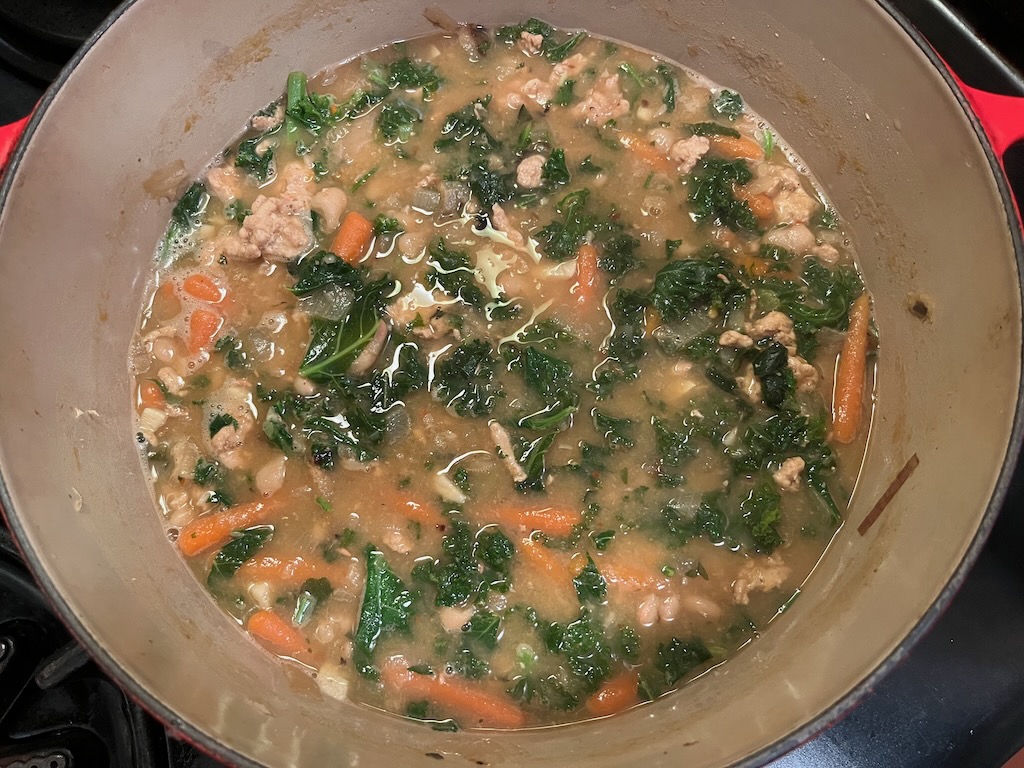
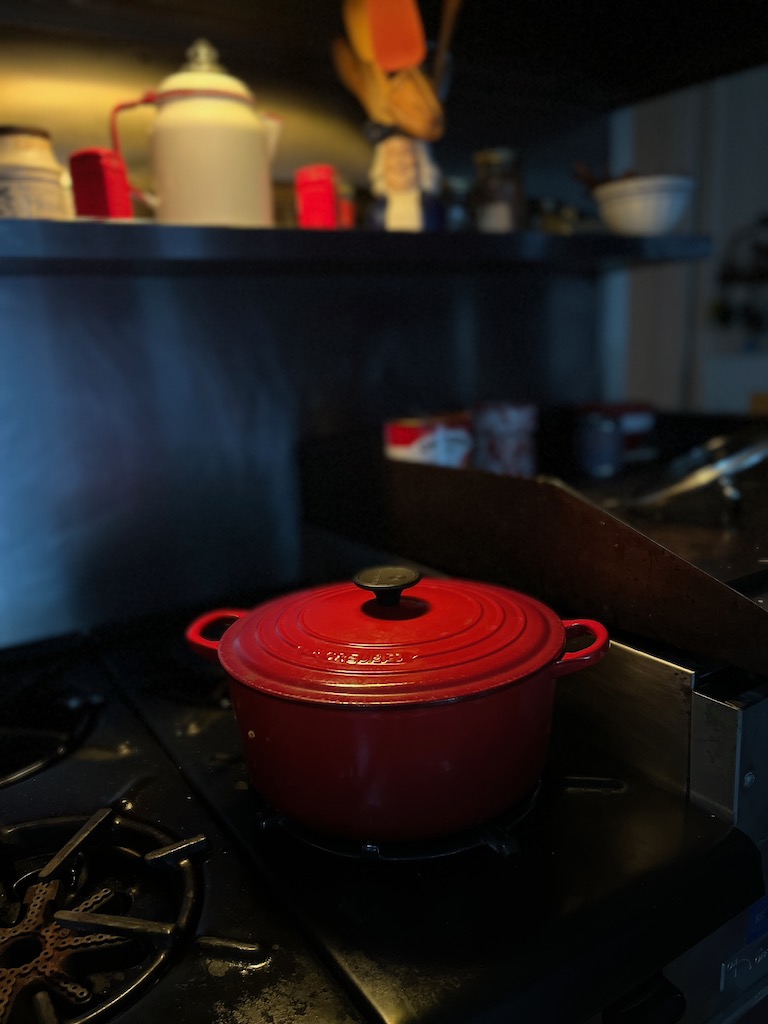
i do rise on occasion from my butter-yellow-checked chair, mid-morning sometimes, to take my station at the chopping block, where my knife work begins. usually in the alliums, chopping onions to bits, mincing garlic buds, filling the room and my fingertips with the essence of under-earth. i glug olive-y oils into the big red pot, the one weighty enough to shatter my toes should i ever let it slip from my grip. i slow-cooked my way through the year’s first month: stews and soups and braises. more stews and soups and braises.

it’s the simple rhythms that put the hum in my day. sustenance, really. the exotic and the excitement––the sighs and the gasps––come in the pages i turn. the ones where i might find a sentence so lovely i all but haul out my scissors to make of it a shrine to the genius of human mind and soul that so sees the world in these breathtaking ways, and dares to combine words in ways we’ve never before imagined. or felt.

really, it’s all filling my tank for the weeks ahead when my little book will take its pirouette for a few short moments, and i will step beyond my shadows long enough to put voice to its birthing. those of us who tremble when stepping before a crowd, we need to store up a winter’s worth of quietude, of sustenance, so we’ve a reserve to dip into. to share abundantly.

these wintry months i am doing winter’s work: letting the roots seek deeper ground whilst on the surface all looks still.

and so my offerings here are leaning more than usual on the genius of those i gather round me. and my hope is that what punctuates and titillates my day might bring the same to you…


we begin with mary oliver, a little poem she wrote as part of a septet.

“So Every Day”

So every day
I was surrounded by the beautiful crying forth
of the ideas of God,

One of which was you.

—Mary Oliver


a beloved, beloved friend of the chair sent me this the other day. and i thought you too might want to tuck it in your drawer of special words (i could not for the life of me find its origins, only that it was tagged “healers” and so i share it thusly:

some will turn away when you show them your bleeding.
some will stay.
will press stars into the wounds.
will hold your feet as you learn to walk again with the weight of a too-full heart pummeling your bones.

(healers)


i mentioned last week that i’d tumbled my way into a poetry conversation between dante micheaux and a poet priest named spencer reece, whose story so intrigued me i ran to the library and found his magnificent, magnificent memoir, the secret gospel of mark: a poet’s memoir, which is hands down the most gasp-inspiring book i’ve read in a good long while. i couldn’t stop reading; inhaled 400-plus pages in two days. tried hard as i could to stay awake into the night to keep reading. but my old body refused. i saved it till the morrow. i wound up giving it five stars in an amazon review, and i wrote this:

5.0 out of 5 stars In a Word: Brilliant Reviewed in the United States on February 2, 2023

In an age of binge-watching, this magnificent, tender, deeply vulnerable, and utterly breathtaking memoir from poet and Anglican priest Spencer Reece deserves to be binge-read. In one gulp, if you don’t need to sleep. I swallowed it whole in two sittings. And I couldn’t wait to get back to its pages when I had to put it down. Reece writes gloriously on multiple levels. He is at once raconteur and poet. A lifetime’s close read of poetry pours from the pages, as Reece takes us deep into his fluency in — and kinship with — Sylvia Plath, Elizabeth Bishop, Emily Dickinson, James Merrill, Mark Strand, George Herbert, and Gerard Manley Hopkins. Interwoven with his own sometimes wrenching, occasionally tragic, story — one that carries him through dark years as a closeted gay teen, and later an alcoholic who briefly finds himself on a psych ward, and ultimately stumbles into grace as a priest called to love with abundance — Reece writes that “poetry saved me more than the church.” The twinned lenses, funneling toward a holy and redemptive intersection of God and poetics, serve to make this a book I’ll long press close to my heart. As a longtime reviewer of Books for the Soul for the Chicago Tribune, this one counts among the rare few unforgettable treasures tucked on that bookshelf. It’s at turns bawdy, and funny, and crushing, and always, always crafted in sentences so beautiful, so crisp, and — yes — so poetic, they will leave you gasping in awe.

and from the pages of reece’s secret gospel come this week’s. . .

sentences of the week (in which i invite you into my commonplacing world and share some of the snippets that filled my notebook this week):

“The hint of night scratched at the edges of the day.” (372; Spencer Reece, Secret Gospel of Mark)

“foggy green lawn footnoted with hedgehogs” The Secret Gospel of Mark: A Poet’s Memoir, by Spencer Reece (“footnoted” as in splattered, punctuated with…(113)

“the land oozed God.” (and for the trifecta, it’s Spencer Reece once again…)


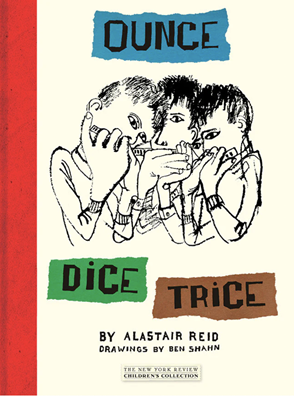
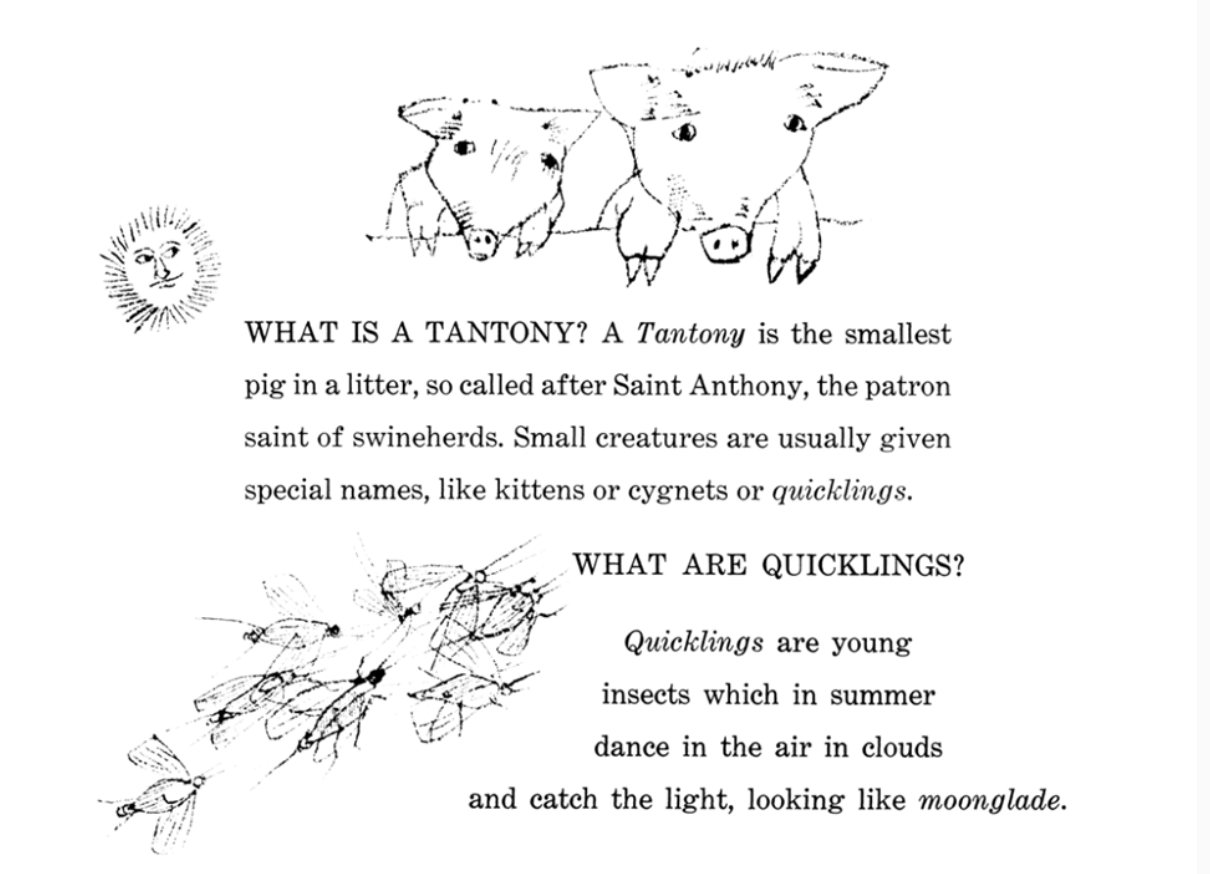
i often let my friends at the New York Review of Books point me toward what belongs on my shelves. and so it is, especially, in the children’s corner. i’ve long been mad for whimsical nearly obsolete words, words that need a puff of oxygen to keep their hearts still beating. and, so, i’m enchanted by this long-time favorite, which i’d not known before: Ounce Dice Trice, with words by Alastair Reid and illustrations by Ben Shahn. Ounce Dice Trice was the only children’s book ever illustrated by Shahn, and only one of two books Reid wrote for children. 

NYBR says this: “Ounce Dice Trice operates as a haphazard, whimsical dictionary of words and word play. Reid, a Scottish-born poet and long-time correspondent for The New Yorker, provides list upon silly list of fantastic words, most of them real, some completely made-up. Shahn, the Lithuanian-born American artist known for his socially- and politically-informed art, provides hilarious drawings to accompany the words.” [see below, for a wee quickling of a peek. and be charmed, like me, by the name for a little pig. i suppose dear wilbur (of charlotte’s barnyard) was a tantony.]


and that, dear friends, is my week’s worth of sustenance. except for one thing: the big red pot. so here is but one of the many things that filled that pot this past week and this past month:

Turkey Meatballs in Eggplant Tomato Sauce (from Melissa Clark at the New York Times, with a little twist by me*)

INGREDIENTS

Yield: 28 meatballs, 4 to 6 servings

  • ½ cup grated Parmesan cheese, more for serving, if desired
    ½ cup panko or other plain dried bread crumbs
    ¼ cup minced onion
    ¼ cup chopped chives or basil
    2 garlic cloves, grated on a microplane or minced
    1½ teaspoons kosher salt
    ½ teaspoon black pepper
    ½ teaspoon dried oregano
    Pinch red pepper flakes (optional)
    1½ pounds ground turkey, very cold
    1 large egg, beaten
    3 tablespoons extra-virgin olive oil, more as needed
    3 cups marinara sauce, more to taste*

PREPARATION
Step 1
In a large bowl, combine cheese, bread crumbs, onion, chives, garlic, salt, pepper, oregano and red pepper flakes, if using, and mix well. Add turkey and egg and blend with your hands until well mixed. If you’ve got time, cover mixture and chill for an hour or up to 24 hours. These are easiest to form into balls while very cold. Form into 28 meatballs, each about 1¼-inches in diameter.

Step 2
Heat 2 tablespoons of the oil in a large sauté pan. When hot, add enough of the meatballs to fit in one layer without crowding, and brown on all sides, 5 to 8 minutes. Transfer to a plate, add another tablespoon of oil to pan and brown another layer of meatballs, transferring them to the plate as they brown. Repeat until all meatballs are browned, adding more oil to the pan as needed.

Step 3
When meatballs are all browned, add marinara sauce to pan and bring to a simmer, scraping up the browned bits on the pan bottom. Return meatballs and their juices to pan, shake pan to cover the meatballs with sauce, and lower heat. Partly cover pan and simmer until the meatballs are cooked through, 15 to 20 minutes.

Step 4
Serve hot, drizzled with more olive oil and sprinkled with more cheese, if you like.

*note: this week i super jazzed up the sauce with a shiny night-black eggplant: while the meatballs chilled in the fridge, i took my marinara up a couple notches: sautéed onions, garlic, and then eggplant. added fennel, red pepper flaks (a pinch), marjoram and oregano, salt and pepper. cook till browned and then relaxed. add splash red wine. jar of tomato basil marinara; let simmer a good half hour. (here’s where i added extra bowls: i scooped my simmered sauce into a bowl, and browned my meatballs in the big red pot; once browned, i poured back the sauce, and let it all get cozy, simmering for another while. at dinner time, they all arrived deliciously on our plates. (and this is why you’d best take your cooking instruction for a more precise cook!)

what sustains you through your week?

forecast: more quiet

we seem to have stumbled around here onto the recalcitrant version of the red-ringed bug, the one that won’t go away. or came back before it left. i was on the mend, as was my mate here in this old house, when suddenly a cumulus nimbus of cloudy congestion came roaring back to the head of the one with whom i share these rooms. and then the little test confirmed our suspicions: it’s covid again. so he’s re-grounded and i’m shuffling quietly, still under wraps (aka mask).

which means that with a weekend forecast for snow and cold, along comes one for much more quiet. to which i let out a little yelp of muffled delight. because that means more time to dig into my latest reads: thoreau’s walden; and what could be more fitting for a january cold spree than a charming tome titled the nightingale: notes on a songbird?

and that means that once again, i’ve spent bits of my week cobbling together a few morsels for my friends who might pull up a chair.

to wit:

i begin with this beauty from henri nouwen, the modern-day mystic and deep theologian whose wisdoms are many, and whose birthday this week had me bumping into this:

Compassion asks us to go where it hurts, to enter into the places of pain, to share in brokenness, fear, confusion, and anguish. Compassion challenges us to cry out with those in misery, to mourn with those who are lonely, to weep with those in tears. Compassion requires us to be weak with the weak, vulnerable with the vulnerable, and powerless with the powerless. Compassion means full immersion in the condition of being human.

Henri Nouwen

a more beautiful definition of compassion, of being a profoundly alive human, i do not know. perhaps you’ll marinate in these holy words for a few hours this cold, cold weekend.


next up, in the wonders of the week, i found myself in a poetry conversation that spanned continents (thank you, oh wonders of zoom), and thanks to my friend Pádraig Ó Tuama, i discovered a poet whose work and whose voice i can’t get enough of. his name is dante micheaux, and what i know is that i will be chasing down his poetries in any form i might find them. here’s a bit of his bio (though i am starting to dream of a journalistic beat in which i wander the globe talking to poets, in hopes of filling out the fine grains of their stories). . .

Dante Micheaux is the author of Circus (Indolent Books, 2018) and Amorous Shepherd (Sheep Meadow Press, 2010). He holds a Master of Fine Arts in Creative Writing from New York University. His poems and translations have appeared in The American Poetry Review, Callaloo, Poetry, PN Review and Tongue—among other journals and anthologies. Micheaux’s honors include a prize in poetry from the Vera List Center for Art & Politics, the Oscar Wilde Award and fellowships from Cave Canem Foundation and The New York Times Foundation. In 2019, he won the Four Quartets Prize from the T.S. Eliot Foundation. He grew up in New Jersey, but lives now in London, and we shared a wee bit of enthusiasms for a bagel shop on Brick Lane, or as the brits would spell it, a “beigel bake.”

the judges’ citation on the Four Quartets Prize is this: “How right that this poet’s first name should be Dante. For his Circus is a Comedy: a savage comedy, lacerating dialects, fingering wounds, looking for loves right and wrong in the crevices of history and of humiliated bodes. And yet, and yet. His language exults, triumphs, and freely rummages in the treasuries of the Bible, Baudelaire, Whitman, Eliot, Baraka, and Mahalia Jackson, taking what it needs, making it his sovereign own, a wrested blessing. Congratulations, Dante Micheaux, on your astonishing Circus.”

you can hear a bit of him here, in a podcast called beyond the red door, an audio companion to a poetry series that brings poetic meditation inside the walls of St Mark’s, an Anglican church in Jackson Heights, in New York City. Here, Micheaux is in conversation with Anglican priest and poet, Father Spencer Reece (himself a whole nother story). Micheaux reads a poem reminiscient of Tony Morrison’s The Bluest Eye, and at the end a Canto …

(i’m promising more on Spencer Reece next week, as i’ve requested a slew of his books from the library…) and here is but one of dante’s poems that took my breath away…

Mary at the Torture

Everyone was out that day, for a show.
Sure, it was sad for people who knew him
but she was his mother, slinking about
the rabble in that dark halug, veiling
her face with a headscarf—as if no one noticed her.

Some say it served her right,
letting her son run about the countryside
the way she did. Poor Joseph,
for all efforts at teaching the boy
a skill, never succeeded,
hadn’t a chance against Mary’s coddling.

But how could she just stand there, watching?
Each time the scourge met flesh she didn’t even flinch.
No cry, no lamentation—most unlike a child of God.
Any other mother would have had to be contained,
would have put herself between lash and child,
would have succumbed to conniption—at the least,
rent her clothing. Not one tear.

She was always strange, though—quiet,
dark days about her since she was a girl.

It wasn’t easy: the scandal before the wedding;
him getting into trouble with the law.
Perhaps, she was relieved.

–Dante Micheaux

(first published May 11, 2011, in Painted Bride Quarterly)


the techno team here at the chair is figuring out how to host a virtual launch of my soon-to-be book, The Book of Nature: The Astonishing Beauty of God’s First Sacred Text (which got its very first official review this week, in Booklist, a publication of the American Library Association, and which you can find over on Book of Nature’s very own page here at the chair. details and sign-up soon as the techno wizards figure it out. and yesterday, in a meeting with the lovely team who does the heavy lifting in the book-peddling department, someone held up an actual hot-off-the-presses copy of said book, proving its existence, and alerting me to the notion that it could soon be landing with a plop on my snow-covered stoop. (though it’s official pub date is still firmly on the vernal equinox, march 21, 2023)

before closing, a wee bit about the two books waiting on my butter-yellow-checked chair: thoreau’s walden i am reading cover to cover as preamble to the weeks ahead when i’ll likely be extolling the wonders of keen-eyed watchkeeping on the woods and the turning of seasons.

sam lee’s the nightingale has been on my bedside table for at least a year (there’s a whole essay on the books we keep close at hand, yet never manage to crack). for the pure whimsy of it (as well as a fine excuse to read the pages of the irish news) here’s what they have to say about the wondrous love-letter to the vanishing bird. but should you refrain from clicking, here’s the book jacket description:

Come to the forest, sit by the fireside and listen to intoxicating song, as Sam Lee tells the story of the nightingale. Every year, as darkness falls upon woodlands, the nightingale heralds the arrival of Spring.

Throughout history, its sweet song has inspired musicians, writers and artists around the world, from Germany, France and Italy to Greece, Ukraine and Korea. Here, passionate conservationist, renowned musician and folk expert Sam Lee tells the story of the nightingale. This book reveals in beautiful detail the bird’s song, habitat, characteristics and migration patterns, as well as the environmental issues that threaten its livelihood.

From Greek mythology to John Keats, to Persian poetry and ‘A Nightingale Sang in Berkeley Square’, Lee delves into the various ways we have celebrated the nightingale through traditions, folklore, music, literature, from ancient history to the present day. The Nightingale is a unique and lyrical portrait of a famed yet elusive songbird. Sam Lee has brought the poetic magic that has long enchanted so many of his musical fans into the written word.

and that’s the news, thin as it is, from here at covid central.

how shall you be soaking in your quiet hours ahead?