pull up a chair

where wisdom gathers, poetry unfolds and divine light is sparked…

Category: joy of writing

on faraway sands, the poets of war spoke to me

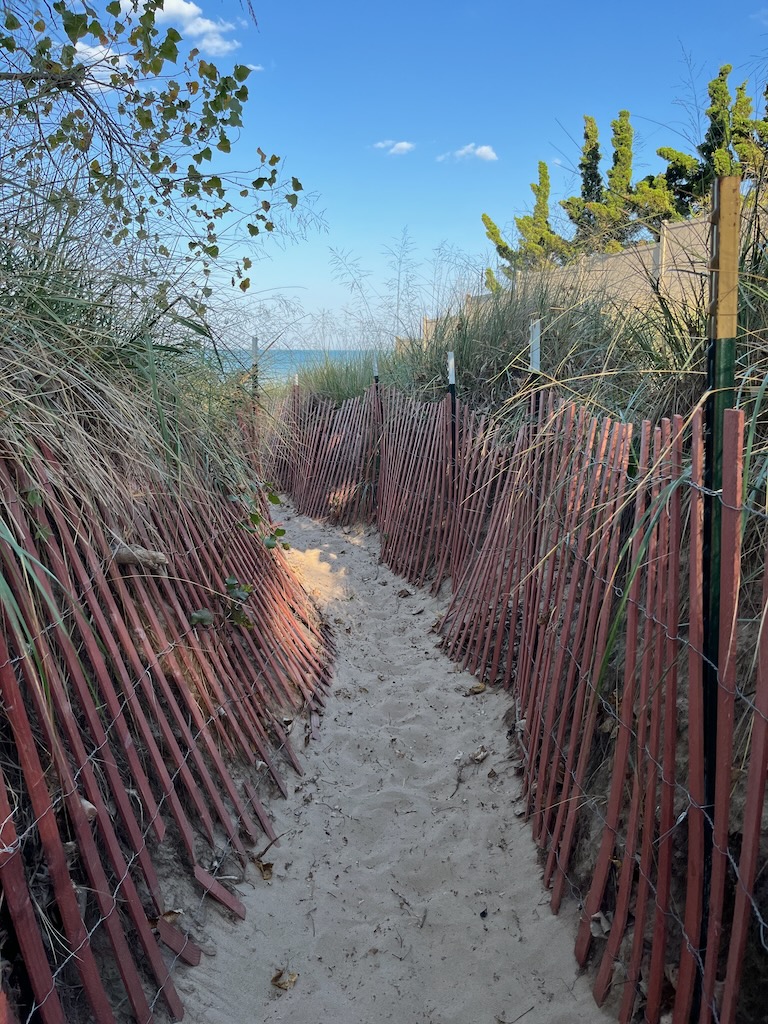
i was alone for the day, a whole sumptuous day of solitude and silence. so i, like half the rest of the world it seemed, was pulled to the water’s edge. i carried but a book and a bottle of water. i knew the week ahead would be rough, though i hadn’t a clue yet quite how rough. (two beloved souls, my exact age, died suddenly, one falling to her death*, another simply dying in his sleep.)

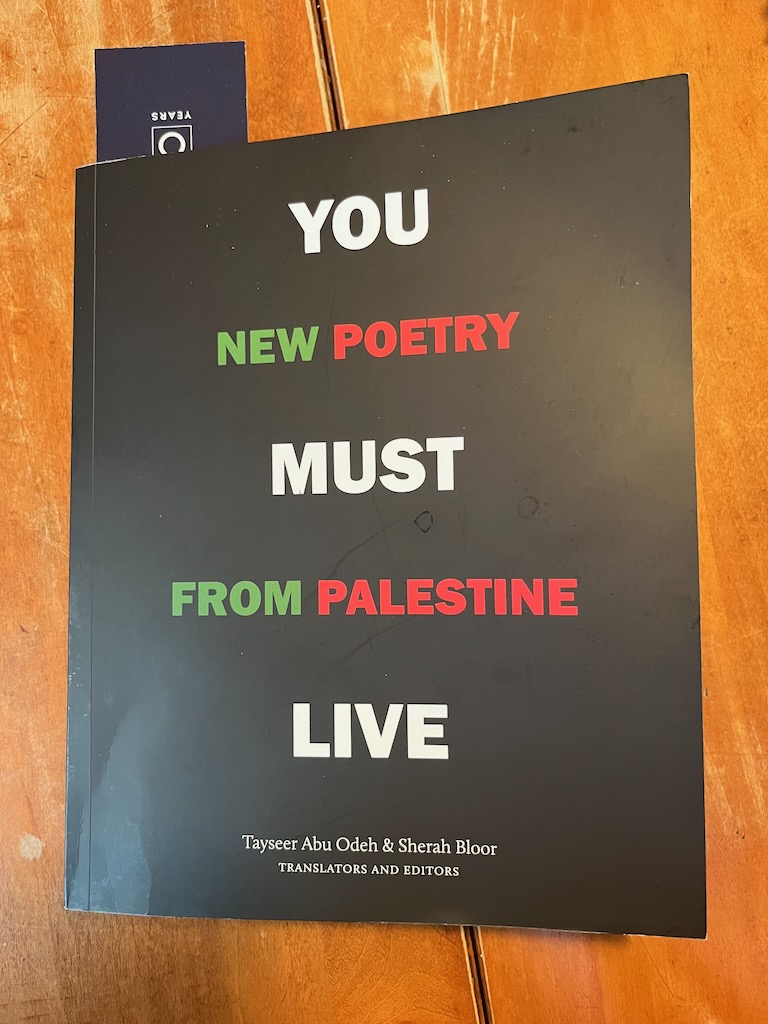
the book i carried is one i’d yearned to crack into, and as i sat there allowing its truths to wash over me, as the waves of the lake just across the sand washed over the shoreline again and again, i felt every drop of its anguish and truth. it was a book of poems written by thirty poets in gaza, and four from the west bank.

once upon a time, for ten good years, i gathered up each month for the chicago tribune a collection of three books that had most stirred my soul. they might be children’s books, or poetries, or memoirs and stories of the holiest people. the gatherings were vast, and some of those publishers still send me books, knowing full well my readers now are not the millions from the tribune and beyond, but rather the cherished friends of the chair.

this book i bring today is one worth clutching in your hands, pressing hard against your heart. it might be even more poignant against the improbable news that a cease fire in gaza has begun and some twenty living israeli hostages will soon be released.

its title, you must live: new poetry from palestine (copper canyon press, 2025), only begins to tell the story, only hints at the horrors and tendernesses within. but you can hear the pleas, the cries rising up from the rubble. it’s a bilingual anthology of poetries from gaza and the west bank, translated from the arabic and edited by Tayseer Abu Odeh and Sherah Bloor, with guest editor Jorie Graham, and it’s written not by poets who’ve somehow escaped, left behind the ravages of war, but rather it’s written by those still there. in poring over its pages—slowly and with prayerful intent—you hear the murmurs perhaps unheard by anyone else, you hear the lone voice rising from dust, you hear the whimper of a child left alone in the world, in the shattered brokenness of a world that no longer stands.

“especially now,” the editors write, “it is crucial to attend to those whose voices are under threat of elimination.”

ocean vuong called it “a light beam of a collection in our dark hours.” ilya kaminsky, the great poet most famous for his deaf republic, has written that it’s a book “filled with poems of utter urgency, poems that give us wisdom, in the face of devastation, in spite of devastation.”

i was as moved by the story behind the poems, as by some of the poems themselves. for starters, editing in a war zone is no feat for the timid. the editors write that at first they didn’t realize that every time someone’s phone connected to a satellite (to reply to an editing question) they became a target. to get a clear signal, the editors write, meant a life-or-death decision: standing atop rubble is where the signal is sharpest, and yet of course that means the poet is risking her or his life to reply.

consider that.

the editors write too that every time a reply did come through, be it a response about punctuation or diction, the editors sighed with relief. “they were still with us.” imagine being willing to die over a comma rather than a semicolon. consider that the next time you make a simple correction in a sentence you’re typing.

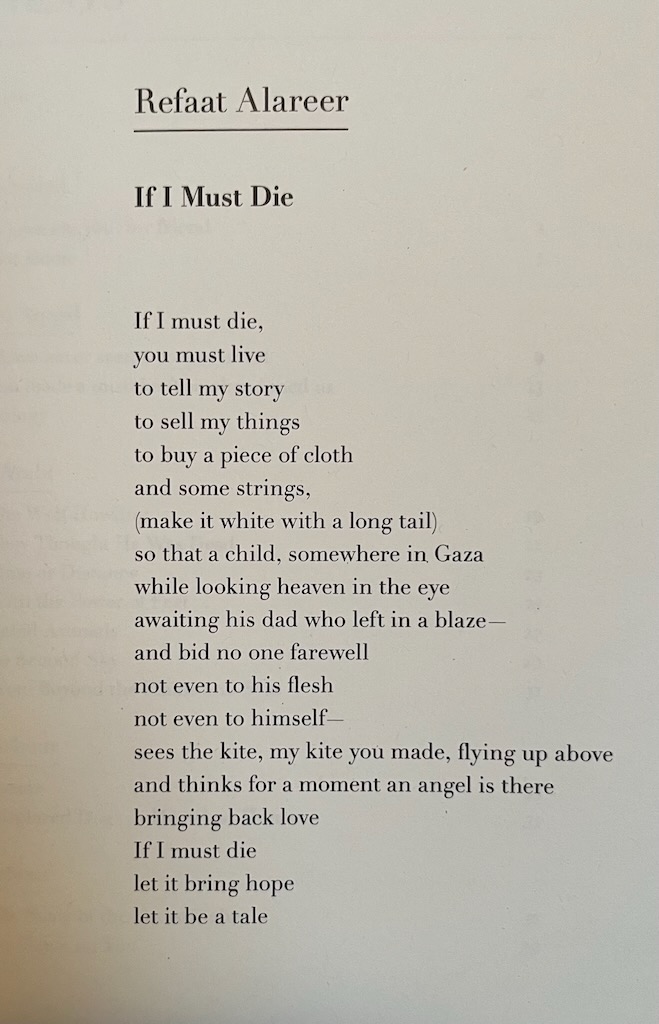
the collection begins with a poem that’s become fairly widely known, “if i must die,” by the late Refaat Alareer. the editors write: “this poem stands in for all those poets we failed to reach in time. their poems—chalked onto collapsed walls, or on the blackboards of schools-turned-shelters-turned-bombsites, traced in sand, or shared in private messages—will never reach us.”

the silence is stunning. the silence demands our reverence.

the editors call the poems a “poetry of witness,” speaking from a war zone deadly for journalists, a war zone where so many stories would otherwise go untold. the poets paint the portrait. and it is seizing with humanity. humanity crushed. humanity pummeled. human refusing to extinguish its tender, fragile beauties. we must know what we, humanity all, have wrought.

here are a few samples, barely enough to give you a sense of the pathos within, the pathos that rises from this old globe like a poisonous cloud desperate for one breath of air….

here is the poet Waleed al-Aqqad’s elegy for a young friend, set at the boy’s funeral, and tenderly describing the mutilations of his war-torn body:

We said goodbye
to you in your small death like the death
of sparrows.
We rearranged you.
We placed your severed hand across your chest,
covered your wounds with flowers,
cried as you wanted.

or this, from Ala’a al-Qatrawi’s poem to her children, two daughters and two sons, all under the age of six, all killed in an air strike on their home. she addresses her babies in heaven, offers her own body parts to her daughter, Orchida, as if she could piece her body back into her embrace:

And give my lungs to her.
Without them, maybe she suffocated.
Maybe she couldn’t call my name.
The rubble would have been too heavy for her.

it is wrenching to read. all of it. page after page, i read slowly, as if a dirge. i sat on a bench on the sand thousands and thousands of miles away. that seemed cruel, unfair, that i should be hearing the sounds of a day at a beach, when the sounds of war pressed on. and the words of new poets would again go unheard.

to those who understand the power of words, to those who dared to gather poems out from the rubble, bless you, and bless you, and may peace, everlasting peace, at last come to the holy land.

maria corina machado, recipient of the 2025 nobel peace prize

this hard week ends with a few sparks of hope: first, word of the cease fire and the imminent promised release of 20 living israeli hostages, and the bodies of 26 confirmed dead. and, in the immediate wake of that, the nobel peace prize was awarded this morning to venezuela’s “iron lady,” maria corina machado. the committees’ citation reads: “She is receiving the Nobel Peace Prize for her tireless work promoting democratic rights for the people of Venezuela and for her struggle to achieve a just and peaceful transition from dictatorship to democracy.”

where did you find hope in these hard times?

*joannie barth was a most beloved reader of the chair. she lived in evergreen, colorado. was the right-hand everything to the best-selling author philip yancey. she and i had gone to college together, but mostly got to know each other’s souls through this ol’ chair. she would send notes radiant with love, with a faith that couldn’t be shaken. she shared her own heart’s ache, an ache i now hold for her. i was with her less than a year ago, and as she always had, she lit up a room. her smile rose from a deep deep place. a week ago, she was rock climbing. and the belts gave out. she died instantly. not at all surprisingly, i feel her closer than ever. she was, and is, an angel.

joannie

add this to your constellation of poetries

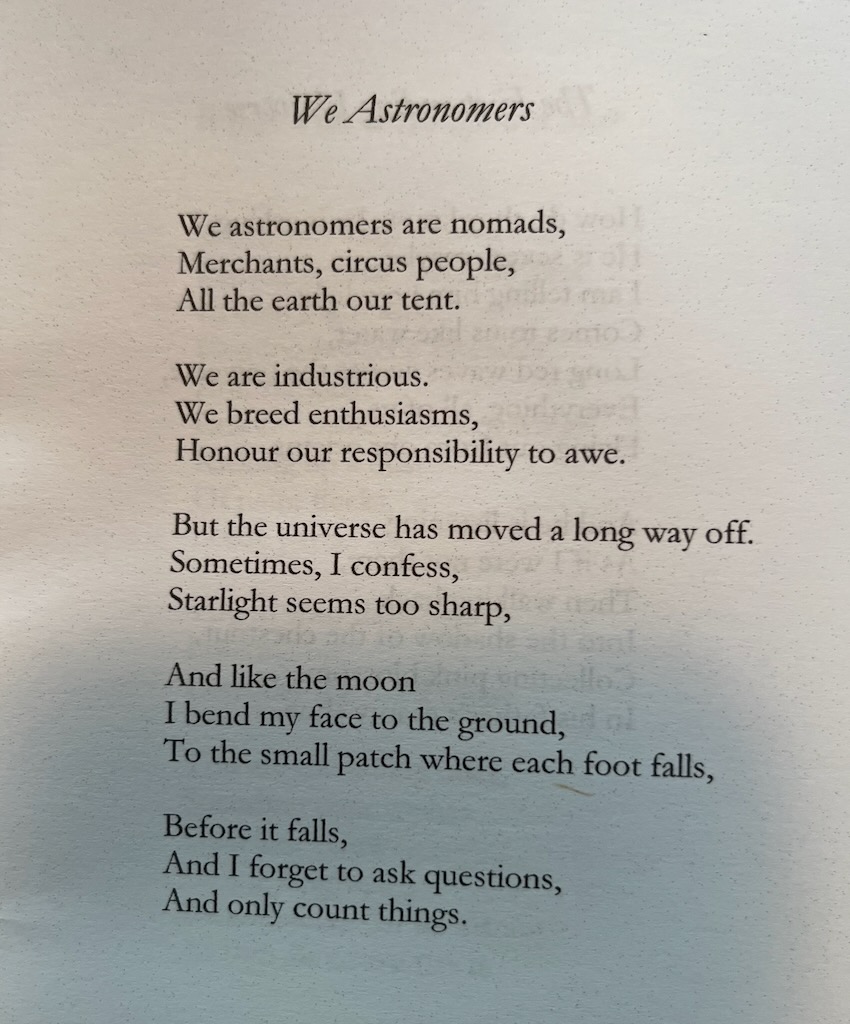
rebecca elson: astronomer + poetess

i’ve been on rooster time for weeks now, though there’s no rooster pecking about the nearby yards. the rooster resides in my little noggin where it cock-a-doodle-doos round about four, and i patiently wait till five. as if the nuns have granted permission and at last i can dash out from under the bedsheets and into the playground that is my kitchen table at that early early hour.

ostensibly i’m up to write, to think, to edit. and i do get to that. i always do. but first i soften into morning turning pages. in other words: i read.

it sometimes seems my mission here is morphing into something more along the lines of slipping poets under your noses; writers, too. any weavers of wonder i happen to happen upon. this week i happened upon an astronomer poet, a brilliant soul who died too soon at 39. she spent her life mesmerized by the heavens, and hers was the gift of reaching into the stars, scooping up a glug of moon, and giving us a taste.

her name was rebecca elson (1960-1999), a canadian-american who at 16 began her studies at smith college, and would go on to earn her PhD from the university of cambridge, somehow fitting in years at radcliffe college and harvard teaching creative writing as well as an expository writing course on science and ethics. at cambridge’s institute of astronomy she was awarded an isaac newton studentship, meaning they paid for her to be there. it’s where she died, amid a field of star embers, i do hope.

her posthumously-published slim volume of poetries and extracts from her notebooks is titled a responsibility to awe (carcanet press, 2001). that title alone is poetry, and tells you all you need to know. in four short words, some might argue, it lays out our holy purpose. our one assignment while we’re here on planet earth, that little orb floating amid a universe of burning flecks of star dust and helter-skelter sky litter (though there’s nothing remotely litter-ish in even one celestial orb, from jupiter to milky way, to the not-yet-named planet L 98-59 f (identified just last month!, the fifth such planet in a splotch of far-off space unpoetically named L 98-59, a system of “remarkably diverse worlds.” little f is orbiting so close to its star, it’s possible liquid water might exist there, the scientists tell us.)

back to rebecca, known to those who loved her as becky. soon as i read the words astronomer and poet coupled in a pair, i was drawn magnet-like to snatch up a copy of her awe-struck works. it’s considered a contemporary classic, in the world of poetries. and not a line of it disappoints. among the pages that left me awe-struck: an ode to discovering zero; another asking what if there were no moon? (her reply: “there would be no months / a still sea / no spring tides / no bright nights / occulations of the stars / no face / no moon songs / terror of eclipse / no place to stand / and watch the Earth rise.”)
a mind as facile and deep as one that imagines darkest night, scans heavens for answers to questions others never even think to ask, is a mind i want to enter. to add my footprints to the paths that have traversed it. as if, in poring over her way of seeing, i too might see more vividly.

that rebecca/becky died too young of a cruel cancer (isn’t every one a cruel one?) added but another element to my quest to know her by her words. her masterwork is considered her six-stanza poem, “antidotes to fear of death.” she begins (as only a star-studier might): “sometimes as an antidote / to fear of death / i eat the stars.”

from there, extracts from her notebooks follow, and we almost watch a mind at work. as she cobbles poetries, we see the words struck out, the finer ones she chose instead. we see, in a swatch titled “origins,” her change of mind, in the line “shaken in the dark soil soul of space.” soil, a richer word (more unexpected) than soul here. we see adjectives get ditched, as she pares and pares her lines. titles of poems are revised. it’s a nimble mind, exercising in the gym, and we are peering through the windows.

two years after elson’s death, the economist, in 2001, named responsibility to awe (her one published poetry volume, though she published 56 scientific papers in her short life) a “book of the year,” writing “with great poignancy, she shows us the world through the eyes of a human being faced by her finite time.”

the bulletin of the american astronomical society, in their roster of supernovae gone dark, described the breadth of elson’s scientific research, her work ranging from “a search for stars in the halo of our own galaxy to regions of rapid star formation halfway across the Universe. She set strong limits on the contribution normal stars could make to the Milky Way’s dark matter halo, using counts from the Hubble Deep Field to rule out a significant stellar component.”

maria popova, who first pointed me to the poet-astronomer, calls her poem “antidotes to fear of death,” a “stunning cosmic salve for our creaturely tremblings of the heart.” she recorded a recitation of it, set against the mournful strains of cello, for her 2020 “universe in verse” extravaganza, popova’s “annual charitable celebration of the science and splendor of nature through poetry.”

elson, whose book now rests beside me, belongs in that rare constellation, a favorite of mine, of those who study the cosmos and, side-by-side the formulae and theorems, see the poetry, and draw it forth: loren eiseley, lewis thomas, robin wall kimmerer. they and their ilk (there are more and more) hold a sacred space on my bookshelves. without them, there are volumes i’d not see, musics i’d not hear.

the back jacket of responsibility to awe says it best, describing elson’s work as “a book of poems and reflections by a scientist for whom poetry was a necessary aspect of her research, crucial to understanding the world and her place in it, even as, having contracted terminal cancer (non-hodgkins lymphoma, diagnosed at 29), she confronted early death.” the text goes on to say that elson was an astronomer whose work took her “to the boundary of the visible and measurable.” isn’t that the space we’re all drawn to, meant to explore? isn’t that where theologians and mystics ply their minds? isn’t that where simple us might wonder too?

in the end, elson, like all who dare to ponder deep beyond the lunar surface, was “undeterred by knowing how little we can know.”

and thus we all now have our one assignment: to search undeterred for what we can. knowing there is majesty in the mystery, and beauty far beyond what we’ve yet glimpsed. our responsibility, of course, is always, always to awe.

where did you stumble into awe this week?

i’ll leave you with a page. . .

have a blessed, awe-filled week….


oh, i promised my dear friend wini i’d share this wonderment she is bringing to town (town being chicago, or the northern environs to be specific). wini is a poet, and she’s worked closely with, and had one of her poems judged “best in class” by the marvelous poet rosemerry wahtola trommer. wini, who makes things happen, invited her and now is inviting all of us for a day of poetries. part workshop, all wonder, it promises to be a day to remember. here are the details, courtesy of wini:

Come experience the gorgeousness of poet, teacher, and storyteller Rosemerry Wahtola Trommer. This event is about more than just poetry; it’s a chance to listen to what is true in your heart and open to “The all of it — the Beauty and Sorrow.

It is beyond lovely to be in-person with Rosemerry, and truly what a treat to sit in community again with like-minded people, and to uplift and celebrate each other’s beauty and light.

I hope you’ll join us. It would be so lovely to see you again.

  • When: Saturday, September 27, 9:00 a.m. – 3:00 p.m. (lunch included)
  • Where: Valley Lo Club, Glenview, IL
  • Details: Three different ticket prices are available.

Buy your ticket here

thank you, wini, for bringing this priceless gift…..

light and shadow, in perpetual dance

all you need do is glance toward the sky, eyes skimming over the players on high. sunlight and cumulus. sunlight and cirrus. sunlight and nimbostratus. sunlight and cloud ever in play, in duet, in doh-si-doh of shadow and light. 

there’s a truth being told there, a universal and organizing principle of all creation. on the first day, in the second verse, there was darkness, darkness hovering over the deep. in the third verse, light. God commanded it. and God saw that it was good. 

in our lives, the leitmotif is a given. light will come. shadow will follow. light will come again. 

so it was in my reading this week, when first i tumbled deeply into a luminous shaft, a boreen* of writings from a norwegian bishop and monk, erik varden, whose power as a writer was pointed out to me by a poetry friend whose taste i know to be exquisite and deep. i swiftly realized the bishop’s thinking and writing are everything they were billed to be: rare. exquisite. deep. radiant.

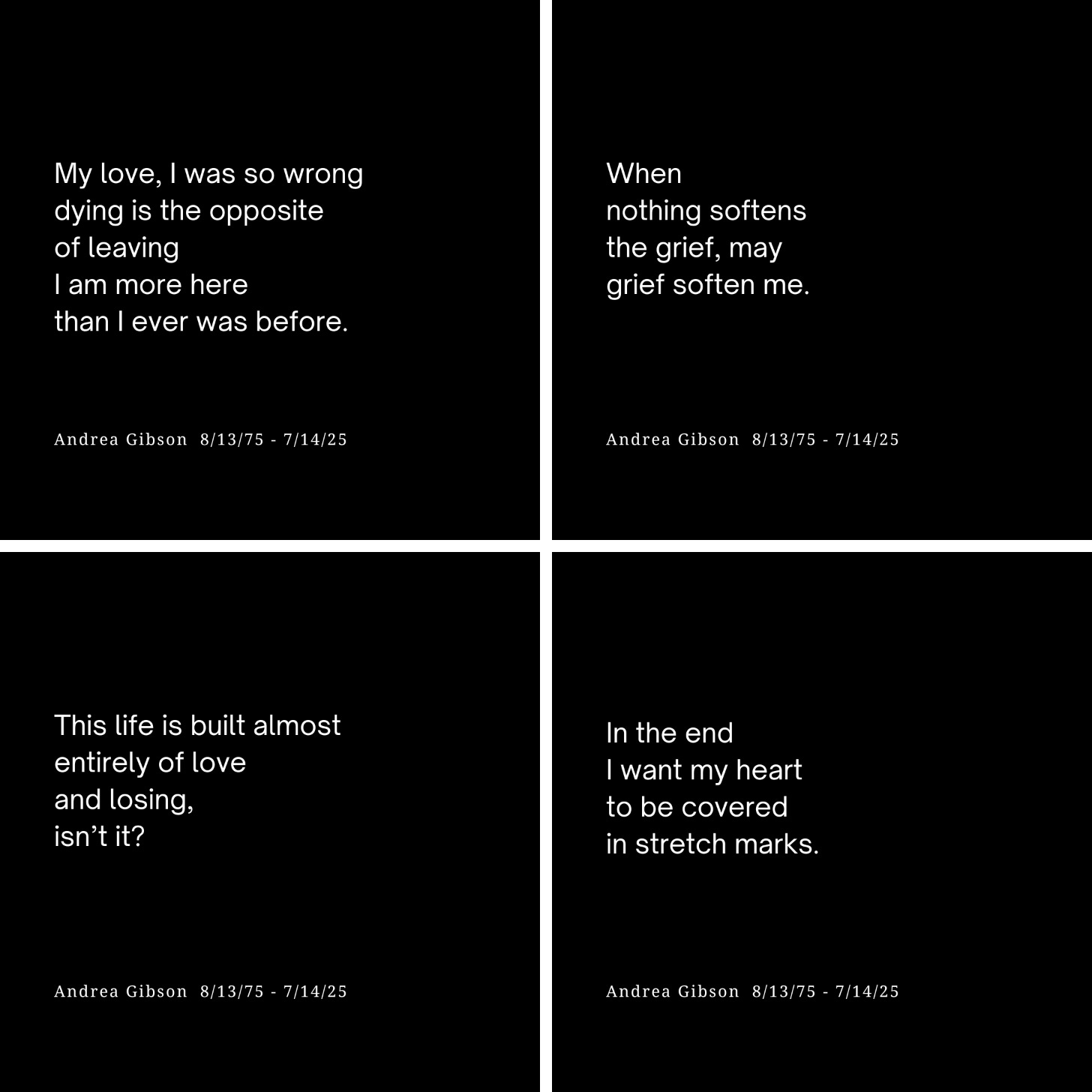
but then, hours later, shadow: i began reading a string of sentences posted from the account of one of my lifeline poets, someone you might call a patron saint of heartbreak and healing, of being more alive than you’ve ever imagined. i started to read, as if it were just another brilliant post: “Whenever I leave this world, whether it’s sixty years from now, I wouldn’t want anyone to say I lost some battle. I’ll be a winner that day.” and then i got to these words: “Andrea Gibson was a winner today. On July 14th, at 4:16AM, Andrea Gibson died…” and my legs stopped moving, and my breath was caught in midstream, and i read and read again. and then my fingers started to tremble, and my knees too. 

andrea gibson

andrea gibson, 49, colorado poet laureate in 2023, queer activist (they/them/their pronouns), who had been diagnosed with stage 4 ovarian cancer in 2021, not long after they’d started a newsletter titled “Things That Don’t Suck,” had many, many times pried open my heart, pulled out the unspoken words and the fears and set them soaring. when i too found out what it is to live with cancer as one of the nouns in my story, i drew andrea into my innermost circle. the ones who know, without you uttering a word, just what you’re thinking, you’re feeling, you’re praying. the ones who some days save you. because even though the cyberworld is distant and intangible, it works in mysterious ways, and someone with whom you’ve never breathed the same air can become someone whose voice you can hear as you flutter to sleep, and whose courage you conjure as they glide you into the sarcophagus that is your biannual CT scan.

light. shadow. light from shadow. shadow deepening light. it’s the dance of the duet, interminably entwined. one is always more beautiful because of the other’s presence, because the duet is perpetual. 

first, this week’s light:

that monk on a bicycle, spotted cycling through the garth just beyond the cloister, is all it took for me to want to whisper my vows, and cycle along. 

as i’m quick to do, i signed up for bishop varden’s website, coram fratribus, a name derived from his episcopal (meaning “of the bishop”) motto, coram fratribus intellexi, latin for “understanding with my brothers.” because the bishop is shepherd of a flock spread across 22,000 square miles in the north of norway, extending beyond the polar circle, he sees his site as a way to speak to the diaspora, to think aloud of those things he finds beautiful or challenging, to gather his flock into a communion of thought. specifically, i felt my heart quicken as i burrowed into the bishop’s collections of writings under the tabs “life illumined,” and the shorter jottings under “notebook,” which he describes thusly: 

“To scribble in the margins of texts is an ancient practice. There are people, these days, who make an academic career out of studying ancient marginalia. Any exercise of reading is fundamentally conversational. The notes collected here are brief responses to impressions received not just through books, but also through encounters, art, music, and films.”

now you see why i, a marginalian of long practice, swoon?

before i get to the paragraph in “life illumined” that drew me deep into thought, let us pause to note why we see that little outline of an owl, in the upper right corner, and hovering over every page of the site. the good bishop describes that choice thusly (emphasis mine from here on in): 

“The emblem of the site is an owl. The owl does not just wing you back to the front page. It has for centuries been a symbol of the monk. Why? Because it watches in the night, when most people sleep; because it is able to see in the dark, discerning movements and patterns, foundations of meaning, where the human eye perceives only vaguely. I am fond of this Italian doggerel:

“Sopra una vecchia quercia
c’era un vecchio gufo:
più sapeva e più taceva,
più taceva e più sapeva.

“In an old oak tree
there sat an old owl:
the more it knew, the silenter it was;
the silenter it was, the more it knew.”

what fluttered into my mailbox the other morning was a page of the monk’s notebook on the nightingale, complete with an ancient poem (from the early middle ages, written by alcuin of york, an adviser to charlemagne) mourning the absence of the wild creature and its delicate throat. a recitation in english and latin, and including a recording of the nightingale’s song. that alone was more than beautiful enough. and then my poking and peeking accelerated, and that’s how, under the “life illumined” tab, i found a break-me-open paragraph on learning to pray.

in an essay focused on the simplicity of jesus’s prayer, and the universal cry of all believers, “lord, teach us to pray,” varden paints the scene of 72 disciples who learned not simply by listening to the words of jesus in prayer, but in witness to his consuming attention to the ways and will of God. varden expounds: 

“Jesus’s teaching on prayer amounted to more than the provision of a text for recitation, that is clear. It was the sight of Jesus praying that made the disciples wish to learn prayer. The words of prayer, which touch our reason and orient our will, point towards the breaking-open of our heart, the transformation of our being as we dare to aspire, even in this life, to ‘become participants of the divine nature’.”

it is the breaking open of the heart, indeed, where the truest serum of our souls pours out. only in the last couple years have i understood that as profoundly as i do now. and, yes, that breaking so often comes with pain, or in pain, or through pain. but i’ve learned now how it truly is the propellent, the force that pushes us deeper into sacred truths than we might otherwise venture. without the breaking open, we might cling to the safer and shallower waters.

the bishop goes on. takes us beyond merely the breaking, and makes the point of its purpose. be it through prayer or through living, the breaking open is the vehicle for those who dare to aspire, in the here and now, to become participants of the divine nature. to inch as close as we can in this lifetime to something akin to sacred. i found a redemptive resonance in that line because at heart, even for the quiet ones among us, we are a people of communion, and there is a heartening, an emboldening, that comes in finding that your purpose, your aim, is not yours alone, but shared in common understanding with at least some of your sisters and brothers.

let us be broken open, then, if it points us toward our holiest purpose. through the break in the clouds, the light comes.

and onto the shadow, the eclipsing shadow…

less than one month shy of her fiftieth birthday, andrea gibson, the poet who boldly faced the coming of her death, who has been amplifying wonder, making us see the unseen, relish the oft-overlooked, took her last breath in the wee hours of monday morning.

i have been relishing her, here and in my everyday, for years now. curiously, her presence in my life spans almost precisely the arc of time in which i’ve been in the company of my own cancer. 

the month before my lung surgery, when the world felt overwhelmingly like the depths of a cave, i wrote of andrea and lines i’d inscribed on my heart: 

thanks to a friend i love with my whole heart, i stumbled on another wise soul with buckets of beauty to grace the world. a poet-activist-performer named andrea gibson, now a cancer survivor whose words might take your breath away. andrea identifies as queer, and uses the pronoun “they;” and they are known for their trademark honesty and bare-naked vulnerability, traits i find irresistible and blessed beyond words. here are just a few lines i couldn’t keep from scribbling down:

when it comes to hearts i want always to be size queen…

i love you because we both showed up to kindness tryouts with notes from the school nurse that said we were too hurt to participate….

when your heart is broken, you plant seeds in the cracks and pray for rain.

before i die, i want to be somebody’s favorite hiding place, the place they can put everything they know they need to survive, every secret, every solitude, every nervous prayer, and be absolutely certain i will keep it safe. i will keep it safe.

andrea gibson

and nearly a year ago, in a musing about scan time’s equal measures of shadow and light, i shared lines that kept me from drowning.

and just a little more than a month ago, i wrote about them and a poem i called more than enough:

yesterday, thursday, this slipped into my mailbox from andrea’s wife, meg:

A couple years ago, Andrea said, “Whenever I leave this world, whether it’s sixty years from now, I wouldn’t want anyone to say I lost some battle. I’ll be a winner that day.”

Whatever beast of emotion bucks or whimpers through you right now, I hope you can hold that line beside it: Andrea didn’t lose anything. If you had been here in our home during the three days of their dying—if you’d seen dozens of friends drift in to help, to say goodbye, to say thank you, to kiss their perfect face, if you’d felt the love that floored every hospice nurse—you would have agreed. Andrea won.

I won’t sugarcoat the fact that they desperately wanted more time on this planet that they loved so much. This planet of squirrels and romance and basketball and moonlight.

But the time they had was significant, prismatic, and wild. It was full of trampolines and mountain ranges, stage lights and pants-peeing laughter. In their words, they “juiced the sun for every holy drop.” One of the last things they said before dying was, “I fucking loved my life.” Their conviction stunned the room.

If Andrea’s life was a poem (and it was), could there be a better last line?

a little backstory, again from meg: 

In 2021, before the diagnosis, Andrea announced they were writing a newsletter, titled Things That Don’t Suck. A few weeks later, we learned they had ovarian cancer.

At first, Andrea said, “What a terrible time to be committed to writing about what doesn’t suck.” Then, almost immediately, they shifted their perspective and said, “What a perfect time.”

And so, this space was born. Part journal, part poetry, part pep talk, part treasure hunt. It became an archive of Andrea’s ability to find beauty in unlikely places, to wring gratitude from even the hardest hours. A museum of how they danced through their diagnosis, always turning their compass toward joy. It fostered a community they deeply loved.

And Andrea wanted all of it to continue.

meg tells us it will. there are reams and reams of unpublished writings, lines scribbled under the silvery light of the moon on those nights when sleep wouldn’t come. pages poured into volumes tucked away. a memoir, unfinished. half-written poems. a documentary coming this fall. 

and meg promises this: 

And there are stories of our life, and of the last months, that I, as their partner, and as a writer, feel both lucky to carry and uniquely able to tell.

As gut-wrenching, impossible, and tear-soaked as this moment is, I’m grateful beyond measure that they were so prolific. Through their books, their reels, their interviews, their albums, Andrea’s incredible mind will reverberate for a century—I’m sure of that.

and so, in the presence of the bishop monk, and the absence of the poet prophet, we shall go on. awake in the light and the shadow. and the shadow that deepens the light. 


in case you’re curious, a bit more about dear bishop varden:

it was only after absorbing so much of his writing that i circled back to learn a bit of his origin story. 

varden was born into a non-practicing lutheran family in a small village in the south of norway, and would go on to earn a doctorate in theology and religious studies at the university of cambridge, and further study in rome. a convert to catholicism at 19, he was drawn to the monastic life, and joined the mount saint bernard abbey, a cistertian monastery, in charnwood forest, in leicestershire, england. he was called to rome to be a professor of syriac language, monastic history, and Christian anthropology. and two years later, returned to the abbey when he was named its eleventh abbot. and, in 2019, pope francis named him bishop of trondheim, a nearly 22,000-square-mile prelature north of the polar circle in norway.

mount saint bernard abbey, varden’s home monastery, is where the only Trappist beer is brewed in all of England, under the name Tynt Meadow English Trappist Ale. beer to the trappists is no earthly distraction. the belgian trappists have a saying: “Beer should be liquid bread, not coloured water.”

and here’s a morsel, this one on the theology of beer, as spoken at the blessing of the monk’s brewery on st. george’s day, 2018. from Dom Erik’s address:

“One of the fascinating things about beer, is that this (potentially) sophisticated beverage is made of the simplest ingredients. By being refined to manifest their choicest qualities; by being brought together in a favourable environment; by mingling their properties and so revealing fresh potential; by being carefully stored and matured, the humble malt, hops, yeast, and water are spirit-filled and bring forth something new, something nurturing and good, that brings joy to those who share it. Considered in this perspective, the brewery provides us with a parable for our monastic life, with the Lord as virtuoso brewmaster. The Scriptures favour wine as an image of the Gospel – but that is culturally conditioned; beer, it seems to me, is a much neglected theological symbol.” 

*boreen, you might recall from a few weeks ago, is the old irish word for what we might call a pothole, a rabbit’s hole, but in ireland, an island etched with cowpaths, it’s a word derived from a meandering side path when the cow decides to venture off on her own….if language is a cumulative patchwork, boreen is a word now in my lexicon….

you’ll find a veritable font of andrea’s spoken word poems, and writings at their website, andrea gibson.org. spend some good time there.

where did you find light and shadow this week?

irish bath

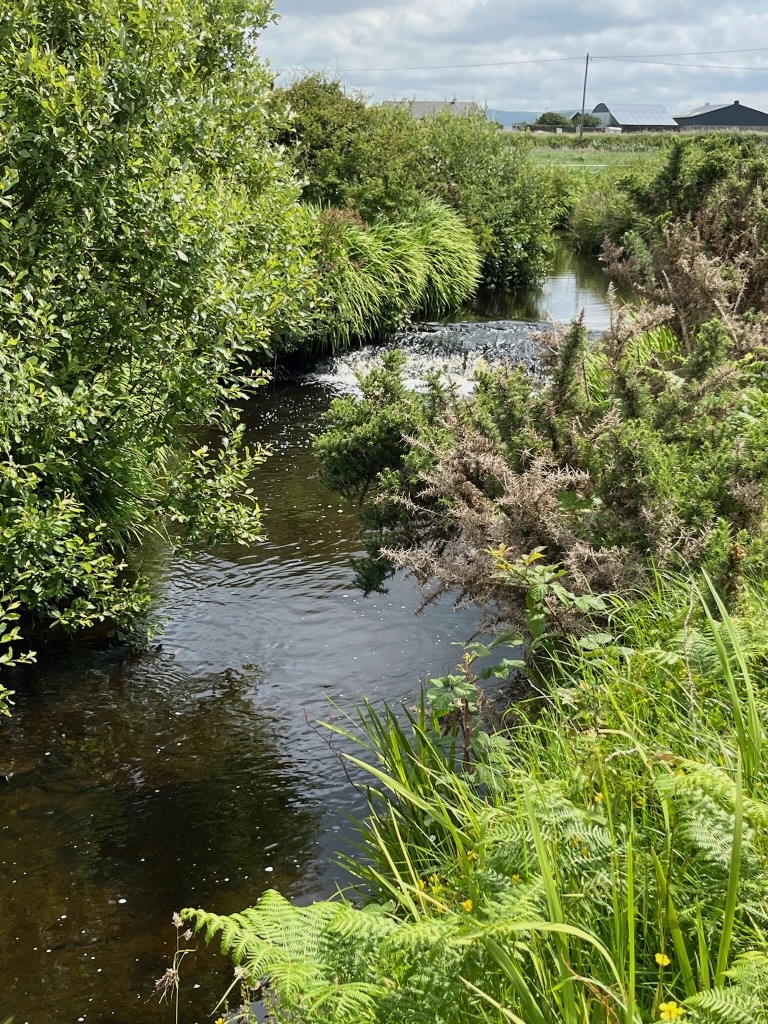
annagh river at kildimo south, my ancestral land, as it flows toward the sea at spanish point

i don’t want to wash it off. instead, i am in that necessary liminal state of in-betweens, when a newfound knowing needs time and space and silence to seep in. when we’re wise to open wide our pores, to fill our lungs, to allow our synapses to affix to new neural pathways. to come to indelible understanding.

if that seems an odd way to describe an adventure, so be it. my days in ireland were so much more than a “trip,” a “vacation,” a “getaway”—banal descriptors for folderol and whimsy, with suitcase attached. instead, my days in dublin, cork, and county clare were something of a journey in its deepest form: a coming to know someone, some place, i’ve always known but not yet fully met. and that someone, in fact, was me. a deep-down part of me long stirring, long felt, but not yet seen in fine focus. as if untold parts of me longed to know from whence they came. and not just my affinity for cloudy days and wit and poetry. and why i feel the hand of God so profoundly in the morning’s mist, and the moonbeams’ amber glow.

or maybe it was propelled by a yearning never sated, a yearning my whole life long to know the people from whom i sprang. the grandmother whose stories have stirred me from the start. the father who spoke so little of his past, and whose answers to my questions died when he breathed his last in 1981.

maybe my search was a daughter’s reaching for the hem of her father’s cloak. to run my fingers along its nubby threads, to stitch in quilt squares where the cloth had worn too thin. maybe there is something of longed-for re-union in my diligent tracings of ancestral ties and tales. maybe my father is who i try still to reach.

and then there’s the radiant present, the crucible of time that amplifies the here and now, the intense knowing that each and every hour is a gift, and before it ends, i intend to magnify the time, to expand the boundaries of my heart, to leave tracings on the ones i love so that my imprint might not fade so quickly. so that some part of me forever lingers in the one place where it matters: their blessed hearts.

i remember, in the darkest turns of these past two years, and especially at the turning of my latest birthday, how deep the wish i made, when i closed my eyes and drew a deep, deep breath, one that filled my lung and a half. i wished with all my might for precious time with my boys, time huddled close, time punctuated with the percolations of laughter without end. time punctuated with the sort of silence that is sodden even its wordlessness, because you know each other so well, so adoringly, you’ve room for time inside the vault of your own thoughts.

my wishes, every one of them, came tumbling true in the trek we took these past eight days, returning to the homeland of my soul, my spirit, my way of being. 

in that uncanny way we can reach across time, reach into a past that was not ours, i’ve long felt that tugging cord to my grandma anna mae, the kentucky schoolteacher whose papa, thadius shannon, hailed from the granite house at annagh bridge, in county clare, on the wedge of land squeezed between the confluence of the annagh and the kildimo rivers as they flow into the sea at spanish point. 

to press my sole onto that soil, to walk the land and listen to the rush of water playing over rocks, to do so with my boys at my side, and my God shining down and through me, was to feel bathed and baptized in life as sweet as it allows. 

it’s too soon, really, to step back and make sense of all of it, so at this just-home stage i’ve little but a mosaic of moments i’ll not forget, and which i’m scrambling to scribble onto the page in hopes of holding on for a good long while. among the litany i’m pressing to my heart, re-looping through the sleepless jet-lagged night, there are these: 

awaking on a rain-sodden morning when the country lane was still puddled, and the branches dripping diamond-like droplets of morning drink, and stepping into the soundscape of magpie and rook and lowing cows and calves. the whir of the milking machines beginning to rumble before the roar. 

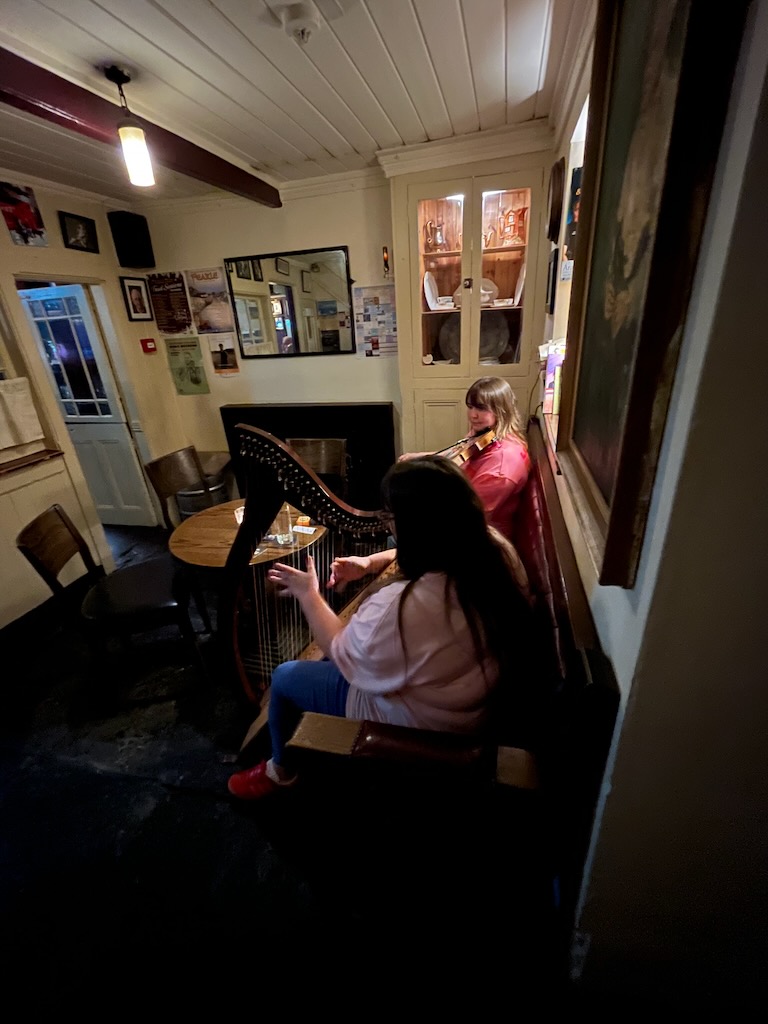
arms that reached out to wrap me in the minute i knocked on the door and introduced myself as a long-lost cousin, no questions asked. the rounds of drink at the pub that night where we gathered to tell tales above the lilt of harp and fiddle. and the hilarity of the cousin who moaned, “oh jezus!” when i asked if they might have a prosecco. and when i leapt into the self-mockery right along with her, she continued on, “you’re in a pub in a wee town, jezus, what are ya thinkin’?” or words nearly to that effect. 

driving down country lanes that turned like corkscrews (in fact one set of directions included the name “corkscrew hill,” and i feared dear blair’s heart might skip a beat or two, if not pause altogether), and threaded through ancient arbors where branches on each side of the road reached out to join hands.

the plates of food that arrived with herbs from the sea and tendrils of sweet pea, the butter from cows who sleep in the fields, under stars and moon each night and chew the sweet grasses by day, the fish you imagine leapt from streams just beyond the kitchen where little more than heat was put to flesh. 

the hilarity and wit. of just about everyone. from the taxi drivers in dublin to the tattoed and multi-pierced fellow clearing away your luncheon plates.

the charms of signs like: “matchmaking goat farm.” do they matchmake goats or give you a choice? a mate or a goat, your pick. (photo to come!)

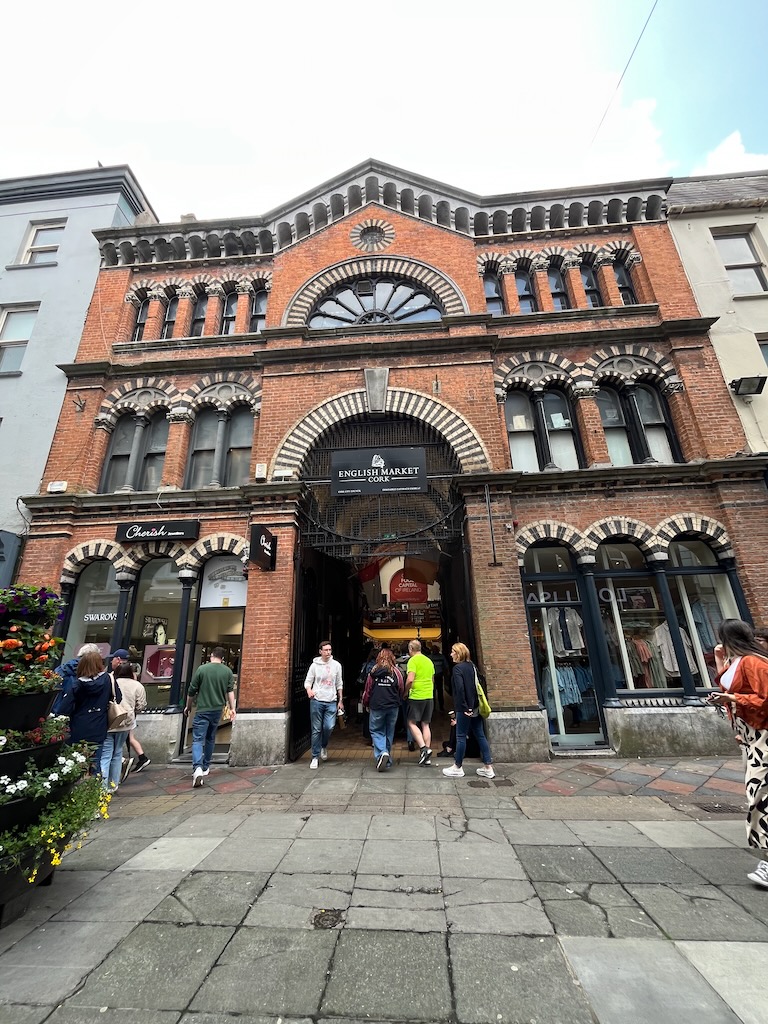
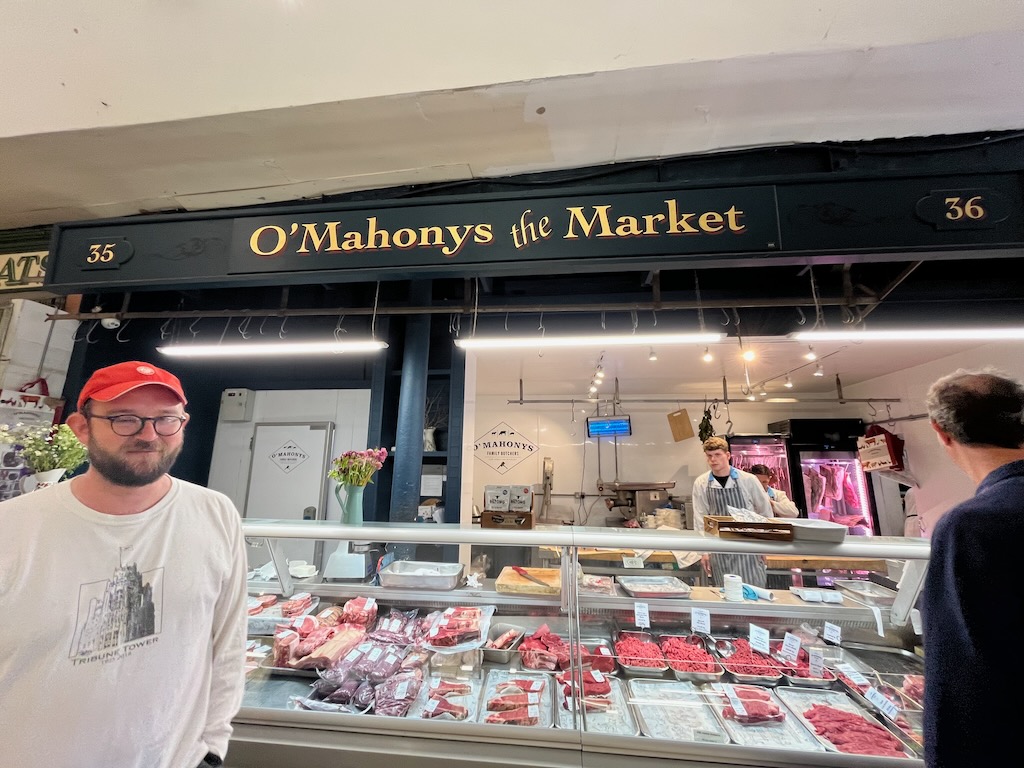
the english food market in cork, a veritable labyrinth of fresh-from-the-earth-and-sea delicious. a butter chicken pie in a crust so flaky the only apt desciption, according to what i witnessed in the expressions of my boys, might be (excuse my language) “orgasmically delicous.” 

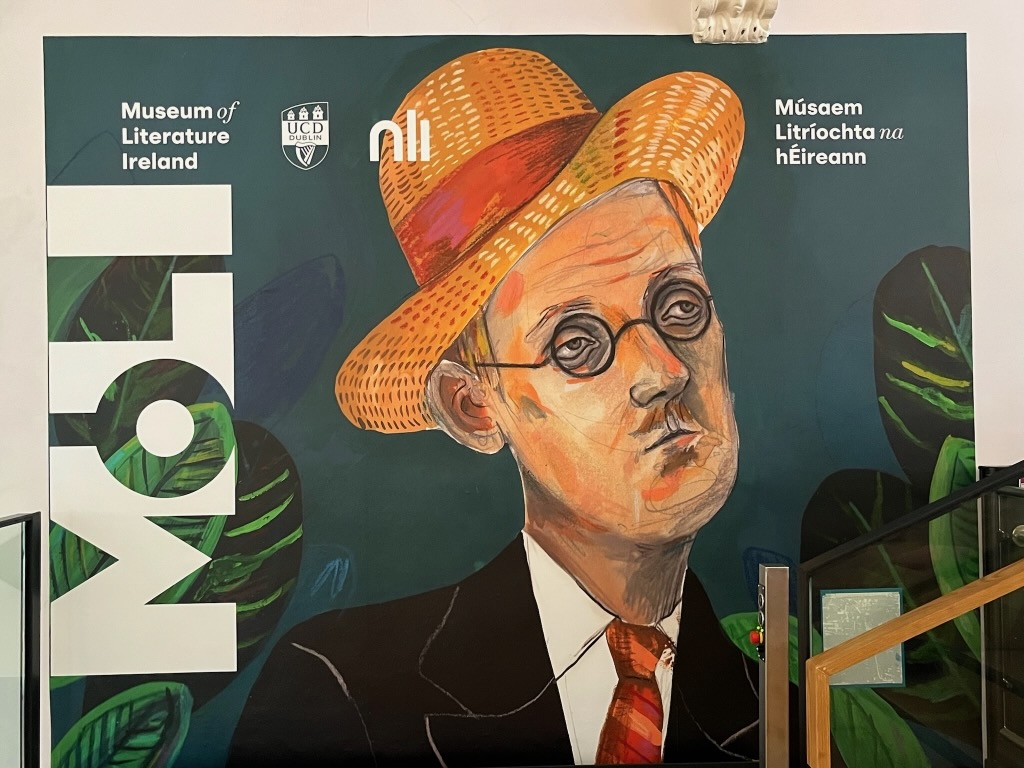
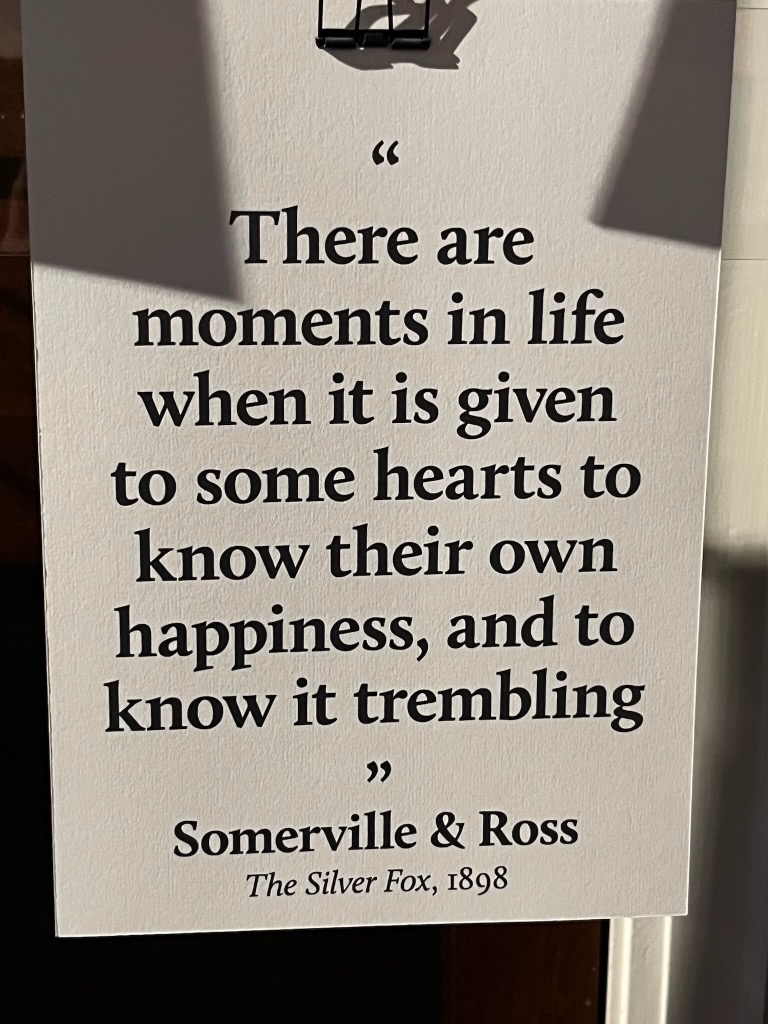
a whole museum that heralds words, and language, poetry and wit, the Museum of Literature Ireland, where Copy Number One of Ulysses basks under glass, and whole rooms are filled with epigraph upon epigraph, one of those rare places on the globe where human language and its infinite configurations are held up as priceless treasure. 

the straight-from-a-storybook propietor of the Dublin pharmacy, Sweny, where on page 88 of Ulysses, in the chapter “Lotus Eaters,” Leopold Bloom buys his lemon soap. the drippingly elegant gent who, upon barely-whispered request, broke into Gaelic song while sipping from his vat of burgundy wine on the eve of Bloomsday. 

i’ll turn it over here to a bit of Joyce and his telling of Sweny’s:

“The chemist turned back page after page. Sandy shrivelled smell he seems to have. Shrunken skull. And old. Quest for the philosopher’s stone. The alchemists. Drugs age you after mental excitement. Lethargy then. Why? Reaction. A lifetime in a night. Gradually changes your character. Living all the day among herbs, ointments, disinfectants. All his alabaster lilypots. Mortar and pestle.”

seán of seán’s bookshop

the bookseller Séan in Milltown Malbay, the town from which my people hail, whose shelves near collapsed under the weight of thousands upon thousands of tomes, with that telltale musty smell of words embalmed in ancient ink, and dusts of time a welcome attribute. 

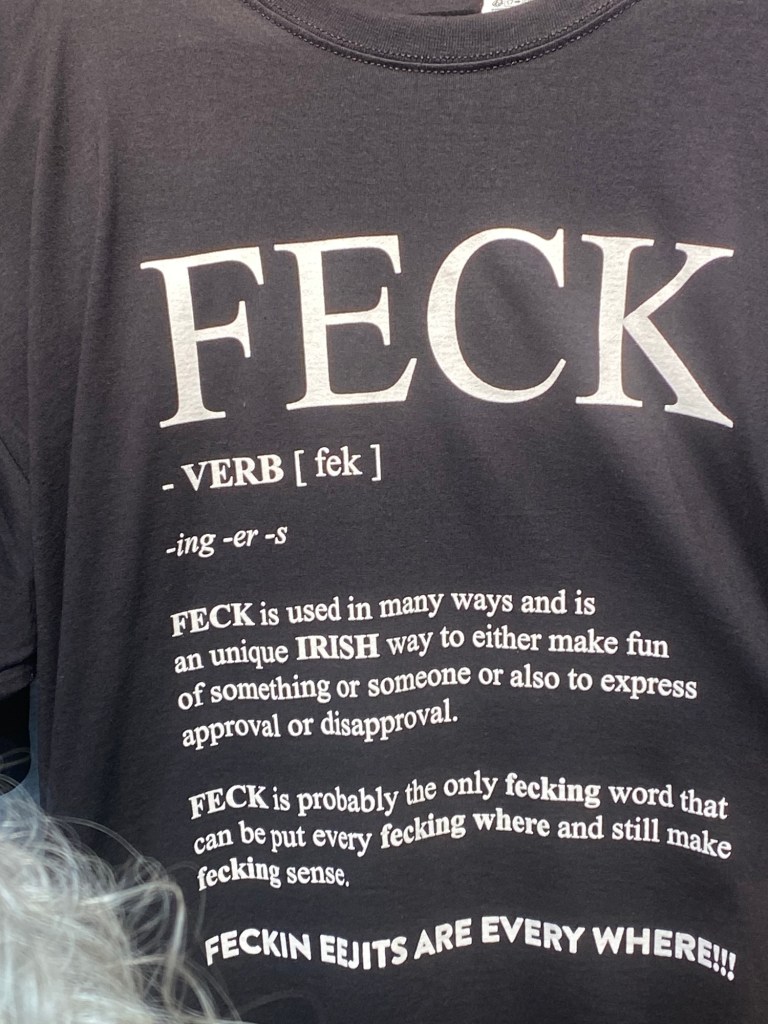
the countless times we heard the sympathies for us pitiable americans who at the moment seem to find ourselves under the rule of the “feckin ijeet.” eye rolls every time only served to emphasize the point. one cousin told us they keep keen eye on news from america as if it’s real-time soap opera leaping from the daily news. 

the infinitely comforting knowing that 45 years after my first and only other trek to the land of forty shades of green, it’s truly not too changed. sure, there are homes built bigger and sturdier than i’d seen before, but ancient thatched roofs are not a rarity, stone walls still scythe the hillsides, a geometric grid that bespeaks hard labor never shirked and an undying reliance on the old ways, and town centres present row after row of storefronts in kaleidoscopic colors, no pink too pink, no purple or orange too vivid. as one new friend, a poet and old irish professor, told us: in a land so gray, a language rife with wit, and a townscape of vivid palate is but necessity. 

my friend Tadhg Ó Dúshláine, poet, writer, professor of Irish

and i shall let my poet and professor friend tadhg close us out here with these words sent to me upon our arrival home….

It’s just after 8.00 a.m. here in West Kerry, as I look out at the sun rising over the top of Mount Brandon, the holy mountain of the Navigator, across the bay of Smerwick Harbour (google Battle of Smerwick). The ebb and flow of the sea and the steadfast reassurance of the mountain reminds us that the flux, change, coming and going, restlessness, which is part of the human condition, is reflected in the sea; just as our eternal destiny is represented by the mountain, to which we lift up our eyes, in the awesome wonder of faith and hope. At times like this I embrace Isaiah’s vision: ‘… and they shall beat their swords into ploughshares’, le cúnamh Dé.

Bíodh lá maith agat agus fan slán.

                                                                         Tadhg.

may you too take the necessary journeys of your heart and soul.


while away, i got notice from my little library that a book i’d requested was waiting on the “hold shelf,” and before i got back in the door, i began to read. it is so fine a read, i am leaving it here on the table should you be poking around for a summer wonder. a new read: raising hare: a memoir, by chloe dalton, described as “a moving and fascinating meditation on freedom, trust, loss, and our relationship with the natural world, explored through the story of one woman’s unlikely friendship with a wild hare.”


and whilst in the little town of milltown malbay (pop. 921), from where my people hail, we stumbled into Seán’s Bookshop, an emporium of well-read books all but falling off the shelves, and curated by a bookseller with twinkle in his eye, and tales to tell till midnight sundown. there, i plucked a tome from a poet i’ve read too sparsely till now. the book, rapture, by carol ann duffy, winner of the 2005 t.s. eliot prize, is aptly described (per the irish times): “brilliant, beautiful, and heart-aching.” here’s but one of its beauties:

p.s. happy blessed birthday this sunday to my most beloved firstborn, and law professor, will. soon to be teaching within a morning’s drive away, at the university of notre dame law school, another dream come true, prayer answered, and holy wonder for all time.

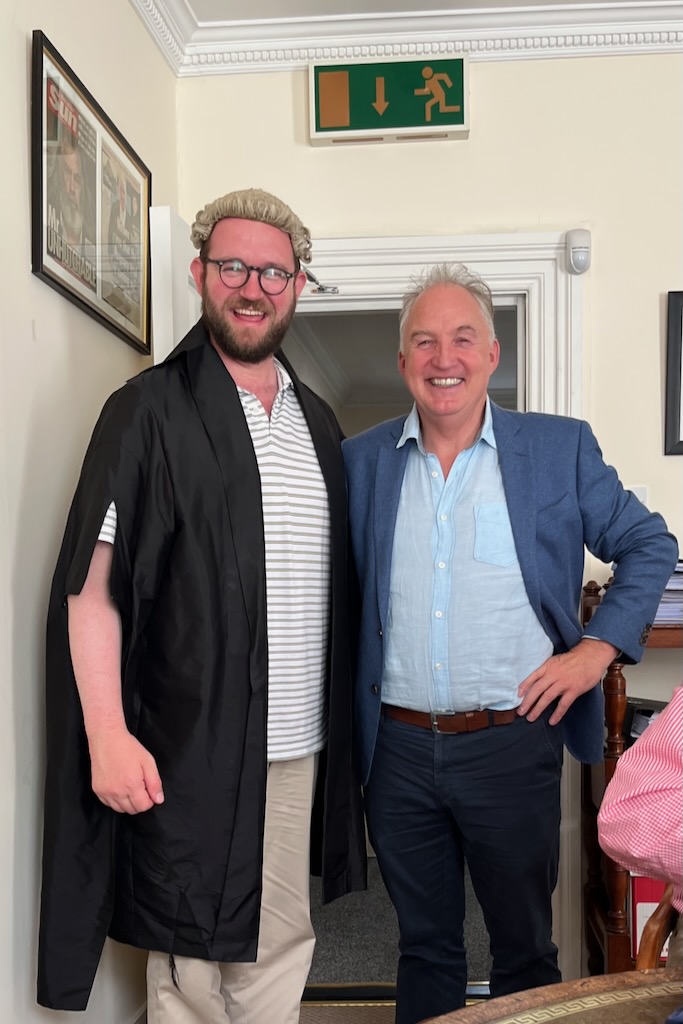
sweet will with one of ireland’s top barristers, brendan grehan, who shared his silks and wig for the occasion.

what journeys home have called to you, those taken or not yet taken?

and may the full sunlight of the solstice warm you and bring radiance to your soul….

Big Gulps

Never mind sips. This is for gulping.

I shan’t often begin with an image de moi but this is not usual time. This is unusual. As in extraordinary. As in pinch-me, this-could-be-heaven time.

Bliss would be a word for it. Bliss defined as when all variables in an equation perfectly align: three boys + one mama + Dublin, capital of the Land of 40 Shades of Green = Bliss. Then square it. And square it again. Getting close.

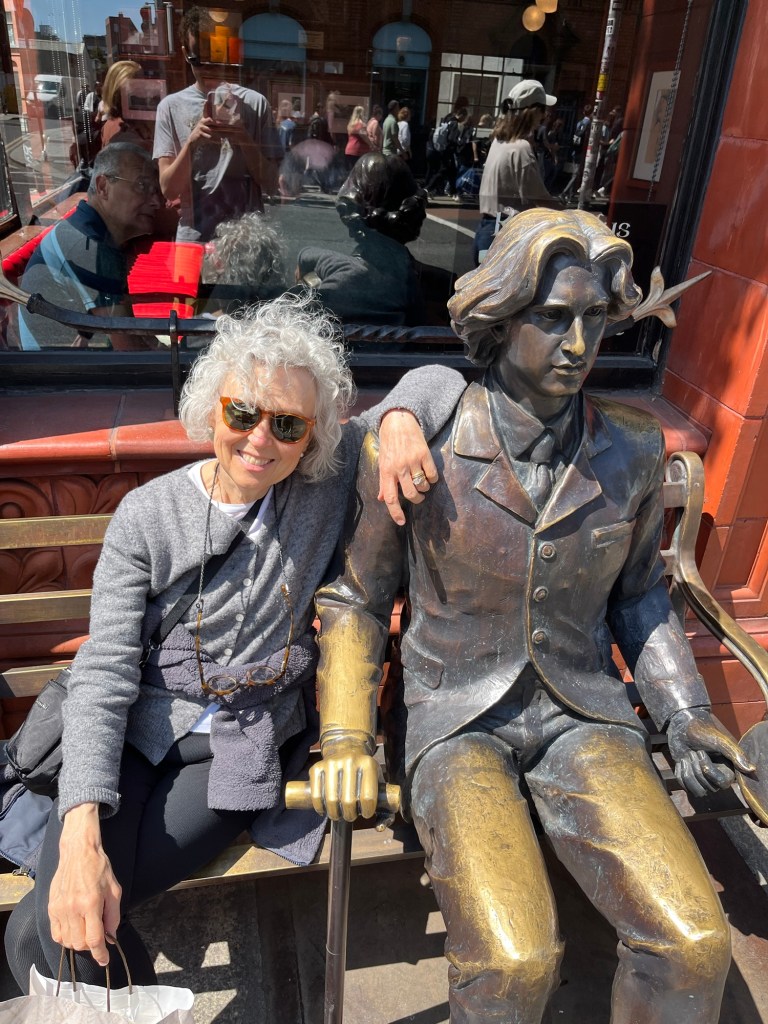
It’s only been a wee few days but oh what we’ve all squeezed in. Joyce (of course; we’re here for Bloomsday it turns out, and the city is teeming with folks dressed as if they’ve just stepped out of Ulysses, June 16, 1904) and O. Wilde, whom I bumped into on a city bench.

Oscar & me

Add to that pair, a stunning afternoon absorbing epigraphs at the Museum of Literature Ireland, miles and miles of strolls through greenswards like this:

And hilarities that come every other syllable in a land that flows with wit and gab.

It’s the gift of living in the crucible of time. You’re compelled by holy ordinance and keen attentiveness to squeeze each succulence from every blessed morsel.

And so I gulp and gulp. I whisper undying thanks and memorize the moment, pressing all this wonder, all this love, into the cockles of my heart.

Before I dive into another Dublin day, a short picture reel:

The Winding Stair Fish Plate
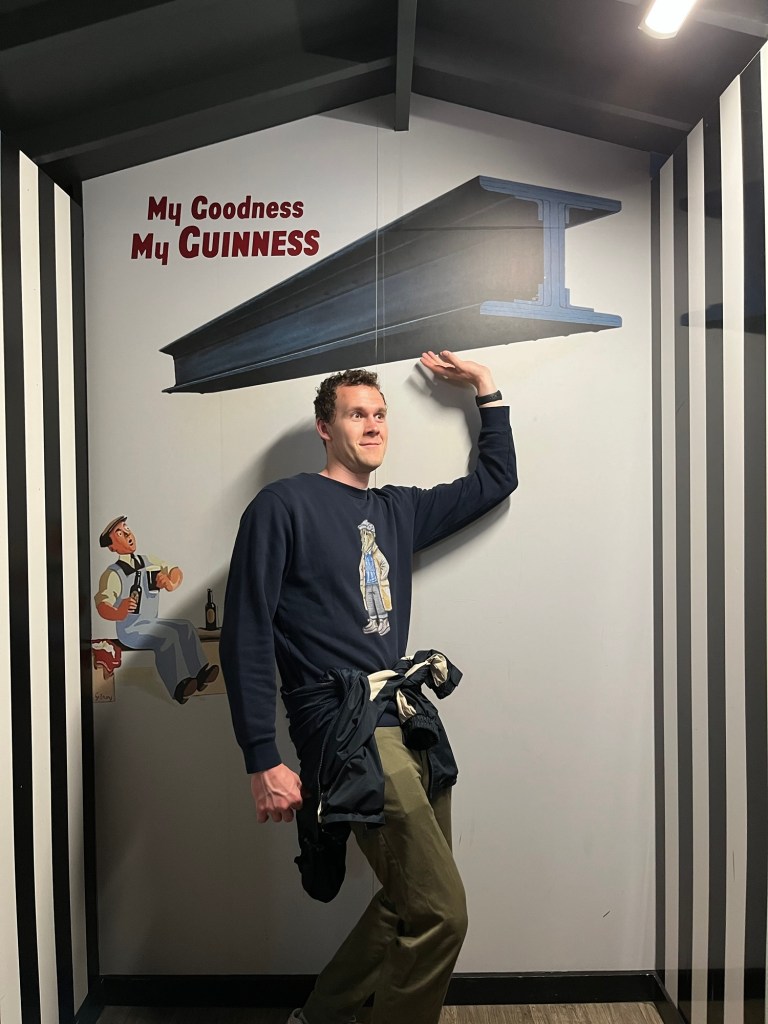
My Goodness, indeed.
A word heard in abundance. I’m importing this new derivation.
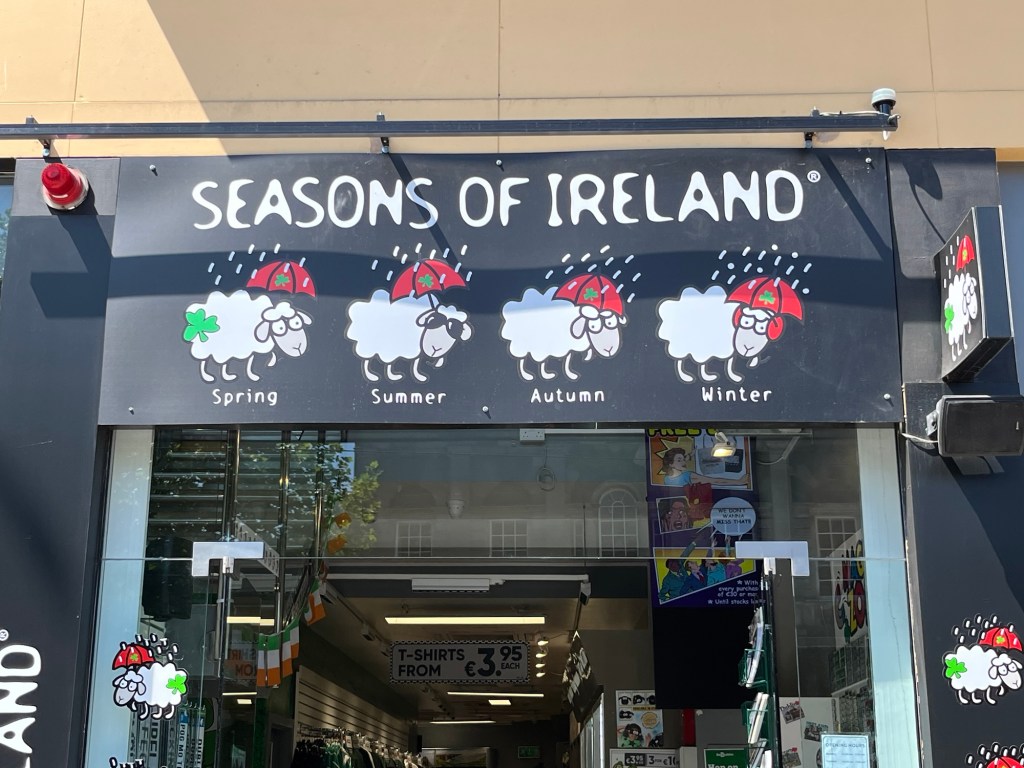
A peoples not averse to poking fun wherever possibility lies.

And I don’t even mention Evensong in St. Patrick Cathedral, nor the intoxicating tour of the Guinness Storehouse, nor fish and chips in Dublin’s most ancient pub (1198), nor the coterie of cabdrivers we now count among our friends.

But when I gulp the most—voraciously and with all my soul—is nothing more astounding than sitting round a table, or strolling hand in hand along a winding path with the boys who grew my heart as big as big could be.

May your day too be blessed in big big gulps or the sweetest sips to ever wet your lips.

Love from Dublin 2.

Your Babs.

this poem is more than enough

i promised some iteration of a summer reading club, as in the days of yore when a little card at the public library was slipped in an envelope and marked with an empty grid, and for every book i slipped off the shelf, carried home to devour, the lovely librarian rewarded me with an ink-stamped icon of summer. an ice cream, a fish, a globe of the world. a deep-sea diver. each, a trophy for tucking myself away in the summer’s quiet, blocking out even the buzz of the vexatious mosquito, and turning page after page—finding myself in the big woods, the little house on the prairie, mary’s secret garden, or robert louis stevenson’s pages and pages of rhyme. 

to garner an ink-stamp for adventuring away, for riding the winds of farflung imagination, was over-abundance defined. the reading, the being carried away, the learning to trust the deep powers of my mind’s true colors, that was the abundance. the gift. the one i’ll never surrender. 

ever since those bicycling-to-the-library summery days, for me the span between the last and the first school bells of the year has long been synonymous with hours unspooled within the wingspan of a book. 

the world we live in today doesn’t always require wingspans. sometimes what beckons us is flat on a screen and glows space-age eerie against the darkness. sometimes the words that stir me most in a week are words i’m able to copy and paste, words plucked from the cyberletters that waft my way. 

and in those cases, this summer reading club might become more of a book report club, in which i bring to the table the one single snippet that most caught my breath in the week. this week it’s one single poem. a poem from one of my true lifelines—andrea gibson, the queer activist and poet with an ovarian cancer deemed incurable two years ago. she reminds that though the soul is my true work in progress, the thing i pray is alive into the forever, in whatever form that will be, the vessel into which it’s been stuffed is mighty miraculous too. 

i’ve never quite given my physical being enough credit. i’ve not paused to marvel at many parts of it, save for the five digits extending from each palm, gobsmacked at however that ingenious appendage was wholly imagined, evolved. that we can pick up a slip of paper, or a rose petal fallen to the ground, that we can hold the hand of the one we love, or the stranger whom we know is afraid, is trembling, is nothing short of divine genius. 

the priest who along with a rabbi amid our tiny city garden was blessing our newborn firstborn once gave a teaching focusing our attention on the genius of the elbow, a hinge without which we’d ever be at arm’s length, unable to bring a fork to our own mouths, or button our buttons, or zipper our zippers.  

it’s ironic that for as desperately as i want my old resilient heart to keep lub-dubbing, and my little air sacs to keep being my wee vital accordions, expanding and whooshing the air in and out, as much as i think of those majordomos, i forget the rest of the bodily wonders: the way eyes crinkle when they’re in the thick of a heart-melting smile; the way the tears know just how and when to fall; that stubby little toe that in fact keeps us from toppling. . .

andrea gibson

andrea, though, as do all the best poets, makes us pause to pay attention. holy attention. to the quirks and the nooks and the crannies, the history told through flesh, bones, and sinew. and all the overlooked bits: the loose tooth of long ago, the goosebumps over the years, the boing in our hair we once tried to hide. andrea makes us take note of how holy, how blessed, these chipped, wrinkled, creaky old soul vessels truly are. the infinite ways our multiple parts—incidental and otherwise—have carried us through the years.

to do so, she puts the soul into the driver’s seat and allows it to look back, longingly, lovingly. and along the way, directs our attention. . .

here’s andrea:

For the Days I Stop Wanting a Body

Imagine when a human dies the soul misses the body
Actually grieves the loss of its hands
And all they could hold
Misses the throat closing shy
Reading out loud on the first day of school

Imagine the soul misses the stubbed toe
The loose tooth
The funny bone
The soul still asks
“Why does the funny bone do that?
It’s just weird.”

Imagine the soul misses the thirsty garden cheeks
Watered by grief
Misses how the body could sleep through a dream
What else can sleep through a dream
What else can laugh
What else can wrinkle the smile’s autograph
Imagine the soul misses each falling eyelash
Waiting to be wished
Misses the wrist screaming away the blade
The soul misses the lisp
The stutter
The limp
The soul misses the holy bruise
Blue from that army of blood rushing to the wound’s side
When a human dies
The soul searches the universe for something blushing
Something shaking in the cold
Something that scars
Sweeps the universe for patience worn thin
The last nerve fighting for its life
The voice box aching to be heard

The soul misses the way the body would hold another body
And not be two bodies but one pleading God doubled in grace
The soul misses how the mind told the body
“You have fallen from grace.”
And the body said, “Erase every scripture that doesn’t have a pulse
There isn’t a single page in the Bible that can wince
That can clumsy
That can freckle
That can hunger.”

Imagine the soul misses hunger
Emptiness
Rage
The fist that was never taught to curl, curls
The teeth that were never taught to clench, clench
The body that was never taught to make love, makes love
Like a hungry ghost digging its way out of the grave
The soul misses the un-forever of old age
The skin that no longer fits
The soul misses every single day the body was sick
The now it forced
The here it built from the fever
Fever is how the body prays
How it burns and begs for another average day

The soul misses the legs creaking up the stairs
Misses the fear that climbed up the vocal chords
To curse the wheelchair
The soul misses what the body could not let go
What else could hold on that tightly to everything
What else could hear the chain of a swing set and fall to its knees
What else could touch a screen door and taste lemonade
What else could come back from a war and not come back
But still try to live
Still try to lullaby

When a human dies the soul moves through the universe
Trying to describe how a body trembles when it’s lost
Softens when it’s safe
How a wound would heal given nothing but time

Do you understand
Nothing in space can imagine it
No comet
No nebula
No ray of light can fathom the landscape of awe
The heat of shame
The fingertips pulling the first grey hair
And throwing it away
“I can’t imagine it.”
The stars say
“Tell us again about goosebumps.
Tell us again about pain.”
—Andrea Gibson

you can watch andrea read it here.

what might your soul miss about your beautiful body?

and before i shuffle off, happy blessed day to two true loves of this ol’ chair: amy from illinois, as she was first made known to me, and nan P, who’s been the beating heart of the tenderest, bravest moments for years beyond years. one of you passes the birthday baton to the next, and a pairing as sweet it’s hard to imagine. love to you both, and bless these beautiful days in which we dwell on the light you bring to this world. 

in a very few days, my sweet boys and i fly to the island of my dreams, the land from which i feel my ancestors calling so deeply. i’ll be in dublin when i next write. see you from there. i’ve been teaching myself irish for months, and will be meeting up with a professor of irish poetry, who mostly writes in what we’d call “old irish,” so i need to keep practicing, thus: beannachtí. (blessings.)

(these summerly trips with the boys the past few years all fall under the category “live your dreams while you can.” bless the little legs and the lungs that will carry me there…..i hope to fill those wee air sacs with the holiest breath the coast of ireland offers…)

finishing school

i suffer from a common ailment. especially among a certain breed of bibliophile. i don’t finish. i start, enthusiasms drawing me in like ink to a blotter. pages are turned. pens pulled forth and margins scribbled with scrawl. and then another seductress comes along. another delectable enticement: author. idea. or merely a title.

and it happens all over again. 

i’m talking books, of course. and my long-held habit of starting and stopping. 

start. stop. rinse. repeat. 

crack open the binding, turn pages, ink it all up. add to the pile. the towering, toppling, could-knock-me-out-if-it-fell pile of books. 

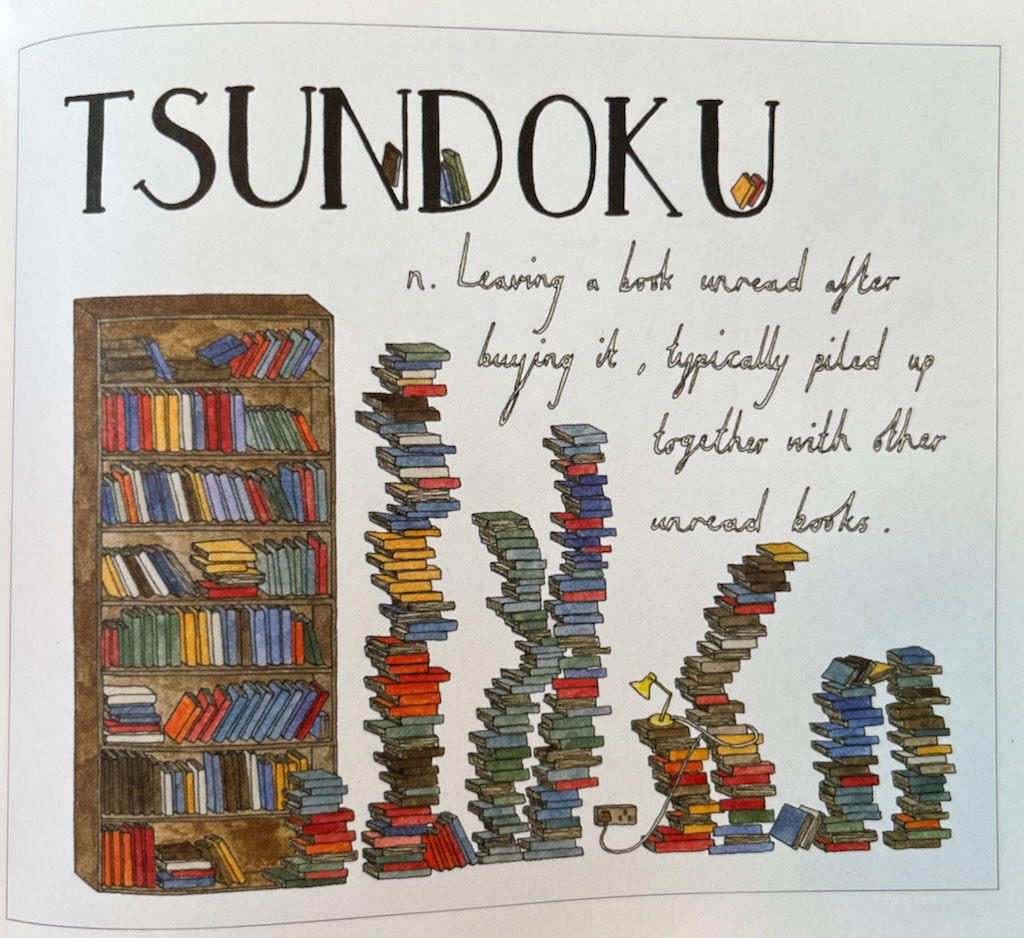
there’s a name for the ailment: tsundoku. (積ん読)

it’s the japanese word meaning, quite literally, “reading pile.” nowhere in the definition—“the phenomenon of accumulating books but not reading them”—would you find evidence of the lethal nature of said phenomenon (ten books falling on your nose will leave a dent). nor the drip-drip-drip of guilt that accumulates every time one sashays past said pile and fails to move forward in a page-turning way. 

so i’ve hatched a plan, an antidote to what ails me. i call it finishing school. i shall, in the summer months ahead, the months when the sun is strong and summer sounds abound, commit to a single purpose: one by one tracking my way toward the last sentence of at least some of the many books piled on my nightstand, my reading nook, my writing room floor, and most any other horizontal plane sturdy enough to hold a vertical biblio-ascension. 

by virtue of this determination to see literary arcs through to the end, i shall be relieving all of you of the task of checking in on the chair to see what’s astir. i am intending to post mostly what leaps off the pages, as i plod along through plots, poetries, and otherwise paradisiacal paragraphs. 

i envision something of a commonplace summer reading adventure, in which we all can chime in with any ol’ ‘graph or line that makes your heart thump, or your eyes fill with tears. 

my summer’s focus will be more reading than writing, at least here. 

the writing portion of my summer will apparently have me bent over the keyboard tapping out pages for a new project i’m not yet free to chat about. there’s an end-of-summer deadline, i do believe, so i’ll be burning up the keys to make that happen. and my refueling time will be spent deeply in reading. in finishing, specifically. 

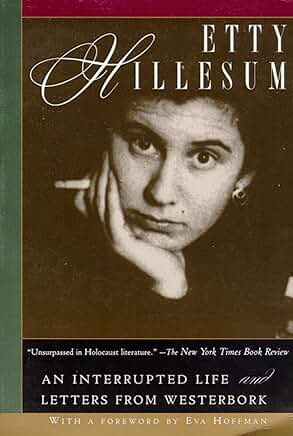
i plan to officially begin my finishing school with a book that’s tugged at me for years, one i started and loved, and truly need to wade deeper into. it’s etty hillesum: an interrupted life and letters from westerbork. begun in 1941, nine months after the netherlands fell to hitler, it’s the epistolary journal of a young dutch jewish woman who traces the darkening shadow of the nazi presence in her homeland as well as her own moral awakening before her death at auschwitz in november of 1943. it seems as essential a book in my stack as any there is. and i’m committing to etty.

back in 1986, in a review of the book in the new york times, michiko kakutani wrote this: 

“All Holocaust writings, of course, must deal with the inadequacy of words in the face of events that defy the imagination, but while Miss Hillesum frequently speaks of her inability to convey the awful magnitude of events around her, she proves herself a most eloquent witness to history—a witness whose grave yet shining testimony attests to the resilience of the human spirit in the face of incalculable odds.”

it seems a book for this moment.

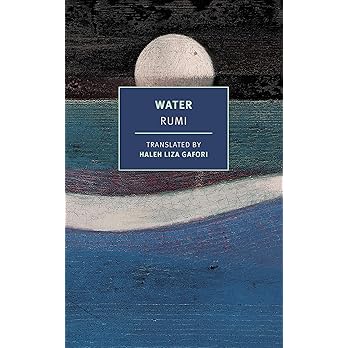
and even though the official starting bell hasn’t chimed, i tiptoed into my project this week by reading start-to-end not one but two magnificent poetry collections: water, by rumi, translated from the farsi by haleh liza gafori (new york review book classics), the second volume of gafori’s translations of the thirteenth-century persian poet (the first one, unfinished but in my pile, of course, was gold, acclaimed for its fluid rendering of rumi’s lyric ecstasies). water’s essence is Love, capital L, gafori writes in her introduction, in which she claims: “Love is a 360-degree embrace of creation, a compassionate acceptance of what it…Love is our unobscured essence, at the root of the root of all creation…Above all, Love is a practice.” 

and but one line that took my breath away in the poems themselves, was this: “Come or go, Love told me, / I am here, closer to you than the vein in your neck.” 

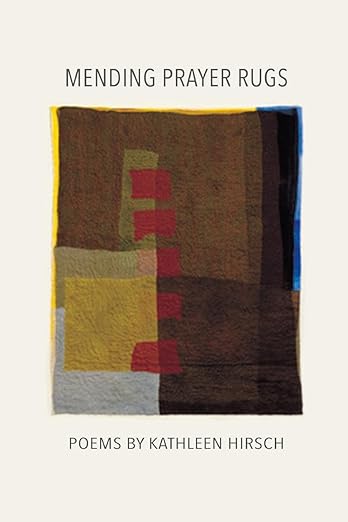
and the second collection of poems i gulped down, start to finish not once but twice, was a book i bumped into quite by accident and whose author immediately swooped into the inner circle of kindred spirits. it’s titled mending prayer rugs, poems by kathleen hirsch (finishing line press), and this collection mines the sacred amid the quotidian, with a particular focus on women of prayer, women whose wisdom is hard-won, be they women from the Bible, craftswomen, workers, wanderers or women we recognize from among our own generations.

in her opening poem, “prayer rug,” hirsch (a longtime journalist and spiritual director) writes in the voice of a woman i imagine with gnarled knuckles and fading eyesight, the cost of a lifetime spent pulling needle and thread through the tatters of prayer rugs for those who prostrate in prayer: “I bend in blessing toward all that breathes: / May each hour enlarge the pattern— / rose dawn, wind song, tender shoot of faith— / that I may see the weft of the hidden weaver.

the weft of the hidden weaver. another name for the Unnameable One. it is the metaphors of poetry that catch the breath in our throats, and frame our seeing anew.

lines such as this, a line that had me choking back tears in a poem titled, “in the end”: “Kiss the light / before it dies / leave those you love / the heirlooms of your passion, your gratitude, your tears.” 

i envision a magical summer. 

straight through to the end. 

will you read along?


a subtly transgressive little poem from the bard of the bluegrass state:

The Hidden Singer

The gods are less for their love of praise.
Above and below them all is a spirit that needs nothing
but its own wholeness, its health and ours.
It has made all things by dividing itself.
It will be whole again.
To its joy we come together –
the seer and the seen, the eater and the eaten,
the lover and the loved.
In our joining it knows itself. It is with us then,
not as the gods whose names crest in unearthly fire,
but as a little bird hidden in the leaves
who sings quietly and waits, and sings.

+ Wendell Berry

p.s. a bit more on tsundoku: The term combines “tsunde-oku” (積んでおく), meaning “to pile up ready for later and leave,” with “dokusho” (読書), meaning “reading books”. 

a note: i’m sensing we all need to shake off some of the routines of our lives that begin to feel too confining, and i don’t ever want the chair to feel that way. so my intention is to be a little bit looser about it, but still to leave faint tracings here on the table, should you happen by. summer for me has long been synonymous with reading, and thus a reading project. feel free to bring your favorites.

when writerly rabbit holes swallow you whole….

in which a writing assignment, one that’s wholly captured my imagination, has taken over my gray matter (the stuff inside my head, not the pewter hairs that spring from it), and precluded most any other human activity—save for the occasional re-fueling at the cookstove to keep from puddling to the floor, famished. and for which i’ve shared my simmering salvation down below…

excuse me while i type over here. i seem to have fallen down-down-down into an engrossing writerly rabbit hole, and as the week’s worn on, i’ve only found myself burrowing deeper and deeper. it’s been a while since i’ve chased a thread of idea down to where the earthworms wriggle and the bunnies make hutches. and while i admit that my inner mad-scientist might be vividly on display here, in the way that i can’t put down my wild-eyed pursuit, there is a preponderance of joy stirring the madness. 

i love chasing ideas. love untangling cognitive threads. discovering new ways of thinking i’d not known of before. love when one read leads to another and another. and then it’s my task to slice it, and dice it, and make it all make sense. extra points if it comes out poetic.

i’ve been a rabbit-hole writer as long as i’ve been slapping verbs and nouns into sentences. back in high school, i decided to write a mega theme paper on the misuse of wealth in america, and pretty much took hostage the dining room table for weeks on end. if anyone wanted easter dinner that year, they were going to have to shove aside my teetering stacks of tomes chronicling the gatsby brigade of modernday over-conspicuous consumption. years later, when the tribune set me off on a cross-country steinbeckian journey, zigzagging the continent from the deep woods of maine to the pacific northwest and plenty of points between, chronicling stories of hunger in america for a 10-part series, i distinctly remember my editor, a rumpled import from the new york times, sauntering over to my cubicle and insisting i unchain myself from my keyboard to at least stand under a shower, or swim a lap in a pool, long enough for one or two big ideas to snap into place. i was never much for taking breaks. 

granted, writing that way might have been bad for the eyes and tough on the spine and the wrist, but i kept at it (one night, in the thick of telling a murderous tale, my writing partner and i took turns falling asleep on a very fat phone book). until i birthed a wee child. and said child insisted on eating. and i was the source, the one and only. swiftly realizing that typing while nursing had its drawbacks, i reluctantly succumbed to the art of the pause. 

lo and behold, i discovered epiphany. 

amazing things happen in the chambers of the mind when you stop hard-charging the thoughts. when you allow a synapse to slow to a pokier pace. 

more often than i wish to admit, some elusive sentence has snapped into place while rinsing a plate under the faucet. and a sugarplum of a word has skydived in from seeminly nowhere. so i’ll concede that there’s virtue in lifting my head from the writerly hole.

but now that this old house is mostly empty again, there’s no stopping me. except that there is still one other mouth to feed. (fear not, he feeds himself well and is happy to do so on the nights i relinquish my post at the cookstove.) and besides, chopping and stirring, i’ve found, provides fine syncopation for the drumming of thoughts while assembling an essay.

soup by the kettleful is my solution. all it takes is one afternoon of onion slicing, garlic mincing, and the tossing in of a few other things. and by nightfall, and the night after too, you’ve got plenty to slurp from your bowl. 

my ode to autumn, lemony white bean soup with turkey and tuscan kale, is what i bring you this week with the promise that it is utterly, perfectly, shlurpably delicious. it comes, as so much of my best cooking does, from my very fine friends at NYT Cooking, one of the perqs of seven-day-a-week home delivery, the last house this side of the block to still believe in turning actual newsprint pages.

Lemony White Bean Soup With Turkey and Greens
By Melissa Clark
Total Time 45 minutes

INGREDIENTS
Yield: 4 servings

3 tablespoons olive oil
1 large onion, diced
1 large carrot, diced
1 bunch sturdy greens, such as kale, broccoli rabe, mustard greens or collard greens
1 tablespoon tomato paste
3⁄4 teaspoon ground cumin, plus more to taste
1⁄8 teaspoon red-pepper flakes, plus more to taste
1⁄2 pound ground turkey
3 garlic cloves, minced
1 tablespoon finely grated fresh ginger
1 teaspoon kosher salt, plus more to taste
1 quart chicken stock
2 (15-ounce) cans white beans, drained and rinsed
1 cup chopped fresh, soft herbs, such as parsley, mint, dill, basil, tarragon, chives or a combination
Fresh lemon juice, to taste

PREPARATION

Step 1: Heat a large pot over medium-high for a minute or so to warm it up. Add the oil and heat until it thins out, about 30 seconds. Add onion and carrot, and sauté until very soft and brown at the edges, 7 to 10 minutes.

Step 2: Meanwhile, rinse the greens and pull the leaves off the stems. Tear or chop into bite-size pieces and set aside.

Step 3: When the onion is golden, add tomato paste, 3⁄4 teaspoon cumin and 1⁄8 teaspoon red-pepper flakes to the pot, and sauté until paste darkens, about 1 minute. Add turkey, garlic, ginger and 1 teaspoon salt, and sauté, breaking up the meat with your spoon, until turkey is browned in spots, 4 to 7 minutes.

Step 4: Add stock and beans, and bring to a simmer. Let simmer until the soup is thick and flavorful, adding more salt if needed, 15 to 25 minutes. If you like a thicker broth, you can smash some of the beans with the back of the spoon to release their starch. Or leave the beans whole for a brothier soup.

Step 5: Add the greens to the pot and simmer until they are very soft. This will take 5 to 10 minutes for most greens, but tough collard greens might take 15 minutes. (Add a little water if the broth gets too reduced.)

Step 6: Stir herbs and lemon juice into the pot, taste and add more salt, cumin and lemon until the broth is lively and bright-tasting. Serve topped with a drizzle of olive oil and more red-pepper flakes, if desired.


and because even amid my mad musing this week, i still found myself melted by poetry, i bring you this beauty…

End of Summer

An agitation of the air,
A perturbation of the light
Admonished me the unloved year
Would turn on its hinge that night.

I stood in the disenchanted field
Amid the stubble and the stones,
Amazed, while a small worm lisped to me
The song of my marrow-bones.

Blue poured into summer blue,
A hawk broke from his cloudless tower,
The roof of the silo blazed, and I knew
That part of my life was over.

Already the iron door of the north
Clangs open: birds, leaves, snows
Order their populations forth,
And a cruel wind blows.
—Stanley Kunitz 

named the tenth poet laureate of the united states in the autumn of 2000, kunitz was 95 at the time. his poetry was said to get richer with age. and one of his lifetime’s most pervasive themes probed the simultaneity of life and death. “it’s the way things are: death and life inextricably bound to each other,” he once explained. “one of my feelings about working the land [as a gardener] is that i am celebrating a ritual of death and resurrection. every spring i feel that. i am never closer to the miraculous than when i am grubbing in the soil.” he once told the new york times: “the deepest thing i know is that i am living and dying at once, and my conviction is to report that dialogue. it is a rather terrifying thought that is at the root of much of my poetry.” kunitz won the pulitzer prize in poetry in 1959. he died in 2006. (boldface emphasis mine…)

“my conviction is to report that dialogue. . .” and thus is the reason writers fall into rabbit holes…


i was looking high and low for a roz chast cartoon of a madwoman pulling her hair out, for illustrative purposes above. but, alas, i could not find. though ed koren’s wild-haired woman did come in a close second, and in the end i opted for the wanna-be writer above, courtesy of mr. koren…

see you next week when if all goes well i hope to tell you the story of how i got myself a new name last week, and a hebrew one at that…

in the meantime, are you, like me, one who prefers to tie on the blinders and not come up for air till the task is completed, or are you of the sort who finds that leisurely attending to a task makes for all-round saner existence? 

of pickled onions and a particular fondness for kentucky’s homegrown farmer bard

wendell berry

in which the somnolence of summer has settled into its seasonal adagio so much so that pickling a red onion or two, and slow-reading the poetries and musings of one wendell berry is as fever-pitched as it gets around here. welcome to my slo-mo world of the week.

it started when i stumbled on the poem below, a poem that captures the quietude of a couplet of humans who’ve breathed in unison for so long they can fill the silence richly. so it is here in this old house of late, where only two of us now reside. where we know the choreography of most days by heart. and come and go as in a wordless waltz. there’s an ease now, one i never imagined, as i balked mightily long ago about the idea of two lives squeezed under one roof and in a labyrinth of too-tight rooms. but over time, across all these years (near 33), the respirations of our souls have aligned, at least enough to feel our echo in the lines below. those lines, by wendell berry, the poet, novelist, and conservation farmer whom i count as one of my heroes, were just enough to take me down the rabbit hole that is the life and work of kentucky’s homegrown literary treasure. and, besides, mr. berry’s birthday was this week, the fifth of august, wedged, it so happens, between the birthdays of two of the three humans whom i count as pillars holding up my world and whose arrivals to the planet are marked across the week in that steady beat of 4-6-8.

here’s the poem that got me started:

They Sit Together on the Porch
By Wendell Berry

They sit together on the porch, the dark
Almost fallen, the house behind them dark.
Their supper done with, they have washed and dried
The dishes–only two plates now, two glasses,
Two knives, two forks, two spoons–small work for two.
She sits with her hands folded in her lap,
At rest. He smokes his pipe. They do not speak,
And when they speak at last it is to say
What each one knows the other knows. They have
One mind between them, now, that finally
For all its knowing will not exactly know
Which one goes first through the dark doorway, bidding
Goodnight, and which sits on a while alone.

i shared the verse with the one with whom i share these walls, and he wrote back that he found it “haunting,” which made me see the lines anew. and was just enough to prompt a bit more poking around, again reminded how much i love the poetries that come with accumulated lifelong wisdoms. and that’s where i then re-bumped into this 2019 dispatch from the new yorker, a days-long interview between bard and scribe, one distilled and put to paper. it’s worth a read in whole (link below will take you straight to it), but i’ll pluck a few parts should your summer’s day demand a snappier pace than mine (or should a paywall keep you out):

the dispatch, titled Going Home with Wendell Berry, is by amanda petrusich, a new yorker staff writer and writer-in-residence at the gallatin school of individualized study at NYU. a 2016 guggenheim fellow, she writes often about music, and blessedly for us she takes the occasional road trip down kentucky way. in this case, she wound her way to where berry’s farmed for more than four decades, a little town that goes by the name port royal. sixty-three miles from the dot in the blue-grass map my papa called home (paris, KY), and one mile from the meandering kentucky river, it’s a town you might think ol’ garrison keillor pulled from his imagination. (in 2010, its population, according to the U.S. Census, was all of 64 humans.) it’s a town one writer (sandra mcCracken, a singer-songwriter) described thusly (and not too surprisingly given the threadworn quilt that is rural america these days): “Port Royal is a patchwork strip of storefronts, a blink-and-you’ll-miss-it sort of spot made up of a local bank, a post office, a general store with a built-in diner (with little printed signs about their town’s famous author, Wendell Berry), and an old Baptist church. I am sad to report that, like most small towns in our country, Port Royal looks as though it is dying.” 

here’s how the new yorker‘s chronicling of that luscious conversation between journalist (petrusich) and poet (berry) begins:

Two and a half years ago, feeling existentially adrift about the future of the planet, I sent a letter to Wendell Berry, hoping he might have answers. Berry has published more than eighty books of poetry, fiction, essays, and criticism, but he’s perhaps best known for “The Unsettling of America,” a book-length polemic, from 1977, which argues that responsible, small-scale agriculture is essential to the preservation of the land and the culture. The book felt radical in its day; to a contemporary reader, it is almost absurdly prescient. Berry, who is now eighty-four, does not own a computer or a cell phone, and his landline is not connected to an answering machine. We corresponded by mail for a year, and in November, 2018, he invited me to visit him at his farmhouse, in Port Royal, a small community in Henry County, Kentucky, with a population of less than a hundred.

Berry and his wife, Tanya, received me with exceptional kindness, and fed me well. Berry takes conversation seriously, and our talks in his book-lined parlor were extensive and occasionally vulnerable. One afternoon, he offered to drive me around Port Royal in his pickup truck to show me a few sights: the encroachment of cash crops like soybeans and corn on nearby farms, the small cemetery where his parents are buried, his writing studio, on the Kentucky River. Berry’s connection to his home is profound—several of his novels and short stories are set in “Port William,” a semi-fictionalized version of Port Royal—and his children now run the Berry Center, a nonprofit dedicated to educating local communities about sustainable agriculture. Our correspondence would continue, but, before I left, Berry gave me a broadside letterpress of his poem “A Vision.” I think often of some of its final lines, which clarify, for me, what it means to truly know a place:

Memory,
native to this valley, will spread over it
like a grove, and memory will grow
into legend, legend into song, song
into sacrament.

here’s but one of the questions captured from their conversation (with a few lines in bold for emphasis):

Q: Have you always farmed here?

A: Right away, we had a large garden, and we kept two milk cows. We fattened two hogs to slaughter, for our own meat. We had a flock of chickens. And we had some fruit that we produced ourselves, and some that was wild. We were sitting down during that time to a lot of meals that came entirely from under our own feet by our own effort. And our children came up in that way of living. The integration of the various animals and crops into a relatively small acreage becomes a formal problem that is just as interesting and just as demanding as the arrangement of the parts of a novel. You’ve got to decide what comes first, and then you work your way to the revelation of what comes last. But the parts also have to be ordered. And if they’re ordered properly on a farm, something even more miraculous than most art happens: you have sustainability. Each thing supports the whole thing.

and here’s another exchange:

Q: It’s funny, clarity is often undervalued in art. One of the things I admire about your writing, especially the essays, which feel like polemics, is that you’re very clear in your arguments. They’re beautifully supported. In the new book, you talk about how you often read seeking instruction. I’m curious how you balance that idea with reading for beauty, savoring the visceral pleasure of words.

A: You’re being fed in an essential way by the beauty of things you read and hear and look at. A well-made sentence, I think, is a thing of beauty. But then, a well-farmed farm also can feed a need for beauty. In my short story “The Art of Loading Brush,” when Andy Catlett and his brother go to a neighbor’s farm, there’s a wagonload of junk, and it’s beautifully loaded. Andy’s brother says, “He couldn’t make an ugly job of work to save his life.” In the epigraph I use from Aldo Leopold he questions if there’s any real distinction between esthetics and economics.


and here, in case you’re even a little bit hooked, is a poem worth reading in whole. it’s from a 1965 volume of Poetry magazine, and it’s excerpts from an early Berry wonder, titled, “The Handing Down,” a poem about a grandfather and grandson sitting on a porch and the quiet conversation that unspools between them. read those excerpts here.


oh, and about those onions. . . my kid, the one who turned 23 yesterday, finds himself a line cook these days at a chicago eatery of some notoriety; girl and the goat, it’s called, and stephanie izard, who dreamed up the joint seems to have a particular fondness for things pickled. she pickles everything from kumquats to mushrooms to beets. i decided pickled red onions might be a summery thing to do, and besides i like a little crunch amid the strata of my sandwich. and, as with many a task in my kitchen, i pickle the easy way. no cauldrons steaming for me. no sterilizing jars and lids. i dumped a little of this, stirred in some of that, and by next morning, i had a jar of garnet rings shimmering in my fridge. i’m not fond of sugar these days (i never was, and then a dear friend told me cancer is fond of sugar, making it something of a foe of mine, thus i’ve perma-sealed my lips to sugar’s sweetness), so i searched for pickling roadmap that steered clear of the sugar bin. here’s what i found: (and ps i have no real clue what whole30 compliant means, so feel free to disregard.)

what captured your fancy this week, quick-clipped or slow?

all these years later

forty-four cakes. three-thousand-two-hundred-seventy-eight candles. that’s how many cakes and candles we’ve missed since my papa died in the winter of 1981. i counted it up because today would have been his 96th birthday. he didn’t make it past 52. 

all these years later the second of august is still a day i remember.

i remember the sunny sunday mornings when honeydew melon and handmade cards were strewn at his place at the dining room table, birthday brunch a step-up from the requisite eggs, bacon, and toast after ten-o’clock mass. i remember, in the preambles to birthday dinner, the glistening of his pewter mug, summer’s sultry humidity meeting the cold of his ice cubes and tonic and gin. the quarter of lime floating canoe-like near the rim. eight-minute burgers on the grill, corn on the cob littering all of our chins. 

i remember his laugh. 

much, though, fades.

i can’t remember the sound of his voice. or the way he called me barbie. i remember a few lines, but not the ones my brothers often remember. i remember the time he told me he’d prayed and prayed and could not understand why he was driving me to the hospital. i remember the time, driving home from my college graduation, when he told me he’d felt his mother right beside him when they called out the names of those who, like him long before, were graduating with highest latin honors, and he watched me rise from my seat in the crowded arena. 

i remember how one late summer’s afternoon he called me from the office and asked me to meet him for burgers on the outdoor cafe of a place called jerome’s in lincoln park, a place he deemed “kicky.” my papa liked things that were “kicky” or “cool.” my papa, born of a locomotive engineer and a country school teacher in little bitty paris, kentucky, never shed the marvel of being a big-city ad man in the heady era of Mad Men and martini lunches and sixty-second commercials whose jingles and cutlines stoked the soundtrack of america’s bell-bottomed woodstock-and-watergate age. my papa liked to travel the globe. to give speeches in sydney and meetings in munich. he liked his corporate apartment in mid-town manhattan. he loved new york city. a place he never wanted to move us; he’d moved his moptop crew too many times, he and my mama agreed. one more uprooting might do us in. so he more or less made a weekly commute to the big juicy apple.

and home base for all those years was the two-story colonial with all the big trees at the bend in the dead-end lane. he brought the “neat, keen, cool, fab, it’s a blast” to our dutch backdoor, and on in to the big oval table where, at 6:30 sharp each night of the week except for on sunday when we pushed it to 5:30, we sat down for dinner, all seven of us. if there was something new out there in the world, my papa wanted us to know. didn’t matter if it was a word or a box soon to be labeled “hamburger helper.” he was our conduit, our passport, to all that was grander and jazzier than our sleepy little burg one in from the lake. 

those are the things, all these decades later, i still remember––like yesterday. i remember, too, the year after he died when i thought i might never stop crying. how there were nights when i wailed a wild-animal sort of a wail, and bit into my pillow to muffle the sound. i never thought i would know joy again. 

i never thought the ache would stop aching.

but here we are: two kids, a long marriage, and a whole career later. my papa had no idea i––a nurse when he died––would take his and my shared love of words and make a life of it. but the first day i sat down in the chicago tribune newsroom and they told me i needed a password, i knew just what i’d type each time i needed to rev up my desktop computer: my papa’s initials and mine; he was a part of every start to every story. and i never dropped his last name, cuz i wanted my papa to stay in the news. and in print. day after day. byline by byline. 

here’s where i fell short: no matter how many stories i’ve told my boys and the man i love the most, i have not come close to bringing my papa to life. and, believe me, i’ve tried. no story, no matter how animated, no matter the gleam in my eye, can ever, ever come close. the man was a human high-wattage bulb. he was known for his wit. but i remember the tenderest parts. i’ve tried to bring all of it forth over the years. 

but all these years later, it fades. and the truth is, my papa fades too. there’s too much i cannot remember. 

grief and time make for an odd, sometimes cruel calculus. yes, the aching abates most of the time. though the piercing can come and come strong. in a grocery aisle. when a certain song comes on. when you’re trying to tell––or to catch every word of––a particular story. (writing these words here this morning, the tears have come too. if i’ve wallowed in moments, in memories, here, it’s only to make it all last. to live in those moments again.) 

as much as the gasping for air is no longer a part of the grief, so too the frames of a life reel on, and the erasing begins. after so, so many years, you sometimes forget the one who’s no longer there. not always, and not in those crucible moments, when time itself feels condensed and magnified all at once. i too have felt my papa beside me when my firstborn walked a graduation stage; when my firstborn became a professor of law (a profession my papa once yearned for). i’ve watched how tender my so-called “little one” is, especially to my papa’s widow (“grammy” to both of my boys), and i know my papa would melt. but, truth is, ordinary time mostly hurls by, and i don’t remember. and then i might catch myself with a twinge. or i might not catch myself at all. there’s an anesthesia in grief that i never saw coming. maybe it saves us. maybe it’s cruel.

maybe that’s why there are birthdays, even when the someone is gone. especially when someone is gone. they become remembering days. they are days without cakes and no candles. but, in the silent chambers of the heart and the mind and the soul where time knows no rules, those someones return. 

my papa rumbles in me this morning. in the only way i know how, i just brought him back. and i didn’t need to close my eyes, or make a wish, or blow out candles to make it happen.

he’s here. right beside me. in each of these stories. i know it.

happy birthday, dear papa. i love you forever.

at our house, we have an august birthday parade, a 2-4-6-8 of celebrations. so most blessed of birthdays i wish for my brother david (4), my blair(6), my teddy(8). i love you each and all to the moon and mars and beyond.…

tell a story of any someone you miss. any story. any someone. we’ll make this a party.

my papa and me