pull up a chair

where wisdom gathers, poetry unfolds and divine light is sparked…

Category: joy of reading

light and shadow, in perpetual dance

all you need do is glance toward the sky, eyes skimming over the players on high. sunlight and cumulus. sunlight and cirrus. sunlight and nimbostratus. sunlight and cloud ever in play, in duet, in doh-si-doh of shadow and light. 

there’s a truth being told there, a universal and organizing principle of all creation. on the first day, in the second verse, there was darkness, darkness hovering over the deep. in the third verse, light. God commanded it. and God saw that it was good. 

in our lives, the leitmotif is a given. light will come. shadow will follow. light will come again. 

so it was in my reading this week, when first i tumbled deeply into a luminous shaft, a boreen* of writings from a norwegian bishop and monk, erik varden, whose power as a writer was pointed out to me by a poetry friend whose taste i know to be exquisite and deep. i swiftly realized the bishop’s thinking and writing are everything they were billed to be: rare. exquisite. deep. radiant.

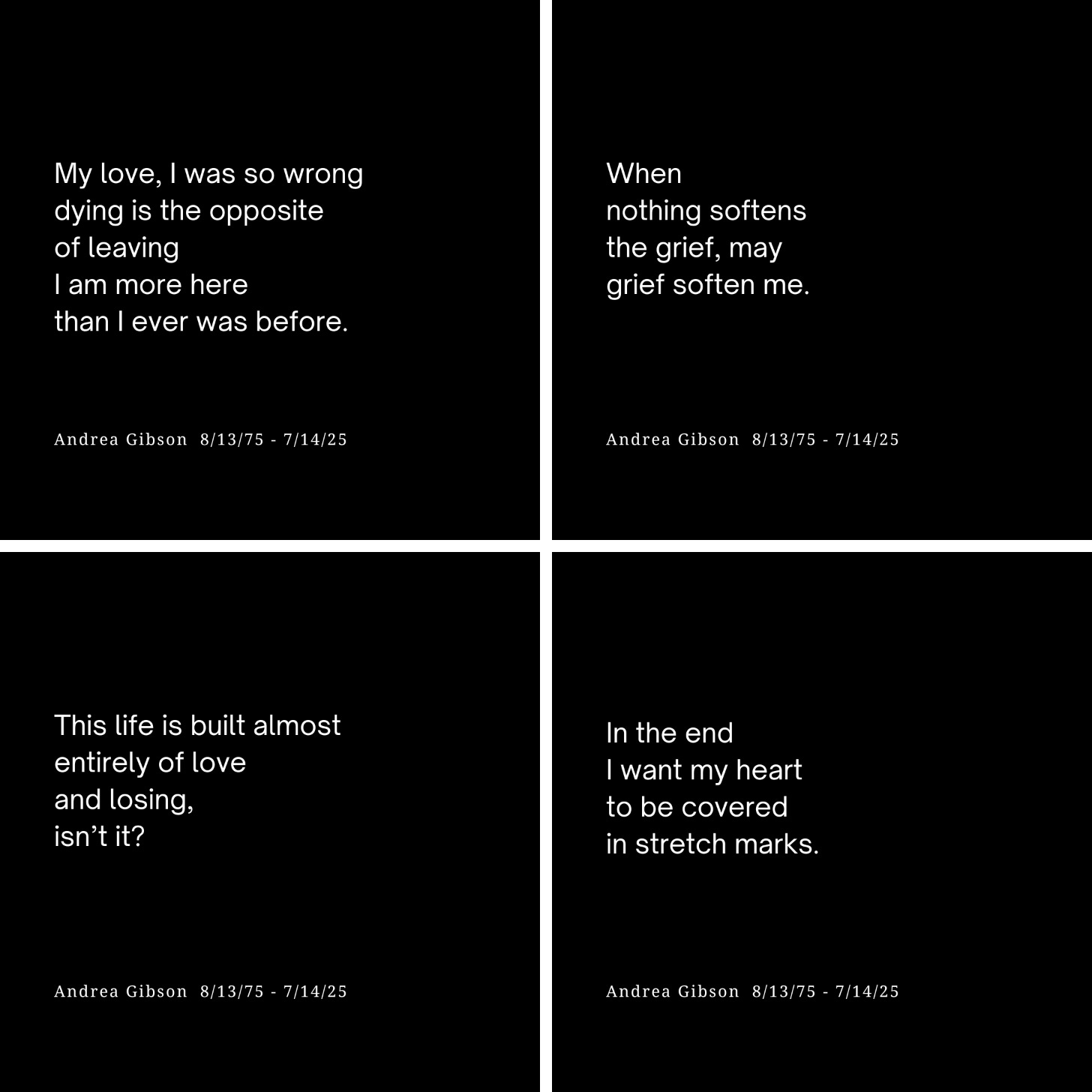
but then, hours later, shadow: i began reading a string of sentences posted from the account of one of my lifeline poets, someone you might call a patron saint of heartbreak and healing, of being more alive than you’ve ever imagined. i started to read, as if it were just another brilliant post: “Whenever I leave this world, whether it’s sixty years from now, I wouldn’t want anyone to say I lost some battle. I’ll be a winner that day.” and then i got to these words: “Andrea Gibson was a winner today. On July 14th, at 4:16AM, Andrea Gibson died…” and my legs stopped moving, and my breath was caught in midstream, and i read and read again. and then my fingers started to tremble, and my knees too. 

andrea gibson

andrea gibson, 49, colorado poet laureate in 2023, queer activist (they/them/their pronouns), who had been diagnosed with stage 4 ovarian cancer in 2021, not long after they’d started a newsletter titled “Things That Don’t Suck,” had many, many times pried open my heart, pulled out the unspoken words and the fears and set them soaring. when i too found out what it is to live with cancer as one of the nouns in my story, i drew andrea into my innermost circle. the ones who know, without you uttering a word, just what you’re thinking, you’re feeling, you’re praying. the ones who some days save you. because even though the cyberworld is distant and intangible, it works in mysterious ways, and someone with whom you’ve never breathed the same air can become someone whose voice you can hear as you flutter to sleep, and whose courage you conjure as they glide you into the sarcophagus that is your biannual CT scan.

light. shadow. light from shadow. shadow deepening light. it’s the dance of the duet, interminably entwined. one is always more beautiful because of the other’s presence, because the duet is perpetual. 

first, this week’s light:

that monk on a bicycle, spotted cycling through the garth just beyond the cloister, is all it took for me to want to whisper my vows, and cycle along. 

as i’m quick to do, i signed up for bishop varden’s website, coram fratribus, a name derived from his episcopal (meaning “of the bishop”) motto, coram fratribus intellexi, latin for “understanding with my brothers.” because the bishop is shepherd of a flock spread across 22,000 square miles in the north of norway, extending beyond the polar circle, he sees his site as a way to speak to the diaspora, to think aloud of those things he finds beautiful or challenging, to gather his flock into a communion of thought. specifically, i felt my heart quicken as i burrowed into the bishop’s collections of writings under the tabs “life illumined,” and the shorter jottings under “notebook,” which he describes thusly: 

“To scribble in the margins of texts is an ancient practice. There are people, these days, who make an academic career out of studying ancient marginalia. Any exercise of reading is fundamentally conversational. The notes collected here are brief responses to impressions received not just through books, but also through encounters, art, music, and films.”

now you see why i, a marginalian of long practice, swoon?

before i get to the paragraph in “life illumined” that drew me deep into thought, let us pause to note why we see that little outline of an owl, in the upper right corner, and hovering over every page of the site. the good bishop describes that choice thusly (emphasis mine from here on in): 

“The emblem of the site is an owl. The owl does not just wing you back to the front page. It has for centuries been a symbol of the monk. Why? Because it watches in the night, when most people sleep; because it is able to see in the dark, discerning movements and patterns, foundations of meaning, where the human eye perceives only vaguely. I am fond of this Italian doggerel:

“Sopra una vecchia quercia
c’era un vecchio gufo:
più sapeva e più taceva,
più taceva e più sapeva.

“In an old oak tree
there sat an old owl:
the more it knew, the silenter it was;
the silenter it was, the more it knew.”

what fluttered into my mailbox the other morning was a page of the monk’s notebook on the nightingale, complete with an ancient poem (from the early middle ages, written by alcuin of york, an adviser to charlemagne) mourning the absence of the wild creature and its delicate throat. a recitation in english and latin, and including a recording of the nightingale’s song. that alone was more than beautiful enough. and then my poking and peeking accelerated, and that’s how, under the “life illumined” tab, i found a break-me-open paragraph on learning to pray.

in an essay focused on the simplicity of jesus’s prayer, and the universal cry of all believers, “lord, teach us to pray,” varden paints the scene of 72 disciples who learned not simply by listening to the words of jesus in prayer, but in witness to his consuming attention to the ways and will of God. varden expounds: 

“Jesus’s teaching on prayer amounted to more than the provision of a text for recitation, that is clear. It was the sight of Jesus praying that made the disciples wish to learn prayer. The words of prayer, which touch our reason and orient our will, point towards the breaking-open of our heart, the transformation of our being as we dare to aspire, even in this life, to ‘become participants of the divine nature’.”

it is the breaking open of the heart, indeed, where the truest serum of our souls pours out. only in the last couple years have i understood that as profoundly as i do now. and, yes, that breaking so often comes with pain, or in pain, or through pain. but i’ve learned now how it truly is the propellent, the force that pushes us deeper into sacred truths than we might otherwise venture. without the breaking open, we might cling to the safer and shallower waters.

the bishop goes on. takes us beyond merely the breaking, and makes the point of its purpose. be it through prayer or through living, the breaking open is the vehicle for those who dare to aspire, in the here and now, to become participants of the divine nature. to inch as close as we can in this lifetime to something akin to sacred. i found a redemptive resonance in that line because at heart, even for the quiet ones among us, we are a people of communion, and there is a heartening, an emboldening, that comes in finding that your purpose, your aim, is not yours alone, but shared in common understanding with at least some of your sisters and brothers.

let us be broken open, then, if it points us toward our holiest purpose. through the break in the clouds, the light comes.

and onto the shadow, the eclipsing shadow…

less than one month shy of her fiftieth birthday, andrea gibson, the poet who boldly faced the coming of her death, who has been amplifying wonder, making us see the unseen, relish the oft-overlooked, took her last breath in the wee hours of monday morning.

i have been relishing her, here and in my everyday, for years now. curiously, her presence in my life spans almost precisely the arc of time in which i’ve been in the company of my own cancer. 

the month before my lung surgery, when the world felt overwhelmingly like the depths of a cave, i wrote of andrea and lines i’d inscribed on my heart: 

thanks to a friend i love with my whole heart, i stumbled on another wise soul with buckets of beauty to grace the world. a poet-activist-performer named andrea gibson, now a cancer survivor whose words might take your breath away. andrea identifies as queer, and uses the pronoun “they;” and they are known for their trademark honesty and bare-naked vulnerability, traits i find irresistible and blessed beyond words. here are just a few lines i couldn’t keep from scribbling down:

when it comes to hearts i want always to be size queen…

i love you because we both showed up to kindness tryouts with notes from the school nurse that said we were too hurt to participate….

when your heart is broken, you plant seeds in the cracks and pray for rain.

before i die, i want to be somebody’s favorite hiding place, the place they can put everything they know they need to survive, every secret, every solitude, every nervous prayer, and be absolutely certain i will keep it safe. i will keep it safe.

andrea gibson

and nearly a year ago, in a musing about scan time’s equal measures of shadow and light, i shared lines that kept me from drowning.

and just a little more than a month ago, i wrote about them and a poem i called more than enough:

yesterday, thursday, this slipped into my mailbox from andrea’s wife, meg:

A couple years ago, Andrea said, “Whenever I leave this world, whether it’s sixty years from now, I wouldn’t want anyone to say I lost some battle. I’ll be a winner that day.”

Whatever beast of emotion bucks or whimpers through you right now, I hope you can hold that line beside it: Andrea didn’t lose anything. If you had been here in our home during the three days of their dying—if you’d seen dozens of friends drift in to help, to say goodbye, to say thank you, to kiss their perfect face, if you’d felt the love that floored every hospice nurse—you would have agreed. Andrea won.

I won’t sugarcoat the fact that they desperately wanted more time on this planet that they loved so much. This planet of squirrels and romance and basketball and moonlight.

But the time they had was significant, prismatic, and wild. It was full of trampolines and mountain ranges, stage lights and pants-peeing laughter. In their words, they “juiced the sun for every holy drop.” One of the last things they said before dying was, “I fucking loved my life.” Their conviction stunned the room.

If Andrea’s life was a poem (and it was), could there be a better last line?

a little backstory, again from meg: 

In 2021, before the diagnosis, Andrea announced they were writing a newsletter, titled Things That Don’t Suck. A few weeks later, we learned they had ovarian cancer.

At first, Andrea said, “What a terrible time to be committed to writing about what doesn’t suck.” Then, almost immediately, they shifted their perspective and said, “What a perfect time.”

And so, this space was born. Part journal, part poetry, part pep talk, part treasure hunt. It became an archive of Andrea’s ability to find beauty in unlikely places, to wring gratitude from even the hardest hours. A museum of how they danced through their diagnosis, always turning their compass toward joy. It fostered a community they deeply loved.

And Andrea wanted all of it to continue.

meg tells us it will. there are reams and reams of unpublished writings, lines scribbled under the silvery light of the moon on those nights when sleep wouldn’t come. pages poured into volumes tucked away. a memoir, unfinished. half-written poems. a documentary coming this fall. 

and meg promises this: 

And there are stories of our life, and of the last months, that I, as their partner, and as a writer, feel both lucky to carry and uniquely able to tell.

As gut-wrenching, impossible, and tear-soaked as this moment is, I’m grateful beyond measure that they were so prolific. Through their books, their reels, their interviews, their albums, Andrea’s incredible mind will reverberate for a century—I’m sure of that.

and so, in the presence of the bishop monk, and the absence of the poet prophet, we shall go on. awake in the light and the shadow. and the shadow that deepens the light. 


in case you’re curious, a bit more about dear bishop varden:

it was only after absorbing so much of his writing that i circled back to learn a bit of his origin story. 

varden was born into a non-practicing lutheran family in a small village in the south of norway, and would go on to earn a doctorate in theology and religious studies at the university of cambridge, and further study in rome. a convert to catholicism at 19, he was drawn to the monastic life, and joined the mount saint bernard abbey, a cistertian monastery, in charnwood forest, in leicestershire, england. he was called to rome to be a professor of syriac language, monastic history, and Christian anthropology. and two years later, returned to the abbey when he was named its eleventh abbot. and, in 2019, pope francis named him bishop of trondheim, a nearly 22,000-square-mile prelature north of the polar circle in norway.

mount saint bernard abbey, varden’s home monastery, is where the only Trappist beer is brewed in all of England, under the name Tynt Meadow English Trappist Ale. beer to the trappists is no earthly distraction. the belgian trappists have a saying: “Beer should be liquid bread, not coloured water.”

and here’s a morsel, this one on the theology of beer, as spoken at the blessing of the monk’s brewery on st. george’s day, 2018. from Dom Erik’s address:

“One of the fascinating things about beer, is that this (potentially) sophisticated beverage is made of the simplest ingredients. By being refined to manifest their choicest qualities; by being brought together in a favourable environment; by mingling their properties and so revealing fresh potential; by being carefully stored and matured, the humble malt, hops, yeast, and water are spirit-filled and bring forth something new, something nurturing and good, that brings joy to those who share it. Considered in this perspective, the brewery provides us with a parable for our monastic life, with the Lord as virtuoso brewmaster. The Scriptures favour wine as an image of the Gospel – but that is culturally conditioned; beer, it seems to me, is a much neglected theological symbol.” 

*boreen, you might recall from a few weeks ago, is the old irish word for what we might call a pothole, a rabbit’s hole, but in ireland, an island etched with cowpaths, it’s a word derived from a meandering side path when the cow decides to venture off on her own….if language is a cumulative patchwork, boreen is a word now in my lexicon….

you’ll find a veritable font of andrea’s spoken word poems, and writings at their website, andrea gibson.org. spend some good time there.

where did you find light and shadow this week?

incurably circuitous

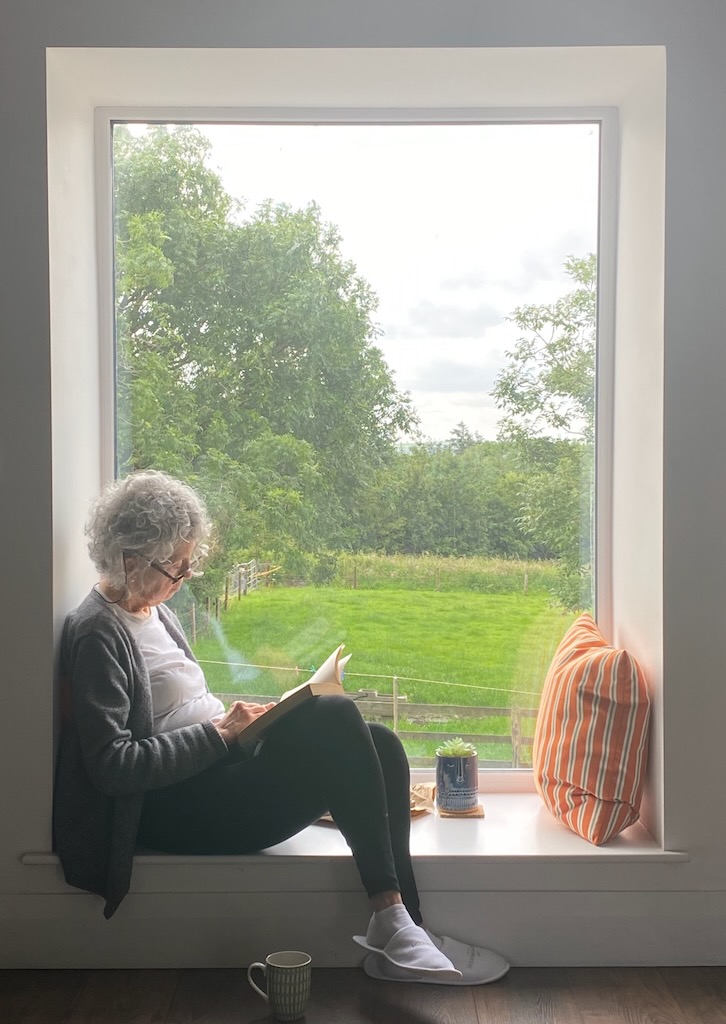
my favorite reading nook in all the world. o’connell’s dairy farm in drumellihy, county clare

i tried. i truly did. it seems i’ve, well, failed. if failed is the verdict we choose to put to the determined effort to concentrate, to focus, to linearly follow page after page.

instead i am a jackrabbit of a reader. i cannot, for the life of me, trace a straight line. one minute i’m attempting ulysses, starting with an easy reader after traipsing the trail of leonard bloom through dublin. another minute i’ve decided pope francis’s slim collected works, against war: building a culture of peace, is the page i need to put to heart. then it’s onto raising hare, a love story so gentle i found it the perfectly prescribed balm in a week when bombs fell and mistruths fired right, left, and sideways.

i know full well that i set out to stick to one and only one tome till i—or summer—came to its end. etty hillesum was going to hold my attention. but my attention didn’t listen. it was distracted. as it so often is.

my irish poet penpal tadhg described rabbit holes, the literary divots i fall into, in charming irish terms not so long back. he makes every word he writes and utters sound poetic or profound, and he fails not here (his description of how it was that my last name leapt out and caught his attention during a morning’s meditation):

“Like the early Irish monks who doodled mystical nature poems on the margins of sacred manuscripts, I was distracted by the spelling of your name and wandered off, as those monks were wont to do (excuse the arrogant comparison), down a boreen (from Irish bóthairín, diminuitive of bóthar, meaning ‘road’, from the Irish ‘bó’, ‘cow’. A meandering pathway made by a cow).”

i am now—especially after strolling country lanes pocked with aftermath of bovine traipsing—inclined to consider my rabbit holes in more bucolic irish terms, and think of them as my boreens, meandering pathways made by my cow mind.  

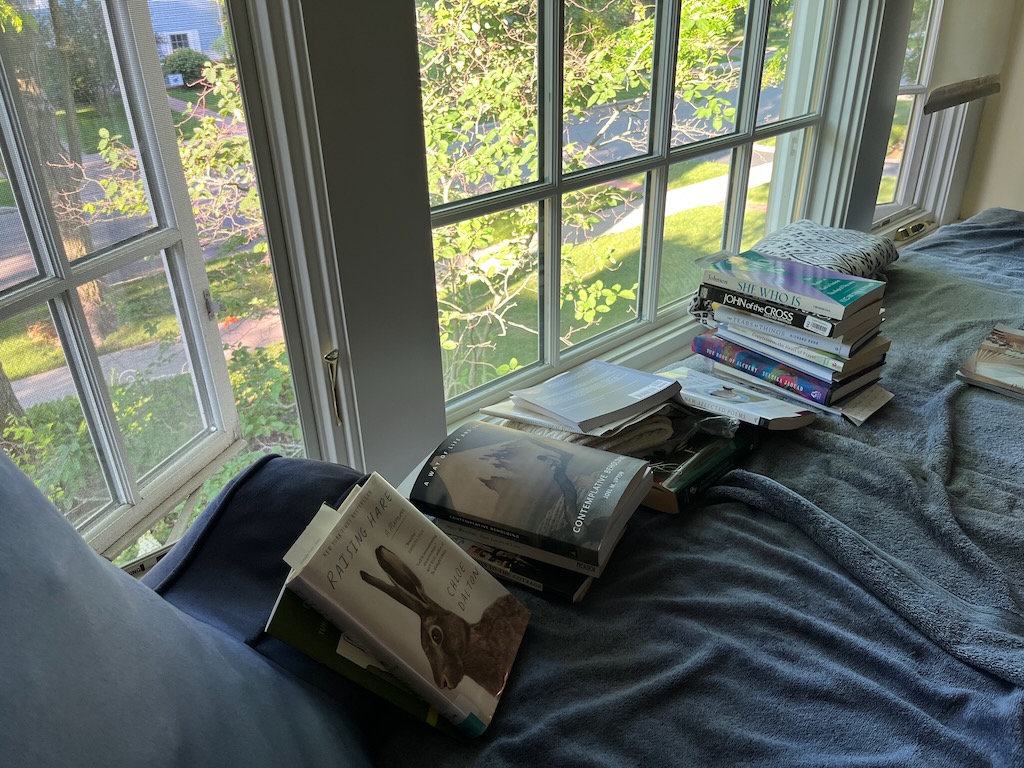
my boreen, in physical form, looks not bucolic at all. in fact, it’s rather a beehive of possible distraction, all piled and teetering hither and yon:

i cannot for the life of me go straight.

besides gulping down my friend tadhg’s glorious meditations on the stations of the cross, i found my nose deep in raising hare (see last week’s mention), and am tucking in my overnight bag practice of the presence, a glorious little tome of translations from one of my favorite saintly souls ever, brother lawrence, whom i think of as the patron saint of pots and pans, though in fact he’s more oft referred to as the friar of pots and pans, and ultimately the friar of amour (love). he’s the humble little monk who toiled fifty years in a monastery, forty of those in the steamy kitchen, and thirty as a sandal repairer (monks wear through their soles on the road to polishing their souls). he described himself, famously, as “a clumsy oaf who broke everything” in his early attempt at being a hermit, and then a footman. when at last he found the monastery at 74 rue de vaugirard, he found his peace and his place.

and in him, i find mine: the gentle, humble soul who finds grace and God in the most quotidian of daily tasks, and spends his hours in the company and comfort of the Author of It All. even in the steamy monastery kitchen.

what’s notable is that dear brother lawrence hated kitchen work, but in his biographer’s writings it’s told that he did it “with the greatest love possible.” and that his practice of the presence of God in the most ordinary of moments, stirring a kettle, pulling trays of bread from the oven, “grew like dew, or mist on mountains.”

the translation i’ve just found, by carmen acevedo butcher, is extraordinary in the fullest measure, and might be the soothingest read yet of this hot summer.

the little monk’s spiritual maxims, work gently, be humble and authentic, includes this boreen (meandering cow path, remember?) on the highest reach of the soul, writing that in true spiritual union:

“the soul is not asleep as in the other unions, but finds herself powerfully stirred. its activity is more intense than fire, and brighter than the sun when not obscured by cloud. we can, however, misunderstand this feeling, for it is not a simple expression of the heart, like saying, ‘my God, i love you with all my heart,’ or other similar words. no, it is an i don’t know what, a je ne sais quoi of the soul, a something indescribable, loving, and very simple, that carries the soul and nudges her to love, respect, and embrace God with a tenderness that cannot be expressed, and that only experience can conceive.”

to this indescribableness, i dive deep. turning page after page. in no particular order. but trusting i’ll find the grace i seek.

may your distractions, too, carry you to lofty heights and voluminous depths. what distracted you this week?

before i go, and scurry off to a writerly retreat at my dear friend katie’s on the lake, i am sending love without end to my beloved friend andrea whose birth we celebrate tomorrow, and who is closing the book on one fine chapter of her life on the same day. i love her dearly. her wit, her hilarity, her unconditional and undemanding love. she is like no other.

there are a few brother lawrence books out there, but the one i’ve just procured and cannot recommend more heartily is carmen acevedo butcher’s, from broadleaf books. you can find it here.

this poem is more than enough

i promised some iteration of a summer reading club, as in the days of yore when a little card at the public library was slipped in an envelope and marked with an empty grid, and for every book i slipped off the shelf, carried home to devour, the lovely librarian rewarded me with an ink-stamped icon of summer. an ice cream, a fish, a globe of the world. a deep-sea diver. each, a trophy for tucking myself away in the summer’s quiet, blocking out even the buzz of the vexatious mosquito, and turning page after page—finding myself in the big woods, the little house on the prairie, mary’s secret garden, or robert louis stevenson’s pages and pages of rhyme. 

to garner an ink-stamp for adventuring away, for riding the winds of farflung imagination, was over-abundance defined. the reading, the being carried away, the learning to trust the deep powers of my mind’s true colors, that was the abundance. the gift. the one i’ll never surrender. 

ever since those bicycling-to-the-library summery days, for me the span between the last and the first school bells of the year has long been synonymous with hours unspooled within the wingspan of a book. 

the world we live in today doesn’t always require wingspans. sometimes what beckons us is flat on a screen and glows space-age eerie against the darkness. sometimes the words that stir me most in a week are words i’m able to copy and paste, words plucked from the cyberletters that waft my way. 

and in those cases, this summer reading club might become more of a book report club, in which i bring to the table the one single snippet that most caught my breath in the week. this week it’s one single poem. a poem from one of my true lifelines—andrea gibson, the queer activist and poet with an ovarian cancer deemed incurable two years ago. she reminds that though the soul is my true work in progress, the thing i pray is alive into the forever, in whatever form that will be, the vessel into which it’s been stuffed is mighty miraculous too. 

i’ve never quite given my physical being enough credit. i’ve not paused to marvel at many parts of it, save for the five digits extending from each palm, gobsmacked at however that ingenious appendage was wholly imagined, evolved. that we can pick up a slip of paper, or a rose petal fallen to the ground, that we can hold the hand of the one we love, or the stranger whom we know is afraid, is trembling, is nothing short of divine genius. 

the priest who along with a rabbi amid our tiny city garden was blessing our newborn firstborn once gave a teaching focusing our attention on the genius of the elbow, a hinge without which we’d ever be at arm’s length, unable to bring a fork to our own mouths, or button our buttons, or zipper our zippers.  

it’s ironic that for as desperately as i want my old resilient heart to keep lub-dubbing, and my little air sacs to keep being my wee vital accordions, expanding and whooshing the air in and out, as much as i think of those majordomos, i forget the rest of the bodily wonders: the way eyes crinkle when they’re in the thick of a heart-melting smile; the way the tears know just how and when to fall; that stubby little toe that in fact keeps us from toppling. . .

andrea gibson

andrea, though, as do all the best poets, makes us pause to pay attention. holy attention. to the quirks and the nooks and the crannies, the history told through flesh, bones, and sinew. and all the overlooked bits: the loose tooth of long ago, the goosebumps over the years, the boing in our hair we once tried to hide. andrea makes us take note of how holy, how blessed, these chipped, wrinkled, creaky old soul vessels truly are. the infinite ways our multiple parts—incidental and otherwise—have carried us through the years.

to do so, she puts the soul into the driver’s seat and allows it to look back, longingly, lovingly. and along the way, directs our attention. . .

here’s andrea:

For the Days I Stop Wanting a Body

Imagine when a human dies the soul misses the body
Actually grieves the loss of its hands
And all they could hold
Misses the throat closing shy
Reading out loud on the first day of school

Imagine the soul misses the stubbed toe
The loose tooth
The funny bone
The soul still asks
“Why does the funny bone do that?
It’s just weird.”

Imagine the soul misses the thirsty garden cheeks
Watered by grief
Misses how the body could sleep through a dream
What else can sleep through a dream
What else can laugh
What else can wrinkle the smile’s autograph
Imagine the soul misses each falling eyelash
Waiting to be wished
Misses the wrist screaming away the blade
The soul misses the lisp
The stutter
The limp
The soul misses the holy bruise
Blue from that army of blood rushing to the wound’s side
When a human dies
The soul searches the universe for something blushing
Something shaking in the cold
Something that scars
Sweeps the universe for patience worn thin
The last nerve fighting for its life
The voice box aching to be heard

The soul misses the way the body would hold another body
And not be two bodies but one pleading God doubled in grace
The soul misses how the mind told the body
“You have fallen from grace.”
And the body said, “Erase every scripture that doesn’t have a pulse
There isn’t a single page in the Bible that can wince
That can clumsy
That can freckle
That can hunger.”

Imagine the soul misses hunger
Emptiness
Rage
The fist that was never taught to curl, curls
The teeth that were never taught to clench, clench
The body that was never taught to make love, makes love
Like a hungry ghost digging its way out of the grave
The soul misses the un-forever of old age
The skin that no longer fits
The soul misses every single day the body was sick
The now it forced
The here it built from the fever
Fever is how the body prays
How it burns and begs for another average day

The soul misses the legs creaking up the stairs
Misses the fear that climbed up the vocal chords
To curse the wheelchair
The soul misses what the body could not let go
What else could hold on that tightly to everything
What else could hear the chain of a swing set and fall to its knees
What else could touch a screen door and taste lemonade
What else could come back from a war and not come back
But still try to live
Still try to lullaby

When a human dies the soul moves through the universe
Trying to describe how a body trembles when it’s lost
Softens when it’s safe
How a wound would heal given nothing but time

Do you understand
Nothing in space can imagine it
No comet
No nebula
No ray of light can fathom the landscape of awe
The heat of shame
The fingertips pulling the first grey hair
And throwing it away
“I can’t imagine it.”
The stars say
“Tell us again about goosebumps.
Tell us again about pain.”
—Andrea Gibson

you can watch andrea read it here.

what might your soul miss about your beautiful body?

and before i shuffle off, happy blessed day to two true loves of this ol’ chair: amy from illinois, as she was first made known to me, and nan P, who’s been the beating heart of the tenderest, bravest moments for years beyond years. one of you passes the birthday baton to the next, and a pairing as sweet it’s hard to imagine. love to you both, and bless these beautiful days in which we dwell on the light you bring to this world. 

in a very few days, my sweet boys and i fly to the island of my dreams, the land from which i feel my ancestors calling so deeply. i’ll be in dublin when i next write. see you from there. i’ve been teaching myself irish for months, and will be meeting up with a professor of irish poetry, who mostly writes in what we’d call “old irish,” so i need to keep practicing, thus: beannachtí. (blessings.)

(these summerly trips with the boys the past few years all fall under the category “live your dreams while you can.” bless the little legs and the lungs that will carry me there…..i hope to fill those wee air sacs with the holiest breath the coast of ireland offers…)

finishing school

i suffer from a common ailment. especially among a certain breed of bibliophile. i don’t finish. i start, enthusiasms drawing me in like ink to a blotter. pages are turned. pens pulled forth and margins scribbled with scrawl. and then another seductress comes along. another delectable enticement: author. idea. or merely a title.

and it happens all over again. 

i’m talking books, of course. and my long-held habit of starting and stopping. 

start. stop. rinse. repeat. 

crack open the binding, turn pages, ink it all up. add to the pile. the towering, toppling, could-knock-me-out-if-it-fell pile of books. 

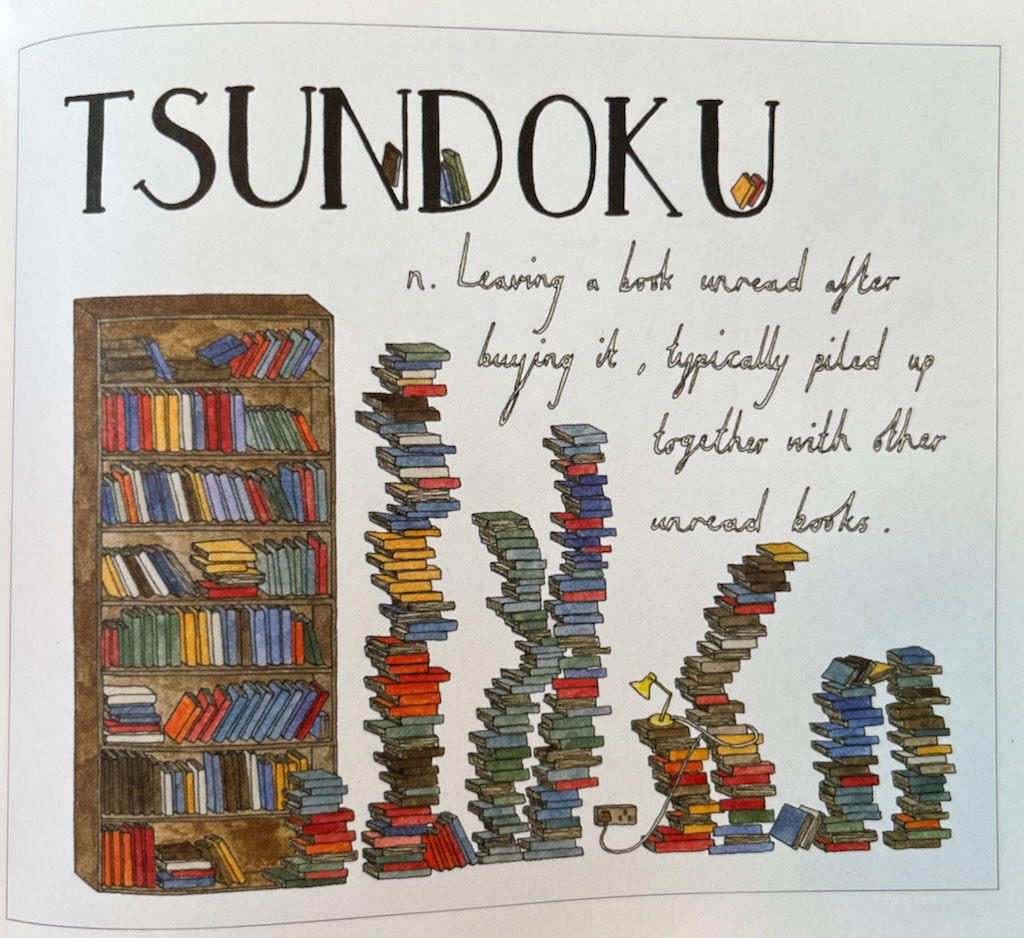
there’s a name for the ailment: tsundoku. (積ん読)

it’s the japanese word meaning, quite literally, “reading pile.” nowhere in the definition—“the phenomenon of accumulating books but not reading them”—would you find evidence of the lethal nature of said phenomenon (ten books falling on your nose will leave a dent). nor the drip-drip-drip of guilt that accumulates every time one sashays past said pile and fails to move forward in a page-turning way. 

so i’ve hatched a plan, an antidote to what ails me. i call it finishing school. i shall, in the summer months ahead, the months when the sun is strong and summer sounds abound, commit to a single purpose: one by one tracking my way toward the last sentence of at least some of the many books piled on my nightstand, my reading nook, my writing room floor, and most any other horizontal plane sturdy enough to hold a vertical biblio-ascension. 

by virtue of this determination to see literary arcs through to the end, i shall be relieving all of you of the task of checking in on the chair to see what’s astir. i am intending to post mostly what leaps off the pages, as i plod along through plots, poetries, and otherwise paradisiacal paragraphs. 

i envision something of a commonplace summer reading adventure, in which we all can chime in with any ol’ ‘graph or line that makes your heart thump, or your eyes fill with tears. 

my summer’s focus will be more reading than writing, at least here. 

the writing portion of my summer will apparently have me bent over the keyboard tapping out pages for a new project i’m not yet free to chat about. there’s an end-of-summer deadline, i do believe, so i’ll be burning up the keys to make that happen. and my refueling time will be spent deeply in reading. in finishing, specifically. 

i plan to officially begin my finishing school with a book that’s tugged at me for years, one i started and loved, and truly need to wade deeper into. it’s etty hillesum: an interrupted life and letters from westerbork. begun in 1941, nine months after the netherlands fell to hitler, it’s the epistolary journal of a young dutch jewish woman who traces the darkening shadow of the nazi presence in her homeland as well as her own moral awakening before her death at auschwitz in november of 1943. it seems as essential a book in my stack as any there is. and i’m committing to etty.

back in 1986, in a review of the book in the new york times, michiko kakutani wrote this: 

“All Holocaust writings, of course, must deal with the inadequacy of words in the face of events that defy the imagination, but while Miss Hillesum frequently speaks of her inability to convey the awful magnitude of events around her, she proves herself a most eloquent witness to history—a witness whose grave yet shining testimony attests to the resilience of the human spirit in the face of incalculable odds.”

it seems a book for this moment.

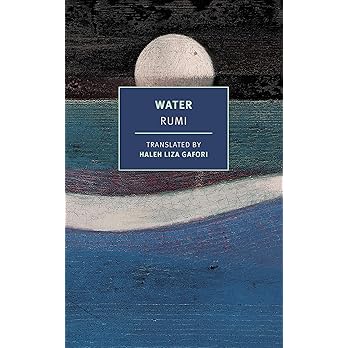
and even though the official starting bell hasn’t chimed, i tiptoed into my project this week by reading start-to-end not one but two magnificent poetry collections: water, by rumi, translated from the farsi by haleh liza gafori (new york review book classics), the second volume of gafori’s translations of the thirteenth-century persian poet (the first one, unfinished but in my pile, of course, was gold, acclaimed for its fluid rendering of rumi’s lyric ecstasies). water’s essence is Love, capital L, gafori writes in her introduction, in which she claims: “Love is a 360-degree embrace of creation, a compassionate acceptance of what it…Love is our unobscured essence, at the root of the root of all creation…Above all, Love is a practice.” 

and but one line that took my breath away in the poems themselves, was this: “Come or go, Love told me, / I am here, closer to you than the vein in your neck.” 

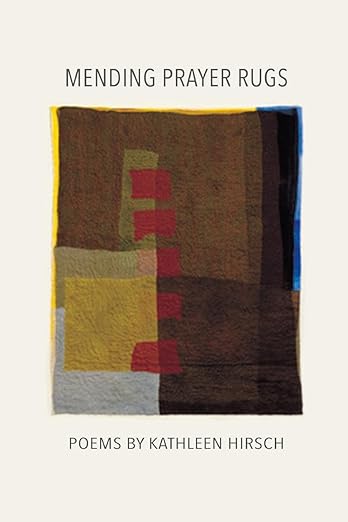
and the second collection of poems i gulped down, start to finish not once but twice, was a book i bumped into quite by accident and whose author immediately swooped into the inner circle of kindred spirits. it’s titled mending prayer rugs, poems by kathleen hirsch (finishing line press), and this collection mines the sacred amid the quotidian, with a particular focus on women of prayer, women whose wisdom is hard-won, be they women from the Bible, craftswomen, workers, wanderers or women we recognize from among our own generations.

in her opening poem, “prayer rug,” hirsch (a longtime journalist and spiritual director) writes in the voice of a woman i imagine with gnarled knuckles and fading eyesight, the cost of a lifetime spent pulling needle and thread through the tatters of prayer rugs for those who prostrate in prayer: “I bend in blessing toward all that breathes: / May each hour enlarge the pattern— / rose dawn, wind song, tender shoot of faith— / that I may see the weft of the hidden weaver.

the weft of the hidden weaver. another name for the Unnameable One. it is the metaphors of poetry that catch the breath in our throats, and frame our seeing anew.

lines such as this, a line that had me choking back tears in a poem titled, “in the end”: “Kiss the light / before it dies / leave those you love / the heirlooms of your passion, your gratitude, your tears.” 

i envision a magical summer. 

straight through to the end. 

will you read along?


a subtly transgressive little poem from the bard of the bluegrass state:

The Hidden Singer

The gods are less for their love of praise.
Above and below them all is a spirit that needs nothing
but its own wholeness, its health and ours.
It has made all things by dividing itself.
It will be whole again.
To its joy we come together –
the seer and the seen, the eater and the eaten,
the lover and the loved.
In our joining it knows itself. It is with us then,
not as the gods whose names crest in unearthly fire,
but as a little bird hidden in the leaves
who sings quietly and waits, and sings.

+ Wendell Berry

p.s. a bit more on tsundoku: The term combines “tsunde-oku” (積んでおく), meaning “to pile up ready for later and leave,” with “dokusho” (読書), meaning “reading books”. 

a note: i’m sensing we all need to shake off some of the routines of our lives that begin to feel too confining, and i don’t ever want the chair to feel that way. so my intention is to be a little bit looser about it, but still to leave faint tracings here on the table, should you happen by. summer for me has long been synonymous with reading, and thus a reading project. feel free to bring your favorites.

a literary form for the slipperiest of minds

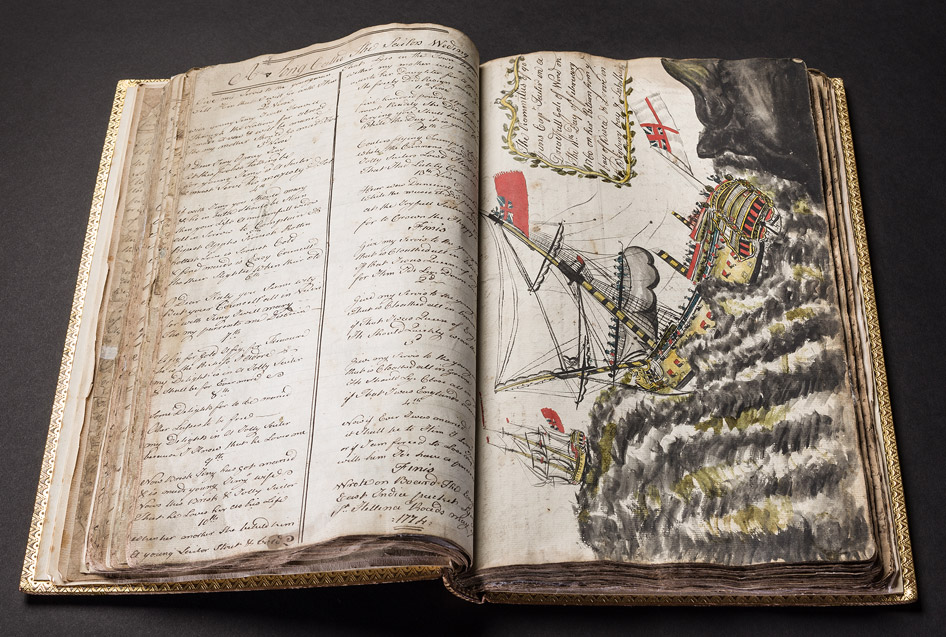
a page from british sailor henry tiffin’s commonplace book, 1760

more and more, the literary form into which i ease is one that traces roots to the ancients. to pliny, the great naturalist, whose mind must have been a beehive of sorts back in first-century rome. it’s an enthusiasm for accumulation that courses its path on through the renaissance when humanists, especially, were anxious to lock down their thoughts, keenly aware of the tragic loss of ancient learning, as libraries were so often, too often, the sites of military revenge. it’s a form that wends its way on and on through the centuries, straight through the twentieth, when mark twain, thomas hardy, ralph waldo emerson, and henry david thoreau, to name but a few, all partook of the habit. and here we are now, with plenty of us keen practitioners of the urge to gather up bits of literary esoterica and assorted ephemera before they skitter away. i think of myself, more often than you might imagine, as a rag picker of ideas in any which size, from the itty-bitty and poetic to the mindbogglingly big.

humans, it seems, like to scribble things down.

may our scribbling never cease.

the fancy name for this scribbling is commonplacing, the literary form the italians once named zibaldone, “a salad of many herbs,” in culinary terms, or a “hodgepodge” more broadly. we’re contemplating here the hodgepodge.

it’s the mosquito netting of the mind, of wonders and thoughts before they escape. or, as the 13th-century dominican monk, vincent of beauvais, once explained, it was “the multitude of books, the shortness of time, and the slipperiness of memory” that compels one to scribble.

count me in on the slippery mind.

vincent’s not-so-slippery solution: a ginormous tome, totaling 4.5 million words (someone counted!), an exhaustive compendium of all medieval knowledge, which he titled speculum maius (literally “great mirror”), speculum a word he chose because it contained “whatever is worthy of contemplation (speculatio), that is, admiration or imitation.” and thus he set out, over the course of his monastic lifetime to gather all the “flowers” (his word), or best bits of all the books he was able to read, in a selfless quest to save others the strains (time, money, trips to the library) of doing so themselves.

over the last many months, as the population of this old house has dwindled to two, and the stories to tell are fewer and fewer, my efforts here seem to have morphed into a looser, yet more concentrated consideration of the bountiful ideas and thunderbolts i bump into across the arc of a week.

there is something so natural about the human instinct to share what we’re thinking. of course there are those who might protest, who might consider me rude for shoving a book or a page or a picture in your face. but, when you think of it, isn’t that the instinct that drives so much of social media? (i often think we’ve gone overboard there, but that might be because too often it’s the magnification of any or every passing brain burp and not necessarily ones that might leave us enlightened. and too often amount to plain old overgazing at navels, or hair-raising nastiness and gut-wrenching vulgarity. but i digress…)

i’ve been keeping what amounts to my salad of many herbs for years and years now, and that urge seems to have spilled over to here, where week after week sometimes i seem to be assaulting you with the few morsels i’ve found most delicious in recent days. it’s a way, i suppose, of collectively swelling our brains. and our souls, most certainly.

in the spirit in which i bring my rag picking here, i like to think of us sitting side-by-side, cozy against the pillowy confines of an armchair broad enough for two. and in the gentlest, yet conspiratorial whisper, i offer you a page or a passage, my eyes widened and sparkling with glee, as if to say, wait’ll you see this one. what wonderments or deep thoughts spring to your mind?

any one of these next morsels is worthy of long and deep consideration. here are the ones that struck me this week:

these first two come from maria popova, whom i’ve referred to in the past as the high priestess of cultural commentary, and one of the most voracious gatherers of ideas i’ve encountered in recent years. her online literary journal, now known as The Marginalian, has been described as a compendium of hundreds of thousands of entries “that search for meaning, cross-linking ideas and connecting metaphysical dots.” here’s where she thunderbolted me this week:

“joy is a stubborn courage we must not surrender.”

“. . . love — whether we call it friendship or family or romance — is the work of mirroring and magnifying each other’s light. Gentle work. Steadfast work. Life-saving work in those moments when life and shame and sorrow occlude our own light from our view, but there is still a clear-eyed loving person to beam it back. In our best moments, we are that person for another.”


another place i often turn for soulful sustenance is Emergence magazine, a wellspring that explores the timeless connections between ecology, culture and spirituality. in a recent talk, titled “memory, praise, and spirit,” the filmmaker, composer, sufi teacher, and driving force behind Emergence, emmanuel vaughan-lee, opened with these words:

“The mystics say that we are like a seed; that we hold the blueprint for our highest potential within us, and that much of spiritual practice, regardless of what tradition, is unlocking that potential.”


and i close with this one from the great james baldwin, a passage from his 1964 collection of intimate but somewhat little-known essays, titled nothing personal. this passage is from the fourth of the four essays collected there:

“One discovers the light in darkness, that is what darkness is for; but everything in our lives depends on how we bear the light. It is necessary, while in darkness, to know that there is a light somewhere, to know that in oneself, waiting to be found, there is a light.”

i could write an essay on any one of the above, but instead i invite you to chew on each or any one. each one, a morsel worthy of your time, your mind, your soul.

which one spurs you and stirs you the most, and what deep thoughts spring to your mind?

i’ve written before of commonplacing. here at the chair, and in my latest book, The Book of Nature, on pages 87 and 88. it’s a habit i can’t get enough of, an urge i can’t quench.

pages from the commonplace book of charles dodgson, aka lewis carroll

gathering a congregation of sages…

if you asked me today what church i belong to, i might stumble into an answer that wasn’t much of an answer. it might go round about. explain that sometimes i feel like an orphan. yes, there is a place where i go on the sundays when i’m on duty. i’m an altar girl at a church that welcomes my presence, where the sermons are great, but where i’m not much of a signer-upper which makes me feel a bit like a slacker. i have a synagogue, where sometimes i wander in to talk with the rabbi. where i can find myself in the deepest of prayer.

but the truth i’ve been wrestling with all summer long is that, mostly, i feel lost, adrift.

i didn’t grow up with a deep congregational sense. i talked to God most of the time from behind the closed door of my childhood bedroom. i found God in the notes i wrote, night after night during high school, to a motley band of the broken-hearted, the lost, and the otherwise looking for warmth. for a friend.

good thing i grew up with a mama who quoted emily dickinson more than anyone else. who taught me the lines of this poem that’s been ground into my soul in the finest of fine-grain elixirs:

Some keep the Sabbath going to Church – (236)

Some keep the Sabbath going to Church –
I keep it, staying at Home –
With a Bobolink for a Chorister –
And an Orchard, for a Dome –

Some keep the Sabbath in Surplice –
I, just wear my Wings –
And instead of tolling the Bell, for Church,
Our little Sexton – sings.

God preaches, a noted Clergyman –
And the sermon is never long,
So instead of getting to Heaven, at last –
I’m going, all along.

the other thing my mama taught me––the one line she etched onto my soul was this: don’t let the Church get in the way of God.

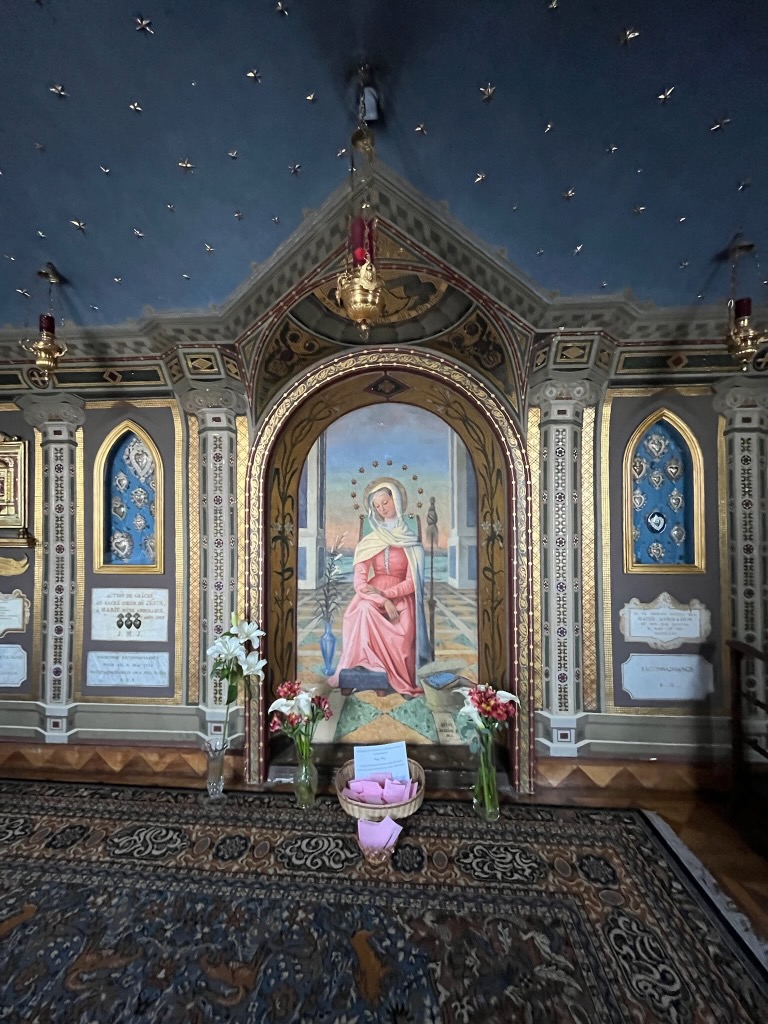
my mama, a girl who grew up in a convent where the nuns taught her to curtsy each time she dashed past the statue of the Pink Madonna (a story is told that one of the nuns–these are Sacred Heart nuns–once tried to paint a portrait of the Blessed Virgin Mary, and what she painted was so godawful, they tossed a rug over the thing, to hide it, and some time later when the rug was pulled off, lo and behold, there was a breathtakingly beautiful Mother of God decked out not in the usual blue but in pink. thus, the Pink Madonna that Sacred Heart girls (and their dutiful daughters) seek out whenever and wherever in the world they sense themselves in breathing distance of one of the few extant copies), my mama, as devout as the day is long, is far more radical than you might imagine for a girl who grew up in a convent in the most parochial burg of cincinnati, ohio. and that might be one of the things i treasure most about my mama.

and maybe that has something to do with my unwavering quest to find my way in this world along a path populated by sages, and not always of the churchly persuasion. i find holiness in unorthodox moments and places and, often, smack dab in the thick of a sentence.

i might not belong to a particular church these days. but i gather a goodly––and godly––congregation of pathfinders along my way. my church, quite often, rises up from the page.

i read, hour by hour, and day after day, with an eye out for wisdoms and truths, and guideposts to stir me. something akin to wandering an orchard, plucking from trees the lushest of fruits. i find my convictions deepened. my heart, often on fire. my intent: to make this blip that is my life as blessed as i can make it. i live by a gospel of love, one with an emphasis on that which is tender, and gentle not harsh. i believe, more and more, in humility. in understanding how little i know. and how much there is still for me to learn. to understand.

we live in a world that some days feels like it’s spewing all that i detest: there is cruelty, and hubris, and parading around as if no one else matters.

but then i open a book. or click on a text from a most blessed friend. and i read words that resonate. that underscore what seems to be Truth with a capital T. and i feel less alone, and less lost.

these are the lines that spoke to me this week in this holy space of my own making; one is from hafiz, the 14th-century sufi poet, another from thich nhat hanh, the blessed buddhist monk who died just two years ago, and the third is from greg boyle, the jesuit priest who founded Homeboy Industries, the world’s largest gang intervention and rehab program, based in east LA, and whose book, barking to the choir, is now on my most-wanted list.

first up, a prayer poem sent by a beloved friend, one from hafiz, the sufi poet, from a translation by daniel ladinsky, and which my blessed friend found in the pages of greg boyle’s barking to the choir:

Every child has known God,
Not the God of names,
Not the God of don’ts,
Not the God who ever does anything weird,
But the God who knows only four words.
And keeps repeating them, saying:
“Come Dance with Me, come dance.”

i love a God who whirls with me, who invites me into the dance.


next up, thich nhat hanh:

Understanding someone’s suffering is the best gift you can give another person. Understanding is love’s other name. If you don’t understand, you can’t love.

oh, that we should enter deep into the wounds of another. and therein find the walls of our own hearts widening and deepening, and our compulsion to hold a trembling hand the surest thing we can do.


and, finally, once down the greg boyle rabbit hole, i just got deeper and deeper, and then i found this:

“For unless love becomes tenderness—the connective tissue of love—it never becomes transformational. The tender doesn’t happen tomorrow . . . only now.” 

― Gregory Boyle, Barking to the Choir: The Power of Radical Kinship

tenderness, the connective tissue of love . . .

to which i whisper, amen

who do you gather in your congregation of sages?

photo above, of Mater Admirabilis, the Pink Madonna, is from our trip to rome back in may, during which, dutiful daughter that i am, i trekked to the top of the Spanish Steps, rang a bell at the convent of the sacred heart (my mother’s breed of nuns), turned over my passport for entry to the upper chapel where Our Lady resides, and beheld her.

in which we pause to remember one who would bristle at being called the patron saint of anything. . .

She stretches from Sharon Olds’ Stag’s Leap to Christine Valters Paintner’s Dreaming of Stones on my bookshelf. Sixteen volumes in all. And that’s just the poetry. Doesn’t count her essays, housed on a whole other shelf. I am talking, of course, of the poet I call my “patron saint of paying attention.” Mary Oliver. 

You might also say she’s the poet master of astonishment. She breaks me out in goosebumps and wonder. Line after line after line.

Oh, I’ve heard her poetries dismissed for their “surface simplicity and populist reach.” But when it comes to stirring my soul, I’ve no need for the critics. I side with those who, as was written in her New York Times obituary, find that “her poems, which are built of unadorned language and accessible imagery, have a pedagogical, almost homiletic quality.”

I call them holy. 

Give me a writer who can write of the “uncombed morning,” or confess that “sometimes I am that quiet person down on my knees.” Or cobble together words into a stanza that reads: “All things are inventions of holiness / Some more rascally than others.” Give me that writer and I’ll hitch my starship any last day.

These days, this long hard season, I seek saving grace wherever it falls. I find it in an evening’s sky punctuated by dragonflies drifting and darting in parabola. I find it in any sentence that ends “unlikely distant metastasis.” And I most certainly find it in the poet who reminds me: “So quickly, without a moment’s warning, does the miraculous swerve and point to us, demanding that we be its willing servant.” 

Count me willing.

Emily D. taught me to look for and love the slant, the wisdom that slides in on a steep-edged, improbable angle. Mary O does that every time. I am reading of a bluefish being washed at the water’s edge, and suddenly I am remembering to be on the lookout. To find God, the Holy, in all of creation. Or, as Emerson put it: “To attend all the oratorios, the operas, in nature,” in life, in the day upon day. 

Mary O is the one who puts her ink to the sacred as it spills across creation’s page. How else to describe the one who, when writing of a lone seal pup found on a desolate beach, muses: “. . . maybe / our breathing together was some kind of heavenly conversation / in God’s delicate and magnifying language, the one / we don’t dare speak out loud, / not yet.”

Pay attention to how she places that very last line. The barbed last hook. The one that sticks in your craw just a little bit longer. Whispers a gossamer faith. Mary O was a theologian of the barest brushstroke. You’d barely know you were shaken, but then you quake through to your deepest marrow. 

Mary Oliver’s birthday is September 10. She would have been 88.

And here, in her poem “Messenger,” she describes her life’s work:

My work is loving the world.
Here the sunflowers, there the hummingbird—
equal seekers of sweetness.
Here the quickening yeast; there the blue plums.
Here the clam deep in the speckled sand.

Are my boots old? Is my coat torn?
Am I no longer young, and still half-perfect? Let me
keep my mind on what matters,
which is my work,

which is mostly standing still and learning to be
astonished.
The phoebe, the delphinium.
The sheep in the pasture, and the pasture.
Which is mostly rejoicing, since all the ingredients are here,

which is gratitude, to be given a mind and a heart
and these body-clothes,
a mouth with which to give shouts of joy
to the moth and the wren, to the sleepy dug-up clam,
telling them all, over and over, how it is
that we live forever.

—by Mary Oliver


Seeing Not Looking

Celtic scholar Esther de Waal considers Thomas Merton’s practice of contemplative photography:   

Thomas Merton was of course a writer and a teacher, and a poet, but he was also a photographer, and it is from his photographs that we learn much about how he saw the world, and how he prayed—and the two are of course intimately connected…. He handled a camera as an artist would, and used it as an instrument of delight and perception. It was in the later 1950s that the journalist John Howard Griffin [1920–1980] visited Merton in his hermitage. He had his camera with him and … let [Merton] keep it on extended loan. At first when Merton sent him the negatives, John Howard Griffin was puzzled, for [Merton’s] view was so different from that of most people. Merton photographed whatever crossed his path—a battered fence, a rundown wooden shack, weeds growing between cracks, working gloves thrown down on a stool, a dead root, a broken stone wall. He approached each thing with attention, he never imposed, he allowed each thing to communicate itself to him in its own terms, and he gave it its own voice.  

Later on when he was out in the woods with a young friend, Ron Seitz, both with their cameras, Merton reprimanded him severely for the speed with which he approached things. He told him to stop looking and to begin seeing:  

Because looking means that you already have something in mind for your eye to find; you’ve set out in search of your desired object and have closed off everything else presenting itself along the way. But seeing is being open and receptive to what comes to the eye…. [1] 

He used his camera primarily as a contemplative instrument. He captured the play of light and dark, the ambience, the inner life. But above all he struggled towards an expression of silence through the visual image, so that his photographs show us that ultimately his concern was to communicate the essence of silence. 


it’s the month of Elul in the Jewish calendar, a month for accounting of the soul before the high holidays, Rosh Hashanah, the new year, and Yom Kippur, the day of atonement. i’ve been deep in soulful accounting, and bring along this prayer from the blessed Rabbi Nachman, who taught that life should be lived with joy. and centered in prayer.

A Prayer of Rabbi Nachman of Bratslav (1772-1810)

Grant me the ability to be alone;
may it be my custom to go outdoors each day
among the trees and grass – among all growing things
and there may I be alone, and enter into prayer,
to talk with the One to whom I belong.
May I express there everything in my heart,
and may all the foliage of the field –
all grasses, trees, and plants –
awake at my coming,
to send the powers of their life into the words of my prayer
so that my prayer and speech are made whole
through the life and spirit of all growing things,
which are made as one by their transcendent Source.
May I then pour out the words of my heart
before your Presence like water, O God,
and lift up my hands to You in worship,
on my behalf, and that of my children!


hummingbird photo (above) by shelia zimmerman, sister of my beloved late friend mary ellen sullivan, may her memory be a blessing, (and it is. every day.)

happy blessed sunday birthday to a personal patron saint of mine, mark burrows.

looks like i was in the mood for capitals this morning, maybe just to prove i know how to find the shift key. hope you don’t mind the tall letters every once in a while. i do understand how it makes a sentence filled with proper nouns a bit easier to read…..

let’s play a bit of book group: what are some of your favorite Mary O lines, or words, or phrases?

p.s.s. i almost forgot: i’m taking The Book of Nature on the road this weekend. sunday afternoon, in fact, when i’ll be at Winnetka’s Book Stall at 2 p.m. for a book talk canceled last spring and now back on the calendar. problem is my little voice has gone missing again, and my vocal cord injections are on the books for tuesday, so it’ll be a bit squawky but the show must go on. it’s also Printers Row LitFest this weekend, so lots of getting pulled in several directions. wherever you are, have a lovely blessed almost-autumn weekend.

chop. stir. turn. sigh. repeat.

my days these days are filled with simple verbs; staccato, monosyllabic verbs: chop. stir. turn. sigh.

in other words, i fill my hours tucked between the pages of tall stacks of books i am guzzling down as if to carry me across the frozen tundra out my window. i guzzled my way through january, and except for a few days in the air in february, i aim to do it all over again in this the shortest month. 

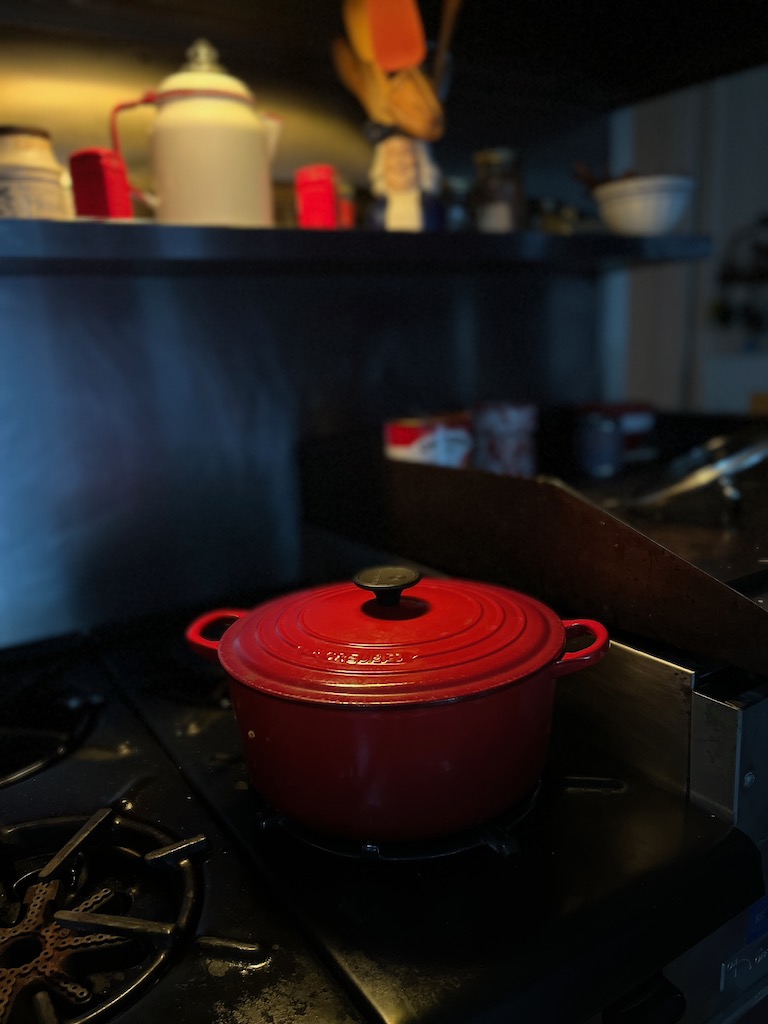
i do rise on occasion from my butter-yellow-checked chair, mid-morning sometimes, to take my station at the chopping block, where my knife work begins. usually in the alliums, chopping onions to bits, mincing garlic buds, filling the room and my fingertips with the essence of under-earth. i glug olive-y oils into the big red pot, the one weighty enough to shatter my toes should i ever let it slip from my grip. i slow-cooked my way through the year’s first month: stews and soups and braises. more stews and soups and braises.

it’s the simple rhythms that put the hum in my day. sustenance, really. the exotic and the excitement––the sighs and the gasps––come in the pages i turn. the ones where i might find a sentence so lovely i all but haul out my scissors to make of it a shrine to the genius of human mind and soul that so sees the world in these breathtaking ways, and dares to combine words in ways we’ve never before imagined. or felt.

really, it’s all filling my tank for the weeks ahead when my little book will take its pirouette for a few short moments, and i will step beyond my shadows long enough to put voice to its birthing. those of us who tremble when stepping before a crowd, we need to store up a winter’s worth of quietude, of sustenance, so we’ve a reserve to dip into. to share abundantly.

these wintry months i am doing winter’s work: letting the roots seek deeper ground whilst on the surface all looks still.

and so my offerings here are leaning more than usual on the genius of those i gather round me. and my hope is that what punctuates and titillates my day might bring the same to you…


we begin with mary oliver, a little poem she wrote as part of a septet.

“So Every Day”

So every day
I was surrounded by the beautiful crying forth
of the ideas of God,

One of which was you.

—Mary Oliver


a beloved, beloved friend of the chair sent me this the other day. and i thought you too might want to tuck it in your drawer of special words (i could not for the life of me find its origins, only that it was tagged “healers” and so i share it thusly:

some will turn away when you show them your bleeding.
some will stay.
will press stars into the wounds.
will hold your feet as you learn to walk again with the weight of a too-full heart pummeling your bones.

(healers)


i mentioned last week that i’d tumbled my way into a poetry conversation between dante micheaux and a poet priest named spencer reece, whose story so intrigued me i ran to the library and found his magnificent, magnificent memoir, the secret gospel of mark: a poet’s memoir, which is hands down the most gasp-inspiring book i’ve read in a good long while. i couldn’t stop reading; inhaled 400-plus pages in two days. tried hard as i could to stay awake into the night to keep reading. but my old body refused. i saved it till the morrow. i wound up giving it five stars in an amazon review, and i wrote this:

5.0 out of 5 stars In a Word: Brilliant Reviewed in the United States on February 2, 2023

In an age of binge-watching, this magnificent, tender, deeply vulnerable, and utterly breathtaking memoir from poet and Anglican priest Spencer Reece deserves to be binge-read. In one gulp, if you don’t need to sleep. I swallowed it whole in two sittings. And I couldn’t wait to get back to its pages when I had to put it down. Reece writes gloriously on multiple levels. He is at once raconteur and poet. A lifetime’s close read of poetry pours from the pages, as Reece takes us deep into his fluency in — and kinship with — Sylvia Plath, Elizabeth Bishop, Emily Dickinson, James Merrill, Mark Strand, George Herbert, and Gerard Manley Hopkins. Interwoven with his own sometimes wrenching, occasionally tragic, story — one that carries him through dark years as a closeted gay teen, and later an alcoholic who briefly finds himself on a psych ward, and ultimately stumbles into grace as a priest called to love with abundance — Reece writes that “poetry saved me more than the church.” The twinned lenses, funneling toward a holy and redemptive intersection of God and poetics, serve to make this a book I’ll long press close to my heart. As a longtime reviewer of Books for the Soul for the Chicago Tribune, this one counts among the rare few unforgettable treasures tucked on that bookshelf. It’s at turns bawdy, and funny, and crushing, and always, always crafted in sentences so beautiful, so crisp, and — yes — so poetic, they will leave you gasping in awe.

and from the pages of reece’s secret gospel come this week’s. . .

sentences of the week (in which i invite you into my commonplacing world and share some of the snippets that filled my notebook this week):

“The hint of night scratched at the edges of the day.” (372; Spencer Reece, Secret Gospel of Mark)

“foggy green lawn footnoted with hedgehogs” The Secret Gospel of Mark: A Poet’s Memoir, by Spencer Reece (“footnoted” as in splattered, punctuated with…(113)

“the land oozed God.” (and for the trifecta, it’s Spencer Reece once again…)


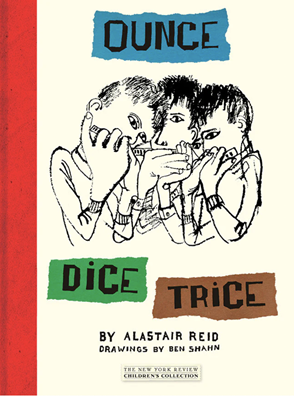
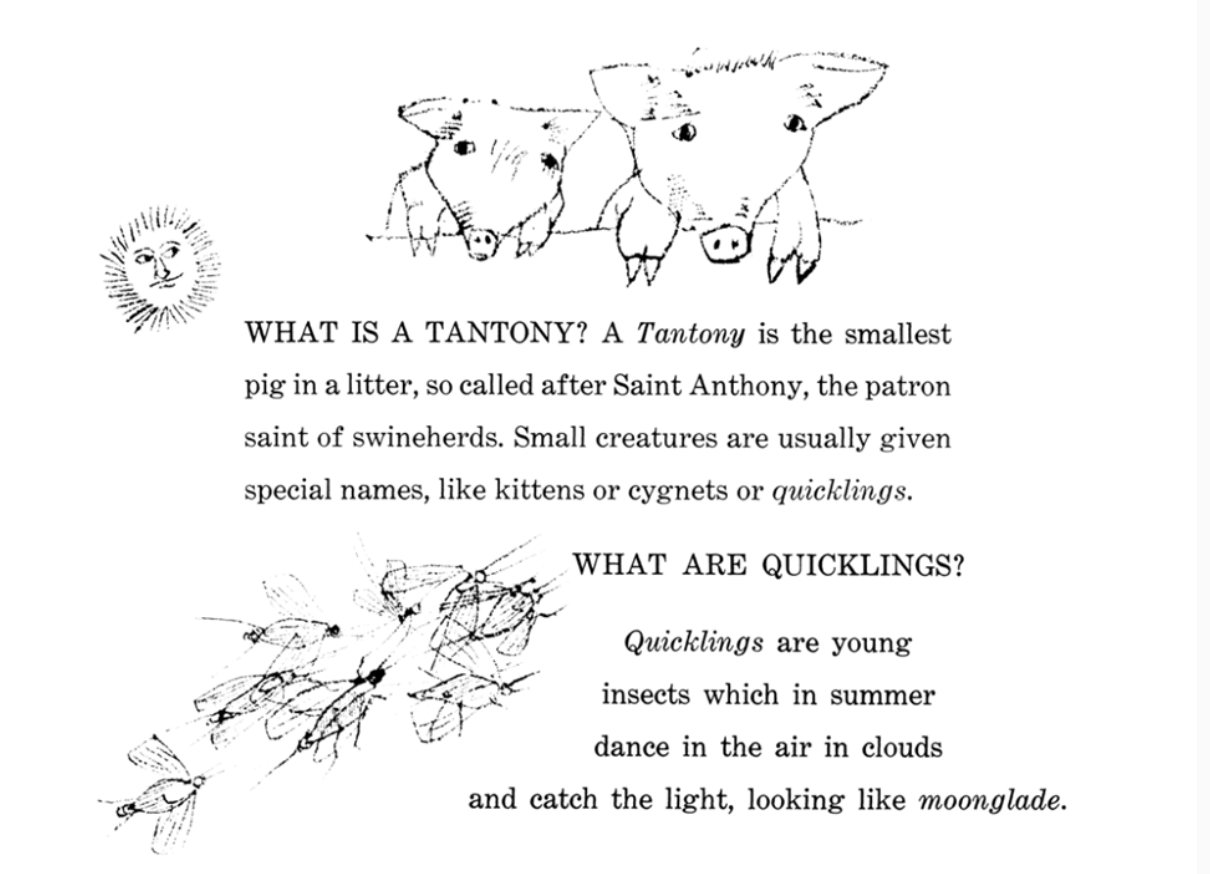
i often let my friends at the New York Review of Books point me toward what belongs on my shelves. and so it is, especially, in the children’s corner. i’ve long been mad for whimsical nearly obsolete words, words that need a puff of oxygen to keep their hearts still beating. and, so, i’m enchanted by this long-time favorite, which i’d not known before: Ounce Dice Trice, with words by Alastair Reid and illustrations by Ben Shahn. Ounce Dice Trice was the only children’s book ever illustrated by Shahn, and only one of two books Reid wrote for children. 

NYBR says this: “Ounce Dice Trice operates as a haphazard, whimsical dictionary of words and word play. Reid, a Scottish-born poet and long-time correspondent for The New Yorker, provides list upon silly list of fantastic words, most of them real, some completely made-up. Shahn, the Lithuanian-born American artist known for his socially- and politically-informed art, provides hilarious drawings to accompany the words.” [see below, for a wee quickling of a peek. and be charmed, like me, by the name for a little pig. i suppose dear wilbur (of charlotte’s barnyard) was a tantony.]


and that, dear friends, is my week’s worth of sustenance. except for one thing: the big red pot. so here is but one of the many things that filled that pot this past week and this past month:

Turkey Meatballs in Eggplant Tomato Sauce (from Melissa Clark at the New York Times, with a little twist by me*)

INGREDIENTS

Yield: 28 meatballs, 4 to 6 servings

  • ½ cup grated Parmesan cheese, more for serving, if desired
    ½ cup panko or other plain dried bread crumbs
    ¼ cup minced onion
    ¼ cup chopped chives or basil
    2 garlic cloves, grated on a microplane or minced
    1½ teaspoons kosher salt
    ½ teaspoon black pepper
    ½ teaspoon dried oregano
    Pinch red pepper flakes (optional)
    1½ pounds ground turkey, very cold
    1 large egg, beaten
    3 tablespoons extra-virgin olive oil, more as needed
    3 cups marinara sauce, more to taste*

PREPARATION
Step 1
In a large bowl, combine cheese, bread crumbs, onion, chives, garlic, salt, pepper, oregano and red pepper flakes, if using, and mix well. Add turkey and egg and blend with your hands until well mixed. If you’ve got time, cover mixture and chill for an hour or up to 24 hours. These are easiest to form into balls while very cold. Form into 28 meatballs, each about 1¼-inches in diameter.

Step 2
Heat 2 tablespoons of the oil in a large sauté pan. When hot, add enough of the meatballs to fit in one layer without crowding, and brown on all sides, 5 to 8 minutes. Transfer to a plate, add another tablespoon of oil to pan and brown another layer of meatballs, transferring them to the plate as they brown. Repeat until all meatballs are browned, adding more oil to the pan as needed.

Step 3
When meatballs are all browned, add marinara sauce to pan and bring to a simmer, scraping up the browned bits on the pan bottom. Return meatballs and their juices to pan, shake pan to cover the meatballs with sauce, and lower heat. Partly cover pan and simmer until the meatballs are cooked through, 15 to 20 minutes.

Step 4
Serve hot, drizzled with more olive oil and sprinkled with more cheese, if you like.

*note: this week i super jazzed up the sauce with a shiny night-black eggplant: while the meatballs chilled in the fridge, i took my marinara up a couple notches: sautéed onions, garlic, and then eggplant. added fennel, red pepper flaks (a pinch), marjoram and oregano, salt and pepper. cook till browned and then relaxed. add splash red wine. jar of tomato basil marinara; let simmer a good half hour. (here’s where i added extra bowls: i scooped my simmered sauce into a bowl, and browned my meatballs in the big red pot; once browned, i poured back the sauce, and let it all get cozy, simmering for another while. at dinner time, they all arrived deliciously on our plates. (and this is why you’d best take your cooking instruction for a more precise cook!)

what sustains you through your week?

forecast: more quiet

we seem to have stumbled around here onto the recalcitrant version of the red-ringed bug, the one that won’t go away. or came back before it left. i was on the mend, as was my mate here in this old house, when suddenly a cumulus nimbus of cloudy congestion came roaring back to the head of the one with whom i share these rooms. and then the little test confirmed our suspicions: it’s covid again. so he’s re-grounded and i’m shuffling quietly, still under wraps (aka mask).

which means that with a weekend forecast for snow and cold, along comes one for much more quiet. to which i let out a little yelp of muffled delight. because that means more time to dig into my latest reads: thoreau’s walden; and what could be more fitting for a january cold spree than a charming tome titled the nightingale: notes on a songbird?

and that means that once again, i’ve spent bits of my week cobbling together a few morsels for my friends who might pull up a chair.

to wit:

i begin with this beauty from henri nouwen, the modern-day mystic and deep theologian whose wisdoms are many, and whose birthday this week had me bumping into this:

Compassion asks us to go where it hurts, to enter into the places of pain, to share in brokenness, fear, confusion, and anguish. Compassion challenges us to cry out with those in misery, to mourn with those who are lonely, to weep with those in tears. Compassion requires us to be weak with the weak, vulnerable with the vulnerable, and powerless with the powerless. Compassion means full immersion in the condition of being human.

Henri Nouwen

a more beautiful definition of compassion, of being a profoundly alive human, i do not know. perhaps you’ll marinate in these holy words for a few hours this cold, cold weekend.


next up, in the wonders of the week, i found myself in a poetry conversation that spanned continents (thank you, oh wonders of zoom), and thanks to my friend Pádraig Ó Tuama, i discovered a poet whose work and whose voice i can’t get enough of. his name is dante micheaux, and what i know is that i will be chasing down his poetries in any form i might find them. here’s a bit of his bio (though i am starting to dream of a journalistic beat in which i wander the globe talking to poets, in hopes of filling out the fine grains of their stories). . .

Dante Micheaux is the author of Circus (Indolent Books, 2018) and Amorous Shepherd (Sheep Meadow Press, 2010). He holds a Master of Fine Arts in Creative Writing from New York University. His poems and translations have appeared in The American Poetry Review, Callaloo, Poetry, PN Review and Tongue—among other journals and anthologies. Micheaux’s honors include a prize in poetry from the Vera List Center for Art & Politics, the Oscar Wilde Award and fellowships from Cave Canem Foundation and The New York Times Foundation. In 2019, he won the Four Quartets Prize from the T.S. Eliot Foundation. He grew up in New Jersey, but lives now in London, and we shared a wee bit of enthusiasms for a bagel shop on Brick Lane, or as the brits would spell it, a “beigel bake.”

the judges’ citation on the Four Quartets Prize is this: “How right that this poet’s first name should be Dante. For his Circus is a Comedy: a savage comedy, lacerating dialects, fingering wounds, looking for loves right and wrong in the crevices of history and of humiliated bodes. And yet, and yet. His language exults, triumphs, and freely rummages in the treasuries of the Bible, Baudelaire, Whitman, Eliot, Baraka, and Mahalia Jackson, taking what it needs, making it his sovereign own, a wrested blessing. Congratulations, Dante Micheaux, on your astonishing Circus.”

you can hear a bit of him here, in a podcast called beyond the red door, an audio companion to a poetry series that brings poetic meditation inside the walls of St Mark’s, an Anglican church in Jackson Heights, in New York City. Here, Micheaux is in conversation with Anglican priest and poet, Father Spencer Reece (himself a whole nother story). Micheaux reads a poem reminiscient of Tony Morrison’s The Bluest Eye, and at the end a Canto …

(i’m promising more on Spencer Reece next week, as i’ve requested a slew of his books from the library…) and here is but one of dante’s poems that took my breath away…

Mary at the Torture

Everyone was out that day, for a show.
Sure, it was sad for people who knew him
but she was his mother, slinking about
the rabble in that dark halug, veiling
her face with a headscarf—as if no one noticed her.

Some say it served her right,
letting her son run about the countryside
the way she did. Poor Joseph,
for all efforts at teaching the boy
a skill, never succeeded,
hadn’t a chance against Mary’s coddling.

But how could she just stand there, watching?
Each time the scourge met flesh she didn’t even flinch.
No cry, no lamentation—most unlike a child of God.
Any other mother would have had to be contained,
would have put herself between lash and child,
would have succumbed to conniption—at the least,
rent her clothing. Not one tear.

She was always strange, though—quiet,
dark days about her since she was a girl.

It wasn’t easy: the scandal before the wedding;
him getting into trouble with the law.
Perhaps, she was relieved.

–Dante Micheaux

(first published May 11, 2011, in Painted Bride Quarterly)


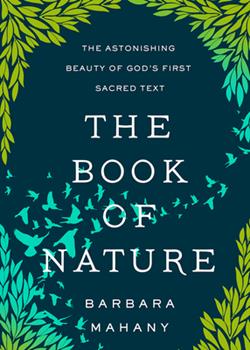
the techno team here at the chair is figuring out how to host a virtual launch of my soon-to-be book, The Book of Nature: The Astonishing Beauty of God’s First Sacred Text (which got its very first official review this week, in Booklist, a publication of the American Library Association, and which you can find over on Book of Nature’s very own page here at the chair. details and sign-up soon as the techno wizards figure it out. and yesterday, in a meeting with the lovely team who does the heavy lifting in the book-peddling department, someone held up an actual hot-off-the-presses copy of said book, proving its existence, and alerting me to the notion that it could soon be landing with a plop on my snow-covered stoop. (though it’s official pub date is still firmly on the vernal equinox, march 21, 2023)

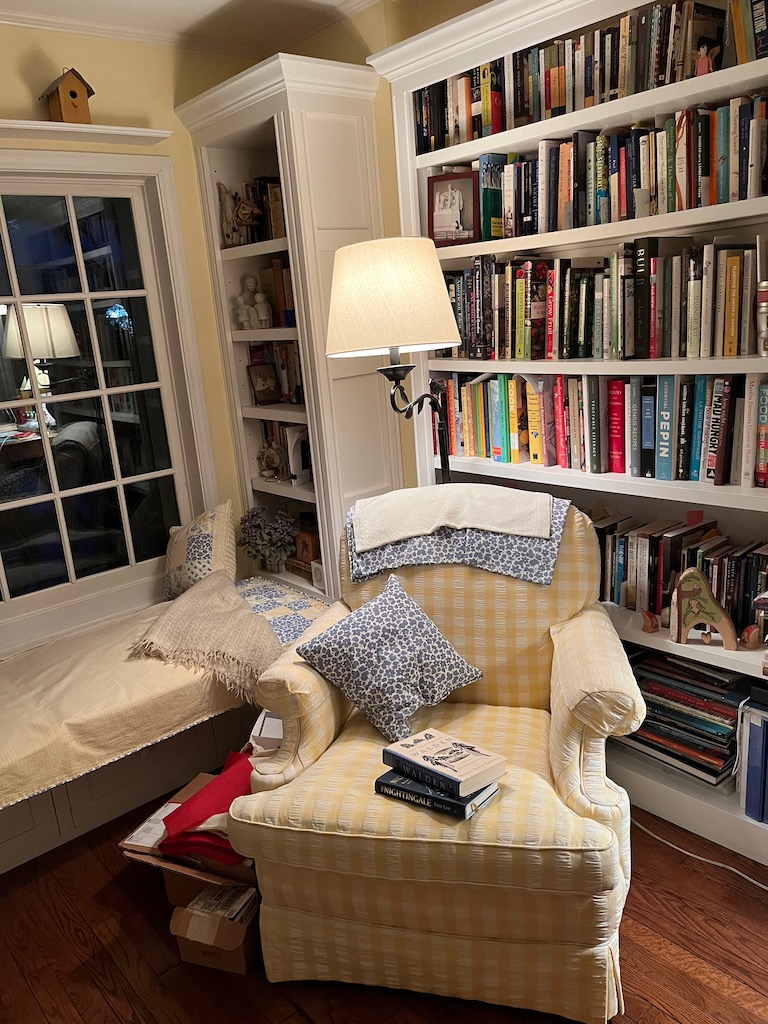
before closing, a wee bit about the two books waiting on my butter-yellow-checked chair: thoreau’s walden i am reading cover to cover as preamble to the weeks ahead when i’ll likely be extolling the wonders of keen-eyed watchkeeping on the woods and the turning of seasons.

sam lee’s the nightingale has been on my bedside table for at least a year (there’s a whole essay on the books we keep close at hand, yet never manage to crack). for the pure whimsy of it (as well as a fine excuse to read the pages of the irish news) here’s what they have to say about the wondrous love-letter to the vanishing bird. but should you refrain from clicking, here’s the book jacket description:

Come to the forest, sit by the fireside and listen to intoxicating song, as Sam Lee tells the story of the nightingale. Every year, as darkness falls upon woodlands, the nightingale heralds the arrival of Spring.

Throughout history, its sweet song has inspired musicians, writers and artists around the world, from Germany, France and Italy to Greece, Ukraine and Korea. Here, passionate conservationist, renowned musician and folk expert Sam Lee tells the story of the nightingale. This book reveals in beautiful detail the bird’s song, habitat, characteristics and migration patterns, as well as the environmental issues that threaten its livelihood.

From Greek mythology to John Keats, to Persian poetry and ‘A Nightingale Sang in Berkeley Square’, Lee delves into the various ways we have celebrated the nightingale through traditions, folklore, music, literature, from ancient history to the present day. The Nightingale is a unique and lyrical portrait of a famed yet elusive songbird. Sam Lee has brought the poetic magic that has long enchanted so many of his musical fans into the written word.

and that’s the news, thin as it is, from here at covid central.

how shall you be soaking in your quiet hours ahead?

in praise of eeyore

in all the annals of children’s literature, there deserves to be a shelf devoted to one gloomy donkey. eeyore is his name, a name derived from a phonetic spelling of the sound the farmyard friend is alleged to make. i say “alleged” because i cannot claim that i’ve leaned against a split-rail fence and listened in for just the way he hees and haws.

i write in praise of this misanthropic fellow, forlorn as the day is long, this chap who ambles through the hundred-acre wood tossing out lines wholly hollowed of all hope––for instance, “it’s not much of a tail, but i’m attached to it,” or, when someone pins a red balloon to where his tail went missing, he sighs, “sure is a cheerful color. guess i’ll have to get used to it”––because just yesterday i felt his every pain, and found myself cheered to be so deeply in his shadow.

ups and downs of EKG

it was an eeyore sort of day, and i was in an eeyore sort of slump (my best, best friend had three biopsies the day before, someone else was positive for covid, and i’ve not shaken the last of my own red-ringed devil although i’m due to board a plane to NYC tomorrow). and it made me think how fine a thing it was and is for a child to have an eeyore on the shelf, to feel some kinship when the world turns gloomy grey and a few good hours of slumping around in self-defined misery is not such a bad thing. it’s part of human nature. etched into the very dips and hollows of any old EKG, for starters. and it made me think that our gloomier angels deserve a moment’s appreciation. so here i am appreciating.

if not for grey, wouldn’t rosy raspberry be just another shade from the far side of the color wheel?

i’ve known souls who never seem to veer off the happy plane, and frankly they worry me. it simply cannot be a fact of nature that optimism is ever present. i like a little deviation in my moods. how on earth can you fully appreciate the good days, if you’ve not felt the uptick from down in the doldrums?

of course, i’m not rooting myself down where misery loves its company. like cloudy skies, it passes. and, after all, by day’s end at least a few of yesterday’s bumps had smoothed (the kid with positive covid PCR–a kid hunkered down in our basement just the night before–took another test and this one proved him negative; and this meant we didn’t need to seal our own college kid in a cellophane wrap, keep him home from college for an extra week, figure out just how to get him off to school without infecting every other passenger in sight).

all i’m saying is that i am grateful that in turning the pages of alan alexander milne’s classic children’s tale, a wee child sodden with sadness might find a kindred shadow in the likes of dear friend eeyore. no one likes to be alone in sorrow. i know very few who would appreciate a swift “get over it” when feeling wearied by the world, with no quick fix in sight.

and so i burrow against the contours of the dreary donkey. i embrace his full expression of how dark it sometimes feels. and, unlike eeyore, i look forward to the dawn when the sky is once again awash in pretty pink.

i can’t quite think of a question, so i offer simply this: if you’re feeling eeyore glum, may you find some tiny shred of solace in knowing you are not alone. one thing to contemplate might be this: what are the few ties to hope that sometimes pull you from the doldrums? do you have any tricks up your sleeve that chase the clouds away?

please pray for my beloved auntie M, as she is known in these parts, and where she has been my number one love angel since the very day she walked into my life—and my heart—my sophomore year of college.