pull up a chair

where wisdom gathers, poetry unfolds and divine light is sparked…

Category: interfaith family

hallowing the hollows

“the garden of eden with the fall of man” (ca. 1615):
Peter Paul Rubens
Jan Brueghel the Elder

i emerge here from a day of prayer, a day of poring over the sins of my soul, and the sins of us all collectively. it is a day that’s not easy to leave behind. certainly not this year.

Yom Kippur, the day of atonement, opened with the rabbi once again sharing shattering news. a horror in manchester, england, he told us, without details, had left more than one dead.

morning light streamed in.

i felt us all move in closer, a natural deeply human instinct to harbor each other. it’s those natural instincts that tend to get drowned out on ordinary days, days when it’s noisy, days when we’re so distracted we don’t pay attention to the sound of our breath, the warmth of our skin, the deeply human instinct to run toward, not away, from someone who’s hurting.

we live in a world so distant now from the original vision. from an edenic world where boughs were bent from the heaviness of their fruits, where the silence allowed for the chorus of chirring and chirping to rise from the underbrush, from the branches. in the beginning, in the genesis, after the cascade of wonders—light, darkness, seas and sky, dry land and waters, seed-bearing plants and fruits with seeds buried inside, two great lights in heaven’s vault, the demarcation of day and night, teeming waters and birds filling the air, wild beasts and slithering, down-on-the-ground ones—the one who’d imagined it all, the one we name God, God looked down and saw still a void. how would the garden be tilled? how would it be kept?

and so God made beings in God’s own image, so genesis tells us. and for a short flash of time, man and woman lived in peaceful accord. but temptation arose. and it all shattered and changed. eden was no longer. the man and the woman were banned.

and all these millennia later, we are a people plagued by temptation. temptation of power, of greed, of malice and evil, of hurtful whisper, and weapons of war.

we have fallen so far from the garden of peace and tranquility.

and so, on Yom Kippur, we atone. all world religions, as far as i know, hold confession at the core, are built on the knowing that we will go wrong, exercise evil, traffic in hate.

and so, through the day, over and over and over again, we confess. we confess in short form and long form. we confess and confess, each go at it grating closer and closer to the core.

against the backdrop of the world in which we are living, these are a few of the confessions we prayed:

“The ways we have wronged you by hardening our hearts; and the harm we have caused in Your world through careless speech.”

“The ways we have wronged You by giving in to our hostile impulses; and the harm we have caused in Your world through inflexibility and stubbornness.”

or this, one of the pleas to the Almighty and Merciful, Avinu Malkeinu:

Avinu Malkeinu, halt the reign of those who cause pain and terror.”

so ardently we confess and we pray.

to enter the sanctuary, be it the one of a synagogue or the one under the heavens in my own backyard, is to submit to a paradigm other than the distortions of a world ruled by greed, and power, and envy, and lust.

in these past godawful years, when i can almost hear the walls of decency and democracy crumbling, i retreat more and more into the sanctuary. the voice to whom i answer is that of the Merciful, Benevolent God, a God who is gentle, and tender, a God who seeps into the deepest parts of me, the parts where i surrender, where i know my place is so, so small, and yet, whatever light i can bring to this world, whatever infinitesimal flickering flame, it matters. because we are not the only flame. we inch closer together when word comes, once again, of horror and chaos and evil upon evil. we are many, many flames. or we can be. if we so choose.

it is a mighty thing to stand and sit through a day when over and over we confess our sins, our evils, our hurt-making acts. we are a nation that could do with a day of atoning.

and i am blessed that i, a lifelong believer in God’s tender mercy, was asked to atone for the sins of my own and the sins of us all.

i enter quietly back into this shattered, and shattering world.

i will not extinguish my faint little flame.

what will be your flame this holy day?


i leave you with words of john lewis, the late great hero of civil rights and warrior for justice:

Every human personality is something sacred, something special. We don’t have a right, as another person or as a nation, to destroy that spark of divinity, that spark of humanity, that is made and created in the image of God. 
—John Lewis 


and should you care to be moved by one of the gentlest, fiercest spirits ever to walk among us, this beautiful interview, recorded just last week, of jane goodall, the great primatologist and anthropologist who died at 91 on wednesday. bless her, she was deep in her last book tour when her blessed heart beat its last.

i remember how, when there was a jane goodall special on national geographic, my mother would huddle us around the TV, for she was someone worthy, and i always found her a brilliant source of hope, kindness, an uncanny attunement with nature and nature’s creatures. i have prayed all my life to live to be a wise grace-filled woman like her…..wrinkles worn with dignity, hair whitened by the sun, wrapped in her shawl, at once wise and funny, of the moment and yet timeless. . . .

even in darkness, we gather light

i know the darkness is inching toward us, minute by minute. and i welcome it, being a winter baby, and being drawn to shadows and inkiest night. but i find myself thinking glistening sorts of thoughts these past few days, make-believing we’re pulling up chairs on this snow-swaddled morn for a festive wintry all-chair tea. 

my house is aglow and will be glowier once the candles are plunked in the menorah, and kindled one by one, eight nights in a row. this year, for the first time in two decades and only the second time since 1959, both Christmas and the first night of Hanukkah fall on the twenty-fifth of december. i’ll be pulling out all the festival stops with my anglophile mother’s favorite yorkshire pudding and roast of beef, and my beloved’s brisket and latkes. (crank the ovens! and, please, bring on the sous chefs!)

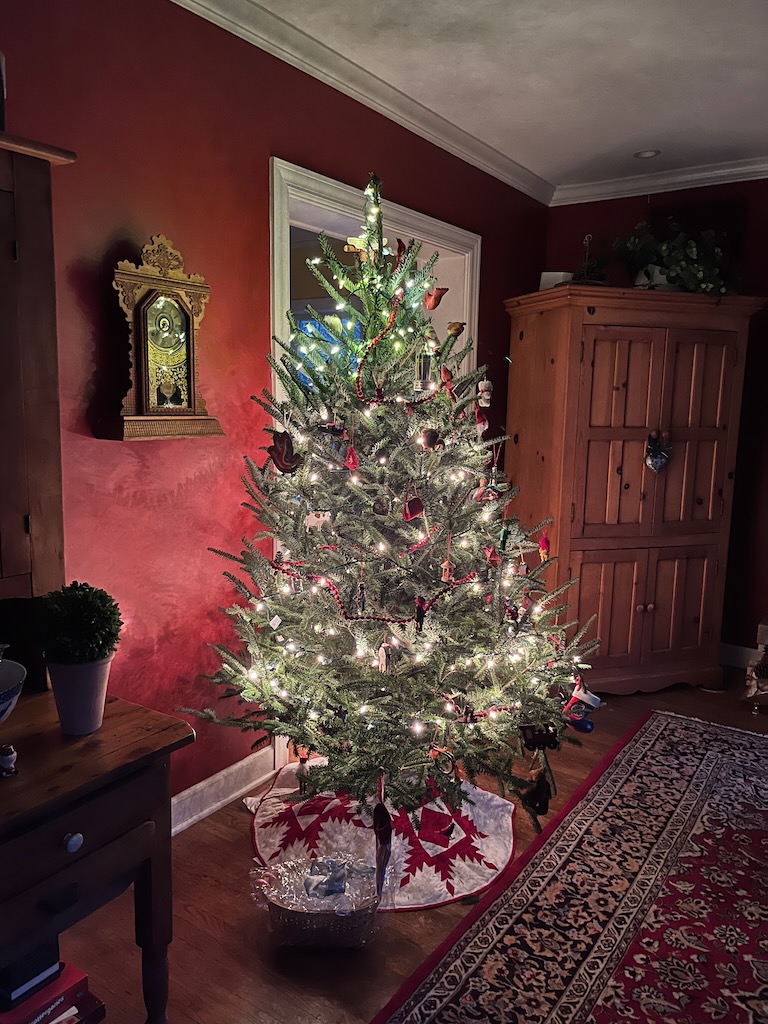
but here, at my make-believe solstice tea, i imagine the tintinnabulation of porcelain teacups being stirred with antique silver spoons, and the pungent perfume of star anise and clove and the peel of one fat orange simmering in my old red “christmasy smell” pot. without make-believing, i inhale the foresty perfume of the fraser fir that, for days now, has stood proud in the corner, obnoxiously blinking because someone pulled the wrong box off the hardware store shelf.

if we were all here, gathered round this old worn table, we’d be shy maybe at first. surely, one or two wouldn’t be because there’s always a livelier wire in every good bunch. but i’m of the shyer persuasion these days, so i’d be purring most loudly simply being a listener. i’m apt to station myself on the circle’s outer edge, and to be the one keeping close and quiet watch. 

i’d delight myself in crowding the table with sugar-dusted spice cookies, crisp and bronze round the edges. and i’d put out a mound of satsuma oranges, the ones plucked with leaves still attached, drawing me that much closer to pretending i’m sitting on the orchard floor, spine leaned against the trunk, peeling a just-plucked orb, watching the clouds waft by. 

and here at the old maple slab, there would be teas by the pots full. and a crackling hearth just across the room, where logs would hiss and pop and flames would leap up the chimney. and warm woolen blankets would be amply piled in a basket nearby. and a drummer boy or two surely would pa-rum-pum-pum-pum from the crackly radio. and maybe i’d set out earthenware bowls, one filled with clementines, another with sprigs of clove, and spools of ribbons, for the making of pomanders while we while away the morn telling stories.

i’d send you home with candy canes. and a fat satsuma too. and to tuck in your pocket, these beautiful, beautiful poems for safe-keeping. the first, from rainer maria rilke, and the next two from wendell berry, the farmer poet from the bluegrass state where i was born. his first is solstice-focused, and the other, a magical reframing of the very first Christmas.

all this my way of saying merry blessed Christmas, and Hanukkah, and Kwanzaa, too. may the glistenings and tinklings and all the spicy perfumes of the season set aglow your deep and tender and most blessed heart…

Advent
The wind in winter woods is like
a shepherd to his flock of flakes
and soon the firs anticipate
how blessed will be the light

and eavesdrop. The garden doves
ready themselves in branches white
and fend off the wind, growing towards
the glory of this night.
—Rainer Maria Rilke

To Know the Dark
To go in the dark with a light is to know the light.
To know the dark, go dark. Go without sight,
and find that the dark, too, blooms and sings,
and is traveled by dark feet and dark wings.
––Wendell Berry

Remembering that it happened once
Remembering that it happened once,
We cannot turn away the thought,
As we go out, cold, to our barns
Toward the long night’s end, that we
Ourselves are living in the world
It happened in when it first happened,
That we ourselves, opening a stall
(A latch thrown open countless times
Before), might find them breathing there,
Foreknown: the Child bedded in straw,
The mother kneeling over Him,
The husband standing in belief
He scarcely can believe, in light
That lights them from no source we see,
An April morning’s light, the air
Around them joyful as a choir.
We stand with one hand on the door,
Looking into another world
That is this world, the pale daylight
Coming just as before, our chores
To do, the cattle all awake,
Our own white frozen breath hanging
In front of us; and we are here
As we have never been before,
Sighted as not before, our place
Holy, although we knew it not.
––Wendell Berry

my hope this day of longest night, when darkness is the victor, is that no matter when or how the darknesses come we always find those and that which brings us light in all its intensities, from flickering to full-on blazing. bless you, bless you, ever bless you…

where do you find your essential light?

that fat little fir up above is the one that fills the room with its insistent eau de forêt

*branch of birds above from beautiful amy years ago….

the names we are called, and the names that call us

my little irish grandma mae, as my grandpa, “choo-choo papa,” received his 50-year gold watch from the L&N Railroad, for which he was a locomotive engineer on the cincinnati-to-corbin (ky.) line

the email from synagogue came back in the spring. the rabbis and cantor had been thinking for awhile about some of us. an odd lot of us. we were the ones who’d found our way, through one inlet or another, into the river of jewish life — at synagogue and at home — yet “don’t identify as jewish.” (that wording, so very of the cultural times, cracks me up. in the old days wouldn’t we simply have been “not jewish”?) 

they, this lovely trio of clergy, all young, brilliant, and devoted to their callings, recognized that we were in many ways bringing our lives to the poetries and prayers of judaism, and that judaism’s poetry and prayers had found its way fairly deep into our lives. they wanted to honor that. 

they weren’t asking that we convert, weren’t asking us to sign on any dotted line. 

but they had a radical idea, deeply radical when set against the context of a tradition that long saw intermarriage as the great scourge, one of the most grievous threats to the ancient and blessed religion. the radical idea of our rabbis and cantor was to give us each a hebrew name. but not without deeply engaging in weeks of contemplation and discussion, coming to synagogue on wednesday nights as summer turned to autumn, as the air grew cooler, and the trees more golden and crimson. 

we talked the first night about the journey into judaism, they asked us to talk about moments of pain, times we felt excluded, rejected, pushed to the margins. or when we’d felt welcomed. we talked about being an outsider versus insider. did we feel we had a voice in the conversation, in the congregation, at our own kitchen tables, and even more broadly in the jewish world?

they asked us to tell the stories of each of the names we’d been given at birth, and the names we’d chosen to carry through life. they asked us to unspool the narrative of nicknames that ebbed and flowed through our stories. 

and they asked us to think deeply about what a name means. and to pull from our lives and from Torah particular names of particular souls who somehow stirred us. with whom we felt some deep, almost palpable pull.

i knew fairly quickly whose pull i was feeling. but before settling on my little irish grandma, the only grandparent i never knew, one with whom i’ve long felt an uncanny cord, i briefly considered sarah, she who — like me — thought she was “barren,” and found out at the ripe old age of 90 (i was nearly 45) that she was “with child.” and who greeted the news by laughing out loud. sarah, like me, is the archetypal old mother.

we had homework: a sheet of essay questions pondering names, all of which were meant to evoke for the rabbis a few hebrew names that might be fitting for each of us. after poring over our essays, they sent us our custom-curated list of possibilities. i didn’t choose from high up on the list; i found my name deep down in the unlikelier choices. but, turned out, it was a tight fit. a name with the same roots, the same meaning, whether celtic or hebrew. (you’ll see below.)

once we had our names, and had written the stories of how we came to those names, and why, we were invited to synagogue for a special friday night Shabbat service, where we’d be called to stand in a half circle on the bimah (the raised platform from which the Torah is read). one by one, we’d speak our names, and tell our short stories. 

before we told our stories, the rabbi, who i love, and whose name is ally or allison, (i don’t know her hebrew name, i just realized), set the stage with the eloquence and grace i’ve come to think of as her trademark, her inimitable magnificent, heart-melting way.

“Jewish tradition believes that names have great power,” she began. and then she read this poem from the israeli poet zelda, who is known widely by only her first name: 

israeli poet, zelda

“Each of us has a name given by God and given by our parents.
“Each of us has a name given by our stature and our smile and given by what we wear.
“Each of us has a name given by the mountains and given by our walls.
“Each of us has a name given by the stars and given by our neighbors.
“Each of us has a name given by our enemies and given by our love.” 

in a sentence that took my breath away before she called us from our pews to stand in our half-circle, to step to the podium, she said that we’d “earned these names through sacrifice and grit, through tenderness and care. they earned these names through their openness, their tolerance, their expansive and soft hearts.”

that sentence made me riffle through the rolodex of my life, through the hard conversations at the kitchen table, the tears on long telephone calls when a Jew and a Catholic were hashing it out in the three years before we married, trying to decide whether we could work it out, whether we could braid two faiths, two traditions, two deep ancestral ties into something that might even be greater than the sum of its parts. made me think of the blessing ceremonies in our tiny little garden on Wellington Avenue, when a rabbi and a priest poured their words, their wisdoms, and their blessings on two baby boys we were both blessing and naming (with eight years between each). made me think of the pair of Shabbat candlesticks, layered with wax from candles dripping and dripping over the years. made me think of the lamb stew we’ve stirred at the cookstove, my beloved and i side-by-side. 

i thought how, indeed, both of our hearts have softened, have opened, have grown.

and then it was my turn to step to the podium, clear the tears from my eyes, and read these words to those gathered:

I’ve spent much of my life peeking beyond the borders of what was before me. Yearnings have always stirred me––reaching for what I don’t yet know, reaching for the holiness I deeply believe in, reaching for loves long after they’re gone. 

And there is a particular grandmother, the only grandparent I never met, who has always, always animated my imagination. I yearned to know this daughter of Irish immigrants, a Kentucky schoolteacher, who, according to family lore, was the first woman to graduate from college in the commonwealth, who snagged the highest score on her county’s teachers’ exams, and just as importantly, could wring a chicken’s neck!––a praiseworthy prelude to many a Sunday supper in the Bluegrass State. 

Her name was Mae, Mae Shannon, and her only child, her beloved child, was my beloved long-gone papa, Eugene Shannon Mahany. 

Until now, my connection to Mae has been purely by heart, and through a few fading photographs that show we share an uncanny resemblance. 

Her name, Mae, is a Celtic derivitive of Mary or Margaret, and one of its meanings is “pearl.” So, too, the Hebrew name Margalit—yet another “pearl.” 

Considered the gemstone of inner wisdom, the pearl is one of creation’s wonders, formed through the mysterious interplay of oceanic depths and the celestial pull of the tides. 

The pearl is formed when the mollusk, or bivalve, senses an irritant—a grain of sand, perhaps—which it enwraps by secreting layer upon layer of minerals, all extracted from seawater. Sand to seawater to pearl.

Ergo, pearl equals protection, luminous protection. Its very creation, an equation of awe. And the pearl, a moonlike orb, is thus said to be a vessel for water’s energy, to carry the lucid movement of the tide’s ebb and flow. It’s believed to hold deeply healing powers. 

Its beauty, formed in unseen depths. 

Radiance, evolved over time. 

The pearl, Margalit––the Hebrew name of my choosing––my tie at long last to the little Irish grandma I so long to sit down beside. And whose inner luminous wisdom I so yearn to absorb. 

And mightn’t she be wonderstruck to discover she’s inspired her only granddaughter’s new Hebrew name.

love you, dear chairs. by your names that i know, and your names that i don’t.

what’s the story of your names?

p.s. our rabbis are pretty sure that ours is the first congregation in the U.S. to undertake such a process, the giving of hebrew names to those who don’t identify as jewish.

and tonight we begin the highest and most solemn of high holy days, yom kippur, the day of deep atonement.

let us speak of the awesomeness

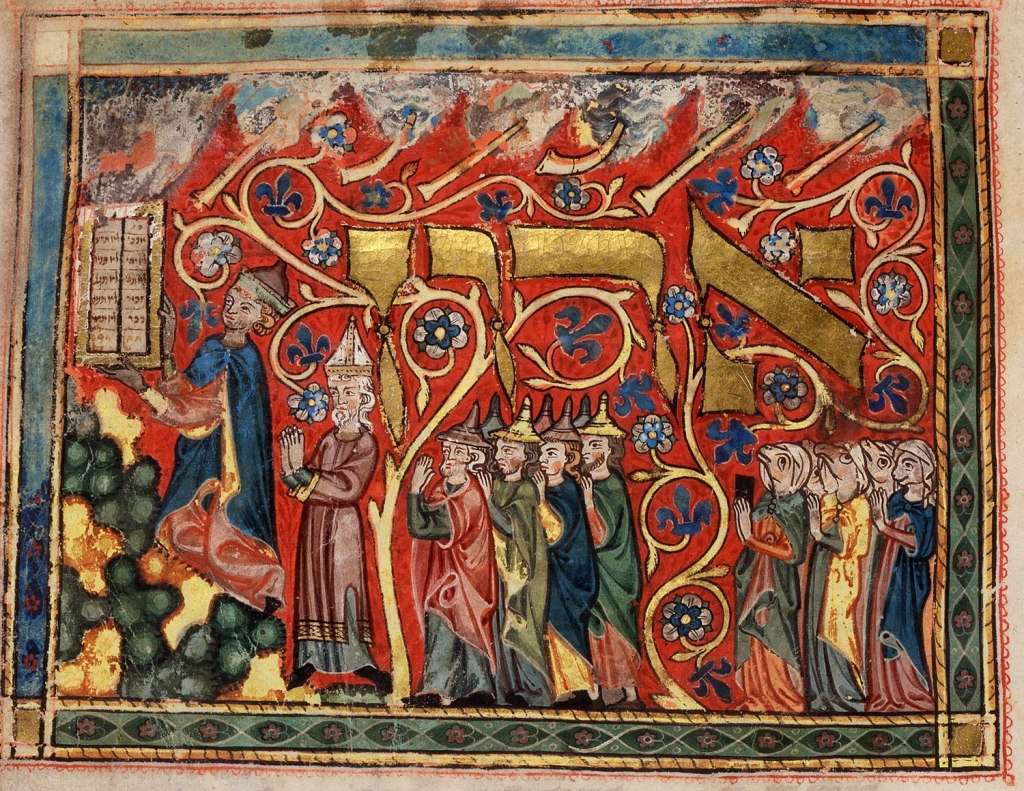
This image has an empty alt attribute; its file name is sinai.jpg

of all the majestic moments in the days to come, the days of awe to come, for this is the cusp of the jewish new year –– the hours when we drop to our knees (figuratively, for there’s not a lot of kneeling in the synagogue) in thanks for all creation, for the newbornness of the world, this world we are entrusted to keep, meaning not to possess but to preserve, to tend, to watch over as a shepherd over his lambs –– one of the moments that will stop time for me is when the chanting of the unetanneh tokef (“let us speak of the awesomeness”) begins. 

its words are as stirring as they come, deep down to the marrow. and they will stir me so deeply this year.

Unetanneh Tokef (ונתנה תקף) (“Let us speak of the awesomeness”) is a piyyut, or Jewish liturgical poem, woven into the hours of prayer of Rosh Hashanah, the new year, and Yom Kippur, the day of atonement to follow. it is chanted just before the Kedushah, the prayer in which the angels sing of the holiness of God, and when the ark that holds the Torah, or sacred scroll, is opened. 

leonard cohen sung from it. in his glorious, goosebumping “who by fire?”** 

it’s a prayer poem in which we stare into the face of our ending, our death, and examine closely the sharp edges of that terrain we so often run from. while it hurls us into attention, a mortal attention that is the base of plenty of theologies (those teachings believe we heighten our game when we’re aware it will end), it doesn’t look only at the last steps, but, too, at the ones we might take as we march there. it’s in the unflinchingness of judaism –– the bracing, no-beating-around-the-bush, straight-on-ness of it –– that so often grabs me by the scruff of the neck and keeps me transfixed. 

and certainly here, and in the hours and days ahead, when we will take public inventory of our sins, when we will stand before a body of water and along with those who stand beside us cast our sins (in the form of bread chunks) into the currents or tide. and when, in the silence of our own pews, we will once again ask these mortal questions. it is the second section of the four-part prayer-poem, the litany of not only death but life, that stirs me most profoundly. 

here are its words (with emphasis on the lines that emphasize living, not dying):

“On Rosh Hashanah will be inscribed and on Yom Kippur will be sealed – how many will pass from the earth and how many will be created; who will live and who will die; who will die after a long life and who before his time; who by water and who by fire, who by sword and who by beast, who by famine and who by thirst, who by upheaval and who by plague, who by strangling and who by stoning. Who will rest and who will wander, who will live in harmony and who will be harried, who will enjoy tranquility and who will suffer, who will be impoverished and who will be enriched, who will be degraded and who will be exalted. But Repentance, Prayer, and Charity mitigate the severity of the Decree.”

one of the prevailing pounding questions of this long hard summer has been my considerable wondering about what lies ahead for me, how many years to love on this world that i love so lavishly. it’s left me breathless, a true foggy night of the soul. and yet, as fall emerges, and the new year begins, so it’s time for me to turn (another command of the days of awe, teshuva, to turn in forgiveness, to repair what we’ve broken) to face the light of the days i won’t –– and can’t –– count. 

it’s a soul-scouring exercise, one that was flung upon me the moment i heard “it’s cancer,” and i’ve taken it to heart. spent more hours than anyone knows contemplating how i will live what remains of my portion. if i emerge living more alive than ever before, if i emerge wildly embracing each and every dawn and the day that follows, if i love as i would be loved, if i take to heart every last prompt to be gentle, to be kind, to forgive as i would be forgiven, then my prayers this year, my Unetennah Tokef, will be answered.

this is a question to be answered in your own silence: how will you live the next holy days of your one blessed life? 

the whole text, for anyone keen to read, broken into four thematic sections:

fear and trembling:

“Let us now relate the power of this day’s holiness, for it is mighty and frightening. On it Your Kingship will be exalted; Your throne will be firmed with kindness and You will sit upon it in truth. It is true that You alone are the One Who judges, proves, knows, and bears witness; Who writes and seals, Who counts and Who calculates. You will remember all that was forgotten. You will open the Book of Remembrances — it will read itself – and each person’s signature is there. And the great shofar will be sounded and a still, thin voice will be heard. Angels will be frenzied, a trembling and terror will seize them — and they will say, ‘Behold, it is the Day of Judgment, to muster the heavenly host for judgment!’ — for even they are not guiltless in Your eyes in judgment.”

God judges us:

“All mankind will pass before You like a flock of sheep. Like a shepherd pasturing his flock, making sheep pass under his staff, so shall You cause to pass, count, calculate, and consider the soul of all the living; and You shall apportion the destinies of all Your creatures and inscribe their verdict.

“On Rosh Hashanah will be inscribed and on Yom Kippur will be sealed – how many will pass from the earth and how many will be created; who will live and who will die; who will die after a long life and who before his time; who by water and who by fire, who by sword and who by beast, who by famine and who by thirst, who by upheaval and who by plague, who by strangling and who by stoning. Who will rest and who will wander, who will live in harmony and who will be harried, who will enjoy tranquility and who will suffer, who will be impoverished and who will be enriched, who will be degraded and who will be exalted. But Repentance, Prayer, and Charity mitigate the severity of the Decree.”

we are helpless:

“For Your Name signifies Your praise: hard to anger and easy to appease, for You do not wish the death of one deserving death, but that he repent from his way and live. Until the day of his death You await him; if he repents You will accept him immediately. It is true that You are their Creator and You know their inclination, for they are flesh and blood. A man’s origin is from dust and his destiny is back to dust, at risk of his life he earns his bread; he is likened to a broken shard, withering grass, a fading flower, a passing shade, a dissipating cloud, a blowing wind, flying dust, and a fleeting dream.”

God is enduring: 

“But You are the King, the Living and Enduring God.

There is no set span to Your years and there is no end to the length of Your days. It is impossible to estimate the angelic chariots of Your glory and it is forbidden to pronounce Your Name. Your Name is worthy of You and You are worthy of Your Name, and You have included Your Name in our name.”

bless you all, profoundly.

This image has an empty alt attribute; its file name is ancient-hebrew-scroll.jpg

**i tried to post a video, a glorious recording of leonard cohen singing “why by fire?” but the video seemed to be getting in the way of publishing this post, so if you’d love a musical blessing, try googling “who by fire?” by leonard cohen. it’s worth a listen. xoxox


into the depths and the darkness…

i hadn’t set out to burrow into the darknesses of history this week. but i’ve been traversing trails darker and darker, as i’ve turned the pages of jewish history, a history i entered into on sunday when i listened to a priest tell a story of holy week. drawing from the work of early christian scholars, the priest i was listening to closely laid into a tight and stark timeline an account of holy week, one i’d never quite followed so closely, one which even more poignantly drew me into the jesus for whom judaism held the holiest code.

one curiosity led to another, and notes were exchanged between the priest and i, and books were requested from the library. while i awaited the books, i wandered upstairs to the bookcase where my husband keeps his collection of jewish-themed books, from the big book of jewish humor to the wisdom of the Talmud, from chaim potok to martin buber. that’s where i found the big fat doorstopper of my people: the story of the jews, the majestic 522-page historical tome written by abba eban, the late great israeli statesmen and scholar of hebrew and arabic languages (he was fluent in 10 languages).

i pulled the book from the shelf, and started to read, and soon i was typing line after line of notes as i turned the pages of eban’s telling of jewish history, from the drama of abraham through the rise of christianity, and on through the crusades of the middle ages, through the founding of israel, straight through to the state of the middle east when eban’s book was published in 1968.

these are but some of the notes i typed, ones especially relevant to this holy week:

Jesus meticulously kept Jewish law, made pilgrimage to Jerusalem on Passover, ate unleavened bread, uttered blessing when he drank wine. “He was a Jew in word and deed.” Articulated ideas of the masses. Sermon on the Mount: “I have not come to destroy Law but to fulfill it.”

with each page’s turning it felt apt to be tracing more and more deeply the story of the jews in this particularly blessed week where our house is filled with the rhythms, once again, of passover and passion week. after spending each saturday of the year studying torah, portion by portion with a collection of inquiring minds at our synagogue, it seemed as if eban was giving me a glimpse of the whole jigsaw puzzle i’d been studying piece by piece.

but the longer i read, the darker it grew. in the name of one holy God, we have persecuted, and burned at the stake. we’ve thrown the holiest texts of the jews onto the pyres of history. we’ve forced them into ghettoes, ordered them to stay in their homes with shutters drawn on easter sunday. ordered them to wear badges, so identifying themselves as followers of the One Holy God. we’ve told centuries and centuries of stories making them out to be the ones who crucified jesus. who betrayed him in the garden, who led him before pontius pilate, mocked him and crowned him with thorns. those stories, lost in translation, lacking full context, miss plenty of points. those stories have been turned into stones to torture the jews.

Jesus meticulously kept Jewish law, made pilgrimage to Jerusalem on Passover, ate unleavened bread, uttered blessing when he drank wine. “He was a Jew in word and deed.” Articulated ideas of the masses. Sermon on the Mount: “I have not come to destroy Law but to fulfill it.”

i weep at the decimations of history, at the evil and the distortion that drives the worst of humanity. at the fact that we wage such wars under the flag of God, and of church. how dare we.

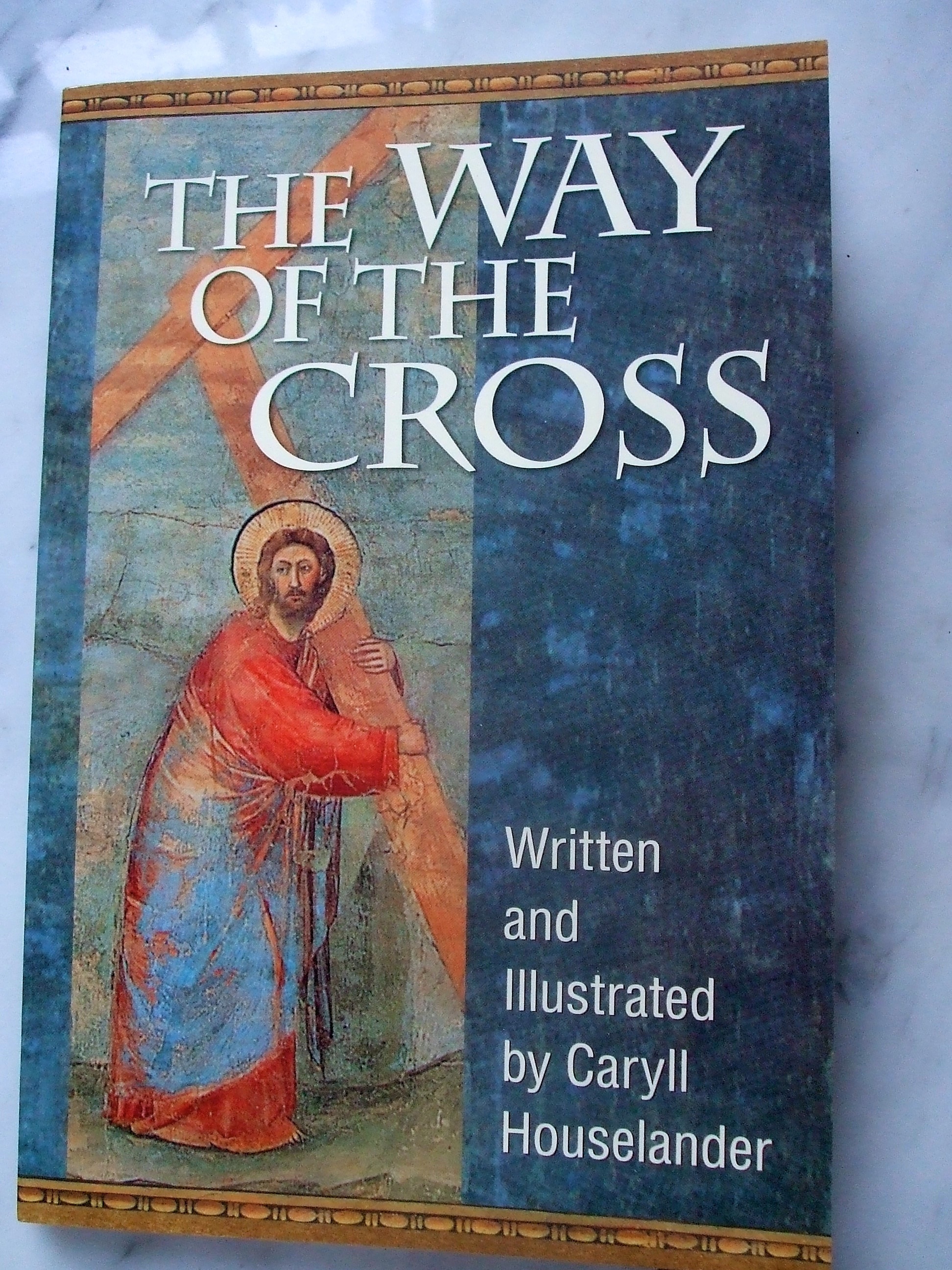
i’m 239 pages in; i’ve just read through the crusades, and the development of the ghetto in medieval europe, where “jewry was sealed off by a bolted gate.” today, i’ll put down eban, and i’ll pick up the way of the cross, by caryll houselander, the anglican mystic and artist, who curiously worked as a counselor of war-traumatized children, the war in question being the one where hitler sought to exterminate (what a detestable verb) the entire jewish population, a hatred that never seems to die.

i will read, as i always do, each station along the way of the cross, to the mount where jesus was nailed to a cross and left to die between two criminals, one who sought forgiveness and one who scoffed.

i will weep as i turn those pages, just as i’ve wept through the pages of my people.

i will ask, louder and louder, how might we have been so very wrong? and how have we dared demonize a holy people, a chosen people, a people whose truth jesus so ardently tried to tell? jesus’s holiest command, “love as you would be loved,” is in fact the jews’ central command, found in leviticus, and taught by the great hillel to be the greatest of all.

a marvelous story, in fact, is told of hillel, the gentle sage, who once was confronted by someone who wanted him to teach the whole of the Torah while standing on one foot, and to which hillel is said to have replied something along the lines of “what is hateful to you, do not do to your neighbor. that is the whole Torah; the rest is the explanation of this—go and study it!”

what is hateful to you, do not do to your neighbor.

love as you would be loved.

Father, forgive us for all of our sins, for which there are so, so many.

who taught you to love as you would be loved? and how did you see that played out in the fine grain of your life?

because friday is the day we pull up a chair, i’ve written on 17 good fridays now, and each year i seem to find a new way in. here are a few others:

way of sorrows
 
jesuit girl with jewish soul

into the depths

silence on the day that darkens

year upon year, truth upon truth…

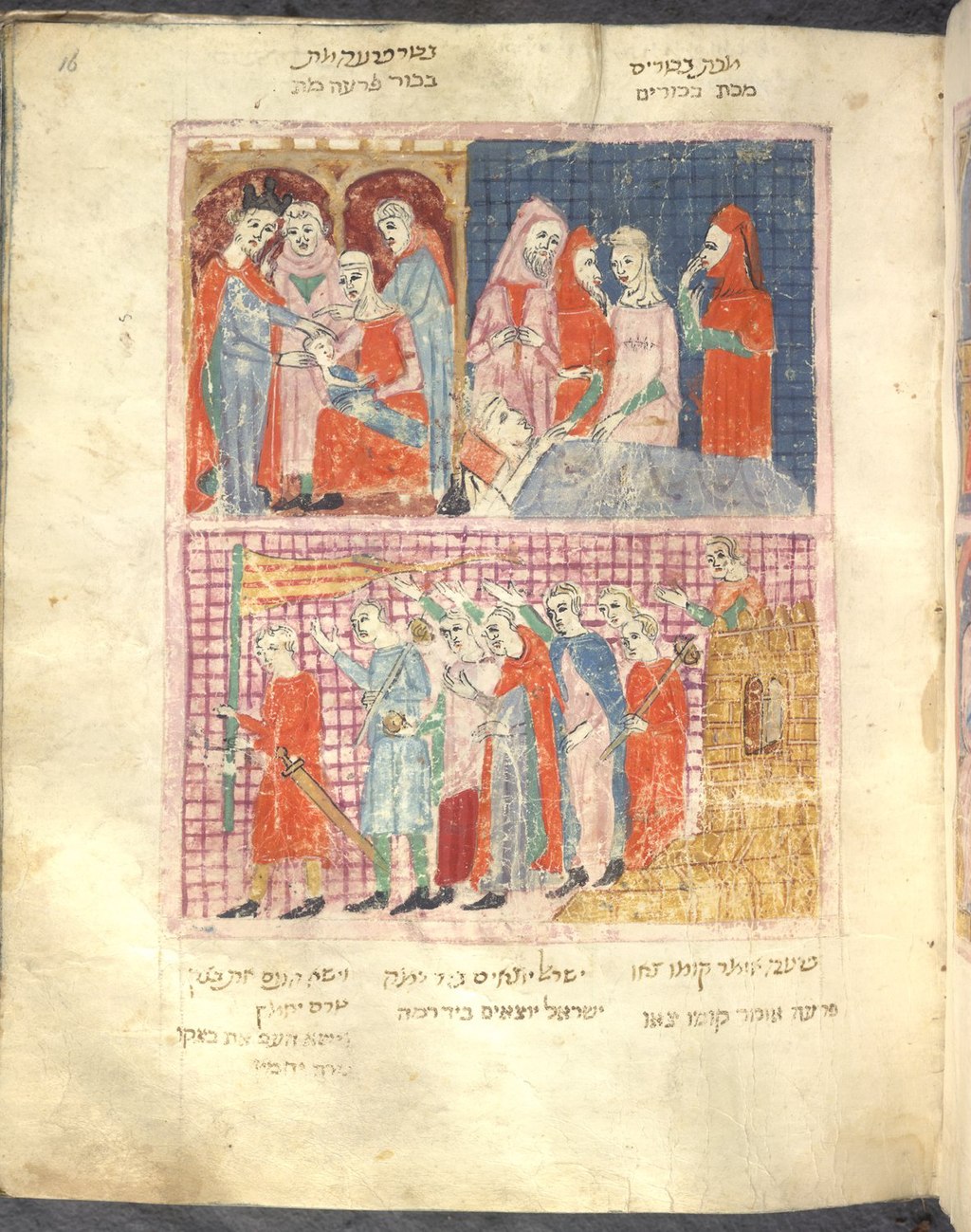
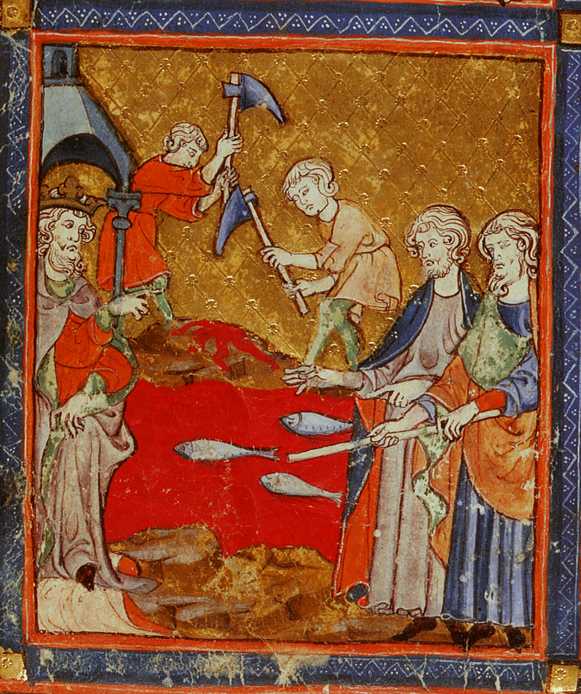
14th-century rendering of the plagues of egypt

we are tellers and re-tellers of story, a people long bound by the unspooling of truths told in text or in verse, around table or hearth, under moon and star or plaster and beam.

in the geometry of time, there lies both wisdom and instruction in the unfurling of the year, an unfurling that might feel like a circle but that i see as a spiral. year after year, we return to texts––familiar texts––that draw us in more and more deeply, the more closely we pay attention. 

so it is––as i fill my house with matzo and shred it of breadcrumbs, as i shop for both lamb and shank bone, as i steam mounds and mounds of asparagus––that once again we come to this holy stretch of time endowed with foundational story, ancient stories both christian and jewish. the story of a savior who wept in a garden, and soon was betrayed, then flogged and stripped and pierced with a crown of thorns. a humiliation as severe as any i’ve ever read. certainly more than any i’ve ever known. and at the same time in this house, we read and retell the story of the enslaved jews finding their way out of bondage, crossing an isthmus, a sand bar in a sea of reeds, but not before witnessing the scourge of ten plagues. 

the beauty of these texts, and any text meant for endless curiosity––these texts, as if prisms we hold to the light, turning and turning for the making of new rainbows––is that each year some new fragment may catch our attention. new rainbows might scatter against the walls of our soul. 

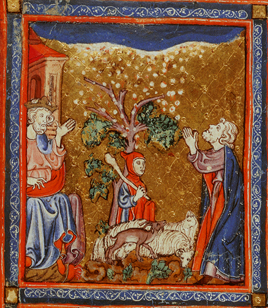
so it is that this year i am thinking anew of the plagues: water turning to blood, frogs, lice, flies, livestock pestilence, boils, hail, locusts, darkness, and the killing of firstborn children.

i remember how at the long seder table where my boys grew up, the table would be scattered with wee plastic frogs and broad-winged bugs; ping pong balls would serve as hail. and red food dye would be splattered on plates. the detail was never lost. 

and only this year––a year when both those boys who once squirmed at the bugs and squealed at the blood will be hundred of miles away––only this year have i come to pay closer attention to what the plagues might have meant to the story we’re commanded to tell. 

according to a wise, wise rabbi whose wisdom i found myself reading the other day, the plagues are “commonly read as punishments levied against the egyptian people for the terrible suffering they forced upon the israelites,” writes sharon brous, the senior rabbi and founder of IKAR, a jewish congregation in los angeles, a rabbi who calls it her life’s work to re-animate religion. oh, that we animate it, this vein in our lives that seems to either be bent to fit particular agendas, or shoved to the side altogether. 

but, writes rabbi brous, there is another way to interpret the plagues, and God’s intent therein (and here’s where i buckle my seatbelt, and begin my own homegrown rocket ride): what if the plagues, the sufferings, are meant not to punish but rather to tender the heart. to grow compassion. to breathe and breed empathies. 

we need turn to the 16th and 17th centuries, to the wisdom of a venetian scholar and rabbi named obadiah ben jacob sforno, to find the seeds of this thinking: sforno argued in his commentary on the text of exodus that the plagues were actually brought to awaken the conscience of the oppressor, “to increase the chances that pharaoh would finally see the light and become a genuine penitent.” 

“in other words,” writes brous, “what God desired was a true change of heart. God wanted pharaoh and his people to take responsibility for the injustices they committed. tell the truth. make amends. offer reparations. chart a new course, together with the israelites.”

in a world as plagued as ours currently is––war and pillage, pandemic and pestilence, fire and flood and drought––in a world where it’s too too easy to turn our backs on the sacred, to point to the suffering and insist there’s no God so hard-hearted to look the other way so therefore there must be no God, in a world as replete with reasons not to believe, what if the radical notion, the one that’s hardest to come by, is the dawning idea that with each and every suffering we grow more and more tender. 

there’s the crux, the hard part: to allow the suffering to tender us, not to harden. not to let horrors metastasize, not to let hurt spread like a cancer, nor turn us into walking, talking cess pools of resentment, to leave us every morning, noon, and night with the afterburn of bitterness there on our tongues. 

imagine ten of your own plagues: the time you were double-crossed; the time you discovered a terrible truth, a truth that was crushing; the dying and death of someone you loved. the remembering and never forgetting of a time you caused the suffering. the lie you let grow. the cruel innuendo that crossed your own lips. count your own ten.

now, consider the pain that you felt. how it awoke you in the night. how it haunted you by the day. how it felt like a nest of hornets let loose in your soul. 

now imagine that the pain didn’t harden. imagine it worked to loosen the loam of your soul. allowed room for new seeds to be planted there. tender sproutlings of purer compassion. how, ever after, you knew what it meant to grieve in a bottomless way. how, ever after, you knew how tempting it was to turn away and never turn back. how, ever after, you knew the muscularity demanded to rise up and out from the darkness. 

consider how those plagues pushed you––not without ache, not without wishing you could wish it away––toward a deeper, broader understanding of and connection with the suffering all around.

imagine if the resonance of your own hours of suffering allowed you to look upon the sins and the suffering all around and find common ground, feel your heart open not close.

imagine if the world’s suffering was meant to do the same. imagine if all this is an exercise in tendering our holiest vessel: the one heart made as a chamber for the sacred to dwell. 

what if, instead of growing bitter and hard over time, we grow softer and sweeter? what if we return to the text––the suffering and crucifixion of the one born to teach and live love, the freeing of an oppressed people made to witness hardship upon hardship, ten plagues in all––what if we return to the text and find, for the very first time, a wisdom to carry us on? into a world that never seems to pause in its inflicting of pain.

what if, in feeling the pain, we are moved to be the agent of balm, of healing, of lifting the other out of a pain we know all too well? tikkun olam. “repair the world.” mend the tatters. reimagine the whole.

there must be wisdom, must be reason we circle again and again to the same lines of text, as if we’re meant to meet it again with whomever we are one year to the next. this year the lines that most drew me in were the ones that ask why in the world would ours be a God who not only allows but inflicts plague upon plague, hurt upon hurt.

my knowing next year might differ. but this year i’ve come to dwell on the thought that no one escapes a life stitched with sufferings. and if the sufferings come, how might they make of us souls that pulse with compassion. communion, after all, is the holiness we seek. oneness. with God, with ourselves, and the whole of humanity circling this earth in this long, dark hour.

what plagues move you to compassion? (a question to answer deep in your soul in these entwined holy hours ahead….)

i cannot let this day pass without remembering my beautiful mother-in-law whom i last saw on this day, her birthday, a year ago. we keep her flame alive, very much alive, in the telling and re-telling of her stories. may they never end…..

*the question of the israelites and the plagues––whether they witnessed them or endured them––was a question that prompted much discussion at dinner last night. one of those rabbit holes into which we fall at our house because one of us––either the jew or the catholic––is always fairly new (or newer) to a story, and wonders about it in ways that have never quite struck the one to whom it is more familiar. i’d assumed––wrongly, it turns out––that to be in egypt at the time of the plagues meant to endure them but a closer read of the story made clear that, according to Exodus, for at least some of the plagues, the israelites were protected. certainly, i knew that the whole point of the “passover” was that Jews were to mark the doorways to their home with the blood of a sacrificed lamb, and the angel of death would know to pass over, sparing the firstborn son. i hadn’t realized––nor had my tablemate––that plagues one through three seem to have been endured by all, and four through ten were endured only by the egyptians, except for those who were penitent and thus spared the wrath.

the necessary and somewhat radical act of saying “i have sinned”…

the idea, the sacred idea, is to step out of and away from the worldly, the den of sin and brokenness, the everyday landscape where we knock around and are knocked around, where some days we haul ourselves to bed only after rinsing off the scrapes and skinned knees and slapping on a slew of bandaids. 

the idea is that for one cycle of darkness to light to star-salted dusk, we burrow deeper and deeper into a journey of the soul. to scour every last particle of grit and grime that gets in the way of the blessedness we are, the blessedness we might have forgotten long, long ago. to emerge into a radiance that matches the heaven’s-on-fire setting of the sun.

one great rabbi taught that on yom kippur, the holiest of holy days in the jewish calendar, the day of deep atonement, we are to stand in front of the great mirror, to see ourselves as the divine sees us, stripped of our excuses and rationalizations, our denials and self-trickeries: to see our brokenness, our bumps and our bruises, the hurts we’ve held onto long after expiration date, and, too, to see fully and in fine grain all the tender places and the faintest stirrings of our hopes and dreams, the inkling that we do have the courage — and the grit (the good kind) — to put muscle to the blessedness we’re called to be. 

we begin with confession. vidui, the hebrew word for confessing. we confess in short form (vidui zuta) and, because that would be short-shrifting our fumblings and failings and only half doing the job, we do it again in longform (vidui rabbah), poking around in all the places where we pretend we’ve hidden what hurts, scrubbing out each and every crevice, spilling all our secrets and the moments when we know we’ve stumbled and precisely how we’ve done so.

we live in an age without much confession. extreme defensiveness seems to be the preferred posture, the safer stance, necessary armor in the rough and tumble of this gory global moment. i’m sorry’s are mumbled or slurred. we sneak one in, if at all, and hope it doesn’t halt the proceedings, call too much attention to itself, to our admitting how far we sometimes fall. 

but from the start, the jews — a people with whom i’ve been practicing now for more than three decades, along with my practices catholic and anglican, my practices in all paths toward a life that is holy (and by practice i mean not only the noun but also the verb, to try again and again) — they’ve set themselves apart. they see themselves as a people commanded to strive for holiness, not just individually but collectively. as a people. as a nation. a people with whom God has chiseled out a covenant; follow me and my ways, and I will harbor you and bring you abundant fruitfulness.

and with a nuanced grasp of the innermost self, fluent in the light and shadow of the soul, daring to stand naked, to wrestle and argue with God, jews erect a tabernacle of confession into the holiest of holy days. traditionally, it’s an acrostic, an accounting of sin in alphabetical inventory, spoken aloud and collectively, in the third person. ashmanu, bagadnu, gazalnu, dibarnu dofi…kizavnu, latznu, maradnu, niatznu…we betray, we steal, we scorn, we act perversely…we have deceived, we have mocked, we have rebelled against God and his Torah, we have caused God to be angry with us. 

in a commentary on the acrostic confessional, known as the ashmanu, one rabbi (Alan Cook) writes of how, over a lifetime, he’d squandered his once-innocent alphabet, the 26 letters he’d learned as a child, hardened it, allowed A to stand for apathy, B for brusqueness, C for coarseness, and he prays: “Help me, then, to return to that innocence. / Let the letters be letters once again, / And let them rise to the heavens / And form into the words / That You know I wish to say.”

the words that You know I wish to say…acknowledging how, even before God, it is so, so hard to admit our sins, to put breath to the naming of each and every one. 

it’s that breathtaking truth-telling at the foot — or in the face — of the divine that arrests me. stops me in my pilgrim tracks. draws me deep into the embrace of this ancient people who so profoundly and poetically unspool the most intimate utterings of the soul. makes me certain we are meant to lean on and learn from each other’s most finely, surely trod paths to the mountaintop, the place where the Holiest of Holy dwells. 

i might not make it through the whole alphabet, not in one sitting anyway, but it seems right to try to insert an act of contrition, confession, into the public square of the 21st century in the midst of pandemic, and flood and drought and fire, and never-ending vitriol. 

this tiny pebble i will try to cast, may it ripple at least as far as across this old scarred table. and in the spirit of the ancient peoples who do not flinch, may it plumb true depths and stirrings.

i begin with these words from the prayer book of Yom Kippur: You know the secrets of the universe and the secrets of the human heart. You know and understand us, for You examine our inner lives. Nothing is concealed from You, nothing hidden from Your sight. Eternal One, our God and God of our ancestors, we pray that this be Your will: forgive all our wrongs, pardon us for every act of injustice, help us atone for all our moral failures.

for these sins, our God, we ask forgiveness: 

for the times we avoid and evade, because we’re too afraid to put breath to truth. for being ashamed of who we are, or how we look or think or act, for allowing the self-criticism to serve as excuse for retreat.

for betraying the ones we love, and all who need an ally.

for calculating kindness, measuring it out for motive, rather than its own unfettered sake. for cold shoulders when we couldn’t — or wouldn’t —muster warmth.

for denying what we believe in, too spineless to stand with our convictions.

for eclipsing the words, or thoughts, or gestures of those who share our space, in those moments when we fail to simply listen, to turn the stage to those whose voices aren’t so loud, so certain.

for falling short a hundred times a day — or hour — because we sell our own selves short; the sin of false modesty, a sin of not stepping up to the plate for which we’re made.

for going with the crowd when we know we’re meant to go another way, a lesser trod way, simply because we shy away from stirring any sort of friction.

for hurling hateful, vengeful thoughts at those we deem “against us,” those who overpopulate the public square, who by their words and actions seem hellbent on inflicting pain. and so we justify our sin by deeming them deserving of every vile drop. because we pretend we’re holier.

for ignoring muffled cries from those who are hurting, are lonely, are cast aside, those who seek the simple solace of one warm soul to walk beside. and for inflexibilities, when we can’t bend to whatever life is asking of us, even if it’s the merest accommodation, one that might make another’s day just a little easier.

for jealousies in all their bitter poisons. for judging far too swiftly with far too little evidence or reason.

for kindness we were too lazy to extend. 

for love we withhold, a self-righteous tax we convince ourselves is ours to dole out or deny as we so choose. 

for mindgames we play, locking ourselves inside cages of our own making.

for not noticing the quiet hurt our words or inattentions inflict.

for obstinance, the rigid stance of non-surrender, when simple empathies would unblock a holy current.

for pretense and prejudice, thinking somehow we’re superior in any way, shape, or form.

for quietly shuffling away from rough spots where we might otherwise leave a mark of reconciliation or compassion, or simple healing.

for refusing to unclench our tightly-furled fist, for thinking that to let go is to tumble down a precipice rather than realizing that in releasing we just might catch an updraft.

for sleepwalking through too many days of our lives. 

for time and again falling into the same traps, the ones that hold us back from those tiny fuels that might propel us.

for underestimating ourselves and those who surround us, for not giving the benefit of the doubt and banking on our better instincts.

for venomously casting stones on those who think or see the world in ways other than we do.

for wasting precious, precious time.

for xenophobia, of course, the scourge of casting “other” as “less than.” and turning our backs, closing our doors and our borders, to their agonies and sufferings.

for yoking ourselves to old rhythms that only serve to hold us back, for a stubborn resistance to letting go of anxieties and quirks that chain us to a hollow past. 

for over-zealously chasing after whatever in our lives feels out of reach: be it love or attention, or the peaceful coexistence chiseled out of old animosities.

Avinu Malkeinu, almighty and merciful God, hear our voice, wield compassion, renew us for a year of goodness, let our hands overflow with Your blessings.

amen.

i have to wonder if the constraints of A,B,C, eclipsed a more nuanced confession, or if the alphabet nudged me toward nooks and crannies i might have overlooked. but more importantly:

what alphabet letter, what frailty or failing, might you step forward to confess, to form the words so hard to say?

the way of sorrows

Palestine Thorn (Zizyphus spina-christi). Illustration (1881) by Edwin W. Rice.

i feel intense need for silence, as is so often my posture on this day of sorrows. no desire to add my voice to the cacophony. i turn instead to the voice of caryll houselander, a mystic and twentieth-century british catholic writer, who referred to herself as a “rocking horse catholic.” the title of her biography, written in 1962 by maisie ward (of the famous publishing house Sheed and Ward), is “that divine eccentric.”

i’ve always found the eccentric to be especially poignant. in the nooks and shadows of their beyond-the-boundaries ways of seeing, it seems the sacred makes itself especially at home. 

houselander might have been eccentric, but she stirs the soul for me. i pull her The Way of the Cross off the shelf every Holy Week. i remember well the first time i stumbled onto her stations of the cross; “the way of sorrows” is how she refers to the long dusty ascent of jesus to the hill upon which he would die. would be nailed to a cross, stripped, speared, shamed. 

her words gripped me so completely that first time, alone in a church on a dark gray Good Friday, and they’ve never ever let go. they bring good friday, the way of sorrows, to life for me, year after year. and it’s a place i choose to go, a dusty trail i am compelled to enter into, to follow footfall by footfall, year after year. 

in the depth of sorrow — so many sorrows — i find an open wound of the heart for the one who stumbled up the hill, the one who fell not once but thrice, the one who called out, “Father, forgive them, for they know not what they are doing,” as the last bitter taste of the vinegar, put to him on the end of a stick, swirled over his tongue. 

in reading even more of houselander this year, she makes the point that for most of his life jesus was hidden. little is known of his childhood, little is known of his life before he was 30 and stepped into the public square, where he preached in parable, healed the broken, toppled the hypocrites. she writes how he often dispatched alone into the desert to pray. how even on the eve of his crucifixion, he left behind his closest soulmates, went deep — and alone — into the garden of gethsemane to beg for this cup to be passed from him. 

houselander, a deeply empathetic eccentric, writes how part of the trial — little mentioned but certainly deeply real in that awful moment of time —was how this paradoxically private soul was stripped of his deeply private self.

he was exposed, made public property. stripped naked before the whole world, not only in body but in mind and in soul. to reveal not only his love, but its intimacy, its sensitivity, its humanity. “all his secrets were out,” houselander writes. i think long and hard about that exposure. i am thinking of that as i turn the page and read deeper into the way of sorrows.

she writes: “he is a man of sorrows. he is covered in bruises and stripes. he is made a laughing stock.”

i ask: how many of us have been made laughing stocks?

how many of us have felt the red tide of shame rise up and over our faces?

how many of us have ever been hit? on purpose? with a hand, or a stick, or a belt? 

“his face is covered with spittings.”

how many of us have ever been spit upon? 

“he is bound like a dangerous criminal.”

how many of us have watched the innocent be bound like a criminal?

“his friends have forsaken Him.”

how many of us have felt a friend do the same?

“the kiss of treason burns on His cheek.”

how many of us have been betrayed? and how often by someone to whom we believed we were especially close?

i leave you, quietly, with two of caryll houselander’s prayers from The Way of the Cross:

first:

“Lord, that I may see!”

“…Let me recognize You not only in saints and martyrs, in the innocence of children, in the patience of old people waiting quietly for death, in the splendor of those who die for their fellow men; …

“Let me know You in the outcast, in the humiliated, the ridiculed, the shamed; in the sinner who weeps for his sins. …”

and, this, from the moment along the way of sorrows when a woman named veronica, a compassionate woman, burst through the rabble to come face to face with the tormented jesus, and wiped his face, a soulful act of compassion if ever there was. this is houselander, with her own pleadings inspired by veronica:

give me Your eyes

to discern the beauty of your face,

hidden under the world’s sorrow.

give me the grace

to be a Veronica;

to wipe away

the ugliness of sin

from the human face,

and to see

Your smile on the mouth of pain,

Your majesty on the face of dereliction,

and in the bound and helpless,

the power of Your infinite love.

Lord take my heart

And give me Yours.

Jesus is mocked” is one of the downloadable Stations of the Cross, by Scott Erickson. featured in Image Journal, for his “Stations in the City” project, posted around the streets of Portland, OR. He writes: “I think the stations are for everyone, no matter your religious affiliation, because they are a meditation on being human, so I wanted people to see them without the hurdle of having to enter a religious space.” 

illustration above: Botanical illustration of the Zizyphus Spina Christi, the thorny bush thought to have been used for the crown of thorns placed on Jesus on that first long-ago day of crucifixion, from A pictorial commentary on the Gospel according to Mark, with the Text of the Authorized and Revised Version, (1881) by Edwin W. Rice.

my questions are in the litany above, the echoes to houselander’s cries….

how many of us have been made laughing stocks? how many of us have felt the red tide of shame rise up and over our faces? how many of us have ever been hit? on purpose? with a hand, or a stick, or a belt? how many of us have ever been spit upon? how many of us have watched the innocent be bound like a criminal? how many of us have felt forsaken? how many of us have been betrayed? and how often by someone to whom we believed we were especially close?

i believe, like Erickson, the artist above, that regardless of religious affiliation, the Stations of the Cross in so many ways are a meditation on being human, and into that holy and intimate space, i enter….

since the beginning, awe

across the years, i’ve been swept into the river of an ancient time. i wear it, almost, like a prayer shawl. wrap myself in its silken threads. inhale the sweet spice rising up from earth’s release, as summer breathes its final breaths and autumn rushes in.

it’s in the morning air, the chill that makes me pull the covers tight round my shoulders; it’s in the thin bronze light that casts its amber shadow, long across the floorboards. it’s in the withering of the garden, the last green tomato clinging, holding on for just another ray of sunlight. will it turn before the freeze?

all around, you can feel the shuddering of season folding into season, of the turning of the prayer book page.

when the new moon, in its indigo darkness, rises tonight, a holy people — the blessed jews — all around the globe will spark the first flames of the new year’s light in the kindling of the rosh hashanah candles. i will strike the match at this old house. and only two of us will bless the light, the wine, the spiraled raisin-studded challah.

we need the new year prayers more than ever, this gasping year. the burned-out brokenness is everywhere, the globe (or vast acres of it anyway) is shrouded in ashes, a more fitting metaphor it’s hard to imagine.

hope though comes in prayer — and, spine-tingly, in the science that tells us there are forest pines whose seeds can only burst new life when exposed to flame. may our prayers be those forest seeds.

prayer, for me, has become something of a force field. we fire up our deep-down jet-pack of incantation; we might, some of us, fall to our knees (a posture sure to super-launch those prayers, to propel with oomph through all the turbulence along the way). we do our part, our lowly simple part. and we realize that the more of us who fire up our prayers, the more fiercely, more mightily we put forth our voices, we just might forge an opening in heaven’s door, and our petitions — our saying we are so so sorry for the state of things, our vow to spend our living, breathing hours in pursuit of all that’s good, that’s holy — might find the way to the heart of the God to whom we are praying. it’s a collective effort, really, an all-out, all-of-us campaign to light the light, to open up the spigot of holy goodness, to let it rain down on this parched and burned-out earth.

there’s an ancient teaching, taught by long-ago rabbis and mystics, that in the beginning the light God made was so blindingly bright, it burst out of its vessel, and the shards, the sparks, the bits of flame sifted down to all creation — not unlike the embers raining down in all the smoldering forests, maybe. and from that shattering of the vessel came the first and holiest instruction, the one to carry all of humankind from that day forward: seek the shards of light, look deep into the souls of each and every someone you meet, look into the morning’s dew and the constellations strewn across the heavens, look where you least expect to find the shard, and in those places where you can’t help but see it.

and when you find it, when you gather up the bits and shards, bring your light harvest to the table, where we will all lay down our gleanings, where we will stand back and marvel. in awe. in awe for what we’ve all done, all on our own and all together. in awe for all the light that’s here to be pulled from the shadows and the darkness. in awe of how luminous it might be.

awe is what these days are called — the holy days of awe — in the great and holy tradition that unfolds at the cusp of the jewish new year. from tonight’s setting of the sun and the rising of the new moon, clear through to ten days from now, on the day of atonement, we stand in awe. we marvel at the light, holy light, that’s mustered from all the cracks and broken places in this still-holy, ever-holy earth.

it’s how we heal the world, how we make it whole — tikkun olum — repair the broken shattered world. it’s God’s command. and we begin to sew it whole with our prayer, our harvest of the light, and our undying awe.

will you join the prayer collective, do your bit to scrounge up shards of light wherever you go today, and tomorrow, and every day after? will you bring your bits of light to the shared table, so we can all of us stitch together the whole cloth of incandescence this broken world so deeply desperately needs?

an old maple table and the command to build a “little sanctuary”: a holiness story

our mikdash m’at

“over 2,000 years ago,” our rabbi began last night, “our people mourned the destruction of the temple.” the temple, of course, had been the place of worship, of prayer and sacrifice. it was the holy place of the jews. and in the year 70 of the common era, it was sacked by the romans. destroyed to dust and ashes.

but “our people” are resilient people. they are the people of the diaspora. they know what it is to wander, homeless, in the desert. to be strangers in a strange land. they know — deep in the marrow of their bones — the history of exile, the history of holocaust. of nations turning their backs on a holy people.

our rabbi went on: she taught that in the wake of mourning their holy temple’s loss, the rabbis of the time urged the people to build mikdash m’at — little sanctuaries — in their homes, to bring their prayers into where they lived and ate and drank and bathed and slept. and so, all these millennia later, when once again we have been banished — by an invisible virus — from our temples — and our churches, and our mosques, and all our holy shrines — my rabbi was urging us, on the cusp of the holy days of awe, to build mikdash m’at in our circa 2020 houses.

***

mikdash m’at
From the Talmud, Megillah 29a: The verse states: “Yet I have been to them as a little sanctuary in the countries where they have come” (Ezekiel 11:16). Rabbi Yitzḥak said: This is referring to the synagogues and study halls in Babylonia. And Rabbi Elazar said: This is referring to the house of our master, i.e., Rav, in Babylonia, from which Torah issues forth to the entire world.

מְעַט (n-m) heb

  1. littleness, few, a little, fewness
    1. little, small, littleness, fewness, too little, yet a little
    2. like a little, within a little, almost, just, hardly, shortly, little worth

***

i’d signed up for our synagogue’s workshop on creating a sanctuary in our homes for the high holidays because i am always up for carving out a sacred space. and i listened closely to the instruction: pick your prayer space, a place where you might feel elevated, outside the ordinary, at one with the sacred. a sanctuary, our rabbi explained, is a “space that’s holy or set apart.” she went on to define the ways we might fulfill God’s command, “make for me a sanctuary that I can dwell in.”

and so, once i’d sauntered back to the kitchen, as i was chopping eggplant and leaves of basil, dousing grilled peppers in balsamic glaze, i began to babble about this holy assignment. i recounted the instruction to the tall, bespectacled one with whom i share this creaky old house. i told him — in that way an eager student does — that we must pick a holy space. because, of course, the rabbi said so. and then i asked him where that might be. where would be our sanctuary for the holy days of awe? where might be the place where God — and we — could dwell?

and in that knowing way of his, in that quiet, certain, deeply-rooted-without-a-drop-of-drama-ever way of his, he lifted his finger toward the old maple kitchen table tucked in the corner, and he nodded. case closed.

there was no holier place in our house, of course, than the nearly century-old, hand-me-down maple table, the table etched with imprints of penmanship from ages-ago schoolwork, the table scrubbed bare in patches of whatever stain was long ago applied by some long-ago carpenter. the table where, since moving here almost 18 years ago, umpteen thousand prayers have been unspooled, night after night, morning after morning, midday after midday. countless stories — funny ones, hold-your-breath ones, rip-your-heart-out ones — have let rip here; tears, too. deliberations have been parsed here; life courses, corrected. midnight bowls of cereal have been gobbled down, and blazing birthday cakes presented on pedestals. books have been written here, and law school papers, too. we have mourned and rejoiced here. laughed and sometimes stormed away.

as poet laureate joy harjo so gloriously put it in her kitchen-table poem, “perhaps the world ends here,” “this table has been a house in the rain, an umbrella in the sun.”

and it will be for us, in the unbroken days of awe ahead — the blessed new year, rosh hashanah, and the holiest of holy, the day of atonement, yom kippur — my bespectacled beloved and i will wrap ourselves in our prayer shawls and our prayers, we will lift ourselves out of the ordinary, and reach for the star-stitched heavens, we will hunker down at the years-worn, scruffed-up slab of old maple tree, and we will aim to dwell with the Almighty.

as it is commanded.

where would be your holy place, where would you build your little sanctuary, your mikdash m’at?