
pull up a chair

where wisdom gathers, poetry unfolds and divine light is sparked…

Category: hanging onto hope

undaunted

only when it is dark enough can you see the stars…

Undaunted is the word that came to me. Once the shock began to dull. Once I quelled the queasing in my belly. Once I decided I won’t surrender this blessed world, won’t shift the course of the project I call my most urgent life’s work. 

I am undaunted.

My life’s work is accelerated these days. Its urgency is upon me, upon us all. 

My life’s work aligns with that of every sage and mystic that ever has been: I am devoted to molding myself closer and closer to the holiness I was made to be, we were all made to be. Because this world is a sacred work in progress, and we are its players. We are the ones with the hearts and minds and hands to bend the arc of justice, to kindle more and more brightly the flame of the sacred. To reach toward the holiness infused through our every breath, every utterance, every inkling. The whole of it. At every turn. To be gentle, and kind. To tenderize the fibers of our heart. Especially the ones that have been torn and shorn over the years. 

This is a path beyond the politics and power seekers of the world. I answer to a call from deep within, the eternal flame of the Divine breathed into us all in the beginning. In our beginnings. And the very beginning.

We’re called to play out our work in the milieu of the everyday, on a plane peopled with those who might test us, or just as certainly––often, more certainly––those who reach out a hand, and carry us along. Shimmy us onto their shoulders, if need be. And we in turn will do the same when we’re the ones whose knees aren’t buckling.

It’s contagious more often than not, this reaching toward kindness, toward peeling open the heart, digging deep, living for joy.

I’ve come to know that it’s a work best played out in incremental barely-noticed exchanges: the heart-melting smile shared in a crowded hallway; the hospital scheduler who takes the time to squeeze your hand, knowing you’re afraid; the grocery-store clerk who wipes away the tear that has crept down your cheek.

I once dreamed of solving world problems, curing life-crippling ills. Now, all I ask of each day is that I find moments to be bigger than I’ve been before, to reach deeper into the well of ordinary kindness, to bow my head and heart in deep thanks for every drop of beauty, wonder, decency. 

That work is unaffected by whatever plays out on the world stage. The powers that be hold no power over our souls, and we needn’t succumb. Needn’t employ the crude or the cruel we witness too, too often these days; in fact, we need amplify the opposing forces. Be radical in our generosity. Our empathies. Our magnanimity. Our humility. And our righteous indignation when called for. 

It so happens that this week found me being schooled in some of these very practices, and through the doorways of two great world religions. On Monday, a magnificent soul who happens to be a Hindu yogi, sat me down, lit a candle, and taught me the ways of deep meditation, turning my focus inward to the eternal flame of the Divine within; I am practicing every day. On Wednesday, I walked into the first of a series of classes at our synagogue on an ancient Jewish spiritual practice called the Mussar, centered on the verse in the Torah that tells us, “You shall be holy.” By drawing on seventeen soul attributes, and spending an arc of time––a season, a month, a week––keenly attuned to each, we exercise the muscles of our deepest being to become holy, to work toward our “primary mission in this world…to purify and elevate the soul.” The practice begins with humility. 

In simplest terms, as the great Chasidic teacher known as the Kotzker, once put it: “Fine, be holy. But remember first one has to be a mensch.”

No one can stop us. Mensches will be we.


I’ve spent the week gathering around me a wagon train of wisdoms, a line from the Talmud, a prayer from Judy Chicago, a profoundly wise passage from EM Forster, another from Hannah Arendt, a post from Rebecca Solnit, and finally a paragraph or two from Kamala Harris’ gracious concession speech…..


from the wisdom of the Talmud, found in what’s known as the Pirkei Avot, which translates to Chapters of the [Fore]Fathers, a compilation of ethical teachings and maxims from Rabbinic Jewish tradition. It is a part of the Mishnah, a code of Jewish law compiled in the early third century of the Common Era.

“Do not be daunted by the enormity of the world’s grief. Do justly now, love mercy now, walk humbly now. You are not obligated to complete the work, but neither are you free to abandon it.”


A Prayer for Our Nation
by Judy Chicago

And then all that has divided us will merge
And then compassion will be wedded to power
And then softness will come to a world that is harsh and unkind
And then both men and women will be gentle
And then both women and men will be strong
And then no person will be subject to another’s will
And then all will be rich and free and varied
And then the greed of some will give way to the needs of many
And then all will share equally in the Earth’s abundance
And then all will care for the sick and the weak and the old
And then all will nourish the young
And then all will cherish life’s creatures
And then all will live in harmony with each other and the Earth
And then everywhere will be called Eden once again.


The English novelist, essayist, and broadcaster E.M. Forster (January 1, 1879–June 7, 1970) took up questions of societal empathies in an essay titled “What I Believe,” originally written just before the outbreak of WWII and later included in the out-of-print Two Cheers for Democracy, his 1951 collection of essays based on his wartime anti-Nazi broadcasts. Here’s Forster:

I distrust Great Men. They produce a desert of uniformity around them and often a pool of blood too… I believe in aristocracy, though… Not an aristocracy of power, based upon rank and influence, but an aristocracy of the sensitive, the considerate and the plucky. Its members are to be found in all nations and classes, and all through the ages, and there is a secret understanding between them when they meet. They represent the true human tradition, the one permanent victory of our queer race over cruelty and chaos. Thousands of them perish in obscurity, a few are great names. They are sensitive for others as well as for themselves, they are considerate without being fussy, their pluck is not swankiness but the power to endure, and they can take a joke… Their temple… is the holiness of the Heart’s affections, and their kingdom, though they never possess it, is the wide-open world.

With this type of person knocking about, and constantly crossing one’s path if one has eyes to see or hands to feel, the experiment of earthly life cannot be dismissed as a failure.


Politcial theorist and philosopher Hannah Arendt reminds us our reach for change needn’t be in the boldest strokes in The Human Condition, her 1958 study of the state of modern humanity, thought to be more striking now than at the time of its first publishing. Here’s but one sentence underscoring that claim: 

“The smallest act in the most limited circumstances, bears the seed of… boundlessness, because one deed, and sometimes one word, suffices to change every constellation.”


Rebecca Solnit’s message the morning after the election:

You are not giving up, and neither am I. The fact that we cannot save everything does not mean we cannot save anything and everything we can save is worth saving.  You may need to grieve or scream or take time off, but you have a role no matter what, and right now good friends and good principles are worth gathering in. Remember what you love. Remember what loves you. Remember …what love is. The pain you feel is because of what you love. 


and finally, these two passages from Kamala’s gracious concession speech:

Fight in the voting booth, in the courts and in the public square. And … in quieter ways: in how we live our lives by treating one another with kindness and respect, by looking in the face of a stranger and seeing a neighbor, by always using our strength to lift people up, to fight for the dignity that all people deserve. The fight for our freedom will take hard work. … The important thing is don’t ever give up. Don’t ever give up. Don’t ever stop trying to make the world a better place. … This is not a time to throw up our hands. This is a time to roll up our sleeves. This is a time to organize, to mobilize, and to stay engaged for the sake of freedom and justice and the future that we all know we can build together.

and she closed with this…

You have the capacity to do extraordinary good in the world. And so to everyone who is watching, do not despair. This is not a time to throw up our hands. This is a time to roll up our sleeves. This is a time to organize, to mobilize, and to stay engaged for the sake of freedom and justice and the future that we all know we can build together. Look, many of you know I started out as a prosecutor and throughout my career I saw people at some of the worst times in their lives. People who had suffered great harm and great pain, and yet found within themselves the strength and the courage and the resolve to take the stand, to take a stand, to fight for justice, to fight for themselves, to fight for others. So let their courage be our inspiration. Let their determination be our charge. And I’ll close with this. There’s an adage a historian once called a law of history, true of every society across the ages. The adage is, only when it is dark enough can you see the stars. I know many people feel like we are entering a dark time, but for the benefit of us all, I hope that is not the case. But here’s the thing, America, if it is, let us fill the sky with the light of a brilliant, brilliant billion of stars.

what bright stars did you see this week? and how do you intend to carry on?

to those who note the rare use of caps this week, indeed sometimes you need to stand tall and say it loud and with proper capitalization, and so it is this fine morning. i mean what i say, and i say it undaunted.

when springtime lives up to its billing: equal parts shadow and light

according to celestial alignments, the shadow now is equal, light and dark. the sun has crossed the equator, and here on the northern half of the orb, spring is upon us. except that as i type, snow is blanketing my tender spring tendrils, and the walk is slick, and, well, tis the very picture of springtime here in the heartlands, where you’re wise not to count your blooms before the ides of may.

my heart too is heavy, beating in time with that of a mother i know who is off in the mountains of northern california searching for her blessed daughter who went hiking from the tassajara zen mountain center on monday, and five days and cold dark nights later still has not been found. i ask for prayers for caroline.

motherhearts are a communal collective. we cannot pause the pounding against our own chest wall, we cannot sleep soundly, when we know profoundly of another mother in unimaginable distress. be it the mothers of syria, or gaza, or israel’s kibbutzim, or my long-ago newsroom compatriot now strapped into her hiking boots, hearing only the echo of her own cry as she walks the remote yet exquisite topography where, somewhere, her firstborn is lost, is lying, is awaiting her mama’s arms and a wrapping in blankets.

my prayers have been looping nonstop, clouding out most other thoughts, since i first heard word. caroline’s mama is a woman of incredible, unbreakable faith. the notes she is sending back home, here in chicago, bolster my faltering. “my gratitude and hope outweigh my fears,” she wrote in her last short update, teaching me a thing or two about how to be strong in the face of the unbearable.


because the promise of springtime is, indeed, equal parts shadow and light, i turn to the poets for a dappling of light. and we begin with emily, the belle of amherst, and quickly turn to the little-known artist who inspired her:

“to be a flower,” emily dickinson wrote in her 1865 poem, “bloom,” considered a pre-ecological work, “is profound responsibility.”

clarissa munger badger

a passionate lifelong gardener, emily D (“a keen observer of the house of life who made of it a temple of beauty,” as cultural critic maria popova once put it) had fallen under the spell of wildflowers as a teenager while composing her herbarium of 424 blooms native to new england. but, writes popova, it was an “uncommonly beautiful” book her father gave her just before she turned thirty that rocket-blasted her poetic passion for nature’s own garden: wild flowers drawn and colored from nature by the botanical artist and poet clarissa munger badger (may 20, 1806–december 14, 1889).

published in 1859, the same year charles darwin’s on the origin of species shook science, badger’s book “contained twenty-two exquisite scientifically accurate paintings of common new england wildflower species — violets and harebells, the rhododendron and the honeysuckle — each paired with a poem bridging the botanical and the existential: some by titans like percival and longfellow, some by long-forgotten poets of her time and place, some by badger herself,” writes popova.

seven years later, badger brought her brush to the beauty of wildflowers’ domestic counterparts, the blooms of greenhouse and garden: the pansy and the lily, the day-blazing geranium and the night-blooming cactus, the tulip and the rose, and once again pairing her paintings with poems, she celebrated garden flowers as “brilliant hopes, all woven in gorgeous tissues,” as “stars… wherein we read our history.”


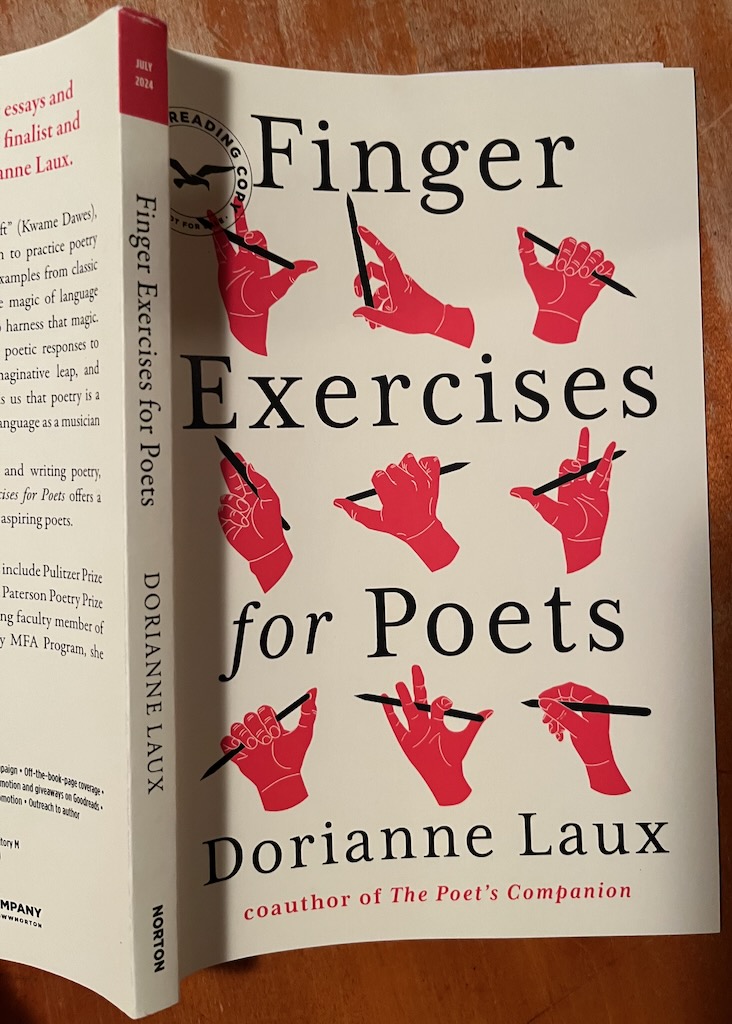
another poet, one i dream of sitting down to dinner with, or more in keeping with her ilk, plopping on a porch swing, she with cigarette burning orange against the black of night, me, merely pumping my merry little legs. dorianne laux is her name, and you’ve seen me write of her here. she has a brand new craft book, companion of sorts to her earlier the poet’s companion, and the new book, finger exercises for poets, is “an engaging invitation to practice poetry alongside a master,” and it’ll be out this july from w.w. norton & company. (they still send me advance reader copies; bless them.)

here’s a passage i knew i needed to share, from glorious, glorious dorianne’s introduction:

“My instrument is the immensity of language, the techniques and effect of crafting images, shaping sound and rhythm, creating new combinations with the single notes of words, each colliding or coming together, meshing or crashing, standing firm or tumbling. There are eighty-eight keys on a piano, six hundred thousand words in the English language. The patterns, the sequences, and permutations of both are endless. For me, language is another kind of music.

“I practice poetry. This book invites you to practice along with me.”


and i close, this snowy spring morning, with yet another master of language, and truth-telling: james baldwin. (this comes to me from a french monk whose writing i follow; laurence freeman is his name, and here’s a bit of what he sent this week from the bonnevaux centre for peace, in the southwest of france): “toward the end of his life, baldwin gave a television interview in which he was asked to reflect on the essential subject of his classic, groundbreaking novel, giovanni’s room. baldwin’s answer is an extraordinary meditation on love, and in particular, how it can serve a kind of educational purpose in our lives.” here’s what baldwin said, laid out as a poem. 

Q: What’s the novel, Giovanni’s Room, about?

Baldwin’s answer:

It’s about what happens to you
if you can’t love anybody.
It doesn’t make any difference
whether you can’t love a woman,
or can’t love a man —
if you can’t love anybody,
you’re dangerous.
Because you’ve no way
of learning humility.
No way of learning
that other people suffer.
No way of learning
how to use your suffering,
and theirs, to get from one place
to another.

In short, you fail the human
responsibility, which is
to love each other.

+ James Baldwin

what are the lessons of love you learned in this week of shadow and light?

my “springtime” garden, whitened.

p.s. illustration at the top is indeed one of clarissa munger badger’s beauties. and i will ask once again, please please offer up prayers for rescue for blessed, blessed caroline, her mama, her papa, and all who are holding their most sacred breath…..

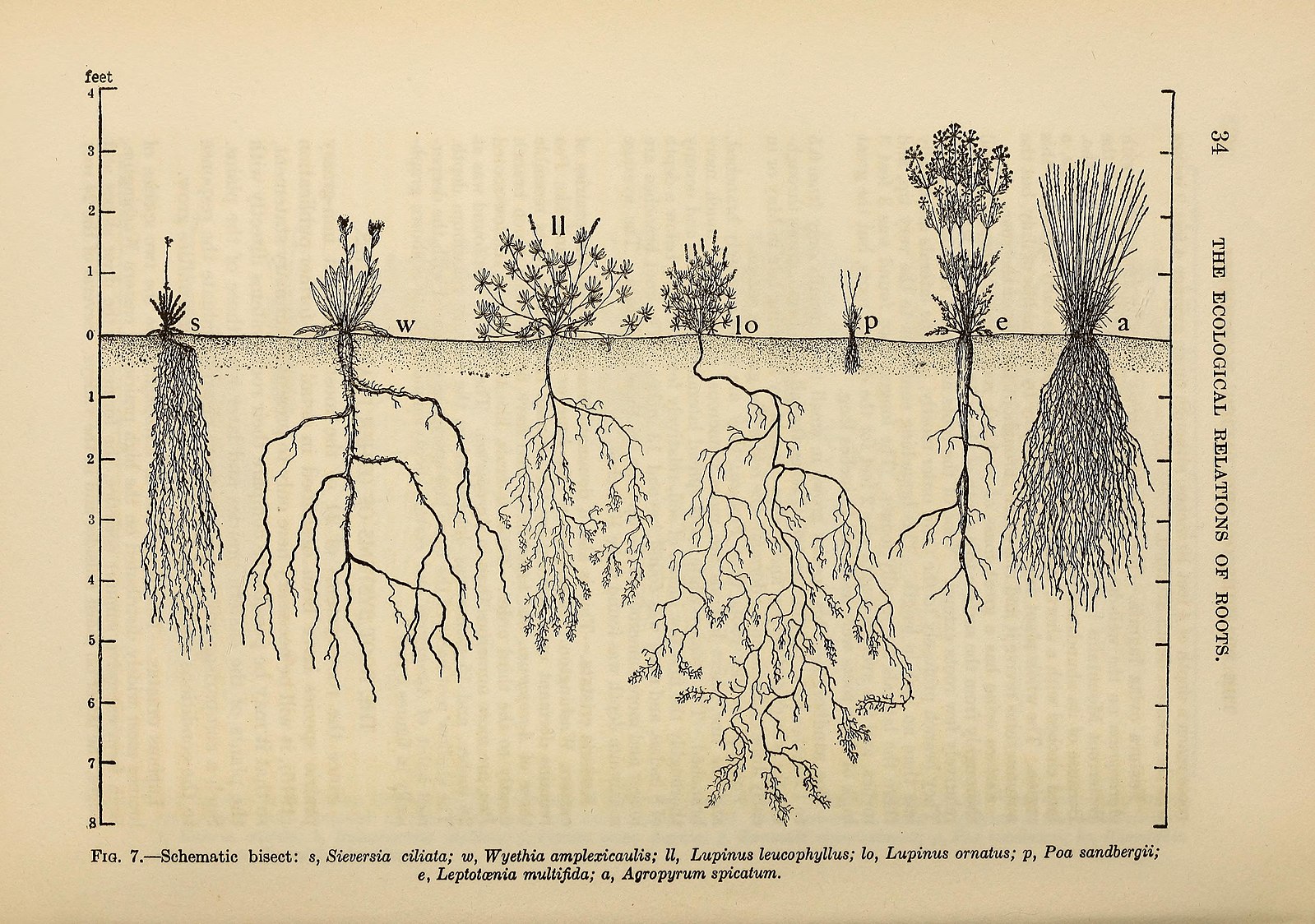
the roots are stirring. . .

sometimes, especially when staring into a tableau best described as blkkh, a monochrome of melted soot + oozy mud, we little people need reminding that there is stirring afoot. underground, that is. deep in this holy earth, particles expand. and multiply. and do those “rooty” things. they set down shoots. reach into the hollows to construct the nutrient highways that, come spring, will rise in daffodil and snowdrop. will punctuate the earthscape in royal-purple crocus and knock-your-socks off cobalt blue.

since ancient times, spurred by the collected wisdoms of those who’ve found themselves at this point in the revolution of the year, at the very midpoint between winter’s darkest longest night — the solstice — and springtime’s resuscitating equinox, the moment when the shadow and the sunlight fall in equal measure, this moment has been marked in ways that promised hope. ancient peoples, too, must have known the dregs of winter trodding on too long, or at least the ancients of the north.

those ancient peoples dubbed this a cross-quarter day, the precise mid-score between the changing of the seasons. and those ancient peoples, ones whose livings came not from sitting in front of keyboard pounding keys, but rather who picked up staff or rod, and herded flocks or fished the seas or tilled the earth, they turned to what they knew best to look for hopeful signs: earth and sea and sky. therein was the stirring from which they drew their wisdoms and their post-it notes from God.

in the case of this cross-quarter day, the one that falls as winter wanes, when springtime hasn’t yet picked up its paces, there might well have been some undercurrent of we-are-running-out-of-steam-here. and so perhaps one wintry day, one wise (and desperate) someone dropped to her knees, pawed the crusty earth just down deep enough to catch a glimpse of tangled rootlets reaching down, down, down. she might have whooped in exclamation, let her fellow desperados know that, lo and behold, all was not lost. the earth had not gone thoroughly to sleep. deep down where earth keeps all its secrets, there was promise stirring.

and so, the peoples celebrated. the peoples, being wise long before we were specks of anyone’s imagination, might have extracted their own wisdoms from this botanic wonder. they might have realized that if the wondrous underbellies of the bulbs were hard at work in ways unseen, we too might seek analogous metaphor in the vicinity of our psyche and our souls. we too might figure out that now, as winter’s grip begins to loosen, our own deep-down growing stirs. even when we think it not. (and we’d be wise, methinks, to bolster that stirring with at least a dab of concentrated meditations, sifting through the questions that might propel our year ahead, steering our own soulful energies to those one or two roots we decide most warrant our attention.)

the ancient israelites (and jews today) called it tu b’shevat, the new year of the trees, so marked by the first blossoming of the almond trees. the celts called it imbolc, a word that means “in the belly,” when the earth’s belly begins its thaw and the seeds below begin their stirring. (the word imbolc comes from Old Irish, and was reference to the ewes beginning to lactate as birthing season comes and the field grasses start to grow.)

indeed, the earth is quickening, the obstetric name for that first sacred stirring from within, when that tiny tiny human limb first garners enough muscular oomph to kick the wall of mama’s womb. i remember sensing it, unsure if it was just a tummy rumble, or the first fetal morse code that someone in there was really in there. in due time, the kicks make clear that it’s no hiccup of the fetal variety.

jews gather for the tu b’shevat seder, a feast of seven fruits and four glasses of wine, beginning with one of deepest red (winter at its fullest) and each successive glass a paler pink till springtime’s wine, all white. the celts, being earthly people, turned to fire and water: the women of the home slept beside the hearth on imbolc’s eve (jan. 31), and checked in the morning for any markings in the ash signifying that saint brigid (a fiery spirit) had wafted by in the night, spreading her imbolc blessings. they headed for the hills, too, and lit bonfires atop the crests, then spent the night leaping over the flames. more docile celts might have settled for kindling a few wicks around the house. but every peoples has its wild ones. and if fire wasn’t your thing, you might wander to the nearest sacred well, and take a dip for purification purposes.

i might let the candles burn today, or perhaps i’ll take a sudsy bath, as i think deep and hard of how i intend to bring my little flickering of light into this world that grows dark and darker by the day….

and on that note i bring you this emboldenment that my blessed firstborn sent along the other day, quoting from his favorite of thomas merton’s writings, raids on the unspeakable.

Be human in this most inhuman of ages; guard the image of man for it is the image of God. You agree? Good. Then go with my blessing. But I warn you, do not expect to make many friends…

Thomas Merton

what might you do today to mark the incoming of light, minute by minute, day by day, till the full birthing comes?

the light does come . . .

the light does come. this is a reminder. this is a note to tuck away for the days when the shadows occlude the sun.

we all live among darkness sometimes. sometimes for spells that stretch on for so long we’re sure we’ll run out of oxygen. but we muscle on anyways. because what other choice do we have? even in the darkest times, there are tiny shards that fall on our path. the kindness of someone we didn’t realize was paying attention. the encounter that puffs just enough hope back into our hearts. the wholly unexpected solace of finding ourselves shoulder to shoulder with someone who knows something about the steepness of the incline we’re climbing.

we all find ourselves in chapters so impossibly hard we’ve no choice but to tap into playbooks we’ve not yet scanned. we revert to those fine few things that just might steady us: we remember to breathe; we stand under the sunshine just long enough to plump a few shrunken cells; we giggle aloud at the ridiculous humor that never fails to creep its way in. even in ICUs. and funeral homes.

truth is: ours is a choreography of shadow and peekaboo sunlight. we bank on it. wars end. babies are born. laughter comes. so does the dawn. even the night is speckled with stars.

i’m here to say that after an almost unbearable few weeks, weeks that had me teetering, all but certain this might be the time my heart called it quits, the load is lighter again. my mama is chipper. my mama is finding her way, carving her path, skittering hither and yon, all on her new red convertible. (the name we’ve given her little red rollator, the latest iteration of spiffy walker, with wheels and brakes and a little compartment for stashing your assorted sundries.)

we’ve pulled through. none of us too worse for the wear.

my mama’s return to her lifelong indomitable state of being happens to coincide with the end of my jam-packed calendar of book talks. and after a summer of searching for answers to questions of cancer, i finally found someone who knows my cancer inside and out. and who laid out a scenario i can live with.

feels to me like someone’s rung the school’s-out-for-summer bell, and i might wiggle a jig all the way home.


because this week held one of my favorite feast day — all saints — and because i love looking for saints in places where no one might think to look, i found myself swooned by this blessed sonnet, “a last beatitude,” from malcolm guite, an anglican priest and poet who’s been said to resemble a hobbit, what with his predilection for waistcoats and long-necked pipes (from which he blows smoke rings), and whose tonsorial tastes tend toward the bushiest of beards, and long locks to go with it.

herewith, “a last beatitude” by malcolm guite . . .

And blessèd are the ones we overlook;

The faithful servers on the coffee rota,

The ones who hold no candle, bell or book

But keep the books and tally up the quota,

The gentle souls who come to 'do the flowers',

The quiet ones who organise the fete,

Church sitters who give up their weekday hours,

Doorkeepers who may open heaven’s gate.

God knows the depths that often go unspoken

Amongst the shy, the quiet, and the kind,

Or the slow healing of a heart long broken

Placing each flower so for a year’s mind.

Invisible on earth, without a voice,

In heaven their angels glory and rejoice.


and one last bit of poetry, as autumn, the season of awe is upon us, these lines from rilke’s poem “Onto a Vast Plain”: 

Summer was like your house: you know
where each thing stood.
Now you must go out into your heart
as onto a vast plain. Now
the immense loneliness begins.

The days go numb, the wind
sucks the world from your senses like withered leaves.

Through the empty branches the sky remains.
It is what you have.
Be earth now, and evensong.
Be the ground lying under that sky.


and, lastly, before i skitter off, this line from the thirteenth-century mystic and monastic mechtild of magdeburg:

When simplicity of heart dwells in the wisdom of the mind, 

Much holiness results in a person’s soul.


what, pray tell, carries you through your darkest hours?

winter worn-thin

the icicles must be considering a strike: one day they’re dripping away, growing into winter’s stalactites, next day they’re on their way to oblivion, drop by splashy drop–an existence tied to the rise and the fall of the mercury. same with the slush. hasn’t a clue what form it should take, though frozen or slop, it’s all shades of gray. gray and grayer.

it’s a postcard of winter worn-thin, only we’re the ones worn to the bone, gasping for hope, muttering foul grunts as we jam our toes into our boots (our boots taking on that february aroma, the one that begs to be cloaked, doused, or disguised under a thin veil of anything gentler on the nose).

i’ve long been convinced that february is the shortest month–interrupted by the national explosion of valentine hearts, and chocolate-doused brownies–for a reason. and the reason is plain old survival. we might throw in the towel if we had to stick with it any longer than 28 days (some wisecracker somehow decided long, long ago to sneak in that make-up 29th, but only every four years, the next being two years from now).

all of that is to say, i sense we might be in need of something akin to spiritual transfusion, a hearty reminder of why it is some of us preach winter as the soulful season. (um, that would be me, i confess.) so as i sit here contemplating ways to make it through to the ides of march, and the onslaught of april, i thought i’d bring in the masters for a little shot of espresso-strength reminder: this is good for the soul, all this dreariness out the window. (and those of you reading under the swaying of palm trees, exercise compassion–in the form of imagining a landscape where trees look like so many uninspired sticks, the earth is covered in gray, and the wrong step on the sidewalk can send you flailing and broken, splat on the ground.)

let us begin with rilke, who insisted this is the season for tending to the inner garden of the soul. or albert camus, who wrote, “in the depths of winter, i finally learned that within me there lay an invincible summer.” (sunscreen and popsicles must be hiding somewhere down in the toes of my snow boots.)

henry david thoreau

but for a wintry vitamin in the form of wisdom, i’m walking into the woods with h.d. thoreau, who left this reminder:

There is a slumbering subterranean fire in nature which never goes out, and which no cold can chill…. What fire could ever equal the sunshine of a winter’s day, when the meadow mice come out by the wallsides, and the chicadee lisps in the defiles of the wood? The warmth comes directly from the sun, and is not radiated from the earth, as in summer; and when we feel his beams on our backs as we are treading some snowy dell, we are grateful as for a special kindness, and bless the sun which has followed us into that by-place.

This subterranean fire has its altar in each man’s breast, for in the coldest day, and on the bleakest hill, the traveller cherishes a warmer fire within the folds of his cloak than is kindled on any hearth. A healthy man, indeed, is the complement of the seasons, and in winter, summer is in his heart. There is the south. Thither have all birds and insects migrated, and around the warm springs in his breast are gathered the robin and the lark.

–Henry David Thoreau, “A Walk in Winter”

and so, he reminds, here in the deep of winter, summer stirs in the heart. he goes on to declare that “in winter we lead a more inward life. our hearts are warm and cheery, like cottages under drifts, whose windows and doors are half concealed, but from whose chimneys the smoke cheerfully ascends.”

i’m taking that as a challenge, this notion that my heart is puffing up cheery whirls of smoke from its cheery little cottage. in fact, i am marching straight to the stack of blankets there on my couch, surrendering to the notion that a long day’s reading is just what the transcendentalist ordered.

he leaves us with prescription:

We must go out and re-ally ourselves to Nature every day. We must make root, send out some little fibre at least, even every winter day. I am sensible that I am imbibing health when I open my mouth to the wind. Staying in the house breeds a sort of insanity always. Every house is in this sense a hospital. A night and a forenoon is as much confinement to those wards as I can stand. I am aware that I recover some sanity which I had lost almost the instant that I come [outdoors].

–Thoreau

guess it’s time to slip on my stinky boots and embark into this slushy february day.

how do you re-stoke your wintry hearth come the depth of this shortest month?

**image above is from a page of a children’s book i pulled from our shelves (i will not give up those shelves of books i know by heart, forward and backward), one titled, A Winter Place, by Ruth Yaffe Radin, with illustrations by Mattie Lou O’Kelley.

in praise of eeyore

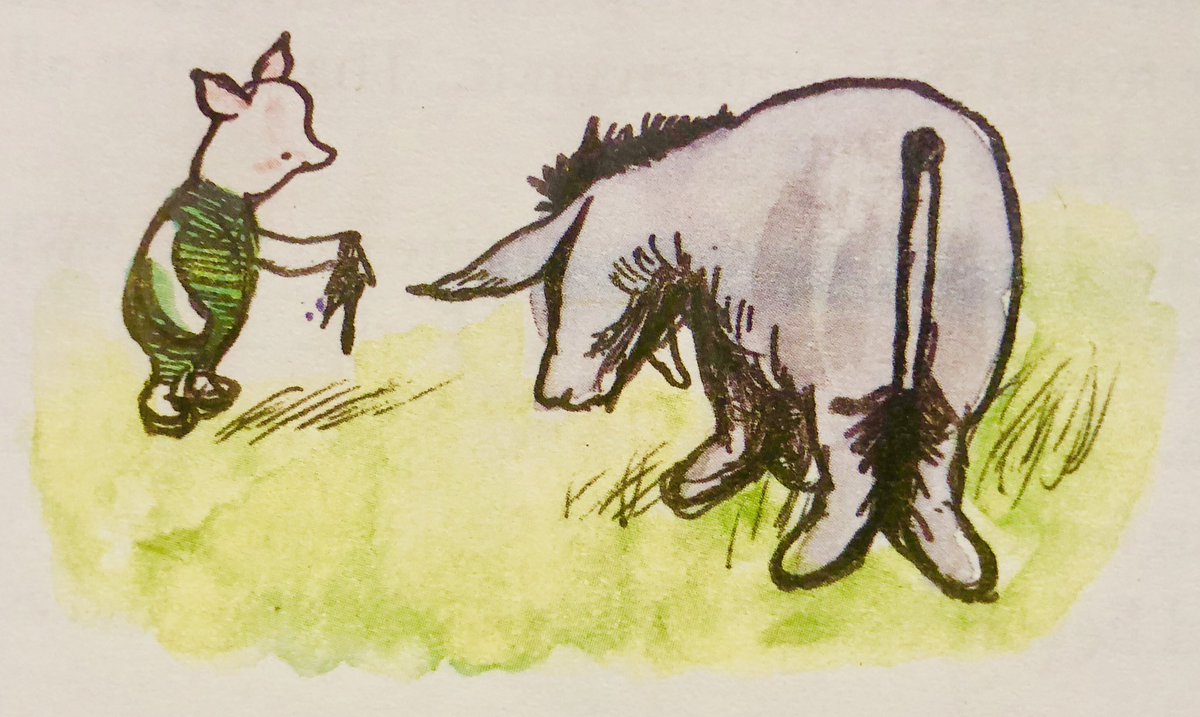
in all the annals of children’s literature, there deserves to be a shelf devoted to one gloomy donkey. eeyore is his name, a name derived from a phonetic spelling of the sound the farmyard friend is alleged to make. i say “alleged” because i cannot claim that i’ve leaned against a split-rail fence and listened in for just the way he hees and haws.

i write in praise of this misanthropic fellow, forlorn as the day is long, this chap who ambles through the hundred-acre wood tossing out lines wholly hollowed of all hope––for instance, “it’s not much of a tail, but i’m attached to it,” or, when someone pins a red balloon to where his tail went missing, he sighs, “sure is a cheerful color. guess i’ll have to get used to it”––because just yesterday i felt his every pain, and found myself cheered to be so deeply in his shadow.

ups and downs of EKG

it was an eeyore sort of day, and i was in an eeyore sort of slump (my best, best friend had three biopsies the day before, someone else was positive for covid, and i’ve not shaken the last of my own red-ringed devil although i’m due to board a plane to NYC tomorrow). and it made me think how fine a thing it was and is for a child to have an eeyore on the shelf, to feel some kinship when the world turns gloomy grey and a few good hours of slumping around in self-defined misery is not such a bad thing. it’s part of human nature. etched into the very dips and hollows of any old EKG, for starters. and it made me think that our gloomier angels deserve a moment’s appreciation. so here i am appreciating.

if not for grey, wouldn’t rosy raspberry be just another shade from the far side of the color wheel?

i’ve known souls who never seem to veer off the happy plane, and frankly they worry me. it simply cannot be a fact of nature that optimism is ever present. i like a little deviation in my moods. how on earth can you fully appreciate the good days, if you’ve not felt the uptick from down in the doldrums?

of course, i’m not rooting myself down where misery loves its company. like cloudy skies, it passes. and, after all, by day’s end at least a few of yesterday’s bumps had smoothed (the kid with positive covid PCR–a kid hunkered down in our basement just the night before–took another test and this one proved him negative; and this meant we didn’t need to seal our own college kid in a cellophane wrap, keep him home from college for an extra week, figure out just how to get him off to school without infecting every other passenger in sight).

all i’m saying is that i am grateful that in turning the pages of alan alexander milne’s classic children’s tale, a wee child sodden with sadness might find a kindred shadow in the likes of dear friend eeyore. no one likes to be alone in sorrow. i know very few who would appreciate a swift “get over it” when feeling wearied by the world, with no quick fix in sight.

and so i burrow against the contours of the dreary donkey. i embrace his full expression of how dark it sometimes feels. and, unlike eeyore, i look forward to the dawn when the sky is once again awash in pretty pink.

i can’t quite think of a question, so i offer simply this: if you’re feeling eeyore glum, may you find some tiny shred of solace in knowing you are not alone. one thing to contemplate might be this: what are the few ties to hope that sometimes pull you from the doldrums? do you have any tricks up your sleeve that chase the clouds away?

please pray for my beloved auntie M, as she is known in these parts, and where she has been my number one love angel since the very day she walked into my life—and my heart—my sophomore year of college.

inaugural promise

photo by Jason Andrew/NYT

“we must end this uncivil war…”

as soon as his breath propelled those words across his lips and out into the snow-flecked january cold, i inscribed them on my heart. i hadn’t quite framed it that way, in those four words, so profoundly, so poetically, so imploringly. 

and then, as if that wasn’t enough, the wise old soul whose very fiber has been forged in the white-hot furnace of grief compounded by grief, he all but unbuttoned his coat, pulled back his ribs and showed us what burns in that cavity: “my whole soul is in it,” he said, as if speaking to each and every one of us, as if elbows were plopped on our very kitchen tables, eyeballs gazing at eyeballs, mugs of coffee just off to the side, instead of there in the sunlight and shadow of the nation’s capital. then he all but whispered it again: “my whole soul is in it.” and that’s when i whispered, “mine too.” 

having just witnessed — from the edges of our seats — how close this fragile experiment in democracy came to crashing into splintered bits, having lived under a poisonous cloud of daily assaults on decency, straining to stay steady, to keep from being sucked under in the shifting quicksands of moral decay, of a nation under the false premise that license had been given to spew venom from the checkout line to the capitol steps, i am more certain than ever that this is not a one-person parade. if we stand a chance of shoving this moment in time toward the light we claim, toward the peaceable kingdom we believe is possible, well then every last one of us needs to get to work, to chip in, to put one foot before the other in a slow walk toward mercy and justice for all.

my inaugural promise is this:

i will cloak myself each and every day in humility and gentle spirit, the surest vestment for the hard and holy work ahead. for months now i’ve tiptoed in the darkness to my kitchen table where i’ve lit a candle and whispered the words of confession. “most merciful God…” i begin. “…we have not loved our neighbors as ourselves. we are truly sorry and we humbly repent.”

i will not reflexively shut my ears, close my heart, turn my cheek the wrong way. i will hear them out, whoever it is. i will try, oh i will try, not to leap in with my insistent retort. not to interrupt. not to wield the sharp sword of assumed superiority, not think that my way is the right way, and all else is wrong. i will try, i will try, to step into the other guy’s shoes. to imagine the hurt, or the fear. to look for a gentle way in, to open just a little bit wider the doorway to some common ground. even if only fraction by fraction.

i will actively step into kindness. into imagining the unexpected waft of goodness that might just turn the tide of someone else’s dark day. i will model the thousands of kindnesses that have come my way — the sacks of apples left on my stoop, the tray brought to my hospital bedside, the steaming hot chicken pot pie once delivered on an arctic cold night, to name just a few. 

i will carve out time even amid the whirlingest of days for whoever taps me on the shoulder, looks me in the eye, and whispers, do you have a minute? 

i will — in some way, shape, or form — seek out foreign terrain, the realm of those who might be quick to dismiss me: too white, too old, too left-leaning. and begin with the light-seeking questions: what keeps you awake at night? what do you dream? what brings you joy? what makes you cry? where does it hurt? who do you consider to be the most heroic human you’ve ever known? and how so? what’s one act of kindness you’ve never forgotten? 

because i realize my impotence for change-making at the structural level, i will pinpoint one not-for-profit effectively working toward solution — be it reuniting children separated from parents at the border, or ferreting out all vestiges of racism and bigotry from the nooks and crannies of america, or protecting wetlands from the ravages of greedy exploitation — and i will commit to shaving off a dollar here, a dollar there from my weekly spending and send off occasional bundles from my consciously set-aside sum.

photo of Amanda Gorman by Patrick Semansky

but even more than dollar bills, the currency i commit to this campaign is the craft i ply each and every day: mine is a calling to words, words as instruments of peace, words as the silken thread that weaves together uncommon hearts, words that open doorways into long-locked corridors. as the beautiful and blessed national youth poet laureate amanda gorman so perfectly put it in the wake of her inaugural poem: “words matter. we’ve seen over the past few years the ways in which the power of words has been violated and misappropriated.” she sought, and i seek with her, to “reclaim poetry as that site in which we can repurify, resanctify the power of words. and to invest that in the highest office of the land.” to invest that in every office of the land, elected and otherwise. from the humblest foot soldier to the commander in chief. and to that, i say amen, amen. 

we must end this uncivil war. and my whole soul is in it. 

what’s your inaugural promise?

archipelagos of calm amid a roiling sea

ar·chi·pel·a·go /ˌärkəˈpeləˌɡō/ noun

noun: archipelago; plural noun: archipelagoes; plural noun: archipelagos

  1. a group of islands. “the Indonesian archipelago”
  2. a sea or stretch of water containing many islands.

early 16th century: from Italian arcipelago, from Greek arkhi- ‘chief’ + pelagos ‘sea’. The word was originally used as a proper name ( the Archipelago ‘the Aegean Sea’): the general sense arose because the Aegean Sea is notable for its large numbers of islands.

alternative definition: calmus interruptus, in which rocky protruberances, barely discernible in dimension, arise from roiling fluid surface, providing flash of terra firma before which desperate swimmer loses grip, plunges once again into tempestuous sea — alone, afraid, intent on staying afloat. sanctity provided, ephemeral at best.


we turn to the mapmaker’s lexicon — complete with dictionary definition and etymology — because it was the faint and far-between dotted line of rock piles (aka the archipelago) that leapt to mind as the fittingest metaphor for an otherwise nearly indescribable heap of twists and turns, as i tried in vain to keep from keeling over amid this week’s drama of near historic family proportion.  

it went something like this:

round about the middle of tuesday, the geography of my interior life morphed suddenly and without warning from restless squatting on the shores of big-enough occasional islands of calm (the sort where you might slow your breathing for as long as five-minute stretches, and in which you might temporarily put at least a shred of worries to the side) to swimming breathlessly through an archipelago of tiny anxious island dots, each one offering maybe a moment’s lull before the waves kicked up again. before i found myself paddling madly to not go glub-glub-glub.

while awaiting the biopsy results of brother No. 2 (see last week’s news), beloved brother No. 3 up and had a heart attack. a real one, a not-so-small one. oh, lordy. (i only have four brothers, so these odds are getting stiff.)                                                

brother 3 — four years younger than me, the father of two young and glorious children — had called mid-afternoon that day (as ordinary as a tuesday might be when awaiting a second biopsy of someone you dearly love), wondering what to do about a terrible case of heartburn, a dyspepsia he was blaming on the banana pepper and hot sauce he had tucked into his lunch and the preamble pot of coffee that had started his until-then ordinary weekday. next thing we knew — and i mean within minutes — there was an ambulance and ER, swiftly followed by OR and days in ICU, all deeply laced with prayer upon prayer. 

and i mean hard-knees-against-the-floorboards prayer. the highest octane of beseeching known to this prayerful sister. 

as of this writing, brothers 1 and 4 are idly sitting in their homes, where they’ve been instructed to not move, not lift so much as a pair of scissors for fear of fate tap-tapping at their wintry windowpanes. 

quite frankly, i’ve found it hard to breathe at various twists and turns in this wildly unspooling narrative. i was reportedly circling room-to-room-to-room the other afternoon, muttering, “Jesus, Mary, and Joseph!” in more exclamatory than prayerful tones. (and i was not previewing the Christmas story.)

a mere week ago, i was finding episodic solace in simple kitchen tasks — slicing onions, plucking cloves. this week, that all went whirling out the window, and i could not have cared less if we swallowed air for breakfast, lunch, or dinner. 

there is only so much adrenaline one’s itty-bitty fight-or-flight pump can spurt and swoosh through veins. and i’m about to call a truce, to leave my shaky nerves stranded on some unassuming island. which is where the archipelago — or interrupted line of splintered refuge — comes in. 

cling is the more appropriate verb in describing my posture when, amid hyperventilation or dizzying projections down the pot-holed road ahead, i catch my breath via one of my ever-shrinking litany of soothing balms. (hot bath; hot bath; hot bath.)

we humans do seem to have a godly bottomline default, a trapeze net for those stretches of our lives when all hell seems to be breaking from the quiet room where we try to keep it handcuffed to the chairs. in those rare quiet spells, when i might be sitting in the dark watching the dance of the candle flame, or folding one lone shirt from the dryer, or glancing toward the moon while taking out the trash, i find my inner gyroscope settling still. i manage an in and out breath. i might even think of something that makes me laugh. (gallows humor is a saving grace; brother 3 mentioned in a text from the ICU that, after a weekend conversation about Faulkner, he’d requested “As I Lay Dying,” from his local library. and then he drolly mentioned “it awaits me now,” fully acknowledging said gallows. God bless his never-ceasing wit.)

the reprieves were short, so short, the fractions of a minute when breath was caught, when fog of fear fugaciously lifted. the rocky seas between made it seem i might not ever get there. might be swallowed whole by swirling waters, pulled down by stubborn riptides.

i’ll get through this tight passage, as we always have before. but, oh my, this december at the start of the twenty-first century’s third decade…it’s a doozy. 

here’s hoping we return soon to more quotidian rumblings round the chair. 

i mean not a word of this lightly, and fact is, the palpitations just beneath my ribs have not yet quelled. i seem to have twisted myself into a knot of nerves that, as the author of a tome on stillness, is making me feel a wee bit silly. i am employing all my stillnesses, and for the momentary peace they bring, i am deeply deeply grateful. my brothers and i are deeply blessed to be so close, to march through life (especially of late) arms locked and bent into whatever winds we face.

all i need now is for child No. 2 to turn in the last of his string of finals, to prowl the Christmas tree yard for the humblest branches on the lot, and to await the word that things are taking turns for all that’s good and blessed and ripe with hope.

i wish the same for you.

when you’re at wits end, what wraps you in a cloak of calm?

pins and needles and why it matters…

dear america,

land of the free and the brave. land i want to be home to the kind and the gentle. and the fair and the just. land where truth is the national language, the one we expect to hear and to speak, the one that rings from sea to shining sea. land where we’re blind to the melanin that colors our skin, but not blind to the sins we’ve borne until now. still bear. land where bullies get sent to the principal’s office. and aren’t allowed on the playground, not till they right their ways. land where some big-hearted, big-eared soul sits down to listen, to find out why the bully’s so mean. land of confession. land where we fall to our knees, open our heart, and spill out our sins. where we say we’re sorry, so sorry, and we mean it. where we do right, right our wrongs. make up for the shatters and hurt we’ve left in our wake.

that’s the nation i want to belong to. that’s the world i want to populate, for the short time i get to be here.

it’s all evanescent. we’re not here for long. we’ve one short shot at weaving our one single thread into the tapestry. i aim for my thread to be radiant. too often it’s frayed. falls short. but the thing is, day after day, i clamber out of bed and i set my mind to living the promise: love as you would be loved. reach beyond your own borders. imagine how it feels to live in the other guy’s shoes. to be strapped with the load that he or she was born into, picked up along the way. the stuff that broke and scarred and left scabs that never quite healed.

i reach for the stars, for the heavens. my own personal plot, the one by which i measure my life, is to open the doorway to heaven here on earth. to make it all a little bit kinder, gentler, to love as i would be loved.

the thing is when you grow up knowing hurt, you sometimes decide to dedicate your every blessed hour to doing all you can to not let it happen to anyone else. to be, as blessed st. francis put it, the instrument of peace. to be the consoler. the sower of love. it’s a prayer i pray every day of my life.

i pray for that hope to spread like a rash. once upon a time i believed we could cure the world of the scourge of hunger, fill every last belly. now i’m sinking my hopes into the radical notion that we could all — just for one day, maybe even for longer — stop with the ugliness, put down the guns, dial down the incessant noise. stop seeing the world in us versus them.

for God’s sake: be still. breathe in the deep and calming oxygen of pure unfiltered kindness. imagine forgiveness.

i believe in capital D Decency. i believe in resurrection and redemption. i believe in the hard-rock capital of empathy. i’m willing to hope we can find it again. i’m not certain. but i cast my vote for all the holiness i believe in, the holiness that is the architecture, the underpinning, the spine and the sinew of my every blessed day.

and that’s why i wait, holding my breath, awaking in the night to peek at the numbers, to see if there’s half a chance we might become a more perfect union. one where life, liberty, and the pursuit of happiness is spelled out in three hundred million-plus variations on the theme. but one where justice, and fairness, and truth is the least common denominator. the one we strap on each and every morning, and take it from there. there is so much work to be done….

let us begin.

what are the threads of the world you believe in? the one that deep in your heart waits to be born?

it’s a scary thing to put yourself out there, to lay it all on the line. but this moment demands unfiltered courage in all its iterations. mine lies in saying it aloud, in whispering my heart’s deepest prayers. maybe i’m not alone…

on the subject of ephemerality…(and other long-lasting truths)

IMG_1479

in an already cruel april, this seems the cruelest of april’s jokes, this pillow fluff falling from the skies, soft as it is, quick as it is to melt on the tongue (i know; i was just out there with mouth wide open, agasp at the softness, the quiet of this particular snow). this meringue of ice crystals clasping the prayer hands of all the buds just on the verge. the leaden sting of waking up not just to a snow-falling morning, but doing so in the latter weeks of april when the earth has finally, triumphantly, broken through the thawing crust, when the whole globe is aching, is straining, is trying to muster resilience and make it to the other side…

IMG_1476instead, a lesson in ephemerality. the suddenness of slipping away. magnolia? velvety perfumed petals, now on ice. spring beauties, flash-frozen. i dashed out last night, clippers in hand, on a late-night salvation run through the garden. trying to save the soon-to-be stricken.
in any april, a snowfall is crushing. this april, it might knock the last breath of wind out of these tired old lungs. this is the april when we’d already drawn in, drawn quiet. when we were down on our knees, some of us, begging the earth to come to the rescue in the form of easter-egg pastels rising up amid the bursting-forth green synonymous with spring.

when the news pages read apocalyptic — when a zoo in the german town of neumünster is making a sacrifice plan of which animal to feed to another; when krakatoa, the great indonesian volcano, sent “violent puffs” (plumes of smoke and ash and flame) into the skies above the sundra strait, making like some sort of mountainous dragon; when the red-ringed virus crushes our hearts, day after day — we need something akin to a life rope.

the ephemerals of spring carry the whiff of that promise. it’s the evanescence — the now-it’s-here, now-it’s-goneness — that cups the germ of its beauty. the japanese, long wise to this notion in its cherry-blossom iteration, teach this as the truth of the sakura season, in an island nation that maps the bloom from first hint to full blossom.

and, now, it’s all gone. or buried under inches of snow here in the middlelands, here along the lapping shore of lake michigan (where these days it is so very quiet, i could count out the waves by the minute).

so we will need to turn inward again, further and deeper inward. i’ve taken up morning prayer (the serious kind, with flickering candle, the turning of pages, sliding a ribbon from section to section in the book of common prayer). i’ve taken up sourdough baking. and, soon as we can rustle up some plain white rice (the boys protest my usual brown), the homebound college kid and i are honing in on the original nursery confection, from-scratch, stirred-in-a-pot, rice pudding.

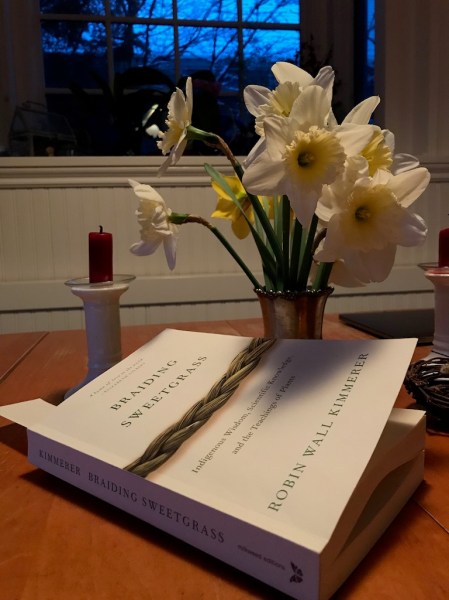
braiding sweetgrassamid my red-ringed survival plot, i’ve stumbled into a global book discussion group through my friends at emergence magazine. we’re reading the breathtakingly beautiful robin wall kimmerer’s braiding sweetgrass: indigenous wisdom, scientific knowledge, and the teachings of plants. kimmerer is a mother, scientist, botany professor, and member of the citizen potawatomi nation. each week, these past corona weeks, i find myself in small-group clusters that stretch from bern, switzerland, to tribeca, from the mexican countryside to south portland, maine.

this week we read a chapter titled, “the honorable harvest,” a framework for living centered on the insistent question that arises for kimmerer — and for us, i would argue, as we ache to plot a way forward, out of this corona siege into a recalibrated symbiosis with the world all around — as she pulls fat white bulbs of leek from forest floor:

“if we are fully awake, a moral question arises as we extinguish the other lives around us on behalf of our own. how do we consume in a way that does justice to the lives that we take?” kimmerer asks (italics, for emphasis, are mine). kimmerer, a plant scientist who lives and breathes indigenous wisdom, turns to her ancestral instruction for answers.

“collectively, the indigenous canon of principles and practices that govern the exchange of life for life is known as the Honorable Harvest,” she writes, and goes on to say that the guidelines aren’t in fact written down, but rather reinforced in small acts of daily life (the best such codes anyway). if you were to list them, and i will, she writes that they might look something like this (and, again, i’d add that there is here a particular resonance for mutual reciprocities in the age of corona, when hoarding — and stripping bare grocery store shelves — seems an instinct worth batting down):

know the ways of the ones who take care of you, so that you may take care of them.

introduce yourself. be accountable as the one who comes asking for life.

ask permission before taking. abide by the answer.

never take the first. never take the last.

take only what you need. 

take only that which is given.

never take more than half. leave some for others. 

harvest in a way that minimizes harm.

use it respectfully. never waste what you have taken.

share.

give thanks for what you have been given. 

give a gift in reciprocity for what you have taken. 

sustain the ones who sustain you and the earth will last forever.

brian doyle long riveri’ve one more morsel for the week, and it’s one worthy of its own post, but i’ll tuck it here instead (if i change my mind, you’ll see so in a subsequent post). my wonderful six-year gig plucking and reading and extolling the wonders of books for the soul for the chicago tribune has come to a close (slashed budgets, new owners, no money for freelancers), and the last of my tribune reviews is, fittingly, a book that deserves a trumpet blast. it’s a collection of breathtaking essays from the late, great brian doyle, and it’s titled, one long river of song: notes on wonder. if you are looking to survive this red-ringed siege with your heart and soul intact, read it. if you’re a high-minded soul and hope to emerge more vibrant and alive than ever, read it.

here’s but a bit of what i wrote:

At turns in “One Long River of Song,“ we discover Doyle the psalmist (singing the wonders of raptors and hummingbirds, otters or three-legged elks), Doyle as God’s acolyte (from the prayers to his unborn children to the one starkly titled, “Last Prayer”), Doyle as run-on sentence humorist (antics with his rambunctious brothers, basketball with toddler teammates). Over and over, his musings are canticles of joy, punctuated with occasional double-shots of heartbreak and humility. It’s the textured layering, the leap from shadow to light, that keeps the reader alert, and ever absorbing.

Always, emphatically, there comes wisdom; it’s a signature move, one you can count on. Have your pens aimed and ready.

It’s gospel of the ordinary, the shoved-aside, the otherwise overlooked. And at the heart of it, that ineffable and necessary unction, a holiness you can all but hold in your palms.

and with that, i will tiptoe away, to spend my day turning pages, stirring puddings, and awaiting the melt of the ephemeral snow…

bless you all. be safe. and be blessed….

since this morning is a bit of potpourri, have at it. leap in with any thoughts about anything corona. about the beauty of evanescence in your life and your world. about the honorable harvest and how you intend to live it….