pull up a chair

where wisdom gathers, poetry unfolds and divine light is sparked…

Category: garden

ode to my fairy gardenmother: one last love note. . .

Mostly, this is a love letter. One I might have tucked in the pine coffin now buried beneath a foot-and-a-half of Chicago’s clumpiest earth, earth we shoveled onto it, one full spade at a time. The one to whom I write this, though, my fairy gardenmother, is not one ever confined by boxes or borders or hard lines scrawled in the dirt. She, my Marguerite, was as free a spirit as they come. So I cast this to the wind, and know she will catch it. 

Marguerite made beauty for a living. She sowed joy in abundance. Not a single root or shoot was tucked in the earth or tied to a trellis without the ringing sound of her laughter. 

Marguerite’s acanthus

She bequeathed me beauty, her beauty and that of this holy earth. And grace, and a tidepool of peace, the sort that settles deep within, calming what had long been a turbulence. It all came in a litany of botanic derivative, a litany I water and witness: tree peonies, fuchsia and ruffled and broad as a dinner plate; oakleaf hydrangea, its bottle-brush blooms now bursting in time for the Fourth of July. Pieris japonica (sometimes known as lily-of-the-valley shrub, or flame of the forest) whose delicate white star-blooms are the petit point of late springtime, stitched along the bluestone path that bends toward my front door. A dwarf lilac that defies its definition and perfumes profusely my brick walk out back. My garden blooms with acanthus, the ancient Greek thistle of endurance and immortality, and white bleeding hearts that, as instructed, seem to be on the verge of spilling succulence drop by drop by drop. Everywhere, the vanilla scent of Jack-in-the-pulpit rises. There are ferns in abundance, and climbing hydrangea who wouldn’t be daunted by Everest. And about a dozen other beauties whose names I often forget, and when I do I’d text her, and she’d remind me, always with annotation of what she loved most about it. And another something I might want to try. 

If I tried to describe her, I’d begin with her face. Her face was alive, was radiant, was always revved up in joy. Or deep concentration. Her laugh came easy, so easy. Her limbs flowed. She was a ballerina in the everyday. Clogs buried in garden, wielding a shovel or pruners, she swayed with the wind, with the whims, with purpose. 

She planted my secret garden, the one that meanders along the side of my house, from my writing room window, past the kitchen door, and into the garden out back. It’s the place I’d point to if pressed to answer the question: Where did you finally find your long-sought peace? It was there in the garden that Marguerite grew. 

I first met Marguerite a garden ago, back in 1991, months after we married, my beloved and I. The very day we wandered into the old Victorian that became our house for a decade, the house to which both our boys first came home, the house that held so many joys and so many sorrows, Marguerite was there. She was packing up boxes with Jim the sculptor who was dying of AIDS, and who would soon leave us his beautifully sculpted three-story house (and a set of Old Willow dishes besides). They wept and wailed and laughed together. We heard the echo of their affections before we saw them, and when we climbed the stairs there she was: radiant, a mop of blond curls, eyes hazel and sparkling. 

She knelt beside me summer after summer, teaching me much of what I know about what grows in a garden. We wandered nurseries and tree lots. We planted according to her unorthodox teachings. When anything ailed, she knew the fix. Or we yanked it and started again. 

My jewel box of a tiny urban garden, one where the alley rats dared not roam for the fierce farm cat who patrolled it, grew to be a wonder. One whose measure in my mind far exceeded a yardstick. 

When at last we decided we’d finished our work, at least for the time being, Marguerite and Ted, her rabbi of a husband who presided over a congregation of his psychotherapy clients, came by one late summer’s evening to bless the little plot. In a story I love so much I included it on pages 37 and 38 of The Book of Nature**, Ted offered up fertility prayers for my garden, that it would blossom and bloom, and multiply. Four months later, on the brink of my 44th birthday, after eight years of broken hearts and infertility, I discovered that I was the one blossoming and multiplying. I was “with child,” as the Bible would put it. I always giggled that Ted had mixed up his fertility prayers, and pulled out the ones for the barren woman instead of the ones for the garden. 
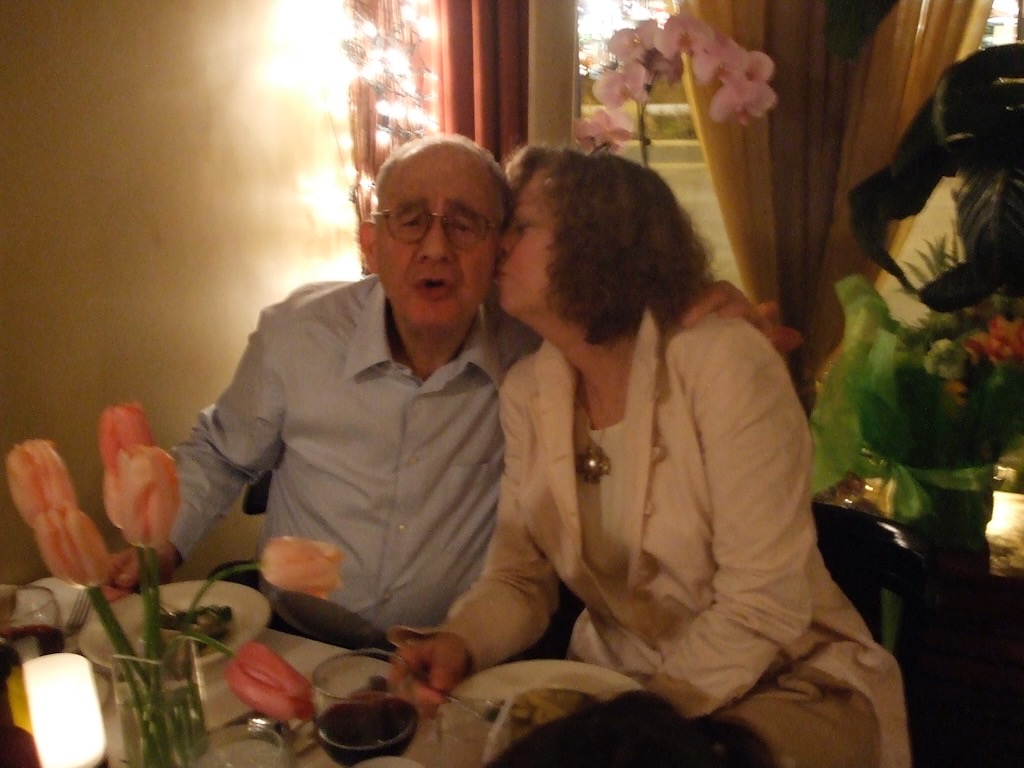
ted and marguerite

And so, of course, and ever since, Marguerite is the one to whom I turned with every garden question, and every delight as it bloomed. When Ted died not quite two years ago, I knew Marguerite’s heart was shattered. And there was no glue in the world to put it back together. But I didn’t know it would kill her. 

I now know that it did. For she died on Monday, and was buried on Tuesday. And ever since I’ve been strolling through my garden, stopping to marvel here, stooping to deadhead there. I’ve been shlepping my hose, and giving big drinks to each and every bloom bequeathed to me by my Marguerite. 

Marguerite will always bloom in my garden. Her longtime sidekick, David the cop, is coming soon to help me dream once again. There is a plot under the ornamental lilac and the row of burning bush, and I have named it Marguerite’s Garden, and I will be planting it before the month of her death turns to August. 

And it will be abundant in beauty. Because that’s what Marguerite taught me to grow. And that will never die.
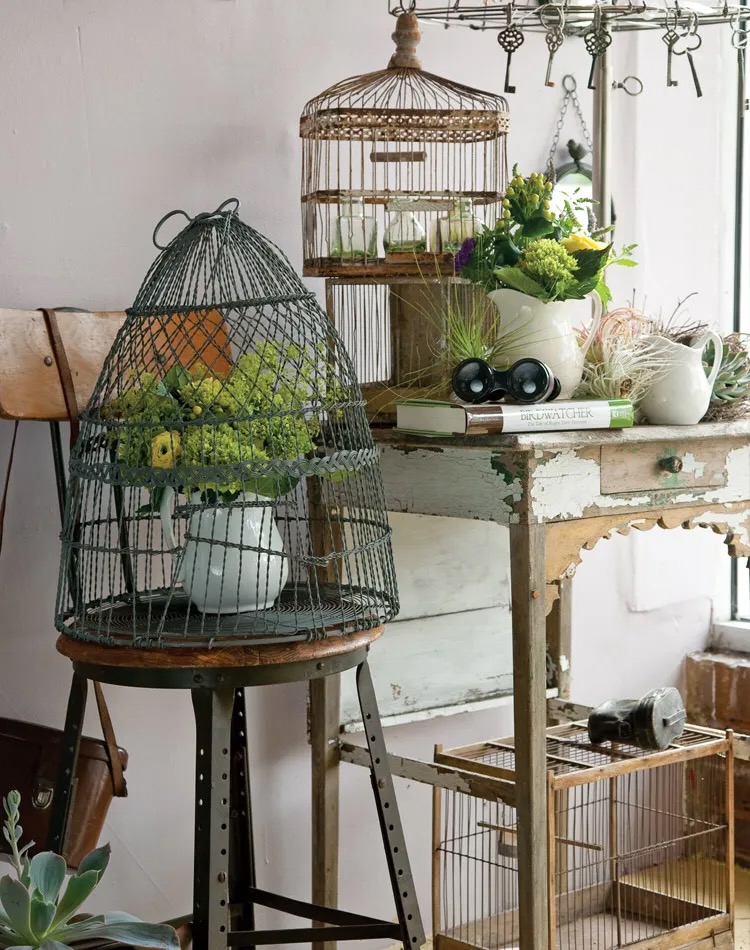
the jewel box of a flower shop: Marguerite Gardens (from Victoria Magazine)

Marguerite’s genius in the garden spread far beyond our little block of Wellington Avenue, 60657. When she couldn’t be contained, she launched a for-hire garden crew (a motley crew counting two cops, a U of C theology grad fluent in Mandarin Chinese, a commodities trader, a banker, and a pet photographer) with a seasons-long waiting list. She planted tulips by the thousands up and down Boul Mich, Chicago’s grand Magnificent Mile. She planted the city’s lushest rooftops and balcony gardens. She was a connoisseur of miniatures, and knew how to cram the most in the least. She opened a dream of a flower shop in Andersonville, aptly named Marguerite Gardens, and twice daily received imports from her beloved Netherlands. The shop, with the bell that tinkled as you walked in, held a European-style flower market, and was stuffed to the rafters with eighteenth-century antiques, from bird cages to terraria. Aptly, she was named for the daisy whose name means “pearl” in French, and is the bloom from which petals are plucked in the prognostication game, “he loves me, he loves me not.” Married for 43 years to the inimitable, unorthodox, Yale-educated rabbi and psychotherapist, Theodore Gluck, Marguerite died 656 days after Ted, three days short of what would have been his 95th birthday. Marguerite was 75.

**excerpt from pages 37 and 38, Marguerite’s star turn in The Book of Nature, in which i describe that first garden we planted and blessed together…

. . .That garden—where a priest, a rabbi, and a tight circle of people we love gathered for blessings shortly after the births of each of our boys; where baby bunnies and nestlings and goldfish were buried after premature deaths; where our stubbornly resistant house cat mastered the art of escape—that plat of earth became as sacred to me as any cloister garth.

Not only was it where I knelt to teach my firstborn the magic of tucking a spit-out watermelon seed into the loam and, each morning after, tracking its implausible surge. During seven long years of miscarriage after miscarriage, ectopic pregnancy and emergency surgery, and doctors finally telling us to give up hope, I dug and I dug in that garden, all but willing the tiniest bulbs and tenderest sprouts to beat impossible odds, refusing to let anything else die on my watch. And then, at the end of one summer, as the crab apples were starting to turn, a rabbi who lived down the block came by with his wife, whom I’d long called my fairy gardenmother for her magical ways and her unbroken guidance. Standing under the stars, the rabbi, his wife, and I, we blessed the garden itself, casting prayers and sprinklings of water. By that Christmas, I was pregnant, with nary a drop of medical intervention. Just shy of forty-five when that blessing of a baby arrived the next August, I’ve always wondered if maybe the rabbi mixed up the garden fertility prayers.

It’s all a holy whirl—that intricate and inseparable interweaving that is the cosmos.


one poem this week, from a bouquet of many i plucked:

Desiderata

Go placidly amid the noise and the haste, and remember what peace there may be in silence. As far as possible, without surrender, be on good terms with all persons.

Speak your truth quietly and clearly; and listen to others, even to the dull and the ignorant; they too have their story.

Avoid loud and aggressive persons; they are vexatious to the spirit. If you compare yourself with others, you may become vain or bitter, for always there will be greater and lesser persons than yourself…

Exercise caution in your business affairs, for the world is full of trickery. But let this not blind you to what virtue there is; many persons strive for high ideals, and everywhere life is full of heroism…

Take kindly the counsel of the years, gracefully surrendering the things of youth…

Beyond a wholesome discipline, be gentle with yourself. You are a child of the universe no less than the trees and the stars; you have a right to be here.

And whether or not it is clear to you, no doubt the universe is unfolding as it should. Therefore be at peace with God, whatever you conceive Him to be. And whatever your labors and aspirations, in the noisy confusion of life, keep peace in your soul. With all its sham, drudgery and broken dreams, it is still a beautiful world. Be cheerful. Strive to be happy.

by Max Ehrmann


and in extra case you’re extra curious, here’s a story i wrote for the chicago tribune back in may of 2000 about my friend marguerite and her garden crew: https://www.chicagotribune.com/2000/05/07/planting-away-again-in-marguerite-aville/

who taught you much of what you know about beauty and joy and free-flowing grace? might you tell us a bit of that story….

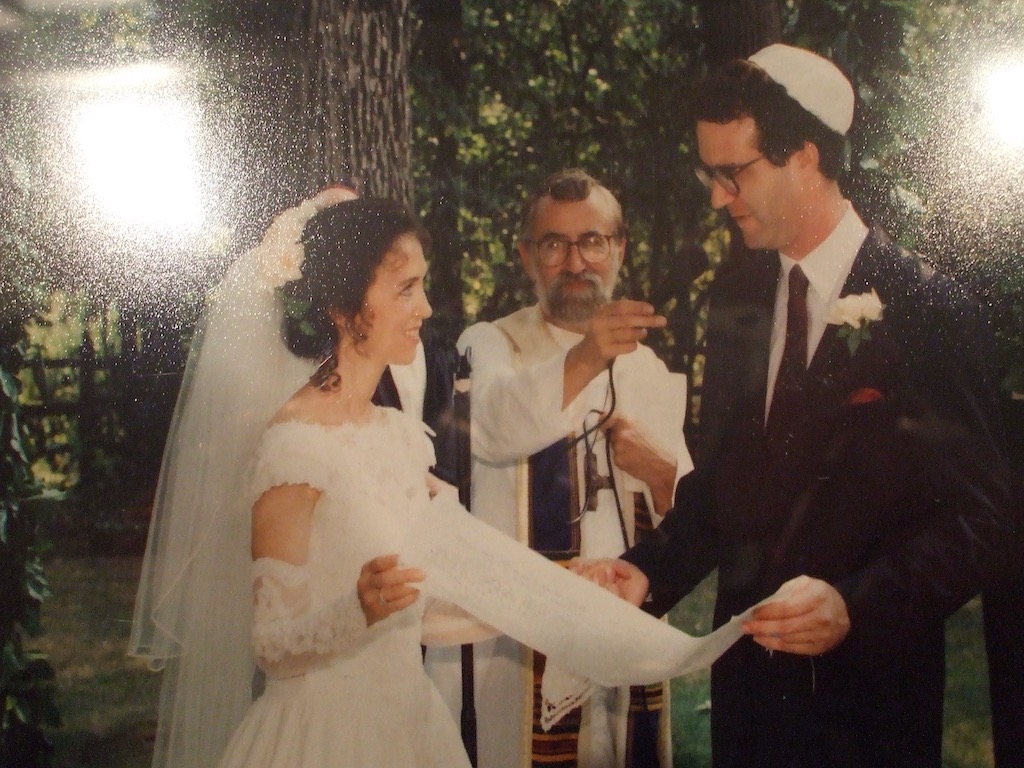
one last time: love story of a lifetime. ted + marguerite = forever and ever. amen.

springtime’s reluctant suitress

i was, for reasons that escape me, something of a reluctant suitress this year. the season’s slow-building seductions did little to seduce. i turned a blind eye. gave the cold shoulder. 

harumph.

spring wasn’t an easy sell this time round. it came on thin, and unconvincingly. it taunted, played catch-me-if-you-can. and i couldn’t. couldn’t catch it. 

i worried it might wholesale evade me this year. where was the catch in the throat, in the heart, in the soul, that usually caught me? had i been numbed, beaten down by the thrum of the world? was the malaise of the moment eclipsing the vernal exuberance?

but then, this week, it opened the spigot, came on rushingly, came on like a buttery rivulet poured on a mound of mash. i couldn’t resist. 

i fell hard. have found myself dizzily staring out windows. even more dizzily tracing the garden’s edge. staring. marveling. asking again and again how it does it. how it knows. how, year after year, for all the inhales and exhales of the millennia of this holy Earth, does it find the oomph to give forth again and again and again?

if there’s wisdom in this year’s slow coming—and we know there is, for the earth is the vessel of wisdom without end—it must be one of patience. of giving it time. no need to go anxious when the oomph isn’t there. “live the questions,” taught rilke, in the one phrase we’re most apt to remember. but it came at the end of a wisdom more fulsome in the whole:

“Be patient toward all that is unsolved in your heart and try to love the questions themselves, like locked rooms and like books that are now written in a very foreign tongue. Do not now seek the answers, which cannot be given you because you would not be able to live them. And the point is, to live everything. Live the questions now. Perhaps you will then gradually, without noticing it, live along some distant day into the answer.” 

so much of life swirls in the liminal time of not knowing, of waiting, of dwelling in the not-yet. 

so this spring was for me. i knew what the calendar said. i knew how the sun had crossed its equinox, how light and shadow had fallen in equal measure and we were now slithering toward light and more light.

but the light out my window didn’t convince me. nor the nubs of green pushing up from their winter’s retreat. maybe it was the noise of the world blocking the sense that something lush and luscious might really be coming. 

and then the abundance came. the climbing hydrangea emphatically leafed and greened, all but tapping at my kitchen window, come rub your nose in us. the viburnum buds about to burst with their pyrotechnic perfumery. the nodding heads of bluebell and snowflake. the aubade of the cardinal. the rampant rufflings of feather as sparrow mounts sparrow in the delirious dance of procreation. 

and when the wind blows, which it has quite often this year, magnolia petals take flight, filling the air with what appear to be wings. a fluttering of perfumed birds playing on the breeze.

fibonacci spiral

it might have been the question mark of a woodland fern unfurling that first stopped me on a path this week. a flock of inquiry rising from the garden, in all the shadowed places. it’s the mystery of the universal spiral that catches me by the throat, the fibonacci spiral a leitmotif of all creation. born of the mysterious fibonacci sequence of 1, 1, 2, 3, 5, 8, 13, 21—wherein each number is the sum of the preceding two, beginning with 0—the spiral is the geometry laid upon that very grid. a geometric pattern constructed by connecting the corners of squares whose side lengths are consecutive fibonacci numbers, the spiral (sometimes known as the golden spiral) pervades the cosmos, from the spiral in a sunflower, to the question mark arising from my garden, to the scales of a pine cone, to the swirls of the chambered nautilus. 

chou Romanesco, or Romanesco cauliflower

i sometimes imagine God so delighting in the whorl that the divine enthusiasms couldn’t be tamped, and thus its profligate presence wherever we look: into the vast galaxies above or the dappled woodlands below.

i often sense the spiral is but a trace of the soul’s very geometry, the innermost chamber tightly held at the apex. but what i don’t know is whether we spend our lives unfurling, from the nucleus of the sacred from which we divide and multiply in the womb, or whether ours is a journey inward, inching closer and closer into the fertile and eminently holy nub. 

is it furl or unfurl? twining in or unspooling beyond?

such are the questions that arise from the earth’s thawing, such are the questions put before me, whirling within me, as the season begs only one thing: come close, bend low, watch what arises. from the earth, yes, but more so your soul. 


a poem plucked from the book of garden wisdoms….

this is the recipe of life
said my mother
as she held me in her arms as i wept
think of those flowers you plant
in the garden each year
they will teach you
that people too
must wilt
fall
root
rise
in order to bloom
The Sun and Her Flowers by Rupi Kaur


what stopped you in your tracks this week?

a few summers ago, in one of the wonders of my life, my beloved friend kat the priest handed me a ticket to a summer course at yale divinity school, a course i came to call my “poetry school.” my firstborn (now the law professor) was at law school there at the time, and for the summer had shuffled off to DC, meaning there was an empty apartment where i could play house–or college–for the week. so every morning i shuffled down the lanes of new haven and settled in for a day of poetries with a professor who happens to be named david mahan–yes, exactly like my last name, only without the “y”. when he wasn’t brilliantly teaching poetry, he was running a glorious something called the Rivendell Institute, which “seeks to examine and advance the contribution of a Christian vision of life to human flourishing and the common good within the academy and contemporary culture.” within the institute there is another something called the Rivendell Center for Theology and the Arts (RCTA), and their mission is “curating conversations between a variety of interlocutors.” long story short, this week, in their spring issue of Among Winter Cranes, RCTA published an excerpt from my Book of Nature, and since publishers love eyeballs, here’s the link to the essay, On Paying a Particular Attention.

the quickening of september

if i were truly of the prairie, rooted into its undulating loam, rather than a citizen merely plopped here by geography, because it’s the place i call home, i’d know the turning of the celestial wheel and its interplay with earth as robustly as the marrow that courses my bones. alas, my knowing is fainter than that. and yet, still, each september i feel it. the angle of light shifts, and the lens does too. it’s amber now, or so i seem to imagine. the days are drenched, more and more, in molasses hue. and the air holds a chill one minute, a warming the next.

the season itself is playing meteorological tug-of-war: do we want to let go? do we want to surrender? or shall we hang on with the last of our oomph?

ah, but the signs, they abound. and they quicken my spirit, each and every one. the school bus sightings, for one. they lumber the streets now, that slow serpentine crawl, disgorging couplets of children at most any corner. i’m detached from the school calendar now. it’s merely there at the edge of the frame. but, nonetheless, i notice.

my cooking’s changed too. i simmered this week. slow stirring a vegetable stew. i spent a good chunk of hours stationed by the stove, overseeing allium play sidekick to eggplant, to pepper. offering up its essence to add just a pique to the whole.

but mostly i feel the turning of earth in the garden, the plot that keeps me most rooted in the wonder, the majesty, the undying wisdom that is the sacred whole of creation. i felt it in the proliferation of spider webs, those silken geometries of arachnid architectures. the uncanny way the eight-legged thing knows to construct its trapping, and in the process makes beauty of pace-pausing proportion. i felt it in the crisping of blooms, and the heads of hydrangea and black-eyed susan starting to droop, the weight of their long season now taking its toll. a last gasp before death.

i hear it just now in the distant cloudcall of the goose, threading the sky, signaling autumn. it’s a cry that can shroud me in goosebumps. a call to prayer if ever there was.

september is when i feel myself beginning to curl like the nautilus, inward spiral, expanding the chambers within. making room for the quiet, the sacred, to come.

thirty some years into a spiritually-braided marriage, i know september to be the season of awe. quite literally. liturgically speaking. we are in the hebrew calendar’s month of elul, counting the days till the high holiness of the jewish new year. according to jewish tradition, it is the month for contemplating the question, “how should i live the existence that i am.”

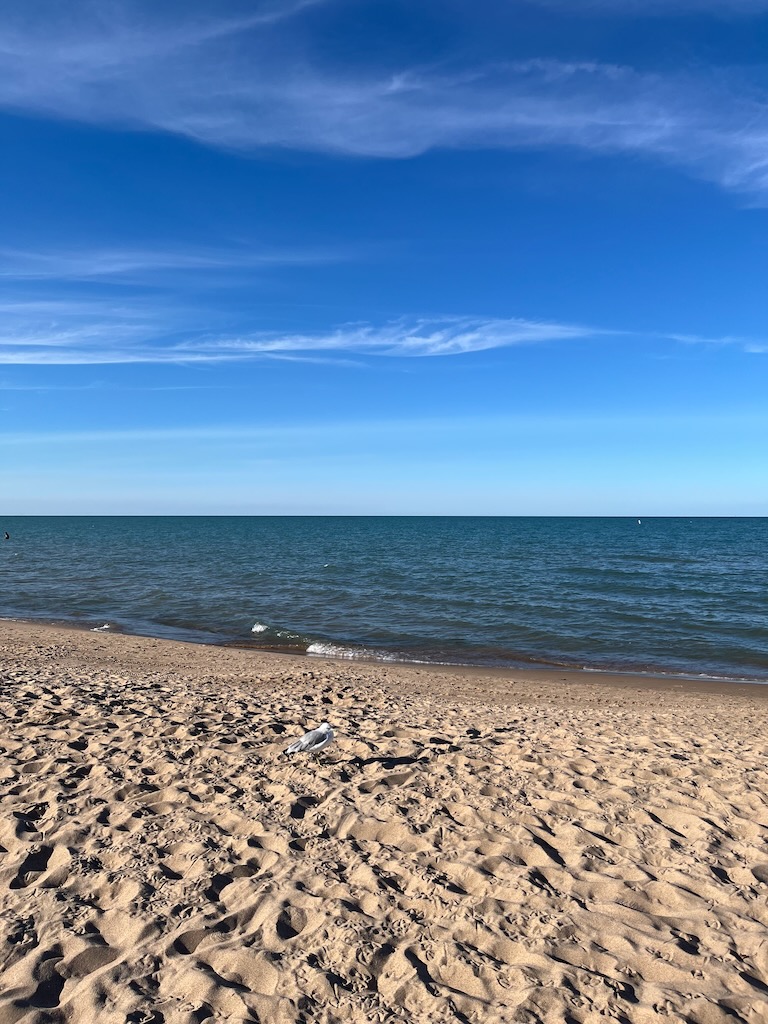
just the other day, i –– along with a rabbi i love and a gathering of women –– walked to the water’s edge, recited three blessings, and dropped into the water, into the great lake michigan. it was a cleansing, a beginning anew, a rite of purification. it was a mikveh, an ancient ancient tradition that is symbolically a turning of the page.

the question at the core of elul, “how should i live the existence that i am,” is one that especially quickened for me in a paragraph i read this week that had little to do with religion, and everything to do with the holiness of how we live our lives. it was the beginning of a review of a children’s picture book, and it was written by one of the high priestesses of everyday cultural commentary, maria popova.

she was writing about kamau & zuzu find a way, an “uncommonly soulful” story of a little boy and his grandmother who, somehow, find themselves living on the moon.

popova begins her essay this way:

The astonishing thing is that not one human being who ever lived has chosen the body, brain, place, or time to be born into, and yet in the narrow band of freedom between these chance parameters, we must find a way to live lives of substance and sweetness. Chance deals the hand and we must play it, and in how we choose to play it lies the measure of who we are.

“we must find a way to live lives of substance and sweetness.

“chance deals the hand and we must play it, and in how we choose to play it lies the measure of who we are.”

those are the questions i shall carry into my fading garden, and under the dome of a sky now rife with the cries and the calls of the flocks flying as one, in the migrational river that carries them faraway home.

in the quiet of your own soul, that’s the question for today: how do you choose to play the hand that chance has dealt you? what will be your sweetness and your substance?

when springtime lives up to its billing: equal parts shadow and light

according to celestial alignments, the shadow now is equal, light and dark. the sun has crossed the equator, and here on the northern half of the orb, spring is upon us. except that as i type, snow is blanketing my tender spring tendrils, and the walk is slick, and, well, tis the very picture of springtime here in the heartlands, where you’re wise not to count your blooms before the ides of may.

my heart too is heavy, beating in time with that of a mother i know who is off in the mountains of northern california searching for her blessed daughter who went hiking from the tassajara zen mountain center on monday, and five days and cold dark nights later still has not been found. i ask for prayers for caroline.

motherhearts are a communal collective. we cannot pause the pounding against our own chest wall, we cannot sleep soundly, when we know profoundly of another mother in unimaginable distress. be it the mothers of syria, or gaza, or israel’s kibbutzim, or my long-ago newsroom compatriot now strapped into her hiking boots, hearing only the echo of her own cry as she walks the remote yet exquisite topography where, somewhere, her firstborn is lost, is lying, is awaiting her mama’s arms and a wrapping in blankets.

my prayers have been looping nonstop, clouding out most other thoughts, since i first heard word. caroline’s mama is a woman of incredible, unbreakable faith. the notes she is sending back home, here in chicago, bolster my faltering. “my gratitude and hope outweigh my fears,” she wrote in her last short update, teaching me a thing or two about how to be strong in the face of the unbearable.


because the promise of springtime is, indeed, equal parts shadow and light, i turn to the poets for a dappling of light. and we begin with emily, the belle of amherst, and quickly turn to the little-known artist who inspired her:

“to be a flower,” emily dickinson wrote in her 1865 poem, “bloom,” considered a pre-ecological work, “is profound responsibility.”

clarissa munger badger

a passionate lifelong gardener, emily D (“a keen observer of the house of life who made of it a temple of beauty,” as cultural critic maria popova once put it) had fallen under the spell of wildflowers as a teenager while composing her herbarium of 424 blooms native to new england. but, writes popova, it was an “uncommonly beautiful” book her father gave her just before she turned thirty that rocket-blasted her poetic passion for nature’s own garden: wild flowers drawn and colored from nature by the botanical artist and poet clarissa munger badger (may 20, 1806–december 14, 1889).

published in 1859, the same year charles darwin’s on the origin of species shook science, badger’s book “contained twenty-two exquisite scientifically accurate paintings of common new england wildflower species — violets and harebells, the rhododendron and the honeysuckle — each paired with a poem bridging the botanical and the existential: some by titans like percival and longfellow, some by long-forgotten poets of her time and place, some by badger herself,” writes popova.

seven years later, badger brought her brush to the beauty of wildflowers’ domestic counterparts, the blooms of greenhouse and garden: the pansy and the lily, the day-blazing geranium and the night-blooming cactus, the tulip and the rose, and once again pairing her paintings with poems, she celebrated garden flowers as “brilliant hopes, all woven in gorgeous tissues,” as “stars… wherein we read our history.”


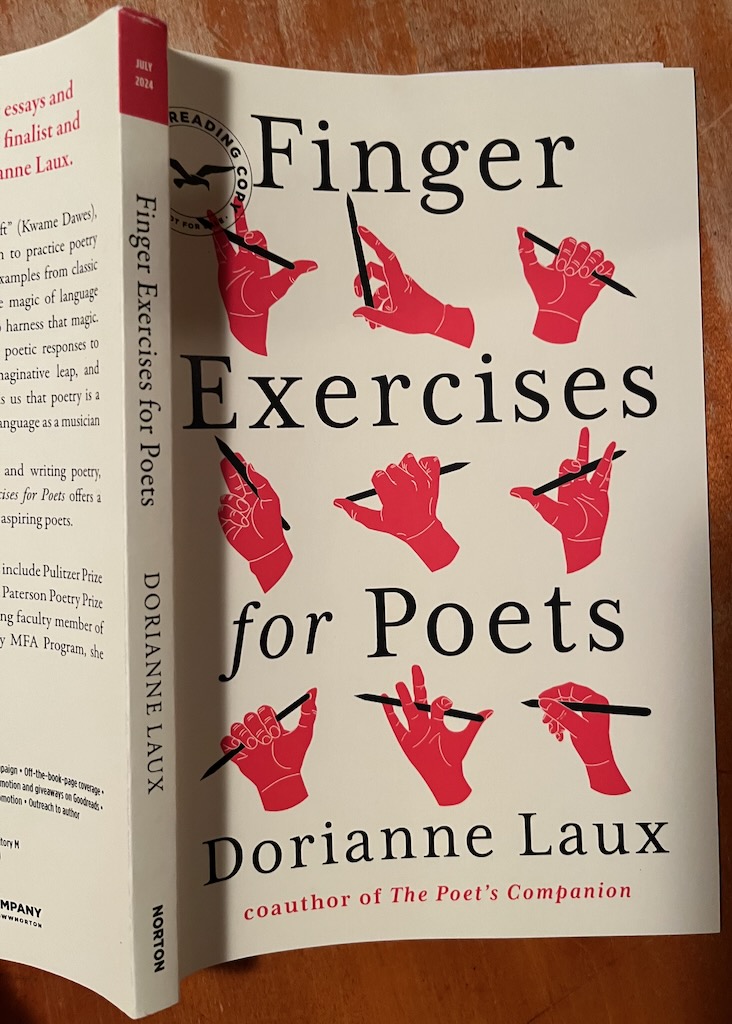
another poet, one i dream of sitting down to dinner with, or more in keeping with her ilk, plopping on a porch swing, she with cigarette burning orange against the black of night, me, merely pumping my merry little legs. dorianne laux is her name, and you’ve seen me write of her here. she has a brand new craft book, companion of sorts to her earlier the poet’s companion, and the new book, finger exercises for poets, is “an engaging invitation to practice poetry alongside a master,” and it’ll be out this july from w.w. norton & company. (they still send me advance reader copies; bless them.)

here’s a passage i knew i needed to share, from glorious, glorious dorianne’s introduction:

“My instrument is the immensity of language, the techniques and effect of crafting images, shaping sound and rhythm, creating new combinations with the single notes of words, each colliding or coming together, meshing or crashing, standing firm or tumbling. There are eighty-eight keys on a piano, six hundred thousand words in the English language. The patterns, the sequences, and permutations of both are endless. For me, language is another kind of music.

“I practice poetry. This book invites you to practice along with me.”


and i close, this snowy spring morning, with yet another master of language, and truth-telling: james baldwin. (this comes to me from a french monk whose writing i follow; laurence freeman is his name, and here’s a bit of what he sent this week from the bonnevaux centre for peace, in the southwest of france): “toward the end of his life, baldwin gave a television interview in which he was asked to reflect on the essential subject of his classic, groundbreaking novel, giovanni’s room. baldwin’s answer is an extraordinary meditation on love, and in particular, how it can serve a kind of educational purpose in our lives.” here’s what baldwin said, laid out as a poem. 

Q: What’s the novel, Giovanni’s Room, about?

Baldwin’s answer:

It’s about what happens to you
if you can’t love anybody.
It doesn’t make any difference
whether you can’t love a woman,
or can’t love a man —
if you can’t love anybody,
you’re dangerous.
Because you’ve no way
of learning humility.
No way of learning
that other people suffer.
No way of learning
how to use your suffering,
and theirs, to get from one place
to another.

In short, you fail the human
responsibility, which is
to love each other.

+ James Baldwin

what are the lessons of love you learned in this week of shadow and light?

my “springtime” garden, whitened.

p.s. illustration at the top is indeed one of clarissa munger badger’s beauties. and i will ask once again, please please offer up prayers for rescue for blessed, blessed caroline, her mama, her papa, and all who are holding their most sacred breath…..

hungry for color

it hits this time of year, at this point in the turning of globe when we’re deep in shadow, and the world out our window is endlessly, endlessly, drainingly gray. even i, a self-proclaimed fangirl of the cloudiest day, a girl who thrills at billows of fog, those days when the sunlight can’t find its way in — even i get a bit itchy for hues beyond pigeon and charcoal and smoke, all close kin in the family of gray.

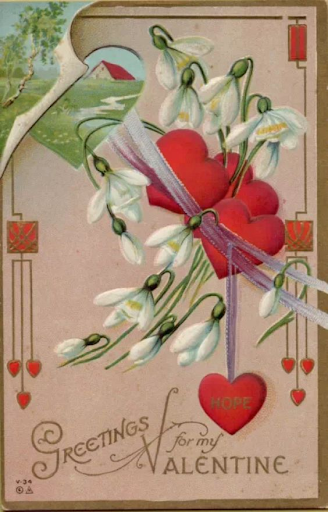
which is precisely why that shock of scarlet and pink boldly inserts itself in the february calendar. we need a little color. and the heart-shaped holiday brings it on. coils and coils of red, beribboned with oyster pink or flamingo. maybe even dashes of fuchsia.

i detected this color deficiency (more of a self-diagnosis) when i realized that all through the week i was clicking and clicking on dizzying droplets of anything resembling “other-than-gray.” and when i caught myself daydreaming, once again, of a riotous, bouquet-gathering, summery cutting garden — zinnias and cosmos and blue bachelor’s buttons all rising up like a botanical box of jazzy crayolas (preferably the 64-pack in which those waxy rainbow-hued sticks stand shoulder-to-shoulder as if choir-robed darlings marched into their multi-row loft).

and so, in hopes of sating your own chromatic hungers, i bring you a compendium of colors from a painter, a cook, a maven of tulips, and a poet.


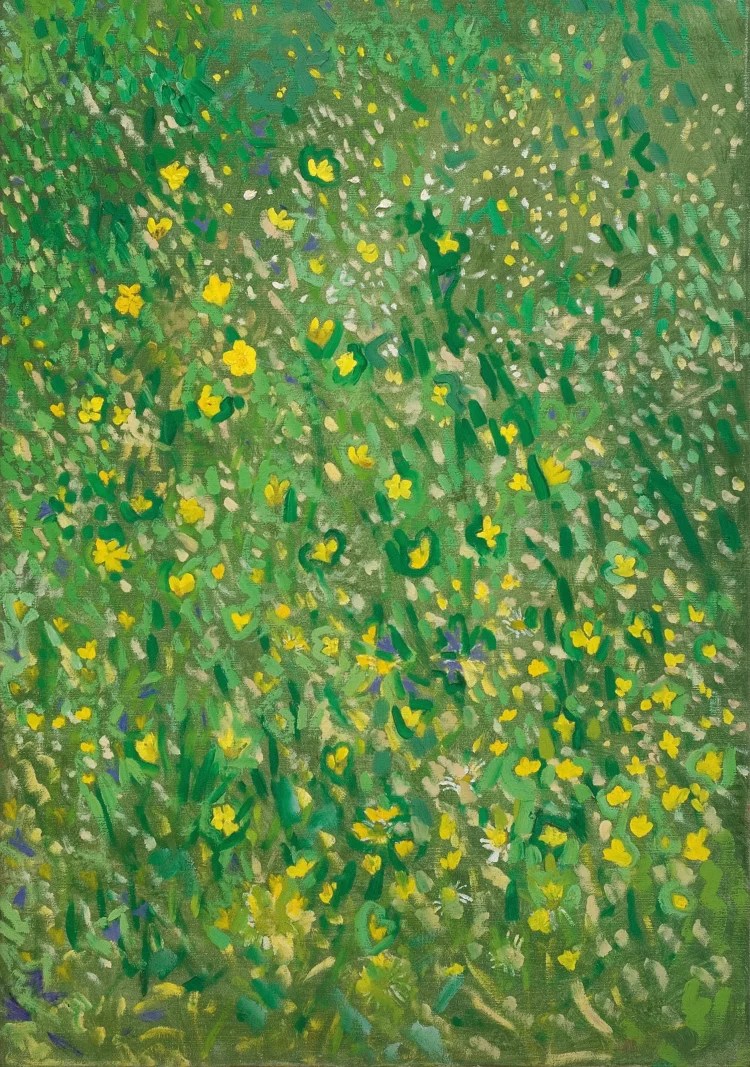
jean cooke’s “The Blumenthal,” 1995

first up: the painter, whose style of garden i aim to emulate, mostly because it’s been said that her “rambling garden was unkempt to imperfection.” jean cooke is her name, and she was considered one of britain’s greatest woman painters of the twentieth century. described, too, as a remarkable, bird-like woman, the london gallery that shows her work, goes on to describe her “ungardening” thusly:

Cooke’s neglect of her garden—she sometimes called it ‘ungardening’—was partly a reflection of her priorities: her painting and the care of her children. Beyond these demands there was little energy to give less pressing concerns. Grass went unmown, fences unmended and trees unpruned. But the messy garden was not entirely accidental. The disarray was cultivated over an extended period of time and helped Cooke to create a new subgenre in works such as The Wild Plum Tree, which drew upon aspects of both landscape and garden painting traditions. Whereas Claude Monet’s waterlily pond was scrupulously tended, Jean Cooke’s rambling garden was unkempt to imperfection just as her painting required. Whereas earlier paintings such as Grassland had used the Sussex coastline to create landscape-scale wilderness, by the mid-eighties when she began painting spring blossom in earnest her own garden had achieved a similarly expansive quality.

piano-nobile gallery
jean cooke at work in her unkempt imperfection

and in a nod to cupid’s holiday cusping on the near horizon, here’s a tad of insight, should tulips be the thing you choose to send your true love:

“rococo”

“As far as I’m concerned, …[tulips] are the best, indeed the only flowers to send or receive on Valentine’s Day. Wild, irrepressible, wayward, unpredictable, strange, subtle, generous, elegant, tulips are everything you would wish for in a lover. Best of all are the crazy parrot tulips such as ‘Rococo’ with red and pink petals feathered and flamed in crinkly lime-green. ‘When a young man presents a tulip to his mistress,’ wrote Sir John Chardin (Travels in Persia, 1686), ‘he gives her to understand by the general red color of the flower that he is on fire with her beauty, and by the black base that his heart is burned to coal.’ That’s the way to do it.”

– Anna Pavord, wonderful British garden writer and bulb lover, in The Curious Gardener: A Year in the Garden, 2010

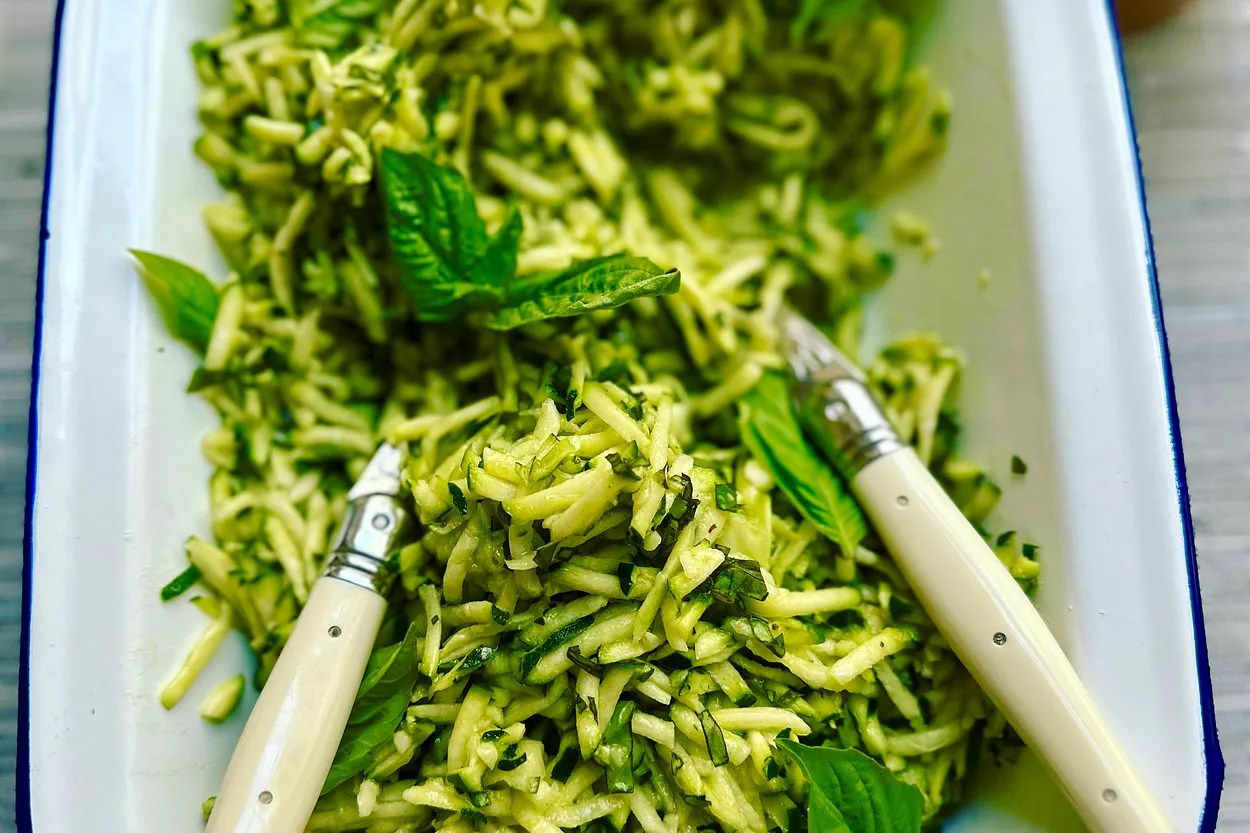
on the subject of wild women who tend toward the vivid end of the paint pot, there is the utterly marvelous and delicious emily nunn, formerly of the new yorker and the chicago tribune. she is a food writer like no other, and in recent years she has devoted her not-inconsiderable genius to the subject of salads. her newsletter often has me giggling straight off my chair. and her salads are beyond delicious more often than not. it delights me to introduce you to the one and only emily nunn’s department of salads, along with a peek at but one of emily’s many-hued produce concoctions….


and finally, let’s wrap this up with a wonder from mary O that i had never seen before, from a slim little volume i’d not known of till just last week when a wonder of a woman hosted a candlemas gathering and asked us all to bring a.) a candle, and b.) a poem about light. and thus i discovered house of light, mary oliver’s 1990 collection of poems. since the subject of this one is van gogh, it seems perfectly suited as a prescriptive for those who find themselves suffering a little color deprivation.

EVERYTHING   by Mary Oliver

No doubt in Holland,
when van Gogh was a boy,
there were swans drifting
over the green sea
of the meadows, and no doubt
on some warm afternoon
he lay down and watched them,
and almost thought: this is everything.
What drove him
to get up and look further
is what saves this world,
even as it breaks
the hearts of men.
In the mines where he preached,
where he studied tenderness,
there were only men, all of them
streaked with dust.
For years he would reach
toward the darkness.
But no doubt, like all of us,
he finally remembered
everything, including the white birds
weightless and unaccountable,
floating around the towns
of grit and hopelessness––
and this is what would finish him:
not the gloom, which was only terrible,
but those last yellow fields, where clearly
nothing in the world mattered, or ever would,
but the insensible light.

and with that i shall wonder, where did you find color this week?

jean cooke’s “springtime through the window,” 1980s

looking into the darkness

maybe it’s the darkness we’re meant to look into. deep into. maybe halves of the world go darkest once a year, so we become practiced. so not only our eyes but our souls learn to widen the aperture, to let in whatever droplets of light there might be. or maybe it’s the inky darkness itself we’re meant to wrap ourselves in. to not be afraid.

maybe we’re left to our own devices when the darkness comes — and it will come — so we learn to find our way. steady our wobbling, put meat to the muscle that holds us upright. in a lifetime’s ebb and flow of darkness and light, it’s the shadowed chapters that have made me the deeper parts of who i am. maybe we should all look to the roots wriggling down below the frozen crust of earth to see how it’s done, how the growing comes unnoticed, in the tabernacle of earthly darkness.

maybe we’d be wise to consider the hidden work of wintertide, the profound intelligence unfolding where eyes cannot see, where sense cannot reach.

in this year’s darkest hour, i can’t say i was up keeping night vigil, awaiting the nadir of night. i was not out in my yard, kindling sticks and dried-up old leaves, setting a bonfire to keep the darkness at bay. fact is, i was felled by a bug that did have me up moseying about the house in the wee hours, but not to contemplate the darkness.

what i did do, as is my wont (and i did it by daylight), was gather up words, snippets of poetry, that made me think about light and darkness, and the shimmering shards we need to find to keep from tumbling headlong into the abyss.

the world this christmas is dark indeed. more than ever, we need to light our way. and pray that our penumbra illumines the path of those who travel nearby.

a solstice offering…

Let the ordinary be in your hand;
hold it open and imagine a bird landing,
offering all it possesses in trust
to come to you.

Learn to look for the little things
that weigh nothing at all,
but fill the heart with such light
they can never be measured.

-Kenneth Steven*, Seeing the Light 


To go in the dark with a light is to know the light.
To know the dark, go dark. Go without sight,
and find that the dark, too, blooms and sings,
and is traveled by dark feet and dark wings.
 
-Wendell Berry


Holding the Light
 by Stuart Kestenbaum

Gather up whatever is 
glittering in the gutter,
whatever has tumbled 
in the waves or fallen 
in flames out of the sky,

for it’s not only our
hearts that are broken, 
but the heart
of the world as well.
Stitch it back together. 

Make a place where
the day speaks to the night
and the earth speaks to the sky.
Whether we created God
or God created us

it all comes down to this:
In our imperfect world
we are meant to repair
and stitch together 
what beauty there is, stitch it 

with compassion and wire. 
See how everything 
we have made gathers 
the light inside itself
and overflows? A blessing.


i keep watch on a few monastics who dwell in the heart of france. brother laurence, a modern-day mystic, sent along this the other day, a wonder of imagery from the winter’s solstice at Newgrange, a stone-age relic and world heritage site that rises from the earth not too, too far from the irish sea along ireland’s eastern shore. he sent a short video along with this short meditation:

“New Grange is a monumental 5,000 year-old burial mound in Count Meath, Ireland. At sunrise on December 21st, the first ray of direct sunlight from the new-born sun precisely, silently, enters the narrow aperture over the entrance, penetrates into the mound of solid rock and fills the inner chamber with golden light for seventeen minutes. Light overcomes darkness. It is irresistible and yet gentle. As it grows stronger with occasional surges, its intensity increases and the power of its beauty. It communicates purely by itself – the meaning of truth.

“I hope you can take time to watch this short silent video of the phenomenon. It captures a sacred moment, the revelation of God in nature. And it may give you a sense of how the light of Christ, the light of truth, actually enters and changes our world.” (Laurence Freeman, OSB)


and finally, for those among us who find the poetic to be a vessel of the ineffable sacred, this from a Paris Review interview with the late great Louise Gluck. i particularly swooned over the line that a poem “is like a message in a shell held to an ear”…:

From the beginning, Glück cited the influence of Blake, Keats, Yeats, and Eliot—poets whose work “craves a listener.” For her, a poem is like a message in a shell held to an ear, confidentially communicating some universal experience: adolescent struggles, marital love, widowhood, separation, the stasis of middle age, aging, and death. There is a porous barrier between the states of life and death and between body and soul. Her signature style, which includes demotic language and a hypnotic pace of utterance, has captured the attention of generations of poets, as it did mine as a nascent poet of twenty-two. In her oeuvre, the poem of language never eclipses the poem of emotion. Like the great poets she admired, she is absorbed by “time which breeds loss, desire, the world’s beauty.” –Henri Cole


*as this is the second Kenneth Steven poem in as many weeks, you can bet i am following his thread and will be finding out more about this scottish poet and children’s book writer. and gathering up his new book of poems, Seeing the Light, from my favorite friendly librarians….

where are you gathering up shards of light these days?

light lessons

i was slinking into the early-morning light of my garden, when i startled to the sound of a chainsaw. (a chainsaw in morning’s newly-born hours is, by any definition, a startling eruption.) i looked up and there was a man high in the limbs of the woodland grove that hugs the other side of the fence, the fence that now borders my quiet, contemplative, pretend-cloister garden. 

i swallowed my yelp, but let out a pipsqueak of question: “cutting down trees?” (my questions are so utterly incisive when chainsaws, at any hour, are involved.)

“only this one that’s in the way,” he replied as a tree as tall and willowy as our chimney came shimmying down. it was “in the way” of the soon-to-be hot tub that will gurgle and whir just the other side of said fence.

i swallowed back tears, and darted inside. 

i couldn’t bear to look at the now naked space, where once a gnarly old serviceberry had offered its limbs as occasional nursery and everyday waystation for the sparrows, and robins, and cheery wee chickadees that flock––season by season, hour by hour––to my feeders and fountains and free-for-all baths.

hours later, though, i needed distraction in the form of a hose. so i cranked the faucet and started my rounds. 

and that’s when i noticed: the light in that crook of my garden was suddenly dappled. and beautifully so. sunlight falling in splotches. and sprees. sunlight igniting the backsides of leaves. where once there’d been only monochrome of shadow, there now was shimmer and glint and translucence on flat plane of leaf and frill of each fern frond. the patch was a playlot for luminescence as never before. a landscape “tricked out in gilt,” is how annie dillard once wrote of the play of peekaboo light as it darted and dodged.

i almost swore i could hear the wide-mouthed leaves gulping down sunlight, a commodity they’d tasted far too little of over the long many years.

i stood there beholding. letting each molecule sink deep down within.

and i had to admit it was as lovely a light show as i’d seen since the one in the night sky the midnight before, when the great mama blue moon headlined the stage in her most zaftig dimensions. 

seems light is my gospel of the week. moonlight leading me home in the night. sunlight alive where it’s not fallen in decades. 

this whole holy earth, it seems, is straining to fill in my shadowy cracks with every last drop of all the light it can muster. 

and i, like my forget-me-not’s leaves, am guzzling it greedily down. 


after dousing myself in this splash of a light bath, this bit of earthly gospel from the center for spirituality in nature landed in my mailbox: more insight on light, the way the trees bend toward the light. botanically, biologically speaking, i mean. it’s the leaves that lead the way. specifically, the cells on the dark side of the leaves elongate and stretch toward the light, seeking photosynthesis, that alchemical wonder that stirs sunlight and water and carbon dioxide and somehow winds up with O2 and sugar, and moves the whole show along. the branches and twigs follow the lead of the leaves. so the tree actually bends, reaches toward light. and the question is asked: what would it mean to turn toward the light with all of our energy and substance and being? is their holy wisdom to drink in here?

it’s something to ponder, all right. so have a listen right here:

sometimes i think the folks in charge must have a check by name, letting them know i’m one of the ones who needs lessons in duplicate or triplicate. so when three times in 24 hours i’m struck by a lightbeam, i get the idea there’s something i’m supposed to be pondering. 

what light lessons have struck you lately? 


this beautiful poem, on how the world is saturated in prayer — voluntary and involuntary, spoken and sung, resounding and silent — is one i bumped into this week. it’s by carol ann duffy, one of the UK’s best-known poets, the first woman, and first openly LGBTQ+ person, to become poet laureate of the UK. it’s a poem with a bit of vernacular that might benefit from a few notes. so these, from my friends at SALT Project, a not-for-profit production company dedicated to visual storytelling and to my mind a humming hive of creativity:

(1) “Minims” are half-notes written on a page of musical notation. 

(2) BBC Radio has long broadcast the “Shipping Forecast” for the various seas around the British Isles, waters divided into 31 sea areas, including Rockall, Malin, Dogger, and Finisterre. These regular broadcasts, especially the ones late at night, are for many Britons a deeply familiar touchstone: the announcer’s voice methodically reciting the sea areas all around the islands, one by one, forecasting the weather. 

(3) And finally, “Finisterre” (pronounced “FIN-iss-tair,” rhymes with “BIN-kiss-fair”) literally means “end of the world”; the sea area’s name was recently changed to “FitztRoy,” but many Britons (such as the poet Duffy herself) grew up hearing the older name “Finisterre” repeatedly intoned on BBC Radio… 

Prayer

Some days, although we cannot pray, a prayer
utters itself. So, a woman will lift
her head from the sieve of her hands and stare
at the minims sung by a tree, a sudden gift.

Some nights, although we are faithless, the truth
enters our hearts, that small familiar pain;
then a man will stand stock-still, hearing his youth
in the distant Latin chanting of a train.

Pray for us now. Grade 1 piano scales
console the lodger looking out across
a Midlands town. Then dusk, and someone calls
a child’s name as though they named their loss.

Darkness outside. Inside, the radio’s prayer —
Rockall. Malin. Dogger. Finisterre.

  • Carol Ann Duffy

p.s. lots of chair birthdays in the days past: sharon b, jcv, my dear neighbor sarah who keeps us in sweets. and in the days ahead, my big brother john. happy blessed days to each and every one of you, and anyone else i might have happened to miss…

bee season

when you happen to tiptoe outside into the dewy sop of dawn, just after the light breaks through, you might hear a noise, at that liminal hour when noise is one thing there’s not. not much of, anyway. 

i was standing there with my mug and my prayers, when all of a sudden i heard it. the sound of a mosquito buzzing your ear, only amplitudes louder. it’s not as loud as the nighttime’s cicada, nowhere near it. it’s the buzzsaw of dawn, when the bees are up early and nose-deep in work. 

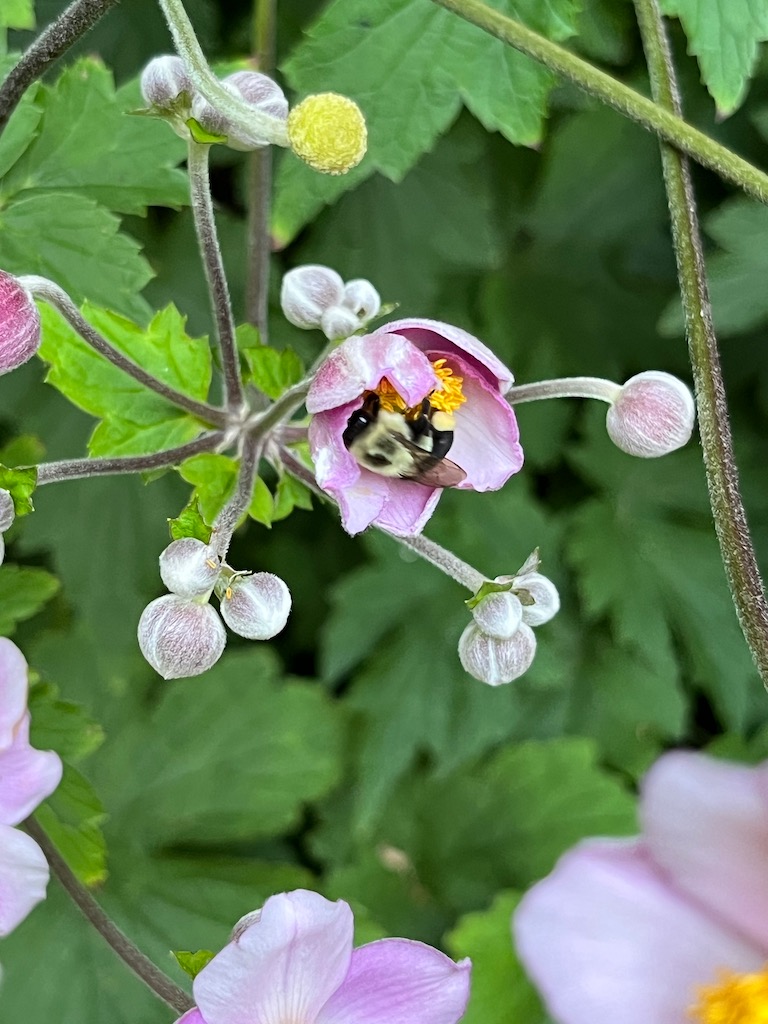
i followed a pair, fat, fuzzy, all full of themselves. full of unctuous beads of gold-dazzled pollen. looked like they’d rolled in a can of it. which they more or less did, dive bombing into the gold-dusted pincushions that rise from the swirl of anemone petals.

because i tend to read nature in a scriptural way, meaning i stand there in the face of a question, connecting the dots, unpuzzling the parable, i wondered what lesson i might extract from the bee, while the bee was drowsily, drunkenly, extracting its pollen-y porridge. 

what i came up with was unrelenting. unrelenting as in the bee, morning after morning, rises up from the hive, zigzags out the door, and plows ahead with his one holy task: he gathers up gold dust, the baseline of honey. it’s the task he was born to, a task he can’t shirk. a task he dives into with unrelenting enthusiasms.

i stood there for a while marveling at all there is in the tableau of dawn. the breeze already stirring. the moon now off the clock, back under the covers. or maybe just hiding back behind clouds. one or two birds were up and starting to chirp. but centerstage, in my attentions at least, was that fine pair of harvesting bees.

i thought about the perfect harmony of this early hour. how all of creation plays its own part. 

i thought about my own holy task and not being daunted. i don’t really know yet what exactly i’m up against — none of us do. but, i took a note from the bees: head down, nose first, gather up gold dust wherever you can.

be unrelenting. don’t be distracted. or daunted. even on days when it’s harder than hard: nuzzle your way into the gold dust, suck up what you can. 

it’s the reason you’re here on this holy earth.

maybe the bee understands: his days in the hive, they’re numbered. just like yours and like mine. so he gets down to business. gathering all that he can.

i let that sink in, while i kept up my watch, mesmerized by the bee who would not be dissuaded, distracted, or daunted. 

bee season brings lessons. but you need to perk up your ears. 


among the gold-dusted pollens i gathered this week was one heavenly spoken-word poet, podcaster, and author: amena brown. “a breathtaking blend of poet, prophet and pioneer,” one reviewer wrote. “her life and words will bless your soul.” no less than richard rohr, the modern-day mystic, and his center for contemplation and action pointed me in her direction. and what a direction it is. have a listen:

amena brown: “She Said How Do You Know When You’re Hearing From God”

i ran out and bought the book from which it came, so knocked off my socks by it was i. and i was only going to share the first verse. or two. but i can’t bear to leave out a one. it’s a bit long. and worth every drop. thank you, amena, for sharing your wonder…

She said, “How do you know when you are hearing from God?”
I didn’t know how to explain
It is to explain the butter grit of
  cornbread to a mouth that just
  discovered it has a tongue
The sound of jazz to ears that only ever
   thought they’d be lobes of flesh
The sight of sunsets to blinded eyes
   that in an instant can see
To fail at the ability to give words to
   how the scent of baked bread can
   make the mind recall a memory
Every detail
Of a house, a room, a kitchen, a
   conversation
Like explaining to a newborn baby this
   is what it feels like to be held
My words never felt so small, so
   useless, so incapable

I wanted to say
Put your hand in the middle of your chest
Feel the rhythm there
I wanted to say you will find the holy
  text in so many places
On crinkly pages of scripture
In dusty hymnals
In the creases of a grandmother’s smile
The way she clasps her hands
The way she prays familiar, with
 reverence as if to a dignitary and friend
The way she sings a simple song from
  her spirit and porches turn to cathedrals

I learned from my great-grandmother
   how to pray
How to talk to God
How to listen
Watching her and the other silver-
   haired church mothers gather in her
   living room
Worn wrinkled hands on top of leather
   bibles well traveled

They prayed living room prayers
   because you don’t have to be inside
   the four walls of a church to cry out to
   the God who made you
Because no matter where you sing or
   scream or whisper God’s ears can
   hear you

And despite what the laws say or what
   our human flaws say
God’s ears don’t play favourites
God’s ears don’t assess bank accounts
   or social status before they attune
   themselves to the story your tears or
   your fears are telling

God’s ears are here for the babies
For the immigrant, for the refugee
For the depressed, for the lonely
For the dreamers
The widow, the orphan
The oppressed and the helpless
Those about to make a mess or caught
   in the middle of cleaning one up
Dirt don’t scare God’s ears
God is a gardener
God knows things can’t grow without
   sun, rain and soil

I want to tell her to hear God
You have to be willing to experience
   what’s holy in places many people
   don’t deem to be sacred
That sometimes God sits next to you
   on a barstool
Spilling truth to you like too many beers
That God knows very well the dance
   we’ll do
When we love ourselves so little that
    just about anyone will do

That God cares about the moments we
   find ourselves
On the edge of a cliff
On the edge of sanity
On the edge of society
Even when we have less than an inch
   left of the thread that’s been holding
   us together

I want to tell her God is always waiting
Lingering after the doors close
And the phone doesn’t ring
And we are finally alone
God is always saying
I love you
I am here
Don’t go, stay
Please

I try to explain how God is pleading with us
To trust
To love
To listen
That God’s voice is melody and bass
   lines and whisper and thunder and
   grace

Sometimes when I pray, I think of her
How the voice of God was lingering in
   her very question
How so many of us just like her
Just like me
Just like you
Are still searching
Still questioning, still doubting
I know I don’t have all the answers
I know I never will
That sometimes the best thing we can
   do is put our hands in the middle of
   our chest
Feel the rhythm there
Turn down the noise in our minds, in
   our lives
And whisper,
God
Whatever you want to say
I’m here
I’m listening

– Amena Brown


and one last wonder, sent my way this week, from rebecca solnit’s 2004  Hope in the Dark, her counterpoint to a world in despair, an exploration of hope as “an embrace of the unknown and the unknowable.”.

Hope is not a lottery ticket you can sit on the sofa and clutch, feeling lucky. It is an axe you break down doors with in an emergency. Hope should shove you out the door, because it will take everything you have to steer the future away from endless war, from the annihilation of the earth’s treasures and the grinding down of the poor and marginal…

To hope is to give yourself to the future – and that commitment to the future is what makes the present inhabitable. 

Rebecca Solnit

finally, finally, but maybe sweetest for last: 32 years ago i married the love of my life. my tall sequoia of a sweet and steady soul. he has been my ballast all these holy blessed years, and never more than now, so one big giant i love you from me.

how were you unrelenting this week? and did you gather up gold dust?

praise song for black-eyed susan

should you poke through the lore-and-legend files of the black-eyed susan, that luminescent exclamation of the august meadow, you’d find it’s long been treasured for its curative charms. the keetoowah peoples (formerly known by the name cherokee, which translated to “people who speak a different language,” which begs the question who’s the different one?) squeezed juice from the roots to cure an earache. a tea made from dried leaves served as a mild diuretic; in other words, it made the bloat go away. and the native peoples of my neck of the woods, the neshnabék (formerly known as the potawatomi) chased away a cold with the ooze they squeezed from black-eyed susan roots. the anishinaabe (a name that means “the good humans”) used it as a poultice against snake bites or open wounds. 

i’d like to amend the apothecary: rudbeckia hirta, it turns out, is the perfect balm for rinsing away whatever hurts you deep inside. and i mean the sort of hurt that won’t show up on x-ray, nor splotch a purply bruise on flank or limb or bum. in other words, the black-eyed susan just might be the original pick-me-upper. especially when those nodding heads embroider the banks of a ripple-less pond, especially when their cheery saffron heads stick their necks out as far as the eye can see.

i stumbled onto such a swath this week, after days and days of poring over medical journals that must have been quick-sinking me into summer’s gloom. i’d not known quite how much i needed a spoonful of black-eyed whimsy till it unfurled before me, and far, far beyond me. but once i crouched down low, once i spied the bumbly bees doing their doh-si-doh and la-dee-da, poking their probisci into pollen pouch upon pollen pouch, i found myself entranced. and might have plopped myself permanently amid said swath, except for the fact that chicago’s finest would have given me a chase come the closing hour of the grand old park. 

i can’t quite put my finger on whether it’s the hoop skirt of golden petals or the way the fuzzy black-eyed dome periscopes up the middle, or the way the flock of them insistently interrupt the summer fade to jolt us back to joy, but there is a certain je ne sait-something that stands tall and wafts my way, and ever makes me break into a jolly when i come upon a black-eyed susie. 

maybe the other day it was the unendingness of it all, the exuberance of earth, rising up and rolling out the golden carpet, one french-knotted with those black-eyed buttons. it was as if the earth was daring me to laugh, to set aside my worries and my dread, to roll with what it offered: it offered stubborn testament to holy hope. it all but rubbed joy in my face, plucked the weight right off my soul, shouted in its earthly way: ”be not afraid; this here’s a world where skies turn pink at dawn, and posies rise in paint-box colors.” 

the black-eyed susans got it done. and thus i poked around, to see what else i just might learn while traipsing by their beds.

with one of the more curious common names among the prairie inhabitants, i exercised my curiosities and found out that the name traces back to an old english ballad, one penned near the dawn of the eighteenth century (in 1720, to be precise) by a fellow named john gay. it tells the sad, sad tale of a lovelorn lass (aka susan) who leaps aboard a fleet of moored ships soon to set sail for battle. she’s desperate to find her lover (a sweet fellow by the name of wiliam, the tale so goes) before he shoves off to sea. with tears spilling from her dark, dark eyes (here we find the black-ey’d bit), she cries out his name, he hears her from high above the ship’s yardarms, and, don’t you know, he scrambles down to bid his susan one last farewell. and so it goes in “sweet william’s farewell to black-eyed susan,” the first stanza of which rolls out like this: 

All in the Downs the fleet was moor’d,
The streamers waving in the wind,
When black-ey’d Susan came on board:
Oh! where shall I my true love find?
Tell me, ye jovial Sailors, tell me true,
If my sweet William sails among your crew!

never mind that love language of the seventeen hundreds all but drips with sticky treacle.

and here’s a gardener’s tip to go with it (cuz we never stop pouring it on here at the chair!): it’s said that if you seed wild Sweet William (Dianthus barbatus) with Black-eyed Susan (Rudbeckia hirta), the pair will bloom at precisely the exact the same time. forever twinned, the star-crossed, black-eyed lovers. 

so goes the etiology of the common name, and now for a bit about the latinate, the rudbeckia hirta, so named by the great father of taxonomy, carl linnaeus, who tidily ordered the world of nature, dividing and naming every which thing according to genus and species. 

as these things go, there’s always a backstory. and it’s all in who you know. in this case, before hitting it big in the taxonomy department (binomial nomenclature, his claim to fame), it seems mr. linnaeus needed a little side job. a professor at uppsala university, a school founded in sweden in 1477, a professor by the name of olof rudbeck, was in need of a tutor for his three children, and, in 1730, he hired linnaeus to do the job. linnaeus returned the kindness years later when he conferred immortality on his boss, the good prof, by pinning his name to the black-eyed beauty. as andrea wulf explains in The Brother Gardeners: Botany, Empire and the Birth of an Obsession: “For his old teacher Olof Rudbeck, Linnaeus chose the popular Rudbeckia. The tall flower reflected Rudbeck’s stature, Linnaeus explained, and the ray-like petals bore ‘witness that you shone among savants like the sun among stars.’”

its second name, hirta, is latin for “rough and hairy,” which if you rub your nose up against the black-eyed dome is pretty much what you’ll bump into. 

but from here on in, i’m going to think of the rudbeckia hirta as the bloom that makes the hurt go ‘way…

…and there’s pretty black-eyed Susan,

perfect as the night is blue…

George Elliott Clarke, from “King Bee Blues”

where’d you find your joy this week?

should you need your own dose of rudbeckia hirta, i beg you waste no time and  point yourself in the direction of the brilliantly restored north pond in chicago’s lincoln park. it’s breathtaking in the extreme. and will cure whatever ails you. 

p.s.s. the perseid meteor showers — summertime’s biggest celestial splash — hit the skies this weekend. without a full moon this year, the good folk at NASA promise A+ viewing. just find yourself a cozy spot to plop (i’d vote for black-eyed susan proximities), align your spine with the curve of earth and look straight up. they’ll be hard to miss. 

catching my breath . . .

raspberry, three years in the making…

catching my breath is something i do quite often these days. my breath runs away from me. or it gets lost deep down inside me, down where the sacs of my lungs are no longer, i sometimes imagine. and i steady myself in ways i like to think are inconspicuous: i lean against walls, i grab onto the arm of whomever i’m walking with. i plop swiftly onto the nearest flat plane. i lurch to a pause in the thick of a sentence, one that never would have stopped me before.

but the breath i’m catching this week is the breath that comes from deeper than lungs. it’s the breath of being home, of feeling swept into the holy embrace of the nooks and crannies you know by heart. the ones on which you’ve been keeping watch for whole long decades. the ones you sense keep watch on you. 

especially the ones in the garden, the patch of earth you call your own. where every square inch is a story unfolding, a story that bedazzles me, that fills me with wonder, a story that feels like watching the impossible prove the possible: like how, after three years of being nothing but prickly canes and leaves, does the raspberry bush know to put forth teeny tiny clusters of what will be sunbursting shades of fat juicy berries? or how, out of the stark and bare ground, does the fern know to jut forth frill upon frill of feathery fronds, tight curled into commas that only slowly relent? and how, pray tell, does the red-breasted robin know right where in the grass to pluck out a worm? (here’s a hint: the robins can hear the slithering of the worm underground. how’s that for astonishing wonder?!?!)

because i’m sauntering at the slowest of paces these days, i find my long silent spells in the garden particularly punctuated by questions like these. and the answers that come, given their long-winded meanders and the places they take me along the circuitous way, give me plenty of time to consider how all of creation proclaims the one certain truth i need in these days: there is an animating force, beyond comprehension, and as it choreographs the turning of this holy earth and the unfolding of wonder, so too it keeps watch over me. which is just another way of saying the God who greens the world is the very God who, so too, keeps me so tenderly, tenderly close. 

being home, being back in my garden, is the closest i know to curling into the palm of my God’s holy clutch.

we’re only home for the shortest of spells, which is why i’m so busily catching my breath here. last week we were away for a longer stretch of days––truth be told––than i’d felt ready to be, but it was the graduation of that boy i so love. and it was, uncannily, at the very same time, ultimate frisbee, the national championship. for three days in the sun, and the rain, perched on the sidelines, and under the power lines, in picturesque obetz, ohio. and in a few more days we are going away again: to the city of lights and baguettes and the eiffel tower. it’s a rare trip for the whole motley lot of us, and i can’t think of a quartet to which i’d rather belong. even if it means this ol’ homebody is going to have to uproot her slowpoke of a self once again. 

a part of me aches to leave so soon. i am, after all, the queen of the homiest homebodies. but, as i work to absorb the wisdoms this hard chapter brings, i will trust my ferns to unfurl, and my not-yet berries to fatten. i will leave the robins and cardinals in charge. and i will inhale the city of lights, and a few baguettes besides. 

i long to be home again. home for a long quiet summer. where my breath will be caught, and my lungs will be filled, and, holy God willing, i will be deeper than ever before. 


a few treasures before i go….

And I am thinking: maybe just looking and listening
is the real work.
Maybe the world, without us,
is the real poem.

Mary Oliver (an excerpt from “The Book of Time”)

and this from my friends at SALT Project, who this week bring us denise levertov’s poem about caedmon, the earliest english-writing poet whose name we know, though only one of his compositions—translated as “caedmon’s hymn”—survives. caedmon was a seventh-century northumbrian cowherd, our SALT friends tell us, “who took care of the local monastery’s cattle, and who wasn’t much of a talker or a singer (cowherds would sometimes sing to pass the time, keep the cattle close, and keep predators away).” but “one night in the cowshed, the story goes, an angel inspired him to sing about creation—and he never looked back. convinced he was divinely called, the monastery took him in as a monk, and he wrote lyrics for songs on Genesis, Exodus, the New Testament, and more, always honoring God the Creator. so when it comes to the English language, the earliest poet we know of was a composer praising creation.”

in “caedmon,” levertov imagines that fateful night, to tell the story of an ordinary, humble person who’s given the courage to speak, create, and sing.

*one other note, from SALT: “a twist / of lit rush” refers to a rushlight, an old, inexpensive sort of candle (essentially a wick of rush drenched in fat).

Caedmon

All others talked as if
talk were a dance.
Clodhopper I, with clumsy feet
would break the gliding ring.
Early I learned to
hunch myself
close by the door:
then when the talk began
I’d wipe my
mouth and wend
unnoticed back to the barn
to be with the warm beasts,
dumb among body sounds
of the simple ones.
I’d see by a twist
of lit rush the motes
of gold moving
from shadow to shadow
slow in the wake
of deep untroubled sighs.
The cows
munched or stirred or were still. I
was at home and lonely,
both in good measure. Until
the sudden angel affrighted me — light effacing
my feeble beam,
a forest of torches, feathers of flame, sparks upflying:
but the cows as before
were calm, and nothing was burning,
               nothing but I, as that hand of fire
touched my lips and scorched my tongue
and pulled my voice
                                        into the ring of the dance.


+ Denise Levertov


how do you catch your breath?

a heavenly friend arrived at my door with a library of my books, in miniature.

p.s. i promise a few picture postcards from paris….

happy blessed day to my beloved jan, safe harbor for so many years. may this year bring you those things of which you dream….