pull up a chair

where wisdom gathers, poetry unfolds and divine light is sparked…

Category: books for the soul

pilgrimage to the land of poets – and spring peepers, while we’re at it

IMG_7469

a short interlude of my poetry bookshelf (alphabetical by poet, of course)

i’m told tales of folks who slip their finery off their boudoir shelves, who tuck silks and satins into trunks and valises. i’m told they jet off to faraway places, wiggle their toes in pure white sands. sip intoxicants adorned with wee paper parasols and wedges of papaya. then, i’m told, they manage to find their way home, whole again.

i’d not know from such exotica. and i doubt it’d do much besides break me out in patchy hives.

i, in sharp contrast, am yanking out a sweater or three, tucking them alongside my toothbrush. i’ll pack a stash of honeycrisp apples (an upgrade for the occasion) and piles of reporter’s notebooks, then slide behind the wheel of my old red wagon, and motor my way to grand rapids, smack dab in the palm of the mitten state just to the north and the east of my land of lincoln. i’ll hole up for three days of prayerful prose and poetry, and thinking way beyond the quotidian box.

it’s called the festival of faith and writing, and it’s a poet’s idea of heaven on earth. especially if you take your poetry infused with a dollop of holy. it’s an every-other-year consortium where the mystical meets iambic pentameter, or more likely the freest of free verse. it’s a forget-about-lunch, who-needs-sleep, dawn-till-midnight fill-your-lungs-with-real-life-bylines-who-make-you-swoon jamboree.

this year it’s where tobias wolff and george saunders (professor and protege, respectively, long ago at syracuse university) will put heads together for a public tete-a-tete. where dani shapiro, memoirist and essayist, will “insist that sorrow not be meaningless.” and where poet scott cairns will mine eastern orthodox liturgy to “clear a pathway through the slings and arrows of modern life.” ashley bryan, the 92-year-old children’s book author and illustrator, will illuminate the art-making behind his collections of black american spirituals for children. and, before the first day’s dinner hour, i’ll sit down in a small room to listen to christian wiman, guggenheim fellow, former editor of poetry magazine, now senior lecturer in divinity and literature at yale’s divinity school, read poems from every riven thing, or passages from my bright abyss: meditation of a modern believer, which the new republic called “an apologia and a prayer, an invitation and a fellow traveler for any who suffer and all who believe.” before i nod off, i’ll whirl in the incantatory vapors of zadie smith who will ponder the question, “why write?”

yes, by day, i’ll binge on words and thoughts that stir the soul, and, often, put goosebumps to the flesh (the surest sign i know that God’s in the neighborhood). and then at night, i’ll make my escape to a historic inn, where a room under the eaves will be my hideaway. and where i’ll forego dreams for the sheer joy of turning pages upon pages, all while plopped atop my featherbed. or perhaps i’ll shrivel like a prune in the depths of my victorian claw-footed tub.

and it just might be the surest cure for my tattered soul.

as i did two years ago, i’ll be taking copious notes, and promise to report back next week, with all the snippets and moments that make me woozy.

but, of all the poetry the days will bring, the one i’m most awaiting is wholly otherworldly, and not propelled to sound waves by human breath. it’s amphibian, as a matter of fact: the wee spring peepers, whose dissonant and deafening nightsong, rising from a blur of woods, stopped me more than anything i’d heard two years ago april.

back then, i described the soul-perking moment thusly:

the moon was half both nights, or nearly so. the sky, a western michigan sodden blue. the daylight not yet rinsed out. the night shadow inking in. and then, from the lacy backdrop of leafless woods, the rising vernal chorus of the spring peepers, that amphibian night song that breaks you out in goosebumps — or it does me, anyway. it’s a froggy croak — a high-pitched rendition, indeed — i’d not heard since trying to fall asleep in the upstairs dormer of my husband’s boyhood home, where the backyard pond and its full-throated citizens lull me to dreamland with their percolating melodies. i wanted to record a few bars for you, so you too could share the goosebumps. instead, i offer this, borrowed from the land of internet.

listen in to the peepers for now, and i’ll be back next week, to pour forth the very best i tuck into my writerly notebooks.

and a bit of poetic amuse-bouche till then:

A Word
BY SCOTT CAIRNS

For A.B.

She said God. He seems to be there
when I call on Him but calling
has been difficult too. Painful.

And as she quieted to find
another word, I was delivered
once more to my own long grappling

with that very angel here — still
here — at the base of the ancient
ladder of ascent, in foul dust

languishing yet at the very
bottom rung, letting go my grip
long before the blessing.

Source: Poetry (July/August 2013).

if you imagined a getaway for the soul, a stretch of days to soothe and restore, where would you go? what would you ink into your itinerary? 

and, p.s., happy blessed birthday to my mother-of-heart, ginny, the most loyal reader of the chair that ever there was. and happy one day late to my little ellabellabeautiful! 

soulful pages: latest edition

roundup jan

i sometimes forget to post my roundups of soulful books here at the table, so this morning i am delivering the latest edition, which will run in this sunday’s printers row journal, the chicago tribune’s literary supplement. you’ll find it online now, right here, but i’m saving you the click, and posting below. and as the spirit moves me, i just might post a second post this morning…..i’ve a hankering to write about proper porridge. stay tuned. (turns out i decided to also post here — way down below — the tribune’s holiday gift guide roundup of what you might say were the six soulful books that most vociferously leapt off my bookshelf last year…) so lots of soulfulness to muse this wintry morning. put the kettle on, grab the fuzzy afghan, and commence the art of curling up with a great good tome….

Spiritual roundup: ‘Sabbaths 2013’ by Wendell Berry, more
Barbara Mahany

Sabbaths 2013 by Wendell Berry, Larkspur, 36 pages, $28wendellberry sabbaths
There are rare few times in the unfolding of our quotidian lives when we hold something in our hands and know, right away, that it’s sacred. To hold “Sabbaths 2013,” a hand-bound volume of Kentucky poet Wendell Berry’s poems in handset type with wood engravings by Wesley Bates, is to behold the sacred.

It’s as all the finest books on our shelves should be — a work of art, of exquisite attention, at every step of the bookmaking process. Larkspur Press in Monterey, Ky., is that rarest of small-press publishing houses. Gray Zeitz, the founder, is described as “bewhiskered, aproned, and ink-smudged.” He sets type by hand on clamshell printing presses, and his place of creation is said to be equal parts library, museum and workshop. Larkspur’s tagline: “Creating fine books one letter at a time.”

Certainly, these poems of Berry deserve to be unspooled with such care. Each of the 20 poems is a meditation, the closest we might come to modern-day Scripture. To encounter these lines is to brush up against the beautiful, the breathtaking, rooted in the everyday — the birthing barn, the generations-worn kitchen table, the old dog with her gray muzzle.

Consider, for instance, just this one line: “The years / have brought him love and grief. / They have taught him that grief / is love clarified, appraised / beyond confusion, affirmed, lifted / out of time.”

Stripped: At the Intersection of Cancer, Culture and Christ by Heather King, Loyola, 224 pages, $14.95

Cancer is hardly the landscape where one might expect soliloquies on prayer. But prayer, the down-on-your-knees, heart-wide-open petitions that spring from the raw fear of dying and death, is what makes “Stripped” (the author originally titled it, “Stripped: Culture, Cancer, and the Cloud of Unknowing”) very much a book for the soul — and not only for those who’ve been excoriated by the words, “You have cancer.”

More than anything, it’s the quality of King’s writing that catapults this book off the shelf. Her words are sharp-edged as any surgeon’s knife, and, as with all the most powerful writing, hers has the capacity to slip in wisdoms and enlightenments without notice. You’re busy laughing, or wiping away a tear, and suddenly you realize you’ve pulled out a pen to underline words to keep for the ages.

This is not a cancer saga you’ve read before, and where King’s faith takes her is a place few might choose. (She submits to surgery, but decides against radiation or chemotherapy — decisions she made 15 years ago now, and she’s still alive to write about it.) It’s the journey, the straight-shooting, no-punches-pulled, intimate cry of her heart, that makes this a most soulful expedition. One you’ll not soon forget.

Inside Time: A Chassidic Perspective on the Jewish Calendar, based on the works of the Lubavitcher Rebbe, adapted by Yanki Tauber, Meaningful Life Center, 3 volumes, 944 pages, $54.99

It would be shortchanging this three-volume set to call it simply a meditation on time. More apt would be to call it meditations within meditations, a Russian doll of deep thinking on the sacred nature of time and the particulars of the Jewish calendar. What’s found here is a collection of deeply thoughtful essays, exploring the soul of time as defined by the Torah and seen through the lens of Hasidic teaching. You needn’t subscribe to a Lubavitch world view to be enlightened by the epiphanies found in these pages.

At heart, in Volume One, “Time and Its Cycles,” is the notion that Creation wasn’t a divine one-time act, but rather that God creates the world anew in every moment. (Volume Two considers the Jewish calendar from Rosh Hashana to Purim; Volume Three, Passover to Elul.) This notion of perpetual creation, Rabbi Tauber argues, is a powerful antidote to the hopelessness that plagues so much of the modern-day landscape. Most powerful of all, he writes, is the corollary that time is wholly concentrated in the here and the now, inviting a fine-tuned focus on mindfulness.

Consider this instruction, drawn from one of the many charming stories Tauber tells to illustrate his teachings: “We cannot make our days longer, nor can we add additional hours to our nights. But we can maximize our usage of time by regarding each segment of time as a world of its own.”

For the student eager to burrow deep into the great vault of Jewish sacred text, this is a book to hold our attention for a very long time.

Barbara Mahany is the author of “Slowing Time: Seeing the Sacred Outside Your Kitchen Door.” Twitter: @BarbaraMahany

Copyright © 2016, Chicago Tribune

p.s. as i’ve spent the last hour riffling through my files to see how very many times i’ve not posted those soulful roundups here, i realize i must have some reticence about taking up space at the table when the roundups are not too hard to find on the tribune website. looks like i’ve only posted five of 10 roundups, or even included a link. oh my! one you might want to look up would be the gift guide, in which i picked the six books that most leapt off the shelf last year, in the soulfulness department. you can find that roundup here. or, on second thought, maybe i should post it here……

Gift guide: Books for the soul
From a book by Pope Francis to an anthology of world religions, these 6 books are ideal for the spiritual-minded.
By Barbara Mahany

It’s a glorious expedition to survey the spiritual landscape of this year’s books for the soul, to pluck the ones with richest deepest resonance. Poets and scholars, a pundit and pope, all rise to the top.

Consolations: The Solace, Nourishment and Underlying Meaning of Everyday Words by David Whyte, Many Rivers, 247 pages, $22

Poet and philosopher David Whyte constructs an alternative dictionary of 52 words — an abecedarian that stretches from “alone” to “vulnerable” — and, in so doing, invites the reader to explore the depths of each entry, beyond the semantic surface, burrowing into the poetic and the profound. It’s a form of prayerfulness, the meditative powers of contemplating a single word. Whyte takes us there in plainspeak, though his is a language that pulses with counterpoints of shadow and illumination. Surely, a certain road to soulfulness is paved with unexpected poetries and luminescence at every bend. Whyte takes you there by heart.

The Norton Anthology of World Religions: Volume 1 and 2, W.W. Norton, 4,448 pages, $100

Weighing in at 8.4 pounds, a whopping 4,448 pages, and tucked in a tidy two-volume book pack, this massive and monumental Norton Anthology, edited by Pulitzer Prize-winner Jack Miles, holds inspiration for more than one lifetime. At heart, writes Miles, it’s an invitation “to see others with a measure of openness, empathy, and good will. … In that capacity lies the foundation of human sympathy and cultural wisdom.” With more than 1,000 primary texts — Volume 1 covers Hinduism, Buddhism, Daoism; Volume 2, Judaism, Christianity and Islam — this is an instant classic.

The Road to Character by David Brooks, Random House, 320 pages, $28

Before diving into modern-day parables in the form of biographies — ranging from Augustine to George Eliot to Dwight Eisenhower to Dorothy Day — David Brooks, columnist for The New York Times and opinionator for this oft-imploding globe, pens as fine an exegesis on sin as has been written in recent times. Our sin: “self-satisfied moral mediocrity.” It’s in those character studies of some of history’s greatest thinkers and leaders, 10 in all, that Brooks lays bare what it takes to cultivate deep moral character. And isn’t a moral core, tested in everyday trials, our one best hope at an everlasting soul?

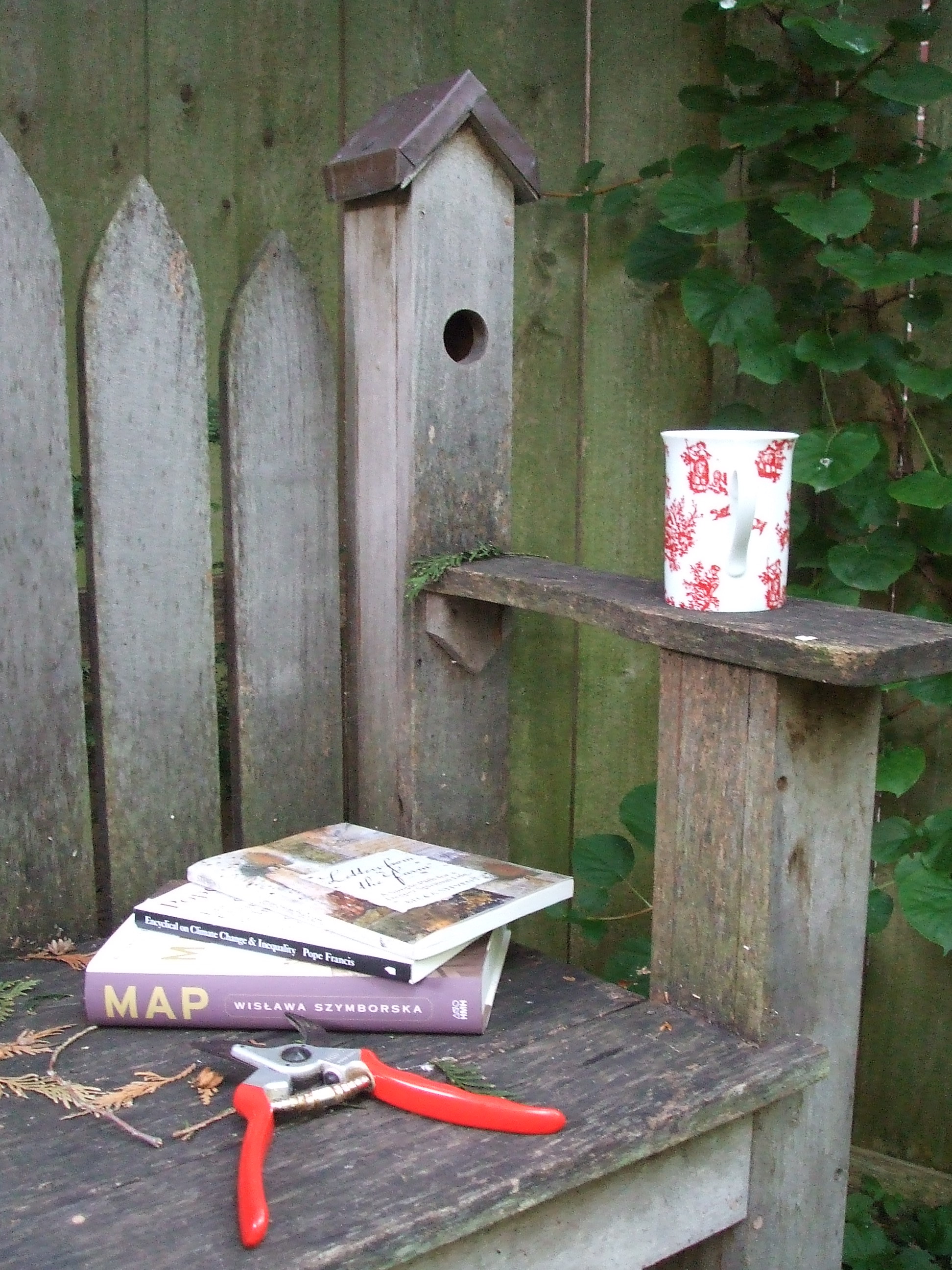
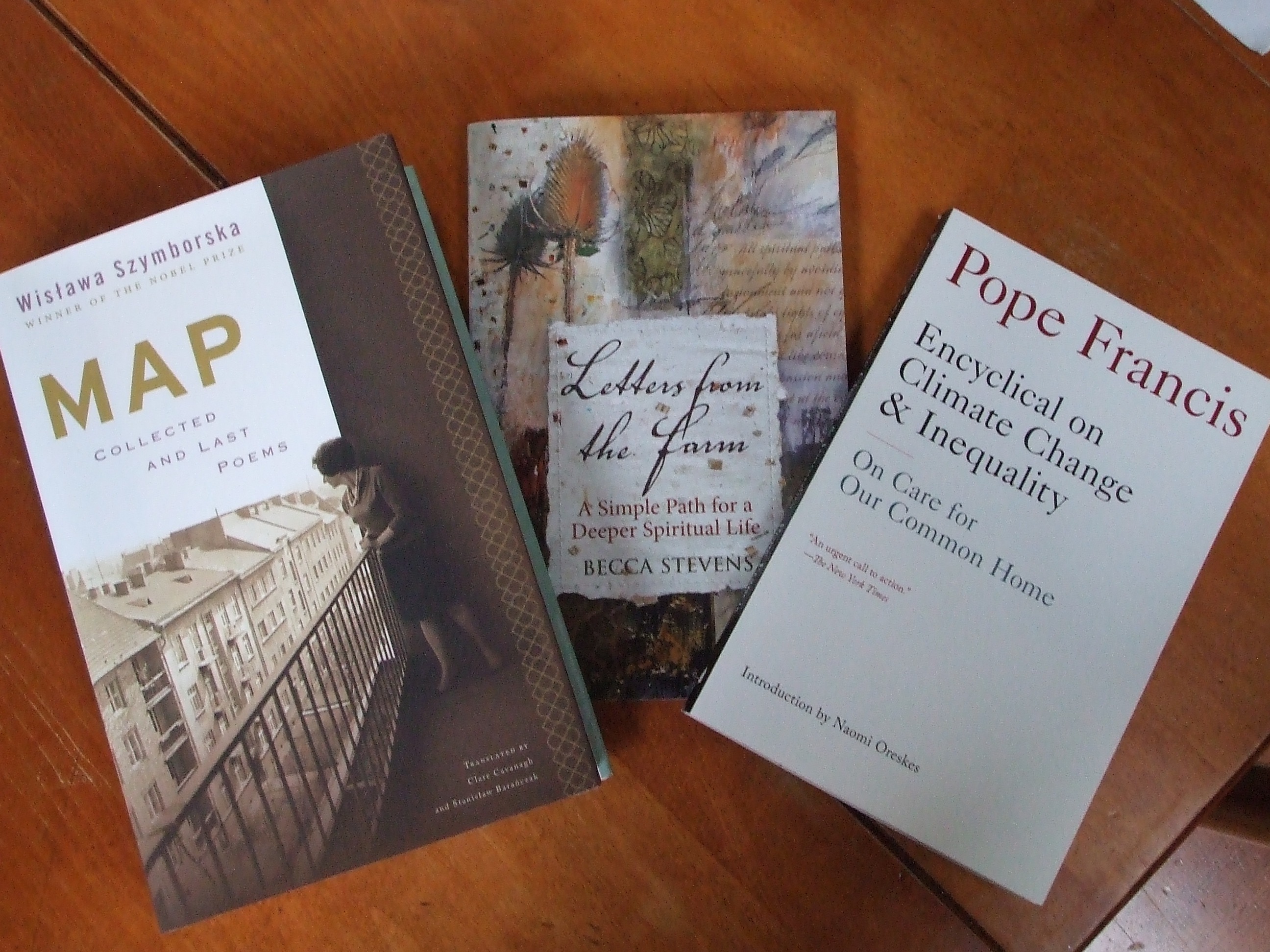
Map by Wislawa Szymborska, translated by Clare Cavanagh and Stanislaw Baranczak, HMH, 464 pages, $32

Here, for the first time, is the English translation of all of the poems of Nobel Laureate Wislawa Szymborska’s last Polish collection, including previously unpublished works. In all, “Map” gathers some 250 poems written between 1944 and 2011. While Szymborska, who died in 2012, focuses her attention on quotidian subjects — an onion, a cat — she plumbs them to probe life’s big questions — love, death, and passing time. And while she might not be as widely read in America as poets Mary Oliver and Mark Strand, her words bore deep. She is poet serving as spiritual guide.

Encyclical on Climate Change and Inequality: On Care for Our Common Home by Pope Francis, Melville House, 192 pages, $14.95

This breathtaking amalgam of urgency and poetry mines the spirit and appeals to the moral core. It’s as essential a soul-stirring read as any recent manuscript. Billed as the pope’s pontifications on the environment, it is in fact a sweeping letter addressing a spectrum of global sins. The Guardian termed it “the most astonishing and perhaps the most ambitious papal document of the past 100 years,” bespeaking its relevance beyond the walls of the Roman Catholic Church.

In the Shelter: Finding a Home in the World by Padraig O Tuama, Hodder & Stoughton, 192 pages, $23.95

This quiet book of contemplations by Belfast-based poet, theologian and peace worker Padraig O Tuama barely stirred a ripple in the marketplace of books, but where it counts — in the hearts of those blessed to turn its pages — it swiftly became a treasure. More deserve to be stirred by its deep currents. Putting to work poetry and gospel, side by side with story and Celtic spirituality, O Tuama explores ideas of shelter along life’s journey, opening up gentle ways of living well in a troubled world. The reader can’t help but be drawn in, slip-sliding into the harbor of the author’s soulful words.
Copyright © 2015, Chicago Tribune

A version of this article appeared in print on November 29, 2015, in the Printers Row section of the Chicago Tribune with the headline “Food for the soul – Poetry and profundity in these true gifts” 

the book bench at summer’s close

book bench august

as this summer draws to its quiet close, there tiptoes in this latest roundup of books for the soul — from the pages of the chicago tribune, where i cull through a stack of offerings every month. this lands in my mailbox at a moment when i too am feeling quiet. in this old house, we’re sinking back into the sacred rhythm of whispered dawn followed by momentary rustle as that new-to-high-school boy is shuffled out the door. then it’s quiet again. for too-short a spell.

before the pace picks up — or maybe to keep it at bay — i’m headed out to my book bench to soak in the succulence of summer’s end. here’s hoping you, too, have a quiet place to curl into human comma, turning the pages perhaps of a book that fills your soul. here, a few titles you might want to slip into your book bag. or ferry to your favorite reading nook. no matter your choosing, may you be blessed abundantly as we reach the summer’s closing chapter…

from the pages of Printers Row Journal, the Chicago Tribune’s literary supplement…

soul roundup august

Spiritual roundup: ‘Encyclical on Climate Change and Inequality’ by Pope Francis, more
By Barbara Mahany

Encyclical on Climate Change & Inequality by Pope Francis, Melville House, 167 pages, $14.95

Naomi Oreskes, professor of the history of science at Harvard University, begins her introduction to this particular printing of Pope Francis’ latest encyclical by reminding us “(h)istorians looking back often recognize turning points, but ordinary people living through them rarely do. Sometimes, however, a book catalyzes thought into action.” She goes on to count “Uncle Tom’s Cabin” and “Silent Spring” as two such masterworks. And then she deftly tucks “Encyclical on Climate Change & Inequality: On Care for Our Common Home” onto that same rare call-to-action bookshelf.

As it should be.

This breathtaking amalgam of urgency and poetry mines the spirit and appeals to the moral core. Billed as the pope’s pontifications on the environment, it is in fact a sweeping letter addressing a spectrum of global sins, not the least of which is summed up in Francis’ declaration that “(t)he earth, our home, is beginning to look more and more like an immense pile of filth.”

That a secular publisher, Melville House, chose to print in its entirety the papal document — termed by The Guardian “the most astonishing and perhaps the most ambitious papal document of the past 100 years” — bespeaks its relevance beyond the walls of the Roman Catholic Church. Where it stirs the soul, though, is in its majestically crafted sentences that wholly illuminate the understanding that nature is “a magnificent book in which God speaks to us and grants us a glimpse of his infinite beauty and goodness.”

Coupled with the pope’s insistence that pillaging the planet exacts too costly a toll on the world’s poor, this work drills home the plea that we “hear both the cry of the earth and the cry of the poor.”

Map: Collected and Last Poems by Wislawa Szymborska, translated from the Polish by Clare Cavanagh and Stanislaw Baranczak, edited by Clare Cavanagh, Houghton Mifflin Harcourt, 447 pages, $32

 
When awarding Wislawa Szymborska the Nobel Prize in Literature in 1996, the Nobel commission called her “the Mozart of poetry.” But they didn’t stop the invocation there, adding that her elegant, precise works held “something of the fury of Beethoven.”

All of which is to underline the supreme sadness that one of Europe’s greatest recent poets is not better known this side of the Atlantic. “Map: Collected and Last Poems” could right that.

Here, for the first time, is the English translation of all of the poems of Szymborska’s last Polish collection, including previously unpublished works. In all, “Map” gathers some 250 poems written between 1944 and 2011.

While Szymborska, who died in 2012, focuses her attention on quotidian subjects — an onion, a cat — she plumbs them to probe life’s big questions — love, death, and passing time. And while she might not be as widely read in America as poets Mary Oliver and Mark Strand, her words bore deep into a shared soulful landscape. She is poet serving as spiritual guide.

Consider, for instance, this one stanza from the poem “Nothing Twice”:

“Why do we treat the fleeting day/ with so much needless fear and sorrow?/ It’s in its nature not to stay:/ today is always gone tomorrow.”

Is that not a call to savor the one holy hour that is upon us? To not fritter away a single day?

We can only hope that hers becomes a household name, in any house that believes poetry is direct line to the depths of the human spirit. This tome is the place to begin.

Letters from the Farm by Becca Stevens, Morehouse, 160 pages, $18

“Letters from the Farm: A Simple Path for a Deeper Spiritual Life” is one of those quiet books that slips across the transom. You couldn’t predict from its cover — nor from the measure of its page count — just how much it holds inside. You needn’t read too far to realize its heft.

Stevens is an Episcopal priest and the founder of Thistle Farms, a community of women who have survived sex trafficking and addiction. Rooted outside Nashville since 2001, it is in fact a farm, one where herbs and teas and thistle are grown and made into bath and body care products distributed nationally. And it is from this plot that Stevens reaps much wisdom.

Her redemptive truth: “Love heals.” She writes: “I’m not called to change the world. I am called to love it.”

It’s the take-your-breath-away simplicity of Stevens’ letters that makes you take sharp notice. Count her emphatically in the Anne Lamott tradition of unexpectedly walloping you over the head, or in the heart, with a sentence so profoundly wise, so steeped in substance, you could pause and spend a few days burrowing into the truth of it.

Her stories from the farm — and from her travels to Africa and around the United States — are raw and rugged. When she writes of a woman locked in a lightless closet for four months, or mentions another woman who slept in a bathtub, night after night, to avoid “being raped before sunrise,” she stirs a knowing grittiness into what she calls her stack of “love letters to God.” Her prose unsettles in the most profound ways. And that is a very good thing.

Barbara Mahany is the author of “Slowing Time: Seeing the Sacred Outside Your Kitchen Door.” Twitter: @BarbaraMahany
Copyright © 2015, Chicago Tribune

praise be to youyet another lovely edition of the pope’s encyclical arrived post-deadline, but it’s one worth considering. footnotes unspool across the bottom of each page, and, as with the melville house edition, (above), it’s an exact reprinting of the original, pressed between hard-bound covers.

“Praise Be To You: Laudato Si’ On Care for Our Common Home,” by Pope Francis (Ignatius Press, $14.95)

and what might you carry to your book bench?

from the middle ages to me: my voracious appetite for the not-so-edible “salad of many herbs”

799px-Flickr_-_Beinecke_Flickr_Laboratory_-_(Commonplace_Book),_(late_17th_Century)-thumb-615x190-75565

florilegium, or “gathering of flowers,” they’re called. or were called in medieval times.

quaint.

one wealthy 15th-century italian wool merchant declared his zibaldone, or book of hodgepodgery, “the salad of many herbs.” a snip here, a pungent bit there.

it was his self-inscribed anthology of esoterica and knowledge, the pages into which he stuffed everything from recipes to tables of weights and measures to the latest smart something he’d heard rumbling on the florentine sidewalks. decidedly, it was not a journal, no catch-all for memoir, nothing like a diary. nary a rambling of the soul found here, this was strictly the province of accumulated knowledge — and things not to forget.

more commonly known as commonplace books, i’ve just discovered i’ve been keeping one — or four or five, more like it — for years and years. (“commonplace,” you should know, is a translation of the latin term locus communis (from greek tópos koinós), or “common place,” and, according to our friends at harvard university’s library, suggests a storehouse, or clearinghouse — in ink, on paper — of ideas and arguments, easily located for ready application. say, when engaged in verbal jousting at the medieval village pub.)

and i just thought i was a hoarder of the literary kind, demonstrating my rodent-like tendencies for squirreling away little bits and snips of enchantment. of the poetic species.

they live in assuming places, my commonplace books, my cache for what tickles my imagination, delights my word-ly fancy, catches my breath. for years, one lived on my laptop’s desktop, but it grew to be so long, so unwieldy, so likely to bring down my hard drive, i only recently birthed its second generation, both titled, “words and lines worth saving,” iterations I and II.

two more, the kind made of cardboard and paper pressed between covers, they live atop my desk, my actual old pine desk, one to my right and one to my left. as i flip through them now, i see i’ve stuffed inside a post-it note with a german address (in case i visit, i suppose), an advent calendar from 2012, a rosary (still in plastic) from the basilica of holy hill. and as i flip through the left-hand book, one i’ve titled, “notes of wonder,” i see that it’s bulging with snipped-out pages from the new york times book review, notes i scribbled on the back of someone’s eighth-grade essay, and assorted ponderings, including this: “God’s first language, which is silence.”

the one i count among my life’s truest treasures, though, is the unwieldy one on my desktop. there, if you scroll along, you’ll find among its 9,938 words unfurled across 35 pages, the turkish word for “moonlight on water” (gumusservi), the definition of epistemology (after stumbling across the line, “the epistemology of loss,” in a john berryman poem), or this from galway kinnell: “to me,” he said, “poetry is somebody standing up, so to speak, and saying, with as little concealment as possible, what it is for him or her to be on earth at this moment.”

it’s my digital memory box, the place where i commit the things that take my breath away, stir my soul, make my heart beat double-time. it’s my independent study in the literary arts, and poetry in particular.

little did i know that no less than jonathan swift prescribes one thusly:

“A commonplace book is what a provident poet cannot subsist without, for this proverbial reason, that ‘great wits have short memories:’ and whereas, on the other hand, poets, being liars by profession, ought to have good memories; to reconcile these, a book of this sort, is in the nature of a supplemental memory, or a record of what occurs remarkable in every day’s reading or conversation. There you enter not only your own original thoughts, (which, a hundred to one, are few and insignificant) but such of other men as you think fit to make your own, by entering them there.”
—from “A Letter of Advice to a Young Poet”

apparently, the practice, with its roots in antiquity, has been unbroken since the middle ages, with a particular up-bump in renaissance times. the idea — brought on with a bang not long after the invention of the gothenburg press, “largely because literate people were discombobulated by the flood of information the printing press had unleashed upon them,” according to alan jacobs, writing in the atlantic — was that particularly pithy or otherwise catchy little thoughts were to be hand-copied and tucked into one’s commonplace book. in arranging topically, it was thought, the literate raconteur would have, at fingertips’ reach, a ready arsenal of neatly tucked-away poetry and argument. need a zippy rejoinder? oh, just wait, it’s right here, on page 23 of my florilegium (the latin name pinned onto the practice by the medievals, who found them particularly handy for stockpiling thought of theological and religious theme. for what little it’s worth, i much prefer to think of mine as that “salad of many herbs”).

why, thomas jefferson was a prodigious keeper of the commonplace (writing in english, latin and greek, of course). as were henry david thoreau and ralph waldo emerson. the british library’s renaissance project boasts a collection of some 50, many penned inside the iron bars of prison cells and locked towers (sir walter raleigh, so imprisoned from 1606 to 1608, filled his penitent hours with library lists, poetry and an illustrated guide to the middle east). in fact, clear through the early 20th century, students and scholars were long required to keep them. and so, if you tiptoe into the bowels of any of the western world’s great libraries, just ask to see the commonplace collections, and you’ll soon stumble on the jottings of john milton, victor hugo, sarah orne jewett, samuel clemens, and john quincy adams, to name but a smattering.

i found out i was such a keeper of the commonplace only by accident. because i happened to ask a dear friend of mine, one who unfurls great lines of poetry at the drop of a hat, how it was that she had such a stockpile at the ready. here’s how my poetic friend, dear amy, replied:

“Yes, I have books and journals filled with favorite quotes, as well a hefty computer file with snippets of words I want to remember. I’ve been a nut about quotes and have collected them all my life, but it wasn’t until recently that I discovered that the squirreling away of meaningful quotes is called keeping a commonplace book, a practice that hearkens back to the likes of Marcus Aurelius and Montaigne and Thomas Jefferson. I just LOVE words of beauty and wisdom, and like a magpie, I love to feather my nest with them, as it were!”

it is the dearest thing to encounter a fellow magpie, both of us flitting through the air with words dangling from our beaks. i’ve long said that if my house began to burn, one of the few things i’d tuck to my bosom would be my long-kept compendium of beauty and breath-taking.

for that, in the end, is what animates so much of my imagination. and puts flight to the task of typing so many hours of my lifetime. there is something deeply holy about tripping upon depths of meaning in thoughts thought before you, in words committed to paper long ago, or just the other afternoon.

i can’t imagine my world without knowing that, at the click of a computer key, i could unlock these lines, copied and pasted long ago, breath-catching beauties from dear virginia woolf:

from “Mrs. Dalloway”: “…she was like a bird sheltering under the thin hollow of a leaf, who blinks at the sun when the leaf moves; starts at the crack of a dry twig.”

on sewing: “…her needle, drawing the silk smoothly to its gentle pause, collected the green folds together and attached them, very lightly, to the belt.”

describing grand houses of London: “….halls laid in black and white lozenges…”

“turning one’s nerves to fiddle strings….”

“long streamers of sunlight…”

on “the compensation of growing old”: “the passions remain as strong as ever, but one has gained — at last! — the power which adds the supreme flavour to existence, — the power of taking hold of experience, turning it round, slowly, in the light.”

“thunderclaps of fear”

i copy to remember. i paste to never forget. as mr. swift so finely put it: it’s my “supplemental memory,” my “record of what occurs remarkable in every day’s reading or conversation.”

excuse me while i amble off to imbibe on my salad of many, many herbs.

do you keep a salad of many herbs, a gathering of flowers, a book of hodgepodgery, otherwise known simply as a commonplace book? and do you not think the practice a wholly invigorating one? a holy one, too?

and, most deliciously, what would be among the herbs you’ve snipped from your literary garden?

finally, happy blessed launch of spring on this day of equal light and darkness, the vernal equinox, when, as my beautiful brother david says, “you can hear the earth breathing.” but only if you listen, of course…..

books for the soul: the february roundup

ct-spiritual-roundup-jpg-20150212

i know, i know: it’s march already. half way into the month, and i’m finally getting around to hauling over the long-ago promised february roundup of books for the soul. 

as i mentioned a few weeks back, a marvelous new assignment sent my way by my old beloved newspaper, the chicago tribune, is to read and round up a trinity of books for the soul every four to six weeks. since i’ve always believed in coloring outside the lines, my definition of what stirs the soul is a sweeping one.

already, i’ve crept through picture-book shelves, and poetry tomes. i’m perusing the landscape of brilliant nature writing. and don’t be surprised if, one month, you find a book with very few words at all, allowing images — sketched or caught by the lens of a camera — to do all the soulful lifting.

truth is, the soul, i do believe, is stirred far beyond the walls — or pages — of where you might expect to bow your head, bend knee, and offer up a vesper or three.

in fact, it’s in the least-expected nooks and crannies where i’m most likely to find my breath swept away, and my soul most deeply stirred.

stumbling on astonishment, to paraphrase the beloved poet saint mary oliver. 

so, before the march roundup hits the news stands, here are the three titles i found soulful in february.

The Norton Anthology of World Religions, Vols. 1 and 2

Edited by Jack Miles, Wendy Doniger, Donald S. Lopez Jr., James Robson, David Biale, Lawrence S. Cunningham, Jane Dammen McAuliffe, W.W. Norton, 4448 pages, $100

Weighing in at 8.4 pounds, a whopping 4,448 pages, and tucked in a tidy two-volume book pack, this massive and monumental Norton Anthology, edited by Pulitzer Prize winner Jack Miles, holds inspiration for more than one lifetime. At heart, writes Miles, it’s an invitation “to see others with a measure of openness, empathy, and good will. … In that capacity lies the foundation of human sympathy and cultural wisdom.”

Sign me up.

With more than 1,000 primary texts — Volume 1 covers Hinduism, Buddhism, Daoism; Volume 2, Judaism, Christianity and Islam — this instant classic allows readers to discover religions’ common threads, to plumb the sharp-edged distinctions, and to drink from the pure well of original text, not watered down through centuries or millennia of interpretation, clouded or otherwise.

In a world where religion too often divides, this portable library of foundational works is intended “for readers of any religion or none.” Skeptics needn’t stay away. Scholarly texts, buttressed by timelines, glossaries, maps, and handy pronunciation guides, rub up against essays, poems, even hip-hop lyrics, all serving to define, expand and illuminate faith.

Beginning with the brilliant 46-page “poetic prelude” by Miles — a former Jesuit seminarian, now distinguished professor of English and religious studies at the University of California, Irvine, who won his Pulitzer for his biography of God, no less — this foot-crushing tome is worth its weight, and its price tag, in wisdom — and enlightenment, of the truest kind.

Flunking Sainthood Every Day: A Daily Devotional for the Rest of Us

By Jana Riess, Paraclete, 328 pages, $23.99

If you’re inspirationally inclined — meaning you tend to rip wisdom-steeped paragraphs out of whatever your read and pin them prominently wherever they’ll stir you to action (the pantry, the dashboard, tucked under the toothpaste) — this little book has, effectively, hauled out the scissors, mastered the clipping and pasting, and packed a year’s worth of finely curated wisdom into its pages.

And these aren’t your everyday inspirers, the usual host of holy thinkers. Here, you’ll find the likes of Marmee from Louisa May Alcott’s “Little Women” or A.A. Milne’s “Winnie the Pooh.” You’ll find Annie Dillard at her literary best, and St. Augustine of Hippo, C.S. Lewis and Thomas Merton, for a sweep through the centuries. Kathleen Norris and Desmond Tutu are among the enlightened. The index at the back of the book will help you put your finger on thinkers from Angelou, Maya, to Singer, Isaac Bashevis.

It’s a book of daily readings centered on 12 spiritual practices Jana Riess explored in her wry and deeply humble 2011 memoir, “Flunking Sainthood: A Year of Breaking the Sabbath, Forgetting to Pray, and Still Loving My Neighbor.” Riess made it abundantly clear back then that trying and failing is more or less the whole point. And in her latest work, she offers day-by-day “courage to laugh at our shortcomings as we pick ourselves up to try, once again, to inch just a little closer to God.”

While it’s written with an eye and an ear to Christianity, this is a book that transcends denominations.

St. Peter’s B-list: Contemporary Poems Inspired by the Saints

Edited by Mary Ann B. Miller, Ave Maria, 266 pages, $15.95

Cracking open the pages of this collection, you have every reason to suspect you’re about to encounter a churchy gathering of dusty old lives of the saints, in stanza and verse.

You will discover — on the first line of the first poem — you’re blatantly wrong. You find yourself reading about dishes in the sink and bickering. Tumbling along to the book’s next poem, you’re reading about straitjackets and a baby who “screams and / won’t go down.”

And yes, the verse — from poets Mary Karr to Dana Gioia — is interspersed with language lifted straight from prayer, familiar prayer, prayer some of us learned by heart long ago. But the words and images volley so swiftly from the banal, the earthly, to the sacred, the heavenly, that you are ever startled.

And yes, saints are mentioned in many — but not all — of the poems. And not in ways you’ve encountered them before. Thus, it becomes a passing parade of modern-day wise folk with something to teach, a story to tell.

“(T)he lives of the saints cannot be understood unless seen as works of art, as poems,” writes Rev. James Martin, the Jesuit thinker and writer, in the afterword. “The most important truths about God are not reached with definitions and proofs but by poems and stories. And by people: the saints. That is why this book is a treasure. These poets take the lives of the saints as they are meant to be understood: as poems. From human works of art they draw out literary ones.”

Barbara Mahany is the author of “Slowing Time: Seeing the Sacred Outside Your Kitchen Door.” Twitter: @BarbaraMahany

Copyright © 2015, Chicago Tribune

i don’t think this will work unless you’re a subscriber to the Tribune’s Sunday literary supplement, Printers Row Journal. but here’s the link, just in case. 

and, please, pass along any titles anywhere if you’ve found they stir your soul. my only stipulation is that the books need to have been recently published, meaning within the last few weeks, or months at most….