pull up a chair

where wisdom gathers, poetry unfolds and divine light is sparked…

Category: books for the soul

turning inward, turning back

these times call for pronounced postures, for intention. ultimately we want to reach out, to be the bridge, the peacemaker. or, maybe little more than one flickering flame amid the global shadow. but first, in aim of fortification, we turn in. it’s where we stoke the fire, clarify the vision, and maybe just maybe find the peace, the calm, from which to set forth.

i’d call myself a quietist. one of the ones who finds the solitude and silence a necessary interiority. it is the place of prayer, of wisdom seeking, reaching far beyond the bounds of life as i know it, and drawing in pole stars to point the way. more and more, i start to think i subscribe to the church of the bookshelf. an eclectic crowd of thinkers and seers, the holy well from which i draw.

the noise of the world is beyond cacophony these days. rafters are rattling, pots and pans are clanging. all of which pushes me into the cracks of the world, where i poke around endlessly, sniffing out wisdoms like a mouse after cheese. i’m intent.

this week i turn east, and i turn back in time. way back, and way east. east to india. back to the first century of the common era, roughly 55 CE.

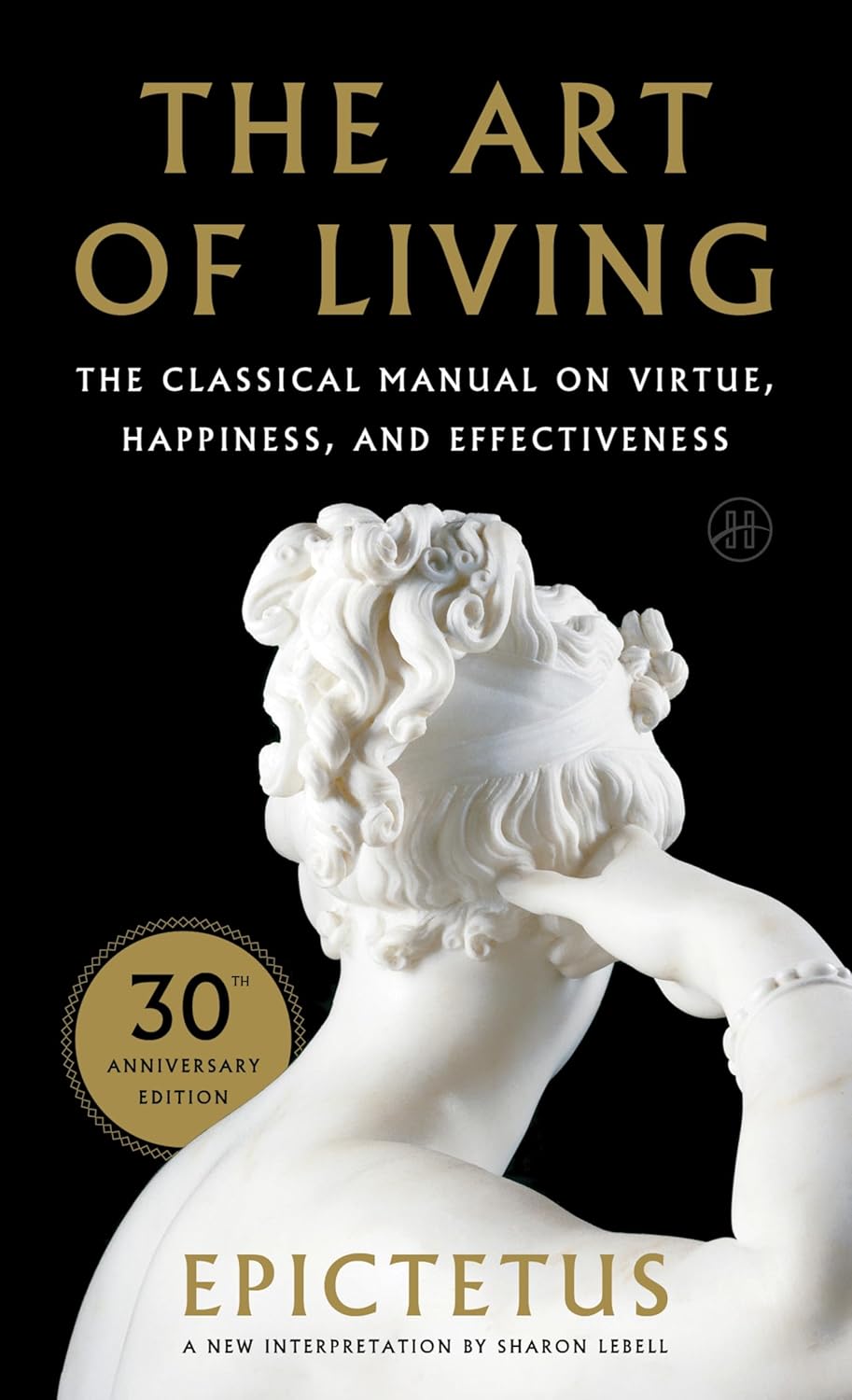
epictetus, the unsung stoic, goes first. he was as unlikely a pole star as they might come: born a slave, a slave with a limp, he carved out 93 instructions, bound them as a book, slapped on a catchy title (the art of living), one that came with a wallop of staying power (we’re still seeking the art), and all these millennia later, we’re still turning its pages.

a marvelous philosopher and musician, a northern californian by the name of sharon lebell, back in 1995 took a crack at translating epictetus anew. her translation stuck, and it’s now considered a classic. i found epi’s wisdoms rather timeless, and in keeping with survival in tumultuous times.

here’s epictetus:

Caretake This Moment

Caretake this moment.
Immerse yourself in its particulars.
Respond to this person, this challenge, this deed.

Quit the evasions.
Stop giving yourself needless trouble.
It is time to really live; to fully inhabit the situation you happen to be in now.
You are not some disinterested bystander.
Exert yourself.

Respect your partnership with providence.
Ask yourself often, How may I perform this particular deed
such that it would be consistent with and acceptable to the divine will?
Heed the answer and get to work.

When your doors are shut and your room is dark you are not alone.
The will of nature is within you as your natural genius is within.
Listen to its importunings.
Follow its directives.

As concerns the art of living, the material is your own life.
No great thing is created suddenly.
There must be time.

Give your best and always be kind.

~ Epictetus ~
(Epictetus: The Art of Living a New Interpretation by Sharon Lebell.)

Arundhati Roy

the next wise soul i bumped into this week was arundhati roy, the booker prize-winning novelist, who grew up and lives still in india; delhi specifically these days. she’s getting plenty of ink of late because her latest work, her first memoir, Mother Mary Comes to Me, has just been published. it’s an exploration of her complex relationship with her “iconic” and “extraordinary” mother, whom she describes as both “my shelter and my storm.”

roy’s 1997 novel, The God of Small Things, is what won her the booker prize for fiction, which in this mercenary worldly equates with that murkily-defined “success,” and its often evil twin, fame. roy, wise woman, wasn’t having it. she was not one to be deluded, or seduced, by such worldly measures. as she tells it she was keenly influenced by an uncle, a beloved uncle, who was one of india’s first rhodes scholars for his work in greek and roman mythology, but gave up his academic pursuits to start a pickle, jam, and curry-powder factory with his mother. and to build balsa-wood model airplanes in his basement.

not surprisingly, someone schooled in the shadow of such an uncle might have strong instincts on the “right” definition of success. and in a conversation with an old friend, arguing that “recognition is not the only barometer of brilliance or human worth,” she noted the friend’s eyebrow arching. skepticism, in full display. so roy did what any cocktail debater might do: she pulled the paper napkin out from under her drink, and a pen from her purse, and began to scribble.

what she wrote amounts to a gospel of success that belongs not on half-soggy paper, but a granite slab somewhere:

To love. To be loved. To never forget your own insignificance. To never get used to the unspeakable violence and the vulgar disparity of life around you. To seek joy in the saddest places. To pursue beauty to its lair. To never simplify what is complicated or complicate what is simple. To respect strength, never power. Above all to watch. To try and understand. To never look away. And never, never to forget.
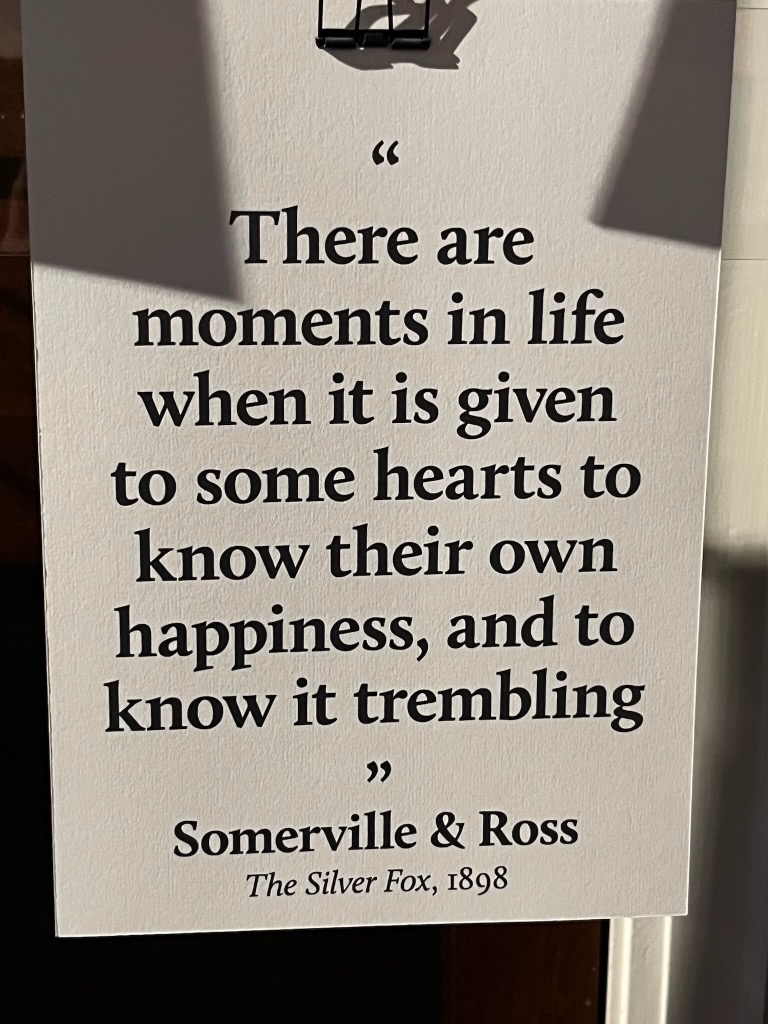
sometimes i think i’m a broken record, saying over and over—and over—such a few simple truths. 

never get used to the unspeakable violence and vulgar disparity of life around you.

seek joy in the saddest places.

never simplify what is complicated or complicate what is simple.

respect strength, never power.

above all, watch.

never look away.

love.

love.

love.

what inscription might you add to a granite wall of truths?

p.s. i hyperlinked to a marvelous interview with sharon lebell above (i love her whole story, how she was drawn to study philosophy, inspired by a neighbor with more books than she’d ever seen, and how she found those first classes in philosophy “exercises in obfuscation” — might that describe much of the noise here on planet Earth in the year 2025?). here is just one of the grafs from that interview you might find as delicious as i did….

Epictetus drew me in particular because in the mid-1990s he was the unsung Stoic. People had heard of Marcus, of Seneca. No one, except the cognoscenti, had heard of Epictetus or could pronounce his name. I liked his humble background: he wasn’t an emperor or a big cheese. As a former slave with a limp, he was someone who wasn’t expected to have a voice, but he used his voice anyway. He was a relatable everyman trying to figure out best practices for getting through the day.  Since I am female, this mattered a lot. Many philosophers invoke male experience as a stand-in for the universal human experience. Epictetus did not, of course, address females when he taught, but his teachings have an inclusive, of-the-people feel.”

add this to your constellation of poetries

rebecca elson: astronomer + poetess

i’ve been on rooster time for weeks now, though there’s no rooster pecking about the nearby yards. the rooster resides in my little noggin where it cock-a-doodle-doos round about four, and i patiently wait till five. as if the nuns have granted permission and at last i can dash out from under the bedsheets and into the playground that is my kitchen table at that early early hour.

ostensibly i’m up to write, to think, to edit. and i do get to that. i always do. but first i soften into morning turning pages. in other words: i read.

it sometimes seems my mission here is morphing into something more along the lines of slipping poets under your noses; writers, too. any weavers of wonder i happen to happen upon. this week i happened upon an astronomer poet, a brilliant soul who died too soon at 39. she spent her life mesmerized by the heavens, and hers was the gift of reaching into the stars, scooping up a glug of moon, and giving us a taste.

her name was rebecca elson (1960-1999), a canadian-american who at 16 began her studies at smith college, and would go on to earn her PhD from the university of cambridge, somehow fitting in years at radcliffe college and harvard teaching creative writing as well as an expository writing course on science and ethics. at cambridge’s institute of astronomy she was awarded an isaac newton studentship, meaning they paid for her to be there. it’s where she died, amid a field of star embers, i do hope.

her posthumously-published slim volume of poetries and extracts from her notebooks is titled a responsibility to awe (carcanet press, 2001). that title alone is poetry, and tells you all you need to know. in four short words, some might argue, it lays out our holy purpose. our one assignment while we’re here on planet earth, that little orb floating amid a universe of burning flecks of star dust and helter-skelter sky litter (though there’s nothing remotely litter-ish in even one celestial orb, from jupiter to milky way, to the not-yet-named planet L 98-59 f (identified just last month!, the fifth such planet in a splotch of far-off space unpoetically named L 98-59, a system of “remarkably diverse worlds.” little f is orbiting so close to its star, it’s possible liquid water might exist there, the scientists tell us.)

back to rebecca, known to those who loved her as becky. soon as i read the words astronomer and poet coupled in a pair, i was drawn magnet-like to snatch up a copy of her awe-struck works. it’s considered a contemporary classic, in the world of poetries. and not a line of it disappoints. among the pages that left me awe-struck: an ode to discovering zero; another asking what if there were no moon? (her reply: “there would be no months / a still sea / no spring tides / no bright nights / occulations of the stars / no face / no moon songs / terror of eclipse / no place to stand / and watch the Earth rise.”)

a mind as facile and deep as one that imagines darkest night, scans heavens for answers to questions others never even think to ask, is a mind i want to enter. to add my footprints to the paths that have traversed it. as if, in poring over her way of seeing, i too might see more vividly.

that rebecca/becky died too young of a cruel cancer (isn’t every one a cruel one?) added but another element to my quest to know her by her words. her masterwork is considered her six-stanza poem, “antidotes to fear of death.” she begins (as only a star-studier might): “sometimes as an antidote / to fear of death / i eat the stars.”

from there, extracts from her notebooks follow, and we almost watch a mind at work. as she cobbles poetries, we see the words struck out, the finer ones she chose instead. we see, in a swatch titled “origins,” her change of mind, in the line “shaken in the dark soil soul of space.” soil, a richer word (more unexpected) than soul here. we see adjectives get ditched, as she pares and pares her lines. titles of poems are revised. it’s a nimble mind, exercising in the gym, and we are peering through the windows.

two years after elson’s death, the economist, in 2001, named responsibility to awe (her one published poetry volume, though she published 56 scientific papers in her short life) a “book of the year,” writing “with great poignancy, she shows us the world through the eyes of a human being faced by her finite time.”

the bulletin of the american astronomical society, in their roster of supernovae gone dark, described the breadth of elson’s scientific research, her work ranging from “a search for stars in the halo of our own galaxy to regions of rapid star formation halfway across the Universe. She set strong limits on the contribution normal stars could make to the Milky Way’s dark matter halo, using counts from the Hubble Deep Field to rule out a significant stellar component.”

maria popova, who first pointed me to the poet-astronomer, calls her poem “antidotes to fear of death,” a “stunning cosmic salve for our creaturely tremblings of the heart.” she recorded a recitation of it, set against the mournful strains of cello, for her 2020 “universe in verse” extravaganza, popova’s “annual charitable celebration of the science and splendor of nature through poetry.”

elson, whose book now rests beside me, belongs in that rare constellation, a favorite of mine, of those who study the cosmos and, side-by-side the formulae and theorems, see the poetry, and draw it forth: loren eiseley, lewis thomas, robin wall kimmerer. they and their ilk (there are more and more) hold a sacred space on my bookshelves. without them, there are volumes i’d not see, musics i’d not hear.

the back jacket of responsibility to awe says it best, describing elson’s work as “a book of poems and reflections by a scientist for whom poetry was a necessary aspect of her research, crucial to understanding the world and her place in it, even as, having contracted terminal cancer (non-hodgkins lymphoma, diagnosed at 29), she confronted early death.” the text goes on to say that elson was an astronomer whose work took her “to the boundary of the visible and measurable.” isn’t that the space we’re all drawn to, meant to explore? isn’t that where theologians and mystics ply their minds? isn’t that where simple us might wonder too?

in the end, elson, like all who dare to ponder deep beyond the lunar surface, was “undeterred by knowing how little we can know.”

and thus we all now have our one assignment: to search undeterred for what we can. knowing there is majesty in the mystery, and beauty far beyond what we’ve yet glimpsed. our responsibility, of course, is always, always to awe.

where did you stumble into awe this week?

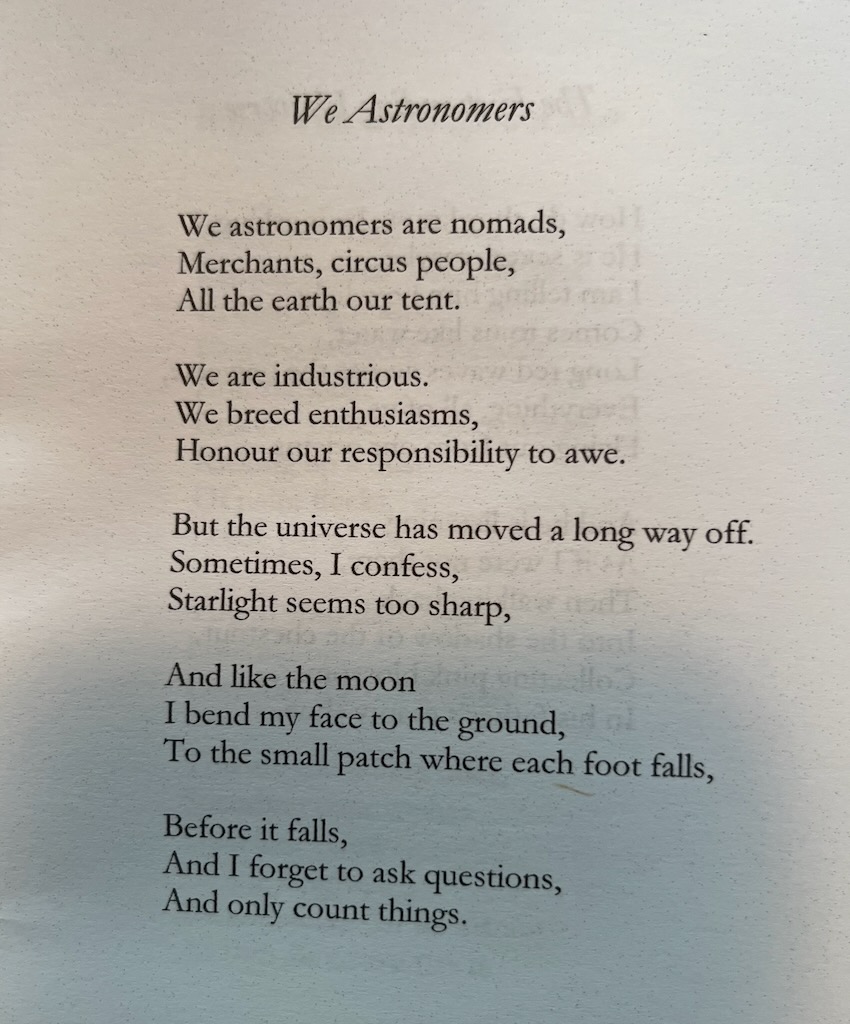
i’ll leave you with a page. . .

have a blessed, awe-filled week….


oh, i promised my dear friend wini i’d share this wonderment she is bringing to town (town being chicago, or the northern environs to be specific). wini is a poet, and she’s worked closely with, and had one of her poems judged “best in class” by the marvelous poet rosemerry wahtola trommer. wini, who makes things happen, invited her and now is inviting all of us for a day of poetries. part workshop, all wonder, it promises to be a day to remember. here are the details, courtesy of wini:

Come experience the gorgeousness of poet, teacher, and storyteller Rosemerry Wahtola Trommer. This event is about more than just poetry; it’s a chance to listen to what is true in your heart and open to “The all of it — the Beauty and Sorrow.

It is beyond lovely to be in-person with Rosemerry, and truly what a treat to sit in community again with like-minded people, and to uplift and celebrate each other’s beauty and light.

I hope you’ll join us. It would be so lovely to see you again.

  • When: Saturday, September 27, 9:00 a.m. – 3:00 p.m. (lunch included)
  • Where: Valley Lo Club, Glenview, IL
  • Details: Three different ticket prices are available.

Buy your ticket here

thank you, wini, for bringing this priceless gift…..

acquiring acquaintances: another name for pen pals

it started because months, or maybe years, ago, i stumbled onto a poem that took my breath away. it was written by a poet i’d not known of, didn’t think i’d ever read. but the poem, titled “Nativity,” stayed with me, a poem that paints the first Christmas scene in strokes and shades that settled deep into my marrow, and forever more are the Christmas i imagine.

it’s a poem that lays the baby Jesus in a rough-sawn barn, the air pungent with animal. “the wind tugging at the shutters.” there is nothing gilded about it. and it was written, i knew right away, by someone at ease with being small, tucked off in a corner keeping watch. it was written, i could tell, by someone whose very veins course with humility, and understood a God who preached the same, a God who asks us to get about the business, the holy business, of loving as we would be loved without noise or bombast or folderol.

the poet’s name is kenneth steven.

it turns out he lives on an isle on the scottish west coast, a place where the wind might tug at shutters. and it turns out he is something of a polymath: a poet, a painter, a children’s book writer, a translator of great works. and, above all, something of a pilgrim, a pilgrim seeking the quiet beauties that punctuate the everyday. he calls them “atoms of delight.”

and he writes of pilgrimage: “the word is often used to describe the journey to a shrine or sanctuary in search of spiritual transformation, which is a meaning i acknowledge. but now pilgrimage has become a much bigger thing for me; it has gone far beyond that rather heavy and medieval sense of going on a journey to visit a holy site. why shouldn’t it be about a walk to a hill loch to listen to the impossibly beautiful singing of red-throated divers? why shouldn’t it be about a child running into the forest in the early morning to find the treasure they dreamed of? these are journeys of the heart, seeking the profoundly precious places where little miracles happen. and why shouldn’t it be about panentheism—the finding of God in all things?”

it’s not hard sometimes to recognize a kindred soul.

what is hard is to imagine finding yourself in conversation with such a kindred someone. but that’s what’s happened. kindness is the thing that opened the door, his kindness. in a world ruled by transaction, where fees are paid and contracts signed for any exchange of goods—be it words or bricks or lumber—kenneth steven lives otherwise.

i found that out not long ago, when, during the editing phase of my next book, i dove into the task called “permissions,” in which for any chunk of text—poetry or prose or lyrics to a song—beyond a certain measure, you must secure permissions from its author. this can be a costly exercise. and it is always one that makes me quiver, wondering what walls i’ll encounter, and what cold-shouldered hubris i might have to tiptoe through.

it’s that poem, “Nativity,” that’s stayed with me all these years. and i’d included the whole of it, eight lines, at the start of an essay that i hope to include in the book.

wondering if i was whistling into the wind, i sent off a proper letter, the digital kind, and shipped it cross the sea. i’d no idea if mr. kenneth steven would ever reply. but, lo and behold, come monday morning, there he was, tucked kindly in my mailbox. and more than generously writing: “of course you are more than welcome to use the poem. i’m sure you’ll mention where you found it.”

and thus, with the stroke of his generous heart, a friendship has unfolded. and a treasure trove of poetries have now brushed through me. and i am richer for this scottish friend who, as a boy, awoke one night at midnight, and hearing a great and ferocious wind, hurriedly dressed and left the house, where he climbed a hill in howling winds, before crossing through a field to reach his favorite tree, where he knew the horse chestnuts would be falling, and he was out to save them, to gather them up. “i felt given a whole world,” he writes in an essay about the midnight escapade. “it was about the autumn and the big winds, and the thrill of running up that long hill and entering the field at last at what felt like the middle of the night.” and the indescribable delight of knowing “that all this treasure was mine.” the treasure: a cloth bag of chestnuts shaken from the limbs, their deep and woody smell, orbs that looked as though they were made of shoe leather.

befriending him, he who writes me every day now, sometimes more than once a day, is magical. is akin to befriending any of the authors from my childhood who’ve long entranced me, drew me into storybook tableaus: tasha tudor; e.b. white; frances hodgson burnett, who wrote the 1911 children’s classic, the secret garden, a book that featured my holy trinity—an orphaned girl, a padlocked garden, and a robin redbreast that finds the key—and once prompted me to fake a fever so i could skip church one sunday to stay at home and turn its pages.

long ago, when i’d be asked if i’d ever want to write a book, i demurred, brushed away the thought. didn’t think i could hold a thought long enough to pen more than a few pages. i didn’t know, though, that the magic of a book comes in all the threads unspooled along the way. threads that carry me to places far and wide, and to souls i’d never otherwise know. but words, like little birds, or prairie seeds, catch on the wind and settle into fertile loam. and we are richer for them.

in much the way, my beloved chairs, through all the words and all the years, have become my dearest treasures.

bless you.

love, bam

have you a penpal in this digital, globe-crossing, email world? someone you’ve not met but who seems a certain friend?

i promised kenneth i would share word of his beautiful meditative podcast, Imagining Things, on the patreon platform. recorded in a studio that seems to be just behind his island home, you can sometimes hear the scottish winds blowing off the atlantic, and a bird or two not far away. (or maybe i’m imagining.) and of course he speaks in a scottish-soaked timbre, and in between reflections he shares poems that will make you hit rewind so you can listen once again, so breathtaking are the lines.

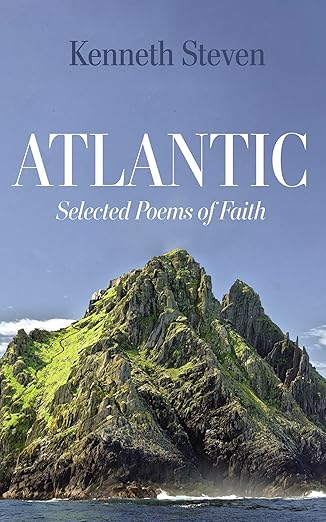
his latest book, one that should be landing on my front stoop within days, is Atlantic: Selected Poems of Faith. but i’m already deep into Atoms of Delight: Ten Pilgrimages in Nature, and Iona: New and Selected Poems.

incurably circuitous

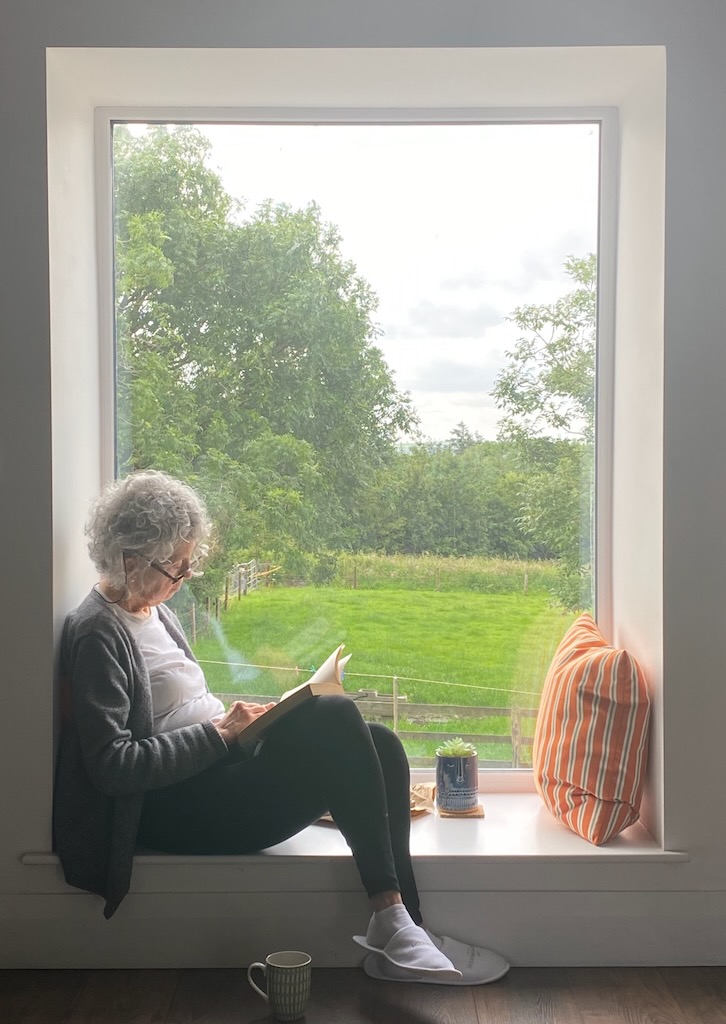
my favorite reading nook in all the world. o’connell’s dairy farm in drumellihy, county clare

i tried. i truly did. it seems i’ve, well, failed. if failed is the verdict we choose to put to the determined effort to concentrate, to focus, to linearly follow page after page.

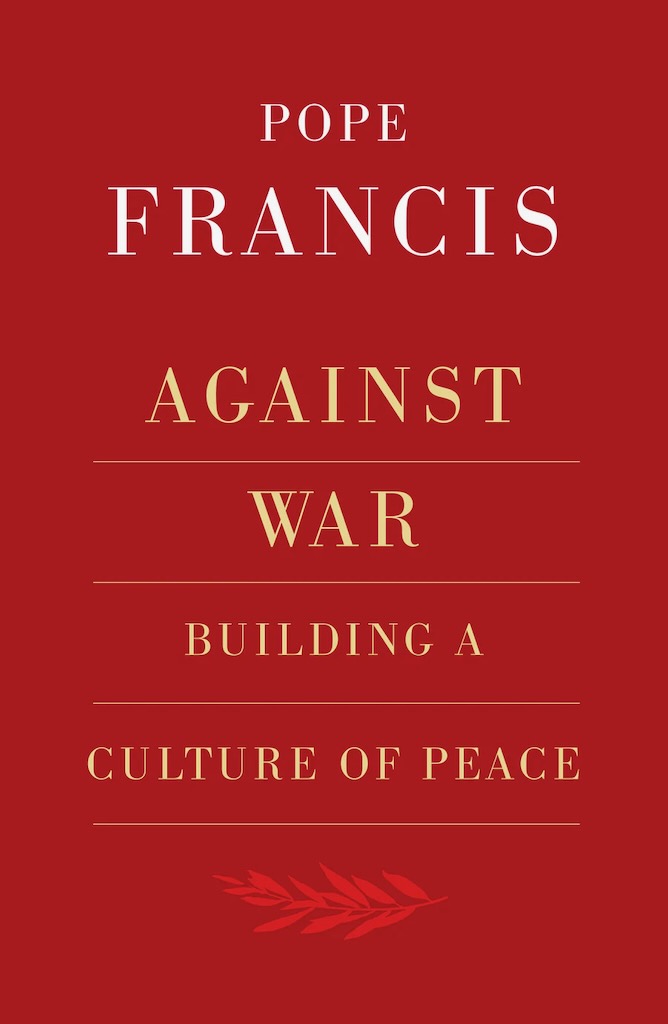
instead i am a jackrabbit of a reader. i cannot, for the life of me, trace a straight line. one minute i’m attempting ulysses, starting with an easy reader after traipsing the trail of leonard bloom through dublin. another minute i’ve decided pope francis’s slim collected works, against war: building a culture of peace, is the page i need to put to heart. then it’s onto raising hare, a love story so gentle i found it the perfectly prescribed balm in a week when bombs fell and mistruths fired right, left, and sideways.

i know full well that i set out to stick to one and only one tome till i—or summer—came to its end. etty hillesum was going to hold my attention. but my attention didn’t listen. it was distracted. as it so often is.

my irish poet penpal tadhg described rabbit holes, the literary divots i fall into, in charming irish terms not so long back. he makes every word he writes and utters sound poetic or profound, and he fails not here (his description of how it was that my last name leapt out and caught his attention during a morning’s meditation):

“Like the early Irish monks who doodled mystical nature poems on the margins of sacred manuscripts, I was distracted by the spelling of your name and wandered off, as those monks were wont to do (excuse the arrogant comparison), down a boreen (from Irish bóthairín, diminuitive of bóthar, meaning ‘road’, from the Irish ‘bó’, ‘cow’. A meandering pathway made by a cow).”

i am now—especially after strolling country lanes pocked with aftermath of bovine traipsing—inclined to consider my rabbit holes in more bucolic irish terms, and think of them as my boreens, meandering pathways made by my cow mind.  

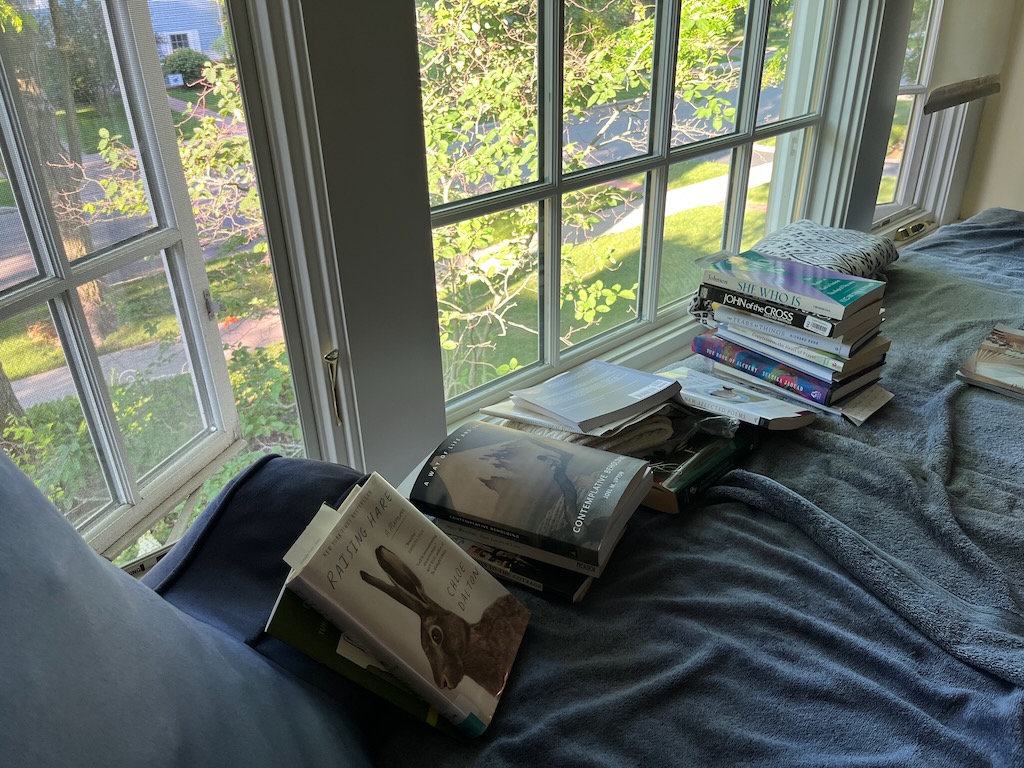
my boreen, in physical form, looks not bucolic at all. in fact, it’s rather a beehive of possible distraction, all piled and teetering hither and yon:

i cannot for the life of me go straight.

besides gulping down my friend tadhg’s glorious meditations on the stations of the cross, i found my nose deep in raising hare (see last week’s mention), and am tucking in my overnight bag practice of the presence, a glorious little tome of translations from one of my favorite saintly souls ever, brother lawrence, whom i think of as the patron saint of pots and pans, though in fact he’s more oft referred to as the friar of pots and pans, and ultimately the friar of amour (love). he’s the humble little monk who toiled fifty years in a monastery, forty of those in the steamy kitchen, and thirty as a sandal repairer (monks wear through their soles on the road to polishing their souls). he described himself, famously, as “a clumsy oaf who broke everything” in his early attempt at being a hermit, and then a footman. when at last he found the monastery at 74 rue de vaugirard, he found his peace and his place.

and in him, i find mine: the gentle, humble soul who finds grace and God in the most quotidian of daily tasks, and spends his hours in the company and comfort of the Author of It All. even in the steamy monastery kitchen.

what’s notable is that dear brother lawrence hated kitchen work, but in his biographer’s writings it’s told that he did it “with the greatest love possible.” and that his practice of the presence of God in the most ordinary of moments, stirring a kettle, pulling trays of bread from the oven, “grew like dew, or mist on mountains.”

the translation i’ve just found, by carmen acevedo butcher, is extraordinary in the fullest measure, and might be the soothingest read yet of this hot summer.

the little monk’s spiritual maxims, work gently, be humble and authentic, includes this boreen (meandering cow path, remember?) on the highest reach of the soul, writing that in true spiritual union:

“the soul is not asleep as in the other unions, but finds herself powerfully stirred. its activity is more intense than fire, and brighter than the sun when not obscured by cloud. we can, however, misunderstand this feeling, for it is not a simple expression of the heart, like saying, ‘my God, i love you with all my heart,’ or other similar words. no, it is an i don’t know what, a je ne sais quoi of the soul, a something indescribable, loving, and very simple, that carries the soul and nudges her to love, respect, and embrace God with a tenderness that cannot be expressed, and that only experience can conceive.”

to this indescribableness, i dive deep. turning page after page. in no particular order. but trusting i’ll find the grace i seek.

may your distractions, too, carry you to lofty heights and voluminous depths. what distracted you this week?

before i go, and scurry off to a writerly retreat at my dear friend katie’s on the lake, i am sending love without end to my beloved friend andrea whose birth we celebrate tomorrow, and who is closing the book on one fine chapter of her life on the same day. i love her dearly. her wit, her hilarity, her unconditional and undemanding love. she is like no other.

there are a few brother lawrence books out there, but the one i’ve just procured and cannot recommend more heartily is carmen acevedo butcher’s, from broadleaf books. you can find it here.

irish bath

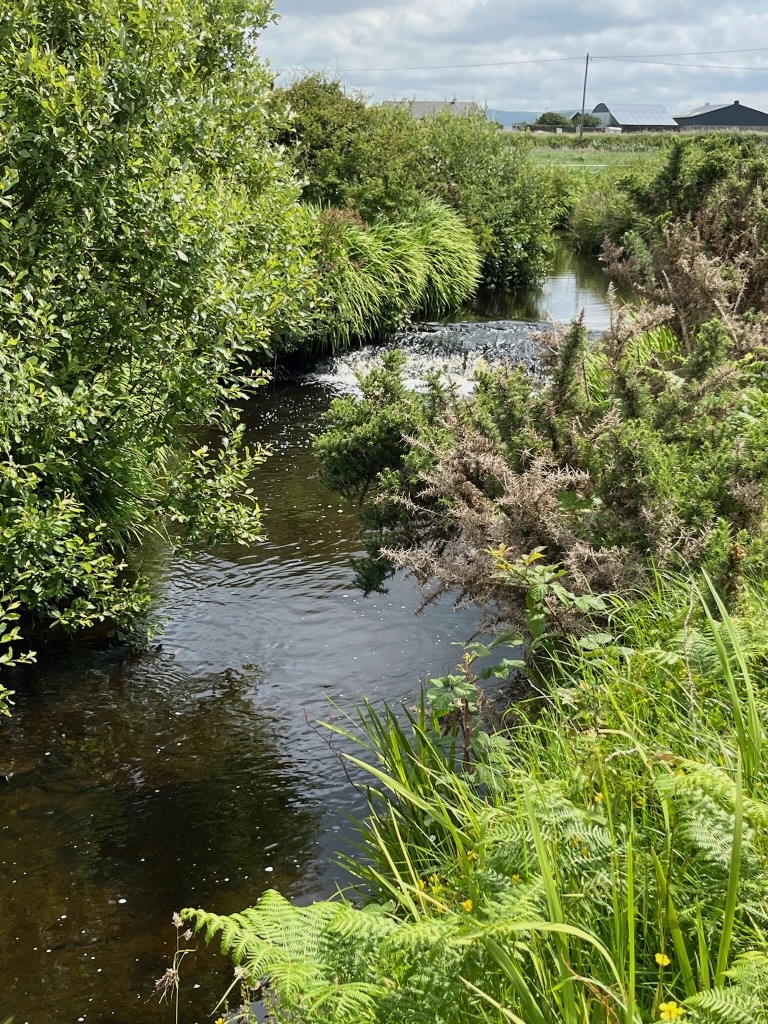
annagh river at kildimo south, my ancestral land, as it flows toward the sea at spanish point

i don’t want to wash it off. instead, i am in that necessary liminal state of in-betweens, when a newfound knowing needs time and space and silence to seep in. when we’re wise to open wide our pores, to fill our lungs, to allow our synapses to affix to new neural pathways. to come to indelible understanding.

if that seems an odd way to describe an adventure, so be it. my days in ireland were so much more than a “trip,” a “vacation,” a “getaway”—banal descriptors for folderol and whimsy, with suitcase attached. instead, my days in dublin, cork, and county clare were something of a journey in its deepest form: a coming to know someone, some place, i’ve always known but not yet fully met. and that someone, in fact, was me. a deep-down part of me long stirring, long felt, but not yet seen in fine focus. as if untold parts of me longed to know from whence they came. and not just my affinity for cloudy days and wit and poetry. and why i feel the hand of God so profoundly in the morning’s mist, and the moonbeams’ amber glow.

or maybe it was propelled by a yearning never sated, a yearning my whole life long to know the people from whom i sprang. the grandmother whose stories have stirred me from the start. the father who spoke so little of his past, and whose answers to my questions died when he breathed his last in 1981.

maybe my search was a daughter’s reaching for the hem of her father’s cloak. to run my fingers along its nubby threads, to stitch in quilt squares where the cloth had worn too thin. maybe there is something of longed-for re-union in my diligent tracings of ancestral ties and tales. maybe my father is who i try still to reach.

and then there’s the radiant present, the crucible of time that amplifies the here and now, the intense knowing that each and every hour is a gift, and before it ends, i intend to magnify the time, to expand the boundaries of my heart, to leave tracings on the ones i love so that my imprint might not fade so quickly. so that some part of me forever lingers in the one place where it matters: their blessed hearts.

i remember, in the darkest turns of these past two years, and especially at the turning of my latest birthday, how deep the wish i made, when i closed my eyes and drew a deep, deep breath, one that filled my lung and a half. i wished with all my might for precious time with my boys, time huddled close, time punctuated with the percolations of laughter without end. time punctuated with the sort of silence that is sodden even its wordlessness, because you know each other so well, so adoringly, you’ve room for time inside the vault of your own thoughts.

my wishes, every one of them, came tumbling true in the trek we took these past eight days, returning to the homeland of my soul, my spirit, my way of being. 

in that uncanny way we can reach across time, reach into a past that was not ours, i’ve long felt that tugging cord to my grandma anna mae, the kentucky schoolteacher whose papa, thadius shannon, hailed from the granite house at annagh bridge, in county clare, on the wedge of land squeezed between the confluence of the annagh and the kildimo rivers as they flow into the sea at spanish point. 

to press my sole onto that soil, to walk the land and listen to the rush of water playing over rocks, to do so with my boys at my side, and my God shining down and through me, was to feel bathed and baptized in life as sweet as it allows. 

it’s too soon, really, to step back and make sense of all of it, so at this just-home stage i’ve little but a mosaic of moments i’ll not forget, and which i’m scrambling to scribble onto the page in hopes of holding on for a good long while. among the litany i’m pressing to my heart, re-looping through the sleepless jet-lagged night, there are these: 

awaking on a rain-sodden morning when the country lane was still puddled, and the branches dripping diamond-like droplets of morning drink, and stepping into the soundscape of magpie and rook and lowing cows and calves. the whir of the milking machines beginning to rumble before the roar. 

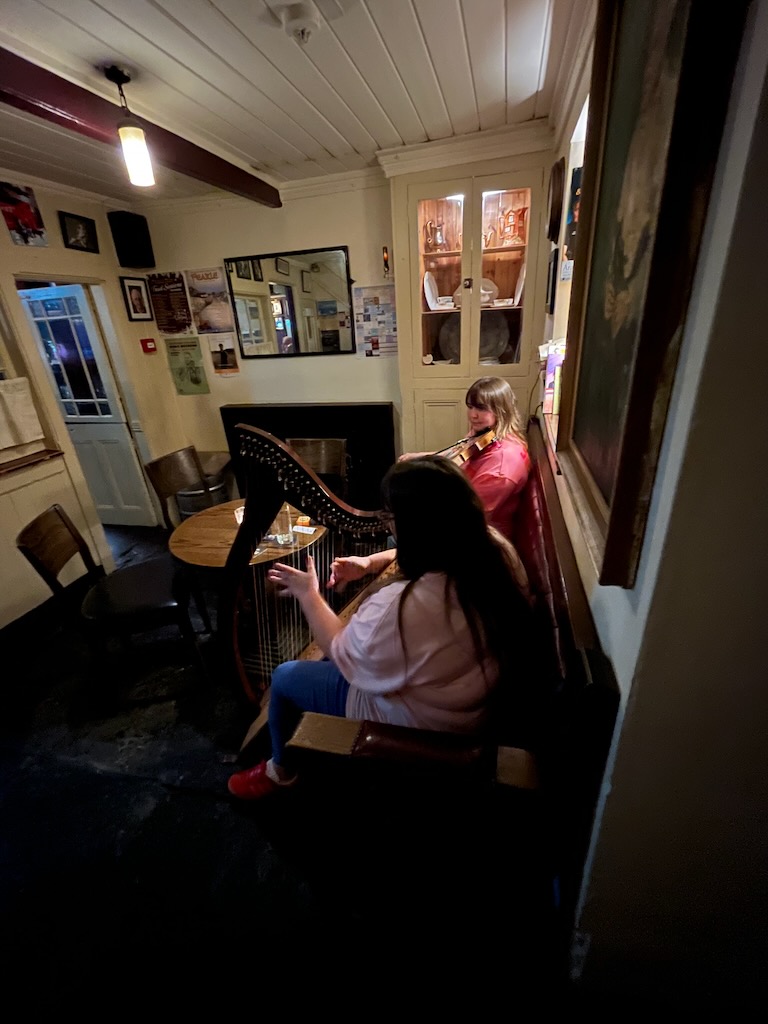
arms that reached out to wrap me in the minute i knocked on the door and introduced myself as a long-lost cousin, no questions asked. the rounds of drink at the pub that night where we gathered to tell tales above the lilt of harp and fiddle. and the hilarity of the cousin who moaned, “oh jezus!” when i asked if they might have a prosecco. and when i leapt into the self-mockery right along with her, she continued on, “you’re in a pub in a wee town, jezus, what are ya thinkin’?” or words nearly to that effect. 

driving down country lanes that turned like corkscrews (in fact one set of directions included the name “corkscrew hill,” and i feared dear blair’s heart might skip a beat or two, if not pause altogether), and threaded through ancient arbors where branches on each side of the road reached out to join hands.

the plates of food that arrived with herbs from the sea and tendrils of sweet pea, the butter from cows who sleep in the fields, under stars and moon each night and chew the sweet grasses by day, the fish you imagine leapt from streams just beyond the kitchen where little more than heat was put to flesh. 

the hilarity and wit. of just about everyone. from the taxi drivers in dublin to the tattoed and multi-pierced fellow clearing away your luncheon plates.

the charms of signs like: “matchmaking goat farm.” do they matchmake goats or give you a choice? a mate or a goat, your pick. (photo to come!)

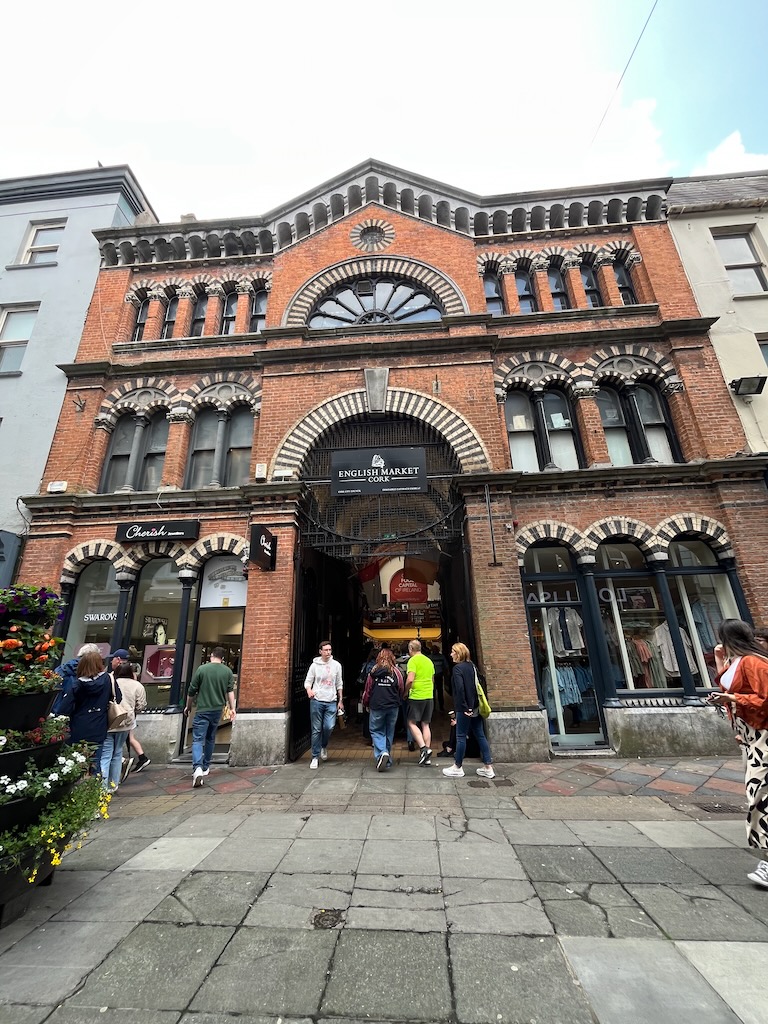
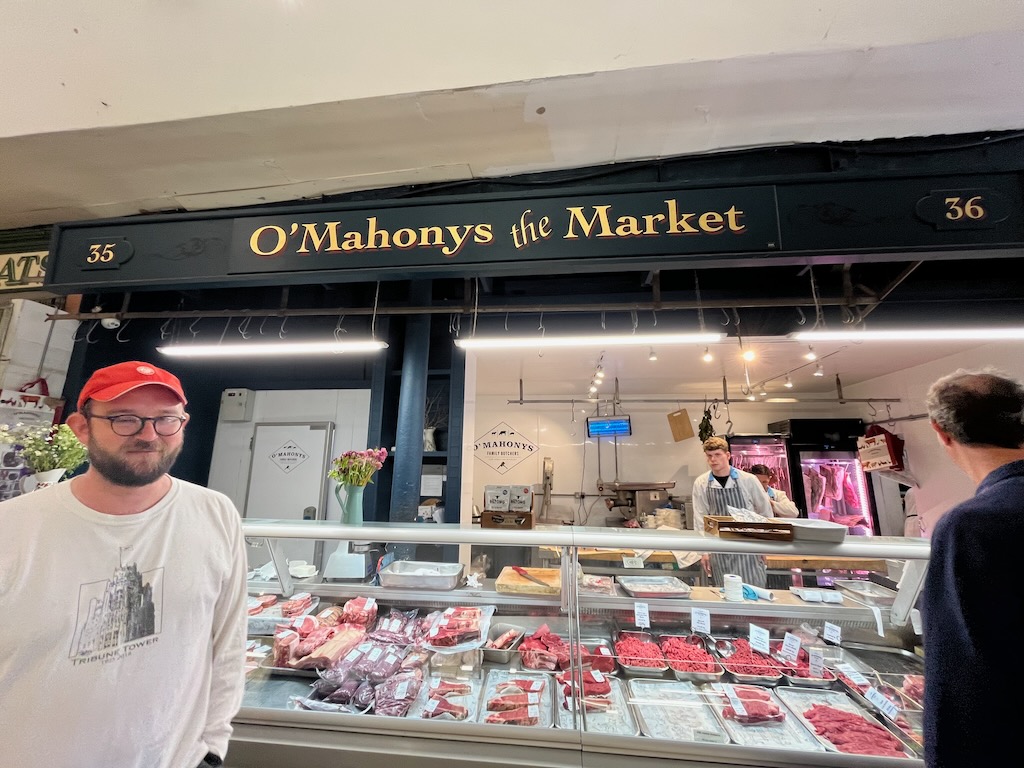
the english food market in cork, a veritable labyrinth of fresh-from-the-earth-and-sea delicious. a butter chicken pie in a crust so flaky the only apt desciption, according to what i witnessed in the expressions of my boys, might be (excuse my language) “orgasmically delicous.” 

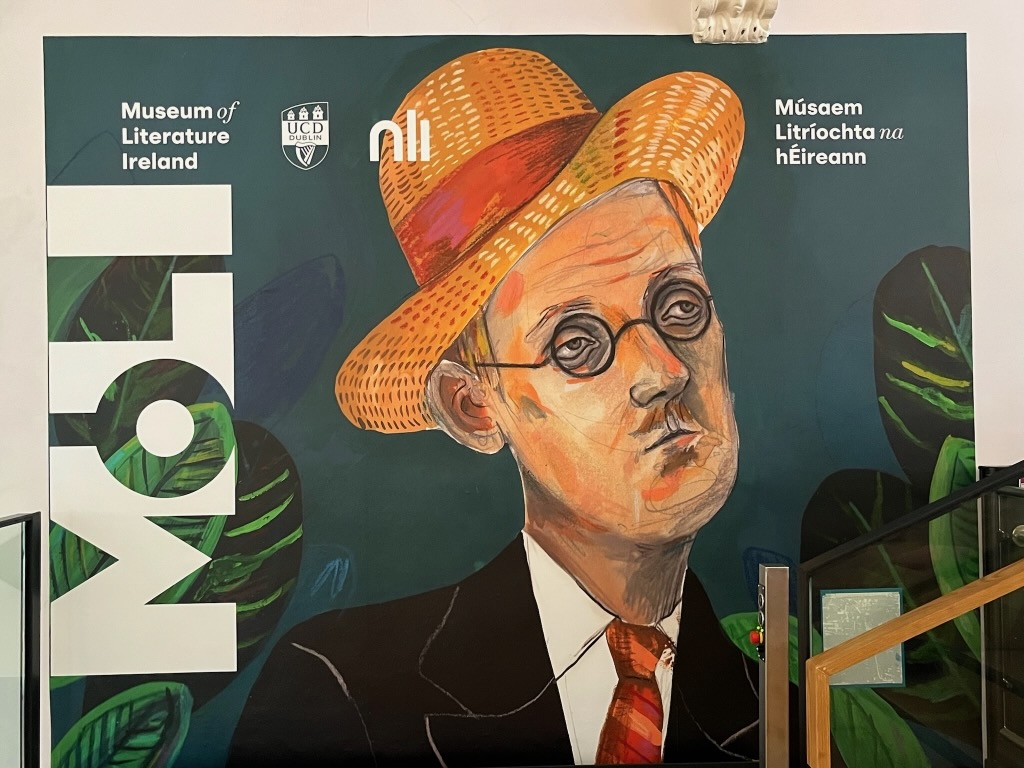
a whole museum that heralds words, and language, poetry and wit, the Museum of Literature Ireland, where Copy Number One of Ulysses basks under glass, and whole rooms are filled with epigraph upon epigraph, one of those rare places on the globe where human language and its infinite configurations are held up as priceless treasure. 

the straight-from-a-storybook propietor of the Dublin pharmacy, Sweny, where on page 88 of Ulysses, in the chapter “Lotus Eaters,” Leopold Bloom buys his lemon soap. the drippingly elegant gent who, upon barely-whispered request, broke into Gaelic song while sipping from his vat of burgundy wine on the eve of Bloomsday. 

i’ll turn it over here to a bit of Joyce and his telling of Sweny’s:

“The chemist turned back page after page. Sandy shrivelled smell he seems to have. Shrunken skull. And old. Quest for the philosopher’s stone. The alchemists. Drugs age you after mental excitement. Lethargy then. Why? Reaction. A lifetime in a night. Gradually changes your character. Living all the day among herbs, ointments, disinfectants. All his alabaster lilypots. Mortar and pestle.”

seán of seán’s bookshop

the bookseller Séan in Milltown Malbay, the town from which my people hail, whose shelves near collapsed under the weight of thousands upon thousands of tomes, with that telltale musty smell of words embalmed in ancient ink, and dusts of time a welcome attribute. 

the countless times we heard the sympathies for us pitiable americans who at the moment seem to find ourselves under the rule of the “feckin ijeet.” eye rolls every time only served to emphasize the point. one cousin told us they keep keen eye on news from america as if it’s real-time soap opera leaping from the daily news. 

the infinitely comforting knowing that 45 years after my first and only other trek to the land of forty shades of green, it’s truly not too changed. sure, there are homes built bigger and sturdier than i’d seen before, but ancient thatched roofs are not a rarity, stone walls still scythe the hillsides, a geometric grid that bespeaks hard labor never shirked and an undying reliance on the old ways, and town centres present row after row of storefronts in kaleidoscopic colors, no pink too pink, no purple or orange too vivid. as one new friend, a poet and old irish professor, told us: in a land so gray, a language rife with wit, and a townscape of vivid palate is but necessity. 

my friend Tadhg Ó Dúshláine, poet, writer, professor of Irish

and i shall let my poet and professor friend tadhg close us out here with these words sent to me upon our arrival home….

It’s just after 8.00 a.m. here in West Kerry, as I look out at the sun rising over the top of Mount Brandon, the holy mountain of the Navigator, across the bay of Smerwick Harbour (google Battle of Smerwick). The ebb and flow of the sea and the steadfast reassurance of the mountain reminds us that the flux, change, coming and going, restlessness, which is part of the human condition, is reflected in the sea; just as our eternal destiny is represented by the mountain, to which we lift up our eyes, in the awesome wonder of faith and hope. At times like this I embrace Isaiah’s vision: ‘… and they shall beat their swords into ploughshares’, le cúnamh Dé.

Bíodh lá maith agat agus fan slán.

                                                                         Tadhg.

may you too take the necessary journeys of your heart and soul.


while away, i got notice from my little library that a book i’d requested was waiting on the “hold shelf,” and before i got back in the door, i began to read. it is so fine a read, i am leaving it here on the table should you be poking around for a summer wonder. a new read: raising hare: a memoir, by chloe dalton, described as “a moving and fascinating meditation on freedom, trust, loss, and our relationship with the natural world, explored through the story of one woman’s unlikely friendship with a wild hare.”


and whilst in the little town of milltown malbay (pop. 921), from where my people hail, we stumbled into Seán’s Bookshop, an emporium of well-read books all but falling off the shelves, and curated by a bookseller with twinkle in his eye, and tales to tell till midnight sundown. there, i plucked a tome from a poet i’ve read too sparsely till now. the book, rapture, by carol ann duffy, winner of the 2005 t.s. eliot prize, is aptly described (per the irish times): “brilliant, beautiful, and heart-aching.” here’s but one of its beauties:

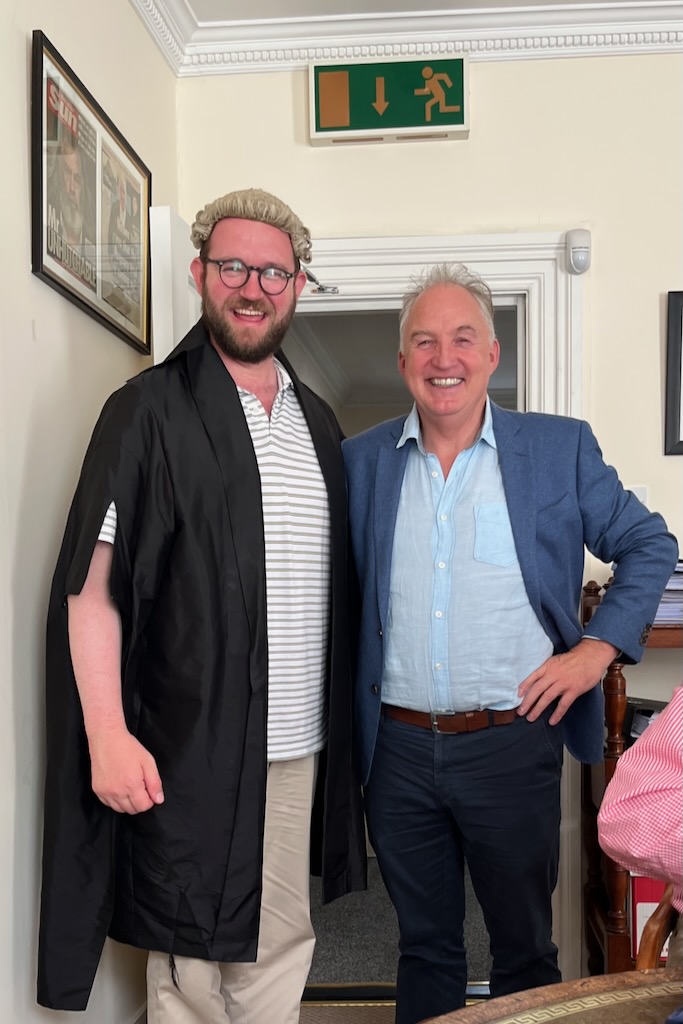
p.s. happy blessed birthday this sunday to my most beloved firstborn, and law professor, will. soon to be teaching within a morning’s drive away, at the university of notre dame law school, another dream come true, prayer answered, and holy wonder for all time.

sweet will with one of ireland’s top barristers, brendan grehan, who shared his silks and wig for the occasion.

what journeys home have called to you, those taken or not yet taken?

and may the full sunlight of the solstice warm you and bring radiance to your soul….

finishing school

i suffer from a common ailment. especially among a certain breed of bibliophile. i don’t finish. i start, enthusiasms drawing me in like ink to a blotter. pages are turned. pens pulled forth and margins scribbled with scrawl. and then another seductress comes along. another delectable enticement: author. idea. or merely a title.

and it happens all over again. 

i’m talking books, of course. and my long-held habit of starting and stopping. 

start. stop. rinse. repeat. 

crack open the binding, turn pages, ink it all up. add to the pile. the towering, toppling, could-knock-me-out-if-it-fell pile of books. 

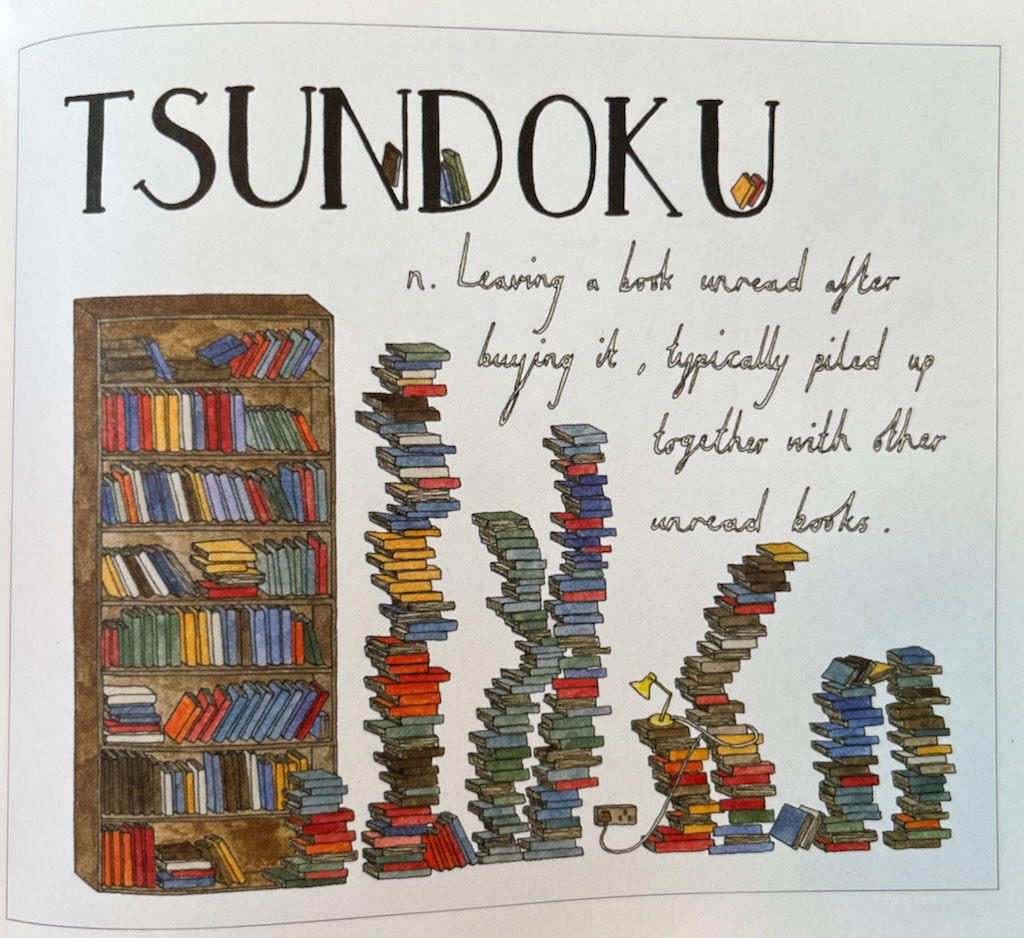
there’s a name for the ailment: tsundoku. (積ん読)

it’s the japanese word meaning, quite literally, “reading pile.” nowhere in the definition—“the phenomenon of accumulating books but not reading them”—would you find evidence of the lethal nature of said phenomenon (ten books falling on your nose will leave a dent). nor the drip-drip-drip of guilt that accumulates every time one sashays past said pile and fails to move forward in a page-turning way. 

so i’ve hatched a plan, an antidote to what ails me. i call it finishing school. i shall, in the summer months ahead, the months when the sun is strong and summer sounds abound, commit to a single purpose: one by one tracking my way toward the last sentence of at least some of the many books piled on my nightstand, my reading nook, my writing room floor, and most any other horizontal plane sturdy enough to hold a vertical biblio-ascension. 

by virtue of this determination to see literary arcs through to the end, i shall be relieving all of you of the task of checking in on the chair to see what’s astir. i am intending to post mostly what leaps off the pages, as i plod along through plots, poetries, and otherwise paradisiacal paragraphs. 

i envision something of a commonplace summer reading adventure, in which we all can chime in with any ol’ ‘graph or line that makes your heart thump, or your eyes fill with tears. 

my summer’s focus will be more reading than writing, at least here. 

the writing portion of my summer will apparently have me bent over the keyboard tapping out pages for a new project i’m not yet free to chat about. there’s an end-of-summer deadline, i do believe, so i’ll be burning up the keys to make that happen. and my refueling time will be spent deeply in reading. in finishing, specifically. 

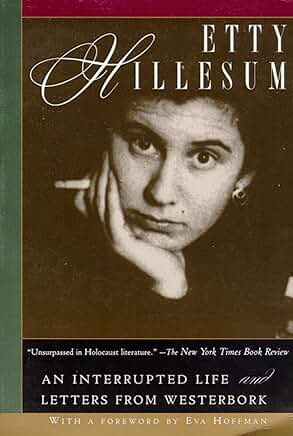
i plan to officially begin my finishing school with a book that’s tugged at me for years, one i started and loved, and truly need to wade deeper into. it’s etty hillesum: an interrupted life and letters from westerbork. begun in 1941, nine months after the netherlands fell to hitler, it’s the epistolary journal of a young dutch jewish woman who traces the darkening shadow of the nazi presence in her homeland as well as her own moral awakening before her death at auschwitz in november of 1943. it seems as essential a book in my stack as any there is. and i’m committing to etty.

back in 1986, in a review of the book in the new york times, michiko kakutani wrote this: 

“All Holocaust writings, of course, must deal with the inadequacy of words in the face of events that defy the imagination, but while Miss Hillesum frequently speaks of her inability to convey the awful magnitude of events around her, she proves herself a most eloquent witness to history—a witness whose grave yet shining testimony attests to the resilience of the human spirit in the face of incalculable odds.”

it seems a book for this moment.

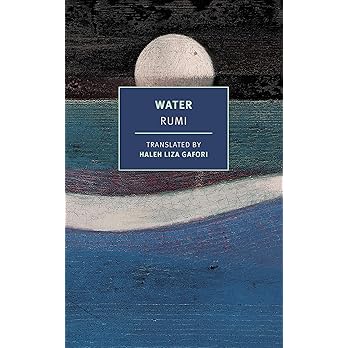
and even though the official starting bell hasn’t chimed, i tiptoed into my project this week by reading start-to-end not one but two magnificent poetry collections: water, by rumi, translated from the farsi by haleh liza gafori (new york review book classics), the second volume of gafori’s translations of the thirteenth-century persian poet (the first one, unfinished but in my pile, of course, was gold, acclaimed for its fluid rendering of rumi’s lyric ecstasies). water’s essence is Love, capital L, gafori writes in her introduction, in which she claims: “Love is a 360-degree embrace of creation, a compassionate acceptance of what it…Love is our unobscured essence, at the root of the root of all creation…Above all, Love is a practice.” 

and but one line that took my breath away in the poems themselves, was this: “Come or go, Love told me, / I am here, closer to you than the vein in your neck.” 

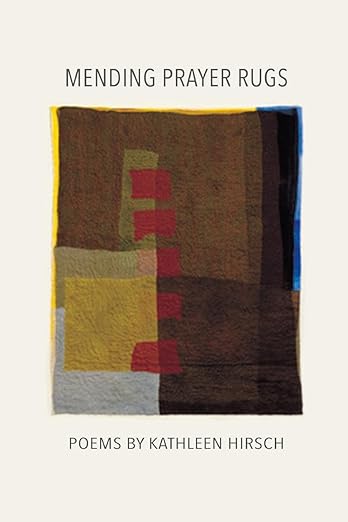
and the second collection of poems i gulped down, start to finish not once but twice, was a book i bumped into quite by accident and whose author immediately swooped into the inner circle of kindred spirits. it’s titled mending prayer rugs, poems by kathleen hirsch (finishing line press), and this collection mines the sacred amid the quotidian, with a particular focus on women of prayer, women whose wisdom is hard-won, be they women from the Bible, craftswomen, workers, wanderers or women we recognize from among our own generations.

in her opening poem, “prayer rug,” hirsch (a longtime journalist and spiritual director) writes in the voice of a woman i imagine with gnarled knuckles and fading eyesight, the cost of a lifetime spent pulling needle and thread through the tatters of prayer rugs for those who prostrate in prayer: “I bend in blessing toward all that breathes: / May each hour enlarge the pattern— / rose dawn, wind song, tender shoot of faith— / that I may see the weft of the hidden weaver.

the weft of the hidden weaver. another name for the Unnameable One. it is the metaphors of poetry that catch the breath in our throats, and frame our seeing anew.

lines such as this, a line that had me choking back tears in a poem titled, “in the end”: “Kiss the light / before it dies / leave those you love / the heirlooms of your passion, your gratitude, your tears.” 

i envision a magical summer. 

straight through to the end. 

will you read along?


a subtly transgressive little poem from the bard of the bluegrass state:

The Hidden Singer

The gods are less for their love of praise.
Above and below them all is a spirit that needs nothing
but its own wholeness, its health and ours.
It has made all things by dividing itself.
It will be whole again.
To its joy we come together –
the seer and the seen, the eater and the eaten,
the lover and the loved.
In our joining it knows itself. It is with us then,
not as the gods whose names crest in unearthly fire,
but as a little bird hidden in the leaves
who sings quietly and waits, and sings.

+ Wendell Berry

p.s. a bit more on tsundoku: The term combines “tsunde-oku” (積んでおく), meaning “to pile up ready for later and leave,” with “dokusho” (読書), meaning “reading books”. 

a note: i’m sensing we all need to shake off some of the routines of our lives that begin to feel too confining, and i don’t ever want the chair to feel that way. so my intention is to be a little bit looser about it, but still to leave faint tracings here on the table, should you happen by. summer for me has long been synonymous with reading, and thus a reading project. feel free to bring your favorites.

spring might be sprung, but i’m not springing

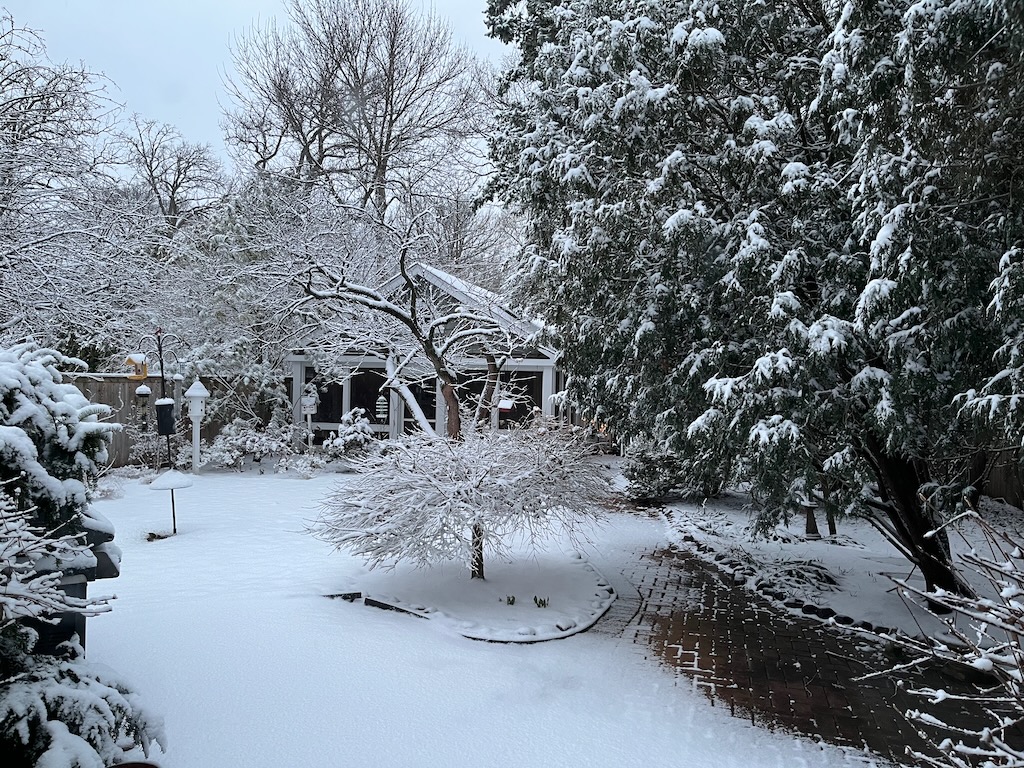
vernal equinox out my backdoor

they say it’s spring out there. celestial lines were crossed in the wee, wee hours of yesterday, and, for a flash there, light and shadow fell in equal measure. 

i don’t feel the light though. not in sync with springtime’s beckoning. i’m inclined still to hunker down in winter’s shadow. 

for reasons i can’t quite fathom, i’m not ready this time ’round for the seasonal advance. i still feel wintry in my bones. the light change is too abrupt for me, too ice-white for me. my inner metronome is far too slow for the prestissimo that’s rising. i don’t mind the cardinal’s vernal song, though, rung out from treetops high, and piercing through still-frigid air. but i’m not seasonally adjusted. i’m lagging at least two lopes behind. 

i can’t tell if it’s that my winter felt circumvented. or that i’m wishing for all of time to freeze in place. since the world is rather dire these days, that cannot be a wise solution. in that regard, i’ll take time in double measure. may we all wake up on the morning of eight november, 2028, with a whole new glimmer in our eyes. and the present firmly in the past.

i’m feeling somewhat stuck. hardly welcoming of burgeoning to come. and that’s a most peculiar state for me. 

might the whole universe be toppled on its head, upside down and inside out? 

the one sure sign that spring is here is that when i awoke, just hours after equinox, the world i saw was dumped with snow. which in these parts is something of a rite of spring. tulips rise, and snowflakes fall. my mother swears she knows it’s spring when she slides on her winter boots and brushes all the glops of snow off her daffydills. 

no wonder we of the four-quarter year take spring in slow, uncertain sips. there is no fine delineation, as if the calendar and earth set their clocks in synchronous coordination. 

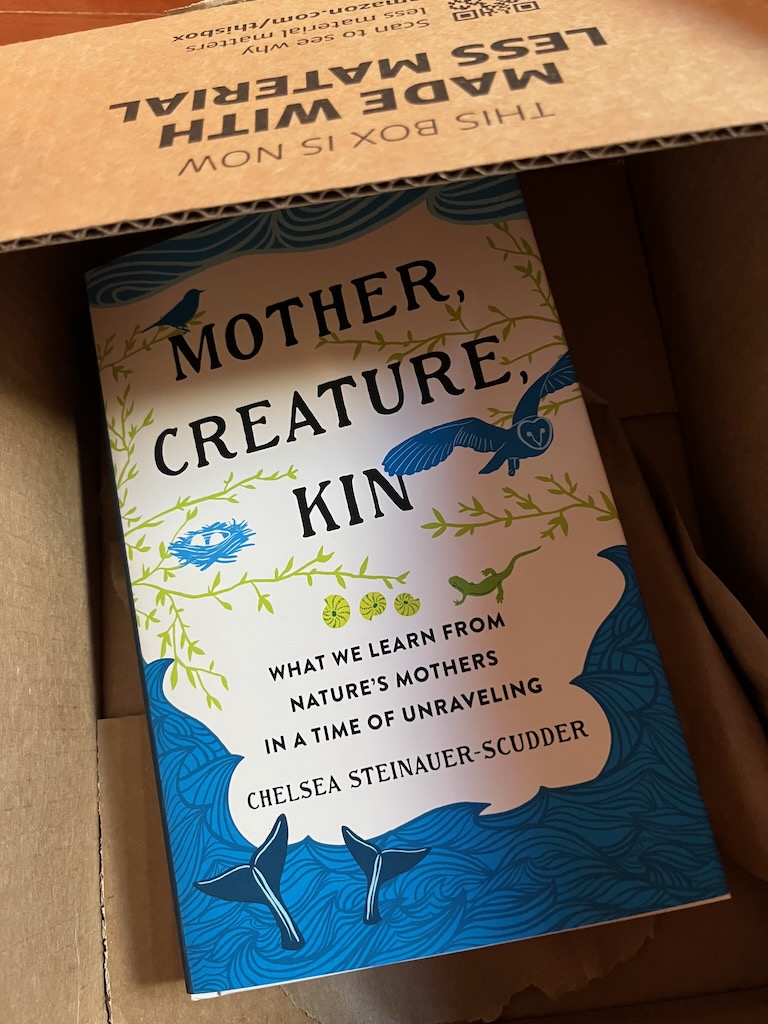
on a day when snows fell in glops, and then proceeded to melt in same-sized gloppings, and on the day when headlines kept insisting the springtime was upon us, i heard a thump at my door, and therein found prescriptive for my seasonal laggings. 

there, in a plain brown box, lay a book i’d been awaiting. my friend chelsea steinauer-scudder, as intelligent and beautiful a writer as could be, became a mother back when she and i were reading books and writing in the zoom rooms that covid carved. i’d first read chelsea in the pages of emergence magazine, a wunder site (online and print magazine, as well as creative production studio) that probes the depths of ecology, culture, and spirituality, and where she was a writer and editor for five years. when i saw she’d be leading reading circles (braiding sweetgrass, among them) and ones for the craft of nature writing, i signed up, and cemented myself to what would otherwise have been a front-row seat. 

chelsea grew up on the great plains of oklahoma and the sandhills prairie of nebraska, where for a time her papa researched bison, fire, and native plant communities, so she comes to her native landscape––language enfolding the sanctity of earth––with what seems an effortless fluency, as if she grew up breathing it. which, of course, she did. and then she went on to harvard divinity school, where she earned a masters in theological studies, and ever since she’s been writing sumptuously, focusing her work, in her words, “on the confluence of relationship to place with experiences of the sacred.”  

her first book, Mother, Creature, Kin: What We Learn from Nature’s Mothers in a Time of Unraveling (Broadleaf Books), is what brought the thud to my front stoop. it’s due out april 8, but my copy landed yesterday. and it might be the cure i needed to lull me into spring. 

a.) it gives me excuse to curl under a blanket for a day or two, and b.) here’s what i’m about to bathe in, passages such as this:

“I wish to invite you into a kind of mothering that is wild and porous. The kind that draws blood, that loves and fears, rejoices and doubts, that exposes where we are most deeply vulnerable and from there stretches us into what is beyond us. I mean the kind of mothering that works within uncertainty and mystery. The kind that leaves soil beneath our fingernails and seeds in our hair.” 

she writes about mothering and being mothered by places. ecological mothering. she defines ecological motherhood as: a shared, place-based responsibility to nurture and support human and more-than-human life. she writes of the karmic cycle of rebirth, a subject aptly plucked from the vernal syllabus. she writes of the silent flight of barn owls, of nursing and endangered right whales, of real and imagined forests, eroding salt marshes, and newly planted gardens. 

she writes that the protagonists of these stories have been teaching her facets of mothering (a verb that she, like me, insists is not tied to gender nor obstetrics). those facets belong to us all, no matter our life’s work: “language, belonging, entanglement, community, edge work, homemaking, and how to think about the future.”

my friend chelsea just might nudge me over my springtime bump, and land me softly on the vernal side….


as i await the vernal skip in my own heart, i scan the literary landscape for those others who, along with chelsea, might nudge me there. and no surprise, i turn to two favorites, the great naturalist and writer, aldo leopold, and the poet mary oliver, who drew the sacred from her every path and passage.

“One swallow does not make a summer, but one skein of geese, cleaving the murk of a March thaw, is the spring.”

aldo leopold

North Country

In the north country now it is spring and there
     is a certain celebration. The thrush
has come home. He is shy and likes the 
     evening best, also the hour just before
morning; in that blue and gritty light he
     climbs to his branch, or smoothly
sails there. It is okay to know only
     one song if it is this one. Hear it
rise and fall; the very elements of your soul
     shiver nicely. What would spring be
without it? Mostly frogs. But don’t worry, he

arrives, year after year, humble and obedient
     and gorgeous. You listen and you know
you could live a better life than you do, be
     softer, kinder. And maybe this year you will
be able to do it. Hear how his voice
     rises and falls. There is no way to be
sufficiently grateful for the gifts we are
     given, no way to speak the Lord’s name
often enough, though we do try, and

especially now, as that dappled breast
     breathes in the pines and heaven’s
windows in the north country, now spring has come,
     are opened wide.

––Mary Oliver

a little peek at what a few other authors have to say of Mother, Creature, Kin. may i call your attention to the one who writes that this beautiful book belongs in the company of works by Ursula LeGuin, Rachel Carson, Terry Tempest Williams, and Robin Kimmerer, to name a constellation of the highest-reaching lights…

are you finding yourself in springlike mode, and what sights and sounds and scents are stirring you there?

artisanal peace

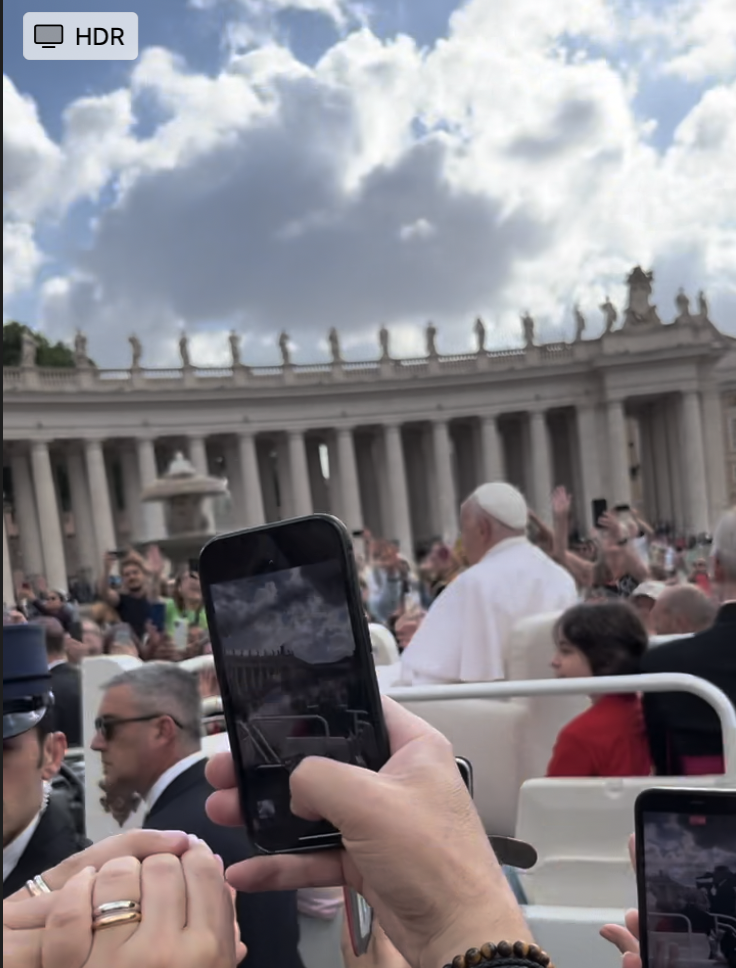
closest i got to Il Papa, when i found myself accidentally at the barricades that clear the way for the Pope-mobile

sages are in short supply, it seems. certainly now, and certainly on the global scale. i scan where i can, ever on the lookout. and wasn’t my eye caught when i read the words “artisanal path” to “handmade peace.”

tell me more, my little heart shouted. 

though it sounded a bit like a recipe for earthy bread or hand-thrown plates, the sort that rise from the potter’s wheel, i sensed the subject here was far more urgent, and in dire need of replenishing. not what you’d find on any pantry shelf. 

hand-crafted peace, peace constructed with care and attention. peace that we at home can build, without scissors or glue or a potter’s spinning wheel.

i clicked on a duly-provided link, and wasn’t one iota surprised to find that Il Papa, our most beloved Francis, was the one who not only dared to raise his voice above the blather, but considered it a requisite of his job’s description.

he is, after all, shepherd to a farflung flock. but more than that, he’s a prophet, which, according to the definition i found in richard rohr’s brand-new the tears of things: prophetic wisdom for an age of outrage, means a radical change agent, teacher of a moral alternative, and deconstructor of every prevailing order. rohr reminds us of the prophets of ancient times, the ones described by isaiah and ezekiel, whose job it was to hold the powers that be “maddeningly honest.”

bring on the prophets, please.

in these times, francis, our dear pope who from his hospital bed in rome reached out to the suffering of gaza, is the rare voice to which all the world will sometimes listen. thank holy God, he speaks the language of love without condition, clause, or pause. there are those among us, in this age of outrage, who might do well to listen. especially when they claim to take instruction from the very same God who whispers to Il Papa

the new york times calls him “an increasingly lonely moral voice on the world stage.”

all the more reason to listen. and listen hard.

“peace is crafted; it is the work of our hands,” francis began at a prayer vigil in the central african republic back in 2015, “it is built up by the way we live our lives.” he was speaking to an audience of children, teens, and young adults in bangui, the capital of the central african republic, when that country was in the midst of a sectarian war between Christians and Muslims, and thousands had been killed, and more than a million displaced from homes, their properties looted or destroyed.

this artisanal path, “built up by the way we live our lives,” is spelled out, it turns out, in francis’s Against War: Building a Culture of Peace, a book i’ve ordered from my local bookstore, as it’s one with permanent claim to a slot on my bookshelf. 

it’s not that i think i can build a culture of worldwide peace, though once upon a time i dreamed of such things. the point here, from the wee bit i’ve read, is that peace is a sphere we build bit by bit, as we travel through space and time, and it’s built by even the most unassuming of gestures, attitudes, and actions.

what the pope is saying, and what the world ought listen to, is that the tiniest empathies and kindnesses matter: giving cuts in the grocery line, waving someone into your expressway lane; taking time to take the call, dropping the tupperware of soup on your neighbor’s stoop. biting your tongue when you’re tempted to snap, and, yes oh yes, turning the other cheek, a trait i’m told no longer belongs in a world of dog eat dog. 

what a game changer: here’s the head of a church that counts 1.39 billion baptized among its ranks, and he too concurs that we needn’t be rocket scientists in the art of magnanimous charitable persuasion to make a dent in the realm of ever-spreading goodness. 

for one thing, it’s fairly contagious. if you’re out-of-the-blue kind to me, if you take my breath away with some wonder act of yours, chances are i’m inclined to be a copy cat and try the same. if for no other reason than the pure joy of watching someone be surprised you’ve not just slammed the door in their sorry, sorry face. 

here’s where Il Papa begins his artisanal path to handmade peace, with this fulsome criticism of the futility of war: 

“war is not the solution, war is madness, war is a monster, war is a cancer that feeds off itself, engulfing everything!”

that’s all i needed to keep on reading. and what i found, and what you’ll find should you decide to play along, is a compendium of his most outstanding commentaries on war and peace during the first nine years of his pontificate. 

here are a few of the nuggets you just might choose to tuck in your peace-gathering pockets. 

because one can’t best the pope when it comes to eloquence and voice, i am quoting from the book, here on in, and plucking five that leap out the most….

1.) seeing the world as one human family living in one common home.

The stars in the sky shine down on every single person — from the beginning of time to today — and learning “to look at the stars” will be “the most effective vaccine for a future of peace,” he said in Ur, Iraq, in 2021.

“Anyone with the courage to look at the stars, anyone who believes in God, has no enemies to fight. He or she has only one enemy to face, an enemy that stands at the door of the heart and knocks to enter. That enemy is hatred,” the pope said.

“There will be no peace as long as we see others as them and not us,” he said. Humanity lives under one heaven, under the gaze of one God who desires his children to be “hospitable and welcoming” to each other on earth.

2.) reconciling with one’s enemies and embracing unity in diversity.

The pope told young people in the Central African Republic that the first step toward being a peacemaker was “never hate anyone. If someone wrongs you, seek to forgive.”

“We only win if we take the road of love,” he said, and, with love, “you will win the hardest battle in life” and find peace.

But “we need to pray in order to be resilient, to love and not to hate, to be peacemakers,” and “you must be courageous,” he added. “Courageous in love, in forgiveness, in building peace.”

3.) the difficult art of dialogue and listening, which can sometimes be as hard as building a bridge over an abyss.

Pride and arrogance must be eradicated from one’s own heart, he told young people at a congress of the educational project, “Scholas Occurrentes,” in 2016. “Our world needs to lower the level of aggression. It needs tenderness. It needs gentleness, it needs to listen, it needs to walk together.”

Dialogue is “the capacity to listen, not to argue immediately, to ask,” he said. “Everyone wins in dialogue; no one loses” because “it is about agreeing to proposals so as to move forward together.”

Dialogue is to put oneself in the other’s place, “to form a bridge” and “persuade with gentleness.”

4.) peace is a constant journey of “getting one’s hands dirty,” concretely working for the common good.

“Our path leads us to immersing ourselves in situations and giving first place to those who suffer,” he said in Assisi for the World Day of Prayer for Peace in 2016.

Feeling responsible for helping others and refusing to be indifferent cleanses the heart and requires the “purification” and conversion that can only come from God, he said in Irbil, Iraq, in 2021.

This new order must meet humanity’s desire for justice, equality and participation, he said in his World Day of Peace message in 2020. A democratic society recognizes everyone’s rights and one’s duties toward others, which can temper a harmful, unbridled understanding of freedom.

5.) living the beatitudes is to bring heaven––and peace––to earth.

In his homily in Baghdad in 2021, the pope said, “We do not need to become occasional heroes, but to become witnesses, day after day,” embodying the wisdom and love of Jesus.

Jesus changed history “with the humble power of love, with his patient witness. This is what we are called to do,” he said, and “that is how the world is changed: not by power and might, but by the beatitudes.”

People who live the beatitudes “are helping God to fulfill his promises of peace,” he said. “This is the way; there is no other.”


in these tumultuous times, i am turning hungrily to prophets and sages in the news and on my dusty bookshelves. i’m inclined to not fill this space with my own blather, but rather to bring any lights that might dapple our paths. it’s always a tug-of-war to quiet the chair or keep it going with whatever bits i find. this doesn’t seem like the time to turn to silence. so my aim is upped to break through blather and bring voices that will wedge open our hearts, and like a doorstop, keep it wedged till we get through to the other side….

what voices broke through to you this week?

when you find the sages on your shelf echoing one essential truth. . .

not so very long ago, within the reach of my old brain folders, this was the morn i had my boys set out shoes (sometimes admittedly smelly sneakers), which i filled with clementines and tinfoil-wrapped chocolates. the feast of st. nick, the jolly soul who in long-ago times filled the shoes of girls and boys with trinkets from his pouch. the original arbiter of good v. not-so-good; a lump of coal you did not want to find tucked in the toe of your wooden clog.

december, it seems, is a month punctuated with tradition. we embroider advent’s waiting, the dim day-by-day darkening with the kindled flickering of myth and lore and wonder gathered round the globe. every land, it seems, is looking for a bit of light amid the darkness.

i learned only this week of december fourth’s “barbara branch,” when the german tradition is to give the branch of a flowering tree to a barbara and await its blossoming by christmas. the story goes that barbara, who would become a saint and then later (at my tender and impressionable age of 9 or 10) be stripped of her sainthood (for reasons i never quite grasped but the good ol’ Church did it anyway), dear barbara back in medieval times was such a beauty that her wretched father locked her in a tower whenever he went away. and when she refused to marry some princely fellow, because she preferred to marry Jesus Christ (plenty of saints chose that path) he sent her off to prison, awaiting beheading. on the way to prison, so the story goes, a cherry branch snagged against her skirt, so wise and wily barbara clutched the branch and carried it along to her cell, whereupon every few days she watered it with drops from her scantly-filled drinking glass. and don’t you know that on the day she was burned at the stake and then beheaded, the branch blossomed. and so we barbaras carry on the blossoming, with branches awaiting bloom. my mother is a barbara, and she now has a dear friend where she lives who also happens to be a barbara. so this barbara brought those barbaras branches awaiting bloom. 

and so december goes. 

but really what i find myself thinking here this morning is how the sages i have come to know and love find themselves in conversation across space and time. how their wisdoms interlace and amplify, and to my mind underscore the eternal in their simple truths. 

the sages shelf: poets, left; mystics and sages to the right

the two i’ve drawn from my shelf this week are brian doyle, the beyond-brilliant late great essayist and longtime editor of portland magazine, who died of a brain tumor not too many years ago. his wisdoms cannily or not line up with those of dorothy day, the radical pacifist and co-founder of the Catholic Worker movement, devoted to the poor, the hungry, the broken, and now on the road to sainthood, though she famously protested that labelling when she once snapped: “don’t call me a saint. i don’t want to be dismissed so easily.” (a sassy saint she’ll be, patron saint of sassiness among her zillion virtues.)

i found myself pulling dear brian off my sages shelf this week, and zeroed in on this passage in particular from his magnificent one long river of song: notes on wonder (a book whose praises i once sang in the pages of the chicago tribune, back when i wrote a column called “books for the soul”): 

This is what I know: that the small is huge, that the tiny is vast, that pain is part and parcel of the gift of joy, and that this is love, and then there is everything else. You either walk toward love or away from it with every breath you draw. Humility is the road to love. Humility, maybe, is love.

he echoes the essence of dorothy’s wisdom, an epiphany of hers long etched on my heart. this simple, simple code: “by little and by little.” 

her biographer, robert ellsberg in dorothy day: selected writings, elucidates: “simply, it consisted of performing, in the presence and love of God, all the little things that make up our everyday life and contact with others. from therese [of lisieux, yet another saint, the one who inspired dorothy], dorothy learned that any act of love might contribute to the balance of love in the world, any suffering endured in love might ease the burden of others. . . we could only make use of the little things we possessed—the little faith, the little strength, the little courage. these were the loaves and fishes. we could only offer what we had, and pray that God would make the increase. it was all a matter of faith.”

what i’ve come to know, through the alchemies of age and maybe cancer, is that my one holy task here is to live by love, little by little, day by day, for as many days as i have. if i can be a little flame, if i can choose love, choose joy, choose kindness at each and every turn and each and every choice, then my swift life here will have left some mark and measure. if each one of us might tip the balance, bend the arc toward justice, then our existence holds holy purpose. the choice becomes so clear, so finely-grained focused: i aim to walk closer and closer to the holiness i was––we were all––meant to be. and to find unending bliss within.

so help me God. 

one more brian doyle: in a brilliant, brilliant essay (found in One Long River, p. 12) about two strangers holding hands as they leapt from the south tower on sept. 11, doyle wrote: “their hands reaching and joining are the most powerful prayer i can imagine, the most eloquent, the most graceful. it is everything we are capable of against horror and loss and death. it is what makes me believe we are not craven fools and charlatans to believe in God, to believe that human beings have greatness and holiness within them like seeds that open only under great fires, to believe that some unimaginable essence of who we are persists past the dissolution of what we were, to believe against such evil hourly evidence that love is why we are here.”

i don’t know why i even try to say what has been so magnificently, unforgettably uttered already. brian doyle’s truth i feel unfolding in me every blessed day. i feel those seeds breaking open in the roaring furnace that is a cancer in your lungs.


because, why not, two Advent poems from emily d. or at least two poems worth contemplating in this season of anticipation, of heightened awaiting, of soul on the lookout for wonder coming….(Advent reflection on the poems, from my friends at the Salt Project, down below, but first, emily, the belle of amherst:)

“The Infinite a sudden Guest” (1309)

The Infinite a sudden Guest
Has been assumed to be —
But how can that stupendous come
Which never went away?

“Tell all the truth but tell it slant — “ (1263)

Tell all the truth but tell it slant —
Success in Circuit lies
Too bright for our infirm Delight
The Truth’s superb surprise
As Lightning to the Children eased
With explanation kind
The Truth must dazzle gradually
Or every man be blind —

+ Emily Dickinson

and here’s what my friends at Salt Project say about both…

These two Dickinson poems are perfect meditations for Advent:

The first as a provocative play on one of the season’s mysteries (How can we “wait” for someone who is also present to us, and in us, even as we wait?); and the second as a window into the many ways the Advent and Christmas stories testify to a God who comes in ways that are somewhat softened, accessible, “slant,” camouflaged, even hidden.

An ordinary baby in an ordinary backwater town, signaled by a star so faint that only Magi can spot it (Herod’s assassins can’t!), and announced not to the powerful in Jerusalem but to nameless shepherds on a forgotten hillside, watching their flocks by night.

It’s as the old carol has it: “Veiled in flesh the Godhead see, Hail th’ incarnate Deity!” (that’s from “Hark the Herald Angels Sing”). Veiled, hidden, not so God disappears but precisely so God may appear — or rather, so we may see. The Truth must dazzle gradually…

what simple sages’ truths have you found echoing of late?

blessings to teresa p for teaching me all about BBs, barbara branches!

a literary form for the slipperiest of minds

a page from british sailor henry tiffin’s commonplace book, 1760

more and more, the literary form into which i ease is one that traces roots to the ancients. to pliny, the great naturalist, whose mind must have been a beehive of sorts back in first-century rome. it’s an enthusiasm for accumulation that courses its path on through the renaissance when humanists, especially, were anxious to lock down their thoughts, keenly aware of the tragic loss of ancient learning, as libraries were so often, too often, the sites of military revenge. it’s a form that wends its way on and on through the centuries, straight through the twentieth, when mark twain, thomas hardy, ralph waldo emerson, and henry david thoreau, to name but a few, all partook of the habit. and here we are now, with plenty of us keen practitioners of the urge to gather up bits of literary esoterica and assorted ephemera before they skitter away. i think of myself, more often than you might imagine, as a rag picker of ideas in any which size, from the itty-bitty and poetic to the mindbogglingly big.

humans, it seems, like to scribble things down.

may our scribbling never cease.

the fancy name for this scribbling is commonplacing, the literary form the italians once named zibaldone, “a salad of many herbs,” in culinary terms, or a “hodgepodge” more broadly. we’re contemplating here the hodgepodge.

it’s the mosquito netting of the mind, of wonders and thoughts before they escape. or, as the 13th-century dominican monk, vincent of beauvais, once explained, it was “the multitude of books, the shortness of time, and the slipperiness of memory” that compels one to scribble.

count me in on the slippery mind.

vincent’s not-so-slippery solution: a ginormous tome, totaling 4.5 million words (someone counted!), an exhaustive compendium of all medieval knowledge, which he titled speculum maius (literally “great mirror”), speculum a word he chose because it contained “whatever is worthy of contemplation (speculatio), that is, admiration or imitation.” and thus he set out, over the course of his monastic lifetime to gather all the “flowers” (his word), or best bits of all the books he was able to read, in a selfless quest to save others the strains (time, money, trips to the library) of doing so themselves.

over the last many months, as the population of this old house has dwindled to two, and the stories to tell are fewer and fewer, my efforts here seem to have morphed into a looser, yet more concentrated consideration of the bountiful ideas and thunderbolts i bump into across the arc of a week.

there is something so natural about the human instinct to share what we’re thinking. of course there are those who might protest, who might consider me rude for shoving a book or a page or a picture in your face. but, when you think of it, isn’t that the instinct that drives so much of social media? (i often think we’ve gone overboard there, but that might be because too often it’s the magnification of any or every passing brain burp and not necessarily ones that might leave us enlightened. and too often amount to plain old overgazing at navels, or hair-raising nastiness and gut-wrenching vulgarity. but i digress…)

i’ve been keeping what amounts to my salad of many herbs for years and years now, and that urge seems to have spilled over to here, where week after week sometimes i seem to be assaulting you with the few morsels i’ve found most delicious in recent days. it’s a way, i suppose, of collectively swelling our brains. and our souls, most certainly.

in the spirit in which i bring my rag picking here, i like to think of us sitting side-by-side, cozy against the pillowy confines of an armchair broad enough for two. and in the gentlest, yet conspiratorial whisper, i offer you a page or a passage, my eyes widened and sparkling with glee, as if to say, wait’ll you see this one. what wonderments or deep thoughts spring to your mind?

any one of these next morsels is worthy of long and deep consideration. here are the ones that struck me this week:

these first two come from maria popova, whom i’ve referred to in the past as the high priestess of cultural commentary, and one of the most voracious gatherers of ideas i’ve encountered in recent years. her online literary journal, now known as The Marginalian, has been described as a compendium of hundreds of thousands of entries “that search for meaning, cross-linking ideas and connecting metaphysical dots.” here’s where she thunderbolted me this week:

“joy is a stubborn courage we must not surrender.”

“. . . love — whether we call it friendship or family or romance — is the work of mirroring and magnifying each other’s light. Gentle work. Steadfast work. Life-saving work in those moments when life and shame and sorrow occlude our own light from our view, but there is still a clear-eyed loving person to beam it back. In our best moments, we are that person for another.”


another place i often turn for soulful sustenance is Emergence magazine, a wellspring that explores the timeless connections between ecology, culture and spirituality. in a recent talk, titled “memory, praise, and spirit,” the filmmaker, composer, sufi teacher, and driving force behind Emergence, emmanuel vaughan-lee, opened with these words:

“The mystics say that we are like a seed; that we hold the blueprint for our highest potential within us, and that much of spiritual practice, regardless of what tradition, is unlocking that potential.”


and i close with this one from the great james baldwin, a passage from his 1964 collection of intimate but somewhat little-known essays, titled nothing personal. this passage is from the fourth of the four essays collected there:

“One discovers the light in darkness, that is what darkness is for; but everything in our lives depends on how we bear the light. It is necessary, while in darkness, to know that there is a light somewhere, to know that in oneself, waiting to be found, there is a light.”

i could write an essay on any one of the above, but instead i invite you to chew on each or any one. each one, a morsel worthy of your time, your mind, your soul.

which one spurs you and stirs you the most, and what deep thoughts spring to your mind?

i’ve written before of commonplacing. here at the chair, and in my latest book, The Book of Nature, on pages 87 and 88. it’s a habit i can’t get enough of, an urge i can’t quench.

pages from the commonplace book of charles dodgson, aka lewis carroll