pull up a chair

where wisdom gathers, poetry unfolds and divine light is sparked…

Category: books

turning inward, turning back

these times call for pronounced postures, for intention. ultimately we want to reach out, to be the bridge, the peacemaker. or, maybe little more than one flickering flame amid the global shadow. but first, in aim of fortification, we turn in. it’s where we stoke the fire, clarify the vision, and maybe just maybe find the peace, the calm, from which to set forth.

i’d call myself a quietist. one of the ones who finds the solitude and silence a necessary interiority. it is the place of prayer, of wisdom seeking, reaching far beyond the bounds of life as i know it, and drawing in pole stars to point the way. more and more, i start to think i subscribe to the church of the bookshelf. an eclectic crowd of thinkers and seers, the holy well from which i draw.

the noise of the world is beyond cacophony these days. rafters are rattling, pots and pans are clanging. all of which pushes me into the cracks of the world, where i poke around endlessly, sniffing out wisdoms like a mouse after cheese. i’m intent.

this week i turn east, and i turn back in time. way back, and way east. east to india. back to the first century of the common era, roughly 55 CE.

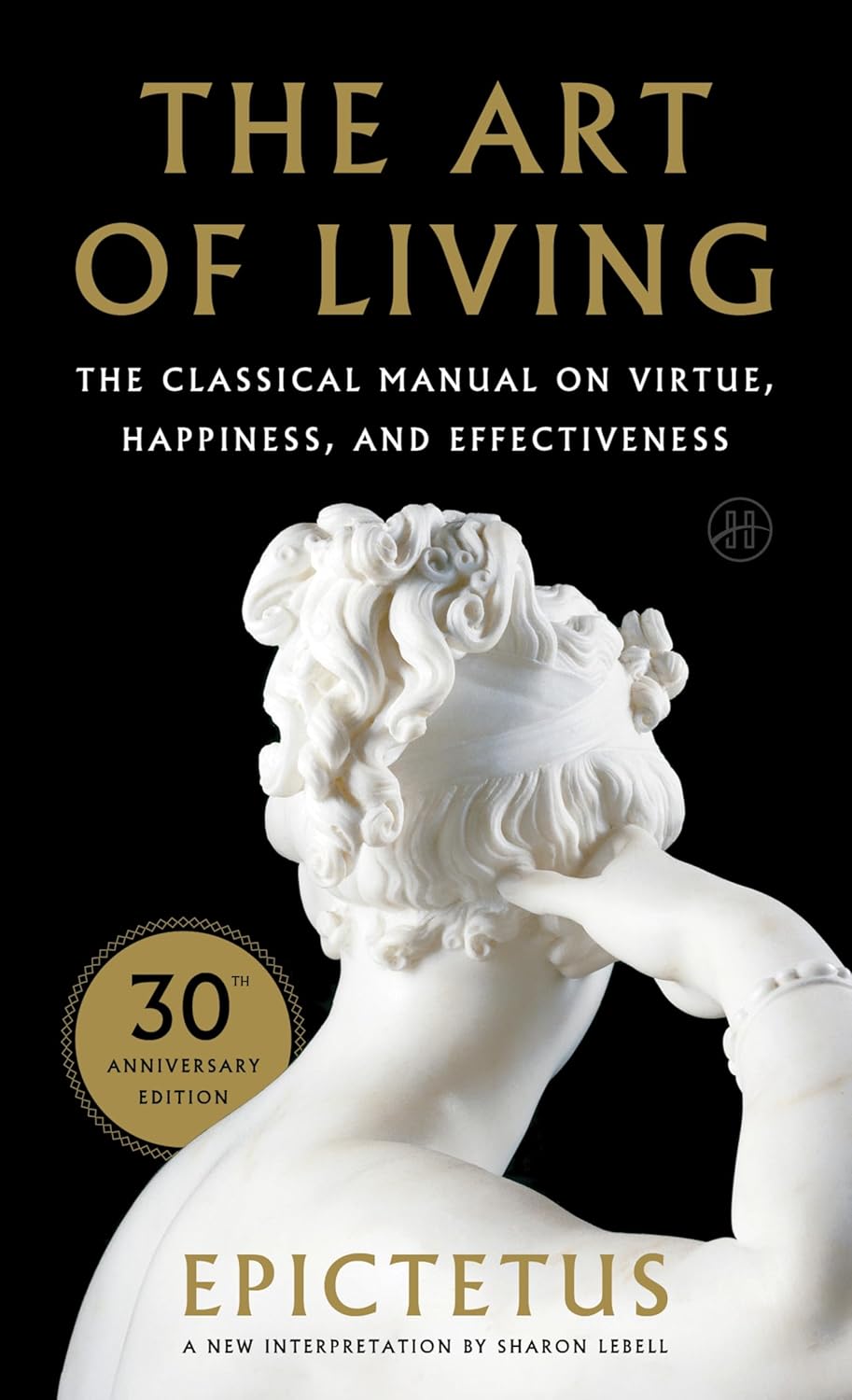
epictetus, the unsung stoic, goes first. he was as unlikely a pole star as they might come: born a slave, a slave with a limp, he carved out 93 instructions, bound them as a book, slapped on a catchy title (the art of living), one that came with a wallop of staying power (we’re still seeking the art), and all these millennia later, we’re still turning its pages.

a marvelous philosopher and musician, a northern californian by the name of sharon lebell, back in 1995 took a crack at translating epictetus anew. her translation stuck, and it’s now considered a classic. i found epi’s wisdoms rather timeless, and in keeping with survival in tumultuous times.

here’s epictetus:

Caretake This Moment

Caretake this moment.
Immerse yourself in its particulars.
Respond to this person, this challenge, this deed.

Quit the evasions.
Stop giving yourself needless trouble.
It is time to really live; to fully inhabit the situation you happen to be in now.
You are not some disinterested bystander.
Exert yourself.

Respect your partnership with providence.
Ask yourself often, How may I perform this particular deed
such that it would be consistent with and acceptable to the divine will?
Heed the answer and get to work.

When your doors are shut and your room is dark you are not alone.
The will of nature is within you as your natural genius is within.
Listen to its importunings.
Follow its directives.

As concerns the art of living, the material is your own life.
No great thing is created suddenly.
There must be time.

Give your best and always be kind.

~ Epictetus ~
(Epictetus: The Art of Living a New Interpretation by Sharon Lebell.)

Arundhati Roy

the next wise soul i bumped into this week was arundhati roy, the booker prize-winning novelist, who grew up and lives still in india; delhi specifically these days. she’s getting plenty of ink of late because her latest work, her first memoir, Mother Mary Comes to Me, has just been published. it’s an exploration of her complex relationship with her “iconic” and “extraordinary” mother, whom she describes as both “my shelter and my storm.”

roy’s 1997 novel, The God of Small Things, is what won her the booker prize for fiction, which in this mercenary worldly equates with that murkily-defined “success,” and its often evil twin, fame. roy, wise woman, wasn’t having it. she was not one to be deluded, or seduced, by such worldly measures. as she tells it she was keenly influenced by an uncle, a beloved uncle, who was one of india’s first rhodes scholars for his work in greek and roman mythology, but gave up his academic pursuits to start a pickle, jam, and curry-powder factory with his mother. and to build balsa-wood model airplanes in his basement.

not surprisingly, someone schooled in the shadow of such an uncle might have strong instincts on the “right” definition of success. and in a conversation with an old friend, arguing that “recognition is not the only barometer of brilliance or human worth,” she noted the friend’s eyebrow arching. skepticism, in full display. so roy did what any cocktail debater might do: she pulled the paper napkin out from under her drink, and a pen from her purse, and began to scribble.

what she wrote amounts to a gospel of success that belongs not on half-soggy paper, but a granite slab somewhere:

To love. To be loved. To never forget your own insignificance. To never get used to the unspeakable violence and the vulgar disparity of life around you. To seek joy in the saddest places. To pursue beauty to its lair. To never simplify what is complicated or complicate what is simple. To respect strength, never power. Above all to watch. To try and understand. To never look away. And never, never to forget.

sometimes i think i’m a broken record, saying over and over—and over—such a few simple truths. 

never get used to the unspeakable violence and vulgar disparity of life around you.

seek joy in the saddest places.

never simplify what is complicated or complicate what is simple.

respect strength, never power.

above all, watch.

never look away.

love.

love.

love.

what inscription might you add to a granite wall of truths?

p.s. i hyperlinked to a marvelous interview with sharon lebell above (i love her whole story, how she was drawn to study philosophy, inspired by a neighbor with more books than she’d ever seen, and how she found those first classes in philosophy “exercises in obfuscation” — might that describe much of the noise here on planet Earth in the year 2025?). here is just one of the grafs from that interview you might find as delicious as i did….

Epictetus drew me in particular because in the mid-1990s he was the unsung Stoic. People had heard of Marcus, of Seneca. No one, except the cognoscenti, had heard of Epictetus or could pronounce his name. I liked his humble background: he wasn’t an emperor or a big cheese. As a former slave with a limp, he was someone who wasn’t expected to have a voice, but he used his voice anyway. He was a relatable everyman trying to figure out best practices for getting through the day.  Since I am female, this mattered a lot. Many philosophers invoke male experience as a stand-in for the universal human experience. Epictetus did not, of course, address females when he taught, but his teachings have an inclusive, of-the-people feel.”

acquiring acquaintances: another name for pen pals

it started because months, or maybe years, ago, i stumbled onto a poem that took my breath away. it was written by a poet i’d not known of, didn’t think i’d ever read. but the poem, titled “Nativity,” stayed with me, a poem that paints the first Christmas scene in strokes and shades that settled deep into my marrow, and forever more are the Christmas i imagine.

it’s a poem that lays the baby Jesus in a rough-sawn barn, the air pungent with animal. “the wind tugging at the shutters.” there is nothing gilded about it. and it was written, i knew right away, by someone at ease with being small, tucked off in a corner keeping watch. it was written, i could tell, by someone whose very veins course with humility, and understood a God who preached the same, a God who asks us to get about the business, the holy business, of loving as we would be loved without noise or bombast or folderol.

the poet’s name is kenneth steven.

it turns out he lives on an isle on the scottish west coast, a place where the wind might tug at shutters. and it turns out he is something of a polymath: a poet, a painter, a children’s book writer, a translator of great works. and, above all, something of a pilgrim, a pilgrim seeking the quiet beauties that punctuate the everyday. he calls them “atoms of delight.”

and he writes of pilgrimage: “the word is often used to describe the journey to a shrine or sanctuary in search of spiritual transformation, which is a meaning i acknowledge. but now pilgrimage has become a much bigger thing for me; it has gone far beyond that rather heavy and medieval sense of going on a journey to visit a holy site. why shouldn’t it be about a walk to a hill loch to listen to the impossibly beautiful singing of red-throated divers? why shouldn’t it be about a child running into the forest in the early morning to find the treasure they dreamed of? these are journeys of the heart, seeking the profoundly precious places where little miracles happen. and why shouldn’t it be about panentheism—the finding of God in all things?”

it’s not hard sometimes to recognize a kindred soul.

what is hard is to imagine finding yourself in conversation with such a kindred someone. but that’s what’s happened. kindness is the thing that opened the door, his kindness. in a world ruled by transaction, where fees are paid and contracts signed for any exchange of goods—be it words or bricks or lumber—kenneth steven lives otherwise.

i found that out not long ago, when, during the editing phase of my next book, i dove into the task called “permissions,” in which for any chunk of text—poetry or prose or lyrics to a song—beyond a certain measure, you must secure permissions from its author. this can be a costly exercise. and it is always one that makes me quiver, wondering what walls i’ll encounter, and what cold-shouldered hubris i might have to tiptoe through.

it’s that poem, “Nativity,” that’s stayed with me all these years. and i’d included the whole of it, eight lines, at the start of an essay that i hope to include in the book.

wondering if i was whistling into the wind, i sent off a proper letter, the digital kind, and shipped it cross the sea. i’d no idea if mr. kenneth steven would ever reply. but, lo and behold, come monday morning, there he was, tucked kindly in my mailbox. and more than generously writing: “of course you are more than welcome to use the poem. i’m sure you’ll mention where you found it.”

and thus, with the stroke of his generous heart, a friendship has unfolded. and a treasure trove of poetries have now brushed through me. and i am richer for this scottish friend who, as a boy, awoke one night at midnight, and hearing a great and ferocious wind, hurriedly dressed and left the house, where he climbed a hill in howling winds, before crossing through a field to reach his favorite tree, where he knew the horse chestnuts would be falling, and he was out to save them, to gather them up. “i felt given a whole world,” he writes in an essay about the midnight escapade. “it was about the autumn and the big winds, and the thrill of running up that long hill and entering the field at last at what felt like the middle of the night.” and the indescribable delight of knowing “that all this treasure was mine.” the treasure: a cloth bag of chestnuts shaken from the limbs, their deep and woody smell, orbs that looked as though they were made of shoe leather.

befriending him, he who writes me every day now, sometimes more than once a day, is magical. is akin to befriending any of the authors from my childhood who’ve long entranced me, drew me into storybook tableaus: tasha tudor; e.b. white; frances hodgson burnett, who wrote the 1911 children’s classic, the secret garden, a book that featured my holy trinity—an orphaned girl, a padlocked garden, and a robin redbreast that finds the key—and once prompted me to fake a fever so i could skip church one sunday to stay at home and turn its pages.

long ago, when i’d be asked if i’d ever want to write a book, i demurred, brushed away the thought. didn’t think i could hold a thought long enough to pen more than a few pages. i didn’t know, though, that the magic of a book comes in all the threads unspooled along the way. threads that carry me to places far and wide, and to souls i’d never otherwise know. but words, like little birds, or prairie seeds, catch on the wind and settle into fertile loam. and we are richer for them.

in much the way, my beloved chairs, through all the words and all the years, have become my dearest treasures.

bless you.

love, bam

have you a penpal in this digital, globe-crossing, email world? someone you’ve not met but who seems a certain friend?

i promised kenneth i would share word of his beautiful meditative podcast, Imagining Things, on the patreon platform. recorded in a studio that seems to be just behind his island home, you can sometimes hear the scottish winds blowing off the atlantic, and a bird or two not far away. (or maybe i’m imagining.) and of course he speaks in a scottish-soaked timbre, and in between reflections he shares poems that will make you hit rewind so you can listen once again, so breathtaking are the lines.

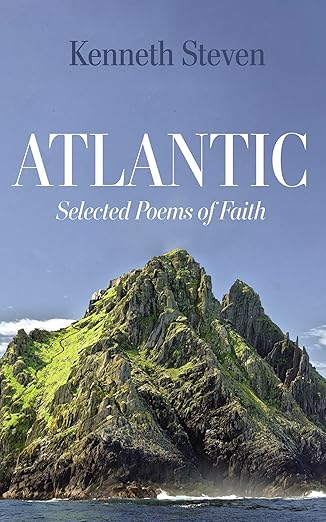
his latest book, one that should be landing on my front stoop within days, is Atlantic: Selected Poems of Faith. but i’m already deep into Atoms of Delight: Ten Pilgrimages in Nature, and Iona: New and Selected Poems.

incurably circuitous

my favorite reading nook in all the world. o’connell’s dairy farm in drumellihy, county clare

i tried. i truly did. it seems i’ve, well, failed. if failed is the verdict we choose to put to the determined effort to concentrate, to focus, to linearly follow page after page.

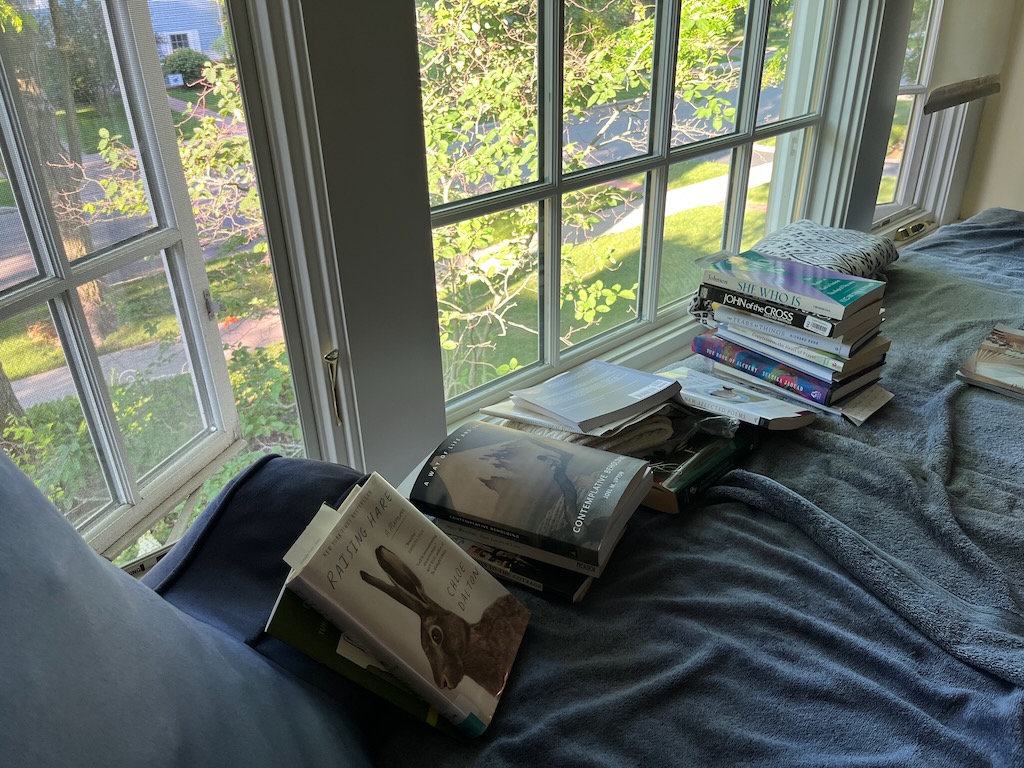
instead i am a jackrabbit of a reader. i cannot, for the life of me, trace a straight line. one minute i’m attempting ulysses, starting with an easy reader after traipsing the trail of leonard bloom through dublin. another minute i’ve decided pope francis’s slim collected works, against war: building a culture of peace, is the page i need to put to heart. then it’s onto raising hare, a love story so gentle i found it the perfectly prescribed balm in a week when bombs fell and mistruths fired right, left, and sideways.

i know full well that i set out to stick to one and only one tome till i—or summer—came to its end. etty hillesum was going to hold my attention. but my attention didn’t listen. it was distracted. as it so often is.

my irish poet penpal tadhg described rabbit holes, the literary divots i fall into, in charming irish terms not so long back. he makes every word he writes and utters sound poetic or profound, and he fails not here (his description of how it was that my last name leapt out and caught his attention during a morning’s meditation):

“Like the early Irish monks who doodled mystical nature poems on the margins of sacred manuscripts, I was distracted by the spelling of your name and wandered off, as those monks were wont to do (excuse the arrogant comparison), down a boreen (from Irish bóthairín, diminuitive of bóthar, meaning ‘road’, from the Irish ‘bó’, ‘cow’. A meandering pathway made by a cow).”

i am now—especially after strolling country lanes pocked with aftermath of bovine traipsing—inclined to consider my rabbit holes in more bucolic irish terms, and think of them as my boreens, meandering pathways made by my cow mind.  

my boreen, in physical form, looks not bucolic at all. in fact, it’s rather a beehive of possible distraction, all piled and teetering hither and yon:

i cannot for the life of me go straight.

besides gulping down my friend tadhg’s glorious meditations on the stations of the cross, i found my nose deep in raising hare (see last week’s mention), and am tucking in my overnight bag practice of the presence, a glorious little tome of translations from one of my favorite saintly souls ever, brother lawrence, whom i think of as the patron saint of pots and pans, though in fact he’s more oft referred to as the friar of pots and pans, and ultimately the friar of amour (love). he’s the humble little monk who toiled fifty years in a monastery, forty of those in the steamy kitchen, and thirty as a sandal repairer (monks wear through their soles on the road to polishing their souls). he described himself, famously, as “a clumsy oaf who broke everything” in his early attempt at being a hermit, and then a footman. when at last he found the monastery at 74 rue de vaugirard, he found his peace and his place.

and in him, i find mine: the gentle, humble soul who finds grace and God in the most quotidian of daily tasks, and spends his hours in the company and comfort of the Author of It All. even in the steamy monastery kitchen.

what’s notable is that dear brother lawrence hated kitchen work, but in his biographer’s writings it’s told that he did it “with the greatest love possible.” and that his practice of the presence of God in the most ordinary of moments, stirring a kettle, pulling trays of bread from the oven, “grew like dew, or mist on mountains.”

the translation i’ve just found, by carmen acevedo butcher, is extraordinary in the fullest measure, and might be the soothingest read yet of this hot summer.

the little monk’s spiritual maxims, work gently, be humble and authentic, includes this boreen (meandering cow path, remember?) on the highest reach of the soul, writing that in true spiritual union:

“the soul is not asleep as in the other unions, but finds herself powerfully stirred. its activity is more intense than fire, and brighter than the sun when not obscured by cloud. we can, however, misunderstand this feeling, for it is not a simple expression of the heart, like saying, ‘my God, i love you with all my heart,’ or other similar words. no, it is an i don’t know what, a je ne sais quoi of the soul, a something indescribable, loving, and very simple, that carries the soul and nudges her to love, respect, and embrace God with a tenderness that cannot be expressed, and that only experience can conceive.”

to this indescribableness, i dive deep. turning page after page. in no particular order. but trusting i’ll find the grace i seek.

may your distractions, too, carry you to lofty heights and voluminous depths. what distracted you this week?

before i go, and scurry off to a writerly retreat at my dear friend katie’s on the lake, i am sending love without end to my beloved friend andrea whose birth we celebrate tomorrow, and who is closing the book on one fine chapter of her life on the same day. i love her dearly. her wit, her hilarity, her unconditional and undemanding love. she is like no other.

there are a few brother lawrence books out there, but the one i’ve just procured and cannot recommend more heartily is carmen acevedo butcher’s, from broadleaf books. you can find it here.

musings on tenderness

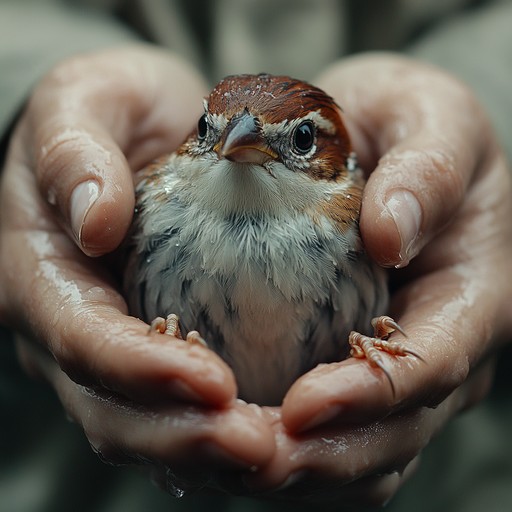
of all the ways of love, tenderness is one i hold closest to my heart. it’s the lesson learned and practiced as a little girl, when my mother taught me to run for a shoebox, or little glass jar. to punch its lid with air holes. and to line it with grass and leaves, to bring the outdoors in for this space that would become an infirmary, whether the patient be a baby bird fallen from the nest, or one with a broken wing, or simply a ladybug or firefly who happened to straggle behind. 

i don’t remember signing up for the advanced class, but i do very much recall the village i (a kindergartener at the time) made for my singular ladybug, each edifice constructed of paper and cardboard, care and attention devoted to every adornment (a flower box under the paned window, a wiggly “flagstone” path to the house’s front door). the steeple for the ladybug church i recall being a particular construction challenge. (and i remember depositing said spotted-back bug into the church come sunday morning at 9, per clockwork familial custom.)

tenderness is love on its gentlest setting. tenderness is the heart pierced through with empathies, with quiet, with the barest wisp of touch. a touch so silken it breaks you out in chills down your spine, might make you audibly sigh. to be tendered is, well, to be buttered in love. it is a butterfly kiss of kindness. a heart petaled open, and dusted with golden-grained succors.

tenderness, maria popova tells us, “is the best adaptation we have to our existential inheritance as ‘the fragile species.’”

lewis thomas, the poet and physicist (the lives of a cell: notes of a biology watcher) who first named us “the fragile species,” gives context for why in a 1996 essay from his last such collection, published under the same title, in which he positions us in the context of the universe’s timeline:

“This is a very big place,” lewis begins, “and I do not know how it works, or how I fit in. I am a member of a fragile species, still new to the earth, the youngest creatures of any scale, here only a few moments as evolutionary time is measured, a juvenile species, a child of a species. We are only tentatively set in place, error-prone, at risk of fumbling, in real danger at the moment of leaving behind only a thin layer of our fossils, radioactive at that.”

olga tokarczuk

when olga tokarczuk, the polish psychologist turned poet and novelist, won the 2018 nobel prize in literature, she mused on the art of tenderness in her nobel banquet lecture, a lecture titled “the tender narrator,” and one widely regarded as nothing short of “magnificent.”

tokarczuk began by telling the story of a black-and-white photo of her mother that’s always haunted her, in a blessed way. it was a photo taken before olga was born, and i’ll let her words take it from here (emphasis mine throughout): 

“There’s nothing really happening in the picture—it’s a photograph of a state, not a process. The woman is sad, seemingly lost in thought—seemingly lost.

“When I later asked her about that sadness—which I did on numerous occasions, always prompting the same response—my mother would say that she was sad because I hadn’t been born yet, yet she already missed me.

“‘How can you miss me when I’m not there yet?’ I would ask.

“I knew that you miss someone you’ve lost, that longing is an effect of loss.

“‘But it can also work the other way around,’ she answered. ‘Missing a person means they’re there.’”

stopped by the tenderness of a mother telling her small daughter that she missed her even before she was born, popova comments, is “an astonishing gesture of love so total that it bends the arrow of time.

ponder that string of words, and the meaning behind it, before reading on. “an astonishing gesture of love so total that it bends the arrow of time.” may we all know such love…

tokarczuk picks up her telling from there: 

“This brief exchange, someplace in the countryside in western Poland in the late sixties, an exchange between my mother and me, her small child, has always remained in my memory and given me a store of strength that has lasted me my whole life. For it elevated my existence beyond the ordinary materiality of the world, beyond chance, beyond cause and effect and the laws of probability. She placed my existence out of time, in the sweet vicinity of eternity. In my child’s mind, I understood then that there was more to me than I had ever imagined before. And that even if I were to say, ‘I’m lost,’ then I’d still be starting out with the words ‘I am’—the most important and the strangest set of words in the world.

“And so a young woman who was never religious—my mother—gave me something once known as a soul, thereby furnishing me with the world’s greatest tender narrator.”

a good bit later in the speech, tokarczuk raises this next question, more than worth considering:

“….Have you ever wondered who the marvelous storyteller is in the Bible who calls out in a loud voice: ‘In the beginning was the word’? Who is the narrator who describes the creation of the world, its first day, when chaos was separated from order, who follows the serial about the origin of the universe, who knows the thoughts of God, is aware of his doubts, and with a steady hand sets down on paper the incredible sentence: ‘And God saw that it was good’? Who is this, who knows what God thought?

“Leaving aside all theological doubts, we can regard this figure of a mysterious, tender narrator as miraculous and significant. This is a point of view, a perspective from where everything can be seen. Seeing everything means recognizing the ultimate fact that all things that exist are mutually connected into a single whole, even if the connections between them are not yet known to us. Seeing everything also means a completely different kind of responsibility for the world, because it becomes obvious that every gesture ‘here’ is connected to a gesture ‘there,’ that a decision taken in one part of the world will have an effect in another part of it, and that differentiating between ‘mine’ and ‘yours’ starts to be debatable.”

and then toward the very end of her speech, tokarczuk turns to a literature of tenderness: 

“Tenderness is the art of personifying, of sharing feelings, and thus endlessly discovering similarities. Creating stories means constantly bringing things to life, giving an existence to all the tiny pieces of the world that are represented by human experiences, the situations people have endured and their memories. Tenderness personalizes everything to which it relates, making it possible to give it a voice, to give it the space and the time to come into existence, and to be expressed.

“Tenderness is the most modest form of love. It is the kind of love that does not appear in the scriptures or the gospels, no one swears by it, no one cites it. It has no special emblems or symbols, nor does it lead to crime, or prompt envy.

“It appears wherever we take a close and careful look at another being, at something that is not our ‘self.’

“Tenderness is spontaneous and disinterested; it goes far beyond empathetic fellow feeling. Instead it is the conscious, though perhaps slightly melancholy, common sharing of fate. Tenderness is deep emotional concern about another being, its fragility, its unique nature, and its lack of immunity to suffering and the effects of time. Tenderness perceives the bonds that connect us, the similarities and sameness between us. It is a way of looking that shows the world as being alive, living, interconnected, cooperating with, and codependent on itself.

“Literature is built on tenderness toward any being other than ourselves.”

and a short bit later, she closes her remarks with this:

“That is why I believe I must tell stories as if the world were a living, single entity, constantly forming before our eyes, and as if we were a small and at the same time powerful part of it.”

in a world emblazoned with harshness and cruelties for the sake of cruelty, i will joyfully devote my days to making a living case for tenderness as a way of being. those who have touched me most indelibly in my life are those who wove their way in through that very rare and breathtaking capacity, the one that comes on with a whisper not a bang, the one that quietly says i’ve been keeping close watch on your finest-grained threads, and i see where those threads are tattered or thinned, and i am here to tenderly, yet certainly, place my palm against the small of your back, to let you know you are not alone, you are not unloved, you are seen and beheld.


a modest selection of olga readings:

the whole of her 2019 Nobel Prize acceptance speech here…

and an excerpt from one of the works that won her the 2018 Nobel Prize in Literature, and for which the judges cited: “for a narrative imagination that with encyclopedic passion represents the crossing of boundaries as a form of life”

this one from Flights, her 2007 novel that twines fiction and non-fiction, and which james wood, the new yorker critic and harvard english professor, in 2018 described as tokarczuk’s “omnium-gatherum, a big book full of many peculiar parts: there are mini-essays on airports, hotel lobbies, the psychology of travel, guidebooks, the atavistic pleasures of a single Polish word, the aphorisms of E. M. Cioran. Some of these riffs, which themselves tend toward the aphoristic, are as short as a couple of sentences.”

HERE I AM

I’m а few years old. I’m sitting on the window sill, surrounded by strewn toys and toppled-over block towers and dolls with bulging eyes. It’s dark in the house, and the air in the rooms slowly cools, dims. There’s no one else here; they’ve left, they’re gone, though you can still hear their voices dying down, that shuffling, the echoes of their footsteps, some distant laughter. Out the window the courtyard is empty. Darkness spreads softly from the sky, settling on everything like black dew.

The worst part is the stillness, visible, dense – а chilly dusk and the sodium-vapour lamps’ frail light already mired in darkness just а few feet from its source.

Nothing happens – the march of darkness halts at the door to the house, and all the clamour of fading falls silent, makes а thick skin like on hot milk cooling. The contours of the buildings against the backdrop of the sky stretch out into infinity, slowly lose their sharp angles, corners, edges. The dimming light takes the air with it – there’s nothing left to breathe. Now the dark soaks into my skin. Sounds have curled up inside themselves, withdrawn their snail’s eyes; the orchestra of the world has departed, vanishing into the park.

That evening is the limit of the world, and I’ve just happened upon it, by accident, while playing, not in search of anything. I’ve discovered it because I was left unsupervised for а bit. I’ve clearly found myself in а trap now, and I can’t get out. I’m а few years old, I’m sitting on the windowsill, and I’m looking out onto the chilled courtyard. The lights in the school’s kitchen are extinguished; everyone has left. All the doors are closed, hatches down, blinds lowered. I’d like to leave, but there’s nowhere to go. My own presence is the only thing with а distinct outline now, an outline that quivers and undulates, and in so doing, hurts. And all of а sudden I know there’s nothing anyone can do now, here I am.
—Olga Tokarczuk

maybe you’ll want to add olga to your summer reading list. if you’ve a favorite passage that holds tenderness to the light for you, we’d love to read along here at the table….

who taught you tenderness or, rather, how did you learn of its ways?

blessed birthday today to becca who i love, and who is as wise and strong as woman as i am blessed to know….

finishing school

i suffer from a common ailment. especially among a certain breed of bibliophile. i don’t finish. i start, enthusiasms drawing me in like ink to a blotter. pages are turned. pens pulled forth and margins scribbled with scrawl. and then another seductress comes along. another delectable enticement: author. idea. or merely a title.

and it happens all over again. 

i’m talking books, of course. and my long-held habit of starting and stopping. 

start. stop. rinse. repeat. 

crack open the binding, turn pages, ink it all up. add to the pile. the towering, toppling, could-knock-me-out-if-it-fell pile of books. 

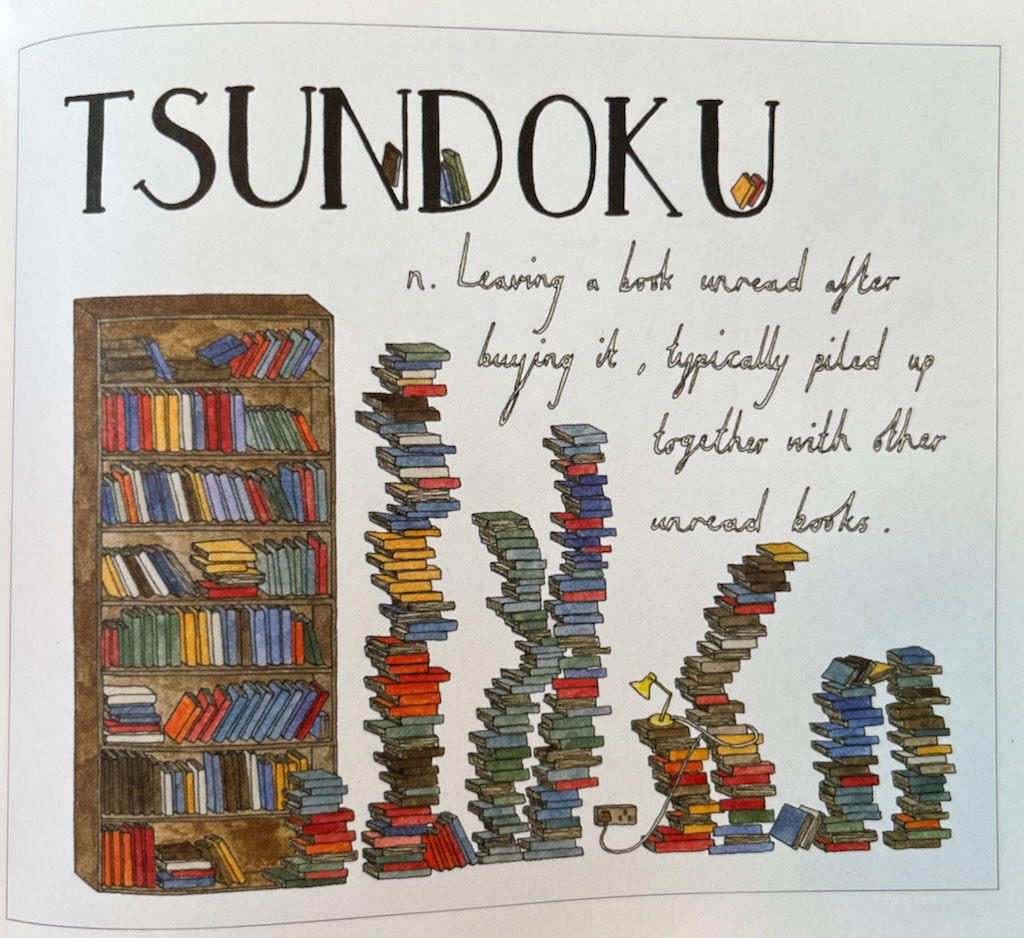
there’s a name for the ailment: tsundoku. (積ん読)

it’s the japanese word meaning, quite literally, “reading pile.” nowhere in the definition—“the phenomenon of accumulating books but not reading them”—would you find evidence of the lethal nature of said phenomenon (ten books falling on your nose will leave a dent). nor the drip-drip-drip of guilt that accumulates every time one sashays past said pile and fails to move forward in a page-turning way. 

so i’ve hatched a plan, an antidote to what ails me. i call it finishing school. i shall, in the summer months ahead, the months when the sun is strong and summer sounds abound, commit to a single purpose: one by one tracking my way toward the last sentence of at least some of the many books piled on my nightstand, my reading nook, my writing room floor, and most any other horizontal plane sturdy enough to hold a vertical biblio-ascension. 

by virtue of this determination to see literary arcs through to the end, i shall be relieving all of you of the task of checking in on the chair to see what’s astir. i am intending to post mostly what leaps off the pages, as i plod along through plots, poetries, and otherwise paradisiacal paragraphs. 

i envision something of a commonplace summer reading adventure, in which we all can chime in with any ol’ ‘graph or line that makes your heart thump, or your eyes fill with tears. 

my summer’s focus will be more reading than writing, at least here. 

the writing portion of my summer will apparently have me bent over the keyboard tapping out pages for a new project i’m not yet free to chat about. there’s an end-of-summer deadline, i do believe, so i’ll be burning up the keys to make that happen. and my refueling time will be spent deeply in reading. in finishing, specifically. 

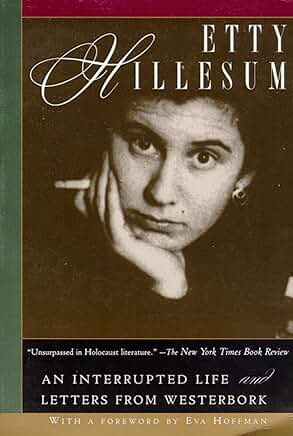
i plan to officially begin my finishing school with a book that’s tugged at me for years, one i started and loved, and truly need to wade deeper into. it’s etty hillesum: an interrupted life and letters from westerbork. begun in 1941, nine months after the netherlands fell to hitler, it’s the epistolary journal of a young dutch jewish woman who traces the darkening shadow of the nazi presence in her homeland as well as her own moral awakening before her death at auschwitz in november of 1943. it seems as essential a book in my stack as any there is. and i’m committing to etty.

back in 1986, in a review of the book in the new york times, michiko kakutani wrote this: 

“All Holocaust writings, of course, must deal with the inadequacy of words in the face of events that defy the imagination, but while Miss Hillesum frequently speaks of her inability to convey the awful magnitude of events around her, she proves herself a most eloquent witness to history—a witness whose grave yet shining testimony attests to the resilience of the human spirit in the face of incalculable odds.”

it seems a book for this moment.

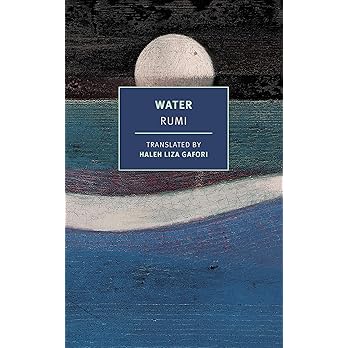
and even though the official starting bell hasn’t chimed, i tiptoed into my project this week by reading start-to-end not one but two magnificent poetry collections: water, by rumi, translated from the farsi by haleh liza gafori (new york review book classics), the second volume of gafori’s translations of the thirteenth-century persian poet (the first one, unfinished but in my pile, of course, was gold, acclaimed for its fluid rendering of rumi’s lyric ecstasies). water’s essence is Love, capital L, gafori writes in her introduction, in which she claims: “Love is a 360-degree embrace of creation, a compassionate acceptance of what it…Love is our unobscured essence, at the root of the root of all creation…Above all, Love is a practice.” 

and but one line that took my breath away in the poems themselves, was this: “Come or go, Love told me, / I am here, closer to you than the vein in your neck.” 

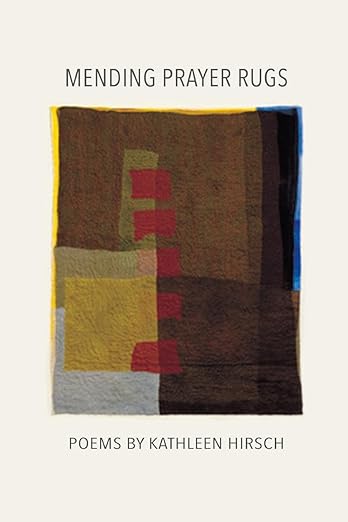
and the second collection of poems i gulped down, start to finish not once but twice, was a book i bumped into quite by accident and whose author immediately swooped into the inner circle of kindred spirits. it’s titled mending prayer rugs, poems by kathleen hirsch (finishing line press), and this collection mines the sacred amid the quotidian, with a particular focus on women of prayer, women whose wisdom is hard-won, be they women from the Bible, craftswomen, workers, wanderers or women we recognize from among our own generations.

in her opening poem, “prayer rug,” hirsch (a longtime journalist and spiritual director) writes in the voice of a woman i imagine with gnarled knuckles and fading eyesight, the cost of a lifetime spent pulling needle and thread through the tatters of prayer rugs for those who prostrate in prayer: “I bend in blessing toward all that breathes: / May each hour enlarge the pattern— / rose dawn, wind song, tender shoot of faith— / that I may see the weft of the hidden weaver.

the weft of the hidden weaver. another name for the Unnameable One. it is the metaphors of poetry that catch the breath in our throats, and frame our seeing anew.

lines such as this, a line that had me choking back tears in a poem titled, “in the end”: “Kiss the light / before it dies / leave those you love / the heirlooms of your passion, your gratitude, your tears.” 

i envision a magical summer. 

straight through to the end. 

will you read along?


a subtly transgressive little poem from the bard of the bluegrass state:

The Hidden Singer

The gods are less for their love of praise.
Above and below them all is a spirit that needs nothing
but its own wholeness, its health and ours.
It has made all things by dividing itself.
It will be whole again.
To its joy we come together –
the seer and the seen, the eater and the eaten,
the lover and the loved.
In our joining it knows itself. It is with us then,
not as the gods whose names crest in unearthly fire,
but as a little bird hidden in the leaves
who sings quietly and waits, and sings.

+ Wendell Berry

p.s. a bit more on tsundoku: The term combines “tsunde-oku” (積んでおく), meaning “to pile up ready for later and leave,” with “dokusho” (読書), meaning “reading books”. 

a note: i’m sensing we all need to shake off some of the routines of our lives that begin to feel too confining, and i don’t ever want the chair to feel that way. so my intention is to be a little bit looser about it, but still to leave faint tracings here on the table, should you happen by. summer for me has long been synonymous with reading, and thus a reading project. feel free to bring your favorites.

spring might be sprung, but i’m not springing

vernal equinox out my backdoor

they say it’s spring out there. celestial lines were crossed in the wee, wee hours of yesterday, and, for a flash there, light and shadow fell in equal measure. 

i don’t feel the light though. not in sync with springtime’s beckoning. i’m inclined still to hunker down in winter’s shadow. 

for reasons i can’t quite fathom, i’m not ready this time ’round for the seasonal advance. i still feel wintry in my bones. the light change is too abrupt for me, too ice-white for me. my inner metronome is far too slow for the prestissimo that’s rising. i don’t mind the cardinal’s vernal song, though, rung out from treetops high, and piercing through still-frigid air. but i’m not seasonally adjusted. i’m lagging at least two lopes behind. 

i can’t tell if it’s that my winter felt circumvented. or that i’m wishing for all of time to freeze in place. since the world is rather dire these days, that cannot be a wise solution. in that regard, i’ll take time in double measure. may we all wake up on the morning of eight november, 2028, with a whole new glimmer in our eyes. and the present firmly in the past.

i’m feeling somewhat stuck. hardly welcoming of burgeoning to come. and that’s a most peculiar state for me. 

might the whole universe be toppled on its head, upside down and inside out? 

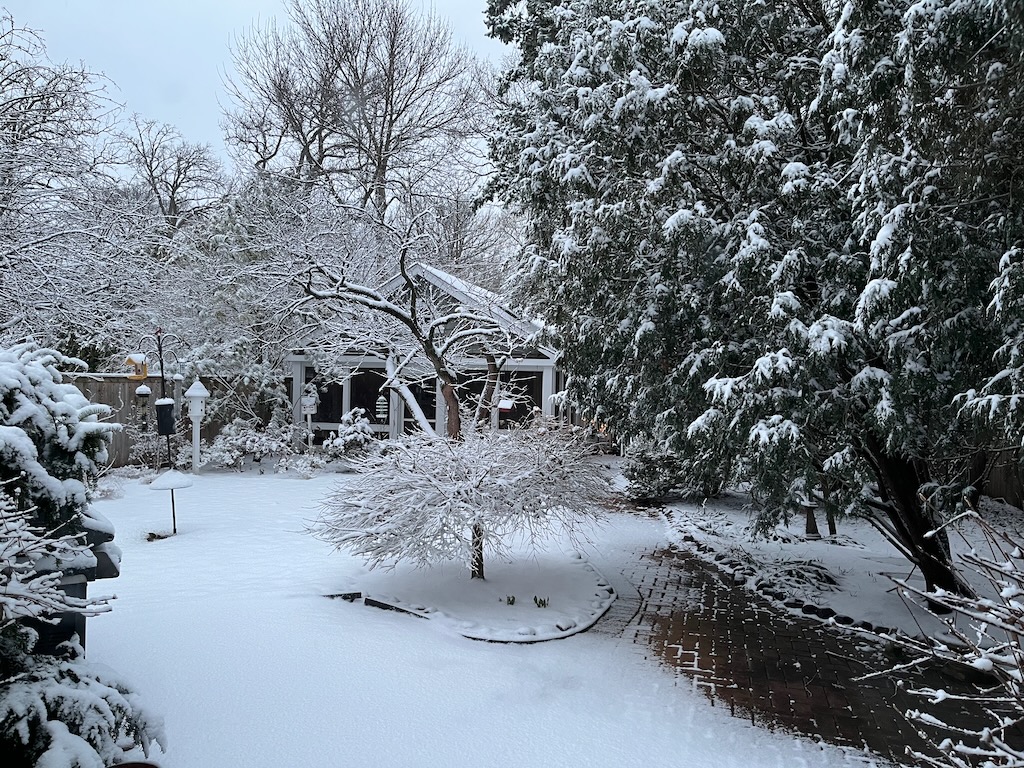
the one sure sign that spring is here is that when i awoke, just hours after equinox, the world i saw was dumped with snow. which in these parts is something of a rite of spring. tulips rise, and snowflakes fall. my mother swears she knows it’s spring when she slides on her winter boots and brushes all the glops of snow off her daffydills. 

no wonder we of the four-quarter year take spring in slow, uncertain sips. there is no fine delineation, as if the calendar and earth set their clocks in synchronous coordination. 

on a day when snows fell in glops, and then proceeded to melt in same-sized gloppings, and on the day when headlines kept insisting the springtime was upon us, i heard a thump at my door, and therein found prescriptive for my seasonal laggings. 

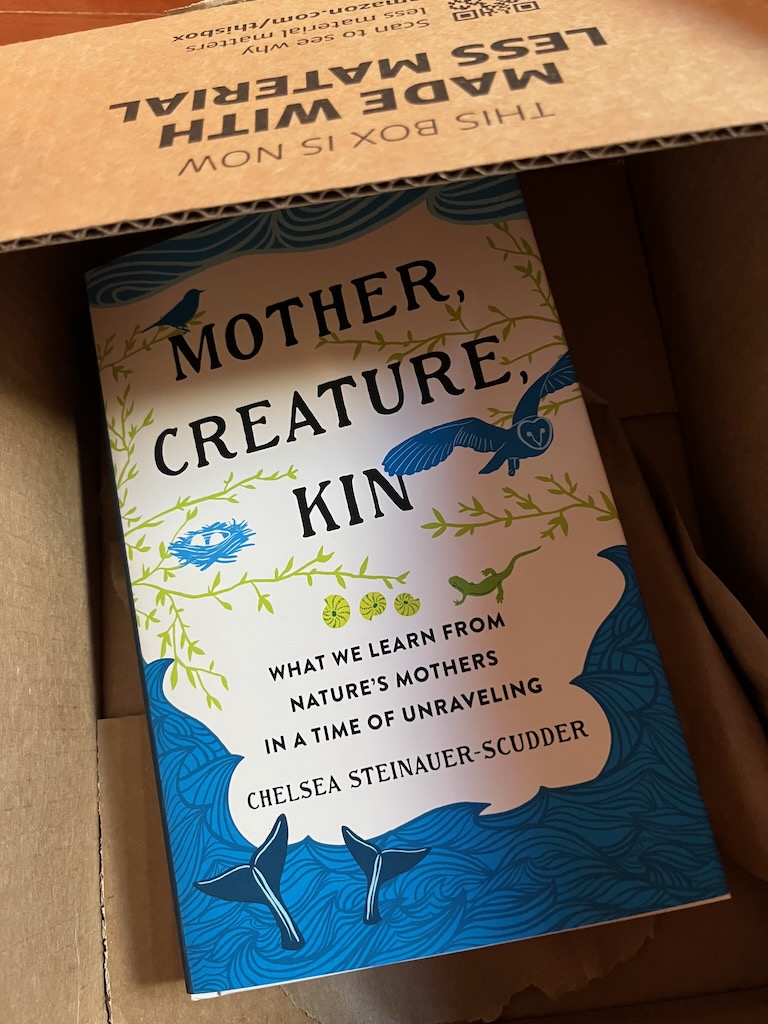
there, in a plain brown box, lay a book i’d been awaiting. my friend chelsea steinauer-scudder, as intelligent and beautiful a writer as could be, became a mother back when she and i were reading books and writing in the zoom rooms that covid carved. i’d first read chelsea in the pages of emergence magazine, a wunder site (online and print magazine, as well as creative production studio) that probes the depths of ecology, culture, and spirituality, and where she was a writer and editor for five years. when i saw she’d be leading reading circles (braiding sweetgrass, among them) and ones for the craft of nature writing, i signed up, and cemented myself to what would otherwise have been a front-row seat. 

chelsea grew up on the great plains of oklahoma and the sandhills prairie of nebraska, where for a time her papa researched bison, fire, and native plant communities, so she comes to her native landscape––language enfolding the sanctity of earth––with what seems an effortless fluency, as if she grew up breathing it. which, of course, she did. and then she went on to harvard divinity school, where she earned a masters in theological studies, and ever since she’s been writing sumptuously, focusing her work, in her words, “on the confluence of relationship to place with experiences of the sacred.”  

her first book, Mother, Creature, Kin: What We Learn from Nature’s Mothers in a Time of Unraveling (Broadleaf Books), is what brought the thud to my front stoop. it’s due out april 8, but my copy landed yesterday. and it might be the cure i needed to lull me into spring. 

a.) it gives me excuse to curl under a blanket for a day or two, and b.) here’s what i’m about to bathe in, passages such as this:

“I wish to invite you into a kind of mothering that is wild and porous. The kind that draws blood, that loves and fears, rejoices and doubts, that exposes where we are most deeply vulnerable and from there stretches us into what is beyond us. I mean the kind of mothering that works within uncertainty and mystery. The kind that leaves soil beneath our fingernails and seeds in our hair.” 

she writes about mothering and being mothered by places. ecological mothering. she defines ecological motherhood as: a shared, place-based responsibility to nurture and support human and more-than-human life. she writes of the karmic cycle of rebirth, a subject aptly plucked from the vernal syllabus. she writes of the silent flight of barn owls, of nursing and endangered right whales, of real and imagined forests, eroding salt marshes, and newly planted gardens. 

she writes that the protagonists of these stories have been teaching her facets of mothering (a verb that she, like me, insists is not tied to gender nor obstetrics). those facets belong to us all, no matter our life’s work: “language, belonging, entanglement, community, edge work, homemaking, and how to think about the future.”

my friend chelsea just might nudge me over my springtime bump, and land me softly on the vernal side….


as i await the vernal skip in my own heart, i scan the literary landscape for those others who, along with chelsea, might nudge me there. and no surprise, i turn to two favorites, the great naturalist and writer, aldo leopold, and the poet mary oliver, who drew the sacred from her every path and passage.

“One swallow does not make a summer, but one skein of geese, cleaving the murk of a March thaw, is the spring.”

aldo leopold

North Country

In the north country now it is spring and there
     is a certain celebration. The thrush
has come home. He is shy and likes the 
     evening best, also the hour just before
morning; in that blue and gritty light he
     climbs to his branch, or smoothly
sails there. It is okay to know only
     one song if it is this one. Hear it
rise and fall; the very elements of your soul
     shiver nicely. What would spring be
without it? Mostly frogs. But don’t worry, he

arrives, year after year, humble and obedient
     and gorgeous. You listen and you know
you could live a better life than you do, be
     softer, kinder. And maybe this year you will
be able to do it. Hear how his voice
     rises and falls. There is no way to be
sufficiently grateful for the gifts we are
     given, no way to speak the Lord’s name
often enough, though we do try, and

especially now, as that dappled breast
     breathes in the pines and heaven’s
windows in the north country, now spring has come,
     are opened wide.

––Mary Oliver

a little peek at what a few other authors have to say of Mother, Creature, Kin. may i call your attention to the one who writes that this beautiful book belongs in the company of works by Ursula LeGuin, Rachel Carson, Terry Tempest Williams, and Robin Kimmerer, to name a constellation of the highest-reaching lights…

are you finding yourself in springlike mode, and what sights and sounds and scents are stirring you there?

harumph.

with planes crashing into helicopters, and bodies falling into the potomac, and DEI blame being cast with no evidence in sight, i am in no mood to add more noise to the prattle. why tragedy needed to take a sharp turn into retribution, why our skies feel suddenly shaky, is only adding to the despondency i struggle to keep at bay. 

i heard stories this week of kids i love, one in far off thailand teaching english in remote villages for the peace corps, terrified that the freezing of federal funds would shatter their dreams in the making. i’ve heard stories of dish washers and cooks in chicago’s little village, a mostly mexican corner of the city, afraid to show their face on the streets, forgoing paychecks in lieu of being handcuffed and torn from the families they love. 

we live in a rippling circle of fear and confusion, a darkness is shrouding day after day.

in my teeny-tiny circle of life closer to home, some of that darkness is countered by flickering light. i find good reason for joy. feel wishes come blessedly true. i’ve lived to see a day i had prayed and prayed for, for one of my boys. and i am witness to the fire burning in the dreams of another. 

just days ago, i was holed up in a rambling old house on the shore of one great lake with four glorious women whose lives have been marred and scarred by tragedy, and yet, they’ve risen. they’ve written their way through darkness toward light. and they are magnificent. and so so brave. (one wrote the searing memoir while you were out; two others are soon coming with masterpieces all their own. a fourth, i hope, will someday publish her stories that cut to the bone.)

i hobbled home, after an otherwise uneventful walk on a stone-sprinkled beach, with an unhappy ankle.and a quick trip to the foot doc had me strapped into what feels like a leaden boot, and has curtailed my daily constitutionals for the next few weeks. but that’s not all: before week’s end, the resident triathlete in this old hovel had his knees poked and prodded and subjected to space-age medicine, and thus we’ve declared this the hobbledy house. indeed, we are a hobbling, most humbled pair, trading ice packs and heating pads, advil and tylenol, as prescribed by our duet of doctors. 

and so my offerings this week rest on the shoulders of others far wiser, less wobbly, than me. cumulatively, they compound the point that we are the solution to the miasma that abounds. 

this is our time, of all the times in our lives, to dig down deep as we can, and pull out the fiercest, finest truths we believe in. we must make true the life that ought to be. take it from this collection of seers and sages: clifton, mandelstam, rilke, and trommer, poets all. 

In the bigger scheme of things the universe is not asking us to do something,
the universe is asking us to be something.
And that’s a whole different thing.

— Lucille Clifton


“What tense would you choose to live in?” the poet Osip Mandelstam once asked his journal, before answering his own question. “I want to live in the imperative of the future passive participle—in the ‘what ought to be.’”


Let this darkness be a bell tower and you the bell.
As you ring, what batters you becomes your strength.

—Rainer Maria Rilke


BECAUSE
by Rosemerry Wahtola Trommer

So I can’t save the world—
can’t save even myself,
can’t wrap my arms around
every frightened child, can’t
foster peace among nations,
can’t bring love to all who
feel unlovable.
So I practice opening my heart
right here in this room and being gentle
with my insufficiency. I practice
walking down the street heart first.
And if it is insufficient to share love,
I will practice loving anyway.
I want to converse about truth,
about trust. I want to invite compassion
into every interaction.
One willing heart can’t stop a war.
One willing heart can’t feed all the hungry.
And sometimes, daunted by a task too big,
I tell myself what’s the use of trying?
But today, the invitation is clear:
to be ridiculously courageous in love.
To open the heart like a lilac in May,
knowing freeze is possible
and opening anyway.
To take love seriously.
To give love wildly.
To race up to the world
as if I were a puppy,
adoring and unjaded,
stumbling on my own exuberance.
To feel the shock of indifference,
of anger, of cruelty, of fear,
and stay open. To love as if it matters,
as if the world depends on it.

how might you begin to try — not to save the world, nor even your own sweet self — to practice opening your heart, to be gentle with your insufficiencies, to take love seriously, give wildly, and live in the imperative of the future passive participle, in what “ought to be”?

sun rising over the great lake michigan

a literary form for the slipperiest of minds

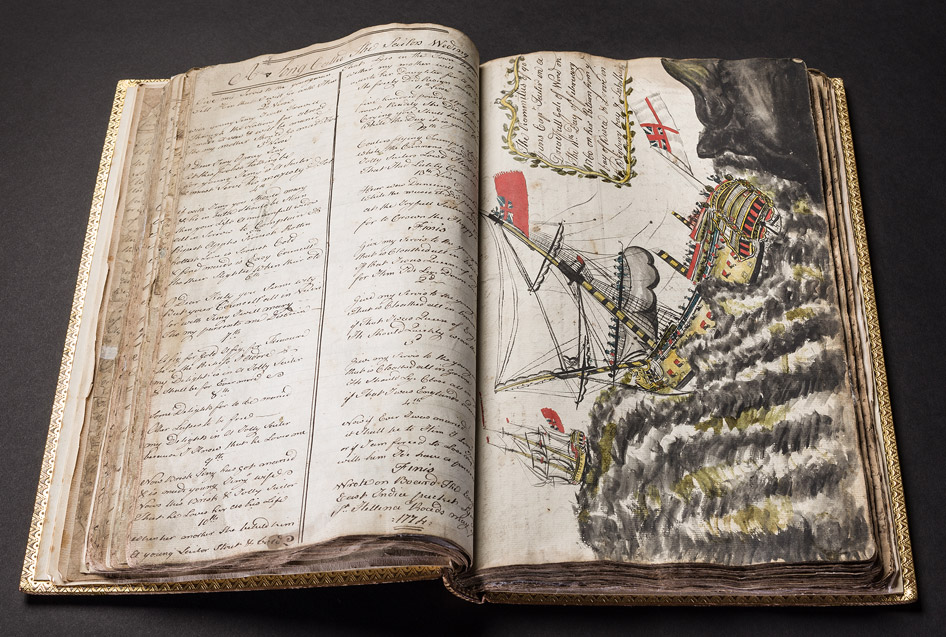
a page from british sailor henry tiffin’s commonplace book, 1760

more and more, the literary form into which i ease is one that traces roots to the ancients. to pliny, the great naturalist, whose mind must have been a beehive of sorts back in first-century rome. it’s an enthusiasm for accumulation that courses its path on through the renaissance when humanists, especially, were anxious to lock down their thoughts, keenly aware of the tragic loss of ancient learning, as libraries were so often, too often, the sites of military revenge. it’s a form that wends its way on and on through the centuries, straight through the twentieth, when mark twain, thomas hardy, ralph waldo emerson, and henry david thoreau, to name but a few, all partook of the habit. and here we are now, with plenty of us keen practitioners of the urge to gather up bits of literary esoterica and assorted ephemera before they skitter away. i think of myself, more often than you might imagine, as a rag picker of ideas in any which size, from the itty-bitty and poetic to the mindbogglingly big.

humans, it seems, like to scribble things down.

may our scribbling never cease.

the fancy name for this scribbling is commonplacing, the literary form the italians once named zibaldone, “a salad of many herbs,” in culinary terms, or a “hodgepodge” more broadly. we’re contemplating here the hodgepodge.

it’s the mosquito netting of the mind, of wonders and thoughts before they escape. or, as the 13th-century dominican monk, vincent of beauvais, once explained, it was “the multitude of books, the shortness of time, and the slipperiness of memory” that compels one to scribble.

count me in on the slippery mind.

vincent’s not-so-slippery solution: a ginormous tome, totaling 4.5 million words (someone counted!), an exhaustive compendium of all medieval knowledge, which he titled speculum maius (literally “great mirror”), speculum a word he chose because it contained “whatever is worthy of contemplation (speculatio), that is, admiration or imitation.” and thus he set out, over the course of his monastic lifetime to gather all the “flowers” (his word), or best bits of all the books he was able to read, in a selfless quest to save others the strains (time, money, trips to the library) of doing so themselves.

over the last many months, as the population of this old house has dwindled to two, and the stories to tell are fewer and fewer, my efforts here seem to have morphed into a looser, yet more concentrated consideration of the bountiful ideas and thunderbolts i bump into across the arc of a week.

there is something so natural about the human instinct to share what we’re thinking. of course there are those who might protest, who might consider me rude for shoving a book or a page or a picture in your face. but, when you think of it, isn’t that the instinct that drives so much of social media? (i often think we’ve gone overboard there, but that might be because too often it’s the magnification of any or every passing brain burp and not necessarily ones that might leave us enlightened. and too often amount to plain old overgazing at navels, or hair-raising nastiness and gut-wrenching vulgarity. but i digress…)

i’ve been keeping what amounts to my salad of many herbs for years and years now, and that urge seems to have spilled over to here, where week after week sometimes i seem to be assaulting you with the few morsels i’ve found most delicious in recent days. it’s a way, i suppose, of collectively swelling our brains. and our souls, most certainly.

in the spirit in which i bring my rag picking here, i like to think of us sitting side-by-side, cozy against the pillowy confines of an armchair broad enough for two. and in the gentlest, yet conspiratorial whisper, i offer you a page or a passage, my eyes widened and sparkling with glee, as if to say, wait’ll you see this one. what wonderments or deep thoughts spring to your mind?

any one of these next morsels is worthy of long and deep consideration. here are the ones that struck me this week:

these first two come from maria popova, whom i’ve referred to in the past as the high priestess of cultural commentary, and one of the most voracious gatherers of ideas i’ve encountered in recent years. her online literary journal, now known as The Marginalian, has been described as a compendium of hundreds of thousands of entries “that search for meaning, cross-linking ideas and connecting metaphysical dots.” here’s where she thunderbolted me this week:

“joy is a stubborn courage we must not surrender.”

“. . . love — whether we call it friendship or family or romance — is the work of mirroring and magnifying each other’s light. Gentle work. Steadfast work. Life-saving work in those moments when life and shame and sorrow occlude our own light from our view, but there is still a clear-eyed loving person to beam it back. In our best moments, we are that person for another.”


another place i often turn for soulful sustenance is Emergence magazine, a wellspring that explores the timeless connections between ecology, culture and spirituality. in a recent talk, titled “memory, praise, and spirit,” the filmmaker, composer, sufi teacher, and driving force behind Emergence, emmanuel vaughan-lee, opened with these words:

“The mystics say that we are like a seed; that we hold the blueprint for our highest potential within us, and that much of spiritual practice, regardless of what tradition, is unlocking that potential.”


and i close with this one from the great james baldwin, a passage from his 1964 collection of intimate but somewhat little-known essays, titled nothing personal. this passage is from the fourth of the four essays collected there:

“One discovers the light in darkness, that is what darkness is for; but everything in our lives depends on how we bear the light. It is necessary, while in darkness, to know that there is a light somewhere, to know that in oneself, waiting to be found, there is a light.”

i could write an essay on any one of the above, but instead i invite you to chew on each or any one. each one, a morsel worthy of your time, your mind, your soul.

which one spurs you and stirs you the most, and what deep thoughts spring to your mind?

i’ve written before of commonplacing. here at the chair, and in my latest book, The Book of Nature, on pages 87 and 88. it’s a habit i can’t get enough of, an urge i can’t quench.

pages from the commonplace book of charles dodgson, aka lewis carroll

summer reading: the writer who gave us spider webs and a little mouse, plus other wisdoms

elwyn brooks white, best known to those who loved him as “andy,” and best known to you and me alphabetically as “e.b.,” taught me as much about love as just about any author i’ve ever read. and that includes the sacred texts of just about any religion i’ve happened upon.

every time i’ve pored over the words of charlotte’s web, or stuart little, or “death of a pig,” among the most masterful essays put to paper, i’ve felt the walls of my heart widen, and the bottom go deeper. perched against pillows in the old four-poster bed where both our boys inhabited the dreamland of their youths, i recall the sobs coming in echoes––from the one who was reading and the one being read to––as i choked my way through the tear-blurred words at the top of a still-splotted page 171: “she knew he was saying good-bye in the only way he could. and she knew her children were safe.” (i can’t even type that last sentence now without the tears coming again, filling my sockets.) “. . . she never moved again.” and then “. . .no one was with her when she died.”

we are reading, of course, of a spider. a spider we have all come to love, named charlotte.

and any writer who could make me love with all my heart an arachnid is a writer about whom i can never ever know enough. so it was with purest, geyser-like joy that i turned the pages this week of the first-ever fully illustrated biography of the legendary elwyn brooks white.

part collage, part scrap book, with excerpts of e.b.’s letters, and sketches, and reprints of early drafts and revisions in his own handwritten manuscript, Some Writer! The Story of E.B. White, by the caldecott honor winner melissa sweet, is at heart a love story told of one of the great disciples of love in its quietest, most undeniable forms.

e.b.’s life’s work, as he saw it, and as he wrote in a letter to a reader of charlotte’s web, boils down, pretty much, to this:

love these days seems to be a commodity of which the world is running short. but andy, or e.b., set out to make us see it, and feel it deep in our bones, by telling us the stories, as he put it, “of the small things of the day, the trivial matters of the heart.” he calls those matters “the only kind of creative work which i could accomplish with any sincerity or grace.”

e.b. white

well, dear andy, my gratitude to you is etched on the chambers of my heart, a graffiti of the highest order. to teach a child that love comes in the corner of a barn or even atop the manure pile where wilbur the pig so merrily huddled, well, that’s a blessing pure and certain. and imperative, i’d argue. and too often missed, i’d add.

because he’s earned his post as ballast for my wobbly, sometimes-too-tender heart, wasn’t i delighted when i turned to page 132 in this charmed and charming illustrated biography, and found this excerpt from andy’s letters, which seemed to me a prescriptive for these hard times and the dark clouds under which we find ourselves:

“things can look dark, then a break shows in the clouds, and all is changed, sometimes rather suddenly. it is quite obvious that the human race has made a queer mess of life on this planet. but as a people we probably harbor seeds of goodness that have lain for a long time, waiting to sprout when the conditions are right.

i’ll stop there with my old friend e.b., because that’s the line i want to consider, the line i want us to latch onto and live.

and so, what a curious thing that the next wise soul i wandered into this week was one olga jacoby, a german-jewish englishwoman and mother of four adopted children, who, in 1909 at age 35, had received a terminal diagnosis from her doctor, and sat down to write him a letter on the subject of living and dying without religion, but with moral courage, kindness, and a stunning receptivity to beauty. their correspondence would unfold until jacoby’s death four years later, and her letters, “by turns funny, touching, and intensely sad,” were published posthumously and anonymously by her husband in 1919.

in her first letter, to “my dear doctor,” she boiled down her belief to this:

“To leave a good example to those I love [is] my only understanding of immortality.”

and a year into her diagnosis she illuminated that notion:

“. . . More and more to me this simplest of thoughts seems right: Live, live keenly, live fully; make ample use of every power that has been given us to use, to use for the good end. Blind yourself to nothing; look straight at sadness, loss, evil; but at the same time look with such intense delight at all that is good and noble that quite naturally the heart’s longing will be to help the glory to triumph, and that to have been a strong fighter in that cause will appear the only end worth achieving. The length of life does not depend on us.”

and, she leaves us with this bedrock of lived truth:

“. . . Love, like strength and courage, is a strange thing; the more we give the more we find we have to give. Once given out love is set rolling for ever to amass more, resembling an avalanche by the irresistible force with which it sweeps aside all obstacles, but utterly unlike in its effect, for it brings happiness wherever it passes and lands destruction nowhere.”

who teaches you on the subject of love? what seeds of goodness harbor in you, and how will you coax them to sprout? and how might you put into practice the avalanche of irresistible force practiced by spiders and pigs alike (at least in the rich imagination of one e.b. white) and that, to the dying mother of four, was the most lasting thing that ever there was?

Some Writer! came to me, as so many of the best so-called children’s books do, by way of my best longest friend, auntie mullane, the children’s librarian, who prescribed it as the sure cure for summer blues, or any blues that might befall us in this dark-clouded era.

e.b. white on a rope swing, 1976

bibliotherapy: of fictional nature

i tend to ground myself in the world in all its nitty-gritty. that mattered (critically) when i was a nurse (don’t you dare inverse a systolic for a diastolic, when it comes to blood pressure reading), and in all my decades of chasing after news, the truth—and every grimy detail—was what we sought. thus, when i peruse the bookshelves of my local free library (the world’s most generous invention, to be sure), i am nearly always in the down-low where no windows are, where the endless rows of fact not fiction reside. 

i’m decidedly non-fictionally inclined.

but this week i was lulled into the rooms upstairs, the rooms where sunshine streams through sky-high windows, and where make-believe is the order of the room. in other words, i crept up to where the fiction is. and in the writings of one irish novelist, a fellow i’d give anything to sit with in any irish pub, or better yet to stroll the rocky coastline of the continent from which half my peoples come, i found the surest cure for running from the blues. 

niall williams is his name, an irishman, who is but a year younger than me, and who has gathered wisdom as an old stone takes on a mossy coat. i can almost see the glint in his eye, as from some quiet post in the corner of a dimly-lit, crossbeamed room, he’s kept closest watch on the quirks and comedies of human nature. and on the heartbreak too. as the tenderness he kneads into his prose and paragraphs has left me gasping more than once (and i am only eight chapters in). 

the book is this is happiness, as prescriptive a title as a girl in search of antidote might want. 

the irishman had me at chapter 1: “It had stopped raining.” (that’s the chapter in its entirety.)

chapter 2 picked up where 1 left off: “Nobody in Faha” (the fictional irish town that just happens to be a spot on the map not far from where my non-fictional peoples hailed) “could remember when it started.” by the third sentence of that second chapter, i was ready to shove up my shirtsleeves and not move an inch till i’d turned the last page. it went like this: “[Rain] came straight down and sideways, frontwards, backwards, and any other wards God could think of. It came in sweeps, in waves, sometimes in veils. It came dressed as drizzle, as mizzle, as mist, as showers, frequent and widespread, as a wet fog, as a damp day, a dreeping, an out-and-out downpour.” 

and on it goes, plip-plopping along, this incantatory passage that soon enough tells us that the unrelenting rain came “like a blessing God had forgotten he had left on.”

this is nothing less than bliss in garamond font (a literary typographic detail nearly always spelled out at the back end of any book); and most certainly for a girl who penned a paragraph of her own, in her most recent book, that unfurled in uncannily kindred ways. c’est moi:

“Rain, like most of us, has its moods. In its more laconic hours, it comes on unsuspectingly, without folderol, timpani, or cymbal crashing, the barest slip of a presence and suddenly you’re bespattered. On the days when rain is tempestuous, furious, raging, it rattles the heavens, cleaves the night, pummels the trees, and sends all the world—even the puddle-­paddling robins—running for cover. Betwixt and between, it’s the master of a thousand voices, from the salubrious plopp—the drop with a splatter—to the militaristic rat-a-tat-tat, when the rain tries to pretend it’s a handful of pebbles thrashing your windows, and on to the audible gulp when a downpour is frothing your gulleys. The Brits, reliably saturated in the subject, offer a lengthy lexicon for precipitation’s multiple personalities: there’s a basking (drenching in heavy shower); a drisk (misty drizzle); a fox’s wedding (sudden drops out of clear blue sky); a hurly-burly (thunder and lightning); a stotting (rain so hard it bounces up off the ground); and, for closers, thunner-­pash (heavy shower with thunder). Because it’s so elemental, the life stuff of our very existence, the celestial surge that fills our rivers and waters our crops, rinses away the detritus, bathes all the woods, and the sidewalks as well, it’s been the subject of intense preoccupation and prognostication for a long, long time. time. Since ever ago.”
(p. 85, The Book of Nature)

is there not a hint here of shared joy in precipitatory romps? can you not feel the two of us––niall et moi––luxuriating in the many, many wondrous ways to say “the rain is unrelenting”?

i am hardly alone in my enamorment of mr. williams. my best best friend, a longtime children’s librarian in the los angeles public schools, couldn’t stop texting me pictures of its pages this week, and, soon after, when i mentioned to a beloved literary friend (a sister chair, who might reveal herself below) that i’d fallen into novel love, she reminded me that she’d told me so a few years back. as always, i am late to my own party. 

in any case, here’s what the new yorker had to say back at the dawn of 2020, in the year of our covid, when happiness whirled onto the world stage.

This Is Happiness, by Niall Williams (Bloomsbury). This elegiac novel is as unhurried as its setting: Faha, a village in western Ireland, “unchanged since creation” until, in the late fifties, electricity arrives. The narrator, now elderly, reminisces about that time; having come from Dublin as a teen-ager, to live with his grandparents after the death of his mother, he conceived a hopeless passion for three sisters. “We spend most of our lives guarding against washes of feeling, I’m guarding no more,” he promises. The novel’s description of a lost rural life style, and the gaps between a young man’s romantic expectations and the inescapable letdown of reality, is comic and poignant in equal measure.

all of which is to say that bibliotherapy is one of the world’s great cures for whate’er ails you. and even more so when it ferries you off to a wee irish village “where story was a kind of human binding,” where church pews were filled as if by unwritten order, where front doors were never closed in daytime nor backdoors locked at night, and where, we’re told, “religion lasted longer … because we were an imaginative people, and so could most vividly picture the fires of Hell.” 

and wherein the self-described antiquarian narrator notes in passing, “i know it seems unlikely that Faha then might have been the place to learn how to live, but in my experience the likely is not in God’s lexicon.”

the world these days is wearying. and worrying, too. my week began with a funeral, a breathtakingly beautiful one that wove buddhist and roman catholic threads but was tragic nonetheless, and was followed by a seder where the weight of gaza and jerusalem bore down on every heart. by week’s end, i’d heard tell that my kid was nearly carjacked, and a dear friend who lives alone (and has borne already more than too much suffering) is on the cusp of twelve rounds of godawful, pray-to-God-it-works chemo for the newly-diagnosed cancer in her lungs.

the blooms outside my kitchen door were doing all they could to boost the perfumed quota in the vernal air, and the robins busied themselves constructing scrappy nests in my window box along the alley. (do not ask me to tell you the tragic tale of the mama robin who was tangled in a dessicated grapevine, nor of the nest no longer in the works.) all the earth’s wonderment––glorious as it is as winter erupts into spring––is ephemeral, is here, then, poof, it’s gone. 

but what i find on the page is lasting. can be read and read again. can be indelibly inked into the files of our mind.

and so, this week, a newfound balm and friend was found. and i’ll be tucked away in faha, on the fictional irish coast, for as long as the pages will carry me. bibliotherapy rarely fails me. 

what carried you away this week?


here’s a jolt of joy that took my breath away this week: the great christian mystic richard rohr, a franciscan friar and ecumenical teacher, and his new mexico-based Center for Action and Contemplation saw fit to surprise me by clipping an excerpt from The Book of Nature in his daily meditations on wednedsay. that he chose a favorite passage, the story of brother lawrence, the barefoot monk who saw God in the pots and pans of his parisian monastery kitchen, and was struck by the innate holiness of a nuck-naked little tree, only charmed me all the more. here’s a peek at the preaching of the trees.


and from this week’s commonplacing. this morsel from DH Lawrence:

The vast marvel is to be alive… The supreme triumph is to be most vividly, most perfectly alive. Whatever the unborn and the dead may know, they cannot know the beauty, the marvel of being alive in the flesh. The dead may look after the afterwards. But the magnificent here and now of life in the flesh is ours, and ours alone, and ours only for a time. We ought to dance with rapture that we should be alive and in the flesh, and part of the living, incarnate cosmos. I am part of the sun as my eye is part of me. That I am part of the earth my feet know perfectly, and my blood is part of the sea. My soul knows that I am part of the human race, my soul is an organic part of the great human soul… There is nothing of me that is alone and absolute except my mind, and we shall find that the mind has no existence by itself, it is only the glitter of the sun on the surface of the waters.

this, from mary oliver

Morning Light

by MARY OLIVER

Every morning
 the good news
  pours
   through the field

touching
 every blossom
  every stem
   and each of them,

on the instant
 offers to be part of it—
  offers to lift and hold, willingly
   the vast burden of light

all day.
 In my life
  I have never seen it to fail—
   flower after flower

leaf after pearly leaf,
 to the acre,
  to the massy many,
   is silvered, is flooded;

and such voices
 spangle among it—
  larks and sparrows—
   all those small souls—

are everywhere
 tossing the quick wheels of pleasure
  from their red throats
   as they hang on—

as though on little masts
 of golden ships,
  to the tops of the weeds—
   and that’s when I come—

that’s when I come, crying out to the world:
 oh give me a corner of it
  to lift also, to sing about, to touch
   with my wild hands—and they do.

and this from annie dillard‘s the writing life, prose laid out as a poem by my friends at SALT Project:

One of the few things I know
about writing is this:
spend it all, shoot it, play it, lose it,
all, right away, every time. 

Do not hoard what seems good
for a later place in the book,
or for another book;
give it, give it all, give it now. 

The impulse to save
something good
for a better place later
is the signal to spend it now. 

Something more will arise
for later, something better.
These things fill from behind,
from beneath, like well water. 

Similarly, the impulse to keep
to yourself what you have learned
is not only shameful, it is destructive.

Anything you do not give
freely and abundantly
becomes lost to you. 

You open your safe
and find ashes.

and finally, this goodbye to “poetry’s colossus,” helen vendler, whom i was blessed to call my teacher in our year of sumptuous thinking

and blessings to you, and thanks for whirling by….

p.s. the other two books in my bibliotherapy stack (above) are william’s history of the rain, which had me at the title, and letters from max: a book of friendship, an epistolary collection between a poet and a playwright: sarah ruhl, the twice pulitzer-finalist playwright who was once teacher to poet max ritvo and quickly became dear friends, and as max’s cancer grew worse, their connection deepened. suleika jauoad ran an excerpt the other day in her isolation journals, and i ran to the library to grab a copy.