pull up a chair

where wisdom gathers, poetry unfolds and divine light is sparked…

Category: blessings

a jump on counting my blessings . . .

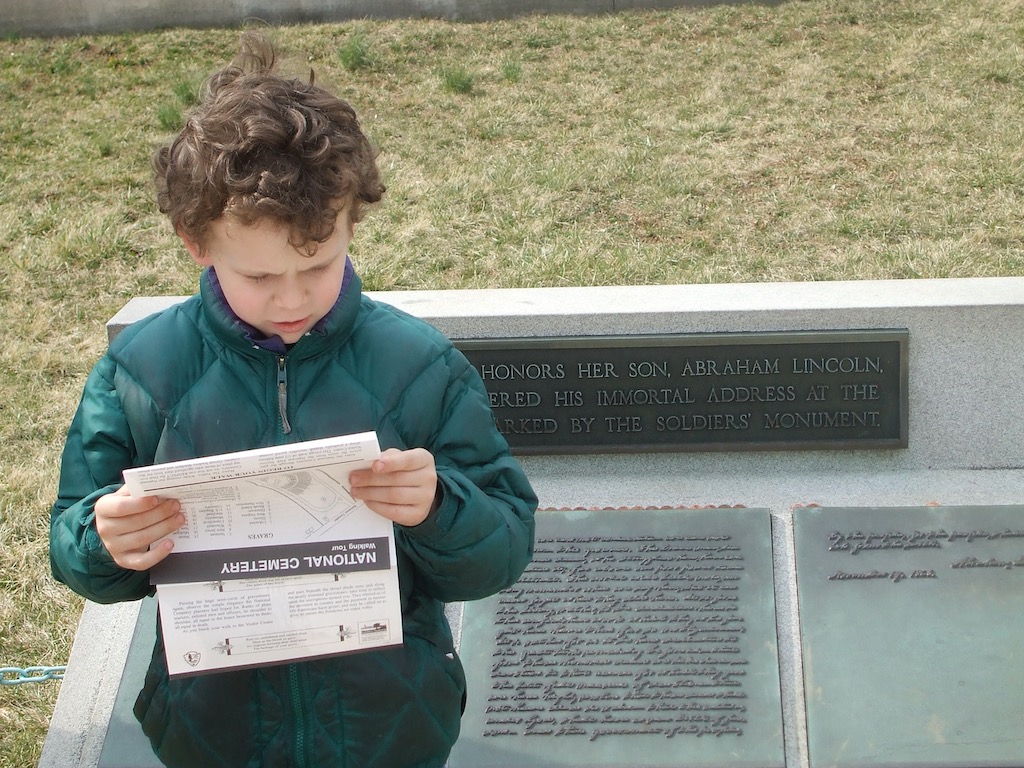
photo by will kamin*

the days of late have been plenty gray, sodden gray, gray the color of chimney ash. 

the gray started seeping into me especially this week when someone i love lost her father who might have qualified as one of the dearest men on earth. he was 97 and as alive and filled with curiosity and charm as anyone whose tales i’ve ever known through the close transitive property of one shared soul. i’d never met him, though i longed to, but he came alive to me because his daughter, our very own amy of the chair, told the most animated love-drenched stories of him. his last name was neighbour, and i am pretty sure his amy must have grown up thinking the whole world was singing along with mister rogers when the sweatered one belted, “won’t you be my neighbour?” because who wouldn’t want to be hub neighbour’s neighbor??

the grayness, though, started to shatter when i looked up late yesterday afternoon and saw not one, not three, but six scarlet cardinals circling round my feeder, taking turns at the 0s where the seed dribbles down for the plucking. 

that’s all it took to remind me to count my blessings. 

so i begin with six: cardinals, all in a ring, chasing away the murky gloom of twilight, chasing away the murky shadow that’s been eclipsing a chunk of my soul. . .

more blessings: 

the boy driving home from college on sunday. the dinner i’ll serve, a birthday feast for my very own mama who turned 92 this week, and who longs for birthdays to end, so she can “go home,” to the heaven she pines for. . .

the boy flying home on thanksgiving morn, when his hours among us are brief, too brief, but at least he’ll be here long enough for me to reach under the table and give his fingers a squeeze. and that hallowed night i’ll fall asleep to the sounds of two boys in two ‘cross-the-hall rooms rustling the sheets of their boyhoods, snug in their long-ago beds. . .

the faraway cousin who bathes me in books, this week’s batch a quartet on the birds and wild herbs and trees and critters of ireland, complete with marvelous lore and legend. (according to one celtic telling, the robin is the bird thought to bring comfort to the wounded and suffering. and here’s my favorite part: the plump little bird came to boast its red breast, according to the heavenly irish, when it pulled either a thorn from Jesus’s crown while he hung on the cross, or a nail from his hands or his feet, so Jesus’s blood spattered on the robin and thus it became red-breasted.) . . .

the husband who sits across from me at dinner each night, fielding my curiosities and never ever failing to say thank you for a dinner he always claims “delicious,” (even, i swear, when it’s not). and who, even after all these years, can set my heart soaring because of the way he captures a thought or a phrase, and whose unheralded kindnesses often only i witness. . .

these lines i read from rabbi jonathan sacks’ posthumously published, studies in spirituality: a weekly reading of the jewish bible (more on this some other friday), in a chapter on judaism as a religion of listening . . .

“If I were asked how to find God, I would say: Learn to listen. Listen to the song of the universe in the call of the birds, the rustle of trees, the crash and heave of the waves. Listen to the poetry of prayer, the music of the Psalms. Listen deeply to those you love and who love you. Listen to the words of God in the Torah and hear them speak to you. Listen to the debates of the sages through the centuries as they tried to hear the texts’ intimations and inflections. 

“Don’t worry about how you or others look. The world of appearances is a false world of masks, disguises, and concealments. Listening is not easy. I confess I find it formidably hard. But listening alone bridges the abyss between soul and soul, self and other, I and the Divine.”

Rabbi Jonathan Sacks

the poet friend who’s found the courage to once again plunk herself at my so-called kitchen table writing school (virtually, this go-around), so we can try to chase away whatever demons spook her into thinking she can’t write when in fact she writes in a way that takes my breath away. . .

the friend who never fails to ping me when there’s a glorious moon rising or looming out my late-night window. . .

every single one of you who pulls up a chair. for all these years, known or unknown, you have graced me and blessed me. . .

that’s more blessings than i can count, and i am only just beginning. 

what lines are you adding to your litany of gratitudes this year?

*photo by will kamin, from his AP art photo portfolio from his senior year of high school. now professor kamin, our very own assistant professor of law….

please keep our amy in your prayers. and the soul of her papa.

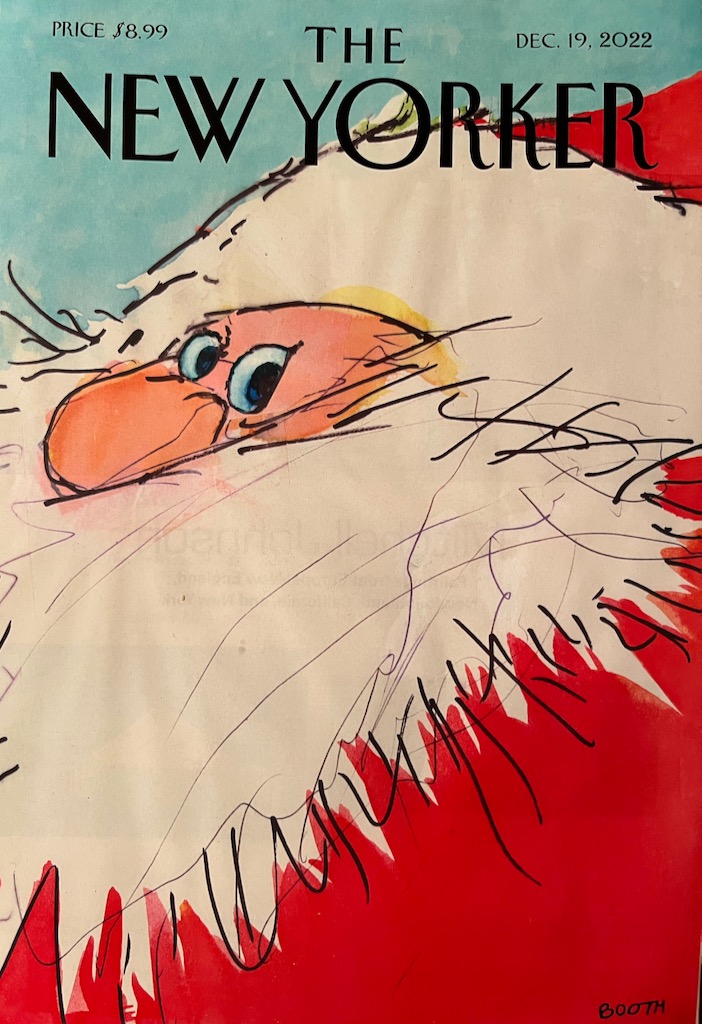
george booth has died and other news of the week…

George Booth, the New Yorker cartoonist who created a world of oddballs sharing life’s chaos with a pointy-eared bull terrier that once barked a flower to death, and sometimes with a herd of cats that shredded couches and window shades between sweet naps, died on Tuesday at his home in Brooklyn. He was 96.

so begins the new york times obituary of a man who infused my childhood. no, he didn’t frequent the five-and-dime in our leafy little town. he didn’t populate the pews of our native church. he came in the mail. every week. and in the weeks when he graced the cover, or was tucked inside the confines of william shawn’s new yorker (known as “the holy grail for cartoonists”), you could count on tracking down my mother if you traced the vapors of her out-loud laughing to where you’d find her giddily all but hiding behind the glossy pages of the slick. she would laugh, back then and even now, in a way that made you think there was something almost-naughty about those pages, which of course made us, her troupe of five, scamper to its pages soon as she abandoned it on the stack of mail, where hours later our ad man of a dad (who never met a joke or pun he didn’t relish) would saunter on the scene and chuckle at whatever was the funny. 

george booth proved to us that our mother — the very one who trained us to eat our peas and lima beans without complaint, and never tell a lie, to ne’er ignore the dinner bell, and always look both ways –– had a secret compartment full of almost-naughty humor. and if we kept close watch, we too might figure out the shortcut to some eternally redemptive funny bone. 

thus, coming upon the news that mr. booth has died this week, and that his wife of 64 years had died a mere six days earlier (such tales of love and lives that end in stunning unison nearly always make me weak at the knees), i felt a thud to the heart that only certain deaths elicit. 

there is a minor cast of characters in every childhood — the names that brought applause, the ones whose books most frequently recurred, the ones whose movies brought us the rare chance to blow a bedtime  –– who indelibly marked our evolution, and maybe formed the foggy outlines of who we aimed to be when we grew up. or at least what attributes we might try on for size. 

if i close my eyes and tick through the litany of those my mother ushered in, the ones held up in near heroic halo, it’s george booth & co., the new yorker cartoony cast; peg bracken, she of the i hate to cook cookbook; it’s doris day and julia child, all of whom made my mother giggle. it must have been the giggle that so allured. it was a merriment i must have longed for, and long for still. laughter belongs to a human register all its own, audible proof of joyful stirring deep inside. w. h. auden once observed: “among those whom i like or admire, i can find no common denominator, but among those whom i love, i can: all of them make me laugh.”

thank you, mr. booth, for bringing laughter, so much muffled laughter, to the house where i grew up.

in other news, i find myself absorbing the miracle of 70-degree november days. took me a long time — too long — to learn to freeze-frame pure joy and deep-down contentment. but now the hours of my days are as if beads threaded on a string, not unlike the rosaries i long ago learned to pray: mysteries joyful, sorrowful, glorious, and luminous. not a bad paradigm for living. learn to live bead by bead, moment to holy saturated moment. allow each orb to shine in all its constitution, be it radiant or shadowed or somewhere in between. and the beauty of these days, when the leaves are blazing paint-pot hues –– aubergine and persimmon, pure gold and harvard crimson –– they tap me on the soft shell of my soul, and whisper: this is holy time. behold it well. 

george booth would make me laugh at that. but he’s no longer here. so it’s on us to find the humor hidden in the chaos of the every day. 

who comprised the minor cast of characters in your growing up years? who made your mama laugh or cry, who or what did you aspire to be when you grew up and moved away from home?

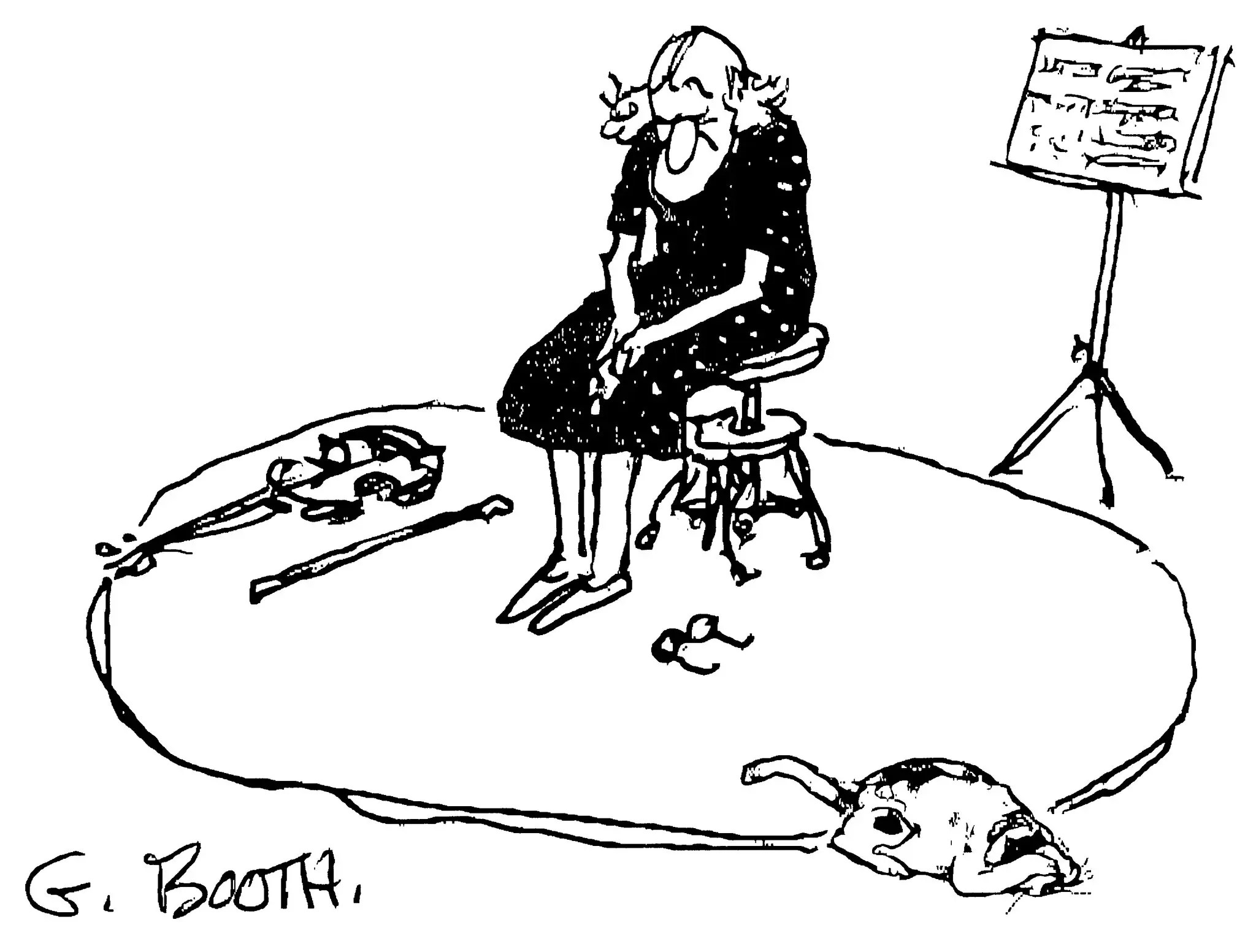
this is booth’s cartoon in the immediate wake of 9/11, when the new yorker had decided no cartoons for that issue, but george submitted this anyway; the cat covering its face with its paws, the usually animated fiddle-playing miss rittenhouse (a recurring character modeled after booth’s mother), head down, hands clasped in prayer, sadly silenced by it all.

make room for joy. always make room.

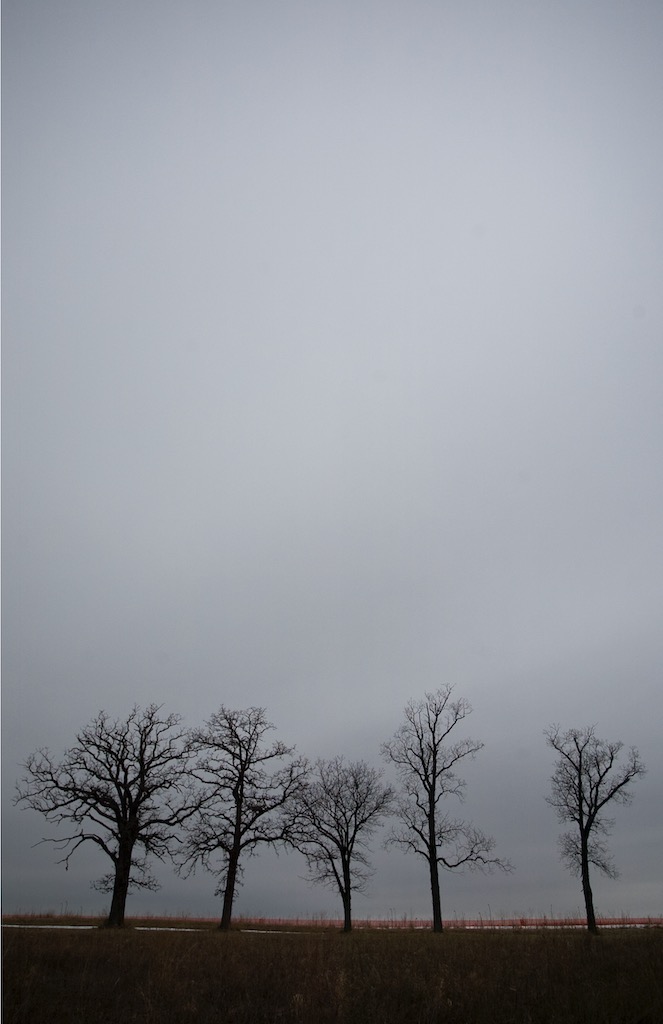
from what i know, from what i hear, and from what i gather, there’s a miasma of gloom hovering over the landscape, not unlike an early morning fog that forgets to scuttle away once the sun burns down. 

it’s a despair in general and in particular. it’s a despair that has long been casting its shadow, as we seem to be dwelling in an epoch of upheavals. from a rage that’s spilled even into the lanes of the little village where i live (did i really deserve a middle finger for driving exactly the speed limit on a curvy hill?) to venom poured onto airwaves and social media feeds (excuse me for backing away from all but a quick scroll for news), it’s gotten harsh out there. and institutions we counted on seem to be pulling out the rug.  

but i read something this week that reinforced what’s become my saving grace, though reading it helped me to see more clearly that i needn’t feel guilty for reaching toward my apothecarial shelf of simplest balms. i’ve been making a practice of stitching the tiniest joys into my day, and pausing long enough and deeply enough to let them sink deep down into the crevices, the nooks and crannies and channels of the soul where the life spark burns. 

i might pause in my dashing down the walk to listen to the gurgle of my bubbling fountain. i might plop in a wicker chair to watch the slanting sunlight turn golden a flapping hydrangea leaf. i might catch mama wren ferrying a worm to her chirpy little ones. they’re the littlest wisps of joy, the things that percolate my heart and soul and each and every summer’s day.

what i read this week were wisdoms from mary pipher, an american clinical psychologist, long rooted in lincoln, nebraska (which in my book certifies her down-to-earth wisdoms as deep as the roots of the prairie dropseed that rolls across the miles). pipher, whose wisdoms are too boundless to be bottled, is best known for reviving ophelia: saving the selves of adolescent girls, her 1994 rescue guide for an america she calls a “girl-destroying place,” and more recently she’s written women rowing north, a book on aging gracefully. (note to self: please read.)

this week, though, she wrote an op-ed for the new york times, in which, after outlining the simple joys with which she unfurls her day––a morning cup of coffee, watching the sun rise over a lake, listening to the sounds of sparrows, the commonest of common birds––she writes that she is “leading a double life.”

Underneath my ordinary good life, I am in despair for the world. Some days, the news is such that I need all my inner strength to avoid exhaustion, anxiety and depression. I rarely discuss this despair. My friends don’t either. We all feel the same. We don’t know what to say that is positive. So, we keep our conversations to our gardens, our families, books and movies and our work on local projects. We don’t want to make one another feel hopeless and helpless.

Many of us feel we are walking through sludge. This strange inertia comes from the continuing pandemic, a world at war and the mass shootings of shoppers, worshipers and schoolchildren. In addition, our country and our planet are rapidly changing in ways that are profoundly disturbing. We live in a time of groundlessness when we can reasonably predict no further than dinnertime. The pandemic was a crash course in that lesson.

As we are pummeled with daily traumatic information, more and more of us shut down emotionally. I can hear the flatness in the newscasters’ voices, see the stress in my friends’ faces and sense it in the tension of the workers at my sister’s nursing home. We are not apathetic; we are overwhelmed. Our symptoms resemble those of combat fatigue.

Mary Pipher

she goes on to write that in an age where ukraine and afghanistan and yemen are everyday news, and the horrors therein threaten to numb us, where the american political landscape some days resembles an extreme-wrestling match, nothing short of world-class coping skills are called for. and thus she lists three of her wellsprings: her grandmother who raised five children on a ranch during the dust bowl and the great depression; thich nhat hahn, the buddhist monk and zen master; and her years-long study of psychology. 

her wisdoms are these: her grandmother urged her to “be the person you want to live with every day of your life,” and on the last day of her life she told mary that her life goal had been “to leave the world a better place;” from thich nhat hahn, who’d witnessed great suffering in vietnam, she not only absorbed his practices of mindfulness, anchoring herself in the present moment, but also his deepest teaching about our interconnectedness with all of life, a worldview that finds healing through reaching out to the frightened, the hungry, the ravaged in all its forms; and, from psychology, pipher learned that the best way to cope with suffering is to face it, feel it in our bones, explore it, extract its meaning, and then muster the resources to move forward. here she prescribes: “find ways to balance our despair with joy.”

maybe take a minute to let each one of those soak in. . . 

“be the person you want to live with. . .”

“present moment. beautiful moment. . .”

“action is an antidote to despair. . .”

Most of us cannot be great heroes. However, we all have the capacity to be ordinary heroes.

to be an ordinary hero is to find someone close to home who’s hurting, and be the healing balm. resist the urge to flip back someone else’s insolence. even on a day when you might prefer pure silence, invite in someone whose days are defined by loneliness. make your front stoop or your back porch a place where the welcome sign is often posted. 

go about the business of gathering up simple joys; know that they’re the fuel to carry you across the long and lonely miles. revel in the red bird who alights just beyond your window sill, and serenades the coming darkness. follow a butterfly across your garden. watch the night stars turn on. keep an eye out for the fireflies’ first flickering. 

make room for joy. joy is a necessary oxygen for both soul and psyche. without it, we shrivel, furl inward, gasp for breath amid the not-unlimited allotment of days we have here. 

those joys needn’t be grand, needn’t strike up any band. we’re on the hunt here for simple joys, barely detectable threads of joy; weave them through your day.

they just might embolden you for the long haul, the long and seemingly unbearable haul. 

where will you find joy today? how will you make room?

i just yesterday got page proofs for my next book, The Book of Nature: The Astonishing Beauty of God’s First Sacred Text (pub date: march 21, 2023), and that means i will be underwater for the next two weeks making sure there are no runaway commas, or words wrongly landed amid a sentence. it’s nerve-wracking and eye-straining, but it moves me closer to the finish line. i might not get a chance to circle back to reply to comments for awhile, but sooner or later, i promise i will. and soon as i can i’ll show you how pretty someone made the pages of my little book. till then, take care, and take joy, as tasha tudor always insisted…

photo above by will kamin.

p.s. here’s a little joy that slipped under the transom yesterday, when my beloved brother brian found my little book available for pre-order in — get this!!! — park slope and switzerland. excuse me while i gulp. (the actual cover, which i’ve not yet been told i can share, is peeking out from under the pre-order banner on the community bookstore, now a shop added to my must-visit list. xoxoxo thank you little bookstores, online and real-world.)

catching up…

it’s been 792 days since that red-ringed virus shut down the world as we know it. all sorts of events got pushed off to the side, and plenty others — too many others — happened anyway, though no one was allowed to gather, to convene to absorb each other’s pain or amplify the joy of sweet triumphs large or small or somewhere cozily in the middle.

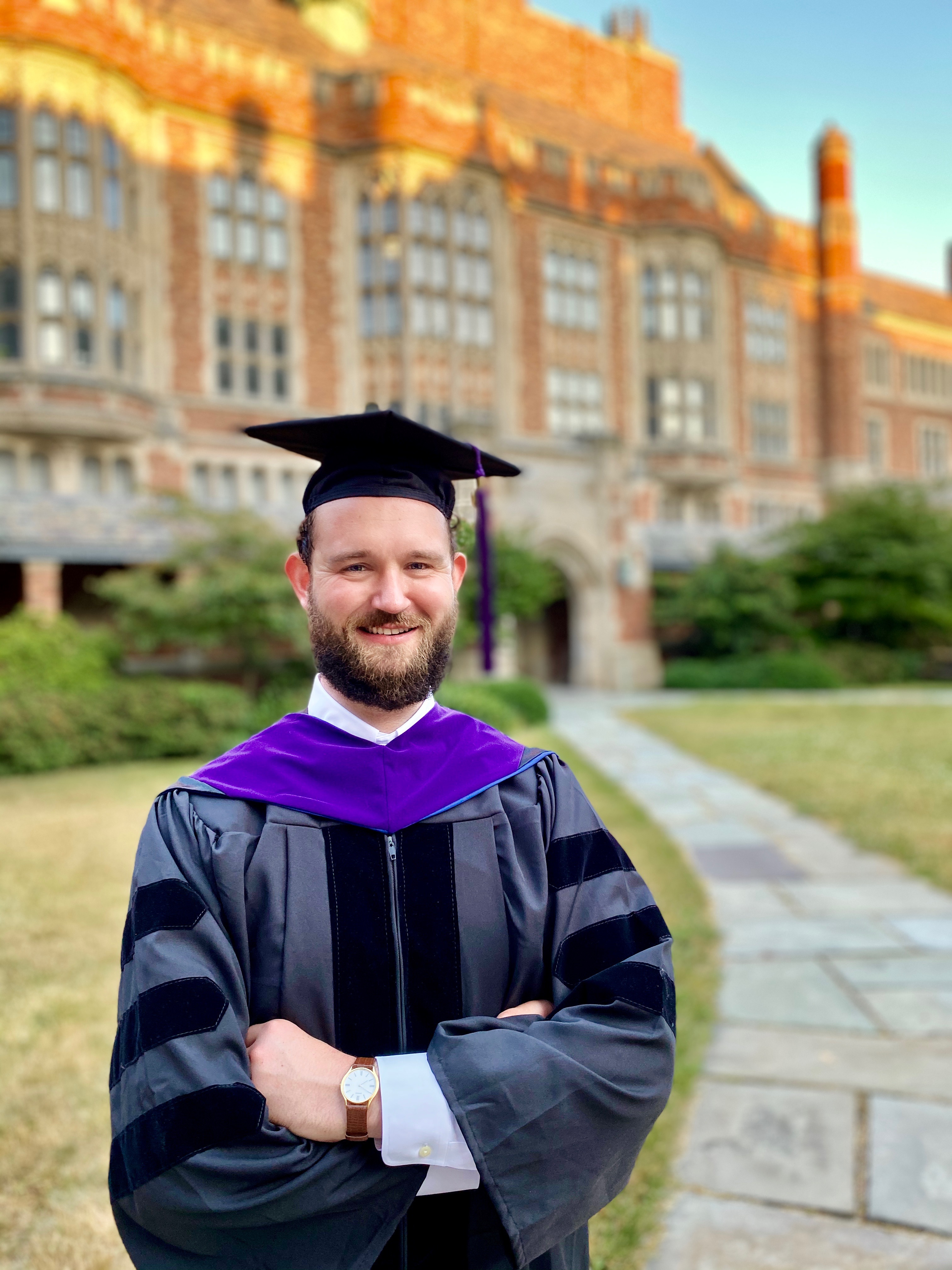
a kid i love made it across one of the toughest finish lines of his life back in may of 2020. turned in a book-length dissertation, crossed off the last of the law school to-do’s, and promptly slept in the morning his law school zoomed some semblance of quasi graduation.

they promised they’d make it up down the road, whenever ol’ covid relinquished its grip, let humans be human again. that moment, allegedly, is now. (though a good part of me is not so sure the grip is much relinquished as we were dashing to the pharmacy the other night for a friend who fell ill with covid for the third time since this all started and needed us to grab a prescription of paxlovid, the anti-viral wonder drug, and on our one little block, house after house is sealed shut for the cases of covid brewing inside.)

so we’re leaping into the unknown, taking our chances, flapping our wings new york way, and motoring up interstate 95, along the connecticut coast, where, come saturday morning, all four of our little family will convene with all the gusto we can muster there on an old campus where the classes of 2020 and 2021 get to make it official.

after all that separation, the simple magnificence of being together, being able to see the gleam in the eyes of the ones we love most, being able to wipe away a tear in real time, squeeze hands while walking through nothing so fancy as a parking garage: that is the definition of blessing.

despite its many deprivations, one good thing about these pandemic years is that it’s made the simple miracle of being together all the sweeter, more succulent.

there is catching up to be done, in the wake of red-ringed abductor of so many lives and so very much living.

so, two years after the fact, we are ditching long distance, saying no thank you to zoom. doesn’t matter to me if it’s two years too late. we’re going to be there. we’re going to hear that kid’s name when it’s called, and we’re going to watch that lope i know so well as he makes his way across the stage. i imagine i’ll be rifling through a cerebral cortex of memories, the late nights we stayed on the phone, the trips to the emergency room, the hours and hours i worried about how many days he’d gone without sleep, fueled on coffee and fumes. and i know i’ll be thinking all the way back to the start of it all, back to the very last thing he said to us, there on the sidewalk the morning we left him at law school, after we’d moved him in, made the requisite rounds of trips to IKEA for bookshelves that would not withstand the weight of all his books. he gave his papa a sturdy handshake, looked him in the eye, and said with all the certainty we had worked for and prayed for all those years: “thank you for everything; i’ll take it from here.”

and he did. and he does…

and that is the joy and the love beyond words that will be pulsing so loudly as i sit on the edge of my chair gulping back tears and holy hallelujahs.

God bless you, always, sweet Will. and thank you. love, always, your very own mama.

cap, gown, and hood in 2020 — but no ceremony. will add the real deal once it happens…

what catching up are you doing these days?

when grace comes tapping at the windowpane…

amid a season of war and worry, on the very day when steam was all but rising from this keyboard––a deadline looming, conveyor belts of verbs and nouns at high production––there came a rustling in the bushes just beyond the panes of glass that stretch between my bookshelves.

the morning was punctuated with the sounds of preoccupation, the faintest plink barely tapping at the glass, more than the usual chatter between birds. over and over, takeoffs and landings from bush to branch to nearby picket fence. the occasional outburst of trills and warbles.

it was the quiet of the sound that most intrigued me, the sound of trying to be unnoticed, hard at work in the art of concealment, a most necessary survival skill when up against the odds of danger, in a world where prowling cats and coons, thunderstorms and untimely freezes are another name for doom.

because i knew my role in this rare showing was to be as discrete and invisible as possible, i barely shifted my eyes, dared not tiptoe near the glass, for fear of spooking, for fear of shutting down production.

turned out, the faintest murmurings were these: the sound of wing brushing up against the glass, the sound of branches being jostled to make way for the laying down of bits of grasses, dried and brown and wholly unremarkable.

but what was done, over the course of a single day, was not only wholly remarkable and breathtaking. it was only the beginning.

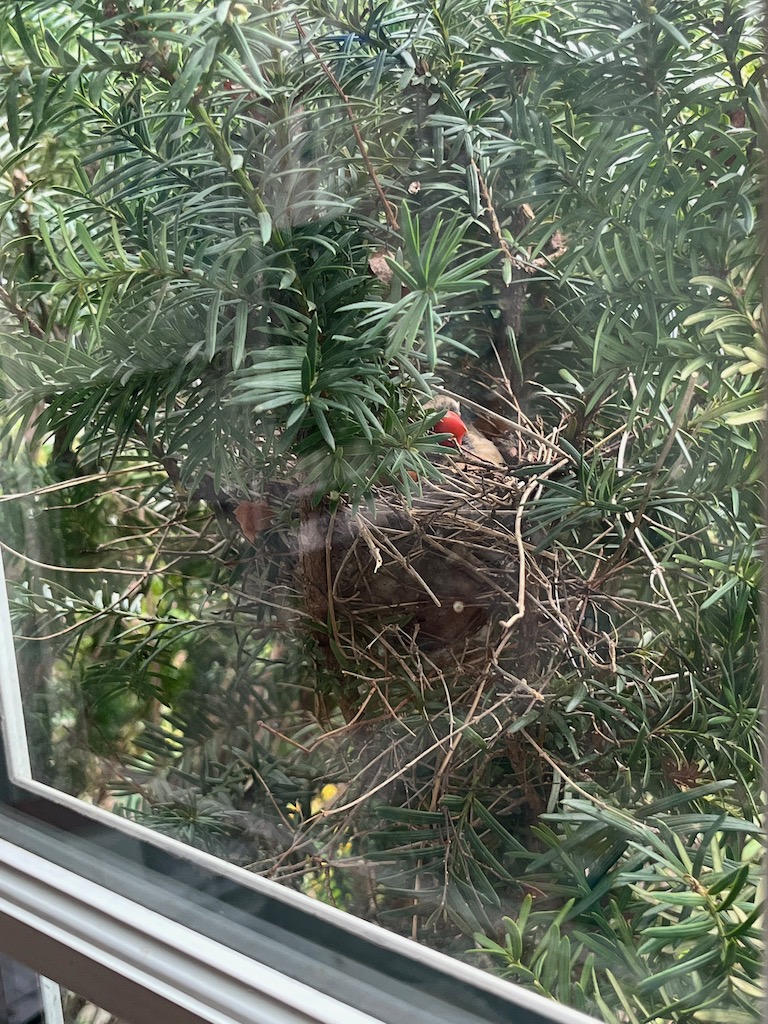
mama and papa–a pair of cardinals i know by name–had for the first time in all my decades decided to grace me with a front row seat on their reproductive spring: they’d chosen my very ordinary, very ungroomed evergreens, as the very spot to build their nest. it just so happens to be up against the glass, as if the window to the nursery in the maternity ward, the ones where long ago fathers pressed their nose against the glass to get a first peek at the progeny newly birthed and swaddled, the hard labor shielded from the men not allowed near delivery, too faint for such primal birthings.

over all my years, i’ve spied robins all but nesting in the public square. i’ve seen sparrows busily and noisily stuffing gutters and cracks in this old house with the makings of a nest. but never ever had i figured out just where it is the cardinals go to replenish the species.

i now know why. my guess is they’re the high scorers in the game of hide-and-seek. their nest, literally up against the glass, is all but impossible to see from the other side of the bushes, and wedged in in such a way that i cannot for the life of me peek into the bowl of the nest (believe me, when mama flits off to grab a seed, to relieve her feathered bum from all its incubating, i’ve climbed atop my window seat to try to fetch a look).

we’ve come to work in synchrony, mama cardinal and moi. i tap quietly at my keys all day long while she goes about her warming of those eggs all day long. once the sun goes down, i leave the premises, turn off the lights, shuffle off to the old maple table in the kitchen–not wanting a brood of mixed-up baby birds to mistake my desk lamp for a never-setting sun.

far as i can tell, and i tell you my guess here is based on scantest evidence, there’s not yet a clutch of little beaks to fill with bits of worms. each day, though, the drumbeat picks up pace. it’s been two whole weeks, and surely we must be getting close.

it’s a blessed thing, a most blessed thing, a thing that fills my soul, to be witness to the against-all-odds timeless knowings of the feathered flocks. those little birds know nothing of the ravages that tear apart the human flock. theirs is a universe––far as we know, and maybe i’m just wishful thinking––without the sorts of strife, without the demonic ingenuities to dream and build and drop a bomb. do birds know worry? does mama bird go about her business without the slightest hint of begrudgement? is she already plotting her grocery list? does she count her clutch, scan for misshapen egg, dread the day those baby birds take flight and leave the nest?

such are the questions that reel through my mind, as mama bird and i go about our tasks this one most blessed spring. it’s a wonder when grace comes tapping at the window pane. as if the heavens know just who and when needs holy balm far far from the madding crowd.

what grace has brushed you by this spring? what’s caught you unawares? what quiet has so startled you, and awakened you from your worldly slumbers?

in need of beannacht, i found my way back to an old friend, the irish poet of infinite blessing…

the author photo of John O’Donohue, now fading, but still my bookmark

in search of profound goodness this week, i found my way back to the saint of a gentle soul, a poet with whom i once shared a st. patrick’s day, and who would remain a kindred spirit and friend, with warm and occasional phone calls until 2008, when he died in his sleep on january 3, a day that happens to be my birthday, and two days after his own 52nd birthday.

john o’donohue was a priest and a poet on the day in 1999 when i (a newspaper scribe at the time) pulled up to his hotel in my little brown toyota corolla and spirited him away to one of those ridiculous faux irish pubs that line chicago’s more touristy streets. we landed there, amid faux celtic ruins and an endless loop of tin pipes and ditties, with more than a touch of irony. we talked till the sky beyond us went dark, and the city streetlights turned on. it was one of those newspaper interviews that wound its way into something that never ended. we were there in the wake of his best-selling anam cara‘s american publication (and marking the occasion of what would become his second best-seller, eternal echoes), and we found our own soul friendship. he was and is a rare blessing to me. his mind was voluminous. his heart and his soul even more so.

i found my way back to john, against the drumbeat of this unrelenting savagery in ukraine, because i was looking for words that might comfort. i was trying to be hopeful in hard times (per howard zinn down below, sent to me this week by a beloved friend of the chair.) i’d been collecting a litany of small wondrous moments of human kindness and utter goodness arising from the brokenness in kyiv and kharkiv and mariupol, when i decided to search for words that capture this moment of brokenness, of enormity distilled into poetries, well-chosen words that give us a way in to whatever is true, and beyond our worldly comprehension.

i found john’s beannacht or blessing, a blessing with a tinge of goodbye, “goodbye and God bless,” and whenever i read john’s words, i think of the day — and the story that came of it — back in march of 1999. as i started to read the story under my byline, a story that ran in the chicago tribune on st. patrick’s day of that year, i decided i’d bring my friend here to the table, for all of us. we could all use some comfort. we could all use some john o’donohue.

THE GOOD GREEN POET

By Barbara Mahany

Chicago Tribune

Mar 17, 1999

The poet-philosopher, who lives in solitude in the west of Ireland, leapt the curb and strode into a North Clark Street saloon purporting to be an authentic Irish pub — about a block away from another place purporting to be a rain forest.

The poet-philosopher has experienced the real thing plenty — pubs, that is — and when he looked up and saw, beside the tavern door, faux stone slabs pretending to be ancient Celtic ruins, he jolted up a bit and mumbled something about the Flintstones.

But not wanting to sound impolite, he muffled most of the rest of what he had to say, here in a place in downtown Chicago where the accents on the waiters were so thick he couldn’t believe they came from the country he has called his own for all of his 43 years.

John O’Donohue, a giant of a thinker, and a pretty tall guy, too, folded his 6-foot-3-inch frame onto a carved-wood bench, and did what any self-respecting Irishman would do, caught in such a circumstance. He ordered a pint of Guinness, and a bit of Irish stew to wash it down.

Then, his feet occasionally breaking into an under-the-table tap, in tune with some fine accordion blaring over the speakers, he settled into a long afternoon of conversation — the great art he alternately refers to as “an old blast of ideas” or “the source of luminosity in the Western tradition, going back to Plato’s dialogues.”

Oh, how he laments that discourse is dying, one of the great casualties of postmodern culture. What passes for it these days, he says, is really “just intersecting monologues.”

For a man who spends most of his days hearing only his own thinking, living alone as he does in the wilds of Connemara, O’Donohue–a Catholic scholar, priest and, of late, a best-selling author–is spilling with much to say about everything from how odd it is to refer to coffee as regular, “as distinct from coffee that misbehaves,” to how we should cross the threshold of the millennium in two days of silence, “with a liturgical solemnity in some way.”

He cracks Steven Wright jokes –“I went into a restaurant. It said, `Breakfast Any Time.’ I ordered French toast during the Renaissance.” He croons with Sinead O’Connor. He drops the names of philosophers from practically every century dating to ancient Greece. He sprinkles blessings on everything from the car he had just bumped around in, to the table where the afternoon’s conversation unspooled.

And the world is very much starting to listen–even if it’s only to him talking to himself, as he puts it.

In fact, of his pair of best-selling books, both spiritual works laced with Irish lyricism–“Anam Cara: A Book of Celtic Wisdom,” the No. 1 best seller in Ireland for 18 months until it was bumped from that spot by his new book, “Eternal Echoes,” now shifting between No. 1 and 2 in the country that, after 800 years of colonization, has built an empire of words–he says: “All I’m doing with these two books is allowing, maybe, others to overhear some of my own internal conversations. I’m not sure I’m right at all.”

And some conversations they are.

“He is the finest English-language-speaking spiritual writer of our time,” says Rev. Andrew Greeley, the Irish-Catholic priest and best-selling author of 42 novels, including his newest, “Irish Mist,” in bookstores for St. Patrick’s Day.

“When I started his first book, I said, `Oh, I’ll sit down and read the whole thing.’ Well, I soon realized I’d only read a chapter a day. It got down to a paragraph, at most a page, a day. I’m using the new book for spiritual reading, and the section I’m on now, it’s about a sentence a day.”

It’s not that it’s drudgery. “It’s rich,” says Greeley, who has the heroine of his new book quoting O’Donohue, a sure sign that he’s seeping into popular culture.

No less than Deepak Chopra, the best-selling author, physician and spiritualist, is a fan. He says O’Donohue’s work is “a rare synthesis of philosophy, poetry and spirituality.” He calls it “life-transforming for those who read it.”

Yow.

And how is it that the boy who grew up on a sod farm, whose vision of hell to this day is an endless prairie of turnips that need thinning, who lives an ascetic’s life alone in a cottage with walls held up by books, the nearest human a mile away, how is it that such a lad grew up to be “well on his way to becoming one of the master practitioners of the trade,” in the words of Greeley, the trade being the saving of souls through spiritual writing?

“I was born on a farm in the west of Ireland, and I’m so glad of that because I think one of the finest places to begin acquaintance with the universe is on the land,” says O’Donohue. “The landscape at home is exceptionally dramatic, the Burren region of County Clare, the amazing stonescapes, you know.”

You mean sort of like the stones standing near the door?

“No, not at all,” he says, barely glancing away from his Guinness.

“It was an intimate landscape. Every field had its name. It was a folk world, a world of folk culture. Also, through working the land –cows and cattle, sheep and fowl, sowing crops, cutting hay and turf, it was a full farming life–it meant that you became acquainted with the landscape.”

His favorite chore: Cutting turf in the bog, slicing half-foot slabs of earth, boring deeper and deeper with every slice. The bog, he explains, “is where there was a forest and where it collapsed, and where all the past life is congealed underneath the surface in a fallen way.”

And so, “in a sense, cutting turf is a place where you enter the hidden time of a landscape, where its memory is interred.”

It is those poetic riffs, infused with a passion for the natural world, that are the underpinning of O’Donohue’s vision. It is his Celtic soul oozing out–in conversation or in his books.

He was blessed with a father “with a lovely mind for a farmer. He always had the ability to think. He could go to the horizon with the thoughts.”

And always, turning the hay, cutting the turf, there was conversation.

“At night, too, around the fire at home, the experience of the day is sifted. With all kinds of silence, loads of silence looking into the fire. A lot of old time for integrating experience, digesting, mulling over things.

“It was a lovely way for a young man to grow up. James Hillman (the Jungian analyst) said, `Women relate face to face, but men relate shoulder to shoulder.’ “

It wasn’t long before O’Donohue went off to university, where he studied philosophy and English literature, and where his mind, he says, “really woke up.”

“I always think that thoughts are the most intimate part of humans,” he says. “The way you think is the way you are. Meister Eckehart (a 13th Century German mystic) says our thoughts are our inner senses. Polish them and refine them; the edge of your thinking will determine who you hold yourself to be, what you hold the meaning of life to be and how you will live with yourself in the world.

“I think one of the things that really holds us back and atrophies us and condemns us to live such forsaken lives is the deadness of our thinking, and how we swallow like fast food the public cliches that are given to us, and how we dedicate so much of our precious inner time of the mind to listening to garbage that has nothing to do with anything.”

O’Donohue, in his own humble way, wouldn’t mind turning that around. He doesn’t much like the trappings of celebrity, though. He quips as his picture is being taken, “Rilke says, `Fame is the sum total of misunderstandings that gather around a new name.’ “

He never set out to be the writer of books that have made him a household name back in the old country. And lately he has been crisscrossing America where people line up, sometimes in the hundreds, waiting for a word, and his scrawl on the books they buy, often four or five at a time.

“One of the things that consoles me about all this is that I didn’t go out looking for it at all,” he says.

He was quite satisfied with having completed his PhD in philosophical theology with a dissertation on the philosopher Georg Hegel that won him a summa cum laude in 1990 from the University of Tubingen, near the edge of the Black Forest in Germany. That dissertation, written in German, draws rave reviews — one as recent as last summer in The Review of Metaphysics, a scholarly journal. He’s thinking he should have it published in English.

But back to the, er, more accessible road his writing career has taken.

It just kind of took off on its own, it seems.

Having written poetry since he was 21 and along the way becoming a priest, although not tied to any parish or particular order, O’Donohue had been invited several years ago to share his meditations at a conference in California. Someone made tapes of his talks that were later heard by an agent in New York. The agent got them tucked between covers as “Anam Cara,” which sold like hot cross buns from Dublin to Donegal. In America, sales topped 50,000 in hardcover and 60,000 in paperback, not too shabby for a first book of its ilk.

“I’ve been totally blown away, really amazed, so humbled, by the resonance these books have found,” says O’Donohue, who for long hours every morning sits with a fountain pen in a little room with an open fire, writing a sentence, throwing it out, writing another, tossing it too. “After three hours, you have four miserable sentences,” he says. “For every one of them, you’ve thrown out 100.”

But in the end, when all the sentences add up to a finished work, he whispers one last benediction as he seals the envelope to his publisher. “Always when I’m launching a book,” he confides, “the last line I always say is, `May this book find its way to those who need it.’ “


and here is the beannacht that started my way back to my old poet friend….

written for his mother, Josie; beannacht, in Gaelic, is a word with more nuance than mere blessing, it’s “goodbye and God bless,” so here is a beannacht for the those we have lost, in ireland, in ukraine, here on our very own sod…

Beannacht

On the day when
the weight deadens
on your shoulders
and you stumble,
may the clay dance
to balance you.

And when your eyes
freeze behind
the grey window
and the ghost of loss
gets into you,
may a flock of colours,
indigo, red, green
and azure blue,
come to awaken in you
a meadow of delight.

When the canvas frays
in the currach of thought
and a stain of ocean
blackens beneath you,
may there come across the waters
a path of yellow moonlight
to bring you safely home.

May the nourishment of the earth be yours,
may the clarity of light be yours,
may the fluency of the ocean be yours,
may the protection of the ancestors be yours.

And so may a slow
wind work these words
of love around you,
an invisible cloak
to mind your life.

~ John O’Donohue ~

(Echoes of Memory)

if you’d like surround-sound comfort, you can listen to him — and hear that beautiful lilt — here, talking with krista tippett about beauty….

and here is the wonderful wisdom from howard zinn that had me looking for hope….(with huge thanks to PJT, my holy light in D.C.)

where did you find comfort — and hope — this week?

the simple blessing of a snowy morning

it is as close as i’ve ever come to waking up inside the pages of a picture book, or an enchanted forest, the waking up to fat flakes falling, to heaps and meringues of snow on every flat plane, every bough and twig; even the lumps in the walk get a dollop of beautiful. everything sometimes deserves to be adorned. everything sometimes yearns to be simply lovely.

the days of waking to grace feel numbered of late. more often i awake with a lump in my belly, a worry grown big and bigger in the dark and the tangle of sheets. almost like a sourdough rising, the way the night worries grow. but today is not one of those days. today it begins with nose pressed to the pane. i long to step outside in the thick blue light of it, the silence of it. but i’ve a silly thing about not wanting to mar the tableau, not wanting to plunk my boots in the seamlessness of it all. so i keep to my side of the glass. and i let the snow and the quiet fall unbroken.

i marvel always at the ways the world––grace, God, unseen sacred stirring––steps in just as i need it. the way the prescriptive fills every hunger and hurt. it’s as if all creation is apothecary for the soul. and when we quiet ourselves, and allow its medicinal balms to seep into the cuts and the lumps and aches, the healing comes. the respite of catching our breath, making sense of the madness.

just this morning i awoke with the knowing that a longtime beloved friend had awakened yesterday to find her husband still in his chair from the night before. he’d died, alone. he was 67. no one saw it coming. the night before, wednesday, had been any old wednesday; my friend had made meatloaf for dinner, hadn’t a clue that one single thing was not as it should be. life shatters without making a sound.

my faraway best, best friend is going to surgery next week, her second time in ten years with a surgeon and an oncologist she calls her own. a third friend, one of my bridesmaids, is sitting by her sister’s bedside in dallas, where the cancer has crept into her brain, and where upon finishing a CT scan last week, her sister (four years younger than me) had suffered a stroke. right there on the gurney. right there in the middle of an already terrible cancer.

i ache for every one of them, ache in ways that push against the walls of my heart. ache in ways that crowd every other thought out of my head. ache in ways that make me pay more attention than ever to the most ordinary of miracles.

and this morning i sit here absorbed in the lull that follows an overnight snow. it’s as if all creation understands we need silence between all the noise. we need the holy pause that allows us to catch our broken breath, to be still as we gather up the shards, put the pieces back together again.

the world aims to comfort us; it’s one of its marvels. it aims to shake us to our core, too. another one of its marvels.

how blessed are we that we live in a world of creation, sacred creation, a world where the woods are a balm. where the red bird alights. where snow falls without sound. where, dawn after dawn, the sun rises. and stars stitch the night sky.

the blessings abound. all we are asked is to notice.

dear God, thank you for the balm of this holy morning. may grace fall in thick meringues on the ones i love who are so deeply hurting. and afraid. and alone.

and just like that i looked up, and the red bird came. just beyond my window in a nestle of branches puffy with snow.

God answered. and the red bird flew.

where did you find grace this morning?

in case you need a quiet walk in the wintry woods here’s a little miracle sent my way; last night i gave a talk on the stillness of winter, and opened the evening with this moment of beauty. not all of you live in snowy climes, so here’s your taste of it, too. may it bring you peace, this walk in the snow-laden woods

the kindness project

tagging the word “project” onto just about anything takes it up a notch. makes it sound more determined. not some sloppy mess off in the corner. and so it is that my firstborn and i seem to have stumbled onto a “project,” though he’s the chief engineer and i am merely its occasional scribe.

it was birthed–for me, anyway–in the bowels of manhattan, underground, in the glare of fluorescence that lights up the 23rd street subway station. we were dashing from the bone-trembling cold of madison square park where we’d just been soaking in the opening of hugh hayden’s “brier patch,” a sculptural installation of 100 school desks and tangled tree limbs that speaks, among many things, to educational disparities and injustices (and is just plain beautiful), and that was curated by the glorious woman my husband calls his one and only sister. despite the fact that each of my limbs could not stop shaking from the cold, i will never forget watching her–against the golden halo of the lamp light–as i thought of the mother, the father, and the grandmother who had so profoundly shaped her. tears were falling as i imagined them watching her there in the cold january night, a crowd assembled to listen to her every astute word, to witness her latest public art offering to the metropolis that is manhattan.

hugh hayden’s “brier patch” madison square park conservancy

but back to the kindness project. having scrambled to the bottom of the long flight of subway station stairs, i paused and took in the whole of the whirl of the thousands of lives momentarily all in the very same place at the very same time. i couldn’t help imagining the stories, the struggles, the sufferings, etched into the faces that ran past me, that leapt into train cars that whisked down the tunnels, disappearing into the darkness.

i felt the thrum of humanity at its most percussive pulse point. we were all in this together–whatever “this” is, whatever “this” brings us. and, at the moment, the world is a tough place to inhabit. reports come in from all corners: of wars on the brink, of political revenge, of ugly words rising in senate chambers (and uglier ones spilled in cloakrooms and hallways).

if kindness is antidote to madness, if there lies a paradigm beyond the worldly one of spite and retributions, one where the gospel of empathy reigns, where we’re guided by a command to love as we would be loved, maybe that’s where the healing begins. maybe that’s where we find our salvation. maybe it cloaks us against the cold, maybe it’s how we the people stand one slim chance of turning our backs on all that we find so wretched, so deeply unjust, so just plain vulgar.

maybe we get about the business of seeking living breathing moments of goodness. of nothing less than simple decency, looking out for the stranger, offering hope to the hopeless. maybe, if we pay enough attention, if we gather those moments of kindness like beads on a prayer string, we might begin to gather momentum, to put forth and build a force that just might put a dent in what some days feels like a tidal wave of the ugly.

more and more over the last stretch of years, i’ve found myself pulled deeper and deeper into the realm of the sacred Divine as the world around has gotten more and more vile. to hear the call of a voice eternal and True is to begin to drown out the shouts from the ugliest corners. it’s where and how i find my peace.

and it’s a project worth tallying. a count worth keeping.

and so, on that cold january night, there on the 4 train as it threaded through tunnels, the kindness project catalogued its first unmistakable display: a fellow hunched like a comma on his hard plastic train seat was muttering to himself, when he happened to glance up and i–hanging onto a subway car pole–happened to glance down. this, apparently, was enough to offend, so he let me have it, with a spew of expletives that grew increasingly incensed. at that very moment a woman whose accent gave away her caribbean roots, pointedly tapped hard against the metal subway-car door against which she leaned, and inched herself just enough to make safe harbor for me. with little more than the tap of her finger, and the insistence in her eyes, she’d signaled loud and clear that she was having nothing of the old man’s vitriol and she was keeping me from any harm. the moment passed, the animosity diffused, and i was washed over in the blessing of stranger caring for stranger. i nearly reached out to squeeze her by the arm, a wordless expression of infinite gratitude, but i refrained, not wanting my gesture to be mistaken for any form of crossing the line.

and for the next string of days, as my firstborn and i made our way through the winding lanes of lower lower manhattan, as we fell into joyful conversation with the checker at the grocery, or the lady behind the counter at the lamp repair shop, there grew the sense that we were onto something. new york, new york, is not known widely as the capital of nice, and yet it seems to brim with hardscrabble kindness. and it’s nothing short of miraculous, to find those glimmering shards of straight-up goodness––humanity at its best––among the art-deco towers and the deeply-shadowed corridors of capitalistic commerce.

my firstborn, blessed soul that he is, is all in on the project. called me last night to report his latest finds; in an uzbek barber, and an orthodox watch repairman, in the old wrinkled man behind the counter of a chinese general store, where he found himself invited for new year’s.

the plan is to keep watch, and keep note (tapped out on his phone, or inked into one of his many moleskin notebooks). in a city that never sleeps, in a city not known for tender loving plenitude, take census of kindness and allow its superpowers to alter the landscape.

it’s a mission i’m taking up here, in the heart of the heartland.

one by one, little by little, one act of golden good kindness at a time, we are building a fortress to keep out the ugly, the vile, the deeply unkind.

and, besides, it makes for a million fine yarns.

as i wrote in a note to my firstborn just this morning: “it seems one of our holy tasks is to see the sacred sparks all around, in the souls of kindness you are finding in watch repair shops and chinese general stores. keep at it. the work is never done.” 

would you care to join us? record your findings here.

the tall skinny tower with the beacon on top is home to the sweet boy i so dearly love…

i’m home from my blessed string of six days in new york, unpacking 89 boxes and making a nest for someone i dearly dearly love (my firstborn) on the 34th floor of a grand old art-deco tower at the bottom tip of manhattan. i miss both my boys madly (the other one is back at college), as i’m now home in the quietest of old houses, but i revel in knowing our home-grown law clerk has fallen instantly in love with the place he’s now calling home. while away, i got double whammies of awful bad news from two of my oldest dearest friends in the whole wide world, and i’d so welcome a prayer or two if you’ve a spare: one beloved friend found out she’s up against breast cancer (a second time), and another called to tell me her little sister’s cancer has crept to her brain. life sure is cruel. but as my friend with the very sick sister put it so starkly eloquently, “this is life, it’s full of suffering and ours to endure. our job is to do it with grace.”

barreling on, gently…

christmas-morning bread pudding, eight days late

it wasn’t the winter break it was supposed to be. or the christmas. or the new years. two of us were behind closed doors for days on end. one of us is still shuffling from armchair to armchair, plopping down for little puffs of air. another one has blotchy red spots on the back of his hands, covid rash they call it. the other two of us strained to keep two steps ahead and out of the path of the red-spiked intruder.

but we barreled on, the four of us. christmas-morning bread pudding finally billowed in the oven on january 2. and ever since we’ve been trying to shove the train back onto the rails, to make the most of these 10 days before flights and calendars dissipate us once again.

it dawned on me in the middle of the night, as i shuffled through the dark to trace my way to the bathroom down the hall, that we were––at that very moment––all four of us safe under one single roof, as is my most settled equation, as is the variable i’ve prayed for, waited for, for two long years. and it hit me just as quickly how the four of us, over the years, have grown to be our own impenetrable force, a circle of loving each other fully and thoroughly through thick and thin and whatever the whims of life hurl our way. 

we’ve worked hard at that. it doesn’t come without determination and practice. it’s a living, breathing exercise in turning the other cheek, in forgiving, in listening, in quietly knocking on a bedroom door and asking, “can i come talk?” it’s long long hours on the long-distance line. it’s jumping in the car and driving hours, if necessary. it’s showing up, again and again. it’s being willing to admit, i blew it. i worry too much. i got scared. (or whatever is the foible of the hour.)

it’s believing in the best of each other. and giving yourself the time to see it. it’s figuring out that if someone else sees the best in me, maybe the best is deep down under there, after all. 

it’s a lifelong practice in practicing. in knowing there will be days when you don’t quite do your best. when your voice comes out in sharper tones than you’d intended. when you wish you lived alone. when tears sting your eyes, and eventually you hold each other tight.

it’s a testament to loving played out in episodes that take your breath away: the time the stranger called to say she’d found your kid unconscious, strewn on the bike path; the time your kid called to say he got into the law school of his dreams; the time the brand-new driver slunked in the house and handed over the speeding ticket he’d just gotten on his first friday night out; the time your mom turned to you and said they’d found a tumor, and weeks later your then-little one proposed a hat party to make a little bit of joy out of grammy losing all her hair. 

those are the strands that make a family, that stand a chance of weaving something whole in a world of rampant brokenness. it’s the little asides at the dinner table, or while stirring onions on the cookstove, the gospel spelled out––again and again––in certain truths you dare impart. it’s the notes you slide under the bedroom door. the stories they hear you share at the kitchen counter, or listening in on one of your phone calls. that’s the slow-unfurling whole of who you are, and what you believe, what you stand for, that gets spelled out, inscribed, passed on without a slip of parchment. 

families are made by choice or by birth. both stand strong against the cold winds of history. families take endless work, and infinite joy. at our house, it’s the laughter that is the certain glue. the antics that punctuate the pure delight. sometimes, too, it’s tears, the willingness to cry. always, it’s the listening, and the curiosities that drive the questions. hours and hours of questions. of true and telling replies.

it’s the most important work i’ve ever done. making a family, day after day after blessed loving day. it’s the hardest work, and the work that lifts my soul more than any other aim i’ve reached for. 

my definition of family is nothing like it was when i was little. i used to look to the scrubbed and polished clans who filled the church pew, all in matching hats and coats, lined up like stepping stones in graduated sizes. a lifetime of paying attention clobbered that flimsy facade. now the ones who teach me how it works are the ones who weather heartache, who do not give up, who tell the truth, don’t hide the hard parts.  

i remember in the hours before my firstborn was born, i was sitting all alone at the kitchen table, and i whispered words to God, promised to envelope that sweet child in all the love i could muster, to harbor him from every hurt. i’ve found out over the years that you can’t keep the ones you love from hurt, from heartache. but you can build a mighty shield, you can build an unbreakable ring of love and light, and you can be there to catch ’em when they falter, you can wrap them in your arms, rest their heads against your heartbeat, and you can promise them your love is one inextinguishable force, and your light will always always burn for them. and you can always make ’em laugh. and listen to their secrets, their hopes, their dreams, their prayers. 

and when the days don’t unfold the way you’d wished, the ways you’d dreamed of, well, you can wait till the darkness ends, and you can tuck a new bread pudding in the oven, and you can shuffle to the kitchen table, join hands, squeeze tight, and whisper, thank you God for bringing us this holy, holy moment, and letting us weather all of life––its best, its worst––with each other at our backs, our sides, our wholes

every family is its own story, is a vessel for a hundred thousand stories, some passed down from generations, and it’s hard work to make a tiny community of similar-but-unique human beings coalesce into something whole. how do you get through the hard parts? what’s your one essential ingredient? (questions need only be for your own personal reflection, as is always always the case.)

tis january, a month of new beginnings, and a happy birthday blessing to the one and only MJH, loyal reader, dear friend of this ol’ chair, and to my longtime beloved comrade MBW, whose birthdays are today!

covidian land of counterpane: geography for the new year

counterpane noun

coun·​ter·​pane | \ ˈkau̇n-tər-ˌpān

Definition of counterpane: BEDSPREAD

Origin (from Oxford Languages): early 17th century: alteration of counterpoint, from Old French contrepointe, based on medieval Latin culcitra puncta ‘quilted mattress’ (puncta, literally meaning ‘pricked’, from the verb pungere). The change in the ending was due to association with pane in an obsolete sense ‘cloth’.

***

when i was little, i was oft confined to bed when i got sick. and, as i recall, my childhood was pocked with the sorts of sicknesses for which bedroom doors were closed and meals delivered by metal tray. a dinner bell rested on my mirror-topped vanity, and i jingled it if in need of gingerale on ice, or saltine crackers in wee stacks. clearly, my mother of five was practicing astute infection control lest she find herself in charge of quintuple cases of whatever was my ailment of the hour.

it was all quotidian enough—scarlet fever, chicken pox, mumps, measles, really nasty flu. i twice was sent to hospitals for IVs and a week of restitution, and so, given the spells in bed, i came to think the land of counterpane a most familiar terrain. (maybe, in part, it’s why i was drawn to being a pediatric nurse.) and, of course, i populated the contours of my bedclothes with a well-steeped storybook imagination––hills and vales and undulations, the nooks and crannies of my make-believe lilliputian chambermates: trolls and elves and sprites and sometimes an imaginary baby sister.

among the first poems i memorized was robert louis stevenson’s “the land of counterpane,” a verse i know by heart: 

When I was sick and lay a-bed,
I had two pillows at my head,
And all my toys beside me lay
To keep me happy all the day.

and so, this past stretch of days (now ten), once again behind closed bedroom door with trays duly delivered by the nurse in charge (now, the sweet, sweet man i married long ago), i find myself a-bed, beneath my counterpane, all my toys beside me laying. and (except for the few days when it was a bit of a challenge to catch a breath) it’s not been quite as dreadful as it might sound. 

apocalyptic broccoli, 30-year shelf life

i’ve windows on three sides with golden sunlight streaming in by day; at night, i watch the twinkling lights and street lamps that punctuate the darkness as far as i can see. and the wonders of laptops and itty-bitty phones mean you can stay in touch with even the longest lost compatriots (two friends from nursing school in fact), neighbors who’ve checked in every day, my faraway best friend who has been as close as close could be, and my distant cousin whom i adore who thought to overnight me a barrel of freeze-dried apocalyptic broccoli. and, best of all, i’ve got my covid buddy––my firstborn, the one who fell first––directly across the hall. he escaped solitary confinement at midnight last night, as we’re abiding by the 10-day rule unless a negative antigen test allows early egress (which, in his case, he never got). so he and i have had long hours of crossword puzzles and conversation that might not have unfolded had we both been skittering hither and yon. it’s the younger one i miss the most, as he’s taken to steering as clear as possible of me and my omicron. (the kid’s no dummy.) 

strange to think, a week ago i didn’t yet know what it was that had buckled me at the knees, and it would not be till christmas afternoon that the test result came back in red ink with exclamation mark, dare i miss the point. 

the lesson of this covid tale would be as one wise doctor told me just the other day: assume you’ve got it––and stay in isolation––till proven otherwise. testing is just a mess, and misses far too many positivities till all the contagions are scattered in your wake. i fear for what’s coming in a country shut down by this latest red-ringed mutation. but i enter it now armed with mighty antibodies (or so i hope and pray). and a determined willingness to do all i can to help the next one fallen to make it through with TLC, and all the isolation tips i’ve learned along the way.**

sticking to the rules, i’ll not be sprung from my confinement till the midnight bell tolls tonight, and the year turns as well, allowing me to begin afresh the year of our Lord MMXXII. 

my new year prayer is even more distilled than my christmas prayer a week ago:

dear God, let all of us have someone dear to check in on us, to bring us cups of tea, to care for us in tender ways (and even on the days when we’re not anchored in our lands of counterpane). keep us safe, dear God, and mindful of all that matters most: let us put down the weapons of words, of grudges, of cold hard shoulders. let us snap into focus to see that the path is short, is sometimes rough, and that the best way home is side by side, entwining elbows, and leaning toward the light. let us lock out the rampant toxicities (and i don’t mean the biologically viral ones), bar the doors to discourse that divides us, and strain to find our common common threads. we’re woven of the sacred, after all. it’s buried there, beneath the noise, the bombast, the sure evidence otherwise. the unfettered truth––most clearly realized on long nights when breath comes hard and fevers swirl––is this: life is swift. we’ve no escape from certain end, so let us make each day a living prayer in which we seek and find certain trace of all that’s heaven-sent, and all that hails from You, the One who fuels the light, who preaches love beyond measure and without end, and who gives us our each and every breath—even when it’s labored. blessed be that holy, holy breath, amen.

most of all, i hope and pray you’re well. and staying safe from this nasty bug that’s toppling us like tin soldiers.

what’s your prayer to usher in the new year?

** see isolation tips in comment down below!!!