pull up a chair

where wisdom gathers, poetry unfolds and divine light is sparked…

Category: birds

gravitational pull

i can’t stay away. 

etched on a map, you might not notice; its tucked-away nature is but the flint of its charm: a treasure in almost plain sight. i might have zipped by a thousand times. it only took once for curiosity’s lure to draw me into its fold. and now it won’t let me go.

i’m coming to think of it as my footpath to the wellspring where the sacred stirs me, a nowhere-else-like-it sanctuary under the arbors, carved into the banks of a slow-flowing channel, a serpentine zig and a zag, through patches of woodland and birdsong. 

as far back as i can remember, the woods behold wonder to me. my biography would be laced with a trail through woodlands and ponds and gurgling creeks. the never-ending acres of lily of the valley where my papa once drove me as a wee girl of three. the woods across from the house where i grew up, a copse that came to life in my imagination, one day a pioneer’s outpost, the next day a place to pretend i’m laura ingalls wilder in the big woods. 

trailheads beckon. the barely-noticed aperture into the brush, where suddenly suburbia is leagues and leagues away. maybe it’s my imaginative overdrive, or my storybook tendencies. but give me a path, and a parting of trees leaning this way and that, and my feet cannot but go forward.

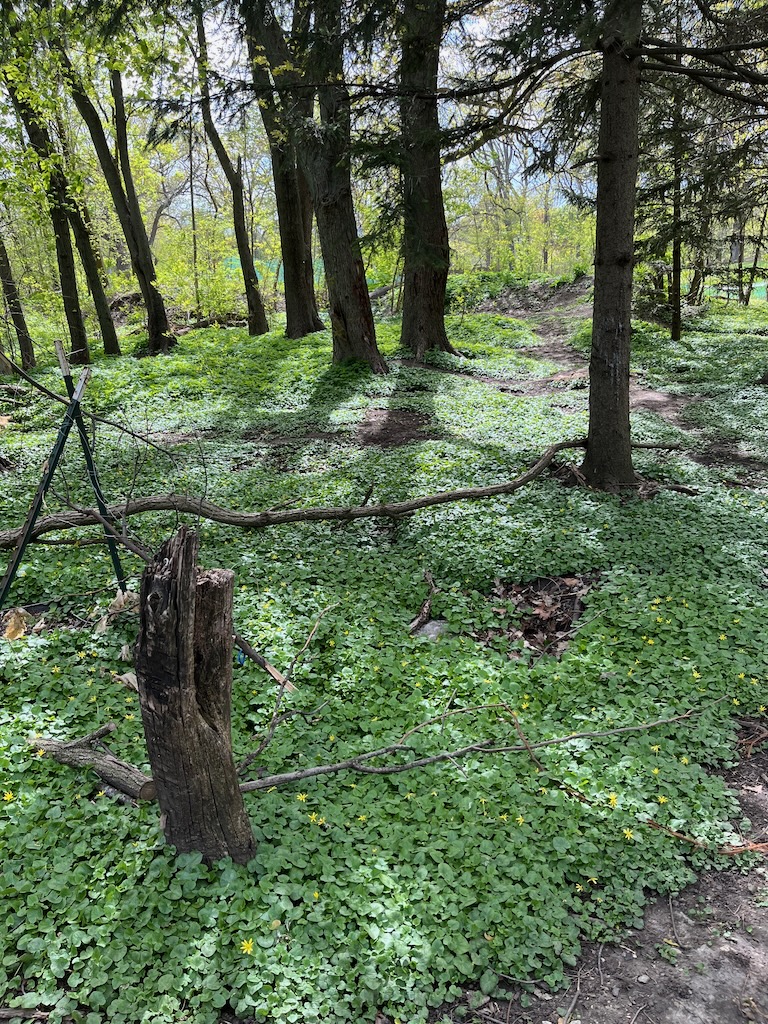
so it was on mother’s day morn when at last i found myself at the trailhead i’d vaguely noticed in the making. trees had been felled, and buckthorn burned by the wheelbarrow full. logs were yanked from where they’d fallen, and laid in a line, woodchips carpeted the paths in between. a woodland trail that meanders along and through a woods both ancient and newly imagined. 

enchanted at first footfall, the only way to describe it. the ups and the downs, the dappling of light, and the peek-a-boo shadow. i walked with my eyes and my mouth wide open. over and over i marveled. 

it’s a woods best described as delicate, at least in the moment—a petit point of vernal ephemerals stitched into the hillsides. springtime at its tenderest, springtime in may when it’s no longer tenuous. 

it’s a place that suddenly holds inexplicable pull on me. enough to lurch me out of my wintry posture, curled over a book or an alphabet keyboard, snug in the nook by the wall-to-wall windows. it’s a place that lured the prayer right out of me. a place to dwell in my quietest stillness. 

it’s my axis mundi, you see. 
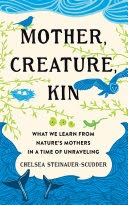
my friend chelsea steinauer-scudder, a breathtaking writer and author of the new book, mother, creature, kin: what we learn from nature’s mothers in a time of unraveling (broadleaf), explains: “i’ve heard countless stories of what i’ve come to think of as axis mundi experiences: encounters that have pulled someone into a deep experience of felt belonging upon the tiny bit of Earth that they find themselves upon. 

“…within the study of religion, an axis mundi is a sacred pole, literal or figurative, which is fixed in a particular place, connecting Earth to the realms of heaven, underworld, and divine. “

these holy places might be a mountain (the Mauna Kea on Hawaii’s Big Island, known by the Indigenous peoples to be the umbilical cord, “the place from which the world emerged”), a cosmic tree (Norse mythology), the Ka’aba in Mecca (which pilgrims encircle seven times, as within it is the stone believed to have been handed to Adam as he was banished from Eden, so his sins would thus be forgiven). 

or, in my case, an undulating woodland path along what in fact is a sanitation canal, though i pretend for the life of me that it’s an idyllic stream or a creek. one that just happens to shimmer an odd shade of aqua, a phosphoresence that might signal toxins astir. 

my friend chelsea goes on to write that “we are a species in need of centers,” and within us there is encoded “an inherent capacity for place-based awe.”

those are the places with gravitational pull. a pull from the deepest well. the sacred well. 

or, as chelsea distinguishes between the capital-A Axes Mundi (the most sacred of places so recognized by cultures or religions), and the small-a axes mundi (the ones you and i might call our own), the ones i know best are the quotidian, intimate ones, defined as “small, daily irruptions of majesty, those any-place encounters with the sacred.”

no surprise then that i can’t stay away. it’s an itch that can’t be scratched till i double-knot my sneakers, and try to remember sunscreen (i never do). 

and it’s walking through a poem, quite literally. the soundscape a montage of birdsong and trill, punctuated with quarter notes and a screech that scares off the feeble.

these are the verses i walked among on just one of my mornings traipsing along the trail: common yellowthroat; red-bellied woodpecker; swainson’s thrush; red-winged blackbird; northern cardinal; blue jay; goldfinch; baltimore oriole; rose-breasted grosbeak; gray catbird; and a hairy woodpecker to boot. it’s as if the crayola crayon box was suddenly feathered in flight. 

and in the flora department, a whole other poem: bloodroot, bluebells, celandine poppy, and columbine. lily of the valley, trout lily, spring beauty, wood anemone, and blue cohosh. jack-in-the-pulpit, shooting star, mayapples, and dutchman’s breeches. 

all these names, which whirl in me thanks to the Original Mother Nature who schooled me, got me to wondering who in the world gave the names to the winged flocks and the leafy ones too. the stories behind names are their own wonders. the ones from folklore and legend are the ones that charm me most: jack-in-the-pulpit is said, of course, to resemble a preacher spreading the Good Word; the trout lilies’ mottled leaves resemble the markings of the freshwater fish; and dutchman’s breeches clearly resemble the pantaloons of one who’d also wear wooden shoes.

those, though, are merely the preamble curiosities, the ones that loosen my soul, open me up to the prayer that burbles up whilst sauntering deeper and deeper, per God’s gravitational pull, unwilling to pause till i get there. to the place where i go to feel as saturated with the sacred as i do of the sun when at last i plop onto the stump of a log, and consecrate the most blessed moment of being.

where is your axis mundi?


wislawa szymborska

and before we part, a poem worth pondering, from the late, great polish poet and nobel prize-winner, wislawa szymborska

Life While-You-Wait

Life While-You-Wait.
Performance without rehearsal.
Body without alterations.
Head without premeditation.

I know nothing of the role I play.
I only know it’s mine. I can’t exchange it.

I have to guess on the spot
just what this play’s all about.
|Ill-prepared for the privilege of living,
I can barely keep up with the pace that the action demands.
I improvise, although I loathe improvisation.
I trip at every step over my own ignorance.
I can’t conceal my hayseed manners.
My instincts are for happy histrionics.
Stage fright makes excuses for me, which humiliate me more.
Extenuating circumstances strike me as cruel.

Words and impulses you can’t take back,
stars you’ll never get counted,
your character like a raincoat you button on the run?
the pitiful results of all this unexpectedness.

If only I could just rehearse one Wednesday in advance,
or repeat a single Thursday that has passed!
But here comes Friday with a script I haven’t seen.
Is it fair, I ask
(my voice a little hoarse,
since I couldn’t even clear my throat offstage).

You’d be wrong to think that it’s just a slapdash quiz
taken in makeshift accommodations. Oh no.
I’m standing on the set and I see how strong it is.
The props are surprisingly precise.
The machine rotating the stage has been around even longer.
The farthest galaxies have been turned on.
Oh no, there’s no question, this must be the premiere.
And whatever I do
will become forever what I’ve done.
~ Wislawa Szymborska ~

(Poems New and Collected 1957-1997, trans. S. Baranczak and C. Cavanagh)

not all gravitational pulls are without hazard

in the tabernacle of an autumn’s night

these are days of awe, all right. the earth and heavens––at least here on the northern half of the globe—are turning in, the shadows growing longer. yet the last gasps of summer’s bounty do not fade without an exuberance of autumn. the sky somehow seems more star-stitched. and the moon, the moon at its most zaftig of the month bathes all in amber wash. 

it’s as if all is ringing out in exclamation. one tree more golden than the next. berries so abundant on the bough, the boughs are bent in botanic downward dog.

i can almost hear the whisper of the woods, and even my ramshackle garden, calling out, don’t forget us, don’t forget how glorious we were and are, the delights and wonders we’ve offered since the symphony of spring began: the perfumes, the unfolding petals, the sweetness of the fruits, the earthly prayer of wind rustling through the leaves. 

it’s a paean in minor key––part elegy, but mostly gratitude and grace.

to partake of it is holy.

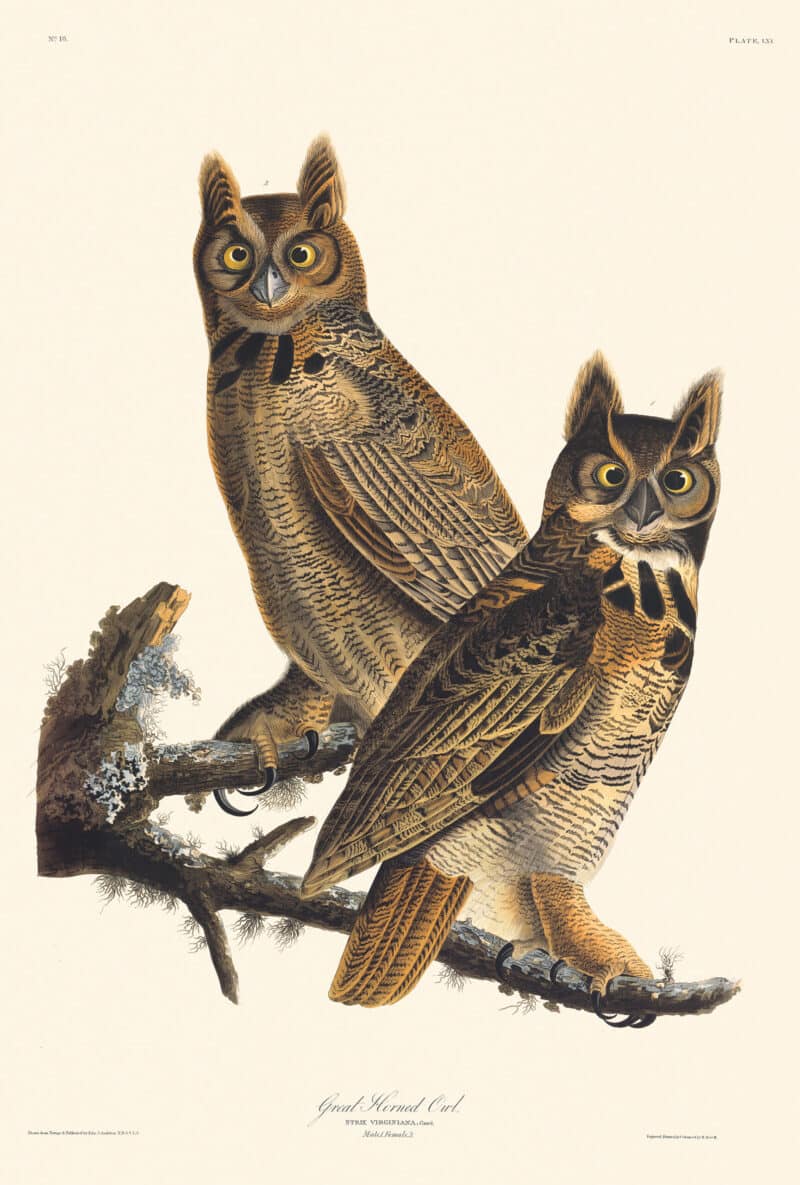
the other night i stepped into the chill of just-past dusk, ferrying a crumb-strewn pizza box to the recycling bin, and before two footfalls had crossed the bricks, the haunting whoot-whoo-whoo of a great horned owl called out from somewhere in the trees. 

john james audubon: great horned owl

owls might be my spirit bird. i learned reverence for owls from my grandma lucille, who wore one in a jeweled brooch she pinned to her bosom, and tucked in many a nook and cranny of her ivy-covered house. far back as i can remember, the front of her ice box was forever festooned with strigiform, a magnet onto which she’d glued an owlish silhouette cut from felted wool and adorned with alphabet-letter pastas as its eyes and ears and markings. not one for idling, my grandma once or twice was spied by little me with ear pressed hard to windowpane, rapt by the nightcall from the woods.

i too stand rapt. 

of all the notes that rise from avian throats, the owl’s are the ones that stir me deep down where the prayers rise up. at the first of the whoot-whoo-whoo the other night, i felt myself break out in goosebumps. then i lifted my eyes, drank in the light of that nearly full hunter’s moon, and prayed. mightily. 

i sometimes think that trips to the recycling bin are my surest daily invitation into prayer. into the cloak of night. against the silence of a day gone hush. the tabernacle in which i offer up my nightly office is one that stations me on the cracked concrete slabs of my alley. trash cans line the side aisle. and the nave is vast. is infinite. in between where trees and old garages block the view, the sky opens wide and deep. here where i live, sky is a bit of a commodity. sunsets aren’t free for the viewing, blocked by those mainstays of suburbia: house and tree and fence. but the night sky, the obsidian up above, is blocked by no one or nothing and it is enveloping enough to soak up my every verse of prayer. 

and so i stood there flinging madly. add-on after add-on. a madwoman hungrily hanging her prayers out to dry. as if a clothesline of prayer i string across the alley, flinging each one skyward as i inch my way down the line. 

it’s a sacred thing to stand beneath a wheel of yellow moon, with a whoot-whoo-whoo as chorister, and to pour out your insides to the heavens. 

i pray the heavens heard.


here’s a bit of what else stirred me this week . . .

vassar miller was an american poet and writer, who served as poet laureate of texas in 1982 and 1988. born with cerebral palsy, her father encouraged her from a young age to write by typewriter, which she did prodigiously. and powerfully. she once said that the purpose of her life was “to write. and to serve God.” it brings me great joy to bring her here to this holy table.

Morning Person

God, best at making in the morning, tossed
stars and planets, singing and dancing, rolled
Saturn’s rings spinning and humming, twirled the earth
so hard it coughed and spat the moon up, brilliant
bubble floating around it for good, stretched holy
hands till birds in nervous sparks flew forth from
them and beasts — lizards, big and little, apes,
lions, elephants, dogs and cats cavorting,
tumbling over themselves, dizzy with joy when
God made us in the morning too, both man
and woman, leaving Adam no time for
sleep so nimbly was Eve bouncing out of
his side till as night came everything and
everybody, growing tired, declined, sat
down in one soft descended Hallelujah.

+ Vassar Miller


and this beauty from christian wiman…

Prayer
By Christian Wiman

For all
the pain

passed down
the genes

or latent
in the very grain

of being;
for the lordless

mornings,
the smear

of spirit
words intuit

and inter;
for all

the nightfall
neverness

inking
into me

even now,
my prayer

is that a mind
blurred

by anxiety
or despair

might find
here

a trace
of peace.

Christian Wiman, “Prayer” from Once in the West, published by Farrar, Straus and Giroux. Copyright © 2014 by Christian Wiman.

what stirred you to awe this week?

nursing tender things along. . .

barely perceptible nub of palest green, on the first outpost of the left branch of what might once again be my peewee hydrangea…see it?

i found myself crouching down as low as i could go the other day—likely lower than a girl with slits in her side should wisely have gone. but i was intent on inspection. i was searching clumps of stick for little nubs of green. of life. of any sign that the last shrub i planted in the fall — the day before the frost came — had survived the long winter. 

it was a long winter for plenty of us — certainly for my garden, newly planted in the weeks not long after the dreaded fence went up next door, and indeed for me. 

and yet now the season of birth and rebirth is upon us. from every bough and limb, from every red bird’s throat, the song of springtime’s hallelujah bursts forth and keeps on forthing. 

i find myself particularly intent on the tendernesses of this holy spring. i am crouching down low day after day, keeping watch for signs of life, coaxing beauties to unfurl.

poor mama robin laid her egg on a porch railing. oops. fear not, all now is well.

seems a wise posture, that of nursemaid to the birthing earth. it’s one i am learning to mimic as i consider my own deeply tender places, as i picture the convulsions of my poor little lung that likely has no clue what hit it, and why all the folderol and commotion a week or so ago. but it is now doing its darnedest to sew itself back to whole, pressing tight the seams that now are held in place with metal threads. the miracle of the human body is not unlike the miracle of holy earth, and as i slowly walk my garden’s edge, stooping here or there to lend a hand — lifting clematis vine to its fallen trellis, rescuing a robin’s egg mislaid on a railing’s edge — i am breathing in the tender caretaking ways of the God who so tenderly holds us in God’s sacred trusted hand. or so i imagine. none of us has a clue really just what form this God of ours inhabits, so from time to time i apply my storybook imaginings to make it all more apprehensible. i understand the naiveté of picturing a God who scoops me in God’s hand, but somewhere deep in that vision there is a grain of holy comfort. there is an image put to the ineffable. and right in here, i need that image.

i’m not the first to put pictures to my God, and i know i’m not the last. it’s a hard task here on earth to imagine the Divine goodness that inhabits all the cosmos, and surely all the heavens, and then the questions come: is heaven the holy light deep in our hearts? is heaven that palpable knowing that we are held by a goodness beyond our wildest imagination? once upon a time the nuns taught that heaven had a pearly gate, and was carpeted in clouds. oh, lord, they shouldn’t teach such things to wide-eyed little children; it can take a long long time to revise the picture reel inside your head, and why waste time in lala land when God is so much more and vaster and infinitely deeper.

i am spending many chunks of time pondering the presence of God in this messy chapter of my life. what i know is this: when i was deep in the dark tunnel of an MRI that scanned the vessels of my brain, and told not to flinch a single muscle for 45 excruciating minutes, i surrendered to the softest arms i’ve ever known. i imagined them as the arms of God, cradling me. and in that space of utter peace, i rested. and did not flinch, did not cough, did not exercise the itch or cramp in my shoulder; i found the holy wherewithal to do precisely as the doctor ordered. 

and that is how i pass the hardest hours. i go deep down under. into the place where God and angels dwell. i’ve no knowledge of this landscape. it’s all uncharted and unknown. but when i go there i am safe. and i am cradled in what feels like love. and that to me is how it feels when i walk my garden’s edge, crouch down low, and lift a hand to bud or vine or mislaid egg. we are all nurturing each other along. God and all of us. and i’ve no idea just how it works, or what it is. but i know i sense a holiness that i am choosing to call my God.

amen.

(i fully grasp that i’m going out on limbs here, groping along in wholly naked ways, but if i don’t use these hours of my life to plumb the deepest questions, to fumble for the truest answers i know, then what worth will these struggles hold? we have a chance to be our best selves in our darkest hardest hours. and these are mine. so far. so why not open the book and see what stirs? i’m impelled to wonder and to muse aloud….)

mama robin, safely atop her mislaid egg. photo by kerry, who saved the egg and whose porch is mama’s birthing room….

and now a few morsels, as has been my way in this year of gathering up bouquets of wisdoms…

Julian of Norwich, an English anchoress who experienced a vision in 1373 and wrote about it in a work titled Showings or Revelations of Divine Love — the earliest surviving book by a woman in the English language. my friends at the SALT Project (emmy-award-winning visual storytellers with a spiritual bent; check them out) laid this excerpt out as a poem. i found it lovely….

And in this he showed me a little thing
the quantity of a hazelnut,
lying in the palm of my hand, as it seemed.
And it was as round as any ball. 

I looked upon it with the eye of my understanding,
and thought, ‘What may this be?’
And it was answered generally thus,
”It is all that is made.”

I marveled how it might last,
for I thought it might
suddenly have fallen to nothing
for littleness. 

And I was answered in my understanding:
It lasts and ever shall, for God loves it.
And so have all things their beginning
by the love of God. 

In this little thing I saw three properties.
The first is that God made it.
The second that God loves it.
And the third, that God keeps it.


+ Julian of Norwich


 as has been my habit in recent months, i mark the turning of each month by turning to the pages of Henry David Thoreau’s The Journal: 1837–1861. here’s a dreamy entry from the ninth of may when thoreau was 34 and aswirl in the warmth of mid-Spring. (may our warmth please come….) 

May 9. It is impossible to remember a week ago. A river of lethe flows with many windings the year through, separating one season from another. The heavens for a few days have been lost. It has been a sort of paradise instead.

Saw a green snake, twenty or more inches long, on a bush, hang­ing over a twig with its head held forward six inches into the air, without support and motionless. What there for? Leaves generally are most beautiful when young and tender, before insects or weather has defaced them.

These are the warm­-west-­wind, dream­-frog, leafing­-out, wil­lowy, haze days. Is not this summer, whenever it occurs, the vireo and yellowbird and golden robin being here? The young birch leaves reflect the light in the sun.

Mankind seen in a dream. The gardener asks what kind of beans he shall plant. Nobody is looking up into the sky.

a little dictionary for those of us who don’t know our greek: lethe: “forgetfulness,” from the river in Hades that causes drinkers to forget their past.


one more thing a brilliant woman sent me this week when i was inquiring whether a certain “tiny retreat” (that’s how it was billed) had a virtual component, for those of us whose lives are pretty zoom-y these days…..

“Be who God meant you to be and you will set the world on fire.”

Catherine of Siena

finally, a profound note of thanks, to the brilliant and bold mountain-mover of a friend i have in poet and scholar (and my former cambridge landlord) mark burrows, who sent a note to all who were at the zoom book launch a few weeks ago (a lifetime ago!), and who implored you to add a little amazon review to my “languishing” Book of Nature. well, the book isn’t languishing but its state of review sure was. i have no understanding of the algorithms of amazon, but apparently, without reviews, you’re sunk. glub. glub. glub. so mark, unbeknownst to me, rallied the forces and got the reviews boosted from 3 to 11, currently. in a million years i couldn’t have done what he did. in these otherwise upturned days, the human species has shown me in brilliant colors just how magnificently we all can be, and love is pouring forth with the might to rocket me to the holy moon, which was magnificent last night if you happened to notice.

so, thank you, blessed blessed mark. and thank every one of you who in your own magnificent ways has stepped to my side in this curious curious walk through springtime 2023…..

love, bam

slow birding

A force in us drives us to the untamed. We dream of the wild, not the domestic, for it is wildness that is unknown….It can be a daily need, a desire to connect with the wind, to live facing the unexpected.

What will bring us wildness in the places we live, domesticated with warmth and culture? For some, icy branches scratching together will suffice. A glimpse of a gibbous moon or a pomegranate-stained evening sky might help. But more than these, more than perhaps anything else, are the birds. These winged dinosaurs that have given up stored fat, hollowed their bones, and made many other compromises for flight––these organisms connect us with here and there, with then and now, as they chatter outside our windows or soar past our lives. 

Slow Birding: The Art and Science of Enjoying the Birds in Your Own Backyard by Joan E. Strassmann

i surrender my soul to anyone who looks out the window and sees so vastly, so deeply. someone who understands that the pulsebeat of all creation––timeless creation––is as near as the fluttering in the branch that scrapes against the panes of our window. 

joan strassmann, an animal behaviorist and beloved professor, is the someone who penned those words. she penned them in her new book, Slow Birding, a title that immediately caught my eye (and when i mentioned it to my birdwatching mother, she swiftly informed me she’s been slow birding forever; so much for novel ideas). strassmann writes that she, like my mother, has been a slow birder all her life, not one of those birders frantically motoring hither and yon for a quick glimpse through the binocular lens, a scribbled addition to the “lifelist,” and then onto the next spotting. strassmann is not about “spotting.” she’s about slow-paced study. about taking the time to delight in the humors, startle at the spats (as even regal papa cardinal squawks away the lowly sparrowly choristers), marvel at the parabolas of flight, as feather takes on the wind. she’s all about absorbing the wonder. 

here at my cloister-in-the-making, where the walled garden soon will be serpentined with climbing hydrangea, where an elegant and capacious shingle-roofed bird B+B has been ceremoniously mounted on an elegant hand-carved post (the resident architecture critic thought it would be nifty if the scrolled brackets of the house were matched by post brackets that echoed the scrolling; and our beloved jim the builder obliged), it’s the feathered flocks that spring the whole place to life, to effervescent animation: the crimson troupe of cardinals, the squawking trio of jays, the countless sparrows, the occasional and pesky grackles, the ominous hawk.

with a mind toward soothing and stoking the soul, we’ve pared our dwelling here in this old house to an unfettered few balms: armchairs are ample and poised for conversation, a fireplace crackles with logs from the forest, books line the walls, hours are filled with the quiet of pages turning and spices simmering on the near-ancient cookstove. 

it’s the birds who bring the wild to our windowsills and put flight to our wondering. my housemate here, the aforementioned architecture critic, a man who makes an art of the rhythm of routine, has made it his solemn and devoted morning chore to scoop up a tin of seed and ferry it out to the flocks. whenever i can manage to beat him to the punch, i punctuate my seed dumping with a cheery call to the flocks, to let them know that breakfast is served. i refer to my birds in the diminutive. “here, sweeties,” i call, much to the dismay, i fear, of the neighbors. (but, oh well, they put up the fence so i can do as i wacky-well please in my now-secret walled garden.)

and even though our birding has always been slow, i find strassmann’s intentionality, her keen and fine-grained observations of the ways of each and every genre of bird, has me upping my game. putting down distraction, training my eye out the window for longer and longer spells of the day. taking note of peculiar particulars i might otherwise miss. (it’s excellent training for the whole of one’s closely examined and attentively-lived sole chance at life.)

strassmann passes along the wisdom of famed ornithologist margaret morse nice whose instruction is at once spare yet richly complex: sit still and watch. draw what you see, perhaps, the singular birds who flutter and flit. befriend them. scribble notes in a journal you keep by the window. 

but why a whole book, a 334-page book, if the instruction itself is so brief? well, strassmann explains that she delves into the intricacies of sixteen birds––and five bird-watching places––because to know the ways of the birds, to know each particular one’s biological story, is to illuminate all the more what we might otherwise be utterly missing out yonder. and thus we might look and look more closely.

the stories, obtained over the lifetimes of various ornithologists who trained their lenses on a single question or puzzle or species, might leave you oohhing and ahhing and racing to windows.

for instance: blue jays––noisy, bossy––are “the most american of birds, occurring in every state” (though not a single state claims the jay as its state bird); the american robin is the “earthworm whisperer,” and when a robin cocks its head toward the earth, it’s listening for the rustle of the underground worm; the ubiquitous sparrow is a bird with roots in bethlehem (yes, that bethlehem), and once was considered a pot-pie delicacy (thankfully those days are behind us––and the sparrow); and finally, the cardinal has reason for chasing after the reddest of berries: the carotenoids in the fruits make for a deeper red of its feathers (and not only that, but the redder the cardinal, the more desirable it’s regarded in the feathered fiefdom of red-bird mating).

it’s all endlessly wondrous to me, the alchemy of poetry and science and feather on air, the proximity of the wild, the animations of beings both social and singular. 

there is something about the delicate ways of the avian world, something about the simple existence of seed and nest, flight and song, that stirs in me an exercise of the prayerful. it’s as close as i come to the wild day in and day out, and it draws me every time into a marveling that makes me sense i’ve been brushed by the holy divine. 

what will you do slowly today?

the other night i was blessed to sit and listen in proximity to pádraig ó tuama, who among many wonders spoke about how he loves birds and irish names for birds, and i was enchanted. because he’s as kind and generous as he is brilliant, yesterday afternoon he sent me the poem he’d read—“now i watch through an open door”––with the irish names for various birds woven into the poetry, and so i am including here the last stanza, with the names highlighted and i’m adding a little glossary below, so you too might be enchanted by the names the irish put to their birds…..

Oh forest flame, oh young light on the old oak,
oh small brown druid I hear
but never see. Oh red king of the morning, oh dainty feet
among the dungheaps, and fierce goose
with fierce goslings, oh muscled hare, russeted
by the long evening. Oh my
low deer, powerful and insignificant,
oh glen, oh magnificent.

irish names for birds:

*goldfinch: “bright flame of the forest” 

*wren: “brown druid”

*chaffinch: “red king”

barn owl: “graveyard screecher”

red wing: “little red one of the snow”

meadow pipit: “little streaked one of the bog/moor”

kestrel: “wind frolicker”

bullfinch: “little scarlet one of the woods”

greenfinch: “little green one of the oak tree”

oh, sigh, oh magnificent irish….

one last thing: i’ve been invited by a dear friend, the poet mark burrows, to partake of a celebration of the great austrian-bohemian poet rainer maria rilke, on dec. 4, rilke’s birthday. i quake to tell you that we’ll be in conversation with none other than pádraig ó tuama, and the details are spelled out in the flyer below. and you can find out more and register for the free zoom program here. (you’ll need to scroll down a wee bit; it’s the third in the roster of events…) (my favorite part of the flyer is where it notes the time of the event in ireland! be still my ol’ irish heart….)

and that, dear friends, is it for the week. be well, and be slow….

empty nest

once the adrenaline died down, more fire-hydrant surge than all-out combat, once i paused my pounding on the window, realized how close i’d come to thrusting my fist right through the glass, shattering and bleeding sure to pre-empt the rescue i’d attempted, once i took a breath, my first impulse was to think maybe i’d jinxed it.

it must be my fault for letting out their secret. maybe i shouldn’t have extolled the wonders of the nest right before my eyes.

here’s what happened: mama and i were, as we’d been for weeks, co-existing peacefully, she on her side of the glass, blanketing her babies in her downy feathers, me tap-tapping away here on the word-churn machine. it was late saturday afternoon, just one short day and a half after i’d spun the tale of how mama cardinal and i were expectantly working toward our deadlines: mine, a book in the making; hers, a clutch of eggs.

she’d been on the nest 15 days and counting. i delighted at the way she punctuated our shared workspace –– seemingly out of the blue –– by belting out an abbreviated string of song, as if she’d suddenly been overcome by the jubilance of nesting. any day now, i would have heard the wee peep-peep-peeps of nestlings, seen the blur of pointy beaks thrusting skyward for an airdrop of worm.

but then, at nearly six o’clock that fateful evening, without so much as a peep of warning, in those final hours of what eliot so rightly termed “the cruellest month,” there suddenly arose from the bushes such squawking as i’ve never heard. i turned and saw furiously flapping wings — mama and papa both, each on separate branches of the ordinary evergreen that for two weeks now had been the nursery for their nest, the closest i had ever come to northern cardinal observation deck, a broodling in the works. while the two of them squawked and flapped, i noticed the third player in this late-breaking drama. it was furry, brown, and little. its stripe down the back gave it away: a chipmunk. a very hungry and extremely nasty chipmunk, if you don’t mind my editorializing. i leapt into life-guard mode, pounded hard as i could pound from my side of the glass. gave a holler to my own mother, ensconced in her armchair in the other room. as if she could help me here in dire land. at first my pounding seemed to confound the furry one, he turned down the branch, as if in exit. but then, he must have had a second thought, for up he turned, and scampered head-first into the nest. oh, dear god, such horror i’ve not witnessed. this was full-tilt assault. this was nature at its cruelest. and i stood witness. after plumbing the hollow of the nest, the hungry varmint turned and ran. i couldn’t swear to what i saw, but it would not be wrong to think i saw him clutching something in his mouth.

poor mama sat there flapping. her squawks slowing but not quieting. she circled the branch a few lonely times and then resumed her post. we both tried to catch our breath. i tried to convince myself that all was not lost, perhaps the casualty count was one and only one. and, besides, mama stood her post straight through to nightfall, never once lifting her belly from what she surely must be guarding with her life. only then, when darkness eclipsed my keeping watch, did i surrender too; turned off my desk lamp, whispered benediction, and tiptoed off, unsure of what the dark would bring.

alas, when dawn came, i threw off my blankets and hurried down the stairs. no mama. i’d thought i heard a muffled squawk not too too long after dark. i now presume the furry thing returned, finished the deed. the dastardly, dastardly deed.

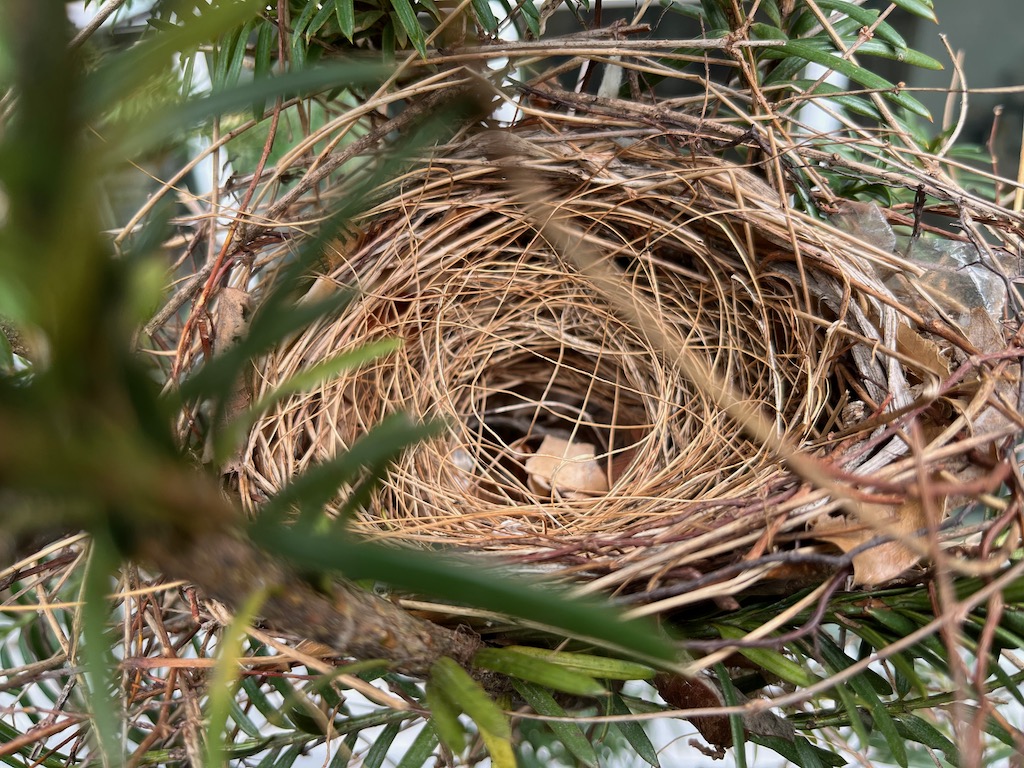
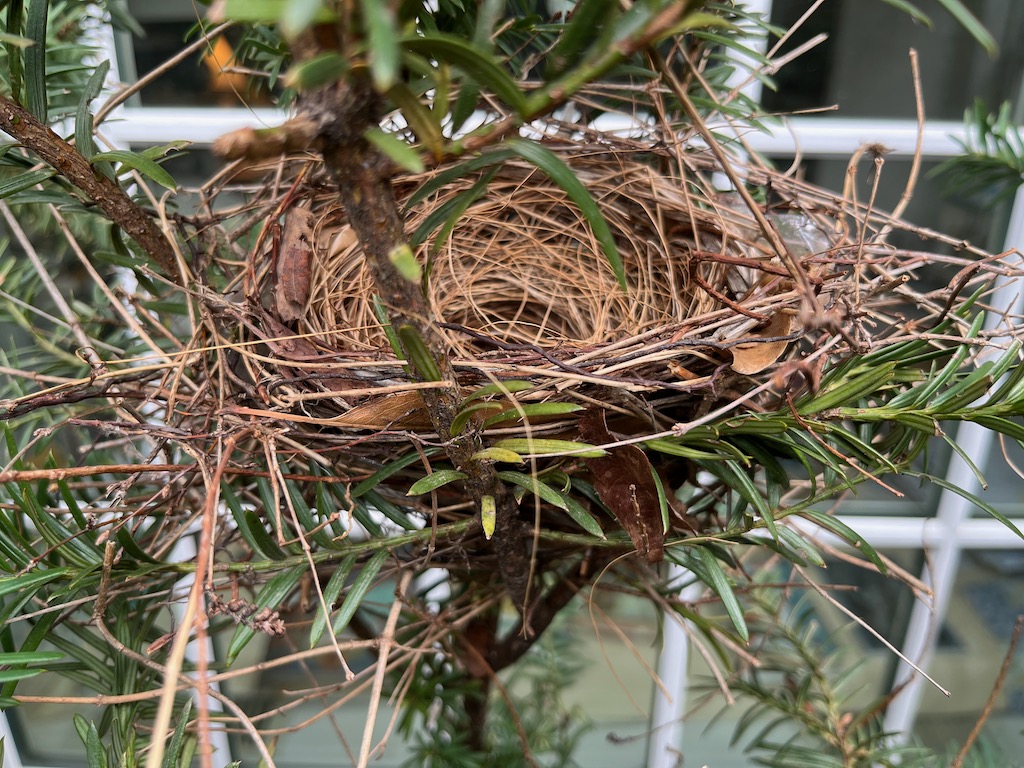
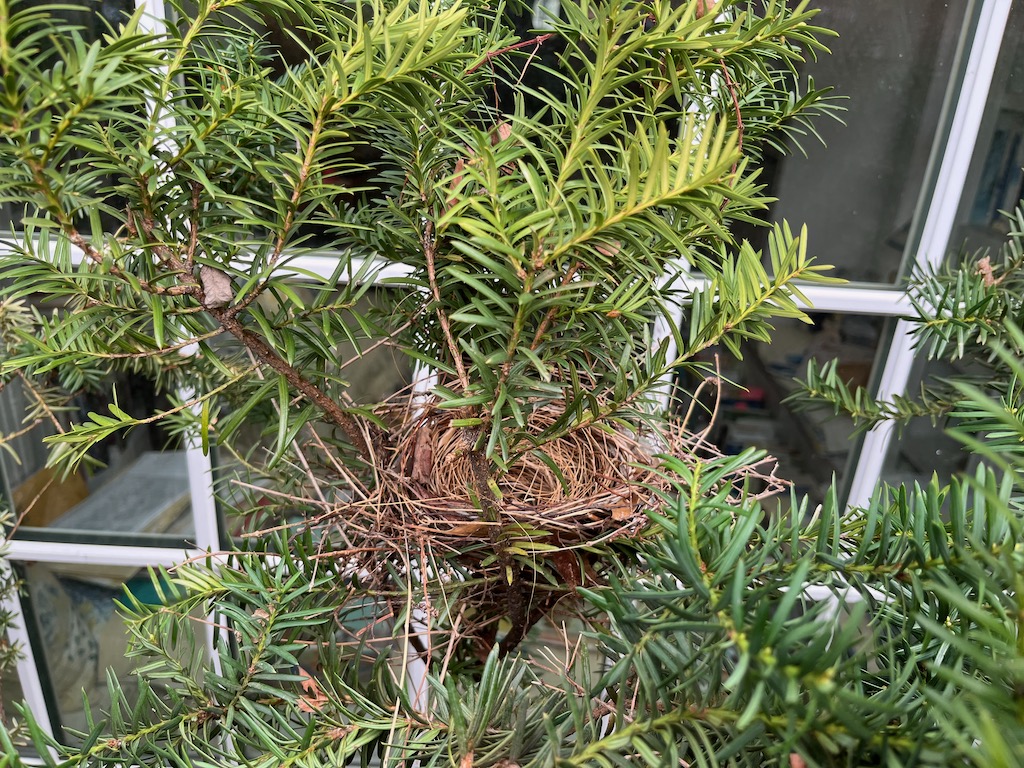
and so, the nest is empty. quite literally as i have just now hauled a step ladder out the door and, clinging for dear life, i climbed and pulled back branches, and indeed there is not a sign of life. just the artistry of their construction, right down to the shiny cellophane they might have thought to employ as something of a rain guard, what with all the rainy weeks of april.

turns out, the cardinals never had more than a one in three chance at making it out of the nest. despite their predilection for deeply tucking away their vernal constructions — remnants of a summer past, a bricolage of bits, dried grasses, thread-thin sticks, that cellophane wrapper perhaps from someone’s pack of cigarettes — the northern cardinal ranks near the sorry cellar of the nesting-survival charts, a long tumble down from the ash-throated flycatcher who scores the highest chance of flying from the nest, with seven of ten baby flycatchers flying. only the lowly house sparrow (11 percent chance) and the european starling (16 percent) fare worse than the red birds, and both sparrow and starling are invaders, anyway, non-native species snuck in as unintended cargo on some north america-bound vessel.

it hurt to sit here the first few days, the silence pounding in my ear. the absence of mama’s brown and red tail feathers protruding from the tuft of evergreen in which she so adeptly hid her nest.

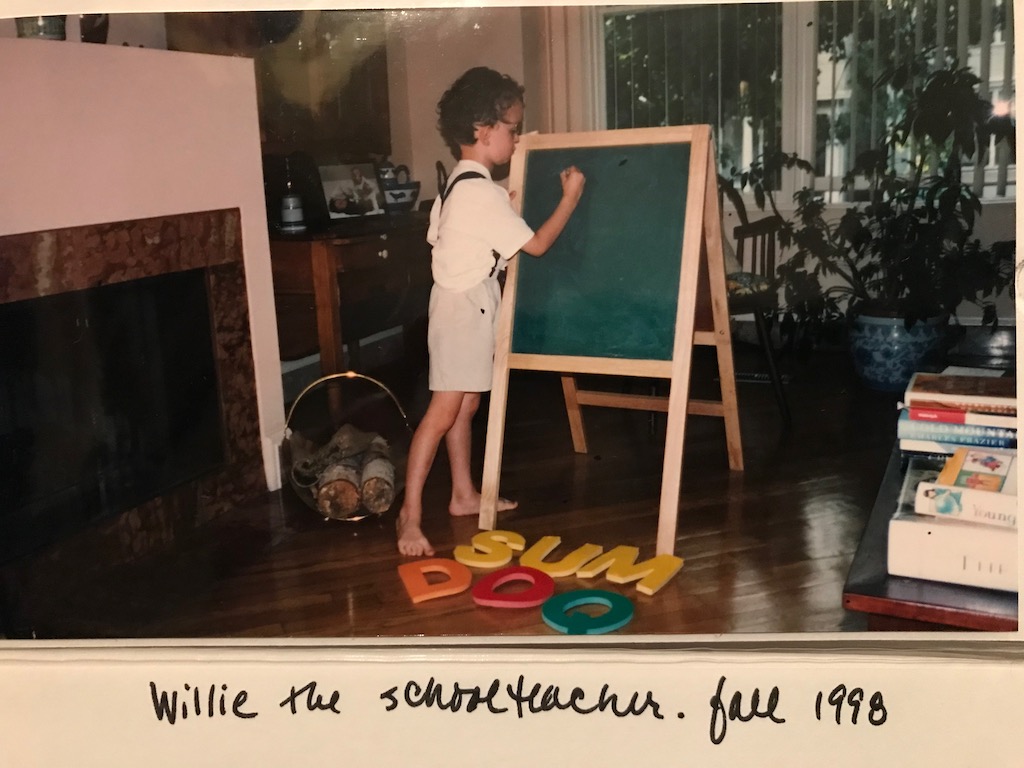
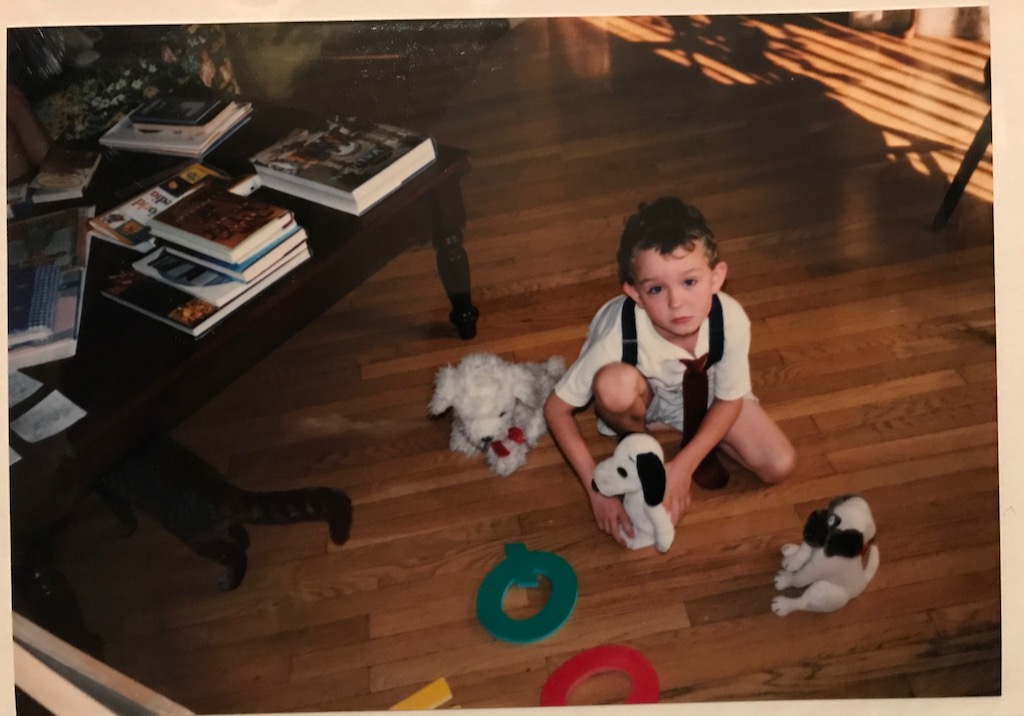
and then i started to consider my own empty nest, a consideration that comes, of course, as mothering day approaches. i think as much now about mothering as i ever have. though it consumes fewer hours of my focus, and fewer drives hither and yon, my fascination only deepens. i think often of how rare — how blessed — it is to know so fluently the whole makings of any life, let alone these two i love so dearly. day by day, it seems, the adventures pick up pace. the twists and turns in their narratives expand my own sense of being alive, being witness to lives unfurling each according to his own storyline. from my perch here at the old homestead, where i am reliably on watch and ever present, i follow two young men carving out paths that couldn’t be more different and yet entwine in ways that make me see the shared origins loud and clear and undeniably. the little boy who once could stare at a tv screen for interminably long times, he is carving out a path to be the very voices, the very storytellers, he once listened to. and the one who once set up an easel in the living room, encircled the room with every stuffed critter from his toy box, donned suspenders and necktie, scooped up a clutch of alphabet letters, and commenced a lecture on the fine points of S-U-M and Q, he looks toward a life in lecture halls filled with legal scholars in the making. let the record show it was snoopy who got first crack at his fledgling professorial skills.

my job here — simply loving through and through — will never ever be done. they might not need me (not so often anyway) to rouse them from their slumbers, to ferry them to the school house door, to shiver on their sidelines, but i’ve come to understand that my unique brand of loving means i’ll never find a way to lay aside aside my worries and my sometimes overly rambunctious fears. the phone calls these days are farther in between, the texts often unanswered, but my contemplations and my prayers deepen by the month. i’ve started worrying in a whole new way about this world we’re leaving to their keeping. i once held out hope that they could right our many, many wrongs. but now i wonder if we’re too far gone, this world so broken in so many places.

i look to mama bird, and her now hollowed nest. there is stunned silence out my window. no flicker of a sighting of mama now at it once again. she makes me think hard about the seasons of mothering, how some are full to bursting, and others pulse with a kind of aching, a sorrow for the hours out of reach, a longing for the more tactile days when every flinch and whimper was within our watch. her empty nest makes me think hard about the one i call my own, at once emptier and fuller than i can sometimes truly comprehend.

no wonder mothering never ever loosens its holy grip on me.

may your motherings be ever blessed, in whatever ways you love and hold those you count as your dearest rarest treasures.

now empty…

when grace comes tapping at the windowpane…

amid a season of war and worry, on the very day when steam was all but rising from this keyboard––a deadline looming, conveyor belts of verbs and nouns at high production––there came a rustling in the bushes just beyond the panes of glass that stretch between my bookshelves.

the morning was punctuated with the sounds of preoccupation, the faintest plink barely tapping at the glass, more than the usual chatter between birds. over and over, takeoffs and landings from bush to branch to nearby picket fence. the occasional outburst of trills and warbles.

it was the quiet of the sound that most intrigued me, the sound of trying to be unnoticed, hard at work in the art of concealment, a most necessary survival skill when up against the odds of danger, in a world where prowling cats and coons, thunderstorms and untimely freezes are another name for doom.

because i knew my role in this rare showing was to be as discrete and invisible as possible, i barely shifted my eyes, dared not tiptoe near the glass, for fear of spooking, for fear of shutting down production.

turned out, the faintest murmurings were these: the sound of wing brushing up against the glass, the sound of branches being jostled to make way for the laying down of bits of grasses, dried and brown and wholly unremarkable.

but what was done, over the course of a single day, was not only wholly remarkable and breathtaking. it was only the beginning.

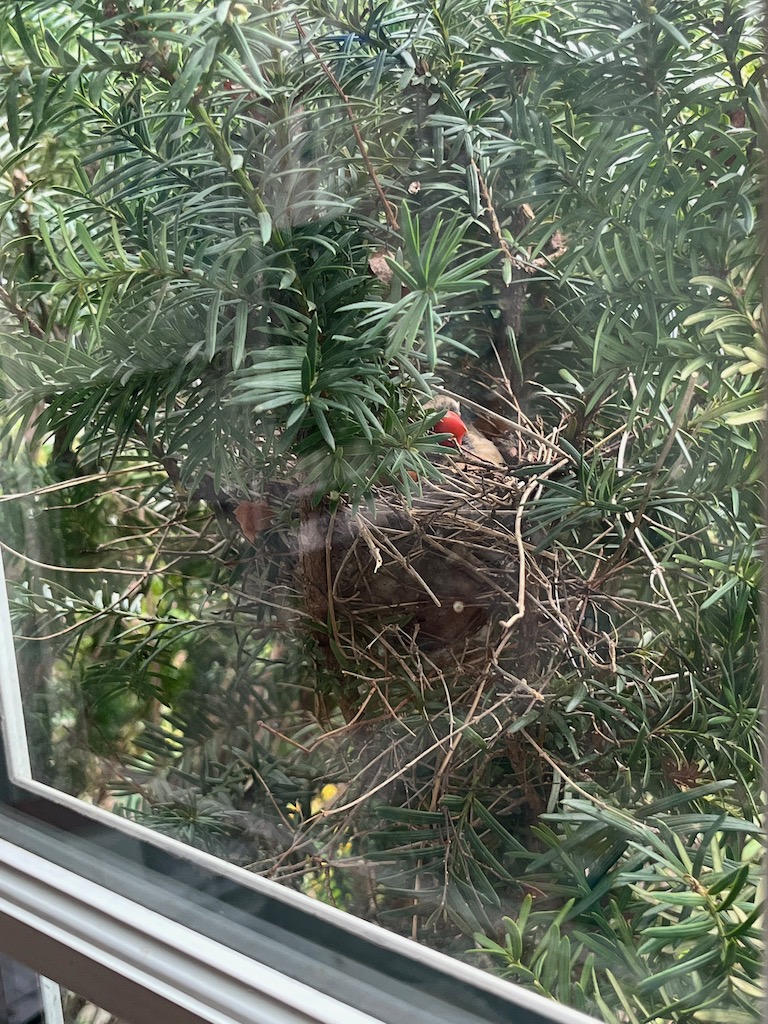
mama and papa–a pair of cardinals i know by name–had for the first time in all my decades decided to grace me with a front row seat on their reproductive spring: they’d chosen my very ordinary, very ungroomed evergreens, as the very spot to build their nest. it just so happens to be up against the glass, as if the window to the nursery in the maternity ward, the ones where long ago fathers pressed their nose against the glass to get a first peek at the progeny newly birthed and swaddled, the hard labor shielded from the men not allowed near delivery, too faint for such primal birthings.

over all my years, i’ve spied robins all but nesting in the public square. i’ve seen sparrows busily and noisily stuffing gutters and cracks in this old house with the makings of a nest. but never ever had i figured out just where it is the cardinals go to replenish the species.

i now know why. my guess is they’re the high scorers in the game of hide-and-seek. their nest, literally up against the glass, is all but impossible to see from the other side of the bushes, and wedged in in such a way that i cannot for the life of me peek into the bowl of the nest (believe me, when mama flits off to grab a seed, to relieve her feathered bum from all its incubating, i’ve climbed atop my window seat to try to fetch a look).

we’ve come to work in synchrony, mama cardinal and moi. i tap quietly at my keys all day long while she goes about her warming of those eggs all day long. once the sun goes down, i leave the premises, turn off the lights, shuffle off to the old maple table in the kitchen–not wanting a brood of mixed-up baby birds to mistake my desk lamp for a never-setting sun.

far as i can tell, and i tell you my guess here is based on scantest evidence, there’s not yet a clutch of little beaks to fill with bits of worms. each day, though, the drumbeat picks up pace. it’s been two whole weeks, and surely we must be getting close.

it’s a blessed thing, a most blessed thing, a thing that fills my soul, to be witness to the against-all-odds timeless knowings of the feathered flocks. those little birds know nothing of the ravages that tear apart the human flock. theirs is a universe––far as we know, and maybe i’m just wishful thinking––without the sorts of strife, without the demonic ingenuities to dream and build and drop a bomb. do birds know worry? does mama bird go about her business without the slightest hint of begrudgement? is she already plotting her grocery list? does she count her clutch, scan for misshapen egg, dread the day those baby birds take flight and leave the nest?

such are the questions that reel through my mind, as mama bird and i go about our tasks this one most blessed spring. it’s a wonder when grace comes tapping at the window pane. as if the heavens know just who and when needs holy balm far far from the madding crowd.

what grace has brushed you by this spring? what’s caught you unawares? what quiet has so startled you, and awakened you from your worldly slumbers?

the last cricket and all those other blessed moments we miss…

we’re ankle-deep in october already, and the woods and the skies and the last vestige of garden are enmeshed in the verbs of autumn: gilding, disrobing, graying, withering.

while the world all around is exulting in the yin and yang of the seasonal shift, lurching from summer to winter, hewing the razor’s edge of autumnal juxtaposition — the last vestige of bone-baking warmth to the goosebumps of dawn’s early chill — while the chipmunks are making like there’s an acorn-stuffing contest, and he with the bulgingest cheeks wins, and the chatter of sparrows rises some days to a deafening chorus, the last of the summer’s songs have vanished.

and i didn’t notice till now.

the blanket of cricket song, a rising crescendo that all but tucked me into bed each summer’s night, it’s stilled. silenced. taken away, tucked on a shelf somewhere, awaiting the heat of next august.

the last of the cicadas’ 24-hour love song for survival. it’s gone too. snuffed out. it too rose to a deafening roar, and then with the flick of a switch that i didn’t bother to witness, it melted away.

now, when you open your windows at night, there’s little to hear save for the possums knocking over the watering can. or the night winds rustling the leaves before they loose from the limbs.

what with all the commotion — of the world, of the news, of the worry — i didn’t notice the absence till i stumbled into the thoughts of someone who’s paying closer attention.

sacred attention, i’d call it, a religion i aim to practice.

i read these words, and felt the ache in my chest:

My intention every year is to listen for the last cricket, the explosion of silence after its ridged wings have struck their final chirp. I imagine it as somehow akin to Bashō’s temple bell whose sound, after the bell has stopped ringing, comes pouring out of the flowers. I have no reason for wanting to mark the occasion other than a poetic temperament and a feeling that the mindfulness required of such a task is its own reward.

The idea usually arrives in September when the crickets are at their most frantic. I toy with the thought of camping out the night it seems likely they’ll stop. I imagine myself keenly attuned to the hypnotic lull, aware that if I fall asleep, even for a moment, I could miss it. The novelty appeals to me. The invention of such an inconsequential drama. It would make no difference to anyone whether I succeeded, or if it took me years to accomplish. The achievement would be mine alone. Sometimes to up the ante, I imagine decades of failed attempts until maybe one night—when I’m an old man, stumbling, bearded, blind, bereft of all hope—a Zen-like oneness with the woods sets in and from nearby, under the bark of a rotten log, I hear the teeth of a cricket wing crackling the air, and listen, knowingly, as the world resolves itself in silence.

Steve Edwards, “The Last Cricket,” Orion Magazine, Autumn 2020

mr. edwards’ elegy to the cricket song made me think of all else that i’d missed. it seemed an exercise that drew me — and maybe you — into a necessary meditation. an exercise in paying attention, for this is our one sweet moment to clasp our gaze, and our listening, on the beauties offered up in this one ephemeral whirl around the blazing star.

it’s a canticle worth our attention.

have you noticed…

*the moon gliding across the sky, still clinging to its post as the sun comes along, both sky lights sharing heaven’s dome?

*the stars turning on, any one particular night?

*the moment when God hauled out his paint set and brushes, and the first leaf turned amber or garnet or the color of pumpkins?

*did you happen to catch the river of monarchs riding the winds, flapping their stained-glass wings as if their life depended on it — because it did?

*did you stare into the indigo darkness, into the etched silhouette of what looked like endless punctuation marks crossing the moon, the night the tens of millions of birdsongs flew overhead, miles and miles into their autumnal sweep southward?

*have you paused in genuflection when the chevron of geese called out from the heavens with their spine-tingling minor-key cries?

*have you watched the sparrows upholstering their wintry homes with blades of dried grasses and tufts of runaway cotton?

*have you found where the cardinal sleeps in winter?

it’s all the wonderment out our window, in the woods, in the world where we’re not looking. and all it asks is that we notice. that we pay quiet and unbroken attention.

it’s all we need some mornings to remind us the world is still intact. to remind us we’re safe in the bosom of this holy and most sacred earth. our ears pressed against its soft chest and the heartbeat of the One who keeps it working.

what wonderments have you noticed, from the autumnal litany above, or from the zillions of moments i’ve not even mentioned?

p.s. my sweet boy is still on the mend. slowly, slowly. tray by tray of home-cooked mac-n-cheese, bread pudding, applesauce and water bottles by the case. slow walks around the block. long interludes of napping in the quiet of leafy suburbia. it’s all aiming to get him back to college before the already abbreviated semester lurches to an end. thank you, so much, for your love and your care, and your prayers. xoxox (p.s.s. i was a wee bit late here this morning, because my friend, the patient, beckoned, and the computer was playing all sorts of tricks….)

wild things

IMG_1229

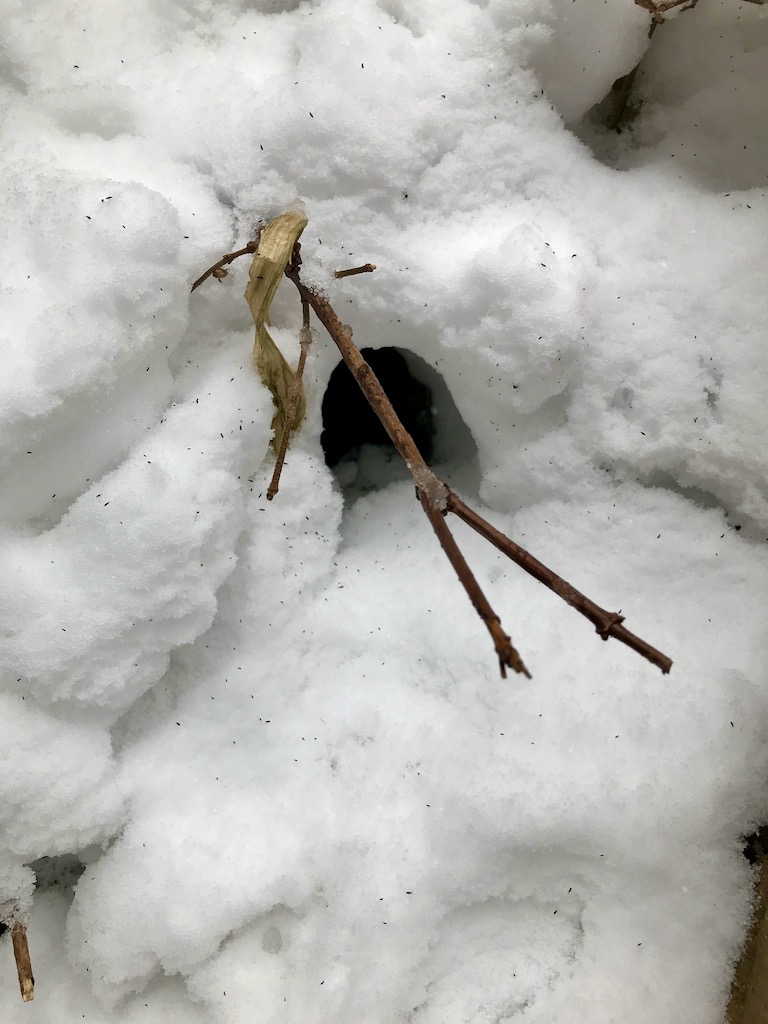
a mouse’s house? with front-porch perch…

it’s the permeability of winter, when the cell wall between the wild and the worldly is punctured, when the precious little things come out into the open, are pushed out into the open, all but tap at the window, beg for a taste of mercy, that’s holiness to me.

IMG_1231against the white tableau of snowy day after snowy day, winter makes evident the tracings of the wild things: a mouse hole here; chantilly-lace tracks of junco and cardinal and jay. even the abominable paw prints of a giant-sized coyote, straight from the woods, up my walk, paused there by the door (did he press his nose to the glass, take a peek under the cookie dome?).
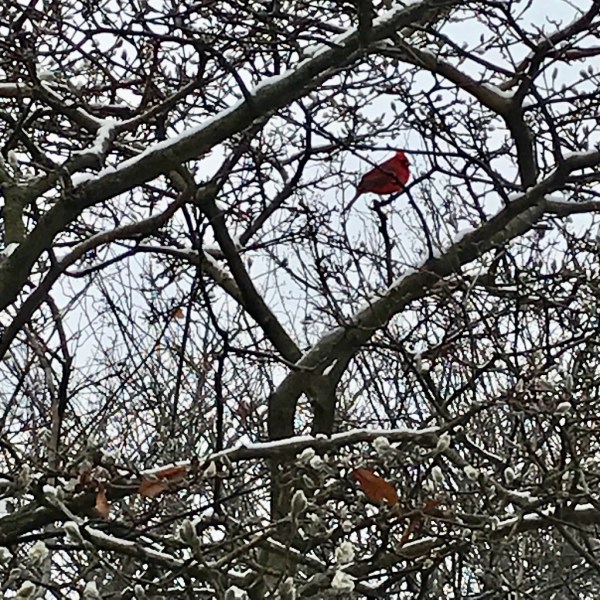
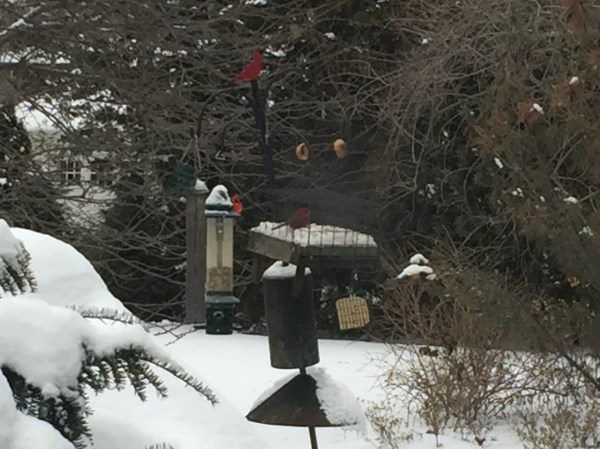
each morning, no matter what the heavens are hurling my way, i don my make-believe farmer-girl boots, i scoop my battered old tin can, fill it with seed, and head out for what you might call matins, morning benediction. i bow to the heavens. scan the trees for any flash of scarlet, or blue-jay blue. i unfurl prayer upon prayer (the moon, if it’s shining, even a crescent or wedge, draws it deep out of me, never more so than in those inky minutes just before the dawn).

what i love about the wild, about this curious equation between us in our warm cozy kitchens and them seeking harbor in ways that mystify now and forever, is the fragile interplay in which we reach beyond what we know, extend an open palm of pure unbridled trust, an offering, no strings attached. it takes stripped-away ego to dare to tiptoe into the world of the wild. it takes a deep and undiluted knowledge of how small a dot we are against the vast canvas of the universe, all but insists we put aside our big ol’ bossy pants, our hurried agendas, our know-it-all nonsense.

it’s the very image of holy veneration: head bowed, palms extended. i come bearing sustenance, in the form of plain seed.

have you ever felt the backdraft of a feathered thing, as it’s flown inches away from your shoulder? have you felt the rush of the wing, heard the soft sound of feather and bone parting the wind?

and then there’s the shock of color, all day long, brush strokes of scarlet, of blue, of smoky charcoal. the boughs are alive, are animated. it’s not all black and white and static gray, not in my patch of the world anyway. all day long it’s a reminder, the wild is just beyond, the wild has wisdoms to teach. mercy is among the urgencies. mercy is what we need to remember; we are lacking in mercies these days.

who ever thought to bring so much wonder to winter? that’s the point at which my wondering leaps from earthly to divine. that’s where unshakeable faith begins to take hold. the wild begs questions that only the heavens can answer for me.

which brings me, round about and once again, to david whyte, whose poem the journey says everything i could ever hope to say with any string of words. have a listen:

The Journey

Above the mountains
the geese turn into
the light again

Painting their
black silhouettes
on an open sky.

Sometimes everything
has to be
inscribed across
the heavens

so you can find
the one line
already written
inside you.

Sometimes it takes
a great sky
to find that

first, bright
and indescribable
wedge of freedom
in your own heart.

Sometimes with
the bones of the black
sticks left when the fire
has gone out

someone has written
something new
in the ashes of your life.

You are not leaving.
Even as the light fades quickly now,
you are arriving.

from House of Belonging  and Essentials by David Whyte

IMG_1240

what wisdoms does the wild whisper to you?

and, while we’re here, the late january table brings a slew of birthdays: kerry down the lane today, beloved beloved pammy jo of the high desert, yesterday. british columbia mary and indiana BB on the 28th. happy blessed whirls around the sun, ladies. and thank you for your radiance….

survival, astonishingly

frost-crystals-on-glass-texture

the artistry of dawn, frozen against the windowpane

the weather people soothe us now with reports that it’s all of 9-without-a-minus-sign degrees. but the thermometer outside my kitchen window insists otherwise. it says 5, and not a micrometer higher. either way, that’s eons better than the -22, or 45 below with wind chill. and here along the windy shore of lake michigan, wind counts mightily. it always counts.

our house the other night was burping. or so it sounded. every once in a while through the night a thud arose from who knows where. sounded to me like things were crashing to the roof. i got up to check out the window, to see if i could see a falling something, to see if ice chunks were hurling toward the house. the next day’s news brought word that these ominous noises — these noises that had people rushing to their windows, to see if glass had shattered, limbs had fallen, or maybe stars had tumbled from the heavens — these noises were a phenomenon known as “frost quakes.” so defined as: “a seismic event that may be caused by a sudden cracking action in frozen soil or rock saturated with water or ice.” egad. yet another quirk to be added to the weather woes. count me among the ones who do not like “seismic events” in and under and all around my house.

at our seismically-burping house, as we whirled into the abyss of the polar vortex, we settled our worries on anyone or anything who might, for some godforsaken reason, be stuck outside. we worried mightily about the folks who sleep in tents under viaducts and along the banks of the chicago river, and in flimsy encampments near the railroad yards, in hollows of the city where the forgotten stake their claim in pockets of oblivion. we prayed that somehow someone might convince those folks to leave behind their propane tanks and blankets and the cardboard boxes they call home. and just for one night — or until the vortex whirled away — deign to climb aboard a warming bus, or a cot inside a shelter. dear God, please do not let there be a child out there, i whispered over and over.

closer to home — right outside our kitchen door, in fact — our heap of fears focused on the tiny feathered flocks who dart and flit all day, every day. we knew that we had blankets, and a fridge filled with clementines. and a tea kettle that could whistle on command. but what about the red birds? what about the little juncoes, those snow monks of the winter? and what about the sparrows, the unassuming brown birds whose chatter never stops.

if i could have, i would have opened wide the kitchen door, invited them all in. but i knew that was whimsy. pure wishful whimsy. as if a flock of cardinals would roost above our dinner plates, or huddle high up in the pantry. i was not alone in my worrying. the tall bespectacled fellow who shares this house, he’s the one who first named the little birds when we bowed our heads to pray before tuesday night’s dinner. he did the same on wednesday and thursday.

we could not for the life of us figure out how those tiny-footed creatures — the ones who weigh all of five aspirins or one and a half slices of bread (that’s 1.5 ounces or the same as a papa cardinal) — how in the world would those tiny wisps of heartbeat survive through the long dark arctic night?

it was an equation of survival stripped to its essence. it’s not every night we boil it down to life or death, just beyond our kitchen window. and hope against hope for life to be the victor.

i couldn’t bear to imagine the little things hovering, tucked away in some bough of some fir tree that hardly blocked the wind. i pictured tiny frozen red birds fallen to the snowdrifts by morning. i couldn’t sleep.

once the daylight came, once the sun against the snow made it hurt to stare into the glare, we kept watch anyway. nothing moved out there, save a snow-capped branch blowing in the wind. i’d trudged out early, dumped a can of seed — just in case. but nothing and no one budged. all day on the coldest day, the yard was still.

at last one chickadee appeared. darted toward the seed, nibbled, flitted off. but no one else. then nightfall came again. and dawn. and nothing. not a single bird.

and then, as i kept watch through the morning, as the bespectacled one peered from his upstairs window, at 10:57 yesterday morning, there it came: the flash of muted red that is mama cardinal. she clung to a branch not far from the feeder. and then, at last, she swooped in. as she pecked away at the sunflower seeds, along came her backup squad: one red bird, aka papa, and two more mamas. survival

there was jubilance in our kitchen. the mere shock of red against the white-on-grey tableau, it was victorious. nothing short of a death-defying feat. it was still, at that mid-day hour, -12 degrees. and yet, somehow, the little birds survived. had made it through the wind-whipping night, had endured a cold they’d never ever known, and tucked away in some unknown-to-us cove, employing unimaginable survival skills. we should show such grit. we too should defy the insurmountable when it’s heaped against us.

i stood in awe. the mysteries of the woodland escape and astonish me. the masterwork of creation is what floors me, over and over and over.

we’ve pummeled this holy earth, with our chimneys spewing smoke, and the poisons we’ve poured into the waters, and yet, on a polar vortex night, the papa cardinal clung on, he didn’t freeze to death. he doubled the air mass in between his feathers. he slowed his breath. and before the mercury climbed to zero, he flashed across the yard. the red flash, triumphant.

thank you, Great Protector. and hallelujah cardinals. and all who have survived.

what’s your survival story from this long and bitter week?

“wake up!” shouts the world to its sleepy citizens

perhaps, over the long winter’s months, you dozed into somnolence. sleepy-eyed, you shuffled, as if in your scraggliest house slippers, through the days and the hours. why bow down to sniff the gnarly branches when nothing but snow — and icy cold — bumped into your nose?

ah, but then, as it’s been doing forever and ever — since the dawn of creation, as a matter of fact — the old globe turned on its axis. inch by inch. or galloping yard by galloping yard. whether we notice or not, it keeps on with its celestial work. it’s the job of the earth, for heaven’s sake, to not slow to a crawl, to not stop in its tracks. it’s the job of the earth to carry us all on its curious merry-go-round, a ride for which we don’t need a ticket, needn’t stand in a queue, waiting our turn. we’re on — strapped in or not — for the whole of the whirl.

and so, here we are, back in the part where, if we’re paying attention, we find ourselves in the minute-by-minute explosion of all that’s been quietly waiting out the winter. it’s slow seduction, this day by day, hour by hour, unfurling of all that’s within. mama earth doesn’t give away all her hallelujahs at once. she wants you back, she wants you keeping close watch on her show, so she lures you in, a slo-mo unveiling of all of her secrets.

one day you might notice a nub where the day before there was nothing but stick. and then, should you sashay back to the scene, say by mid-afternoon, you’ll see a bit more of the skin, of the bulging protrusion that is the bloom in the making.

it’s all newborn right now. the leaves, just beginning their term, as if cut from a fat bolt of velvet, pinned onto branches, by the night seamstress, the sorceress of spring, who wisps through the dark delighting our senses, making way for the morning show, when the curtain of dawn rises.

everywhere, the earth is shouting: wake up, you sleepy heads. wipe the goop from your eyes, slip on your galoshes, and come give it a gander.

and lest that all be too subtle for you, lest you miss the whisper of the garden, well, old mr. robin has a wake-up for you. and he starts his warble in the wee, wee hours. not long after three, perhaps. certainly by four. in the morning, i mean. the american robin is no dawdler, sleeping in, taking his sweet holy time. nope, he’s up well before the crack of dawn, and he’s in full throat these past coupla weeks. has he not awakened you?

here, have a listen: mr. robin singing his song.

he’s out there in the dark, poor warbler of night. good thing he’s got a fairly fine song. a clarion call of 10 consecutive notes, the ornithologists tell us. clear whistles. some folk, the ones who try to put words to the script of the birds, they say he’s calling out “cheer up, cheer up.” or “cheerily, cheerily.” i for one can’t quite make out the words, but i do hear the song, i hear it for most of the night, these past few insomniac nights.

my friend tim the birdman tells me it’s all about hormonal overdrive, of course. and the poor robin just can’t sleep when he’s got one and only one thing on his mind: he needs to procreate, plain and simple. so he’s awake at the first lumen of light. and that’s where the problem comes in, says ornithological tim. those peachy-breasted birds are suffering a modern-day plight: the extreme wattage of the world, the herds of high-intensity light poles lining our highways, the bizarre habit of planting floodlights in branches of trees, they’re all doing a number on the chorister of dawn — they’re pushing his start time closer and closer to midnight. some robins, says tim, are singing their lungs out “almost all night long.”

egad.

the over-illumination of our planet — the daylight that stretches from dawn to dawn — it’s mucking up the works in a serious way.

but, back to the lone robin who sings out my window — and likely yours too.

seems to me, he’s all part of the magnificent plot to shake us all out of our stupor, our natural-born inclination to doze at the wheel of this thing called “a life.”

there’s divine wisdom, indeed, in this once-a-year whirl through the explosion of spring. the earth is literally bursting with the beautiful. it’s beckoning, begging: crouch down, pay attention. give a sniff. plop your bum. inhale. watch me unfurl. i’ll give you a wallop, minute by minute. 

in a thousand million mind-spinning ways the whole of creation is clued in to the infinite wisdom: this is your gift, it’s yours for the taking. all you need do is open your eyes, open your ears and your nose, pry open your heart — and your soul while you’re at it — and let in the holiest whisper.

it’s the wake-up call of heaven and earth.

the springs of our lifetime are numbered, they won’t last forever and ever. the beauty is now, go bury your nose in the whole of it.

and whisper a fine hallelujah.

(mr. robin might be pleased to know that you’re adding your notes to his noisy spring chorus.)

if only someone had invented a scratch-n-sniff for the whole of the springtime….

what are the ways the explosion of spring slows you to deepest attention?