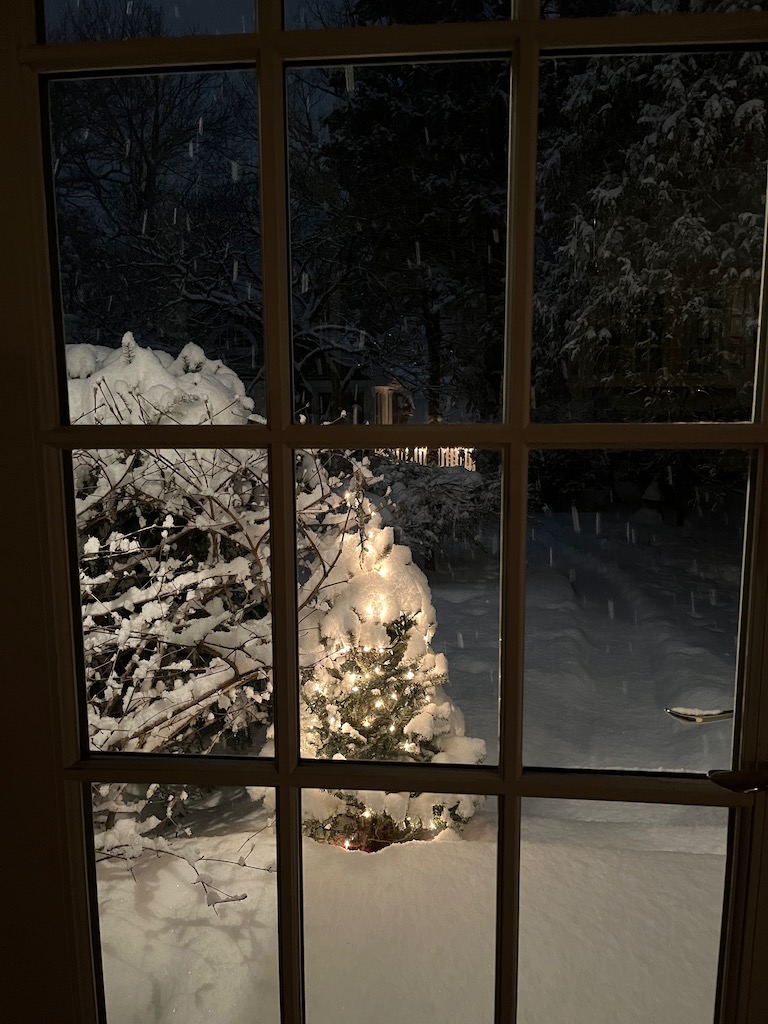
it is as close as i’ve ever come to waking up inside the pages of a picture book, or an enchanted forest, the waking up to fat flakes falling, to heaps and meringues of snow on every flat plane, every bough and twig; even the lumps in the walk get a dollop of beautiful. everything sometimes deserves to be adorned. everything sometimes yearns to be simply lovely.
the days of waking to grace feel numbered of late. more often i awake with a lump in my belly, a worry grown big and bigger in the dark and the tangle of sheets. almost like a sourdough rising, the way the night worries grow. but today is not one of those days. today it begins with nose pressed to the pane. i long to step outside in the thick blue light of it, the silence of it. but i’ve a silly thing about not wanting to mar the tableau, not wanting to plunk my boots in the seamlessness of it all. so i keep to my side of the glass. and i let the snow and the quiet fall unbroken.
i marvel always at the ways the world––grace, God, unseen sacred stirring––steps in just as i need it. the way the prescriptive fills every hunger and hurt. it’s as if all creation is apothecary for the soul. and when we quiet ourselves, and allow its medicinal balms to seep into the cuts and the lumps and aches, the healing comes. the respite of catching our breath, making sense of the madness.
just this morning i awoke with the knowing that a longtime beloved friend had awakened yesterday to find her husband still in his chair from the night before. he’d died, alone. he was 67. no one saw it coming. the night before, wednesday, had been any old wednesday; my friend had made meatloaf for dinner, hadn’t a clue that one single thing was not as it should be. life shatters without making a sound.
my faraway best, best friend is going to surgery next week, her second time in ten years with a surgeon and an oncologist she calls her own. a third friend, one of my bridesmaids, is sitting by her sister’s bedside in dallas, where the cancer has crept into her brain, and where upon finishing a CT scan last week, her sister (four years younger than me) had suffered a stroke. right there on the gurney. right there in the middle of an already terrible cancer.
i ache for every one of them, ache in ways that push against the walls of my heart. ache in ways that crowd every other thought out of my head. ache in ways that make me pay more attention than ever to the most ordinary of miracles.
and this morning i sit here absorbed in the lull that follows an overnight snow. it’s as if all creation understands we need silence between all the noise. we need the holy pause that allows us to catch our broken breath, to be still as we gather up the shards, put the pieces back together again.
the world aims to comfort us; it’s one of its marvels. it aims to shake us to our core, too. another one of its marvels.
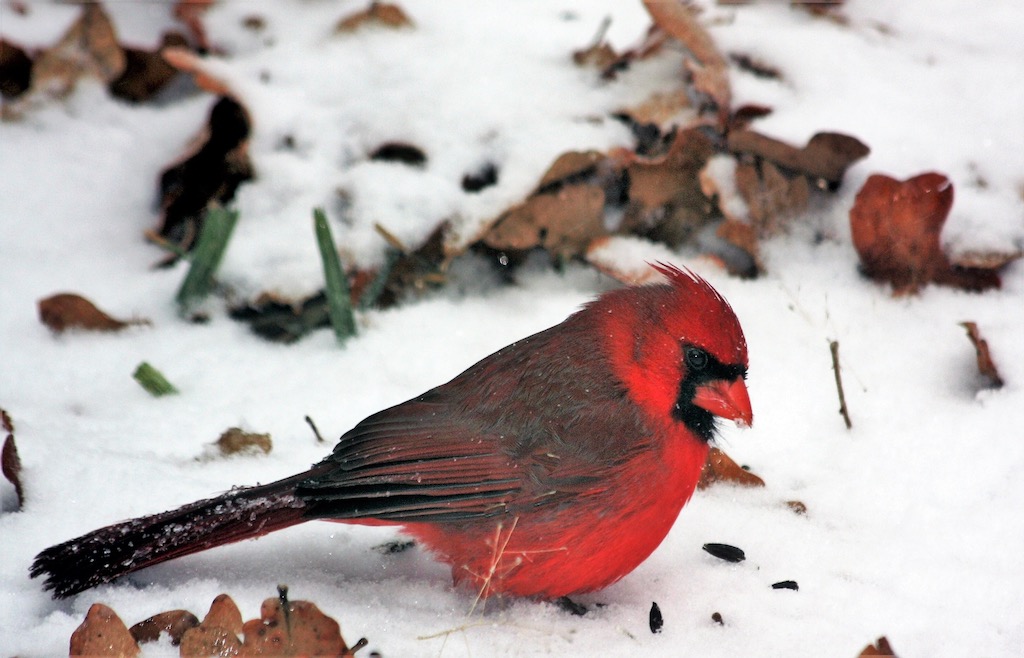
how blessed are we that we live in a world of creation, sacred creation, a world where the woods are a balm. where the red bird alights. where snow falls without sound. where, dawn after dawn, the sun rises. and stars stitch the night sky.
the blessings abound. all we are asked is to notice.
dear God, thank you for the balm of this holy morning. may grace fall in thick meringues on the ones i love who are so deeply hurting. and afraid. and alone.
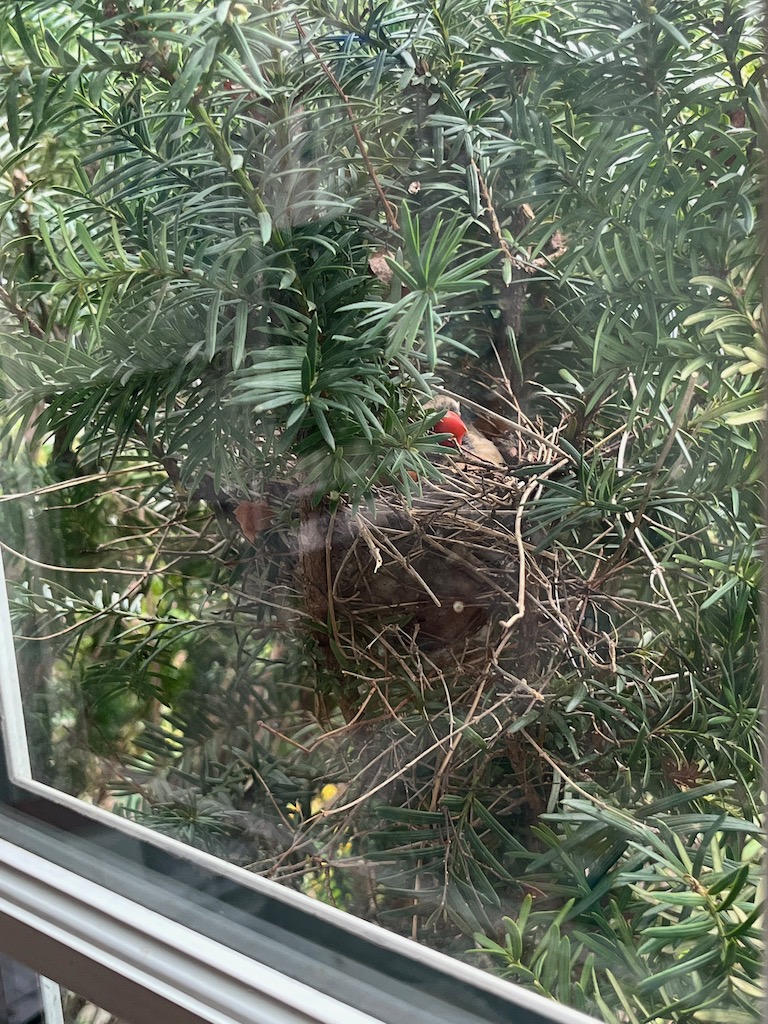
and just like that i looked up, and the red bird came. just beyond my window in a nestle of branches puffy with snow.
God answered. and the red bird flew.
where did you find grace this morning?
in case you need a quiet walk in the wintry woods here’s a little miracle sent my way; last night i gave a talk on the stillness of winter, and opened the evening with this moment of beauty. not all of you live in snowy climes, so here’s your taste of it, too. may it bring you peace, this walk in the snow-laden woods…
tagging the word “project” onto just about anything takes it up a notch. makes it sound more determined. not some sloppy mess off in the corner. and so it is that my firstborn and i seem to have stumbled onto a “project,” though he’s the chief engineer and i am merely its occasional scribe.
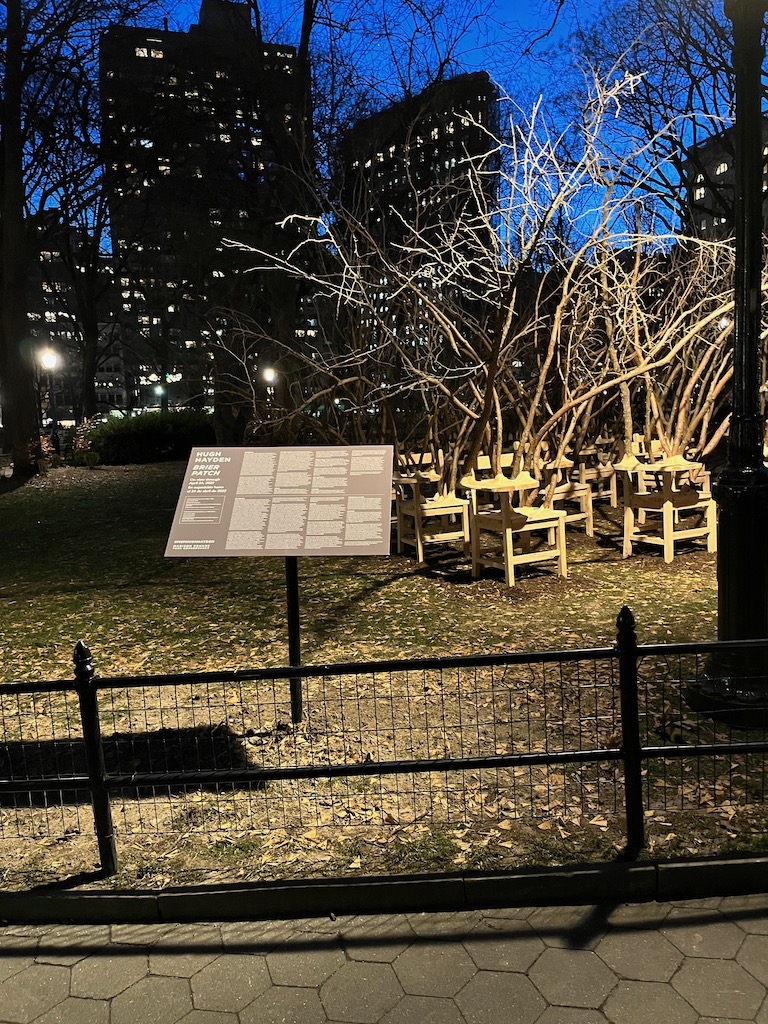
it was birthed–for me, anyway–in the bowels of manhattan, underground, in the glare of fluorescence that lights up the 23rd street subway station. we were dashing from the bone-trembling cold of madison square park where we’d just been soaking in the opening of hugh hayden’s “brier patch,” a sculptural installation of 100 school desks and tangled tree limbs that speaks, among many things, to educational disparities and injustices (and is just plain beautiful), and that was curated by the glorious woman my husband calls his one and only sister. despite the fact that each of my limbs could not stop shaking from the cold, i will never forget watching her–against the golden halo of the lamp light–as i thought of the mother, the father, and the grandmother who had so profoundly shaped her. tears were falling as i imagined them watching her there in the cold january night, a crowd assembled to listen to her every astute word, to witness her latest public art offering to the metropolis that is manhattan.
hugh hayden’s “brier patch” madison square park conservancy
but back to the kindness project. having scrambled to the bottom of the long flight of subway station stairs, i paused and took in the whole of the whirl of the thousands of lives momentarily all in the very same place at the very same time. i couldn’t help imagining the stories, the struggles, the sufferings, etched into the faces that ran past me, that leapt into train cars that whisked down the tunnels, disappearing into the darkness.
i felt the thrum of humanity at its most percussive pulse point. we were all in this together–whatever “this” is, whatever “this” brings us. and, at the moment, the world is a tough place to inhabit. reports come in from all corners: of wars on the brink, of political revenge, of ugly words rising in senate chambers (and uglier ones spilled in cloakrooms and hallways).
if kindness is antidote to madness, if there lies a paradigm beyond the worldly one of spite and retributions, one where the gospel of empathy reigns, where we’re guided by a command to love as we would be loved, maybe that’s where the healing begins. maybe that’s where we find our salvation. maybe it cloaks us against the cold, maybe it’s how we the people stand one slim chance of turning our backs on all that we find so wretched, so deeply unjust, so just plain vulgar.
maybe we get about the business of seeking living breathing moments of goodness. of nothing less than simple decency, looking out for the stranger, offering hope to the hopeless. maybe, if we pay enough attention, if we gather those moments of kindness like beads on a prayer string, we might begin to gather momentum, to put forth and build a force that just might put a dent in what some days feels like a tidal wave of the ugly.
more and more over the last stretch of years, i’ve found myself pulled deeper and deeper into the realm of the sacred Divine as the world around has gotten more and more vile. to hear the call of a voice eternal and True is to begin to drown out the shouts from the ugliest corners. it’s where and how i find my peace.
and it’s a project worth tallying. a count worth keeping.
and so, on that cold january night, there on the 4 train as it threaded through tunnels, the kindness project catalogued its first unmistakable display: a fellow hunched like a comma on his hard plastic train seat was muttering to himself, when he happened to glance up and i–hanging onto a subway car pole–happened to glance down. this, apparently, was enough to offend, so he let me have it, with a spew of expletives that grew increasingly incensed. at that very moment a woman whose accent gave away her caribbean roots, pointedly tapped hard against the metal subway-car door against which she leaned, and inched herself just enough to make safe harbor for me. with little more than the tap of her finger, and the insistence in her eyes, she’d signaled loud and clear that she was having nothing of the old man’s vitriol and she was keeping me from any harm. the moment passed, the animosity diffused, and i was washed over in the blessing of stranger caring for stranger. i nearly reached out to squeeze her by the arm, a wordless expression of infinite gratitude, but i refrained, not wanting my gesture to be mistaken for any form of crossing the line.
and for the next string of days, as my firstborn and i made our way through the winding lanes of lower lower manhattan, as we fell into joyful conversation with the checker at the grocery, or the lady behind the counter at the lamp repair shop, there grew the sense that we were onto something. new york, new york, is not known widely as the capital of nice, and yet it seems to brim with hardscrabble kindness. and it’s nothing short of miraculous, to find those glimmering shards of straight-up goodness––humanity at its best––among the art-deco towers and the deeply-shadowed corridors of capitalistic commerce.
my firstborn, blessed soul that he is, is all in on the project. called me last night to report his latest finds; in an uzbek barber, and an orthodox watch repairman, in the old wrinkled man behind the counter of a chinese general store, where he found himself invited for new year’s.
the plan is to keep watch, and keep note (tapped out on his phone, or inked into one of his many moleskin notebooks). in a city that never sleeps, in a city not known for tender loving plenitude, take census of kindness and allow its superpowers to alter the landscape.
it’s a mission i’m taking up here, in the heart of the heartland.
one by one, little by little, one act of golden good kindness at a time, we are building a fortress to keep out the ugly, the vile, the deeply unkind.
and, besides, it makes for a million fine yarns.
as i wrote in a note to my firstborn just this morning: “it seems one of our holy tasks is to see the sacred sparks all around, in the souls of kindness you are finding in watch repair shops and chinese general stores. keep at it. the work is never done.”
would you care to join us? record your findings here.
the tall skinny tower with the beacon on top is home to the sweet boy i so dearly love…
i’m home from my blessed string of six days in new york, unpacking 89 boxes and making a nest for someone i dearly dearly love (my firstborn) on the 34th floor of a grand old art-deco tower at the bottom tip of manhattan. i miss both my boys madly (the other one is back at college), as i’m now home in the quietest of old houses, but i revel in knowing our home-grown law clerk has fallen instantly in love with the place he’s now calling home. while away, i got double whammies of awful bad news from two of my oldest dearest friends in the whole wide world, and i’d so welcome a prayer or two if you’ve a spare: one beloved friend found out she’s up against breast cancer (a second time), and another called to tell me her little sister’s cancer has crept to her brain. life sure is cruel. but as my friend with the very sick sister put it so starkly eloquently, “this is life, it’s full of suffering and ours to endure. our job is to do it with grace.”
long, long ago, the one certain place where i escaped in the house where i grew up, where i all but opened the window and soared out through the oaks, was beneath the covers of a patchwork quilt in my upstairs room where i’d hide for hours on end in the pages of an opened book.
the very architecture of a book is built for drawing you in: there’re the pages opening like spread-wide angels’ wings, there’s the tucked-in gulley where those pages are hinged to the spine, the gulley that demands ocular acrobatics, as your eyeballs make the leap from one page’s bottom to another one’s top. it’s an enclosing space, the sprawl of a book, a paper-and-glue construction akin to being wrapped in the long arms of a hug.
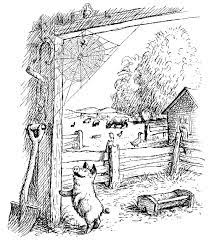
garth williams’ pig barn and charlotte’s web
back in the days when the books i read were washed in watercolor from the brushes of tasha tudor, or in the black ink of garth williams, i could get lost in a book from sun-up till starlight.
tasha tudor’s thumbelina
i’d wager a bet that those were the pages that imprinted on me the storybook poetries that have shaped every room of my grown-up house — the ticking and chiming of old schoolhouse clocks, windowpanes that peer into trees, birdhouses on poles, amply padded armchairs upholstered in checks, teapots that whistle, and logs that crackle in hearths.
that itch to escape — really, more of a pang or an unstoppable pull — still lures me, especially as the affairs of the world seem to crumble, as the ends of my nerves feel rubbed raw with brillo and steel wool. it might be why the walls of this old house are stacked, floor to ceiling in plenty of rooms, in tight-soldier rows of spine after spine. books are the balm, the antidote to so much of the madness beyond our front doors.
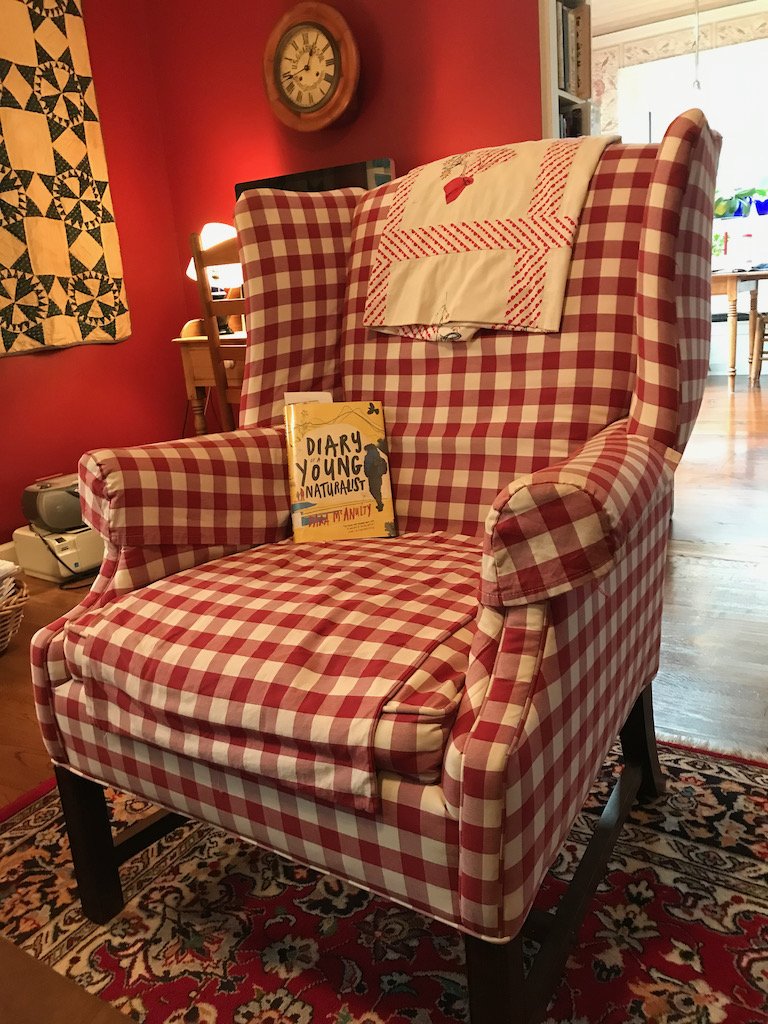
especially so is a book i tumbled into only this week. it’s a book for the soul, if ever there was. it’s a book for the tenderhearted, to which i most assuredly and emphatically admit. it’s diary of a young naturalist, by dara McAnulty, who not only is a teenager (a northern irish one) but one with extraordinary voice and vision. he’s autistic, he lets you know before you’ve come to the end of the prologue. but before he tells you that, he describes himself thusly: “i have the heart of a naturalist, the head of a would-be scientist, and the bones of someone who is already wearied by the apathy and destruction wielded against the natural world.”
count me as a kindred spirit.
even more so, he lets on again and again how trampled his heart often feels, how porous it is, and how solace for him comes in the tendernesses of the unfiltered natural world.
the book has bedazzled the literary world. young dara, all of fourteen when he penned these glorious pages, won the wainwright prize, britain’s blue ribbon for nature writing, for this, his debut work. that his words found their way into a book, let alone a prize-winning book, is a feat in and of itself; “quite amazing,” he writes, “as a teacher once told my parents ‘your son will never be able to complete a comprehension (a mandatory exam in the british educational system), never mind string a paragraph together.'”
well, string paragraphs he has done. has done, indeed. has done to the tune of 222 pages.
he’s been compared to the incomparable greta thunberg, perhaps the planet’s fiercest defender and an unfiltered critic of our devastations thereof. the guardian of london sang the diary’s praises, calling it “miraculous,” writing that it’s “a combination of nature book and memoir, a warm portrait of a close-knit family and a coming-of-age story,” in which McAnulty’s “simple, gorgeous sentences unfurl, one after another.” the poet aimee nezhukumatathil called it “at once a lush and moving meditation and electric clarion call to action.” reviewers, in the UK and here in the states, have heaped it with praise. “it really is a strange and magical experience,” wrote a reviewer in the daily mail, before comparing McAnulty’s writing to that of the poet ted hughes. another reviewer, one in the guardian, said McAnulty’s writing reminded him again and again of the great WH Hudson, a brilliant and eccentric nature writer “who lived with the same deep and authentic sense of emotional engagement with nature as McAnulty.”
weaving across the arc of a year, paying exquisite attention to season upon season, McAnulty drops us all to our knees, as we behold, along with him, the wonders of barn owls, cowslips, corncakes, and the summer’s first blackberries.
of the poetry of a blackbird’s morning sonata: “When the blackbird came, I could breathe a sigh of relief. It meant the day had started like every other. There was a symmetry. Clockwork.”
of dandelions: “Dandelions remind me of the way I close myself off from so much of the world,” he writes, “either because it’s too painful to see or feel, or because when I am open to people, the ridicule comes.”
a hidden pond: “…reflecting the sky and squiggling with shadows galore, darting in and out of the light. A convulsing mass of tadpoles, and with them the epic cycle of life, anticipation and fascination.”
springtime: “The ebb and flow of time punctuated by the familiar brings a cycle of wonder and discovery every year, just as if it’s the first time. That rippling excitement never fades. The newness is always tender.”
for a girl whose jangled nerves and galloping heart are soothed and slowed by the poetries of startling never-before-so-captured language, McAnulty is bliss by the spoonful. he describes his family as “close as otters,” and in describing a soaring white seabird he writes of “the art deco lines” of the gannet. caterpillars move “like slow-motion accordions,” and a goshawk chick looks “like an autumn forest rolled in the first snows of winter.”
as if that’s not more than more than plenty, here are but two excerpts:
Prologue This diary chronicles the turning of my world, from spring to winter, at home, in the wild, in my head. It travels from the west of Northern Ireland in County Fermanagh to the east in County Down. It records the uprooting of a home, a change in county and landscape, and at times the de-rooting of my senses and my mind. I’m Dara, a boy, an acorn. Mum used to call me lon dubh (which is Irish for blackbird) when I was a baby, and sometimes she still does. I have the heart of a naturalist, the head of a would-be scientist, and the bones of someone who is already wearied by the apathy and destruction wielded against the natural world. The outpourings on these pages express my connection to wildlife, try to explain the way I see the world, and describe how we weather the storms as a family……
I started to write in a very plain bungalow surrounded by families who kept their children behind closed doors, and empty-nesters who manicured their gardens and lawns with scissors – yes, I actually witnessed this. This is where sentences first began to form, where wonder grappled with frustration on the page, and where our garden (unlike any other in the cul-de-sac) became a meadow during the spring and summer months, with wildflowers and insects and a sign that read ‘Bee and Bee’ staked in the long grasses, and where our family spent hours and hours observing the abundance that other gardens lacked, all of us gloriously indifferent to the raised eyebrows of neighbours that appeared from behind curtains from time to time.
Wednesday, August 1 We watch in wonder as countless silver Y moths feast on the purple blooms. Some rest, drunk with nectar, before refilling, whirling and dancing in constant motion. The feather-like scales, brown flecked with silver, are shimmering with starry dust, protecting them from being eaten by our other nocturnal neighbours. I find it fascinating that silver Y fur can confuse the sonar readings of bats, and even when they are predated they can escape, leaving the bat with a mouthful of scales. And here we all are, the McAnultys congregated in worship of these tiny migrants. Soon they will make the journey to their birthplace, silver stars crossing land and sea to North Africa.
The night crackles as the storm of flitting moves off. We jump up and down and hug each other, tension leaking out. We chat and look at the sky, sparkling with Orion, Seven Sisters and the Plough. This is us, standing here. All the best part of us, and another moment etched in our memories, to be invited back and relived in conversations for years to come. Remember that night, when fluttering stars calmed a storm in all of us.
Dara McAnulty, Diary of a Young Naturalist
part of the miracle of McAnulty’s writing is that he writes as evocatively about his neurocognitive otherness as he does about the dandelions, the otters, and the caterpillars. he is something of a spelunker into the unexplored wilds of the world seen through an asperger’s lens.
again, from the prologue, where he writes matter-of-factly:
“Not only is our family bound together by blood, we are all autistic, all except Dad [a conservationist] — he’s the odd one out, and he’s also the one we rely on to deconstruct the mysteries of not just the natural world but the human one too. Together, we make for an eccentric and chaotic bunch. We’re pretty formidable, really. We’re as close as otters, and huddled together, we make our way out in the world.”
he writes, bracingly, about being bullied. about how, under the fluorescent lights of a classroom, he feels “boxed in, a wild thing caged.” he writes of the foul-mouthed insults hurled his way. simply because he’s not like the others.
i’d say he’s beyond them.
reading his stripped-bare sentences, my eyes stung with tears. and in his aloneness, i felt the walls of my own heart reaching toward his. i found not merely comfort, but the rarest of company.
how blessed is the world that from his distant landscape of otherness, he makes art from life’s murkiest shadows to its patches of purest white light.
McAnulty’s latest book, wild child: a journey through nature, a multi-sensory jaunt through the wilds especially for children, was published last summer, and described as a “dreamy dive” into the natural world. he’s planning another book about his wanderings around ireland, connecting nature with myth. i’ve taken a number and am already standing in line for that one.
for i’ve found, in the pages gloriously inscribed by a boy who writes in tender tones, who sees the world in ways that make me truly see, a kindred spirit, a diarist who makes me feel safe and warmed in the clutches of this holy, holy earth.
what are the titles that bring you comfort in these trying times? and how precisely do they do so?
i’d loped to the garage, grabbed the crusty old trowel, grabbed my prophylactic spritz bottle of stay-away-squirrels spray, and headed out to the secret sinuous side garden where i looked for a desperate patch crying for hope. crying for something to rise up in the spring, on the far side of the harsh and impending winter.
i was armed with a battery of bulbs, bulbs in various girths, fat ones that promised me daffodil, itty-bitty wisps of bulbs who promised me the tenderlings, snowdrops and siberian squill, and those space-age globes of allium, in this case promising a puff ball of blue. as pretty a thing to bury my nose in as i could imagine.
i’d somehow gotten the itch to give back, to give back to dear mama earth what she so unfailingly offers me: tender and certain shelter, jolt of resilience, undying promise that even if daunted she’s not going away. not yet anyway. not if we can muscle the forces to cease and desist with the trashing of the one glorious blue marble long, long ago entrusted to us.
a few mornings before, amid the cleaning and clearing and worrying, i’d leapt into the old red wagon, the car that takes me wherever i aim it, and i’d motored over to the store with the rows and bins of springtime bulbs, an adventure that’s something like a trip to the candy counter, only without the threat of cavities. i’d filled my arms, judiciously putting aside the bulbs that would have cost as much as a pound of burgers. and then, when the urge struck, i’d be stocked and ready to dig, bury, and someday behold.
i’ve always found it sacramental, the dropping to my knees, gashing into the surrendering soil, shaking a powder of bulb-boosting fortifier, and then carefully lifting just the right bulb for the purpose: to tuck in for the winter the concentrated pouch of promise. the thing that looks like a dried-up onion, laying it to rest in the shadow of autumn, nestling it soft against the earth’s curve, the earth’s cupped hands, the earth’s promise: i’ll take it from here.
and all winter long, through the ice and the wind that will pound at my windowpanes, my bevy of bulbs will be silently doing their thing, shooting down roots, stirring within.
the tasks of autumn are the stockpiling tasks, the turning-in ones. slip on an extra layer of sweater, slow roast the last of the tomatoes, make them last through the long months ahead. upholster the garden with unseen but certain patches of promise.
when your heart hurts or is heavy, i’ve found, it helps to ply tender ministrations to whomever or whatever falls in my path. this week it was my paltry patch of earth. there’ve been times when it was one of my boys, one whose knee or whose heart had been banged up and bloodied. or a friend who needed little more than a hot mug of tea and an hour of listening.
but the taking care of this holy earth is bigger even than that. it’s understanding how sacred it is at its core, and in its every blessed breath. go silent for a minute or two (or three or four) and simply keep watch: listen for the mournful cry of the geese veeing the sky. watch the leaves go gold. plop yourself at the water’s edge and marvel at its infinite rhythm.
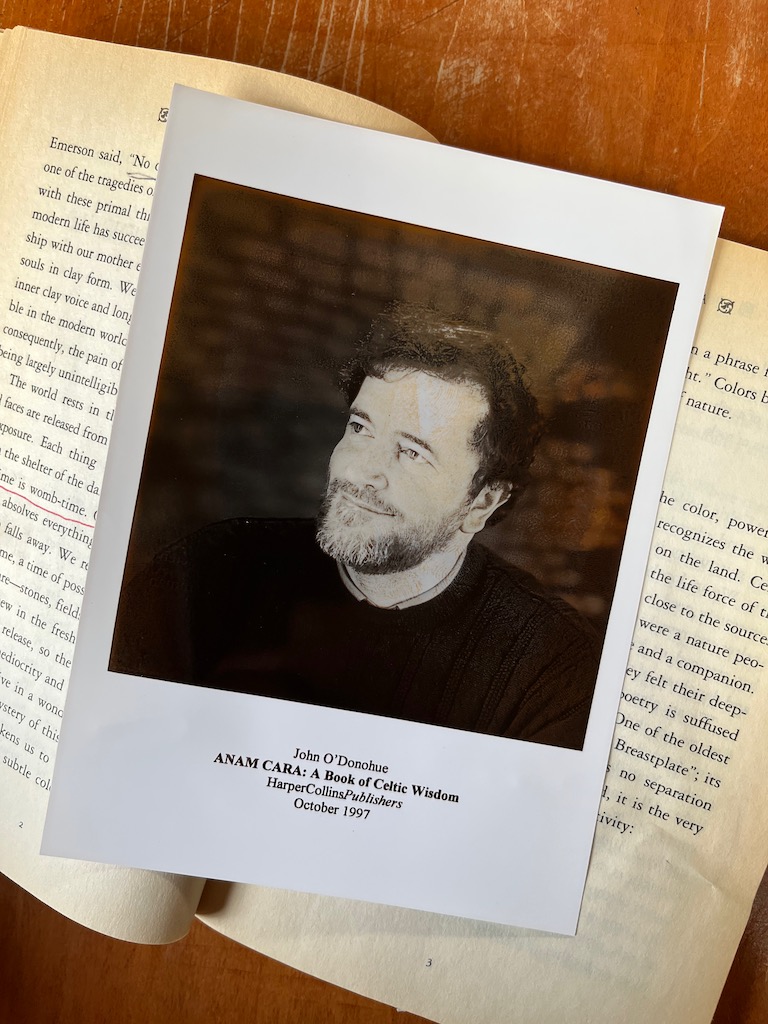
i’ve just started reading a marvelous book by john philip newell, one titled, sacred earth, sacred soul, and like newell’s earlier books, it’s an exploration of celtic wisdoms, a reawakening of the ancient and eternal truths long ago snuffed nearly into extinction. it’s a book i’ve already managed to slather with my inky underlinings, page after page.
newell, once the warden of iona abbey, a sixth-century monastery rising up from a wee island off scotland in the roar of the north atlantic, beckons us to listen for the beat of the sacred deep within ourselves and one another, and deep within the body of the earth. sacred, he writes, “is not bound by religion.” sacred is the soulful knowing, the keen awareness, that deep down in all things — in the earth, and in everything that has been born — there pulses an inextinguishable holiness. it’s our task, our holy task, to sense it, to seize it: to see it, to feel it, to honor it. to make way for it, make an altar for it, hold it up high.
my bulb-burying the other morning might have been seen as just another autumnal chore. or, through the celtic lens, the lens of an ancient wisdom shared by all the world’s great religions, it’s that i was quietly tucking in visible manifestations, reminders come spring, that what pulses deep within the earth, deep within each of our souls and our selves, is something unflaggingly beautiful. and holy. at once tender and resilient.
digging those bulbs, turning newell’s pages, brought me back to a peaceful holy calm. and i filled my lungs with pure blessed air.
what brings you breath? what’s your understanding of sacred? and how do you sense the sacred within?
it’s as if someone’s set a buzzer that must go off at asynchronous times–could be twilight, could be the middle of the afternoon, could be on the verge of thunderclap, or the first dappled stitches of starlight–and deep inside me there is some cord that must be yanked. suddenly, i am turning toward the east, propelled to the water’s edge by wagon, bike, or soles. it’s the vast, vast ever-shifting canvas, where lake and sky, earth and heaven, never cease their stagings.
in these weeks and months when what’s bottled up inside–the worldly angst, the brokenness in all its iterations–when all of that feels so compressed, so hungry for release, relief, it’s the expanse, the i-can’t-reach-the-end-of-it of heaven’s vault that offers ablution. that rinses out the muck. and fills me once again with hope, with depth, with the unshakable sense that i am held in the very palm of God. and all that worries me, weighs me down, is drained away.
there’s the play of color, a color wheel of endless turning, from indigo to amethyst, cerulean to aubergine, and at the dawn and dusk, who’s ever behind the curtain hauls out the rosy tray, where the sky ignites in shades of flame. there’s light and shadow, too. the sky roils in charcoaled turbulence, storm churning in the distance. the sun illuminates the lacy edges of a cloud. sun and clouds and sky in eternal choreography, not one scene ever plays on rerun.
it is, by definition, an anointed place, a most holy place. a place where the nearness of God, the encircling of that infinite tenderness, pours out from some unseen vessel. holy unction, indeed.
when i was all of eight, in Mrs. Bishop’s third-grade religion class, learning all the things that make a catholic catholic, i always tripped over the one of the seven sacraments they called extreme unction. it sounded downright scary. i knew that oil was involved. i couldn’t tell you if it was safflower or olive, but it was oil, and it was poured on you in the hour of your direst need. at the cusp of dying, among other times. getting blessed with water was an everyday matter (to this day i lurch toward any holy water basin, splash fitfully and let it rain sloppily down on me), but getting blessed with oil was like calling in the light brigade. it was reserved for Serious Stuff. in my third-grade vernacular that probably meant whatever was worse than falling off your bike, or getting pushed down on the playground, when Mrs. Dolder the school nurse, pulled out that stinging bottle of mercurochrome, its iron bitterness running down your leg.
thetis anointing achilles
turns out, oil’s claim to holiness is an ancient one. it’s there in the early pages of the bible, not long after genesis. thought to be the medium through which God’s blessings are conveyed. it’s what makes a king a king, apparently. (well, that and a crown.) jews and egyptians reached for olive oil (poured from a ram’s horn). butter is the anointment of choice in hindu blessings. a newly built house is smeared with it, so too are those thought to be possessed by demonic forces. indigenous australians believed that if they smeared themselves with the intestinal fat of a dead person they would absorb that person’s virtues. (i’ll pass, thank you.) arabs of east africa rubbed themselves with lion’s fat to muster courage. and in greek mythology, the sea nymph thetis anointed her mortal child achilles with ambrosia to make him immortal. (another telling of the myth has thetis dipping achilles in the waters of the river styx, but she failed to dip the heel by which she held him. and we all know what happened to achilles’ heel).
lest i get too far sidetracked by the oily substance of anointments, let us leap back to a consideration of a place that’s anointed, even if not a slick. a place the celts would call a thin place. where the opening to heaven is so thin as to be not there. in other words, it’s where you go when you need to fall into the arms of God, or whomever you think is out there trying to hold us together.
walking along the water’s edge, dodging the tickle of the still-warm undulations, dodging the squawky gulls, it’s all but impossible not to be swept into the game of it, the deep-down child’s joy of it. nearly every time, i hear the sound of someone out-loud laughing; i look around and figure out the sound is me, it’s coming from my bellows. be it a brisk constitutional or a lazy jaunt, those sands, those waves, that sky, soak up what ails me every time.
i’ve not always been a shore girl. more often i’ve found myself tucked inside grassy coves, leaning against the rough bark of oak or cottonwood, or plopped on a log deep in the woods. i’m one for making myself all but hidden, a tiny dot, in the all-engulfing canvas of the never-ending curve of globe. but there is a singular prescriptive that comes where water plays, and where the sky can’t keep from turning. it’s a wide-out-in-the-open sort of place.
it’s cast a holy spell on me. and i’ve no intention of rubbing it away.
what’s your anointed place?
and should the woods be on your anointed list, i share this meditative walk in the woods from my wonderful friends at orion magazine. (it’s a 20-minute enchantment, sung by the Crossing Choir of philadelphia, sure to lift you to some ethereal plane.) it’s described thusly:
IN THE DEPTHS of the pandemic, when choral groups could not safely gather to sing indoors, The Crossing Choir of Philadelphia took their singing outdoors, into parks and open-air venues. Last October, they premiered a work entitled “The Forest” in Bowman’s Hill, a stand of mature trees, many over 200 years old, in the Philadelphia neighborhood of Mt. Airy.
During the performance, the singers, unmasked, stood far apart among the trees, their voices amplified by specially-designed speakers, while audience members walked at safely-distanced intervals along a thousand-foot path through the forest.
in which, after a seven-week summer’s sabbatical, our little scribe shuffles back to the table, ferrying a tall stack of books, and the hope of something to say….
well, good morning. i promised it wouldn’t be long, and it wasn’t. really. oh, i’ll admit to all but sitting on my typing hands the first few fridays, an itch to write that nearly needed ointment to make it go away. but i held on, and soon enough, savored the quiet. found plenty to fill the days. in the weeks i’ve been away, tucked behind the virtual monastery walls, i’ve been witness to the scattering of ashes of a woman we loved, i’ve flown across the country, had both my boys under this old roof for one 36-hour slice of heavenliness, cheered on the now dubbed TriathlonMan (aka former architecture critic) not once but twice as he gleefully crossed the finish line (well, he was gleeful the first time, and in last sunday’s 97-degree heat “gleeful” would be the last adjective i’d reach for), and said too many tearful goodbyes at airports and college dorms.
so here we are. not unlike the back-to-school rhythms of clean underwear and sharpened pencils, ready to dive back in. what a blessing that the holiest of holy days are upon us, just as the light takes on its amber molasses glow. and the blood in my veins percolates with its usual seasonal vivacity (i am autumn’s child, to be sure).
one of the truths of the summer — and of this moment — is that i often feel crushed by the news of the world around me. these last few weeks and days offer no reprieve. many a night i’ve lay awake imagining how it is to be sardined in a hangar in qatar with no water, no food, and sunlight beating down, all of it underscored with unchartable fear. and the cries of hungry babies all around. and now we’ve got a lone star state filled with deputized vigilantes racing around to turn in their already broken neighbors. let he who is without sin cast the first stone.
and so i was particularly struck when i stumbled on an essay this week from maria popova, she of brain pickings wonderment, an essay in which she writes of hermann hesse’s belief in little joys. i seem to gather proponents of littleness — dorothy day and her little courages, and now hesse and his little joys. anyway, i ran to the library — the candy counter equivalent for those who binge on poetries and paragraphs — and checked me out some hesse (german-swiss poet, painter, novelist; author of siddhartha*), specifically his collection, translated into english in 1974, titled mybelief: essays on life and art.
hesse writes, in his 1905 essay “on little joys”:
Great masses of people these days live out their lives in a dull and loveless stupor. Sensitive persons find our inartistic manner of existence oppressive and painful, and they withdraw from sight… I believe what we lack is joy. The ardor that a heightened awareness imparts to life, the conception of life as a happy thing, as a festival… But the high value put upon every minute of time, the idea of hurry-hurry as the most important objective of living, is unquestionably the most dangerous enemy of joy…
Our ways of enjoying ourselves are hardly less irritating and nerve-racking than the pressure of our work. “As much as possible, as fast as possible” is the motto. And so there is more and more entertainment and less and less joy… This morbid pursuit of enjoyment [is] spurred on by constant dissatisfaction and yet perpetually satiated.
I would simply like to reclaim an old and, alas, quite unfashionable private formula: … Do not overlook the little joys!
These little joys … are so inconspicuous and scattered so liberally throughout our daily lives that the dull minds of countless workers hardly notice them. They are not outstanding, they are not advertised, they cost no money!
Hermann Hesse, “On Little Joys” from My Belief: Essays on Life and Art
he echoes annie dillard, another of my pantheon of “little” saints, she who preaches like no other on the sacred art of paying attention, she who indelibly wrote:
The world is fairly studded and strewn with pennies cast broadside from a generous hand. But — and this is the point — who gets excited by a mere penny?
[…]
It is dire poverty indeed when a man is so malnourished and fatigued that he won’t stoop to pick up a penny. But if you cultivate a healthy poverty and simplicity, so that finding a penny will literally make your day, then, since the world is in fact planted in pennies, you have with your poverty bought a lifetime of days. It is that simple.
Annie Dillard, Pilgrim at Tinker Creek
keep your eyes — nay, your whole soul — open is her point. and hesse follows suit. leaving little to chance, hesse points to the particulars, and prescribes thusly:
Just try it once — a tree, or at least a considerable section of sky, is to be seen anywhere. It does not even have to be blue sky; in some way or another the light of the sun always makes itself felt. Accustom yourself every morning to look for a moment at the sky and suddenly you will be aware of the air around you, the scent of morning freshness that is bestowed on you between sleep and labor. You will find every day that the gable of every house has its own particular look, its own special lighting. Pay it some heed if you will have for the rest of the day a remnant of satisfaction and a touch of coexistence with nature. Gradually and without effort the eye trains itself to transmit many small delights, to contemplate nature and the city streets, to appreciate the inexhaustible fun of daily life. From there on to the fully trained artistic eye is the smaller half of the journey; the principal thing is the beginning, the opening of the eyes.
yet another wise person i read this week, yuriko saito, a professor of philosophy at the rhode island school of design, calls the little joys “everyday aesthetics,” and defines them as “tiny, perfect things.” it’s the art of the ordinary, and the ordinary is where we live, those of us whose days are mapped by carpools and grocery trips and scrubbing out the bathroom sinks.
the world — even in its brokenness — is filled with tiny, perfect things. the imperative is that we keep close watch. God gave us input pipes — eyes, ears, nose, skin, tastebud. we are meant to notice. invited to, anyway. we dwell in holy kaleidoscope. it twists and turns and sways and dapples minute by minute, season upon season.
and so my days take on a hopscotch paradigm: i skip and hop from little joy to little joy, and hold on tight to those wisps of poesy that fall across my path. i mosey the alley, where wild things bloom and sway, and wander through my garden, clippers in hand, snipping stems for tiny bouquets i tuck all around the house, especially on the windowsills, a perch made for paying outward glance. i tiptoe down the brick walk to my summer porch, and keep watch from behind the screens where the birds take no notice, and carry on their birdlike ways as if i’ve morphed into just another leaf or willow frond and become unseen, no longer alien, no longer brake to their flutterings and chatter. i curl in my reading nook, keeping watch on the world passing by, on the pages i turn.
i keep a silence. a holy silence. the sort from which my prayers take flight endlessly, eternally. i pray for this world which too many days seems to be crumbling. i pray for lives i will never know. but i imagine. and my empathies carry me to faraway deserts, to tarmacs and hotlines where the desperation rises by the hour.
i’m surely not saying that the little joys will mend the brokenness. that takes a whole nother level of dedication and muscle moving. all i’m saying is that if we can fix our gaze on even the occasional tiny, perfect thing, we might stave off the paralysis that comes with the avalanche of awful news. we might gather up shards of beautiful, shards of little joy, and find the oomph to not stay stuck, the oomph to make the blessed most of these fine breaths left in us as we march through the bracketed hours of our days.
for this i pray.
what might be the little joys, the tiny perfect things that carry you through the day, even when the darkness comes?
*starting a new cumulative reading list, and first up, siddhartha, hesse’s 1920 novel which delves deep into hinduism, a religion about which i know not enough….it’s described as the “absolutely amazing and engrossing tale of one man’s journey to find that all-elusive idea of enlightenment.” enlightenment, here i come.….
this fine dragonfly landed — and stayed — just outside our front door this week. the dragonfly*: “symbol of change, transformation, self-realization; it teaches us to love life.”
sabbatical(adj.)
1640s, “of or suitable for the Sabbath,” from Latin sabbaticus, from Greek sabbatikos “of the Sabbath” (see Sabbath). Noun meaning “a year’s absence granted to researchers” (originally one year in seven, to university professors) is from 1934, short for sabbatical year, etc., first recorded 1886 (the thing itself is attested from 1880, at Harvard), related to sabbatical year (1590s) in Mosaic law, the seventh year, in which land was to remain untilled and debtors and slaves released.
Sabbath(n.)
Old English sabat “Saturday as a day of rest,” as observed by the Jews, from Latin sabbatum, from Greek sabbaton, from Hebrew shabbath, properly “day of rest,” from shabath “he rested.” Spelling with -th attested from late 14c., not widespread until 16c.
The Babylonians regarded seventh days as unlucky, and avoided certain activities then; the Jewish observance might have begun as a similar custom. Among European Christians, from the seventh day of the week it began to be applied early 15c. to the first day (Sunday), “though no definite law, either divine or ecclesiastical, directed the change,” but elaborate justifications have been made. The change was driven by Christians’ celebration of the Lord’s resurrection on the first day of the week, a change completed during the Reformation.
The original meaning is preserved in Spanish Sabado, Italian Sabato, and other languages’ names for “Saturday.” Hungarian szombat, Rumanian simbata, French samedi, German Samstag “Saturday” are from Vulgar Latin *sambatum, from Greek *sambaton, a vulgar nasalized variant of sabbaton. Sabbath-breaking attested from 1650s.
sabbatical. the word bathed over me like cool water to a banged-up knee, aloe to a sunburn, a waft of lavender to the nose. my eyes swept across its four short syllables; they draped me like a balm.
sabbatical, the word itself soothes. each sound jumble tumbling softly into the next, a somersault of sound rolling off the tongue. it’s a word that seized me, and instantly made perfect sense. as if it had been calling out, awaiting my attention.
i believe in sabbath, by my definition “anointed time,” time to dwell in the sacred, to burrow into the nautilus of our deepest stirrings.
time to be quiet. time to ponder. time to be alone with one’s thoughts, to see where they course, to discover the rivulets and the river stones under which they seek shadow.
for too long now i’ve felt i was uttering sound when silence might have been the wiser course. we are a noisy nation. too noisy. the sound of silence might be the wisest one for recalibrating so much of what’s amiss on this cacophonous planet.
especially now, after a homegrown tornado of a year here in this old house — of illness, death, distress, and mountainloads of worries — i hear a deep-down shushing, the call to be quiet. say little more. offer silence, the most generous of invitations in which each one of us is untethered, unconstrained, our thoughts our own to trace as far or near as we so choose.
so many friday mornings i’ve sat down to write with a dyspeptic sense that i might be barging in, the noisy guest who doesn’t know her exit was welcomed hours ago. sometimes, though, i sat down unsure of where i’d go, and suddenly i’d find myself plumbing some eddy i’d not realized was still water awaiting stirring.
and now, after so many hollowings (the cavernousness that comes in the wake of heartache), and with a thick batch of editing about to drop onto my laptop lap, it seems a fine time to tiptoe quietly off to the riverbank, where i’ll keep close watch but watch in silence.
i’ve been at it, straight, for 1,027 posts, and i would have paused at 1,025 but then dear ginny neared her end, and i was drawn to leave her mark here, at the table where she so dutifully pulled up a chair week after week after week for all these almost 15 years, always hoping for a few threads that might have unspooled with the doings of her grandsons or her son. (not long before she died she asked me to print out any of the chairs she might have missed, but she only wanted ones about the family, she specified, “none of that religion or nature.”)
to be on sabbatical is not to curl up in a ball and doze for a van winkle-style snooze. it is to read, to learn, to exercise curiosities and follow trickles to their source. sabbatical, in agricultural terms, is to leave a field unsown, to give it air and time to grow fertile again. consider me in fallows. seeking the fertile will be my task.
i’ll be back once i feel a stirring again, once i think there might be a thought, an observation, a story worth leaving here at the table that’s become so sacred over time, sanctified by our gentle kindnesses, our willingness to listen, our back-bent humilities.
in the meantime, there’s a trove here to peek around. but mostly, there is life to be lived at full attention, and from the bottom of my heart, bless you, and thank you, for stopping by whenever you feel so stirred.
xoxox
bam
one last summery salad to send you on your plein air picnics….
homegrown cucumber, fennel, corn, red pepper, and basil leaf salad
serves 1 to 4, depending how hungry you find yourself
salad:
chop to your heart’s content:
1 or 2 cucumbers (preferably, plucked from the vine)
1 fennel bulb (plus a few fronds)
1 ear fresh corn
1 red pepper
fennel fronds, to taste
basil leaves, a good handful
can be chopped, covered tightly, and chilled ahead.
dressing*:
1 Tbsp. dijon mustard
1 fat garlic clove
1 teaspoon kosher salt (or to taste)
3 Tbsp. white wine vinegar
4 to 6 Tbsp. olive oil
basil leaves chopped
fresh ground pepper
*really, i wing it with measurements here, but i am adding rough approximates for those who like a little precision at their chopping block….
mix dressing ahead of time, let steep all day.
shortly before serving, add dressing to chopped salad, mix with freshly chopped basil leaves and fennel fronds; toss.
savor summer on a fork.
***
*the dragonfly, according to hindu teaching, is a “symbol of change, transformation and self-realization. it teaches us to love life, to rejoice and have faith even amidst difficulties.” be on the lookout for your dragonflies…..
a question to ponder: how will you rejuvenate your soul in these deepening days of summer?
p.s.s. don’t be surprised and please don’t roll your eyes if i come back sooner rather than later. soon as i think i’ve nothing to say, i might think of something to scribble before it escapes me….
another friend who landed here last friday morning and hovered through the weekend…
some weeks, it feels like the crank on the faucet is wide open and what comes surging forth is akin to fire hydrant velocity. it just keeps coming, the news, bad and good and all in between. this was one of those weeks where i could barely steady myself between one and another. it started with a phone call, early monday morning, from an emergency room. someone i love was calling, crying, needed me and needed me fast. that’s pretty much all that mattered this week. but of course it was only the beginning of the cascade of 1,001 other thoughts, decisions, realities.
somewhere in there good news came too. and somewhere in there i got my second Moderna COVID vaccine.
seems these long months of COVID, of unnatural tethering to dorm rooms and home turf, of worries that you’ve been exposed, of navigating degrees of caution and leniency, it’s worn most of us ragged. i worry most about kids whose lives are disproportionally filled with histories of dark american chapters: kids born in the shadow of 9/11; kids who might never live a valentine’s day without remembering parkland and the unending video of high schoolers with hands over their head filing out from the building once the coast was clear, helicopters ominously hovering just over the school rooftop; kids who’ve now spent two years of college looking over their shoulder, submitting to swabs up their nose every few weeks, kids with no clue of an all-campus party.
sometimes i wish the world would break forth in birdsong, in pastel petal, in tenderly unfurling leaves. sometimes i wish we could breathe all that in, feel steadied, feel braced, feel fresh air in our lungs. isn’t it genius, then, that should we bother to look out the window, should we bother to lace on our shoes, it’s all right there, ready to take our worn-ragged selves and fill us with those quiet healing balms that stitch us together again?
we need this springtime, and the summer that follows, the slow, steady summer, the season of indolence. we all need a break from the rush and the roar of the news and the heartbreak.
we need to all catch our breath. and stockpile joys for a minute or two.
because this poem always rights me, i offer naomi shihab nye’s “kindness”….
KINDNESS by Naomi Shihab Nye
Before you know what kindness really is you must lose things, feel the future dissolve in a moment like salt in a weakened broth. What you held in your hand, what you counted and carefully saved, all this must go so you know how desolate the landscape can be between the regions of kindness. How you ride and ride thinking the bus will never stop, the passengers eating maize and chicken will stare out the window forever.
Before you learn the tender gravity of kindness, you must travel where the Indian in a white poncho lies dead by the side of the road. You must see how this could be you, how he too was someone who journeyed through the night with plans and the simple breath that kept him alive.
Before you know kindness as the deepest thing inside, you must know sorrow as the other deepest thing. You must wake up with sorrow. You must speak to it till your voice catches the thread of all sorrows and you see the size of the cloth.
Then it is only kindness that makes sense anymore, only kindness that ties your shoes and sends you out into the day to mail letters and purchase bread, only kindness that raises its head from the crowd of the world to say It is I you have been looking for, and then goes with you everywhere like a shadow or a friend.
how do you steady yourself in the weeks when the hydrant is gushing?
excuse me if i sound grumpy today, though i do think it’s fine to know that moods come in all sorts of colors. and my color today is grumpy gray. i might be suffering a slight case of the housebounds, in which we’re more or less stuck in the house thanks to the veritable stalactites of ice that have formed just above our front door.
to enter or exit by way of the ice cave is an obstacle of death-defying proportion. there’s the dripping from way up above, and the stoop where you’d step is a sleek sheet of bone-breaking ice; the buckets we’ve plonked there under the drips seem to fill by the hour. i fear the leaking to come once the layers of snow begin their unrestrained melt—but that’s getting ahead of the worries (a particular knack i’m not proud of).
we’d be utterly stuck in the house if not for the snowman i married, who courageously set out across the tundra to get to the store in his snow boots, trekking down the middle of streets, the only path cleared by the snow plows. he saved the day, yes he did, when he ferried home 10 pounds of ice-melting salt.
after a day of gently and safely making some headway, i decided not to leave well enough alone. i decided to get in on the act, ignoring the fact that my bones are quite thin and quite brittle. and for reasons that now escape me, i decided to bang on the bucket of ice with my fist. one swift thwack and i realized quite clearly my ignorance.
as i sit here typing with ice pack wrapped round my wrist, and a makeshift splint holding it tight, i’m scanning the forecasts for any degrees higher than freezing. since typing makes me wince, and i’d best store up for the pages i’ve yet to type for that book in the works, i shall once again make short of it here, and leave you with a sure cure for the housebound blues (or the grumpy grays, should that be your color of choice).
once upon a healing soak, a do-it-yourself hot-water escape…
try this: fill your tub with the hottest water your naked limbs can take, plop in a few shakes of DIY bath salts, instructions courtesy of an old homesteader below. dawdle there till your skin wrinkles like raisins, or you feel your mood starting to lighten (whichever comes first). if this doesn’t work, play polynesian tunes, and sway in your towel, as if on the beach on a faraway island.
you’ll need:
½ cup epsom salts
½ cup sea salt
½ cup baking soda
10-15 drops of essential oils (find variations and formulations below)
mix the epsom salts, sea salt and baking soda together in a bowl. add your essential oils. rule of thumb here is 10 drops per cup of the salt mixture, so in this case you’ll need15 drops of whatever your essential oil. use less if you like things on the milder side.
scoop it into a jar with a lid; any washed-out vessel will do. save the extra for your next gray or blue day.
now, a few essential oil concoctions for your DIY bath salts; take your pick, depending on whatever it is you’re after, a little tranquility, petal-soft skin, or the chance to take a deep cleansing breath:
tranquility blend:
10 drops lavender oil
5 drops vetiver (the oil of tranquility, apparently)
a blend for petal-soft skin:
5 drops lavender oil
5 drops frankincense
5 drops palmarosa
you could use 10 drops lavender + 5 drops frankincense if you don’t have palmarosa on hand.
deep-breathing blend:
10 drops eucalyptus
5 drops tea tree
i could be coming to you next week from an ark, should these bergs start to melt with alacrity. in the meantime, do tell of your cures for the deep-winter blues.
as soon as his breath propelled those words across his lips and out into the snow-flecked january cold, i inscribed them on my heart. i hadn’t quite framed it that way, in those four words, so profoundly, so poetically, so imploringly.
and then, as if that wasn’t enough, the wise old soul whose very fiber has been forged in the white-hot furnace of grief compounded by grief, he all but unbuttoned his coat, pulled back his ribs and showed us what burns in that cavity: “my whole soul is in it,” he said, as if speaking to each and every one of us, as if elbows were plopped on our very kitchen tables, eyeballs gazing at eyeballs, mugs of coffee just off to the side, instead of there in the sunlight and shadow of the nation’s capital. then he all but whispered it again: “my whole soul is in it.” and that’s when i whispered, “mine too.”
having just witnessed — from the edges of our seats — how close this fragile experiment in democracy came to crashing into splintered bits, having lived under a poisonous cloud of daily assaults on decency, straining to stay steady, to keep from being sucked under in the shifting quicksands of moral decay, of a nation under the false premise that license had been given to spew venom from the checkout line to the capitol steps, i am more certain than ever that this is not a one-person parade. if we stand a chance of shoving this moment in time toward the light we claim, toward the peaceable kingdom we believe is possible, well then every last one of us needs to get to work, to chip in, to put one foot before the other in a slow walk toward mercy and justice for all.
my inaugural promise is this:
i will cloak myself each and every day in humility and gentle spirit, the surest vestment for the hard and holy work ahead. for months now i’ve tiptoed in the darkness to my kitchen table where i’ve lit a candle and whispered the words of confession. “most merciful God…” i begin. “…we have not loved our neighbors as ourselves. we are truly sorry and we humbly repent.”
i will not reflexively shut my ears, close my heart, turn my cheek the wrong way. i will hear them out, whoever it is. i will try, oh i will try, not to leap in with my insistent retort. not to interrupt. not to wield the sharp sword of assumed superiority, not think that my way is the right way, and all else is wrong. i will try, i will try, to step into the other guy’s shoes. to imagine the hurt, or the fear. to look for a gentle way in, to open just a little bit wider the doorway to some common ground. even if only fraction by fraction.
i will actively step into kindness. into imagining the unexpected waft of goodness that might just turn the tide of someone else’s dark day. i will model the thousands of kindnesses that have come my way — the sacks of apples left on my stoop, the tray brought to my hospital bedside, the steaming hot chicken pot pie once delivered on an arctic cold night, to name just a few.
i will carve out time even amid the whirlingest of days for whoever taps me on the shoulder, looks me in the eye, and whispers, do you have a minute?
i will — in some way, shape, or form — seek out foreign terrain, the realm of those who might be quick to dismiss me: too white, too old, too left-leaning. and begin with the light-seeking questions: what keeps you awake at night? what do you dream? what brings you joy? what makes you cry? where does it hurt? who do you consider to be the most heroic human you’ve ever known? and how so? what’s one act of kindness you’ve never forgotten?
because i realize my impotence for change-making at the structural level, i will pinpoint one not-for-profit effectively working toward solution — be it reuniting children separated from parents at the border, or ferreting out all vestiges of racism and bigotry from the nooks and crannies of america, or protecting wetlands from the ravages of greedy exploitation — and i will commit to shaving off a dollar here, a dollar there from my weekly spending and send off occasional bundles from my consciously set-aside sum.
photo of Amanda Gorman by Patrick Semansky
but even more than dollar bills, the currency i commit to this campaign is the craft i ply each and every day: mine is a calling to words, words as instruments of peace, words as the silken thread that weaves together uncommon hearts, words that open doorways into long-locked corridors. as the beautiful and blessed national youth poet laureate amanda gorman so perfectly put it in the wake of her inaugural poem: “words matter. we’ve seen over the past few years the ways in which the power of words has been violated and misappropriated.” she sought, and i seek with her, to “reclaim poetry as that site in which we can repurify, resanctify the power of words. and to invest that in the highest office of the land.” to invest that in every office of the land, elected and otherwise. from the humblest foot soldier to the commander in chief. and to that, i say amen, amen.
we must end this uncivil war. and my whole soul is in it.