pull up a chair

where wisdom gathers, poetry unfolds and divine light is sparked…

Category: antidotes to madness

turning inward, turning back

these times call for pronounced postures, for intention. ultimately we want to reach out, to be the bridge, the peacemaker. or, maybe little more than one flickering flame amid the global shadow. but first, in aim of fortification, we turn in. it’s where we stoke the fire, clarify the vision, and maybe just maybe find the peace, the calm, from which to set forth.

i’d call myself a quietist. one of the ones who finds the solitude and silence a necessary interiority. it is the place of prayer, of wisdom seeking, reaching far beyond the bounds of life as i know it, and drawing in pole stars to point the way. more and more, i start to think i subscribe to the church of the bookshelf. an eclectic crowd of thinkers and seers, the holy well from which i draw.

the noise of the world is beyond cacophony these days. rafters are rattling, pots and pans are clanging. all of which pushes me into the cracks of the world, where i poke around endlessly, sniffing out wisdoms like a mouse after cheese. i’m intent.

this week i turn east, and i turn back in time. way back, and way east. east to india. back to the first century of the common era, roughly 55 CE.

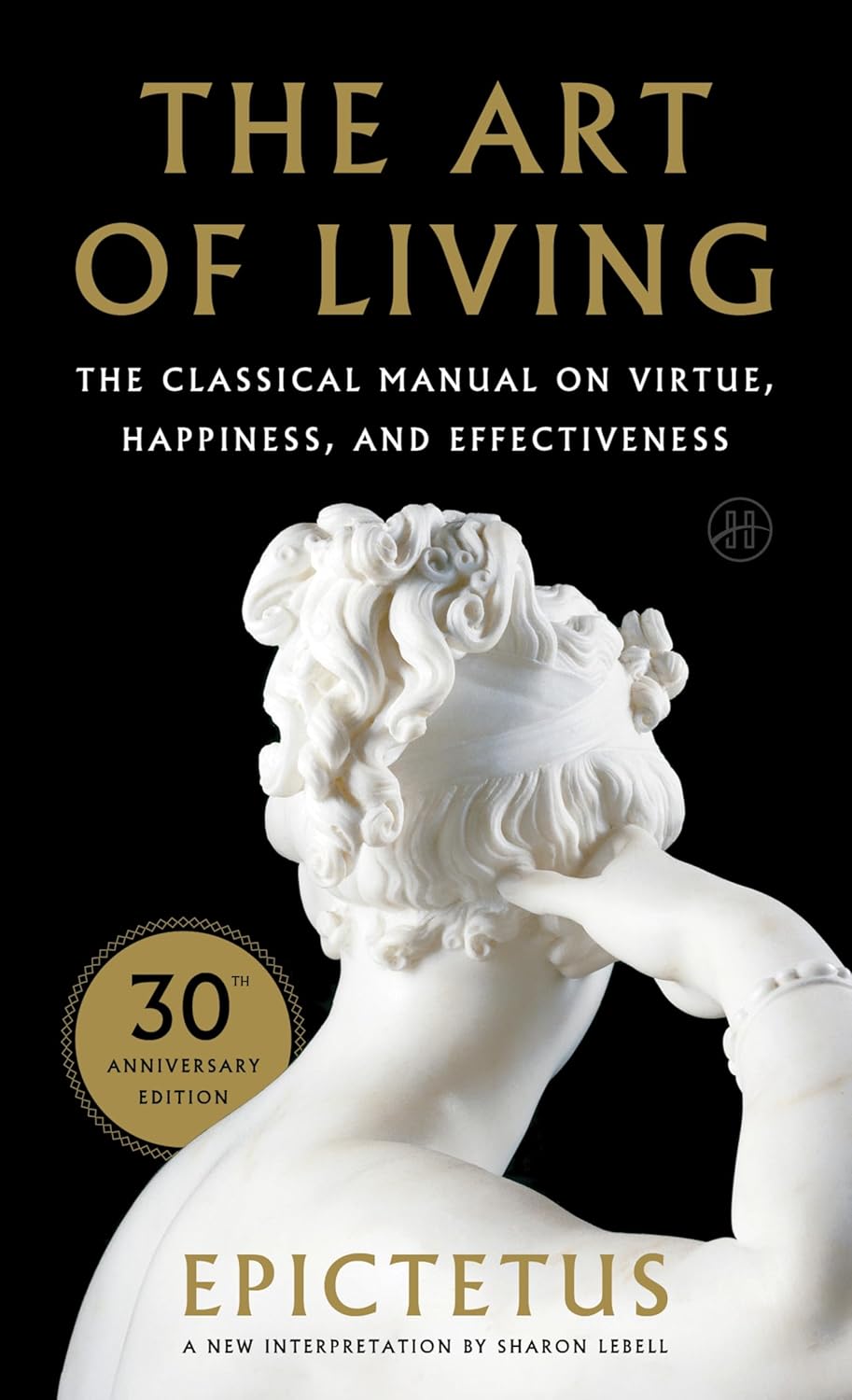
epictetus, the unsung stoic, goes first. he was as unlikely a pole star as they might come: born a slave, a slave with a limp, he carved out 93 instructions, bound them as a book, slapped on a catchy title (the art of living), one that came with a wallop of staying power (we’re still seeking the art), and all these millennia later, we’re still turning its pages.

a marvelous philosopher and musician, a northern californian by the name of sharon lebell, back in 1995 took a crack at translating epictetus anew. her translation stuck, and it’s now considered a classic. i found epi’s wisdoms rather timeless, and in keeping with survival in tumultuous times.

here’s epictetus:

Caretake This Moment

Caretake this moment.
Immerse yourself in its particulars.
Respond to this person, this challenge, this deed.

Quit the evasions.
Stop giving yourself needless trouble.
It is time to really live; to fully inhabit the situation you happen to be in now.
You are not some disinterested bystander.
Exert yourself.

Respect your partnership with providence.
Ask yourself often, How may I perform this particular deed
such that it would be consistent with and acceptable to the divine will?
Heed the answer and get to work.

When your doors are shut and your room is dark you are not alone.
The will of nature is within you as your natural genius is within.
Listen to its importunings.
Follow its directives.

As concerns the art of living, the material is your own life.
No great thing is created suddenly.
There must be time.

Give your best and always be kind.

~ Epictetus ~
(Epictetus: The Art of Living a New Interpretation by Sharon Lebell.)

Arundhati Roy

the next wise soul i bumped into this week was arundhati roy, the booker prize-winning novelist, who grew up and lives still in india; delhi specifically these days. she’s getting plenty of ink of late because her latest work, her first memoir, Mother Mary Comes to Me, has just been published. it’s an exploration of her complex relationship with her “iconic” and “extraordinary” mother, whom she describes as both “my shelter and my storm.”

roy’s 1997 novel, The God of Small Things, is what won her the booker prize for fiction, which in this mercenary worldly equates with that murkily-defined “success,” and its often evil twin, fame. roy, wise woman, wasn’t having it. she was not one to be deluded, or seduced, by such worldly measures. as she tells it she was keenly influenced by an uncle, a beloved uncle, who was one of india’s first rhodes scholars for his work in greek and roman mythology, but gave up his academic pursuits to start a pickle, jam, and curry-powder factory with his mother. and to build balsa-wood model airplanes in his basement.

not surprisingly, someone schooled in the shadow of such an uncle might have strong instincts on the “right” definition of success. and in a conversation with an old friend, arguing that “recognition is not the only barometer of brilliance or human worth,” she noted the friend’s eyebrow arching. skepticism, in full display. so roy did what any cocktail debater might do: she pulled the paper napkin out from under her drink, and a pen from her purse, and began to scribble.

what she wrote amounts to a gospel of success that belongs not on half-soggy paper, but a granite slab somewhere:

To love. To be loved. To never forget your own insignificance. To never get used to the unspeakable violence and the vulgar disparity of life around you. To seek joy in the saddest places. To pursue beauty to its lair. To never simplify what is complicated or complicate what is simple. To respect strength, never power. Above all to watch. To try and understand. To never look away. And never, never to forget.

sometimes i think i’m a broken record, saying over and over—and over—such a few simple truths. 

never get used to the unspeakable violence and vulgar disparity of life around you.

seek joy in the saddest places.

never simplify what is complicated or complicate what is simple.

respect strength, never power.

above all, watch.

never look away.

love.

love.

love.

what inscription might you add to a granite wall of truths?

p.s. i hyperlinked to a marvelous interview with sharon lebell above (i love her whole story, how she was drawn to study philosophy, inspired by a neighbor with more books than she’d ever seen, and how she found those first classes in philosophy “exercises in obfuscation” — might that describe much of the noise here on planet Earth in the year 2025?). here is just one of the grafs from that interview you might find as delicious as i did….

Epictetus drew me in particular because in the mid-1990s he was the unsung Stoic. People had heard of Marcus, of Seneca. No one, except the cognoscenti, had heard of Epictetus or could pronounce his name. I liked his humble background: he wasn’t an emperor or a big cheese. As a former slave with a limp, he was someone who wasn’t expected to have a voice, but he used his voice anyway. He was a relatable everyman trying to figure out best practices for getting through the day.  Since I am female, this mattered a lot. Many philosophers invoke male experience as a stand-in for the universal human experience. Epictetus did not, of course, address females when he taught, but his teachings have an inclusive, of-the-people feel.”

sodden, sodden week

i come this week with sodden heart, afraid for the world we are (no longer becoming but present in the now), fearful of what’s to come. 

once again, a week of news bulletins, and the voices of mass-shooter psychologists filling the airwaves, unfurling the narrative in their cable-news staccato. i didn’t write of the children of annunciation church two weeks past, because i had no words vast enough to reach the depths of it. and i didn’t want to add empty noise.

but a woman i’ve come to love for the purity of her heart, and her inextinguishable humor (mother of five, breast cancer survivor, sister of a brother who died too young, neighbor of annunciation, and one as likely to freely shed tears as to find the hilarity in the everyday) found out that at the moment the first bullets shattered the stained glass of annunciation church, the children in the pews were just beginning to recite psalm 139. 

one of the most ancient prayers, it begins: 

Lord, you have probed me, you know me:

    you know when I sit and stand;
    you understand my thoughts from afar.

You sift through my travels and my rest;
    with all my ways you are familiar.

Even before a word is on my tongue,
    Lord, you know it all.

Behind and before you encircle me
    and rest your hand upon me.

Such knowledge is too wonderful for me,
    far too lofty for me to reach.

and it includes a line i consider one of the most beautiful of all sacred text: 

II
You formed my inmost being;
    you knit me in my mother’s womb.

I praise you, because I am wonderfully made;
    wonderful are your works!
    My very self you know.

My bones are not hidden from you,
When I was being made in secret,
    fashioned in the depths of the earth.[e]

Your eyes saw me unformed;
    in your book all are written down;
    my days were shaped, before one came to be.

III
How precious to me are your designs, O God;
    how vast the sum of them!

Were I to count them, they would outnumber the sands;
    when I complete them, still you are with me.

When you would destroy the wicked, O God,
    the bloodthirsty depart from me!

Your foes who conspire a plot against you
    are exalted in vain.

i can barely get past the line about being knit in my mother’s womb. and it turns out neither could my friend laura. 

she recites it here, a reading worth hearing, as you absorb the words….

then came this wednesday, and with it an assassination and yet another school shooting. and then, thursday, the twenty-fourth anniversary of 9/11. another tragedy, another thread that over the years has brought its tragedy into full view as a woman i have come to love lost her father in that tower that day. and because i know of the layers and layers of tragedy it brought, it is so much more to me now than a terrible day in our national story. as with any violent death, the shrapnel is of the never-ending sort, carnage upon carnage, year after year. flesh shredded, souls shattered, psyches never ever re-settled. 

and so, this poem, with its title so apt: “Try to Praise the Mutilated World.” mutilated we are, all right. 

this poem, it seems, made its way to light in the immediate wake of 9/11 quite by accident, when the poetry editor at the new yorker, who happened to be reviewing an advance copy of the poet’s newest book (at the time) was asked by david remnick, the new yorker’s editor, to find a poem fitting for a special edition of the magazine to be printed and published within days of the tragedy. it was printed on the last page of that issue, as we all scanned the mutilations that hadn’t yet fully revealed themselves. isn’t that always the case with tragedy? the revelations, not unlike a land mine, explode and explode, unseen until the moment of detonation, whenever that comes. 

adam zagajewski, a polish poet who died in 2021, had written the poem with no particular occasion in mind. over the last two dozen years, it’s become his most famous poem, and a poem often pulled from the files to mark this sad, sad day. his choice of the word mutilation is most apt, a word not too too often pulled into text. twinning it with the verb “to praise,” is wholly disturbing. what is there to praise? maybe the work is in the “try.” maybe that’s the instructive, meant to be just beyond our reach. try to praise….

there is work to be done here. there is always work. and maybe if we can remember june’s long days, and the wild strawberries, and the gentle caring of one stranger for another, we can remember why we must weep at the sound of gunshot, and why we must not surrender. this world, mutilated in so many ways, is still a world rife with wonders. 

might we add but a single drop of sweetness to the bitter, bitter taste in our mouths….

Try to Praise the Mutilated World

By Adam Zagajewski

Try to praise the mutilated world.
Remember June’s long days,
and wild strawberries, drops of wine, the dew.
The nettles that methodically overgrow
the abandoned homesteads of exiles.
You must praise the mutilated world.
You watched the stylish yachts and ships;
one of them had a long trip ahead of it,
while salty oblivion awaited others.
You’ve seen the refugees heading nowhere,
you’ve heard the executioners sing joyfully.
You should praise the mutilated world.
Remember the moments when we were together
in a white room and the curtain fluttered.
Return in thought to the concert where music flared.
You gathered acorns in the park in autumn
and leaves eddied over the earth’s scars.
Praise the mutilated world
and the gray feather a thrush lost,
and the gentle light that strays and vanishes
and returns.
(Translated, from the Polish, by Clare Cavanagh.)


a closing thought from jeremiah johnson, co-founder of the Center for New Liberalism, who writes on his substack Infinite Scroll, where he ponders the politics of posting and the dynamics of the social internet: 

As much as you can, resist the hysteria. Refuse to participate in it, refuse to make the polarization worse. The purpose of liberalism is to allow us to disagree with someone without discriminating against them, without harassing them, without killing them. It’s a precious thing, perhaps the most precious thing our civilization has achieved. Every time you break bread in peace with an outsider, every time a Catholic and Protestant shake hands, it’s a miracle. Don’t take it for granted.

what might you find to praise in this mutilated time and this week of mutilation?

acquiring acquaintances: another name for pen pals

it started because months, or maybe years, ago, i stumbled onto a poem that took my breath away. it was written by a poet i’d not known of, didn’t think i’d ever read. but the poem, titled “Nativity,” stayed with me, a poem that paints the first Christmas scene in strokes and shades that settled deep into my marrow, and forever more are the Christmas i imagine.

it’s a poem that lays the baby Jesus in a rough-sawn barn, the air pungent with animal. “the wind tugging at the shutters.” there is nothing gilded about it. and it was written, i knew right away, by someone at ease with being small, tucked off in a corner keeping watch. it was written, i could tell, by someone whose very veins course with humility, and understood a God who preached the same, a God who asks us to get about the business, the holy business, of loving as we would be loved without noise or bombast or folderol.

the poet’s name is kenneth steven.

it turns out he lives on an isle on the scottish west coast, a place where the wind might tug at shutters. and it turns out he is something of a polymath: a poet, a painter, a children’s book writer, a translator of great works. and, above all, something of a pilgrim, a pilgrim seeking the quiet beauties that punctuate the everyday. he calls them “atoms of delight.”

and he writes of pilgrimage: “the word is often used to describe the journey to a shrine or sanctuary in search of spiritual transformation, which is a meaning i acknowledge. but now pilgrimage has become a much bigger thing for me; it has gone far beyond that rather heavy and medieval sense of going on a journey to visit a holy site. why shouldn’t it be about a walk to a hill loch to listen to the impossibly beautiful singing of red-throated divers? why shouldn’t it be about a child running into the forest in the early morning to find the treasure they dreamed of? these are journeys of the heart, seeking the profoundly precious places where little miracles happen. and why shouldn’t it be about panentheism—the finding of God in all things?”

it’s not hard sometimes to recognize a kindred soul.

what is hard is to imagine finding yourself in conversation with such a kindred someone. but that’s what’s happened. kindness is the thing that opened the door, his kindness. in a world ruled by transaction, where fees are paid and contracts signed for any exchange of goods—be it words or bricks or lumber—kenneth steven lives otherwise.

i found that out not long ago, when, during the editing phase of my next book, i dove into the task called “permissions,” in which for any chunk of text—poetry or prose or lyrics to a song—beyond a certain measure, you must secure permissions from its author. this can be a costly exercise. and it is always one that makes me quiver, wondering what walls i’ll encounter, and what cold-shouldered hubris i might have to tiptoe through.

it’s that poem, “Nativity,” that’s stayed with me all these years. and i’d included the whole of it, eight lines, at the start of an essay that i hope to include in the book.

wondering if i was whistling into the wind, i sent off a proper letter, the digital kind, and shipped it cross the sea. i’d no idea if mr. kenneth steven would ever reply. but, lo and behold, come monday morning, there he was, tucked kindly in my mailbox. and more than generously writing: “of course you are more than welcome to use the poem. i’m sure you’ll mention where you found it.”

and thus, with the stroke of his generous heart, a friendship has unfolded. and a treasure trove of poetries have now brushed through me. and i am richer for this scottish friend who, as a boy, awoke one night at midnight, and hearing a great and ferocious wind, hurriedly dressed and left the house, where he climbed a hill in howling winds, before crossing through a field to reach his favorite tree, where he knew the horse chestnuts would be falling, and he was out to save them, to gather them up. “i felt given a whole world,” he writes in an essay about the midnight escapade. “it was about the autumn and the big winds, and the thrill of running up that long hill and entering the field at last at what felt like the middle of the night.” and the indescribable delight of knowing “that all this treasure was mine.” the treasure: a cloth bag of chestnuts shaken from the limbs, their deep and woody smell, orbs that looked as though they were made of shoe leather.

befriending him, he who writes me every day now, sometimes more than once a day, is magical. is akin to befriending any of the authors from my childhood who’ve long entranced me, drew me into storybook tableaus: tasha tudor; e.b. white; frances hodgson burnett, who wrote the 1911 children’s classic, the secret garden, a book that featured my holy trinity—an orphaned girl, a padlocked garden, and a robin redbreast that finds the key—and once prompted me to fake a fever so i could skip church one sunday to stay at home and turn its pages.

long ago, when i’d be asked if i’d ever want to write a book, i demurred, brushed away the thought. didn’t think i could hold a thought long enough to pen more than a few pages. i didn’t know, though, that the magic of a book comes in all the threads unspooled along the way. threads that carry me to places far and wide, and to souls i’d never otherwise know. but words, like little birds, or prairie seeds, catch on the wind and settle into fertile loam. and we are richer for them.

in much the way, my beloved chairs, through all the words and all the years, have become my dearest treasures.

bless you.

love, bam

have you a penpal in this digital, globe-crossing, email world? someone you’ve not met but who seems a certain friend?

i promised kenneth i would share word of his beautiful meditative podcast, Imagining Things, on the patreon platform. recorded in a studio that seems to be just behind his island home, you can sometimes hear the scottish winds blowing off the atlantic, and a bird or two not far away. (or maybe i’m imagining.) and of course he speaks in a scottish-soaked timbre, and in between reflections he shares poems that will make you hit rewind so you can listen once again, so breathtaking are the lines.

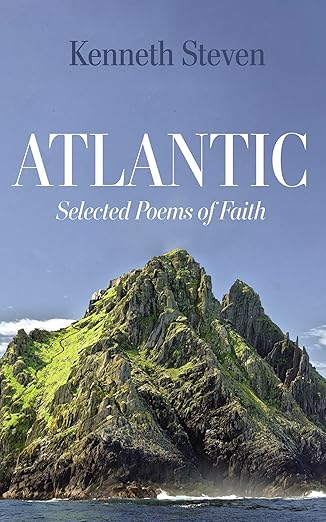
his latest book, one that should be landing on my front stoop within days, is Atlantic: Selected Poems of Faith. but i’m already deep into Atoms of Delight: Ten Pilgrimages in Nature, and Iona: New and Selected Poems.

incurably circuitous

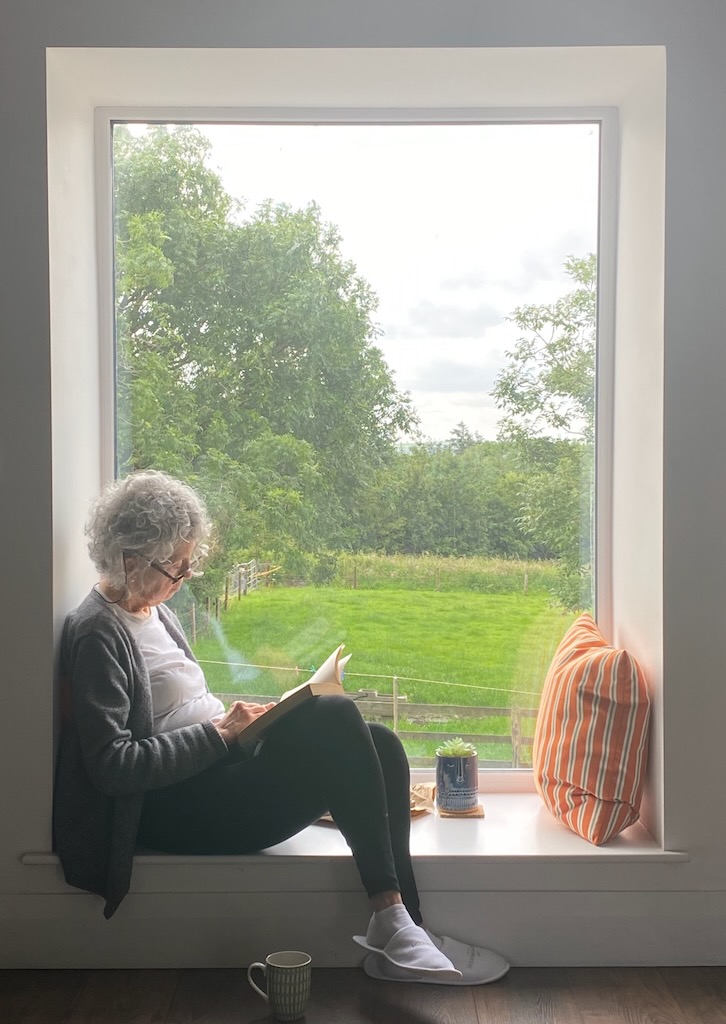
my favorite reading nook in all the world. o’connell’s dairy farm in drumellihy, county clare

i tried. i truly did. it seems i’ve, well, failed. if failed is the verdict we choose to put to the determined effort to concentrate, to focus, to linearly follow page after page.

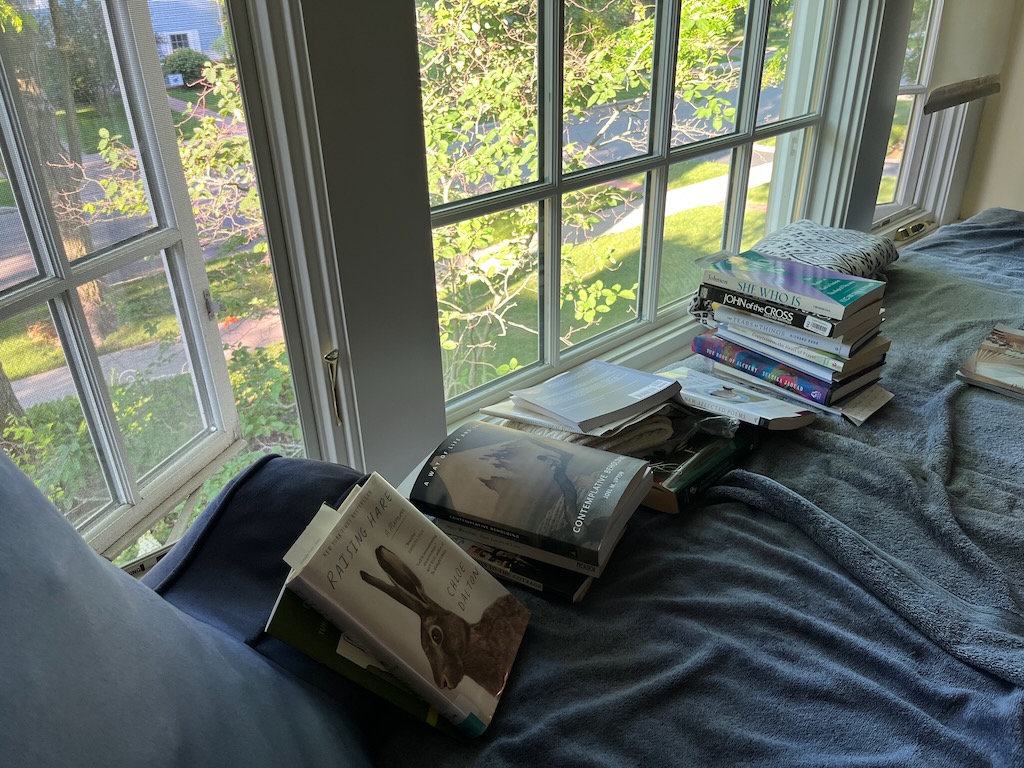
instead i am a jackrabbit of a reader. i cannot, for the life of me, trace a straight line. one minute i’m attempting ulysses, starting with an easy reader after traipsing the trail of leonard bloom through dublin. another minute i’ve decided pope francis’s slim collected works, against war: building a culture of peace, is the page i need to put to heart. then it’s onto raising hare, a love story so gentle i found it the perfectly prescribed balm in a week when bombs fell and mistruths fired right, left, and sideways.

i know full well that i set out to stick to one and only one tome till i—or summer—came to its end. etty hillesum was going to hold my attention. but my attention didn’t listen. it was distracted. as it so often is.

my irish poet penpal tadhg described rabbit holes, the literary divots i fall into, in charming irish terms not so long back. he makes every word he writes and utters sound poetic or profound, and he fails not here (his description of how it was that my last name leapt out and caught his attention during a morning’s meditation):

“Like the early Irish monks who doodled mystical nature poems on the margins of sacred manuscripts, I was distracted by the spelling of your name and wandered off, as those monks were wont to do (excuse the arrogant comparison), down a boreen (from Irish bóthairín, diminuitive of bóthar, meaning ‘road’, from the Irish ‘bó’, ‘cow’. A meandering pathway made by a cow).”

i am now—especially after strolling country lanes pocked with aftermath of bovine traipsing—inclined to consider my rabbit holes in more bucolic irish terms, and think of them as my boreens, meandering pathways made by my cow mind.  

my boreen, in physical form, looks not bucolic at all. in fact, it’s rather a beehive of possible distraction, all piled and teetering hither and yon:

i cannot for the life of me go straight.

besides gulping down my friend tadhg’s glorious meditations on the stations of the cross, i found my nose deep in raising hare (see last week’s mention), and am tucking in my overnight bag practice of the presence, a glorious little tome of translations from one of my favorite saintly souls ever, brother lawrence, whom i think of as the patron saint of pots and pans, though in fact he’s more oft referred to as the friar of pots and pans, and ultimately the friar of amour (love). he’s the humble little monk who toiled fifty years in a monastery, forty of those in the steamy kitchen, and thirty as a sandal repairer (monks wear through their soles on the road to polishing their souls). he described himself, famously, as “a clumsy oaf who broke everything” in his early attempt at being a hermit, and then a footman. when at last he found the monastery at 74 rue de vaugirard, he found his peace and his place.

and in him, i find mine: the gentle, humble soul who finds grace and God in the most quotidian of daily tasks, and spends his hours in the company and comfort of the Author of It All. even in the steamy monastery kitchen.

what’s notable is that dear brother lawrence hated kitchen work, but in his biographer’s writings it’s told that he did it “with the greatest love possible.” and that his practice of the presence of God in the most ordinary of moments, stirring a kettle, pulling trays of bread from the oven, “grew like dew, or mist on mountains.”

the translation i’ve just found, by carmen acevedo butcher, is extraordinary in the fullest measure, and might be the soothingest read yet of this hot summer.

the little monk’s spiritual maxims, work gently, be humble and authentic, includes this boreen (meandering cow path, remember?) on the highest reach of the soul, writing that in true spiritual union:

“the soul is not asleep as in the other unions, but finds herself powerfully stirred. its activity is more intense than fire, and brighter than the sun when not obscured by cloud. we can, however, misunderstand this feeling, for it is not a simple expression of the heart, like saying, ‘my God, i love you with all my heart,’ or other similar words. no, it is an i don’t know what, a je ne sais quoi of the soul, a something indescribable, loving, and very simple, that carries the soul and nudges her to love, respect, and embrace God with a tenderness that cannot be expressed, and that only experience can conceive.”

to this indescribableness, i dive deep. turning page after page. in no particular order. but trusting i’ll find the grace i seek.

may your distractions, too, carry you to lofty heights and voluminous depths. what distracted you this week?

before i go, and scurry off to a writerly retreat at my dear friend katie’s on the lake, i am sending love without end to my beloved friend andrea whose birth we celebrate tomorrow, and who is closing the book on one fine chapter of her life on the same day. i love her dearly. her wit, her hilarity, her unconditional and undemanding love. she is like no other.

there are a few brother lawrence books out there, but the one i’ve just procured and cannot recommend more heartily is carmen acevedo butcher’s, from broadleaf books. you can find it here.

musings on tenderness

of all the ways of love, tenderness is one i hold closest to my heart. it’s the lesson learned and practiced as a little girl, when my mother taught me to run for a shoebox, or little glass jar. to punch its lid with air holes. and to line it with grass and leaves, to bring the outdoors in for this space that would become an infirmary, whether the patient be a baby bird fallen from the nest, or one with a broken wing, or simply a ladybug or firefly who happened to straggle behind. 

i don’t remember signing up for the advanced class, but i do very much recall the village i (a kindergartener at the time) made for my singular ladybug, each edifice constructed of paper and cardboard, care and attention devoted to every adornment (a flower box under the paned window, a wiggly “flagstone” path to the house’s front door). the steeple for the ladybug church i recall being a particular construction challenge. (and i remember depositing said spotted-back bug into the church come sunday morning at 9, per clockwork familial custom.)

tenderness is love on its gentlest setting. tenderness is the heart pierced through with empathies, with quiet, with the barest wisp of touch. a touch so silken it breaks you out in chills down your spine, might make you audibly sigh. to be tendered is, well, to be buttered in love. it is a butterfly kiss of kindness. a heart petaled open, and dusted with golden-grained succors.

tenderness, maria popova tells us, “is the best adaptation we have to our existential inheritance as ‘the fragile species.’”

lewis thomas, the poet and physicist (the lives of a cell: notes of a biology watcher) who first named us “the fragile species,” gives context for why in a 1996 essay from his last such collection, published under the same title, in which he positions us in the context of the universe’s timeline:

“This is a very big place,” lewis begins, “and I do not know how it works, or how I fit in. I am a member of a fragile species, still new to the earth, the youngest creatures of any scale, here only a few moments as evolutionary time is measured, a juvenile species, a child of a species. We are only tentatively set in place, error-prone, at risk of fumbling, in real danger at the moment of leaving behind only a thin layer of our fossils, radioactive at that.”

olga tokarczuk

when olga tokarczuk, the polish psychologist turned poet and novelist, won the 2018 nobel prize in literature, she mused on the art of tenderness in her nobel banquet lecture, a lecture titled “the tender narrator,” and one widely regarded as nothing short of “magnificent.”

tokarczuk began by telling the story of a black-and-white photo of her mother that’s always haunted her, in a blessed way. it was a photo taken before olga was born, and i’ll let her words take it from here (emphasis mine throughout): 

“There’s nothing really happening in the picture—it’s a photograph of a state, not a process. The woman is sad, seemingly lost in thought—seemingly lost.

“When I later asked her about that sadness—which I did on numerous occasions, always prompting the same response—my mother would say that she was sad because I hadn’t been born yet, yet she already missed me.

“‘How can you miss me when I’m not there yet?’ I would ask.

“I knew that you miss someone you’ve lost, that longing is an effect of loss.

“‘But it can also work the other way around,’ she answered. ‘Missing a person means they’re there.’”

stopped by the tenderness of a mother telling her small daughter that she missed her even before she was born, popova comments, is “an astonishing gesture of love so total that it bends the arrow of time.

ponder that string of words, and the meaning behind it, before reading on. “an astonishing gesture of love so total that it bends the arrow of time.” may we all know such love…

tokarczuk picks up her telling from there: 

“This brief exchange, someplace in the countryside in western Poland in the late sixties, an exchange between my mother and me, her small child, has always remained in my memory and given me a store of strength that has lasted me my whole life. For it elevated my existence beyond the ordinary materiality of the world, beyond chance, beyond cause and effect and the laws of probability. She placed my existence out of time, in the sweet vicinity of eternity. In my child’s mind, I understood then that there was more to me than I had ever imagined before. And that even if I were to say, ‘I’m lost,’ then I’d still be starting out with the words ‘I am’—the most important and the strangest set of words in the world.

“And so a young woman who was never religious—my mother—gave me something once known as a soul, thereby furnishing me with the world’s greatest tender narrator.”

a good bit later in the speech, tokarczuk raises this next question, more than worth considering:

“….Have you ever wondered who the marvelous storyteller is in the Bible who calls out in a loud voice: ‘In the beginning was the word’? Who is the narrator who describes the creation of the world, its first day, when chaos was separated from order, who follows the serial about the origin of the universe, who knows the thoughts of God, is aware of his doubts, and with a steady hand sets down on paper the incredible sentence: ‘And God saw that it was good’? Who is this, who knows what God thought?

“Leaving aside all theological doubts, we can regard this figure of a mysterious, tender narrator as miraculous and significant. This is a point of view, a perspective from where everything can be seen. Seeing everything means recognizing the ultimate fact that all things that exist are mutually connected into a single whole, even if the connections between them are not yet known to us. Seeing everything also means a completely different kind of responsibility for the world, because it becomes obvious that every gesture ‘here’ is connected to a gesture ‘there,’ that a decision taken in one part of the world will have an effect in another part of it, and that differentiating between ‘mine’ and ‘yours’ starts to be debatable.”

and then toward the very end of her speech, tokarczuk turns to a literature of tenderness: 

“Tenderness is the art of personifying, of sharing feelings, and thus endlessly discovering similarities. Creating stories means constantly bringing things to life, giving an existence to all the tiny pieces of the world that are represented by human experiences, the situations people have endured and their memories. Tenderness personalizes everything to which it relates, making it possible to give it a voice, to give it the space and the time to come into existence, and to be expressed.

“Tenderness is the most modest form of love. It is the kind of love that does not appear in the scriptures or the gospels, no one swears by it, no one cites it. It has no special emblems or symbols, nor does it lead to crime, or prompt envy.

“It appears wherever we take a close and careful look at another being, at something that is not our ‘self.’

“Tenderness is spontaneous and disinterested; it goes far beyond empathetic fellow feeling. Instead it is the conscious, though perhaps slightly melancholy, common sharing of fate. Tenderness is deep emotional concern about another being, its fragility, its unique nature, and its lack of immunity to suffering and the effects of time. Tenderness perceives the bonds that connect us, the similarities and sameness between us. It is a way of looking that shows the world as being alive, living, interconnected, cooperating with, and codependent on itself.

“Literature is built on tenderness toward any being other than ourselves.”

and a short bit later, she closes her remarks with this:

“That is why I believe I must tell stories as if the world were a living, single entity, constantly forming before our eyes, and as if we were a small and at the same time powerful part of it.”

in a world emblazoned with harshness and cruelties for the sake of cruelty, i will joyfully devote my days to making a living case for tenderness as a way of being. those who have touched me most indelibly in my life are those who wove their way in through that very rare and breathtaking capacity, the one that comes on with a whisper not a bang, the one that quietly says i’ve been keeping close watch on your finest-grained threads, and i see where those threads are tattered or thinned, and i am here to tenderly, yet certainly, place my palm against the small of your back, to let you know you are not alone, you are not unloved, you are seen and beheld.


a modest selection of olga readings:

the whole of her 2019 Nobel Prize acceptance speech here…

and an excerpt from one of the works that won her the 2018 Nobel Prize in Literature, and for which the judges cited: “for a narrative imagination that with encyclopedic passion represents the crossing of boundaries as a form of life”

this one from Flights, her 2007 novel that twines fiction and non-fiction, and which james wood, the new yorker critic and harvard english professor, in 2018 described as tokarczuk’s “omnium-gatherum, a big book full of many peculiar parts: there are mini-essays on airports, hotel lobbies, the psychology of travel, guidebooks, the atavistic pleasures of a single Polish word, the aphorisms of E. M. Cioran. Some of these riffs, which themselves tend toward the aphoristic, are as short as a couple of sentences.”

HERE I AM

I’m а few years old. I’m sitting on the window sill, surrounded by strewn toys and toppled-over block towers and dolls with bulging eyes. It’s dark in the house, and the air in the rooms slowly cools, dims. There’s no one else here; they’ve left, they’re gone, though you can still hear their voices dying down, that shuffling, the echoes of their footsteps, some distant laughter. Out the window the courtyard is empty. Darkness spreads softly from the sky, settling on everything like black dew.

The worst part is the stillness, visible, dense – а chilly dusk and the sodium-vapour lamps’ frail light already mired in darkness just а few feet from its source.

Nothing happens – the march of darkness halts at the door to the house, and all the clamour of fading falls silent, makes а thick skin like on hot milk cooling. The contours of the buildings against the backdrop of the sky stretch out into infinity, slowly lose their sharp angles, corners, edges. The dimming light takes the air with it – there’s nothing left to breathe. Now the dark soaks into my skin. Sounds have curled up inside themselves, withdrawn their snail’s eyes; the orchestra of the world has departed, vanishing into the park.

That evening is the limit of the world, and I’ve just happened upon it, by accident, while playing, not in search of anything. I’ve discovered it because I was left unsupervised for а bit. I’ve clearly found myself in а trap now, and I can’t get out. I’m а few years old, I’m sitting on the windowsill, and I’m looking out onto the chilled courtyard. The lights in the school’s kitchen are extinguished; everyone has left. All the doors are closed, hatches down, blinds lowered. I’d like to leave, but there’s nowhere to go. My own presence is the only thing with а distinct outline now, an outline that quivers and undulates, and in so doing, hurts. And all of а sudden I know there’s nothing anyone can do now, here I am.
—Olga Tokarczuk

maybe you’ll want to add olga to your summer reading list. if you’ve a favorite passage that holds tenderness to the light for you, we’d love to read along here at the table….

who taught you tenderness or, rather, how did you learn of its ways?

blessed birthday today to becca who i love, and who is as wise and strong as woman as i am blessed to know….

Dear God, thank you.

Dear God,

Um, I hate to be so bold but we could have used him a little bit longer. (You undoubtedly already know that.) Things are pretty rough around here. Whole swaths of this holy earth, and the people who populate it, seem to have lost their minds. And maybe their souls. 

As You most certainly know, and definitely must have heard, his was the rare voice that could drown out the ungodly noise. The cacophonies of greed and grievance, the ugliness of sin and the Self that thinks it’s higher and mightier. He didn’t let up when it came to the terrible, terrible traumas of war—newborns bombed in hospital nurseries; toddlers drowning in turbulent seas, washing to shore, as if cast-aside flotsam; whole families entombed in the rubble of raining-down concrete and rebar in murderous twists.

He called it where he saw it: called out the avarice of modern capitalism and consumerism, diagnosed it as the fundamental root of the exploitation and suffering of the poor and the vulnerable. Named it “the Devil’s dung.”

He minced not a word in a letter to American bishops this February, when in the wake of the current administration’s drastic deportation campaign, he wrote that while nations have the right to defend themselves, “the rightly formed conscience cannot fail to make a critical judgment and express its disagreement with any measure that tacitly or explicitly identifies the illegal status of some migrants with criminality.”

He didn’t stop there: “The act of deporting people who in many cases have left their own land for reasons of extreme poverty, insecurity, exploitation, persecution or serious deterioration of the environment, damages the dignity of many men and women, and of entire families, and places them in a state of particular vulnerability and defenselessness.”

Il Papa, il mio papa!

Oh, dear God, thank you immensely for making his lifetime line up, at least for a while, with mine. I was starting to fall off the edge there, till the first puff of fumata bianca arose from the Vatican chimney back on March 13, 2013, and the bells from St. Peter’s rang through the city.

Dear Francis filled my lungs again. He preached the version of You that I’d long pressed to my heart, the One taught to me by my post-Vatican II Sisters of Loretto, they who puffed cigarettes behind the convent, traded in their flowy black habits for street clothes and lipstick, all while strumming guitars and singing kumbaya, and all while watching films like “The Red Balloon,” where we little Catholics were meant to evoke the godly meaning from the metaphor.

He was, far as I could tell, a walking-talking, put-your-money-where-your-mouth-is, “love as you would be loved” kind of a guy. He colored wildly outside the lines, as if to shake us out of our stupors, our thinking the ways of the world were the only ways there were. As if to remind that love, honestly, could shatter the worst kind of walls, break through to the tender core at the heart of us all—the one You nestled inside all of us when You breathed us into being. 

His time as the 266th charge of the Church was something of a Kodak carousel of indelible encounters, the ones you cannot forget because they sear you so soundly. (p.s. He was mighty fine with the pen, as well; at least one modern poet called him “the most literary pope of the modern Vatican.”)

He took on no airs. Which made his message all the more of a wallop. He seemed to be saying that we too, in our fumbling, bumbling, banged-up bodies, we too could reach for the heavens. 

His message, quite simply, was to remind that we’re all equipped and ready to cut a swath of radical love through this world. 

And what I really loved about the beloved Argentian Jesuit were the moments when he reached out his arms, and cradled the sobbing child, especially the little boy whose atheist papa had died, and the boy was so very worried about what would happen to his papa. When the little guy was all but choking on his sobs and the words to his question, “Is my dad in heaven?” Francis called out to the little boy, “Come, come to me, Emanuele. Come and whisper it in my ear.” And everyone sobbed, while Francis quelled the boy’s fears and spoke to the crowd: “What a beautiful witness of a son who inherited the strength of his father, who had the courage to cry in front of all of us,” Francis said. “If that man was able to make his children like that, then it’s true, he was a good man.”

Or the little ones born with an extra chromosome who sometimes wandered curiously right onto the altar in the middle of Mass, or a homily, and instead of shooshing the child away, he stood there beatifically smiling, clutching their soft little hand. And went right on with his papal business.

Pope Francis embraces Vinicio Riva, the man with neurofibromatosis.

Or that indelible image of Your Francis first kissing then cradling the man with the eruptions of leathery tumors curdled across his face, his scalp, and clear down his neck. 

And what struck me most, dear God, when I awoke Monday morning to the news that he’d died in the night, was the sudden stunning realization of how breathtakingly he had died—a lesson for us all, and surely for me. I believe he knew these were his last days on earth, when he insisted on leaving the hospital, and knew that until he breathed his last he would teach his last most lasting lessons. In the last week of his life, he visited with 70 prisoners in Rome’s Regina Coeli Prison, from a balcony overlooking St. Peter’s Square he blessed the crowds, and in his Easter Sunday sermon he begged for mercy for “the vulnerable, the marginalized, and the migrants.” He also sent an emissary to preach compassion to the nation’s second-highest ranking executive officeholder and fairly recent convert to Catholicism. 

And then, and only then, he breathed his last. 

I barely have words for the emptiness left in Francis’s wake. It’s rare these days to find a soul who’s proven her or himself worthy of speaking such penetrating truth that the whole world turns an ear to listen. 

We listened, and some of us shouted silent hallelujahs every time. 

We are a world with a spinning moral compass. Up seems down, and right and wrong are inside out and sideways. Hate is cloaked, too often, as a return to the old ways. Truth is chopped into bits and spit back out in bilious flows. 

Are we meant to be the collective voice to fill the new and jarring silence? Is that the point? He constructed the paradigm, handed us the blueprints, and now it’s us who must step to the line, to be brave now? 

Maybe it’s a blessing that much of the world is weeping. Maybe, if we follow our tears, we’ll dig down and rise up. Maybe, like Francis, we can look out at the battle field that is the world and make of ourselves the field hospital set to begin to stanch the bleeding, and work to heal some of the wounds. 

Anyway, God, we’re on it. And thank you, thank you, thank you.

Love, BAM

what memories or moments of Francis most lastingly speak to you?

photo above is from the little video i managed to capture when i managed to all but stumble into the path of the oncoming PopeMobile this past summer in St. Peter’s Square….

and p.s.s. a letter to God, i figured, called for capitals. thus, i made rare use of the shift key this morning….

the nautilus of sacred time

last night, from my wooden pew in the great stone nave that is the church where i pray, i listened to the words spoken from the pulpit, and i imagined back in time to the night in a garden when the man and God wept. i imagined his betrayal. i imagined how he was tried on charges trumped, convicted by the roar of a deafened and deafening crowd, then stripped, and flogged, and soon told to carry the cross upon which he would breathe his last and die.

i thought of who this man-God was: how he’d upturned the tax-collectors’ tables, and the moneychangers’ too. i thought of how profoundly he lived and breathed the words of Torah, how he prayed the sh’ma; the v’ahavta, too. (“you shall love Adonai your God with all your heart, with all your soul, and with all your might.”) and i listened to the priest who, in his sermon, said that the man, named Jesus, had on this holy night gathered his disciples, the ones who’d turned over their lives to him and his teachings, and how just before the grueling hours in the garden, he’d shared the Seder, the Passover meal, and one last time taught his truest, lasting lessons.

before he did, though, he broke rank, broke tradition, this soul who lived not by worldly rule. he rose amid the telling of the exodus from egypt, took off his outer robe, poured water in a basin, tied a towel around his waist, and began to wash the dusty feet of those who’d gathered one last time. this man soon to be accused of claiming to be king took on the servant’s role: he bent, pressed his knees to the floor, and one by one, he washed away the grime.

and then he spoke his one last teaching:

“I give you a new commandment,” he began in the hours before betrayal, “that you love one another. Just as I have loved you, you also should love one another. By this everyone will know that you are my disciples, if you have love for one another.”

as i wrapped myself in the whole of those words, spoken by the Jesus who would soon be crowned with thorns, the priest called us to come forward, to bare our bumpy calloused feet, the ones with toes oddly angled, and nails often yellowed or purpled or however one’s toes age. and then we knelt. and washed each other’s feet, a posture of utter and bottomless humility. “thou shalt love as you are loved.” we poured warm water from a pitcher, and we grabbed a freshly folded towel, and wiped each toe and heel and sole. we washed each other’s feet, an act of reverence in which we’re at once stripped of all pretense, exposed—and yet and yet, we’re met with tender loving kindness, our naked flesh bathed and dried, wiped of earthly dust.

against all of this, a newsreel spooled through my mind. in particular, a single prisoner held behind merciless bars. i was stunned in the contrast: how sacred time, year after year, returns us to the ancient, timeless themes, the ones my parents learned and lived, and their parents too. and theirs, and theirs.

i thought of how starkly this year the sacred story stands against the backdrop of the worldly news. how trumped up charges are once again in play. how there are those who’ve been stripped and shorn. made to sit in ungodly postures, crammed like urchins in a tin can. locked behind bars. held by merciless guards.

that newsreel cracked open in my mind a way of seeing the night of betrayal, the trial and the dusty road to golgotha in dimension i’d not seen quite so viscerally before.

as we knelt and washed each other’s feet, i would later read, a senator who would not be refused, who would not leave the prison gate, had persisted. had finally sat beside the man who’d all but disappeared. gave him but a simple glass of water. “love as you would be loved.”

this year, as the world stands gasping, as cruelties beyond our imaginations play out, i found myself wrapped in the timelessness of sacred time. how its truths have not been quashed. how all the cruelties of humankind have still not stilled, nor silenced, the one command of every sacred text: “love as you would be loved.” stand up to evil. kneel and wash the feet of the stranger just beside you. gnarly toes and crusty heels and all.

sacred time is dauntless. worldly time will crumble in our hands.

the rhythms of the church, of sacred time, again and again, point our attention to the timeless. this year, more than ever, i am on my knees and crying out for mercy.

i am cradled in the nautilus of sacred, sacred time where the cruelties of humankind crumble in the face of Holy Breath.

as the altar last night was stripped of every cloth, as every candle snuffed, and we filed out in silence, so too i leave this table unadorned today. and i ask no question. i leave you in silence, in whatever prayers you pray.

may you be blessed in this holy time.

a p.s.: this good friday is especially deep for me this year, as two years ago today i was wheeled into surgery, and came out minus half a lung, and with a worldview forever changed. i see through a clearer lens now, the lens that cancer brings. and i embrace each holy hour like never before. i am, for the first time in at least a decade, home with all my boys this weekend: the law professor, the line cook, the critic, all gathered for the easter-pesach weekend. it gets no holier than this. dear God, for this blessing, i am eternally, eternally grateful.

the great kaleidoscope

“it’s like we’re the great kaleidoscope, all little pieces, but every time you turn it, it’s different. so you and i are made up of exactly the same stuff, but every one of us is unique. there’s only one in all the world. and the same with every petal of a pansy….i’m the star thistle, and the grass, and the dirt. i am you; you are me.”

i tumbled into this most breathtaking old soul, majestic soul, and i shall let her do the talking today. i quickly grew so enchanted by her voice, her deep and gravely voice, a voice that must have traveled rocky roads, that i began to take notes, and i am leaving those notes here: part transcript, part poem. i’m not catching every word but the words i’m catching are those i do not want to lose. it’s as if a great elder has come today to impart something. to share a light, the light she came to know was her one thing to share. to leave with the world.

may we all be so.

may we all by illuminated by this nearly 96-year-old, who is a veritable masterpiece of all that matters. 

and here are notes, in prayer form, in poetry…

that i can still breathe easy
i don’t want to have just visited this world
i want to be a child of wonder and astonishment

i’m having my second childhood now, my happy childhood
i was always the outsider, i was always pointed at,
i always felt terribly self-conscious
so i have fun now

i’m just learning about play
because i didn’t know what play was when i was a child
i think play means exploring, experimenting, being curious,
looking, seeing, being in the body
not being afraid

it’s about the miracle and mystery of being alive

“we shall not cease from exploration
and the end of all our exploring
will be to arrive where we started
and to know the place for the first time”

that’s t.s. eliot.

i had cancer once
and . . .
and afterwards i had surgery
and i felt like i had to give myself a reaon that i was spared.
that i got my life back
and then, over many years,
i saw that i had
something to give, my light

something ineffable that i don’t know
that light of harmlessness and harmony
and singing and being joyful and rejoicing and being grateful

we’re here to experience the wonder of being in a body. . .
to know that we are each other
that we’re the same
we’re made of all the same stuff . . .
we’re little bits of stars, we’re dust

it’s like we’re the great kaleidoscope
all little pieces
but every time you turn it, it’s different
so you and i are made up of exactly the same stuff,
but every one of us is unique.
there’s only one
in all the world.
and the same with every petal of a pansy….

i’m the star thistle, and the grass, and the dirt.
i am you; you are me.

. . . my prayer is to go gently
and as much aware of myself leaving with gratitude and joy
and the satisfaction, “i’m done, i’m outa here. and it’s ok”
it’s all such a mystery

thanks, i wanna say thank you
not try to figure anything out, or understand it

but just be in awe

what’s the secret?
it’s go slow
for me . . .

[breaks into song. . .]

this beautiful film was made by two south african filmmakers who go by first names only as far as i can tell, justine and michael. their mission: to explore our shared humanity. their enterprise is known as reflections of life, formerly green renaissance. i do believe there is a trove worth plumbing…..i do not know the name of this blessedly beautiful nonagenarian so i shall name her simply Wisdom.

as we enter into supremely holy time, in both the jewish and the christian spheres, (are we not always in supremely holy time?), our friend here prompts the question how will you choose to live in awe?

no exit

there seems so little worth my saying these days. the stock markets plunge. the pink slips abound. research labs, the ones that might save lives, are all but padlocked. it’s been argued that measles might be cured with megadose of good ol’ vitamin A, and why not wipe out bird flu by letting it run rampant? (i could not find either fix in my old nursing texts, circa 1976.) 

the urge for me to go mum and wait it out has never felt stronger. i use my political voice in other realms, but feel reticent to bring it here, which has brought me a wee bit of backlash from one or two who think i ought to use this platform as a public square for political discourse. 

i’ve always considered this a space away from the melee, a place where we play by otherworldly rules of kindness, gentleness, mercy. (over my dead body, those will never be abandoned—here or elsewhere.) the mission here, from the very start, has been to train our focus on the timeless truths that course through the quotidian. politics, as worldly as it gets, is messy. by definition, a battle of wills and ways. there’s little room for sacred, and sacred is my aim.

maybe 1,217 posts in 220 months is far exceeding my welcome. maybe the age of trump is my flashing exit sign. but maybe that’s false surrender. 

maybe i’m just too chicken to face the backlash sure to come even if i try to frame my arguments in civil discourse. the flummox here is that the ones i love who see things another way, they are not hearing the same news i am. that’s the breakdown. or a breakdown. the definition of trusted news source seems to have brittled over the years. when i say trusted, i mean objectively combing through the facts, listening to a swath of voices, each expert in her field. (being a talk show host, or a peddler of ivermectin does not make you an expert, in any way, shape, or forum.) and, forgive my peculiarities, but i like my facts delivered without sass, or ridicule, or put-down. vengeance makes me rhymes-with-comet.

“trusted” in the age of trump seems to mean “you see things the way i do, so i will choose to listen to you.” and, by the way, “i’ll trust you’ve done our homework.” all else is evil. is out to get us. is symptom of demented mind.

we cannot converse if our words and thoughts and big ideas whiz by on orbits all their own. and without a grain of truth to stand on, we’re not standing and we have no standing. if i’m in my silo, and you’re in yours, and ne’er the twain shall meet, then we might as well build a wall and cut the continent in half. you take mountains, we’ll take prairie. no one gets the five great lakes. 

even my propensity for gathering bits of poetry and prose is feeling rather flimsy. is it hyperbole to say we’re on the verge of the collapse of democracy? what to call the dismantling of a century of intricate, mold-breaking science and biotechnology? what happened to the beatitudes—blessed are the meek, the poor in spirit, the meek, the merciful? whither the golden rule: love as you shall be loved? be it in africa, or gaza, or ukraine; in blue cities, red swaths, or canada or mexico or greenland? 

though i’m tempted to hold back on poetries this week, to leave this simply as a placeholder, i shall forge quietly ahead with one or two worth tucking in your noggin.

Once upon a time,
When women were birds,
There was the simple understanding
That to sing at dawn
And to sing at dusk
Was to heal the world through joy.
The birds still remember what we have forgotten,
That the world is meant to be celebrated.

When Women Were Birds by Terry Tempest Williams


from my friends at SALT Project, a bit of anne lamott (whose birthday is april 10) laid out in verse form. this is from an interview in 2011 with NPR’s michele norris, a once-upon-a-time chicago tribune writer, who asked annie how the meaning of easter had changed for her over the years:

When I was 38,
my best friend, Pammy,
died, and we went shopping
about two weeks before she died,
and she was in a wig
and a wheelchair. 

I was buying a dress
for this boyfriend I was trying to impress,
and I bought a tighter,
shorter dress than I was used to.
And I said to her,
“Do you think this makes my hips look big?”
and she said to me, so calmly,
“Anne, you don’t have that kind of time.” 

And I think Easter has been about
the resonance of that simple statement;
and that when I stop,
when I go into contemplation and meditation,
when I breathe again and do the sacred action
of plopping and hanging my head
and being done with my own agenda, 

I hear that, ‘You don’t have that kind of time,’
you have time only to cultivate presence
and authenticity and service,
praying against all odds
to get your sense of humor back. 

That’s how it has changed for me.
That was the day my life changed,
when she said that to me.
+ Anne Lamott


and here’s a little nudge from former u.s. secretary of labor robert reich on speaking up in these tough times:

Every one of us has a town square. It may include our social media accounts, our local book club, or our dinner table. Use your town square to speak out in favor of democracy and against what [that which you see as anathema to decency]. Do not shy away from difficult conversations; seek them out. Engage the curious. Educate those who seek information. We all have a role to play, so don’t assume your voice is too faint or your platform too small.

point taken, mr. reich. point taken. i’ll talk decency anywhere and everywhere.


and finally, as i’ve spent these past few weeks tapping out a manuscript for what might be a book, i found these closing lines from WS Merwin’s poem remembering his mentor, John Berryman, to be well worth taking to heart:

I asked how can you ever be sure
that what you write is really
any good at all and he said you can’t

you can’t you can never be sure
you die without knowing
whether anything you wrote was any good
if you have to be sure don’t write


do you remember the most beautiful thing you read this week, or saw this week, the thing that gave your heart a lift????

artisanal peace

closest i got to Il Papa, when i found myself accidentally at the barricades that clear the way for the Pope-mobile

sages are in short supply, it seems. certainly now, and certainly on the global scale. i scan where i can, ever on the lookout. and wasn’t my eye caught when i read the words “artisanal path” to “handmade peace.”

tell me more, my little heart shouted. 

though it sounded a bit like a recipe for earthy bread or hand-thrown plates, the sort that rise from the potter’s wheel, i sensed the subject here was far more urgent, and in dire need of replenishing. not what you’d find on any pantry shelf. 

hand-crafted peace, peace constructed with care and attention. peace that we at home can build, without scissors or glue or a potter’s spinning wheel.

i clicked on a duly-provided link, and wasn’t one iota surprised to find that Il Papa, our most beloved Francis, was the one who not only dared to raise his voice above the blather, but considered it a requisite of his job’s description.

he is, after all, shepherd to a farflung flock. but more than that, he’s a prophet, which, according to the definition i found in richard rohr’s brand-new the tears of things: prophetic wisdom for an age of outrage, means a radical change agent, teacher of a moral alternative, and deconstructor of every prevailing order. rohr reminds us of the prophets of ancient times, the ones described by isaiah and ezekiel, whose job it was to hold the powers that be “maddeningly honest.”

bring on the prophets, please.

in these times, francis, our dear pope who from his hospital bed in rome reached out to the suffering of gaza, is the rare voice to which all the world will sometimes listen. thank holy God, he speaks the language of love without condition, clause, or pause. there are those among us, in this age of outrage, who might do well to listen. especially when they claim to take instruction from the very same God who whispers to Il Papa

the new york times calls him “an increasingly lonely moral voice on the world stage.”

all the more reason to listen. and listen hard.

“peace is crafted; it is the work of our hands,” francis began at a prayer vigil in the central african republic back in 2015, “it is built up by the way we live our lives.” he was speaking to an audience of children, teens, and young adults in bangui, the capital of the central african republic, when that country was in the midst of a sectarian war between Christians and Muslims, and thousands had been killed, and more than a million displaced from homes, their properties looted or destroyed.

this artisanal path, “built up by the way we live our lives,” is spelled out, it turns out, in francis’s Against War: Building a Culture of Peace, a book i’ve ordered from my local bookstore, as it’s one with permanent claim to a slot on my bookshelf. 

it’s not that i think i can build a culture of worldwide peace, though once upon a time i dreamed of such things. the point here, from the wee bit i’ve read, is that peace is a sphere we build bit by bit, as we travel through space and time, and it’s built by even the most unassuming of gestures, attitudes, and actions.

what the pope is saying, and what the world ought listen to, is that the tiniest empathies and kindnesses matter: giving cuts in the grocery line, waving someone into your expressway lane; taking time to take the call, dropping the tupperware of soup on your neighbor’s stoop. biting your tongue when you’re tempted to snap, and, yes oh yes, turning the other cheek, a trait i’m told no longer belongs in a world of dog eat dog. 

what a game changer: here’s the head of a church that counts 1.39 billion baptized among its ranks, and he too concurs that we needn’t be rocket scientists in the art of magnanimous charitable persuasion to make a dent in the realm of ever-spreading goodness. 

for one thing, it’s fairly contagious. if you’re out-of-the-blue kind to me, if you take my breath away with some wonder act of yours, chances are i’m inclined to be a copy cat and try the same. if for no other reason than the pure joy of watching someone be surprised you’ve not just slammed the door in their sorry, sorry face. 

here’s where Il Papa begins his artisanal path to handmade peace, with this fulsome criticism of the futility of war: 

“war is not the solution, war is madness, war is a monster, war is a cancer that feeds off itself, engulfing everything!”

that’s all i needed to keep on reading. and what i found, and what you’ll find should you decide to play along, is a compendium of his most outstanding commentaries on war and peace during the first nine years of his pontificate. 

here are a few of the nuggets you just might choose to tuck in your peace-gathering pockets. 

because one can’t best the pope when it comes to eloquence and voice, i am quoting from the book, here on in, and plucking five that leap out the most….

1.) seeing the world as one human family living in one common home.

The stars in the sky shine down on every single person — from the beginning of time to today — and learning “to look at the stars” will be “the most effective vaccine for a future of peace,” he said in Ur, Iraq, in 2021.

“Anyone with the courage to look at the stars, anyone who believes in God, has no enemies to fight. He or she has only one enemy to face, an enemy that stands at the door of the heart and knocks to enter. That enemy is hatred,” the pope said.

“There will be no peace as long as we see others as them and not us,” he said. Humanity lives under one heaven, under the gaze of one God who desires his children to be “hospitable and welcoming” to each other on earth.

2.) reconciling with one’s enemies and embracing unity in diversity.

The pope told young people in the Central African Republic that the first step toward being a peacemaker was “never hate anyone. If someone wrongs you, seek to forgive.”

“We only win if we take the road of love,” he said, and, with love, “you will win the hardest battle in life” and find peace.

But “we need to pray in order to be resilient, to love and not to hate, to be peacemakers,” and “you must be courageous,” he added. “Courageous in love, in forgiveness, in building peace.”

3.) the difficult art of dialogue and listening, which can sometimes be as hard as building a bridge over an abyss.

Pride and arrogance must be eradicated from one’s own heart, he told young people at a congress of the educational project, “Scholas Occurrentes,” in 2016. “Our world needs to lower the level of aggression. It needs tenderness. It needs gentleness, it needs to listen, it needs to walk together.”

Dialogue is “the capacity to listen, not to argue immediately, to ask,” he said. “Everyone wins in dialogue; no one loses” because “it is about agreeing to proposals so as to move forward together.”

Dialogue is to put oneself in the other’s place, “to form a bridge” and “persuade with gentleness.”

4.) peace is a constant journey of “getting one’s hands dirty,” concretely working for the common good.

“Our path leads us to immersing ourselves in situations and giving first place to those who suffer,” he said in Assisi for the World Day of Prayer for Peace in 2016.

Feeling responsible for helping others and refusing to be indifferent cleanses the heart and requires the “purification” and conversion that can only come from God, he said in Irbil, Iraq, in 2021.

This new order must meet humanity’s desire for justice, equality and participation, he said in his World Day of Peace message in 2020. A democratic society recognizes everyone’s rights and one’s duties toward others, which can temper a harmful, unbridled understanding of freedom.

5.) living the beatitudes is to bring heaven––and peace––to earth.

In his homily in Baghdad in 2021, the pope said, “We do not need to become occasional heroes, but to become witnesses, day after day,” embodying the wisdom and love of Jesus.

Jesus changed history “with the humble power of love, with his patient witness. This is what we are called to do,” he said, and “that is how the world is changed: not by power and might, but by the beatitudes.”

People who live the beatitudes “are helping God to fulfill his promises of peace,” he said. “This is the way; there is no other.”


in these tumultuous times, i am turning hungrily to prophets and sages in the news and on my dusty bookshelves. i’m inclined to not fill this space with my own blather, but rather to bring any lights that might dapple our paths. it’s always a tug-of-war to quiet the chair or keep it going with whatever bits i find. this doesn’t seem like the time to turn to silence. so my aim is upped to break through blather and bring voices that will wedge open our hearts, and like a doorstop, keep it wedged till we get through to the other side….

what voices broke through to you this week?